

The JASP guidelines for conducting and reporting a Bayesian analysis
Open accessThe DOI matches its Crossref record; 60 of the 63 references it cites were found in a registry or an index; 3 of the 43 sources its claims cite were checked for support.
Abstract
Despite the increasing popularity of Bayesian inference in empirical research, few practical guidelines provide detailed recommendations for how to apply Bayesian procedures and interpret the results. Here we offer specific guidelines for four different stages of Bayesian statistical reasoning in a research setting: planning the analysis, executing the analysis, interpreting the results, and reporting the results. The guidelines for each stage are illustrated with a running example. Although the guidelines are geared towards analyses performed with the open-source statistical software JASP, most guidelines extend to Bayesian inference in general.
Overview
CoChat Summary
TL;DR
This paper provides practical guidelines for planning, executing, interpreting, and reporting Bayesian analyses, illustrated with a running stereogram example and focused on JASP. It emphasizes Bayes factors for testing, posterior distributions/credible intervals for estimation, and transparent reporting of priors, robustness, and analysis files.
Key findings
- The guidelines cover four stages: planning, executing, interpreting, and reporting, with recommendations such as preregistration, assumption checks, correct Bayes factor/credible interval interpretation, and sharing annotated `.jasp` files.
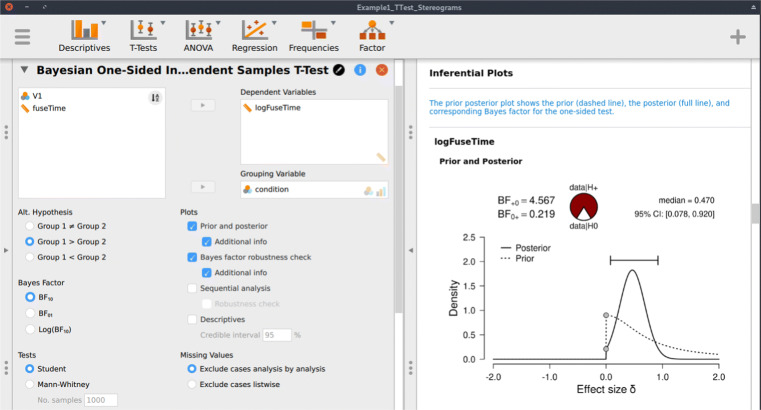
- In the stereogram example, the one-sided Bayesian two-sample t test yielded BF+0 = 4.567, described as moderate evidence; the Bayesian Mann–Whitney U test yielded BF+0 = 5.191.
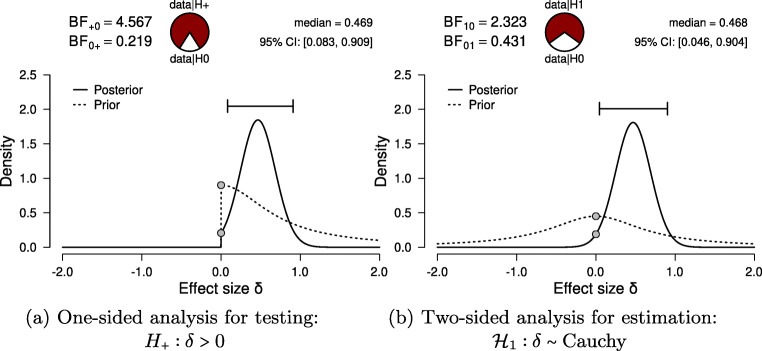
- For parameter estimation, the two-sided analysis gave a posterior median for δ of 0.47 with a 95% central credible interval from 0.046 to 0.904.
- The paper lists five common pitfalls, including confusing Bayes factors with posterior odds, confusing prior model probabilities with parameter prior distributions, and using credible intervals as hypothesis tests.
Methods
- Design: methodological guidelines for Bayesian statistical reasoning in research, organized into four stages and summarized in Table 1.
- Data/sample: the running example uses Frisby and Clatworthy’s (1975) stereogram data; the original sample had 103 participants, 25 were eliminated for failing an initial stereo-acuity test, leaving 78 participants (43 NV, 35 VV).
- Main analysis: the example applies a one-sided Bayesian two-sample t test for hypothesis testing, a two-sided Bayesian two-sample t test for parameter estimation, a Bayesian Mann–Whitney U test as a robustness check, and a Bayes factor robustness plot; the fuse times were log-transformed after assumption checks.
Limitations
- The paper states that for some frequentist analyses, the Bayesian counterpart has not yet been developed or implemented in JASP.
- It states that some JASP analyses currently provide only a Bayes factor and not visual posterior distributions, and that some analyses are available only with a relatively limited set of prior distributions.
- The text notes these are not principled limitations and that JASP is actively being developed; it also makes evident that the guidelines focus on standard JASP analyses, while more complex models may require custom coding in JAGS, Stan, R, or Python.
Model-written summary. Check it against the paper before relying on it.
Integrity signals
Registry
Cites
Statistics
Figures
Verification
Claims the paper makes
3 Valid · 1 Not valid · 25 Not checked · 53 Own results and interpretations
The cited sources support only part of this claim — read each source’s verdict below.
In the paper
“In Bayesian hypothesis testing, a one-sided hypothesis yields a more diagnostic test than a two-sided alternative (e.g., Jeffreys, 1961; Wetzels, Raaijmakers, Jakab, & Wagenmakers, 2009, p.283).”
§ The JASP guidelines for conducting and reporting a Bayesian analysis > Stage 1: Planning the analysis > Specifying the statistical model.
What the sources say
- Not checked yetcites Jeffreys, 1961
- Partly supportedcites Wetzels, Raaijmakers, Jakab, & Wagenmakers, 2009 matched to “How to quantify support for and against the null hypothesis: A flexible WinBUGS implementation of a default Bayesian t test” (2009) sourceExperimental — accuracy not yet measured
Our copy never states the general comparative principle that a one-sided hypothesis yields a more diagnostic test than a two-sided alternative; its motivation for the one-sided (order-restricted) SD test is applicability — the JZS two-sided test 'does not directly apply' when the alternative is directional (Introduction, p. 1; Bayesian Hypothesis Testing, p. 3). What it does supply is a worked illustration in Extension 1: Order Restrictions (p. 5), where the same data give BF01 = 6.08 under the unrestricted two-sided alternative but BF01 = 13.75 (posterior .93 vs .86) under the order-restricted one-sided alternative, i.e. a sharper quantification. So the example supports part of the claim while the general assertion attributed here is not made by this paper. (LLM, conf=0.65)
plainstates a cause- Asserted: passes — The authors put it forward as true.
- Checkable: passes — It can be checked against evidence.
- Load-bearing: passes — The paper’s conclusions depend on it.
- Based: passes — The paper gives a reason why it holds.
A result the paper reports from its own data — it cites no other source for it, so there is none to check. The quote shows it is in the paper.
In the paper
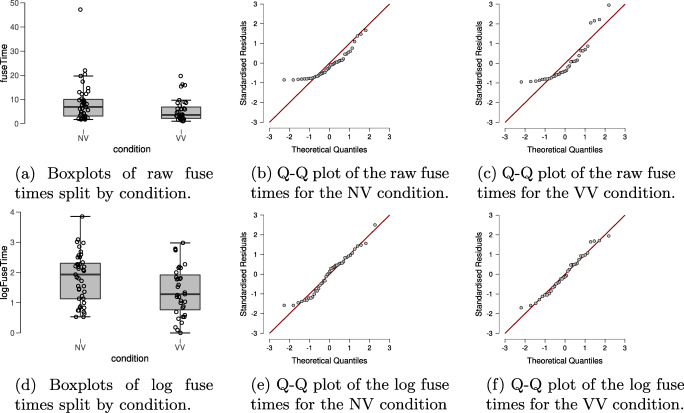
“Visual inspection of the boxplots suggests that the variances of the fuse times may not be equal”
§ The JASP guidelines for conducting and reporting a Bayesian analysis > Stage 2: Executing the analysis > Stereogram example
hedged- Asserted: passes — The authors put it forward as true.
- Checkable: passes — It can be checked against evidence.
- Load-bearing: passes — The paper’s conclusions depend on it.
- Based: passes — The paper gives a reason why it holds.
A result the paper reports from its own data — it cites no other source for it, so there is none to check. The quote shows it is in the paper.
In the paper
“There also appear to be a number of potential outliers in both groups.”
§ The JASP guidelines for conducting and reporting a Bayesian analysis > Stage 2: Executing the analysis > Stereogram example
hedged- Asserted: passes — The authors put it forward as true.
- Checkable: passes — It can be checked against evidence.
- Load-bearing: passes — The paper’s conclusions depend on it.
- Based: passes — The paper gives a reason why it holds.
A result the paper reports from its own data — it cites no other source for it, so there is none to check. The quote shows it is in the paper.
In the paper
“observed standard deviations of the NV and VV groups are 8.085 and 4.802, respectively”
§ The JASP guidelines for conducting and reporting a Bayesian analysis > Stage 2: Executing the analysis > Stereogram example
plain- Asserted: passes — The authors put it forward as true.
- Checkable: passes — It can be checked against evidence.
- Load-bearing: passes — The paper’s conclusions depend on it.
- Based: passes — The paper gives a reason why it holds.
A result the paper reports from its own data — it cites no other source for it, so there is none to check. The quote shows it is in the paper.
In the paper
“Moreover, the Q-Q plots show that the normality assumption of the t test is untenable here.”
§ The JASP guidelines for conducting and reporting a Bayesian analysis > Stage 2: Executing the analysis > Stereogram example
plain- Asserted: passes — The authors put it forward as true.
- Checkable: passes — It can be checked against evidence.
- Load-bearing: passes — The paper’s conclusions depend on it.
- Based: passes — The paper gives a reason why it holds.
25 more claims
Create a free account to see all 82 claims and to verify the 40 references still open.
- It may state two separate claims as one. 33
- Probably not a substantial claim. 29
Claims other papers make about this one
Each is checked against this paper’s own text: does it say what the citing paper says it does?
The cited source says what the claim attributes to it.
In the citing paper
“According to common interpretive guidelines (Van Doorn et al., 2021), a Bayes Factor between 0.33 and 0.10 can be considered moderate evidence for the null, and this result falls at the upper end of that range.”
From This is not the way: global directional cues do not improve spatial learning in an immersive virtual environment (2025) · cites this paper as Van Doorn et al., 2021
Self-check
Percentages, sums and reported differences re-computed from the paper’s own numbers.
Each contradiction between two passages listed here was confirmed by an independent check.
Rated minor: it would not touch a result — a value no result rests on, a p-value that stays on the same side of the significance level, or a conflict that is clerical, resolved elsewhere in the paper, or outside its own findings.
In the paper
§ The JASP guidelines for conducting and reporting a Bayesian analysis > Stage 3: Interpreting the results > Stereogram example
“For parameter estimation, the results of the two-sided t test are presented in Fig. 6a.”
§ The JASP guidelines for conducting and reporting a Bayesian analysis > Stage 3: Interpreting the results > Stereogram example
“The left panel shows the one-sided procedure for hypothesis testing and the right panel shows the two-sided procedure for parameter estimation.”
Citations
Cites
Kass, R. E., & Raftery, A. E. (1995) · Journal of the American Statistical Association · doi:10.1080/01621459.1995.10476572 · Cited by 12,558
Statistical Methods for Research Workers
(1945) · American Journal of Clinical Pathology · doi:10.1093/ajcp/15.11.552b · Cited by 10,880
brms : An R Package for Bayesian Multilevel Models Using Stan
Bürkner, P.-C. (2017) · Journal of Statistical Software · doi:10.18637/jss.v080.i01 · Cited by 9,476 · cited 1×
“Popular packages for conducting Bayesian analyses in R are the BayesFactor package (Morey & Rouder, 2015) and the brms package (B¨urkner, 2017), among others (see https://cran.r-project.org/web/views/Bayesian.html for a more exhaustive list).”
MethodStan : A Probabilistic Programming Language
Carpenter, B., Gelman, A., Hoffman, M. D., Lee, D., Goodrich, B., Betancourt, M., Brubaker, M., Guo, J., Li, P., & Riddell, A. (2017) · Journal of Statistical Software · doi:10.18637/jss.v076.i01 · Cited by 7,754
JAGS: A program for analysis of Bayesian graphical models using Gibbs sampling
Plummer, M. (2003) · Cited by 4,720
Hoeting, J. A., Madigan, D., Raftery, A. E., & Volinsky, C. T. (1999) · Statistical Science · doi:10.1214/ss/1009212519 · Cited by 4,118
Bayesian t tests for accepting and rejecting the null hypothesis
Rouder, J. N., Speckman, P. L., Sun, D., Morey, R. D., & Iverson, G. (2009) · Psychonomic Bulletin & Review · doi:10.3758/pbr.16.2.225 · Cited by 3,688
Probabilistic programming in Python using PyMC3
Salvatier, J., Wiecki, T. V., & Fonnesbeck, C. (2016) · PeerJ Computer Science · doi:10.7717/peerj-cs.55 · Cited by 2,544
Using Bayes to get the most out of non-significant results
Dienes, Z. (2014) · Frontiers in Psychology · doi:10.3389/fpsyg.2014.00781 · Cited by 1,998
Computing Bayes Factors by Combining Simulation and Asymptotic Approximations
Diciccio, T. J., Kass, R. E., Raftery, A., & Wasserman, L. (1997) · Journal of the American Statistical Association · doi:10.1080/01621459.1997.10474045 · Cited by 1,943
Research works printed but not linked: 3
- Jeffreys, H. (1939). Theory of probability, 1st. Oxford University Press.
- Jeffreys, H. (1961). Theory of probability. 3rd. Oxford University Press.
- Wrinch D Jeffreys H On certain fundamental principles of scientific inquiry Philosophical Magazine 1921 42 369 390
Cited by
Items 601–700 of 995
Krieglstein, F., Schmitz, M., Wesenberg, L., Spitzer, M., & Rey, G. D. (2025) · Memory & Cognition · doi:10.3758/s13421-025-01764-3 · Cited by 7
“The interpretation of Bayes factors followed the guidelines proposed by van Doorn et al. (2021).”
Job, X., Andersen, L. M., Vinding, M. C., Cemeljic, N., Lundqvist, D., & Kilteni, K. (2026) · Journal of Neuroscience · doi:10.1523/jneurosci.1553-25.2026 · Cited by 3
Woh, P. Y., Chen, Y., & Nurjadi, D. (2025) · International Journal of Food Microbiology · doi:10.1016/j.ijfoodmicro.2025.111431 · Cited by 4
Madsen, K. S., Baaré, W. F. C., Hernández‐Torres, E., Larsen, K. M., Kaminski, A., Johnsen, L. K., Hemager, N., Gregersen, M., Brandt, J. M., Krantz, M. F., et al. (2025) · Biological Psychiatry Cognitive Neuroscience and Neuroimaging · doi:10.1016/j.bpsc.2025.08.005 · Cited by 4
Martin, L. J., Breza, J. M., & Sollars, S. I. (2021) · Journal of Neurophysiology · doi:10.1152/jn.00552.2020 · Cited by 3
“However, these findings should be interpreted cautiously given the low Bayes Factor values (BF10 between 1/3 and 3) indicating weak evidence for the alternative hypothesis (56,57).”
BackgroundThe effects of self‐esteem and perspective‐taking on group auditor's review actions
Borkus, A. M., de Boer, H. D., van Brenk, H. M., & Amerongen, N. V. N. (2021) · International Journal of Auditing · doi:10.1111/ijau.12250 · Cited by 4
Tari, B., & Heath, M. D. (2021) · Behavior Research Methods · doi:10.3758/s13428-021-01735-x · Cited by 4
Kelter, R. (2021) · Statistics in Biosciences · doi:10.1007/s12561-021-09326-2 · Cited by 5
“01 ) are regularly provided by now, see [35] and [2].”
BackgroundIs Early Bilingual Experience Associated with Greater Fluid Intelligence in Adults?
D’Souza, D., & Dakhch, Y. (2022) · Languages · doi:10.3390/languages7020100 · Cited by 5
Parker, A., Parkin, A., & Dagnall, N. (2022) · Memory · doi:10.1080/09658211.2022.2072894 · Cited by 3
“Essentially, a BF10 between 3 and 10 is considered as moderate support for the alternate hypothesis, over 10 as strong support, and below .33 as evidence for the null hypothesis (van Doorn et al., 2021).”
BackgroundHealth appeal appraisal and memory in older adults: the effects of goal and valence framing
Yang, L., Greenbaum, D., Cupid, J., & Reed, M. J. (2022) · Aging Neuropsychology and Cognition · doi:10.1080/13825585.2022.2079601 · Cited by 5
“To verify the probability of the presence (i.e., H1 or alternative hypothesis) or absence of age effect (i.e., H0 or null hypothesis) given the observed data, Bayesian analysis was conducted in Jeffreys’s Amazing Statistics Program (JASP 0.16, van Doorn et al., 2021).”
InfluentialThe association between experience‐based risky choice and mathematical ability
Sheng, Y., Yu, M., Liu, P., Wang, X., Bai, X., & Zhou, X. (2022) · PsyCh Journal · doi:10.1002/pchj.612 · Cited by 3
Retrieval practice and verbal-visuospatial transfer: From memorization to inductive learning
Hughes, G. I., & Thomas, A. K. (2022) · Journal of Memory and Language · doi:10.1016/j.jml.2022.104402 · Cited by 3
“We conducted our analyses with the JASP software (JASP Team, 2022) and followed analysis procedures recommended by van Doorn et al. (2021) and van den Bergh et al. (2022).”
BackgroundMethodYin, S., Xie, L., Ma, Y., Yu, K., & Wang, R. (2023) · Brain Sciences · doi:10.3390/brainsci13020192 · Cited by 4
“We conducted traditional three-way repeated-measures ANOVA and Bayes analyses via the JASP software [58] on the MMN amplitudes with lexicality (real words and pseudowords), information (identity information, linguistic information), and hemispheres (left and right) as the within-group factors.”
MethodHalim, J. A., Robinson, A. H., Navas, J. F., Martín-Pérez, C., Vilar‐López, R., Chong, T. T. ‐., & Verdejo‐García, A. (2023) · Appetite · doi:10.1016/j.appet.2023.106484 · Cited by 2
Sierra, M. A., & Ortíz, E. (2023) · Journal of Contextual Behavioral Science · doi:10.1016/j.jcbs.2023.03.010 · Cited by 11
Lempert, K. M., Schaefer, L., Breslow, D., Peterson, T. D., Kable, J. W., & McGuire, J. T. (2023) · Cognition · doi:10.1016/j.cognition.2023.105468 · Cited by 6
McKay, K. T., Grainger, S. A., Alister, M., & Henry, J. D. (2023) · Psychology and Aging · doi:10.1037/pag0000764 · Cited by 5
Grainger, S. A., Henry, J. D., Alister, M., Bourdaniotis, X. E., Mead, J. K., Bailey, T. G., Coombes, J. S., & Vear, N. K. (2023) · The Journals of Gerontology Series B · doi:10.1093/geronb/gbad101 · Cited by 3
“In line with previously reported conventions (van Doorn et al., 2021), a Bayes Factor (BF 10 ) less than 1 was indicative of evidence for the null hypothesis, with a BF 10 between 0.01 and 0.33 indicative of moderate evidence for the null hypothesis and a BF 10 between 0.33 and 1 indicative of…”
MethodInfluentialDoes allowing for changes of mind influence initial responses?
Taylor, G. J., Nguyen, A., & Evans, N. J. (2023) · Psychonomic Bulletin & Review · doi:10.3758/s13423-023-02371-6 · Cited by 7
“We interpreted the strength of evidence in accordance with van Doorn et al. (2020) (see also Jeffreys 1961).”
Self-citationAre latent working memory items retrieved from long-term memory?
Chao, C., Xu, C., Loaiza, V. M., & Rose, N. S. (2023) · Quarterly Journal of Experimental Psychology · doi:10.1177/17470218231217723 · Cited by 8
“We also used JASP to conduct Bayesian analysis of variance (BANOVA; Rouder et al., 2012) and Bayesian t test (Rouder et al., 2009) to calculate Bayes factors (BF) and estimate the strength of evidence favouring the null (BF 01 ) versus alternative (BF 10 ) hypothesis (van Doorn et al., 2021).”
Instructing somebody else to act: motor co-representations in the instructor
der Biest, M. V., Pedinoff, R., Verbruggen, F., Braß, M., & Kuhlen, A. K. (2024) · Royal Society Open Science · doi:10.1098/rsos.230839 · Cited by 2
Self-referential information optimizes conflict adaptation
Li, Z., Chen, Y., Yin, S., & Chen, A. (2024) · Memory & Cognition · doi:10.3758/s13421-023-01490-8 · Cited by 5
“We adopt the commonly used classification scheme, where BF 1–3 equates to anecdotal evidence, BF 3–10 as moderate evidence, BF 10–100 as strong evidence, and BF > 100 as very strong evidence (Lee & Wagenmakers, 2014; van Doorn et al., 2021).”
von Spreckelsen, P., Wessel, I., Glashouwer, K. A., & de Jong, P. J. (2024) · Behaviour Research and Therapy · doi:10.1016/j.brat.2024.104496 · Cited by 3
Song, Y., Shi, Y., Huang, Y. M., & Zang, F. (2024) · The Journal of Genetic Psychology · doi:10.1080/00221325.2024.2317425 · Cited by 3
“Specifically, a BF = 10 is typically interpreted as strong evidence for a hypothesis (Lee & Wagenmakers, 2014; van Doorn et al., 2021).”
Nakajima, S. (2024) · Quarterly Journal of Experimental Psychology · doi:10.1177/17470218241237646 · Cited by 3
“…preference ratios of these two preexposed groups, but the one-sided, rather than two-sided, procedure was used here not only because the alternative hypothesis posits a specific direction (van Doorn et al., 2021) but also because its prediction was opposite to the group averages, as noted above.”
Liapi, A., Silva, S., & Folia, V. (2024) · European Journal of Investigation in Health Psychology and Education · doi:10.3390/ejihpe14030046 · Cited by 3
“Following the guidelines proposed by van Doorn et al. [28], BFs ranging between 1 and 3 were considered indicative of weak evidence, from 3 to 10 as moderate, while BFs in the range of 10 − 30 were regarded as strong support for H1 and values above 30 indicated very strong support.”
MethodENHANCING WRITING COMPREHENSION IN L2 ARABIC LEARNERS THROUGH AI-BASED TRANSLANGUAGING CHATBOTS
Zaimah, N. R., Fatchiatuzahro, F., & Hartanto, E. B. (2024) · Al-Mubin Islamic Scientific Journal · doi:10.51192/almubin.v7i1.753 · Cited by 8
“The Bayes Factor Robustness Check is an additional concept within Bayesian statistics that is employed to assess the robustness of results, the stability of findings, and the likelihood of outliers occurring (Faulkenberry et al., 2020; Van Doorn et al., 2021).”
BackgroundMethodRecurrence of atypical and anaplastic intracranial Meningiomas: A meta-analysis of risk factors
Sanikommu, S., Panchawagh, S., Eatz, T. A., Lu, V. M., Rodrigues, P. B., Abdelsalam, A., Gurses, M. E., Cummings, A., Uppalapati, V., Akurati, S., et al. (2024) · Clinical Neurology and Neurosurgery · doi:10.1016/j.clineuro.2024.108450 · Cited by 3
How Much Progress Did I Make? An Unexplored Human Feedback Signal for Teaching Robots
Yu, H., Fang, Q., Fang, S., Aronson, R. M., & Short, E. S. (2024) · IEEE RO-MAN · doi:10.1109/ro-man60168.2024.10731359 · Cited by 4
“To analyze the data, we used t-tests [40] and Bayesian statistics with the schemes present in [41].”
MethodDeath of the P Value? Bayesian Statistics for Orthopaedic Surgeons
Polmear, M. M., Vasilopoulos, T., O’Hara, N. N., & Krupko, T. (2024) · Journal of the American Academy of Orthopaedic Surgeons · doi:10.5435/jaaos-d-24-00813 · Cited by 3
The impact of a fairytale-like story on the food choices of preschool children
Zahedi, A., Katembu, S., Sind, S. M., Sommer, U., Kimamo, C. O., & Sommer, W. (2024) · Appetite · doi:10.1016/j.appet.2024.107839 · Cited by 6
Cohen-Aknine, G., Homs, A., Mottet, D., Mura, T., Jedryka, F., & Dupeyron, A. (2025) · Journal of Pain Research · doi:10.2147/jpr.s494546 · Cited by 3
“47”
The thermal grill elicits central sensitization
Cormie, M. A., Seminowicz, D. A., & Moayedi, M. (2025) · Pain · doi:10.1097/j.pain.0000000000003776 · Cited by 3
Emotion-induced attentional bias: does it modulate the spatial Simon effect?
Lien, M.-C., Proctor, R. W., & Hinkson, J. (2020) · Cognition & Emotion · doi:10.1080/02699931.2020.1785847 · Cited by 4
Prasetyaningtyas, W. E., Nasri, W. O. L. A., & Amalianita, B. (2020) · Konselor · doi:10.24036/0202092110553-0-00 · Cited by 5
The interplay between gaze cueing and facial trait impressions
Mattavelli, G. C., Romano, D., Young, A. W., & Ricciardelli, P. (2021) · Quarterly Journal of Experimental Psychology · doi:10.1177/17470218211007791 · Cited by 7
“Using the classification scheme from JASP guidelines (van Doorn et al., 2020) for the interpretation of BF, a BF between 3 and 10 suggests moderate evidence and a BF > 10 suggests strong evidence for the best model compared to other listed models.”
MethodDiminishing sensitivity and absolute difference in value-driven attention
Kim, S., Harman, J. L., & Beck, M. R. (2022) · Journal of Vision · doi:10.1167/jov.22.1.12 · Cited by 3
“In addition, the Bayes factor (BF 0– ) = 8.24 (van Doorn et al., 2020) indicates that the prediction of more attention to the 1000-point color distractor than the 100-point color distractor was 8.24 times less favored than the null.”
BackgroundMethodInfluentialIs word learning capacity restored after a daytime nap?
March, J. A., Ricketts, J., & Tamminen, J. (2022) · Cortex · doi:10.1016/j.cortex.2022.10.013 · Cited by 5
Investigating insight and rigour as separate constructs in mathematical proof
Sangwin, C., & Kinnear, G. (2024) · Research in Mathematics Education · doi:10.1080/14794802.2024.2379301 · Cited by 6
Maintenance of Bound or Independent Features in Visual Working Memory is Task-dependentPreprint
Cao, R., Pertzov, Y., Gao, Z., Shen, M., & Deouell, L. Y. (2021) · bioRxiv (Cold Spring Harbor Laboratory) · doi:10.1101/2021.04.12.439333 · Cited by 3
Phylactou, P., & Konstantinou, N. (2022) · PsyArXiv (OSF Preprints) · doi:10.31234/osf.io/jnp8c · Cited by 3
McKay, K. T., Grainger, S. A., Alister, M., & Henry, J. D. (2023) · doi:10.31219/osf.io/vuft5 · Cited by 3
Task-Dependent Representation of Feature Binding within the Same Dimension in Visual Working MemoryPreprint
Cao, R., & Deouell, L. Y. (2023) · bioRxiv (Cold Spring Harbor Laboratory) · doi:10.1101/2023.12.19.572444 · Cited by 3
“The inclusion Bayes factor is the ratio of posterior inclusion probability and the prior inclusion probability, representing the evidence in the data for including a predictor (van Doorn et al., 2020).”
BackgroundYüksel, E., Boogaart, Z., & Weisberg, S. M. (2025) · Cognitive Research: Principles and Implications · doi:10.1186/s41235-025-00654-1 · Cited by 2
“According to common interpretive guidelines (Van Doorn et al., 2021), a Bayes Factor between 0.33 and 0.10 can be considered moderate evidence for the null, and this result falls at the upper end of that range.”
InfluentialDistinct roles of theta and alpha oscillations in the process of contingent attentional capture
Zhong, C., Ding, Y., & Qu, Z. (2023) · Frontiers in Human Neuroscience · doi:10.3389/fnhum.2023.1220562 · Cited by 2
Michailovs, S., Pond, S., Irons, J. L., Salmon, P. M., Visser, T. A. W., Schmitt, M., Stanton, N. A., Strickland, L. J. G., Huf, S., & Loft, S. D. (2024) · Ergonomics · doi:10.1080/00140139.2024.2375365 · Cited by 2
Lecuona, O. Z., Martínez-Barajas, O., Gimeno-Martín, A., Martín, A. H., Carrillo-Molina, C., Cantero, R. A., Rodríguez‐Carvajal, R., & de Rivas, S. (2024) · Journal of Homosexuality · doi:10.1080/00918369.2024.2364891 · Cited by 3
Calibration Feedback With the Practical Scoring Rule Does Not Improve Calibration of Confidence
Martin, M. J., & Mandel, D. R. (2024) · Futures & Foresight Science · doi:10.1002/ffo2.199 · Cited by 5
Zhang, H., Bingham, G. P., & Pan, J. S. (2024) · British Journal of Psychology · doi:10.1111/bjop.12752 · Cited by 2
Hubschmid, F., Flury, M. L., Löffler, M., Desch, S., & Becker, S. (2025) · Pain · doi:10.1097/j.pain.0000000000003514 · Cited by 2
van den Heuvel, R. M., Teunisse, J., Radhoe, T. A., van der Putten, W., Torenvliet, C., Wen, S., Wensing, M., & Geurts, H. M. (2025) · Journal of Autism and Developmental Disorders · doi:10.1007/s10803-025-06722-1 · Cited by 6
“As for ANOVAs, a robustness check is not yet a standard option in JASP, we checked this by manually changing the prior to 0.2 and 1.0 (van Doorn et al., 2021).”
InfluentialKong, Q., Liu, Q., Gao, F., Wang, X., Wang, Z., Xiao, C., Zhang, X., Yu, Q., Fan, J., & Zhu, X. (2025) · BMC Psychology · doi:10.1186/s40359-025-02662-8 · Cited by 3
“To evaluate the group and sex differences on standard behavioral indicator (CSD) of the VWM and the VP model parameters (Initial resources, Decaying exponent, Resource allocation variability, and Choice variability), we performed the Bayesian ANCOVA in JASP software [43–45].”
Persistent greenhouse conditions in Eocene North America point to lower climate sensitivity
Smith, K. T., & Bruch, A. A. (2025) · Communications Earth & Environment · doi:10.1038/s43247-025-02288-z · Cited by 2
Reinhold, F. L., Someren, E. J. W. V., & Kindt, M. (2025) · SLEEP Advances · doi:10.1093/sleepadvances/zpaf029 · Cited by 2
“Evidence for the alternative hypothesis was considered moderate with BFs between 3 and 10 and strong for BFs greater than 10 [49].”
Zou, H., Bao, C., Wang, X., Zhang, Q., Chen, Z., Hua, L., Yan, R., Veniero, D., Lu, Q., & Yao, Z. (2025) · Journal of Affective Disorders · doi:10.1016/j.jad.2025.119617 · Cited by 2
Forsberg, A., Belletier, C., Graham, A. J., Rhodes, S., Barrouillet, P., Camos, V., Cowan, N., Naveh‐Benjamin, M., & Logie, R. H. (2025) · Quarterly Journal of Experimental Psychology · doi:10.1177/17470218251351307 · Cited by 3
“When interpreting BF s, we rely on guidelines from van Doorn et al. (2021), in which a BF between 1 and 3 is considered inconclusive or weak , while a BF between 3 and 10 is considered moderate , and between 10 and 100 is considered strong .”
Rijmen, J., Senoussi, M., & Wiersema, J. R. (2025) · Journal of Attention Disorders · doi:10.1177/10870547251357074 · Cited by 3
“…hypothesis tests were performed in JASP version 0.17.1 (JASP Team, 2023) to quantify the predictive performance of the alternative hypothesis (H 1 : a positive impact of auditory stimulation) relative to that of the null hypothesis (H 0 : no impact of auditory stimulation; van Doorn et al., 2021).”
InfluentialMemory distrust and imagination inflation: A registered report
Dudek, I. A., & Polczyk, R. (2025) · PLoS ONE · doi:10.1371/journal.pone.0327638 · Cited by 1
Bablekou, Z., Chrysochoou, E., Kazi, S., Masoura, E. V., & Tsigilis, N. (2025) · Cognitive Development · doi:10.1016/j.cogdev.2025.101614 · Cited by 3
Effects of repeated sprint exercise on brachial artery shear rate patterns in healthy adults
Chatlaong, M. A., Keys, L. M., & Jessee, M. B. (2025) · Physiological Reports · doi:10.14814/phy2.70523 · Cited by 2
“A classification scheme for BF 10 was used (van Doorn et al., 2021).”
Hundscheid, T. M., Amodeo, I., Cavallaro, G., Hooijmans, C. R., Bartos̆, F., & Villamor, E. (2025) · Biomedicines · doi:10.3390/biomedicines13092274 · Cited by 2
“We performed the BMA in JASP, which utilizes the metaBMA R package version 0.6.9 [40,41].”
InfluentialMulder, J., Pfadt, J. M., & Wagenmakers, E. (2025) · Behavior Research Methods · doi:10.3758/s13428-025-02846-5 · Cited by 3
Self-citationBeauchamp, M. L. H., Scorah, J., & Elsabbagh, M. (2025) · Frontiers in Human Neuroscience · doi:10.3389/fnhum.2025.1638595 · Cited by 3
Driskill, T., Watanabe, B. K., & MacNamara, A. (2025) · Behaviour Research and Therapy · doi:10.1016/j.brat.2025.104920 · Cited by 2
Chen, H., Sun, D. B., Zhang, Q., Yuan, Y., Song, Y., Li, F., Liu, Q., Bíró, I., Sárosi, J., Šimon, J., et al. (2025) · Gait & Posture · doi:10.1016/j.gaitpost.2025.110085 · Cited by 5
Gijsen, M., Tricht, C. V., Catrysse, L., van Gog, T., Mæyer, S. D., & Gijbels, D. (2026) · Learning and Instruction · doi:10.1016/j.learninstruc.2026.102343 · Cited by 2
Help or hurt? When platform filters contradict product attributes in online retail
Sharma, Y., & Gour, A. (2026) · Journal of Retailing and Consumer Services · doi:10.1016/j.jretconser.2026.104875 · Cited by 2
Universal rhythmic architecture uncovers two modes of neural dynamics
Karvat, G., Crespo‐García, M., Vishne, G., Anderson, M. C., & Landau, A. N. (2026) · Nature Communications · doi:10.1038/s41467-026-73553-8 · Cited by 9
Similar eye movements in aphantasia and visualizers during mental map exploration
Takamura, Y., Coustaty, S., Liu, J., Razzak, E., Pouget, P., Spagna, A., & Bartolomeo, P. (2026) · Cortex · doi:10.1016/j.cortex.2026.06.010 · Cited by 4
What information is provided from non-significant findings and how can this be improved?
Dankel, S. J. (2019) · Journal of Trainology · doi:10.17338/trainology.8.2_19 · Cited by 2
Caramenti, M., Lafortuna, C. L., Mugellini, E., Khaled, O. A., Bresciani, J., & Dubois, A. (2019) · Applied Sciences · doi:10.3390/app9214589 · Cited by 2
“11, thereby constituting a moderate to strong evidence in favour of H0 [27].”
BackgroundFranse, R. K., Sachisthal, M. S. M., & Raijmakers, M. E. J. (2023) · Frontiers in Psychology · doi:10.3389/fpsyg.2023.1113019 · Cited by 2
Concurrent visual sequence learning
Wilts, S., & Haider, H. (2023) · Psychological Research · doi:10.1007/s00426-023-01810-2 · Cited by 5
The role of external power demand on the choice of technique in classic cross-country skiing
Ettema, G. J. C., Skovereng, K., Ritman, T., & Danielsen, J. (2023) · PLoS ONE · doi:10.1371/journal.pone.0283794 · Cited by 2
Advanced Considerations in Quantitative Methods for New Directions in Engineering Education Research
Katz, A., Godwin, A., & Brozina, C. (2023) · Routledge eBooks · doi:10.4324/9781003287483-36 · Cited by 4
Funicelli, M., Salphati, S., Ungureanu, S., & Laurence, J.-R. (2023) · Biological Psychology · doi:10.1016/j.biopsycho.2023.108666 · Cited by 2
“For example, if we state that the BF 10 = 5, it means that the data is approximately 5 times more likely under the alternative hypothesis than under the null hypothesis, and this is moderate evidence in favor of the alternative hypothesis (van Doorn et al., 2020).”
Agency influences vicarious approach/avoidance effects
Zogmaister, C., Vezzoli, M., Bading, K. C., & Perugini, M. (2023) · Cognition & Emotion · doi:10.1080/02699931.2023.2258573 · Cited by 4
“Bayesian analysis indicates compelling evidence in favour of the alternative hypothesis as it is nearly 500 times more likely than the null ( BF 10 = 498.20; see van Doorn et al., 2021, for BFs rules of thumb).”
BackgroundInfluentialSchultz, B. K., Evans, S. W., Bowditch, J., Carter, K. M., Rogers, E. E., Donelan, J., & Dembowski, A. (2023) · PLOS Digital Health · doi:10.1371/journal.pdig.0000374 · Cited by 2
Hu, C., Zhang, H., Short, L. A., Liu, M., Huang, C., Liang, Z., Yang, Y., Huang, M., & Xie, D. (2023) · Archives of Suicide Research · doi:10.1080/13811118.2023.2280227 · Cited by 1
“Following the advice offered by van Doorn et al. (2021), we adjusted the Cauchy prior distribution to test the robustness of the results.”
Hydrocortisone reduces altruistic punishment in healthy men
Strojny, J., von Dawans, B., Schächinger, H., & Domes, G. (2024) · Psychoneuroendocrinology · doi:10.1016/j.psyneuen.2024.107027 · Cited by 2
“…increase as well as the cortisol medication as a linear variable. o f All these analysis were conducted using SPSS 28.0.1.1. o The Bayesian statistics of the main results (BF 10 ) were calculated with JASP for ANOVAs and correlations, respectively (JASP Team, 2024; van Doorn et al., 2021). p r”
MethodInfluentialGiesel, M., Filippi, F. D., & Hesse, C. (2024) · Psychological Research · doi:10.1007/s00426-024-01947-8 · Cited by 2
“The Bayesian analysis follows the recommendations of van Doorn et al. (2021).”
Trainability of affordance judgments in right and left hemisphere stroke patients
Bauer, I., Finkel, L., Gölz, M. S., Stoll, S. E. M., Liepert, J., Willmes, K., & Randerath, J. (2024) · PLoS ONE · doi:10.1371/journal.pone.0299705 · Cited by 2
Simultaneous but independent spatial associations for pitch and loudness
Koch, S., Schubert, T., & Blankenberger, S. (2024) · Psychological Research · doi:10.1007/s00426-024-01970-9 · Cited by 3
Pineda‐Pardo, J. A., Martínez‐Fernández, R., Natera‐Villalba, E., Ruiz‐Yanzi, A., Rodríguez‐Rojas, R., del Álamo, M., Jiménez‐Castellanos, T., Matarazzo, M., Gasca‐Salas, C., Rascol, O., et al. (2024) · Movement Disorders Clinical Practice · doi:10.1002/mdc3.14040 · Cited by 2
Jeyarajan, G., Ayaz, A., Herold, F., Zou, L., & Heath, M. D. (2024) · Brain and Cognition · doi:10.1016/j.bandc.2024.106182 · Cited by 3
Bakken, K., Horton, C., Fisher, M. G., Wadsley, C. G., & Greenhouse, I. (2024) · Experimental Brain Research · doi:10.1007/s00221-024-06895-8 · Cited by 2
“The strength of evidence was determined using a standard BF01 classification table (BF01 < 0.3: inconclusive evidence for (1) the null hypothesis; 0.3 ≤ BF01 ≤ 3: weak evidence for the null hypothesis; BF01 > 3: moderate evidence for the null hypothesis; van Doorn et al. 2021).”
InfluentialLong-term memory for faces in dysmorphic concern and self-reported body dysmorphic disorder
Möllmann, A., Peters, C., Heinrichs, N., & Herwig, A. (2024) · Journal of Experimental Psychopathology · doi:10.1177/20438087241252532 · Cited by 2
“As suggested by van Doorn et al. (2021), a Bayes factor of 1 indicates equal support for H0 and H1, a Bayes factor between 1 and 3 indicates weak, 3 to 10 moderate, and >10 strong evidence for the H1.”
Representations of the relative proportions of body part width.
Wareing, L., Lin, L. P. Y., Readman, M., Crawford, T., Longo, M., & Linkenauger, S. (2024) · Cognition · doi:10.1016/j.cognition.2024.105916 · Cited by 1
“Percentage error is reported alongside Bayes Factors where an error of 20% is deemed to be acceptable (van Doorn et al., 2021).”
MethodFlicker adaptation improves acuity for briefly presented stimuli by reducing crowding
Tagoh, S., Hamm, L. M., Schwarzkopf, D. S., & Dakin, S. C. (2024) · Journal of Vision · doi:10.1167/jov.24.8.15 · Cited by 2
“To ensure clear interpretation of our results, we adopted the classification system for Bayes factors as proposed by van Doorn et al. (2021).”
MethodError monitoring under working memory load: An electrocortical investigation
Watanabe, B. K., Bauer, E., & MacNamara, A. (2024) · Psychophysiology · doi:10.1111/psyp.14694 · Cited by 3
Kikuchi, K., Honda, M., Baba, Y., Kita, Y., & Higuchi, T. (2024) · Cortex · doi:10.1016/j.cortex.2024.08.005 · Cited by 3
Klotzsche, F., Motyka, P., Molak, A., Sahula, V., Darmová, B., Byrnes, C., Fajnerová, I., & Gaebler, M. (2024) · Royal Society Open Science · doi:10.1098/rsos.241072 · Cited by 8
“The relative robustness of Bayes factors was further validated in analogous comparisons using different prior widths (narrow, r = 0.354, and wide, r = 1 [68]).”
BackgroundInfluentialNakajima, S., & Okuda, K. (2024) · Learning and Motivation · doi:10.1016/j.lmot.2024.102061 · Cited by 2
Learning without awareness revisited and reconsidered: A conceptual replication and extension
Williams, J. N., & Xue, Y. (2024) · Studies in Second Language Acquisition · doi:10.1017/s0272263124000500 · Cited by 3
Schüler, J., & Bieleke, M. (2024) · Current Psychology · doi:10.1007/s12144-024-06899-1 · Cited by 2
“To classify the strength of evidence that different Bayes Factors provide, we refer to Jeffreys ( 1939) and Van Doorn et al. (2021) and describe a BF10 of 3 or less as “weak evidence”, of 3–10 as “moderate evidence”, and a BF greater than 10 as “strong evidence” in favor of the alternative…”
Nieuwenhuys, A., Wadsley, C. G., Sullivan, R., Cirillo, J., & Byblow, W. D. (2024) · SLEEP · doi:10.1093/sleep/zsae275 · Cited by 4
“Data were analyzed with Bayesian analyses of variance (ANOVA) and t -tests, using JASP software (Version 0.17.2; JASP Team, 2023) with default prior distributions [52].”
InfluentialAcquiring complex concepts through classification versus observation
Corral, D., & Carpenter, S. K. (2024) · Cognitive Research Principles and Implications · doi:10.1186/s41235-024-00608-z · Cited by 5
“The following Bayesian analyses were run with the JASP software and were set to the software’s default parameters (JASP team, 2019; van Doorn et al., 2021).”
Utility of teleneuropsychology services among pediatric patients with long COVID
Luedke, J. C., Vargas, G., Malone, L. A., Parker, K., & Ng, R. (2024) · The Clinical Neuropsychologist · doi:10.1080/13854046.2024.2445269 · Cited by 2
Kim, C.-H., Lee, N. Y. L., Jung, K., & Han, S. W. (2025) · Attention Perception & Psychophysics · doi:10.3758/s13414-024-03003-4 · Cited by 3
“We used JASP (Van Doorn et al., 2021; Wagenmakers et al., 2018) to obtain BFs.”
Metadata
- Authors
- van Doorn, J., van den Bergh, D., Böhm, U., Dablander, F., Derks, K., Draws, T., Etz, A., Evans, N. J., Gronau, Q. F., Haaf, J. M., Hinne, M., Kucharský, Š., Ly, A., Marsman, M., Matzke, D., Gupta, A. R. K. N., Sarafoglou, A., Stefan, A., Voelkel, J. G., & Wagenmakers, E.-J.
- Affiliations
- University of Amsterdam (NL)
- Nyenrode Business University (NL)
- University of California, Irvine (US)
- Stanford University (US)
- ORCID
- Venue
- Psychonomic Bulletin & Review
- Published
- 2020-10-09
- Volume
- 28
- Issue
- 3
- Pages
- 813-826
- ISSN
- 1069-9384 (ISSN-L)
- 1531-5320
- PMC
- PMC8219590
- OpenAlex
- W3091779368
- Semantic Scholar
- c4bca921d78c0f4fb8569eb9d5c0cb42cbb3ec0b
- Cited by
- 1,114
- References
- 63
- Citations by year
- 2026: 111 · 2025: 169 · 2024: 216 · 2023: 202 · 2022: 177 · 2021: 139 · 2020: 71
- FWCI
- 103.84
- Type
- journal article
- Language
- en
- Open access
- hybrid
- doi.org
- Licence
- cc-by
- creativecommons.org/licenses/by/4.0 (tdm)
- creativecommons.org/licenses/by/4.0 (vor)
- Locations
- Psychonomic Bulletin & Review (publishedVersion, cc-by)
- PubMed Central (publishedVersion, cc-by)
- PubMed (publishedVersion)
- UvA-DARE (University of Amsterdam) (acceptedVersion, cc-by)
- Centrum Wiskunde & Informatica (CWI), the national research institute for mathematics and computer science in the Netherlands (submittedVersion)
- Data Archiving and Networked Services (DANS) (submittedVersion, other-oa)
- Radboud Repository (Radboud University) (submittedVersion)
- PsyArXiv (OSF Preprints) (submittedVersion, cc-by)
- PsyArXiv (OSF Preprints) (submittedVersion)
- Radboud Repository (Radboud University) (submittedVersion, other-oa)
- Funders
- National Science Foundation (1321846)
- Universiteit van Amsterdam
- Nederlandse Organisatie voor Wetenschappelijk Onderzoek (016.Vici.170.083, 406.18.559, 451-17-017)
- Topics
- Physical Sciences › Mathematics › Statistics and Probability › Statistical Methods and Bayesian Inference
- Social Sciences › Decision Sciences › Statistics, Probability and Uncertainty › Meta-analysis and systematic reviews
- Physical Sciences › Computer Science › Artificial Intelligence › Bayesian Modeling and Causal Inference
- Keywords
- Bayesian inference, JASP, reporting guidelines, statistical reporting, open-source statistical software
- MeSH terms
- Bayes Theorem, Data Interpretation, Statistical, Humans, Research Design, Models, Statistical, Guidelines as Topic
About these checks
Registry, retraction, Cites and statistics results are computed, not judged, with one exception: a printed reference that no index lists is read once by a model before it counts as a citation error. Claims are extracted by a model and kept only when their quote appears verbatim in the text; each cited source is then checked, with a model’s help, for whether it says what the claim relies on. Those verdicts can be wrong — read the claim’s quote and the cited source before relying on one.
The claim verdicts this report counts are experimental: their accuracy is not yet measured.
A language model drew the claims from the paper on 2026-10-04, under version 3 of the claim definition (model deepseek-v4.1-flash, prompt extract-v3).
A second model labelled each claim on 2026-10-04 (model jev-1.13-20260917, definition revision gold-guideline-v0.2).
Cited sources are checked with a language model’s help (qwen3.8-omni-flash).
Statistics and arithmetic are recomputed, not judged.
Confidence bands are shown only for fields calibrated on our annotated test set. None is calibrated yet, so no band is shown.
What counts as a claim ›How we measure confidence ›How we check this ›
Are you an author, or do you see a problem with this page? Request a review
Data sources
Bibliographic data: Semantic Scholar, OpenAlex, Crossref.
Contains information from the Semantic Scholar Academic Graph Datasets, made available under the ODC Attribution License (ODC-BY 1.0).
Semantic Scholar’s data is described in: Kinney, R., et al. (2023). The Semantic Scholar Open Data Platform. arXiv:2301.10140.
