

The relationship between mind wandering and reading comprehension: A meta-analysis
Open accessThe DOI matches its Crossref record; 119 of the 120 references it cites were found in a registry or an index, and 1 are not checked yet; 2 of the 65 sources its claims cite were checked for support.
Abstract
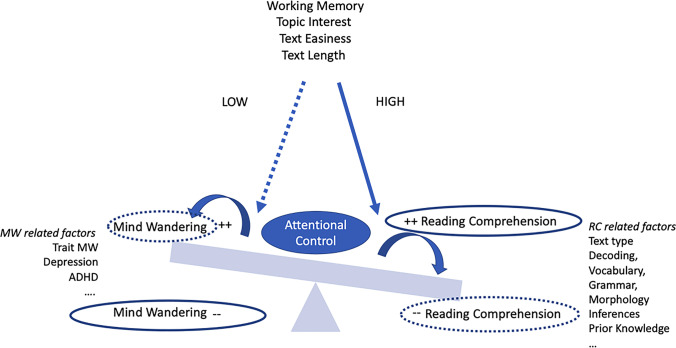
Mind wandering (MW), a shift of attention away from external tasks toward internally generated thoughts, has been frequently associated with costs in reading comprehension (RC), although with some contrasting results and many reported potential intervening factors. The aim of the meta-analysis was to evaluate the relationship between MW and RC, considering the role of participants’ and text’s characteristics, as well as methodological issues in the measurement of the two constructs. From a set of 25 selected full texts (73 correlation coefficients), pooled correlation (r = −0.21) revealed a negative significant relationship. Using trait-based questionnaires to assess MW compared with online probes resulted in an average significant change of 0.30 in the correlation between MW and RC, leading to a null correlation. A significant effect of age was also found, with more negative correlations with increasing age. None of the other moderating variables considered (i.e., language, text type, text length, RC assessment, text difficulty, text interest, and working memory) resulted in a significant effect. From the present meta-analysis, we might suggest that MW and RC are partially overlapping and vary, within a swing effect, in relation to a set of shared factors, such as working memory, interest, and text length. There might also be side-specific factors that drive the movement of primarily one side of the swing, and future research should further consider the role of individual differences in RC. Implications for research and educational settings are discussed.
Verified 2026-11-25 · 1 reference not checked yet
Overview
CoChat Summary
TL;DR
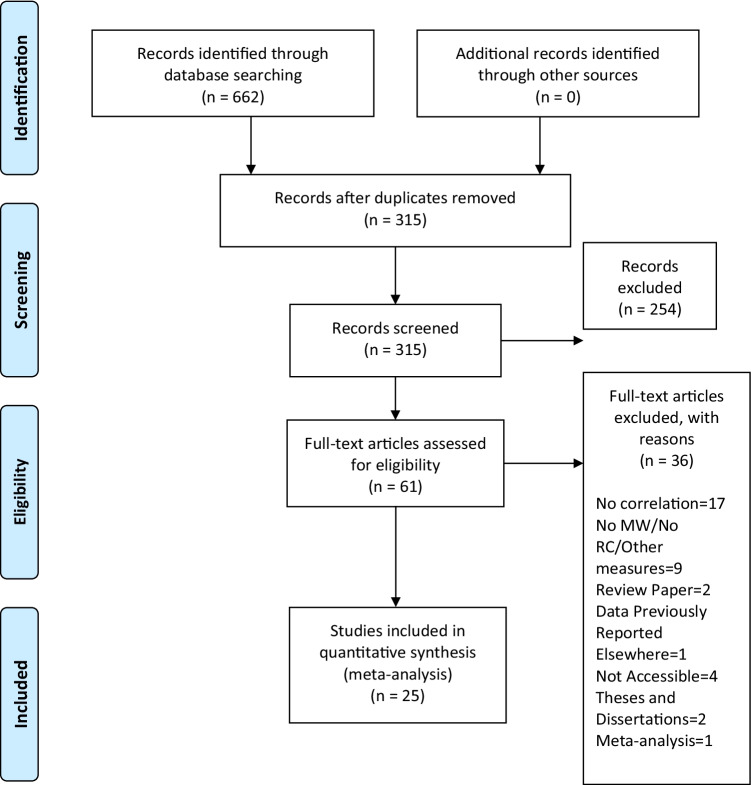
This meta-analysis of 25 articles (73 correlations, 3,926 participants) found a small-to-moderate negative pooled relationship between mind wandering and reading comprehension (r = −0.21). The relationship was moderated by MW assessment method and age, with trait-based MW measures yielding an almost null correlation and older participants showing more negative associations.
Key findings
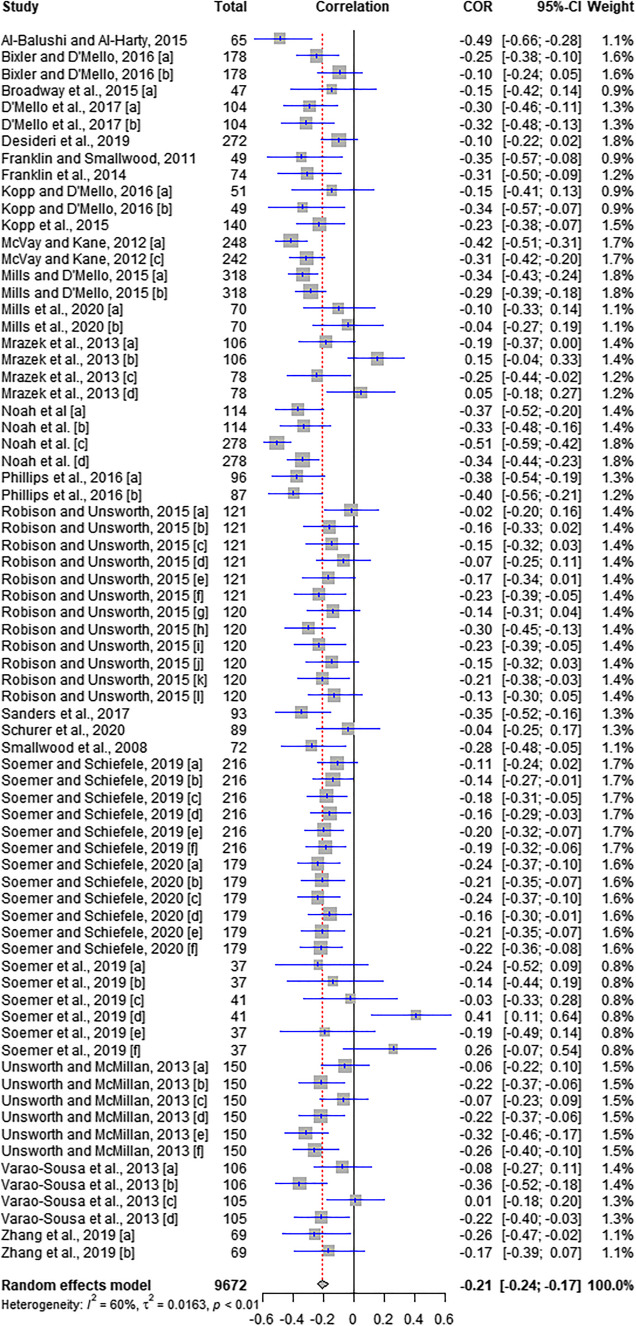
- Across 25 articles (73 correlation coefficients; 3,926 participants), MW and RC had a significant negative pooled correlation, r = −0.21 (p < .0001, 95% CI [−0.24, −0.1]); probed MW alone gave r = −0.23 (p < .0001, 95% CI [−0.26, −0.19]).
- MW assessment moderated the relationship: using trait-based questionnaires instead of online probes produced an average significant change of 0.305 in the MW–RC correlation, leading to an almost null correlation (Table 2; p < .001).
- Age moderated the relationship: each additional year was associated with a −0.016 average decrease in the correlation, i.e., a more negative association (p = .002).
- Text type, text length, RC assessment, text difficulty, topic interest, and working memory did not significantly affect the correlation; language was reported as marginal (transparent vs. opaque estimate 0.096, p = .021) but not treated as fully significant.
Methods
- PRISMA systematic search of Web of Science, Scopus, PubMed, and EBSCO (PsychInfo, PsychArticles, ERIC), January–March 2020, restricted to English-language peer-reviewed journals; grey literature was excluded. Included 25 articles/73 correlations/3,926 participants; participants were school-aged >10 years and/or adults 18–40, skilled readers without reported clinical conditions, and studies had to report Pearson’s r between MW and RC.
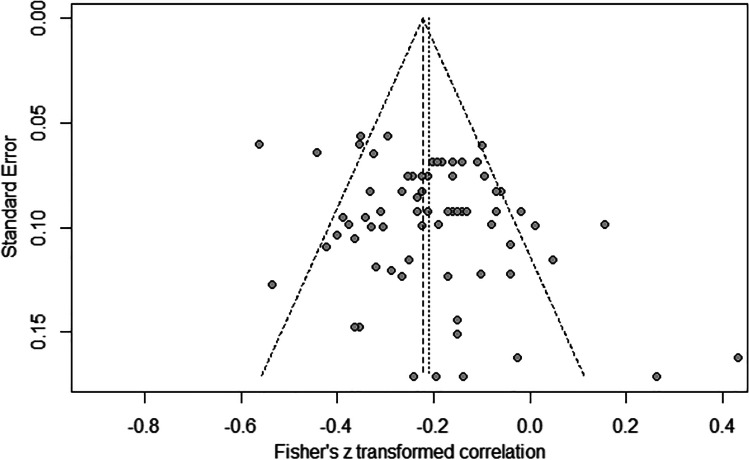
- Random-effects meta-analysis in R using the dmetar package (Hunter–Schmidt variance pooling, Fisher’s z transformation, Sidik–Jonkman heterogeneity estimator), with metaregressions for age, language type, text type, text length, MW assessment, RC procedures, topic interest, text difficulty, and working memory; publication bias was assessed with Egger’s regression, Begg’s test, and trim-and-fill.
Limitations
- Stated: most moderator analyses had limited available data and limited variability; more evidence is needed on text interest and text difficulty; voluntary vs. involuntary MW could not be distinguished due to insufficient information; grey literature was excluded, with potential overestimation; section length could not be controlled, so total word count was used and was nonsignificant.
- Evident from the text: heterogeneity was about 60% (I²), and the evidence base was dominated by English (68.5%), informative texts (84.9%), multiple-choice RC (83.6%), and online probes (76.7%), limiting generalizability; the paper also notes there were no studies in which reading was required in a second language.
Model-written summary. Check it against the paper before relying on it.
Integrity signals
Registry
Cites
Statistics
Figures
Verification
Claims the paper makes
2 Valid · 1 Not valid · 58 Not checked · 66 Own results and interpretations
Every source the paper cites for this claim was checked and supports it.
In the paper
“People with reading disorders, for example, have been found to mind-wander more in self-paced reading compared with text-to-speech reading (Bonifacci et al., 2022).”
§ The relationship between mind wandering and reading comprehension: A meta-analysis > Discussion
What the sources say
- Supportedcites Bonifacci et al., 2022 matched to “Text‐to‐speech applications to reduce mind wandering in students with dyslexia” (2022) source
The Discussion of our copy states outright that 'children with SLD showed more MW in the self-paced reading condition compared to the text-to-speech condition', and §6.2 (Main analysis) reports the significant Reading condition × Group interaction (F(1, 68) = 8.488, p = 0.005, η² = 0.111) with similar probe scores for the two groups in the text-to-speech condition but a significantly lower probe score (i.e. more mind wandering) for the SLD group in self-paced reading. The Abstract likewise says students with dyslexia were significantly more on task in the text-to-speech condition than in the self-paced condition. The source's sample is school-aged children with specific learning disorders/dyslexia (20 SLD, 50 typical readers), and its baseline dispositional MW measures did not differ between groups, so the excess mind wandering is specific to the self-paced versus text-to-speech comparison, exactly as the citing sentence frames it. (LLM, conf=0.85)
plainstates an association- Asserted: passes — The authors put it forward as true.
- Checkable: passes — It can be checked against evidence.
- Load-bearing: unclear — It is unclear whether the paper’s conclusions depend on it.
- Based: passes — The paper gives a reason why it holds.
- Supported
The cited sources support only part of this claim — read each source’s verdict below.
In the paper
“In other instances, a set of weaknesses in the comprehension process, as in the case of poor comprehenders (e.g., meta-analysis by Spencer & Wagner, 2018) might bring the mind to wander.”
§ The relationship between mind wandering and reading comprehension: A meta-analysis > Discussion
What the sources say
- Partly supportedcites Spencer & Wagner, 2018 matched to “The Comprehension Problems of Children With Poor Reading Comprehension Despite Adequate Decoding: A Meta-Analysis” (2018) sourceExperimental — accuracy not yet measured
Spencer & Wagner's (2018) meta-analysis does document the 'set of weaknesses in the comprehension process' in poor comprehenders: the Abstract lists deficits beyond decoding in sensitivity to story structure, inference making, comprehension monitoring, syntactic processing, verbal working memory and oral language, and the Discussion (Theoretical and Practical Implications) reports hidden language impairment in children with SCD. However, no passage in our copy links those comprehension weaknesses to mind wandering, attention lapse or task-unrelated thoughts (searched: mind wandering/attention lapse, distractibility/reading avoidance, engagement with text); the closest is the Theories of Reading Comprehension section's talk of devoting attentional resources, which concerns resource allocation, not the mind wandering off. The mind-wandering consequence is the citing authors' extrapolation, not a finding of this source. (LLM, conf=0.72)
hedgedstates a possible cause- Asserted: passes — The authors put it forward as true.
- Checkable: passes — It can be checked against evidence.
- Load-bearing: unclear — It is unclear whether the paper’s conclusions depend on it.
- Based: passes — The paper gives a reason why it holds.
- Partly supported
A result the paper reports from its own data — it cites no other source for it, so there is none to check. The quote shows it is in the paper.
In the paper
“given the small-to-medium correlation found and the absence of significant publication bias”
§ The relationship between mind wandering and reading comprehension: A meta-analysis > Discussion
plain- Asserted: passes — The authors put it forward as true.
- Checkable: passes — It can be checked against evidence.
- Load-bearing: passes — The paper’s conclusions depend on it.
- Based: passes — The paper gives a reason why it holds.
A result the paper reports from its own data — it cites no other source for it, so there is none to check. The quote shows it is in the paper.
In the paper
“The Egger’s regression has a p value at the limit of significance (t = 2.49, df = 71, p = .0152).”
§ The relationship between mind wandering and reading comprehension: A meta-analysis > Results > Association between MW and RC
plain- Asserted: passes — The authors put it forward as true.
- Checkable: passes — It can be checked against evidence.
- Load-bearing: unclear — It is unclear whether the paper’s conclusions depend on it.
- Based: passes — The paper gives a reason why it holds.
A result the paper reports from its own data — it cites no other source for it, so there is none to check. The quote shows it is in the paper.
In the paper
“Of these, age has a significant negative effect: when age increases by one year, the correlation decreases by −0.016 on average, thus bringing to a slightly higher negative correlation.”
- Also stated in: § Data analysis · plain
“| Age | −0.016 | 0.005 | −3.071 | 0.002 | −0.027 | −0.006 |”
- Also stated in: § Discussion · hedged
“Considering age, the relationship between MW and RC became more negative with increasing age, with an estimated change of −0.016 per year.”
§ The relationship between mind wandering and reading comprehension: A meta-analysis > Results > Test of moderators
plainstates a cause- Asserted: passes — The authors put it forward as true.
- Checkable: passes — It can be checked against evidence.
- Load-bearing: passes — The paper’s conclusions depend on it.
- Based: passes — The paper gives a reason why it holds.
- Also stated in: § Data analysis · plain
26 more claims
Create a free account to see all 127 claims and to verify the 44 references still open.
- Probably not a substantial claim. 63
- It may state two separate claims as one. 55
Claims other papers make about this one
Each is checked against this paper’s own text: does it say what the citing paper says it does?
In the citing paper
“Mind wandering during reading has been shown to hinder extracting information from written texts and the ability to make inferences, leading to reduced comprehension performance (Bonifacci et al., 2023; D’Mello & Mills, 2021).”
From Mind wandering during first- and foreign-language reading (2026) · cites this paper as Bonifacci et al., 2023
In the citing paper
“which replicates previous work showing that increased mind wandering impairs comprehension (Bonifacci et al., 2023).”
From Mind wandering during first- and foreign-language reading (2026) · cites this paper as Bonifacci et al., 2023
In the citing paper
“In previous studies, mind wandering has repeatedly been found to increase the risk of comprehension failure during reading (e.g., Feng et al., 2013; Steindorf & Rummel, 2020) with recent meta-analyses supporting the stability of this effect specifically for the reading domain (Bonifacci et al., 2022) and more broadly within an educational setting (Wong et al., 2022).”
From When there is noise on Sherlock Holmes: Mind wandering increases with perceptual processing difficulty during reading and listening (2023) · cites this paper as Bonifacci et al., 2022
Statistics recomputed
Every reported test result, recomputed from its test statistic and degrees of freedom. A result shows as not adding up only once an independent check has confirmed it.
- Consistentz = 0.83reported p = .4064 · recomputed p = .407
“(z = 0.83, p = .4064”
Self-check
Percentages, sums and reported differences re-computed from the paper’s own numbers.
Each contradiction between two passages listed here was confirmed by an independent check.
Rated major: it would touch a result — a value a result rests on, reported and recomputed p-values on opposite sides of the significance level, two passages that conflict with no sign which is right, or a cited work retracted before this paper was published.
In the paper
§ The relationship between mind wandering and reading comprehension: A meta-analysis > Discussion
“language did not result in being a significant moderator.”
§ The relationship between mind wandering and reading comprehension: A meta-analysis > Method > Data analysis
“| Text language | 0.096 | 0.041 | 2.307 | 0.021 | 0.014 | 0.177 |”
Rated minor: it would not touch a result — a value no result rests on, a p-value that stays on the same side of the significance level, or a conflict that is clerical, resolved elsewhere in the paper, or outside its own findings.
In the paper
§ The relationship between mind wandering and reading comprehension: A meta-analysis > Discussion
“the absence of significant publication bias”
§ The relationship between mind wandering and reading comprehension: A meta-analysis > Results > Association between MW and RC
“The Egger’s regression has a p value at the limit of significance (t = 2.49, df = 71, p = .0152).”
Citations
Cites
Duval, S., & Tweedie, R. (2000) · Biometrics · doi:10.1111/j.0006-341x.2000.00455.x · Cited by 14,099
Preferred reporting items for systematic reviews and meta-analyses: The PRISMA statement
Moher, D., Liberati, A., Tetzlaff, J., & Altman, D. G. (2010) · International Journal of Surgery · doi:10.1016/j.ijsu.2010.02.007 · Cited by 12,156
Cohen, J. (1992) · Psychological Bulletin · doi:10.1037//0033-2909.112.1.155 · Cited by 8,771
Santos, A. G., da Rocha, G. O., & de Andrade, J. B. (2019) · Scientific Reports · doi:10.1038/s41598-018-37186-2 · Cited by 8,495
Journal of Consciousness Studies
(2022) · Journal of Consciousness Studies · doi:10.53765/20512201 · Cited by 6,832
How to perform a meta-analysis with R: a practical tutorial
Balduzzi, S., Rücker, G., & Schwarzer, G. (2019) · Evidence Based Mental Health · doi:10.1136/ebmental-2019-300117 · Cited by 5,827
The role of knowledge in discourse comprehension: A construction-integration model.
Kintsch, W. (1988) · Psychological Review · doi:10.1037/0033-295x.95.2.163 · Cited by 4,363
Decoding, reading, and reading disability.
Gough, P. B., & Tunmer, W. E. (1986) · Remedial and Special Education · doi:10.1177/074193258600700104 · Cited by 3,972 · cited 5×
“…hypothesize that individual differences in general cognitive functions used in reading (Li et al., 2022) play a role in the relationship between MW and RC. RC is known to be affected both by decoding skills and linguistic abilities, according to the Simple View of Reading (Gough & Tunmer, 1986).”
BackgroundInfluentialHoover, W. A., & Gough, P. B. (1990) · Reading and Writing · doi:10.1007/bf00401799 · Cited by 2,956
Effect size guidelines for individual differences researchers
Gignac, G. E., & Szodorai, E. T. (2016) · Personality and Individual Differences · doi:10.1016/j.paid.2016.06.069 · Cited by 2,860
Foundation literacy acquisition in European orthographies
Seymour, P. H. K., Aro, M., Erskine, J. M., & collaboration with COST Action A8 network (2003) · British Journal of Psychology · doi:10.1348/000712603321661859 · Cited by 2,601 · cited 1×
“Reading processes are also related to orthographic transparency (Seymour et al., 2003), and reading models developed and tested on a single language could be misleading (Share, 2008).”
BackgroundA wandering mind is an unhappy mind
Killingsworth, M. A., & Gilbert, D. T. (2010) · Science · doi:10.1126/science.1192439 · Cited by 2,575
Publication Bias in Meta‐Analysis: Prevention, Assessment and Adjustments
(2005) · doi:10.1002/0470870168 · Cited by 2,368
Smallwood, J., & Schooler, J. W. (2006) · Psychological Bulletin · doi:10.1037/0033-2909.132.6.946 · Cited by 2,067 · cited 1×
“The standard approaches to MW define this phenomenon as either task-unrelated thought (thought disengaged from one’s primary task) and/or stimulus-independent thought (i.e., thought decoupled from perception; Smallwood & Schooler, 2006; Smallwood & Schooler, 2015).”
BackgroundThe Science of Mind Wandering: Empirically Navigating the Stream of Consciousness
Smallwood, J., & Schooler, J. W. (2015) · Annual Review of Psychology · doi:10.1146/annurev-psych-010814-015331 · Cited by 1,685 · cited 2×
“The standard approaches to MW define this phenomenon as either task-unrelated thought (thought disengaged from one’s primary task) and/or stimulus-independent thought (i.e., thought decoupled from perception; Smallwood & Schooler, 2006; Smallwood & Schooler, 2015).”
BackgroundGray literature: An important resource in systematic reviews
Paez, A. (2017) · Journal of Evidence-Based Medicine · doi:10.1111/jebm.12266 · Cited by 1,459
Mind-wandering as spontaneous thought: a dynamic framework
Christoff, K., Irving, Z. C., Fox, K. C. R., Spreng, R. N., & Andrews-Hanna, J. R. (2016) · Nature Reviews Neuroscience · doi:10.1038/nrn.2016.113 · Cited by 1,376 · cited 1×
“Finally, a fourth approach further conceives MW as a dynamic and unguided thought that floats from topic to topic over time (Christoff et al., 2016; Irving, 2016; Irving & Thompson, 2018; Mills et al., 2018).”
BackgroundShare, D. L. (2008) · Psychological Bulletin · doi:10.1037/0033-2909.134.4.584 · Cited by 1,022 · cited 2×
“Reading processes are also related to orthographic transparency (Seymour et al., 2003), and reading models developed and tested on a single language could be misleading (Share, 2008).”
BackgroundInspired by Distraction: Mind Wandering Facilitates Creative Incubation
Baird, B., Smallwood, J., Mrazek, M. D., Kam, J. W. Y., Franklin, M. S., & Schooler, J. W. (2012) · Psychological Science · doi:10.1177/0956797612446024 · Cited by 975
McVay, J. C., & Kane, M. J. (2009) · Journal of Experimental Psychology: Learning, Memory, and Cognition · doi:10.1037/a0014104 · Cited by 769
Keenan, J. M., Betjemann, R. S., & Olson, R. K. (2008) · Scientific Studies of Reading · doi:10.1080/10888430802132279 · Cited by 668
The costs and benefits of mind-wandering: A review.
Mooneyham, B. W., & Schooler, J. W. (2013) · Canadian Journal of Experimental Psychology / Revue canadienne de psychologie expérimentale · doi:10.1037/a0031569 · Cited by 665
Delgado, P., Vargas, C., Ackerman, R., & Salmerón, L. (2018) · Educational Research Review · doi:10.1016/j.edurev.2018.09.003 · Cited by 664
Grey literature: An important resource in systematic reviews
Páez, A. (2017) · Journal of Evidence-Based Medicine · doi:10.1111/jebm.12265 · Cited by 606
Publication Bias in Meta‐Analysis
Rothstein, H. R., Sutton, A. J., & Borenstein, M. (2005) · Publication Bias in Meta‐Analysis · doi:10.1002/0470870168.ch1 · Cited by 603
Correcting for Bias in Psychology: A Comparison of Meta-Analytic Methods
Carter, E. C., Schönbrodt, F. D., Gervais, W. M., & Hilgard, J. (2019) · Advances in Methods and Practices in Psychological Science · doi:10.1177/2515245919847196 · Cited by 588
Back to the future: Autobiographical planning and the functionality of mind-wandering
Baird, B., Smallwood, J., & Schooler, J. W. (2011) · Consciousness and Cognition · doi:10.1016/j.concog.2011.08.007 · Cited by 588
McVay, J. C., & Kane, M. J. (2012) · Journal of Experimental Psychology: General · doi:10.1037/a0025250 · Cited by 562 · cited 5×
“Low working memory capacity is associated with increased off-task thoughts (i.e., MW), which in turn might affect performance in attention-demanding tasks such as reading (McVay & Kane, 2012).”
BackgroundInfluentialMind-wandering: Phenomenology and function as assessed with a novel experience sampling method
Stawarczyk, D., Majerus, S., Maj, M., Van der Linden, M., & D'Argembeau, A. (2011) · Acta Psychologica · doi:10.1016/j.actpsy.2011.01.002 · Cited by 505
Interest, Reading, and Learning: Theoretical and Practical Considerations
Hidi, S. (2001) · Educational Psychology Review · doi:10.1023/a:1016667621114 · Cited by 463
When attention matters: The curious incident of the wandering mind
Smallwood, J., McSpadden, M., & Schooler, J. W. (2008) · Memory & Cognition · doi:10.3758/mc.36.6.1144 · Cited by 458
Mind-wandering, cognition, and performance: A theory-driven meta-analysis of attention regulation.
Randall, J. G., Oswald, F. L., & Beier, M. E. (2014) · Psychological Bulletin · doi:10.1037/a0037428 · Cited by 410
Mrazek, M. D., Phillips, D. T., Franklin, M. S., Broadway, J. M., & Schooler, J. W. (2013) · Frontiers in Psychology · doi:10.3389/fpsyg.2013.00560 · Cited by 400
Smallwood, J., Fishman, D. J., & Schooler, J. W. (2007) · Psychonomic Bulletin & Review · doi:10.3758/bf03194057 · Cited by 387
Mind-Wandering as a Natural Kind: A Family-Resemblances View
Seli, P., Kane, M. J., Smallwood, J., Schacter, D. L., Maillet, D., Schooler, J. W., & Smilek, D. (2018) · Trends in Cognitive Sciences · doi:10.1016/j.tics.2018.03.010 · Cited by 378 · cited 1×
“Actually, MW refers to a wide range of experiences that vary in content, intentionality, and relationship between activities and external stimuli (Seli et al., 2018).”
BackgroundEye Movements During Mindless Reading
Reichle, E. D., Reineberg, A. E., & Schooler, J. W. (2010) · Psychological Science · doi:10.1177/0956797610378686 · Cited by 378
A Meta-Analysis of Interventions for Struggling Readers in Grades 4–12: 1980–2011
Scammacca, N. K., Roberts, G., Vaughn, S., & Stuebing, K. K. (2015) · Journal of Learning Disabilities · doi:10.1177/0022219413504995 · Cited by 372
Allan Cheyne, J., Solman, G. J. F., Carriere, J. S. A., & Smilek, D. (2009) · Cognition · doi:10.1016/j.cognition.2008.12.009 · Cited by 369
Beyond Cognition: Reading Motivation and Reading Comprehension
Wigfield, A., Gladstone, J. R., & Turci, L. (2016) · Child Development Perspectives · doi:10.1111/cdep.12184 · Cited by 344
Unsworth, N., & McMillan, B. D. (2013) · Journal of Experimental Psychology: Learning, Memory, and Cognition · doi:10.1037/a0029669 · Cited by 335 · cited 5×
“…a negative impact of MW on RC (e.g., Feng, et al., 2013; Reichle et al., 2010; Smallwood et al., 2008; Smallwood et al., 2008; Smilek et al., 2010; Unsworth & McMillan, 2013), others have failed to observe such negative association (e.g., Broadway et al., 2015; Desideri et al., 2019;…”
BackgroundInfluentialExecutive Function and Reading Comprehension: A Meta-Analytic Review
Follmer, D. J. (2018) · Educational Psychologist · doi:10.1080/00461520.2017.1309295 · Cited by 317
Structuring Mind: The Nature of Attention and how it Shapes Consciousness
Watzl, S. (2017) · Oxford University Press eBooks · doi:10.1093/acprof:oso/9780199658428.001.0001 · Cited by 317
Differential Competencies Contributing to Children's Comprehension of Narrative and Expository Texts
Best, R. M., Floyd, R. G., & Mcnamara, D. S. (2008) · Reading Psychology · doi:10.1080/02702710801963951 · Cited by 281
Out of Mind, Out of Sight: Eye Blinking as Indicator and Embodiment of Mind Wandering
Smilek, D., Carriere, J. S. A., & Cheyne, J. A. (2010) · Psychological Science · doi:10.1177/0956797610368063 · Cited by 279
Ruby, F. J. M., Smallwood, J., Engen, H., & Singer, T. (2013) · PLoS ONE · doi:10.1371/journal.pone.0077554 · Cited by 275
Task unrelated thought whilst encoding information
Smallwood, J. M., Baracaia, S. F., Lowe, M., & Obonsawin, M. (2003) · Consciousness and Cognition · doi:10.1016/s1053-8100(03)00018-7 · Cited by 273
Working memory and updating processes in reading comprehension
Palladino, P., Cornoldi, C., De Beni, R., & Pazzaglia, F. (2001) · Memory & Cognition · doi:10.3758/bf03194929 · Cited by 267 · cited 3×
“, 2014; Unsworth & McMillan, 2013) and RC (De Beni, et al., 1998; Follmer, 2018; Palladino et al., 2001).”
BackgroundThe role of mind-wandering in measurements of general aptitude.
Mrazek, M. D., Smallwood, J., Franklin, M. S., Chin, J. M., Baird, B., & Schooler, J. W. (2012) · Journal of Experimental Psychology: General · doi:10.1037/a0027968 · Cited by 265
Increases in Intrusion Errors and Working Memory Deficit of Poor Comprehenders
Cornoldi, R. D. B. P. P. F. P. C. (1998) · The Quarterly Journal of Experimental Psychology A · doi:10.1080/027249898391648 · Cited by 262
Mind wandering while reading easy and difficult texts
Feng, S., D’Mello, S., & Graesser, A. C. (2013) · Psychonomic Bulletin & Review · doi:10.3758/s13423-012-0367-y · Cited by 257 · cited 1×
“Other text characteristics that might impact MW are text type and text length (Feng et al., 2013; Forrin et al., 2019).”
BackgroundMorphological awareness: A key to understanding poor reading comprehension in English.
Tong, X., Deacon, S. H., Kirby, J. R., Cain, K., & Parrila, R. (2011) · Journal of Educational Psychology · doi:10.1037/a0023495 · Cited by 239
Meta-analyses in mental health research. A practical guide
Cuijpers, P. J. (2016) · VU Research Portal · Cited by 239
Kintsch, W., & Rawson, K. A. (2008) · The Science of Reading: A Handbook · doi:10.1002/9780470757642.ch12 · Cited by 233
An Overview of Top-Down and Bottom-Up Effects in Comprehension: The CI Perspective
Kintsch, W. (2005) · Discourse Processes · doi:10.1080/0163853x.2005.9651676 · Cited by 229
Eason, S. H., Goldberg, L. F., Young, K. M., Geist, M. C., & Cutting, L. E. (2012) · Journal of Educational Psychology · doi:10.1037/a0027182 · Cited by 229
Schmucker, C. M., Blümle, A., Schell, L. K., Schwarzer, G., Oeller, P., Cabrera, L., von Elm, E., Briel, M., Meerpohl, J. J., & on behalf of the OPEN consortium (2017) · PLOS ONE · doi:10.1371/journal.pone.0176210 · Cited by 227
Hedges, L. V., & Vevea, J. L. (1996) · Journal of Educational and Behavioral Statistics · doi:10.2307/1165338 · Cited by 221
Mind-wandering is unguided attention: accounting for the “purposeful” wanderer
Irving, Z. C. (2016) · Philosophical Studies · doi:10.1007/s11098-015-0506-1 · Cited by 195
Automatic gaze-based user-independent detection of mind wandering during computerized reading
Bixler, R., & D’Mello, S. K. (2015) · User Modeling and User-Adapted Interaction · doi:10.1007/s11257-015-9167-1 · Cited by 194
Catching the mind in flight: Using behavioral indices to detect mindless reading in real time
Franklin, M. S., Smallwood, J., & Schooler, J. W. (2011) · Psychonomic Bulletin & Review · doi:10.3758/s13423-011-0109-6 · Cited by 186
Rummel, J., & Boywitt, C. D. (2014) · Psychonomic Bulletin & Review · doi:10.3758/s13423-013-0580-3 · Cited by 182
Components of reading comprehension and scholastic achievement
Meneghetti, C., Carretti, B., & Béni, R. D. (2006) · Learning and Individual Differences · doi:10.1016/j.lindif.2006.11.001 · Cited by 175
Smallwood, J. (2011) · Language and Linguistics Compass · doi:10.1111/j.1749-818x.2010.00263.x · Cited by 174 · cited 14×
“Within this view, a unilateral causal model such as the cascade model of inattention (Smallwood, 2011) might not fully capture the nature of the relationship and shared underpinnings.”
BackgroundResultInfluentialSmeekens, B. A., & Kane, M. J. (2016) · Psychology of Aesthetics, Creativity, and the Arts · doi:10.1037/aca0000046 · Cited by 170
Revisiting the simple view of reading
Kendeou, P., Savage, R., & van den Broek, P. (2009) · British Journal of Educational Psychology · doi:10.1348/978185408x369020 · Cited by 161
Mills, C., Raffaelli, Q., Irving, Z. C., Stan, D., & Christoff, K. (2017) · Consciousness and Cognition · doi:10.1016/j.concog.2017.10.003 · Cited by 159
The simple view of reading in a transparent orthography: the stronger role of oral comprehension
Tobia, V., & Bonifacci, P. (2015) · Reading and Writing · doi:10.1007/s11145-015-9556-1 · Cited by 135
Self-citationStawarczyk, D., Majerus, S., Catale, C., & D'Argembeau, A. (2014) · Acta Psychologica · doi:10.1016/j.actpsy.2014.01.007 · Cited by 131 · cited 1×
“…correlated with posttask self-reports (e.g., Zhang et al., 2019) and dispositional (i.e., trait-based) measures of MW obtained by questionnaires (e.g., Smallwood et al., 2003; Smallwood et al., 2006), even in young adults and adolescents (Stawarczyk et al., 2014; Varao-Sousa & Kingstone, 2019).”
MethodA multi-faceted approach to understanding individual differences in mind-wandering
Robison, M. K., Miller, A. L., & Unsworth, N. (2020) · Cognition · doi:10.1016/j.cognition.2019.104078 · Cited by 131
Reading Comprehension and Reading Comprehension Difficulties
Oakhill, J. V., Cain, K., & Elbro, C. (2019) · Springer eBooks · doi:10.1007/978-3-030-26550-2_5 · Cited by 130
Universal and specific reading mechanisms across different writing systems
Li, X., Huang, L., Yao, P., & Hyönä, J. (2022) · Nature Reviews Psychology · doi:10.1038/s44159-022-00022-6 · Cited by 129
Dimensions Affecting the Assessment of Reading Comprehension
Francis, D. J., Fletcher, J. M., Catts, H. W., & Tomblin, J. B. (2005) · doi:10.4324/9781410612762-26 · Cited by 117
Text difficulty, topic interest, and mind wandering during reading
Soemer, A., & Schiefele, U. (2019) · Learning and Instruction · doi:10.1016/j.learninstruc.2018.12.006 · Cited by 102 · cited 1×
“…reporting correlations involving latent factors (derived from confirmatory factor analysis), manifest-variable correlations were recovered from appendices included in the studies or by contacting the authors and asking for the original data sets (Soemer & Schiefele, 2019; Soemer et al., 2019).”
MethodSmallwood, J., Riby, L. M., Heim, D., & Davies, J. B. (2005) · Consciousness and Cognition · doi:10.1016/j.concog.2005.03.003 · Cited by 102
Experience, Meta-consciousness, and the Paradox of Introspection.
Schooler, J. W., & Schreiber, C. A. (2004) · Journal of Consciousness Studies · Cited by 100
The Oxford Handbook of Spontaneous Thought
(2018) · Oxford University Press eBooks · doi:10.1093/oxfordhb/9780190464745.001.0001 · Cited by 100
Mind wandering in sentence reading: Decoupling the link between mind and eye.
Foulsham, T., Farley, J., & Kingstone, A. (2013) · Canadian Journal of Experimental Psychology / Revue canadienne de psychologie expérimentale · doi:10.1037/a0030217 · Cited by 95
Morphological and Syntactic Awareness in Poor Comprehenders: Another Piece of the Puzzle
Tong, X., Deacon, S. H., & Cain, K. (2014) · Journal of Learning Disabilities · doi:10.1177/0022219413509971 · Cited by 86
Assessing the associations among trait and state levels of deliberate and spontaneous mind wandering
Seli, P., Risko, E. F., & Smilek, D. (2016) · Consciousness and Cognition · doi:10.1016/j.concog.2016.02.002 · Cited by 79
The way we encounter reading material influences how frequently we mind wander
Varao Sousa, T. L., Carriere, J. S. A., & Smilek, D. (2013) · Frontiers in Psychology · doi:10.3389/fpsyg.2013.00892 · Cited by 77 · cited 1×
“, 2010; Unsworth & McMillan, 2013), others have failed to observe such negative association (e.g., Broadway et al., 2015; Desideri et al., 2019; Varao-Sousa et al., 2013; Zhang et al., 2019).”
BackgroundBonifacci, P., & Tobia, V. (2017) · Scientific Studies of Reading · doi:10.1080/10888438.2016.1261869 · Cited by 77
Self-citationSpencer, M., & Wagner, R. K. (2018) · Review of Educational Research · doi:10.3102/0034654317749187 · Cited by 75
What are the benefits of mind wandering to creativity?
Murray, S. F., Liang, N., Brosowsky, N. P., & Seli, P. (2024) · Psychology of Aesthetics Creativity and the Arts · doi:10.1037/aca0000420 · Cited by 71
Aging and mind wandering during text comprehension.
Krawietz, S. A., Tamplin, A. K., & Radvansky, G. A. (2012) · Psychology and Aging · doi:10.1037/a0028831 · Cited by 69
Robison, M. K., & Unsworth, N. (2015) · Applied Cognitive Psychology · doi:10.1002/acp.3150 · Cited by 68
Mills, C., Gregg, J., Bixler, R., & D’Mello, S. K. (2021) · Human–Computer Interaction · doi:10.1080/07370024.2020.1716762 · Cited by 67
Specific Reading Comprehension Disability: Major Problem, Myth, or Misnomer?
Spencer, M., Quinn, J. M., & Wagner, R. K. (2014) · Learning Disabilities Research & Practice · doi:10.1111/ldrp.12024 · Cited by 66
McVay, J. C., & Kane, M. J. (2010) · Plenum series on human exceptionality · doi:10.1007/978-1-4419-1210-7_19 · Cited by 62
Broadway, J. M., Franklin, M. S., & Schooler, J. W. (2015) · Biological Psychology · doi:10.1016/j.biopsycho.2015.02.009 · Cited by 62
Zhang, M., Savill, N. J., Margulies, D. S., Smallwood, J., & Jefferies, E. (2019) · Scientific Reports · doi:10.1038/s41598-019-52674-9 · Cited by 62
On the influence of re-reading on mind wandering
Phillips, N. E., Mills, C., D'Mello, S., & Risko, E. F. (2016) · Quarterly Journal of Experimental Psychology · doi:10.1080/17470218.2015.1107109 · Cited by 52
Mind wandering and reading comprehension in secondary school children
Soemer, A., Idsardi, H. M., Minnaert, A. E. M. G., & Schiefele, U. (2019) · Learning and Individual Differences · doi:10.1016/j.lindif.2019.101778 · Cited by 51
Influencing the occurrence of mind wandering while reading
Kopp, K., D’Mello, S., & Mills, C. (2015) · Consciousness and Cognition · doi:10.1016/j.concog.2015.03.003 · Cited by 48
Text‐to‐speech applications to reduce mind wandering in students with dyslexia
Bonifacci, P., Colombini, E., Marzocchi, M., Tobia, V., & Desideri, L. (2022) · Journal of Computer Assisted Learning · doi:10.1111/jcal.12624 · Cited by 47
Self-citationSteindorf, L., Hammerton, H. A., & Rummel, J. (2020) · Psychology of Aesthetics Creativity and the Arts · doi:10.1037/aca0000373 · Cited by 46
Assessing Reading Comprehension: The Effects of Text-Based Interest, Gender, and Ability
Babbitt Bray, G., & Barron, S. (2004) · Educational Assessment · doi:10.1080/10627197.2004.9652961 · Cited by 45
D'Mello, S. K., & Mills, C. S. (2021) · Language and Linguistics Compass · doi:10.1111/lnc3.12412 · Cited by 45
Varao-Sousa, T. L., & Kingstone, A. (2019) · Behavior Research Methods · doi:10.3758/s13428-018-1073-0 · Cited by 39
Working memory capacity and (in)voluntary mind wandering
Soemer, A., & Schiefele, U. (2020) · Psychonomic Bulletin & Review · doi:10.3758/s13423-020-01737-4 · Cited by 37
The Philosophy of Mind-Wandering
Irving, Z. C., & Thompson, E. T. (2018) · Oxford University Press eBooks · doi:10.1093/oxfordhb/9780190464745.013.19 · Cited by 33
Zone out no more: Mitigating mind wandering during computerized reading
D’Mello, S. K., Mills, C., Bixler, R., & Bosch, N. (2017) · Educational Data Mining · Cited by 33
Mind wandering increases linearly with text difficulty
Kahmann, R., Ozuer, Y., Zedelius, C. M., & Bijleveld, E. (2022) · Psychological Research · doi:10.1007/s00426-021-01483-9 · Cited by 32 · cited 1×
“When people fail to build a situational model, they are thought to disengage from the text, and mind wander (Kahmann et al., 2022).”
BackgroundSanders, J. G., Wang, H.-T., Schooler, J. W., & Smallwood, J. (2017) · Quarterly Journal of Experimental Psychology · doi:10.1080/17470218.2016.1216573 · Cited by 32
On the relation between reading difficulty and mind-wandering: a section-length account
Forrin, N. D., Risko, E. F., & Smilek, D. (2019) · Psychological Research · doi:10.1007/s00426-017-0936-9 · Cited by 31
Yıldırım, K., Yıldız, M., Ateş, S., & Rasinski, T. V. (2010) · Educational Sciences Theory & Practice · Cited by 30
What Does “Mind‐Wandering” Mean to the Folk? An Empirical Investigation
Irving, Z. C., Glasser, A., Gopnik, A., Pinter, V., & Sripada, C. (2020) · Cognitive Science · doi:10.1111/cogs.12908 · Cited by 30
The contribution of schooling to learning gains of pupils in Years 1 to 6
Luyten, H., Merrell, C., & Tymms, P. (2017) · School Effectiveness and School Improvement · doi:10.1080/09243453.2017.1297312 · Cited by 29 · cited 1×
“32 is relevant in the RC field because it represents approximately two thirds of the yearly growth in RC during primary school (Luyten et al., 2017), and about one third of the effect of remedial reading interventions (Scammacca et al.”
BackgroundThinking one thing, saying another: The behavioral correlates of mind-wandering while reading aloud
Franklin, M. S., Mooneyham, B. W., Baird, B., & Schooler, J. W. (2014) · Psychonomic Bulletin & Review · doi:10.3758/s13423-013-0468-2 · Cited by 28
Mills, C., & D’Mello, S. K. (2015) · Educational Data Mining · Cited by 27
Desideri, L., Ottaviani, C., Cecchetto, C., & Bonifacci, P. (2019) · British Journal of Educational Psychology · doi:10.1111/bjep.12240 · Cited by 27
Self-citationWorking Memory Capacity but Not Prior Knowledge Impact on Readers' Attention and Text Comprehension
Schurer, T., Opitz, B., & Schubert, T. (2020) · Frontiers in Education · doi:10.3389/feduc.2020.00026 · Cited by 27
Gotcha! Catching Kids During Mindless Reading
Nguyen, K.-V., Binder, K. S., Nemier, C., & Ardoin, S. P. (2014) · Scientific Studies of Reading · doi:10.1080/10888438.2013.876424 · Cited by 21
TL;DR: Longer Sections of Text Increase Rates of Unintentional Mind-Wandering
Forrin, N. D., Mills, C., D’Mello, S. K., Risko, E. F., Smilek, D., & Seli, P. (2021) · The Journal of Experimental Education · doi:10.1080/00220973.2020.1751578 · Cited by 21
Al-Balushi, S. M., & Al-Harthy, I. S. (2015) · Chemistry Education Research and Practice · doi:10.1039/c5rp00052a · Cited by 20
The Impact of Modality on Mind Wandering during Comprehension
Kopp, K., & D'Mello, S. (2016) · Applied Cognitive Psychology · doi:10.1002/acp.3163 · Cited by 17
24. Reading comprehension: Individual differences, disorders, and underlying cognitive processes
Schindler, J., & Richter, T. (2018) · De Gruyter eBooks · doi:10.1515/9781614514909-025 · Cited by 15
In the eye of the beholder: Evaluative context modulates mind-wandering
Forrin, N. D., Risko, E. F., & Smilek, D. (2018) · Acta Psychologica · doi:10.1016/j.actpsy.2018.02.005 · Cited by 9
Tobia, V., & Bonifacci, P. (2020) · Journal of Research in Reading · doi:10.1111/1467-9817.12328 · Cited by 8 · cited 1×
“…differences between narrative versus informative texts, which demand different cognitive skills (Eason, et al., 2012) and strategies for answering (Tobia & Bonifacci, 2020), and it has been suggested that narrative texts might be easier to comprehend than expository texts (Best et al., 2008;…”
BackgroundSelf-citationAssessing the relationship between trait and state levels of mind wandering during a tracing task
da Silva, M. R. D., Gonçalves, Ó. F., Postma, M., Denison, S., Mack, M., Xu, Y., & Armstrong, B. C. (2020) · Tilburg University Research Portal · Cited by 2
An Overview of Top-Down and Bottom-Up Effects in Comprehension: The CI Perspective
Kintsch, W. (2005) · Discourse Processes · doi:10.1207/s15326950dp3902&3_2
Research works printed but not linked: 2
- Schwarzer G Meta: An R package for meta-analysis R News 2007 7 40 45
- Seli P Kane MJ Smallwood J Schacter DL Maillet D Schooler JW Smilek D Mind-wandering as a natural kind: A family-resemblances view Trends in Cognitive Sciences 2018 22 6 479 490 10.1016/j.tics.2018.03.010 29776466 PMC5962028 · DOI · Paper page
Cited by
Yang, H., Xu, N., Lin, X., & Zhang, W. (2025) · Computers in Human Behavior Reports · doi:10.1016/j.chbr.2025.100833 · Cited by 27
Distractions in digital reading: a meta-analysis of attentional interference effects
Shen, Y. (2025) · Frontiers in Psychology · doi:10.3389/fpsyg.2025.1671214 · Cited by 27
Unique Patterns of Eye Movements Characterizing Inattentive Reading in ADHD
Stern, P., Kolodny, T., Tsafrir, S., Cohen, G., & Shalev, L. (2024) · Journal of Attention Disorders · doi:10.1177/10870547231223728 · Cited by 22
Simor, P., Vékony, T., Farkas, B. C., Szalárdy, O., Bogdány, T., Brezóczki, B., Csifcsák, G., & Németh, D. (2025) · Journal of Neuroscience · doi:10.1523/jneurosci.1421-24.2025 · Cited by 22
Wong, A. Y., Bryck, R. L., Baker, R. S., Hutt, S. J., & Mills, C. (2023) · International Conference on Learning Analytics and Knowledge (LAK) · doi:10.1145/3576050.3576115 · Cited by 23
Metadata
- Authors
- Bonifacci, P., Viroli, C., Vassura, C., Colombini, E., & Desideri, L.
- Affiliations
- University of Bologna (IT)
- Corresponding author
- Bonifacci, Paola
- Venue
- Psychonomic Bulletin & Review
- Published
- 2022-07-15
- Volume
- 30
- Issue
- 1
- Pages
- 40-59
- ISSN
- 1069-9384 (ISSN-L)
- 1531-5320
- PMC
- PMC9971160
- OpenAlex
- W4285492483
- Semantic Scholar
- e963ff61fa99753d4b923dbb026e0c677f6e430e
- Cited by
- 83
- References
- 119
- Citations by year
- 2026: 26 · 2025: 27 · 2024: 16 · 2023: 14
- FWCI
- 1.52
- Type
- journal article
- Language
- en
- Open access
- hybrid
- doi.org
- Licence
- cc-by
- creativecommons.org/licenses/by/4.0 (tdm)
- creativecommons.org/licenses/by/4.0 (vor)
- Locations
- Psychonomic Bulletin & Review (publishedVersion, cc-by)
- PubMed (publishedVersion)
- PubMed Central (publishedVersion, cc-by)
- Archivio istituzionale della ricerca (Alma Mater Studiorum Università di Bologna) (submittedVersion, other-oa)
- Archivio istituzionale della ricerca (Alma Mater Studiorum Università di Bologna) (submittedVersion, cc-by)
- Funders
- Alma Mater Studiorum - Università di Bologna
- Topics
- Life Sciences › Neuroscience › Cognitive Neuroscience › Mind wandering and attention
- Social Sciences › Psychology › Developmental and Educational Psychology › Reading and Literacy Development
- Social Sciences › Psychology › Experimental and Cognitive Psychology › Cognitive Abilities and Testing
- Keywords
- mind wandering, reading comprehension, attentional control, working memory, text length, age differences, individual differences, text complexity
- MeSH terms
- Attention, Humans, Individuality, Memory, Short-Term, Reading, Comprehension
About these checks
Registry, retraction, Cites and statistics results are computed, not judged, with one exception: a printed reference that no index lists is read once by a model before it counts as a citation error. Claims are extracted by a model and kept only when their quote appears verbatim in the text; each cited source is then checked, with a model’s help, for whether it says what the claim relies on. Those verdicts can be wrong — read the claim’s quote and the cited source before relying on one.
The claim verdicts this report counts are experimental: their accuracy is not yet measured.
A language model drew the claims from the paper on 2026-11-18, under version 3 of the claim definition (model deepseek-v4.1-flash, prompt extract-v3).
A second model labelled each claim on 2026-11-18 (model jev-1.13-20260917, definition revision gold-guideline-v0.2).
Cited sources are checked with a language model’s help (qwen3.8-omni-flash).
Statistics and arithmetic are recomputed, not judged.
Confidence bands are shown only for fields calibrated on our annotated test set. None is calibrated yet, so no band is shown.
What counts as a claim ›How we measure confidence ›How we check this ›
Are you an author, or do you see a problem with this page? Request a review
Data sources
Bibliographic data: Semantic Scholar, OpenAlex, Crossref.
Contains information from the Semantic Scholar Academic Graph Datasets, made available under the ODC Attribution License (ODC-BY 1.0).
Semantic Scholar’s data is described in: Kinney, R., et al. (2023). The Semantic Scholar Open Data Platform. arXiv:2301.10140.
