

The CARE Principles for Indigenous Data Governance
Open accessThe DOI matches its Crossref record; 26 of the 27 references it cites were found in a registry or an index; none of the 1 sources its claims cite is checked for support yet.
Abstract
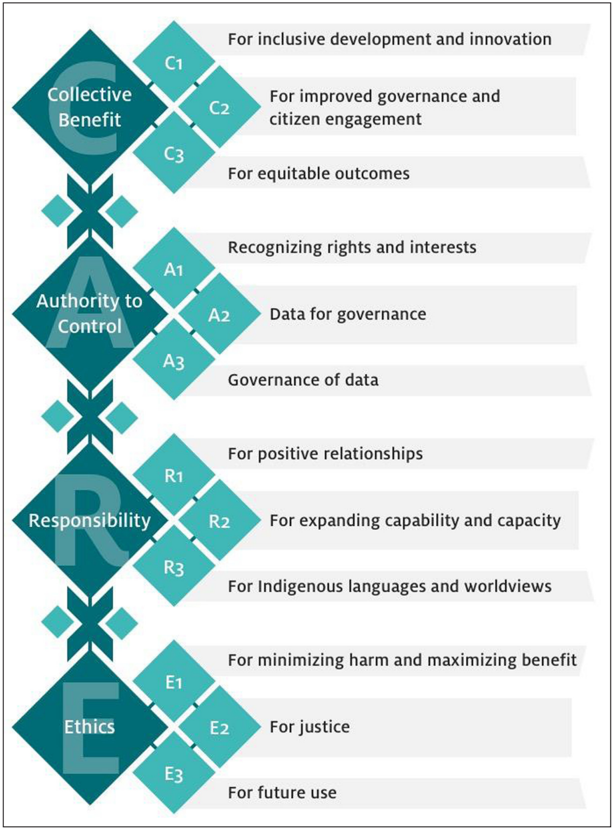
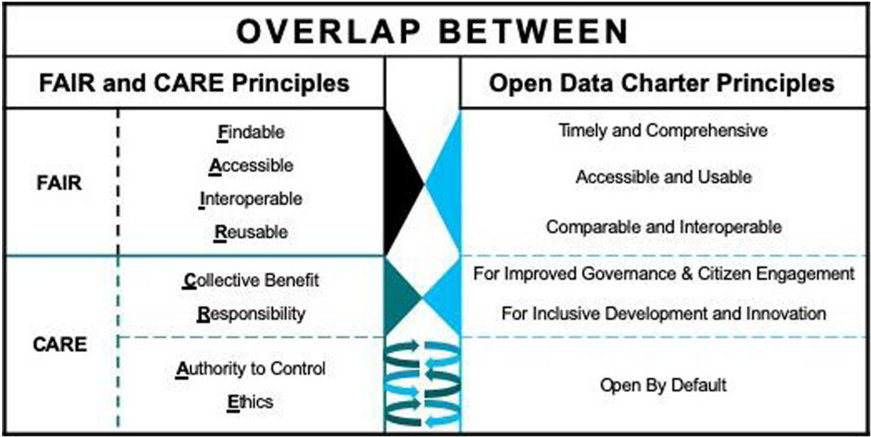
Concerns about secondary use of data and limited opportunities for benefit-sharing have focused attention on the tension that Indigenous communities feel between (1) protecting Indigenous rights and interests in Indigenous data (including traditional knowledges) and (2) supporting open data, machine learning, broad data sharing, and big data initiatives. The International Indigenous Data Sovereignty Interest Group (within the Research Data Alliance) is a network of nation-state based Indigenous data sovereignty networks and individuals that developed the ‘CARE Principles for Indigenous Data Governance’ (Collective Benefit, Authority to Control, Responsibility, and Ethics) in consultation with Indigenous Peoples, scholars, non-profit organizations, and governments. The CARE Principles are people– and purpose-oriented, reflecting the crucial role of data in advancing innovation, governance, and self-determination among Indigenous Peoples. The Principles complement the existing data-centric approach represented in the ‘FAIR Guiding Principles for scientific data management and stewardship’ (Findable, Accessible, Interoperable, Reusable). The CARE Principles build upon earlier work by the Te Mana Raraunga Maori Data Sovereignty Network, US Indigenous Data Sovereignty Network, Maiam nayri Wingara Aboriginal and Torres Strait Islander Data Sovereignty Collective, and numerous Indigenous Peoples, nations, and communities. The goal is that stewards and other users of Indigenous data will ‘Be FAIR and CARE.’ In this first formal publication of the CARE Principles, we articulate their rationale, describe their relation to the FAIR Principles, and present examples of their application.
Overview
CoChat Summary
TL;DR
The CARE Principles for Indigenous Data Governance (Collective Benefit, Authority to Control, Responsibility, and Ethics) are people- and purpose-oriented principles developed by the International Indigenous Data Sovereignty Interest Group to complement the data-centric FAIR Principles. They aim to support Indigenous rights, self-determination, and control over Indigenous data while enabling equitable data reuse.
Key findings
- CARE comprises four principles—Collective Benefit, Authority to Control, Responsibility, and Ethics—designed to complement FAIR (Findable, Accessible, Interoperable, Reusable) and guide data stewards and users to “Be FAIR and CARE.”
- The paper reports global context from UN 2009: Indigenous presence spans over 90 countries, includes over 370 million Indigenous persons, and involves more than 5,000 distinct cultures.
- CARE emerged from an Indigenous-led workshop held in Gaborone, Botswana, on 8 November 2018, as part of International Data Week, with later input from Indigenous leaders, scholars, network members, and allies.
- Early adopters/implementation examples include the Research Data Alliance, the Smithsonian Institution (e.g., Smithsonian Directive 609 and planned Collection CARE Notices), and the Open Data Charter.
Methods
- This is a conceptual/principles development paper, not an empirical study; it describes the rationale, development, and illustrative application of the CARE Principles.
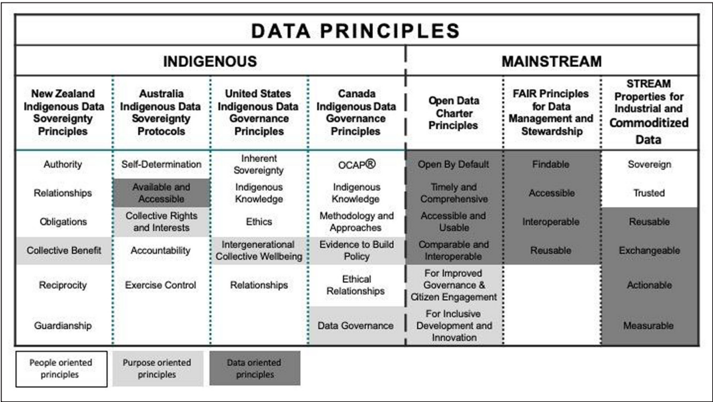
- Workshop organizers prepared an analysis of principles from Indigenous data sovereignty/governance frameworks and mainstream sources (Table 1) to inform dialogue; participants identified the four primary principles and drafted primary and sub-principles, then circulated the draft for input.
- The paper presents the principles’ relation to FAIR and examples of adoption; no formal sample, dataset, or statistical analysis is reported.
Limitations
- Stated: further research is needed to identify mechanisms that support implementation; create tools, policies, and practices that enact the Principles; explore application in different contexts (e.g., research repositories, knowledge co-production, institutional policies, existing databases/systems); and operationalize the Principles in tandem with FAIR.
- Evident: the paper is a principles publication and does not report empirical evaluation of implementation outcomes; the adoption examples are illustrative rather than systematically assessed.
Model-written summary. Check it against the paper before relying on it.
Integrity signals
Registry
Cites
Statistics
Figures
Verification
Claims the paper makes
0 Valid · 0 Not valid · 1 Not checked · 9 Own results and interpretations
- Probably not a substantial claim. 9
- It may state two separate claims as one. 5
Claims other papers make about this one
Each is checked against this paper’s own text: does it say what the citing paper says it does?
The source backs part of the claim, not all of it — or backs it for a different population, condition or comparison.
In the citing paper
“This can be in conflict with cultural values, e.g., in the case of indigenous communities that are generally underrepresented on Wikipedia but have concerns about how their knowledge might be exploited if shared [28, 29].”
From Data Governance in the Age of Large-Scale Data-Driven Language Technology (2022) · cites this paper as [28]
Experimental — accuracy not yet measuredThe source backs part of the claim, not all of it — or backs it for a different population, condition or comparison.
In the citing paper
“The key distinction is that while FAIR principles focus on making data maximally open and shareable-goals that align with scientific efficiency, CARE principles focus on people and purpose, emphasizing that data use should align with the rights and needs of Indigenous Peoples.”
From Data colonialism and indigenous languages in AI: a critical review of existing initiatives and their struggles with data sovereignty (2026) · cites this paper as Carroll et al. 2020
Experimental — accuracy not yet measuredThe source backs part of the claim, not all of it — or backs it for a different population, condition or comparison.
In the citing paper
“A concrete expression of Indigenous Data Sovereignty is found in the CARE Principles for Indigenous Data Governance, formulated in 2019 by the Global Indigenous Data Alliance and related networks (Carroll et al. 2020).”
From Data colonialism and indigenous languages in AI: a critical review of existing initiatives and their struggles with data sovereignty (2026) · cites this paper as Carroll et al. 2020
Experimental — accuracy not yet measuredThe source backs part of the claim, not all of it — or backs it for a different population, condition or comparison.
In the citing paper
“Indigenous data, whether born digital or not, include information, knowledge, specimens, and belongings about Indigenous Peoples to which they relate at both the individual and collective levels (Carroll et al., 2020; Rainie et al., 2019; Lovett et al., 2019).”
From Using Indigenous Standards to Implement the CARE Principles: Setting Expectations through Tribal Research Codes (2022) · cites this paper as Carroll et al., 2020
Experimental — accuracy not yet measuredThe source backs part of the claim, not all of it — or backs it for a different population, condition or comparison.
In the citing paper
“The FAIR Principles are aligned to the global shift towards open science and open data, promoting data centric criteria that facilitate increased data sharing among entities while ignoring relationships, power differentials, and the historical conditions associated with the collection of data10,11.”
From Operationalizing the CARE and FAIR Principles for Indigenous data futures (2021) · cites this paper as [11]
Experimental — accuracy not yet measured
6 more claims about this paper
Create a free account to see every claim other papers make about this one.
Self-check
Percentages, sums and reported differences re-computed from the paper’s own numbers.
Each contradiction between two passages listed here was confirmed by an independent check.
Rated minor: it would not touch a result — a value no result rests on, a p-value that stays on the same side of the significance level, or a conflict that is clerical, resolved elsewhere in the paper, or outside its own findings.
In the paper
§ The CARE Principles for Indigenous Data Governance > Research Data Alliance (www.rd-alliance.org), in research environments
“In 2012, the American Museum of Natural History at the Smithsonian Institution in Washington, DC released an Access and Benefit Sharing Policy on Genetic Resources”
§ The CARE Principles for Indigenous Data Governance > References
“42. Smithsonian Institution. 2012. Access and Benefit Sharing Policy on Genetics Resources. Washington, DC: National Museum of American History.”
Citations
Cites
The FAIR Guiding Principles for scientific data management and stewardship
Wilkinson, M. D., Dumontier, M., Aalbersberg, I. J., Appleton, G., Axton, M., Baak, A., Blomberg, N., Boiten, J.-W., da Silva Santos, L. B., Bourne, P. E., et al. (2016) · Scientific Data · doi:10.1038/sdata.2016.18 · Cited by 18,423
Indigenous Peoples In International Law: Second Edition
Anaya, S. J. (2004) · doi:10.1093/oso/9780195173499.001.0001 · Cited by 1,011
(2016) · doi:10.22459/caepr38.11.2016 · Cited by 696 · cited 6×
“…has become an increasingly relevant topic as big data, open data, open science, and data reuse become an integral part of research and institutional practices (Carroll, Rodriguez-Lonebear & Martinez 2019; Lovett et al. 2019; Rainie et al. 2019; Kukutai & Taylor 2016a; Taylor & Kukutai 2015).”
BackgroundInfluentialBuck, M., & Hamilton, C. (2011) · Review of European Community & International Environmental Law · doi:10.1111/j.1467-9388.2011.00703.x · Cited by 627
Indigenous Data Governance: Strategies from United States Native Nations
Carroll, S. R., Rodriguez-Lonebear, D., & Martinez, A. (2019) · Data Science Journal · doi:10.5334/dsj-2019-031 · Cited by 264
Self-citationGenomic Research Through an Indigenous Lens: Understanding the Expectations
Garrison, N. A., Hudson, M., Ballantyne, L. L., Garba, I., Martinez, A., Taualii, M., Arbour, L., Caron, N. R., & Rainie, S. C. (2019) · Annual Review of Genomics and Human Genetics · doi:10.1146/annurev-genom-083118-015434 · Cited by 220
Self-citationData sovereignty for indigenous peoples: current practice and future needs
Kukutai, T., & Taylor, J. (2016) · Indigenous Data Sovereignty · doi:10.22459/caepr38.11.2016.01 · Cited by 116
Rainie, S. C., Schultz, J. L., Briggs, E., Riggs, P., & Palmanteer-Holder, N. L. (2017) · International Indigenous Policy Journal · doi:10.18584/iipj.2017.8.2.1 · Cited by 114
Law, Knowledge, Culture: The Production of Indigenous Knowledge in Intellectual Property Law
Anderson, J. E. (2009) · Edward Elgar Publishing eBooks · doi:10.4337/9781848447196 · Cited by 95
Self-citationNational Inuit Strategy on Research.
Kanatami, I. T. (2018) · IOC of UNESCO (Intergovernmental Oceanographic Commission) · doi:10.25607/obp-1673 · Cited by 93
Research works printed but not linked: 18
- Cajete, G. 2000. Native science: Native laws of interdependence. Santa Fe: Clear Light.
- Castellano, MB. 2004. Ethics of Aboriginal research. Journal of Aboriginal Health, January, 98-114.
- Hudson, M, Milne, M, Russell, K, Smith, B, Reynolds, P and Atatoa-Carr, P. 2016. The Development of Guidelines for Indigenous Research Ethics in Aotearoa/New Zealand. In A.-L. Drugge (ed.), Ethics in Indigenous Research, Past Experiences -Future Challenges, 157-174. Umea, Sweden: Vaartoe Centre for Sami Research, Umea University.
- Drugge, A-L. 2016. Ethics in Indigenous Research: Past Experiences -Future Challenges. Umea, Sweden: Vaartoe Centre for Sami Research, Umea University.
- Julayinbul Statement in Indigenous Intellectual Property Rights. 1993. The Julayinbul Conference on Intellectual and Cultural Property. Australia: Jingarrba.
- Kovach, M. 2009. Indigenous methodologies: Characteristics, conversations, and contexts. Toronto: University of Toronto Press.
- Kukutai, T and Taylor, J. 2016a. Indigenous data sovereignty: Toward an agenda. Canberra, Australia: Aus- tralian National University Press. DOI: https://doi.org/10.22459/CAEPR38.11.2016 · DOI · Paper page
- Lovett, R, Lee, V, Kukutai, T, Cormack, D, Rainie, SC and Walker, J. 2019. Good data practices for Indigenous Data Sovereignty and Governance. In: Daly, A, Devitt, K and Monique, M (eds.), Good Data. Amsterdam: Institute of Network Cultures Inc. ISBN 978-94-92302-27-4.
- Mātaatua Declaration on Cultural and Intellectual Property Rights of Indigenous Peoples. 1993. First International Conference on the Cultural and Intellectual Property Rights of Indigenous Peoples. 12-18 June 1993. Aotearoa, New Zealand. Available at https://www.wipo.int/export/sites/www/tk/en/ databases/creative_heritage/docs/mataatua.pdf.
- McGregor, D, Restoule, JP and Johnston, R. (eds.) 2018. Indigenous research: Theories, practices, and rela- tionships. Canadian Scholars' Press.
- 2017, First Nations’ data governance: Measuring the nation-to-nation relationship discussion paper, British Columbia First Nations’ Data Governance Initiative
- Rainie, SC, Kukutai, T, Walter, M, Figueroa-Rodriguez, OL, Walker, J and Axelsson, P. 2019. Issues in Open Data: Indigenous Data Sovereignty. In: Davies, T, Walker, S, Rubinstein, M and Perini, F (eds.), The State of Open Data: Histories and Horizons. Cape Town and Ottawa: African Minds and International Development Research Centre. pp. 300-319.
- Ratima, M. 2001. Kia uruuru mai a hauora being healthy, being Maori: Conceptualising Maori health promotion. Published thesis (PhD) Department of Public Health. Dunedin, University of Otago.
- Ratima, M. 2001. Kia uruuru mai a hauora being healthy, being Maori: Conceptualising Maori health promotion. Published thesis (PhD) Department of Public Health. Dunedin, University of Otago. Research Data Alliance. 2017. International Indigenous Data Sovereignty Intertest Group. Available at https://www.rd-alliance.org/groups/international-indigenous-data-sovereignty-ig [Last accessed 17 January 2020].
- Snipp, CM. 2016. What does data sovereignty imply: what does it look like? In: Kukutai and Taylor, J (eds.), Indigenous data sovereignty: Toward an agenda. Canberra, Australia: Australian National University Press. pp. 39-55. DOI: https://doi.org/10.22459/CAEPR38.11.2016. · DOI · Paper page
- Smith, LT. 2012. Decolonizing Methodologies: Research and Indigenous Peoples. Zed Books. London: Univer- sity of Otago Press.
- Rodriguez-Lonebear, D. 2016. Building a data revolution in Indian country. In: Kukutai, T and Taylor, J (eds.), Indigenous data sovereignty: Toward an agenda. Canberra, Australia: Australian National University Press. pp. 253-272. DOI: https://doi.org/10.22459/CAEPR38.11.2016. · DOI · Paper page
- 2008, Research is ceremony: Indigenous research methods
Cited by
Items 1,101–1,200 of 1,410
Patología molecular y biobancos en medicina de precisión del cáncer
Rafael, P.-M., Huertas, A., Tapiero, S., Riveros-Barrera, I., Enríquez-Cárcamo, V. I., & Riaño-Moreno, J. C. (2026) · Revista Colombiana de Hematología y Oncología · doi:10.51643/22562915.827
“Esto se alinea con los Principios CARE 61 y con las Pautas CIOMS 59 (Tabla 3).”
Raghunath, P. (2026) · Palgrave global media policy and business · doi:10.1007/978-3-032-14090-6_1
Eronen, E., Chiblow, S. B., Smiles, N. D., & Öberg, G. (2026) · Environment and Planning E Nature and Space · doi:10.1177/25148486251411653
“Such data systems have resulted in a paradox of scarcity and abundance of Indigenous data 3 that exists today: The paradox of scarcity and abundance points to the fact that there currently exists a wealth of Indigenous data in governance systems (Carroll et al., 2020).”
Ebo, T. O., Osunmakinde, A., Asaolu, A. J., Ebo, D. M., Egbon, E., & Olawade, D. B. (2026) · AI & Society · doi:10.1007/s00146-026-02930-0 · Cited by 1
“Marginal-ized communities must reclaim ownership of health data extracted from their bodies and lives, determining not only who accesses this information, but how it is used, who benefits, and under what terms (Carroll et al. 2020).”
Pasquetto, I. V., Fenlon, K., & Hyning, V. V. (2026) · Elsevier eBooks · doi:10.1016/b978-0-443-26629-4.00165-9
Adding FAIRness to Earth science data
Wang, J., Zhihong, S. H. E. N., Xu, Z., Wang, J., Guo, X., Duan, B., & Sun, F. (2026) · Science Bulletin · doi:10.1016/j.scib.2026.02.047
Pagenstecher, C. (2026) · BIOS – Zeitschrift für Biographieforschung Oral History und Lebensverlaufsanalysen · doi:10.3224/bios.v38i1-2.04
Small‐Rodriguez, D., Keene, A. J., & Davis‐Delano, L. R. (2026) · AlterNative An International Journal of Indigenous Peoples · doi:10.1177/11771801261422776
“…own data sovereignty policies and principles, the CARE Principles for Indigenous Data Governance (Collective Benefit, Authority to Control, Responsibility, Ethics) can serve as a guide for how researchers can uphold AIAN nation sovereignty and further Indigenous interests (Carroll et al., 2020).”
Katic, P., Neuhaus, H., Maccera, M. B., Sohns, A., Mutter, E. A., & Hickey, G. M. (2026) · Water Security · doi:10.1016/j.wasec.2026.100197 · Cited by 1
Grady, S. D. (2026) · Emerald Group Publishing Limited eBooks · doi:10.1108/s0065-283020260000060013
Sanfaçon-Verret, A., Neashish, E., Moar, B.-T., Taler, V., & Monetta, L. (2026) · Global Public Health · doi:10.1080/17441692.2026.2640763
McCallion, A., Berry, M., Cookson, A. L., Hardy, D. J., Henry, M., Igatia, M., Inal, U., Mercer, H., & Russell, M. (2026) · Local Environment · doi:10.1080/13549839.2025.2560355
“This fragmentation significantly impacts the recognition of Māori (the indigenous people of Aotearoa/New Zealand) communities and their ability to effectively practice sovereignty over their places and resources (Carroll et al. 2020; Kukutai, Whitehead, and Kani 2022; Rainie et al. 2019).”
Open Context in a Changing Context: Data Publishing, Interoperability and Governance
Kansa, E. C., & Kansa, S. W. (2026) · Internet Archaeology · doi:10.11141/ia.71.3
Peuples autochtones et souveraineté des données : enjeux de recherche et de gouvernance numérique
Basile, S., Radu, I., & Piedboeuf, E. (2025) · Nouvelles pratiques sociales · doi:10.7202/1123975ar
Data Governance Approach to Integrate Techstrat Fusion for Enterprise Growth
Srivastava, S., Singh, M., & Rokade, V. (2025) · Emerald Group Publishing Limited eBooks · doi:10.1108/978-1-83708-460-920251005
Gandasari, A., Supiandi, M. I., Aristo, T. J. V., Oktaviani, U. D., Wahyudin, D., & Hernawan, A. H. (2026) · Data in Brief · doi:10.1016/j.dib.2026.112692
“Ethical data governance frameworks such as CARE (Collective Benefit, Authority to Control, Responsibility, and Ethics) [ 8 ] and OCAP (Ownership, Control, Access, and Possession) [ 9 ] offer important guidance in navigating these issues [ 10 ].”
InfluentialMicrobial ecology for all: A vision of accessibility, unity, and responsibility
Sorouri, B., Bernardin, J. R., Favier, A. I., Garces, K. R., McMullen, J. G., & McGuire, R. M. (2026) · Ecology · doi:10.1002/ecy.70342
“…guidelines, such as the CARE Principles for Indigenous Data Governance (collective benefit, authority to control, responsibility, and ethics) (Carroll et al., 2020) or the C.I.R.C.L.E community-based participatory research (communicate, invest, research, commit, learn, empower) (Wilson et…”
Murikah, W., Nthenge, J. K., & Musyoka, F. M. (2026) · Telematics and Informatics Reports · doi:10.1016/j.teler.2026.100318 · Cited by 1
Open Research and Data Standards
Hartmann, S., & Engel, E. (2026) · Elsevier eBooks · doi:10.1016/b978-0-323-95504-1.01529-5
Wang, H. (2026) · Environmental Sociology · doi:10.1080/23251042.2026.2646618
D3-Transdisciplinary Framework for Public Health in the Post-Platform Era
Muralidhar, L. B., Madhu, S. V., Rajan, R., Sheeba, K. P., & Sathyanarayana, N. (2026) · IGI Global eBooks · doi:10.4018/979-8-3373-5467-5.ch005
Advancing Indigenous Knowledge Research Epistemologies and Research Methodologies in LIS Research
Rugambwa, N. O., & Lyaka, M. (2026) · Advances in computational intelligence and robotics book series · doi:10.4018/979-8-2600-0434-0.ch009
Holland, R., Rahman, S., Pal, S., Karmakar, C. K., & Pan, L. (2026) · IEEE Transactions on Computational Social Systems · doi:10.1109/tcss.2026.3669432
“The collective benefit, authority to control, responsibility, ethics (CARE) Principles are people-and purpose-oriented, reflecting the crucial role of data in advancing innovation, governance, and self-determination among Indigenous Peoples [40].”
Scoping review protocol of E-Health interventions targeting Indigenous populations
Shah, S. M. S., Monteiro, S. M. D. R., Borana, R., Yarran, T., Topp, S. M., & Castellanos, M. E. (2026) · BMJ Open · doi:10.1136/bmjopen-2025-112683
“62 Interventions embedding these principles may strengthen community autonomy, while those extracting data without community governance perpetuate colonial practices.”
Petrov, A. N., Graybill, J. K., Heleniak, T. E., & Schweitzer, P. P. (2026) · Environmental Research Letters · doi:10.1088/1748-9326/ae58bd
“…justice, equity, legitimacy, and power in sustainability research. of data integration and sovereignty (e.g. integration of CARE principles (Carroll et al 2020)) will also need to be addressed within the next few years to ensure ethical and non-extractive research, while reducing…”
Understanding Social Media Users' Perspectives for Content Reuse
Sinha, R., & Li, H. (2026) · Proceedings of the ACM on Human-Computer Interaction · doi:10.1145/3799454
“Researchers have also explored ways to promote indigenous data sovereignty in environmental contexts [30], knowledge preservation [23], and self-determination [45].”
Yogananthan, S., Ulle, R. S., Sampath, B., Dikshit, S. K., & Gopalan, B. (2026) · IGI Global eBooks · doi:10.4018/979-8-3373-4531-4.ch004 · Cited by 1
Hassan, S. (2026) · Journal of International Students · doi:10.32674/bmfche03
“Rather than functioning as neutral instruments, algorithmic validation systems operate as gatekeeping infrastructures that can reproduce universalizing tendencies unless they are governed by principles of data sovereignty and digital equity (Carroll et al., 2020).”
InfluentialRaciti, M., & Harris, J. (2026) · Journal of Social Marketing · doi:10.1108/jsocm-04-2026-382
Royaux, C. (2024) · theses.fr (ABES) · doi:10.70675/47ccc132zb8acz493az8b90z9ac335fc5d04
Quarshie, A., Poleacovschi, C., Cetin, K. S., Feinstein, S. G., Ullrich, J. S., Lin, K., Mneimneh, F., & Conrad, C. (2026) · SSRN Electronic Journal · doi:10.2139/ssrn.6553001
From transparency of knowledge graphs to a general framework for defining assessment measures
Andersen, J. (2024) · theses.fr (ABES) · doi:10.70675/7fc678d9zbb9fz428dz80aezd281a62edcb1 · Cited by 1
Shah, S., Prabhu, S., Liougas, M. P., & Chandra, P. (2026) · CHI Conference on Human Factors in Computing Systems · doi:10.1145/3772318.3791618
“Indigenous data governance frameworks, such as the CARE Principles and M¯aori data sovereignty models, emphasize that communities retain ultimate decision-making authority over data affecting them [12].”
AI for climate: from technological solutions to relational accountability
Stein, S. (2026) · npj Climate Action · doi:10.1038/s44168-026-00376-0
Ethical challenges in indigenous health research on climate change and implications for India
Panda, S. N., & Barik, M. (2026) · Discover Public Health · doi:10.1186/s12982-026-01639-1 · Cited by 1
The Future of Gender Data: Navigating Ethical Frontiers in the Age of AI and Big Data
Gressel, C. M., & Anil, A. (2025) · Gender and Technology Conference (GTC) · doi:10.1109/gtc64325.2025.11478230
“…systematically. c. Case Study: The CARE Principles for Indigenous Data Governance The CARE Principles for Indigenous Data Governance (Collective benefit, Authority to control, Responsibility, and Ethics) provide a useful model for ethical data governance that could be adapted for gender data [36].”
Ademola‐Popoola, I. J., & Weyrich, L. S. (2026) · American Journal of Biological Anthropology · doi:10.1002/ajpa.70246
“Importantly, CARE does not treat local strategies as optional additions; rather, it explicitly requires that high-level principles be operationalized through locally designed Indigenous data sovereignty and data governance models (Carroll et al. 2021, 2020).”
InfluentialOchieng, H. O., & Muema, L. (2026) · Artificial intelligence · doi:10.5772/intechopen.1013672 · Cited by 1
Stanicka-Brzezicka, K. (2026) · DOAJ (DOAJ: Directory of Open Access Journals) · doi:10.17175/2026_005
Coleman, A. K., Deutsch, A. R., Shea, C. M., Austin, A. E., Murphey, F., Bachand, A. Y., Lich, K. H., & Frerichs, L. (2026) · Journal of Racial and Ethnic Health Disparities · doi:10.1007/s40615-026-02987-z
do Carmo, R. F. R., Rodrigues, A. A. D. B., de Moura, J. M. G., Silva, C. A., de Oliveira, C. D., da Mata, P. T., Neto, J. A., da Costa, M. O., & Soldati, G. T. (2026) · Ethnobiology and Conservation · doi:10.15451/ec2026-04-15-10-1-17 · Cited by 1
“…not every collaboration fits the academic authorship model and that other forms of accountability may be more urgent than a name on a paper; and the evaluation of researchers based on criteria that include territorial impact and community accountability (Carroll et al. 2020; McAl-vay et al. 2019).”
Jenner, L., Metzger, M. J., Moseley, D., & Forrest, E. (2026) · People and Nature · doi:10.1002/pan3.70327
Indigenous microorganisms and benefit sharing
Riddle, K., Sterling, R., Hudson, M., & Anderson, J. (2026) · FEMS Yeast Research · doi:10.1093/femsyr/foag016 · Cited by 1
“The Global Indigenous Data Alliance developed the CARE Principles, which provide ethical guidance for data use and help shape culturally appropriate benefit sharing models (Carroll et al. 2020 ).”
Self-citationSystématique et biogéographie, ontologie et vicariance
Ung, V., & Grand, A. (2026) · Biosystema. · doi:10.3917/biosy.033.0141
Gemeinholzer, B., Bonn, A., Ebert, B., Fischer, S., Güntsch, A., Holetschek, J., Johansson, V. A., Friedrichs‐Manthey, M., Röder, J., Schomburg, C., et al. (2026) · BioScience · doi:10.1093/biosci/biag032
“The FAIR (Wilkinson et al. 2016 ) and CARE principles (Collective Benefit, Authority to Control, Responsibility, Ethics, Carroll et al. 2020 ) as well as TRUST (Trans-parency, Responsibility, User-Focus, Sustainability, Technology, Lin et al. 2020 ) should be irrefutable assets for all national data…”
InfluentialConsiderations for biobanking of nonhuman genome data connected to Indigenous Peoples and lands
de Flamingh, A., Alexander, N., Diaz, J. D., Bader, A. C., & Malhi, R. S. (2026) · Conservation Biology · doi:10.1111/cobi.70301
“…the priorities for human genome data in that they focus on integrating CARE (collective benefit, authority to control, responsibility, and ethics) (Carroll et al., 2020) and FAIR (findable, accessible, interoperable, reusable) (Wilkinson et al., 2016) principles so that data will remain under…”
EmbroidVR: Weaving Cultural Heritage with AI-Powered Immersive Interaction
Kang, X., Hua, X., Tan, J., Huang, Z., & Chen, Y. (2025) · International Conference on Human-Engaged Computing (ICHEC) · doi:10.1145/3786995.3787074
Tractenberg, R. E., & Thornton, S. (2026) · Statistical Journal of the IAOS · doi:10.1177/18747655261442298
“15 Indigenous Data Governance operationalizes this right, using frameworks such as the CARE Principles ( C ollective Benefit, A uthority to Control, R esponsibility, E thics 16”
Rau, F. (2026) · Studies in language companion series · doi:10.1075/slcs.240.06rau
Schonhardt, M., Geelhaar, T., Hodel, T., & Odstrčilík, J. (2026) · Bielefeld University Press eBooks · doi:10.64136/tmbx6948
Do AIs dream of electric trees? Traditional knowledge and AI in environmental issues
Ojeda-Zavala, N. (2026) · AI & Society · doi:10.1007/s00146-026-03011-y · Cited by 1
“…capabilities, and the strengthening of Indigenous languages and cultures (Responsibility), informed by Indigenous peoples’ ethical frameworks, maximizing benefits and minimizing risks for Indigenous peoples (Ethics) (e.g., FNIGC 2015; Carroll et al 2020; Carroll et al 2021; Jennings et al 2023).”
Cushman, E. (2026) · Written Communication · doi:10.1177/07410883261440225 · Cited by 1
“A uthority over the rights and interests of the data R esponsibility, reciprocity, and relationship to the data E thics to maximize tribal community benefits and ensure future use (Carroll et al., 2020, p. 5).”
Schonhardt, M., Geelhaar, T., Hodel, T., & Odstrčilík, J. (2026) · Bielefeld University Press eBooks · doi:10.64136/vqtt9446
de Brito, G. R., de Campos, E. O., da Silveira, M. E., Vendrame, L. P. D. C., Pereira, R. B., & Siqueira, M. V. B. M. (2026) · Frontiers in Ecology and Evolution · doi:10.3389/fevo.2026.1729058
“Applying ethical data governance, such as the CARE Principles, ensures that research aligns with community priorities and equitable bene fi t sharing (Carroll et al., 2020).”
Schonhardt, M., Geelhaar, T., Hodel, T., & Odstrčilík, J. (2026) · Bielefeld University Press eBooks · doi:10.64136/ypmh8773
Understanding Automated Text Recognition
Schonhardt, M., Geelhaar, T., Hodel, T., & Odstrčilík, J. (2026) · Bielefeld University Press eBooks · doi:10.64136/ftqk5914
Schonhardt, M., Geelhaar, T., Hodel, T., & Odstrčilík, J. (2026) · Bielefeld University Press eBooks · doi:10.64136/iwvc5016
Conclusion and What's Next in the Field of Text Recognition
Schonhardt, M., Geelhaar, T., Hodel, T., & Odstrčilík, J. (2026) · Bielefeld University Press eBooks · doi:10.64136/bleu9105
Kuranga, C., & Masenya, T. M. (2026) · Sustainability · doi:10.3390/su18104734
Carson, W. O., & Haring, R. C. (2026) · Discover Public Health · doi:10.1186/s12982-026-02684-6
Indigenous Business Algorithmic Futures in AI-Mediated Marketing Ecosystems
Raciti, M. (2026) · Springer eBooks · doi:10.1007/978-3-031-75316-9_119-1
Mapping Localized Permafrost and Seasonal Freezing with Machine Learning
Mnev, P., Nyland, K. E., Engstrom, R. N., & Kholodov, A. (2026) · Remote Sensing · doi:10.3390/rs18101597
Jiang, A., Zhang, R., & Dong, L. (2026) · Remote Sensing Applications Society and Environment · doi:10.1016/j.rsase.2026.102069 · Cited by 1
Equity-Centered Innovation Ecosystems
Brown, S. (2026) · IGI Global eBooks · doi:10.4018/979-8-3373-6355-4.ch001
Strategic Partnership Building Across Sectors
Brown, S. (2026) · IGI Global eBooks · doi:10.4018/979-8-3373-6355-4.ch002
Artificial intelligence/machine learning in Alaska Native healthcare systems: symposium perspectives
Hiratsuka, V. Y., Pritchard, A., Day, G., Thomas, T., Wark, K. A., Shane, A. L., Onders, R., Hernandez‐Boussard, T., & Rice, B. T. (2026) · International Journal of Circumpolar Health · doi:10.1080/22423982.2026.2677426
“Participants discussed centring data sovereignty as a driving issue, as they described using concepts of the CARE principles (collective benefit, authority to control, responsibility and ethics) [26] in ATHS data use, alongside those set out by FAIR [27,28], the Common Rule (OHRP, 2017) and HIPAA.”
Lefthand-Begay, C., Purty, T., Carl, S., & Williams, M. (2026) · Public humanities. · doi:10.1017/pub.2026.10178
“These reflections culminate in a unified call for developing tribally led-research partnership through IRM that respect and uplift AIAN voices, ensuring that the 38 Carroll et al. 2020, 43; Pool et al. 2023.”
Memory Twin and Cultural Heritage Tourism
Cassar, A. (2026) · Springer eBooks · doi:10.1007/978-3-032-22974-8_2
Kolb, L., & Kothe, L. (2026) · Open Book Publishers · doi:10.11647/obp.0528.10
Vásquez, J. S. Z., & Delborne, J. (2026) · Open Book Publishers · doi:10.11647/obp.0528.11
Mager, Meyer, & Ridgway (2026) · Open Book Publishers · doi:10.11647/obp.0528.00
Dunn, K. P. R., Crump, L., Weight, C., Lockwood, E., Masching, R., Scott, N., Simpson, C., Chow, A. F., Martin, C., Lavallée, J., et al. (2026) · F1000Research · doi:10.12688/f1000research.179526.1
Mota, A., Ramos, R. P., Almeida, B., Souza, I. D., Nicácio, J. M., Pereira, V., Carvalho, T., Maduro, P. A., Schwingel, P., Souza, C., et al. (2026) · Research Square · doi:10.21203/rs.3.rs-9815931/v1
Temadji, R. (2026) · Communication technologies et développement · doi:10.4000/16b2r
de Pinillos, M. M., Fernández, A. Á., Estéban, B. D., Delgado, M., Dern, L. L., Irish, J. D., Kondo, O., Martinón‐Torres, M., Modesto‐Mata, M., Scott, G. R., et al. (2026) · bioRxiv (Cold Spring Harbor Laboratory) · doi:10.64898/2026.05.30.728952
Williamson, E. (2026) · Digital Scholarship in the Humanities · doi:10.1093/llc/fqag062
Text Classification for Cultural Heritage Corpora: A Review of Methods, Datasets, and Benchmarks
Abdulla, H. (2025) · International Conference on Sustaining Heritage (ICSH) · doi:10.1109/icsh68040.2025.11548011
“Choose deployment targets that minimize energy footprint and cost without compromising model quality; document datasets and decisions following FAIR; consult communities and stakeholders consistent with CARE [26], [27], [28], [29].”
Santana, F. N., Ferguson, C. E., Naggea, J., Singeo, A., Lindsey, E. (., Yurkanin, A., Stark, T. E., & de Rosnay, A. (2026) · Society & Natural Resources · doi:10.1080/08941920.2026.2677121
Reimagining Heritage through AI and Co-Creation: A Systematic Literature Review
Almadhoob, H., & Khalfan, M. (2025) · International Conference on Sustaining Heritage (ICSH) · doi:10.1109/icsh68040.2025.11547934
“Frameworks like FAIR ( for Findability and interoperability) and CARE ( for Collective benefit, Authority to control, Responsibility, and Ethics) help guide responsible use, where participatory auditing and attention to context can further reduce differences [12, 34, 35].”
Hirata, G., Araújo, P., Klaczko, J., Slobodian, V., & De‐Lima, A. K. S. (2026) · Biological Journal of the Linnean Society · doi:10.1093/biolinnean/blag031
Measuring what matters for carbon removal
Nawaz, S., Stevens, M. T., Satterfield, T. A., & Belotti, G. (2026) · Environmental Science & Policy · doi:10.1016/j.envsci.2026.104417
‘Ticking a Box’ or Transforming Practice? Open Research Viewpoints from the Humanities
Davin, C., & Ma, L. (2026) · Open Information Science · doi:10.1515/opis-2025-0052
“Concepts like ‘ as open as possible, as closed as necessary, ’ and frameworks such as the CARE (Collective bene fi t, Authority to control, Responsibility, and Ethics) principles are gaining traction (Carroll et al. 2020), although they only occupy the margins of open research discourse.”
Ophilile, M. (2026) · International Journal of Research in Business and Social Science (2147-4478) · doi:10.20525/ijrbs.v15i3.5031
“Scholars stress the importance of safeguards that protect community ownership while also upholding Indigenous data sovereignty principles (Carroll et al., 2020), particularly in situations like South Africa, where past dispossession patterns continue to impact resource governance.”
InfluentialShaping Ethical Use of Health Data: Moving Beyond Compliance to Relational Governance in Canada
Power, A., & Affleck, A. (2026) · Healthcare Management Forum · doi:10.1177/08404704261455828
“1,13 If people do not trust how data will be used, the social licence will be jeopardized and fail to materialize benefits from data in Canada.”
Anderson, K. M., Malik, N., Garvey, D. C., Howard, K., Dickson, M., & Garvey, G. (2026) · Frontiers in Education · doi:10.3389/feduc.2026.1804339
Collings, N., Stoianoff, N., & Martin, F. (2026) · International Journal of Cultural Property · doi:10.1017/s0940739126100277
Parcelas-CL: a community-sourced vegetation dataset for multi-scale biodiversity monitoring in ChilePreprint
Cerda, J. M., Miranda, A., Altamirano, A., Becerra, P. I., Dobbs, C., Galleguillos, M., Miranda, M. D., Morales, N. S., Ovalle, J. F., Venegas‐González, A., et al. (2026) · Research Square · doi:10.21203/rs.3.rs-9986019/v1
Indigenous data governance in Sápmi: the Sámi ownership and data access (SODA) principles
Carrasco, L. B. (2026) · Journal of Documentation · doi:10.1108/jd-03-2026-0112 · Cited by 3
Norris, E., & Uele, I. M. (2026) · Meditari Accountancy Research · doi:10.1108/medar-11-2025-3413
Brosnan, S. F., Meirmans, S., Neiman, M., Peralta, G., & Singh-Shepherd, S. (2026) · Proceedings of the Royal Society B Biological Sciences · doi:10.1098/rspb.2026.1176
Itoje-akpokiniovo, L. O., Irogbo, P. U., Gaaz, T. S., Omoriwhovo Enoch., O., Edo, G. I., Edo, V. E., Yousif, E., Owheruo, J. O., Oghroro, E. E. A., Igbuku, U. A., et al. (2026) · Peace and Sustainability · doi:10.1016/j.nerpsj.2026.100046 · Cited by 4
Voices in the Loop: Mapping Participatory AI
Mushkani, R. A. (2026) · ACM Conference on Fairness, Accountability, and Transparency (FAccT) · doi:10.1145/3805689.3812241
“For projects involving Indigenous communities or other groups with collective governance requirements, the repository prioritizes documentation that specifies community authority and consent conditions [7].”
InfluentialWising, J., Mollo, D. C., Rönnbäck, S., Sandström, C., Sonesson, J., & Lidberg, W. (2026) · Forest Policy and Economics · doi:10.1016/j.forpol.2026.103833
“…including authority over data concerning Indigenous lands and livelihoods, control over sensitive spatial information, secondary use of data, and the translation of situated knowledge into digital formats (Carroll et al., 2020; Carroll et al., 2021; Williamson et al., 2023; Johnsen et al., 2024).”
For the Next Seven Generations: Indigenous Strengths-Based Developmental Science
Bundlers, I. D. S., Fish, J., Uink, B. N., Wiglesworth, A., Tsethlikai, M., Him, D. A., & O’Keefe, V. M. (2026) · Cambridge University Press eBooks · doi:10.1017/9781009351478.016 · Cited by 21
Kiang, M. V. (2026) · Addiction · doi:10.1111/add.70520
Landovskis, S., Bate, C. S., Dini, A., Jones, B., Keener-LaCroix, E., Liu, J., Niu, Y., Tress, N., Wu, H., & Pye, J. D. (2026) · Canadian Journal of Fisheries and Aquatic Sciences · doi:10.1139/cjfas-2025-0341
Cutrer‐Párraga, E. A., Akau, O. K., Seu, L., Hull, I. M., Allen, G. E. K., Hafoka, O., Hee, C. W. H., & Garrett, M. F. (2026) · Education Sciences · doi:10.3390/educsci16071001
“Integrating the CARE Principles for Indigenous Data Governance (Carroll et al., 2020) with Community-Based Participatory Research (CBPR) approaches (Israel et al., 2010; Wallerstein & Duran, 2010) offers a methodological foundation through which research can be community-driven from inception,…”
InfluentialRistiani, I., Stofiana, T., Hasanah, A., Adawiyah, A., & Nuryadin, C. (2026) · SSRN Electronic Journal · doi:10.2139/ssrn.6993281
Metadata
- Authors
- Carroll, S. R., Garba, I., Figueroa-Rodríguez, O. L., Holbrook, J., Lovett, R., Materechera, S., Parsons, M., Raseroka, K., Rodriguez-Lonebear, D., Rowe, R., Sara, R., Walker, J. D., Anderson, J., & Hudson, M.
- Affiliations
- University of Arizona (US)
- University of the Western Cape (ZA)
- Australian National University (AU)
- North-West University (ZA)
- Rensselaer Polytechnic Institute (US)
- University of California, Los Angeles (US)
- Laurentian University (CA)
- New York University (US)
- University of Waikato (NZ)
- Corresponding author
- Carroll, Stephanie Russo
- ORCID
- Venue
- Data Science Journal
- Publisher
- Ubiquity Press, Ltd.
- Published
- 2020
- Volume
- 19
- ISSN
- 1683-1470 (ISSN-L)
- OpenAlex
- W3048186973
- Semantic Scholar
- 2b01e7dbaded2f74e39fe492ffda38d91c88d0e4
- Cited by
- 1,408
- References
- 19
- Citations by year
- 2026: 417 · 2025: 310 · 2024: 227 · 2023: 208 · 2022: 133 · 2021: 101 · 2020: 12
- FWCI
- 62.98
- Type
- journal article
- Language
- en
- Open access
- gold
- doi.org
- Licence
- Locations
- Data Science Journal (publishedVersion, cc-by)
- ANU Open Research (Australian National University) (submittedVersion, cc-by)
- Lincoln (University of Nebraska) (submittedVersion)
- DOAJ (DOAJ: Directory of Open Access Journals) (submittedVersion, cc-by-sa)
- Data Science Journal (submittedVersion, cc-by)
- Edinburgh Research Explorer (University of Edinburgh) (submittedVersion, cc-by)
- Funders
- European Commission (HORIZON2020, 777388)
- Rural Development Administration
- Topics
- Social Sciences › Health › Indigenous Health, Education, and Rights
- Physical Sciences › Computer Science › Information Systems › Research Data Management Practices
- Physical Sciences › Computer Science › Artificial Intelligence › Ethics and Social Impacts of AI
- Keywords
- Indigenous data sovereignty, CARE principles, Indigenous data governance, traditional knowledge, data reuse, benefit sharing, FAIR principles, data ethics, Indigenous self-determination, Research Data Alliance, data stewardship
About these checks
Registry, retraction, Cites and statistics results are computed, not judged, with one exception: a printed reference that no index lists is read once by a model before it counts as a citation error. Claims are extracted by a model and kept only when their quote appears verbatim in the text; each cited source is then checked, with a model’s help, for whether it says what the claim relies on. Those verdicts can be wrong — read the claim’s quote and the cited source before relying on one.
A language model drew the claims from the paper on 2026-10-30, under version 3 of the claim definition (model deepseek-v4.1-flash, prompt extract-v3).
A second model labelled each claim on 2026-10-30 (model jev-1.13-20260917, definition revision gold-guideline-v0.2).
Statistics and arithmetic are recomputed, not judged.
Confidence bands are shown only for fields calibrated on our annotated test set. None is calibrated yet, so no band is shown.
What counts as a claim ›How we measure confidence ›How we check this ›
Are you an author, or do you see a problem with this page? Request a review
Data sources
Bibliographic data: Semantic Scholar, OpenAlex, Crossref.
Contains information from the Semantic Scholar Academic Graph Datasets, made available under the ODC Attribution License (ODC-BY 1.0).
Semantic Scholar’s data is described in: Kinney, R., et al. (2023). The Semantic Scholar Open Data Platform. arXiv:2301.10140.
