

The CARE Principles for Indigenous Data Governance
Open accessThe DOI matches its Crossref record; 26 of the 27 references it cites were found in a registry or an index; none of the 1 sources its claims cite is checked for support yet.
Abstract
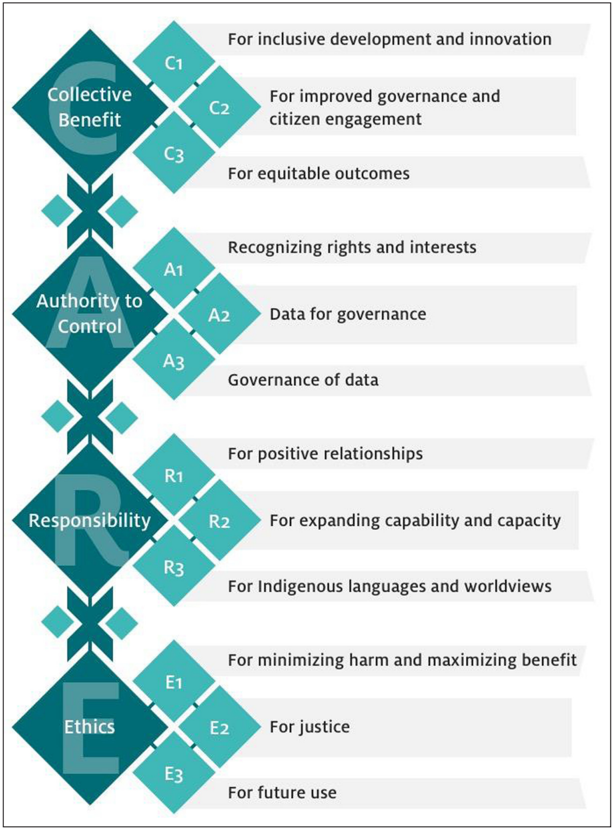
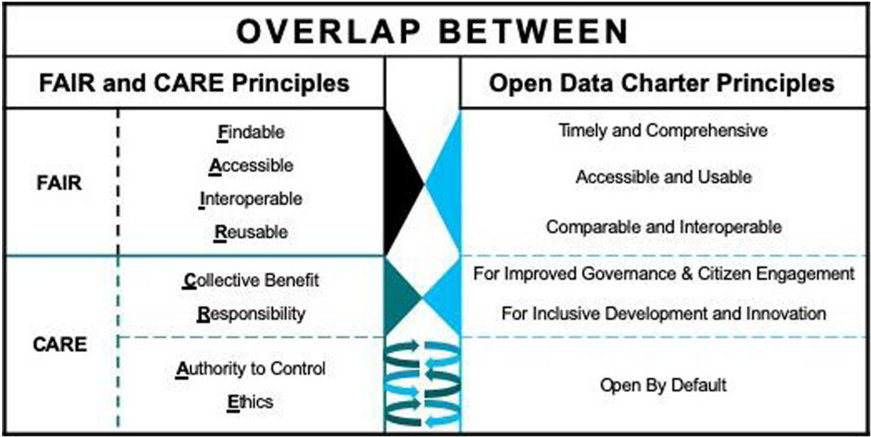
Concerns about secondary use of data and limited opportunities for benefit-sharing have focused attention on the tension that Indigenous communities feel between (1) protecting Indigenous rights and interests in Indigenous data (including traditional knowledges) and (2) supporting open data, machine learning, broad data sharing, and big data initiatives. The International Indigenous Data Sovereignty Interest Group (within the Research Data Alliance) is a network of nation-state based Indigenous data sovereignty networks and individuals that developed the ‘CARE Principles for Indigenous Data Governance’ (Collective Benefit, Authority to Control, Responsibility, and Ethics) in consultation with Indigenous Peoples, scholars, non-profit organizations, and governments. The CARE Principles are people– and purpose-oriented, reflecting the crucial role of data in advancing innovation, governance, and self-determination among Indigenous Peoples. The Principles complement the existing data-centric approach represented in the ‘FAIR Guiding Principles for scientific data management and stewardship’ (Findable, Accessible, Interoperable, Reusable). The CARE Principles build upon earlier work by the Te Mana Raraunga Maori Data Sovereignty Network, US Indigenous Data Sovereignty Network, Maiam nayri Wingara Aboriginal and Torres Strait Islander Data Sovereignty Collective, and numerous Indigenous Peoples, nations, and communities. The goal is that stewards and other users of Indigenous data will ‘Be FAIR and CARE.’ In this first formal publication of the CARE Principles, we articulate their rationale, describe their relation to the FAIR Principles, and present examples of their application.
Overview
CoChat Summary
TL;DR
The CARE Principles for Indigenous Data Governance (Collective Benefit, Authority to Control, Responsibility, and Ethics) are people- and purpose-oriented principles developed by the International Indigenous Data Sovereignty Interest Group to complement the data-centric FAIR Principles. They aim to support Indigenous rights, self-determination, and control over Indigenous data while enabling equitable data reuse.
Key findings
- CARE comprises four principles—Collective Benefit, Authority to Control, Responsibility, and Ethics—designed to complement FAIR (Findable, Accessible, Interoperable, Reusable) and guide data stewards and users to “Be FAIR and CARE.”
- The paper reports global context from UN 2009: Indigenous presence spans over 90 countries, includes over 370 million Indigenous persons, and involves more than 5,000 distinct cultures.
- CARE emerged from an Indigenous-led workshop held in Gaborone, Botswana, on 8 November 2018, as part of International Data Week, with later input from Indigenous leaders, scholars, network members, and allies.
- Early adopters/implementation examples include the Research Data Alliance, the Smithsonian Institution (e.g., Smithsonian Directive 609 and planned Collection CARE Notices), and the Open Data Charter.
Methods
- This is a conceptual/principles development paper, not an empirical study; it describes the rationale, development, and illustrative application of the CARE Principles.
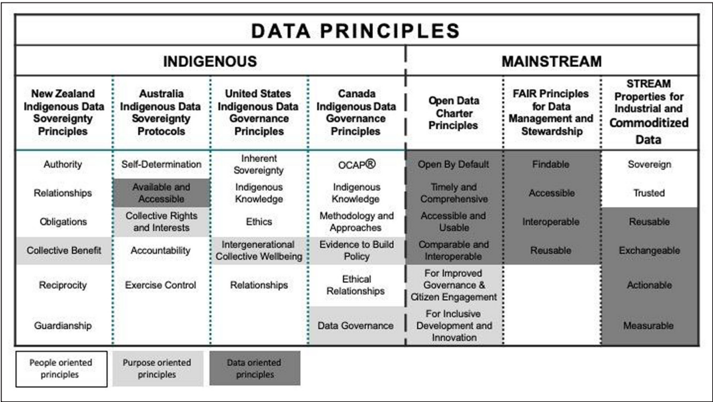
- Workshop organizers prepared an analysis of principles from Indigenous data sovereignty/governance frameworks and mainstream sources (Table 1) to inform dialogue; participants identified the four primary principles and drafted primary and sub-principles, then circulated the draft for input.
- The paper presents the principles’ relation to FAIR and examples of adoption; no formal sample, dataset, or statistical analysis is reported.
Limitations
- Stated: further research is needed to identify mechanisms that support implementation; create tools, policies, and practices that enact the Principles; explore application in different contexts (e.g., research repositories, knowledge co-production, institutional policies, existing databases/systems); and operationalize the Principles in tandem with FAIR.
- Evident: the paper is a principles publication and does not report empirical evaluation of implementation outcomes; the adoption examples are illustrative rather than systematically assessed.
Model-written summary. Check it against the paper before relying on it.
Integrity signals
Registry
Cites
Statistics
Figures
Verification
Claims the paper makes
0 Valid · 0 Not valid · 1 Not checked · 9 Own results and interpretations
- Probably not a substantial claim. 9
- It may state two separate claims as one. 5
Claims other papers make about this one
Each is checked against this paper’s own text: does it say what the citing paper says it does?
The source backs part of the claim, not all of it — or backs it for a different population, condition or comparison.
In the citing paper
“This can be in conflict with cultural values, e.g., in the case of indigenous communities that are generally underrepresented on Wikipedia but have concerns about how their knowledge might be exploited if shared [28, 29].”
From Data Governance in the Age of Large-Scale Data-Driven Language Technology (2022) · cites this paper as [28]
Experimental — accuracy not yet measuredThe source backs part of the claim, not all of it — or backs it for a different population, condition or comparison.
In the citing paper
“The key distinction is that while FAIR principles focus on making data maximally open and shareable-goals that align with scientific efficiency, CARE principles focus on people and purpose, emphasizing that data use should align with the rights and needs of Indigenous Peoples.”
From Data colonialism and indigenous languages in AI: a critical review of existing initiatives and their struggles with data sovereignty (2026) · cites this paper as Carroll et al. 2020
Experimental — accuracy not yet measuredThe source backs part of the claim, not all of it — or backs it for a different population, condition or comparison.
In the citing paper
“A concrete expression of Indigenous Data Sovereignty is found in the CARE Principles for Indigenous Data Governance, formulated in 2019 by the Global Indigenous Data Alliance and related networks (Carroll et al. 2020).”
From Data colonialism and indigenous languages in AI: a critical review of existing initiatives and their struggles with data sovereignty (2026) · cites this paper as Carroll et al. 2020
Experimental — accuracy not yet measuredThe source backs part of the claim, not all of it — or backs it for a different population, condition or comparison.
In the citing paper
“Indigenous data, whether born digital or not, include information, knowledge, specimens, and belongings about Indigenous Peoples to which they relate at both the individual and collective levels (Carroll et al., 2020; Rainie et al., 2019; Lovett et al., 2019).”
From Using Indigenous Standards to Implement the CARE Principles: Setting Expectations through Tribal Research Codes (2022) · cites this paper as Carroll et al., 2020
Experimental — accuracy not yet measuredThe source backs part of the claim, not all of it — or backs it for a different population, condition or comparison.
In the citing paper
“The FAIR Principles are aligned to the global shift towards open science and open data, promoting data centric criteria that facilitate increased data sharing among entities while ignoring relationships, power differentials, and the historical conditions associated with the collection of data10,11.”
From Operationalizing the CARE and FAIR Principles for Indigenous data futures (2021) · cites this paper as [11]
Experimental — accuracy not yet measured
6 more claims about this paper
Create a free account to see every claim other papers make about this one.
Self-check
Percentages, sums and reported differences re-computed from the paper’s own numbers.
Each contradiction between two passages listed here was confirmed by an independent check.
Rated minor: it would not touch a result — a value no result rests on, a p-value that stays on the same side of the significance level, or a conflict that is clerical, resolved elsewhere in the paper, or outside its own findings.
In the paper
§ The CARE Principles for Indigenous Data Governance > Research Data Alliance (www.rd-alliance.org), in research environments
“In 2012, the American Museum of Natural History at the Smithsonian Institution in Washington, DC released an Access and Benefit Sharing Policy on Genetic Resources”
§ The CARE Principles for Indigenous Data Governance > References
“42. Smithsonian Institution. 2012. Access and Benefit Sharing Policy on Genetics Resources. Washington, DC: National Museum of American History.”
Citations
Cites
The FAIR Guiding Principles for scientific data management and stewardship
Wilkinson, M. D., Dumontier, M., Aalbersberg, I. J., Appleton, G., Axton, M., Baak, A., Blomberg, N., Boiten, J.-W., da Silva Santos, L. B., Bourne, P. E., et al. (2016) · Scientific Data · doi:10.1038/sdata.2016.18 · Cited by 18,423
Indigenous Peoples In International Law: Second Edition
Anaya, S. J. (2004) · doi:10.1093/oso/9780195173499.001.0001 · Cited by 1,011
(2016) · doi:10.22459/caepr38.11.2016 · Cited by 696 · cited 6×
“…has become an increasingly relevant topic as big data, open data, open science, and data reuse become an integral part of research and institutional practices (Carroll, Rodriguez-Lonebear & Martinez 2019; Lovett et al. 2019; Rainie et al. 2019; Kukutai & Taylor 2016a; Taylor & Kukutai 2015).”
BackgroundInfluentialBuck, M., & Hamilton, C. (2011) · Review of European Community & International Environmental Law · doi:10.1111/j.1467-9388.2011.00703.x · Cited by 627
Indigenous Data Governance: Strategies from United States Native Nations
Carroll, S. R., Rodriguez-Lonebear, D., & Martinez, A. (2019) · Data Science Journal · doi:10.5334/dsj-2019-031 · Cited by 264
Self-citationGenomic Research Through an Indigenous Lens: Understanding the Expectations
Garrison, N. A., Hudson, M., Ballantyne, L. L., Garba, I., Martinez, A., Taualii, M., Arbour, L., Caron, N. R., & Rainie, S. C. (2019) · Annual Review of Genomics and Human Genetics · doi:10.1146/annurev-genom-083118-015434 · Cited by 220
Self-citationData sovereignty for indigenous peoples: current practice and future needs
Kukutai, T., & Taylor, J. (2016) · Indigenous Data Sovereignty · doi:10.22459/caepr38.11.2016.01 · Cited by 116
Rainie, S. C., Schultz, J. L., Briggs, E., Riggs, P., & Palmanteer-Holder, N. L. (2017) · International Indigenous Policy Journal · doi:10.18584/iipj.2017.8.2.1 · Cited by 114
Law, Knowledge, Culture: The Production of Indigenous Knowledge in Intellectual Property Law
Anderson, J. E. (2009) · Edward Elgar Publishing eBooks · doi:10.4337/9781848447196 · Cited by 95
Self-citationNational Inuit Strategy on Research.
Kanatami, I. T. (2018) · IOC of UNESCO (Intergovernmental Oceanographic Commission) · doi:10.25607/obp-1673 · Cited by 93
Research works printed but not linked: 18
- Cajete, G. 2000. Native science: Native laws of interdependence. Santa Fe: Clear Light.
- Castellano, MB. 2004. Ethics of Aboriginal research. Journal of Aboriginal Health, January, 98-114.
- Hudson, M, Milne, M, Russell, K, Smith, B, Reynolds, P and Atatoa-Carr, P. 2016. The Development of Guidelines for Indigenous Research Ethics in Aotearoa/New Zealand. In A.-L. Drugge (ed.), Ethics in Indigenous Research, Past Experiences -Future Challenges, 157-174. Umea, Sweden: Vaartoe Centre for Sami Research, Umea University.
- Drugge, A-L. 2016. Ethics in Indigenous Research: Past Experiences -Future Challenges. Umea, Sweden: Vaartoe Centre for Sami Research, Umea University.
- Julayinbul Statement in Indigenous Intellectual Property Rights. 1993. The Julayinbul Conference on Intellectual and Cultural Property. Australia: Jingarrba.
- Kovach, M. 2009. Indigenous methodologies: Characteristics, conversations, and contexts. Toronto: University of Toronto Press.
- Kukutai, T and Taylor, J. 2016a. Indigenous data sovereignty: Toward an agenda. Canberra, Australia: Aus- tralian National University Press. DOI: https://doi.org/10.22459/CAEPR38.11.2016 · DOI · Paper page
- Lovett, R, Lee, V, Kukutai, T, Cormack, D, Rainie, SC and Walker, J. 2019. Good data practices for Indigenous Data Sovereignty and Governance. In: Daly, A, Devitt, K and Monique, M (eds.), Good Data. Amsterdam: Institute of Network Cultures Inc. ISBN 978-94-92302-27-4.
- Mātaatua Declaration on Cultural and Intellectual Property Rights of Indigenous Peoples. 1993. First International Conference on the Cultural and Intellectual Property Rights of Indigenous Peoples. 12-18 June 1993. Aotearoa, New Zealand. Available at https://www.wipo.int/export/sites/www/tk/en/ databases/creative_heritage/docs/mataatua.pdf.
- McGregor, D, Restoule, JP and Johnston, R. (eds.) 2018. Indigenous research: Theories, practices, and rela- tionships. Canadian Scholars' Press.
- 2017, First Nations’ data governance: Measuring the nation-to-nation relationship discussion paper, British Columbia First Nations’ Data Governance Initiative
- Rainie, SC, Kukutai, T, Walter, M, Figueroa-Rodriguez, OL, Walker, J and Axelsson, P. 2019. Issues in Open Data: Indigenous Data Sovereignty. In: Davies, T, Walker, S, Rubinstein, M and Perini, F (eds.), The State of Open Data: Histories and Horizons. Cape Town and Ottawa: African Minds and International Development Research Centre. pp. 300-319.
- Ratima, M. 2001. Kia uruuru mai a hauora being healthy, being Maori: Conceptualising Maori health promotion. Published thesis (PhD) Department of Public Health. Dunedin, University of Otago.
- Ratima, M. 2001. Kia uruuru mai a hauora being healthy, being Maori: Conceptualising Maori health promotion. Published thesis (PhD) Department of Public Health. Dunedin, University of Otago. Research Data Alliance. 2017. International Indigenous Data Sovereignty Intertest Group. Available at https://www.rd-alliance.org/groups/international-indigenous-data-sovereignty-ig [Last accessed 17 January 2020].
- Snipp, CM. 2016. What does data sovereignty imply: what does it look like? In: Kukutai and Taylor, J (eds.), Indigenous data sovereignty: Toward an agenda. Canberra, Australia: Australian National University Press. pp. 39-55. DOI: https://doi.org/10.22459/CAEPR38.11.2016. · DOI · Paper page
- Smith, LT. 2012. Decolonizing Methodologies: Research and Indigenous Peoples. Zed Books. London: Univer- sity of Otago Press.
- Rodriguez-Lonebear, D. 2016. Building a data revolution in Indian country. In: Kukutai, T and Taylor, J (eds.), Indigenous data sovereignty: Toward an agenda. Canberra, Australia: Australian National University Press. pp. 253-272. DOI: https://doi.org/10.22459/CAEPR38.11.2016. · DOI · Paper page
- 2008, Research is ceremony: Indigenous research methods
Cited by
Items 901–1,000 of 1,410
Farmer, J., McCosker, A., Albury, K., & Aryani, A. (2022) · Springer eBooks · doi:10.1007/978-981-19-5554-9_1
Hagenström, F. (2022) · Science studies · doi:10.14361/9783839459669-005
Reeg, N. (2022) · Science studies · doi:10.14361/9783839459669-006
Frisch, K., Hagenström, F., & Reeg, N. (2022) · Science studies · doi:10.14361/9783839459669-009
Czesnick, H. (2022) · Science studies · doi:10.14361/9783839459669-002
Frisch, K. (2022) · Science studies · doi:10.14361/9783839459669-007
Schlussüberlegungen - Faire Wissenschaft
Frisch, K., Hagenström, F., & Reeg, N. (2022) · Science studies · doi:10.14361/9783839459669-008
Frisch, K., Hagenström, F., & Reeg, N. (2022) · Science studies · doi:10.14361/9783839459669-001
Frisch, K., Hagenström, F., & Reeg, N. (2022) · Science studies · doi:10.14361/9783839459669-toc
Steckt die Wissenschaft in einer Krise?
Frisch, K., Hagenström, F., & Reeg, N. (2022) · Science studies · doi:10.14361/9783839459669-003
Kapitel 1: Zwischen Integrität und Fehlverhalten
Frisch, K., Hagenström, F., & Reeg, N. (2022) · Science studies · doi:10.14361/9783839459669-004
Frisch, K., Hagenström, F., & Reeg, N. (2022) · Science studies · doi:10.14361/9783839459669-fm
Klöcking, M., Wyborn, L., Lehnert, K. A., Ware, B., Prent, A., Profeta, L. R., Kohlmann, F., Noble, W. P., Bruno, I. J., Lambart, S., et al. (2022) · doi:10.31223/x5h07q
Human Remains: Challenges and Future Directions
Nikita, E. (2022) · Elsevier eBooks · doi:10.1016/b978-0-323-90799-6.00026-4
(FAIRe) Forschungsdaten, Open Access und neue Formen der Kommunikation in der Romanistik
Trapp, M., & Vacano, J. V. (2022) · apropos [Perspektiven auf die Romania] · doi:10.15460/apropos.9.1899
Rißler-Pipka, N. (2022) · apropos [Perspektiven auf die Romania] · doi:10.15460/apropos.9.1933
How FAIR are pharma publication data?
Awodiya, E., & Osório, J. (2022) · Medical Writing · doi:10.56012/efip1000
Towards Equitable Health Outcomes Using Group Data Rights
Wachtel, G. (2022) · Digital ethics lab yearbook · doi:10.1007/978-3-031-09846-8_15
Tan, K. L. (2022) · DR-NTU (Nanyang Technological University) · doi:10.32657/10356/163438
Shaw, E. (2022) · Digital Commons - Michigan Tech (Michigan Technological University) · doi:10.37099/mtu.dc.etdr/1456 · Cited by 1
(2023) · Amerikastudien/American Studies · doi:10.33675/amst/2023/1/1
Research on the practice and exploration progress of data journals
Yan, X. I., Lihua, K. O. N. G., Yang, W. A. N. G., & Shushu, C. H. E. N. (2023) · China Scientific Data · doi:10.11922/11-6035.ncdc.2023.0001.zh
Island Digital Ecosystem Avatars (IDEA) Consortium: Infrastructure for Democratic Ecological Action
Davies, N. (2023) · Social and ecological interactions in the Galapagos Islands · doi:10.1007/978-3-031-28089-4_28
(2023) · Zeitschrift für Medienwissenschaft · doi:10.14361/zfmw-2023-150117
Garstki, K. (2023) · Elsevier eBooks · doi:10.1016/b978-0-323-90799-6.00176-2
An integrated framework for exploring critical zone architecture and evolutionPreprint
Singha, K., Sullivan, P., Billings, S., Walls, L., Jarecke, K. M., Li, L., Barnard, H., Gasparini, N. M., Madoff, R. D., Dhital, S., et al. (2023) · doi:10.22541/essoar.169049069.99859822/v1
Artificial Intelligence on Indian Reservations in the United States: Prospects and ChallengesPreprint
Crepelle, A., & Murtazashvili, I. (2023) · SSRN Electronic Journal · doi:10.2139/ssrn.4528766 · Cited by 1
Pinto, A. D., Eissa, A., Kiran, T., Mashford‐Pringle, A., Needham, A. C., & Dhalla, I. A. (2023) · Canadian Medical Association Journal · doi:10.1503/cmaj.221587-f
The Long Story of an Indigenous Health Research Project
Sullivan, P. S., & McIlduff, C. D. (2023) · Healthy Populations Journal · doi:10.15273/hpj.v3i1.11486
Liboiron, M., & Cotter, R. (2023) · Cambridge Prisms Plastics · doi:10.1017/plc.2023.16.pr4
Liboiron, M., & Cotter, R. (2023) · Cambridge Prisms Plastics · doi:10.1017/plc.2023.16.pr9
Decision: Review of participation of Indigenous peoples in plastics pollution governance — R0/PR5
Liboiron, M., & Cotter, R. (2023) · Cambridge Prisms Plastics · doi:10.1017/plc.2023.16.pr5
Decision: Review of participation of Indigenous peoples in plastics pollution governance — R1/PR10
Liboiron, M., & Cotter, R. (2023) · Cambridge Prisms Plastics · doi:10.1017/plc.2023.16.pr10
Review: Review of participation of Indigenous peoples in plastics pollution governance — R0/PR2
Liboiron, M., & Cotter, R. (2023) · Cambridge Prisms Plastics · doi:10.1017/plc.2023.16.pr2
Review: Review of participation of Indigenous peoples in plastics pollution governance — R0/PR3
Liboiron, M., & Cotter, R. (2023) · Cambridge Prisms Plastics · doi:10.1017/plc.2023.16.pr3
Review: Review of participation of Indigenous peoples in plastics pollution governance — R1/PR7
Liboiron, M., & Cotter, R. (2023) · Cambridge Prisms Plastics · doi:10.1017/plc.2023.16.pr7
Review: Review of participation of Indigenous peoples in plastics pollution governance — R1/PR8
Liboiron, M., & Cotter, R. (2023) · Cambridge Prisms Plastics · doi:10.1017/plc.2023.16.pr8
Liboiron, M. (2023) · Cambridge Prisms Plastics · doi:10.1017/plc.2023.16.pr1
Liboiron, M. (2023) · Cambridge Prisms Plastics · doi:10.1017/plc.2023.16.pr6
Research Data Sharing and Reuse in Canada: Practice and Policy
Goodchild, M., Khair, S., Leahey, A., Newson, K., & Lee, W. (2023) · doi:10.5206/xmmt2180
Jorayev, G. (2023) · Elsevier eBooks · doi:10.1016/b978-0-323-90799-6.00255-x
Kirkpatrick, C. R., Coakley, K. L., Christopher, J., & Dutra, I. (2023) · Data Science Journal · doi:10.5334/dsj-2023-032
Implementing the CARE Principles for Indigenous Data Governance in Biodiversity Data Management
Taitingfong, R. I., & Carroll, S. R. (2023) · Biodiversity Information Science and Standards · doi:10.3897/biss.7.112615
“The CARE Principles (Collective benefit, Authority to control, Responsibility, and Ethics) are designed to guide the inclusion of Indigenous peoples in data governance, and increase their access to and benefit from data (Carroll et al. 2020).”
BackgroundSelf-citationAutomating the Evaluation of Datasets for FAIR and CARE Principles
Yete, R., Purawat, S., Perez, I., Crawl, D. L., & Altıntaş, İ. (2023) · IEEE International Conference on eScience · doi:10.1109/e-science58273.2023.10254897
A bridge between: Te Ao Māori and Te Ara Paerangi
Kukutai, T., Parr‐Brownlie, L. C., & Pitama, S. G. (2023) · New Zealand Science Review · doi:10.26686/nzsr.vi.8256
“Few institutions had explicit data sovereignty policies or had even met minimum requirements, such as the CARE principles for Indigenous data governance (Carroll et al., 2020).”
BackgroundOpportunities and Challenges in Digitally Transforming World Heritage at 50+ Years
Quintero, M. S. (2023) · doi:10.1145/3607542.3617356
“For this reason, FAIR [3] and CARE [4] among other principles of digital data management desperately need adoption in improving the effectiveness and correctness of digital technologies used for world heritage.”
BackgroundReflections on Methodological Approaches and Challenges in Researching Children Born of War
Ødegaard, I. C., & Kleinau, E. (2023) · De Gruyter eBooks · doi:10.1515/9783111010649-003
Children and Youth at Risk in Times of Transition: International and Interdisciplinary Perspectives
Borge, B. H., Kleinau, E., & Ødegaard, I. C. (2023) · De Gruyter eBooks · doi:10.1515/9783111010649 · Cited by 1
Big Qual and the Future of Qualitative Analysis
Weller, S., Davidson, E., Edwards, R., & Jamieson, L. (2023) · Springer eBooks · doi:10.1007/978-3-031-36324-5_9
Weller, S., Davidson, E., Edwards, R., & Jamieson, L. (2023) · Springer eBooks · doi:10.1007/978-3-031-36324-5_8
Sterling, R., Blake, M. E., Jones, N., Hartshorn, R. M., & Kukutai, T. (2023) · doi:10.15663/uow.rdla.dec2023 · Cited by 4
Young, N. L., Anderson, M., Wabano, M. J., Trudeau, T., Jacko, D., Mallick, R., Momoli, F., Thavorn, K., Szatmári, P., Usuba, K., et al. (2023) · CMAJ Open · doi:10.9778/cmajo.20220119
The ELSI Virtual Forum, 30 Years of the Genome: Integrating and Applying ELSI Research
Moore, C. B., Dolan, D. D., Yarmolinsky, R., Cho, M. K., & Lee, S. S. (2023) · The Journal of Law Medicine & Ethics · doi:10.1017/jme.2023.109 · Cited by 1
Marine Microbiomes: Towards Standard Methods and Best Practices
(2023) · Frontiers research topics · doi:10.3389/978-2-8325-4131-9 · Cited by 1
Granados-García, P. L., & Ashley, C. (2023) · Ubiquity Press eBooks · doi:10.5334/bcv.j
How to avoid the “infrastructural blues”? Studying‐while‐caring for data stewardship
Murillo, L. F. R. (2023) · Annals of Anthropological Practice · doi:10.1111/napa.12208
Pierce, R. (2024) · ZRC SAZU, Založba ZRC eBooks · doi:10.3986/9789610508120_1
Achieving Equitable Education: Missing Education Data and the SDG 4 Data Regime
Delprato, M., & Shephard, D. D. (2024) · Edward Elgar Publishing eBooks · doi:10.4337/9781035313839 · Cited by 3
Gooden, A. (2024) · Frontiers in Pharmacology · doi:10.3389/fphar.2024.1304950 · Cited by 4
“The CARE Principles are people centered, and aim to ensure that research is done in such a way so as to bene fi t indigenous people, and to highlight the how data can further the innovation and self-determination of indigenous people (GIDA, 2019; DSI, 2022).”
BackgroundMethodInfluentialData Stewards, Curators, and Experts
Oxley, P. R., Maamar, S. B., & Wheeler, T. R. (2023) · IGI Global eBooks · doi:10.4018/979-8-3693-3026-5.ch026
Massiot, C., Adam, L., Boyd, E. S., Cary, S. C., Colman, D. R., Cox, A. D., Hughes, E., Kilgour, G., Lelli, M., Liotta, D., et al. (2024) · Scientific Drilling · doi:10.5194/sd-33-67-2024
Stephens, N., Nilson, C., Walker, R., & Marriott, R. (2024) · Health Education Journal · doi:10.1177/00178969241247763
“This advisory group approved the data management plan which was developed with Winjan Elders and leaders so as to meet CARE and FAIR principles for handling, managing, and/or analysing Indigenous data (Carroll et al., 2021, Lowitja Institute, 2023, Russo Carroll et al., 2020, Walter et al., 2020, National Health and M…”
Person-centred data sharing: Empirical studies in private individuals’ attitudes
Pickering, B., Boniface, M., Roth, S., Baker, K., & Taylor, S. (2024) · Open Research Europe · doi:10.12688/openreseurope.17330.1
“…(Carroll et al., 2020), these principles reposition research participants as “self - determining users of data for development and wellbeing” (Carroll et al., 2020; p.2) which in turn ensures that all stakeholders across the research data lifecycle are well represented and will potentially…”
InfluentialMeenken, E. D., Stevens, D. R., Turner, J. A., Zydenbos, S. M., Warbrick, L., Pletnyakov, P., Yoswara, H., Palmiero, C., Espig, M., King, W., et al. (2024) · SSRN Electronic Journal · doi:10.2139/ssrn.4809246
Community-led research, public engagement, and open science in Australian archaeology
Monks, C. (2024) · Australian Archaeology · doi:10.1080/03122417.2024.2317557
“Open data practices are guided by FAIR principles, which state that research data should be Findable, Accessible, Interoperable, and Reusable (Carroll et al. 2020).”
MethodResearch on building of scientific data security risk governance capability maturity model
Jin, M. (2023) · International Conference on Big Data, Artificial Intelligence and Risk Management (ICBAR) · doi:10.1145/3656766.3656895
“Data governance principles include “FAIR”, “CARE” and other principles [10], and vary with different data types.”
Background3. Enhancing Genomic Research Through the Lens of Indigenous Data Sovereignty
Garrison, N. A., & Carroll, S. R. (2024) · American Public Health Association eBooks · doi:10.2105/9780875533476ch03
Self-citationReal-Time Repatriation: Data Governance for Social Anthropology in the Twenty-First Century
Rose, J. W. W. (2024) · Ethnologie française · doi:10.3917/ethn.242.0017
Williams, B. M., Hanson, B. R., & Pandya, R. E. (2024) · Elsevier eBooks · doi:10.1016/b978-0-443-15654-0.00022-0
Williams, C. A., Lancaster, R., & Cruz, J. (2024) · Elsevier eBooks · doi:10.1016/b978-0-323-95689-5.00221-2
A GIS software-based method to identify public health data belonging to address-defined communities
Lam, A. M., Singletary, M., & Cullen, T. (2024) · Journal of the American Medical Informatics Association · doi:10.1093/jamia/ocae235
Models, data models, and big data
Brache, L. C., & Bokulich, A. (2024) · Routledge eBooks · doi:10.4324/9781003205647-22
Rebooting the global consensus: norm entrepreneurship, data governance and the majority worldPreprint
Taylor, L., & de Souza, S. P. (2024) · doi:10.31235/osf.io/a2utr
Issues in Reporting Cancer Statistics for Indigenous and Tribal Peoples
Griffiths, K. E., & Connolly, M. (2024) · Springer eBooks · doi:10.1007/978-3-031-56806-0_13
Considerations in Operationalizing Indigenous Data Sovereignty in Cancer Reporting
Griffiths, K. E. (2024) · Springer eBooks · doi:10.1007/978-3-031-56806-0_9 · Cited by 2
Introduction: Language corpora in Australia
Travis, C. E., & Nguyen, L. (2024) · Australian Journal of Linguistics · doi:10.1080/07268602.2024.2389151
“The CARE principles address issues around Indigenous data governance (Carroll et al., 2020), highlighting the importance of ensuring Collective bene fi ts, respecting Authority to control, engaging in Responsible practices and upholding Ethical behaviours (Figure 2).”
Hanson, B., McCann, R. B., & Smiley, D. (2024) · Journal of Sustainability Research · doi:10.20900/jsr20240061
Lee, J., Tyler, A. R. B., Veinot, T. C., & Yakel, E. (2024) · JMIR Public Health and Surveillance · doi:10.2196/66479
“This delicate balance could be achieved by drawing on frameworks such as the CARE Principles for collective rights [4] or data protection principles in humanitarian contexts.”
de Andrade, M. C., Baños-Moreno, M.-J., & Pastor-Sánchez, J.-A. (2024) · Revista española de Documentación Científica · doi:10.3989/redc.2024.2.1491 · Cited by 1
Frameworks, Failures, and Opportunities for Environmental Justice in Climate Negotiations
Albert, R. (2024) · ACS symposium series · doi:10.1021/bk-2024-1483.ch007
Ung, V. (2024) · Biodiversity Information Science and Standards · doi:10.3897/biss.8.141265
Implementing genomics research in developing countries: Common challenges, and emerging solutions
Reynolds, A. W., Lea, A. J., & Nieves-Colón, M. A. (2024) · Elsevier eBooks · doi:10.1016/b978-0-443-18546-5.00004-8
Ferreira-Lopes, P. (2024) · Santander Estudios de Patrimonio · doi:10.22429/euc2024.sep.07.04
Gray, M., Wessel, S., Oster, R. T., Bruno, G., Healy, C., Rich, R., Claringbold, S. S., Williams, K., & Henderson, R. (2024) · Journal of Health Services Research & Policy · doi:10.1177/13558196241300856
“20,21 Moreover, improved health care data is necessary for advancing Indigenous sovereignty and self-determination.”
Kemp, J., Drummond, C., & Watkinson, C. (2024) · Data & Policy · doi:10.1017/dap.2024.78
“In the workshop, the CARE Principles for Indigenous Data Governance (Collective Benefit, Authority to Control, Responsibility, Ethics) (Carroll et al., 2020) were raised as a way to consider data sensitivity.”
Wang, K., Britton, M. C., Hambleton, I. R., Howitt, C., Jeyaseelan, S. M., Fraser, K., Martinez‐Brockman, J. L., Whiteman, S., Rajeevan, H., & Nuñez-Smith, M. (2024) · Revista Panamericana de Salud Pública · doi:10.26633/rpsp.2024.121
Specht, A., Bryceson, K. P., Cao, S., O'Brien, M. C., Guru, S. M., Corrêa, P. L. P., & Waycott, M. (2025) · Data Science Journal · doi:10.5334/dsj-2025-001
Buchan, P. M., Mahu, E., Seeyave, S., Arbic, B. K., Gail, S., Maúre, E. D. R., Mahadeo, S., Kostianaia, E. A., Hermes, J. C., Sacedon, R., et al. (2025) · ICES Journal of Marine Science · doi:10.1093/icesjms/fsae174
Juip, J. (2024) · Digital Commons - Michigan Tech (Michigan Technological University) · doi:10.37099/mtu.dc.etdr/1829
Addressing the Empowerment Divide for the Successful Digitalisation of Indigenous Cultural Heritage
Cocq, C. (2025) · Springer eBooks · doi:10.1007/978-3-031-76941-2_10 · Cited by 1
Introduction: Advancing Sustainable Practices in Digital Indigenous Cultural Heritage
Linkola-Aikio, I.-A., Keskitalo, P., Ballardini, R. M., & Sarantou, M. (2025) · Springer eBooks · doi:10.1007/978-3-031-76941-2_1 · Cited by 1
Magnani, M., & Porsanger, J. (2025) · Springer eBooks · doi:10.1007/978-3-031-76941-2_2
Re-Conceptualizing Governance Policies on Data Access for ResearchPreprint
Aguerre, C. (2025) · SSRN Electronic Journal · doi:10.2139/ssrn.5062144
Right of Reply to Indigenous Knowledges and Information Held in Archives
Thorpe, K. (2025) · Springer eBooks · doi:10.1007/978-3-030-61493-5_106-1
Rebalancing open‐ness – an ethical analysis of publishing coroners’ reports online in Aotearoa
Deuchar, H., Cormack, D. M., & Jonas, M. (2025) · Kōtuitui New Zealand Journal of Social Sciences Online · doi:10.1080/1177083x.2025.2455172
Critical Data Discourses: A Lecture Series on the Ethics of Research Data
Rothfritz, L., & Frisch, K. (2025) · doi:10.59350/6dp70-2j455
Aligning Data Management Plans with Community Standards Using FAIR Implementation Profiles
Singh, N. K., Wang, S., Maineri, A., Hofstra, T., Bruyneel, M., van de Sandt, S., Siebes, R., van Ossenbruggen, J., & Kuhn, T. (2025) · Communications in computer and information science · doi:10.1007/978-3-031-81974-2_14
“Moreover, alternative principles exist next to FAIR, such as the CARE principles (Collective Benefit, Authority to Control, Responsibility, and Ethics) [1], calling for an extension of our approach in future work.”
Exploring control of access to the Japadhola indigenous information
Okello, G., Bukirwa, J., & Magara, E. (2025) · IFLA Journal · doi:10.1177/03400352241310511
“Western intellectual property frameworks, which emphasize individual rights and commercial interests, frequently overlook the communal nature of indigenous knowledge (Anderson, 2009; Carroll et al., 2020; Guillaume, 1981; Kukutai et al., 2020; Stevens, 2008; Tsosie et al., 2021).”
Estruturas de apoio às humanidades abertas
dos Santos, A. A., Lira, E. K. D. S., Bahia, E. M. D. S., & Álvarez, E. B. (2025) · Texto Livre Linguagem e Tecnologia · doi:10.1590/1983-3652.2025.53776
Metadata
- Authors
- Carroll, S. R., Garba, I., Figueroa-Rodríguez, O. L., Holbrook, J., Lovett, R., Materechera, S., Parsons, M., Raseroka, K., Rodriguez-Lonebear, D., Rowe, R., Sara, R., Walker, J. D., Anderson, J., & Hudson, M.
- Affiliations
- University of Arizona (US)
- University of the Western Cape (ZA)
- Australian National University (AU)
- North-West University (ZA)
- Rensselaer Polytechnic Institute (US)
- University of California, Los Angeles (US)
- Laurentian University (CA)
- New York University (US)
- University of Waikato (NZ)
- Corresponding author
- Carroll, Stephanie Russo
- ORCID
- Venue
- Data Science Journal
- Publisher
- Ubiquity Press, Ltd.
- Published
- 2020
- Volume
- 19
- ISSN
- 1683-1470 (ISSN-L)
- OpenAlex
- W3048186973
- Semantic Scholar
- 2b01e7dbaded2f74e39fe492ffda38d91c88d0e4
- Cited by
- 1,408
- References
- 19
- Citations by year
- 2026: 417 · 2025: 310 · 2024: 227 · 2023: 208 · 2022: 133 · 2021: 101 · 2020: 12
- FWCI
- 62.98
- Type
- journal article
- Language
- en
- Open access
- gold
- doi.org
- Licence
- Locations
- Data Science Journal (publishedVersion, cc-by)
- ANU Open Research (Australian National University) (submittedVersion, cc-by)
- Lincoln (University of Nebraska) (submittedVersion)
- DOAJ (DOAJ: Directory of Open Access Journals) (submittedVersion, cc-by-sa)
- Data Science Journal (submittedVersion, cc-by)
- Edinburgh Research Explorer (University of Edinburgh) (submittedVersion, cc-by)
- Funders
- European Commission (HORIZON2020, 777388)
- Rural Development Administration
- Topics
- Social Sciences › Health › Indigenous Health, Education, and Rights
- Physical Sciences › Computer Science › Information Systems › Research Data Management Practices
- Physical Sciences › Computer Science › Artificial Intelligence › Ethics and Social Impacts of AI
- Keywords
- Indigenous data sovereignty, CARE principles, Indigenous data governance, traditional knowledge, data reuse, benefit sharing, FAIR principles, data ethics, Indigenous self-determination, Research Data Alliance, data stewardship
About these checks
Registry, retraction, Cites and statistics results are computed, not judged, with one exception: a printed reference that no index lists is read once by a model before it counts as a citation error. Claims are extracted by a model and kept only when their quote appears verbatim in the text; each cited source is then checked, with a model’s help, for whether it says what the claim relies on. Those verdicts can be wrong — read the claim’s quote and the cited source before relying on one.
A language model drew the claims from the paper on 2026-10-30, under version 3 of the claim definition (model deepseek-v4.1-flash, prompt extract-v3).
A second model labelled each claim on 2026-10-30 (model jev-1.13-20260917, definition revision gold-guideline-v0.2).
Statistics and arithmetic are recomputed, not judged.
Confidence bands are shown only for fields calibrated on our annotated test set. None is calibrated yet, so no band is shown.
What counts as a claim ›How we measure confidence ›How we check this ›
Are you an author, or do you see a problem with this page? Request a review
Data sources
Bibliographic data: Semantic Scholar, OpenAlex, Crossref.
Contains information from the Semantic Scholar Academic Graph Datasets, made available under the ODC Attribution License (ODC-BY 1.0).
Semantic Scholar’s data is described in: Kinney, R., et al. (2023). The Semantic Scholar Open Data Platform. arXiv:2301.10140.
