

The CARE Principles for Indigenous Data Governance
Open accessThe DOI matches its Crossref record; 26 of the 27 references it cites were found in a registry or an index; none of the 1 sources its claims cite is checked for support yet.
Abstract
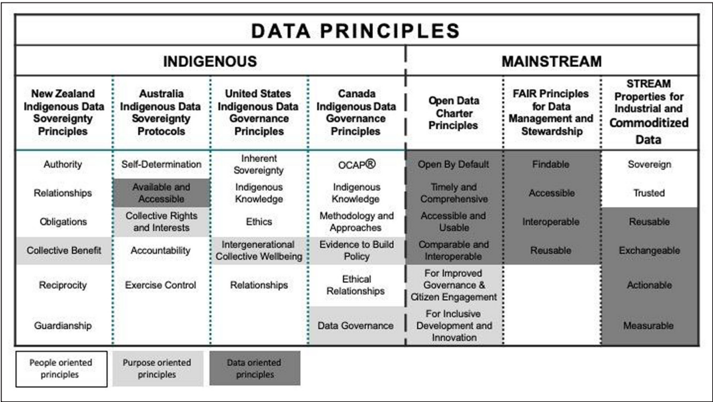
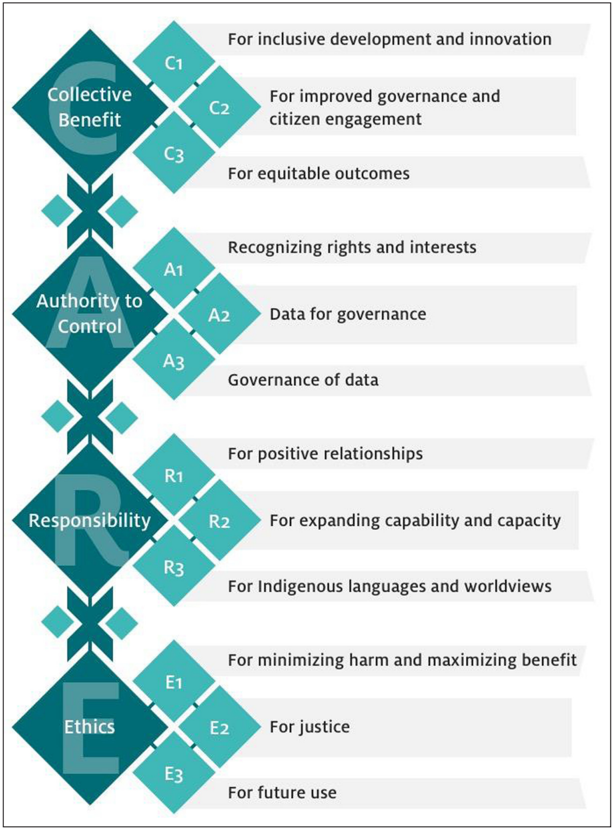
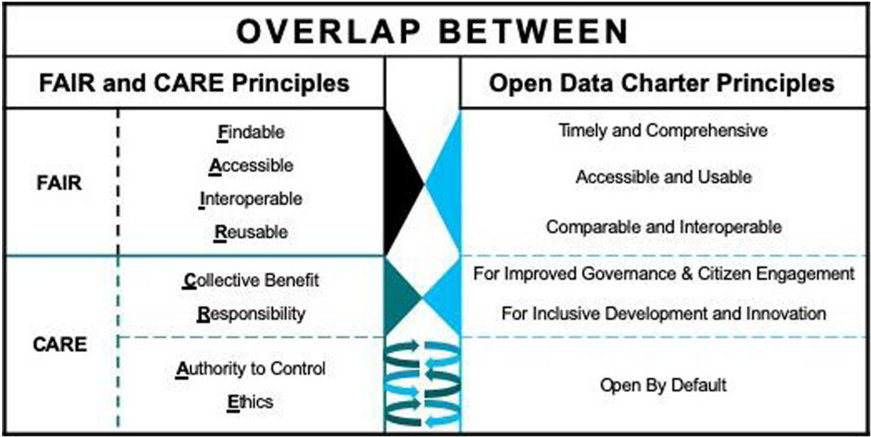
Concerns about secondary use of data and limited opportunities for benefit-sharing have focused attention on the tension that Indigenous communities feel between (1) protecting Indigenous rights and interests in Indigenous data (including traditional knowledges) and (2) supporting open data, machine learning, broad data sharing, and big data initiatives. The International Indigenous Data Sovereignty Interest Group (within the Research Data Alliance) is a network of nation-state based Indigenous data sovereignty networks and individuals that developed the ‘CARE Principles for Indigenous Data Governance’ (Collective Benefit, Authority to Control, Responsibility, and Ethics) in consultation with Indigenous Peoples, scholars, non-profit organizations, and governments. The CARE Principles are people– and purpose-oriented, reflecting the crucial role of data in advancing innovation, governance, and self-determination among Indigenous Peoples. The Principles complement the existing data-centric approach represented in the ‘FAIR Guiding Principles for scientific data management and stewardship’ (Findable, Accessible, Interoperable, Reusable). The CARE Principles build upon earlier work by the Te Mana Raraunga Maori Data Sovereignty Network, US Indigenous Data Sovereignty Network, Maiam nayri Wingara Aboriginal and Torres Strait Islander Data Sovereignty Collective, and numerous Indigenous Peoples, nations, and communities. The goal is that stewards and other users of Indigenous data will ‘Be FAIR and CARE.’ In this first formal publication of the CARE Principles, we articulate their rationale, describe their relation to the FAIR Principles, and present examples of their application.
Overview
CoChat Summary
TL;DR
The CARE Principles for Indigenous Data Governance (Collective Benefit, Authority to Control, Responsibility, and Ethics) are people- and purpose-oriented principles developed by the International Indigenous Data Sovereignty Interest Group to complement the data-centric FAIR Principles. They aim to support Indigenous rights, self-determination, and control over Indigenous data while enabling equitable data reuse.
Key findings
- CARE comprises four principles—Collective Benefit, Authority to Control, Responsibility, and Ethics—designed to complement FAIR (Findable, Accessible, Interoperable, Reusable) and guide data stewards and users to “Be FAIR and CARE.”
- The paper reports global context from UN 2009: Indigenous presence spans over 90 countries, includes over 370 million Indigenous persons, and involves more than 5,000 distinct cultures.
- CARE emerged from an Indigenous-led workshop held in Gaborone, Botswana, on 8 November 2018, as part of International Data Week, with later input from Indigenous leaders, scholars, network members, and allies.
- Early adopters/implementation examples include the Research Data Alliance, the Smithsonian Institution (e.g., Smithsonian Directive 609 and planned Collection CARE Notices), and the Open Data Charter.
Methods
- This is a conceptual/principles development paper, not an empirical study; it describes the rationale, development, and illustrative application of the CARE Principles.
- Workshop organizers prepared an analysis of principles from Indigenous data sovereignty/governance frameworks and mainstream sources (Table 1) to inform dialogue; participants identified the four primary principles and drafted primary and sub-principles, then circulated the draft for input.
- The paper presents the principles’ relation to FAIR and examples of adoption; no formal sample, dataset, or statistical analysis is reported.
Limitations
- Stated: further research is needed to identify mechanisms that support implementation; create tools, policies, and practices that enact the Principles; explore application in different contexts (e.g., research repositories, knowledge co-production, institutional policies, existing databases/systems); and operationalize the Principles in tandem with FAIR.
- Evident: the paper is a principles publication and does not report empirical evaluation of implementation outcomes; the adoption examples are illustrative rather than systematically assessed.
Model-written summary. Check it against the paper before relying on it.
Integrity signals
Registry
Cites
Statistics
Figures
Verification
Claims the paper makes
0 Valid · 0 Not valid · 1 Not checked · 9 Own results and interpretations
- Probably not a substantial claim. 9
- It may state two separate claims as one. 5
Claims other papers make about this one
Each is checked against this paper’s own text: does it say what the citing paper says it does?
The source backs part of the claim, not all of it — or backs it for a different population, condition or comparison.
In the citing paper
“This can be in conflict with cultural values, e.g., in the case of indigenous communities that are generally underrepresented on Wikipedia but have concerns about how their knowledge might be exploited if shared [28, 29].”
From Data Governance in the Age of Large-Scale Data-Driven Language Technology (2022) · cites this paper as [28]
Experimental — accuracy not yet measuredThe source backs part of the claim, not all of it — or backs it for a different population, condition or comparison.
In the citing paper
“The key distinction is that while FAIR principles focus on making data maximally open and shareable-goals that align with scientific efficiency, CARE principles focus on people and purpose, emphasizing that data use should align with the rights and needs of Indigenous Peoples.”
From Data colonialism and indigenous languages in AI: a critical review of existing initiatives and their struggles with data sovereignty (2026) · cites this paper as Carroll et al. 2020
Experimental — accuracy not yet measuredThe source backs part of the claim, not all of it — or backs it for a different population, condition or comparison.
In the citing paper
“A concrete expression of Indigenous Data Sovereignty is found in the CARE Principles for Indigenous Data Governance, formulated in 2019 by the Global Indigenous Data Alliance and related networks (Carroll et al. 2020).”
From Data colonialism and indigenous languages in AI: a critical review of existing initiatives and their struggles with data sovereignty (2026) · cites this paper as Carroll et al. 2020
Experimental — accuracy not yet measuredThe source backs part of the claim, not all of it — or backs it for a different population, condition or comparison.
In the citing paper
“Indigenous data, whether born digital or not, include information, knowledge, specimens, and belongings about Indigenous Peoples to which they relate at both the individual and collective levels (Carroll et al., 2020; Rainie et al., 2019; Lovett et al., 2019).”
From Using Indigenous Standards to Implement the CARE Principles: Setting Expectations through Tribal Research Codes (2022) · cites this paper as Carroll et al., 2020
Experimental — accuracy not yet measuredThe source backs part of the claim, not all of it — or backs it for a different population, condition or comparison.
In the citing paper
“The FAIR Principles are aligned to the global shift towards open science and open data, promoting data centric criteria that facilitate increased data sharing among entities while ignoring relationships, power differentials, and the historical conditions associated with the collection of data10,11.”
From Operationalizing the CARE and FAIR Principles for Indigenous data futures (2021) · cites this paper as [11]
Experimental — accuracy not yet measured
6 more claims about this paper
Create a free account to see every claim other papers make about this one.
Self-check
Percentages, sums and reported differences re-computed from the paper’s own numbers.
Each contradiction between two passages listed here was confirmed by an independent check.
Rated minor: it would not touch a result — a value no result rests on, a p-value that stays on the same side of the significance level, or a conflict that is clerical, resolved elsewhere in the paper, or outside its own findings.
In the paper
§ The CARE Principles for Indigenous Data Governance > Research Data Alliance (www.rd-alliance.org), in research environments
“In 2012, the American Museum of Natural History at the Smithsonian Institution in Washington, DC released an Access and Benefit Sharing Policy on Genetic Resources”
§ The CARE Principles for Indigenous Data Governance > References
“42. Smithsonian Institution. 2012. Access and Benefit Sharing Policy on Genetics Resources. Washington, DC: National Museum of American History.”
Citations
Cites
The FAIR Guiding Principles for scientific data management and stewardship
Wilkinson, M. D., Dumontier, M., Aalbersberg, I. J., Appleton, G., Axton, M., Baak, A., Blomberg, N., Boiten, J.-W., da Silva Santos, L. B., Bourne, P. E., et al. (2016) · Scientific Data · doi:10.1038/sdata.2016.18 · Cited by 18,423
Indigenous Peoples In International Law: Second Edition
Anaya, S. J. (2004) · doi:10.1093/oso/9780195173499.001.0001 · Cited by 1,011
(2016) · doi:10.22459/caepr38.11.2016 · Cited by 696 · cited 6×
“…has become an increasingly relevant topic as big data, open data, open science, and data reuse become an integral part of research and institutional practices (Carroll, Rodriguez-Lonebear & Martinez 2019; Lovett et al. 2019; Rainie et al. 2019; Kukutai & Taylor 2016a; Taylor & Kukutai 2015).”
BackgroundInfluentialBuck, M., & Hamilton, C. (2011) · Review of European Community & International Environmental Law · doi:10.1111/j.1467-9388.2011.00703.x · Cited by 627
Indigenous Data Governance: Strategies from United States Native Nations
Carroll, S. R., Rodriguez-Lonebear, D., & Martinez, A. (2019) · Data Science Journal · doi:10.5334/dsj-2019-031 · Cited by 264
Self-citationGenomic Research Through an Indigenous Lens: Understanding the Expectations
Garrison, N. A., Hudson, M., Ballantyne, L. L., Garba, I., Martinez, A., Taualii, M., Arbour, L., Caron, N. R., & Rainie, S. C. (2019) · Annual Review of Genomics and Human Genetics · doi:10.1146/annurev-genom-083118-015434 · Cited by 220
Self-citationData sovereignty for indigenous peoples: current practice and future needs
Kukutai, T., & Taylor, J. (2016) · Indigenous Data Sovereignty · doi:10.22459/caepr38.11.2016.01 · Cited by 116
Rainie, S. C., Schultz, J. L., Briggs, E., Riggs, P., & Palmanteer-Holder, N. L. (2017) · International Indigenous Policy Journal · doi:10.18584/iipj.2017.8.2.1 · Cited by 114
Law, Knowledge, Culture: The Production of Indigenous Knowledge in Intellectual Property Law
Anderson, J. E. (2009) · Edward Elgar Publishing eBooks · doi:10.4337/9781848447196 · Cited by 95
Self-citationNational Inuit Strategy on Research.
Kanatami, I. T. (2018) · IOC of UNESCO (Intergovernmental Oceanographic Commission) · doi:10.25607/obp-1673 · Cited by 93
Research works printed but not linked: 18
- Cajete, G. 2000. Native science: Native laws of interdependence. Santa Fe: Clear Light.
- Castellano, MB. 2004. Ethics of Aboriginal research. Journal of Aboriginal Health, January, 98-114.
- Hudson, M, Milne, M, Russell, K, Smith, B, Reynolds, P and Atatoa-Carr, P. 2016. The Development of Guidelines for Indigenous Research Ethics in Aotearoa/New Zealand. In A.-L. Drugge (ed.), Ethics in Indigenous Research, Past Experiences -Future Challenges, 157-174. Umea, Sweden: Vaartoe Centre for Sami Research, Umea University.
- Drugge, A-L. 2016. Ethics in Indigenous Research: Past Experiences -Future Challenges. Umea, Sweden: Vaartoe Centre for Sami Research, Umea University.
- Julayinbul Statement in Indigenous Intellectual Property Rights. 1993. The Julayinbul Conference on Intellectual and Cultural Property. Australia: Jingarrba.
- Kovach, M. 2009. Indigenous methodologies: Characteristics, conversations, and contexts. Toronto: University of Toronto Press.
- Kukutai, T and Taylor, J. 2016a. Indigenous data sovereignty: Toward an agenda. Canberra, Australia: Aus- tralian National University Press. DOI: https://doi.org/10.22459/CAEPR38.11.2016 · DOI · Paper page
- Lovett, R, Lee, V, Kukutai, T, Cormack, D, Rainie, SC and Walker, J. 2019. Good data practices for Indigenous Data Sovereignty and Governance. In: Daly, A, Devitt, K and Monique, M (eds.), Good Data. Amsterdam: Institute of Network Cultures Inc. ISBN 978-94-92302-27-4.
- Mātaatua Declaration on Cultural and Intellectual Property Rights of Indigenous Peoples. 1993. First International Conference on the Cultural and Intellectual Property Rights of Indigenous Peoples. 12-18 June 1993. Aotearoa, New Zealand. Available at https://www.wipo.int/export/sites/www/tk/en/ databases/creative_heritage/docs/mataatua.pdf.
- McGregor, D, Restoule, JP and Johnston, R. (eds.) 2018. Indigenous research: Theories, practices, and rela- tionships. Canadian Scholars' Press.
- 2017, First Nations’ data governance: Measuring the nation-to-nation relationship discussion paper, British Columbia First Nations’ Data Governance Initiative
- Rainie, SC, Kukutai, T, Walter, M, Figueroa-Rodriguez, OL, Walker, J and Axelsson, P. 2019. Issues in Open Data: Indigenous Data Sovereignty. In: Davies, T, Walker, S, Rubinstein, M and Perini, F (eds.), The State of Open Data: Histories and Horizons. Cape Town and Ottawa: African Minds and International Development Research Centre. pp. 300-319.
- Ratima, M. 2001. Kia uruuru mai a hauora being healthy, being Maori: Conceptualising Maori health promotion. Published thesis (PhD) Department of Public Health. Dunedin, University of Otago.
- Ratima, M. 2001. Kia uruuru mai a hauora being healthy, being Maori: Conceptualising Maori health promotion. Published thesis (PhD) Department of Public Health. Dunedin, University of Otago. Research Data Alliance. 2017. International Indigenous Data Sovereignty Intertest Group. Available at https://www.rd-alliance.org/groups/international-indigenous-data-sovereignty-ig [Last accessed 17 January 2020].
- Snipp, CM. 2016. What does data sovereignty imply: what does it look like? In: Kukutai and Taylor, J (eds.), Indigenous data sovereignty: Toward an agenda. Canberra, Australia: Australian National University Press. pp. 39-55. DOI: https://doi.org/10.22459/CAEPR38.11.2016. · DOI · Paper page
- Smith, LT. 2012. Decolonizing Methodologies: Research and Indigenous Peoples. Zed Books. London: Univer- sity of Otago Press.
- Rodriguez-Lonebear, D. 2016. Building a data revolution in Indian country. In: Kukutai, T and Taylor, J (eds.), Indigenous data sovereignty: Toward an agenda. Canberra, Australia: Australian National University Press. pp. 253-272. DOI: https://doi.org/10.22459/CAEPR38.11.2016. · DOI · Paper page
- 2008, Research is ceremony: Indigenous research methods
Cited by
Items 601–700 of 1,410
A comprehensive review of tree cover mapping using satellite sensor data
Saimun, M. S. R., & Rahman, M. M. (2025) · Discover Geoscience · doi:10.1007/s44288-025-00201-x · Cited by 8
“…case, adopting the CARE (Collective benefit, Authority to control, Responsibility, Ethics) and FAIR (Findable, Accessible, Interoperable, Reusable) principles ensures ethical data sharing and standardized protocols, promoting consistency and inclusivity across studies (for details see [70, 71]).”
Crumpen, S. (2023) · Archives and Manuscripts · doi:10.37683/asa.v50.10213 · Cited by 3
Attending to the Cultures of Data Science Work
Poirier, L. (2023) · Data Science Journal · doi:10.5334/dsj-2023-006 · Cited by 6
Meumann, E. M., Krause, V., Baird, R., & Currie, B. J. (2022) · Tropical Medicine and Infectious Disease · doi:10.3390/tropicalmed7080181 · Cited by 3
Maxwell, L., Shreedhar, P., Dauga, D., McQuilton, P., Terry, R. F., Denisiuk, A., Molnár‐Gábor, F., Saxena, A., & Sansone, S. (2021) · Research Square · doi:10.21203/rs.3.rs-1045632/v1 · Cited by 3
Morphy, F. (2022) · Wiley eBooks · doi:10.1002/9781118924396.wbiea2485 · Cited by 5
COVID-19 and policy for science
OECD (2023) · OECD science, technology and industry policy papers · doi:10.1787/8f86e60b-en · Cited by 10
Conzon, J. (2023) · Carleton University's Institutional Repository (MacOdrum Library, Carleton University) · doi:10.22215/etd/2023-15542 · Cited by 4
Ten simple rules for recognizing data and software contributions in hiring, promotion and tenurePreprint
Puebla, I., Ascoli, G. A., Blume, J. D., Chodacki, J., Finnell, J., Kennedy, D. N., Mair, B. A., Martone, M. E., Wittenberg, J., & Poline, J. (2024) · doi:10.31219/osf.io/u3c4y · Cited by 3
Common Rule Revisions to Govern Machine Learning on Indigenous Data: Implementing the Expectations
Halmai, N. B., Carroll, S. R., Garba, I., Yracheta, J., & Garrison, N. A. (2025) · The American Journal of Bioethics · doi:10.1080/15265161.2024.2441737 · Cited by 4
“This overlap can be understood from two perspectives: (1) the leading developers of the CARE Principles in Carroll et al. (2020) had just completed work on Garrison et al. (2019), benefitting from an understanding of research regulations and policies across nation-states, and were leading…”
Self-citationCopyright and Licencing for Cultural Heritage Collections As Data
Dişli, M., & Candela, G. (2024) · Journal of Open Humanities Data · doi:10.5334/johd.263 · Cited by 8
Technology-enabled Justice in Indian Courts: New Dilemmas and Way Forward
Mathew, D. (2024) · Journal of Development Policy and Practice · doi:10.1177/24551333241262892 · Cited by 2
“A people and purpose-oriented governance structure will offer visibility to the people behind this data (Carroll, et al., 2020) and promote inclu-sivity .”
Cybersecurity: Putting Indigenous Peoples First
Oliver, G., Lawrence, C., Timbery, N., Lilley, S., Rudolph, C., Whitty, M. T., & Saha, M. (2024) · Proceedings of the Association for Information Science and Technology · doi:10.1002/pra2.1068 · Cited by 2
“…rights to self-determination through CARE Full data practices that will ultimately address complex issues related to privacy, future use, and collective interests, and increase the value of data for reuse”(Carroll et al., 2020 p.8), collaboration with cybersecurity expertise will be essential.”
Biological Invasion Data Gaps in China: Examples of Distribution, Inventories, and Impact
He, J., Chen, K., Sun, P., Xu, H., & Pan, X. (2024) · Biology · doi:10.3390/biology13110872 · Cited by 2
Space technologies for development? Practicing sovereignty, beyond inclusion
Marino, A., Berardi, A., Mistry, J., Jafferally, D., Marcus, C.-A., Albert, G., David, N., Duncan, M., Jacobs, C., David, E., et al. (2024) · Environment and Planning D Society and Space · doi:10.1177/02637758241295514 · Cited by 3
“Open access data may make communities even more vulnerable to external harms (Carroll et al., 2020; Kukutai and Taylor, 2016).”
An introduction to conducting responsible and reproducible agricultural research
Ligowe, I. S., Joy, E. J. M., Manzeke-Kangara, M. G., Pino, L., Rivero, M. J., Devkota, M., Broadley, M. R., Haefele, S. M., & McGrath, S. P. (2024) · CABI Reviews · doi:10.1079/cabireviews.2024.0058 · Cited by 2
Fostering Linguistic Justice in Digital Spaces: Using Indigenous Methods in the Study of NLP
Gasparotto, M. (2024) · Emerging Media · doi:10.1177/27523543241305814 · Cited by 4
Data Sovereignty and Development: How do Native Americans View Data Sharing by Tribal Governments?
Feir, D. L., & Wellhausen, R. L. (2024) · PS Political Science & Politics · doi:10.1017/s1049096524000945 · Cited by 2
“…benefit, authority to control, responsibility, and ethics (CARE) such that data are to reflect the lived realities and ambitions of Indigenous people and not just those of the settler societies in which they find themselves (Carroll et al. 2020; Carroll et al. 2021; Kukutai and Taylor 2016).”
Regional conservation genomics: insights and opportunities from northern Australia
Cremona, T., von Takach, B., Shaw, R. E., Carey, A. R., Campbell, B. L., Cameron, S. F., Catullo, R. A., Chong, C., Cowen, S., Edwards, D. L., et al. (2025) · Biodiversity and Conservation · doi:10.1007/s10531-025-03053-6 · Cited by 3
“This means working closely with Indigenous communities and other stakeholders to ensure that the collection processes respect local customs, ecological knowledge, and social justice principles (Carroll et al. 2020).”
Measuring what matters: Building impact pathways to actionable information for the weADAPT platform
Bharwani, S., Williamson, K., & Butterfield, R. (2025) · Climate Services · doi:10.1016/j.cliser.2025.100574 · Cited by 6
Calewaert, J.-B., Sierra‐Correa, P. C., McMeel, O., McConnell, T., Fanjul, E. Á., & Leadbetter, A. M. (2025) · ICES Journal of Marine Science · doi:10.1093/icesjms/fsaf072 · Cited by 2
Mohanty, T. K., Smith, S. D., Bhattacharjee, T., Weir, C. J., & Norrie, J. D. (2025) · Journal of Global Health · doi:10.7189/jogh.15.03021 · Cited by 2
Mafile’o, T. A., Alofa, P., Kauongo, T., Saguba, L., Steven, H., Filoa, A., Sanga, F., Toloa, T., Isaako-Toloa, L., Halatuituia, S. N. K., et al. (2025) · Climate and Development · doi:10.1080/17565529.2025.2524421 · Cited by 10
“This approach also aligns with Indigenous data sovereignty principles prioritising collective benefit in climate change research (GIDA, 2022; Williamson et al., 2022).”
Laumann, K. M., Hoad, N. M., Alvaro, L., Badri, S., Burke, N., Carew, A., Corte, G. N., Cróquer, A., Esmaeili, Y. S., Farrell, M., et al. (2025) · Cambridge Prisms Coastal Futures · doi:10.1017/cft.2025.10004 · Cited by 4
“Specifically, the Collective benefit, Authority to control, Responsibility, Ethics (CARE) principles ensuring ethical handling of indigenous data (Carroll et al., 2020, 2021; Jennings et al., 2023) should be used by all researchers and organizations seeking partnerships with indigenous communities.”
Liu, N., & Russo, M. (2025) · Interpreting International Journal of Research and Practice in Interpreting · doi:10.1075/intp.00123.liu · Cited by 3
Swerdfager, T., Rangeley, R., & Frid, A. (2025) · FACETS · doi:10.1139/facets-2025-0184 · Cited by 3
Speculative Design Explorations for Sámi Digital Storytelling Futures
Qureshi, A., Paananen, S., Niemimäki, A., & Keskitalo, P. (2025) · International Conference on Mobile and Ubiquitous Multimedia (MUM) · doi:10.1145/3771882.3773956 · Cited by 2
“Guided by CARE and FAIR principles [2], the process prioritised reciprocity, transparency, and collective benefit.”
Djandja, O. S., Zhong, X., Yang, J., McIntyre, H., He, Q. S., & Ali, U. (2025) · Ecological Informatics · doi:10.1016/j.ecoinf.2025.103549 · Cited by 3
Zlotnikova, I., Mokgetse, T. L., & Hlomani, H. (2025) · ACM Global Computing Education Conference (CompEd) · doi:10.1145/3736181.3747148 · Cited by 6
Prehn, J., Guerzoni, M. A., Walter, M., Bodkin‐Andrews, G., & Maher, B. (2025) · Australian Journal of Social Issues · doi:10.1002/ajs4.70086 · Cited by 7
Essentials of research integrity for ecologists
Schlacher Thomas, A., Assaf, Y., Barboza, C. A. D. M., Corte, G. N., Leonardo, C., Dugan, J. E., Michael, E., Emery, K., Fanini, L., Hubbard, D. M., et al. (2025) · Estuarine Coastal and Shelf Science · doi:10.1016/j.ecss.2025.109686 · Cited by 2
Fraisl, D., Haklay, M., Hager, G. M., Wehn, U., See, L., Hecker, S., Tzovaras, B. G., Gold, M. M., Ceccaroni, L., Kieslinger, B., et al. (2026) · Open Research Europe · doi:10.12688/openreseurope.19411.2 · Cited by 2
Environmental data justice is key for developing more effective area-based conservation approaches
Goldstein, J. E., Brockington, D., Sandbrook, C. G., Meyfroidt, P., Geldmann, J., Kuemmerle, T., Pfeifer, M., Sauls, L. A., Vera, L. A., Dutta, A., et al. (2026) · Nature Reviews Biodiversity · doi:10.1038/s44358-025-00126-w · Cited by 4
Adams, J., Barnes, M., Moore, S., & Pinfield, S. (2026) · F1000Research · doi:10.12688/f1000research.178353.1 · Cited by 2
Mata, D., Gil, P., Bellido, Á., & Tello, O. (2026) · ISPRS International Journal of Geo-Information · doi:10.3390/ijgi15060228 · Cited by 2
Dhanda, S., Lee, E. M., Livermore, T., Paton, A. J., Westenberger, P., Williams, C., Milliken, W., Nesbitt, M., Begum, N., & Hudson, M. (2026) · Plants People Planet · doi:10.1002/ppp3.70227 · Cited by 2
“More recently, the CARE (Collective benefit; Authority to control; Responsibility; Ethics) principles set out data governance approaches to provide guidance on the creation, collection, storage and use of Indigenous data (Carroll et al., 2020).”
Self-citationHuvila, I. (2026) · Journal of Documentation · doi:10.1108/jd-11-2025-0367 · Cited by 3
“…that it is necessary in every single case to go all in: to make data fully compliant with, for example, FAIR (Wilkinson et al ., 2016), CARE (Carroll et al ., 2020), TRUST (Lin et al ., 2020) and LOUD (Newbury, 2018) principles, it is worthwhile to take seriously the FAIR mantra from EU’s…”
InfluentialMergen, A. (2026) · Business & Society · doi:10.1177/00076503261455110 · Cited by 2
Deep listening: A framework for collaborative climate adaptation
Gordon, E., Lim, Y., Paradis, J., Guarna, T., Degetau, G., & Vijaykumar, M. (2022) · Proceedings of DRS · doi:10.21606/drs.2022.802 · Cited by 3
Critical Perspectives for Educational Leadership and Policy in Higher Education
Brunette-Debassige, C., & Viczko, M. (2022) · Springer eBooks · doi:10.1007/978-3-030-86343-2_15 · Cited by 2
Archiving a TEI Project FAIRly
Creamer, A., Lembi, G., Mylonas, E., & Satlow, M. L. (2021) · Journal of the Text Encoding Initiative · doi:10.4000/jtei.4324 · Cited by 5
Overton, M., Kleinschmit, S. W., Feeney, M. K., Fusi, F., Hart, N., Maroulis, S. J., Schwoerer, K., Stokan, E., Thomas, H., & Workman, S. (2023) · Journal of Behavioral Public Administration · doi:10.30636/jbpa.61.330 · Cited by 2
QUALIDADE DOS DADOS NA WEB: REVISÃO INTEGRATIVA SOBRE DIRETRIZES PARA PUBLICAÇÃO
de Andrade, M. C., Baños-Moreno, M.-J., & Pastor-Sánchez, J.-A. (2023) · Perspectivas em Ciência da Informação · doi:10.1590/1981-5344/40663 · Cited by 7
Varney, R. (2023) · Integrative and Comparative Biology · doi:10.1093/icb/icad082 · Cited by 2
Harvestable Metadata Services Development: Analysis of Use Cases from the World Data System
Downs, R. R., Díaz, A. U., Xu, Q., Wang, J., Chambodut, A., Chuang, L. I. U., Flower, S., & Payne, K. L. (2023) · Data Science Journal · doi:10.5334/dsj-2023-020 · Cited by 2
Recognising Indigenous Provenance in Biodiversity Records
Hudson, M. L., Anderson, J., Taitingfong, R. I., Martinez, A. O., & Carroll, S. R. (2023) · Biodiversity Information Science and Standards · doi:10.3897/biss.7.112610 · Cited by 3
Self-citationFrom Ice Cores to Dinosaurs: Curation Behaviors of Physical Collections Managers
Bishop, B. W., Gavel, S. W. T., Chapin, E. G., Kansa, S. W., Thomer, A., & Ramdeen, S. (2023) · Proceedings of the Association for Information Science and Technology · doi:10.1002/pra2.810 · Cited by 2
“…considerations such as the CARE (Collective benefit, Authority to control, Responsibility, and Ethics) Principles for Indigenous Data Governance, and new US and other national mandates across funding agencies for as open data as possible (Wilkinson et al., 2016; Carroll et al. 2020; NIH, 2020).”
BackgroundO reúso de dados de pesquisa na perspectiva da Ciência da informação
Silveira, C. Z., & Dias, T. M. R. (2024) · Biblios Journal of Librarianship and Information Science · doi:10.5195/biblios.2023.1092 · Cited by 2
Warum wir eine gemeinwohlorientierte Medien- und Kommunikationswissenschaft brauchen
Arslan, S. C. (2024) · Publizistik · doi:10.1007/s11616-024-00832-z · Cited by 4
Research Data Management in the Humanities: Challenges and Opportunities in the Canadian Context
Higgins, S., Goddard, L., & Khair, S. (2024) · Digital Studies / Le champ numérique · doi:10.16995/dscn.9956 · Cited by 2
Hausam, S. (2024) · Frontiers in Sustainability · doi:10.3389/frsus.2024.1398130 · Cited by 2
Towards a taxonomy for Business-to-Government data sharing
Signorelli, S., Fontana, M., Vespe, M., Gabrielli, L., & Bertoni, E. (2024) · Statistical Journal of the IAOS · doi:10.3233/sji-230122 · Cited by 5
“Additional examples of principles that could be applied are the FAIR [7] and/or the CARE [8] ones, but as already anticipated, they do not cover the whole set of aspects that we envisioned.”
What Does It Mean to “Misuse” Research Data?
Pasquetto, I. V., Thomer, A., Acker, A., Chtena, N., & Desai, M. A. (2024) · Proceedings of the Association for Information Science and Technology · doi:10.1002/pra2.1108 · Cited by 3
Nelson, H. P., Ewert, D. N., Hulme, M. F., Lebbin, D. J., Mortensen, J., Robertson, H., Rusk, B. L., Sorenson, L. G., Haynes-Sutton, A. M., Tossas, A. G., et al. (2024) · Journal of Caribbean Ornithology · doi:10.55431/jco.2024.37.41-50 · Cited by 2
Justice in/and the Design of AI Risk Detection Technologies
Amidon, T. R., & Sackey, D. J. (2024) · ACM International Conference on Design of Communication (SIGDOC) · doi:10.1145/3641237.3691656 · Cited by 2
“In a study of rural perspectives in Australia that included First Nations and Local Aboriginal Land Councils, Randell-Moon and Hynes [64] observed that rural perceptions of S&CC technology is influenced by lived experiences with inequitable access to key infrastructures such unreliable access to…”
Widdicks, K., Samreen, F., Blair, G. S., Rennie, S., & Watkins, J. W. (2024) · Patterns · doi:10.1016/j.patter.2024.101092 · Cited by 2
“…best practices in the research community regarding stake-holders and data repositories within the DRI, e.g., TRUST principles for supporting trustworthiness among stakeholders 7 and CARE principles for data collaborations with indigenous communities, 8 extending these to assets more generally.”
Dunn, K. P. R., Biondi, M. J., & Lee, S. S. (2024) · Microorganisms · doi:10.3390/microorganisms12112364 · Cited by 2
“The CARE Principles for Indigenous Data Governance are defined as Collective Benefit, Authority to Control, Responsibility to relationships, and Ethics in representation and participation [59].”
Sedran-Price, C. (2024) · Nature · doi:10.1038/d41586-024-03640-7 · Cited by 2
Treloar, A. E., & Woodford, C. J. (2024) · Data Science Journal · doi:10.5334/dsj-2024-056 · Cited by 2
Flexner, J. L., Evans, S. L., & Hugues, A. F. (2024) · Curator The Museum Journal · doi:10.1111/cura.12668 · Cited by 2
“One proposal is to follow CARE principles, that is: Collective benefit; Authority to control; Responsibility; and Ethics in any repatri-ation process (Carroll et al. 2020).”
Depraetere, M., Akhlaq, S., Díaz, V. D., Heumann, I., & Schwarz, D. (2024) · Lecture notes in computer science · doi:10.1007/978-3-031-78590-0_8 · Cited by 2
Self-Reported Data for Sustainable Development from People Living in Rural and Remote Areas
Alabdali, S. A., Pileggi, S. F., & Bharathy, G. K. (2025) · Data · doi:10.3390/data10010006 · Cited by 2
“The CARE framework highlights the need for collective benefit, authority to control data, responsibility, and ethical considerations in data management [26].”
In harmony? A scoping review of methods to combine multiple 16S amplicon datasets
Li, Z. R., Chen, Y., Sun, Y., McKee, C., McArthur, K., Carnes, M. U., Liu, T., Mueller, N. T., Page, G. P., Rosman, L. M., et al. (2026) · AJE Advances Research in Epidemiology · doi:10.1093/ajeadv/uuag029 · Cited by 2
Early Career Perspectives to Broaden the Scope of Critical Zone Science
Warix, S. R., Johnson, K., Adamchak, C., Dumont, M., Kerins, D., Knapp, A. S., Sarup, O., Miller, H., Newman, C. P., D'Arcy, S., et al. (2025) · Earth s Future · doi:10.1029/2024ef005238 · Cited by 3
“Additionally, decisions about data storage and governance, attribution, confidentiality, and future use will need to be made collaboratively such that they support stakeholders' best interests (Carroll et al., 2020; Cooper et al., 2021).”
Measuring the diversity of data and metadata in digital libraries
Carrasco, R. C., Candela, G., & Such, M. M. (2025) · International Journal on Digital Libraries · doi:10.1007/s00799-025-00411-1 · Cited by 2
“Recenttrendsin data publication and reuse recommend to include documentation concerning historic and contemporary inequities such as known silences and/or biases in the collection [7, 26].”
Carroll, K. A., Grey, F., Anderson, N., Anderson, N., Goward, S., & Fisher, J. T. (2025) · Earth stewardship. · doi:10.1002/eas2.70009 · Cited by 4
Ortenzi, K. M., Jacque, J., Saunders, M., Schmidt, J. O., & Bailey, M. (2025) · Frontiers in Climate · doi:10.3389/fclim.2025.1527891 · Cited by 2
McIvor, I. H., Hogg, A., Roa, T., Waitoki, W., Boswijk, G., Gumbley, W., Anderson, A., & McBride, R. (2025) · Archaeometry · doi:10.1111/arcm.13074 · Cited by 2
Just smart? The comparative analysis of smart initiatives in North America and Nordic countries
Khaziakhmetova, D., Khodachek, I., Middleton, A., & Владимировна, К. В. (2025) · Polar Geography · doi:10.1080/1088937x.2025.2489169 · Cited by 3
“While this data can facilitate the development of informed urban solutions, it also raises substantial privacy concerns, especially related to protecting Indigenous rights, interests, and traditional knowledge (Carroll et al., 2020).”
Fraisl, D., Haklay, M., Hager, G., Wehn, U., See, L., Hecker, S., Tzovaras, B. G., Gold, M. M., Ceccaroni, L., Kieslinger, B., et al. (2025) · Open Research Europe · doi:10.12688/openreseurope.19411.1 · Cited by 4
Exploring the adoption of collections as data in the GLAM context
Dişli, M., Gabriëls, N., Chambers, S., Ames, S., Knazook, B., & Candela, G. (2025) · Information Research · doi:10.47989/ir30colis52252 · Cited by 2
Strength in Small Numbers: Indigenous Political Participation in Latin America
Boulding, C. E., Foxworth, R., & Verner, M. (2025) · Comparative Political Studies · doi:10.1177/00104140251328005 · Cited by 7
Conrad, J. E., Griffiths, L. L., Osborne, N., Smart, J. C. R., & Frid, C. L. J. (2025) · Marine and Freshwater Research · doi:10.1071/mf24180 · Cited by 3
Anderson, T. G., Pons, D., Taylor, M. J., Xuruc, A., Salvatierra, H. R., Guido, Z., Sullivan, J. A., Liverman, D. M., & Anchukaitis, K. J. (2025) · Climatic Change · doi:10.1007/s10584-025-03978-5 · Cited by 6
Buschbom, J., Bénichou, L., Agosti, D., Egloff, W., Herrmann, E., Kageyama, M., Kroh, A., & Mergen, P. (2025) · European Journal of Taxonomy · doi:10.5852/ejt.2025.1004.2971 · Cited by 2
Loupessis, I., Wesche, S. D., Teymouri, A., Peyton, L., Wabegijig, J., & Rennie, C. D. (2025) · FACETS · doi:10.1139/facets-2025-0018 · Cited by 2
Conrad, Z., Leu, M., Fulcher, E., Wu, S., DiStaso, C., Boston, J., Peterson, T., Roach, B., Tupponce, T., Phillips, J., et al. (2025) · Scientific Reports · doi:10.1038/s41598-025-13581-4 · Cited by 2
Maduka, O. C., & Akintola, S. (2025) · Wellcome Open Research · doi:10.12688/wellcomeopenres.24070.1 · Cited by 2
Romein, C. A., Kirmizialtin, S., Reshef, R., Schneider, C., Agostini, G., Charlton, A., Terras, M., Nockels, J., Ahn, S., Aladağ, F., et al. (2025) · International Journal of Digital Humanities · doi:10.1007/s42803-025-00107-7 · Cited by 2
“…and Reusable) principles by also incorporating the CARE (Collective Benefit, Authority to Control, Responsibility, and Ethics) principles proposed by the Global Indigenous Data Alliance (Wilkinson et al., 2016; Carroll et al., 2020; ‘CARE Principles of Indigenous Data Governance’, 2022).”
Acharya, C. N. (2025) · Journal of International Students · doi:10.32674/hhs39r16 · Cited by 4
“The research is fully aware and sincere, with cultural sensitivity aligned with indigenous CARE principles (Carroll, et al., 2020).”
Thorpe, K., & Booker, L. (2026) · Journal of the Australian Library and Information Association · doi:10.1080/24750158.2026.2654738 · Cited by 2
“These policy developments, combined with the growing influence of the CARE Principles for Indigenous Data Governance (Carroll et al., 2020) and frameworks from the Maiam nayri Wingara Indigenous Data Sovereignty Collective, create opportunities for Australian libraries to contribute to the global movement for Indigeno…”
InfluentialEvaluating QualiCO: an ontology to facilitate qualitative methods sharing to support open science
Hocker, J., Bipat, T., McDonald, D. W., & Zachry, M. R. (2021) · Journal of Internet Services and Applications · doi:10.1186/s13174-021-00135-w · Cited by 5
“When it comes to sharing of reserach data, there have been also several advances: the FAIR principles has undergone several developments [15] as well as have the platforms that embody CARE principles [16].”
BackgroundOpen Research Data in the Global South: Issues and Anomalies in the Indian Context
Das, A. K. (2020) · India studies in business and economics · doi:10.1007/978-981-15-6907-4_14 · Cited by 2
Data Consultations, Racism, and Critiquing Colonialism in Demographic Datasheets
Exner, N., Carrillo, E., & Leif, S. A. (2021) · Journal of eScience Librarianship · doi:10.7191/jeslib.2021.1213 · Cited by 2
Ocean Sciences Perspectives on Integrated, Coordinated, Open, Networked (ICON) Science
Graham, J., Hannides, A. K., Mamnun, N., Sitz, L. E., Walsh, I. D., Wood‐Charlson, E. M., & Ponsoni, L. (2022) · Earth and Space Science · doi:10.1029/2021ea002124 · Cited by 2
Open data and the 21st‐century naturalist
Cramer, A. N. (2022) · Frontiers in Ecology and the Environment · doi:10.1002/fee.2576 · Cited by 2
A Translation Service for Open Data Portals
Urbanek, S., & Schimmler, S. (2022) · JeDEM - eJournal of eDemocracy and Open Government · doi:10.29379/jedem.v14i2.733 · Cited by 2
Chaves, L. F., Gottdenker, N. L., Runk, J. V., & Bergmann, L. R. (2023) · Capitalism Nature Socialism · doi:10.1080/10455752.2022.2152065 · Cited by 3
“…stakeholders that ultimately make governance increasingly less democratic under a simulated umbrella of representation that con fl icts with the abilities of peoples, communities, and nations to participate in the re-appropriation and use of knowledge (Carroll et al. 2020; Latulippe and Klenk 2020).”
The Art, Science, and Magic of the Data Curation Network
Carlson, J. R., Narlock, M. R., Blake, M. R., Herndon, J., & Imker, H. J. (2023) · doi:10.3998/mpub.12782791 · Cited by 2
What's Missing from Data Modernization? A Focus on Structural Racism
Porter, J. M., Castrucci, B. C., & Orr, J. Y. (2023) · Health Equity · doi:10.1089/heq.2023.0086 · Cited by 2
Indigenous data sovereignty and missing education data
Prehn, J., Martin, K., & Bodkin‐Andrews, G. (2024) · Edward Elgar Publishing eBooks · doi:10.4337/9781035313839.00013 · Cited by 2
La justice en jeu : regard sur la recherche avec des êtres humains
Bergeron, M. G., Marceau, E., & Masella, M.-A. (2024) · Lex Electronica · doi:10.7202/1108626ar · Cited by 2
A population genomics analysis of the Aotearoa New Zealand endemic rewarewa tree (Knightia excelsa)
Cartney, A. M. M., Koot, E. M., Prebble, J. M., Jibran, R., Mitchell, C., Podolyan, A., Fergus, A. J. F., Arnst, E., Herron, K. E., Houliston, G. J., et al. (2024) · npj Biodiversity · doi:10.1038/s44185-024-00038-6 · Cited by 3
Toward a community model of scholarly editing: FAIR/CARE, research ethics, & labour visibility
Neumann, J., Richts, K., & Beer, N. (2024) · Journal of New Music Research · doi:10.1080/09298215.2024.2373049 · Cited by 2
“The CARE principles focus more on the rights of people involved in research, both subjects and practitioners (Research Data Alliance International Indigenous Data Sovereignty Interest Group, 2019).”
Annotating Upstream: Digital Scholars, Art History, and the Interoperable Image
Westerby, M. J. (2024) · Open Library of Humanities · doi:10.16995/olh.17217 · Cited by 2
European’s Union Open Science Policy as a global benchmark for Ukraine: legal environment
Орлюк, О. (2021) · Theory and Practice of Intellectual Property · doi:10.33731/62021.249468 · Cited by 12
Co-developing Openness: Indigenous Knowledge and Data Governance and Open Science in Canada
Hunter, A. (2021) · Carleton University's Institutional Repository (MacOdrum Library, Carleton University) · doi:10.22215/etd/2021-14620 · Cited by 2
Standardised Data on Initiatives – STARDIT: Beta VersionPreprint
Nunn, J., & Shafee, T. M. A. (2021) · OSF Preprints (OSF Preprints) · doi:10.31219/osf.io/w5xj6 · Cited by 2
Hallinan, D., Bernier, A., Cambon‐Thomsen, A., Crawley, F. P., Димитрова, Д., Medeiros, C. B., Nilsonne, G., Parker, S., Pickering, B., & Rennes, S. (2020) · SSRN Electronic Journal · doi:10.2139/ssrn.3688392 · Cited by 2
The potential of inclusive and collaborative Open Research processes at the science-policy interfacePreprint
Cole, N. L., Reichmann, S., & Ross‐Hellauer, T. (2023) · SocArXiv (OSF Preprints) · doi:10.31235/osf.io/qzmf6 · Cited by 2
Metadata
- Authors
- Carroll, S. R., Garba, I., Figueroa-Rodríguez, O. L., Holbrook, J., Lovett, R., Materechera, S., Parsons, M., Raseroka, K., Rodriguez-Lonebear, D., Rowe, R., Sara, R., Walker, J. D., Anderson, J., & Hudson, M.
- Affiliations
- University of Arizona (US)
- University of the Western Cape (ZA)
- Australian National University (AU)
- North-West University (ZA)
- Rensselaer Polytechnic Institute (US)
- University of California, Los Angeles (US)
- Laurentian University (CA)
- New York University (US)
- University of Waikato (NZ)
- Corresponding author
- Carroll, Stephanie Russo
- ORCID
- Venue
- Data Science Journal
- Publisher
- Ubiquity Press, Ltd.
- Published
- 2020
- Volume
- 19
- ISSN
- 1683-1470 (ISSN-L)
- OpenAlex
- W3048186973
- Semantic Scholar
- 2b01e7dbaded2f74e39fe492ffda38d91c88d0e4
- Cited by
- 1,408
- References
- 19
- Citations by year
- 2026: 417 · 2025: 310 · 2024: 227 · 2023: 208 · 2022: 133 · 2021: 101 · 2020: 12
- FWCI
- 62.98
- Type
- journal article
- Language
- en
- Open access
- gold
- doi.org
- Licence
- Locations
- Data Science Journal (publishedVersion, cc-by)
- ANU Open Research (Australian National University) (submittedVersion, cc-by)
- Lincoln (University of Nebraska) (submittedVersion)
- DOAJ (DOAJ: Directory of Open Access Journals) (submittedVersion, cc-by-sa)
- Data Science Journal (submittedVersion, cc-by)
- Edinburgh Research Explorer (University of Edinburgh) (submittedVersion, cc-by)
- Funders
- European Commission (HORIZON2020, 777388)
- Rural Development Administration
- Topics
- Social Sciences › Health › Indigenous Health, Education, and Rights
- Physical Sciences › Computer Science › Information Systems › Research Data Management Practices
- Physical Sciences › Computer Science › Artificial Intelligence › Ethics and Social Impacts of AI
- Keywords
- Indigenous data sovereignty, CARE principles, Indigenous data governance, traditional knowledge, data reuse, benefit sharing, FAIR principles, data ethics, Indigenous self-determination, Research Data Alliance, data stewardship
About these checks
Registry, retraction, Cites and statistics results are computed, not judged, with one exception: a printed reference that no index lists is read once by a model before it counts as a citation error. Claims are extracted by a model and kept only when their quote appears verbatim in the text; each cited source is then checked, with a model’s help, for whether it says what the claim relies on. Those verdicts can be wrong — read the claim’s quote and the cited source before relying on one.
A language model drew the claims from the paper on 2026-10-30, under version 3 of the claim definition (model deepseek-v4.1-flash, prompt extract-v3).
A second model labelled each claim on 2026-10-30 (model jev-1.13-20260917, definition revision gold-guideline-v0.2).
Statistics and arithmetic are recomputed, not judged.
Confidence bands are shown only for fields calibrated on our annotated test set. None is calibrated yet, so no band is shown.
What counts as a claim ›How we measure confidence ›How we check this ›
Are you an author, or do you see a problem with this page? Request a review
Data sources
Bibliographic data: Semantic Scholar, OpenAlex, Crossref.
Contains information from the Semantic Scholar Academic Graph Datasets, made available under the ODC Attribution License (ODC-BY 1.0).
Semantic Scholar’s data is described in: Kinney, R., et al. (2023). The Semantic Scholar Open Data Platform. arXiv:2301.10140.
