

The CARE Principles for Indigenous Data Governance
Open accessThe DOI matches its Crossref record; 26 of the 27 references it cites were found in a registry or an index; none of the 1 sources its claims cite is checked for support yet.
Abstract
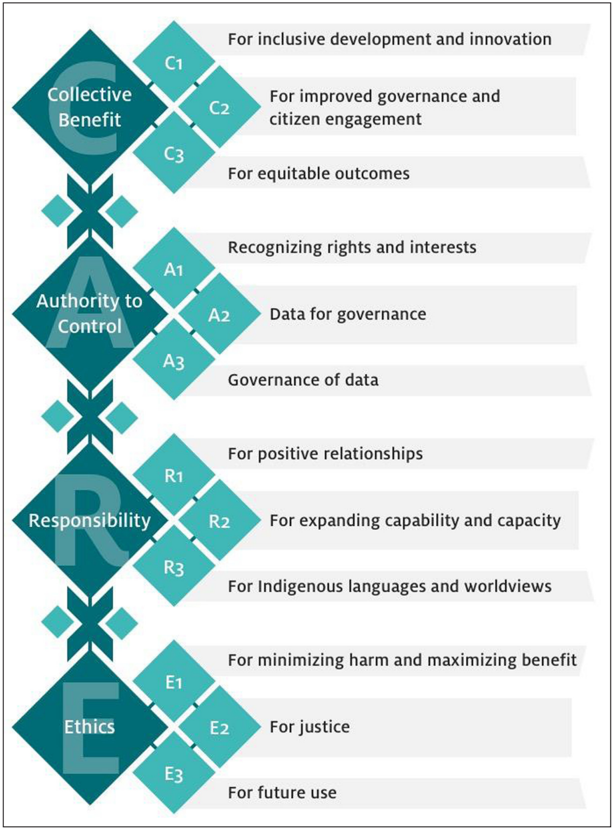
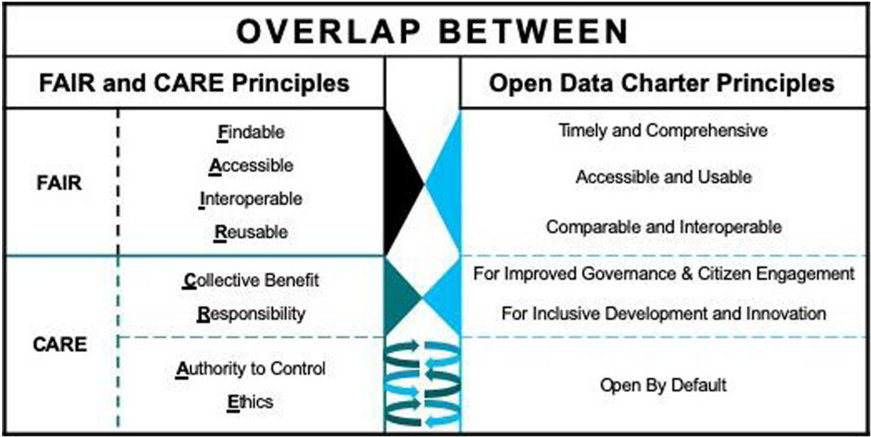
Concerns about secondary use of data and limited opportunities for benefit-sharing have focused attention on the tension that Indigenous communities feel between (1) protecting Indigenous rights and interests in Indigenous data (including traditional knowledges) and (2) supporting open data, machine learning, broad data sharing, and big data initiatives. The International Indigenous Data Sovereignty Interest Group (within the Research Data Alliance) is a network of nation-state based Indigenous data sovereignty networks and individuals that developed the ‘CARE Principles for Indigenous Data Governance’ (Collective Benefit, Authority to Control, Responsibility, and Ethics) in consultation with Indigenous Peoples, scholars, non-profit organizations, and governments. The CARE Principles are people– and purpose-oriented, reflecting the crucial role of data in advancing innovation, governance, and self-determination among Indigenous Peoples. The Principles complement the existing data-centric approach represented in the ‘FAIR Guiding Principles for scientific data management and stewardship’ (Findable, Accessible, Interoperable, Reusable). The CARE Principles build upon earlier work by the Te Mana Raraunga Maori Data Sovereignty Network, US Indigenous Data Sovereignty Network, Maiam nayri Wingara Aboriginal and Torres Strait Islander Data Sovereignty Collective, and numerous Indigenous Peoples, nations, and communities. The goal is that stewards and other users of Indigenous data will ‘Be FAIR and CARE.’ In this first formal publication of the CARE Principles, we articulate their rationale, describe their relation to the FAIR Principles, and present examples of their application.
Overview
CoChat Summary
TL;DR
The CARE Principles for Indigenous Data Governance (Collective Benefit, Authority to Control, Responsibility, and Ethics) are people- and purpose-oriented principles developed by the International Indigenous Data Sovereignty Interest Group to complement the data-centric FAIR Principles. They aim to support Indigenous rights, self-determination, and control over Indigenous data while enabling equitable data reuse.
Key findings
- CARE comprises four principles—Collective Benefit, Authority to Control, Responsibility, and Ethics—designed to complement FAIR (Findable, Accessible, Interoperable, Reusable) and guide data stewards and users to “Be FAIR and CARE.”
- The paper reports global context from UN 2009: Indigenous presence spans over 90 countries, includes over 370 million Indigenous persons, and involves more than 5,000 distinct cultures.
- CARE emerged from an Indigenous-led workshop held in Gaborone, Botswana, on 8 November 2018, as part of International Data Week, with later input from Indigenous leaders, scholars, network members, and allies.
- Early adopters/implementation examples include the Research Data Alliance, the Smithsonian Institution (e.g., Smithsonian Directive 609 and planned Collection CARE Notices), and the Open Data Charter.
Methods
- This is a conceptual/principles development paper, not an empirical study; it describes the rationale, development, and illustrative application of the CARE Principles.
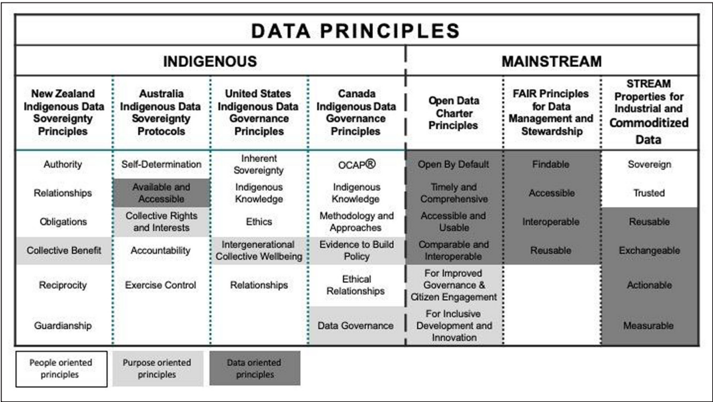
- Workshop organizers prepared an analysis of principles from Indigenous data sovereignty/governance frameworks and mainstream sources (Table 1) to inform dialogue; participants identified the four primary principles and drafted primary and sub-principles, then circulated the draft for input.
- The paper presents the principles’ relation to FAIR and examples of adoption; no formal sample, dataset, or statistical analysis is reported.
Limitations
- Stated: further research is needed to identify mechanisms that support implementation; create tools, policies, and practices that enact the Principles; explore application in different contexts (e.g., research repositories, knowledge co-production, institutional policies, existing databases/systems); and operationalize the Principles in tandem with FAIR.
- Evident: the paper is a principles publication and does not report empirical evaluation of implementation outcomes; the adoption examples are illustrative rather than systematically assessed.
Model-written summary. Check it against the paper before relying on it.
Integrity signals
Registry
Cites
Statistics
Figures
Verification
Claims the paper makes
0 Valid · 0 Not valid · 1 Not checked · 9 Own results and interpretations
- Probably not a substantial claim. 9
- It may state two separate claims as one. 5
Claims other papers make about this one
Each is checked against this paper’s own text: does it say what the citing paper says it does?
The source backs part of the claim, not all of it — or backs it for a different population, condition or comparison.
In the citing paper
“This can be in conflict with cultural values, e.g., in the case of indigenous communities that are generally underrepresented on Wikipedia but have concerns about how their knowledge might be exploited if shared [28, 29].”
From Data Governance in the Age of Large-Scale Data-Driven Language Technology (2022) · cites this paper as [28]
Experimental — accuracy not yet measuredThe source backs part of the claim, not all of it — or backs it for a different population, condition or comparison.
In the citing paper
“The key distinction is that while FAIR principles focus on making data maximally open and shareable-goals that align with scientific efficiency, CARE principles focus on people and purpose, emphasizing that data use should align with the rights and needs of Indigenous Peoples.”
From Data colonialism and indigenous languages in AI: a critical review of existing initiatives and their struggles with data sovereignty (2026) · cites this paper as Carroll et al. 2020
Experimental — accuracy not yet measuredThe source backs part of the claim, not all of it — or backs it for a different population, condition or comparison.
In the citing paper
“A concrete expression of Indigenous Data Sovereignty is found in the CARE Principles for Indigenous Data Governance, formulated in 2019 by the Global Indigenous Data Alliance and related networks (Carroll et al. 2020).”
From Data colonialism and indigenous languages in AI: a critical review of existing initiatives and their struggles with data sovereignty (2026) · cites this paper as Carroll et al. 2020
Experimental — accuracy not yet measuredThe source backs part of the claim, not all of it — or backs it for a different population, condition or comparison.
In the citing paper
“Indigenous data, whether born digital or not, include information, knowledge, specimens, and belongings about Indigenous Peoples to which they relate at both the individual and collective levels (Carroll et al., 2020; Rainie et al., 2019; Lovett et al., 2019).”
From Using Indigenous Standards to Implement the CARE Principles: Setting Expectations through Tribal Research Codes (2022) · cites this paper as Carroll et al., 2020
Experimental — accuracy not yet measuredThe source backs part of the claim, not all of it — or backs it for a different population, condition or comparison.
In the citing paper
“The FAIR Principles are aligned to the global shift towards open science and open data, promoting data centric criteria that facilitate increased data sharing among entities while ignoring relationships, power differentials, and the historical conditions associated with the collection of data10,11.”
From Operationalizing the CARE and FAIR Principles for Indigenous data futures (2021) · cites this paper as [11]
Experimental — accuracy not yet measured
6 more claims about this paper
Create a free account to see every claim other papers make about this one.
Self-check
Percentages, sums and reported differences re-computed from the paper’s own numbers.
Each contradiction between two passages listed here was confirmed by an independent check.
Rated minor: it would not touch a result — a value no result rests on, a p-value that stays on the same side of the significance level, or a conflict that is clerical, resolved elsewhere in the paper, or outside its own findings.
In the paper
§ The CARE Principles for Indigenous Data Governance > Research Data Alliance (www.rd-alliance.org), in research environments
“In 2012, the American Museum of Natural History at the Smithsonian Institution in Washington, DC released an Access and Benefit Sharing Policy on Genetic Resources”
§ The CARE Principles for Indigenous Data Governance > References
“42. Smithsonian Institution. 2012. Access and Benefit Sharing Policy on Genetics Resources. Washington, DC: National Museum of American History.”
Citations
Cites
The FAIR Guiding Principles for scientific data management and stewardship
Wilkinson, M. D., Dumontier, M., Aalbersberg, I. J., Appleton, G., Axton, M., Baak, A., Blomberg, N., Boiten, J.-W., da Silva Santos, L. B., Bourne, P. E., et al. (2016) · Scientific Data · doi:10.1038/sdata.2016.18 · Cited by 18,423
Indigenous Peoples In International Law: Second Edition
Anaya, S. J. (2004) · doi:10.1093/oso/9780195173499.001.0001 · Cited by 1,011
(2016) · doi:10.22459/caepr38.11.2016 · Cited by 696 · cited 6×
“…has become an increasingly relevant topic as big data, open data, open science, and data reuse become an integral part of research and institutional practices (Carroll, Rodriguez-Lonebear & Martinez 2019; Lovett et al. 2019; Rainie et al. 2019; Kukutai & Taylor 2016a; Taylor & Kukutai 2015).”
BackgroundInfluentialBuck, M., & Hamilton, C. (2011) · Review of European Community & International Environmental Law · doi:10.1111/j.1467-9388.2011.00703.x · Cited by 627
Indigenous Data Governance: Strategies from United States Native Nations
Carroll, S. R., Rodriguez-Lonebear, D., & Martinez, A. (2019) · Data Science Journal · doi:10.5334/dsj-2019-031 · Cited by 264
Self-citationGenomic Research Through an Indigenous Lens: Understanding the Expectations
Garrison, N. A., Hudson, M., Ballantyne, L. L., Garba, I., Martinez, A., Taualii, M., Arbour, L., Caron, N. R., & Rainie, S. C. (2019) · Annual Review of Genomics and Human Genetics · doi:10.1146/annurev-genom-083118-015434 · Cited by 220
Self-citationData sovereignty for indigenous peoples: current practice and future needs
Kukutai, T., & Taylor, J. (2016) · Indigenous Data Sovereignty · doi:10.22459/caepr38.11.2016.01 · Cited by 116
Rainie, S. C., Schultz, J. L., Briggs, E., Riggs, P., & Palmanteer-Holder, N. L. (2017) · International Indigenous Policy Journal · doi:10.18584/iipj.2017.8.2.1 · Cited by 114
Law, Knowledge, Culture: The Production of Indigenous Knowledge in Intellectual Property Law
Anderson, J. E. (2009) · Edward Elgar Publishing eBooks · doi:10.4337/9781848447196 · Cited by 95
Self-citationNational Inuit Strategy on Research.
Kanatami, I. T. (2018) · IOC of UNESCO (Intergovernmental Oceanographic Commission) · doi:10.25607/obp-1673 · Cited by 93
Research works printed but not linked: 18
- Cajete, G. 2000. Native science: Native laws of interdependence. Santa Fe: Clear Light.
- Castellano, MB. 2004. Ethics of Aboriginal research. Journal of Aboriginal Health, January, 98-114.
- Hudson, M, Milne, M, Russell, K, Smith, B, Reynolds, P and Atatoa-Carr, P. 2016. The Development of Guidelines for Indigenous Research Ethics in Aotearoa/New Zealand. In A.-L. Drugge (ed.), Ethics in Indigenous Research, Past Experiences -Future Challenges, 157-174. Umea, Sweden: Vaartoe Centre for Sami Research, Umea University.
- Drugge, A-L. 2016. Ethics in Indigenous Research: Past Experiences -Future Challenges. Umea, Sweden: Vaartoe Centre for Sami Research, Umea University.
- Julayinbul Statement in Indigenous Intellectual Property Rights. 1993. The Julayinbul Conference on Intellectual and Cultural Property. Australia: Jingarrba.
- Kovach, M. 2009. Indigenous methodologies: Characteristics, conversations, and contexts. Toronto: University of Toronto Press.
- Kukutai, T and Taylor, J. 2016a. Indigenous data sovereignty: Toward an agenda. Canberra, Australia: Aus- tralian National University Press. DOI: https://doi.org/10.22459/CAEPR38.11.2016 · DOI · Paper page
- Lovett, R, Lee, V, Kukutai, T, Cormack, D, Rainie, SC and Walker, J. 2019. Good data practices for Indigenous Data Sovereignty and Governance. In: Daly, A, Devitt, K and Monique, M (eds.), Good Data. Amsterdam: Institute of Network Cultures Inc. ISBN 978-94-92302-27-4.
- Mātaatua Declaration on Cultural and Intellectual Property Rights of Indigenous Peoples. 1993. First International Conference on the Cultural and Intellectual Property Rights of Indigenous Peoples. 12-18 June 1993. Aotearoa, New Zealand. Available at https://www.wipo.int/export/sites/www/tk/en/ databases/creative_heritage/docs/mataatua.pdf.
- McGregor, D, Restoule, JP and Johnston, R. (eds.) 2018. Indigenous research: Theories, practices, and rela- tionships. Canadian Scholars' Press.
- 2017, First Nations’ data governance: Measuring the nation-to-nation relationship discussion paper, British Columbia First Nations’ Data Governance Initiative
- Rainie, SC, Kukutai, T, Walter, M, Figueroa-Rodriguez, OL, Walker, J and Axelsson, P. 2019. Issues in Open Data: Indigenous Data Sovereignty. In: Davies, T, Walker, S, Rubinstein, M and Perini, F (eds.), The State of Open Data: Histories and Horizons. Cape Town and Ottawa: African Minds and International Development Research Centre. pp. 300-319.
- Ratima, M. 2001. Kia uruuru mai a hauora being healthy, being Maori: Conceptualising Maori health promotion. Published thesis (PhD) Department of Public Health. Dunedin, University of Otago.
- Ratima, M. 2001. Kia uruuru mai a hauora being healthy, being Maori: Conceptualising Maori health promotion. Published thesis (PhD) Department of Public Health. Dunedin, University of Otago. Research Data Alliance. 2017. International Indigenous Data Sovereignty Intertest Group. Available at https://www.rd-alliance.org/groups/international-indigenous-data-sovereignty-ig [Last accessed 17 January 2020].
- Snipp, CM. 2016. What does data sovereignty imply: what does it look like? In: Kukutai and Taylor, J (eds.), Indigenous data sovereignty: Toward an agenda. Canberra, Australia: Australian National University Press. pp. 39-55. DOI: https://doi.org/10.22459/CAEPR38.11.2016. · DOI · Paper page
- Smith, LT. 2012. Decolonizing Methodologies: Research and Indigenous Peoples. Zed Books. London: Univer- sity of Otago Press.
- Rodriguez-Lonebear, D. 2016. Building a data revolution in Indian country. In: Kukutai, T and Taylor, J (eds.), Indigenous data sovereignty: Toward an agenda. Canberra, Australia: Australian National University Press. pp. 253-272. DOI: https://doi.org/10.22459/CAEPR38.11.2016. · DOI · Paper page
- 2008, Research is ceremony: Indigenous research methods
Cited by
Items 1,301–1,400 of 1,410
Jose, J., K, P. K., & Vinitha, E. (2026) · Neural Computing and Applications · doi:10.1007/s00521-026-12349-9
“● Fourth, we establish an ethical monetization framework implementing CARE Principles [4 ] through commu-nity-consent revenue distribution, ensuring collective benefit while respecting indigenous data governance.”
Taborda, J. A., Castro, C. E. P., Bustamante, A. A., & Bustos, H. D. (2026) · Future Internet · doi:10.3390/fi18090450
Tran, T. M. A., Gagnon, V. S., Johnston, E., Schmidt, K., Schelly, C., Tarpey, R., & Vye, E. C. (2026) · Society & Natural Resources · doi:10.1080/08941920.2026.2720891
Bakış, Y. (2026) · Frontiers in Conservation Science · doi:10.3389/fcosc.2026.1920667
Participatory citizen science for Relational One Health and Indigenous food sovereignty
Sarapura-Escobar, S., Benalcazar, P., Potter, C., Berti, N. T., Sabourin, S., & Nishnaabeg, N. (2026) · Frontiers in Sustainable Food Systems · doi:10.3389/fsufs.2026.1886735 · Cited by 1
Steele, G., Wilkinson, K., Milenkovic, V., Sze, W. Y., & Wray, D. (2026) · Journal of the Australian Library and Information Association · doi:10.1080/24750158.2026.2721755
Zhou, C.-H. (2026) · International Journal of Heritage Studies · doi:10.1080/13527258.2026.2723869
Haroz, E. E., Bradshaw, C. P., & Feaster, D. J. (2026) · Prevention Science · doi:10.1007/s11121-026-01971-7
“…uneven evidence accumulation in which claims about AI capability frequently outpace empirical demonstration, alongside well-documented risks to fairness, validity, and community trust (Carroll et al., 2020; Mhasawade et al., 2021; Obermeyer et al., 2019; Panteli et al., 2025; Walter et al., 2021).”
Goel, S. (2026) · Asian Bioethics Review · doi:10.1007/s41649-026-00423-2
An, R., & Yang, F. (2026) · Translational Data Science for Social Impact · doi:10.1177/27556662261481896
“…for Indigenous Data Governance— Collective Benefit, Authority to Control, Responsibility, and Ethics—demonstrate that data governance must include collective benefit, authority to control, responsibility, and ethics, complementing conventional emphases on access and reuse (Carroll et al., 2020).”
Data centres and the new strategic infrastructure governance: From cloud ESG to compute sovereignty
Vivoda, V., Janjua, R., & Borja, D. (2026) · The Extractive Industries and Society · doi:10.1016/j.exis.2026.102036
Wade, W., Hu, S., & Fleming, J. (2026) · Frontiers in Rehabilitation Sciences · doi:10.3389/fresc.2026.1881812 · Cited by 1
“…arrangements: participatory governance with people with disabilities and local organisations, transparent data-access rules, local validation before procurement, training and maintenance contracts, and knowledge-transfer obligations for global developers working with local partners (17, 39, 41).”
Babamahmoodi, A. (2026) · Research Square · doi:10.21203/rs.3.rs-10864198/v1
Griffiths, K. E. (2026) · Statistical Journal of the IAOS · doi:10.1177/18747655261480644
Privacy, Data Sovereignty, and Consent Ethics of Agentic AI in Higher Education
Nwasra, N. M., & Alharthy, A. (2026) · Advances in computational intelligence and robotics book series · doi:10.4018/979-8-2600-4050-8.ch002
Silvestro, D., Goria, S., Rau, E., Sterner, T., & Antonelli, A. (2026) · Environmental Research Letters · doi:10.1088/1748-9326/aea2ab · Cited by 1
“Ethical data governance should be maintained, e.g. under the CARE Principles for Indigenous Data Governance (Carroll et al 2020).”
A wish-list for soil biodiversity in Canada
Lindo, Z., Lumley, L. M., Cameron, E. K., Handa, I. T., Helgason, B. L., Fraser, T. D., Kallenbach, C. M., Gorzelak, M. A., Arcand, M. M., & Schwarzfeld, M. D. (2026) · FACETS · doi:10.1139/facets-2025-0378
Cardoso, F. A., Malcherek, A., & Márquez‐Grant, N. (2026) · Heritage · doi:10.3390/heritage9090354
“Finally, looking to the future, granting excavation permits should be contingent upon FAIR-[44,45] and CARE-compliant [46,47] Data Management Plans supported by institutional or private storage infrastructure and digital stewardship training in archaeological.”
Artificial intelligence for Amazonian health: validation is the price of entry
Serrao, M., Lasmar, M. L., Nakayama, L., Monnerat, G., & Celi, L. A. (2026) · The Lancet Regional Health - Americas · doi:10.1016/j.lana.2026.101627
McBratney, A., & Park, M. (2026) · Soil Security · doi:10.1016/j.soisec.2026.100251
1819Chapter 1 Privacy Will Not Protect Us
Lim, E., Lisker, M., Hess, L., Engeler, M., Friedman, L., Lingel, J., & Ali, M.-U. (2026) · De Gruyter eBooks · doi:10.1515/9783111373096-002
From IFSP to IEP: Promoting Equitable Early Childhood Transitions in New Mexico
Bear, C. R., Pham, Y. K., & Martinez, G. (2026) · Journal of the American Academy of Special Education Professionals · doi:10.64546/jaasep.667
de Pereira, J. R. L. (2026) · De Gruyter eBooks · doi:10.1515/9783111373096-022
From Principles to Practice: FAIR Data and the Infrastructural Turn in Social Science
Stefanizzi, S., & Scisci, D. (2026) · Springer eBooks · doi:10.1007/978-3-032-29575-0_3
Why environmental and ecological researchers who use models should CARE
Sedran-Price, C., Ankeny, R. A., Taitingfong, R. I., Melbourne-Thomas, J., Barrowcliffe, R., Jennings, L. L., & Carroll, S. R. (2026) · One Earth · doi:10.1016/j.oneear.2026.101813
Self-citationZheng, S., Dai, Q., & Abubakar, R. A. (2026) · Society · doi:10.1007/s12115-026-01311-z
Yalamova, R. M. (2026) · SSRN Electronic Journal · doi:10.2139/ssrn.7442124
Digital governance of cropland: a critical lever for food security in the age of algorithms
Fei, L., & Jingfei, R. (2026) · Food Policy · doi:10.1016/j.foodpol.2026.103188
Franziskakis, F., Vérard, C., Richard, J.-P., Castelltort, S., & Giuliani, G. (2026) · Big Earth Data · doi:10.1080/20964471.2026.2723636
Tuncay, H. O., EKİCİ, M., Kartal, F. B., & Akalın, E. (2026) · Research Square · doi:10.21203/rs.3.rs-10902646/v1
Boutier, I. (2026) · Frontiers in Education · doi:10.3389/feduc.2026.1922260
Maemura, E., & Byrne, H. (2026) · Journal of the Association for Information Science and Technology · doi:10.1002/asi.70113
“As data management and curation have matured, more work has focused on the effects of data collection and circulation upon people and communities, leading to new frameworks for guiding practice such as the CARE principles for Indigenous data governance (Carroll et al., 2020).”
Schuh, L., de Souza, B. F., Valim, T., Alves, T. D. E. S., dos Santos, B. M., Rocha, P. H. C., Chang, L. F. D. A., de Castro, D. S. B. D., Caetano, J. P. M., Barboza, L. S. D. L., et al. (2026) · Molecules · doi:10.3390/molecules31183264
“…Framework and the National System for the Management of Genetic Heritage (SisGen) [44]; and the CARE principles (Collective benefit, Authority to control, Responsibility, and Ethics) applied to Indigenous data governance, complementary to the FAIR principles of scientific data management [45,46].”
Te rāranga me te tātau - Weaving indigenous statistical patterns in Aotearoa New Zealand
Waldon, J. (2026) · Statistical Journal of the IAOS · doi:10.1177/18747655261481594
Menéndez, G. O. (2026) · Advances in Archaeological Practice · doi:10.1017/aap.2026.10180
Ten simple rules for elevating Indigenous partnerships in research
Bradley, A., Lescak, E. A., Rudolf, M. H. C., Kamermans, B., & Eicken, H. S. (2026) · PLoS Computational Biology · doi:10.1371/journal.pcbi.1014770
“Develop an understanding of CARE principles (Collective Benefit, Authority to Control, Responsibility, and Ethics [37,38]) and have meaningful conversations about how to implement them (e.g., [39]) before collecting data.”
A Roadmap to Make Geoscience Data AI-Ready
Guo, Y.-L., Feng, M., Li, G.-Q., Wang, J.-L., Bai, Y.-Q., Li, L.-L., Ran, Y., Pan, X.-D., & Li, X. (2026) · Information Geography · doi:10.1016/j.infgeo.2026.100061
Developing a Community-Based Spatial History Platform for Charleston, South Carolina (USA)
Rivet, D., Newhard, J. M. L., Cox, D., Fay, L., Gilmore, R. G., John, K., Lee, M., & Moughan, M. (2026) · Public humanities. · doi:10.1017/pub.2026.10246
Designing AI-Driven Assessments for Competency-Based Education in Higher Education
Dewi, M. A. (2026) · Advances in computational intelligence and robotics book series · doi:10.4018/979-8-3373-9089-5.ch002
Indigenizing Openness: Open Educational Resources in Aotearoa for Equity and Inclusion
Goulding, A., Suraweera, N., & Horsham, A. (2026) · New Review of Academic Librarianship · doi:10.1080/13614533.2026.2732868
Mayer, K. (2026) · Cambridge Forum on AI Culture and Society · doi:10.1017/cfc.2026.10022 · Cited by 2
Frazier, A. E., NELSON, T. A., Kedron, P., Dodge, S., Murray, A. T., Vukomanovic, J., Franklin, J., Miller, J. A., Sarkar, D., Kinka, D., et al. (2026) · Conservation Science and Practice · doi:10.1111/csp2.70410
“As researchers and practitioners build and navigate data platforms, they should leverage FAIR (Wilkinson et al., 2016), TRUST, and Carroll et al., 2020 principles to balance open science practices with responsibilities to uphold Indigenous Peoples' rights and interests in data (L. Jennings, Jones,…”
Ungria, M. C. A. D., & Jimenez, E. B. (2026) · Forensic Science International Genetics · doi:10.1016/j.fsigen.2026.103623
Design-Based Study of an Invisible Field Tool for Endangered LanguagesPreprint
Nemlioğlu, M. U. (2026) · Research Square · doi:10.21203/rs.3.rs-10745242/v1
Soós, G. (2026) · Proceedings of the European Academy of Sciences and Arts · doi:10.4081/peasa.83
Baianonie, H., & Alahdab, F. (2026) · Health Policy and Technology · doi:10.1016/j.hlpt.2026.101321 · Cited by 1
The ethical work of openness in qualitative L2 research
Becker, A., & Herrera, L. J. P. (2026) · Studies in Second Language Acquisition · doi:10.1017/s027226312610196x
Moher, D., Cobey, K. D., Brown, A. N., Armond, A. C. V., Cenci, M. S., Chan, L., Fox, S. H., Gambelli, L., Halas, M., Hoffman, M., et al. (2026) · eLife · doi:10.7554/elife.112683
Moher, D., Cobey, K. D., Brown, A. N., Armond, A. C. V., Cenci, M. S., Chan, L., Fox, S. H., Gambelli, L., Halas, M., Hoffman, M., et al. (2026) · eLife · doi:10.7554/elife.112683.1
Butt, U. I. (2026) · AI and Ethics · doi:10.1007/s43681-026-01415-6 · Cited by 1
Myrie, D. N., Nyoni, P., Guerin, D. L., Anokwuru, J., Egiebor, E. E., & Chirwa, G. W. (2026) · Culture · doi:10.3390/culture2040027
Connecting biodiversity biobanks in the global infrastructure landscape
Droege, G., Astrin, J. J., Güntsch, A., Bentley, A. C., Corrales, C. M., Labuschagne, K., Ocampo, G., Addink, W., Appiah-Madson, H. J., Arita, M., et al. (2026) · BioScience · doi:10.1093/biosci/biag138
Tahseen, M., Zaidi, J., Tanvir, K., Nur, K. M., Nazera, F., Sezan, M. S. B. K., & Gomes, D. J. (2026) · Advances in computational intelligence and robotics book series · doi:10.4018/979-8-2600-1704-3.ch001
Vestiges anthropobiologiques : des limites éthiques à l’opportunité d’une gouvernance innovante
Augias, A. (2026) · Diogène · doi:10.3917/dio.289.0046
Incorporating Existing Archaeological Collections into Cultural Resource Management Mitigation
Herr, S., Bollwerk, E., Childs, S., Henderson, A. G., Olson, H. L., & Thompson, L. (2026) · Advances in Archaeological Practice · doi:10.1017/aap.2026.10178
Maxwell, L., Krishnan, A., Shreedhar, P., Loens, K., Leus, F., & Tacconelli, E. (2026) · doi:10.2196/preprints.112508
Our lands, our minds: research and action agenda on Indigenous mental health in a changing climate
Hill, K. X., Cloud, Q. Y., Martina, M. F., Zeitz, L., Upward, K., Kelliher, A., Warne, D. K., Anchang, K. Y., Ridzuan, F., Duncan, S., et al. (2026) · Frontiers in Climate · doi:10.3389/fclim.2026.1724441
Lightweight OCR in North Sámi Heritage Digitization for Smart Learning
Musioł, J., Varde, A. S., & Heredia, J. (2026) · International Conference on Information, Intelligence, Systems & Applications (IISA) · doi:10.1109/iisa71656.2026.11705557
Agredo-Delgado, V., Collazos, C. A., & Mendoza, D. (2026) · Revista de la Asociación Interacción Persona Ordenador (AIPO) · doi:10.65234/interaccion.145
ACTION : Making Remote Sensing and Volunteered Geographic Information Decision‐Ready
Knoblauch, S., Li, H., Li, W., Ghamisi, P., Herfort, B., & Zipf, A. (2026) · Transactions in GIS · doi:10.1111/tgis.70415
Ocean changes and the impacts in the Polar Regions
von Schuckmann, K., Gues, F., Butel, M., Garric, G., de Pascual-Collar, Á., Alonso-Valle, A., Liné, A., & Mendez, L. M. (2026) · State of the Planet · doi:10.5194/sp-7-osr10-2-2026
Polleti, G., Gerardi, F. F., & Cozman, F. G. (2026) · Lecture notes in computer science · doi:10.1007/978-3-032-39904-5_23
Ahmed, A., Okoko, A., & Kiprotich, C. (2026) · South Sahara Multidisciplinary Journal · doi:10.61250/ssmj/v1.i4.12
“That complementary dimension is addressed by the CARE Principles, which emphasise collective benefit, authority to control, responsibility, and ethics in Indigenous data governance (Carroll et al., 2020).”
Hrnčíř, V., Forkel, R., & Gray, R. D. (2026) · Scientific Data · doi:10.1038/s41597-026-08212-0
Law, Policy and Artificial Intelligence: Protecting Earth’s Natural Resources
Vats, A., Amatya, D. G., & Badar, T. (2026) · Studies in systems, decision and control · doi:10.1007/978-3-032-32770-3_20
Towards guiding principles for One Health research: a novel framework and recommendations
Kulkarni, M. A., Jardine, C., Carabin, H., Mubareka, S., King, M., Parmley, E. J., Ogden, N. H., & Charron, D. F. (2026) · FACETS · doi:10.1139/facets-2025-0349
Krishna, R. N., Crookes, A. E., Tran, T., Tran, H. T. T., Nguyen, H., & Fisher, J. (2026) · De Gruyter eBooks · doi:10.1515/9783112222881-004
Indigenous Knowledge Stewardship in AI-Enabled Technology Education
Seleke, B. (2026) · Encyclopedia · doi:10.3390/encyclopedia6100220
The Health Record Rights Index: Who Holds the Record in 198 Countries?Preprint
Snyder, J., Hill, B., & Raney, D. (2026) · SSRN Electronic Journal · doi:10.2139/ssrn.7556298
Sie, E. K., Amissah, G.-J. A., Antwi, D., & Quarkume, A. Y. (2026) · International Conference on Information Technology for Social Good (GoodIT) · doi:10.1145/3794786.3830778
“Future community deployments in Ivy City will co-design governance protocols — including account ownership transfer, data retention policies, and deletion rights — with resident partners before any data is collected, in alignment with FAIR [10], CARE [3], and PIT [11] principles.”
A FAIR-er digital archaeological ecosystem? Experiments in decolonial intervention
Chen, A. H., A, B. J., Almohamad, A., & Alkhalaf, H. (2026) · Digital Scholarship in the Humanities · doi:10.1093/llc/fqag096 · Cited by 1
Marine ecosystem ecology at a crossroads
Katsanevakis, S., & Teixeira, H. (2026) · Frontiers in Marine Science · doi:10.3389/fmars.2026.1939105 · Cited by 1
STEP towards responsible GIScience: pillars, purposes, and challenges
Zhou, B., & Zou, L. (2026) · Annals of GIS · doi:10.1080/19475683.2026.2738435
Melissa, J., Shrestha, S., Mackenzie, V., & Beal, C. (2026) · Environmental Science & Policy · doi:10.1016/j.envsci.2026.104517
Carrasco, L. B., & Moström, M. (2026) · Archives and Records · doi:10.1080/23257962.2026.2666065
“40 The CARE Principles are explicitly people-and purpose-oriented, reflecting the central role of data in advancing Indigenous self-determination, governance, and innovation.”
Esomchi, C. N., Nwofia, J. O., Chukwu, A. M., Igberi, R. U., Odo, N. P., Ezemagu, U. K., & Egwu, O. A. (2026) · Translational Research in Anatomy · doi:10.1016/j.tria.2026.100532
Griffiths, K. E., Ring, I. T., Barbour, H., Madden, R., & Pulver, L. J. (2026) · Statistical Journal of the IAOS · doi:10.1177/18747655261491225
Advancing Cyclone Resilience Through Community-Centered and Glocally-Informed AI Systems
Chakravarty, P., Gattupalli, S., Chakravarty, U., Chand, G., & Atandi, B. B. (2026) · Springer eBooks · doi:10.1007/978-3-032-28745-8_11
Seleke, B. (2026) · Social Sciences & Humanities Open · doi:10.1016/j.ssaho.2026.103746
Tirivangasi, H. M., & Kontinen, T. (2026) · Oxford University Press eBooks · doi:10.1093/9780198986201.003.0021
How Universities Will Help Build the New Global Order
Hornsby, D. (2026) · Change The Magazine of Higher Learning · doi:10.1080/00091383.2026.2710576
“…of partnership agreements now incorporate the CARE Principles for Indigenous Data Governance (https://www.gida-global.org/ careprinciples) as binding research ethics commitments, requiring institutional changes to how data are collected, stored, and owned across borders (Carroll et al., 2020).”
Leveraging the use of knowledge graphs to extract Collections as Data: a Spanish Civil War use case
Candela, G., Dişli, M., Spence, P., Rosiński, C., & Margraf, A. (2026) · Journal on Computing and Cultural Heritage · doi:10.1145/3858335
I Speak Kanoê: Engineering a Dataset for an Endangered Isolated Language
Gomes, G. A., Aragão, I. S. L. I., silva, M. D. D., de Drumond, P. M. L., & silva, M. D. D. (2026) · doi:10.5753/dsw.2026.249409
“Ethical considerations followed the spirit of the CARE Principles [Carroll et al. 2020].”
InfluentialFussy, D. S., & Iddy, H. (2026) · Qualitative Research Journal · doi:10.1108/qrj-03-2026-0135
The Role of Traditional Knowledge and Oral History in Indigenous Archaeology in North America
Acebo, N. P. (2026) · Oxford University Press eBooks · doi:10.1093/9780197849880.003.0698
Indigenous Doctoral Supervision: Developing Reflexive, Relational and Culturally Responsive Practice
Andrews, S., Eastman, T., Mazel, O., & Munro-Harrison, E. (2026) · Encyclopedia · doi:10.3390/encyclopedia6100228
Digital Methods for the Study of the Colonial History of Latin America
Murrieta‐Flores, P., & Candela, G. (2026) · Springer eBooks · doi:10.1007/978-3-031-77500-0_58-1
Iddrisu, Y., Aliudin, P. M. R. P., & Lopes, R. O. (2026) · Global Heritage · doi:10.1016/j.gloher.2026.100009
LoPresti, A., Dee, L. E., Atencio, C. J., Gideon, B., Glidden, N., & Kelley, S. (2026) · Fire Ecology · doi:10.1186/s42408-026-00581-6
“…to protection of culturally sensitive information and Indigenous data sov-ereignty are factors that require additional consideration within Tribal-Federal partnerships to effectively address communication and information barriers (Carroll et al. 2020, 2019; Rainie et al. 2017; M. M. Adams 2024).”
Biodiversity-inclusive spatial planning underpins the achievement of global biodiversity targets
Grantham, H. S., Adams, V. M., Ban, N. C., Harms, M. J. M., Skowno, A. L., Visconti, P., Álvarez-Romero, J. G., Brodie, J. F., Dudley, N., Heiner, M., et al. (2026) · Nature Reviews Biodiversity · doi:10.1038/s44358-026-00212-7
Data access management system for relational accountability orchestrationPreprint
Hakala, M., Leinonen, J., Husgafvel, M., Kallberg, M., Laitinen, J., Lappalainen, I., Lauros, J., Lehväslaiho, H., Linden, M., Matthiesen, M., et al. (2026) · Research Square · doi:10.21203/rs.3.rs-10915605/v1
Paul, K., McCarty, M., Gurney‐Smith, H., Sordo, L., Warren, B., & Grabb, K. C. (2026) · ICES Journal of Marine Science · doi:10.1093/icesjms/fsag159
Idrees, M., Shahid, H., Manzoor, A., & Riaz, A. (2026) · doi:10.65758/isbn.9786277813680
Governing Smallholder Data in Digital Agriculture: A Multi-Stakeholder AssessmentPreprint
Amar, S., & Cörvers, R. (2026) · SSRN Electronic Journal · doi:10.2139/ssrn.7657651
Loescher, H. W., SanClements, M. D., Laney, C., Ruddell, B. L., Hagen, C., Deshpande, K. B., Morris, B., Mirtl, M., Porter‐Bolland, L., Huber‐Sannwald, E., et al. (2026) · Ecosphere · doi:10.1002/ecs2.70789
Seleke, B. (2026) · New Zealand Journal of Educational Studies · doi:10.1007/s40841-026-00495-6
Ram, A. T., Netto, S. G., Mohanan, S. M., & Dominic, P. (2026) · International Journal of Educational Reform · doi:10.1177/10567879261501072
Metadata
- Authors
- Carroll, S. R., Garba, I., Figueroa-Rodríguez, O. L., Holbrook, J., Lovett, R., Materechera, S., Parsons, M., Raseroka, K., Rodriguez-Lonebear, D., Rowe, R., Sara, R., Walker, J. D., Anderson, J., & Hudson, M.
- Affiliations
- University of Arizona (US)
- University of the Western Cape (ZA)
- Australian National University (AU)
- North-West University (ZA)
- Rensselaer Polytechnic Institute (US)
- University of California, Los Angeles (US)
- Laurentian University (CA)
- New York University (US)
- University of Waikato (NZ)
- Corresponding author
- Carroll, Stephanie Russo
- ORCID
- Venue
- Data Science Journal
- Publisher
- Ubiquity Press, Ltd.
- Published
- 2020
- Volume
- 19
- ISSN
- 1683-1470 (ISSN-L)
- OpenAlex
- W3048186973
- Semantic Scholar
- 2b01e7dbaded2f74e39fe492ffda38d91c88d0e4
- Cited by
- 1,408
- References
- 19
- Citations by year
- 2026: 417 · 2025: 310 · 2024: 227 · 2023: 208 · 2022: 133 · 2021: 101 · 2020: 12
- FWCI
- 62.98
- Type
- journal article
- Language
- en
- Open access
- gold
- doi.org
- Licence
- Locations
- Data Science Journal (publishedVersion, cc-by)
- ANU Open Research (Australian National University) (submittedVersion, cc-by)
- Lincoln (University of Nebraska) (submittedVersion)
- DOAJ (DOAJ: Directory of Open Access Journals) (submittedVersion, cc-by-sa)
- Data Science Journal (submittedVersion, cc-by)
- Edinburgh Research Explorer (University of Edinburgh) (submittedVersion, cc-by)
- Funders
- European Commission (HORIZON2020, 777388)
- Rural Development Administration
- Topics
- Social Sciences › Health › Indigenous Health, Education, and Rights
- Physical Sciences › Computer Science › Information Systems › Research Data Management Practices
- Physical Sciences › Computer Science › Artificial Intelligence › Ethics and Social Impacts of AI
- Keywords
- Indigenous data sovereignty, CARE principles, Indigenous data governance, traditional knowledge, data reuse, benefit sharing, FAIR principles, data ethics, Indigenous self-determination, Research Data Alliance, data stewardship
About these checks
Registry, retraction, Cites and statistics results are computed, not judged, with one exception: a printed reference that no index lists is read once by a model before it counts as a citation error. Claims are extracted by a model and kept only when their quote appears verbatim in the text; each cited source is then checked, with a model’s help, for whether it says what the claim relies on. Those verdicts can be wrong — read the claim’s quote and the cited source before relying on one.
A language model drew the claims from the paper on 2026-10-30, under version 3 of the claim definition (model deepseek-v4.1-flash, prompt extract-v3).
A second model labelled each claim on 2026-10-30 (model jev-1.13-20260917, definition revision gold-guideline-v0.2).
Statistics and arithmetic are recomputed, not judged.
Confidence bands are shown only for fields calibrated on our annotated test set. None is calibrated yet, so no band is shown.
What counts as a claim ›How we measure confidence ›How we check this ›
Are you an author, or do you see a problem with this page? Request a review
Data sources
Bibliographic data: Semantic Scholar, OpenAlex, Crossref.
Contains information from the Semantic Scholar Academic Graph Datasets, made available under the ODC Attribution License (ODC-BY 1.0).
Semantic Scholar’s data is described in: Kinney, R., et al. (2023). The Semantic Scholar Open Data Platform. arXiv:2301.10140.
