

The CARE Principles for Indigenous Data Governance
Open accessThe DOI matches its Crossref record; 26 of the 27 references it cites were found in a registry or an index; none of the 1 sources its claims cite is checked for support yet.
Abstract
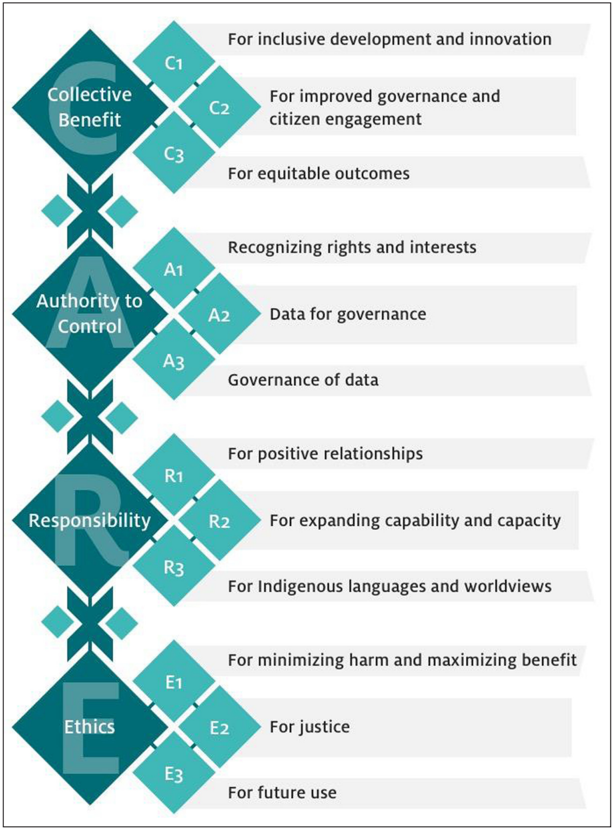
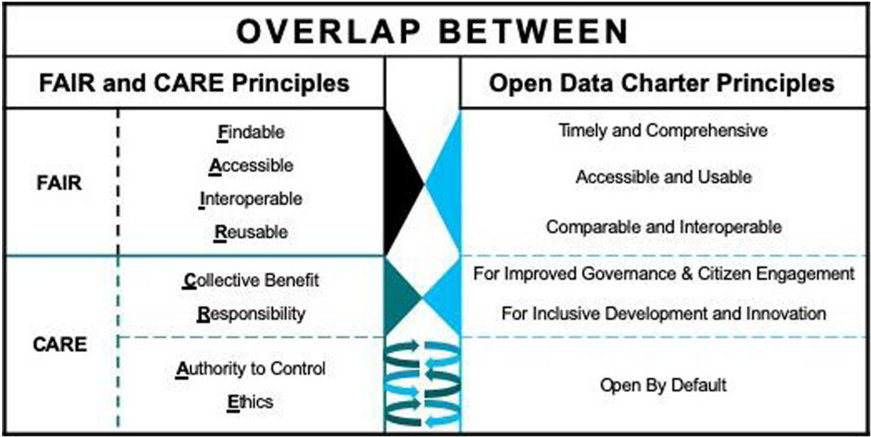
Concerns about secondary use of data and limited opportunities for benefit-sharing have focused attention on the tension that Indigenous communities feel between (1) protecting Indigenous rights and interests in Indigenous data (including traditional knowledges) and (2) supporting open data, machine learning, broad data sharing, and big data initiatives. The International Indigenous Data Sovereignty Interest Group (within the Research Data Alliance) is a network of nation-state based Indigenous data sovereignty networks and individuals that developed the ‘CARE Principles for Indigenous Data Governance’ (Collective Benefit, Authority to Control, Responsibility, and Ethics) in consultation with Indigenous Peoples, scholars, non-profit organizations, and governments. The CARE Principles are people– and purpose-oriented, reflecting the crucial role of data in advancing innovation, governance, and self-determination among Indigenous Peoples. The Principles complement the existing data-centric approach represented in the ‘FAIR Guiding Principles for scientific data management and stewardship’ (Findable, Accessible, Interoperable, Reusable). The CARE Principles build upon earlier work by the Te Mana Raraunga Maori Data Sovereignty Network, US Indigenous Data Sovereignty Network, Maiam nayri Wingara Aboriginal and Torres Strait Islander Data Sovereignty Collective, and numerous Indigenous Peoples, nations, and communities. The goal is that stewards and other users of Indigenous data will ‘Be FAIR and CARE.’ In this first formal publication of the CARE Principles, we articulate their rationale, describe their relation to the FAIR Principles, and present examples of their application.
Overview
CoChat Summary
TL;DR
The CARE Principles for Indigenous Data Governance (Collective Benefit, Authority to Control, Responsibility, and Ethics) are people- and purpose-oriented principles developed by the International Indigenous Data Sovereignty Interest Group to complement the data-centric FAIR Principles. They aim to support Indigenous rights, self-determination, and control over Indigenous data while enabling equitable data reuse.
Key findings
- CARE comprises four principles—Collective Benefit, Authority to Control, Responsibility, and Ethics—designed to complement FAIR (Findable, Accessible, Interoperable, Reusable) and guide data stewards and users to “Be FAIR and CARE.”
- The paper reports global context from UN 2009: Indigenous presence spans over 90 countries, includes over 370 million Indigenous persons, and involves more than 5,000 distinct cultures.
- CARE emerged from an Indigenous-led workshop held in Gaborone, Botswana, on 8 November 2018, as part of International Data Week, with later input from Indigenous leaders, scholars, network members, and allies.
- Early adopters/implementation examples include the Research Data Alliance, the Smithsonian Institution (e.g., Smithsonian Directive 609 and planned Collection CARE Notices), and the Open Data Charter.
Methods
- This is a conceptual/principles development paper, not an empirical study; it describes the rationale, development, and illustrative application of the CARE Principles.
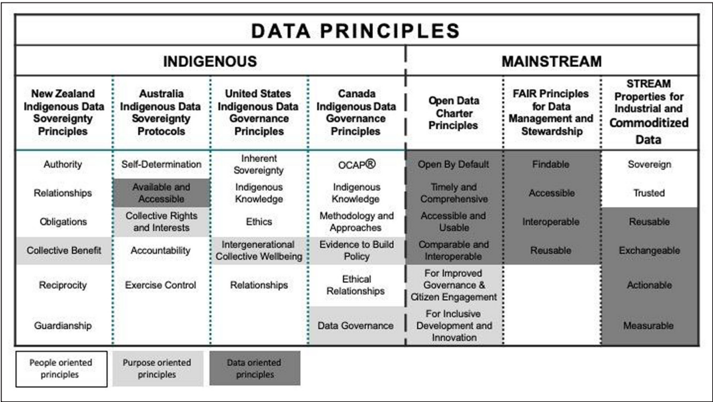
- Workshop organizers prepared an analysis of principles from Indigenous data sovereignty/governance frameworks and mainstream sources (Table 1) to inform dialogue; participants identified the four primary principles and drafted primary and sub-principles, then circulated the draft for input.
- The paper presents the principles’ relation to FAIR and examples of adoption; no formal sample, dataset, or statistical analysis is reported.
Limitations
- Stated: further research is needed to identify mechanisms that support implementation; create tools, policies, and practices that enact the Principles; explore application in different contexts (e.g., research repositories, knowledge co-production, institutional policies, existing databases/systems); and operationalize the Principles in tandem with FAIR.
- Evident: the paper is a principles publication and does not report empirical evaluation of implementation outcomes; the adoption examples are illustrative rather than systematically assessed.
Model-written summary. Check it against the paper before relying on it.
Integrity signals
Registry
Cites
Statistics
Figures
Verification
Claims the paper makes
0 Valid · 0 Not valid · 1 Not checked · 9 Own results and interpretations
- Probably not a substantial claim. 9
- It may state two separate claims as one. 5
Claims other papers make about this one
Each is checked against this paper’s own text: does it say what the citing paper says it does?
The source backs part of the claim, not all of it — or backs it for a different population, condition or comparison.
In the citing paper
“This can be in conflict with cultural values, e.g., in the case of indigenous communities that are generally underrepresented on Wikipedia but have concerns about how their knowledge might be exploited if shared [28, 29].”
From Data Governance in the Age of Large-Scale Data-Driven Language Technology (2022) · cites this paper as [28]
Experimental — accuracy not yet measuredThe source backs part of the claim, not all of it — or backs it for a different population, condition or comparison.
In the citing paper
“The key distinction is that while FAIR principles focus on making data maximally open and shareable-goals that align with scientific efficiency, CARE principles focus on people and purpose, emphasizing that data use should align with the rights and needs of Indigenous Peoples.”
From Data colonialism and indigenous languages in AI: a critical review of existing initiatives and their struggles with data sovereignty (2026) · cites this paper as Carroll et al. 2020
Experimental — accuracy not yet measuredThe source backs part of the claim, not all of it — or backs it for a different population, condition or comparison.
In the citing paper
“A concrete expression of Indigenous Data Sovereignty is found in the CARE Principles for Indigenous Data Governance, formulated in 2019 by the Global Indigenous Data Alliance and related networks (Carroll et al. 2020).”
From Data colonialism and indigenous languages in AI: a critical review of existing initiatives and their struggles with data sovereignty (2026) · cites this paper as Carroll et al. 2020
Experimental — accuracy not yet measuredThe source backs part of the claim, not all of it — or backs it for a different population, condition or comparison.
In the citing paper
“Indigenous data, whether born digital or not, include information, knowledge, specimens, and belongings about Indigenous Peoples to which they relate at both the individual and collective levels (Carroll et al., 2020; Rainie et al., 2019; Lovett et al., 2019).”
From Using Indigenous Standards to Implement the CARE Principles: Setting Expectations through Tribal Research Codes (2022) · cites this paper as Carroll et al., 2020
Experimental — accuracy not yet measuredThe source backs part of the claim, not all of it — or backs it for a different population, condition or comparison.
In the citing paper
“The FAIR Principles are aligned to the global shift towards open science and open data, promoting data centric criteria that facilitate increased data sharing among entities while ignoring relationships, power differentials, and the historical conditions associated with the collection of data10,11.”
From Operationalizing the CARE and FAIR Principles for Indigenous data futures (2021) · cites this paper as [11]
Experimental — accuracy not yet measured
6 more claims about this paper
Create a free account to see every claim other papers make about this one.
Self-check
Percentages, sums and reported differences re-computed from the paper’s own numbers.
Each contradiction between two passages listed here was confirmed by an independent check.
Rated minor: it would not touch a result — a value no result rests on, a p-value that stays on the same side of the significance level, or a conflict that is clerical, resolved elsewhere in the paper, or outside its own findings.
In the paper
§ The CARE Principles for Indigenous Data Governance > Research Data Alliance (www.rd-alliance.org), in research environments
“In 2012, the American Museum of Natural History at the Smithsonian Institution in Washington, DC released an Access and Benefit Sharing Policy on Genetic Resources”
§ The CARE Principles for Indigenous Data Governance > References
“42. Smithsonian Institution. 2012. Access and Benefit Sharing Policy on Genetics Resources. Washington, DC: National Museum of American History.”
Citations
Cites
The FAIR Guiding Principles for scientific data management and stewardship
Wilkinson, M. D., Dumontier, M., Aalbersberg, I. J., Appleton, G., Axton, M., Baak, A., Blomberg, N., Boiten, J.-W., da Silva Santos, L. B., Bourne, P. E., et al. (2016) · Scientific Data · doi:10.1038/sdata.2016.18 · Cited by 18,423
Indigenous Peoples In International Law: Second Edition
Anaya, S. J. (2004) · doi:10.1093/oso/9780195173499.001.0001 · Cited by 1,011
(2016) · doi:10.22459/caepr38.11.2016 · Cited by 696 · cited 6×
“…has become an increasingly relevant topic as big data, open data, open science, and data reuse become an integral part of research and institutional practices (Carroll, Rodriguez-Lonebear & Martinez 2019; Lovett et al. 2019; Rainie et al. 2019; Kukutai & Taylor 2016a; Taylor & Kukutai 2015).”
BackgroundInfluentialBuck, M., & Hamilton, C. (2011) · Review of European Community & International Environmental Law · doi:10.1111/j.1467-9388.2011.00703.x · Cited by 627
Indigenous Data Governance: Strategies from United States Native Nations
Carroll, S. R., Rodriguez-Lonebear, D., & Martinez, A. (2019) · Data Science Journal · doi:10.5334/dsj-2019-031 · Cited by 264
Self-citationGenomic Research Through an Indigenous Lens: Understanding the Expectations
Garrison, N. A., Hudson, M., Ballantyne, L. L., Garba, I., Martinez, A., Taualii, M., Arbour, L., Caron, N. R., & Rainie, S. C. (2019) · Annual Review of Genomics and Human Genetics · doi:10.1146/annurev-genom-083118-015434 · Cited by 220
Self-citationData sovereignty for indigenous peoples: current practice and future needs
Kukutai, T., & Taylor, J. (2016) · Indigenous Data Sovereignty · doi:10.22459/caepr38.11.2016.01 · Cited by 116
Rainie, S. C., Schultz, J. L., Briggs, E., Riggs, P., & Palmanteer-Holder, N. L. (2017) · International Indigenous Policy Journal · doi:10.18584/iipj.2017.8.2.1 · Cited by 114
Law, Knowledge, Culture: The Production of Indigenous Knowledge in Intellectual Property Law
Anderson, J. E. (2009) · Edward Elgar Publishing eBooks · doi:10.4337/9781848447196 · Cited by 95
Self-citationNational Inuit Strategy on Research.
Kanatami, I. T. (2018) · IOC of UNESCO (Intergovernmental Oceanographic Commission) · doi:10.25607/obp-1673 · Cited by 93
Research works printed but not linked: 18
- Cajete, G. 2000. Native science: Native laws of interdependence. Santa Fe: Clear Light.
- Castellano, MB. 2004. Ethics of Aboriginal research. Journal of Aboriginal Health, January, 98-114.
- Hudson, M, Milne, M, Russell, K, Smith, B, Reynolds, P and Atatoa-Carr, P. 2016. The Development of Guidelines for Indigenous Research Ethics in Aotearoa/New Zealand. In A.-L. Drugge (ed.), Ethics in Indigenous Research, Past Experiences -Future Challenges, 157-174. Umea, Sweden: Vaartoe Centre for Sami Research, Umea University.
- Drugge, A-L. 2016. Ethics in Indigenous Research: Past Experiences -Future Challenges. Umea, Sweden: Vaartoe Centre for Sami Research, Umea University.
- Julayinbul Statement in Indigenous Intellectual Property Rights. 1993. The Julayinbul Conference on Intellectual and Cultural Property. Australia: Jingarrba.
- Kovach, M. 2009. Indigenous methodologies: Characteristics, conversations, and contexts. Toronto: University of Toronto Press.
- Kukutai, T and Taylor, J. 2016a. Indigenous data sovereignty: Toward an agenda. Canberra, Australia: Aus- tralian National University Press. DOI: https://doi.org/10.22459/CAEPR38.11.2016 · DOI · Paper page
- Lovett, R, Lee, V, Kukutai, T, Cormack, D, Rainie, SC and Walker, J. 2019. Good data practices for Indigenous Data Sovereignty and Governance. In: Daly, A, Devitt, K and Monique, M (eds.), Good Data. Amsterdam: Institute of Network Cultures Inc. ISBN 978-94-92302-27-4.
- Mātaatua Declaration on Cultural and Intellectual Property Rights of Indigenous Peoples. 1993. First International Conference on the Cultural and Intellectual Property Rights of Indigenous Peoples. 12-18 June 1993. Aotearoa, New Zealand. Available at https://www.wipo.int/export/sites/www/tk/en/ databases/creative_heritage/docs/mataatua.pdf.
- McGregor, D, Restoule, JP and Johnston, R. (eds.) 2018. Indigenous research: Theories, practices, and rela- tionships. Canadian Scholars' Press.
- 2017, First Nations’ data governance: Measuring the nation-to-nation relationship discussion paper, British Columbia First Nations’ Data Governance Initiative
- Rainie, SC, Kukutai, T, Walter, M, Figueroa-Rodriguez, OL, Walker, J and Axelsson, P. 2019. Issues in Open Data: Indigenous Data Sovereignty. In: Davies, T, Walker, S, Rubinstein, M and Perini, F (eds.), The State of Open Data: Histories and Horizons. Cape Town and Ottawa: African Minds and International Development Research Centre. pp. 300-319.
- Ratima, M. 2001. Kia uruuru mai a hauora being healthy, being Maori: Conceptualising Maori health promotion. Published thesis (PhD) Department of Public Health. Dunedin, University of Otago.
- Ratima, M. 2001. Kia uruuru mai a hauora being healthy, being Maori: Conceptualising Maori health promotion. Published thesis (PhD) Department of Public Health. Dunedin, University of Otago. Research Data Alliance. 2017. International Indigenous Data Sovereignty Intertest Group. Available at https://www.rd-alliance.org/groups/international-indigenous-data-sovereignty-ig [Last accessed 17 January 2020].
- Snipp, CM. 2016. What does data sovereignty imply: what does it look like? In: Kukutai and Taylor, J (eds.), Indigenous data sovereignty: Toward an agenda. Canberra, Australia: Australian National University Press. pp. 39-55. DOI: https://doi.org/10.22459/CAEPR38.11.2016. · DOI · Paper page
- Smith, LT. 2012. Decolonizing Methodologies: Research and Indigenous Peoples. Zed Books. London: Univer- sity of Otago Press.
- Rodriguez-Lonebear, D. 2016. Building a data revolution in Indian country. In: Kukutai, T and Taylor, J (eds.), Indigenous data sovereignty: Toward an agenda. Canberra, Australia: Australian National University Press. pp. 253-272. DOI: https://doi.org/10.22459/CAEPR38.11.2016. · DOI · Paper page
- 2008, Research is ceremony: Indigenous research methods
Cited by
Items 801–900 of 1,410
Soltani, A., Bafarasat, A. Z., Bibri, S. E., Ramezani, L., & Qadikolaei, M. R. (2026) · Progress in Planning · doi:10.1016/j.progress.2026.101043 · Cited by 1
Poecze, F., & Tjoa, A. M. (2020) · International Conference on Informatics and Computational Sciences (ICICoS) · doi:10.1109/icicos51170.2020.9299055 · Cited by 1
Simões, A. R. C., dos Anjos, R. L., & Dias, G. A. (2021) · doi:10.22477/9786589167242.cap7 · Cited by 1
Um panorama histórico da iniciativa GO FAIR: da Europa para o Brasil
Sales, L. F., Veiga, V. D. S., Henning, P. C., & Sayão, L. F. (2021) · doi:10.22477/9786589167242.cap1 · Cited by 7
Bourassa, C. A., Hagel, M., Langan, J., Legare, M., Keewatin, M., Peigan, B., McKay, R., Hotomani, M., & Spencer, O. (2021) · Turtle Island Journal of Indigenous Health · doi:10.33137/tijih.v1i2.36035 · Cited by 1
Recreational tobacco consumption and food insecurity among First Nations in Canada
Mirzaei, O., & Natcher, D. C. (2022) · Canadian Journal of Public Health · doi:10.17269/s41997-022-00650-8 · Cited by 1
“The Research MOU was premised on the CARE Principles for Indigenous Data Governance (Carroll et al., 2020), including the following: (1) the right of First Nations to collectively benefit from the collection, analysis, and use of research results; (2) the authority of First Nations to control…”
MethodUnderstanding the Nature of Country Food Sales among First Nations in Alberta, Canada
Natcher, D. C., Ingram, S., & Bogdan, A.-M. (2022) · Human Organization · doi:10.17730/1938-3525-81.4.368 · Cited by 1
Data Governance and Digital Transformation in Saudi Arabia
Al-Qahtani, K. S., & Rahman, M. M. H. (2023) · Studies in autonomic, data-driven and industrial computing · doi:10.1007/978-981-19-7528-8_8 · Cited by 3
Kumar, P. C. (2023) · AoIR Selected Papers of Internet Research · doi:10.5210/spir.v2022i0.13037 · Cited by 1
What are “personal data spaces”?
Lähteenoja, V. (2023) · International World Wide Web Conference (WWW) · doi:10.1145/3543873.3587656 · Cited by 1
20 Years of Data Science: An Editorial
Parsons, M. A., & Mayernik, M. S. (2023) · Data Science Journal · doi:10.5334/dsj-2023-019 · Cited by 1
Self-citation¿Qué hacer con textos que no se pueden publicar? Datos derivados, criterios FAIR y TEI
Tello, J. C., & Rißler-Pipka, N. (2023) · Journal of the Text Encoding Initiative · doi:10.4000/jtei.4720 · Cited by 1
Ung, V. (2023) · Biodiversity Information Science and Standards · doi:10.3897/biss.7.110680 · Cited by 1
What is next for “transformation, trust, and transparency”?
Yun, C. (2023) · Science Editing · doi:10.6087/kcse.319 · Cited by 1
“Of note, indigenous peoples, asserting sovereignty over the application and use of indigenous data, can become uneasy when the sole ob-jective is to increase data shareability [7].”
BackgroundSchwarz, A., Möhrle, F., & von Mering, S. (2023) · Biodiversity Information Science and Standards · doi:10.3897/biss.7.111980 · Cited by 1
Community-Driven Mobile and Ubiquitous Computing
Rothrock, B., Greenlee, E., & Hester, J. D. (2023) · GetMobile Mobile Computing and Communications · doi:10.1145/3631588.3631590 · Cited by 1
Der Digital Turn in den Geisteswissenschaften und seine Implikationen für Gedächtniseinrichtungen
Donig, S. (2023) · BIBLIOTHEK Forschung und Praxis · doi:10.1515/bfp-2023-0046 · Cited by 3
Open Scholarship Policy in Focus
Winter, C. (2023) · doi:10.21428/47bc126e.5abba88b · Cited by 1
The Ethics and Cultural Sensitivities of Data Management: Some Considerations
Leditschke, A., Nichols, J., Farrow, K., & Agius, Q. (2024) · Emerald Group Publishing Limited eBooks · doi:10.1108/s0065-283020240000054003 · Cited by 2
The Women Who Ruled China: Buddhism, Multiculturalism, and Governance in the Sixth Century
Balkwill, S. (2024) · University of California Press eBooks · doi:10.1525/luminos.192 · Cited by 1
Making Sense: Language, Ethics, and Understanding in Deaf Nepal
Green, E. M. (2024) · University of California Press eBooks · doi:10.1525/luminos.193 · Cited by 2
Human-Centered AI for Sustainability and Agriculture
Garard, J., Cohen, A., Habanabakize, E., Gleeson, E. H., Teng, M., Marceau, G., Piracha, D. A., Savanna, R. L., Rayburn, K., Rosa, M. F., et al. (2024) · Chapman & Hall/CRC eBooks · doi:10.1201/9781003320791-14 · Cited by 2
Etnografisk multimediearkiv og GDPR
Anderson, A. (2024) · Norsk antropologisk tidsskrift · doi:10.18261/nat.35.1.10 · Cited by 1
Introduction: Is an “open anthropology” possible?
Heintz, M., & Healy, J. D. L. (2024) · Ethnologie française · doi:10.3917/ethn.242.0005 · Cited by 4
Population neuroscience data sharing: Policy ecology, infrastructure, practices and challenges
Jiang, L., Gao, P., & Zhou, Y. (2024) · Chinese Science Bulletin (Chinese Version) · doi:10.1360/tb-2024-0147 · Cited by 2
Karim, T. S., Krimmel, E., Little, H., & Walker, L. (2024) · Research Ideas and Outcomes · doi:10.3897/rio.10.e134840 · Cited by 1
The GeSCA repository: Gesture and Sign Corpus of Australia
Willoughby, L., Smith, R. T., & Johnston, T. A. (2024) · Australian Journal of Linguistics · doi:10.1080/07268602.2024.2380672 · Cited by 1
Mount, A. L., Barker, J., Barker, R., Sedran-Price, C., Higgins, M., Barker, L. L., Staggs, B., & Simpson, J. (2024) · Australian Journal of Linguistics · doi:10.1080/07268602.2024.2380689 · Cited by 1
“Responsibility also refers to building the capability and capacity of Indigenous People (Carroll et al., 2020, p. 43; 2022), and training resources have been developed to support RJB ’ s and other community members ’ upskilling in the use of ELAN and data management.”
Orlić, O. (2024) · Publications · doi:10.3390/publications12040042 · Cited by 2
The Interconnectedness of All Things: Understanding Digital Collections Through File Similarity
Karp, S. J. (2024) · Preservation Digital Technology & Culture · doi:10.1515/pdtc-2024-0042 · Cited by 1
“The CARE Principles describe such privilege as a “ globalization of Western ideas, values, and lifestyles ” that has resulted in “ epistemicide, the suppression and co-optation of Indigenous knowledges and data systems ” (Carroll et al. 2020).”
Bishop, B. W., Fox, J., Gavel, S. W. T., Chapin, E. G., & Kansa, S. W. (2024) · Biodiversity Information Science and Standards · doi:10.3897/biss.8.142801 · Cited by 1
Research Data Management and Crowdsourcing Personal Histories
Conisbee, C. (2025) · Journal of Open Humanities Data · doi:10.5334/johd.265 · Cited by 1
Fitts, L. A., Montgomery, R., Palik, B. J., Clark, P. W., Kragthorpe, J., Reinikainen, M. R., Edge, G. J., Handler, S. D., Hutnik, B. M., & D’Amato, A. W. (2025) · Journal of Forestry · doi:10.1007/s44392-025-00010-7 · Cited by 2
“…stakeholders, we followed, when applicable, FPIC (free, prior, informed consent) principles and guidance from the Indigenous Tribal Data Sovereignty Network including CARE (collective benefit, authority to control, responsibility and ethics) (Carroll et al. 2020) during our data collection phase.”
Jäger, M. B., Johnson, N., Burk, E., Christensen, N., Ferguson, D. B., Honani, S., Huntington, O. H., Larson, S., Jennings, L. L., Johnson, M. K., et al. (2025) · Arctic Science · doi:10.1139/as-2024-0063 · Cited by 2
Self-citationReimagining Archives in the Age of Automation: A Decolonial and Relational Approach
Long, K., Itchuaqiyaq, C. U., Lindgren, C., Ogier, A., Boyd, L. A., Itchuaqiyaq, D. P., & Yunes, E. (2025) · Technical Communication Quarterly · doi:10.1080/10572252.2025.2490506 · Cited by 2
“The RAA model that we define in the next section is a “CARE Full” (Carroll et al., 2020, p. 5) paradigm shift for many library and archive professionals.”
Working with “Safety”: Researching Oil-Spill-Impacted Communities in the Niger Delta
Adebangbe, S. A., Dixon, D. P., & Barrett, B. (2025) · The Professional Geographer · doi:10.1080/00330124.2025.2503947 · Cited by 3
“Ethics-focused literature highlights the importance of considering issues such as researcher – RA relations, participant safety, data sovereignty, and various forms of power dynamics inherent in research relationships (Davis 2016; Carroll, Rodriguez-Lonebear, and Martinez 2019; Carroll et al. 2020).”
InfluentialImplementation of opioid stewardship programs (OSPs) in hospitals: A narrative literature review
Murphy, B. S., & Falls, N. (2025) · Journal of Opioid Management · doi:10.5055/jom.0915 · Cited by 1
Weatherall, T. J., Lee, K. S., Stearne, A., Dzidowska, M., Hewlett, N., Bullen, L., Reynolds, T., Loggins, S., & Conigrave, J. H. (2025) · Journal of the Australian Indigenous HealthInfoNet · doi:10.14221/2653-3219.1080 · Cited by 1
Foote, I., Chambers, G. K., & Ritchie, P. A. (2025) · Waterbirds · doi:10.1675/063.048.0107 · Cited by 4
Considering NAGPRA When Crafting a Digitization Policy or Protocol
Domeischel, J., Lofaro, E., & Hebert, K. (2025) · Advances in Archaeological Practice · doi:10.1017/aap.2025.10108 · Cited by 1
““CARE” stands for Collective benefit, Authority to control, Responsibility, and Ethics (Carroll et al. 2020, 2021).”
Chamberlain, C., Sundbery, J., Segal, L., Krakouer, J., Langton, M., Donnelly, J., Kotz, J., McEvoy, E., Lyon, M., Mucabel‐Bue, N., et al. (2026) · Frontiers in Public Health · doi:10.3389/fpubh.2025.1721107 · Cited by 2
“…(3) contributing evidence to transform government institutions, particularly health care provision and statutory child protection services; and (4) and prioritising access to and construction of data and information at a regional level, consistent with Indigenous Data Sovereignty Principles (53).”
Princípios FAIR aplicados à gestão de dados de pesquisa
Sayão, L. F. (2021) · doi:10.22477/9786589167242 · Cited by 20
Ribeiro, C. J. S., & Velho, A. C. M. (2021) · doi:10.22477/9786589167242.cap5 · Cited by 1
On critical proximity: Distance, difference, and digital sociality
Johnson, J. L., & Saxena, A. K. (2022) · Journal of Political Ecology · doi:10.2458/jpe.4783 · Cited by 1
Murillo, L. F. R., & Dosemagen, S. (2022) · Commonplace · doi:10.21428/6ffd8432.8f2f6a1d · Cited by 1
Arctic Data Management and Sharing
Pulsifer, P., & Lee, C. (2022) · Oceanography · doi:10.5670/oceanog.2022.129 · Cited by 1
Jensen, G. H., Arbuckle, A., Winter, C., Jesperson, T., Fontenot, T., & Siemens, R. (2022) · IDEAH · doi:10.21428/f1f23564.ed75625f · Cited by 3
Santos, L. O. B. D. S. (2021) · doi:10.22477/9786589167242.pref · Cited by 2
Ludbrook, A., Owen, V., Nayyer, K., & Callison, C. (2021) · doi:10.32920/15138186.v1 · Cited by 1
Ludbrook, A., Owen, V., Nayyer, K., & Callison, C. (2021) · doi:10.32920/15138186 · Cited by 1
AI-ML Ethics Modules for ESES - Version 1 with line numbers- December 2022Preprint
Stall, S. (2022) · doi:10.22541/essoar.167080673.37483484/v1 · Cited by 1
Opportunity Brief: Environmental Data as a Public Good
Williams, E. W., Hoeberling, K., & Dosemagen, S. (2021) · doi:10.15868/socialsector.41840 · Cited by 1
Welcoming more participation in open data science for the oceansPreprint
Fredston, A., & Lowndes, J. S. (2023) · doi:10.32942/x22308 · Cited by 1
COVID-19, resilience and the interface between science, policy and society
OECD (2023) · OECD science, technology and industry policy papers · doi:10.1787/9ab1fbb7-en · Cited by 7
Data Reuse in Agricultural Genomics Research: Present Challenges and Future SolutionsPreprint
Hafner, A., DeLeo, V. L., Deng, C. H., Elsik, C. G., Fleming, D. S., Harrison, P. W., Kalbfleisch, T., Petry, B., Pucker, B., Quezada-Rodríguez, E. H., et al. (2024) · Preprints.org · doi:10.20944/preprints202401.0780.v1 · Cited by 1
Why Revise When We Should Reconcile?
Peugh, E. E., Brown, A. D. H., Tsosie, K. S., & Hull, S. C. (2025) · The American Journal of Bioethics · doi:10.1080/15265161.2024.2441757 · Cited by 3
Artificial Intelligence and Diversity, Equity, and Inclusion
Garard, J., Ezirigwe, J., & Ayoub, M. (2026) · Springer eBooks · doi:10.1007/978-3-031-76750-0_72 · Cited by 1
Schulz, M., & Loewen-Colón, J. (2026) · AI & SOCIETY · doi:10.1007/s00146-026-02931-z · Cited by 1
“For example, “Authority to Control” means Indigenous peoples must have the authority to control the data derived from them; “Collective Benefit” means data use should benefit Indigenous communities, not just external researchers or companies (Carroll et al. 2020).”
InfluentialCommons-Governed Artificial Intelligence: A Taxonomy of Collective Governance
Garrido-Merchán, E. C. (2026) · arXiv · doi:10.48550/arxiv.2606.15466
“The data layer acquires explicit institutional forms in the bottom-up data trust (Delacroix and Lawrence, 2019) and the data cooperative (Hardjono and Pentland, 2019), and a normative content in the CARE principles (Carroll et al., 2020).”
Prehn (Worimi), J., Carlson (Aboriginal), B., Walter (Palawa), M., Lovett (Wongaibon/Ngiyampaa), R., & Maher (Yamatji, N. (2026) · Journal of Sociology · doi:10.1177/14407833261460137
Buck, J., Ayliffe, J., Bradshaw, E., Gaffney, S., Houseago‐Stokes, R. E., Moncoiffé, G., & Snaith, H. M. (2020) · doi:10.1002/essoar.10505542.1
Principle 2 Section Inclusion for hess-2021-392
Hall, C. J. J. V. (2021) · Hydrology and earth system sciences · doi:10.5194/hess-2021-392-ac1
Hall, C. (2021) · Hydrology and earth system sciences · doi:10.5194/hess-2021-392-ac2
(2021) · Hydrology and earth system sciences · doi:10.5194/hess-2021-392-rc1
Couture, S., Toupin, S., & Alejandro, M.-B. (2021) · AoIR Selected Papers of Internet Research · doi:10.5210/spir.v2021i0.12155
“It is noted for instance that the philosophy of information sharing in free and open-source software might foster the usage and misappropriation of knowledge held by Indigenous communities (Christen, 2012; Gida, 2019; Mayoral-Baños, 2021).”
BackgroundBuschbom, J., Zimkus, B. M., Bentley, A. C., Kageyama, M., Lyal, C. H. C., Neumann, D., Waagmeester, A., & Hardisty, A. (2021) · Biodiversity Information Science and Standards · doi:10.3897/biss.5.75168
(2021) · Hydrology and earth system sciences · doi:10.5194/hess-2021-392-rc2
A review of: Archiving for the future: Simple steps for archiving language documentation collections
Baldwin, V. (2021) · SOAS Research Online (SOAS University of London) · doi:10.25501/soas.00035584
Hydrological Perspectives on Integrated, Coordinated, Open, Net- worked (ICON) SciencePreprint
Mehan, S., Acharya, B. S., Ahmmed, B., Hensley, R. T., URycki, D. R., Patil, S. D., Liu, H., Mehana, M. Z., Chen, Y., Persaud, B., et al. (2021) · doi:10.1002/essoar.10508463.2
Hall, C. (2021) · Hydrology and earth system sciences · doi:10.5194/hess-2021-392-ac7
Tecnologias para gestão de dados de pesquisa segundo preceitos FAIR
Shintaku, M., Appel, A. L., & de Oliveira, A. F. (2021) · doi:10.22477/9786589167242.cap10 · Cited by 1
Drucker, D. P., Fortaleza, J. M., Bertin, P. R. B., Vacari, I., & Macário, C. G. D. N. (2021) · doi:10.22477/9786589167242.cap4
VODAN BR – uma plataforma de apoio para dados COVID-19 seguindo os princípios FAIR
Campos, M. L. M., Borges, V., Lopes, G. R., Cavalcanti, M. C., Moreira, J., & da Cruz, S. M. S. (2021) · doi:10.22477/9786589167242.cap18
Rede GO FAIR Brasil Saúde Enfermagem: onde estamos e aonde queremos chegar?
Macedo, E. C., & Henning, P. C. (2021) · doi:10.22477/9786589167242.cap17
Hall, C. (2021) · Hydrology and earth system sciences · doi:10.5194/hess-2021-392-ac3
(2021) · Hydrology and earth system sciences · doi:10.5194/hess-2021-392-rc3
Hall, C. (2021) · Hydrology and earth system sciences · doi:10.5194/hess-2021-392-ac6
Hall, C. (2021) · Hydrology and earth system sciences · doi:10.5194/hess-2021-392-ac5
Hall, C. (2021) · Hydrology and earth system sciences · doi:10.5194/hess-2021-392-ac4
Moving from FAIR to FAIRS and CARE for data sharing in GBADs
STACEY, D., Bernardo, T. M., & RAYMOND, K. (2021) · Bulletin de l OIE · doi:10.20506/bull.2021.1.3261
Dudgeon, P., Alexi, J., Derry, K., Carlin, E., & McPhee, R. (2022) · Springer eBooks · doi:10.1007/978-3-030-84678-7_23 · Cited by 1
Sales, L. F., Veiga, V. D. S., Henning, P. C., & Sayão, L. F. (2021) · doi:10.22477/9786589167242.apr
Todd-Brown, K. E. O., Abramoff, R. Z., Beem-Miller, J., et al. (2022) · Biogeosciences · doi:10.5194/bg-2021-323-rc1
From Obstruction to Decolonization?
Graddy‐Lovelace, G. (2022) · Routledge eBooks · doi:10.4324/9781003172642-6
Todd-Brown, K. E. (2022) · Biogeosciences · doi:10.5194/bg-2021-323-ac2
Working with: The ethics and practices of engaging Indigenous peoples in scientific research
(2022) · Past Global Change Magazine · doi:10.22498/pages.30.1.50
Todd-Brown, K. E. (2022) · Biogeosciences · doi:10.5194/bg-2021-323-ac1
Making Data Right: Embedding Ethics and Data Management in Data Science Instruction
Marsolek, W., Barrick, K., Kubas, A., McBurney, J., & Mohr, A. H. (2022) · Advances in library and information science (ALIS) book series · doi:10.4018/978-1-7998-9702-6.ch010
Data Stewards, Curators, and Experts
Oxley, P. R., Maamar, S. B., & Wheeler, T. R. (2022) · Advances in library and information science (ALIS) book series · doi:10.4018/978-1-7998-9702-6.ch014
(2021) · Hydrology and earth system sciences · doi:10.5194/hess-2021-392-cc1
Hydrological Perspectives on Integrated, Coordinated, Open, Net- worked (ICON) SciencePreprint
Mehan, S., Acharya, B. S., Ahmmed, B., Hensley, R. T., URycki, D. R., Patil, S. D., Liu, H., Mehana, M. Z., Chen, Y., Persaud, B., et al. (2021) · doi:10.1002/essoar.10508463.1
Hydrological Perspectives on Integrated, Coordinated, Open, Net- worked (ICON) SciencePreprint
Mehan, S., Acharya, B. S., Ahmmed, B., Hensley, R. T., URycki, D. R., Patil, S., Liu, H., Mehana, M. Z., Chen, Y., Persaud, B., et al. (2021) · doi:10.1002/essoar.10508463.3
Vera, L. A. (2022) · Digital Repository Service (Northeastern University) · doi:10.17760/d20439238 · Cited by 14
(2022) · Haug Verlag in Georg Thieme Verlag KG eBooks · doi:10.1055/b-0042-191131
Kidney Health of Indigenous Children: Insights from Australia, Aotearoa New Zealand, and Canada
Erickson, R. L., Selvathesan, N., & Dickens, A. (2022) · Current Pediatrics Reports · doi:10.1007/s40124-022-00274-z
Ottinger, G., Wing, K., Hoeberling, K., & Dosemagen, S. (2022) · doi:10.15868/socialsector.40831
Wissenschaftliche Fairness: Wissenschaft zwischen Integrität und Fehlverhalten
Frisch, K., Hagenström, F., & Reeg, N. (2022) · Science studies · doi:10.1515/9783839459669 · Cited by 7
Bertin, P. R. B., Parr, C. S., Drucker, D. P., & Subirats, I. (2022) · Springer eBooks · doi:10.1007/978-3-031-13276-6_15
Activating for a Data-Capable Future
Farmer, J., McCosker, A., Albury, K., & Aryani, A. (2022) · Springer eBooks · doi:10.1007/978-981-19-5554-9_4
Metadata
- Authors
- Carroll, S. R., Garba, I., Figueroa-Rodríguez, O. L., Holbrook, J., Lovett, R., Materechera, S., Parsons, M., Raseroka, K., Rodriguez-Lonebear, D., Rowe, R., Sara, R., Walker, J. D., Anderson, J., & Hudson, M.
- Affiliations
- University of Arizona (US)
- University of the Western Cape (ZA)
- Australian National University (AU)
- North-West University (ZA)
- Rensselaer Polytechnic Institute (US)
- University of California, Los Angeles (US)
- Laurentian University (CA)
- New York University (US)
- University of Waikato (NZ)
- Corresponding author
- Carroll, Stephanie Russo
- ORCID
- Venue
- Data Science Journal
- Publisher
- Ubiquity Press, Ltd.
- Published
- 2020
- Volume
- 19
- ISSN
- 1683-1470 (ISSN-L)
- OpenAlex
- W3048186973
- Semantic Scholar
- 2b01e7dbaded2f74e39fe492ffda38d91c88d0e4
- Cited by
- 1,408
- References
- 19
- Citations by year
- 2026: 417 · 2025: 310 · 2024: 227 · 2023: 208 · 2022: 133 · 2021: 101 · 2020: 12
- FWCI
- 62.98
- Type
- journal article
- Language
- en
- Open access
- gold
- doi.org
- Licence
- Locations
- Data Science Journal (publishedVersion, cc-by)
- ANU Open Research (Australian National University) (submittedVersion, cc-by)
- Lincoln (University of Nebraska) (submittedVersion)
- DOAJ (DOAJ: Directory of Open Access Journals) (submittedVersion, cc-by-sa)
- Data Science Journal (submittedVersion, cc-by)
- Edinburgh Research Explorer (University of Edinburgh) (submittedVersion, cc-by)
- Funders
- European Commission (HORIZON2020, 777388)
- Rural Development Administration
- Topics
- Social Sciences › Health › Indigenous Health, Education, and Rights
- Physical Sciences › Computer Science › Information Systems › Research Data Management Practices
- Physical Sciences › Computer Science › Artificial Intelligence › Ethics and Social Impacts of AI
- Keywords
- Indigenous data sovereignty, CARE principles, Indigenous data governance, traditional knowledge, data reuse, benefit sharing, FAIR principles, data ethics, Indigenous self-determination, Research Data Alliance, data stewardship
About these checks
Registry, retraction, Cites and statistics results are computed, not judged, with one exception: a printed reference that no index lists is read once by a model before it counts as a citation error. Claims are extracted by a model and kept only when their quote appears verbatim in the text; each cited source is then checked, with a model’s help, for whether it says what the claim relies on. Those verdicts can be wrong — read the claim’s quote and the cited source before relying on one.
A language model drew the claims from the paper on 2026-10-30, under version 3 of the claim definition (model deepseek-v4.1-flash, prompt extract-v3).
A second model labelled each claim on 2026-10-30 (model jev-1.13-20260917, definition revision gold-guideline-v0.2).
Statistics and arithmetic are recomputed, not judged.
Confidence bands are shown only for fields calibrated on our annotated test set. None is calibrated yet, so no band is shown.
What counts as a claim ›How we measure confidence ›How we check this ›
Are you an author, or do you see a problem with this page? Request a review
Data sources
Bibliographic data: Semantic Scholar, OpenAlex, Crossref.
Contains information from the Semantic Scholar Academic Graph Datasets, made available under the ODC Attribution License (ODC-BY 1.0).
Semantic Scholar’s data is described in: Kinney, R., et al. (2023). The Semantic Scholar Open Data Platform. arXiv:2301.10140.
