

The CARE Principles for Indigenous Data Governance
Open accessThe DOI matches its Crossref record; 26 of the 27 references it cites were found in a registry or an index; none of the 1 sources its claims cite is checked for support yet.
Abstract
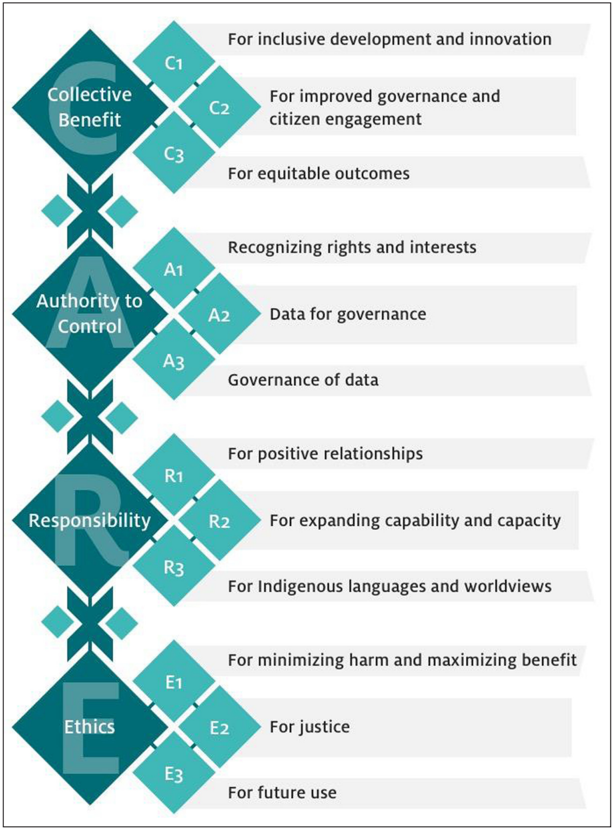
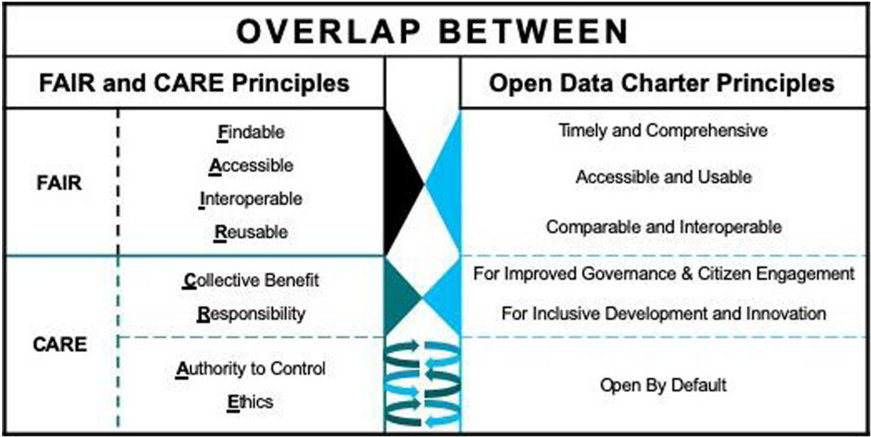
Concerns about secondary use of data and limited opportunities for benefit-sharing have focused attention on the tension that Indigenous communities feel between (1) protecting Indigenous rights and interests in Indigenous data (including traditional knowledges) and (2) supporting open data, machine learning, broad data sharing, and big data initiatives. The International Indigenous Data Sovereignty Interest Group (within the Research Data Alliance) is a network of nation-state based Indigenous data sovereignty networks and individuals that developed the ‘CARE Principles for Indigenous Data Governance’ (Collective Benefit, Authority to Control, Responsibility, and Ethics) in consultation with Indigenous Peoples, scholars, non-profit organizations, and governments. The CARE Principles are people– and purpose-oriented, reflecting the crucial role of data in advancing innovation, governance, and self-determination among Indigenous Peoples. The Principles complement the existing data-centric approach represented in the ‘FAIR Guiding Principles for scientific data management and stewardship’ (Findable, Accessible, Interoperable, Reusable). The CARE Principles build upon earlier work by the Te Mana Raraunga Maori Data Sovereignty Network, US Indigenous Data Sovereignty Network, Maiam nayri Wingara Aboriginal and Torres Strait Islander Data Sovereignty Collective, and numerous Indigenous Peoples, nations, and communities. The goal is that stewards and other users of Indigenous data will ‘Be FAIR and CARE.’ In this first formal publication of the CARE Principles, we articulate their rationale, describe their relation to the FAIR Principles, and present examples of their application.
Overview
CoChat Summary
TL;DR
The CARE Principles for Indigenous Data Governance (Collective Benefit, Authority to Control, Responsibility, and Ethics) are people- and purpose-oriented principles developed by the International Indigenous Data Sovereignty Interest Group to complement the data-centric FAIR Principles. They aim to support Indigenous rights, self-determination, and control over Indigenous data while enabling equitable data reuse.
Key findings
- CARE comprises four principles—Collective Benefit, Authority to Control, Responsibility, and Ethics—designed to complement FAIR (Findable, Accessible, Interoperable, Reusable) and guide data stewards and users to “Be FAIR and CARE.”
- The paper reports global context from UN 2009: Indigenous presence spans over 90 countries, includes over 370 million Indigenous persons, and involves more than 5,000 distinct cultures.
- CARE emerged from an Indigenous-led workshop held in Gaborone, Botswana, on 8 November 2018, as part of International Data Week, with later input from Indigenous leaders, scholars, network members, and allies.
- Early adopters/implementation examples include the Research Data Alliance, the Smithsonian Institution (e.g., Smithsonian Directive 609 and planned Collection CARE Notices), and the Open Data Charter.
Methods
- This is a conceptual/principles development paper, not an empirical study; it describes the rationale, development, and illustrative application of the CARE Principles.
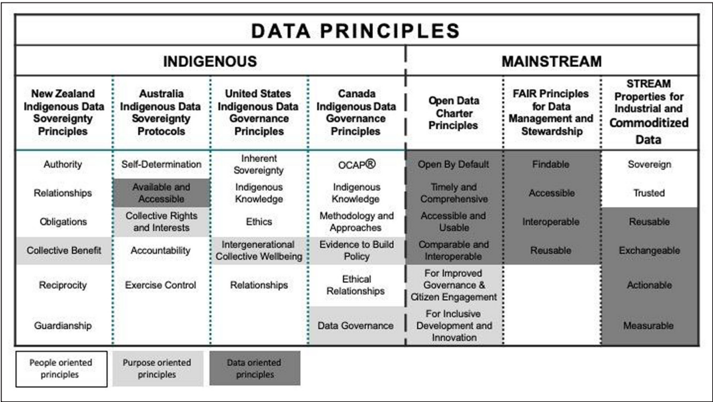
- Workshop organizers prepared an analysis of principles from Indigenous data sovereignty/governance frameworks and mainstream sources (Table 1) to inform dialogue; participants identified the four primary principles and drafted primary and sub-principles, then circulated the draft for input.
- The paper presents the principles’ relation to FAIR and examples of adoption; no formal sample, dataset, or statistical analysis is reported.
Limitations
- Stated: further research is needed to identify mechanisms that support implementation; create tools, policies, and practices that enact the Principles; explore application in different contexts (e.g., research repositories, knowledge co-production, institutional policies, existing databases/systems); and operationalize the Principles in tandem with FAIR.
- Evident: the paper is a principles publication and does not report empirical evaluation of implementation outcomes; the adoption examples are illustrative rather than systematically assessed.
Model-written summary. Check it against the paper before relying on it.
Integrity signals
Registry
Cites
Statistics
Figures
Verification
Claims the paper makes
0 Valid · 0 Not valid · 1 Not checked · 9 Own results and interpretations
- Probably not a substantial claim. 9
- It may state two separate claims as one. 5
Claims other papers make about this one
Each is checked against this paper’s own text: does it say what the citing paper says it does?
The source backs part of the claim, not all of it — or backs it for a different population, condition or comparison.
In the citing paper
“This can be in conflict with cultural values, e.g., in the case of indigenous communities that are generally underrepresented on Wikipedia but have concerns about how their knowledge might be exploited if shared [28, 29].”
From Data Governance in the Age of Large-Scale Data-Driven Language Technology (2022) · cites this paper as [28]
Experimental — accuracy not yet measuredThe source backs part of the claim, not all of it — or backs it for a different population, condition or comparison.
In the citing paper
“The key distinction is that while FAIR principles focus on making data maximally open and shareable-goals that align with scientific efficiency, CARE principles focus on people and purpose, emphasizing that data use should align with the rights and needs of Indigenous Peoples.”
From Data colonialism and indigenous languages in AI: a critical review of existing initiatives and their struggles with data sovereignty (2026) · cites this paper as Carroll et al. 2020
Experimental — accuracy not yet measuredThe source backs part of the claim, not all of it — or backs it for a different population, condition or comparison.
In the citing paper
“A concrete expression of Indigenous Data Sovereignty is found in the CARE Principles for Indigenous Data Governance, formulated in 2019 by the Global Indigenous Data Alliance and related networks (Carroll et al. 2020).”
From Data colonialism and indigenous languages in AI: a critical review of existing initiatives and their struggles with data sovereignty (2026) · cites this paper as Carroll et al. 2020
Experimental — accuracy not yet measuredThe source backs part of the claim, not all of it — or backs it for a different population, condition or comparison.
In the citing paper
“Indigenous data, whether born digital or not, include information, knowledge, specimens, and belongings about Indigenous Peoples to which they relate at both the individual and collective levels (Carroll et al., 2020; Rainie et al., 2019; Lovett et al., 2019).”
From Using Indigenous Standards to Implement the CARE Principles: Setting Expectations through Tribal Research Codes (2022) · cites this paper as Carroll et al., 2020
Experimental — accuracy not yet measuredThe source backs part of the claim, not all of it — or backs it for a different population, condition or comparison.
In the citing paper
“The FAIR Principles are aligned to the global shift towards open science and open data, promoting data centric criteria that facilitate increased data sharing among entities while ignoring relationships, power differentials, and the historical conditions associated with the collection of data10,11.”
From Operationalizing the CARE and FAIR Principles for Indigenous data futures (2021) · cites this paper as [11]
Experimental — accuracy not yet measured
6 more claims about this paper
Create a free account to see every claim other papers make about this one.
Self-check
Percentages, sums and reported differences re-computed from the paper’s own numbers.
Each contradiction between two passages listed here was confirmed by an independent check.
Rated minor: it would not touch a result — a value no result rests on, a p-value that stays on the same side of the significance level, or a conflict that is clerical, resolved elsewhere in the paper, or outside its own findings.
In the paper
§ The CARE Principles for Indigenous Data Governance > Research Data Alliance (www.rd-alliance.org), in research environments
“In 2012, the American Museum of Natural History at the Smithsonian Institution in Washington, DC released an Access and Benefit Sharing Policy on Genetic Resources”
§ The CARE Principles for Indigenous Data Governance > References
“42. Smithsonian Institution. 2012. Access and Benefit Sharing Policy on Genetics Resources. Washington, DC: National Museum of American History.”
Citations
Cites
The FAIR Guiding Principles for scientific data management and stewardship
Wilkinson, M. D., Dumontier, M., Aalbersberg, I. J., Appleton, G., Axton, M., Baak, A., Blomberg, N., Boiten, J.-W., da Silva Santos, L. B., Bourne, P. E., et al. (2016) · Scientific Data · doi:10.1038/sdata.2016.18 · Cited by 18,423
Indigenous Peoples In International Law: Second Edition
Anaya, S. J. (2004) · doi:10.1093/oso/9780195173499.001.0001 · Cited by 1,011
(2016) · doi:10.22459/caepr38.11.2016 · Cited by 696 · cited 6×
“…has become an increasingly relevant topic as big data, open data, open science, and data reuse become an integral part of research and institutional practices (Carroll, Rodriguez-Lonebear & Martinez 2019; Lovett et al. 2019; Rainie et al. 2019; Kukutai & Taylor 2016a; Taylor & Kukutai 2015).”
BackgroundInfluentialBuck, M., & Hamilton, C. (2011) · Review of European Community & International Environmental Law · doi:10.1111/j.1467-9388.2011.00703.x · Cited by 627
Indigenous Data Governance: Strategies from United States Native Nations
Carroll, S. R., Rodriguez-Lonebear, D., & Martinez, A. (2019) · Data Science Journal · doi:10.5334/dsj-2019-031 · Cited by 264
Self-citationGenomic Research Through an Indigenous Lens: Understanding the Expectations
Garrison, N. A., Hudson, M., Ballantyne, L. L., Garba, I., Martinez, A., Taualii, M., Arbour, L., Caron, N. R., & Rainie, S. C. (2019) · Annual Review of Genomics and Human Genetics · doi:10.1146/annurev-genom-083118-015434 · Cited by 220
Self-citationData sovereignty for indigenous peoples: current practice and future needs
Kukutai, T., & Taylor, J. (2016) · Indigenous Data Sovereignty · doi:10.22459/caepr38.11.2016.01 · Cited by 116
Rainie, S. C., Schultz, J. L., Briggs, E., Riggs, P., & Palmanteer-Holder, N. L. (2017) · International Indigenous Policy Journal · doi:10.18584/iipj.2017.8.2.1 · Cited by 114
Law, Knowledge, Culture: The Production of Indigenous Knowledge in Intellectual Property Law
Anderson, J. E. (2009) · Edward Elgar Publishing eBooks · doi:10.4337/9781848447196 · Cited by 95
Self-citationNational Inuit Strategy on Research.
Kanatami, I. T. (2018) · IOC of UNESCO (Intergovernmental Oceanographic Commission) · doi:10.25607/obp-1673 · Cited by 93
Research works printed but not linked: 18
- Cajete, G. 2000. Native science: Native laws of interdependence. Santa Fe: Clear Light.
- Castellano, MB. 2004. Ethics of Aboriginal research. Journal of Aboriginal Health, January, 98-114.
- Hudson, M, Milne, M, Russell, K, Smith, B, Reynolds, P and Atatoa-Carr, P. 2016. The Development of Guidelines for Indigenous Research Ethics in Aotearoa/New Zealand. In A.-L. Drugge (ed.), Ethics in Indigenous Research, Past Experiences -Future Challenges, 157-174. Umea, Sweden: Vaartoe Centre for Sami Research, Umea University.
- Drugge, A-L. 2016. Ethics in Indigenous Research: Past Experiences -Future Challenges. Umea, Sweden: Vaartoe Centre for Sami Research, Umea University.
- Julayinbul Statement in Indigenous Intellectual Property Rights. 1993. The Julayinbul Conference on Intellectual and Cultural Property. Australia: Jingarrba.
- Kovach, M. 2009. Indigenous methodologies: Characteristics, conversations, and contexts. Toronto: University of Toronto Press.
- Kukutai, T and Taylor, J. 2016a. Indigenous data sovereignty: Toward an agenda. Canberra, Australia: Aus- tralian National University Press. DOI: https://doi.org/10.22459/CAEPR38.11.2016 · DOI · Paper page
- Lovett, R, Lee, V, Kukutai, T, Cormack, D, Rainie, SC and Walker, J. 2019. Good data practices for Indigenous Data Sovereignty and Governance. In: Daly, A, Devitt, K and Monique, M (eds.), Good Data. Amsterdam: Institute of Network Cultures Inc. ISBN 978-94-92302-27-4.
- Mātaatua Declaration on Cultural and Intellectual Property Rights of Indigenous Peoples. 1993. First International Conference on the Cultural and Intellectual Property Rights of Indigenous Peoples. 12-18 June 1993. Aotearoa, New Zealand. Available at https://www.wipo.int/export/sites/www/tk/en/ databases/creative_heritage/docs/mataatua.pdf.
- McGregor, D, Restoule, JP and Johnston, R. (eds.) 2018. Indigenous research: Theories, practices, and rela- tionships. Canadian Scholars' Press.
- 2017, First Nations’ data governance: Measuring the nation-to-nation relationship discussion paper, British Columbia First Nations’ Data Governance Initiative
- Rainie, SC, Kukutai, T, Walter, M, Figueroa-Rodriguez, OL, Walker, J and Axelsson, P. 2019. Issues in Open Data: Indigenous Data Sovereignty. In: Davies, T, Walker, S, Rubinstein, M and Perini, F (eds.), The State of Open Data: Histories and Horizons. Cape Town and Ottawa: African Minds and International Development Research Centre. pp. 300-319.
- Ratima, M. 2001. Kia uruuru mai a hauora being healthy, being Maori: Conceptualising Maori health promotion. Published thesis (PhD) Department of Public Health. Dunedin, University of Otago.
- Ratima, M. 2001. Kia uruuru mai a hauora being healthy, being Maori: Conceptualising Maori health promotion. Published thesis (PhD) Department of Public Health. Dunedin, University of Otago. Research Data Alliance. 2017. International Indigenous Data Sovereignty Intertest Group. Available at https://www.rd-alliance.org/groups/international-indigenous-data-sovereignty-ig [Last accessed 17 January 2020].
- Snipp, CM. 2016. What does data sovereignty imply: what does it look like? In: Kukutai and Taylor, J (eds.), Indigenous data sovereignty: Toward an agenda. Canberra, Australia: Australian National University Press. pp. 39-55. DOI: https://doi.org/10.22459/CAEPR38.11.2016. · DOI · Paper page
- Smith, LT. 2012. Decolonizing Methodologies: Research and Indigenous Peoples. Zed Books. London: Univer- sity of Otago Press.
- Rodriguez-Lonebear, D. 2016. Building a data revolution in Indian country. In: Kukutai, T and Taylor, J (eds.), Indigenous data sovereignty: Toward an agenda. Canberra, Australia: Australian National University Press. pp. 253-272. DOI: https://doi.org/10.22459/CAEPR38.11.2016. · DOI · Paper page
- 2008, Research is ceremony: Indigenous research methods
Cited by
Items 501–600 of 1,410
Weaving algorithms: Indigenizing an Arizona water chatbot
Caughman, L., Lauer, C., & Carradını, S. (2025) · Information Design Journal · doi:10.1075/idj.25022.cau · Cited by 4
Local Ancestry‐Informed Candidate Pathway Analysis of Warfarin Stable Dose in Latino Populations
Steiner, H. E., Carrasquillo, K., Giles, J. B., Roche-Lima, A., Yee, K., Sun, X., Cavallari, L. H., Perera, M. A., Duconge-Soler, J., & Karnes, J. H. (2022) · Clinical Pharmacology & Therapeutics · doi:10.1002/cpt.2787 · Cited by 5
“We would also like to direct attention to the literature which highlights prior ethical issues with collection of HGDP data in indigenous peoples,(45,46) and encourage future researchers to consult the Collective Benefit, Authority to Control, Responsibility, and Ethics (CARE) Principles for Indigenous Data Governance…”
BackgroundAbout Creating a Digital Twins in Field of Earth Sciences
Viazilov, E. D. (2022) · International Journal of Applied Sciences & Development · doi:10.37394/232029.2022.1.6 · Cited by 4
“…FAIR principles (findability, accessibility, compatibility, reuse) [15], the repository for DT must satisfy the TRUST criteria (transparency, responsibility, user orientation, sustainability, manufacturability) [16] and CARE (collective benefit, authority on control, responsibility, ethics) [17].”
Aligning Community-Engaged Research Methods with Diverse Community Organizing Approaches
Raphael, C., & Matsuoka, M. (2023) · Social Sciences · doi:10.3390/socsci12060343 · Cited by 11
“…for example, increasingly defend their sovereignty by asserting their rights to collective consent to participate in research, and to exercise ownership and control over disseminating data gathered about their lands, cultural artifacts, DNA, and more (Carroll et al. 2019; RDAIIDSIG 2019).”
BackgroundWilliamson, H. J., Chico-Jarillo, T. M., Sasse, S., Rennie, L., Etcitty, J., Howe, C., Lee, M., & Armin, J. (2023) · Developmental disabilities network journal · doi:10.59620/2694-1104.1082 · Cited by 6
“Incomplete data may result from the U.S. federal government’s inattention to supporting data sovereignty among tribes, which could generate more complete data sets (Carroll et al., 2020).”
BackgroundCan Licensing Mitigate the Negative Implications of Commercial Web Scraping?
Li, H., Vincent, N., Jernite, Y., Merrill, N., Benjamin, J. J., & Tarkowski, A. (2023) · ACM Conference on Computer Supported Cooperative Work (CSCW) · doi:10.1145/3584931.3611276 · Cited by 4
“• Examining parallels between licensing and other creatororiented responsible AI initiatives, such as data stewardship [2, 5] and refusal [4].”
The panzootic potential of SARS-CoV-2
Mabry, M. E., Fanelli, A., Mavian, C. N., Lorusso, A., Manes, C., Soltis, P. S., & Capua, I. (2023) · BioScience · doi:10.1093/biosci/biad102 · Cited by 6
“We want to emphasize, however, that this data collection should follow both FAIR (Wilkinson et al. 2016 ) and CARE (Carroll et al. 2020 ) principles for data management and stewardship to support data provenance and equity.”
MethodSHARE: A Framework for Secondary Qualitative Data Analysis
Jordan, S. S., Matusovich, H., Case, J., Benson, L., Delaine, D., Kajfez, R. L., Lord, S. M., Paretti, M., Young, E. T., & Zastavker, Y. V. (2024) · Studies in Engineering Education · doi:10.21061/see.175 · Cited by 4
Lien-Talks, A. G. W. (2024) · Journal of Computer Applications in Archaeology · doi:10.5334/jcaa.154 · Cited by 13
Greenlee, E., Rothrock, B., Kim, H., Zegura, E. W., & Hester, J. D. (2024) · ACM Journal on Computing and Sustainable Societies · doi:10.1145/3685695 · Cited by 8
“The FAIR principles [39] provide standards and benchmarks for promoting data reuse, while the CARE principles [8] protect ownership and promote responsible and ethical use of Indigenous data, including traditional knowledge.”
Lindsay, M., Paltridge, R., Leseberg, N. P., Jackett, N. A., Murphy, S., Rangers, B., Rangers, K. J. (. M., Rangers, K., Rangers, K., Rangers, N., et al. (2024) · Wildlife Research · doi:10.1071/wr24094 · Cited by 6
“Data were collected and managed in line with CARE Principles for Indigenous Data Governance (Carroll et al .”
Ethics in Public Health Informatics
Gashu, K. D., & Guadie, H. A. (2024) · Sustainable development goals series · doi:10.1007/978-3-031-71118-3_7 · Cited by 6
Smith, L. H., Aguilar, L. N., Joshua, K., Pandey, T., Sox, D. M., Hernandez, B. E., Wang, Y., Yang, K., & Bottiani, J. H. (2024) · Journal of School Psychology · doi:10.1016/j.jsp.2024.101402 · Cited by 10
Browsing Linked Open Data in Cultural Heritage: A Shareable Visual Configuration Approach
Candela, G. (2024) · Journal on Computing and Cultural Heritage · doi:10.1145/3707647 · Cited by 4
“In this context, new initiatives have recently emerged such as Labs , Collections as Data and the CARE principles to promote the responsible use of the digital collections as well as the adoption of computational access methods to make them suitable for machine learning and AI [14, 16, 33, 36].”
A Just Genomics Needs an ELSI of Translation
Halley, M. C., Olson, N. W., Ashley, E. A., Goldenberg, A. J., & Tabor, H. K. (2024) · The Hastings Center Report · doi:10.1002/hast.4938 · Cited by 5
Surveying Native Americans: Early Lessons from the CMPS
Foxworth, R., Ellenwood, C., & Evans, L. (2025) · PS Political Science & Politics · doi:10.1017/s1049096524000337 · Cited by 4
Carroll, D., Redvers, N., & McGregor, D. (2025) · Journal of indigenous social development · doi:10.55016/ojs/jisd.v13i1.79286 · Cited by 7
Towards a unified ontology for monitoring ecosystem services
Affinito, F., Holzer, J. M., Fortin, M., & Gonzalez, A. (2025) · Ecosystem Services · doi:10.1016/j.ecoser.2025.101726 · Cited by 7
Approaching Trust: Case Studies for Developing Global Research Infrastructures
Flanagan, H., Laurel, H., & Paglione, L. (2021) · Frontiers in Research Metrics and Analytics · doi:10.3389/frma.2021.746514 · Cited by 4
“…amazing consensus rules of behavior — principles of fi ndability and accessibility (Wilkinson et al., 2016), as well as responsibility and ethics (Carroll et al., 2020) — that can be applied to infrastructures to improve research rigor and reproducibility and ultimately improve trust and…”
BackgroundDigging Deep: Barriers to HIV Care Among Indigenous Women
Jardine, M., Bourassa, C. A., & Piyêsîs, M. K. (2021) · Turtle Island Journal of Indigenous Health · doi:10.33137/tijih.v1i2.36041 · Cited by 7
Cohen, A. S., Fernández-Diaz, J. C., & Meeks, A. (2022) · Archaeologies · doi:10.1007/s11759-022-09464-z · Cited by 6
“The CARE (Collective Benefit, Authority to Control, Responsibility, and Ethics) Principles, for example, would be a useful place to start for ideas on what Indigenous data sovereignty might look like across diverse regions of Latin America (Carroll et al., 2020).”
BackgroundCritical Sensitivity in Digital Place-Craft to Unsettle Settler Sentiments of Place
Meeken, L. A. (2022) · Marilyn Zurmuehlen Working Papers in Art Education · doi:10.17077/2326-7070.31847 · Cited by 4
Leveraging Critical Information Literacy to Develop Social Justice-Minded Data Literacy Competencies
Chiewphasa, B. B., & Sisk, M. L. (2022) · Journal of Critical Digital Librarianship · doi:10.31390/jcdl.2.1.04 · Cited by 10
Digitization, Digital Humanities, and American Studies
Gessner, I. (2023) · Amerikastudien/American Studies · doi:10.33675/amst/2023/1/4 · Cited by 4
Looking Back to the Future: A Glimpse at Twenty Years of Data Science
Zhang, L. (2023) · Data Science Journal · doi:10.5334/dsj-2023-007 · Cited by 4
Life and times of data access: Regarding Native Lands
Brewer, J. P., Carroll, S. R., Bartecchi, D., Chesnais, A. K., & Johnson, M. K. (2023) · Environment and Planning F · doi:10.1177/26349825231164616 · Cited by 4
“…which recognizes and adheres to Indigenous Peoples’ inherent sovereign rights to govern research processes and steward data across the data lifecycle to maintain relationships, use, and benefit from data and other research outputs (Carroll, Rodriguez-Lonebear, et al., 2019; Carroll et al., 2020).”
BackgroundSelf-citationReeves, J., Treharne, G. J., Ratima, M. M., Theodore, R. F., Edwards, W., & Poulton, R. (2023) · BMC Medical Research Methodology · doi:10.1186/s12874-023-01940-6 · Cited by 9
“The growing Indigenous data sovereignty movement seeks to uphold the rights of self-determination for Indigenous peoples to control and govern their Indigenous data to realise Indigenous aspirations [19, 20].”
BackgroundCyberinfrastructure for sustainability sciences
Song, C., Merwade, V., Wang, S., Witt, M., Kumar, V., Irwin, E. G., Zhao, L., & Walton, A. L. (2023) · Environmental Research Letters · doi:10.1088/1748-9326/acd9dd · Cited by 5
Bénichou, L., Agosti, D., Egloff, W., Hermann, E., Kageyama, M., Mergen, P., Rinaldo, C., & Buschbom, J. (2023) · Research Ideas and Outcomes · doi:10.3897/rio.9.e115466 · Cited by 4
THE ANALYSIS OF BIBLIOSHINY FOR THE ADVANCEMENT OF RESEARCH ON COLLABORATIVE GOVERNANCE
Gian, E. I., Nugroho, D., Novesar, M. R., Yulianthini, N. N., Widiadnya, I. B. M., & Novrina, P. D. (2023) · Warta Dharmawangsa · doi:10.46576/wdw.v17i4.3804 · Cited by 5
“( Russo Carroll et al., 2018) propose that Bradford's Law serves as a theoretical framework for understanding the distribution of scholarly literature inside subject-specific journals.”
BackgroundFuller, D., Stanojevic, S., Watson-Creed, G., Anderson, L. N., Mason, N., & Walker, J. D. (2024) · Canadian Journal of Public Health · doi:10.17269/s41997-024-00876-8 · Cited by 4
Self-citationDecolonizing criminological research methodologies
Guerzoni, M. A., & Walter, M. (2023) · Routledge eBooks · doi:10.4324/9781003176619-50 · Cited by 10
Schöpfel, J., & Azeroual, O. (2023) · De Gruyter eBooks · doi:10.1515/9783110772753-012 · Cited by 6
Standardised Data on Initiatives – STARDIT: Beta VersionPreprint
Nunn, J., Shafee, T. M. A., Chang, S., Stephens, R., Elliot, J., Oliver, S. R., John, D., Smith, M. P., Orr, N., Preston, J., et al. (2021) · Research Square · doi:10.21203/rs.3.rs-934285/v1 · Cited by 4
Data Colonialism in Canada: Decolonizing Data Through Indigenous data governance
Leone, D. (2021) · Carleton University's Institutional Repository (MacOdrum Library, Carleton University) · doi:10.22215/etd/2021-14697 · Cited by 6
The Scholarly Fingerprinting IndustryPreprint
Pooley, J. D. (2023) · doi:10.31235/osf.io/yu34t · Cited by 4
Hoban, S., da Silva, J. M., Hughes, A. C., Hunter, M., Stroil, B. K., Laikre, L., Mastretta‐Yanes, A., Millette, K. L., Paz‐Vinas, I., Ruiz, L., et al. (2023) · doi:10.32942/x2qk5w · Cited by 4
Chapter 16 : Tribes and Indigenous Peoples. Fifth National Climate Assessment
Whyte, K. P., Novak, R., Laramie, M. B., Bruscato, N. G., David-Chavez, D., Dockry, M. J., Johnson, M. K., Jones, C. E., & Leonard, K. (2023) · doi:10.7930/nca5.2023.ch16 · Cited by 11
Yakubu, A., Cartney, A. M. M., & Sprumont, D. (2023) · Frontiers in Genetics · doi:10.3389/fgene.2023.1291181 · Cited by 4
“Benefits that could apply to research involving Indigenous populations applying the CARE principles range from compensation in general (not restricted monetary payments to research participants), payment of royalties, commercialization agreements (and provisions for restrictions), return of results, co-authorship and…”
BackgroundOpen Scholarship in the Humanities
Arthur, P. L., & Hearn, L. (2024) · Bloomsbury Publishing Plc eBooks · doi:10.5040/9781350232303 · Cited by 9
The governance of the SAMINOR Study and integration of the CARE principles
Siri, S. R. A., Melhus, M., & Broderstad, A. R. (2024) · Acta Borealia · doi:10.1080/08003831.2024.2410600 · Cited by 3
“” We present how two steps in the review process, performed by the SAMINOR project board and the SEEC in conjunction with the release and use of SAMINOR data, align with the CARE main and sub-principles (CARE Principles 2019; Carroll et al. 2020).”
InfluentialAdvancing Global Resilience Through Open Data Resources and Services in Disaster Risk Reduction
Zhang, L., Li, J., Li, X., Lian, F., Downs, R. R., Fakhruddin, B. S. H. M., & Han, Q. (2024) · Data Science Journal · doi:10.5334/dsj-2024-054 · Cited by 6
Rakeiora Genomics Platform: a pathfinder for genomic medicine research in Aotearoa New Zealand
Rye, C. E., Puketapu-Watson, H., Wihongi, H., Aika, B. T., Macartney-Coxson, D. P., de Ligt, J., Print, C. G., Stabej, P. L. Q., Tsai, P., Curran, B., et al. (2025) · Journal of the Royal Society of New Zealand · doi:10.1080/03036758.2025.2469626 · Cited by 9
“Internationally, Indigenous data sovereignty is an emerging area, building on principles such as Ownership, Control, Access and Possession (OCAP) (Schnarch 2004) and CARE (Carroll et al. 2020).”
Critical Interactivity: Exploration and Narration in Data Visualization
Morini, F., Garretón, M., Pomerance, J., Zeissig, N., de Günther, S., Thomet, F., Freyberg, L., Kyriazis, I., Scholz, A., & Dörk, M. (2025) · IEEE Computer Graphics and Applications · doi:10.1109/mcg.2025.3544684 · Cited by 7
“The data work and design process was grounded in CARE principles, 48 ensuring that the data were treated with respect, accountability, and a focus on community bene fi t. Indigenous community members were involved as co-creators in shaping the video content and visualization design.”
Munns, S., Brown, A. D. H., & Buckberry, S. (2025) · Frontiers in Molecular Biosciences · doi:10.3389/fmolb.2025.1502640 · Cited by 6
“The CARE Principles are designed to complement the FAIR principles by providing a framework for Indigenous people to self-determine research objectives and have governance over studies and their associated data (Carroll et al., 2020).”
InfluentialOzboneviz: an Australian precedent in FAIR 3D imagery and extended biodiversity collections
Weisbecker, V., Fusco, D. A., Ingleby, S., Lambrides, A. B. J., Manne, T., Maguire, K., O’Connor, S., Peachey, T. J., Carro, S. S., Stemmer, D., et al. (2025) · BioScience · doi:10.1093/biosci/biaf064 · Cited by 8
“Further investment and consultation are needed to ensure that FAIR 3D imagery initiatives also meet the CARE principles for Indigenous data sovereignty (Carroll et al.2020 ) to address the concerns and needs of Indigenous communities.”
Reconceptualizing Repatriation as the Power to Decide
Bourgeois, R. L., Supernant, K., & Gupta, N. (2025) · Museum Anthropology · doi:10.1111/muan.70012 · Cited by 4
How Open Science organizations generate epistemic oppression
Elliott, S., & Sterner, B. (2025) · European Journal for Philosophy of Science · doi:10.1007/s13194-025-00674-0 · Cited by 4
“For example, biodiversity data has been an increasing area of focus for investigating and implementing Indigenous Data Sovereignty (Carroll et al., 2020; Jen-nings et al., 2023; McCartney et al., 2023; Sherkow et al., 2022).”
Indigenous Collaborative, Consultative, and Community-Engaged Archaeology in the American Southeast
Holland‐Lulewicz, J. (2025) · Advances in Archaeological Practice · doi:10.1017/aap.2024.45 · Cited by 4
“Indeed, many of the proposed frameworks for considering this nexus recognize the “crucial role of data in advancing innovation, governance, and self-determination among Indigenous Peoples” (Carroll 2020).”
Decolonizing Digital Technologies for Indigenous Knowledge Systems
Kuranga, C., & Masenya, T. M. (2025) · Conference on Information Communications Technology and Society (ICTAS) · doi:10.1109/ictas64866.2025.11155356 · Cited by 3
“In addition, existing AI ethical guidelines like the Montreal Declaration for Responsible AI must be revised to suit the specific context of IKS, in which the CARE Principles for Indigenous Data are upheld [28][29].”
You Shall Not Pass (Without Consent): Enforcing Data Sovereignty with Solid Pods
Hajszan, T., Staudinger, M., & Miksa, T. (2025) · ACM Transactions on the Web · doi:10.1145/3771554 · Cited by 3
“The CARE principles (Collective Benefit, Authority to Control, Responsibility, and Ethics) high-light the need for data systems that are not only technically secure, but also socially accountable [4].”
InfluentialPalawat, K., & Ramírez‐Andreotta, M. D. (2025) · Journal of Environmental Management · doi:10.1016/j.jenvman.2025.127515 · Cited by 4
“Anti-colonial theory advocates for more community input into risk assessment and to maintain the local context of the people, exposure, and data throughout the risk process (Carroll et al., 2020; Montenegro, 2019).”
Watego, K., Brodhurst-Hill, M., Murray, C., Mangoyana, C., Emery, A., Woon, J., Williams, K., Reid, N., Engstrom, T., Nelson, C., et al. (2025) · The Lancet Regional Health - Western Pacific · doi:10.1016/j.lanwpc.2025.101753 · Cited by 5
“4,24,41 Carroll, Garba 42 underscore that strengthening these frameworks requires continued advocacy to dismantle entrenched systems of control over Indigenous data.”
Ethnography and artificial intelligence: the question of context
Witteborn, S. (2025) · Annals of the International Communication Association · doi:10.1093/anncom/wlaf026 · Cited by 7
Hashish, M. A., Bronstein, S., & Ye, J. (2026) · International Journal for Equity in Health · doi:10.1186/s12939-026-02758-6 · Cited by 6
“Despite extensive listening sessions conducted with tribal communities, concerns persist about the extent to which tribal feedback has meaningfully shaped program policies, particularly regarding data governance, benefit-sharing, and the right to withdraw data [64].”
Collective action for responsible global health data sharing and use
Mayor, A. G., Hamainza, B., & Roca-Feltrer, A. (2026) · BMJ Global Health · doi:10.1136/bmjgh-2025-022013 · Cited by 3
“23 However, most data-sharing guidelines, toolkits and checklists 24–32 focus on making data available to those who want to analyse the data (online supplemental text 1) and very few of them include an equity lens 33–38 (table 1).”
Gray, R. E. (2026) · Science & Education · doi:10.1007/s11191-026-00728-6 · Cited by 3
Szostek, C. L., Atkinson, A., Martinez-Vicente, V., Queirós, A. M., Miller, P. I., Howell, K. L., Millington, R. C., Kay, S., Faith, M. P., Tait, K., et al. (2026) · npj Ocean Sustainability · doi:10.1038/s44183-026-00191-4 · Cited by 3
Bergier, I., Barbedo, J. G. A., Bolfe, É. L., Drucker, D., & Soares, F. M. (2026) · Automation · doi:10.3390/automation7020057 · Cited by 6
“The concept of data sovereignty, i.e., the right of data originators to govern data from their land, is paramount [4,13].”
Acker, A., Struett, T., Tian, Y., & Finn, M. (2026) · Big Data & Society · doi:10.1177/20539517261431593 · Cited by 4
“These repositories often rely on open source software stacks like DSpace or Fedora and operate within a landscape shaped by digital preservation standards, audit requirements, and emerging principles such as FAIR and CARE (Carroll et al., 2020, 2021; Wilkinson et al., 2016).”
van Daalen, K. R., Dada, S., Abímbọ́lá, Ṣ., Bhaumik, S., Chilisa, B., Deerasinghe, G., Kyobutungi, C. K., Peters, S. A. E., Phelan, A., Rajeev, A., et al. (2026) · The Lancet Global Health · doi:10.1016/s2214-109x(26)00054-9 · Cited by 3
Hochgesang, J. (2026) · Cambridge University Press eBooks · doi:10.1017/9781009734349 · Cited by 4
Justice in the governance of personal health data spaces: stakeholder perspectives in Belgium
Laes, E., Denier, Y., Goesaert, E., van Schyndel, C., & Lambrechts, N. (2026) · BMC Medical Ethics · doi:10.1186/s12910-026-01531-2 · Cited by 3
“Frameworks such as the CARE Principles are useful here not because they can be transferred uncritically to the Belgian context, but because they show how data governance can make collective benefit, authority to control, responsibility, and ethics explicit audit points [48].”
Greaves, L. M., Latimer, C. L., Li, E., & Hamley, L. (2023) · Social Science & Medicine · doi:10.1016/j.socscimed.2023.116028 · Cited by 7
Gleason, S., Lim, J. S., Church, L. M., Jones, W., Nicolai, C., Pleasant, J., Church, W., Watterson, A., Strunk, L. A., Knecht, R. A., et al. (2023) · Journal of Computer-Mediated Communication · doi:10.1093/jcmc/zmad030 · Cited by 5
What about Model Data? Best Practices for Preservation and Replicability
Schuster, D. C., Mayernik, M. S., Mullendore, G. L., & Marquis, J. W. (2023) · Bulletin of the American Meteorological Society · doi:10.1175/bams-d-22-0252.1 · Cited by 3
Goñalons, G. L. M., & Torres, M. J. F. (2023) · Revista del Museo de Antropología · doi:10.31048/1852.4826.v16.n2.41157 · Cited by 7
Understanding First Nations exposure and sensitivity to economic and ecological change in Canada
Natcher, D. C., Ingram, S., Bogdan, A.-M., & Rahman, H. T. (2021) · Hunter Gatherer Research · doi:10.3828/hgr.2021.2 · Cited by 3
Making Australian Drought Monitor dataset findable, accessible, interoperable and reusable
Gacenga, F., An-Vo, D.-A., McCulloch, J., Young, R., & Cobon, D. H. (2024) · Computers and Electronics in Agriculture · doi:10.1016/j.compag.2024.109381 · Cited by 3
Klöcking, M., Lehnert, K. A., & Wyborn, L. (2024) · Elsevier eBooks · doi:10.1016/b978-0-323-99762-1.00123-6 · Cited by 3
Shifting Power in Practice: Implementing Relational Research and Evaluation in Conservation Science
Layden, T. J., Fernández, S., Sandoval-Lemus, M. A., Sonius, K. J., David-Chavez, D., & Bombaci, S. (2024) · Social Sciences · doi:10.3390/socsci13100555 · Cited by 6
Garba, I., & Carroll, S. R. (2024) · The Hastings Center Report · doi:10.1002/hast.4937 · Cited by 3
Self-citationClimate Change‐Conscious Methodologies: Ethical Research in a Changing World
Berseth, V., & Letourneau, A. M. (2025) · Wiley Interdisciplinary Reviews Climate Change · doi:10.1002/wcc.933 · Cited by 6
“These conversations are expanding, as are Indigenous-led guidelines for supporting Indigenous data sovereignty with human-and non- human-subjects (Carroll et al. 2020; Hudson et al. 2020; Kukutai and Taylor 2016).”
Indigenous Game Design and Digital Cultural Heritage
Laiti, O. K. (2025) · Springer eBooks · doi:10.1007/978-3-031-76941-2_6 · Cited by 3
Reia, J. (2025) · Data & Policy · doi:10.1017/dap.2024.90 · Cited by 5
“Beyond just extracting information and data from communities, giving them a seat at the (decision-making) table and purposely using their principles (Carroll et al., 2020) can help to understand the reach of automation and big data, as well as the many gaps left behind.”
D’Silva, N. S., Wheeler, M., Roddy, J. K., Haberstroh, S., Baldwin, J. A., Mellott, R. N., & Keene, C. (2025) · Genealogy · doi:10.3390/genealogy9010023 · Cited by 3
“The research process was guided by the Collective benefit, Authority to control, Responsibility, Ethics (CARE) principles for Indigenous Data Governance to honor tribal and data sovereignty (Carroll et al. 2020, 2021, 2022).”
Mestel, E., Smith, B., Tapuke, K., Illsley‐Kemp, F., Kaiser, L., Connon, I., Johnston, D. M., Wilson, C. J. N., Leonard, G. S., Clive, M. A. T., et al. (2025) · Community Science · doi:10.1029/2023csj000066 · Cited by 3
Resisting epistemic exploitation: From institutional remedies to community-based research
Rolin, K. H. (2025) · Studies in History and Philosophy of Science Part A · doi:10.1016/j.shpsa.2025.05.005 · Cited by 5
Cordeaux, E., Marcinow, M. L., Smith, K. M., & Kuluski, K. (2025) · SSM - Health Systems · doi:10.1016/j.ssmhs.2025.100091 · Cited by 3
Supporting the Next Generation of Indigenous STEM Scholars Demands Indigenous Leadership
Reano, D., David-Chavez, D., Skillen, K., Ridgway, K. D., Dahlin, K. J. ‐., & Chong, R. (2025) · Journal of Geography · doi:10.1080/00221341.2025.2499822 · Cited by 5
“…2021; Cronin et al. 2021), nuanced under-standings of Tribal governance structures and priorities (Carroll, Rodriguez-Lonebear, and Martinez 2019; Carroll et al. 2020; Leonard et al. 2023; Norton-Smith et al. 2016), and an urgent obligation to abandon research practices that are harmful to…”
InfluentialCultural sovereignty and the future of Indigenous digital storytelling
Qureshi, A., Häkkilä, J., Keskitalo, P., & Linkola-Aikio, I.-A. (2025) · Nordic design research conference · doi:10.21606/nordes.2025.28 · Cited by 4
Marwick, B., Pham, T. S., & Ko, M. S. (2020) · SPAFA Journal · doi:10.26721/spafajournal.v4i0.625 · Cited by 6
“Similarly, the export of artefacts without Material Transfer Agreements to specify the terms of the loan and return date, or use of digital data without respecting the CARE Principles (Carroll et al. 2020).”
MethodSteiner, T., Mars, M., Bowie, S., & Adema, J. (2022) · Community-led Open Publication Infrastructures for Monographs (COPIM) eBooks · doi:10.21428/785a6451.174760b2 · Cited by 3
Addiction Treatment Models: Sources of Resilience and Empowerment Among Indigenous Peoples
Jardine, M., & Bourassa, C. A. (2021) · Turtle Island Journal of Indigenous Health · doi:10.33137/tijih.v1i2.36048 · Cited by 5
Baladi Seeds in the oPt: Populations as Objects of Preservation and Units of Analysis
Fullilove, C., & Alimari, A. (2022) · Springer eBooks · doi:10.1007/978-3-031-13276-6_4 · Cited by 5
FAIR Island: real-world examples of place-based open science
Robinson, E., Buys, M., Chodacki, J., Garza, K., Monfort, S. L., Nancarrow, C., Praetzellis, M., Riley, B., Wimalaratne, S., & Davies, N. (2023) · GigaScience · doi:10.1093/gigascience/giad004 · Cited by 3
“In addition to a scientific and data-centric focus, the project also addresses ethical, legal, and social issues through application of the CARE principles [3].”
BackgroundMethodacervos e a documentação linguística
Brandão, A. P., Epps, P. L., Kung, S. S., Moore, D., O’Hagan, Z., & Labrada, J. E. R. (2023) · Cadernos de Linguística · doi:10.25189/2675-4916.2023.v4.n1.id666 · Cited by 3
Casari, A., Ferraioli, J., & Lovato, J. L. (2023) · Queue · doi:10.1145/3595879 · Cited by 3
Torino, E., Monteiro, E. C. D. S. D. A., & Vidotti, S. A. B. G. (2023) · Revista Brasileira de Preservação Digital · doi:10.20396/rebpred.v4i00.17936 · Cited by 6
Earning epistemic trustworthiness: an impact assessment model
Rolin, K. H. (2024) · Synthese · doi:10.1007/s11229-023-04472-0 · Cited by 4
Romein, C. A., Hodel, T., Gordijn, F., van Zundert, J., Chagué, A., van Lange, M., Jensen, H. S., Stauder, A., Purcell, J., Terras, M., et al. (2024) · Journal of Data Mining & Digital Humanities · doi:10.46298/jdmdh.10403 · Cited by 3
“18 In short, CARE stands for ‘Collective benefit’, ‘Authority to control’, ‘Responsibility’, and ‘Ethics’, making us aware of the necessity to think about people and cultures that are being treated as data and to give those affected a voice to consider [Carroll et al., 2020].”
BackgroundCommunity Action: Planning for Specimen Management in Funding Proposals
Bentley, A. C., Thiers, B. M., Moser, W. E., Watkins‐Colwell, G. J., Zimkus, B. M., Monfils, A., Franz, N. M., Bates, J. M., Boundy‐Mills, K., Lomas, M. W., et al. (2024) · BioScience · doi:10.1093/biosci/biae032 · Cited by 3
Stewarding Contextual Integrity in Data Services for Indigenous Scholarship
Palmer, C. L., Karcher, S., Belarde‐Lewis, M., Littletree, S., & Guerrero, N. (2024) · Proceedings of the Association for Information Science and Technology · doi:10.1002/pra2.1070 · Cited by 4
“…the significant body of global work on Indigenous data sovereignty, developers of CARE recognize the serious risks of exclusion of Indigenous peoples and harmful bias in a world driven by data and AI solutions (Carroll et al., 2019; Carroll et al., 2020; Carroll et al., 2022; Leonard et al., 2023).”
Smuskowitz, D. G., Ens, E. J., Campbell, B. L., Wunuŋmurra, B. M., Wunuŋmurra, B., Waṉambi, L. G., Wunuŋmurra, B. B., Marrkula, B. T., & Waṉambi, D. G. (2025) · Wildlife Research · doi:10.1071/wr24022 · Cited by 3
Vanderhoorn, J. M. M., Perry, G. L. W., & Wilmshurst, J. M. (2025) · Review of Palaeobotany and Palynology · doi:10.1016/j.revpalbo.2025.105284 · Cited by 3
Candela, G., Hołownia, O., Pedersen, M. O., Cuper, M., Gabriëls, N., Hofmann, K., Gray, E. J., Chambers, S., & Mahey, M. (2025) · Journal of Open Humanities Data · doi:10.5334/johd.261 · Cited by 3
Glover, M. (2025) · Data Science Journal · doi:10.5334/dsj-2025-006 · Cited by 4
Gomes, D. G. E. (2025) · Proceedings of the Royal Society B Biological Sciences · doi:10.1098/rspb.2024.1515 · Cited by 5
Harnessing digital health data for suicide prevention and care: A rapid review
Bennett‐Poynter, L., Kundurthi, S., Besa, R., Joyce, D. W., Kormilitzin, A., Shen, N., Sunwoo, J., Szkudlarek, P., Sequiera, L., & Sikstrom, L. (2025) · Digital Health · doi:10.1177/20552076241308615 · Cited by 7
“142 Thus, there is a clear imperative for additional research within this space to ensure that Indigenous communities ’ rights are respected and upheld.”
Metadata
- Authors
- Carroll, S. R., Garba, I., Figueroa-Rodríguez, O. L., Holbrook, J., Lovett, R., Materechera, S., Parsons, M., Raseroka, K., Rodriguez-Lonebear, D., Rowe, R., Sara, R., Walker, J. D., Anderson, J., & Hudson, M.
- Affiliations
- University of Arizona (US)
- University of the Western Cape (ZA)
- Australian National University (AU)
- North-West University (ZA)
- Rensselaer Polytechnic Institute (US)
- University of California, Los Angeles (US)
- Laurentian University (CA)
- New York University (US)
- University of Waikato (NZ)
- Corresponding author
- Carroll, Stephanie Russo
- ORCID
- Venue
- Data Science Journal
- Publisher
- Ubiquity Press, Ltd.
- Published
- 2020
- Volume
- 19
- ISSN
- 1683-1470 (ISSN-L)
- OpenAlex
- W3048186973
- Semantic Scholar
- 2b01e7dbaded2f74e39fe492ffda38d91c88d0e4
- Cited by
- 1,408
- References
- 19
- Citations by year
- 2026: 417 · 2025: 310 · 2024: 227 · 2023: 208 · 2022: 133 · 2021: 101 · 2020: 12
- FWCI
- 62.98
- Type
- journal article
- Language
- en
- Open access
- gold
- doi.org
- Licence
- Locations
- Data Science Journal (publishedVersion, cc-by)
- ANU Open Research (Australian National University) (submittedVersion, cc-by)
- Lincoln (University of Nebraska) (submittedVersion)
- DOAJ (DOAJ: Directory of Open Access Journals) (submittedVersion, cc-by-sa)
- Data Science Journal (submittedVersion, cc-by)
- Edinburgh Research Explorer (University of Edinburgh) (submittedVersion, cc-by)
- Funders
- European Commission (HORIZON2020, 777388)
- Rural Development Administration
- Topics
- Social Sciences › Health › Indigenous Health, Education, and Rights
- Physical Sciences › Computer Science › Information Systems › Research Data Management Practices
- Physical Sciences › Computer Science › Artificial Intelligence › Ethics and Social Impacts of AI
- Keywords
- Indigenous data sovereignty, CARE principles, Indigenous data governance, traditional knowledge, data reuse, benefit sharing, FAIR principles, data ethics, Indigenous self-determination, Research Data Alliance, data stewardship
About these checks
Registry, retraction, Cites and statistics results are computed, not judged, with one exception: a printed reference that no index lists is read once by a model before it counts as a citation error. Claims are extracted by a model and kept only when their quote appears verbatim in the text; each cited source is then checked, with a model’s help, for whether it says what the claim relies on. Those verdicts can be wrong — read the claim’s quote and the cited source before relying on one.
A language model drew the claims from the paper on 2026-10-30, under version 3 of the claim definition (model deepseek-v4.1-flash, prompt extract-v3).
A second model labelled each claim on 2026-10-30 (model jev-1.13-20260917, definition revision gold-guideline-v0.2).
Statistics and arithmetic are recomputed, not judged.
Confidence bands are shown only for fields calibrated on our annotated test set. None is calibrated yet, so no band is shown.
What counts as a claim ›How we measure confidence ›How we check this ›
Are you an author, or do you see a problem with this page? Request a review
Data sources
Bibliographic data: Semantic Scholar, OpenAlex, Crossref.
Contains information from the Semantic Scholar Academic Graph Datasets, made available under the ODC Attribution License (ODC-BY 1.0).
Semantic Scholar’s data is described in: Kinney, R., et al. (2023). The Semantic Scholar Open Data Platform. arXiv:2301.10140.
