

The CARE Principles for Indigenous Data Governance
Open accessThe DOI matches its Crossref record; 26 of the 27 references it cites were found in a registry or an index; none of the 1 sources its claims cite is checked for support yet.
Abstract
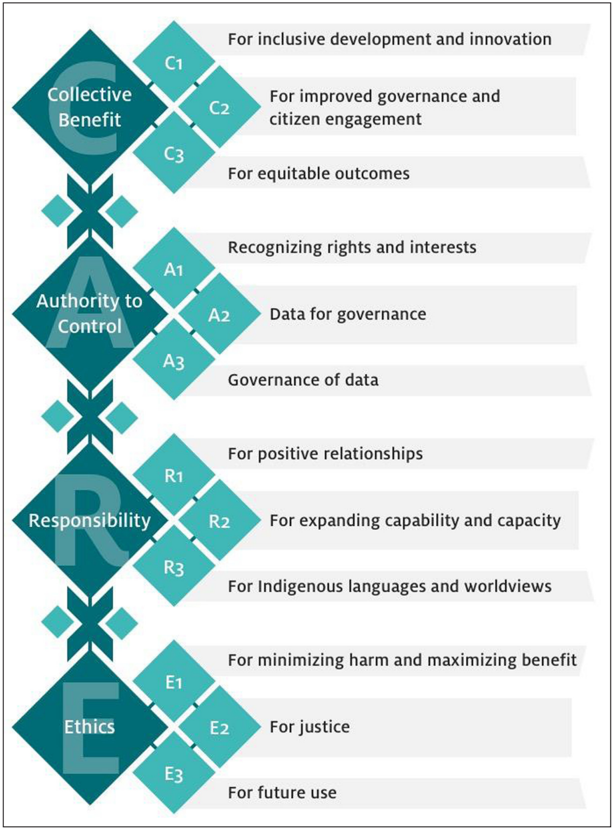
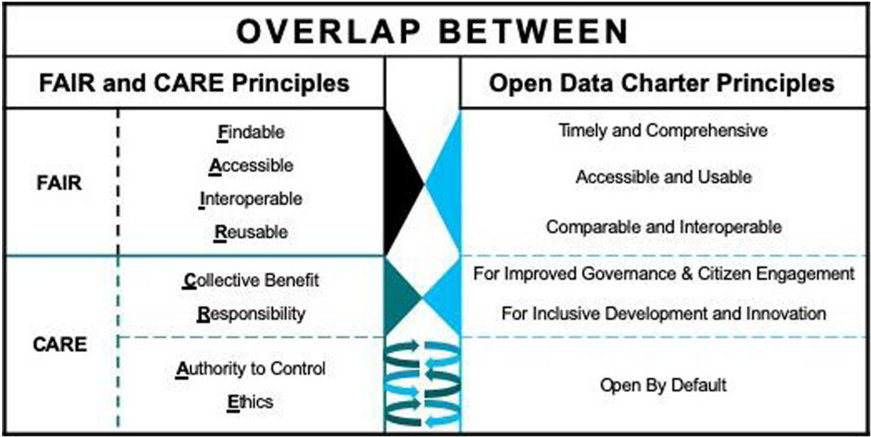
Concerns about secondary use of data and limited opportunities for benefit-sharing have focused attention on the tension that Indigenous communities feel between (1) protecting Indigenous rights and interests in Indigenous data (including traditional knowledges) and (2) supporting open data, machine learning, broad data sharing, and big data initiatives. The International Indigenous Data Sovereignty Interest Group (within the Research Data Alliance) is a network of nation-state based Indigenous data sovereignty networks and individuals that developed the ‘CARE Principles for Indigenous Data Governance’ (Collective Benefit, Authority to Control, Responsibility, and Ethics) in consultation with Indigenous Peoples, scholars, non-profit organizations, and governments. The CARE Principles are people– and purpose-oriented, reflecting the crucial role of data in advancing innovation, governance, and self-determination among Indigenous Peoples. The Principles complement the existing data-centric approach represented in the ‘FAIR Guiding Principles for scientific data management and stewardship’ (Findable, Accessible, Interoperable, Reusable). The CARE Principles build upon earlier work by the Te Mana Raraunga Maori Data Sovereignty Network, US Indigenous Data Sovereignty Network, Maiam nayri Wingara Aboriginal and Torres Strait Islander Data Sovereignty Collective, and numerous Indigenous Peoples, nations, and communities. The goal is that stewards and other users of Indigenous data will ‘Be FAIR and CARE.’ In this first formal publication of the CARE Principles, we articulate their rationale, describe their relation to the FAIR Principles, and present examples of their application.
Overview
CoChat Summary
TL;DR
The CARE Principles for Indigenous Data Governance (Collective Benefit, Authority to Control, Responsibility, and Ethics) are people- and purpose-oriented principles developed by the International Indigenous Data Sovereignty Interest Group to complement the data-centric FAIR Principles. They aim to support Indigenous rights, self-determination, and control over Indigenous data while enabling equitable data reuse.
Key findings
- CARE comprises four principles—Collective Benefit, Authority to Control, Responsibility, and Ethics—designed to complement FAIR (Findable, Accessible, Interoperable, Reusable) and guide data stewards and users to “Be FAIR and CARE.”
- The paper reports global context from UN 2009: Indigenous presence spans over 90 countries, includes over 370 million Indigenous persons, and involves more than 5,000 distinct cultures.
- CARE emerged from an Indigenous-led workshop held in Gaborone, Botswana, on 8 November 2018, as part of International Data Week, with later input from Indigenous leaders, scholars, network members, and allies.
- Early adopters/implementation examples include the Research Data Alliance, the Smithsonian Institution (e.g., Smithsonian Directive 609 and planned Collection CARE Notices), and the Open Data Charter.
Methods
- This is a conceptual/principles development paper, not an empirical study; it describes the rationale, development, and illustrative application of the CARE Principles.
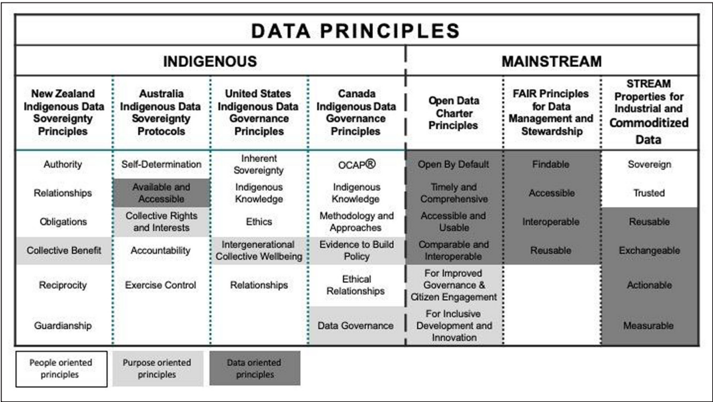
- Workshop organizers prepared an analysis of principles from Indigenous data sovereignty/governance frameworks and mainstream sources (Table 1) to inform dialogue; participants identified the four primary principles and drafted primary and sub-principles, then circulated the draft for input.
- The paper presents the principles’ relation to FAIR and examples of adoption; no formal sample, dataset, or statistical analysis is reported.
Limitations
- Stated: further research is needed to identify mechanisms that support implementation; create tools, policies, and practices that enact the Principles; explore application in different contexts (e.g., research repositories, knowledge co-production, institutional policies, existing databases/systems); and operationalize the Principles in tandem with FAIR.
- Evident: the paper is a principles publication and does not report empirical evaluation of implementation outcomes; the adoption examples are illustrative rather than systematically assessed.
Model-written summary. Check it against the paper before relying on it.
Integrity signals
Registry
Cites
Statistics
Figures
Verification
Claims the paper makes
0 Valid · 0 Not valid · 1 Not checked · 9 Own results and interpretations
- Probably not a substantial claim. 9
- It may state two separate claims as one. 5
Claims other papers make about this one
Each is checked against this paper’s own text: does it say what the citing paper says it does?
The source backs part of the claim, not all of it — or backs it for a different population, condition or comparison.
In the citing paper
“This can be in conflict with cultural values, e.g., in the case of indigenous communities that are generally underrepresented on Wikipedia but have concerns about how their knowledge might be exploited if shared [28, 29].”
From Data Governance in the Age of Large-Scale Data-Driven Language Technology (2022) · cites this paper as [28]
Experimental — accuracy not yet measuredThe source backs part of the claim, not all of it — or backs it for a different population, condition or comparison.
In the citing paper
“The key distinction is that while FAIR principles focus on making data maximally open and shareable-goals that align with scientific efficiency, CARE principles focus on people and purpose, emphasizing that data use should align with the rights and needs of Indigenous Peoples.”
From Data colonialism and indigenous languages in AI: a critical review of existing initiatives and their struggles with data sovereignty (2026) · cites this paper as Carroll et al. 2020
Experimental — accuracy not yet measuredThe source backs part of the claim, not all of it — or backs it for a different population, condition or comparison.
In the citing paper
“A concrete expression of Indigenous Data Sovereignty is found in the CARE Principles for Indigenous Data Governance, formulated in 2019 by the Global Indigenous Data Alliance and related networks (Carroll et al. 2020).”
From Data colonialism and indigenous languages in AI: a critical review of existing initiatives and their struggles with data sovereignty (2026) · cites this paper as Carroll et al. 2020
Experimental — accuracy not yet measuredThe source backs part of the claim, not all of it — or backs it for a different population, condition or comparison.
In the citing paper
“Indigenous data, whether born digital or not, include information, knowledge, specimens, and belongings about Indigenous Peoples to which they relate at both the individual and collective levels (Carroll et al., 2020; Rainie et al., 2019; Lovett et al., 2019).”
From Using Indigenous Standards to Implement the CARE Principles: Setting Expectations through Tribal Research Codes (2022) · cites this paper as Carroll et al., 2020
Experimental — accuracy not yet measuredThe source backs part of the claim, not all of it — or backs it for a different population, condition or comparison.
In the citing paper
“The FAIR Principles are aligned to the global shift towards open science and open data, promoting data centric criteria that facilitate increased data sharing among entities while ignoring relationships, power differentials, and the historical conditions associated with the collection of data10,11.”
From Operationalizing the CARE and FAIR Principles for Indigenous data futures (2021) · cites this paper as [11]
Experimental — accuracy not yet measured
6 more claims about this paper
Create a free account to see every claim other papers make about this one.
Self-check
Percentages, sums and reported differences re-computed from the paper’s own numbers.
Each contradiction between two passages listed here was confirmed by an independent check.
Rated minor: it would not touch a result — a value no result rests on, a p-value that stays on the same side of the significance level, or a conflict that is clerical, resolved elsewhere in the paper, or outside its own findings.
In the paper
§ The CARE Principles for Indigenous Data Governance > Research Data Alliance (www.rd-alliance.org), in research environments
“In 2012, the American Museum of Natural History at the Smithsonian Institution in Washington, DC released an Access and Benefit Sharing Policy on Genetic Resources”
§ The CARE Principles for Indigenous Data Governance > References
“42. Smithsonian Institution. 2012. Access and Benefit Sharing Policy on Genetics Resources. Washington, DC: National Museum of American History.”
Citations
Cites
The FAIR Guiding Principles for scientific data management and stewardship
Wilkinson, M. D., Dumontier, M., Aalbersberg, I. J., Appleton, G., Axton, M., Baak, A., Blomberg, N., Boiten, J.-W., da Silva Santos, L. B., Bourne, P. E., et al. (2016) · Scientific Data · doi:10.1038/sdata.2016.18 · Cited by 18,423
Indigenous Peoples In International Law: Second Edition
Anaya, S. J. (2004) · doi:10.1093/oso/9780195173499.001.0001 · Cited by 1,011
(2016) · doi:10.22459/caepr38.11.2016 · Cited by 696 · cited 6×
“…has become an increasingly relevant topic as big data, open data, open science, and data reuse become an integral part of research and institutional practices (Carroll, Rodriguez-Lonebear & Martinez 2019; Lovett et al. 2019; Rainie et al. 2019; Kukutai & Taylor 2016a; Taylor & Kukutai 2015).”
BackgroundInfluentialBuck, M., & Hamilton, C. (2011) · Review of European Community & International Environmental Law · doi:10.1111/j.1467-9388.2011.00703.x · Cited by 627
Indigenous Data Governance: Strategies from United States Native Nations
Carroll, S. R., Rodriguez-Lonebear, D., & Martinez, A. (2019) · Data Science Journal · doi:10.5334/dsj-2019-031 · Cited by 264
Self-citationGenomic Research Through an Indigenous Lens: Understanding the Expectations
Garrison, N. A., Hudson, M., Ballantyne, L. L., Garba, I., Martinez, A., Taualii, M., Arbour, L., Caron, N. R., & Rainie, S. C. (2019) · Annual Review of Genomics and Human Genetics · doi:10.1146/annurev-genom-083118-015434 · Cited by 220
Self-citationData sovereignty for indigenous peoples: current practice and future needs
Kukutai, T., & Taylor, J. (2016) · Indigenous Data Sovereignty · doi:10.22459/caepr38.11.2016.01 · Cited by 116
Rainie, S. C., Schultz, J. L., Briggs, E., Riggs, P., & Palmanteer-Holder, N. L. (2017) · International Indigenous Policy Journal · doi:10.18584/iipj.2017.8.2.1 · Cited by 114
Law, Knowledge, Culture: The Production of Indigenous Knowledge in Intellectual Property Law
Anderson, J. E. (2009) · Edward Elgar Publishing eBooks · doi:10.4337/9781848447196 · Cited by 95
Self-citationNational Inuit Strategy on Research.
Kanatami, I. T. (2018) · IOC of UNESCO (Intergovernmental Oceanographic Commission) · doi:10.25607/obp-1673 · Cited by 93
Research works printed but not linked: 18
- Cajete, G. 2000. Native science: Native laws of interdependence. Santa Fe: Clear Light.
- Castellano, MB. 2004. Ethics of Aboriginal research. Journal of Aboriginal Health, January, 98-114.
- Hudson, M, Milne, M, Russell, K, Smith, B, Reynolds, P and Atatoa-Carr, P. 2016. The Development of Guidelines for Indigenous Research Ethics in Aotearoa/New Zealand. In A.-L. Drugge (ed.), Ethics in Indigenous Research, Past Experiences -Future Challenges, 157-174. Umea, Sweden: Vaartoe Centre for Sami Research, Umea University.
- Drugge, A-L. 2016. Ethics in Indigenous Research: Past Experiences -Future Challenges. Umea, Sweden: Vaartoe Centre for Sami Research, Umea University.
- Julayinbul Statement in Indigenous Intellectual Property Rights. 1993. The Julayinbul Conference on Intellectual and Cultural Property. Australia: Jingarrba.
- Kovach, M. 2009. Indigenous methodologies: Characteristics, conversations, and contexts. Toronto: University of Toronto Press.
- Kukutai, T and Taylor, J. 2016a. Indigenous data sovereignty: Toward an agenda. Canberra, Australia: Aus- tralian National University Press. DOI: https://doi.org/10.22459/CAEPR38.11.2016 · DOI · Paper page
- Lovett, R, Lee, V, Kukutai, T, Cormack, D, Rainie, SC and Walker, J. 2019. Good data practices for Indigenous Data Sovereignty and Governance. In: Daly, A, Devitt, K and Monique, M (eds.), Good Data. Amsterdam: Institute of Network Cultures Inc. ISBN 978-94-92302-27-4.
- Mātaatua Declaration on Cultural and Intellectual Property Rights of Indigenous Peoples. 1993. First International Conference on the Cultural and Intellectual Property Rights of Indigenous Peoples. 12-18 June 1993. Aotearoa, New Zealand. Available at https://www.wipo.int/export/sites/www/tk/en/ databases/creative_heritage/docs/mataatua.pdf.
- McGregor, D, Restoule, JP and Johnston, R. (eds.) 2018. Indigenous research: Theories, practices, and rela- tionships. Canadian Scholars' Press.
- 2017, First Nations’ data governance: Measuring the nation-to-nation relationship discussion paper, British Columbia First Nations’ Data Governance Initiative
- Rainie, SC, Kukutai, T, Walter, M, Figueroa-Rodriguez, OL, Walker, J and Axelsson, P. 2019. Issues in Open Data: Indigenous Data Sovereignty. In: Davies, T, Walker, S, Rubinstein, M and Perini, F (eds.), The State of Open Data: Histories and Horizons. Cape Town and Ottawa: African Minds and International Development Research Centre. pp. 300-319.
- Ratima, M. 2001. Kia uruuru mai a hauora being healthy, being Maori: Conceptualising Maori health promotion. Published thesis (PhD) Department of Public Health. Dunedin, University of Otago.
- Ratima, M. 2001. Kia uruuru mai a hauora being healthy, being Maori: Conceptualising Maori health promotion. Published thesis (PhD) Department of Public Health. Dunedin, University of Otago. Research Data Alliance. 2017. International Indigenous Data Sovereignty Intertest Group. Available at https://www.rd-alliance.org/groups/international-indigenous-data-sovereignty-ig [Last accessed 17 January 2020].
- Snipp, CM. 2016. What does data sovereignty imply: what does it look like? In: Kukutai and Taylor, J (eds.), Indigenous data sovereignty: Toward an agenda. Canberra, Australia: Australian National University Press. pp. 39-55. DOI: https://doi.org/10.22459/CAEPR38.11.2016. · DOI · Paper page
- Smith, LT. 2012. Decolonizing Methodologies: Research and Indigenous Peoples. Zed Books. London: Univer- sity of Otago Press.
- Rodriguez-Lonebear, D. 2016. Building a data revolution in Indian country. In: Kukutai, T and Taylor, J (eds.), Indigenous data sovereignty: Toward an agenda. Canberra, Australia: Australian National University Press. pp. 253-272. DOI: https://doi.org/10.22459/CAEPR38.11.2016. · DOI · Paper page
- 2008, Research is ceremony: Indigenous research methods
Cited by
Items 201–300 of 1,410
Sovereign genes: wildlife conservation, genetic preservation, and Indigenous data sovereignty
Robbins, P. F., Hunt, H. H., Pelegri, F. J., & Gilbert, J. (2023) · Frontiers in Conservation Science · doi:10.3389/fcosc.2023.1099562 · Cited by 20
“These processes have limited the ability of Indigenous Peoples to recover, develop and sustain their knowledges, an ability that is central to Indigenous Peoples’ capacity to realize their human rights and fulfill their responsibilities” (Carroll et al., 2020).”
BackgroundMethodInfluentialRhodes, K. L., Echo‐Hawk, A., Lewis, J., Cresci, V. L., Satter, D. E., & Dillard, D. A. (2023) · Public Health Reports · doi:10.1177/00333549231199477 · Cited by 23
“30 White et al 31”
Increasing diversity of functional genetics studies to advance biological discovery and human health
George, S. H. L., Medina-Rivera, A., Idaghdour, Y., Lappalainen, T., & Romero, I. G. (2023) · The American Journal of Human Genetics · doi:10.1016/j.ajhg.2023.10.012 · Cited by 20
A community convention for ecological forecasting: Output files and metadata version 1.0
Dietze, M. C., Thomas, R. Q., Peters, J. A., Boettiger, C., Koren, G., Shiklomanov, A., & Ashander, J. (2023) · Ecosphere · doi:10.1002/ecs2.4686 · Cited by 31
Kjerland, T. M., Schroeder, S. M., Tofaeono, V., Walls, M. L., & Gone, J. P. (2024) · Dementia · doi:10.1177/14713012241233651 · Cited by 18
“Some examples include applying the CARE Principles for Indigenous Data Governance (Carroll et al., 2020); specifying how written research agreements protect intellectual property and potential fi nancial bene fi ts (Huria et al., 2019); and, addressing how the research takes a strengths-based…”
MethodCentering Relationality and CARE for Stewardship of Indigenous Research Data
Belarde‐Lewis, M., Littletree, S., Braine, I. R., Srader, K., Guerrero, N., & Palmer, C. L. (2024) · Data Science Journal · doi:10.5334/dsj-2024-032 · Cited by 20
Azzopardi, P. S., Clark, T. C., Renfrew, L., Habito, M., & Ameratunga, S. N. (2024) · Journal of Adolescent Health · doi:10.1016/j.jadohealth.2024.04.001 · Cited by 23
Data reuse in agricultural genomics research: challenges and recommendations
Hafner, A., DeLeo, V. L., Deng, C. H., Elsik, C. G., Fleming, D. S., Harrison, P. W., Kalbfleisch, T., Petry, B., Pucker, B., Quezada-Rodríguez, E. H., et al. (2025) · GigaScience · doi:10.1093/gigascience/giae106 · Cited by 19
“As Carroll et al. [ 121 ] note, we must acknowledge that man y publicl y av ailable and r eused datasets alr eady use Indigenous resources and traditional knowledge.”
Governing artificial intelligence means governing data: (Re)setting the agenda for data justice
Taylor, L., de Souza, S. P., Martin, A. K., & López-Solano, J. (2025) · Dialogues on Digital Society · doi:10.1177/29768640241306800 · Cited by 26
“…accessibility, interoperability, and reusability) which place an emphasis on fi ndability, accessibility, Interoperability and Reusability, but as indigenous data sovereignty experts argue do not address challenges of power, including those centred on historical contexts (Carroll et al., 2020).”
Smits, A. P., Hall, E. K., Deemer, B. R., Scordo, F., Barbosa, C. C., Carlson, S. M., Cawley, K. M., Grossart, H., Kelly, P., Mammola, S., et al. (2025) · Ecosphere · doi:10.1002/ecs2.70205 · Cited by 27
Co‐Creating Ethical Practices and Approaches for Fieldwork
Ryan-Davis, J., & Scalice, D. (2022) · AGU Advances · doi:10.1029/2022av000762 · Cited by 21
Participatory AI Considerations for Advancing Racial Health Equity
Parker, A. G., Vardoulakis, L., Alla, J., & Harrington, C. (2025) · CHI Conference on Human Factors in Computing Systems · doi:10.1145/3706598.3713165 · Cited by 26
“For high level design ideation, the importance of community-engaged data governance is increasingly being recognized, particularly in the context of marginalized populations [38, 139].”
Keeping time with digital technologies: From real-time environments to forest futurisms
Hood, K. L., & Gabrys, J. (2024) · Environment and Planning D Society and Space · doi:10.1177/02637758241229896 · Cited by 24
“Such data infrastructures emerge from calls for Indigenous data sovereignty (Carroll et al., 2020; Kukutai and Taylor, 2016) as the rights of Indigenous peoples to define data relating to their territories and knowledges and to determine how to share, protect, and interpret them.”
BackgroundD’Amato, M. E., Joly, Y., Lynch, V., Machado, H., Scudder, N., & Zieger, M. (2024) · Forensic Science International Genetics · doi:10.1016/j.fsigen.2024.103053 · Cited by 23
Alderman, J. E., Palmer, J., Laws, E., McCradden, M. D., Ordish, J., Ghassemi, M., Pfohl, S. R., Rostamzadeh, N., Cole-Lewis, H. J., Glocker, B., et al. (2024) · NEJM AI · doi:10.1056/aip2401088 · Cited by 19
Interoperability for ecosystem service assessments: Why, how, who, and for whom?
Bagstad, K. J., Balbi, S., Adamo, G., Athanasiadis, I. N., Affinito, F., Willcock, S., Magrach, A., Hayashi, K., Harmáčková, Z. V., Niamir, A., et al. (2025) · Ecosystem Services · doi:10.1016/j.ecoser.2025.101705 · Cited by 22
SEEDS of Indigenous Population Health Data Linkage
Rowe, R., Carroll, S. R., Healy, C., Rodriguez-Lonebear, D., & Walker, J. D. (2021) · International Journal for Population Data Science · doi:10.23889/ijpds.v6i1.1417 · Cited by 23
Self-citationTen simple rules for researchers who want to develop web apps
Saia, S. M., Nelson, N. G., Young, S. N., Parham, S., & Vandegrift, M. (2022) · PLoS Computational Biology · doi:10.1371/journal.pcbi.1009663 · Cited by 17
For the Next Seven Generations: An Indigenous Strengths-Based Developmental SciencePreprint
Fish, J., Uink, B. N., Wiglesworth, A., Tsethlikai, M., Him, D. A., & O’Keefe, V. M. (2023) · doi:10.31234/osf.io/hr28s · Cited by 15
Cartney, A. M. M., Formenti, G., Mouton, A., Panis, D. N. D., Marins, L. S., Leitão, H. G., Diedericks, G., Kirangwa, J., Morselli, M., Salces-Ortiz, J., et al. (2023) · bioRxiv (Cold Spring Harbor Laboratory) · doi:10.1101/2023.09.25.559365 · Cited by 15
Suchikova, Y., & Nazarovets, S. (2025) · Scientific Data · doi:10.1038/s41597-025-04756-9 · Cited by 21
“For Indigenous communities, CARE has empowered them to reclaim control over data historically misused by external entities 11 .”
Horna-Saldaña, C. J., Pérez, J. E. P., & Galeano, M. L. T. (2025) · Journal of Enabling Technologies · doi:10.1108/jet-09-2024-0063 · Cited by 22
Pereda, J., Willcox, P., Candela, G., Diaz, A. S., & Murrieta‐Flores, P. (2025) · International Journal of Digital Humanities · doi:10.1007/s42803-025-00097-6 · Cited by 30
Critically Unpacking the Concept of Equity for Open Science
Bezuidenhout, L. M. (2025) · Social Epistemology · doi:10.1080/02691728.2025.2475460 · Cited by 18
“…injustice is increasingly scrutinized within academic disciplines (Fricker 2007), as are discussions on Indigenous knowledge systems and inclusion (Carroll et al. 2020) Packaging and presentation of data Many Open Science infrastructures are data-heavy and designed to be used through laptops and…”
Artificial intelligence in rare diseases: toward clinical impact
Amorim, A. M. B., Orzeł, U., Caniceiro, A. B., Rosário‐Ferreira, N., & Moreira, I. S. (2025) · Trends in Pharmacological Sciences · doi:10.1016/j.tips.2025.10.010 · Cited by 18
Callison, C., Ludbrook, A., Owen, V., & Nayyer, K. (2021) · KULA knowledge creation dissemination and preservation studies · doi:10.18357/kula.146 · Cited by 22
Effects of Ethnic Classification on Substantive Findings in Adolescent Mental Health Outcomes
Yao, E. S., Bullen, P., Meissel, K., Tiatia‐Seath, J., Fleming, T. M., & Clark, T. C. (2022) · Journal of Youth and Adolescence · doi:10.1007/s10964-022-01612-6 · Cited by 19
Sensing inequity: technological solutionism, biodiversity conservation, and environmental DNA
Shen, E. W., Vandenberg, J. M., & Moore, A. (2023) · BioSocieties · doi:10.1057/s41292-023-00315-w · Cited by 19
“…that are Findable, Accessible, Interoperable, and Reusable) and CARE (data that consider Collective Benefit, Authority to control, Responsibility, and Ethics in working with Indigenous communities) principles, could be useful in the planning and dissemination of eDNA data (Carroll et al. 2020).”
Toward Digitalization of Fishing Vessels to Achieve Higher Environmental and Economic Sustainability
Uriondo, Z., Fernandes, J. A., Reite, K.-J., Quincoces, I., & Pazouki, K. (2024) · ACS Environmental Au · doi:10.1021/acsenvironau.3c00013 · Cited by 17
Māori Algorithmic Sovereignty: Idea, Principles, and Use
Brown, P. T., Wilson, D., West, K., Escott, K.-R., Basabas, K., Ritchie, B., Lucas, D., Taia, I., Kusabs, N., & Keegan, T. T. (2024) · Data Science Journal · doi:10.5334/dsj-2024-015 · Cited by 36
Bari, A. H. A., Abed, R. A., Kadhim, R. M., Hasan, H. F., Sharaf, H. K., & Alwan, A. S. (2024) · Corporate Board role duties and composition · doi:10.22495/cbv20i2art12 · Cited by 14
Spithoff, S. M., Vesely, L., McPhail, B. M., Rowe, R., Mogic, L., & Grundy, Q. (2025) · JAMA Network Open · doi:10.1001/jamanetworkopen.2025.7688 · Cited by 12
Self-citationIdentifying gaps in the photographic record of the vascular plant flora of the Americas
Pitman, N. C. A., Suwa, T., Ulloa, C. U., Miller, J. S., Solomon, J., Philipp, J., Vriesendorp, C., Lewis, A. D., Perk, S., Bonnet, P., et al. (2021) · Nature Plants · doi:10.1038/s41477-021-00974-2 · Cited by 16
Collections Education: The Extended Specimen and Data Acumen
Monfils, A., Krimmel, E., Linton, D., Marsico, T. D., Morris, A. B., & Ruhfel, B. R. (2021) · BioScience · doi:10.1093/biosci/biab109 · Cited by 18
Wold, J., Guhlin, J. G., Dearden, P. K., Santure, A. W., & Steeves, T. E. (2023) · Molecular Ecology Resources · doi:10.1111/1755-0998.13783 · Cited by 24
Ten simple rules for recognizing data and software contributions in hiring, promotion, and tenure
Puebla, I., Ascoli, G. A., Blume, J. D., Chodacki, J., Finnell, J., Kennedy, D. N., Mair, B. A., Martone, M. E., Wittenberg, J., & Poline, J. (2024) · PLoS Computational Biology · doi:10.1371/journal.pcbi.1012296 · Cited by 23
Neo-colonial intelligence: How AI risks reinforcing spatial injustices in a digitally divided world
Baresi, U. (2025) · Cities · doi:10.1016/j.cities.2025.106232 · Cited by 22
Doğan, A. L., & Wood, D. R. (2023) · ACM SIGCAS/SIGCHI Conference on Computing and Sustainable Societies (COMPASS) · doi:10.1145/3588001.3609368 · Cited by 16
“The tertiary principle of the CARE principles is the responsibility “to nurture respectful relationships with Indigenous Peoples from whom the data originate” (Carroll et al. 2020) This responsibility falls ontome, as the outside researcher and stakeholder.”
BackgroundMethodInfluentialLuo, Y., Mao, C., Sanchez-Pinto, L. N., Ahmad, F. S., Naidech, A. M., Rasmussen, L. V., Pacheco, J. A., Schneider, D., Mithal, L. B., Dresden, S. M., et al. (2024) · Learning Health Systems · doi:10.1002/lrh2.10417 · Cited by 21
Bailey-Winiata, A. P., Gallop, S. L., White, I., Wotherspoon, L. M., Fa’aui, T., Dickson, M. E., & Ellis, J. I. (2024) · Regional Environmental Change · doi:10.1007/s10113-024-02240-5 · Cited by 22
“In line with the CARE (Collective benefit, Authority to control, Responsibility and Ethics) principles devised by (Carroll et al. 2020) and as outlined in Māori and Indigenous data sovereignty principles, we do not provide exact locations of Māori sites referred to in this paper, only regional…”
Introducing Isotòpia: A stable isotope database for Classical Antiquity
Formichella, G., Soncin, S., Lubritto, C., Tafuri, M. A., Fernandes, R. J., & Cocozza, C. (2024) · PLoS ONE · doi:10.1371/journal.pone.0293717 · Cited by 14
Dance, M., Duncan, R. J., Gevers, M., Honan, E. M., Runge, E., Schalamon, F. R., & Walch, D. M. R. (2024) · PLOS Climate · doi:10.1371/journal.pclm.0000393 · Cited by 16
“…the local community is involved in all fieldwork stages (planning, executing, and debriefing) also promotes decolonisation of the research enterprise and the promotion of CARE principles [78], equitable cross-cultural understanding, benefit sharing, and informed interpretation of findings [62].”
BackgroundAlderman, J. E., Charalambides, M., Sachdeva, G. S., Laws, E., Palmer, J., Lee, E., Menon, V., Malik, Q., Vadera, S., Calvert, M., et al. (2024) · The Lancet Digital Health · doi:10.1016/s2589-7500(24)00146-8 · Cited by 17
Decolonizing botanical gardens
Leonard, K. (2024) · Qualitative Research Journal · doi:10.1108/qrj-04-2024-0086 · Cited by 24
The need for sustainable funding for Indigenous doula services in Canada
Wodtke, L., Hayward, A., Nychuk, A., Doenmez, C. F. T., Sinclair, S., & Cidro, J. (2022) · Women s Health · doi:10.1177/17455057221093928 · Cited by 15
Kulasegaram, K. M., Grierson, L., Barber, C., Chahine, S., Chou, F. C., Cleland, J., Ellis, R., Holmboe, E. S., Pusic, M. V., Schumacher, D. J., et al. (2024) · Medical Teacher · doi:10.1080/0142159x.2023.2298762 · Cited by 17
“These principles emerge from the history of colonization, active marginalization, and instances in which research data were collected to little benefit or active harm of Indigenous communities (Walter et al. 2021”
Austin, C. C., Bernier, A., Bezuidenhout, L. M., Bicarregui, J. C., Biro, T., Cambon‐Thomsen, A., Carroll, S. R., Cournia, Z., Dąbrowski, P. W., Diallo, G., et al. (2020) · Wellcome Open Research · doi:10.12688/wellcomeopenres.16378.2 · Cited by 26
Self-citationUsing big data from long-form recordings to study development and optimize societal impact
Cychosz, M., & Cristià, A. (2022) · Advances in child development and behavior · doi:10.1016/bs.acdb.2021.12.001 · Cited by 14
Incentivising open ecological data using blockchain technology
Lewis, R. J., Marstein, K., & Grytnes, J. (2023) · Scientific Data · doi:10.1038/s41597-023-02496-2 · Cited by 22
“As such, flexible access control requirements of many data originators are legitimate 35 and ought to be more broadly recognised and respected by journals, funders and end-users.”
BackgroundImplications of high throughput sequencing of plant viruses in biosecurity – a decade of progress?
Fox, A., Botermans, M., Ziebell, H., Fowkes, A., Pareta, N. F., Massart, S., Rodoni, B., Chooi, K. M., Kreuze, J. F., Kumar, P. L., et al. (2025) · Peer Community Journal · doi:10.24072/pcjournal.572 · Cited by 13
“The CARE principles were developed by the Global Indigenous Data Alliance to support Collective benefit; Authority to control; Responsibility; and Ethics (Carroll et al., 2020).”
Global sampling decline erodes science potential of natural history collections
Forbes, O., Young, A. G., & Thrall, P. H. (2025) · Nature Communications · doi:10.1038/s41467-025-64303-3 · Cited by 22
“…owners (e.g. the Nagoya Protocol, the Global Indigenous Data Alliance, CARE principles) add further complexities, requiring thoughtful navigation 25 – 27 . c) Shifting workforce priorities: Growing recognition of the need to ‘ future-proof ’ natural history collections is driving capability…”
Co-producing ocean plans with Indigenous and traditional knowledge holders
Baron-Aguilar, C. C., Boswell, R., Cisneros-Montemayor, A. M., Copenhaver, A. E., Costa, Y., Frid, A., Hiwasaki, L., Hudson, M. L., Jones, N. J. R., Kelly, B. P., et al. (2025) · npj Ocean Sustainability · doi:10.1038/s44183-025-00158-x · Cited by 20
Self-citationKhatiwada, M., Howard, D., Krempley, T., Walton, K. M., Williams, C. S., & Graber, A. D. (2026) · The American Journal of Bioethics · doi:10.1080/15265161.2026.2632012 · Cited by 13
“…et al. 2010), e.g., African American participants (Amofa et al. 2023), American Indian and Alaskan Native participants (Tsosie et al. 2021a, 2021b; Carroll et al., 2020), disabled participants (Kitchin 2000); LGBTQ participants (Meyer et al. 2022), Muslim participants (Suleman 2016), etc.…”
McKinley, C. C., Showalter, G. M., Crofoot, T., & Stone, K. (2022) · Journal of Geoscience Education · doi:10.1080/10899995.2022.2112491 · Cited by 14
“• Recently the CARE principles were developed by the Global Indigenous Data Alliance (Carroll et al., 2020) and they provide clear guidelines for how best to generate and work with Indigenous data, including the importance of Indigenous communities having authority of control over their data including the “cultural he…”
MethodBowers, A. J., & Choi, Y. (2023) · Educational Researcher · doi:10.3102/0013189x231181103 · Cited by 21
“It should be noted that the CARE principles are “designed to guide the inclusion of Indigenous Peoples in data governance across contemporary data ecosystems” (Carroll, Hudson, et al., 2020).”
InfluentialPinhanez, C. S., Cavalin, P., Vasconcelos, M., & Nogima, J. (2023) · International Joint Conference on Artificial Intelligence · doi:10.24963/ijcai.2023/685 · Cited by 25
“Fortunately, recently those communities have been reclaiming the control of their knowledge and data ecosystems, science, and narratives [Carroll et al. , 2020].”
BackgroundGenetic research with Indigenous Peoples: perspectives on governance and oversight in the US
Garrison, N. A., & Carroll, S. R. (2023) · Frontiers in Research Metrics and Analytics · doi:10.3389/frma.2023.1286948 · Cited by 18
“…for Indigenous Data Governance (Collective Benefit, Authority to Control, Responsibility, Ethics) to complement the FAIR principles for scientific data management (Findable, Accessible, Interoperable, Reusable) (Wilkinson et al., 2016; Carroll et al., 2020, 2022a; Carroll S. R. et al., 2021).”
BackgroundSelf-citationAn indigenous geographic position on producing data in colonial conditions
Palmer, M. A. (2024) · Geography Compass · doi:10.1111/gec3.12746 · Cited by 13
Aligning policy and practice to implement CARE with FAIR through Indigenous Peoples’ protocols
Taitingfong, R. I., Martinez, A. O., Hudson, M. L., Lovett, R. W., Maher, B., Prehn, J., Rowe, R., Boileau, K., Franks, A., Khan, S. F., et al. (2024) · Acta Borealia · doi:10.1080/08003831.2024.2410112 · Cited by 20
“…renewed attention is needed to the original intent of CARE: to direct data actors to local communities ’ protocols and frameworks for IDGov, and to transform institutional policies and practice to fortify Indigenous Peoples ’ authority to control their own data (Carroll et al. 2020; GIDA n.d.).”
InfluentialSelf-citationEvolution, genetic diversity, and health
Palma-Martínez, M. J., Posadas‐García, Y. S., Shaukat, A., López-Ángeles, B. E., & Sohail, M. (2025) · Nature Medicine · doi:10.1038/s41591-025-03558-1 · Cited by 15
“In this context, frameworks such as the CARE (collective benefit, authority to control, responsibility and ethics) principles offer guidance, emphasizing the importance of actions that guarantee Indigenous data governance and ensure a beneficial outcome for the community 131 .”
Meinel, G., Sikder, S. K., & Krueger, T. (2021) · Jahrbücher für Nationalökonomie und Statistik · doi:10.1515/jbnst-2021-0009 · Cited by 12
Building digital workforce capacity and skills for data-intensive science
OECD (2020) · OECD science, technology and industry policy papers · doi:10.1787/e08aa3bb-en · Cited by 30
Wheeler, R., Arsenault, J., & Taylor, M. (2022) · Collections: A Journal for Museum and Archives Professionals · doi:10.1177/15501906211072916 · Cited by 12
Narlock, M. R., Calvert, S., Taylor, S., Marquez, R. P., & Parkman, A. (2024) · Data Science Journal · doi:10.5334/dsj-2024-046 · Cited by 12
Large multimodal models for low-resource languages: A survey
Lupaşcu, M., Rogoz, A.-C., Stupariu, M., & Ionescu, R. T. (2026) · Information Fusion · doi:10.1016/j.inffus.2026.104189 · Cited by 33
Maar, M. A., Ominika, T., & Manitowabi, D. (2022) · International Indigenous Policy Journal · doi:10.18584/iipj.2022.13.2.13792 · Cited by 14
“(Carroll et al., 2020, p. 6) In Canada, several Indigenous data sovereignty frameworks have been implemented.”
InfluentialBaldwin, J. A., Alvarado, A., JARRATT-SNIDER, K., Hunter, A. M., Keene, C., Castagno, A. E., Ali-Joseph, A., Roddy, J. K., Begay, M. A., Joseph, D. H., et al. (2023) · JMIR Research Protocols · doi:10.2196/44727 · Cited by 15
“The research process was guided by the Collective benefit, Authority to control, Responsibility, Ethics (CARE) principles for Indigenous Data Governance to honor tribal and data sovereignty [37-39].”
Given, L. M., Polkinghorne, S., & Cattlin, J. (2023) · Journal of the Association for Information Science and Technology · doi:10.1002/asi.24849 · Cited by 11
“Around metadata, for example, Sha-ron cites the current importance of the FAIR principles for digital data management (FAIR Principles, 2016), and the CARE Principles for Indigenous Data Governance (GIDA, 2018).”
Coproducing health research with Indigenous peoples
Cunningham, C. W., & Mercury, M. (2023) · Nature Medicine · doi:10.1038/s41591-023-02588-x · Cited by 21
“Data sovereignty and data-use agreements are one mechanism to address differing and sometimes incommensurable views on data sharing 49 .”
BackgroundGanesh, S. (2024) · Environmental Communication · doi:10.1080/17524032.2023.2299749 · Cited by 14
Monitoring Open Science as transformative change: Towards a systemic framework
Ràfols, I., Meijer, I., & Molas‐Gallart, J. (2024) · F1000Research · doi:10.12688/f1000research.148290.1 · Cited by 23
“This is a good example of an outcome (a change induced by OA: broader reach) aligned with the value of making science more diverse.”
BackgroundChaji, D., Malloy, L., Meredyth, D., Milch, V., Toms, C., Howlett, C., & Keefe, D. M. K. (2024) · Holistic Integrative Oncology · doi:10.1007/s44178-024-00099-4 · Cited by 13
Huvila, I., & Sinnamon, L. S. (2024) · Journal of the Association for Information Science and Technology · doi:10.1002/asi.24957 · Cited by 20
“Leonelli argues that the “ conception of openness as sharing is flawed ” (Leonelli, 2023, p. 43) and advocates for an alternative notion of openness based on inclusion, datafication and research data sharing (Carroll et al., 2020; Oliver et al., 2023b).”
Data sharing ethics toolkit: The Human Cell Atlas
Kirby, E., Bernier, A., Guigó, R., Wold, B. J., Arzuaga, F., Kusunose, M., Zawati, M. H., & Knoppers, B. M. (2024) · Nature Communications · doi:10.1038/s41467-024-54300-3 · Cited by 11
“Sectoral guidelines such as the FAIR 20 and CARE 21 principles and the GA4GH Framework for Responsible Sharing of Genomic and Health-related Data 22 , have proposed frameworks to foster data discovery, accessibility, interoperability and re-use.”
Machine learning approaches to Landsat change detection analysis
Richardson, G., Knudby, A. J., Crowley, M. A., Sawada, M., & Chen, W. (2025) · Canadian Journal of Remote Sensing · doi:10.1080/07038992.2024.2448169 · Cited by 20
“These concerns have reinforced discussions on data sovereignty, meaningful control, ownership, and claims to the data or models (Carroll et al. 2020; Hummel et al. 2021).”
A vision of human–AI collaboration for enhanced biological collection curation and research
Stenhouse, A., Fisher, N., Lepschi, B. J., Schmidt‐Lebuhn, A. N., Rodríguez, J., Turco, F., Reeson, A. F., Paris, C. L., & Thrall, P. H. (2025) · BioScience · doi:10.1093/biosci/biaf021 · Cited by 15
“…initiatives such as the CARE Principles for Indigenous Data Governance (CARE for collective benefit, authority to control, responsibility, and ethics ; Carroll et al. 2020 ) may place a range of requirements on both physical specimens and digital data that increase workloads on curatorial staff.”
Lawniczak, M., Kocot, K. M., Astrin, J. J., Blaxter, M., de Sotero-Caio, C. G., Barker, K. B., Childers, A. K., Coddington, J. A., Davis, P., Howe, K., et al. (2025) · GigaScience · doi:10.1093/gigascience/giaf041 · Cited by 15
Vogt, L. (2025) · Journal of Biomedical Semantics · doi:10.1186/s13326-025-00340-7 · Cited by 9
Dudgeon, P., Collova, J. R., Derry, K., & SUTHERLAND, S. R. (2023) · International Journal of Environmental Research and Public Health · doi:10.3390/ijerph20032173 · Cited by 13
“The roundtable report calls for Indigenous data sovereignty as part of a global movement regarding the human right of Indigenous peoples to govern the creation, collection, ownership and application of their data [83,84].”
BackgroundThe founding charter of the Omic Biodiversity Observation Network (Omic BON)
Meyer, R., Davies, N., Pitz, K. J., Meyer, C., Samuel, R. M., Anderson, J., Appeltans, W., Barker, K. B., Chávez, F. P., Duffy, J. E., et al. (2022) · GigaScience · doi:10.1093/gigascience/giad068 · Cited by 11
Self-citationPaprica, P. A., Crichlow, M., Maillet, D. C., Kesselring, S., Pow, C., Scarnecchia, T., Schull, M. J., Cartagena, R. G., Cumyn, A., Dostmohammad, S., et al. (2023) · International Journal for Population Data Science · doi:10.23889/ijpds.v8i4.2142 · Cited by 17
Northwest Native Plants: A Digital Space for Paleoethnobotanical Knowledges and Biocultural Heritage
Carney, M. C., Diedrich, M., Blong, J. C., Guedes, J. D., Fulkerson, T. J., Kite, T., Leonard-Doll, K., LeCompte-Mastenbrook, J., Tushingham, S., & Zimmermann, M. (2022) · Heritage · doi:10.3390/heritage5010016 · Cited by 12
Walton, K., Scarsbrook, L., Mitchell, K. J., Verry, A. J. F., Marshall, B. A., Rawlence, N. J., & Spencer, H. G. (2022) · Molecular Ecology Resources · doi:10.1111/1755-0998.13696 · Cited by 15
Recommendations on Open Science Rewards and Incentives
Mabile, L., Shmagun, H., Erdmann, C. C., Cambon‐Thomsen, A., Thomsen, M., & Grattarola, F. (2025) · Data Science Journal · doi:10.5334/dsj-2025-015 · Cited by 17
Geospatial Artificial Intelligence (GeoAI) Is Widening the Digital Divide
Huang, X. (2025) · Annals of the American Association of Geographers · doi:10.1080/24694452.2025.2527316 · Cited by 19
Conserving Genetic and Genomic Diversity in Accordance with the Global Biodiversity Framework
da Silva, J. M., Bertola, L. D., DeWoody, J. A., Steeves, T. E., Sunnucks, P., Vilaça, S. T., & Hoban, S. (2025) · Annual Review of Animal Biosciences · doi:10.1146/annurev-animal-030424-070756 · Cited by 17
Effective health and wellness systems for rural and remote Indigenous communities: a rapid review
Stefanon, B. M., Tsetso, K., Tanche, K., & Ninomiya, M. E. M. (2023) · International Journal of Circumpolar Health · doi:10.1080/22423982.2023.2215553 · Cited by 14
Indigenous knowledge mobilization: reflection on context, content, and relationship
Hutchinson, P., McIlduff, C. D., Legare, M., Keewatin, M., Hagel, M., Chapados, M., & Acharibasam, J. B. (2023) · AlterNative An International Journal of Indigenous Peoples · doi:10.1177/11771801231198082 · Cited by 18
“…and possession (First Nation Information Governance Centre, 2011) and the collective benefit; authority to control; responsibility; ethics; and findable, accessible, interoperable, and reusable principles (Research Data Alliance International Indigenous Data Sovereignty Interest Group, 2019).”
BackgroundWhere Generalized Equitable Design Practice Meet Specific Indigenous Communities
Noe, K., & Kirshenbaum, N. (2024) · CHI Conference on Human Factors in Computing Systems · doi:10.1145/3613904.3642931 · Cited by 17
“In terms of data and intellectual property, our practice is guided by both the Paoakalani Declaration [9] and the Care Principles for Indigenous Data Governance [2].”
MethodMetcalf, K., & Sadowski, J. (2024) · Big Data & Society · doi:10.1177/20539517241290215 · Cited by 13
“…and exploitative data collection, recent scholarship under the banner of “ Indigenous data sovereignty ” asserts that Indigenous communities should be the owners and stewards of data about themselves — particularly biological and health data (R. Tsosie, 2019; K. Tsosie, 2021; Carroll et al., 2020).”
Royaux, C., Mihoub, J., Jossé, M., Pelletier, D., Norvez, O., Reecht, Y., Fouilloux, A., Rasche, H., Hiltemann, S., Batut, B., et al. (2025) · GigaScience · doi:10.1093/gigascience/giae122 · Cited by 12
Silviculture—More Complex Than Ever
Puettmann, K. J., D’Amato, A. W., Dockry, M. J., Fortin, M., Himes, A., Palik, B. J., Waring, K. M., & Windmuller-Campione, M. A. (2025) · Journal of Forestry · doi:10.1007/s44392-025-00015-2 · Cited by 14
“Engagement with Indigenous communities also needs to follow ethical data and research practices (see Matson et al. 2021; Carroll et al. 2020).”
Designing inclusive clinical trials: how researchers can drive change to improve diversity
Anand, S. S., Bosch, J., Mehran, R., Mehta, S. R., & Patel, M. R. (2025) · BMJ · doi:10.1136/bmj-2024-082485 · Cited by 10
“34 Aligning with the Clinical Trials Transformation Initiative, researchersshouldallocateresources,trainstaff,andbuildinclusive infrastructuretoenhancediversity.”
InfluentialAlbuquerque, U. P., Alves, R. R. N., & Júnior, W. S. F. (2025) · Journal of Ethnobiology and Ethnomedicine · doi:10.1186/s13002-025-00774-4 · Cited by 14
Bringing Interdisciplinary Data Science Education Challenges into the Classroom
Bednarowska, Z., & Uprichard, E. (2025) · Journal of Statistics and Data Science Education · doi:10.1080/26939169.2025.2507366 · Cited by 14
“…traditional lands without consent (Hummel et al. 2021; Johnson et al. 2023 and Andersen 2013; Smith 2016; Huria et al. 2019; Walter and Suina 2019; Carroll et al. 2019a, 2020; Walter 2020; Smith, Diver, and Reed 2023), Indigenous data sovereignty fundamentally challenges the logic of dominant…”
Calac, A. J., & Mackey, T. K. (2025) · npj Digital Medicine · doi:10.1038/s41746-025-01902-w · Cited by 18
“Several ( n = 5) with direct relevance to the managementof digital data from AI/AN communities are presented in Table 2 25,62 – 64 .”
InfluentialRadha, S. K., Kuehlkamp, A., & Nabrzyski, J. (2025) · ACM Journal on Responsible Computing · doi:10.1145/3768151 · Cited by 16
“Frameworks like CARE (Collective benefit, Authority to control, Responsibility, and Ethics) provide guidance on ethical data stewardship, particularly when managing Indigenous or culturally sensitive data [20].”
Becerra, L., Molendijk, M. A., Porras, N., Spijkers, P. A. N. M., Reydon, B. P., & Morales, J. (2021) · Land · doi:10.3390/land10040382 · Cited by 15
Newman, R. A. (2021) · Bulletin of the Ecological Society of America · doi:10.1002/bes2.1892 · Cited by 12
“…phenomena are ethically accessible only through collaboration or partnership with Indigenous peoples themselves and only in a manner that provides benefits for and respects their right to share only what they are willing (Jantarasami et al. 2018, Ramos 2018, Buell et al. 2020, Carroll et al. 2020).”
BackgroundFigus, E., Jackson, B. K., & Trainor, S. F. (2022) · Frontiers in Climate · doi:10.3389/fclim.2022.885494 · Cited by 16
“Understanding that ideas of ‘open data’ and ‘open science’ do not fully align with Indigenous Peoples’ rights and interests (GIDA, 2019) or the rights and interests of non-academic entities, partners have supported Tribal and local control over all data and information gathered under the Partnership.”
Metadata
- Authors
- Carroll, S. R., Garba, I., Figueroa-Rodríguez, O. L., Holbrook, J., Lovett, R., Materechera, S., Parsons, M., Raseroka, K., Rodriguez-Lonebear, D., Rowe, R., Sara, R., Walker, J. D., Anderson, J., & Hudson, M.
- Affiliations
- University of Arizona (US)
- University of the Western Cape (ZA)
- Australian National University (AU)
- North-West University (ZA)
- Rensselaer Polytechnic Institute (US)
- University of California, Los Angeles (US)
- Laurentian University (CA)
- New York University (US)
- University of Waikato (NZ)
- Corresponding author
- Carroll, Stephanie Russo
- ORCID
- Venue
- Data Science Journal
- Publisher
- Ubiquity Press, Ltd.
- Published
- 2020
- Volume
- 19
- ISSN
- 1683-1470 (ISSN-L)
- OpenAlex
- W3048186973
- Semantic Scholar
- 2b01e7dbaded2f74e39fe492ffda38d91c88d0e4
- Cited by
- 1,408
- References
- 19
- Citations by year
- 2026: 417 · 2025: 310 · 2024: 227 · 2023: 208 · 2022: 133 · 2021: 101 · 2020: 12
- FWCI
- 62.98
- Type
- journal article
- Language
- en
- Open access
- gold
- doi.org
- Licence
- Locations
- Data Science Journal (publishedVersion, cc-by)
- ANU Open Research (Australian National University) (submittedVersion, cc-by)
- Lincoln (University of Nebraska) (submittedVersion)
- DOAJ (DOAJ: Directory of Open Access Journals) (submittedVersion, cc-by-sa)
- Data Science Journal (submittedVersion, cc-by)
- Edinburgh Research Explorer (University of Edinburgh) (submittedVersion, cc-by)
- Funders
- European Commission (HORIZON2020, 777388)
- Rural Development Administration
- Topics
- Social Sciences › Health › Indigenous Health, Education, and Rights
- Physical Sciences › Computer Science › Information Systems › Research Data Management Practices
- Physical Sciences › Computer Science › Artificial Intelligence › Ethics and Social Impacts of AI
- Keywords
- Indigenous data sovereignty, CARE principles, Indigenous data governance, traditional knowledge, data reuse, benefit sharing, FAIR principles, data ethics, Indigenous self-determination, Research Data Alliance, data stewardship
About these checks
Registry, retraction, Cites and statistics results are computed, not judged, with one exception: a printed reference that no index lists is read once by a model before it counts as a citation error. Claims are extracted by a model and kept only when their quote appears verbatim in the text; each cited source is then checked, with a model’s help, for whether it says what the claim relies on. Those verdicts can be wrong — read the claim’s quote and the cited source before relying on one.
A language model drew the claims from the paper on 2026-10-30, under version 3 of the claim definition (model deepseek-v4.1-flash, prompt extract-v3).
A second model labelled each claim on 2026-10-30 (model jev-1.13-20260917, definition revision gold-guideline-v0.2).
Statistics and arithmetic are recomputed, not judged.
Confidence bands are shown only for fields calibrated on our annotated test set. None is calibrated yet, so no band is shown.
What counts as a claim ›How we measure confidence ›How we check this ›
Are you an author, or do you see a problem with this page? Request a review
Data sources
Bibliographic data: Semantic Scholar, OpenAlex, Crossref.
Contains information from the Semantic Scholar Academic Graph Datasets, made available under the ODC Attribution License (ODC-BY 1.0).
Semantic Scholar’s data is described in: Kinney, R., et al. (2023). The Semantic Scholar Open Data Platform. arXiv:2301.10140.
