

The DOI matches its Crossref record; 95 of the 97 references it cites were found in a registry or an index; none of the 66 sources its claims cite is checked for support yet.
Single-cell transcriptomes and whole-brain projections of serotonin neurons in the mouse dorsal and median raphe nuclei
Open accessPublished version of a preprint
Abstract
Serotonin neurons of the dorsal and median raphe nuclei (DR, MR) collectively innervate the entire forebrain and midbrain, modulating diverse physiology and behavior. To gain a fundamental understanding of their molecular heterogeneity, we used plate-based single-cell RNA-sequencing to generate a comprehensive dataset comprising eleven transcriptomically distinct serotonin neuron clusters. Systematic in situ hybridization mapped specific clusters to the principal DR, caudal DR, or MR. These transcriptomic clusters differentially express a rich repertoire of neuropeptides, receptors, ion channels, and transcription factors. We generated novel intersectional viral-genetic tools to access specific subpopulations. Whole-brain axonal projection mapping revealed that DR serotonin neurons co-expressing vesicular glutamate transporter-3 preferentially innervate the cortex, whereas those co-expressing thyrotropin-releasing hormone innervate subcortical regions in particular the hypothalamus. Reconstruction of 50 individual DR serotonin neurons revealed diverse and segregated axonal projection patterns at the single-cell level. Together, these results provide a molecular foundation of the heterogenous serotonin neuronal phenotypes.
Overview
AI snapshot
Written from the paper’s full text.
TL;DR
Plate-based single-cell RNA-sequencing of 999 mouse dorsal and median raphe serotonin neurons identified 11 transcriptomic clusters with distinct spatial, molecular, and projection features. Intersectional viral tracing and single-neuron reconstruction showed that Vglut3+ and Trh+ DR serotonin neurons preferentially innervate cortical versus subcortical targets, while individual DR serotonin neurons have highly diverse whole-brain arborization patterns.
Key findings
- scRNA-seq of 999 Tph2+ serotonin neurons from 14 adult mouse brains resolved 11 transcriptomic clusters: six principal DR clusters (DR-1–6), one caudal DR cluster (cDR), and four median raphe clusters (MR-1–4); HCR-smFISH with 16 markers mapped these clusters to pDR, cDR, or MR locations.
- Co-transmitter and neuropeptide expression was heterogeneous: 65% of serotonin neurons expressed Vglut3, 35% expressed Gad1, Gad2, or both, 13% expressed Vglut3 plus Gad1/Gad2, and 14% expressed none of these glutamate/GABA markers; Trh was expressed in 14% and Crh in 7% of serotonin neurons.
- Intersectional Sert-Flp with Vglut3-Cre or Trh-Cre showed that Vglut3+ pDR serotonin neurons preferentially innervate cortical regions, whereas Trh+ pDR serotonin neurons innervate subcortical regions including anterior/medial hypothalamus and thalamic nuclei; whole-brain mapping used n = 3 mice per genotype.
- Reconstruction of 50 individual DR serotonin neurons revealed total axon lengths from 1.9 cm to 26.3 cm, with cortex-projecting neurons having the longest axons; 37/50 projections were unilateral, and 34/46 forebrain-projecting neurons had >80% of forebrain axon length in either cortical or subcortical regions.
Methods
- Serotonin neurons were labeled using Sert-Cre;Ai14 mice, acutely dissociated from brain slices of postnatal day 40–45 mice (six females, eight males), FACS-sorted, and processed with Smart-seq2; 709 cells came from eight MR/pDR/cDR samples and 290 cells from six pDR-only samples, yielding 999 cells after QC.
- Clustering used Seurat v3.0 with PCA and Louvain clustering; HCR-based smFISH against 16 cluster markers plus Tph2 was used to map transcriptomic clusters anatomically.
- For projection mapping, Sert-Flp mice were crossed with Vglut3-Cre or Trh-Cre and injected with AAV-CreON/FlpON-mGFP; brains were cleared with AdipoClear, imaged by light-sheet microscopy, segmented with a 3D U-Net, and aligned to the Allen Common Coordinate Framework. Single-neuron reconstructions used dual-AAV sparse labeling and fMOST in 14 Sert-Cre mice.
Limitations
- Stated: single-neuron reconstruction was limited in scope to 50 reconstructed cells out of approximately 9000 DR serotonin neurons, and larger-scale reconstruction integrated with molecular identity and function is needed.
- Stated: whole-brain tracing showed inter-individual variability in total labeled axons and detailed projection patterns, and heterogeneity within Vglut3+ or Trh+ populations may contribute; larger experiments or single-cluster Cre lines are required.
- Stated/evident: the Sert-Flp line can drive reporter expression outside raphe serotonin neurons due to transient developmental Sert expression; the paper also notes that whether Gad1/Gad2+ serotonin neurons actually release GABA remains to be determined, and MR cluster anatomical organization was less obvious with clusters more intermingled.
Model-written summary. Check it against the paper before relying on it.
Integrity signals
Registry
Cites
Statistics
Figures
Verification
Claims the paper makes
110 Own result · 55 Not checked yet · 27 Own interpretation · 9 Own method · 3 No basis given
A result the paper reports from its own data — it cites no other source for it, so there is none to check. The quote shows it is in the paper.
In the paper
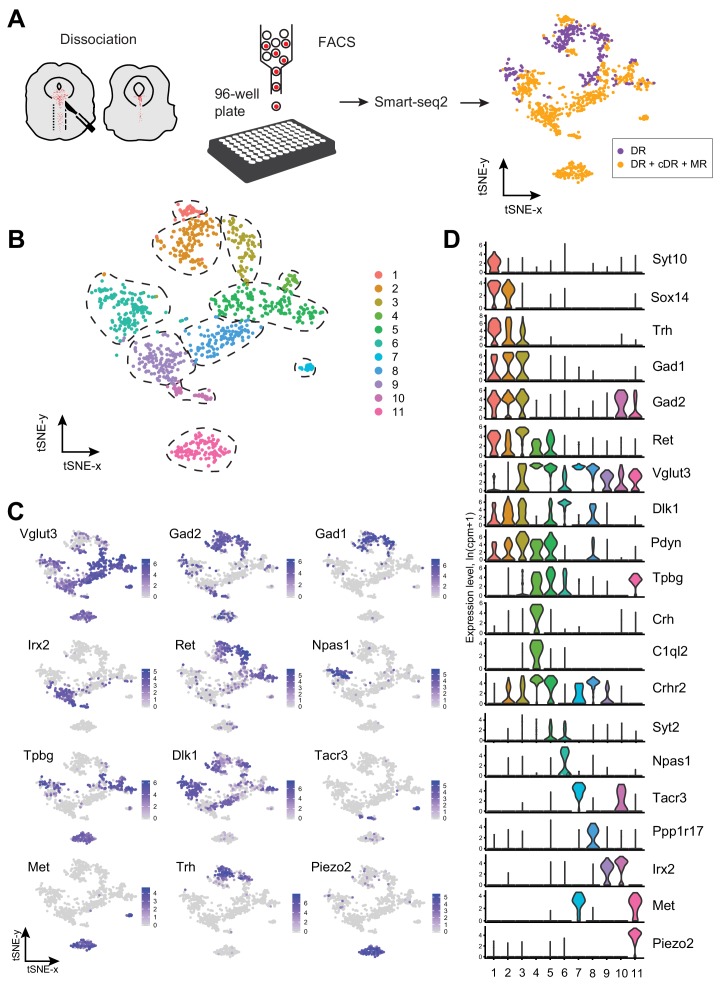
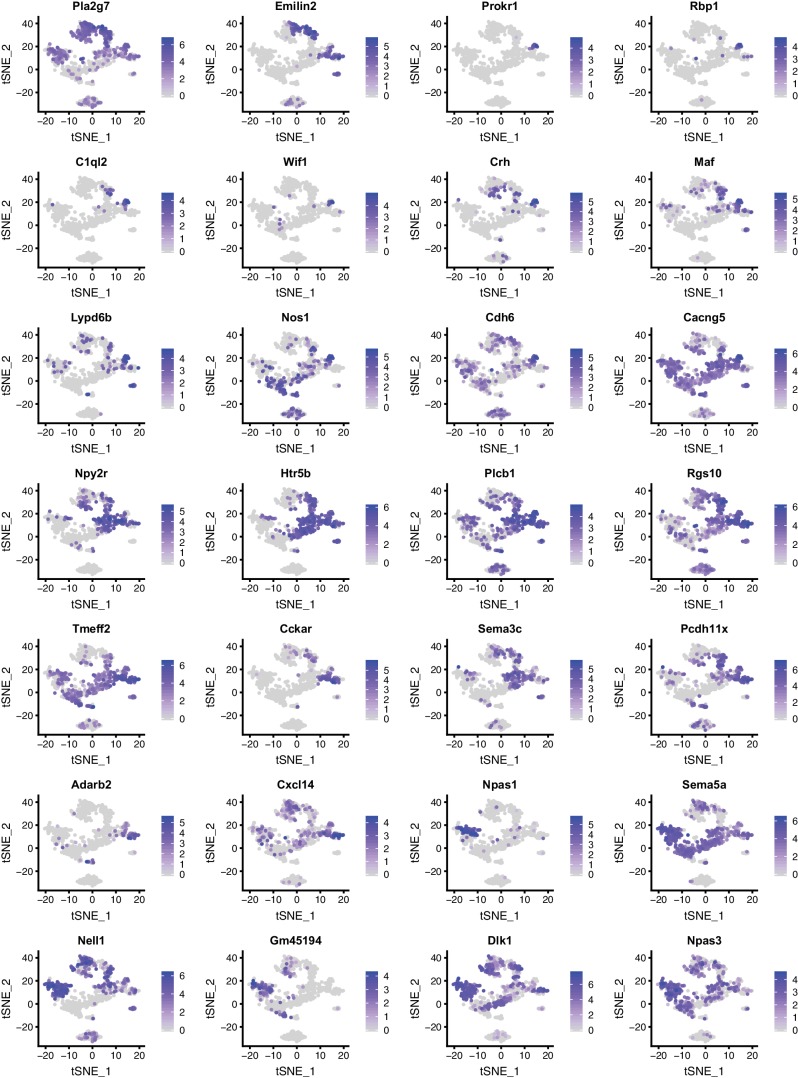
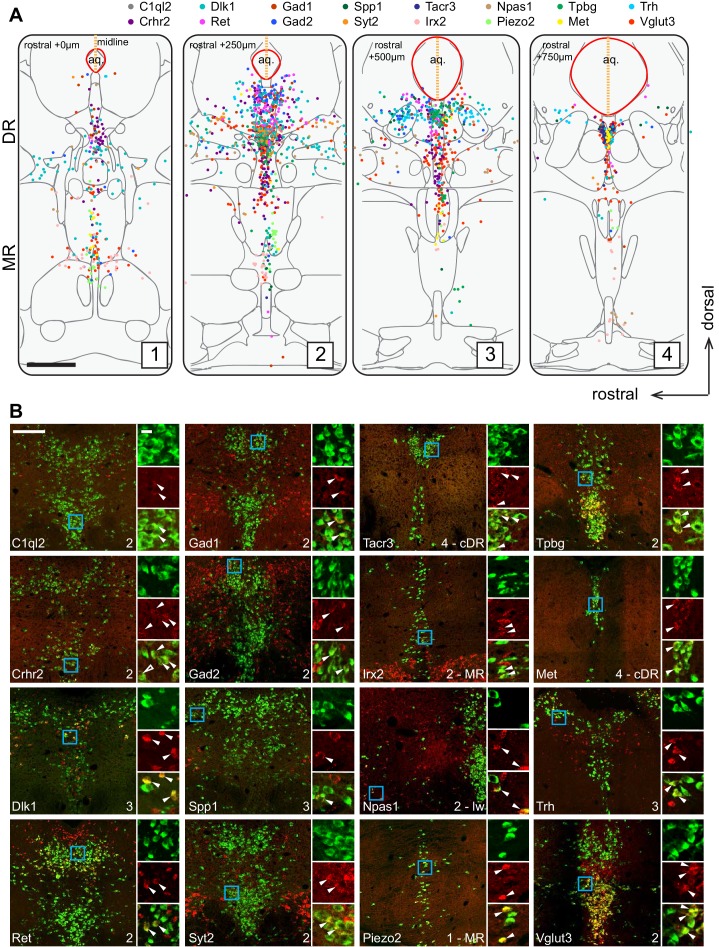
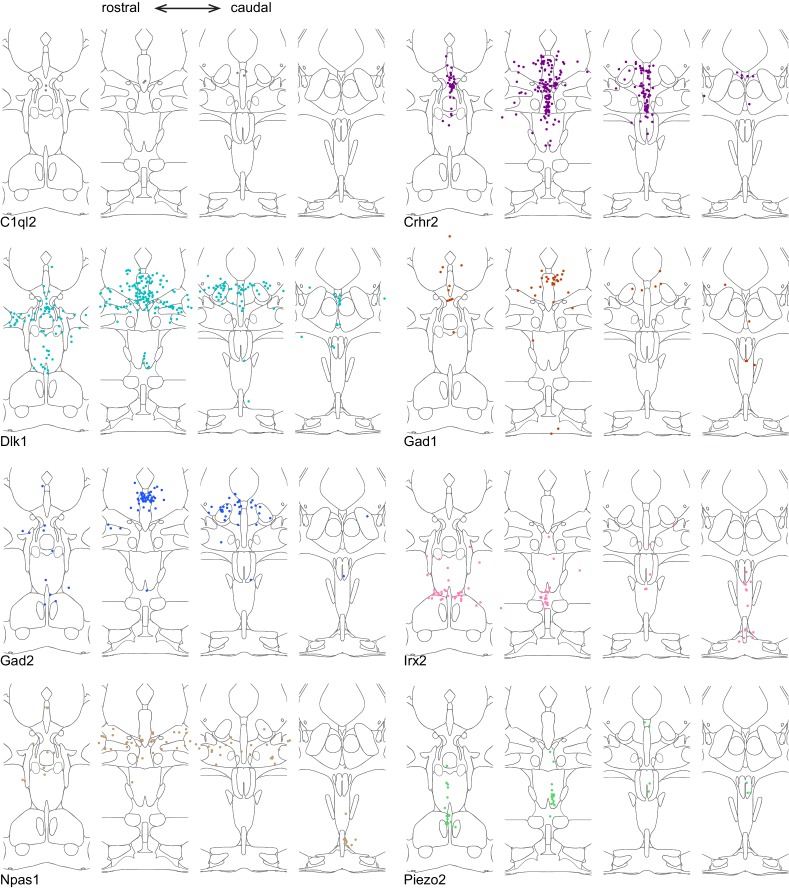
“Specifically, we found that the distribution of markers for Clusters 1–6, Ret, Trh, Gad1, Npas1, Syt2, and C1ql2 (Figure 1D), were mostly restricted to the pDR.”
§ Single-cell transcriptomes and whole-brain projections of serotonin neurons in the mouse dorsal and median raphe nuclei > Results > Anatomical organization of transcriptomically defined serotonin clusters
plaincorrelational- Asserted: passes — The authors put it forward as true.
- Checkable: passes — It can be checked against evidence.
- Load-bearing: passes — The paper’s conclusions depend on it.
- Based: passes — The paper gives a reason why it holds.
A result the paper reports from its own data — it cites no other source for it, so there is none to check. The quote shows it is in the paper.
In the paper
“These 999 MR and DR serotonin neurons comprised 11 clusters (Figure 1B; Figure 1—figure supplement 2).”
- Also stated in: § Abstract · plain
“we used plate-based single-cell RNA-sequencing to generate a comprehensive dataset comprising eleven transcriptomically distinct serotonin neuron clusters.”
§ Single-cell transcriptomes and whole-brain projections of serotonin neurons in the mouse dorsal and median raphe nuclei > Results > Single-cell RNA-sequencing defines 11 transcriptomic clusters of serotonin neurons in the dorsal and median raphe
plain- Asserted: passes — The authors put it forward as true.
- Checkable: passes — It can be checked against evidence.
- Load-bearing: passes — The paper’s conclusions depend on it.
- Based: passes — The paper gives a reason why it holds.
- Also stated in: § Abstract · plain
A result the paper reports from its own data — it cites no other source for it, so there is none to check. The quote shows it is in the paper.
In the paper
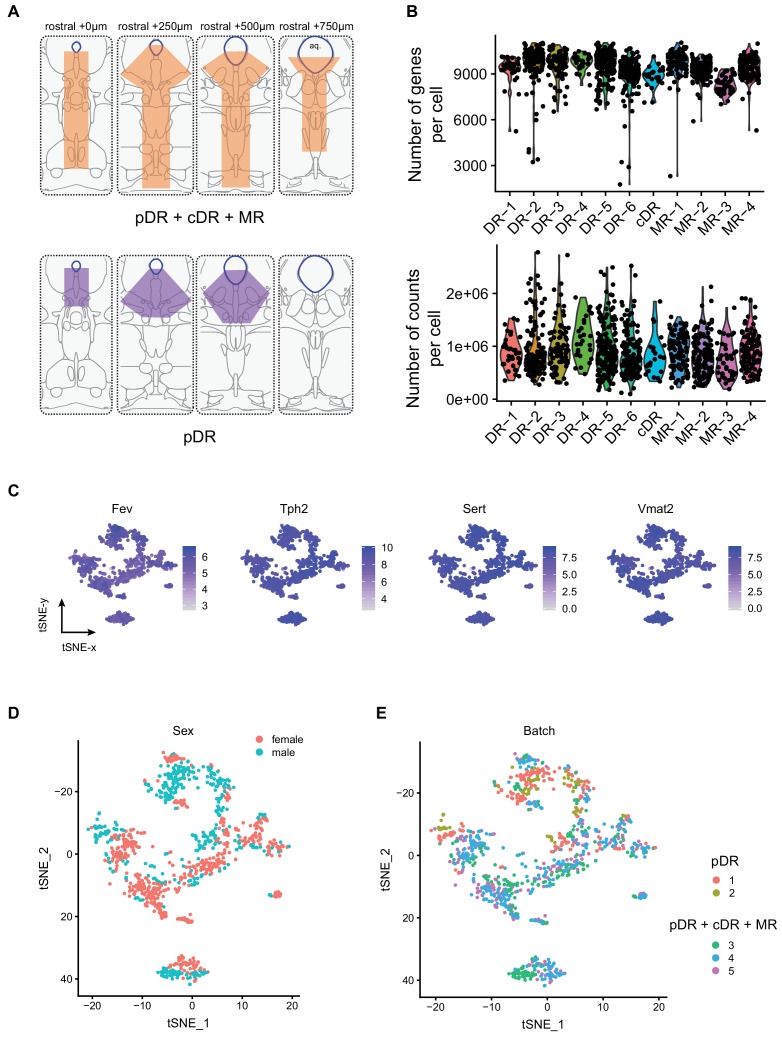
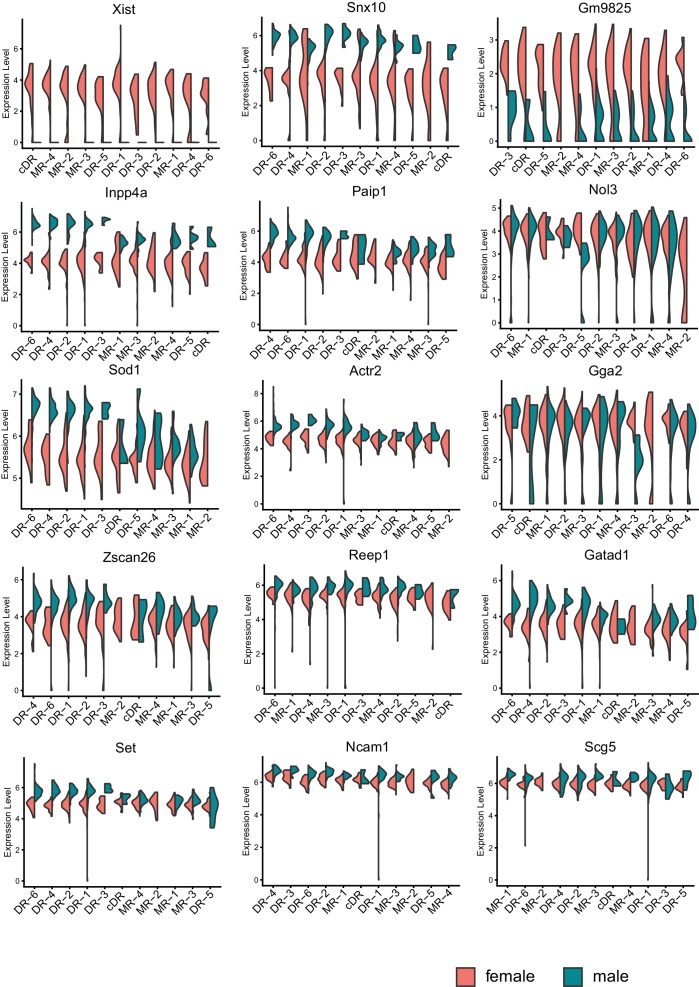
“Each cluster contained cells from both sexes after removing genes located on the Y chromosome, indicating that there were few sex-specific differences at the level of transcriptomic clusters (Figure 1—figure supplement 1D).”
§ Single-cell transcriptomes and whole-brain projections of serotonin neurons in the mouse dorsal and median raphe nuclei > Results > Single-cell RNA-sequencing defines 11 transcriptomic clusters of serotonin neurons in the dorsal and median raphe
hedged- Asserted: passes — The authors put it forward as true.
- Checkable: passes — It can be checked against evidence.
- Load-bearing: unclear — It is unclear whether the paper’s conclusions depend on it.
- Based: passes — The paper gives a reason why it holds.
A result the paper reports from its own data — it cites no other source for it, so there is none to check. The quote shows it is in the paper.
In the paper
“Of the 11 transcriptomic clusters, six (Cluster 1–6) consisted of only serotonin neurons dissected from the pDR.”
§ Single-cell transcriptomes and whole-brain projections of serotonin neurons in the mouse dorsal and median raphe nuclei > Results > Anatomical organization of transcriptomically defined serotonin clusters
plain- Asserted: passes — The authors put it forward as true.
- Checkable: passes — It can be checked against evidence.
- Load-bearing: passes — The paper’s conclusions depend on it.
- Based: passes — The paper gives a reason why it holds.
A result the paper reports from its own data — it cites no other source for it, so there is none to check. The quote shows it is in the paper.
In the paper
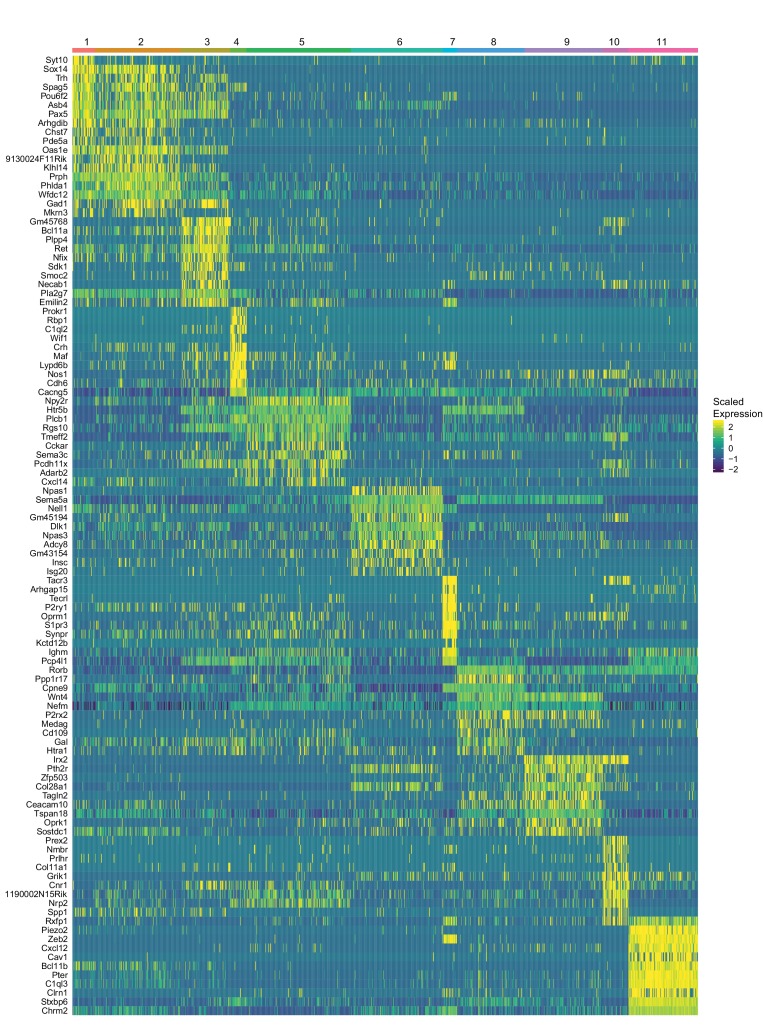
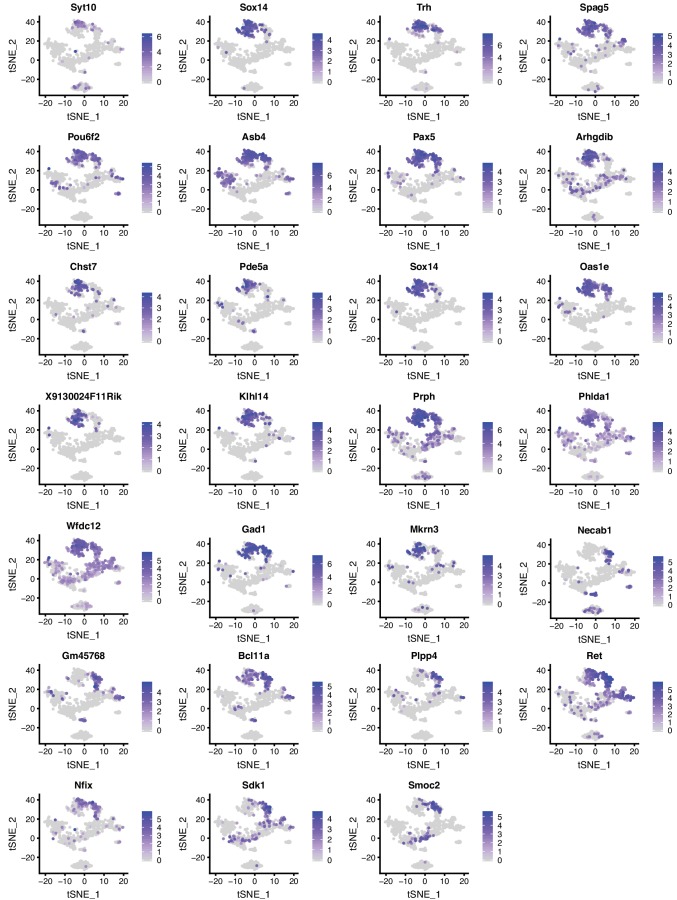
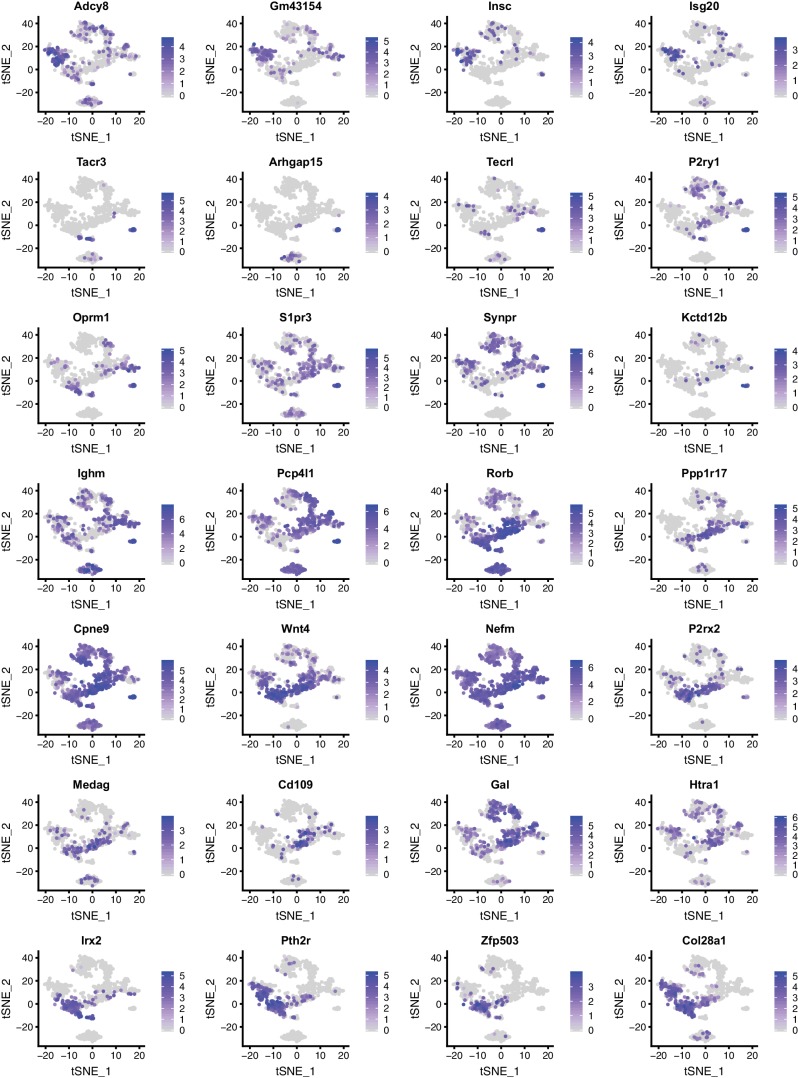
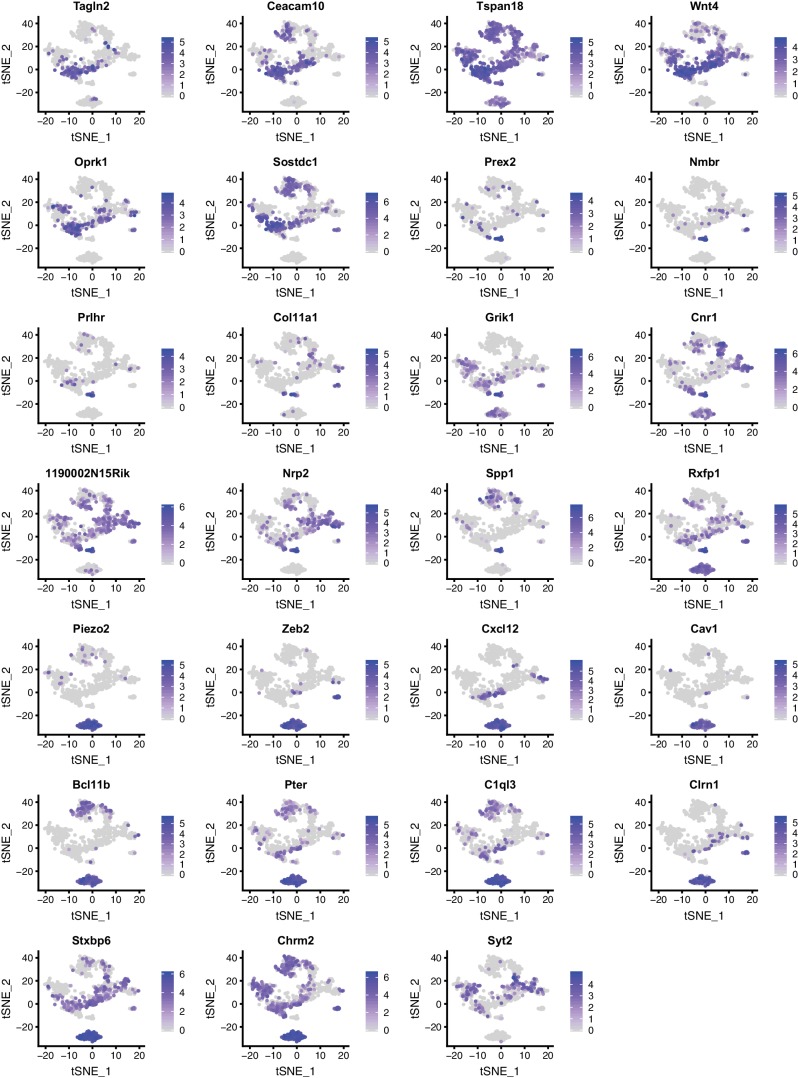
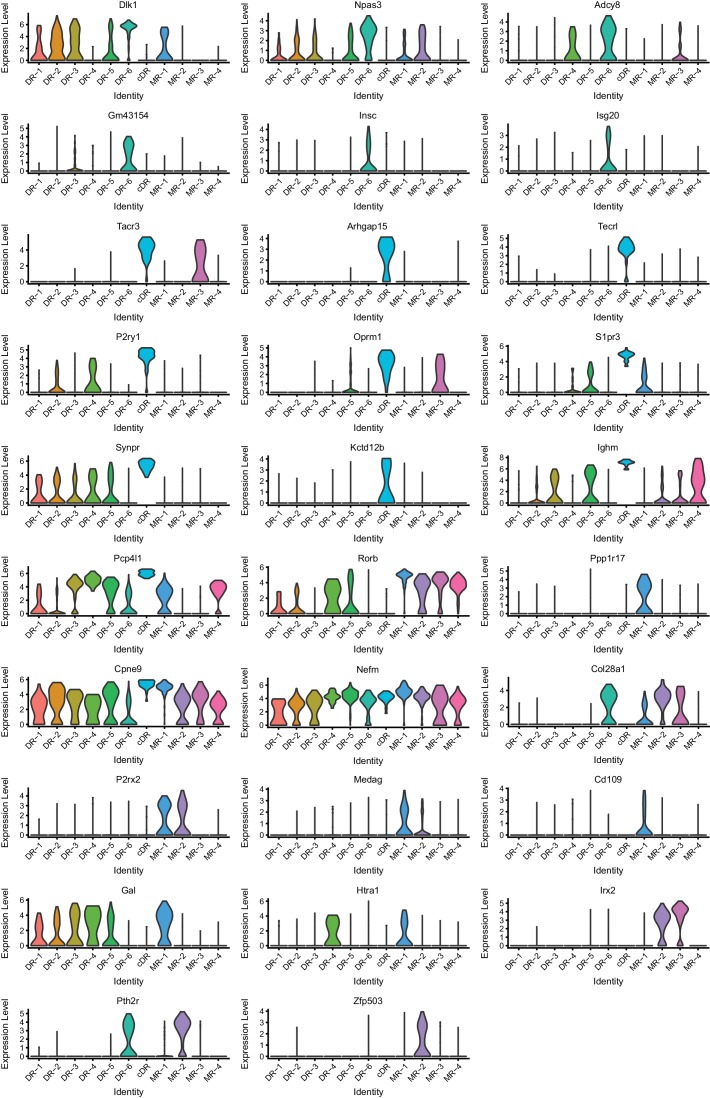
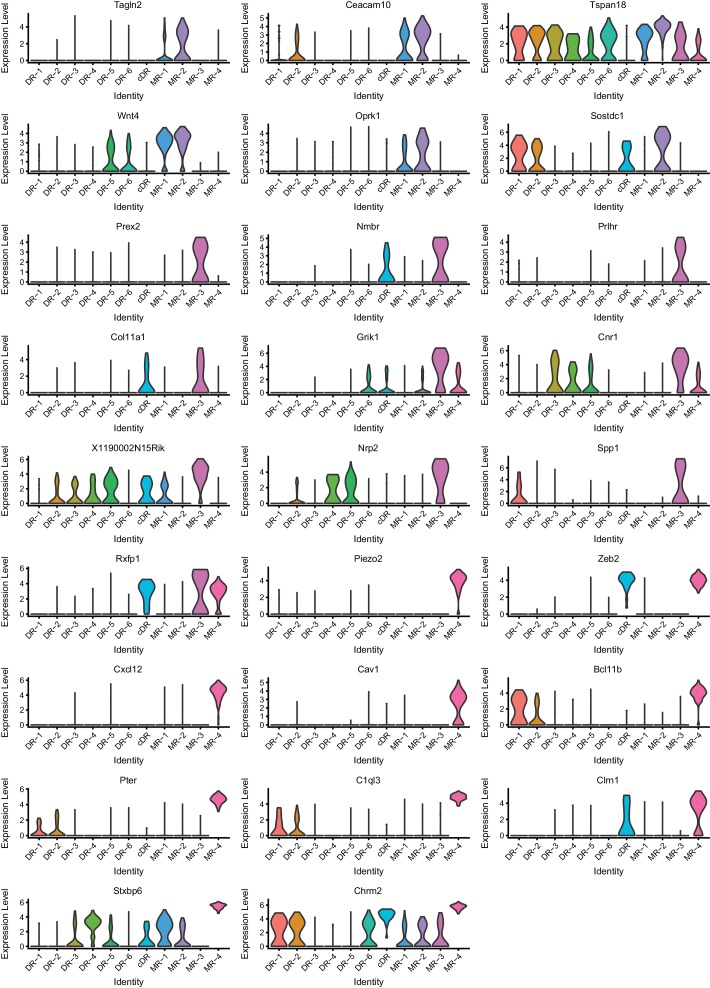
“Each of the 11 clusters expressed a set of cluster-discriminatory genes, including markers for specific neurotransmitter systems, such as Vglut3, Gad1, and Gad2 (Figure 1C,D; Figure 1—figure supplement 1–6).”
§ Single-cell transcriptomes and whole-brain projections of serotonin neurons in the mouse dorsal and median raphe nuclei > Results > Single-cell RNA-sequencing defines 11 transcriptomic clusters of serotonin neurons in the dorsal and median raphe
plain- Asserted: passes — The authors put it forward as true.
- Checkable: passes — It can be checked against evidence.
- Load-bearing: passes — The paper’s conclusions depend on it.
- Based: passes — The paper gives a reason why it holds.
A result the paper reports from its own data — it cites no other source for it, so there is none to check. The quote shows it is in the paper.
In the paper
“After quality control (Materials and methods), we determined the transcriptomes of 709 cells from eight samples that include MR, pDR, and cDR, and 290 cells from six pDR-only samples (999 cells in total, comprising 581 cells from female and 418 cells from male mice).”
§ Single-cell transcriptomes and whole-brain projections of serotonin neurons in the mouse dorsal and median raphe nuclei > Results > Single-cell RNA-sequencing defines 11 transcriptomic clusters of serotonin neurons in the dorsal and median raphe
plainn = 14- Asserted: passes — The authors put it forward as true.
- Checkable: passes — It can be checked against evidence.
- Load-bearing: passes — The paper’s conclusions depend on it.
- Based: passes — The paper gives a reason why it holds.
None of the sources cited for this claim have been checked yet.
In the paper
“Dopamine receptor D2 (Drd2) is highly expressed in DR-3 (Niederkofler et al., 2016).”
§ Single-cell transcriptomes and whole-brain projections of serotonin neurons in the mouse dorsal and median raphe nuclei > Results > Molecular properties of MR and DR serotonin neurons
plaincorrelational- Asserted: passes — The authors put it forward as true.
- Checkable: passes — It can be checked against evidence.
- Load-bearing: unclear — It is unclear whether the paper’s conclusions depend on it.
- Based: passes — The paper gives a reason why it holds.
A result the paper reports from its own data — it cites no other source for it, so there is none to check. The quote shows it is in the paper.
In the paper
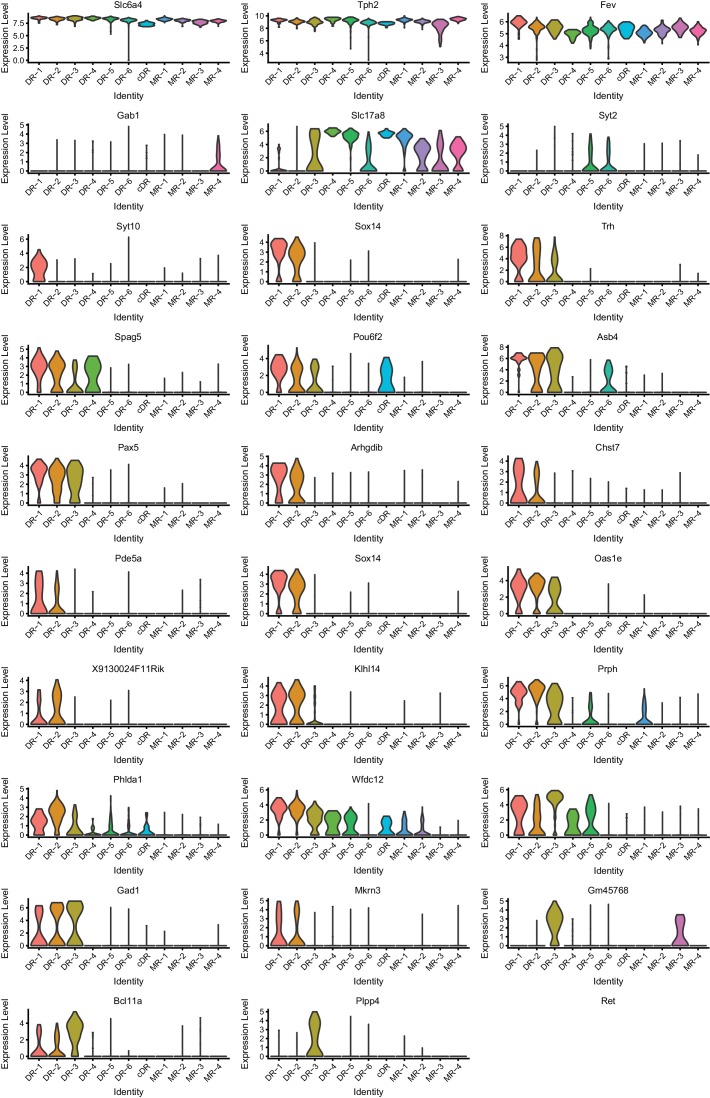
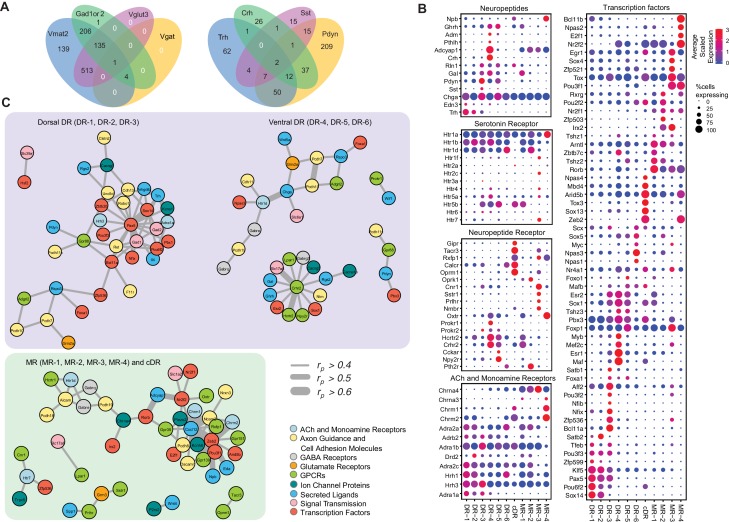
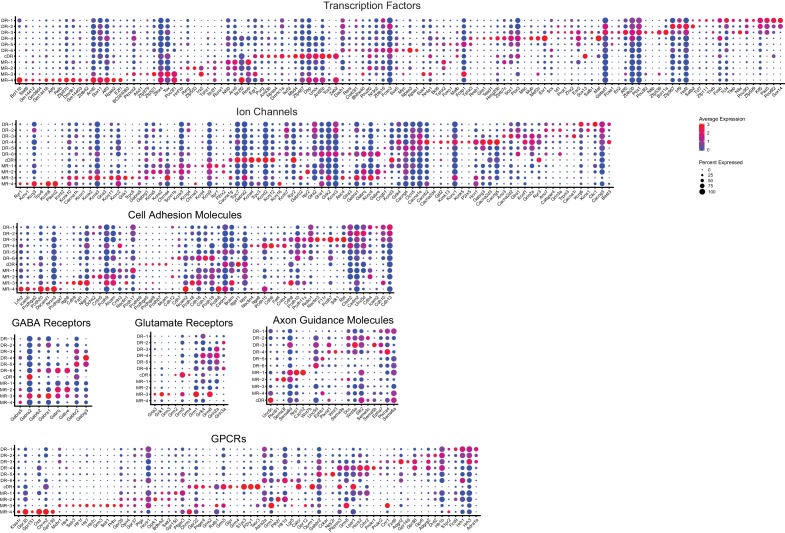
“Within our data, we observed robust cluster-specific expression of multiple TF genes (Figure 4B; Figure 4—figure supplement 1; Figure 3—figure supplement 1–3).”
§ Single-cell transcriptomes and whole-brain projections of serotonin neurons in the mouse dorsal and median raphe nuclei > Results > Molecular properties of MR and DR serotonin neurons
plaincorrelational- Asserted: passes — The authors put it forward as true.
- Checkable: passes — It can be checked against evidence.
- Load-bearing: passes — The paper’s conclusions depend on it.
- Based: passes — The paper gives a reason why it holds.
A result the paper reports from its own data — it cites no other source for it, so there is none to check. The quote shows it is in the paper.
In the paper
“Clusters MR-4 and cDR have the highest expression level of expression for Chrm1 and Chrm2, encoding muscarinic acetylcholine receptors.”
§ Single-cell transcriptomes and whole-brain projections of serotonin neurons in the mouse dorsal and median raphe nuclei > Results > Molecular properties of MR and DR serotonin neurons
plaincorrelational- Asserted: passes — The authors put it forward as true.
- Checkable: passes — It can be checked against evidence.
- Load-bearing: unclear — It is unclear whether the paper’s conclusions depend on it.
- Based: passes — The paper gives a reason why it holds.
A result the paper reports from its own data — it cites no other source for it, so there is none to check. The quote shows it is in the paper.
In the paper
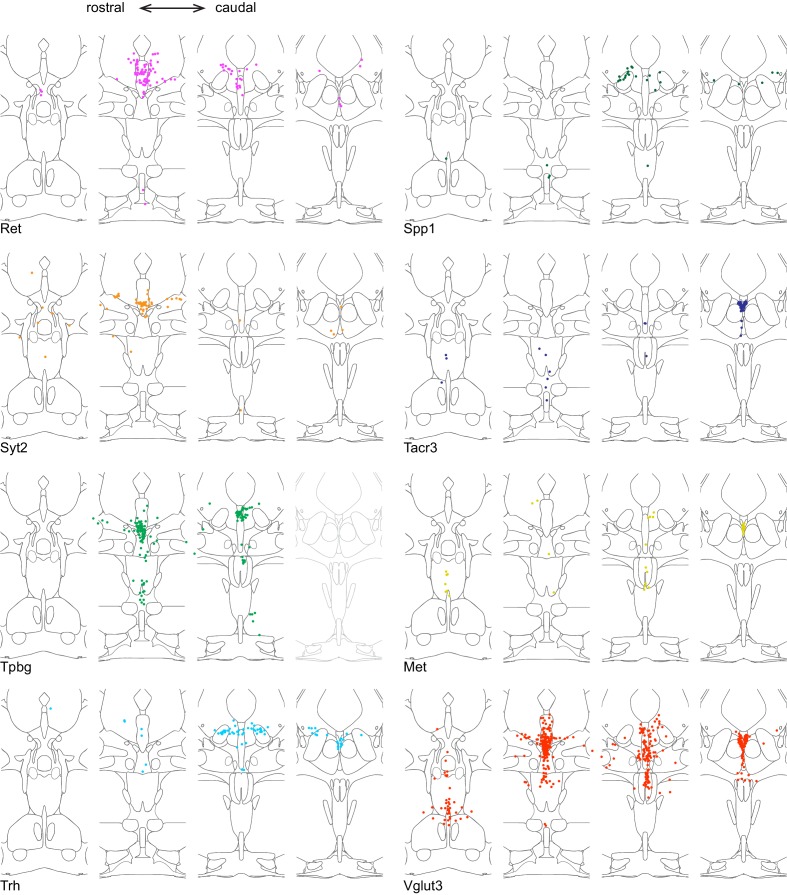
“The two common Cluster 7 markers Tacr3 and Met were both highly concentrated in serotonin neurons under the aqueduct in the cDR.”
§ Single-cell transcriptomes and whole-brain projections of serotonin neurons in the mouse dorsal and median raphe nuclei > Results > Anatomical organization of transcriptomically defined serotonin clusters
plaincorrelational- Asserted: passes — The authors put it forward as true.
- Checkable: passes — It can be checked against evidence.
- Load-bearing: passes — The paper’s conclusions depend on it.
- Based: passes — The paper gives a reason why it holds.
- It may state two separate claims as one. 66
- The quote only partly states this claim. 1
- Probably not a substantial claim. 16
A result the paper reports from its own data — it cites no other source for it, so there is none to check. The quote shows it is in the paper.
In the paper
“TFs associated with neurodevelopmental disorders, such as Npas1 and Npas3 (Erbel-Sieler et al., 2004), are preferentially expressed in DR-6, and Aff2 (Mondal et al., 2012) is enriched within DR-3.”
§ Single-cell transcriptomes and whole-brain projections of serotonin neurons in the mouse dorsal and median raphe nuclei > Results > Molecular properties of MR and DR serotonin neurons
plaincorrelational- Asserted: passes — The authors put it forward as true.
- Checkable: passes — It can be checked against evidence.
- Load-bearing: unclear — It is unclear whether the paper’s conclusions depend on it.
- Based: passes — The paper gives a reason why it holds.
It may state two separate claims as one.
A result the paper reports from its own data — it cites no other source for it, so there is none to check. The quote shows it is in the paper.
In the paper
“Corticotropin-releasing hormone (Crh) is highly expressed in the DR-3 cluster but much less everywhere else (7% serotonin neurons).”
§ Single-cell transcriptomes and whole-brain projections of serotonin neurons in the mouse dorsal and median raphe nuclei > Results > Molecular properties of MR and DR serotonin neurons
plaincorrelational- Asserted: passes — The authors put it forward as true.
- Checkable: passes — It can be checked against evidence.
- Load-bearing: unclear — It is unclear whether the paper’s conclusions depend on it.
- Based: passes — The paper gives a reason why it holds.
It may state two separate claims as one.
A result the paper reports from its own data — it cites no other source for it, so there is none to check. The quote shows it is in the paper.
In the paper
“The chemokine ligand-12 (Cxcl12) and cadherin-6 (Cdh6) are preferentially expressed in MR-1 and DR-4 clusters, respectively.”
§ Single-cell transcriptomes and whole-brain projections of serotonin neurons in the mouse dorsal and median raphe nuclei > Results > Molecular properties of MR and DR serotonin neurons
plaincorrelational- Asserted: passes — The authors put it forward as true.
- Checkable: passes — It can be checked against evidence.
- Load-bearing: unclear — It is unclear whether the paper’s conclusions depend on it.
- Based: passes — The paper gives a reason why it holds.
It may state two separate claims as one.
A result the paper reports from its own data — it cites no other source for it, so there is none to check. The quote shows it is in the paper.
In the paper
“Npas3 is specifically expressed in the DR-6 cluster and is highly correlated with Htr1d, suggesting a critical role of maintaining the characteristics of DR-6 serotonin neurons.”
§ Single-cell transcriptomes and whole-brain projections of serotonin neurons in the mouse dorsal and median raphe nuclei > Results > Molecular properties of MR and DR serotonin neurons
hedgedcorrelational- Asserted: passes — The authors put it forward as true.
- Checkable: passes — It can be checked against evidence.
- Load-bearing: unclear — It is unclear whether the paper’s conclusions depend on it.
- Based: passes — The paper gives a reason why it holds.
It may state two separate claims as one.
A result the paper reports from its own data — it cites no other source for it, so there is none to check. The quote shows it is in the paper.
In the paper
“The majority of the clusters express Slc17a8, which encodes vesicular glutamate transporter-3 (Vglut3). These include almost all serotonin neurons from the cDR, the majority from MR clusters (Domonkos et al., 2016), and DR-3–6 clusters (Figure 1D).”
§ Single-cell transcriptomes and whole-brain projections of serotonin neurons in the mouse dorsal and median raphe nuclei > Results > Molecular properties of MR and DR serotonin neurons
plain- Asserted: passes — The authors put it forward as true.
- Checkable: passes — It can be checked against evidence.
- Load-bearing: passes — The paper’s conclusions depend on it.
- Based: passes — The paper gives a reason why it holds.
It may state two separate claims as one.
A result the paper reports from its own data — it cites no other source for it, so there is none to check. The quote shows it is in the paper.
In the paper
“In contrast to DR, the anatomical organization of the molecular features that define MR clusters is less obvious and different clusters appear more intermingled.”
§ Single-cell transcriptomes and whole-brain projections of serotonin neurons in the mouse dorsal and median raphe nuclei > Results > Anatomical organization of transcriptomically defined serotonin clusters
hedged- Asserted: passes — The authors put it forward as true.
- Checkable: passes — It can be checked against evidence.
- Load-bearing: unclear — It is unclear whether the paper’s conclusions depend on it.
- Based: passes — The paper gives a reason why it holds.
It may state two separate claims as one.
A result the paper reports from its own data — it cites no other source for it, so there is none to check. The quote shows it is in the paper.
In the paper
“Cluster 6 marker Npas1+ was largely excluded from the densest portion of Tph2 expression at the midline and instead was found scattered in the more rostral and ventral portion of the lateral wings.”
§ Single-cell transcriptomes and whole-brain projections of serotonin neurons in the mouse dorsal and median raphe nuclei > Results > Anatomical organization of transcriptomically defined serotonin clusters
plain- Asserted: passes — The authors put it forward as true.
- Checkable: passes — It can be checked against evidence.
- Load-bearing: passes — The paper’s conclusions depend on it.
- Based: passes — The paper gives a reason why it holds.
It may state two separate claims as one.
A result the paper reports from its own data — it cites no other source for it, so there is none to check. The quote shows it is in the paper.
In the paper
“Finally, all serotonin neurons express at least one type of serotonin receptors, with the Gi-coupled Htr1 subfamily in particular Htr1a being the most widely expressed.”
§ Single-cell transcriptomes and whole-brain projections of serotonin neurons in the mouse dorsal and median raphe nuclei > Results > Molecular properties of MR and DR serotonin neurons
plain- Asserted: passes — The authors put it forward as true.
- Checkable: passes — It can be checked against evidence.
- Load-bearing: unclear — It is unclear whether the paper’s conclusions depend on it.
- Based: passes — The paper gives a reason why it holds.
It may state two separate claims as one.
A result the paper reports from its own data — it cites no other source for it, so there is none to check. The quote shows it is in the paper.
In the paper
“Two MR clusters express Gad2 but not Gad1, and cDR expresses neither.”
§ Single-cell transcriptomes and whole-brain projections of serotonin neurons in the mouse dorsal and median raphe nuclei > Results > Molecular properties of MR and DR serotonin neurons
plain- Asserted: passes — The authors put it forward as true.
- Checkable: passes — It can be checked against evidence.
- Load-bearing: unclear — It is unclear whether the paper’s conclusions depend on it.
- Based: passes — The paper gives a reason why it holds.
It may state two separate claims as one.
A result the paper reports from its own data — it cites no other source for it, so there is none to check. The quote shows it is in the paper.
In the paper
“Htr1a is highly expressed in the MR-4 cluster, which does not express other serotonin receptors.”
§ Single-cell transcriptomes and whole-brain projections of serotonin neurons in the mouse dorsal and median raphe nuclei > Results > Molecular properties of MR and DR serotonin neurons
plaincorrelational- Asserted: passes — The authors put it forward as true.
- Checkable: passes — It can be checked against evidence.
- Load-bearing: unclear — It is unclear whether the paper’s conclusions depend on it.
- Based: passes — The paper gives a reason why it holds.
It may state two separate claims as one.
A result the paper reports from its own data — it cites no other source for it, so there is none to check. The quote shows it is in the paper.
In the paper
“Within the DR, Trh+, Gad1+, and Gad2+ serotonin neurons were mainly located in the dorsal DR, whereas Slc17a8+ (also known as Vglut3, used hereafter) and Syt2+ serotonin neurons were mainly located in the ventral DR and cDR.”
§ Single-cell transcriptomes and whole-brain projections of serotonin neurons in the mouse dorsal and median raphe nuclei > Results > Anatomical organization of transcriptomically defined serotonin clusters
plaincorrelational- Asserted: passes — The authors put it forward as true.
- Checkable: passes — It can be checked against evidence.
- Load-bearing: passes — The paper’s conclusions depend on it.
- Based: passes — The paper gives a reason why it holds.
It may state two separate claims as one.
None of the sources cited for this claim have been checked yet.
In the paper
“For example, Bcl11a and Bcl11b (also named Ctip1 and Ctip2) (Chen et al., 2008; Wiegreffe et al., 2015) are highly enriched in DR-3 and MR-4, respectively.”
§ Single-cell transcriptomes and whole-brain projections of serotonin neurons in the mouse dorsal and median raphe nuclei > Results > Molecular properties of MR and DR serotonin neurons
plaincorrelational- Asserted: passes — The authors put it forward as true.
- Checkable: passes — It can be checked against evidence.
- Load-bearing: unclear — It is unclear whether the paper’s conclusions depend on it.
- Based: passes — The paper gives a reason why it holds.
It may state two separate claims as one.
A result the paper reports from its own data — it cites no other source for it, so there is none to check. The quote shows it is in the paper.
In the paper
“On the other hand, Crhr2, which should be expressed in all DR serotonin neuron clusters except Cluster 1 and 6 (Figure 1D), was localized preferentially near the midline and was absent from the lateral wing.”
§ Single-cell transcriptomes and whole-brain projections of serotonin neurons in the mouse dorsal and median raphe nuclei > Results > Anatomical organization of transcriptomically defined serotonin clusters
plaincorrelational- Asserted: passes — The authors put it forward as true.
- Checkable: passes — It can be checked against evidence.
- Load-bearing: passes — The paper’s conclusions depend on it.
- Based: passes — The paper gives a reason why it holds.
It may state two separate claims as one.
A result the paper reports from its own data — it cites no other source for it, so there is none to check. The quote shows it is in the paper.
In the paper
“Another neuropeptide receptor enriched cluster is MR-3, expressing Tacr3, cannabinoid receptor 1(Cnr1), somatostatin receptor-1 (Sstr1), prolactin-releasing hormone receptor (Prlhr), and neuromedin B receptor (Nmbr).”
§ Single-cell transcriptomes and whole-brain projections of serotonin neurons in the mouse dorsal and median raphe nuclei > Results > Molecular properties of MR and DR serotonin neurons
plain- Asserted: passes — The authors put it forward as true.
- Checkable: passes — It can be checked against evidence.
- Load-bearing: unclear — It is unclear whether the paper’s conclusions depend on it.
- Based: passes — The paper gives a reason why it holds.
It may state two separate claims as one.
A result the paper reports from its own data — it cites no other source for it, so there is none to check. The quote shows it is in the paper.
In the paper
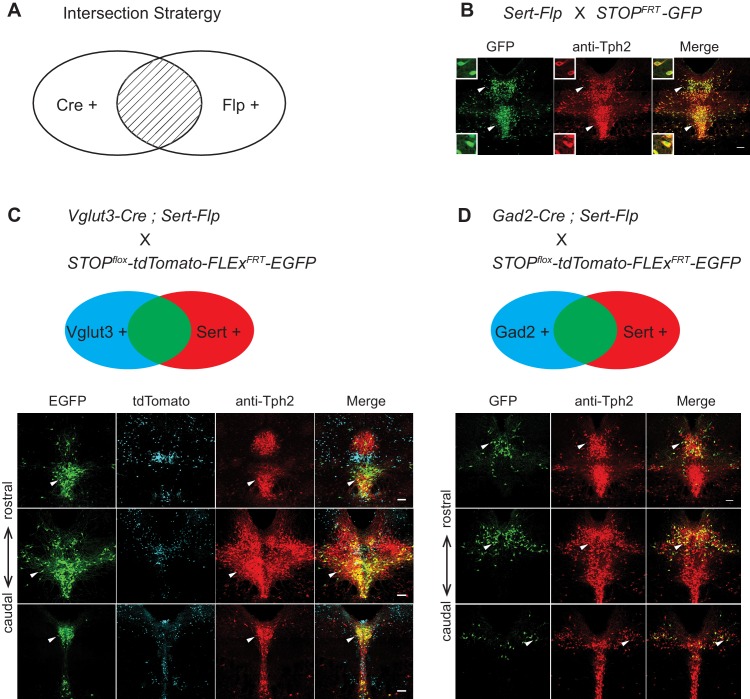
“In the pDR, Vglut3+ serotonin neurons were mainly located ventrally, whereas Gad2+ serotonin neurons were mainly located dorsally, consistent with our previous study (Ren et al., 2018) and the HCR-smFISH results (Figure 2).”
§ Single-cell transcriptomes and whole-brain projections of serotonin neurons in the mouse dorsal and median raphe nuclei > Results > Viral-genetic tools to access different serotonin neuron subtypes
plaincorrelational- Asserted: passes — The authors put it forward as true.
- Checkable: passes — It can be checked against evidence.
- Load-bearing: unclear — It is unclear whether the paper’s conclusions depend on it.
- Based: passes — The paper gives a reason why it holds.
It may state two separate claims as one.
A result the paper reports from its own data — it cites no other source for it, so there is none to check. The quote shows it is in the paper.
In the paper
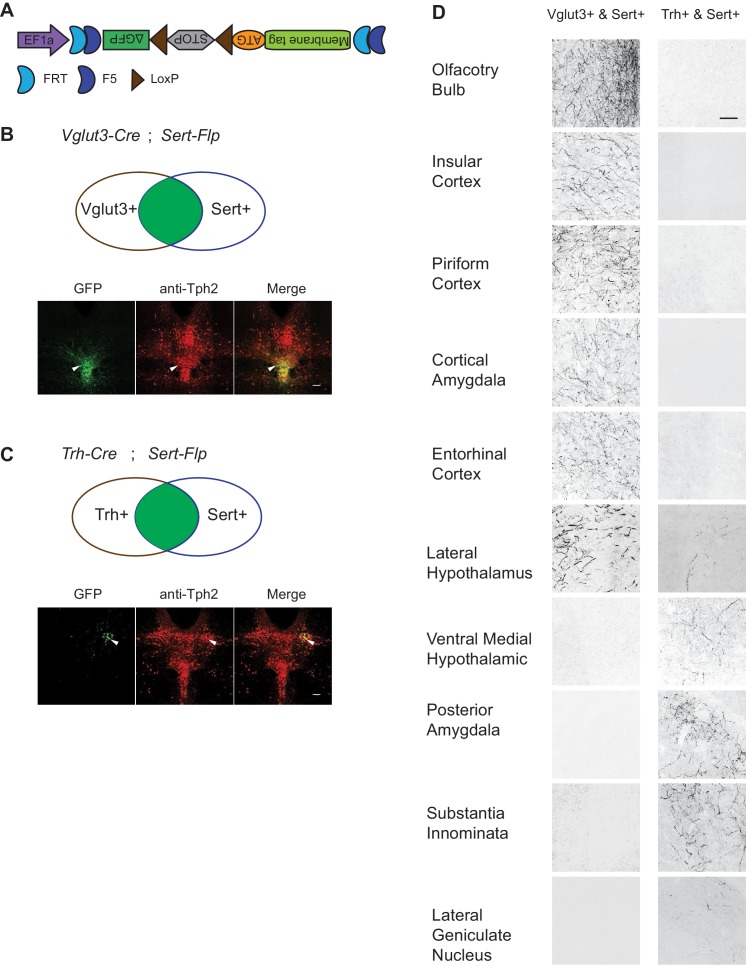
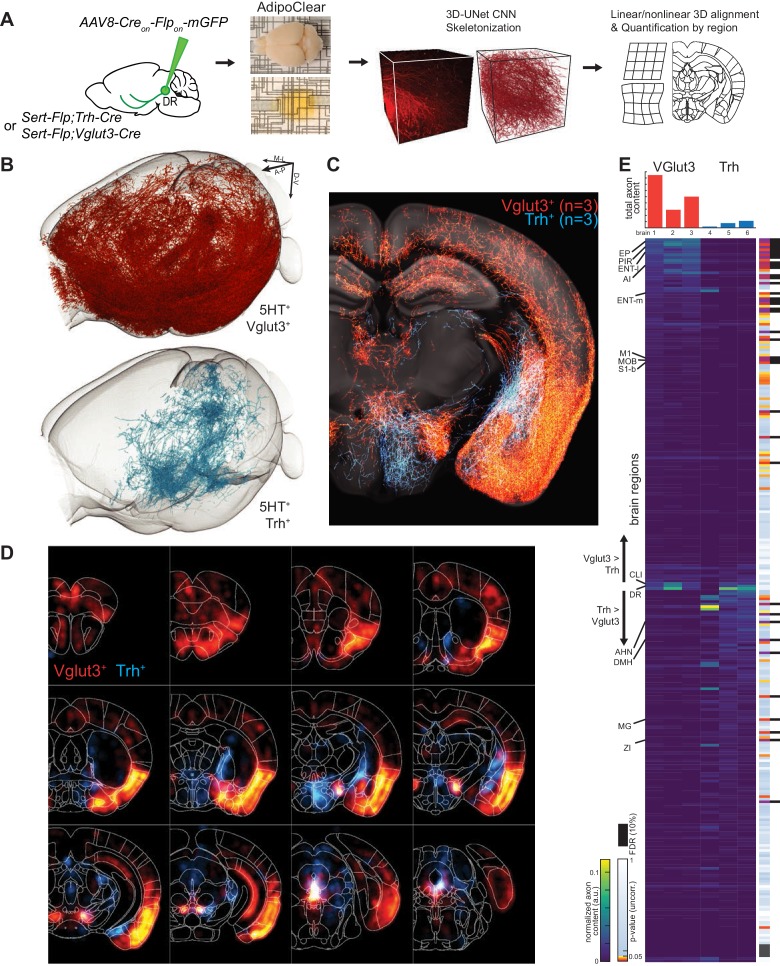
“Instead, Trh+ serotonin axons project to the anterior and medial hypothalamus, posterior amygdala, and the lateral geniculate nucleus in the thalamus, none of which were targeted by Vglut3+ axons (Figure 6D).”
- Also stated in: § Abstract · plain
“Whole-brain axonal projection mapping revealed that DR serotonin neurons co-expressing vesicular glutamate transporter-3 preferentially innervate the cortex, whereas those co-expressing thyrotropin-releasing hormone innervate subcortical regions in particular the hypothalamus.”
§ Single-cell transcriptomes and whole-brain projections of serotonin neurons in the mouse dorsal and median raphe nuclei > Results > Viral-genetic tools to access different serotonin neuron subtypes
plain- Asserted: passes — The authors put it forward as true.
- Checkable: passes — It can be checked against evidence.
- Load-bearing: passes — The paper’s conclusions depend on it.
- Based: passes — The paper gives a reason why it holds.
It may state two separate claims as one.
- Also stated in: § Abstract · plain
A result the paper reports from its own data — it cites no other source for it, so there is none to check. The quote shows it is in the paper.
In the paper
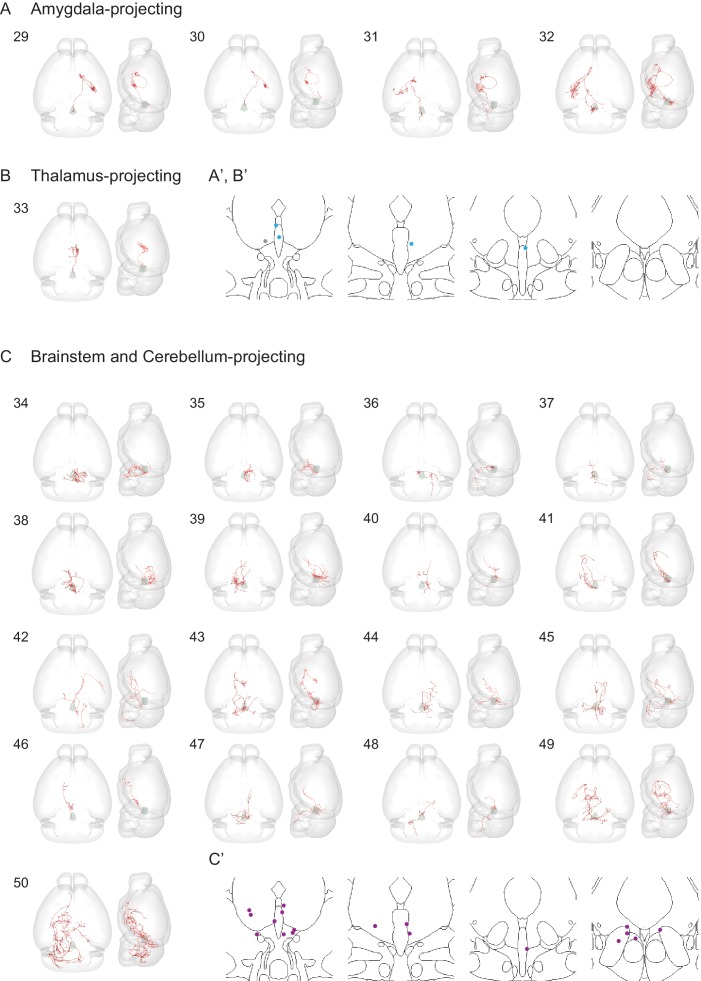
“Two cells had substantial branches to the striatum, and one to the pons (>10% axon length).”
§ Single-cell transcriptomes and whole-brain projections of serotonin neurons in the mouse dorsal and median raphe nuclei > Results > Whole-brain axonal arborization patterns of individual serotonin neurons
plainn = 6- Asserted: passes — The authors put it forward as true.
- Checkable: passes — It can be checked against evidence.
- Load-bearing: unclear — It is unclear whether the paper’s conclusions depend on it.
- Based: passes — The paper gives a reason why it holds.
It may state two separate claims as one.
A result the paper reports from its own data — it cites no other source for it, so there is none to check. The quote shows it is in the paper.
In the paper
“Complete morphological reconstruction revealed that the projection pattern of individual DR serotonin neurons was highly diverse yet follow some general patterns”
§ Single-cell transcriptomes and whole-brain projections of serotonin neurons in the mouse dorsal and median raphe nuclei > Results > Whole-brain axonal arborization patterns of individual serotonin neurons
plainn = 14- Asserted: passes — The authors put it forward as true.
- Checkable: passes — It can be checked against evidence.
- Load-bearing: passes — The paper’s conclusions depend on it.
- Based: passes — The paper gives a reason why it holds.
It may state two separate claims as one.
A result the paper reports from its own data — it cites no other source for it, so there is none to check. The quote shows it is in the paper.
In the paper
“two cortex-projecting serotonin neurons also sent substantial branches to the pons (>10% of axon length), and also innervated the cerebellum.”
§ Single-cell transcriptomes and whole-brain projections of serotonin neurons in the mouse dorsal and median raphe nuclei > Results > Whole-brain axonal arborization patterns of individual serotonin neurons
plainn = 2- Asserted: passes — The authors put it forward as true.
- Checkable: passes — It can be checked against evidence.
- Load-bearing: unclear — It is unclear whether the paper’s conclusions depend on it.
- Based: passes — The paper gives a reason why it holds.
It may state two separate claims as one.
A result the paper reports from its own data — it cites no other source for it, so there is none to check. The quote shows it is in the paper.
In the paper
“subcortical regions primarily in thalamus (zona incerta and medial geniculate) and hypothalamus (anterior and dorsomedial nuclei) were preferentially targeted by Trh+ axons and largely avoided by the Vglut3+ population”
§ Single-cell transcriptomes and whole-brain projections of serotonin neurons in the mouse dorsal and median raphe nuclei > Results > Whole-brain axonal projections of selected serotonin neuron subpopulations
plaincorrelational- Asserted: passes — The authors put it forward as true.
- Checkable: passes — It can be checked against evidence.
- Load-bearing: passes — The paper’s conclusions depend on it.
- Based: passes — The paper gives a reason why it holds.
It may state two separate claims as one.
A result the paper reports from its own data — it cites no other source for it, so there is none to check. The quote shows it is in the paper.
In the paper
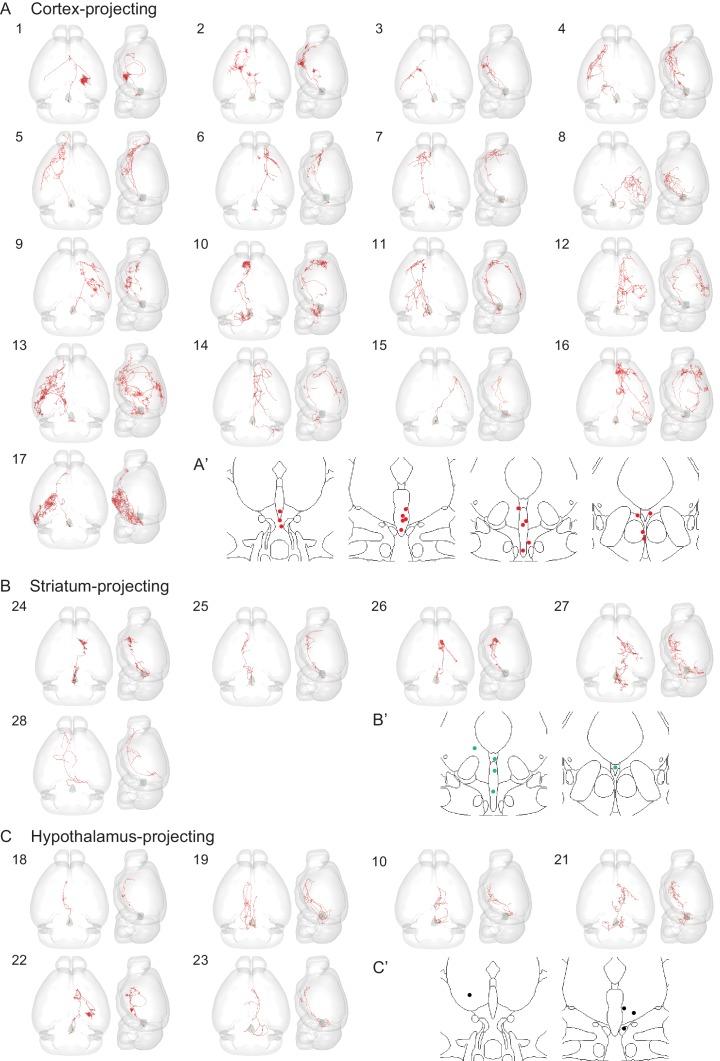
“None of them had collateralization in the cortical regions.”
§ Single-cell transcriptomes and whole-brain projections of serotonin neurons in the mouse dorsal and median raphe nuclei > Results > Whole-brain axonal arborization patterns of individual serotonin neurons
plain- Asserted: passes — The authors put it forward as true.
- Checkable: passes — It can be checked against evidence.
- Load-bearing: unclear — It is unclear whether the paper’s conclusions depend on it.
- Based: passes — The paper gives a reason why it holds.
The quote only partly states this claim.
A result the paper reports from its own data — it cites no other source for it, so there is none to check. The quote shows it is in the paper.
In the paper
“By contrast, Trh+ axons, which originated preferentially from the lateral wing of pDR, were largely absent from these structures.”
§ Single-cell transcriptomes and whole-brain projections of serotonin neurons in the mouse dorsal and median raphe nuclei > Results > Whole-brain axonal projections of selected serotonin neuron subpopulations
plaincorrelational- Asserted: passes — The authors put it forward as true.
- Checkable: passes — It can be checked against evidence.
- Load-bearing: passes — The paper’s conclusions depend on it.
- Based: passes — The paper gives a reason why it holds.
It may state two separate claims as one.
A result the paper reports from its own data — it cites no other source for it, so there is none to check. The quote shows it is in the paper.
In the paper
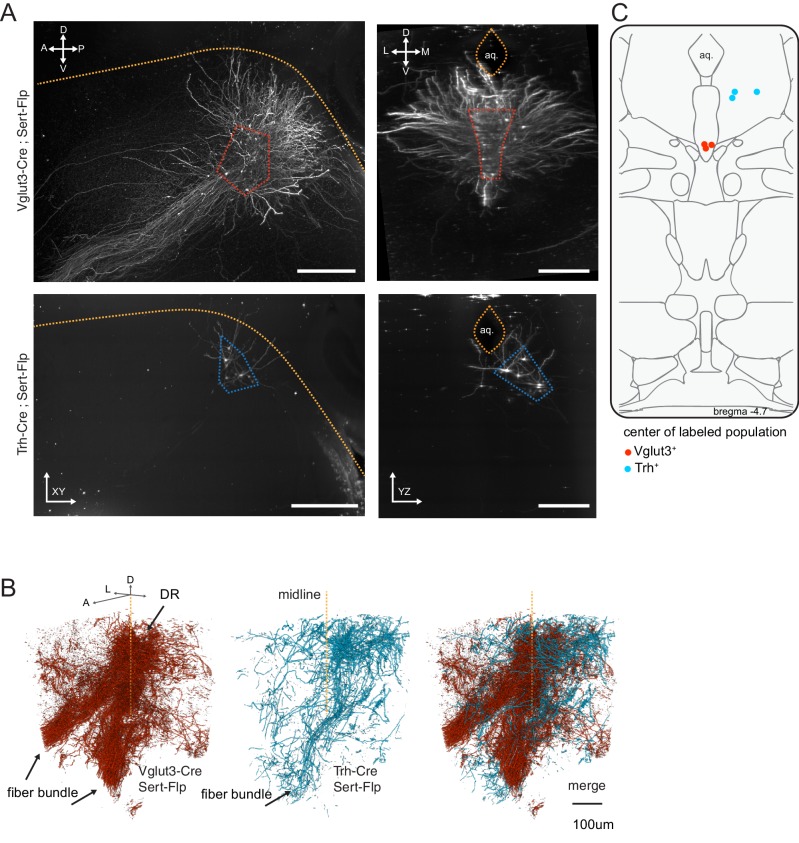
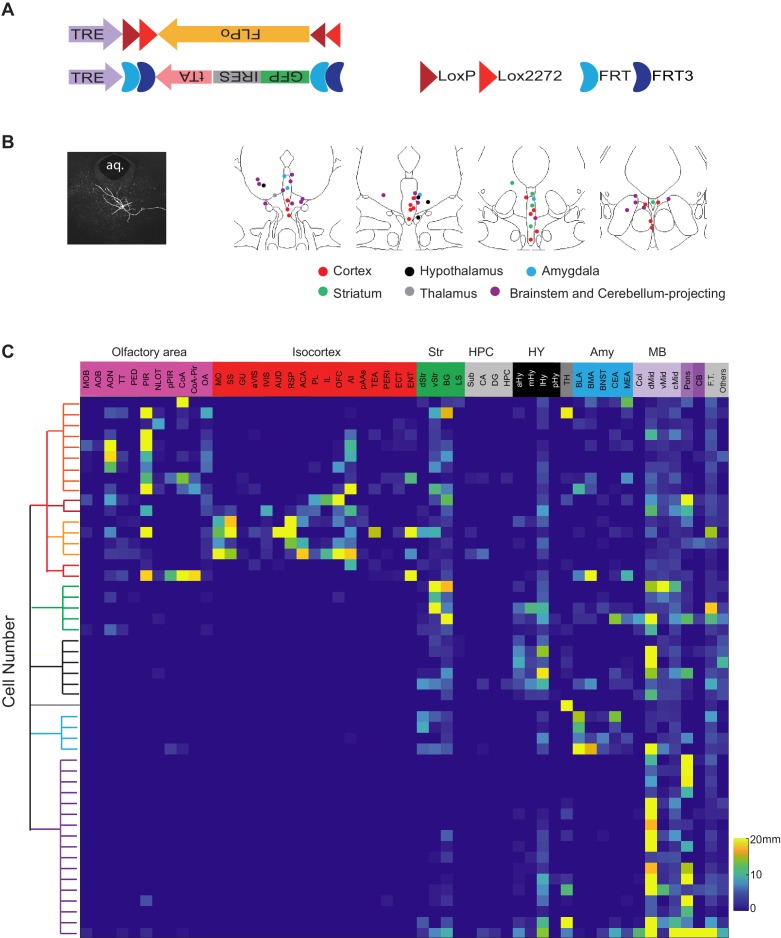
“As predicted, Vglut3+Sert+ GFP cells were mostly located in the ventral pDR (Figure 6B), whereas Trh+Sert+ cells were located in the dorsal pDR (Figure 6C).”
§ Single-cell transcriptomes and whole-brain projections of serotonin neurons in the mouse dorsal and median raphe nuclei > Results > Viral-genetic tools to access different serotonin neuron subtypes
plaincorrelationaln = 3- Asserted: passes — The authors put it forward as true.
- Checkable: passes — It can be checked against evidence.
- Load-bearing: passes — The paper’s conclusions depend on it.
- Based: passes — The paper gives a reason why it holds.
It may state two separate claims as one.
A result the paper reports from its own data — it cites no other source for it, so there is none to check. The quote shows it is in the paper.
In the paper
“this group had the most complex branching pattern, with various combinations of target regions”
§ Single-cell transcriptomes and whole-brain projections of serotonin neurons in the mouse dorsal and median raphe nuclei > Results > Whole-brain axonal arborization patterns of individual serotonin neurons
plaincorrelationaln = 17- Asserted: passes — The authors put it forward as true.
- Checkable: passes — It can be checked against evidence.
- Load-bearing: unclear — It is unclear whether the paper’s conclusions depend on it.
- Based: passes — The paper gives a reason why it holds.
It may state two separate claims as one.
A result the paper reports from its own data — it cites no other source for it, so there is none to check. The quote shows it is in the paper.
In the paper
“Notable examples include anterior bed nucleus of stria terminalis (BNST), posterior amygdala, and globus pallidus external segment (GPe) in Trh+ projections, as well as the lateral central amygdala (CeA) and dentate nucleus of the cerebellum for Vglut3+ projections.”
§ Single-cell transcriptomes and whole-brain projections of serotonin neurons in the mouse dorsal and median raphe nuclei > Results > Whole-brain axonal projections of selected serotonin neuron subpopulations
plainn = 2- Asserted: passes — The authors put it forward as true.
- Checkable: passes — It can be checked against evidence.
- Load-bearing: unclear — It is unclear whether the paper’s conclusions depend on it.
- Based: passes — The paper gives a reason why it holds.
It may state two separate claims as one.
A result the paper reports from its own data — it cites no other source for it, so there is none to check. The quote shows it is in the paper.
In the paper
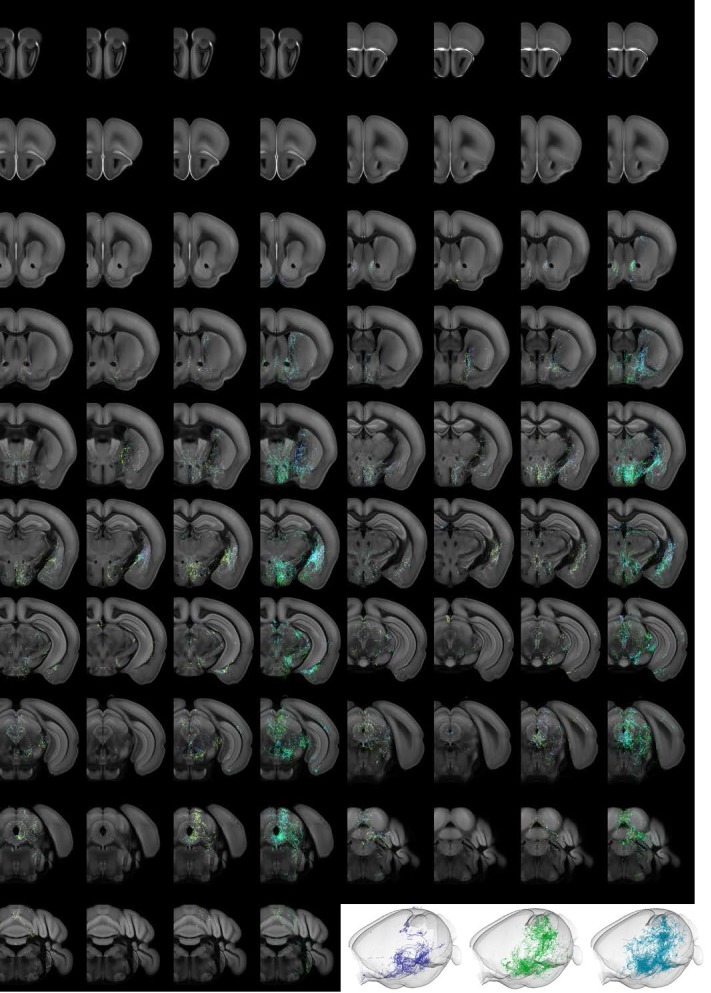
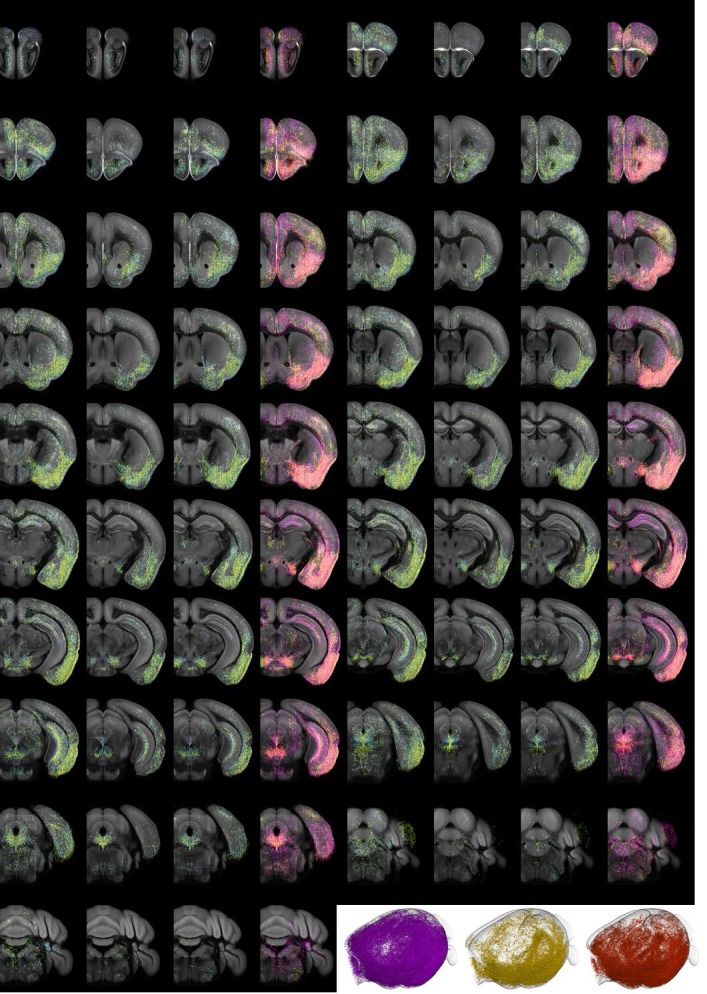
“Axons from both populations followed similar initial trajectories and were observed in shared structures along the length of the median forebrain bundle (Figure 7C,D; Figure 7—figure supplements 1–3; Figure 7—Video 1).”
§ Single-cell transcriptomes and whole-brain projections of serotonin neurons in the mouse dorsal and median raphe nuclei > Results > Whole-brain axonal projections of selected serotonin neuron subpopulations
plaincorrelational- Asserted: passes — The authors put it forward as true.
- Checkable: passes — It can be checked against evidence.
- Load-bearing: unclear — It is unclear whether the paper’s conclusions depend on it.
- Based: passes — The paper gives a reason why it holds.
It may state two separate claims as one.
A result the paper reports from its own data — it cites no other source for it, so there is none to check. The quote shows it is in the paper.
In the paper
“One cell had substantial branches to the cortical regions and two to the hypothalamus.”
§ Single-cell transcriptomes and whole-brain projections of serotonin neurons in the mouse dorsal and median raphe nuclei > Results > Whole-brain axonal arborization patterns of individual serotonin neurons
plainn = 5- Asserted: passes — The authors put it forward as true.
- Checkable: passes — It can be checked against evidence.
- Load-bearing: unclear — It is unclear whether the paper’s conclusions depend on it.
- Based: passes — The paper gives a reason why it holds.
It may state two separate claims as one.
A result the paper reports from its own data — it cites no other source for it, so there is none to check. The quote shows it is in the paper.
In the paper
“individual brains from the same genotype exhibit considerable variation in total axons labeled (Figure 7E top) and in detailed projection patterns”
§ Single-cell transcriptomes and whole-brain projections of serotonin neurons in the mouse dorsal and median raphe nuclei > Results > Whole-brain axonal projections of selected serotonin neuron subpopulations
plain- Asserted: passes — The authors put it forward as true.
- Checkable: passes — It can be checked against evidence.
- Load-bearing: passes — The paper’s conclusions depend on it.
- Based: passes — The paper gives a reason why it holds.
It may state two separate claims as one.
A result the paper reports from its own data — it cites no other source for it, so there is none to check. The quote shows it is in the paper.
In the paper
“serotonin neurons from DR-1–3 clusters are preferentially localized in dorsal pDR, whereas those from DR-4–6 in ventral pDR, with DR-6 neurons preferentially localized to the ventral lateral wings.”
§ Single-cell transcriptomes and whole-brain projections of serotonin neurons in the mouse dorsal and median raphe nuclei > Discussion > Relationship between molecular identity and cell body distribution
plaincorrelational- Asserted: passes — The authors put it forward as true.
- Checkable: passes — It can be checked against evidence.
- Load-bearing: passes — The paper’s conclusions depend on it.
- Based: passes — The paper gives a reason why it holds.
It may state two separate claims as one.
In the paper
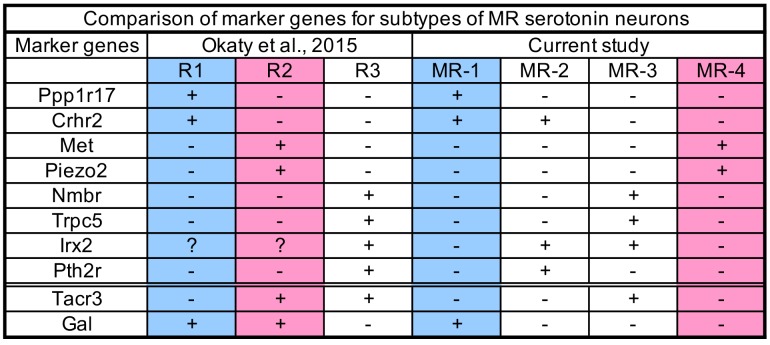
“Comparing marker genes enriched in R1–R3-derived serotonin neurons from Okaty et al. and MR-1–MR-4 transcriptomic clusters from our current study (Figure 3—figure supplement 4) indeed suggests an approximate correspondence: R1-derived serotonin neurons correspond to our MR-1 cluster, R2 to MR-4 cluster, and R3 to both MR-2 and MR-3 clusters.”
§ Single-cell transcriptomes and whole-brain projections of serotonin neurons in the mouse dorsal and median raphe nuclei > Discussion > Relationship between molecular identity and cell body distribution
What the sources say
- Not checked yetcites Okaty et al., 2015 source
hedgedcorrelational- Asserted: passes — The authors put it forward as true.
- Checkable: passes — It can be checked against evidence.
- Load-bearing: passes — The paper’s conclusions depend on it.
- Based: passes — The paper gives a reason why it holds.
It may state two separate claims as one.
A result the paper reports from its own data — it cites no other source for it, so there is none to check. The quote shows it is in the paper.
In the paper
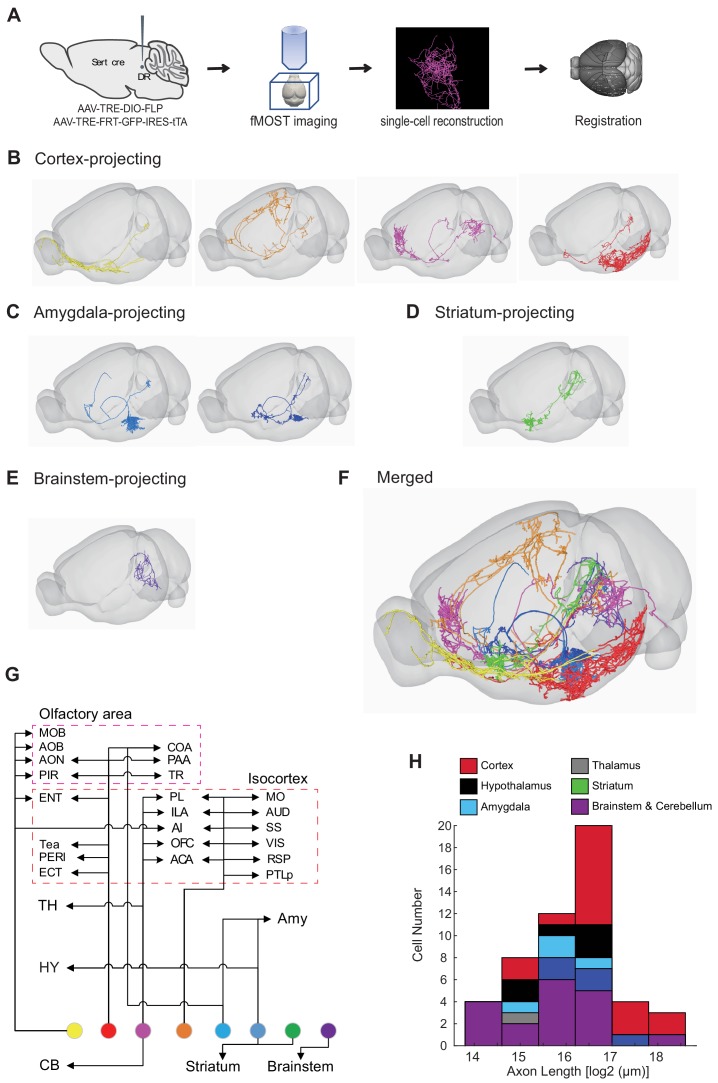
“The cortical-projecting serotonin neurons can have elaborate arborization patterns across multiple cortical areas (e.g., Figure 8—figure supplement 1C) and the longest total axon lengths per cell (Figure 8H).”
§ Single-cell transcriptomes and whole-brain projections of serotonin neurons in the mouse dorsal and median raphe nuclei > Discussion > Insights from single-cell reconstruction
plaincorrelational- Asserted: passes — The authors put it forward as true.
- Checkable: passes — It can be checked against evidence.
- Load-bearing: unclear — It is unclear whether the paper’s conclusions depend on it.
- Based: passes — The paper gives a reason why it holds.
It may state two separate claims as one.
A result the paper reports from its own data — it cites no other source for it, so there is none to check. The quote shows it is in the paper.
In the paper
“Using viral-genetic intersectional approaches to access specifically Vglut3+ pDR serotonin neurons in combination with staining in histological sections (Figure 6) and iDISCO-based whole brain imaging (Figure 7), we found that these neurons project profusely to cover much of the neocortex, as well as the olfactory bulb, cortical amygdala, and lateral hypothalamus.”
§ Single-cell transcriptomes and whole-brain projections of serotonin neurons in the mouse dorsal and median raphe nuclei > Discussion > Relationship between molecular identity and projection-defined serotonin sub-systems
plaincorrelational- Asserted: passes — The authors put it forward as true.
- Checkable: passes — It can be checked against evidence.
- Load-bearing: passes — The paper’s conclusions depend on it.
- Based: passes — The paper gives a reason why it holds.
It may state two separate claims as one.
A result the paper reports from its own data — it cites no other source for it, so there is none to check. The quote shows it is in the paper.
In the paper
“All cDR serotonin neurons co-express Vglut3, and express several unique markers (Figure 3—figure supplement 2).”
§ Single-cell transcriptomes and whole-brain projections of serotonin neurons in the mouse dorsal and median raphe nuclei > Discussion > Relationship between molecular identity and cell body distribution
plaincorrelational- Asserted: passes — The authors put it forward as true.
- Checkable: passes — It can be checked against evidence.
- Load-bearing: passes — The paper’s conclusions depend on it.
- Based: passes — The paper gives a reason why it holds.
It may state two separate claims as one.
In the paper
“Our transcriptome data suggest that each DR/MR serotonin neuron type can be distinguished from others by the expression of two marker genes (Figure 1D; Figure 3—figure supplement 1–3), supporting the view that neuronal subtypes are generally specified by unique combination of genes rather than single genes (Li et al., 2017).”
§ Single-cell transcriptomes and whole-brain projections of serotonin neurons in the mouse dorsal and median raphe nuclei > Discussion > Relationship between molecular identity and projection-defined serotonin sub-systems
What the sources say
- Not checked yetcites Li et al., 2017
hedgedcorrelational- Asserted: passes — The authors put it forward as true.
- Checkable: passes — It can be checked against evidence.
- Load-bearing: passes — The paper’s conclusions depend on it.
- Based: passes — The paper gives a reason why it holds.
It may state two separate claims as one.
A result the paper reports from its own data — it cites no other source for it, so there is none to check. The quote shows it is in the paper.
In the paper
“Our single-cell transcriptomic analysis indicated that serotonin neurons in the cDR are strikingly homogenous and profoundly different from both the pDR and MR at the molecular level (Figure 1, Figure 4, Figure 4—figure supplement 1).”
§ Single-cell transcriptomes and whole-brain projections of serotonin neurons in the mouse dorsal and median raphe nuclei > Discussion > Relationship between molecular identity and cell body distribution
hedgedcorrelational- Asserted: passes — The authors put it forward as true.
- Checkable: passes — It can be checked against evidence.
- Load-bearing: passes — The paper’s conclusions depend on it.
- Based: passes — The paper gives a reason why it holds.
It may state two separate claims as one.
A result the paper reports from its own data — it cites no other source for it, so there is none to check. The quote shows it is in the paper.
In the paper
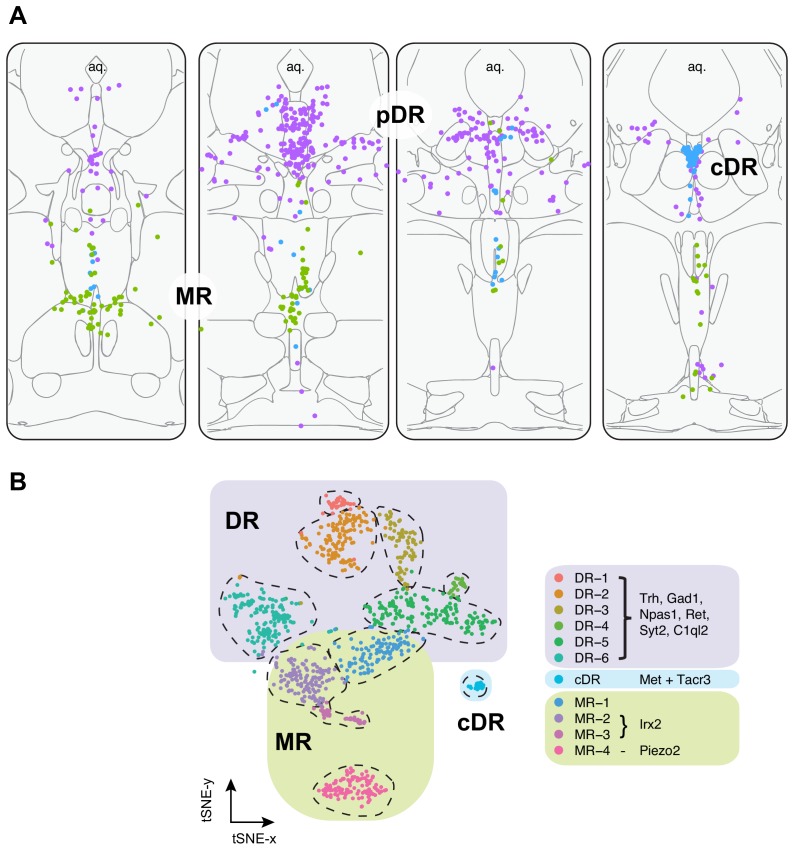
“Based on tissue source from which scRNA-seq data was collected and fluorescent in situ hybridization using transcriptomic cluster markers, we were able to assign six types to principal DR (pDR), one type to caudal DR (cDR), and four types to MR (Figure 3).”
§ Single-cell transcriptomes and whole-brain projections of serotonin neurons in the mouse dorsal and median raphe nuclei > Discussion > Relationship between molecular identity and cell body distribution
plaincorrelational- Asserted: passes — The authors put it forward as true.
- Checkable: passes — It can be checked against evidence.
- Load-bearing: passes — The paper’s conclusions depend on it.
- Based: passes — The paper gives a reason why it holds.
It may state two separate claims as one.
A result the paper reports from its own data — it cites no other source for it, so there is none to check. The quote shows it is in the paper.
In the paper
“We found that Trh+ serotonin neurons predominantly project to subcortical regions, most notably anterior and medial nuclei of the hypothalamus and several thalamic nuclei, a pattern mostly complementary to the Vglut3+ population (Figures 6–7, Figure 7—Video 1).”
§ Single-cell transcriptomes and whole-brain projections of serotonin neurons in the mouse dorsal and median raphe nuclei > Discussion > Relationship between molecular identity and projection-defined serotonin sub-systems
plaincorrelational- Asserted: passes — The authors put it forward as true.
- Checkable: passes — It can be checked against evidence.
- Load-bearing: passes — The paper’s conclusions depend on it.
- Based: passes — The paper gives a reason why it holds.
It may state two separate claims as one.
In the paper
“By contrast, we could not discern obvious difference in spatial distributions among the four MR types, despite the fact that MR serotonin neurons have heterogenous developmental origin (Jensen et al., 2008).”
§ Single-cell transcriptomes and whole-brain projections of serotonin neurons in the mouse dorsal and median raphe nuclei > Discussion > Relationship between molecular identity and cell body distribution
What the sources say
- Not checked yetcites Jensen et al., 2008 source
hedged- Asserted: passes — The authors put it forward as true.
- Checkable: passes — It can be checked against evidence.
- Load-bearing: unclear — It is unclear whether the paper’s conclusions depend on it.
- Based: passes — The paper gives a reason why it holds.
It may state two separate claims as one.
None of the sources cited for this claim have been checked yet.
In the paper
“The rest of the DR serotonin neurons were divided into thalamus-projecting and brainstem/cerebellum-projecting groups based on the highest density of axons (Figure 8—figure supplement 3B,C), one of which likely projecting to the spinal cord (brain 36) as previously reported (Bowker et al., 1981; Bowker et al., 1982).”
§ Single-cell transcriptomes and whole-brain projections of serotonin neurons in the mouse dorsal and median raphe nuclei > Results > Whole-brain axonal arborization patterns of individual serotonin neurons
What the sources say
hedgedcorrelational- Asserted: passes — The authors put it forward as true.
- Checkable: passes — It can be checked against evidence.
- Load-bearing: unclear — It is unclear whether the paper’s conclusions depend on it.
- Based: passes — The paper gives a reason why it holds.
It may state two separate claims as one.
The paper states this without a source or data behind it here, so there is nothing to check it against. The quote shows it is in the paper.
In the paper
“As a specific example, most forebrain-projecting DR serotonin neurons pass through the lateral hypothalamus to reach their targets; it is thus difficult to determine whether axons in the lateral hypothalamus play a local function.”
§ Single-cell transcriptomes and whole-brain projections of serotonin neurons in the mouse dorsal and median raphe nuclei > Discussion > Insights from single-cell reconstruction
plain- Asserted: passes — The authors put it forward as true.
- Checkable: passes — It can be checked against evidence.
- Load-bearing: unclear — It is unclear whether the paper’s conclusions depend on it.
- Based: passes — The paper gives a reason why it holds.
It may state two separate claims as one.
A result the paper reports from its own data — it cites no other source for it, so there is none to check. The quote shows it is in the paper.
In the paper
“One cell had axons that were almost equally distributed in the bed nucleus of stria terminalis (BNST), basal lateral amygdala, basal medial amygdala, and medial amygdala (MeA), and had substantial branches to the hypothalamus (>10% axon length).”
§ Single-cell transcriptomes and whole-brain projections of serotonin neurons in the mouse dorsal and median raphe nuclei > Results > Whole-brain axonal arborization patterns of individual serotonin neurons
plainSingle case- Asserted: passes — The authors put it forward as true.
- Checkable: passes — It can be checked against evidence.
- Load-bearing: unclear — It is unclear whether the paper’s conclusions depend on it.
- Based: passes — The paper gives a reason why it holds.
It may state two separate claims as one.
In the paper
“Gene expression patterns of specific serotonin neuron clusters can in principle allow genetic access to these specific subpopulations for anatomical tracing, physiological recording, and functional perturbation (Luo et al., 2018).”
§ Single-cell transcriptomes and whole-brain projections of serotonin neurons in the mouse dorsal and median raphe nuclei > Results > Viral-genetic tools to access different serotonin neuron subtypes
What the sources say
- Not checked yetcites Luo et al., 2018 source
hedgedconditional- Asserted: passes — The authors put it forward as true.
- Checkable: passes — It can be checked against evidence.
- Load-bearing: passes — The paper’s conclusions depend on it.
- Based: passes — The paper gives a reason why it holds.
Probably not a substantial claim.
A conclusion the paper draws from its own results — it cites no other source for it, so there is none to check. The quote shows it is in the paper.
In the paper
“In summary, our HCR-smFISH experiments support the notion that Clusters 1–6 correspond to pDR serotonin neurons, Cluster 7 corresponds to cDR serotonin neurons, and Clusters 8–11 correspond to MR serotonin neurons.”
- Also stated in: § Abstract · plain
“Systematic in situ hybridization mapped specific clusters to the principal DR, caudal DR, or MR.”
§ Single-cell transcriptomes and whole-brain projections of serotonin neurons in the mouse dorsal and median raphe nuclei > Results > Anatomical organization of transcriptomically defined serotonin clusters
plaincorrelational- Asserted: passes — The authors put it forward as true.
- Checkable: passes — It can be checked against evidence.
- Load-bearing: passes — The paper’s conclusions depend on it.
- Based: passes — The paper gives a reason why it holds.
It may state two separate claims as one.
- Also stated in: § Abstract · plain
A conclusion the paper draws from its own results — it cites no other source for it, so there is none to check. The quote shows it is in the paper.
In the paper
“In summary, the DR and MR serotonin neurons have diverse expression pattern of neuropeptide receptors, indicating that they are subject to complex modulation by a host of neuropeptides.”
§ Single-cell transcriptomes and whole-brain projections of serotonin neurons in the mouse dorsal and median raphe nuclei > Results > Molecular properties of MR and DR serotonin neurons
hedgedcorrelational- Asserted: passes — The authors put it forward as true.
- Checkable: passes — It can be checked against evidence.
- Load-bearing: passes — The paper’s conclusions depend on it.
- Based: passes — The paper gives a reason why it holds.
It may state two separate claims as one.
In the paper
“It has been reported that vesicular monoamine transporters (Slc8a1 for Vmat1; Slc8a2 for Vmat2) can transport GABA into synaptic vesicles (Stensrud et al., 2014), and virtually all serotonin neurons expressed Vmat2 (Figure 1—figure supplement 1D; Figure 4A left).”
§ Single-cell transcriptomes and whole-brain projections of serotonin neurons in the mouse dorsal and median raphe nuclei > Results > Molecular properties of MR and DR serotonin neurons
What the sources say
- Not checked yetcites Stensrud et al., 2014 source
plaindirect- Asserted: passes — The authors put it forward as true.
- Checkable: passes — It can be checked against evidence.
- Load-bearing: passes — The paper’s conclusions depend on it.
- Based: passes — The paper gives a reason why it holds.
Probably not a substantial claim.
A conclusion the paper draws from its own results — it cites no other source for it, so there is none to check. The quote shows it is in the paper.
In the paper
“These data suggest that Clusters 1–3 correspond to the dorsal DR and Cluster 4–6 to the ventral DR.”
§ Single-cell transcriptomes and whole-brain projections of serotonin neurons in the mouse dorsal and median raphe nuclei > Results > Anatomical organization of transcriptomically defined serotonin clusters
hedgedcorrelational- Asserted: passes — The authors put it forward as true.
- Checkable: passes — It can be checked against evidence.
- Load-bearing: passes — The paper’s conclusions depend on it.
- Based: passes — The paper gives a reason why it holds.
It may state two separate claims as one.
A conclusion the paper draws from its own results — it cites no other source for it, so there is none to check. The quote shows it is in the paper.
In the paper
“Based on our scRNA-seq and HCR-smFISH results, the Vglut3+ and Trh+ pDR serotonin neurons consist of largely complementary cell types at the transcriptomic level and have a distinct distribution along the dorsal–ventral axis in the pDR.”
§ Single-cell transcriptomes and whole-brain projections of serotonin neurons in the mouse dorsal and median raphe nuclei > Results > Viral-genetic tools to access different serotonin neuron subtypes
plaincorrelationaln = 3- Asserted: passes — The authors put it forward as true.
- Checkable: passes — It can be checked against evidence.
- Load-bearing: passes — The paper’s conclusions depend on it.
- Based: passes — The paper gives a reason why it holds.
It may state two separate claims as one.
What the paper did — it cites no source for this, so there is none to check. The quote shows it is in the paper.
In the paper
“Anti-Tph2 staining on the brain slices containing pDR showed that 98.5% GFP+ neurons are Tph2+ and 100% Tph2+ neurons are GFP+ (Figure 5B).”
§ Single-cell transcriptomes and whole-brain projections of serotonin neurons in the mouse dorsal and median raphe nuclei > Results > Viral-genetic tools to access different serotonin neuron subtypes
plaincorrelational- Asserted: passes — The authors put it forward as true.
- Checkable: passes — It can be checked against evidence.
- Load-bearing: passes — The paper’s conclusions depend on it.
- Based: passes — The paper gives a reason why it holds.
It may state two separate claims as one.
In the paper
“However, DR and MR contain not only serotonin neurons but also GABAergic and glutamatergic neurons that do not express Tph2 (and hence do not release serotonin), some of which may project to the same target regions (McDevitt et al., 2014).”
§ Single-cell transcriptomes and whole-brain projections of serotonin neurons in the mouse dorsal and median raphe nuclei > Results > Viral-genetic tools to access different serotonin neuron subtypes
What the sources say
- Not checked yetcites McDevitt et al., 2014 source
hedgedcorrelational- Asserted: passes — The authors put it forward as true.
- Checkable: passes — It can be checked against evidence.
- Load-bearing: passes — The paper’s conclusions depend on it.
- Based: passes — The paper gives a reason why it holds.
It may state two separate claims as one.
In the paper
“Transcription factors (TFs) have been shown to be the best molecular feature for cell type definition (Schaum et al., 2018).”
§ Single-cell transcriptomes and whole-brain projections of serotonin neurons in the mouse dorsal and median raphe nuclei > Results > Molecular properties of MR and DR serotonin neurons
What the sources say
- Not checked yetcites Schaum et al., 2018 source
boostedcorrelational- Asserted: passes — The authors put it forward as true.
- Checkable: passes — It can be checked against evidence.
- Load-bearing: fails — The paper’s conclusions may not depend on it.
- Based: passes — The paper gives a reason why it holds.
Probably not a substantial claim. The paper’s conclusions may not depend on it.
A conclusion the paper draws from its own results — it cites no other source for it, so there is none to check. The quote shows it is in the paper.
In the paper
“Thus, these observations support the anatomical breakdown suggested by the dissection of primary tissue, and additionally provide a more granular and detailed description about finer boundaries.”
§ Single-cell transcriptomes and whole-brain projections of serotonin neurons in the mouse dorsal and median raphe nuclei > Results > Anatomical organization of transcriptomically defined serotonin clusters
plaincorrelational- Asserted: passes — The authors put it forward as true.
- Checkable: passes — It can be checked against evidence.
- Load-bearing: passes — The paper’s conclusions depend on it.
- Based: passes — The paper gives a reason why it holds.
It may state two separate claims as one.
None of the sources cited for this claim have been checked yet.
In the paper
“DR serotonin neurons derive entirely from rhombomere 1 of the developing mouse brain, whereas MR serotonin neurons derive predominantly from rhombomeres 1, 2, and 3 (Alonso et al., 2013; Bang et al., 2012; Jensen et al., 2008).”
§ Single-cell transcriptomes and whole-brain projections of serotonin neurons in the mouse dorsal and median raphe nuclei > Introduction
What the sources say
plaindirect- Asserted: passes — The authors put it forward as true.
- Checkable: passes — It can be checked against evidence.
- Load-bearing: fails — The paper’s conclusions may not depend on it.
- Based: passes — The paper gives a reason why it holds.
Probably not a substantial claim. The paper’s conclusions may not depend on it. It may state two separate claims as one.
None of the sources cited for this claim have been checked yet.
In the paper
“Evidence has suggested that the DR and MR serotonin systems differ in developmental origin, connectivity, physiology, and behavioral function (Alonso et al., 2013; Calizo et al., 2011; Okaty et al., 2019).”
§ Single-cell transcriptomes and whole-brain projections of serotonin neurons in the mouse dorsal and median raphe nuclei > Introduction
What the sources say
hedgedcorrelational- Asserted: passes — The authors put it forward as true.
- Checkable: passes — It can be checked against evidence.
- Load-bearing: passes — The paper’s conclusions depend on it.
- Based: passes — The paper gives a reason why it holds.
It may state two separate claims as one.
None of the sources cited for this claim have been checked yet.
In the paper
“The MR serotonin neurons project to structures near the midline, whereas the DR serotonin neurons target more lateral regions (Jacobs and Azmitia, 1992; Muzerelle et al., 2016; Vertes, 1991; Vertes et al., 1999).”
§ Single-cell transcriptomes and whole-brain projections of serotonin neurons in the mouse dorsal and median raphe nuclei > Introduction
What the sources say
plaincorrelational- Asserted: passes — The authors put it forward as true.
- Checkable: passes — It can be checked against evidence.
- Load-bearing: passes — The paper’s conclusions depend on it.
- Based: passes — The paper gives a reason why it holds.
It may state two separate claims as one.
In the paper
“Groups B1–B3 are located in the medulla and provide descending serotonergic innervation to the spinal cord and other parts of the medulla. Groups B4–B9 are located in the pons and midbrain, including the dorsal raphe (DR; groups B6 and B7) and median raphe (MR; groups B5 and B8) nucleus, and provide ascending innervation to the forebrain and midbrain.”
§ Single-cell transcriptomes and whole-brain projections of serotonin neurons in the mouse dorsal and median raphe nuclei > Introduction
What the sources say
- Not checked yetcites Dahlström and Fuxe, 1964
plaindirect- Asserted: passes — The authors put it forward as true.
- Checkable: passes — It can be checked against evidence.
- Load-bearing: fails — The paper’s conclusions may not depend on it.
- Based: passes — The paper gives a reason why it holds.
Probably not a substantial claim. The paper’s conclusions may not depend on it. It may state two separate claims as one.
In the paper
“As a specific example, we recently found that DR serotonin neurons that project to frontal cortex and amygdala constitute two sub-systems with distinct cell body locations, axonal collateralization patterns, biased inputs, physiological response properties, and behavioral functions (Ren et al., 2018).”
§ Single-cell transcriptomes and whole-brain projections of serotonin neurons in the mouse dorsal and median raphe nuclei > Introduction
What the sources say
- Not checked yetcites Ren et al., 2018 source
plaincorrelational- Asserted: passes — The authors put it forward as true.
- Checkable: passes — It can be checked against evidence.
- Load-bearing: passes — The paper’s conclusions depend on it.
- Based: passes — The paper gives a reason why it holds.
It may state two separate claims as one.
None of the sources cited for this claim have been checked yet.
In the paper
“In neural circuits where cell types have been well studied by anatomical and physiological methods, there is an excellent correspondence between cell types defined by transcriptomes and the classical methods (Li et al., 2017; Shekhar et al., 2016).”
§ Single-cell transcriptomes and whole-brain projections of serotonin neurons in the mouse dorsal and median raphe nuclei > Introduction
What the sources say
- Not checked yetcites Li et al., 2017
- Not checked yetcites Shekhar et al., 2016 source
boostedcorrelational- Asserted: passes — The authors put it forward as true.
- Checkable: passes — It can be checked against evidence.
- Load-bearing: fails — The paper’s conclusions may not depend on it.
- Based: passes — The paper gives a reason why it holds.
Probably not a substantial claim. The paper’s conclusions may not depend on it.
In the paper
“Serotonin neurons in the central nervous system are spatially clustered in the brainstem, originally designated as groups B1–B9 (Dahlström and Fuxe, 1964).”
§ Single-cell transcriptomes and whole-brain projections of serotonin neurons in the mouse dorsal and median raphe nuclei > Introduction
What the sources say
- Not checked yetcites Dahlström and Fuxe, 1964
plain- Asserted: passes — The authors put it forward as true.
- Checkable: passes — It can be checked against evidence.
- Load-bearing: fails — The paper’s conclusions may not depend on it.
- Based: passes — The paper gives a reason why it holds.
Probably not a substantial claim. The paper’s conclusions may not depend on it.
In the paper
“Collectively,~12,000 serotonin neurons from the DR and MR in mice (~0.015% of all CNS neurons) innervate the entire forebrain (Ishimura et al., 1988) and modulate diverse physiological and behavioral functions.”
§ Single-cell transcriptomes and whole-brain projections of serotonin neurons in the mouse dorsal and median raphe nuclei > Discussion
What the sources say
- Not checked yetcites Ishimura et al., 1988 source
plaindirect- Asserted: passes — The authors put it forward as true.
- Checkable: passes — It can be checked against evidence.
- Load-bearing: fails — The paper’s conclusions may not depend on it.
- Based: passes — The paper gives a reason why it holds.
Probably not a substantial claim. The paper’s conclusions may not depend on it. It may state two separate claims as one.
In the paper
“The MR serotonin neurons derive from three separate rhombomeres (R1–R3), and Okaty et al. sampled these three populations separately, allowing us to ask the question of whether developmental origins correspond to transcriptomic clusters in adult.”
§ Single-cell transcriptomes and whole-brain projections of serotonin neurons in the mouse dorsal and median raphe nuclei > Discussion > Relationship between molecular identity and cell body distribution
What the sources say
- Not checked yetcites Okaty et al., 2015 source
plaincorrelational- Asserted: passes — The authors put it forward as true.
- Checkable: passes — It can be checked against evidence.
- Load-bearing: passes — The paper’s conclusions depend on it.
- Based: passes — The paper gives a reason why it holds.
It may state two separate claims as one.
In the paper
“By searching Allen Brain Institute development brain database and using multiplex fluorescent in situ hybridization (ML-FISH), Kast et al. (2017) found that the cDR expressed distinct gene markers comparing to pDR, and tracing from these neurons showed cDR was different from the MR and DR in efferent innervation.”
§ Single-cell transcriptomes and whole-brain projections of serotonin neurons in the mouse dorsal and median raphe nuclei > Discussion > Relationship between molecular identity and cell body distribution
What the sources say
- Not checked yetcites Kast et al., 2017 source
plaincorrelational- Asserted: passes — The authors put it forward as true.
- Checkable: passes — It can be checked against evidence.
- Load-bearing: unclear — It is unclear whether the paper’s conclusions depend on it.
- Based: passes — The paper gives a reason why it holds.
It may state two separate claims as one.
In the paper
“The cDR has been suggested to be more similar to the MR than to the pDR in afferent innervation (Commons, 2015).”
§ Single-cell transcriptomes and whole-brain projections of serotonin neurons in the mouse dorsal and median raphe nuclei > Discussion > Relationship between molecular identity and cell body distribution
What the sources say
- Not checked yetcites Commons, 2015 source
hedgedcorrelational- Asserted: passes — The authors put it forward as true.
- Checkable: passes — It can be checked against evidence.
- Load-bearing: fails — The paper’s conclusions may not depend on it.
- Based: passes — The paper gives a reason why it holds.
Probably not a substantial claim. The paper’s conclusions may not depend on it.
In the paper
“In our previous study, we characterized two projection-defined parallel DR serotonin sub-systems.”
§ Single-cell transcriptomes and whole-brain projections of serotonin neurons in the mouse dorsal and median raphe nuclei > Discussion > Relationship between molecular identity and projection-defined serotonin sub-systems
What the sources say
- Not checked yetcites Ren et al., 2018 source
plain- Asserted: passes — The authors put it forward as true.
- Checkable: passes — It can be checked against evidence.
- Load-bearing: passes — The paper’s conclusions depend on it.
- Based: passes — The paper gives a reason why it holds.
Probably not a substantial claim.
In the paper
“We found that serotonin neurons that project to the orbitofrontal cortex (OFC) and central amygdala (CeA) differ in input and output patterns, physiological response properties, and behavioral functions (Ren et al., 2018).”
§ Single-cell transcriptomes and whole-brain projections of serotonin neurons in the mouse dorsal and median raphe nuclei > Discussion > Relationship between molecular identity and projection-defined serotonin sub-systems
What the sources say
- Not checked yetcites Ren et al., 2018 source
plaincorrelational- Asserted: passes — The authors put it forward as true.
- Checkable: passes — It can be checked against evidence.
- Load-bearing: passes — The paper’s conclusions depend on it.
- Based: passes — The paper gives a reason why it holds.
It may state two separate claims as one.
A conclusion the paper draws from its own results — it cites no other source for it, so there is none to check. The quote shows it is in the paper.
In the paper
“Compared to droplet-based platform of the two studies, our FACS-based scRNA-seq platform allowed more sequencing depth per cell (Figure 1—figure supplement 1B) and sequencing larger number of cells, accounting for our finer classification of transcriptomic types of serotonin neurons.”
§ Single-cell transcriptomes and whole-brain projections of serotonin neurons in the mouse dorsal and median raphe nuclei > Discussion > Relationship between molecular identity and cell body distribution
plaindirect- Asserted: passes — The authors put it forward as true.
- Checkable: passes — It can be checked against evidence.
- Load-bearing: passes — The paper’s conclusions depend on it.
- Based: passes — The paper gives a reason why it holds.
It may state two separate claims as one.
A conclusion the paper draws from its own results — it cites no other source for it, so there is none to check. The quote shows it is in the paper.
In the paper
“However, our single-cell reconstruction of DR serotonin neurons revealed many more than six branching patterns (e.g., Figure 8G), indicating that there must be diverse collateralization patterns even within the same transcriptomic cluster, and highlighting the complexity of individual serotonin neuron projections.”
§ Single-cell transcriptomes and whole-brain projections of serotonin neurons in the mouse dorsal and median raphe nuclei > Discussion > Insights from single-cell reconstruction
hedgeddirect- Asserted: passes — The authors put it forward as true.
- Checkable: passes — It can be checked against evidence.
- Load-bearing: passes — The paper’s conclusions depend on it.
- Based: passes — The paper gives a reason why it holds.
It may state two separate claims as one.
In the paper
“These data support and extend our previous finding (Ren et al., 2018) for the preferential ventral pDR location of Vglut3+ serotonin neurons, which is highly expressed in DR-4 and DR-5 clusters.”
§ Single-cell transcriptomes and whole-brain projections of serotonin neurons in the mouse dorsal and median raphe nuclei > Discussion > Relationship between molecular identity and cell body distribution
What the sources say
- Not checked yetcites Ren et al., 2018 source
plaincorrelational- Asserted: passes — The authors put it forward as true.
- Checkable: passes — It can be checked against evidence.
- Load-bearing: unclear — It is unclear whether the paper’s conclusions depend on it.
- Based: passes — The paper gives a reason why it holds.
It may state two separate claims as one.
In the paper
“Because DR serotonin neurons derive exclusively from rhombomere 1 (R1), and the single-cell RNA-seq data was obtained from just 8 cells, the Okaty et al. dataset is limited in providing information about heterogeneity within DR serotonin neurons.”
§ Single-cell transcriptomes and whole-brain projections of serotonin neurons in the mouse dorsal and median raphe nuclei > Discussion > Relationship between molecular identity and cell body distribution
What the sources say
- Not checked yetcites Okaty et al., 2015 source
plaindirect- Asserted: passes — The authors put it forward as true.
- Checkable: passes — It can be checked against evidence.
- Load-bearing: unclear — It is unclear whether the paper’s conclusions depend on it.
- Based: passes — The paper gives a reason why it holds.
It may state two separate claims as one.
In the paper
“Forebrain-projecting serotonin neurons have been estimated to have very long axons based on the total serotonin fiber density and number of serotonin neurons (Wu et al., 2014).”
§ Single-cell transcriptomes and whole-brain projections of serotonin neurons in the mouse dorsal and median raphe nuclei > Results > Whole-brain axonal arborization patterns of individual serotonin neurons
What the sources say
- Not checked yetcites Wu et al., 2014
hedged- Asserted: passes — The authors put it forward as true.
- Checkable: passes — It can be checked against evidence.
- Load-bearing: fails — The paper’s conclusions may not depend on it.
- Based: passes — The paper gives a reason why it holds.
Probably not a substantial claim. The paper’s conclusions may not depend on it.
In the paper
“Given that CeA-projecting DR serotonin neurons do not innervate most of the hypothalamus (Ren et al., 2018), and Trh+ serotonin neurons only partially innervate CeA, these two populations are at most partially overlapping.”
§ Single-cell transcriptomes and whole-brain projections of serotonin neurons in the mouse dorsal and median raphe nuclei > Discussion > Relationship between molecular identity and projection-defined serotonin sub-systems
What the sources say
- Not checked yetcites Ren et al., 2018 source
plaincorrelational- Asserted: passes — The authors put it forward as true.
- Checkable: passes — It can be checked against evidence.
- Load-bearing: passes — The paper’s conclusions depend on it.
- Based: passes — The paper gives a reason why it holds.
It may state two separate claims as one.
None of the sources cited for this claim have been checked yet.
In the paper
“For example, several studies have reported that subgroups of serotonin neurons in the MR and DR express Vglut3 and indeed, subsequent slice recording confirmed that serotonin terminals can co-release glutamate and serotonin (Domonkos et al., 2016; Liu et al., 2014; Ren et al., 2018; Sengupta et al., 2017; Varga et al., 2009; Wang et al., 2019).”
§ Single-cell transcriptomes and whole-brain projections of serotonin neurons in the mouse dorsal and median raphe nuclei > Discussion > Integrating multiple features within individual serotonin sub-systems
What the sources say
plaincorrelational- Asserted: passes — The authors put it forward as true.
- Checkable: passes — It can be checked against evidence.
- Load-bearing: fails — The paper’s conclusions may not depend on it.
- Based: passes — The paper gives a reason why it holds.
Probably not a substantial claim. The paper’s conclusions may not depend on it. It may state two separate claims as one.
A conclusion the paper draws from its own results — it cites no other source for it, so there is none to check. The quote shows it is in the paper.
In the paper
“We have shown that the molecular features of these distinct serotonin groups reflect their anatomical organization and provide tools for future exploration of the full projection map of molecularly defined serotonin groups.”
§ Single-cell transcriptomes and whole-brain projections of serotonin neurons in the mouse dorsal and median raphe nuclei > Discussion > Integrating multiple features within individual serotonin sub-systems
boostedcorrelational- Asserted: passes — The authors put it forward as true.
- Checkable: passes — It can be checked against evidence.
- Load-bearing: passes — The paper’s conclusions depend on it.
- Based: passes — The paper gives a reason why it holds.
It may state two separate claims as one.
None of the sources cited for this claim have been checked yet.
In the paper
“While the reported projection and arborization complexity of individual DR neurons appear qualitatively similar to our findings, these studies cannot be directly compared because the Gagnon and Parent study did not validate the serotonin identity of individually traced DR neurons, which could include Tph2-negative long-distance projecting GABAergic and glutamatergic neurons (Bang and Commons, 2012”
§ Single-cell transcriptomes and whole-brain projections of serotonin neurons in the mouse dorsal and median raphe nuclei > Discussion > Insights from single-cell reconstruction
What the sources say
- Not checked yetcites Gagnon and Parent, 2014
- Not checked yetcites Bang and Commons, 2012
hedged- Asserted: passes — The authors put it forward as true.
- Checkable: passes — It can be checked against evidence.
- Load-bearing: passes — The paper’s conclusions depend on it.
- Based: passes — The paper gives a reason why it holds.
It may state two separate claims as one.
A conclusion the paper draws from its own results — it cites no other source for it, so there is none to check. The quote shows it is in the paper.
In the paper
“which suggests that these serotonin neurons use glutamate as co-transmitter in their cortical targets, and are in turn modulated by corticotropin-releasing hormone and neuropeptide Y.”
§ Single-cell transcriptomes and whole-brain projections of serotonin neurons in the mouse dorsal and median raphe nuclei > Discussion > Integrating multiple features within individual serotonin sub-systems
hedgeddirect- Asserted: passes — The authors put it forward as true.
- Checkable: passes — It can be checked against evidence.
- Load-bearing: unclear — It is unclear whether the paper’s conclusions depend on it.
- Based: passes — The paper gives a reason why it holds.
It may state two separate claims as one.
In the paper
“Our previous study suggests that DR serotonin sub-systems have biased input but segregated output (Ren et al., 2018).”
§ Single-cell transcriptomes and whole-brain projections of serotonin neurons in the mouse dorsal and median raphe nuclei > Discussion > Integrating multiple features within individual serotonin sub-systems
What the sources say
- Not checked yetcites Ren et al., 2018 source
hedgedcorrelational- Asserted: passes — The authors put it forward as true.
- Checkable: passes — It can be checked against evidence.
- Load-bearing: fails — The paper’s conclusions may not depend on it.
- Based: passes — The paper gives a reason why it holds.
Probably not a substantial claim. The paper’s conclusions may not depend on it.
A conclusion the paper draws from its own results — it cites no other source for it, so there is none to check. The quote shows it is in the paper.
In the paper
“In conclusion, our comprehensive transcriptomic dataset and identification of 11 distinct groups of the DR and MR serotonin neurons have revealed the molecular heterogeneity of the forebrain-projecting serotonin system.”
§ Single-cell transcriptomes and whole-brain projections of serotonin neurons in the mouse dorsal and median raphe nuclei > Discussion > Integrating multiple features within individual serotonin sub-systems
plaindirect- Asserted: passes — The authors put it forward as true.
- Checkable: passes — It can be checked against evidence.
- Load-bearing: passes — The paper’s conclusions depend on it.
- Based: passes — The paper gives a reason why it holds.
It may state two separate claims as one.
What the paper did — it cites no source for this, so there is none to check. The quote shows it is in the paper.
In the paper
“All procedures followed animal care and biosafety guidelines approved by Stanford University’s Administrative Panel on Laboratory Animal Care and Administrative Panel of Biosafety in accordance with NIH guidelines.”
§ Single-cell transcriptomes and whole-brain projections of serotonin neurons in the mouse dorsal and median raphe nuclei > Materials and methods > Animals
plain- Asserted: passes — The authors put it forward as true.
- Checkable: passes — It can be checked against evidence.
- Load-bearing: fails — The paper’s conclusions may not depend on it.
- Based: passes — The paper gives a reason why it holds.
Probably not a substantial claim. The paper’s conclusions may not depend on it.
What the paper did — it cites no source for this, so there is none to check. The quote shows it is in the paper.
In the paper
“The reconstructed neurons were checked by one another person.”
§ Single-cell transcriptomes and whole-brain projections of serotonin neurons in the mouse dorsal and median raphe nuclei > Materials and methods > Single Cell Reconstruction
plain- Asserted: passes — The authors put it forward as true.
- Checkable: passes — It can be checked against evidence.
- Load-bearing: fails — The paper’s conclusions may not depend on it.
- Based: passes — The paper gives a reason why it holds.
Probably not a substantial claim. The paper’s conclusions may not depend on it.
A conclusion the paper draws from its own results — it cites no other source for it, so there is none to check. The quote shows it is in the paper.
In the paper
“The molecular architecture of serotonin system lays the foundation for integrating anatomical, neurochemical, physiological, and behavioral functions.”
§ Single-cell transcriptomes and whole-brain projections of serotonin neurons in the mouse dorsal and median raphe nuclei > Discussion > Integrating multiple features within individual serotonin sub-systems
plaindirect- Asserted: passes — The authors put it forward as true.
- Checkable: fails — It may be too vague to check against evidence.
- Load-bearing: fails — The paper’s conclusions may not depend on it.
- Based: passes — The paper gives a reason why it holds.
Probably not a substantial claim. It may be too vague to check against evidence. The paper’s conclusions may not depend on it.
The paper relies on this without support.
The heterogeneity of DR and MR serotonin neurons must be reflected at the molecular level.
“Ultimately, the heterogeneity of DR and MR serotonin neurons must be reflected at the molecular level.”
The paper relies on this without support.
The DR contains approximately 9000 serotonin neurons.
“our study is still limited by the scope (50 reconstructed cells out of 9000 DR serotonin neurons).”
Claims other papers make about this one
Each is checked against this paper’s own text: does it say what the citing paper says it does?
In the citing paper
“Those in the dorsal raphe project widely throughout the cortex and increase or decrease their activity to reward and punish, respectively.76,78”
From Synaptic and circuit functions of multitransmitter neurons in the mammalian brain (2023) · cites this paper as [76]
Self-check
Percentages, sums and reported differences re-computed from the paper’s own numbers.
Each contradiction between two passages listed here was confirmed by an independent check.
Rated minor: it would not touch a result — a value no result rests on, a p-value that stays on the same side of the significance level, or a conflict that is clerical, resolved elsewhere in the paper, or outside its own findings.
In the paper
§ Single-cell transcriptomes and whole-brain projections of serotonin neurons in the mouse dorsal and median raphe nuclei > Results > Anatomical organization of transcriptomically defined serotonin clusters
“Slc17a8+ (also known as Vglut3, used hereafter)”
§ Single-cell transcriptomes and whole-brain projections of serotonin neurons in the mouse dorsal and median raphe nuclei > Materials and methods > Animals
“The Vglut3-Cre (also known as Slc18a8-Cre; JAX Strain 18147)”
Citations
Cites
STAR: ultrafast universal RNA-seq aligner
Dobin, A., Davis, C. A., Schlesinger, F., Drenkow, J., Zaleski, C., Jha, S., Batut, P., Chaisson, M., & Gingeras, T. R. (2013) · Bioinformatics · doi:10.1093/bioinformatics/bts635 · Cited by 51,709
HTSeq—a Python framework to work with high-throughput sequencing data
Anders, S., Pyl, P. T., & Huber, W. (2015) · Bioinformatics · doi:10.1093/bioinformatics/btu638 · Cited by 21,464 · cited 1×
“2 (Anders et al., 2015) with default parameters, except ‘stranded’ was set to ‘false’, and ‘mode’ was set to ‘intersection-nonempty’.”
Comprehensive Integration of Single-Cell Data
Stuart, T., Butler, A., Hoffman, P., Hafemeister, C., Papalexi, E., Mauck, W. M., Hao, Y., Stoeckius, M., Smibert, P., & Satija, R. (2019) · Cell · doi:10.1016/j.cell.2019.05.031 · Cited by 15,453
Integrating single-cell transcriptomic data across different conditions, technologies, and species
Butler, A., Hoffman, P., Smibert, P., Papalexi, E., & Satija, R. (2018) · Nature Biotechnology · doi:10.1038/nbt.4096 · Cited by 13,174
3D U-Net: Learning Dense Volumetric Segmentation from Sparse Annotation
Çiçek, Ö., Abdulkadir, A., Lienkamp, S. S., Brox, T., & Ronneberger, O. (2016) · Lecture Notes in Computer Science · doi:10.1007/978-3-319-46723-8_49 · Cited by 7,945
Highly parallel genome-wide expression profiling of individual cells using nanoliter droplets.
Macosko, E. Z., Basu, A., Satija, R., Nemesh, J., Shekhar, K., Goldman, M., Tirosh, I., Bialas, A. R., Kamitaki, N., Martersteck, E. M., et al. (2015) · Cell · doi:10.1016/j.cell.2015.05.002 · Cited by 7,110
A robust and high-throughput Cre reporting and characterization system for the whole mouse brain
Madisen, L., Zwingman, T. A., Sunkin, S. M., Oh, S. W., Zariwala, H. A., Gu, H., Ng, L. L., Palmiter, R. D., Hawrylycz, M. J., Jones, A. R., et al. (2010) · Nature Neuroscience · doi:10.1038/nn.2467 · Cited by 6,907 · cited 3×
“The Ai14 tdTomato Cre reporter mice (JAX Strain 7914) Ren et al. eLife 2019;8:e49424.”
BackgroundInfluentialFull-length RNA-seq from single cells using Smart-seq2
Picelli, S., Faridani, O. R., Björklund, Å. K., Winberg, G., Sagasser, S., & Sandberg, R. (2014) · Nature Protocols · doi:10.1038/nprot.2014.006 · Cited by 4,137 · cited 1×
“cDNA synthesis and library preparation were performed using the Smart-seq2 protocol (Picelli et al., 2014).”
MethodCell types in the mouse cortex and hippocampus revealed by single-cell RNA-seq
Zeisel, A., Muñoz-Manchado, A. B., Codeluppi, S., Lönnerberg, P., La Manno, G., Juréus, A., Marques, S., Munguba, H., He, L., Betsholtz, C., et al. (2015) · Science · doi:10.1126/science.aaa1934 · Cited by 3,124 · cited 1×
“…powerful tool for unbiased identification of transcriptomic cell types in the brain (Darmanis et al., 2015; Li et al., 2017; Mickelsen et al., 2019; Rosenberg et al., 2018; Saunders et al., 2018; Tasic et al., 2016; Tasic et al., 2018; Welch et al., 2019; Zeisel et al., 2018; Zeisel et al., 2015).”
MethodSingle-cell transcriptomics of 20 mouse organs creates a Tabula Muris
The Tabula Muris Consortium, coordination, O., coordination, L., processing, O. C. A., sequencing, L. P. A., analysis, C. D., annotation, C. T., Writing group, Supplemental text writing group, & Principal investigators (2018) · Nature · doi:10.1038/s41586-018-0590-4 · Cited by 2,842 · cited 3×
“Transcription factors Transcription factors (TFs) have been shown to be the best molecular feature for cell type definition (Schaum et al., 2018).”
BackgroundMethodInfluential
Research works printed but not linked: 1
- Çiçek, 2016, Medical Image Computing and Computer-Assisted Intervention – MICCAI 2016. MICCAI 2016. Lecture Notes in Computer Science, 9901
Cited by
Sorted by citations
A high-resolution transcriptomic and spatial atlas of cell types in the whole mouse brain
Yao, Z., van Velthoven, C. T. J., Kunst, M., Zhang, M., McMillen, D., Lee, C., Jung, W., Goldy, J., Abdelhak, A., Aitken, M., et al. (2023) · Nature · doi:10.1038/s41586-023-06812-z · Cited by 1,203
Molecularly defined and spatially resolved cell atlas of the whole mouse brain
Zhang, M., Pan, X., Jung, W., Halpern, A. R., Eichhorn, S. W., Lei, Z., Cohen, L., Smith, K. A., Tasic, B., Yao, Z., et al. (2023) · Nature · doi:10.1038/s41586-023-06808-9 · Cited by 531
“Serotonergic neurons were enriched in the raphe nuclei (dorsal nucleus raphe, nucleus raphe pontis and nucleus raphe magnus) in the midbrain and hindbrain 30 (Extended Data Fig.”
What is a cell type and how to define it?
Zeng, H. (2022) · Cell · doi:10.1016/j.cell.2022.06.031 · Cited by 439
Single-cell and spatial transcriptomics: deciphering brain complexity in health and disease
Piwecka, M., Rajewsky, N., & Rybak-Wolf, A. (2023) · Nature Reviews Neurology · doi:10.1038/s41582-023-00809-y · Cited by 320
Population-scale single-cell RNA-seq profiling across dopaminergic neuron differentiation
Jerber, J., Seaton, D. D., Cuomo, A. S. E., Kumasaka, N., Haldane, J., Steer, J., Patel, M. J., Pearce, D., Andersson, M. H. L., Bonder, M. J., et al. (2021) · Nature Genetics · doi:10.1038/s41588-021-00801-6 · Cited by 293
A genetically encoded sensor for measuring serotonin dynamics
Wan, J., Peng, W., Li, X., Qian, T., Song, K., Zeng, J., Deng, F., Hao, S., Feng, J., Zhang, P., et al. (2021) · Nature Neuroscience · doi:10.1038/s41593-021-00823-7 · Cited by 302
Self-citationCerebellar nuclei evolved by repeatedly duplicating a conserved cell-type set
Kebschull, J. M., Richman, E. B., Ringach, N., Friedmann, D., Albarran, E., Kolluru, S. S., Jones, R. C., Allen, W. E., Wang, Y., Cho, S. W., et al. (2020) · Science · doi:10.1126/science.abd5059 · Cited by 262
“3 each nucleus using AAV8-CAG-tdTomato followed by brain and spinal cord clearing and light-sheet imaging (Chi et al. 2018; Ren et al. 2019; Friedmann et al. 2020) (Figs.”
MethodSelf-citationThe emergence and influence of internal states
Flavell, S. W., Gogolla, N., Lovett-Barron, M., & Zelikowsky, M. (2022) · Neuron · doi:10.1016/j.neuron.2022.04.030 · Cited by 246
Ion Channel Degeneracy, Variability, and Covariation in Neuron and Circuit Resilience
Goaillard, J., & Marder, E. E. (2021) · Annual Review of Neuroscience · doi:10.1146/annurev-neuro-092920-121538 · Cited by 188
Modulating the Neuromodulators: Dopamine, Serotonin, and the Endocannabinoid System
Peters, K. Z., Cheer, J. F., & Tonini, R. (2021) · Trends in Neurosciences · doi:10.1016/j.tins.2021.02.001 · Cited by 180
Differential Encoding in Prefrontal Cortex Projection Neuron Classes Across Cognitive Tasks
Lui, J. H., Nguyen, N. D., Grutzner, S. M., Darmanis, S., Peixoto, D., Wagner, M. J., Allen, W. E., Kebschull, J. M., Richman, E. B., Ren, J., et al. (2020) · Cell · doi:10.1016/j.cell.2020.11.046 · Cited by 124
Self-citationA single-cell transcriptomic and anatomic atlas of mouse dorsal raphe Pet1 neurons
Okaty, B. W., Sturrock, N., Lozoya, Y. E., Chang, Y., Senft, R. A., Lyon, K. A., Alekseyenko, O. V., & Dymecki, S. M. (2020) · eLife · doi:10.7554/elife.55523 · Cited by 122
Whole-brain spatial organization of hippocampal single-neuron projectomes
Qiu, S., Hu, Y., Huang, Y., Gao, T., Wang, X., Wang, D., Ren, B., Shi, X., Chen, Y., Wang, X., et al. (2024) · Science · doi:10.1126/science.adj9198 · Cited by 116
Self-citationSerotonin regulation of behavior via large-scale neuromodulation of serotonin receptor networks
Salvan, P., Fonseca, M., Winkler, A. M., Beauchamp, A., Lerch, J. P., & Johansen-Berg, H. (2023) · Nature Neuroscience · doi:10.1038/s41593-022-01213-3 · Cited by 101
The nonhuman primate neuroimaging and neuroanatomy project
Hayashi, T., Hou, Y., Glasser, M. F., Autio, J. A., Knoblauch, K., Inoue‐Murayama, M., Coalson, T., Yacoub, E. S., Smith, S. M., Kennedy, H., et al. (2021) · NeuroImage · doi:10.1016/j.neuroimage.2021.117726 · Cited by 110
“Ideally, this type of neuroimaging-based parcellation strategy would be combined with one based on postmortem architectonics, including cytoarchitecture, chemoarchitecture (Zilles and Amunts, 2009), cells (Murakami et al., 2018; Ren et al., 2019), gene expression (Shimogori et al.”
Mapping mesoscale axonal projections in the mouse brain using a 3D convolutional network
Friedmann, D., Pun, A., Adams, E. L., Lui, J. H., Kebschull, J. M., Grutzner, S. M., Castagnola, C., Tessier‐Lavigne, M., & Luo, L. (2020) · Proceedings of the National Academy of Sciences · doi:10.1073/pnas.1918465117 · Cited by 97
Self-citationA whole-brain monosynaptic input connectome to neuron classes in mouse visual cortex
Yao, S., Wang, Q., Hirokawa, K. E., Ouellette, B., Ahmed, R., Bomben, J., Brouner, K., Casal, L., Caldejon, S., Cho, A., et al. (2022) · Nature Neuroscience · doi:10.1038/s41593-022-01219-x · Cited by 91
Cortical disinhibitory circuits: cell types, connectivity and function
Kullander, K., & Topolnik, L. (2021) · Trends in Neurosciences · doi:10.1016/j.tins.2021.04.009 · Cited by 86
Distinct serotonergic pathways to the amygdala underlie separate behavioral features of anxiety
Yu, X., Zhu, Y., Sun, Q., Deng, F., Wan, J., Zheng, D., Gong, W., Xie, S., Shen, C.-J., Fu, J., et al. (2022) · Nature Neuroscience · doi:10.1038/s41593-022-01200-8 · Cited by 89
“m, n = 5, 6, 6 and 6 mice, one-way ANOVA, F(3, 26) = 7.”
InfluentialZheng, X., Wu, B., Liu, Y., Simmons, S., Kim, K., Clarke, G. S., Ashiq, A., Park, J. C., Li, J., Wang, Z., et al. (2024) · Cell · doi:10.1016/j.cell.2024.04.050 · Cited by 86
Dissecting the functional organization of the C. elegans serotonergic system at whole-brain scale
Dag, U., Nwabudike, I., Kang, D., Gomes, M. A., Kim, J. S., Atanas, A. A., Bueno, E., Estrem, C., Pugliese, S. M., Wang, Z., et al. (2023) · Cell · doi:10.1016/j.cell.2023.04.023 · Cited by 96
Reward Contributions to Serotonergic Functions
Liu, Z., Lin, R., & Luo, M. (2020) · Annual Review of Neuroscience · doi:10.1146/annurev-neuro-093019-112252 · Cited by 79
Self-citationHan, Y., Xia, G., Srisai, D., Meng, F., He, Y., Ran, Y., He, Y., Farías, M., Hoang, G. N., Tóth, I., et al. (2021) · Nature Communications · doi:10.1038/s41467-021-23846-x · Cited by 79
Context-specific functions of chromatin remodellers in development and disease
Gourisankar, S. P., Krokhotin, A., Wenderski, W., & Crabtree, G. R. (2023) · Nature Reviews Genetics · doi:10.1038/s41576-023-00666-x · Cited by 88
“Consistent with these earlier studies, recent single-cell RNA sequencing (RNA-seq) studies of mammalian tissues have shown that each cell type examined has the potential (in terms of expressed mRNAs for subunit families) to form a diversity of possible complexes 35 .”
The role of serotonin in declarative memory: A systematic review of animal and human research
Coray, R. C., & Quednow, B. B. (2022) · Neuroscience & Biobehavioral Reviews · doi:10.1016/j.neubiorev.2022.104729 · Cited by 85
Modulation of 5-HT release by dynorphin mediates social deficits during opioid withdrawal
Pomrenze, M. B., Pinto, D. F. C., Neumann, P. A., Llorach, P., Tucciarone, J., Morishita, W., Eshel, N., Heifets, B. D., & Malenka, R. C. (2022) · Neuron · doi:10.1016/j.neuron.2022.09.024 · Cited by 79
X-chromosome regulation and sex differences in brain anatomy
Raznahan, A., & Distèche, C. M. (2020) · Neuroscience & Biobehavioral Reviews · doi:10.1016/j.neubiorev.2020.10.024 · Cited by 69
Midbrain circuits of novelty processing
Tapper, A. R., & Molas, S. (2020) · Neurobiology of Learning and Memory · doi:10.1016/j.nlm.2020.107323 · Cited by 74
5-HT recruits distinct neurocircuits to inhibit hunger-driven and non-hunger-driven feeding
He, Y., Cai, X., Liu, H., Conde, K., Xu, P., Li, Y., Wang, C., Yu, M., He, Y., Liu, H., et al. (2021) · Molecular Psychiatry · doi:10.1038/s41380-021-01220-z · Cited by 60
Synaptic and circuit functions of multitransmitter neurons in the mammalian brain
Wallace, M. L., & Sabatini, B. L. (2023) · Neuron · doi:10.1016/j.neuron.2023.06.003 · Cited by 59
Update on GPCR-based targets for the development of novel antidepressants
Mantas, I., Saarinen, M., Xu, Q., & Svenningsson, P. (2021) · Molecular Psychiatry · doi:10.1038/s41380-021-01040-1 · Cited by 61
Xu, Z., Feng, Z., Zhao, M., Sun, Q., Deng, L., Jia, X., Jiang, T., Luo, P., Chen, W., Tudi, A., et al. (2021) · eLife · doi:10.7554/elife.65502 · Cited by 54
Self-citationThe Role of Dorsal Raphe Serotonin Neurons in the Balance between Reward and Aversion
Nagai, Y., Takayama, K., Nishitani, N., Andoh, C., Koda, M., Shirakawa, H., Nakagawa, T., Nagayasu, K., Yamanaka, A., & Kaneko, S. (2020) · International Journal of Molecular Sciences · doi:10.3390/ijms21062160 · Cited by 56
“Histological analyses have revealed that these vGluT3-positive 5-HT neurons are mainly located within the midline area of the ventral part of the DRN, whereas vGluT3-negative 5-HT neurons are located both in the midline area and lateral wing subregions of the DRN [51,52].”
BackgroundKato, T., Mitsukura, Y., Yoshida, K., Mimura, M., Takata, N., & Tanaka, K. F. (2022) · Journal of Neuroscience · doi:10.1523/jneurosci.2288-21.2022 · Cited by 55
Dorsal raphe serotonergic neurons promote arousal from isoflurane anesthesia
Li, A., Li, R., Ouyang, P., Li, H., Wang, S., Zhang, X., Wang, D., Ran, M., Zhao, G., Yang, Q., et al. (2021) · CNS Neuroscience & Therapeutics · doi:10.1111/cns.13656 · Cited by 54
Self-citationMiquel-Rio, L., Alarcón-Arís, D., Torres‐López, M., Cóppola-Segovia, V., Pavia-Collado, R., Paz, V., Ruiz‐Bronchal, E., Campa, L., Casal, C., Montefeltro, A., et al. (2022) · Translational Psychiatry · doi:10.1038/s41398-022-01842-z · Cited by 56
“Certainly, several reports indicated that midbrain raphe nuclei contain not only 5-HT neurons but also GABAergic and glutamatergic neurons that do not express TPH and hence do not release 5-HT [66].”
BackgroundOpponent control of reinforcement by striatal dopamine and serotonin
Pinto, D. F. C., Pomrenze, M. B., Guo, M. Y., Touponse, G. C., Chen, A. P. F., Bentzley, B. S., Eshel, N., & Malenka, R. C. (2024) · Nature · doi:10.1038/s41586-024-08412-x · Cited by 58
Kawai, H., Bouchekioua, Y., Nishitani, N., Niitani, K., Izumi, S., Morishita, H., Andoh, C., Nagai, Y., Koda, M., Hagiwara, M., et al. (2022) · Nature Communications · doi:10.1038/s41467-022-35346-7 · Cited by 57
Recent Advances in the Understanding of Specific Efferent Pathways Emerging From the Cerebellum
Kang, S., Jun, S., Baek, S. J., Park, H., Yamamoto, Y., & Tanaka, K. (2021) · Frontiers in Neuroanatomy · doi:10.3389/fnana.2021.759948 · Cited by 55
Gaertner, Z. A., Azcorra, M., Dombeck, D. A., & Awatramani, R. B. (2022) · Neurobiology of Disease · doi:10.1016/j.nbd.2022.105925 · Cited by 45
A transcriptomic taxonomy of mouse brain-wide spinal projecting neurons
Winter, C. C., Jacobi, A., Su, J., Chung, L., van Velthoven, C. T. J., Yao, Z., Lee, C., Zhang, Z., Yu, S., Gao, K., et al. (2023) · Nature · doi:10.1038/s41586-023-06817-8 · Cited by 52
Serotonergic modulation across sensory modalities
Sizemore, T. R., Hurley, L. M., & Dacks, A. M. (2020) · Journal of Neurophysiology · doi:10.1152/jn.00034.2020 · Cited by 44
Kempf, J., Knelles, K., Hersbach, B. A., Petřík, D., Riedemann, T., Bednarova, V., Janjic, A., Simon‐Ebert, T., Enard, W., Smialowski, P., et al. (2021) · Cell Reports · doi:10.1016/j.celrep.2021.109409 · Cited by 41
“, Cnr1, Hrh3, Adra2a, and Chrna3 in Neurog2-iNs; Htr5b in Ascl1-iN; Figures S3P–S3R) (Ren et al., 2019).”
BackgroundA single-cell multi-omic atlas spanning the adult rhesus macaque brain
Chiou, K. L., Huang, X., Bohlen, M. O., Tremblay, S., DeCasien, A. R., O’Day, D. R., Spurrell, C. H., Gogate, A. A., Zintel, T. M., Andrews, M. G., et al. (2023) · Science Advances · doi:10.1126/sciadv.adh1914 · Cited by 44
Optogenetic activation of dorsal raphe serotonin neurons induces brain-wide activation
Hamada, H. T., Abe, Y., Takata, N., Taira, M., Tanaka, K. F., & Doya, K. (2024) · Nature Communications · doi:10.1038/s41467-024-48489-6 · Cited by 47
“Co-release of glutamate has recently been reported 6,31 .”
Steinbusch, H. W. M., Dolatkhah, M. A., & Hopkins, D. A. (2021) · Progress in brain research · doi:10.1016/bs.pbr.2021.02.003 · Cited by 38
Layer 1 neocortex: Gating and integrating multidimensional signals
Huang, S., Wu, S. J., Sansone, G., Ibrahim, L. A., & Fishell, G. (2023) · Neuron · doi:10.1016/j.neuron.2023.09.041 · Cited by 43
“103,104 Dopaminergic inputs are sparse in the neocortex and biased toward the rostral regions in mice.”
Michki, S. N., Li, Y., Sanjasaz, K., Zhao, Y., Shen, F. Y., Walker, L. A., Cao, W., Lee, C., & Cai, D. (2021) · Cell Reports · doi:10.1016/j.celrep.2021.109039 · Cited by 35
“…number of unique cellular subtypes in the brain (Cocanougher et al., 2019; Saunders et al., 2018), what the functions of these subtypes might be (Ren et al., 2019), and what subtypes might arise together along a common developmental pathway (Cao et al., 2019; Qiu et al., 2017; Soldatov et al.,…”
Comprehensive topographical map of the serotonergic fibers in the male mouse brain
Awasthi, J. R., Tamada, K., Overton, E. T. N., & Takumi, T. (2020) · The Journal of Comparative Neurology · doi:10.1002/cne.25027 · Cited by 37
“…raphe neurons do not act as a single population, but rather contains parallel subsystems that differ in connectivity, physiological properties, behavioral functions (Okaty, Commons, & Dymecki, 2019; Ren et al., 2018), and in terms of cortical and subcortical projection pattern (Ren et al., 2019).”
BackgroundD-LMBmap: a fully automated deep-learning pipeline for whole-brain profiling of neural circuitry
Li, Z., Shang, Z., Liu, J., Zhen, H., Zhu, E., Zhong, S., Sturgess, R. N., Zhou, Y., Hu, X., Zhao, X., et al. (2023) · Nature Methods · doi:10.1038/s41592-023-01998-6 · Cited by 40
Self-citationThe Wiring Logic of an Identified Serotonergic Neuron That Spans Sensory Networks
Coates, K. E., Calle-Schuler, S. A., Helmick, L. M., Knotts, V. L., Martik, B. N., Salman, F., Warner, L. T., Valla, S. V., Bock, D. D., & Dacks, A. M. (2020) · Journal of Neuroscience · doi:10.1523/jneurosci.0552-20.2020 · Cited by 38
Integrating the monoamine and cytokine hypotheses of depression: Is histamine the missing link?
Hersey, M., Hashemi, P., & Reagan, L. P. (2021) · European Journal of Neuroscience · doi:10.1111/ejn.15392 · Cited by 41
Serotonin release in the habenula during emotional contagion promotes resilience
Mondoloni, S., Molina, P., Lecca, S., Wu, C.-H., Michel, L., Osypenko, D., Cachin, F., Flanigan, M. E., Congiu, M., Lalive, A. L., et al. (2024) · Science · doi:10.1126/science.adp3897 · Cited by 34
Khan, K. M., Balasubramanian, N., Gaudencio, G., Wang, R., Selvakumar, G. P., Kolling, L. J., Pierson, S. R., Tadinada, S. M., Abel, T. G., Hefti, M. M., et al. (2023) · Acta Neuropathologica Communications · doi:10.1186/s40478-023-01546-5 · Cited by 37
Self-citationThe Raphe Dopamine System: Roles in Salience Encoding, Memory Expression, and Addiction
Lin, R., Liang, J., & Luo, M. (2021) · Trends in Neurosciences · doi:10.1016/j.tins.2021.01.002 · Cited by 36
Self-citationReciprocal Lateral Hypothalamic and Raphe GABAergic Projections Promote Wakefulness
Gazea, M., Furdan, S., Sere, P., Oesch, L. T., Molnár, B., Giovanni, G. D., Fenno, L. E., Ramakrishnan, C., Mattis, J., Deisseroth, K. A., et al. (2021) · Journal of Neuroscience · doi:10.1523/jneurosci.2850-20.2021 · Cited by 36
Neuropeptide VF neurons promote sleep via the serotonergic raphe
Lee, D. A., Oikonomou, G., Cammidge, T., Andreev, A., Hong, Y. K., Hurley, H., & Prober, D. A. (2020) · eLife · doi:10.7554/elife.54491 · Cited by 38
“…least two functionally distinct neuronal populations among tph2-expressing IRa neurons, consistent with studies of the mammalian RN that identified molecularly distinct sub-populations with distinct efferent projection patterns and functions (Huang et al., 2019; Ren et al., 2018; Ren et al., 2019).”
ResultConde, K., Fang, S., & Xu, Y. (2023) · Cell & Bioscience · doi:10.1186/s13578-023-01091-7 · Cited by 33
“In addition, studies have explored the diverse projections of 5-HT DRN neurons to different brain regions, with individual neurons responding to different cues and displaying distinct anatomical subpopulations projecting to reward-related or anxiety-related structures [98–101].”
BackgroundLong-Term Impact of Early-Life Stress on Serotonin Connectivity
Ramkumar, R., Edge-Partington, M., Terstege, D. J., Adigun, K., Ren, Y., Khan, N. S., Rouhi, N., Jamani, N. F., Tsutsui, M., Epp, J. R., et al. (2024) · Biological Psychiatry · doi:10.1016/j.biopsych.2024.01.024 · Cited by 30
Kramer, D. J., Aisenberg, E. E., Kosillo, P., Friedmann, D., Stafford, D. A., Lee, A. Y.-F., Luo, L., Hockemeyer, D. F., Ngai, J., & Bateup, H. S. (2021) · Cell Reports · doi:10.1016/j.celrep.2021.109123 · Cited by 29
“To tackle this challenge, intersectional mouse genetic approaches have been developed whereby the combinatorial expression of different recombinases can be used to define a neuron subpopulation (Ren et al., 2019; Fenno et al., 2014; Luo et al., 2018; Awatramani et al., 2003; Okaty et al., 2020).”
Self-citationA Role for Serotonin in Modulating Opposing Drive and Brake Circuits of Impulsivity
Desrochers, S. S., Spring, M. G., & Nautiyal, K. M. (2022) · Frontiers in Behavioral Neuroscience · doi:10.3389/fnbeh.2022.791749 · Cited by 29
Ge, R., & Dai, Y. (2020) · Frontiers in Cellular Neuroscience · doi:10.3389/fncel.2020.575626 · Cited by 29
“Accumulating evidence indicates that the functional diversification of 5-HT neurons is not only related to the different regions innervate by 5-HT neurons but also related to the different subtypes of 5-HT neurons (Fernandez et al., 2016; Ren et al., 2019).”
BackgroundBrain-wide projection reconstruction of single functionally defined neurons
Wang, M., Liu, K., Pan, J., Li, J., Sun, P., Zhang, Y., Li, L., Guo, W., Xin, Q., Zhao, Z., et al. (2022) · Nature Communications · doi:10.1038/s41467-022-29229-0 · Cited by 29
Serotonergic modulation of vigilance states in zebrafish and mice
Zhao, Y., Huang, C., Gu, Y., Zhao, Y., Ren, W., Wang, Y., Chen, J., Guan, N. N., & Song, J. (2024) · Nature Communications · doi:10.1038/s41467-024-47021-0 · Cited by 31
“…of DRN 5-HT neurons serves as an innate mechanism to generate and maintain the internal brain state as well as vigilance behavior in zebra fi sh. Mice share the same innate mechanism for vigilance with zebra fi sh DRN 5-HT neurons are known to project intensely to cortex in mice 16 – 19 , 43 .”
A single-vector intersectional AAV strategy for interrogating cellular diversity and brain function
Hughes, A. C., Pittman, B. G., Xu, B., Gammons, J. W., Webb, C. M., Nolen, H. G., Chapman, P., Bikoff, J. B., & Schwarz, L. A. (2024) · Nature Neuroscience · doi:10.1038/s41593-024-01659-7 · Cited by 30
The dorsal raphe nucleus in the control of energy balance
Bhave, V. M., & Nectow, A. R. (2021) · Trends in Neurosciences · doi:10.1016/j.tins.2021.09.004 · Cited by 26
“One initial finding is that agonizing the neuropeptide Y receptor Y2 (NPY2R), which is expressed in both DRN and DRN neurons, can activate DRN neurons and decrease food intake [23,48,49].”
BackgroundInfluentialMolecular Organization and Patterning of the Medulla Oblongata in Health and Disease
Diek, D., Smidt, M., & Mesman, S. (2022) · International Journal of Molecular Sciences · doi:10.3390/ijms23169260 · Cited by 24
“2 and Lmx1b (Figure 2) and ultimately become serotonergic neurons of the nucleus raphe magnus (RMg), nucleus raphe obscures (ROb), and the nucleus raphe pallidus (RPa) of the medullary raphe nuclei (RN) (r7–r11) [7,20,97], involved in regulation of behavior [98] (Figures 3–5).”
Intersectional mapping of multi-transmitter neurons and other cell types in the brain
Xu, J., Jo, A., DeVries, R. P., Deniz, S., Cherian, S., Sunmola, I., Song, X., Marshall, J. J., Gruner, K. A., Daigle, T. L., et al. (2022) · Cell Reports · doi:10.1016/j.celrep.2022.111036 · Cited by 27
“…et al., 1982; Dymecki et al., 2010), and tTA/TRE (Gossen and Bujard, 1992) can increase targeting specificity and lead to the identification of neuron types with novel functions (Daigle et al., 2018; He et al., 2016; Jo et al., 2018; Madisen et al., 2015; Poulin et al., 2018; Ren et al., 2019).”
A midbrain GABAergic circuit constrains wakefulness in a mouse model of stress
Ren, S., Zhang, C., Yue, F., Tang, J., Zhang, W., Zheng, Y., Fang, Y., Wang, N., Song, Z., Zhang, Z., et al. (2024) · Nature Communications · doi:10.1038/s41467-024-46707-9 · Cited by 31
Adaptation to photoperiod via dynamic neurotransmitter segregation
Maddaloni, G., Chang, Y., Senft, R. A., & Dymecki, S. M. (2024) · Nature · doi:10.1038/s41586-024-07692-7 · Cited by 30
“Because serotonergic axons typically collateralize to multiple brain regions 31–33 , we explored the innervation profile of the mr En1-Pet1 →SCN neuron subgroup.”
Souza, R., Bueno, D., Lima, L. B., Muchon, M. J., Gonçalves, L., Donato, J., Shammah‐Lagnado, S. J., & Metzger, M. (2022) · Brain Structure and Function · doi:10.1007/s00429-022-02538-2 · Cited by 30
“It is now well established that neurons with a 5-HT-only phenotype form a small minority within MnR, whereas neurons with a glutamatergic (VGLUT3), mixed 5-HT/VGLUT3, GABA-only or unknown phenotype are more common (Hioki et al. 2010; Ren et al. 2019; Sos et al. 2017).”
BackgroundChanging the Cortical Conductor’s Tempo: Neuromodulation of the Claustrum
Wong, K. L. L., Nair, A., & Augustine, G. J. (2021) · Frontiers in Neural Circuits · doi:10.3389/fncir.2021.658228 · Cited by 31
“…by Zingg et al. (2018) and the Allen Institute (Experiment 478995566) identify DRN and MRN neurons that may represent serotonergic neurons that also contain the glutamate vesicular transporter, vGluT3, involved in glutamate release (Okaty et al., 2015, 2019; Huang et al., 2019; Ren et al., 2019).”
BackgroundCommons, K. G. (2020) · Journal of Chemical Neuroanatomy · doi:10.1016/j.jchemneu.2020.101868 · Cited by 25
“some extent also the median raphe (MR) (Huang et al., 2019; Okaty et al., 2020; Ren et al., 2019).”
BackgroundA subcortical switchboard for perseverative, exploratory and disengaged states
Ahmadlou, M., Shirazi, M. Y., Zhang, P., Rogers, I. L. M., Dziubek, J., Young, M., & Hofer, S. B. (2025) · Nature · doi:10.1038/s41586-025-08672-1 · Cited by 25
Serotonergic modulation of swallowing in a complete fly vagus nerve connectome
Schoofs, A., Miroschnikow, A., Schlegel, P., Zinke, I., Schneider-Mizell, C. M., Cardona, A., & Pankratz, M. J. (2024) · Current Biology · doi:10.1016/j.cub.2024.08.025 · Cited by 33
Dorsal raphe serotonergic neurons suppress feeding through redundant forebrain circuits
Aklan, İ., Sayar, N., Deng, F., Kim, H., Yavuz, Y., Rysted, J., Laule, C. F., Davis, D., Li, Y., & Atasoy, D. (2023) · Molecular Metabolism · doi:10.1016/j.molmet.2023.101676 · Cited by 24
“Conversely, DRN neurons make dense projections to lateral hypothalamus (LH) [18],and feeding increases LH 5HT levels [20e22].”
BackgroundMetabolic regulation of aging and age-related disease
Hamrick, M. W., & Stranahan, A. M. (2020) · Ageing Research Reviews · doi:10.1016/j.arr.2020.101175 · Cited by 27
“[PubMed: 30634626] Kishi JY, Lapan SW, Beliveau BJ, West ER, Zhu A, Sasaki HM, Saka SK, Wang Y, Cepko CL, Yin P. SABER amplifies FISH: enhanced multiplexed imaging of RNA and DNA in cells and tissues.”
BackgroundInfluentialNeural circuit mechanisms that govern inter-male attack in mice
Zha, X., & Xu, X. (2021) · Cellular and Molecular Life Sciences · doi:10.1007/s00018-021-03956-x · Cited by 24
Serotonin modulates an inhibitory input to the central amygdala from the ventral periaqueductal gray
Hon, O. J., DiBerto, J. F., Mazzone, C. M., Sugam, J. A., Bloodgood, D. W., Hardaway, J. A., Husain, M., Kendra, A. M., McCall, N. M., López, A. J., et al. (2022) · Neuropsychopharmacology · doi:10.1038/s41386-022-01392-4 · Cited by 23
“Additionally, DRN 5HT neurons co-express a variety of neurotransmitters in addition to serotonin [28,41,44], thus activity of DRN 5HT neurons does not necessarily reflect downstream release of 5HT.”
BackgroundMolecular biology of serotonergic systems in avian brains
Fujita, T., Aoki, N., Mori, C., Homma, K. J., & Yamaguchi, S. (2023) · Frontiers in Molecular Neuroscience · doi:10.3389/fnmol.2023.1226645 · Cited by 22
Cheung, A., Konno, K., Kawasawa, Y. I., Matsui, A., Abe, M., Sakimura, K., Sasaoka, T., Uemura, T., Watanabe, M., & Futai, K. (2023) · eLife · doi:10.7554/elife.85058 · Cited by 22
Implementation and validation of single-cell genomics experiments in neuroscience
Colonna, M., Konopka, G., Liddelow, S. A., Nowakowski, T. J., Awatramani, R. B., Bateup, H. S., Cadwell, C. R., Caglayan, E., Chen, J. L., Gillis, J., et al. (2024) · Nature Neuroscience · doi:10.1038/s41593-024-01814-0 · Cited by 22
The Allen Brain Atlas as a Resource for Teaching Undergraduate Neuroscience.
Gilbert, T. L. (2018) · Europe PMC (PubMed Central) · Cited by 21
Senft, R. A., Freret, M. E., Sturrock, N., & Dymecki, S. M. (2021) · Journal of Neuroscience · doi:10.1523/jneurosci.1667-20.2021 · Cited by 26
“expression of Pet1, lack detectable transcript levels for various serotonin pathway genes (Pelosi et al., 2014; Okaty et al., 2015, 2019; Sos et al., 2017; Ren et al., 2019), but demonstrate high levels of Slc17a8 (alias Vglut3) mRNA, which encodes the type 3 transporter [vesicular glutamate transporter type 3 (VGLUT3…”
BackgroundResultSerotonin and neurotensin inputs in the vCA1 dictate opposing social valence
Zorab, J. M., Li, H., Awasthi, R., Schinasi, A., Cho, Y., O’Loughlin, T. A., & Wu, X. (2025) · Nature · doi:10.1038/s41586-025-08809-2 · Cited by 23
“Consistent with previous reports 9,23,33 , expressing Cre-dependent GFP in the DR of Sert-Cre mice (Extended Data Fig.”
InfluentialFontaine, H. M., Silva, P. R., Neiswanger, C., Tran, R., Abraham, A. D., Land, B. B., Neumaier, J. F., & Chavkin, C. (2021) · Neuropsychopharmacology · doi:10.1038/s41386-021-01178-0 · Cited by 24
“The population of overlapping VGluT3/SERTDRN neurons project to a myriad of target regions, including the lateral hypothalamus, ventral tegmental area and many aspects of the cortex [33].”
BackgroundBeine, Z., Wang, Z., Tsoulfas, P., & Blackmore, M. G. (2022) · Journal of Neuroscience · doi:10.1523/jneurosci.1197-22.2022 · Cited by 20
Park, I., Choi, M., Kim, J., Jang, S., Kim, D., Kim, J., Choe, Y., Geum, D., Yu, S.-W., Choi, J., et al. (2024) · Communications Biology · doi:10.1038/s42003-024-06647-y · Cited by 20
Mich, J. K., Sunil, S., Johansen, N., Martinez, R. A., Liu, J., Gore, B. B., Mahoney, J. T., Leytze, M., Ben‐Simon, Y., Bertagnolli, D., et al. (2023) · bioRxiv (Cold Spring Harbor Laboratory) · doi:10.1101/2023.09.20.558718 · Cited by 21
Kawashima, T., Wei, Z., Haruvi, R., Shainer, I., Narayan, S., Baier, H., & Ahrens, M. B. (2025) · Neuron · doi:10.1016/j.neuron.2025.05.017 · Cited by 21
Serotonergic Neurons in the Chick Brainstem Express Various Serotonin Receptor Subfamily Genes
Fujita, T., Aoki, N., Mori, C., Fujita, E., Matsushima, T., Homma, K. J., & Yamaguchi, S. (2022) · Frontiers in Physiology · doi:10.3389/fphys.2021.815997 · Cited by 20
Kuil, L. E., Kakiailatu, N. J. M., Windster, J. D., Bindels, E. M., Zink, J., van der Zee, G., Hofstra, R. M. W., Shepherd, I. T., Melotte, V., & Alves, M. M. (2023) · iScience · doi:10.1016/j.isci.2023.107070 · Cited by 19
Topographical organization of mammillary neurogenesis and efferent projections in the mouse brain
Hou, Y., Zhang, Q., Liu, H., Wu, J., Shi, Y., Qi, Y., Shao, M., Yang, Z., Lu, J., Wu, Z., et al. (2021) · Cell Reports · doi:10.1016/j.celrep.2021.108712 · Cited by 19
“Whole brain immunostaining and imaging Fixed adult mouse brain was delipidated with a modified Adipo-Clear protocol (Chi et al., 2018; Ren et al., 2019): fixed brain samples were washed with B1n buffer (H2O/0.1% Triton X-100/0.3 M glycine, pH 7), then to methanol gradient series (20%, 40%, 60%, 80”
MethodInfluentialMa, H., Qian, Y., Shen, Y. L., Lian, X., Gu, L., Wang, Y., Xu, Q. Y., Han, L., Zhao, H., Zeng, C., et al. (2022) · iScience · doi:10.1016/j.isci.2022.105228 · Cited by 18
Higuchi, Y., Tada, T., Nakachi, T., & Arakawa, H. (2023) · Neuropharmacology · doi:10.1016/j.neuropharm.2023.109634 · Cited by 18
Randolph, A. B., Zheng, H., & Rinaman, L. (2024) · Journal of Neuroscience · doi:10.1523/jneurosci.2063-23.2024 · Cited by 18
Fardous, R. S., Alshmmari, S. K., Tawfik, E. A., Khadra, I., Ramadan, Q., & Zourob, M. M. (2024) · ACS Applied Materials & Interfaces · doi:10.1021/acsami.4c08864 · Cited by 18
Brainstem neuropeptidergic neurons link a neurohumoral axis to satiation
Chowdhury, S., Kamatkar, N. G., Wang, W. X., Akerele, C., Huang, J., Wu, J., Nwankpa, A., Kane, C. M., Bhave, V. M., Huang, H., et al. (2025) · Cell · doi:10.1016/j.cell.2025.01.018 · Cited by 18
IL-1R1-positive dorsal raphe neurons drive self-imposed social withdrawal in sickness
Yang, L., Andina, M., Witkowski, M., King, H. O., Wickersham, I. R., Huh, J. R., & Choi, G. B. (2025) · Cell · doi:10.1016/j.cell.2025.10.040 · Cited by 21
Optogenetic Stimulation of Midbrain Dopamine Neurons Produces Striatal Serotonin Release
Dagher, M., Perrotta, K. A., Erwin, S. A., Hachisuka, A., Iyer, R. K., Masmanidis, S. C., Yang, H., & Andrews, A. M. (2022) · ACS Chemical Neuroscience · doi:10.1021/acschemneuro.1c00715 · Cited by 19
Metadata
- Authors
- Ren, J., Isakova, A., Friedmann, D., Zeng, J., Grutzner, S. M., Pun, A., Zhao, G. Q., Kolluru, S. S., Wang, R., Lin, R., Li, P., Li, A., Raymond, J. L., Luo, Q., Luo, M., Quake, S. R., & Luo, L.
- Affiliations
- Howard Hughes Medical Institute (US)
- Stanford University (US)
- National Institute of Biological Sciences, Beijing (CN)
- Stanford Medicine (US)
- Wuhan National Laboratory for Optoelectronics (CN)
- Chan Zuckerberg Biohub San Francisco (US)
- Corresponding author
- Ren, Jing
- Quake, Stephen R
- Luo, Liqun
- ORCID
- Venue
- eLife
- Publisher
- eLife Sciences Publications, Ltd
- Published
- 2019-10-24
- Volume
- 8
- ISSN
- 2050-084X (ISSN-L)
- PMC
- PMC6812963
- OpenAlex
- W2982239238
- Semantic Scholar
- 73c6ef27934225685f1623abe2f5530230da5ad5
- Cited by
- 304
- References
- 97
- Citations by year
- 2026: 32 · 2025: 52 · 2024: 50 · 2023: 59 · 2022: 42 · 2021: 41 · 2020: 25 · 2019: 2
- FWCI
- 9.10
- Type
- journal article
- Language
- en
- Open access
- gold
- doi.org
- Licence
- Locations
- eLife (publishedVersion, cc-by)
- bioRxiv (Cold Spring Harbor Laboratory) (acceptedVersion)
- PubMed Central (publishedVersion, cc-by)
- PubMed (publishedVersion)
- DOAJ (DOAJ: Directory of Open Access Journals) (submittedVersion, cc-by-sa)
- Funders
- National Institutes of Health (R01 NS104698, NS057488)
- National Science Foundation (NeuroNex)
- Ministry of Science and Technology of the People's Republic of China (2015BAI08B02)
- National Natural Science Foundation of China (91432114, 91632302)
- Beijing Municipal Government
- NSFC (61721092, 81827901)
- Swiss National Science Foundation (PostDoc Mobility Fellowship)
- Topics
- Life Sciences › Biochemistry, Genetics and Molecular Biology › Molecular Biology › Single-cell and spatial transcriptomics
- Life Sciences › Neuroscience › Cellular and Molecular Neuroscience › Neuroscience and Neuropharmacology Research
- Life Sciences › Neuroscience › Cellular and Molecular Neuroscience › Neurotransmitter Receptor Influence on Behavior
- Keywords
- serotonergic neurons, dorsal raphe nucleus, median raphe nucleus, single-cell transcriptomics, neuronal heterogeneity, VGLUT3, thyrotropin-releasing hormone, hypothalamus, neuropeptides, single-neuron reconstruction, mice
- MeSH terms
- Animals, Brain Mapping, Neural Pathways, Raphe Nuclei, Sequence Analysis, RNA, Mice, Single-Cell Analysis, Serotonergic Neurons, Transcriptome
About these checks
Registry, retraction, Cites and statistics results are computed, not judged, with one exception: a printed reference that no index lists is read once by a model before it counts as a citation error. Claims are extracted by a model and kept only when their quote appears verbatim in the text; each cited source is then checked, with a model’s help, for whether it says what the claim relies on. Those verdicts can be wrong — read the claim’s quote and the cited source before relying on one.
A language model drew the claims from the paper on 2026-10-09, under version 3 of the claim definition (model deepseek-v4.1-flash, prompt extract-v3).
A second model labelled each claim on 2026-10-09 (model jev-1.13-20260917, definition revision gold-guideline-v0.2).
Statistics and arithmetic are recomputed, not judged.
Confidence bands are shown only for fields calibrated on our annotated test set. None is calibrated yet, so no band is shown.
What counts as a claim ›How we measure confidence ›How we check this ›
Are you an author, or do you see a problem with this page? Request a review
