

The DOI matches its Crossref record; 22 of the 22 references it cites were found in a registry or an index.
Exercise training increases mitochondrial content and ex vivo mitochondrial function similarly in patients with type 2 diabetes and in control individuals
Open accessAbstract
AIMS/HYPOTHESIS: We previously showed that type 2 diabetic patients are characterised by compromised intrinsic mitochondrial function. Here, we examined if exercise training could increase intrinsic mitochondrial function in diabetic patients compared with control individuals. METHODS: Fifteen male type 2 diabetic patients and 14 male control individuals matched for age, BMI and VO(2max) enrolled in a 12 week exercise intervention programme. Ex vivo mitochondrial function was assessed by high-resolution respirometry in permeabilised muscle fibres from vastus lateralis muscle. Before and after training, insulin-stimulated glucose disposal was examined during a hyperinsulinaemic-euglycaemic clamp. RESULTS: Diabetic patients had intrinsically lower ADP-stimulated state 3 respiration and lower carbonyl cyanide 4-(trifluoro-methoxy)phenylhydrazone (FCCP)-induced maximal oxidative respiration, both on glutamate and on glutamate and succinate, and in the presence of palmitoyl-carnitine (p < 0.05). After training, diabetic patients and control individuals showed increased state 3 respiration on the previously mentioned substrates (p < 0.05); however, an increase in FCCP-induced maximal oxidative respiration was observed only in diabetic patients (p < 0.05). The increase in mitochondrial respiration was accompanied by a 30% increase in mitochondrial content upon training (p < 0.01). After adjustment for mitochondrial density, state 3 and FCCP-induced maximal oxidative respiration were similar between groups after training. Improvements in mitochondrial respiration were paralleled by improvements in insulin-stimulated glucose disposal in diabetic patients, with a tendency for this in control individuals. CONCLUSIONS/INTERPRETATION: We confirmed lower intrinsic mitochondrial function in diabetic patients compared with control individuals. Diabetic patients increased their mitochondrial content to the same extent as control individuals and had similar intrinsic mitochondrial function, which occurred parallel with improved insulin sensitivity.
Overview
AI snapshot
Written from the paper’s full text.
TL;DR
In a 12-week supervised combined endurance and resistance training programme, men with type 2 diabetes and matched control individuals both increased skeletal muscle mitochondrial content and ex vivo mitochondrial respiration, with diabetic patients improving insulin-stimulated glucose disposal but not restoring it to control levels. The training-induced improvement in mitochondrial respiration was largely explained by increased mitochondrial density, and intrinsic mitochondrial function became similar between groups after training.
Key findings
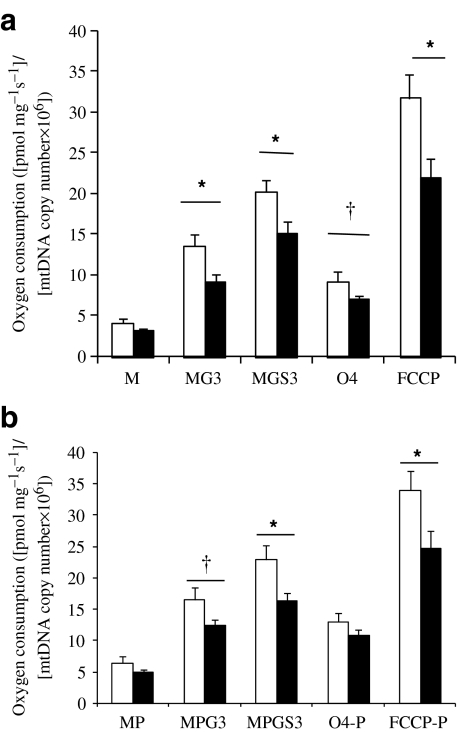
- Before training, diabetic patients had lower intrinsic mitochondrial function than controls: lower ADP-stimulated state 3 respiration on glutamate (MG3 17.2 ± 1.4 vs 22.5 ± 2.0 pmol mg−1 s−1, p < 0.05) and glutamate + succinate (MGS3 28.1 ± 2.0 vs 33.8 ± 2.0 pmol mg−1 s−1, p = 0.05), and lower FCCP-induced maximal respiration on glutamate + succinate (41.2 ± 2.8 vs 53.3 ± 3.1 pmol mg−1 s−1, p < 0.05) and with palmitoyl-carnitine (44.8 ± 3.1 vs 55.8 ± 3.1 pmol mg−1 s−1, p < 0.05); differences largely remained after normalisation to mtDNA copy number.
- Training increased mitochondrial content by about 30%: mtDNA copy number rose from 2.0 ± 0.14 × 10⁶ to 2.7 ± 0.14 × 10⁶ AU in diabetic patients and from 1.8 ± 0.12 × 10⁶ to 2.7 ± 0.13 × 10⁶ AU in controls (both p < 0.01).
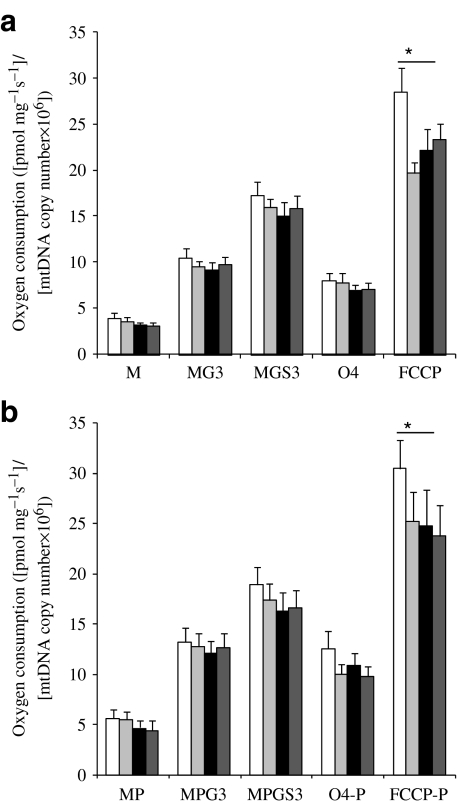
- Training increased state 3 respiration in both groups (diabetic patients: MG3 +34%, MGS3 +33%, p < 0.01; controls: MG3 +26%, p < 0.05, MGS3 +28%, p < 0.01), but FCCP-induced maximal respiration increased only in diabetic patients (e.g. +33% on glutamate + succinate and +27% with palmitoyl-carnitine, p < 0.05). After adjustment for mitochondrial density, state 3 and FCCP-induced maximal respiration were similar between groups after training.
- Insulin-stimulated glucose disposal (ΔRd) was lower in diabetic patients before training (8.1 ± 1.4 vs 16.0 ± 2.3 μmol kg−1 min−1, p < 0.01), increased in diabetic patients to 12.0 ± 1.9 μmol kg−1 min−1 (p < 0.05), showed a tendency to increase in controls (18.2 ± 2.5 μmol kg−1 min−1, p = 0.09), and remained lower in diabetic patients after training (p < 0.05). No correlations were found between ex vivo mitochondrial function and insulin-stimulated glucose disposal.
Methods
- Fifteen male type 2 diabetic patients and 14 male normoglycaemic control individuals, matched for age, BMI and maximal aerobic capacity, completed a 12-week supervised combined endurance and resistance exercise training programme. Diabetic patients had well-controlled type 2 diabetes (HbA1c 7.1 ± 0.2%) and were on metformin only or metformin plus sulfonylurea.
- Ex vivo mitochondrial function was measured by high-resolution respirometry in permeabilised vastus lateralis muscle fibres using multiple substrate combinations (glutamate, succinate, palmitoyl-carnitine, FCCP, oligomycin); mtDNA copy number was used as a marker of mitochondrial density. Insulin sensitivity was assessed with a 3 h hyperinsulinaemic–euglycaemic clamp combined with [6,6-²H₂]glucose infusion.
- Data are means ± SE; between-group differences were tested with independent Student’s t tests, and within-group training effects with repeated-measures ANOVA; significance was set at p < 0.05.
Limitations
- Stated: the study cannot determine whether the training-induced increase in mitochondrial content and oxidative function is responsible for improved insulin sensitivity; no correlation was found between changes in insulin sensitivity and mitochondrial function, suggesting they may be parallel rather than causally related.
- Stated: substrate competition may differ between the ex vivo condition, where substrates were provided in excess, and the in vivo situation; it could not be deduced whether CPT1 or other substrate transporters are altered by training. The exact meaning of the finding that controls did not enhance FCCP-driven maximal respiratory capacity after training cannot be deduced from this study.
- Evident from the text: the sample was small and included only men, limiting generalisability; one control individual was a non-responder for insulin sensitivity, and the figure legend reports 17 control individuals while the Methods report 14, indicating a possible inconsistency in reporting.
Model-written summary. Check it against the paper before relying on it.
Integrity signals
Registry
Cites
Statistics
Figures
Verification
Claims the paper makes
23 Own result · 6 Own interpretation · 4 Own method
A result the paper reports from its own data — it cites no other source for it, so there is none to check. The quote shows it is in the paper.
In the paper
“Diabetic patients increased their mitochondrial content to the same extent as control individuals and had similar intrinsic mitochondrial function, which occurred parallel with improved insulin sensitivity.”
- Also stated in: § Discussion · plain
“Importantly, type 2 diabetic patients had similar intrinsic mitochondrial function compared with control individuals, paralleled by an improvement, but not restoration, of insulin sensitivity.”
§ Exercise training increases mitochondrial content and ex vivo mitochondrial function similarly in patients with type 2 diabetes and in control individuals > Abstract > Conclusions/interpretation
plain- Asserted: passes — The authors put it forward as true.
- Checkable: passes — It can be checked against evidence.
- Load-bearing: passes — The paper’s conclusions depend on it.
- Based: passes — The paper gives a reason why it holds.
- Rests on an assumption: The final exercise bout at least 2 days before the clamp is sufficient to avoid acute exercise effects on mitochondrial function and insulin sensitivity.
- Also stated in: § Discussion · plain
A result the paper reports from its own data — it cites no other source for it, so there is none to check. The quote shows it is in the paper.
In the paper
“Mitochondrial density measured as mtDNA copy number was not different between diabetic patients and control individuals before training (2.0 ± 0.14 × 10⁶ vs 1.8 ± 0.12 × 10⁶ AU).”
§ Exercise training increases mitochondrial content and ex vivo mitochondrial function similarly in patients with type 2 diabetes and in control individuals > Results > Mitochondrial density
plain- Asserted: passes — The authors put it forward as true.
- Checkable: passes — It can be checked against evidence.
- Load-bearing: unclear — It is unclear whether the paper’s conclusions depend on it.
- Based: passes — The paper gives a reason why it holds.
A result the paper reports from its own data — it cites no other source for it, so there is none to check. The quote shows it is in the paper.
In the paper
“After training, mtDNA copy number was not significantly different between control individuals and diabetic patients.”
§ Exercise training increases mitochondrial content and ex vivo mitochondrial function similarly in patients with type 2 diabetes and in control individuals > Results > Mitochondrial density
plain- Asserted: passes — The authors put it forward as true.
- Checkable: passes — It can be checked against evidence.
- Load-bearing: passes — The paper’s conclusions depend on it.
- Based: passes — The paper gives a reason why it holds.
- Rests on an assumption: The final exercise bout at least 2 days before the clamp is sufficient to avoid acute exercise effects on mitochondrial function and insulin sensitivity.
A result the paper reports from its own data — it cites no other source for it, so there is none to check. The quote shows it is in the paper.
In the paper
“Also, state 4 respiration and maximal respiratory capacity (FCCP-driven state u) levels increased by 28% (p < 0.01) and 33% (p < 0.01), respectively.”
§ Exercise training increases mitochondrial content and ex vivo mitochondrial function similarly in patients with type 2 diabetes and in control individuals > Results > Ex vivo mitochondrial respirometry: effect of training
plaindirect- Asserted: passes — The authors put it forward as true.
- Checkable: passes — It can be checked against evidence.
- Load-bearing: unclear — It is unclear whether the paper’s conclusions depend on it.
- Based: passes — The paper gives a reason why it holds.
- Rests on an assumption: The final exercise bout at least 2 days before the clamp is sufficient to avoid acute exercise effects on mitochondrial function and insulin sensitivity.
A result the paper reports from its own data — it cites no other source for it, so there is none to check. The quote shows it is in the paper.
In the paper
“The insulin-stimulated change in R a (ΔR a) was significant lower in type 2 diabetic patients compared with control individuals (ΔR a 9.1 ± 1.3 vs 18.6 ± 2.8 μmol kg−1 min−1; p < 0.05).”
§ Exercise training increases mitochondrial content and ex vivo mitochondrial function similarly in patients with type 2 diabetes and in control individuals > Results > Insulin-mediated glucose disposal
plain- Asserted: passes — The authors put it forward as true.
- Checkable: passes — It can be checked against evidence.
- Load-bearing: unclear — It is unclear whether the paper’s conclusions depend on it.
- Based: passes — The paper gives a reason why it holds.
- Rests on an assumption: The 1-week discontinuation of glucose-lowering medication before testing is sufficient to eliminate medication effects on mitochondrial function and insulin sensitivity.
A result the paper reports from its own data — it cites no other source for it, so there is none to check. The quote shows it is in the paper.
In the paper
“Before and after training, no correlations were found between ex vivo mitochondrial function and insulin-stimulated glucose disposal. Also, when ex vivo mitochondrial function was normalised for mitochondrial content, no correlations with markers of insulin sensitivity were found.”
§ Exercise training increases mitochondrial content and ex vivo mitochondrial function similarly in patients with type 2 diabetes and in control individuals > Results > Ex vivo mitochondrial respirometry: effect of training
plain- Asserted: passes — The authors put it forward as true.
- Checkable: passes — It can be checked against evidence.
- Load-bearing: unclear — It is unclear whether the paper’s conclusions depend on it.
- Based: passes — The paper gives a reason why it holds.
- Rests on an assumption: The 1-week discontinuation of glucose-lowering medication before testing is sufficient to eliminate medication effects on mitochondrial function and insulin sensitivity.
- Rests on an assumption: The final exercise bout at least 2 days before the clamp is sufficient to avoid acute exercise effects on mitochondrial function and insulin sensitivity.
A result the paper reports from its own data — it cites no other source for it, so there is none to check. The quote shows it is in the paper.
In the paper
“After training, insulin-mediated glucose disposal in type 2 diabetic patients remained significantly lower compared with control individuals (p < 0.05).”
§ Exercise training increases mitochondrial content and ex vivo mitochondrial function similarly in patients with type 2 diabetes and in control individuals > Results > Insulin-mediated glucose disposal
plain- Asserted: passes — The authors put it forward as true.
- Checkable: passes — It can be checked against evidence.
- Load-bearing: unclear — It is unclear whether the paper’s conclusions depend on it.
- Based: passes — The paper gives a reason why it holds.
- Rests on an assumption: The 1-week discontinuation of glucose-lowering medication before testing is sufficient to eliminate medication effects on mitochondrial function and insulin sensitivity.
- Rests on an assumption: The final exercise bout at least 2 days before the clamp is sufficient to avoid acute exercise effects on mitochondrial function and insulin sensitivity.
A result the paper reports from its own data — it cites no other source for it, so there is none to check. The quote shows it is in the paper.
In the paper
“O4 respiration on MGS3 increased by 32% (p < 0.01) after training; however, FCCP-driven maximal respiratory capacity in the presence of glutamate and succinate was similar before and after training.”
§ Exercise training increases mitochondrial content and ex vivo mitochondrial function similarly in patients with type 2 diabetes and in control individuals > Results > Ex vivo mitochondrial respirometry: effect of training
plaindirect- Asserted: passes — The authors put it forward as true.
- Checkable: passes — It can be checked against evidence.
- Load-bearing: unclear — It is unclear whether the paper’s conclusions depend on it.
- Based: passes — The paper gives a reason why it holds.
- Rests on an assumption: The final exercise bout at least 2 days before the clamp is sufficient to avoid acute exercise effects on mitochondrial function and insulin sensitivity.
A result the paper reports from its own data — it cites no other source for it, so there is none to check. The quote shows it is in the paper.
In the paper
“When palmitoyl-carnitine was added as a substrate, state 3 respiration on a combination of palmitoyl-carnitine, glutamate and succinate (MPGS3) tended to be lower in diabetic patients compared with control individuals (31.2 ± 2.1 vs 39.1 ± 3.9 pmol mg−1 s−1; p = 0.08).”
§ Exercise training increases mitochondrial content and ex vivo mitochondrial function similarly in patients with type 2 diabetes and in control individuals > Results > Ex vivo mitochondrial respirometry before training
hedged- Asserted: passes — The authors put it forward as true.
- Checkable: passes — It can be checked against evidence.
- Load-bearing: unclear — It is unclear whether the paper’s conclusions depend on it.
- Based: passes — The paper gives a reason why it holds.
A result the paper reports from its own data — it cites no other source for it, so there is none to check. The quote shows it is in the paper.
In the paper
“Diabetic patients had intrinsically lower ADP-stimulated state 3 respiration and lower carbonyl cyanide 4-(trifluoro-methoxy)phenylhydrazone (FCCP)-induced maximal oxidative respiration, both on glutamate and on glutamate and succinate, and in the presence of palmitoyl-carnitine (p < 0.05).”
- Also stated in: § Ex vivo mitochondrial respirometry before training · plain
“Maximal respiratory capacity (FCCP-driven state u) in the presence of glutamate and succinate was significantly lower in diabetic patients compared with control individuals (41.2 ± 2.8 vs 53.3 ± 3.1 pmol mg−1 s−1; p < 0.05).”
- Also stated in: § Ex vivo mitochondrial respirometry before training · plain
“The maximal respiratory capacity (FCCP-driven state u) in the presence of palmitoyl-carnitine, glutamate and succinate was significantly lower in diabetic patients compared with control individuals (44.8 ± 3.1 vs 55.8 ± 3.1 pmol mg−1 s−1; p < 0.05).”
§ Exercise training increases mitochondrial content and ex vivo mitochondrial function similarly in patients with type 2 diabetes and in control individuals > Abstract > Results
plain- Asserted: passes — The authors put it forward as true.
- Checkable: passes — It can be checked against evidence.
- Load-bearing: passes — The paper’s conclusions depend on it.
- Based: passes — The paper gives a reason why it holds.
- Also stated in: § Ex vivo mitochondrial respirometry before training · plain
- It may state two separate claims as one. 9
- The quote only partly states this claim. 1
- Probably not a substantial claim. 2
A result the paper reports from its own data — it cites no other source for it, so there is none to check. The quote shows it is in the paper.
In the paper
“The ΔR a upon exercise training increased to 12.3 ± 1.5 (p < 0.05) in diabetic patients and to 21.2 ± 3.0 μmol kg−1 min−1 (p < 0.05) in control individuals, with ΔR a remaining significantly lower in diabetic patients compared with control individuals.”
§ Exercise training increases mitochondrial content and ex vivo mitochondrial function similarly in patients with type 2 diabetes and in control individuals > Results > Insulin-mediated glucose disposal
plaindirect- Asserted: passes — The authors put it forward as true.
- Checkable: passes — It can be checked against evidence.
- Load-bearing: unclear — It is unclear whether the paper’s conclusions depend on it.
- Based: passes — The paper gives a reason why it holds.
It may state two separate claims as one.
- Rests on an assumption: The 1-week discontinuation of glucose-lowering medication before testing is sufficient to eliminate medication effects on mitochondrial function and insulin sensitivity.
- Rests on an assumption: The final exercise bout at least 2 days before the clamp is sufficient to avoid acute exercise effects on mitochondrial function and insulin sensitivity.
A result the paper reports from its own data — it cites no other source for it, so there is none to check. The quote shows it is in the paper.
In the paper
“and increased significantly after exercise training in diabetic patients to 12.0 ± 1.9 μmol kg−1 min−1 (p < 0.05) with a tendency for increase in control individuals (ΔR d 18.2 ± 2.5 μmol kg−1 min−1; p = 0.09).”
§ Exercise training increases mitochondrial content and ex vivo mitochondrial function similarly in patients with type 2 diabetes and in control individuals > Results > Insulin-mediated glucose disposal
plaindirect- Asserted: passes — The authors put it forward as true.
- Checkable: passes — It can be checked against evidence.
- Load-bearing: unclear — It is unclear whether the paper’s conclusions depend on it.
- Based: passes — The paper gives a reason why it holds.
It may state two separate claims as one.
- Rests on an assumption: The 1-week discontinuation of glucose-lowering medication before testing is sufficient to eliminate medication effects on mitochondrial function and insulin sensitivity.
- Rests on an assumption: The final exercise bout at least 2 days before the clamp is sufficient to avoid acute exercise effects on mitochondrial function and insulin sensitivity.
A result the paper reports from its own data — it cites no other source for it, so there is none to check. The quote shows it is in the paper.
In the paper
“Diabetic patients had intrinsically lower ADP-stimulated state 3 respiration and lower carbonyl cyanide 4-(trifluoro-methoxy)phenylhydrazone (FCCP)-induced maximal oxidative respiration, both on glutamate and on glutamate and succinate, and in the presence of palmitoyl-carnitine (p < 0.05).”
- Also stated in: § Ex vivo mitochondrial respirometry before training · plain
“State 3 respiration on MG3 and on MGS3 was significantly lower in diabetic patients compared with control individuals (MG3: 17.2 ± 1.4 vs 22.5 ± 2.0 pmol mg−1 s−1, p < 0.05 and MGS3: 28.1 ± 2.0 vs 33.8 ± 2.0 pmol mg−1 s−1, p = 0.05).”
- Also stated in: § Discussion · plain
“In agreement with earlier results [5], we showed a ∼25% lower state 3 respiration and a ∼31% lower FCCP-induced maximal oxidative capacity in type 2 diabetic patients compared with control individuals, even when normalised to mitochondrial content.”
§ Exercise training increases mitochondrial content and ex vivo mitochondrial function similarly in patients with type 2 diabetes and in control individuals > Abstract > Results
plain- Asserted: passes — The authors put it forward as true.
- Checkable: passes — It can be checked against evidence.
- Load-bearing: passes — The paper’s conclusions depend on it.
- Based: passes — The paper gives a reason why it holds.
It may state two separate claims as one.
- Also stated in: § Ex vivo mitochondrial respirometry before training · plain
A result the paper reports from its own data — it cites no other source for it, so there is none to check. The quote shows it is in the paper.
In the paper
“Similarly, upon the addition of palmitoyl-carnitine, MPG3 increased upon exercise training by 38% (p < 0.01), MPGS3 by 34% (p < 0.01) and O4 upon MPGS3 increased by 17% (p < 0.05).”
§ Exercise training increases mitochondrial content and ex vivo mitochondrial function similarly in patients with type 2 diabetes and in control individuals > Results > Ex vivo mitochondrial respirometry: effect of training
plaindirect- Asserted: passes — The authors put it forward as true.
- Checkable: passes — It can be checked against evidence.
- Load-bearing: unclear — It is unclear whether the paper’s conclusions depend on it.
- Based: passes — The paper gives a reason why it holds.
It may state two separate claims as one.
- Rests on an assumption: The final exercise bout at least 2 days before the clamp is sufficient to avoid acute exercise effects on mitochondrial function and insulin sensitivity.
A result the paper reports from its own data — it cites no other source for it, so there is none to check. The quote shows it is in the paper.
In the paper
“The increase in mitochondrial respiration was accompanied by a 30% increase in mitochondrial content upon training (p < 0.01).”
- Also stated in: § Mitochondrial density · plain
“After training, mtDNA copy number increased significantly to 2.7 ± 0.14 × 10⁶ AU in diabetic patients (p < 0.01) and to 2.7 ± 0.13 × 10⁶ AU (p < 0.01) in control individuals.”
§ Exercise training increases mitochondrial content and ex vivo mitochondrial function similarly in patients with type 2 diabetes and in control individuals > Abstract > Results
plaindirect- Asserted: passes — The authors put it forward as true.
- Checkable: passes — It can be checked against evidence.
- Load-bearing: passes — The paper’s conclusions depend on it.
- Based: passes — The paper gives a reason why it holds.
The quote only partly states this claim.
- Rests on an assumption: The final exercise bout at least 2 days before the clamp is sufficient to avoid acute exercise effects on mitochondrial function and insulin sensitivity.
- Also stated in: § Mitochondrial density · plain
A result the paper reports from its own data — it cites no other source for it, so there is none to check. The quote shows it is in the paper.
In the paper
“After training, diabetic patients and control individuals showed increased state 3 respiration on the previously mentioned substrates (p < 0.05); however, an increase in FCCP-induced maximal oxidative respiration was observed only in diabetic patients (p < 0.05).”
- Also stated in: § Ex vivo mitochondrial respirometry: effect of training · plain
“Also, state 4 respiration and maximal respiratory capacity (FCCP-driven state u) levels increased by 28% (p < 0.01) and 33% (p < 0.01), respectively.”
- Also stated in: § Ex vivo mitochondrial respirometry: effect of training · plain
“O4 respiration on MGS3 increased by 32% (p < 0.01) after training; however, FCCP-driven maximal respiratory capacity in the presence of glutamate and succinate was similar before and after training.”
§ Exercise training increases mitochondrial content and ex vivo mitochondrial function similarly in patients with type 2 diabetes and in control individuals > Abstract > Results
plaindirect- Asserted: passes — The authors put it forward as true.
- Checkable: passes — It can be checked against evidence.
- Load-bearing: unclear — It is unclear whether the paper’s conclusions depend on it.
- Based: passes — The paper gives a reason why it holds.
It may state two separate claims as one.
- Rests on an assumption: The final exercise bout at least 2 days before the clamp is sufficient to avoid acute exercise effects on mitochondrial function and insulin sensitivity.
- Also stated in: § Ex vivo mitochondrial respirometry: effect of training · plain
A result the paper reports from its own data — it cites no other source for it, so there is none to check. The quote shows it is in the paper.
In the paper
“Improvements in mitochondrial respiration were paralleled by improvements in insulin-stimulated glucose disposal in diabetic patients, with a tendency for this in control individuals.”
- Also stated in: § Discussion · plain
“These improvements were paralleled by improved insulin-stimulated glucose disposal in type 2 diabetic patients and control individuals.”
§ Exercise training increases mitochondrial content and ex vivo mitochondrial function similarly in patients with type 2 diabetes and in control individuals > Abstract > Results
plaincorrelational- Asserted: passes — The authors put it forward as true.
- Checkable: passes — It can be checked against evidence.
- Load-bearing: passes — The paper’s conclusions depend on it.
- Based: passes — The paper gives a reason why it holds.
It may state two separate claims as one.
- Rests on an assumption: The 1-week discontinuation of glucose-lowering medication before testing is sufficient to eliminate medication effects on mitochondrial function and insulin sensitivity.
- Rests on an assumption: The final exercise bout at least 2 days before the clamp is sufficient to avoid acute exercise effects on mitochondrial function and insulin sensitivity.
- Also stated in: § Discussion · plain
What the paper did — it cites no source for this, so there is none to check. The quote shows it is in the paper.
In the paper
“All substrates were added in excess to ensure that respiratory measurements were not limited by substrate availability influencing oxygen flux.”
§ Exercise training increases mitochondrial content and ex vivo mitochondrial function similarly in patients with type 2 diabetes and in control individuals > Discussion
plain- Asserted: passes — The authors put it forward as true.
- Checkable: passes — It can be checked against evidence.
- Load-bearing: passes — The paper’s conclusions depend on it.
- Based: passes — The paper gives a reason why it holds.
Probably not a substantial claim.
A conclusion the paper draws from its own results — it cites no other source for it, so there is none to check. The quote shows it is in the paper.
In the paper
“However, when respiration values were normalised to mtDNA copy number, significant differences reported for all states before and after training in diabetic patients no longer persisted (Fig. 2a,b), illustrating that the major part of the improvement in mitochondrial function was because of an increase in mitochondrial content.”
§ Exercise training increases mitochondrial content and ex vivo mitochondrial function similarly in patients with type 2 diabetes and in control individuals > Results > Ex vivo mitochondrial respirometry: effect of training
boosteddirect- Asserted: passes — The authors put it forward as true.
- Checkable: passes — It can be checked against evidence.
- Load-bearing: passes — The paper’s conclusions depend on it.
- Based: passes — The paper gives a reason why it holds.
It may state two separate claims as one.
- Rests on an assumption: The final exercise bout at least 2 days before the clamp is sufficient to avoid acute exercise effects on mitochondrial function and insulin sensitivity.
A conclusion the paper draws from its own results — it cites no other source for it, so there is none to check. The quote shows it is in the paper.
In the paper
“Again, as in diabetic patients, the increase in mitochondrial respiration (with or without the addition of palmitoyl-carnitine) upon training was mainly accounted for by an increase in mitochondrial density, as no significant increase in intrinsic mitochondrial respiration was observed after adjustment for mtDNA copy number upon exercise training (Fig. 2a,b).”
§ Exercise training increases mitochondrial content and ex vivo mitochondrial function similarly in patients with type 2 diabetes and in control individuals > Results > Ex vivo mitochondrial respirometry: effect of training
plaindirect- Asserted: passes — The authors put it forward as true.
- Checkable: passes — It can be checked against evidence.
- Load-bearing: passes — The paper’s conclusions depend on it.
- Based: passes — The paper gives a reason why it holds.
It may state two separate claims as one.
- Rests on an assumption: The final exercise bout at least 2 days before the clamp is sufficient to avoid acute exercise effects on mitochondrial function and insulin sensitivity.
What the paper did — it cites no source for this, so there is none to check. The quote shows it is in the paper.
In the paper
“The final exercise bout of the training programme was performed at least 2 days before the clamp.”
§ Exercise training increases mitochondrial content and ex vivo mitochondrial function similarly in patients with type 2 diabetes and in control individuals > Methods > Hyperinsulinaemic–euglycaemic clamp
plain- Asserted: passes — The authors put it forward as true.
- Checkable: passes — It can be checked against evidence.
- Load-bearing: fails — The paper’s conclusions may not depend on it.
- Based: passes — The paper gives a reason why it holds.
Probably not a substantial claim. The paper’s conclusions may not depend on it.
A conclusion the paper draws from its own results — it cites no other source for it, so there is none to check. The quote shows it is in the paper.
In the paper
“Remarkably, in control individuals only, exercise training did not enhance FCCP-driven maximal respiratory capacity, as occurred in type 2 diabetic patients. As a result of the increase in mitochondrial content, FCCP-driven maximal respiratory capacity per mitochondrion was actually lower after training.”
§ Exercise training increases mitochondrial content and ex vivo mitochondrial function similarly in patients with type 2 diabetes and in control individuals > Discussion
plaindirect- Asserted: passes — The authors put it forward as true.
- Checkable: passes — It can be checked against evidence.
- Load-bearing: unclear — It is unclear whether the paper’s conclusions depend on it.
- Based: passes — The paper gives a reason why it holds.
It may state two separate claims as one.
- Rests on an assumption: The final exercise bout at least 2 days before the clamp is sufficient to avoid acute exercise effects on mitochondrial function and insulin sensitivity.
The paper relies on this without support.
The 1-week discontinuation of glucose-lowering medication before testing is sufficient to eliminate medication effects on mitochondrial function and insulin sensitivity.
“Glucose-lowering medication was continued throughout the study except for the week preceding the actual tests and sampling of the biopsy.”
“Diabetic patients discontinued their glucose-lowering medication 1 week prior to the clamp, but restarted the use of medication after the test days.”
The paper relies on this without support.
The final exercise bout at least 2 days before the clamp is sufficient to avoid acute exercise effects on mitochondrial function and insulin sensitivity.
“The final exercise bout of the training programme was performed at least 2 days before the clamp.”
Claims other papers make about this one
Each is checked against this paper’s own text: does it say what the citing paper says it does?
In the citing paper
“In humans, physical exercise increases total mitochondrial mass and uncoupling in skeletal muscular cells [192].”
From Mitochondrial Uncoupling: A Key Controller of Biological Processes in Physiology and Diseases (2019) · cites this paper as [192]
In the citing paper
“In patients with T2DM, walking and ergometer cycling exercise increased mitochondrial muscle respiration and mitochondrial content and density, as well as the activity of oxidative enzymes214,215.”
From Mitochondrial and metabolic dysfunction in ageing and age-related diseases (2022) · cites this paper as [215]
Self-check
Percentages, sums and reported differences re-computed from the paper’s own numbers.
Each contradiction between two passages listed here was confirmed by an independent check.
Rated minor: it would not touch a result — a value no result rests on, a p-value that stays on the same side of the significance level, or a conflict that is clerical, resolved elsewhere in the paper, or outside its own findings.
In the paper
§ Exercise training increases mitochondrial content and ex vivo mitochondrial function similarly in patients with type 2 diabetes and in control individuals > Methods
“In this study, 15 male type 2 diabetic patients and 14 normoglycaemic control individuals were included”
§ Exercise training increases mitochondrial content and ex vivo mitochondrial function similarly in patients with type 2 diabetes and in control individuals > Results > Ex vivo mitochondrial respirometry before training
“Figure: Fig. 1 Intrinsic mitochondrial respiration ([pmol mg−1 s−1]/[mtDNA copy number × 106]) in 17 control individuals (white bars) vs 15 diabetic patients (black bars) before training.”
Citations
Cites
Glucose clamp technique: a method for quantifying insulin secretion and resistance.
DeFronzo, R. A., Tobin, J. D., & Andres, R. (1979) · American Journal of Physiology-Endocrinology and Metabolism · doi:10.1152/ajpendo.1979.237.3.e214 · Cited by 7,425
Dysfunction of Mitochondria in Human Skeletal Muscle in Type 2 Diabetes
Kelley, D. E., He, J., Menshikova, E. V., & Ritov, V. B. (2002) · Diabetes · doi:10.2337/diabetes.51.10.2944 · Cited by 2,321
Impaired Mitochondrial Activity in the Insulin-Resistant Offspring of Patients with Type 2 Diabetes
Petersen, K. F., Dufour, S., Befroy, D., Garcia, R., & Shulman, G. I. (2004) · New England Journal of Medicine · doi:10.1056/nejmoa031314 · Cited by 2,193
Mitochondrial dysfunction and type 2 diabetes
Lowell, B. B., & Shulman, G. I. (2005) · Science · doi:10.1126/science.1104343 · Cited by 2,070
Diet, muscle glycogen and physical performance.
Bergström, J., Hermansen, L., Hultman, E., & Saltin, B. (1967) · Acta Physiologica Scandinavica · doi:10.1111/j.1748-1716.1967.tb03720.x · Cited by 1,740 · cited 1×
“lidocaine) according the technique of Bergstrom et al. [ 18 ].”
MethodMitochondrial respiration is decreased in skeletal muscle of patients with type 2 diabetes
Mogensen, M., Sahlin, K., Fernström, M., Glintborg, D., Vind, B. F., Beck-Nielsen, H., & Højlund, K. (2007) · Diabetes · doi:10.2337/db06-0981 · Cited by 573
Effective exercise modality to reduce insulin resistance in women with type 2 diabetes
Cuff, D. J., Meneilly, G. S., Martin, A., Ignaszewski, A., Tildesley, H. D., & Frohlich, J. J. (2003) · Diabetes Care · doi:10.2337/diacare.26.11.2977 · Cited by 545
Patients with type 2 diabetes have normal mitochondrial function in skeletal muscle
Boushel, R., Gnaiger, E., Schjerling, P., Skovbro, M., Kraunsøe, R., & Dela, F. (2007) · Diabetologia · doi:10.1007/s00125-007-0594-3 · Cited by 519
Veksler, V., Kuznetsov, A. V., Sharov, V. G., Kapelko, V. I., & Saks, V. A. (1987) · Biochimica et Biophysica Acta (BBA) - Bioenergetics · doi:10.1016/0005-2728(87)90174-5 · Cited by 371
Phielix, E., Schrauwen-Hinderling, V. B., Mensink, M., Lenaers, E., Meex, R., Hoeks, J., Kooi, M. E., Moonen-Kornips, E., Sels, J.-P., Hesselink, M. K. C., et al. (2008) · Diabetes · doi:10.2337/db08-0391 · Cited by 359
Self-citation
Cited by
Sorted by citations
Bhatti, J. S., Bhatti, G. K., & Reddy, P. H. (2017) · Biochimica et Biophysica Acta (BBA) - Molecular Basis of Disease · doi:10.1016/j.bbadis.2016.11.010 · Cited by 1,655
Type 2 diabetes and cardiovascular disease: Have all risk factors the same strength?
Timon, I. M. (2014) · World Journal of Diabetes · doi:10.4239/wjd.v5.i4.444 · Cited by 1,019
Mitochondrial and metabolic dysfunction in ageing and age-related diseases
Amorim, J. A., Coppotelli, G., Rolo, A. P., Palmeira, C. M., Ross, J. M., & Sinclair, D. A. (2022) · Nature Reviews Endocrinology · doi:10.1038/s41574-021-00626-7 · Cited by 990
KANALEY, J. A., COLBERG, S. R., CORCORAN, M. H., MALIN, S. K., RODRIGUEZ, N. R., CRESPO, C. J., KIRWAN, J. P., & ZIERATH, J. R. (2022) · Medicine & Science in Sports & Exercise · doi:10.1249/mss.0000000000002800 · Cited by 931
Update on the treatment of type 2 diabetes mellitus
Marín-Peñalver, J. J., Martín-Timón, I., Sevillano-Collantes, C., & Cañizo-Gómez, F. J. D. (2016) · World Journal of Diabetes · doi:10.4239/wjd.v7.i17.354 · Cited by 647
“…within a specific plan, provides in general terms multiple benefits: Increased insulin sensitivity in tissues, improvement of glycaemic control [44] , benefits in lipid profile and blood pressure, maintenance or weight loss, cardiovascular benefits, better quality of life, psychological…”
BackgroundThe role of mitochondria in insulin resistance and type 2 diabetes mellitus
Szendroedi, J., Phielix, E., & Roden, M. (2012) · Nature Reviews Endocrinology · doi:10.1038/nrendo.2011.138 · Cited by 600
“In vivo submaximal ADP-stimulated oxidative phosphorylation and mitochondrial content were restored to values seen in control individuals upon a 12-week exercise intervention in patients with T2DM”
BackgroundMitochondrial dysfunction and insulin resistance: an update
Montgomery, M. K., & Turner, N. A. (2014) · Endocrine Connections · doi:10.1530/ec-14-0092 · Cited by 549
Mitochondrial Uncoupling: A Key Controller of Biological Processes in Physiology and Diseases
Demine, S., Renard, P., & Arnould, T. (2019) · Cells · doi:10.3390/cells8080795 · Cited by 476
“In humans, physical exercise increases total mitochondrial mass and uncoupling in skeletal muscular cells [192].”
BackgroundPharmacological approaches to restore mitochondrial function
Andreux, P. A., Houtkooper, R. H., & Auwerx, J. (2013) · Nature Reviews Drug Discovery · doi:10.1038/nrd4023 · Cited by 383
A Prospective Study of Frailty in Nephrology-Referred Patients With CKD
Roshanravan, B., Khatri, M., Robinson‐Cohen, C., Levin, G. R., Patel, K. V., de Boer, I. H., Seliger, S. L., RUZINSKI, J. T., Himmelfarb, J., & Kestenbaum, B. R. (2012) · American Journal of Kidney Diseases · doi:10.1053/j.ajkd.2012.05.017 · Cited by 324
“Antidepressant 110 (33) 89 (31) 21 (45)”
Vanweert, F., Schrauwen, P., & Phielix, E. (2022) · Nutrition and Diabetes · doi:10.1038/s41387-022-00213-3 · Cited by 331
“Dysfunctional mitochondrial BCAA catabolism We as well as others have repeatedly reported that people with insulin resistance and patients with T2D feature low muscle mitochondrial oxidative capacity [13, 148, 149].”
BackgroundSelf-citationEnhanced Respiratory Chain Supercomplex Formation in Response to Exercise in Human Skeletal Muscle
Greggio, C., Jha, P., Kulkarni, S. S., Lagarrigue, S., Broskey, N. T., Boutant, M., Wang, X., Conde Alonso, S., Ofori, E., Auwerx, J., et al. (2017) · Cell Metabolism · doi:10.1016/j.cmet.2016.11.004 · Cited by 286
San-Millán, I., & Brooks, G. A. (2018) · Sports Medicine · doi:10.1007/s40279-017-0751-x · Cited by 264
A Novel MitoTimer Reporter Gene for Mitochondrial Content, Structure, Stress, and Damage in Vivo
Laker, R. C., Xu, P., Ryall, K. A., Sujkowski, A. L., Kenwood, B. M., Chain, K. H., Zhang, M., Royal, M. A., Hoehn, K. L., Driscoll, M., et al. (2014) · Journal of Biological Chemistry · doi:10.1074/jbc.m113.530527 · Cited by 267
Skeletal muscle mitochondria as a target to prevent or treat type 2 diabetes mellitus
Hesselink, M. K. C., Schrauwen-Hinderling, V., & Schrauwen, P. (2016) · Nature Reviews Endocrinology · doi:10.1038/nrendo.2016.104 · Cited by 242
Self-citationDemonstration of a day-night rhythm in human skeletal muscle oxidative capacity
van Moorsel, D., Hansen, J., Havekes, B., Scheer, F. A. J. L., Jörgensen, J. A., Hoeks, J., Schrauwen-Hinderling, V. B., Duez, H., Lefebvre, P., Schaper, N. C., et al. (2016) · Molecular Metabolism · doi:10.1016/j.molmet.2016.06.012 · Cited by 218
Self-citationRichards, J. C., Johnson, T. K., Kuzma, J. N., Lonac, M. C., Schweder, M. M., Voyles, W. F., & Bell, C. (2010) · The Journal of Physiology · doi:10.1113/jphysiol.2010.189886 · Cited by 187
“Journal compilation C© 2010 The Physiological Society training has been shown to induce similar mitochondrial adaptations in adults with type II diabetes compared with healthy controls (Phielix et al. 2010).”
BackgroundCoen, P. M., Menshikova, E. V., Distéfano, G., Zheng, D., Tanner, C. J., Standley, R. A., Helbling, N. L., Dubis, G. S., Ritov, V. B., Xie, H., et al. (2015) · Diabetes · doi:10.2337/db15-0809 · Cited by 190
“Although these effects have been previously reported for exercise (29,33), the present report is the first in obese patients following bariatric surgery.”
BackgroundPesta, D. H., Hoppel, F., Macek, C., Messner, H., Faulhaber, M., Kobel, C., Parson, W., Burtscher, M., Schocke, M. F. H., & Gnaiger, E. (2011) · American Journal of Physiology-Regulatory, Integrative and Comparative Physiology · doi:10.1152/ajpregu.00285.2011 · Cited by 181
“Aerobic exercise is known as an effective preventive measure to counteract these maladies (26, 36, 49).”
BackgroundInsulin Resistance and Mitochondrial Dysfunction
González-Franquesa, A., & Patti, M. (2017) · Advances in experimental medicine and biology · doi:10.1007/978-3-319-55330-6_25 · Cited by 160
Gaesser, G. A., Angadi, S. S., & Sawyer, B. J. (2011) · The Physician and Sportsmedicine · doi:10.3810/psm.2011.05.1898 · Cited by 148
Espino-González, E., Dalbram, E., Mounier, R., Gondin, J., Farup, J., Jessen, N., & Treebak, J. T. (2024) · Cell Metabolism · doi:10.1016/j.cmet.2024.02.014 · Cited by 141
Sparks, L. M., Johannsen, N. M., Church, T. S., Earnest, C. P., Moonen-Kornips, E., Moro, C., Hesselink, M. K. C., Smith, S. R., & Schrauwen, P. (2013) · The Journal of Clinical Endocrinology & Metabolism · doi:10.1210/jc.2012-3874 · Cited by 123
Self-citationHigh Oxidative Capacity Due to Chronic Exercise Training Attenuates Lipid-Induced Insulin Resistance
Phielix, E., Meex, R., Ouwens, D. M., Sparks, L., Hoeks, J., Schaart, G., Moonen-Kornips, E., Hesselink, M. K. C., & Schrauwen, P. (2012) · Diabetes · doi:10.2337/db11-1832 · Cited by 99
“increased mitochondrial mass rather than intrinsic mitochondrial function (32).”
BackgroundSelf-citationTargeting NAD+ in Metabolic Disease: New Insights Into an Old Molecule
Elhassan, Y., Philp, A., & Lavery, G. G. (2017) · Journal of the Endocrine Society · doi:10.1210/js.2017-00092 · Cited by 93
Muscle mitochondria and insulin resistance: a human perspective
Hoeks, J., & Schrauwen, P. (2012) · Trends in Endocrinology & Metabolism · doi:10.1016/j.tem.2012.05.007 · Cited by 94
Self-citationKarstoft, K., Winding, K. M., Knudsen, S. H., James, N. G., Scheel, M. M., Olesen, J., Holst, J. J., Pedersen, B. K., & Solomon, T. P. J. (2014) · Diabetologia · doi:10.1007/s00125-014-3334-5 · Cited by 91
“Mitochondrial content and function have been linked to insulin sensitivity, and changes in mitochondrial markers have been seen along with improvements in glycaemic control and insulin sensitivity [49, 50].”
BackgroundResistance to type 2 diabetes mellitus: a matter of hormesis?
Kolb, H., & Eizirik, D. L. (2011) · Nature Reviews Endocrinology · doi:10.1038/nrendo.2011.158 · Cited by 87
“The small exercise-induced improvement in insulin sensitivity observed in patients with T2DM is not sufficient to normalize insulin action in skeletal muscle cells”
BackgroundVanweert, F., Neinast, M. D., Erazo‐Tapia, E., van de Weijer, T., Hoeks, J., Schrauwen‐Hinderling, V. B., Blair, M. C., Bornstein, M. R., Hesselink, M. K. C., Schrauwen, P., et al. (2022) · Nature Communications · doi:10.1038/s41467-022-31249-9 · Cited by 90
Self-citationPardo, R., Enguix, N., Lasheras, J., Felíu, J. E., Kralli, A., & Villena, J. A. (2011) · PLoS ONE · doi:10.1371/journal.pone.0026989 · Cited by 86
“thiazolidinediones) that enhance oxidative metabolism are also effective in ameliorating whole body insulin sensitivity, an effect that has been associated with the capacity of such treatments to induce mitochondrial biogenesis [12,13,14,15].”
BackgroundToledo, F. G. S., & Goodpaster, B. H. (2013) · Molecular and Cellular Endocrinology · doi:10.1016/j.mce.2013.06.018 · Cited by 84
“Subjects with T2DM also display the greatest degrees of derangements in insulin sensitivity in SkM and the greatest IMCL lipid accumulation.”
BackgroundMethodInfluentialCole, C. L., Kleckner, I. R., Jatoi, A., Schwarz, E. M., & Dunne, R. F. (2018) · JCSM Clinical Reports · doi:10.17987/jcsm-cr.v3i2.65 · Cited by 84
“These improvements were observed in patients with diabetes mellitus [205, 206] and in elderly individuals [207].”
BackgroundHouzelle, A., Jörgensen, J. A., Schaart, G., Daemen, S., van Polanen, N., Fealy, C. E., Hesselink, M. K. C., Schrauwen, P., & Hoeks, J. (2021) · Diabetologia · doi:10.1007/s00125-020-05335-w · Cited by 83
Self-citationThomas, A. W., Davies, N. A., Moir, H. J., Watkeys, L. J., Ruffino, J. S., Isa, S., Butcher, L., Hughes, M. G., Morris, K., & Webb, R. (2011) · Journal of Applied Physiology · doi:10.1152/japplphysiol.00864.2011 · Cited by 81
“Therefore, if individuals with T2D were to respond in a manner similar to the participants in the present study, and T2D and non-T2D cohorts have been shown to respond to a similar extent to exercise (16, 43), it is possible that the exercise-associated effects seen here could help normalize PPAR signaling and, thus,…”
BackgroundResultFujimaki, S., & Kuwabara, T. (2017) · International Journal of Molecular Sciences · doi:10.3390/ijms18102147 · Cited by 77
“Other styles of exercise training, including strength and concurrent training, have been also reported to increase the mitochondrial content in skeletal muscle of patients with T2DM [161,162].”
BackgroundSavikj, M., Stocks, B., Sato, S., Caidahl, K., Krook, A., Deshmukh, A. S., Zierath, J. R., & Wallberg‐Henriksson, H. (2022) · Metabolism · doi:10.1016/j.metabol.2022.155268 · Cited by 77
Secondary muscle pathology and metabolic dysregulation in adults with cerebral palsy
Peterson, M. D., Gordon, P. M., Hurvitz, E. A., & Burant, C. (2012) · American Journal of Physiology-Endocrinology and Metabolism · doi:10.1152/ajpendo.00338.2012 · Cited by 74
Mitochondrial Plasticity in Obesity and Diabetes Mellitus
Jeleník, T., & Roden, M. (2012) · Antioxidants and Redox Signaling · doi:10.1089/ars.2012.4910 · Cited by 72
“However, studies successfully matching the groups for Vo2max revealed no difference in insulin sensitivity between young and elderly (14), supported by observation that insulin sensitivity as well as mitochondrial oxidative capacity improve after exercise in elderly insulin-resistant patients with T2DM and age-matched…”
BackgroundShaw, C. S., Shepherd, S. O., Wagenmakers, A. J. M., Hansen, D., Dendale, P., & van Loon, L. J. C. (2012) · American Journal of Physiology-Endocrinology and Metabolism · doi:10.1152/ajpendo.00272.2012 · Cited by 72
Salvadego, D., Domenis, R., Lazzer, S., Porcelli, S., Rittweger, J., Rizzo, G., Mavelli, I., Šimunič, B., Pišot, R., & Grassi, B. (2013) · Journal of Applied Physiology · doi:10.1152/japplphysiol.00883.2012 · Cited by 68
“In any case, the data obtained in the present study are similar to those obtained after substantially following the same protocol of the present study in the healthy control subjects of recent studies (9, 23, 30).”
ResultKenny, H. C., Rudwill, F., Breen, L., Salanova, M., Blottner, D., Heise, T., Heer, M., Blanc, S., & O’Gorman, D. J. (2017) · Diabetologia · doi:10.1007/s00125-017-4298-z · Cited by 64
Phielix, E., Jeleník, T., Nowotny, P., Szendroedi, J., & Roden, M. (2013) · Diabetologia · doi:10.1007/s00125-013-3127-2 · Cited by 66
“5 h, then permeabilised using saponin, and rinsed using respiration medium as described previously [2, 3, 21].”
BackgroundMethodSelf-citationVanweert, F., de Ligt, M., Hoeks, J., Hesselink, M. K. C., Schrauwen, P., & Phielix, E. (2020) · The Journal of Clinical Endocrinology & Metabolism · doi:10.1210/clinem/dgaa751 · Cited by 62
Self-citationBhatti, J. S., Kumar, S., Vijayan, M., Bhatti, G. K., & Reddy, P. H. (2017) · Progress in molecular biology and translational science · doi:10.1016/bs.pmbts.2016.12.012 · Cited by 61
Combatting type 2 diabetes by turning up the heat
Schrauwen, P., & Lichtenbelt, W. D. V. M. (2016) · Diabetologia · doi:10.1007/s00125-016-4068-3 · Cited by 63
“Indeed, we [68, 69] and others [70–73] have shown that in type 2 diabetes patients an exercise-induced improvement in insulin sensitivity is associated with an improvement in mitochondrial function.”
BackgroundSelf-citationAkhtar, S., & Siragy, H. M. (2019) · PLoS ONE · doi:10.1371/journal.pone.0225728 · Cited by 57
Insulin resistance and mitochondrial function in skeletal muscle
Dela, F., & Helge, J. W. (2012) · The International Journal of Biochemistry & Cell Biology · doi:10.1016/j.biocel.2012.09.019 · Cited by 57
“Next, in a study of 15 patients with type 2 diabetes and 14 controls subjects matched for age, BMI and VO2max internal incoherent data are reported (Phielix et al., 2010).”
BackgroundDam, A. D., Mitchell, A. S., & Quadrilatero, J. (2013) · Biochimica et Biophysica Acta (BBA) - Molecular Cell Research · doi:10.1016/j.bbamcr.2013.04.014 · Cited by 51
Lim, S. K., Choi, S. H., Koo, B. K., Kang, S. M., Yoon, J. W., Jang, H. C., Choi, S. M., Lee, M. G., Lee, W., Shin, H., et al. (2011) · The Journal of Clinical Endocrinology & Metabolism · doi:10.1210/jc.2011-1743 · Cited by 52
Impairment of Mitochondrial Respiration in Metabolic Diseases: An Overview
Avram, V. F., Merce, A. P., Hâncu, I. M., Bătrîn, A. D., Kennedy, G., Rosca, M. G., & Muntean, D. M. (2022) · International Journal of Molecular Sciences · doi:10.3390/ijms23168852 · Cited by 51
“These changes in mitochondrial respiration are similar to thosse reported in skeletal muscle [90,93,96].”
BackgroundResultAre Alterations in Skeletal Muscle Mitochondria a Cause or Consequence of Insulin Resistance?
Genders, A. J., Holloway, G. P., & Bishop, D. J. (2020) · International Journal of Molecular Sciences · doi:10.3390/ijms21186948 · Cited by 51
“Exercise interventions that increase mitochondrial respiratory function have also been shown to improve insulin resistance [8,9].”
BackgroundMethodInfluentialKruse, R., Pedersen, A. J. T., Kristensen, J. M., Petersson, S. J., Wojtaszewski, J. F. P., & Højlund, K. (2016) · Clinical Science · doi:10.1042/cs20160736 · Cited by 48
Mitochondrial Function and Insulin Resistance during Aging – A Mini-Review
Phielix, E., Szendroedi, J., & Roden, M. (2011) · Gerontology · doi:10.1159/000317691 · Cited by 47
Broskey, N. T., Daraspe, J., Humbel, B. M., & Amati, F. (2013) · Journal of Applied Physiology · doi:10.1152/japplphysiol.00063.2013 · Cited by 45
“This is particularly true in exercise science research (4, 21), obesity (2, 6, 22), and diabetes (11, 15, 18).”
BackgroundStephens, N. A., Brouwers, B., Eroshkin, A. M., Yi, F., Cornnell, H. H., Meyer, C., Goodpaster, B. H., Pratley, R. E., Smith, S. R., & Sparks, L. M. (2018) · Diabetes Care · doi:10.2337/dc18-0296 · Cited by 48
Petersen, M. H., de Almeida, M. E., Wentorf, E. K., Jensen, K., Ørtenblad, N., & Højlund, K. (2022) · Frontiers in Endocrinology · doi:10.3389/fendo.2022.1032235 · Cited by 49
“The adaptations underlying the beneficial metabolic effects of exercise training, also in obesity and type 2 diabetes, include increased mitochondrial content and function and increased abundance of proteins involved in insulin-signaling to glucose uptake and glucose storage [4, 12-16].”
BackgroundNutrients, Physical Activity, and Mitochondrial Dysfunction in the Setting of Metabolic Syndrome
Lemos, G., Torrinhas, R. S., & Waitzberg, D. L. (2023) · Nutrients · doi:10.3390/nu15051217 · Cited by 53
Differential Changes in Exercise Performance After Massive Weight Loss Induced by Bariatric Surgery
Wilms, B., Ernst, B., Thurnheer, M., Weisser, B., & Schultes, B. (2012) · Obesity Surgery · doi:10.1007/s11695-012-0795-9 · Cited by 48
“Exercise training has been demonstrated to enhance mitochondrial content in obese patients with [34] and without [35] diabetes, pointing to the dynamic nature of the muscle's mitochondrial capacity.”
BackgroundEffect of Aerobic Exercise-induced Weight Loss on the Components of Daily Energy Expenditure
Broskey, N. T., Martin, C. K., Burton, J. H., Church, T. S., Ravussin, É., & Redman, L. M. (2021) · Medicine & Science in Sports & Exercise · doi:10.1249/mss.0000000000002689 · Cited by 45
Bishop, D. J., Lee, M. J.-C., & Picard, M. A. (2024) · Annual Review of Physiology · doi:10.1146/annurev-physiol-022724-104836 · Cited by 46
Feng, Y., Nikolić, N., Bakke, S. S., Kase, E. T., Guderud, K., Hjelmesaeth, J. S., Aas, V., Rustan, A. C., & Thoresen, G. H. (2015) · American Journal of Physiology-Cell Physiology · doi:10.1152/ajpcell.00314.2014 · Cited by 45
“Although it has been shown that exercise improves both mitochondrial content and intrinsic mitochondrial function in obese and insulin-resistant subjects (43), it has also been reported that there were no changes in key regulators of mitochondrial biogenesis in skeletal muscles in diabetic men after in vivo exercise (…”
Four days of bed rest increases intrinsic mitochondrial respiratory capacity in young healthy males
Larsen, S., Lundby, A. M., Dandanell, S., Oberholzer, L., Keiser, S., Andersen, A. B., Haider, T., & Lundby, C. (2018) · Physiological Reports · doi:10.14814/phy2.13793 · Cited by 40
“In recent years, reduced skeletal muscle mitochondrial content and function (intrinsic mitochondrial respiratory capacity and reactive oxygen species production) has been proposed important in the development of T2D (Mogensen et al. 2007; Phielix et al. 2010) although this remains debated (Larsen et al. 2009, 2011; He…”
BackgroundRole of PGC-1α in the Mitochondrial NAD+ Pool in Metabolic Diseases
Koh, J., & Kim, J. (2021) · International Journal of Molecular Sciences · doi:10.3390/ijms22094558 · Cited by 39
Hao, J., Hao, C., Zhang, L., Liu, X., Zhou, X., Dun, Y., Li, H., Li, G., Zhao, X., An, Y., et al. (2015) · PLoS ONE · doi:10.1371/journal.pone.0131930 · Cited by 38
Eghbalzadeh, K., Brixius, K., Bloch, W., & Brinkmann, C. K. (2013) · Nitric Oxide · doi:10.1016/j.niox.2013.12.009 · Cited by 42
Effects and potential mechanisms of exercise and physical activity on eye health and ocular diseases
Zhang, Q., Jiang, Y., Deng, C., & Wang, J. (2024) · Frontiers in Medicine · doi:10.3389/fmed.2024.1353624 · Cited by 40
Kacerovsky-Bielesz, G., Kacerovsky, M., Chmelík, M., Farukuoye, M., Ling, C., Pokan, R., Tschan, H., Szendroedi, J., Schmid, A. I., Gruber, S., et al. (2011) · Diabetes Care · doi:10.2337/dc11-1426 · Cited by 37
“Furthermore, fATP measures demand-driven ATP synthesis at rest, not necessarily reflecting maximal mitochondrial capacity as assessed with postexercise phosphocreatine recovery (35).”
Backgroundde Goede, P., Wüst, R. C. I., Schomakers, B. V., Denis, S. W., Vaz, F. M., Pras‐Raves, M. L., van Weeghel, M., Yi, C., Kalsbeek, A., & Houtkooper, R. H. (2022) · The FASEB Journal · doi:10.1096/fj.202100707r · Cited by 36
Riera-Borrull, M., Rodríguez‐Gallego, E., Hernández‐Aguilera, A., Luciano‐Mateo, F., Ras, R., Cuyàs, E., Camps, J., Segura‐Carretero, A., Menéndez, J. A., Joven, J., et al. (2015) · Journal of the American Society for Mass Spectrometry · doi:10.1007/s13361-015-1262-3 · Cited by 35
Dahlmans, D., Houzelle, A., Jörgensen, J. A., Phielix, E., Lindeboom, L., Hesselink, M. K. C., Schrauwen, P., & Hoeks, J. (2017) · Frontiers in Physiology · doi:10.3389/fphys.2017.00711 · Cited by 36
“NCT00943059 (van de Weijer et al., 2014), NCT01298375 (Vosselman et al., 2015) and NTR2002 (Phielix et al., 2010, 2012)], and all participants gave their informed written consent in accordance with the Declaration of Helsinki.”
MethodResultInfluentialSelf-citationSparks, L. M., Gemmink, A., Phielix, E., Bosma, M., Schaart, G., Moonen-Kornips, E., Jörgensen, J. A., Nascimento, E. B. M., Hesselink, M. K. C., Schrauwen, P., et al. (2016) · Diabetologia · doi:10.1007/s00125-016-3885-8 · Cited by 34
Self-citationOnofre, T., Carlos, R., Oliver, N., Felismino, A., Fialho, D., Corte, R. C., da Silva, E. P., de Godoy, E. P., & Bruno, S. (2017) · Obesity Surgery · doi:10.1007/s11695-017-2584-y · Cited by 34
Kerr, M. J., Miller, J. J. J. J., Thapa, D., Stiewe, S., Timm, K. N., Aparicio, C. N. M., Scott, I., Tyler, D. J., & Heather, L. C. (2020) · JCI Insight · doi:10.1172/jci.insight.140326 · Cited by 35
Zamora, M., Pardo, R., & Villena, J. A. (2015) · Biochemical Pharmacology · doi:10.1016/j.bcp.2015.06.032 · Cited by 32
Diabetes and Stem Cell Function
Fujimaki, S., Wakabayashi, T., Takemasa, T., Asashima, M., & Kuwabara, T. (2015) · BioMed Research International · doi:10.1155/2015/592915 · Cited by 34
Hoffmann, C., Schneeweiß, P., Randrianarisoa, E., Schnauder, G., Kappler, L., Machann, J., Schick, F., Fritsche, A., Heni, M., Birkenfeld, A. L., et al. (2020) · The Journal of Clinical Endocrinology & Metabolism · doi:10.1210/clinem/dgaa571 · Cited by 31
Physical Fitness and Cardiovascular Risk Factors in Novel Diabetes Subgroups
Saatmann, N., Zaharia, O., Straßburger, K., Pesta, D. H., Burkart, V., Szendroedi, J., Gerdes, N., Kelm, M., & Roden, M. (2021) · The Journal of Clinical Endocrinology & Metabolism · doi:10.1210/clinem/dgab810 · Cited by 34
Exercise in the Management of Type 2 Diabetes Mellitus: What are the Benefits and how does it Work?
Duclos, M., Virally, M.-L., & Dejager, S. (2011) · The Physician and Sportsmedicine · doi:10.3810/psm.2011.05.1899 · Cited by 34
“Combined training increased mitochondrial content to the same extent in both patients with type 2 diabetes and control individuals, in parallel with improved insulin sensitivity.(34) In patients with type 2 diabetes, restoration of mitochondrial function is paralleled by improved insulinstimulated glucose disposal and…”
BackgroundDrug-induced mitochondrial toxicity: Risks of developing glucose handling impairments
Kuretu, A., Arineitwe, C., Mothibe, M. E., Ngubane, P. S., Khathi, A., & Sibiya, N. H. (2023) · Frontiers in Endocrinology · doi:10.3389/fendo.2023.1123928 · Cited by 30
“(92)found no correlation between insulin sensitivity and mitochondrial content.”
BackgroundHejazi, K., & Hackett, D. (2023) · Journal of Clinical Medicine · doi:10.3390/jcm12083011 · Cited by 29
“Over the past few years, NAFLD has attracted a lot of attention as a risk factor for the development of insulin resistance (IR) and type 2 diabetes mellitus (T2DM) [9,10].”
BackgroundInfluentialAl‐Rawaf, H. A., Gabr, S. A., Iqbal, A., & Alghadir, A. H. (2023) · Medicina · doi:10.3390/medicina59071320 · Cited by 34
Larsen, J. K., Kruse, R., Sahebekhtiari, N., Moreno‐Justicia, R., Jorba, G. G., Petersen, M. H., de Almeida, M. E., Ørtenblad, N., Deshmukh, A. S., & Højlund, K. (2023) · Science Advances · doi:10.1126/sciadv.adi7548 · Cited by 35
“In humans, this is accompanied by improved lipid droplet distribution and increased content of mitochondria and enzymes involved in insulin signaling to glucose transport and glycogen synthesis in skeletal muscle ( 3 , 7 – 10 ).”
Poljšak, B., Kovač, V., & Milisav, I. (2020) · Oxidative Medicine and Cellular Longevity · doi:10.1155/2020/8819627 · Cited by 33
“Both manipulations increase the NAMPT-mediated NAD generation, activate mechanistic pathways of AMPK, and enhance the SIRT1 activity and mitochondrial function [4, 114, 177, 178].”
BackgroundRemie, C. M. E., Janssens, G. E., Bilet, L., van Weeghel, M., Duvivier, B. M. F. M., de Wit‐Verheggen, V. H. W., Connell, N. J., Jörgensen, J. A., Schomakers, B. V., Schrauwen‐Hinderling, V. B., et al. (2021) · Diabetologia · doi:10.1007/s00125-021-05558-5 · Cited by 30
Self-citationDahlmans, D., Houzelle, A., Andreux, P. A., Jörgensen, J. A., Wang, X., Windt, L. J. D., Schrauwen, P., Auwerx, J. H., & Hoeks, J. (2017) · Molecular Metabolism · doi:10.1016/j.molmet.2017.08.007 · Cited by 29
“NCT00943059 [33], NTR2002 [34,35] and NCT01298375 [36]), and all participants gave their written informed consent prior to inclusion in the study.”
BackgroundSelf-citationHouzelle, A., Dahlmans, D., Nascimento, E. B. M., Schaart, G., Jörgensen, J. A., Moonen‐Kornips, E., Kersten, S., Wang, X., & Hoeks, J. (2020) · Journal of Cellular Physiology · doi:10.1002/jcp.29797 · Cited by 28
“To test whether these findings are relevant in human physiology, we then selected (from previous human clinical trials performed in our facilities [Phielix et al., 2010; Phielix et al., 2012; van de Weijer et al., 2015; Vosselman et al., 2015]) four subject groups known to be characterized by…”
MethodSelf-citationLactate Levels with Chronic Metformin Use: A Narrative Review
Huang, W., Castelino, R. L., & Peterson, G. M. (2017) · Clinical Drug Investigation · doi:10.1007/s40261-017-0564-6 · Cited by 27
de Queiroz, K. B., Sampaio, K. H., Rossoni, J. V., Leal, D. A., Pinto, A. B. G., Becker, L. K., Evangelista, E. A., & Guerra‐Sá, R. (2017) · PLoS ONE · doi:10.1371/journal.pone.0172103 · Cited by 26
Strijcker, D. D., Lapauw, B., Ouwens, D. M., de Velde, D. V., Hansen, D., Petrović, M., Cuvelier, C. A., Tonoli, C., & Calders, P. (2018) · Europe PMC (PubMed Central) · Cited by 28
Rehabilitation of Individuals With Diabetes Mellitus: Focus on Diabetic Myopathy
Dibai, D. B., Santos‐de‐Araújo, A. D., Dibai‐Filho, A. V., de Azevedo, L. F. S., Goulart, C. D. L., Luz, G. C. P., Burke, P. R., Garcia-Araújo, A. S., & Borghi‐Silva, A. (2022) · Frontiers in Endocrinology · doi:10.3389/fendo.2022.869921 · Cited by 28
Hyperlactatemia in type 2 diabetes: Can physical training help?
Brinkmann, C. K., & Brixius, K. (2015) · Journal of Diabetes and its Complications · doi:10.1016/j.jdiacomp.2015.05.018 · Cited by 28
Al-Jarrah, M. D., Erekat, N. S., & Alkhatib, A. J. (2014) · Neural Regeneration Research · doi:10.4103/1673-5374.130105 · Cited by 25
“…has been reported to promote mitochondrial biogenesis by increasing mitochondrial content, volume and number (Menshikova et al., 2006; Palmer, 2010; Phielix et al., 2010; Safdar et al., 2011) which could account for reduced reactive oxygen species and oxidative stress, and the consequent HSP90…”
BackgroundHarmsen, J., Kotte, M., Habets, I., Bosschee, F., Frenken, K. G., Jörgensen, J. A., de Kam, S. S., Moonen‐Kornips, E., Cissen, J., Doligkeit, D., et al. (2023) · The Journal of Physiology · doi:10.1113/jp285523 · Cited by 25
Self-citationMason, S. A., Baptista, R., Gatta, P. A. D., Yousif, A. M., Russell, A. P., & Wadley, G. D. (2014) · Free Radical Biology and Medicine · doi:10.1016/j.freeradbiomed.2014.09.013 · Cited by 24
Gavin, T. P., Ernst, J. M., Kwak, H., Caudill, S. E., Reed, M. A., Garner, R. T., Nie, Y., Weiss, J. A., Pories, W. J., Dar, M. S., et al. (2017) · The Journal of Clinical Endocrinology & Metabolism · doi:10.1210/jc.2017-01727 · Cited by 25
Tam, E., Bruseghini, P., Calabria, E., Sacco, L. D., Doria, C., Grassi, B., Pietrangelo, T., Pogliaghi, S., Reggiani, C., Salvadego, D., et al. (2015) · European Journal of Applied Physiology · doi:10.1007/s00421-015-3256-z · Cited by 23
Can resveratrol help to maintain metabolic health?
Schrauwen, P., & Timmers, S. (2014) · Proceedings of The Nutrition Society · doi:10.1017/s0029665113003856 · Cited by 25
“We showed that all aspects of mitochondrial function, including in vivo mitochondrial function using phosphocreatine recovery rate, intrinsic mitochondrial function using high-resolution respirometry, and mitochondrial content, increased after the 12 weeks training((24,25)), and restored T2DM patients towards control…”
Self-citationExercise attenuates the premature cardiovascular aging effects of type 2 diabetes mellitus
Huebschmann, A. G., Kohrt, W. M., & Regensteiner, J. G. (2011) · Vascular Medicine · doi:10.1177/1358863x11419996 · Cited by 22
Whytock, K. L., Pino, M. F., Sun, Y., Yu, G., de Carvalho, F. G., Yeo, R. X., Vega, R. B., Parmar, G., Divoux, A., Kapoor, N., et al. (2023) · American Journal of Physiology-Endocrinology and Metabolism · doi:10.1152/ajpendo.00143.2023 · Cited by 23
Poljšak, B., & Milisav, I. (2024) · International Journal of Molecular Sciences · doi:10.3390/ijms25126321 · Cited by 22
“Finkel and Holbrook (2000) [202] observed that the most effective approach to boost endogenous antioxidant levels can involve exposure to oxidative stress itself, based on the classical physiological concept of hormesis.”
Background
Metadata
- Authors
- Phielix, E., Meex, R., Moonen-Kornips, E., Hesselink, M. K. C., & Schrauwen, P.
- Affiliations
- Maastricht University Medical Centre (NL)
- Corresponding author
- Schrauwen, P.
- Venue
- Diabetologia
- Published
- 2010-04-27
- Volume
- 53
- Issue
- 8
- Pages
- 1714-1721
- ISSN
- 0012-186X (ISSN-L)
- 1432-0428
- PMC
- PMC2892060
- OpenAlex
- W1966012125
- Cited by
- 206
- References
- 22
- Citations by year
- 2026: 5 · 2025: 9 · 2024: 16 · 2023: 23 · 2022: 12 · 2021: 15 · 2020: 13 · 2019: 6 · 2018: 8 · 2017: 23 · 2016: 12 · 2015: 10 · 2014: 11 · 2013: 12 · 2012: 14
- FWCI
- 5.60
- Type
- journal article
- Language
- en
- Open access
- hybrid
- doi.org
- Licence
- cc-by-nc
- Locations
- Diabetologia (publishedVersion, cc-by-nc)
- PubMed Central (publishedVersion, cc-by-nc)
- PubMed (publishedVersion)
- Research Publications (Maastricht University) (publishedVersion, cc-by-nc)
- Research Publications (Maastricht University) (submittedVersion, other-oa)
- Funders
- Diabetes Fonds (2004.00.059)
- Topics
- Life Sciences › Biochemistry, Genetics and Molecular Biology › Molecular Biology › Mitochondrial Function and Pathology
- Health Sciences › Medicine › Physiology (medical) › Adipose Tissue and Metabolism
- Health Sciences › Medicine › Physiology (medical) › Cardiovascular and exercise physiology
- Keywords
- type 2 diabetes, exercise training, mitochondrial function, mitochondrial content, skeletal muscle, vastus lateralis, insulin-stimulated glucose disposal, insulin sensitivity, oxidative respiration, state 3 respiration, palmitoylcarnitine, mitochondrial density
- MeSH terms
- Analysis of Variance, Blood Glucose, Diabetes Mellitus, Type 2, Humans, Insulin, Insulin Resistance, Male, Middle Aged, Mitochondria, Oxygen Consumption, Glucose Clamp Technique, Exercise, Muscle, Skeletal
About these checks
Registry, retraction, Cites and statistics results are computed, not judged, with one exception: a printed reference that no index lists is read once by a model before it counts as a citation error. Claims are extracted by a model and kept only when their quote appears verbatim in the text; each cited source is then checked, with a model’s help, for whether it says what the claim relies on. Those verdicts can be wrong — read the claim’s quote and the cited source before relying on one.
A language model drew the claims from the paper on 2026-10-09, under version 3 of the claim definition (model deepseek-v4.1-flash, prompt extract-v3).
A second model labelled each claim on 2026-10-09 (model jev-1.13-20260917, definition revision gold-guideline-v0.2).
Statistics and arithmetic are recomputed, not judged.
Confidence bands are shown only for fields calibrated on our annotated test set. None is calibrated yet, so no band is shown.
What counts as a claim ›How we measure confidence ›How we check this ›
Are you an author, or do you see a problem with this page? Request a review
