

The DOI matches its Crossref record; 54 of the 55 references it cites were found in a registry or an index, and 1 are not checked yet.
Why Does Positive Mental Health Buffer Against Psychopathology? An Exploratory Study on Self-Compassion as a Resilience Mechanism and Adaptive Emotion Regulation Strategy
Open accessAbstract
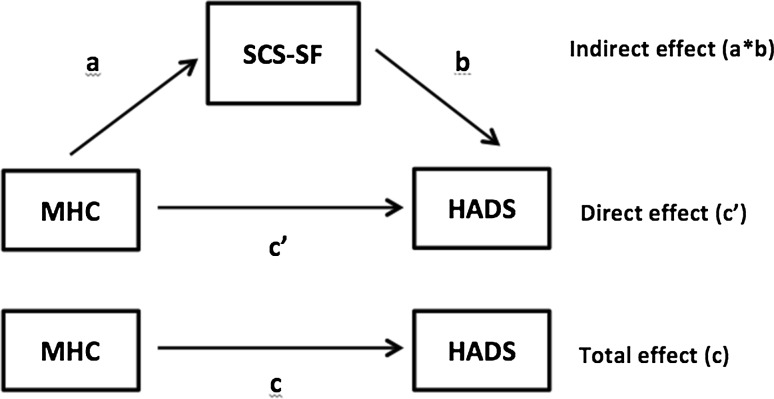
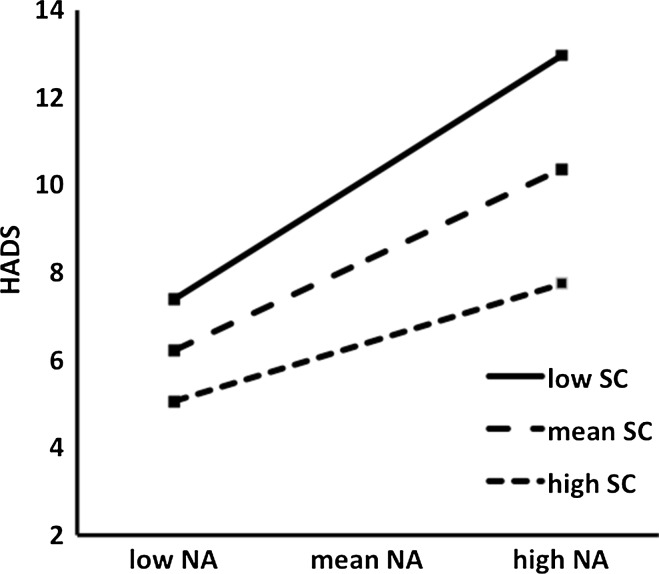
, as it continuously provides a friendly, accepting and situational context for negative experiences, functions as a resilience mechanism and adaptive emotion regulation strategy that protects against psychopathology for those with high levels of positive mental health. Participants from the general population (n = 349) provided measures at one time-point on positive mental health (MHC-SF), self-compassion (SCS-SF), psychopathology (HADS) and negative affect (mDES). Self-compassion significantly mediated the negative relationship between positive mental health and psychopathology. Furthermore, higher levels of self-compassion attenuated the relationship between state negative affect and psychopathology. Findings suggest that especially individuals with high levels of positive mental health possess self-compassion skills that promote resilience against psychopathology. These might function as an adaptive emotion regulation strategy and protect against the activation of schema related to psychopathology following state negative affective experiences. Enhancing self-compassion is a promising positive intervention for clinical practice. It will not only impact psychopathology through reducing factors like rumination and self-criticism, but also improve positive mental health by enhancing factors such as kindness and positive emotions. This may reduce the future risk of psychopathology.
Overview
The claims and statistics of this paper haven’t been checked yet.
Run the check — free, no account needed. It reads the open-access text and checks the sources it cites.
Integrity signals
Registry
Cites
Statistics
Figures
Verification
Claims the paper makes
The claims and statistics of this paper haven’t been checked yet.
Run the check — free, no account needed. It reads the open-access text and checks the sources it cites.
Claims other papers make about this one
Each is checked against this paper’s own text: does it say what the citing paper says it does?
The cited source says what the claim attributes to it.
In the citing paper
“Higher levels of self-compassion have consistently been shown to be associated with lower levels of psychopathology. 29-31”
From Academic stress, mindfulness-related skills and mental health in international university students. (2024) · cites this paper as [30]
The cited source says what the claim attributes to it.
In the citing paper
“Although the bivariate correlation between self-compassion and anxiety was significant, this relationship turned to non-significance after controlling for the other variables, in contrast to the findings of some other studies. 29-31”
From Academic stress, mindfulness-related skills and mental health in international university students. (2024) · cites this paper as [30]
Self-check
Percentages, sums and reported differences re-computed from the paper’s own numbers.
The self-check needs the paper’s full text.
Citations
Cites
Maximum Likelihood from Incomplete Data Via the EM Algorithm
Dempster, A. P., Laird, N. M., & Rubin, D. B. (1977) · Journal of the Royal Statistical Society Series B: Statistical Methodology · doi:10.1111/j.2517-6161.1977.tb01600.x · Cited by 50,444
The Hospital Anxiety and Depression Scale
Zigmond, A. S., & Snaith, R. P. (1983) · Acta Psychiatrica Scandinavica · doi:10.1111/j.1600-0447.1983.tb09716.x · Cited by 47,139
Preacher, K. J., & Hayes, A. F. (2008) · Behavior Research Methods · doi:10.3758/brm.40.3.879 · Cited by 34,117
SPSS and SAS procedures for estimating indirect effects in simple mediation models
Preacher, K. J., & Hayes, A. F. (2004) · Behavior Research Methods, Instruments, & Computers · doi:10.3758/bf03206553 · Cited by 17,383
Happiness is everything, or is it? Explorations on the meaning of psychological well-being.
Ryff, C. D. (1989) · Journal of Personality and Social Psychology · doi:10.1037/0022-3514.57.6.1069 · Cited by 14,847
Depression and quality of life in older persons: A review
Sivertsen, H., Bjørkløf, G. H., Engedal, K., Selbæk, G., & Helvik, A.-S. (2015) · Dementia and Geriatric Cognitive Disorders · doi:10.1159/000437299 · Cited by 14,152
Diener, E. (1984) · Social indicators research series · doi:10.1007/978-90-481-2350-6_2 · Cited by 12,609
Diener, E. (1984) · Psychological Bulletin · doi:10.1037/0033-2909.95.3.542 · Cited by 11,023
ФАКТОРЫ ПСИХОЛОГИЧЕСКОГО БЛАГОПОЛУЧИЯ ЛЮДЕЙ ПОЖИЛОГО ВОЗРАСТА
Р., Н. М., & Ю., Б. С. (2026) · CyberLeninK (CyberLeninka) · doi:10.60797/irj.2026.170.43 · Cited by 7,969
Introduction to mediation, moderation, and conditional process analysis :
Hayes, A. F., & names (2015) · Cited by 7,004
The Development and Validation of a Scale to Measure Self-Compassion
NEFF, K. D. (2003) · Self and Identity · doi:10.1080/15298860309027 · Cited by 6,436 · cited 3×
“The Self-Compassion Scale—Short Form (SCS-SF) is a 12-item self-report questionnaire to assess self-compassion (Neff 2003b; Raes et al. 2011).”
BackgroundMethodSelf-Compassion: An Alternative Conceptualization of a Healthy Attitude Toward Oneself
NEFF, K. (2003) · Self and Identity · doi:10.1080/15298860309032 · Cited by 5,440
The mental health continuum: from languishing to flourishing in life.
Keyes, C. L. M. (2002) · Journal of Health and Social Behavior · doi:10.2307/3090197 · Cited by 5,133 · cited 6×
“comprehensive and theoretically most well-founded measures of positive mental health defined as optimal emotional, psychological and social well-being (Keyes 2002; Lamers et al. 2011).”
BackgroundMethodInfluentialMental illness and/or mental health? Investigating axioms of the complete state model of health
Keyes, C. L. M. (2005) · Journal of Consulting and Clinical Psychology · doi:10.1037/0022-006x.73.3.539 · Cited by 3,357
Preacher, K. J., & Kelley, K. (2011) · Psychological Methods · doi:10.1037/a0022658 · Cited by 3,060
Construction and factorial validation of a short form of the Self-Compassion Scale
Raes, F., Pommier, E., Neff, K. D., & Van Gucht, D. (2011) · Clinical Psychology & Psychotherapy · doi:10.1002/cpp.702 · Cited by 2,997
Psychological Well-Being Revisited: Advances in the Science and Practice of Eudaimonia
Ryff, C. D. (2014) · Psychotherapy and Psychosomatics · doi:10.1159/000353263 · Cited by 2,976 · cited 2×
“levels and cardiovascular disease risk (Boehm and Kubzansky 2012; Lamers et al. 2012; Ryff 2013; Steptoe et al. 2009).”
BackgroundIzard, C. E. (1977) · doi:10.1007/978-1-4899-2209-0 · Cited by 2,825
A pilot study and randomized controlled trial of the mindful self-compassion program
Neff, K. D., & Germer, C. K. (2013) · Journal of Clinical Psychology · doi:10.1002/jclp.21923 · Cited by 2,253
Hedonia, eudaimonia, and well-being: an introduction
Deci, E. L., & Ryan, R. M. (2008) · Journal of Happiness Studies · doi:10.1007/s10902-006-9018-1 · Cited by 2,187
SPINHOVEN, P., ORMEL, J., SLOEKERS, P. P. A., KEMPEN, G. I. J. M., SPECKENS, A. E. M., & HEMERT, A. M. V. (1997) · Psychological Medicine · doi:10.1017/s0033291796004382 · Cited by 2,158
Exploring compassion: A meta-analysis of the association between self-compassion and psychopathology
MacBeth, A., & Gumley, A. (2012) · Clinical Psychology Review · doi:10.1016/j.cpr.2012.06.003 · Cited by 1,838 · cited 2×
“…revealed a negative relationship between self-compassion and psychopathology in the form of depression, anxiety and stress (Barnard and Curry 2011; MacBeth and Gumley 2012), and results of a much smaller range of existing studies that suggest that self-compassion is related to aspects of positive…”
BackgroundResultGilbert, P., & Procter, S. (2006) · Clinical Psychology & Psychotherapy · doi:10.1002/cpp.507 · Cited by 1,822 · cited 3×
“Several studies (e.g. Gilbert and Irons 2005; Gilbert and Procter 2006; Neff and Germer 2013) have indeed found effects of therapy and training focusing on self-compassion on psychopathology in clinical populations.”
BackgroundLeary, M. R., Tate, E. B., Adams, C. E., Batts Allen, A., & Hancock, J. (2007) · Journal of Personality and Social Psychology · doi:10.1037/0022-3514.92.5.887 · Cited by 1,728
Self-compassion and adaptive psychological functioning.
Neff, K. D., Kirkpatrick, K. L., & Rude, S. S. (2007) · Journal of Research in Personality · doi:10.1016/j.jrp.2006.03.004 · Cited by 1,627
Introducing compassion-focused therapy
Gilbert, P. (2009) · Advances in Psychiatric Treatment · doi:10.1192/apt.bp.107.005264 · Cited by 1,435
Evaluating the psychometric properties of the mental health continuum-short form (MHC-SF)
Lamers, S. M. A., Westerhof, G. J., Bohlmeijer, E. T., ten Klooster, P. M., & Keyes, C. L. M. (2011) · Journal of Clinical Psychology · doi:10.1002/jclp.20741 · Cited by 1,402
Self-citationMental Illness and Mental Health: The Two Continua Model Across the Lifespan
Westerhof, G. J., & Keyes, C. L. M. (2010) · Journal of Adult Development · doi:10.1007/s10804-009-9082-y · Cited by 1,345
Self‐Compassion Versus Global Self‐Esteem: Two Different Ways of Relating to Oneself
Neff, K. D., & Vonk, R. (2008) · Journal of Personality · doi:10.1111/j.1467-6494.2008.00537.x · Cited by 1,258
The Relationship Between Self‐Compassion and Well‐Being: A Meta‐Analysis
Zessin, U., Dickhäuser, O., & Garbade, S. (2015) · Applied Psychology: Health and Well-Being · doi:10.1111/aphw.12051 · Cited by 1,237
Neff, K. D., Rude, S. S., & Kirkpatrick, K. L. (2007) · Journal of Research in Personality · doi:10.1016/j.jrp.2006.08.002 · Cited by 1,224
(2005) · doi:10.4324/9780203003459 · Cited by 1,041
Loving-Kindness and Compassion Meditation: Potential for Psychological Interventions
Hofmann, S. G., Grossman, P., & Hinton, D. E. (2011) · Clinical Psychology Review · doi:10.1016/j.cpr.2011.07.003 · Cited by 960
Boehm, J. K., & Kubzansky, L. D. (2012) · Psychological Bulletin · doi:10.1037/a0027448 · Cited by 909
Schaefer, A., Nils, F., Sanchez, X., & Philippot, P. (2010) · Cognition & Emotion · doi:10.1080/02699930903274322 · Cited by 875
Self-Compassion: Conceptualizations, Correlates, & Interventions
Barnard, L. K., & Curry, J. F. (2011) · Review of General Psychology · doi:10.1037/a0025754 · Cited by 835
Change in Level of Positive Mental Health as a Predictor of Future Risk of Mental Illness
Keyes, C. L. M., Dhingra, S. S., & Simoes, E. J. (2010) · American Journal of Public Health · doi:10.2105/ajph.2010.192245 · Cited by 778
Self‐Compassion, Stress, and Coping
Allen, A. B., & Leary, M. R. (2010) · Social and Personality Psychology Compass · doi:10.1111/j.1751-9004.2009.00246.x · Cited by 757
Wood, A. M., & Joseph, S. (2010) · Journal of Affective Disorders · doi:10.1016/j.jad.2009.06.032 · Cited by 624
Huppert, F. A., & Whittington, J. E. (2003) · British Journal of Health Psychology · doi:10.1348/135910703762879246 · Cited by 536
Raes, F. (2010) · Personality and Individual Differences · doi:10.1016/j.paid.2010.01.023 · Cited by 535 · cited 1×
“…self-compassionate individuals seem to use less of maladaptive emotion regulation strategies related to depression and psychopathology such as experiential avoidance and escape of unwanted experiences, thought suppression, and rumination (Barnard and Curry 2011; Neff et al. 2007; Raes 2010).”
BackgroundPositive Affect and Psychobiological Processes Relevant to Health
Steptoe, A., Dockray, S., & Wardle, J. (2009) · Journal of Personality · doi:10.1111/j.1467-6494.2009.00599.x · Cited by 520
(2009) · Cited by 423
Focused therapies and compassionate mind training for shame and self-attacking
(2005) · Routledge eBooks · doi:10.4324/9780203003459-15 · Cited by 406
Self-compassion as an emotion regulation strategy in major depressive disorder
Diedrich, A., Grant, M., Hofmann, S. G., Hiller, W., & Berking, M. (2014) · Behaviour Research and Therapy · doi:10.1016/j.brat.2014.05.006 · Cited by 396
Lamers, S. M. A., Bolier, L., Westerhof, G. J., Smit, F., & Bohlmeijer, E. T. (2012) · Journal of Behavioral Medicine · doi:10.1007/s10865-011-9379-8 · Cited by 306 · cited 1×
“…Department of Psychology, Health and Technology, University of Twente, P.O. Box 217, 7500 AE Enschede, The Netherlands survival despite physical illness, and decreased cortisol levels and cardiovascular disease risk (Boehm and Kubzansky 2012; Lamers et al. 2012; Ryff 2013; Steptoe et al. 2009).”
BackgroundSelf-citationBraehler, C., Gumley, A., Harper, J., Wallace, S., Norrie, J., & Gilbert, P. (2013) · British Journal of Clinical Psychology · doi:10.1111/bjc.12009 · Cited by 294
Examining risk and resilience factors for depression: The role of self-criticism and self-compassion
Ehret, A. M., Joormann, J., & Berking, M. (2014) · Cognition & Emotion · doi:10.1080/02699931.2014.992394 · Cited by 245
Muris, P., Meesters, C. M. G., Pierik, A., & de Kock, B. (2015) · Journal of Child and Family Studies · doi:10.1007/s10826-015-0235-2 · Cited by 213
Lamers, S. M. A., Westerhof, G. J., Glas, C. A. W., & Bohlmeijer, E. T. (2015) · The Journal of Positive Psychology · doi:10.1080/17439760.2015.1015156 · Cited by 207
Self-citationFledderus, M., Bohlmeijer, E. T., Smit, F., & Westerhof, G. J. (2010) · American Journal of Public Health · doi:10.2105/ajph.2010.196196 · Cited by 197 · cited 1×
“For this reason, compassion focused interventions could be important as public mental health strategies (Fledderus et al. 2010).”
BackgroundSelf-citationWell-Being and the Risk of Depression under Stress
Grant, F., Guille, C., & Sen, S. (2013) · PLoS ONE · doi:10.1371/journal.pone.0067395 · Cited by 189 · cited 2×
“In addition, positive mental health longitudinally protects against psychopathology at later moments in time (Grant et al. 2013; Keyes et al. 2010; Lamers et al. 2015; Wood and Joseph 2010).”
BackgroundKelly, A. C., Zuroff, D. C., & Shapira, L. B. (2008) · Cognitive Therapy and Research · doi:10.1007/s10608-008-9202-1 · Cited by 183
Weich, S., Brugha, T., King, M., McManus, S., Bebbington, P., Jenkins, R., Cooper, C., McBride, O., & Stewart-Brown, S. (2011) · British Journal of Psychiatry · doi:10.1192/bjp.bp.111.091496 · Cited by 153
Penile Implants among Prisoners—A Cause for Concern?
Yap, L., Butler, T. G., Richters, J., Malacova, E., Wand, H. C., Smith, A. M. A., Grant, L., Richards, A., & Donovan, B. J. (2013) · PLoS ONE · doi:10.1371/journal.pone.0053065 · Cited by 34
Cited by
Sorted by citations
Wersebe, H., Lieb, R., Meyer, A. H., Hofer, P., & Gloster, A. T. (2018) · International Journal of Clinical and Health Psychology · doi:10.1016/j.ijchp.2017.09.002 · Cited by 250
Kraiss, J. T., ten Klooster, P. M., Moskowitz, J. T., & Bohlmeijer, E. T. (2020) · Comprehensive Psychiatry · doi:10.1016/j.comppsych.2020.152189 · Cited by 252
Self-citationHarrer, M., Adam, S. H., Fleischmann, R. J., Baumeister, H., Auerbach, R., Bruffaerts, R., Cuijpers, P., Kessler, R. C., Berking, M., Lehr, D., et al. (2018) · Journal of Medical Internet Research · doi:10.2196/jmir.9293 · Cited by 216
“Risk and Protective Factors Following measures for established risk and protective factors were assessed to investigate the intervention’s effect on individual resources and vulnerabilities related to the development and proliferation of mental illness: dysfunctional perfectionism [46] (Revised Almost Perfect Scale [4…”
BackgroundSelf-Compassion and Current Close Interpersonal Relationships: a Scoping Literature Review
Lathren, C. R., Rao, S. S., Park, J., & Bluth, K. (2021) · Mindfulness · doi:10.1007/s12671-020-01566-5 · Cited by 186
Franken, K., Lamers, S. M. A., ten Klooster, P. M., Bohlmeijer, E. T., & Westerhof, G. J. (2018) · Journal of Clinical Psychology · doi:10.1002/jclp.22659 · Cited by 152
Self-citation
Metadata
- Authors
- Trompetter, H. R., de Kleine, E., & Bohlmeijer, E. T.
- Affiliations
- University of Twente (NL)
- Corresponding author
- Trompetter, Hester R.
- Venue
- Cognitive Therapy and Research
- Published
- 2016-04-09
- Volume
- 41
- Issue
- 3
- Pages
- 459-468
- ISSN
- 0147-5916 (ISSN-L)
- 1573-2819
- PMC
- PMC5410199
- OpenAlex
- W2333155214
- Cited by
- 368
- References
- 54
- Citations by year
- 2026: 27 · 2025: 45 · 2024: 33 · 2023: 36 · 2022: 42 · 2021: 53 · 2020: 39 · 2019: 28 · 2018: 46 · 2017: 16 · 2016: 3
- FWCI
- 41.50
- Type
- journal article
- Language
- en
- Open access
- hybrid
- doi.org
- Locations
- Cognitive Therapy and Research (publishedVersion, cc-by)
- PubMed Central (publishedVersion, cc-by)
- Research portal (Tilburg University) (publishedVersion, other-oa)
- PubMed (publishedVersion)
- University of Twente Research Information (publishedVersion, other-oa)
- Data Archiving and Networked Services (DANS) (submittedVersion, other-oa)
- University of Twente Research Information (submittedVersion, other-oa)
- Topics
- Social Sciences › Psychology › Clinical Psychology › Mindfulness and Compassion Interventions
- Social Sciences › Psychology › Social Psychology › Psychological Well-being and Life Satisfaction
- Social Sciences › Psychology › Experimental and Cognitive Psychology › Anxiety, Depression, Psychometrics, Treatment, Cognitive Processes
- Keywords
- positive mental health, self-compassion, psychopathology, resilience, emotion regulation, negative affect, mediation, protective factors, self-criticism, rumination, kindness, positive emotions
About these checks
Registry, retraction, Cites and statistics results are computed, not judged, with one exception: a printed reference that no index lists is read once by a model before it counts as a citation error. Claims are extracted by a model and kept only when their quote appears verbatim in the text; each cited source is then checked, with a model’s help, for whether it says what the claim relies on. Those verdicts can be wrong — read the claim’s quote and the cited source before relying on one.
Statistics and arithmetic are recomputed, not judged.
Confidence bands are shown only for fields calibrated on our annotated test set. None is calibrated yet, so no band is shown.
What counts as a claim ›How we measure confidence ›How we check this ›
Are you an author, or do you see a problem with this page? Request a review
