

Food groups and risk of type 2 diabetes mellitus: a systematic review and meta-analysis of prospective studies.
Open accessThe DOI matches its Crossref record; 56 of the 56 references it cites were found in a registry or an index.
Abstract
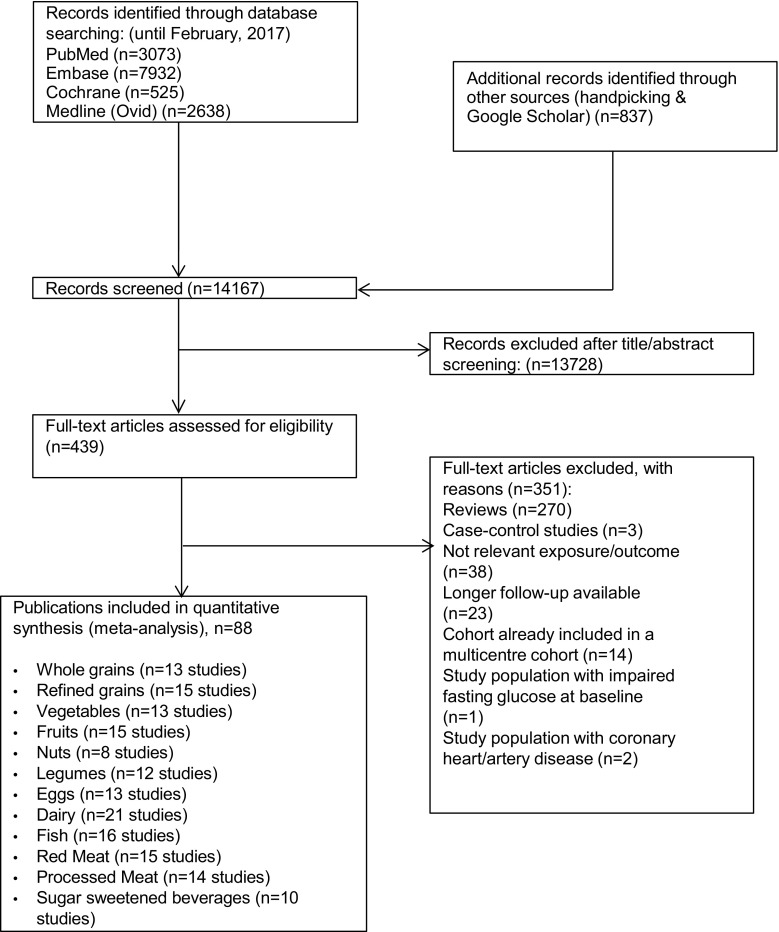
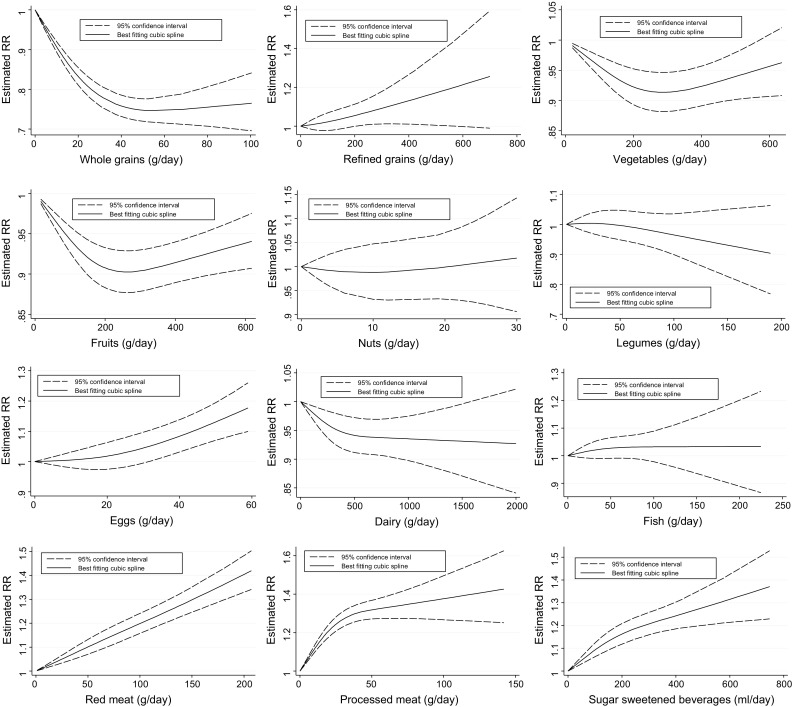
The aim of this systematic review and meta-analysis was to synthesize the knowledge about the relation between intake of 12 major food groups and risk of type 2 diabetes (T2D). We conducted a systematic search in PubMed, Embase, Medline (Ovid), Cochrane Central, and Google Scholar for prospective studies investigating the association between whole grains, refined grains, vegetables, fruits, nuts, legumes, eggs, dairy, fish, red meat, processed meat, and sugar-sweetened beverages (SSB) on risk of T2D. Summary relative risks were estimated using a random effects model by contrasting categories, and for linear and non-linear dose-response relationships. Six out of the 12 food-groups showed a significant relation with risk of T2D, three of them a decrease of risk with increasing consumption (whole grains, fruits, and dairy), and three an increase of risk with increasing consumption (red meat, processed meat, and SSB) in the linear dose-response meta-analysis. There was evidence of a non-linear relationship between fruits, vegetables, processed meat, whole grains, and SSB and T2D risk. Optimal consumption of risk-decreasing foods resulted in a 42% reduction, and consumption of risk-increasing foods was associated with a threefold T2D risk, compared to non-consumption. The meta-evidence was graded "low" for legumes and nuts; "moderate" for refined grains, vegetables, fruit, eggs, dairy, and fish; and "high" for processed meat, red meat, whole grains, and SSB. Among the investigated food groups, selecting specific optimal intakes can lead to a considerable change in risk of T2D.
Overview
The claims and statistics of this paper haven’t been checked yet.
Free: it reads the open-access text and checks the first 5 claims that cite a source we can check. Create a free account to check every claim.
Integrity signals
Registry
Cites
Statistics
Figures
Verification
Claims the paper makes
The claims and statistics of this paper haven’t been checked yet.
Free: it reads the open-access text and checks the first 5 claims that cite a source we can check. Create a free account to check every claim.
Claims other papers make about this one
Each is checked against this paper’s own text: does it say what the citing paper says it does?
In the citing paper
“Many food groups, mostly ultraprocessed (eg, processed meat, and sugary sweetened beverages) are recognized T2D risk factors.3”
From Ultraprocessed Food Consumption and Risk of Type 2 Diabetes Among Participants of the NutriNet-Santé Prospective Cohort (2020) · cites this paper as [3]
In the citing paper
“Of note, energy balance and overweight are both associated with T2D risk.3”
From Ultraprocessed Food Consumption and Risk of Type 2 Diabetes Among Participants of the NutriNet-Santé Prospective Cohort (2020) · cites this paper as [3]
Self-check
Percentages, sums and reported differences re-computed from the paper’s own numbers.
The self-check needs the paper’s full text.
Citations
Cites
1 retracted
RETRACTED: Primary Prevention of Cardiovascular Disease with a Mediterranean Diet
Estruch, R., Ros, E., Salas-Salvadó, J., Covas, M.-I., Corella, D., Arós, F., Gómez-Gracia, E., Ruiz-Gutiérrez, V., Fiol, M., Lapetra, J., et al. (2013) · New England Journal of Medicine · doi:10.1056/nejmoa1200303 · Cited by 4,257
RetractedBias in meta-analysis detected by a simple, graphical test
Egger, M., Smith, G. D., Schneider, M., & Minder, C. (1997) · BMJ · doi:10.1136/bmj.315.7109.629 · Cited by 56,722 · cited 1×
“Potential small-study effects, such as publication bias, were explored using Eggeŕs test and funnel plots [20] when at least 10 studies were available, as recommended by the Cochrane Handbook [21].”
MethodMeta-analysis in clinical trials
DerSimonian, R., & Laird, N. (1986) · Controlled Clinical Trials · doi:10.1016/0197-2456(86)90046-2 · Cited by 39,552 · cited 2×
“To evaluate the weighting of each study, the standard error for the logarithm RR/HR of each study was calculated and regarded as the estimated variance of the logarithm HR/RR, using an inverse variance method [15].”
MethodQuantifying heterogeneity in a meta‐analysis
Higgins, J. P. T., & Thompson, S. G. (2002) · Statistics in Medicine · doi:10.1002/sim.1186 · Cited by 36,763
Dermyshi, E., Wang, Y., Yan, C., Hong, W., Qiu, G., Gong, X., & Zhang, T. (2017) · Neonatology · doi:10.1159/000454668 · Cited by 24,451
Meta-analysis of Observational Studies in Epidemiology<SUBTITLE>A Proposal for Reporting</SUBTITLE>
Stroup, D. F. (2000) · JAMA · doi:10.1001/jama.283.15.2008 · Cited by 20,623
Stang, A. (2010) · European Journal of Epidemiology · doi:10.1007/s10654-010-9491-z · Cited by 17,396 · cited 2×
“However, Stang [14] commented that the Newcastle–Ottawa Scale includes quality items that are not valid (e.g., the ‘‘representativeness of the exposed cohort’’ item), and concluded that this score appeared to be unacceptable for the quality ranking of 364 L. Schwingshackl et al. case–control and cohort studies in meta…”
BackgroundInternational Diabetes Federation 2017
Carracher, A. M., Marathe, P. H., & Close, K. L. (2018) · Journal of Diabetes · doi:10.1111/1753-0407.12644 · Cited by 13,418
Tuomilehto, J., Lindström, J., Eriksson, J. G., Valle, T. T., Hämäläinen, H., Ilanne-Parikka, P., Keinänen-Kiukaanniemi, S., Laakso, M., Louheranta, A., Rastas, M., et al. (2001) · New England Journal of Medicine · doi:10.1056/nejm200105033441801 · Cited by 10,873
Cochrane Handbook for Systematic Reviews of Interventions Version 5.0.1. The Cochrane Collaboration
Higgins, J. P. T., Green, S. R., & Higgins, J. P. T. (2008) · Cited by 7,226
Cited by
Items 401–500 of 866
Liu, Z., Lu, J., Zhang, D., Niu, L., & Shi, B. (2021) · Therapeutic Advances in Endocrinology and Metabolism · doi:10.1177/20420188211059884 · Cited by 11
Omura, Y., Murakami, K., Matoba, K., Nishimura, R., & Sasaki, S. (2021) · Nutrition Metabolism and Cardiovascular Diseases · doi:10.1016/j.numecd.2021.11.006 · Cited by 12
Kaiser, A., Schaefer, S. M., Behrendt, I., Eichner, G., & Faßhauer, M. (2022) · British Journal Of Nutrition · doi:10.1017/s0007114522003233 · Cited by 11
“style risk factors (physical activity and/or smoking status); (3)”
Yu, H., Zhang, J., Xie, J., Li, X., Wang, Y., Yang, Y., Zhou, F., Liu, M., Zhang, Z., Shan, Z., et al. (2023) · China CDC Weekly · doi:10.46234/ccdcw2023.190 · Cited by 11
Dietary Patterns and the Risk of Prediabetes in Taiwan: A Cross-Sectional Study
Hou, Y., Feng, H.-C., Tzeng, I., Kuo, C., Cheng, C., Wu, J. H., & Yang, S. (2020) · Nutrients · doi:10.3390/nu12113322 · Cited by 11
Zhu, Q., Dai, Y., Zhang, J., Xie, W., Zuo, H., Zhang, J., & Zhou, Y. (2021) · British Journal Of Nutrition · doi:10.1017/s0007114521000258 · Cited by 13
“A positive correlation between red meat and type 2 diabetes has been reported by previous studies (35) .”
Gorini, F., & Tonacci, A. (2025) · Nutrients · doi:10.3390/nu17142350 · Cited by 12
“More recently, a number of systematic reviews and meta-analyses have assessed the relationship between food and dietary factors and the onset of T2D [93].”
de la Riera, M. D. C. A., Ortolá, R., Kales, S. N., García‐Esquinas, E., Rodríguez‐Artalejo, F., & Sotos‐Prieto, M. (2025) · Cardiovascular Diabetology · doi:10.1186/s12933-025-02909-z · Cited by 11
“Additionally, the PHDI emphasizes high-fiber plant foods such as whole grains and vegetables, which have been shown to improve glycemic control and insulin sensitivity [39].”
Defagó, M. D., Elorriaga, N., Eynard, A. R., Poggio, R., Gutiérrez, L., Irazola, V. E., & Rubinstein, A. (2019) · Nutrition · doi:10.1016/j.nut.2019.06.002 · Cited by 11
Corte, K. W. D., Jalo, E., Kaartinen, N. E., Simpson, L., Taylor, M. A., Muirhead, R., Raben, A., Macdonald, I. A., Fogelholm, M., & Brand-Miller, J. C. (2023) · Nutrients · doi:10.3390/nu15092083 · Cited by 10
Zapata, M. E., Arrieta, E. M., Beltramo, B., & Rovirosa, A. (2023) · Nutrition Bulletin · doi:10.1111/nbu.12624 · Cited by 13
Hong, T., Sun, F., Wang, Q., Chen, X., & Han, K. (2023) · Diabetes Obesity and Metabolism · doi:10.1111/dom.15290 · Cited by 10
“The combined relative risk of a high intake of such beverages is 1.31, 30 which significantly increases the risk of DM.”
BackgroundInfluentialZhang, G.-L., Kang, J., Jing, S., Chen, Y.-H., Deng, T.-R., Xu, H.-Q., Wu, H.-D., & Xu, F. (2023) · Journal of Nutritional Science · doi:10.1017/jns.2023.104 · Cited by 9
Olsson, K., González-Padilla, E., Janzi, S., Stubbendorff, A., Borné, Y., Ramne, S., Ericson, U., & Sonestedt, E. (2023) · Nutrition Journal · doi:10.1186/s12937-023-00906-0 · Cited by 11
“Intake of red meat and processed meat has been associated with an increased risk of type 2 diabetes, while coffee intake has been associated with a reduced risk [2, 33].”
BackgroundInfluentialWang, M., Lan, T., Williams, A. M., Ehrhardt, M. J., Lanctot, J. Q., Jiang, S., Krull, K. R., Armstrong, G. T., Hudson, M. M., Colditz, G. A., et al. (2024) · Journal of Clinical Oncology · doi:10.1200/jco.23.01260 · Cited by 10
Dairy consumption and risk of prediabetes and type 2 diabetes in the Fenland study
Slurink, I. A. L., Kupper, N. H. M., Smeets, T., & Soedamah‐Muthu, S. S. (2024) · Clinical Nutrition · doi:10.1016/j.clnu.2024.09.026 · Cited by 10
Mohammadi, T., Irandoost, P., Roshanravan, N., Khamechi, S. P., Milajerdi, A., Larijani, B. A., Ayati, M. H., & Namazi, N. (2020) · Complementary Therapies in Medicine · doi:10.1016/j.ctim.2020.102445 · Cited by 11
Consumo de legumbres y su relación con enfermedades crónicas no transmisibles
Wyss, L. G., & Durán‐Agüero, S. (2020) · Revista chilena de nutrición · doi:10.4067/s0717-75182020000500865 · Cited by 22
Li, M., Lin, Q., Shi, J., Xi, Y., Xiang, C., Yong, C., & Guo, J. (2021) · Nutrients · doi:10.3390/nu13082642 · Cited by 11
“A daily intake of 400 to 600 g dairy would decrease the risk of T2DM progression by 6% [8].”
BackgroundLa qualité des aliments d’origine animale : enseignements d’une expertise scientifique collective
Prache, S., Adamiec, C., Astruc, T., Baéza, É., Bouillot, P.-É., Clinquart, A., Feidt, C., Fourat, E., Gautron, J., Girard, A., et al. (2023) · INRAE Productions Animales · doi:10.20870/productions-animales.2023.36.1.7480 · Cited by 10
Empfehlungen zur Ernährung von Personen mit Typ-2-Diabetes mellitus
Skurk, T., Bosy‐Westphal, A., Grünerbel, A., Kabisch, S., Keuthage, W., Kronsbein, P., Müssig, K., Pfeiffer, A. F. H., Simon, M., Tombek, A., et al. (2021) · Diabetologie und Stoffwechsel · doi:10.1055/a-1543-1293 · Cited by 11
Zhang, W., Zhu, X., Que, X., & Zhang, X. (2024) · Digital Health · doi:10.1177/20552076241272514 · Cited by 11
“6 Recently, the American Diabetes Association (ADA) has realized that the current management strategy has been unable to achieve the personalized management goals of patients with T2DM, especially older adults.”
BackgroundMcManus, L., Veras, K. M. D. A., Faria, V. S., Manninen, M., & Egan, B. (2025) · Nutrition Reviews · doi:10.1093/nutrit/nuaf016 · Cited by 11
“19,32 Thus, our purpose for conducting this systematic literature review is to identify, critically appraise, and meta-analyze data from intervention studies that investigated the effects of a period of increased red meat intake on iron status in adults with normal and suboptimal iron status.”
Zhou, P., Li, T., Zhao, J., Wang, Y., Fan, M., Qian, H., Li, Y., & Wang, L. (2025) · Food Research International · doi:10.1016/j.foodres.2025.116837 · Cited by 9
Liu, B., Wang, Y., Hu, Y., Wan, Y., Zhang, C., Rimm, E. B., Hu, F. B., & Sun, Q. (2025) · Diabetes Care · doi:10.2337/dc25-1401 · Cited by 10
Okada, E., Okada, C., Matsumoto, M., Fujiwara, A., & Takimoto, H. (2020) · British Journal Of Nutrition · doi:10.1017/s000711452000269x · Cited by 11
“In a previous meta-analysis, higher intake of vegetables, fruits and dairy was associated with reduced risk for diabetes(42).”
Shams‐White, M., Tjaden, A. H., Edelstein, S. L., Bassiouni, S. S., Kahle, L., Kim, C., Pi-Sunyer, X., Temple, K. A., Venditti, E. M., Reedy, J., et al. (2022) · BMC Nutrition · doi:10.1186/s40795-022-00596-7 · Cited by 9
“Conversely, processed foods have fewer phytochemicals, vitamins, and minerals, which may reduce insulin sensitivity and increase systemic inflammatory markers; processed meats contain higher levels of nitrates, pro-oxidative agents like iron, and advanced glycation end-products, all of which may increase diabetes risk…”
BackgroundChemotherapy-Induced Peripheral Neuropathy
Chen, C.-S., & Hertz, D. L. (2022) · Handbook of experimental pharmacology · doi:10.1007/164_2022_609 · Cited by 11
Mulkerrins, I., Medin, A. C., Groufh-Jacobsen, S., Margerison, C., & Larsson, C. L. (2025) · Frontiers in Nutrition · doi:10.3389/fnut.2025.1528252 · Cited by 10
Ye, Y., Zhuo, S., Lü, W., He, K., Sui, Y., Li, Y., Chen, Y., Wu, S., Chen, P., & Fang, S. (2020) · Public Health Nutrition · doi:10.1017/s1368980020004930 · Cited by 10
“Red meat and processed meat have been reported to have a positive correlation with T2DM in a number of studies, and processed meats are also known to be unhealthy (21,34,35,52) .”
Wu, Y. Y., Thompson, M. D., Youkhana, F., & Pirkle, C. M. (2021) · The Journals of Gerontology Series A · doi:10.1093/gerona/glab025 · Cited by 10
“While a large proportion of existing epidemiologic literature centers around identifying modifiable risk factors, such as unhealthy diet (5), physical inactivity (6), and elevated alcohol consumption (7), heritability studies point to a strong underlying genetic contribution.”
BackgroundShams‐White, M., O’Connor, L. E., O’Connor, S. G., & Herrick, K. (2022) · Journal of the Academy of Nutrition and Dietetics · doi:10.1016/j.jand.2022.06.019 · Cited by 9
Nucci, L. B., Rinaldi, A. E. M., Ramos, A. F. P. L., Itria, A., & Enes, C. C. (2022) · Diabetes Research and Clinical Practice · doi:10.1016/j.diabres.2022.110087 · Cited by 10
Geidl, B., Hochuli, M., Spinas, G. A., & Gerber, P. A. (2022) · Nutrients · doi:10.3390/nu14194169 · Cited by 10
“in the form of beverages) has been identified as a factor promoting metabolic alterations that may not only lead to the development of obesity [1], but also type 2 diabetes [2], non-alcoholic fatty liver disease (NAFLD) [3], cardiovascular disease [4] and other complications.”
BackgroundHentilä, A., Männistö, S., Kaartinen, N. E., Jousilahti, P., & Konttinen, H. M. (2023) · European Journal of Nutrition · doi:10.1007/s00394-023-03231-8 · Cited by 9
Ji, X. N., Huang, M., Yao, S. H., Qi, J. Y., Onwuka, J. U., Wang, Y., Wang, X. M., Chen, Y., Wu, X. Y., Liu, L. Y., et al. (2020) · International Journal of Food Sciences and Nutrition · doi:10.1080/09637486.2020.1746956 · Cited by 9
Li, M., Shi, J., Luo, J., Long, Q., Yang, Q., Ouyang, Y., Liu, H., Lin, Q., & Guo, J. (2020) · International Journal of Environmental Research and Public Health · doi:10.3390/ijerph17165942 · Cited by 9
“Several meta-analyses confirmed the association of dairy intake and T2DM [40,41].”
BackgroundPrediction of type 2 diabetes mellitus based on nutrition data
Katsimpris, A., Aboulmaouahib, B., Rathmann, W., Peters, A., Strauch, K., & Flaquer, A. (2021) · Journal of Nutritional Science · doi:10.1017/jns.2021.36 · Cited by 10
“With regard to nutrition, it has been found that speci fi c dietary behaviours reduce signi fi cantly the incidence of T2DM (26,27) and others can increase it (28) , and so including nutrition data into the T2DM risk prediction models could improve their performance.”
BackgroundLi, Y., Yatsuya, H., Wang, C., Uemura, M. Y., Matsunaga, M., He, Y., Khine, M. T., & Ota, A. (2022) · Nutrients · doi:10.3390/nu14153019 · Cited by 10
“In addition, recent systematic reviews and meta-analyses of RCT [79] or prospective studies [64,65,80] have elucidated that high consumption of red and processed meat [79] as well as diets with high glycemic-index and glycemicload [79,81], such as those featuring high consumption of refined grains, sugar or artificial…”
BackgroundBohn, T., Ferrini, K., & Stahl, C. (2023) · International Journal for Vitamin and Nutrition Research · doi:10.1024/0300-9831/a000795 · Cited by 8
Okekunle, A. P., Asowata, O. J., Akpa, O. M., Fakunle, A. G., Bodunde, I. O., Komolafe, M. A., Arulogun, O., Sarfo, F. S., Obiako, R., Osaigbovo, G. O., et al. (2024) · Journal of Hypertension · doi:10.1097/hjh.0000000000003662 · Cited by 8
Augimeri, G., Lofaro, D., Vivacqua, A., Barone, I., Giordano, C., Morelli, C., Conforti, D., Sisci, D., Catalano, S., Bonofiglio, D., et al. (2025) · Journal of Translational Medicine · doi:10.1186/s12967-025-06978-2 · Cited by 8
Sowah, S. A., Imamura, F., Ibsen, D. B., Monsivais, P., Wareham, N. J., & Forouhi, N. G. (2025) · PLoS Medicine · doi:10.1371/journal.pmed.1004633 · Cited by 9
Planetary Health Diet and Risk of Cardiometabolic Diseases Among Women With Gestational Diabetes
Yin, X., Yang, J., Wang, D., Hu, F. B., Willett, W. C., & Zhang, C. (2025) · JAMA Network Open · doi:10.1001/jamanetworkopen.2025.40170 · Cited by 9
Healthy and unhealthy low-carbohydrate diets and plasma markers of cardiometabolic risk
Huang, Y. P., Li, X., Zhang, T., Zeng, X., Li, M., Li, H., Yang, H., Zhang, C., Zhu, Y., Zhang, Z., et al. (2022) · British Journal Of Nutrition · doi:10.1017/s0007114522003038 · Cited by 9
“For example, intakes of whole grains, legumes, and fruits were associated with lower risk of CVD or mortality (15; 16; 17) , whereas high intakes of carbohydrates from refined grains and added sugars seemed harmful (18; 19; 20) .”
BackgroundDietary Patterns of Patients with Prediabetes and Type 2 Diabetes
Iatcu, O. C., Gal, A. M., & Covașă, M. (2023) · Metabolites · doi:10.3390/metabo13040532 · Cited by 12
“Lifestyle changes are a cause of type 2 diabetes (T2DM) that promotes obesity, and the rapid increase in the number of obesity cases is the leading cause for the rapid growth of T2DM [5].”
BackgroundYe, Z. T., Tseng, S. F., Tsou, S. X., & Tsai, C. W. (2024) · Discover Nano · doi:10.1186/s11671-023-03948-9 · Cited by 8
“Furthermore, excessive consumption of refined grains or sugary drinks can also increase the risk of obesity and diabetes [16–18].”
BackgroundBrígido, J. A., da Rosa, W. L. D. O., & Lund, R. G. (2024) · Gerodontology · doi:10.1111/ger.12777 · Cited by 9
Wu, J., Zhuang, W., Lu, K., Zhang, L., Wang, Y., Chai, F., & Liang, X. (2024) · International Journal of Molecular Sciences · doi:10.3390/ijms252111647 · Cited by 8
MUSAE : Fusion of art and technology to address challenges in food and health
O’Gorman, A., Lauryn, M., Efremenko, T., Canina, M., Redava, P. I., Puig, L. E., Cangelosi, A., Ferro, F., Dellino, F., Gansbeke, R. V., et al. (2024) · Nutrition Bulletin · doi:10.1111/nbu.12723 · Cited by 11
“…disease risk; gastric, oesophageal and colon cancers; and high all-cause mortality (Bechthold et al., 2018; Schwingshackl et al., 2018; Schwingshackl, Hoffmann, Lampousi, Knuppel, et al., 2017; Schwingshackl, Schwedhelm, Hoffmann, Knuppel, et al., 2017; Schwingshackl, Schwedhelm,…”
Fumeron, F., Nicolas, A., Bastard, J., Fellahi, S., Wigger, L., Ibberson, M. R., Cruciani‐Guglielmacci, C., Stunff, H. L., Velho, G., Magnan, C., et al. (2019) · Diabetes & Metabolism · doi:10.1016/j.diabet.2019.06.002 · Cited by 8
Nuts and seeds – a scoping review for Nordic Nutrition Recommendations 2023
Fadnes, L. T., & Balakrishna, R. (2024) · Food & Nutrition Research · doi:10.29219/fnr.v68.10483 · Cited by 8
“For type 2 diabetes, four meta-analyses found no significant associations with nut consumption (A2: critically low, high, moderate, low) (31, 36–38), while one meta-analysis estimated a reduction in incidence with consumption of one serving of nuts per day compared to no intake (RR 0.80; CI…”
BackgroundInfluentialBarbosa, L. B., Gama, I. R. D. S., Vasconcelos, N. B. R., dos Santos, E. A., Ataide‐Silva, T., & Ferreira, H. D. S. (2024) · Ciência & Saúde Coletiva · doi:10.1590/1413-812320242910.03662023 · Cited by 9
Austin, G., Ferguson, J. J. A., Eslick, S., Oldmeadow, C. J., Wood, L. G., & Garg, M. L. (2024) · Lipids in Health and Disease · doi:10.1186/s12944-024-02340-5 · Cited by 8
“Evidence suggest that a dietary pattern rich in fibre and wholefood groups and lower in processed meat, red meat and discretionary choices including sugar sweetened beverages can reduce risk of T2D [69].”
BackgroundBasiak-Rasała, A., Różańska, D., Połtyn–Zaradna, K., Wołyniec, M., Szuba, A., & Zatońska, K. (2018) · International Journal of Diabetes in Developing Countries · doi:10.1007/s13410-018-0675-5 · Cited by 8
“The influence of consumption of individual food groups on the risk of type 2 diabetes differ from one group to another, as it was observed in many studies [11].”
BackgroundKampmann, F. B., Grunnet, L. G., Halldorsson, T. I., Bjerregaard, A. A., Granström, C., Pires, S. M., Strøm, M., Vaag, A. A., Tetens, I., & Olsen, S. F. (2018) · Journal of Developmental Origins of Health and Disease · doi:10.1017/s2040174418000910 · Cited by 10
“We further reported intake of fruits,(35) vegetables,(35) sugar sweetened beverages (SSB)(35,36) and red meat.(35,37)”
BackgroundQuelle place pour les produits animaux dans l’alimentation de demain ?
Rémond, D. (2019) · INRAE Productions Animales · doi:10.20870/productions-animales.2019.32.2.2500 · Cited by 12
Gao, J., Lü, J., Qiu, J., Sun, D., Xu, B., Wang, Z., & Lei, T. (2022) · Journal of Diabetes Investigation · doi:10.1111/jdi.13842 · Cited by 9
Ma, E., Ohira, T., Hirai, H., Okazaki, K., Nagao, M., Hayashi, F., Nakano, H., Suzuki, Y., Sakai, A., Takahashi, A., et al. (2022) · Nutrients · doi:10.3390/nu14224872 · Cited by 9
“We also did not observe significant associations between meat patterns and T2DM onset through simple food groups, in contrast to the observations of other studies [4,52].”
BackgroundResultMyths and fallacies in relation to the consumption of dairy products
Vizuete, A. A., Rodríguez‐Rodríguez, E., Mora, A. M. L., Sánchez-Rodríguez, P., Anta, R. M. O., & López-Sobaler, A. M. (2019) · Nutrición Hospitalaria · doi:10.20960/nh.02801 · Cited by 13
“Se ha ha encontrado que el consumo de lácteos tiene efectos positivos o neutros sobre la obesidad (25), la incidencia de DM2 (26), las cifras de tensión arterial (27) y el SM (28).”
BackgroundRefined Grain Intake and Risk of Type 2 Diabetes
Gaesser, G. A. (2022) · Mayo Clinic Proceedings · doi:10.1016/j.mayocp.2022.05.004 · Cited by 7
“For example, risk of T2D has been shown to be associated with consumption of red and processed meat(3,11,12) and sugar-sweetened beverages.(3,12) To establish the T2D risk associated with refined grain intake, it is necessary to include studies in which refined grains are considered as a separate food category and not…”
BackgroundInfluentialClassification and identification of risk factors for type 2 diabetes
Tang, S., Zhao, X., An, X., Sun, W., Kang, X., Sun, Y., Jiang, L., Gao, Q., Li, Z., Ji, H., et al. (2025) · World Journal of Diabetes · doi:10.4239/wjd.v16.i2.100371 · Cited by 10
Updates on Mediterranean diet and health status: active ingredients and pharmacological mechanisms
Schwingshackl, L., Morze, J., Wallerer, S., & HOFFMANN, G. E. (2026) · British Journal of Pharmacology · doi:10.1111/bph.70441 · Cited by 8
“…Gaesser, 2020; Ghanbari-Gohari et al., 2022; Hu et al., 2023; Schlesinger et al., 2019; Schwingshackl et al., 2018; Schwingshackl, Hoffmann, Lampousi, Knuppel, et al., 2017; Schwingshackl, Schwed-helm, Hoffmann, Knuppel, et al., 2017; Schwingshackl, Schwedhelm, Hoffmann, Lampousi, et al., 2017).”
InfluentialSelf-citationEmpfehlungen zur Ernährung von Personen mit Typ-2-Diabetes mellitus
Skurk, T., Bosy‐Westphal, A., Grünerbel, A., Kabisch, S., Keuthage, W., Kronsbein, P., Müssig, K., Nussbaumer, H., Pfeiffer, A. F. H., Simon, M., et al. (2023) · Die Diabetologie · doi:10.1007/s11428-023-01041-4 · Cited by 7
Hosseini‐Esfahani, F., Koochakpoor, G., Golzarand, M., Mirmiran, P., & Azizi, F. (2023) · Metabolic Syndrome and Related Disorders · doi:10.1089/met.2023.0096 · Cited by 8
“6 There is a strong evidence for the link between dietary intake and the risk of T2D, 7 but our knowledge for the possible link between certain dietary factors such as choline and betaine and the risk of T2D is very limited.”
InfluentialModern Chromatographic Methods for Determination Flavonoids
Rasheed, A. S., Al-Phalahy, B. A., & Mohammed, M. J. (2024) · Journal of Al-Nahrain University-Science · doi:10.22401/anjs.27.2.00 · Cited by 7
Li, S., Xia, R. Z., Gong, X., Wang, C., Liu, H., Dong, H., Su, Z., Liang, Y., Wang, S., & Yang, T. (2025) · BMC Endocrine Disorders · doi:10.1186/s12902-025-01892-6 · Cited by 9
“…integrates disease-specific biomarkers, we identified three distinct DPs. Consistent with prior epidemiological and interventional research [33–35], DP1 was characterized by significant consumption of processed or preserved meat and minimal fruit or vegetable intake—factors that have been…”
Dietary patterns and type 2 diabetes—relationship to metabolic syndrome and inflammation
Bohn, T., Samouda, H., & Alkerwi, A. (2022) · Elsevier eBooks · doi:10.1016/b978-0-12-822130-3.00014-4 · Cited by 10
Dietary Plant Protein Intake Can Reduce Maternal Insulin Resistance during Pregnancy
Hong, Y., Chen, Y., Zhong, J., Hou, Y., Xie, K., & Wang, L. (2022) · Nutrients · doi:10.3390/nu14235039 · Cited by 7
“the risk of diabetes and insulin resistance in studies based on populations from various regions [15].”
BackgroundMirzababaei, A., Abaj, F., Roumi, Z., Clark, C. C. T., & Mirzaei, K. (2024) · Journal of Renal Nutrition · doi:10.1053/j.jrn.2024.07.015 · Cited by 7
Dietary Carbohydrates, Genetic Susceptibility, and Gout Risk: A Prospective Cohort Study in the UK
Hua, B., Dong, Z., Yang, Y., Liu, W., Chen, S., Chen, Y., Sun, X., Ye, D., Li, J., & Mao, Y. (2024) · Nutrients · doi:10.3390/nu16172883 · Cited by 9
“In addition, several studies have found a significant association between the consumption of wholegrains and a reduced risk of cardiometabolic diseases such as CVD [46,47] and diabetes [48,49], which were closely associated with gout [5].”
BackgroundQualité des aliments d'origine animale
Prache, S., Santé-Lhoutellier, V., & Donnars, C. (2021) · Éditions Quæ eBooks · doi:10.35690/978-2-7592-3278-9 · Cited by 8
Aghayan, M., Hosseinpour‐Niazi, S., Bakhshi, B., Mirmiran, P., & Azizi, F. (2021) · Nutrition · doi:10.1016/j.nut.2021.111284 · Cited by 7
He, W., Xu, Q., Han, L., Wu, T., Shi, X., Ye, L., Yao, G., & Li, X. (2021) · BMC Endocrine Disorders · doi:10.1186/s12902-021-00759-w · Cited by 7
“A meta-analysis has concluded that intake of red meat and processed meat is positively associated with the risk of T2DM, while intake of aquatic products has no significant correlation with the risk of T2DM [22].”
BackgroundAre the Eatwell Guide and Nutrient Profiling Models Consistent in the UK?
Pinho‐Gomes, A., Kaur, A., Scarborough, P., & Rayner, M. (2021) · Nutrients · doi:10.3390/nu13082732 · Cited by 7
Vilugrón, F., Fernández, N., Letelier, J., Medina, A., & Torrejón, M. (2022) · Revista Española de Nutrición Humana y Dietética · doi:10.14306/renhyd.26.1.1438 · Cited by 8
The Inflammatory Potential of Diet and Pain Incidence: A Cohort Study in Older Adults
Carballo‐Casla, A., García‐Esquinas, E., López‐García, E., Donat‐Vargas, C., Banegas, J. R., Rodríguez‐Artalejo, F., & Ortolá, R. (2022) · The Journals of Gerontology Series A · doi:10.1093/gerona/glac103 · Cited by 7
Stürmer, J., Franken, D. L., Ternus, D. L., Henn, R. L., da Costa, J. S. D., Olinto, M. T. A., & Paniz, V. M. V. (2022) · Clinical Nutrition ESPEN · doi:10.1016/j.clnesp.2022.06.105 · Cited by 7
Dietas saludables y sustentables, ¿Son posibles en la Argentina?
Arrieta, E. M., González, A. D., & Fernández, R. J. (2021) · Ecología Austral · doi:10.25260/ea.21.31.1.0.1096 · Cited by 12
Abou‐Dakn, M., Alexy, U., Beyer, K., Cremer, M., Ensenauer, R. E., Flothkötter, M., Geene, R., Hellmers, C., Joisten, C., Koletzko, B. V., et al. (2022) · Monatsschrift Kinderheilkunde · doi:10.1007/s00112-022-01519-3 · Cited by 9
Depression and the risk of type 2 diabetes
Lemogne, C., & Chauvet‐Gélinier, J. (2022) · Journal of Psychosomatic Research · doi:10.1016/j.jpsychores.2022.111116 · Cited by 8
Gitelman syndrome: diagnostic challenges and therapeutic strategies
Wang, Y., Wang, H., Li, Y., Xin, S., Liu, X., Shi, W., Wang, B., Yin, H., Han, Y., Bian, Z., et al. (2025) · Clinica Chimica Acta · doi:10.1016/j.cca.2025.120432 · Cited by 6
McCormick, S. J., Smith-Holmquist, N., & Benton, M. J. (2023) · Journal of the American Association of Nurse Practitioners · doi:10.1097/jxx.0000000000000925 · Cited by 6
“…and mortality related to cancer, heart disease, hypertension, diabetes, osteoarthritis, and depression (Aune et al., 2017; Glabska et al., 2020; Goh et al., 2019; Kyu et al., 2016; Schuch et al., 2018; Schwingshackl, Hoffmann, et al., 2017; Schwingshackl, Schwedhelm, et al., 2017; Xu et al., 2020).”
BackgroundClarke, A. E., LeBeau, K., Oda, K., Segovia‐Siapco, G., Paalani, M., Reboussin, D. M., Lichtenstein, A. H., Rajaram, S., & Sabaté, J. (2024) · Current Developments in Nutrition · doi:10.1016/j.cdnut.2024.104451 · Cited by 7
Lan, T., Wang, M., Williams, A. M., Ehrhardt, M. J., Lanctot, J. Q., Jiang, S., Krull, K. R., Armstrong, G. T., Hudson, M. M., Colditz, G. A., et al. (2025) · BMC Medicine · doi:10.1186/s12916-025-03940-3 · Cited by 6
Eble, J., Harms, L., Verbeek, J. H. A. M., Morgan, R. L., Schünemann, H. J., Meerpohl, J. J., & Schwingshackl, L. (2022) · Journal of Clinical Epidemiology · doi:10.1016/j.jclinepi.2022.02.009 · Cited by 6
Self-citationDiabetes Prevention and Measures to Ensuring a Healthy Lifestyle during COVID-19 Pandemic and after
Ayenigbara, I. O. (2023) · Korean Journal of Family Medicine · doi:10.4082/kjfm.21.0216 · Cited by 6
Brayner, B., Kaur, G., Keske, M. A., Marchese, L. E., & Livingstone, K. M. (2023) · Frontiers in Nutrition · doi:10.3389/fnut.2023.1071855 · Cited by 10
Basu, A., Richardson, L. A., Carlos, A., Abubakr, N. H., Weltman, R. L., & Ebersole, J. L. (2023) · Nutrients · doi:10.3390/nu16010081 · Cited by 6
“The present findings conform to previous observational studies showing higher intake of these food groups related to lower incidence of type 2 diabetes, as well as progression of periodontitis [36–40].”
ResultManninen, S. M., Tilles‐Tirkkonen, T., Aittola, K., Männikkö, R., Karhunen, L. J., Kolehmainen, M., Schwab, U., Lindström, J., Lakka, T. A., Pihlajamäki, J., et al. (2024) · Molecular Nutrition & Food Research · doi:10.1002/mnfr.202300338 · Cited by 6
Vallazhath, A., Thimmappa, P. Y., Joshi, H. B., Hebbar, K. R., Nayak, A. V., Umakanth, S., Saoji, A. A., Manjunath, N. K., Hadapad, B. S., & Joshi, M. B. (2025) · Nutrition and Diabetes · doi:10.1038/s41387-025-00371-0 · Cited by 6
“…of vegetables is connected with a 9% reduction in the incidence of T2D with an increased intake of up to 300 g/day, consumption of fruits up to 200 – 300 grams per day lowered T2D risk by 10 and dairy consumption diminished the risk of T2D by 6% with increased intake up to 400 – 600 g/day [122].”
The role of diet in chronic disease
Tucker, K. L. (2020) · Elsevier eBooks · doi:10.1016/b978-0-12-818460-8.00018-6 · Cited by 8
Adjibade, M., Mariotti, F., Leroy, P. L., Souchon, I., Saint‐Eve, A., Fagherazzi, G., Soler, L. G., & Huneau, J. (2021) · British Journal Of Nutrition · doi:10.1017/s0007114521002130 · Cited by 7
“These findings could be explained by the fact that all vegetables have a low and borderline beneficial impact on the risk of T2D (RR= 0·98; 95 % CI= 0·96, 1·00)(12).”
BackgroundPang, X., Cai, C., Dong, H., Lan, X., Zhang, Y., Bai, D., Hao, L., Sun, H., Li, F., & Zeng, G. (2022) · The Journal of Maternal-Fetal & Neonatal Medicine · doi:10.1080/14767058.2021.2017872 · Cited by 6
“benefit to T2DM and cardiovascular disease [10,24,25].”
Empfehlungen zur Ernährung von Personen mit Diabetes mellitus Typ 2
Skurk, T., Bosy‐Westphal, A., Grünerbel, A., Kabisch, S., Keuthage, W., Kronsbein, P., Müssig, K., Pfeiffer, A. F. H., Simon, M., Tombek, A., et al. (2022) · Die Diabetologie · doi:10.1007/s11428-022-00908-2 · Cited by 6
Meat Food Group Intakes and the Risk of Type 2 Diabetes Incidence
Hosseini‐Esfahani, F., Beheshti, N., Koochakpoor, G., Mirmiran, P., & Azizi, F. (2022) · Frontiers in Nutrition · doi:10.3389/fnut.2022.891111 · Cited by 7
“Previous studies indicate that both the quality and quantity of dietary protein determine its effect on the development of T2D (28, 29).”
BackgroundDiabetes risk during pregnancy among second-generation immigrants: A national cohort study in Sweden
Wändell, P. E., Li, X., Stattin, N. S., Carlsson, A. C., Sundquist, J., Crump, C., & Sundquist, K. (2023) · Nutrition Metabolism and Cardiovascular Diseases · doi:10.1016/j.numecd.2023.06.008 · Cited by 7
Bekele, T. H., van Rooijen, M., Gerdessen, J. C., Brouwer, I. D., Feskens, E. J. M., Trijsburg, L. E., Alemayehu, D., & de Vries, J. H. M. (2023) · Public Health Nutrition · doi:10.1017/s1368980023001374 · Cited by 6
“Besides contributing to daily energy and nutrient requirements, a review revealed a lowered or no risk of NCD, such as CVD and type 2 diabetes, in subjects with nuts and seeds consumption up to 28 g/d (44) , an intake level equivalent to that in the modelled diets.”
BackgroundLiu, M., Wang, H., Du, S., Jiao, Y., Wang, Q., Su, C., Zhang, B., & Ding, G. (2023) · Nutrients · doi:10.3390/nu15143277 · Cited by 6
Cerván‐Martín, M., González‐Muñoz, S., Guzmán‐Jiménez, A., Higueras-Serrano, I., Castilla, J. A., Garrido, N., Luján, S., Bassas, L., Seixas, S., Gonçalves, J., et al. (2024) · Human Reproduction · doi:10.1093/humrep/deae007 · Cited by 7
Metadata
- Authors
- Schwingshackl, L., Hoffmann, G., Lampousi, A.-M., Knüppel, S., Iqbal, K., Schwedhelm, C., Bechthold, A., Schlesinger, S., & Boeing, H.
- Affiliations
- German Institute of Human Nutrition (DE)
- University of Vienna (AT)
- Deutsches Diabetes-Zentrum e.V. (DE)
- Corresponding author
- Schwingshackl, Lukas
- ORCID
- Venue
- European Journal of Epidemiology
- Published
- 2017-04-10
- Volume
- 32
- Issue
- 5
- Pages
- 363-375
- ISSN
- 0393-2990 (ISSN-L)
- 1573-7284
- PMC
- PMC5506108
- OpenAlex
- W2606247503
- Cited by
- 799
- References
- 56
- Citations by year
- 2026: 54 · 2025: 67 · 2024: 108 · 2023: 111 · 2022: 132 · 2021: 100 · 2020: 86 · 2019: 78 · 2018: 48 · 2017: 13
- FWCI
- 9.99
- Type
- journal article
- Language
- en
- Open access
- hybrid
- doi.org
- Locations
- European Journal of Epidemiology (publishedVersion, cc-by)
- PubMed Central (publishedVersion, cc-by)
- PubMed (publishedVersion)
- Informationszentrum Lebenswissenschaften (ZB MED) (submittedVersion, cc-by)
- Topics
- Health Sciences › Medicine › Public Health, Environmental and Occupational Health › Nutritional Studies and Diet
- Health Sciences › Medicine › Endocrinology, Diabetes and Metabolism › Diet, Metabolism, and Disease
- Health Sciences › Nursing › Nutrition and Dietetics › Food composition and properties
- Keywords
- type 2 diabetes, food groups, whole grains, refined grains, vegetables, fruits, nuts, Fabaceae, eggs, dairy products, fish, red meat, processed meat, sugar-sweetened beverages, dose-response relationship, dietary risk factors
- MeSH terms
- Whole Grains, Diabetes Mellitus, Type 2, Diet, Eating, Feeding Behavior, Food, Fruit, Humans, Meat, Nuts, Prospective Studies, Risk Factors, Vegetables, Risk Reduction Behavior
About these checks
Registry, retraction, Cites and statistics results are computed, not judged, with one exception: a printed reference that no index lists is read once by a model before it counts as a citation error. Claims are extracted by a model and kept only when their quote appears verbatim in the text; each cited source is then checked, with a model’s help, for whether it says what the claim relies on. Those verdicts can be wrong — read the claim’s quote and the cited source before relying on one.
Statistics and arithmetic are recomputed, not judged.
Confidence bands are shown only for fields calibrated on our annotated test set. None is calibrated yet, so no band is shown.
What counts as a claim ›How we measure confidence ›How we check this ›
Are you an author, or do you see a problem with this page? Request a review
Data sources
Bibliographic data: Semantic Scholar, OpenAlex, Crossref.
Contains information from the Semantic Scholar Academic Graph Datasets, made available under the ODC Attribution License (ODC-BY 1.0).
Semantic Scholar’s data is described in: Kinney, R., et al. (2023). The Semantic Scholar Open Data Platform. arXiv:2301.10140.
