

Food groups and risk of type 2 diabetes mellitus: a systematic review and meta-analysis of prospective studies.
Open accessThe DOI matches its Crossref record; 56 of the 56 references it cites were found in a registry or an index.
Abstract
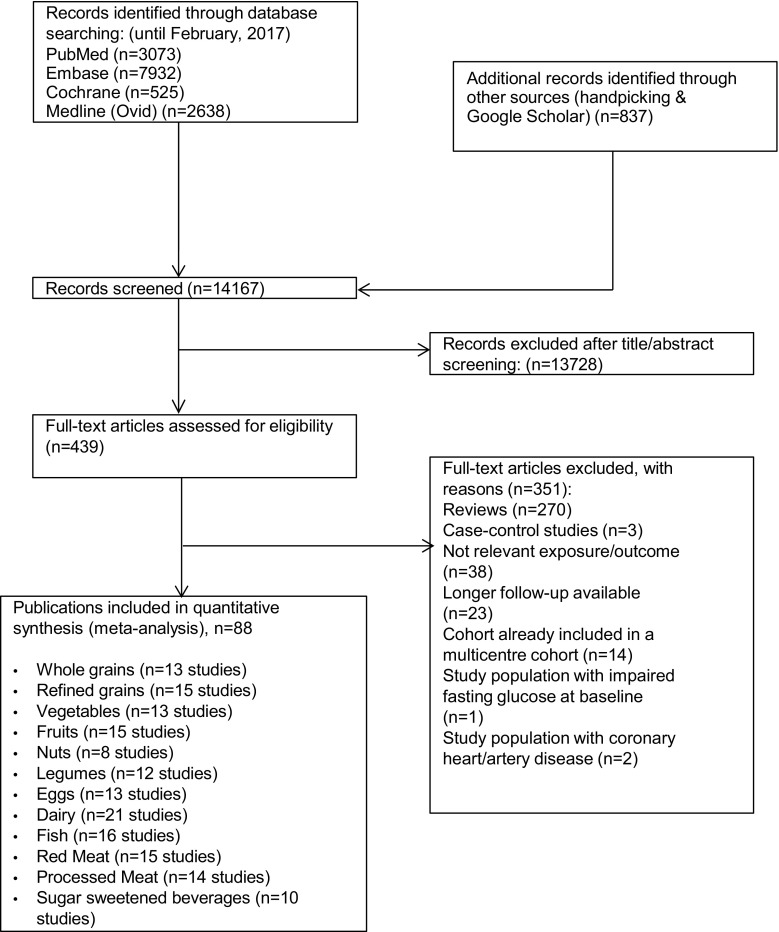
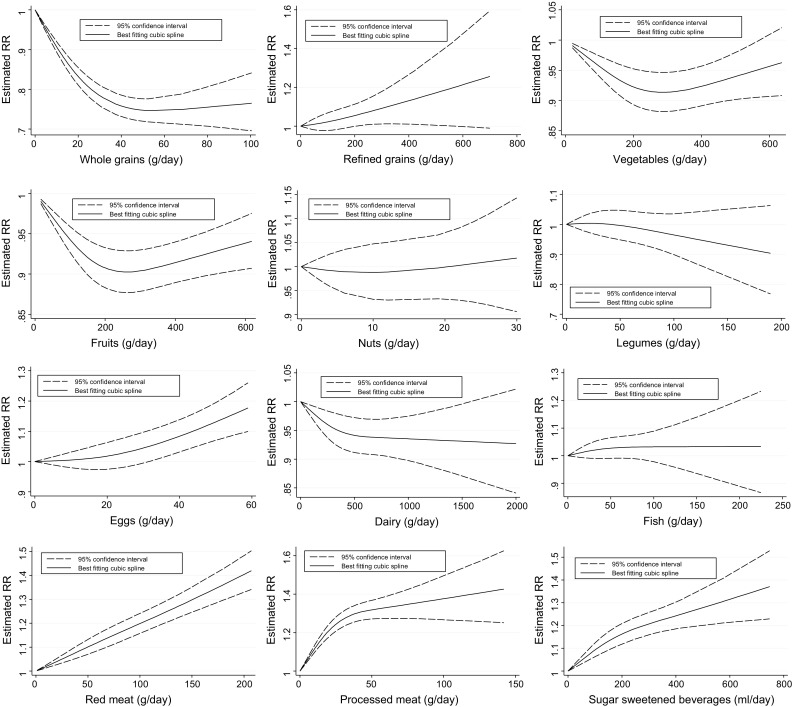
The aim of this systematic review and meta-analysis was to synthesize the knowledge about the relation between intake of 12 major food groups and risk of type 2 diabetes (T2D). We conducted a systematic search in PubMed, Embase, Medline (Ovid), Cochrane Central, and Google Scholar for prospective studies investigating the association between whole grains, refined grains, vegetables, fruits, nuts, legumes, eggs, dairy, fish, red meat, processed meat, and sugar-sweetened beverages (SSB) on risk of T2D. Summary relative risks were estimated using a random effects model by contrasting categories, and for linear and non-linear dose-response relationships. Six out of the 12 food-groups showed a significant relation with risk of T2D, three of them a decrease of risk with increasing consumption (whole grains, fruits, and dairy), and three an increase of risk with increasing consumption (red meat, processed meat, and SSB) in the linear dose-response meta-analysis. There was evidence of a non-linear relationship between fruits, vegetables, processed meat, whole grains, and SSB and T2D risk. Optimal consumption of risk-decreasing foods resulted in a 42% reduction, and consumption of risk-increasing foods was associated with a threefold T2D risk, compared to non-consumption. The meta-evidence was graded "low" for legumes and nuts; "moderate" for refined grains, vegetables, fruit, eggs, dairy, and fish; and "high" for processed meat, red meat, whole grains, and SSB. Among the investigated food groups, selecting specific optimal intakes can lead to a considerable change in risk of T2D.
Overview
The claims and statistics of this paper haven’t been checked yet.
Free: it reads the open-access text and checks the first 5 claims that cite a source we can check. Create a free account to check every claim.
Integrity signals
Registry
Cites
Statistics
Figures
Verification
Claims the paper makes
The claims and statistics of this paper haven’t been checked yet.
Free: it reads the open-access text and checks the first 5 claims that cite a source we can check. Create a free account to check every claim.
Claims other papers make about this one
Each is checked against this paper’s own text: does it say what the citing paper says it does?
In the citing paper
“Many food groups, mostly ultraprocessed (eg, processed meat, and sugary sweetened beverages) are recognized T2D risk factors.3”
From Ultraprocessed Food Consumption and Risk of Type 2 Diabetes Among Participants of the NutriNet-Santé Prospective Cohort (2020) · cites this paper as [3]
In the citing paper
“Of note, energy balance and overweight are both associated with T2D risk.3”
From Ultraprocessed Food Consumption and Risk of Type 2 Diabetes Among Participants of the NutriNet-Santé Prospective Cohort (2020) · cites this paper as [3]
Self-check
Percentages, sums and reported differences re-computed from the paper’s own numbers.
The self-check needs the paper’s full text.
Citations
Cites
1 retracted
RETRACTED: Primary Prevention of Cardiovascular Disease with a Mediterranean Diet
Estruch, R., Ros, E., Salas-Salvadó, J., Covas, M.-I., Corella, D., Arós, F., Gómez-Gracia, E., Ruiz-Gutiérrez, V., Fiol, M., Lapetra, J., et al. (2013) · New England Journal of Medicine · doi:10.1056/nejmoa1200303 · Cited by 4,257
RetractedBias in meta-analysis detected by a simple, graphical test
Egger, M., Smith, G. D., Schneider, M., & Minder, C. (1997) · BMJ · doi:10.1136/bmj.315.7109.629 · Cited by 56,722 · cited 1×
“Potential small-study effects, such as publication bias, were explored using Eggeŕs test and funnel plots [20] when at least 10 studies were available, as recommended by the Cochrane Handbook [21].”
MethodMeta-analysis in clinical trials
DerSimonian, R., & Laird, N. (1986) · Controlled Clinical Trials · doi:10.1016/0197-2456(86)90046-2 · Cited by 39,552 · cited 2×
“To evaluate the weighting of each study, the standard error for the logarithm RR/HR of each study was calculated and regarded as the estimated variance of the logarithm HR/RR, using an inverse variance method [15].”
MethodQuantifying heterogeneity in a meta‐analysis
Higgins, J. P. T., & Thompson, S. G. (2002) · Statistics in Medicine · doi:10.1002/sim.1186 · Cited by 36,763
Dermyshi, E., Wang, Y., Yan, C., Hong, W., Qiu, G., Gong, X., & Zhang, T. (2017) · Neonatology · doi:10.1159/000454668 · Cited by 24,451
Meta-analysis of Observational Studies in Epidemiology<SUBTITLE>A Proposal for Reporting</SUBTITLE>
Stroup, D. F. (2000) · JAMA · doi:10.1001/jama.283.15.2008 · Cited by 20,623
Stang, A. (2010) · European Journal of Epidemiology · doi:10.1007/s10654-010-9491-z · Cited by 17,396 · cited 2×
“However, Stang [14] commented that the Newcastle–Ottawa Scale includes quality items that are not valid (e.g., the ‘‘representativeness of the exposed cohort’’ item), and concluded that this score appeared to be unacceptable for the quality ranking of 364 L. Schwingshackl et al. case–control and cohort studies in meta…”
BackgroundInternational Diabetes Federation 2017
Carracher, A. M., Marathe, P. H., & Close, K. L. (2018) · Journal of Diabetes · doi:10.1111/1753-0407.12644 · Cited by 13,418
Tuomilehto, J., Lindström, J., Eriksson, J. G., Valle, T. T., Hämäläinen, H., Ilanne-Parikka, P., Keinänen-Kiukaanniemi, S., Laakso, M., Louheranta, A., Rastas, M., et al. (2001) · New England Journal of Medicine · doi:10.1056/nejm200105033441801 · Cited by 10,873
Cochrane Handbook for Systematic Reviews of Interventions Version 5.0.1. The Cochrane Collaboration
Higgins, J. P. T., Green, S. R., & Higgins, J. P. T. (2008) · Cited by 7,226
Cited by
Environmental/lifestyle factors in the pathogenesis and prevention of type 2 diabetes
Kolb, H., & Martin, S. (2017) · BMC Medicine · doi:10.1186/s12916-017-0901-x · Cited by 717
“(relative risk increase by 44% to three-fold [14, 15])”
BackgroundBechthold, A., Boeing, H., Schwedhelm, C., Hoffmann, G., Knüppel, S., Iqbal, K., De Henauw, S., Michels, N., Devleesschauwer, B., Schlesinger, S., et al. (2019) · Critical Reviews in Food Science and Nutrition · doi:10.1080/10408398.2017.1392288 · Cited by 693
“…populations suffering from chronic disease; (2) studies reporting only fatal outcomes, since mortality was included in a previous meta-analysis (Schwingshackl et al. 2017c); (3) studies aggregating outcomes as total CVD, and not reporting on CHD, stroke or HF separately; (4) when a study…”
InfluentialSelf-citationAschemann-Witzel, J., Gantriis, R. F., Fraga, P., & Perez-Cueto, F. J. A. (2021) · Critical Reviews in Food Science and Nutrition · doi:10.1080/10408398.2020.1793730 · Cited by 682
“…red meat consumption, especially processed meat, are associated with early mortality (Zheng et al. 2019), Type 2 Diabetes mellitus (Du et al. 2020; Schwingshackl et al. 2017) coronary heart disease (CHD) and stroke (Bechthold et al., 2019); moreover, longterm intake of red meat and poultry is…”
BackgroundWallace, T. C., Bailey, R. L., Blumberg, J. B., Burton-Freeman, B., Chen, C.-Y. O., Crowe-White, K. M., Drewnowski, A., Hooshmand, S., Johnson, E., Lewis, R., et al. (2020) · Critical Reviews in Food Science and Nutrition · doi:10.1080/10408398.2019.1632258 · Cited by 638
“Six systematic reviews have assessed the effect of total F&V intake on type 2 diabetes (Hamer and Chida 2007; Carter et al. 2010; Li et al. 2014b; Wu et al. 2015b; Wang et al. 2016b; Schwingshackl et al. 2017a).”
BackgroundInfluentialAdherence to Mediterranean Diet and Risk of Cancer: An Updated Systematic Review and Meta-Analysis
Schwingshackl, L., Schwedhelm, C., Galbete, C., & Hoffmann, G. (2017) · Nutrients · doi:10.3390/nu9101063 · Cited by 632
“Moreover, consumption of fermented dairy products was associated with a decreased risk to become obese or diabetic [135,136].”
BackgroundSelf-citationSchwingshackl, L., Bogensberger, B., & Hoffmann, G. (2018) · Journal of the Academy of Nutrition and Dietetics · doi:10.1016/j.jand.2017.08.024 · Cited by 606
Self-citationFood based dietary patterns and chronic disease prevention
Schulze, M. B., Martínez-González, M. A., Fung, T. T., Lichtenstein, A. H., & Forouhi, N. G. (2018) · BMJ · doi:10.1136/bmj.k2396 · Cited by 591
Springmann, M., Spajic, L., Clark, M. A., Poore, J., Herforth, A., Webb, P., Rayner, M., & Scarborough, P. (2020) · BMJ · doi:10.1136/bmj.m2322 · Cited by 520
Neuenschwander, M., Ballon, A., Weber, K. S., Norat, T., Aune, D., Schwingshackl, L., & Schlesinger, S. (2019) · BMJ · doi:10.1136/bmj.l2368 · Cited by 511
Self-citationDietary and nutritional approaches for prevention and management of type 2 diabetes
Forouhi, N. G., Misra, A., Mohan, V., Taylor, R., & Yancy, W. (2018) · BMJ · doi:10.1136/bmj.k2234 · Cited by 472
Srour, B., Fezeu, L. K., Kesse-Guyot, E., Allès, B., Debras, C., Druesne-Pecollo, N., Chazelas, E., Deschasaux, M., Hercberg, S., Galan, P., et al. (2020) · JAMA Internal Medicine · doi:10.1001/jamainternmed.2019.5942 · Cited by 465
Călinoiu, L. F., & Vodnar, D. C. (2018) · Nutrients · doi:10.3390/nu10111615 · Cited by 429
“The recent systematic reviews and meta-analysis of prospective studies reported that whole-grain foods have a significant relationship with the risk of T2D, showing a consistent decrease of risk with increasing consumption [90,91].”
BackgroundMorze, J., Danielewicz, A., Hoffmann, G., & Schwingshackl, L. (2020) · Journal of the Academy of Nutrition and Dietetics · doi:10.1016/j.jand.2020.08.076 · Cited by 380
Self-citationSchlesinger, S., Neuenschwander, M., Schwedhelm, C., Hoffmann, G., Bechthold, A., Boeing, H., & Schwingshackl, L. (2019) · Advances in Nutrition · doi:10.1093/advances/nmy092 · Cited by 372
“Methods The planning and conduct of the present meta-analysis followed a strategy that has been implemented in 5 recently published meta-analyses on food groups and risk of mortality (23), colorectal cancer (24), coronary heart disease, stroke and heart failure (25), type 2 diabetes (26), and hypertension (27).”
Self-citationSchwingshackl, L., Schwedhelm, C., Hoffmann, G., Knüppel, S., Iqbal, K., Andriolo, V., Bechthold, A., Schlesinger, S., & Boeing, H. (2017) · Advances in Nutrition · doi:10.3945/an.117.017178 · Cited by 348
“Many meta-analyses have consistently found evidence of an inverse association between the intake of fruits and vegetables and the risk of weight gain, cardiovascular disease, cancer, type 2 diabetes, and all-cause mortality (12, 13, 75, 76).”
BackgroundMethodResultInfluentialSelf-citationFood groups and risk of colorectal cancer
Schwingshackl, L., Schwedhelm, C., Hoffmann, G., Knüppel, S., Laure Preterre, A., Iqbal, K., Bechthold, A., De Henauw, S., Michels, N., Devleesschauwer, B., et al. (2018) · International Journal of Cancer · doi:10.1002/ijc.31198 · Cited by 340
Self-citationMediterranean diet and health status: Active ingredients and pharmacological mechanisms
Schwingshackl, L., Morze, J., & Hoffmann, G. (2020) · British Journal of Pharmacology · doi:10.1111/bph.14778 · Cited by 336
Self-citationQin, P., Li, Q., Zhao, Y., Chen, Q., Sun, X., Liu, Y., Li, H., Wang, T., Chen, X., Zhou, Q., et al. (2020) · European Journal of Epidemiology · doi:10.1007/s10654-020-00655-y · Cited by 323
Ultra-processed foods and human health: from epidemiological evidence to mechanistic insights
Srour, B., Kordahi, M. C., Bonazzi, E., Deschasaux-Tanguy, M., Touvier, M., & Chassaing, B. (2022) · The Lancet Gastroenterology & Hepatology · doi:10.1016/s2468-1253(22)00169-8 · Cited by 303
Therapeutic Benefits and Dietary Restrictions of Fiber Intake: A State of the Art Review
Ioniță-Mîndrican, C.-B., Ziani, K., Mititelu, M., Oprea, E., Neacșu, S. M., Moroșan, E., Dumitrescu, D.-E., Roșca, A. C., Drăgănescu, D., & Negrei, C. (2022) · Nutrients · doi:10.3390/nu14132641 · Cited by 251
The global and regional costs of healthy and sustainable dietary patterns: a modelling study
Springmann, M., Clark, M. A., Rayner, M., Scarborough, P., & Webb, P. (2021) · The Lancet Planetary Health · doi:10.1016/s2542-5196(21)00251-5 · Cited by 284
Jayedi, A., Soltani, S., Abdolshahi, A., & Shab-Bidar, S. (2020) · British Journal of Nutrition · doi:10.1017/s0007114520002330 · Cited by 246
Schwingshackl, L., Chaimani, A., Hoffmann, G., Schwedhelm, C., & Boeing, H. (2018) · European Journal of Epidemiology · doi:10.1007/s10654-017-0352-x · Cited by 273
Self-citationBioactives and health benefits of nuts and dried fruits
Alasalvar, C., Salvadó, J.-S., & Ros, E. (2020) · Food Chemistry · doi:10.1016/j.foodchem.2020.126192 · Cited by 269
Evidence-based European recommendations for the dietary management of diabetes
The Diabetes and Nutrition Study Group (DNSG) of the European Association for the Study of Diabetes (EASD), Aas, A.-M., Axelsen, M., Churuangsuk, C., Hermansen, K., Kendall, C. W. C., Kahleova, H., Khan, T., Lean, M. E. J., Mann, J. I., et al. (2023) · Diabetologia · doi:10.1007/s00125-023-05894-8 · Cited by 262
“These include Mediterranean [4, 21], Nordic [6] and vegetarian dietary patterns [22], or diets high in vegetables and fruit [9], whole grains [8, 23] and fibre [8], or low in glycaemic index and load [10].”
Microgreens—A Comprehensive Review of Bioactive Molecules and Health Benefits
Bhaswant, M., Shanmugam, D. K., Miyazawa, T., Abe, C., & Miyazawa, T. (2023) · Molecules · doi:10.3390/molecules28020867 · Cited by 193
“However, prolonged pharmacological intake may pose adverse effects; thus, the intake of vegetables and fruits with no or low sugar content is usually prescribed [90].”
BackgroundChen, Z., Zuurmond, M. G., van der Schaft, N., Nano, J., Wijnhoven, H. A. H., Ikram, M. A., Franco, O. H., & Voortman, T. (2018) · European Journal of Epidemiology · doi:10.1007/s10654-018-0414-8 · Cited by 221
“By contrast, several animal-based foods, including red meat, processed meat, and daily consumption of eggs have been associated with an increased risk of T2D [4, 6, 7].”
BackgroundVancells Lujan, P., Viñas Esmel, E., & Sacanella Meseguer, E. (2021) · Nutrients · doi:10.3390/nu13051442 · Cited by 209
Aune, D. (2019) · Advances in Nutrition · doi:10.1093/advances/nmz042 · Cited by 209
Incident type 2 diabetes attributable to suboptimal diet in 184 countries
O’Hearn, M., Lara-Castor, L., Cudhea, F., Miller, V., Reedy, J., Shi, P., Zhang, J., Wong, J. B., Economos, C. D., Micha, R., et al. (2023) · Nature Medicine · doi:10.1038/s41591-023-02278-8 · Cited by 196
Galbete, C., Schwingshackl, L., Schwedhelm, C., Boeing, H., & Schulze, M. B. (2018) · European Journal of Epidemiology · doi:10.1007/s10654-018-0427-3 · Cited by 212
Self-citationAssociation of Socioeconomic and Geographic Factors With Diet Quality in US Adults
McCullough, M. L., Chantaprasopsuk, S., Islami, F., Rees-Punia, E., Um, C. Y., Wang, Y., Leach, C. R., Sullivan, K. R., & Patel, A. V. (2022) · JAMA Network Open · doi:10.1001/jamanetworkopen.2022.16406 · Cited by 183
Toi, P. L., Anothaisintawee, T., Chaikledkaew, U., Briones, J. R., Reutrakul, S., & Thakkinstian, A. (2020) · Nutrients · doi:10.3390/nu12092722 · Cited by 178
“, every 4 servings per week or 50 g per day increase in consumption of legumes) did not suggest a significant benefit of legumes for T2DM prevention [9,25,26] (Figure 2B), while evidence for nuts intake was inconsistent.”
BackgroundResultInfluentialThe Mediterranean Diet: An Update of the Clinical Trials
Finicelli, M., Di Salle, A., Galderisi, U., & Peluso, G. (2022) · Nutrients · doi:10.3390/nu14142956 · Cited by 181
Viguiliouk, E., Kendall, C. W., Kahleová, H., Rahelić, D., Salas-Salvadó, J., Choo, V. L., Mejia, S. B., Stewart, S. E., Leiter, L. A., Jenkins, D. J., et al. (2019) · Clinical Nutrition · doi:10.1016/j.clnu.2018.05.032 · Cited by 201
Delpino, F. M., Figueiredo, L. M., Bielemann, R. M., da Silva, B. G. C., dos Santos, F. S., Mintem, G. C., Flores, T. R., Arcêncio, R. A., & Nunes, B. P. (2022) · International Journal of Epidemiology · doi:10.1093/ije/dyab247 · Cited by 163
Health effects associated with consumption of unprocessed red meat: a Burden of Proof study
Lescinsky, H., Afshin, A., Ashbaugh, C., Bisignano, C., Brauer, M., Ferrara, G., Hay, S. I., He, J., Iannucci, V., Marczak, L. B., et al. (2022) · Nature Medicine · doi:10.1038/s41591-022-01968-z · Cited by 172
Effects of Diet-Modulated Autologous Fecal Microbiota Transplantation on Weight Regain
Rinott, E., Youngster, I., Yaskolka Meir, A., Tsaban, G., Zelicha, H., Kaplan, A., Knights, D., Tuohy, K., Fava, F., Scholz, M. U., et al. (2021) · Gastroenterology · doi:10.1053/j.gastro.2020.08.041 · Cited by 192
Ferrari, L., Panaite, S.-A., Bertazzo, A., & Visioli, F. (2022) · Nutrients · doi:10.3390/nu14235115 · Cited by 203
The global and regional burden of diabetic peripheral neuropathy
Savelieff, M. G., Elafros, M. A., Viswanathan, V., Jensen, T. S., Bennett, D., & Feldman, E. L. (2024) · Nature Reviews Neurology · doi:10.1038/s41582-024-01041-y · Cited by 196
“For example, reduced vegetable and fruit consumption is linked to poor cardiovascular health 106 and T2D 107,108 .”
Bechthold, A., Boeing, H., Tetens, I., Schwingshackl, L., & Nöthlings, U. (2018) · Advances in Nutrition · doi:10.1093/advances/nmy033 · Cited by 153
“The guide includes a summary of the evidence supporting a relation between diet and health, in particular, the prevention of noncommunicable chronic diseases (NCDs), such as cardiovascular diseases (CVDs), certain cancers, hypertension, obesity, and type 2 diabetes (T2D).”
InfluentialSelf-citationYip, C. S. C., Chan, W. F. M., & Fielding, R. (2019) · Journal of the Academy of Nutrition and Dietetics · doi:10.1016/j.jand.2018.11.007 · Cited by 173
Soedamah-Muthu, S. S., & de Goede, J. (2018) · Current Nutrition Reports · doi:10.1007/s13668-018-0253-y · Cited by 162
Estimating impact of food choices on life expectancy: A modeling study
Fadnes, L. T., Økland, J.-M., Haaland, Ø. A., & Johansson, K. A. (2022) · PLoS Medicine · doi:10.1371/journal.pmed.1003889 · Cited by 196
Ballon, A., Neuenschwander, M., & Schlesinger, S. (2019) · The Journal of Nutrition · doi:10.1093/jn/nxy194 · Cited by 161
Self-citationNuts: Natural Pleiotropic Nutraceuticals
Ros, E., Singh, A., & O’Keefe, J. H. (2021) · Nutrients · doi:10.3390/nu13093269 · Cited by 165
“The effects of nut consumption on risk of type-2 diabetes mellitus (T2D) in epidemiological studies have mostly been inconclusive and controversial [35,37].”
BackgroundLee, Y., & Park, K. (2017) · Nutrients · doi:10.3390/nu9060603 · Cited by 151
“The most recent meta-analysis of prospective studies using a dose-response analysis revealed that the risk of type 2 diabetes mellitus was reduced by up to 81% by optimally consuming risk-reducing foods such as whole grains, vegetables, fruits, and dairy while simultaneously avoiding risk-increasing foods such as red…”
BackgroundSchwingshackl, L., Hoffmann, G., Iqbal, K., Schwedhelm, C., & Boeing, H. (2018) · The American Journal of Clinical Nutrition · doi:10.1093/ajcn/nqy151 · Cited by 147
Self-citationOptions for reforming agricultural subsidies from health, climate, and economic perspectives
Springmann, M., & Freund, F. (2022) · Nature Communications · doi:10.1038/s41467-021-27645-2 · Cited by 144
Sievenpiper, J. L. (2020) · Nutrition Reviews · doi:10.1093/nutrit/nuz082 · Cited by 144
Viguiliouk, E., Glenn, A. J., Nishi, S. K., Chiavaroli, L., Seider, M., Khan, T., Bonaccio, M., Iacoviello, L., Mejia, S. B., Jenkins, D. J. A., et al. (2019) · Advances in Nutrition · doi:10.1093/advances/nmz113 · Cited by 131
“We identified 6 SRMAs: 3 for CVDs (35–37), 1 for diabetes (38), 1 for hypertension (39), and 1 for obesity outcomes (40).”
BackgroundHalvorsen, R. E., Elvestad, M., Molin, M., & Aune, D. (2021) · BMJ Nutrition Prevention & Health · doi:10.1136/bmjnph-2020-000218 · Cited by 157
“The increased type 2 diabetes risk observed with intake of fruit juice and fruit drinks may be due to the high glycaemic load (GL) and the added sugar in fruit drinks, as well as the lack of dietary fibre, which reduces satiety and leads to more rapid and larger postprandial increases in blood…”
BackgroundRienks, J., Barbaresko, J., Oluwagbemigun, K., Schmid, M. C., & Nöthlings, U. (2018) · American Journal of Clinical Nutrition · doi:10.1093/ajcn/nqy083 · Cited by 142
Neuenschwander, M., Stadelmaier, J., Eble, J., Grummich, K., Szczerba, E., Kiesswetter, E., Schlesinger, S., & Schwingshackl, L. (2023) · BMC Medicine · doi:10.1186/s12916-023-03093-1 · Cited by 124
“Previous meta-analyses also support our findings that higher meat intake was associated with a risk of T2D [8], CHD, and stroke [7], as well as all-cause mortality [9].”
ResultSelf-citationNordic diet, Mediterranean diet, and the risk of chronic diseases: the EPIC-Potsdam study
Galbete, C., Kröger, J., Jannasch, F., Iqbal, K., Schwingshackl, L., Schwedhelm, C., Weikert, C., Boeing, H., & Schulze, M. B. (2018) · BMC Medicine · doi:10.1186/s12916-018-1082-y · Cited by 148
“In our study, we also showed a marginal effect of these two components [38].”
BackgroundSelf-citationToward Optimal Meat Pricing: Is It Time to Tax Meat Consumption?
Funke, F., Mattauch, L., van den Bijgaart, I., Godfray, H. C. J., Hepburn, C. J., Klenert, D., Springmann, M., & Treich, N. (2022) · Review of Environmental Economics and Policy · doi:10.1086/721078 · Cited by 149
“There is also moderate to strong evidence frommeta-analyses of epidemiological studies that red and processed meat increases risks for coronary heart disease, stroke, and type 2 diabetes (Schwingshackl et al. 2017; Bechthold et al. 2019).”
BackgroundAlvarez-Bueno, C., Cavero-Redondo, I., Martinez-Vizcaino, V., Sotos-Prieto, M., Ruiz, J. R., & Gil, A. (2019) · Advances in Nutrition · doi:10.1093/advances/nmy107 · Cited by 126
“Ten systematic reviews and meta-analyses reported an exposure comparison between high and low dairy product consumption (9, 22–25, 27, 29, 35–37) and 7 reported dose– response consumptions (9, 22, 23, 25, 27, 28, 38).”
BackgroundDiet and risk of diabetic retinopathy: a systematic review
Dow, C., Mancini, F. R., Rajaobelina, K., Boutron‐Ruault, M., Balkau, B., Bonnet, F., & Fagherazzi, G. (2017) · European Journal of Epidemiology · doi:10.1007/s10654-017-0338-8 · Cited by 136
Health-Promoting Phytonutrients Are Higher in Grass-Fed Meat and Milk
van Vliet, S., Provenza, F. D., & Kronberg, S. L. (2021) · Frontiers in Sustainable Food Systems · doi:10.3389/fsufs.2020.555426 · Cited by 141
Health effects associated with vegetable consumption: a Burden of Proof study
Stanaway, J. D., Afshin, A., Ashbaugh, C., Bisignano, C., Brauer, M., Ferrara, G., Garcia, V., Haile, D., Hay, S. I., He, J., et al. (2022) · Nature Medicine · doi:10.1038/s41591-022-01970-5 · Cited by 113
Christensen, C., Knudsen, A. W., Arnesen, E., Hatlebakk, J. G., Sletten, I. S. K., & Fadnes, L. T. (2024) · Advances in Nutrition · doi:10.1016/j.advnut.2024.100219 · Cited by 139
Jayedi, A., & Shab-Bidar, S. (2020) · Advances in Nutrition · doi:10.1093/advances/nmaa029 · Cited by 124
“Fish consumption was not associated with the risks of T2D, atrial fibrillation, and hypertension.”
BackgroundInfluentialPerspective: Total, Added, or Free? What Kind of Sugars Should We Be Talking About?
Mela, D. J., & Woolner, E. M. (2018) · Advances in Nutrition · doi:10.1093/advances/nmx020 · Cited by 138
Etiology and Pathogenesis of Latent Autoimmune Diabetes in Adults (LADA) Compared to Type 2 Diabetes
Carlsson, S. (2019) · Frontiers in Physiology · doi:10.3389/fphys.2019.00320 · Cited by 128
“, 2017), and red and processed meat (Schwingshackl et al., 2017).”
BackgroundInfluentialPotatoes and risk of chronic disease: a systematic review and dose–response meta-analysis
Schwingshackl, L., Schwedhelm, C., Hoffmann, G., & Boeing, H. (2019) · European Journal of Nutrition · doi:10.1007/s00394-018-1774-2 · Cited by 119
Self-citationChaltiel, D., Adjibade, M., Deschamps, V., Touvier, M., Herçberg, S., Julia, C., & Kesse‐Guyot, E. (2019) · British Journal Of Nutrition · doi:10.1017/s0007114519001181 · Cited by 122
“Frequencies were assessed using eight possibilities of response: (1) most of the time; (2) occasionally; (3) never (too expensive); (4) never (product not available); (5) never (I’m not interested in organic products); (6) never (I avoid such products); (7) never (for no specific reason); and (8) I don’t know.”
MethodBalakrishna, R., Bjørnerud, T., Bemanian, M., Aune, D., & Fadnes, L. T. (2022) · Advances in Nutrition · doi:10.1093/advances/nmac077 · Cited by 123
“mortality (All nuts, [16], 2016) Mortality (All nuts, [16], 2016) Metabolic syndrome (All nuts, [42], 2017) Kidney disease mortality (All nuts, [16], 2016) Ischemic stroke incidence (All nuts, [38], 2019) Infectious disease mortality (All nuts, [16], 2016) Hemorrhagic stroke incidence (All nuts, [38], 2019) Heart fail…”
Legumes: A Vehicle for Transition to Sustainability
Yanni, A. E., Iakovidi, S., Vasilikopoulou, E., & Karathanos, V. Τ. (2023) · Nutrients · doi:10.3390/nu16010098 · Cited by 128
“Some systematic reviews [63,64] and meta-analyses [63–65] showed no significant effect of legume consumption on T2DM incidence.”
Rye and health - Where do we stand and where do we go?
Jönsson, K., Andersson, R., Knudsen, K. E. B., Hallmans, G., Hanhineva, K., Katina, K., Kolehmainen, M., Kyrø, C., Langton, M., Nordlund, E., et al. (2018) · Trends in Food Science & Technology · doi:10.1016/j.tifs.2018.06.018 · Cited by 123
Kelly, J., Karlsen, M., & Steinke, G. (2020) · American Journal of Lifestyle Medicine · doi:10.1177/1559827620930962 · Cited by 97
“57”
Gu, X., Drouin‐Chartier, J., Sacks, F. M., Hu, F. B., ROSNER, B. A., & Willett, W. C. (2023) · American Journal of Clinical Nutrition · doi:10.1016/j.ajcnut.2023.08.021 · Cited by 115
Li, C., Bishop, T. R. P., Imamura, F., Sharp, S. J., Pearce, M., Brage, S., Ong, K. K., Ahsan, H., Bes‐Rastrollo, M., Beulens, J. W. J., et al. (2024) · The Lancet Diabetes & Endocrinology · doi:10.1016/s2213-8587(24)00179-7 · Cited by 112
Effect of Fruit and Vegetable Consumption on Human Health: An Update of the Literature
Devirgiliis, C., Guberti, E., Mistura, L., & Raffo, A. (2024) · Foods · doi:10.3390/foods13193149 · Cited by 115
“…on the risk of developing type 2 diabetes mellitus (T2DM), a recent systematic review, accompanied by dose–response meta-analysis [33], updated previous analyses of the same type [48], including 16 additional prospective cohort studies published after the extensive meta-analysis in 2017.”
MethodAnderson, J. J., Gray, S. R., Welsh, P., Mackay, D. F., Celis-Morales, C. A., Lyall, D. M., Forbes, J., Sattar, N., Gill, J. M. R., & Pell, J. P. (2020) · BMC Medicine · doi:10.1186/s12916-020-01554-5 · Cited by 102
Miller, V., Micha, R., Choi, E., Karageorgou, D., Webb, P., & Mozaffarian, D. (2022) · JAMA Network Open · doi:10.1001/jamanetworkopen.2021.46705 · Cited by 103
Nobre, M. D. A., & Maló, P. S. (2017) · Journal of Dentistry · doi:10.1016/j.jdent.2017.07.013 · Cited by 114
Xu, C., Cao, Z., Yang, H., Hou, Y., Wang, X., & Wang, Y. (2022) · Frontiers in Nutrition · doi:10.3389/fnut.2021.784018 · Cited by 114
Phenolic Bioactives From Plant-Based Foods for Glycemic Control
Sarkar, D., Christopher, A., & Shetty, K. (2022) · Frontiers in Endocrinology · doi:10.3389/fendo.2021.727503 · Cited by 110
Latin American consumption of major food groups: Results from the ELANS study
Kovalskys, I., Rigotti, A., Koletzko, B., Fisberg, M., Gómez, G., Herrera-Cuenca, M., Cortés Sanabria, L. Y., Yépez García, M. C., Pareja, R. G., Zimberg, I. Z., et al. (2019) · PLOS ONE · doi:10.1371/journal.pone.0225101 · Cited by 100
Gene‐lifestyle interaction on risk of type 2 diabetes: A systematic review
Dietrich, S., Jacobs, S., Zheng, J., Meidtner, K., Schwingshackl, L., & Schulze, M. B. (2019) · Obesity Reviews · doi:10.1111/obr.12921 · Cited by 108
Self-citationMilenković, T., Bozhinovska, N., Μacut, D., Bjekić-Macut, J., Rahelić, D., Velija-Ašimi, Z., & Bureković, A. (2021) · Nutrients · doi:10.3390/nu13041307 · Cited by 119
“Frequent use of vegetables in the dietary pattern, although minimal, nonetheless reduces the risk of type 2 diabetes development [70,71].”
BackgroundInfluentialChen, Z., Ahmed, M., Ha, V., Jefferson, K., Malik, V., Ribeiro, P. A. B., Zuchinali, P., & Drouin‐Chartier, J. (2021) · Advances in Nutrition · doi:10.1093/advances/nmab118 · Cited by 105
Review: Quality of animal-source foods
Prache, S., Adamiec, C., Astruc, T., Baéza, É., Bouillot, P.-É., Clinquart, A., Feidt, C., Fourat, E., Gautron, J., Girard, A., et al. (2021) · animal · doi:10.1016/j.animal.2021.100376 · Cited by 110
Xu, H., Luo, J., Huang, J., & Wen, Q. (2018) · Medicine · doi:10.1097/md.0000000000010686 · Cited by 95
Pepa, G. D., Vetrani, C., Vitale, M., & Riccardi, G. (2018) · Nutrients · doi:10.3390/nu10091288 · Cited by 100
“Recently, a comprehensive meta-analysis has indicated that in addition to foods associated with a lower risk, there are also food items that are associated with an increased risk of T2DM: Red meat, processed meat, eggs, and sugar-sweetened beverages [7].”
BackgroundLegume Consumption and Cardiometabolic Health
Becerra‐Tomás, N., Papandreou, C., & Salas‐Salvadó, J. (2019) · Advances in Nutrition · doi:10.1093/advances/nmz003 · Cited by 100
“Two meta-analyses of prospective studies show no apparent association, although with a high degree of heterogeneity across studies (25, 39).”
BackgroundStanhope, K. L., Goran, M. I., Bosy‐Westphal, A., King, J. C., Schmidt, L. A., Schwarz, J. ‐., Stice, E., Sylvetsky, A. C., Turnbaugh, P. J., Bray, G. A., et al. (2018) · Obesity Reviews · doi:10.1111/obr.12699 · Cited by 87
Diet Quality Indices and Risk of Type 2 Diabetes Mellitus
Chen, G., Koh, W., Neelakantan, N., Yuan, J., Qin, L., & van Dam, R. M. (2018) · American Journal of Epidemiology · doi:10.1093/aje/kwy183 · Cited by 99
Perspective: Whole and Refined Grains and Health—Evidence Supporting “Make Half Your Grains Whole”
Jones, J. M., Guzmán, C., & Braun, H. J. (2019) · Advances in Nutrition · doi:10.1093/advances/nmz114 · Cited by 94
“The strength of association was graded “high,” with the greatest risk reduction occurring with WG intakes between 0 to 40 g/d (76).”
BackgroundSchwingshackl, L., Zähringer, J., Beyerbach, J., Werner, S. S., Heseker, H., Koletzko, B. V., & Meerpohl, J. J. (2021) · Annals of Nutrition and Metabolism · doi:10.1159/000515058 · Cited by 95
Self-citationSchwingshackl, L., Knüppel, S., Michels, N., Schwedhelm, C., HOFFMANN, G. E., Iqbal, K., Henauw, S. D., Boeing, H., & Devleesschauwer, B. (2019) · European Journal of Epidemiology · doi:10.1007/s10654-019-00523-4 · Cited by 88
Self-citationBreuninger, T. A., Wawro, N., Breuninger, J., Reitmeier, S., Clavel, T., Six-Merker, J., Pestoni, G., Rohrmann, S., Rathmann, W., Peters, A., et al. (2021) · Microbiome · doi:10.1186/s40168-020-00969-9 · Cited by 93
“Interestingly, one study found that adhering to a Mediterranean diet increased occurrence of Faecalibacterium prausnitzii in feces and improved insulin sensitivity [58, 59].”
BackgroundEmbracing complexity: making sense of diet, nutrition, obesity and type 2 diabetes
Forouhi, N. G. (2023) · Diabetologia · doi:10.1007/s00125-023-05873-z · Cited by 98
“There is substantial evidence from meta-analyses for inverse (beneficial) associations between the consumption of fibre [49], particularly cereal fibre [50] and wholegrains [11], and the incidence of type 2 diabetes.”
BackgroundInfant Cereals: Current Status, Challenges, and Future Opportunities for Whole Grains
Klerks, M., Bernal, M. J., Román, S., Bodenstab, S., Gil, Á., & Sánchez-Siles, L. M. (2019) · Nutrients · doi:10.3390/nu11020473 · Cited by 92
Nutritional basis of type 2 diabetes remission
Taylor, R., Ramachandran, A., Yancy, W. S., & Forouhi, N. G. (2021) · BMJ · doi:10.1136/bmj.n1449 · Cited by 59
Karavasiloglou, N., Thompson, A. S., Pestoni, G., Knüppel, A., Papier, K., Cassidy, A., Kuhn, T. E., & Rohrmann, S. (2023) · One Earth · doi:10.1016/j.oneear.2023.11.002 · Cited by 84
“6,15,16 24 Most reported an inverse association between the EAT-Lancet reference diet and their outcome of interest, despite the different methodologies they used (e.g., assessment of dietary intake, operationalization of the EAT-Lancet reference diet).”
BackgroundFan, M., Li, Y., Wang, C., Mao, Z., Zhou, W., Zhang, L., Yang, X., Cui, S., & Li, L. (2019) · Nutrients · doi:10.3390/nu11112783 · Cited by 90
Marques, A. C., Fuinhas, J. A., & Pais, D. F. (2018) · Journal of Cleaner Production · doi:10.1016/j.jclepro.2018.06.011 · Cited by 92
Neelakantan, N., Park, S. H., Chen, G., & van Dam, R. M. (2021) · Nutrition Reviews · doi:10.1093/nutrit/nuab010 · Cited by 85
Meat and fish intake and type 2 diabetes: Dose–response meta-analysis of prospective cohort studies
Yang, X., Li, Y., Wang, C., Mao, Z., Zhou, W., Zhang, L., Fan, M., Cui, S., & Li, L. (2020) · Diabetes & Metabolism · doi:10.1016/j.diabet.2020.03.004 · Cited by 83
Metadata
- Authors
- Schwingshackl, L., Hoffmann, G., Lampousi, A.-M., Knüppel, S., Iqbal, K., Schwedhelm, C., Bechthold, A., Schlesinger, S., & Boeing, H.
- Affiliations
- German Institute of Human Nutrition (DE)
- University of Vienna (AT)
- Deutsches Diabetes-Zentrum e.V. (DE)
- Corresponding author
- Schwingshackl, Lukas
- ORCID
- Venue
- European Journal of Epidemiology
- Published
- 2017-04-10
- Volume
- 32
- Issue
- 5
- Pages
- 363-375
- ISSN
- 0393-2990 (ISSN-L)
- 1573-7284
- PMC
- PMC5506108
- OpenAlex
- W2606247503
- Cited by
- 799
- References
- 56
- Citations by year
- 2026: 54 · 2025: 67 · 2024: 108 · 2023: 111 · 2022: 132 · 2021: 100 · 2020: 86 · 2019: 78 · 2018: 48 · 2017: 13
- FWCI
- 9.99
- Type
- journal article
- Language
- en
- Open access
- hybrid
- doi.org
- Locations
- European Journal of Epidemiology (publishedVersion, cc-by)
- PubMed Central (publishedVersion, cc-by)
- PubMed (publishedVersion)
- Informationszentrum Lebenswissenschaften (ZB MED) (submittedVersion, cc-by)
- Topics
- Health Sciences › Medicine › Public Health, Environmental and Occupational Health › Nutritional Studies and Diet
- Health Sciences › Medicine › Endocrinology, Diabetes and Metabolism › Diet, Metabolism, and Disease
- Health Sciences › Nursing › Nutrition and Dietetics › Food composition and properties
- Keywords
- type 2 diabetes, food groups, whole grains, refined grains, vegetables, fruits, nuts, Fabaceae, eggs, dairy products, fish, red meat, processed meat, sugar-sweetened beverages, dose-response relationship, dietary risk factors
- MeSH terms
- Whole Grains, Diabetes Mellitus, Type 2, Diet, Eating, Feeding Behavior, Food, Fruit, Humans, Meat, Nuts, Prospective Studies, Risk Factors, Vegetables, Risk Reduction Behavior
About these checks
Registry, retraction, Cites and statistics results are computed, not judged, with one exception: a printed reference that no index lists is read once by a model before it counts as a citation error. Claims are extracted by a model and kept only when their quote appears verbatim in the text; each cited source is then checked, with a model’s help, for whether it says what the claim relies on. Those verdicts can be wrong — read the claim’s quote and the cited source before relying on one.
Statistics and arithmetic are recomputed, not judged.
Confidence bands are shown only for fields calibrated on our annotated test set. None is calibrated yet, so no band is shown.
What counts as a claim ›How we measure confidence ›How we check this ›
Are you an author, or do you see a problem with this page? Request a review
Data sources
Bibliographic data: Semantic Scholar, OpenAlex, Crossref.
Contains information from the Semantic Scholar Academic Graph Datasets, made available under the ODC Attribution License (ODC-BY 1.0).
Semantic Scholar’s data is described in: Kinney, R., et al. (2023). The Semantic Scholar Open Data Platform. arXiv:2301.10140.
