

Food groups and risk of type 2 diabetes mellitus: a systematic review and meta-analysis of prospective studies.
Open accessThe DOI matches its Crossref record; 56 of the 56 references it cites were found in a registry or an index.
Abstract
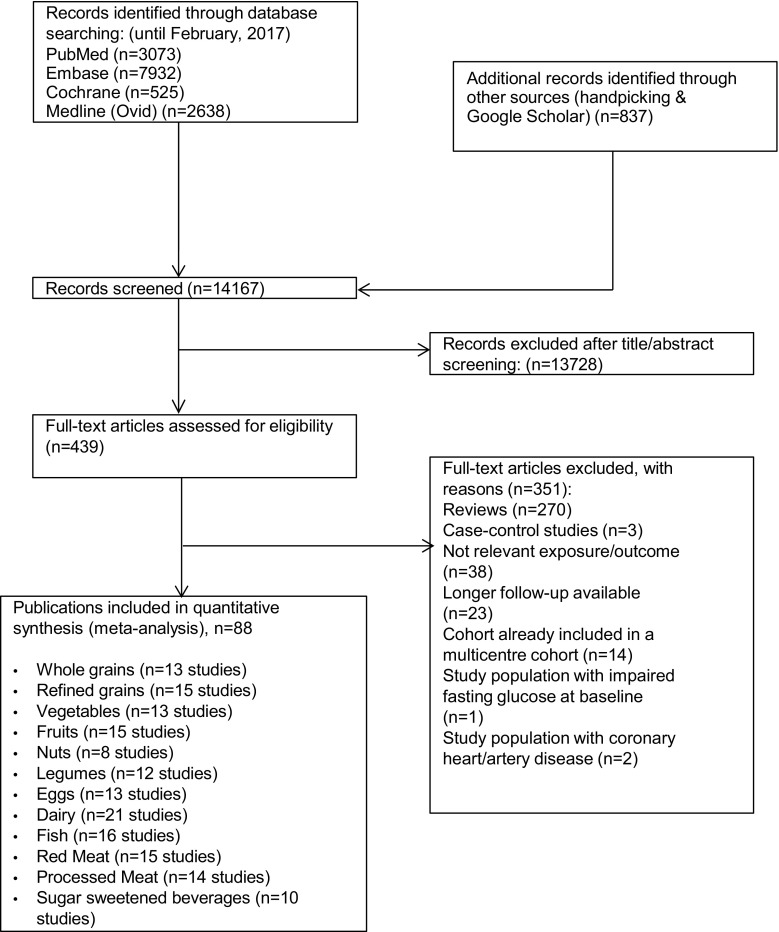
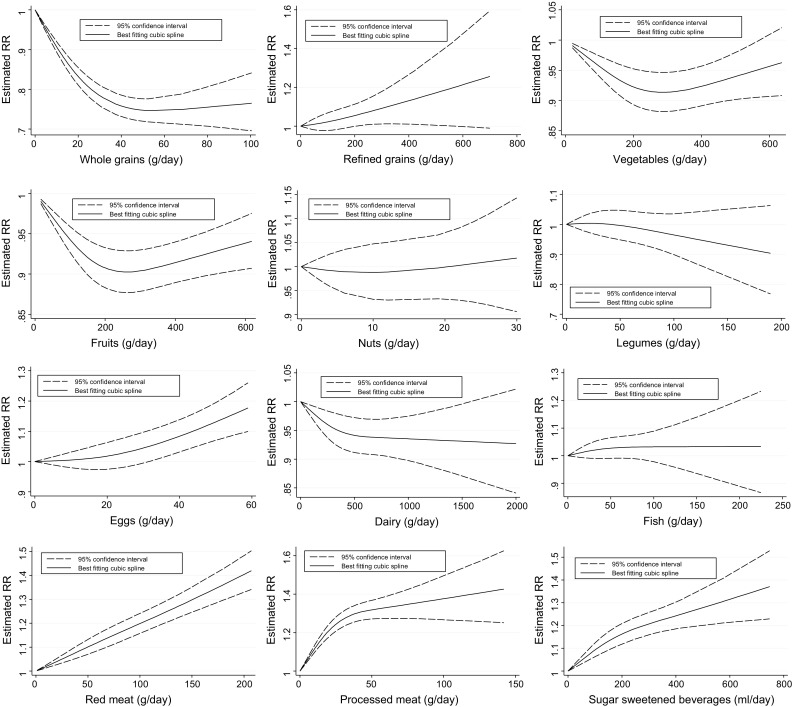
The aim of this systematic review and meta-analysis was to synthesize the knowledge about the relation between intake of 12 major food groups and risk of type 2 diabetes (T2D). We conducted a systematic search in PubMed, Embase, Medline (Ovid), Cochrane Central, and Google Scholar for prospective studies investigating the association between whole grains, refined grains, vegetables, fruits, nuts, legumes, eggs, dairy, fish, red meat, processed meat, and sugar-sweetened beverages (SSB) on risk of T2D. Summary relative risks were estimated using a random effects model by contrasting categories, and for linear and non-linear dose-response relationships. Six out of the 12 food-groups showed a significant relation with risk of T2D, three of them a decrease of risk with increasing consumption (whole grains, fruits, and dairy), and three an increase of risk with increasing consumption (red meat, processed meat, and SSB) in the linear dose-response meta-analysis. There was evidence of a non-linear relationship between fruits, vegetables, processed meat, whole grains, and SSB and T2D risk. Optimal consumption of risk-decreasing foods resulted in a 42% reduction, and consumption of risk-increasing foods was associated with a threefold T2D risk, compared to non-consumption. The meta-evidence was graded "low" for legumes and nuts; "moderate" for refined grains, vegetables, fruit, eggs, dairy, and fish; and "high" for processed meat, red meat, whole grains, and SSB. Among the investigated food groups, selecting specific optimal intakes can lead to a considerable change in risk of T2D.
Overview
The claims and statistics of this paper haven’t been checked yet.
Free: it reads the open-access text and checks the first 5 claims that cite a source we can check. Create a free account to check every claim.
Integrity signals
Registry
Cites
Statistics
Figures
Verification
Claims the paper makes
The claims and statistics of this paper haven’t been checked yet.
Free: it reads the open-access text and checks the first 5 claims that cite a source we can check. Create a free account to check every claim.
Claims other papers make about this one
Each is checked against this paper’s own text: does it say what the citing paper says it does?
In the citing paper
“Many food groups, mostly ultraprocessed (eg, processed meat, and sugary sweetened beverages) are recognized T2D risk factors.3”
From Ultraprocessed Food Consumption and Risk of Type 2 Diabetes Among Participants of the NutriNet-Santé Prospective Cohort (2020) · cites this paper as [3]
In the citing paper
“Of note, energy balance and overweight are both associated with T2D risk.3”
From Ultraprocessed Food Consumption and Risk of Type 2 Diabetes Among Participants of the NutriNet-Santé Prospective Cohort (2020) · cites this paper as [3]
Self-check
Percentages, sums and reported differences re-computed from the paper’s own numbers.
The self-check needs the paper’s full text.
Citations
Cites
1 retracted
RETRACTED: Primary Prevention of Cardiovascular Disease with a Mediterranean Diet
Estruch, R., Ros, E., Salas-Salvadó, J., Covas, M.-I., Corella, D., Arós, F., Gómez-Gracia, E., Ruiz-Gutiérrez, V., Fiol, M., Lapetra, J., et al. (2013) · New England Journal of Medicine · doi:10.1056/nejmoa1200303 · Cited by 4,257
RetractedBias in meta-analysis detected by a simple, graphical test
Egger, M., Smith, G. D., Schneider, M., & Minder, C. (1997) · BMJ · doi:10.1136/bmj.315.7109.629 · Cited by 56,722 · cited 1×
“Potential small-study effects, such as publication bias, were explored using Eggeŕs test and funnel plots [20] when at least 10 studies were available, as recommended by the Cochrane Handbook [21].”
MethodMeta-analysis in clinical trials
DerSimonian, R., & Laird, N. (1986) · Controlled Clinical Trials · doi:10.1016/0197-2456(86)90046-2 · Cited by 39,552 · cited 2×
“To evaluate the weighting of each study, the standard error for the logarithm RR/HR of each study was calculated and regarded as the estimated variance of the logarithm HR/RR, using an inverse variance method [15].”
MethodQuantifying heterogeneity in a meta‐analysis
Higgins, J. P. T., & Thompson, S. G. (2002) · Statistics in Medicine · doi:10.1002/sim.1186 · Cited by 36,763
Dermyshi, E., Wang, Y., Yan, C., Hong, W., Qiu, G., Gong, X., & Zhang, T. (2017) · Neonatology · doi:10.1159/000454668 · Cited by 24,451
Meta-analysis of Observational Studies in Epidemiology<SUBTITLE>A Proposal for Reporting</SUBTITLE>
Stroup, D. F. (2000) · JAMA · doi:10.1001/jama.283.15.2008 · Cited by 20,623
Stang, A. (2010) · European Journal of Epidemiology · doi:10.1007/s10654-010-9491-z · Cited by 17,396 · cited 2×
“However, Stang [14] commented that the Newcastle–Ottawa Scale includes quality items that are not valid (e.g., the ‘‘representativeness of the exposed cohort’’ item), and concluded that this score appeared to be unacceptable for the quality ranking of 364 L. Schwingshackl et al. case–control and cohort studies in meta…”
BackgroundInternational Diabetes Federation 2017
Carracher, A. M., Marathe, P. H., & Close, K. L. (2018) · Journal of Diabetes · doi:10.1111/1753-0407.12644 · Cited by 13,418
Tuomilehto, J., Lindström, J., Eriksson, J. G., Valle, T. T., Hämäläinen, H., Ilanne-Parikka, P., Keinänen-Kiukaanniemi, S., Laakso, M., Louheranta, A., Rastas, M., et al. (2001) · New England Journal of Medicine · doi:10.1056/nejm200105033441801 · Cited by 10,873
Cochrane Handbook for Systematic Reviews of Interventions Version 5.0.1. The Cochrane Collaboration
Higgins, J. P. T., Green, S. R., & Higgins, J. P. T. (2008) · Cited by 7,226
Cited by
Items 801–866 of 866
Food/Food Group-Based Analyses and Measurement Errors in Nutritional Epidemiology
Gu, X. (2023) · Digital Access to Scholarship at Harvard (DASH) (Harvard University)
Prediyabetli Bireylerde Fiziksel Aktivite ve Beslenme Davranışı: Tanımlayıcı Çalışma
Topuz, İ., Topuz, A., & Akmeşe, N. B. (2025) · Sağlık Bilimleri ve Klinik Araştırmaları Dergisi · doi:10.63695/jhscr.1774013
Cancello, L. L., Ceolin, G., Pimenta, A. M., Bressan, J., Hermsdorff, H. H. M., & Steemburgo, T. (2026) · Nutrition Metabolism and Cardiovascular Diseases · doi:10.1016/j.numecd.2026.104542
Jacob, A. E., Dénos, C., Boone, L., Cooreman-Algoed, M., Dewulf, J. P., Jakobsen, M. U., Vandevijvere, S., Pires, S. M., & Jakobsen, L. S. (2026) · Critical Reviews in Food Science and Nutrition · doi:10.1080/10408398.2025.2610408
“…(red and processed meat and type 2 diabetes), or “moderate” (red and processed meat and coronary heart disease, colorectal cancer and all-cause mortality) from prominent meta-analyses (Bechthold et al. 2019; Schwingshackl et al., 2017; Schwingshackl et al., 2017; Schwingshackl et al. 2018).”
García, S. Z. (2025) · Repositori UJI (Universitat Jaume I)
Ülker, Y. (2023) · Hasan Kalyoncu University Institutional Repository (Hasan Kalyoncu University)
Ha, A. W. (2026) · Nutrition Research and Practice · doi:10.4162/nrp.2026.20.1.101
Okada, E., & Takimoto, H. (2026) · Nutrients · doi:10.3390/nu18030550
“In addition, a meta-analysis of prospective studies reported a nonlinear association between fruit and vegetable intake and the risk of type 2 diabetes [36].”
Wang, L.-R., Guo, J., Guan, Y.-R., Zhang, C., Wang, R., Li, K.-J., Zhu, R., & He, J.-J. (2026) · Nutrients · doi:10.3390/nu18040669
“For individuals with already low red meat intake, encouraging further reduction or substitution might be unnecessary [53] and could even divert attention from other more critical dietary improvements, such as increasing vegetables, fruit, or whole grain intake [54].”
Rosser, A. (2023) · Tuwhera (Auckland University of Technology)
Enhancing Diet Quality in Early Stages of Change in Individuals at High Risk for DiabetesPreprint
Andreia, Â. V., Koller, O. G., Bersch-Ferreira, Â. C., Carvalho, A. P. P. F., Bressan, J., Pinto, S. L., Souza, V. S., & de Almeida, J. C. (2026) · Research Square · doi:10.21203/rs.3.rs-8811044/v1
Okada, C., Tousen, Y., Kagami‐Katsuyama, H., Hattori, H., Nishihira, J., Ikeda, K., Inagaki, N., Kuroki, M., Arimura, Y., Miyata, Y., et al. (2026) · BMC Nutrition · doi:10.1186/s40795-026-01284-6
“Furthermore, evidence of a dose– response relationship has emerged for fruit intake, reducing the risk of coronary heart disease [4, 5], stroke [4, 5], cancer [5], and type 2 diabetes mellitus [6].”
The Smoothie as a Clinical Tool: Integrating High-Fiber Plant Protein for Active Adults
Hanus, A. (2026) · American Journal of Lifestyle Medicine · doi:10.1177/15598276261432913
Turton, L., Yao, J., Rebello, S. A., Sim, X., Müller‐Riemenschneider, F., & van Dam, R. M. (2026) · International Journal of Behavioral Nutrition and Physical Activity · doi:10.1186/s12966-026-01903-2
“The diet quality score used, while rooted in available literature regarding the health effects of different food groups and similar to the DASH score, was an unvalidated measure [3, 29, 39–41].”
Park, S. K., Chung, Y., Oh, C., Ryoo, J., & Jung, J. Y. (2026) · Yonsei Medical Journal · doi:10.3349/ymj.2025.0330
Ndiaye, F. K. (2017) · theses.fr (ABES) · doi:10.70675/2a2c2612zd875z404bzbc26zda085d7bc617 · Cited by 1
Modélisation d’une intervention visant à la promotion de la santé des salariés de la SNCF
Garcia, E. L. L. (2017) · theses.fr (ABES) · doi:10.70675/74d6ff96zf175z4ca4z9b0fzcf7e8adf158d
Mohamed, A. B. (2018) · theses.fr (ABES) · doi:10.70675/8206031dz8e5dz47a9z965az67fe5f7e19b6 · Cited by 2
Laget, J. (2019) · theses.fr (ABES) · doi:10.70675/ed653ea5z6ff4z4915za368z0d23f0cd9829 · Cited by 1
Mazenc, A. (2022) · theses.fr (ABES) · doi:10.70675/993fac83z1efdz4dd2z8639z1373d18cf659
Perraud, E. (2023) · theses.fr (ABES) · doi:10.70675/fc6fdb92z2853z44c3za9c0zadb5fbfeeba9
Darabi, M., Tajik, A. J., Aliabadi, M. M., Shakeri, Z., Mohammadi, M., Fakhrzadeh, H., Moudi, M., Khorashadizadeh, M., Varmaghani, M., & Sharifi, F. (2026) · Endocrinology Diabetes & Metabolism · doi:10.1002/edm2.70196
“Likewise, meta-analyses of predominantly Western cohorts indicate that total dairy intake, particularly low-fat dairy and fermented products, tends to have a modest protective effect against T2DM [35, 38].”
Development of a twelve-item screener for assessing diet quality in Japan
Oono, F., Shinozaki, N., Adachi, R., Asakura, K., Masayasu, S., Sasaki, S., & Murakami, K. (2026) · British Journal Of Nutrition · doi:10.1017/s0007114526106837
“Although higher red meat intake has been associated with higher mortality and risks of type 2 diabetes and hypertension (34,35,37) , the optimal intake remains unclear.”
InfluentialLindenthal, T., & Schlatzer, M. (2026) · Organic Eprints (International Centre for Research in Organic Food Systems, and Research Institute of Organic Agriculture)
Robert Koch Institute (2026) · Publication server of the Robert Koch Institute (Robert Kock Institute) · doi:10.25646/14073 · Cited by 1
Robert Koch Institute (2026) · Publication server of the Robert Koch Institute (Robert Kock Institute) · doi:10.25646/14104
“Among these food groups, a distinction can be made between those identified as health-promoting and those whose increased consumption is associated with a higher risk of type 2 diabetes and other NCD [ 31 , 32 ].”
Hong, S.-H., & Bae, Y. (2026) · Nutrients · doi:10.3390/nu18091391
“…meta-analyses indicate that consumption of several food groups—including whole grains, nuts, dairy products, fish, fruits, and vegetables—is significantly associated with the risk of type 2 diabetes, disease management outcomes, and overall mortality, including diabetes-related mortality [10,11].”
Palupi, F. D., Hapsari, I., & Wattiheluw, M. H. (2026) · Jurnal SAGO Gizi dan Kesehatan · doi:10.30867/gikes.v7i1.3191
“…in low-energy-dense foods, such as vegetables, fruits, legumes, and whole grains, contribute to improved weight management and a lower body mass index, which are critical factors in reducing insulin resistance and preventing type 2 diabetes (Neuenschwander et al., 2019; Schwingshackl et al., 2017).”
Or, M. B., Vinegrad, N., Auman, S. M., Liberty, I. F., & Schönberg, T. (2026) · medRxiv · doi:10.64898/2026.05.06.26352307
Moiseeva, M. V., Sevostyanova, A. M., Viktorova, I. A., & Shirlina, N. G. (2026) · Scientific Bulletin of the Omsk State Medical University · doi:10.61634/2782-3024-2025-20-50-59
Molani‐Gol, R., Aftabi‐Yousefabad, S., Azarsina, G., Shanehbandi, D., Malekian, M., Jafarabadi, M. A., & Rafraf, M. (2026) · Genes & Nutrition · doi:10.1186/s12263-026-00802-2
“Research has shown notable associations between specific foods and the risk of developing T2DM [6].”
Ernährungsempfehlungen für Menschen mit Diabetes (Update 2026)
Klammer, C., Schindler, K., Bugl, R., Plazek, D., Vötter, M., Kirchner, T., Martino, C., Klammer-Martin, J., Huber, J., Krzizek, E.-C., et al. (2026) · Wiener klinische Wochenschrift · doi:10.1007/s00508-025-02676-7
“Für den Verzehr von Fisch an sich kann aus Sicht der Datenlage keine signifikante Assoziation hinsichtlich des Risikos für T2DM festgestellt werden [112].”
Hoge, A., Donneau, A., Dardenne, N., Guillaume, M., Afman, L. A., Feskens, E. J. M., Goossens, G. H., & Blaak, E. E. (2026) · European Journal of Nutrition · doi:10.1007/s00394-026-03996-8
Na, J., Shi, X., Dai, Z., Tang, Y., Zhang, D., Yang, Y., Tan, Y., Li, Z., Ji, J. S., & Zhao, A. (2026) · Food Science and Human Wellness · doi:10.26599/fshw.2026.9251129
Ebrahimi-Mousavi, S., Aali, Y., Homayounfar, N., EhsaniTabar, F., Soflaei, S. S., Ferns, G. A., Seifi, N., & Ghayour‐Mobarhan, M. (2026) · Scientific Reports · doi:10.1038/s41598-026-56397-6
“Conversely, higher consumption of red and processed meats and sugar-sweetened beverages has been linked to an increased risk of T2DM 39 .”
de Souza, A. M., Torres, K. G., Costa, R. M., Pereira, G. S., de Morais, C. M. M., Oliveira, A. G., & Bezerra, I. W. L. (2026) · PLoS ONE · doi:10.1371/journal.pone.0349760
Moosavi, D., Nejati, N., Arcan, C., Kroenke, C. H., Saquib, N., Seguin‐Fowler, R. A., Glenn, A., Jung, S. Y., Sun, Y., Laddu, D., et al. (2026) · Journal of the Academy of Nutrition and Dietetics · doi:10.1016/j.jand.2026.156406
Орлова, Н. М., Тонковид, О. Б., Ткаченко, О. В., & Palamar, I. V. (2026) · One Health and Nutrition Problems of Ukraine · doi:10.33273/2663-9726-2026-64-1-50-62
Alem, E., Hosseinpour‐Niazi, S., Mirmiran, P., & Azizi, F. (2026) · Nutrition Metabolism and Cardiovascular Diseases · doi:10.1016/j.numecd.2026.104855
Sikorski, C., Yusuf, S., Miller, V., Anand, S. S., Teo, K., Paré, G., Rangarajan, S., Poirier, P., Swaminathan, S., Mohan, V., et al. (2026) · Nutrition · doi:10.1016/j.nut.2026.113365
Brîndușe, L. A., Vicol, C., Cucu, M. A., & Bratu, E. C. (2026) · Diabetology · doi:10.3390/diabetology7070138
Xu, H., Gou, Y., Zhai, W., Lü, B., Ye, Z., Sun, D., Xiao, W., Cao, C., Zhai, H., & Qiu, H. (2026) · BMC Endocrine Disorders · doi:10.1186/s12902-026-02406-8
“Finally, reduced muscle mass may also serve as a marker of adverse behavioral or nutritional profiles, such as physical inactivity or suboptimal dietary intake, both of which are well-recognized contributors to worsening glycemic status over time [54, 55].”
El‐Sehrawy, A. A. M. A., kandil, I., Elmazny, G. M., Eid, E. A., Yusuf, S. M., Alanazi, M. A., Labib, S., Almansouri, T. S. M., Abdalla, R., & Salah, A. M. (2026) · Scientific Reports · doi:10.1038/s41598-026-63258-9
Ramteke, R., Randhini, O. I., Muljanto, Z. A., Wardoyo, D., Kusumo, D. A., Pardede, A. R., Simatupang, J. A., Susanti, M., Marwaha, A., Agrawal, R., et al. (2026) · American Journal of Health Education · doi:10.1080/19325037.2026.2692483
Frigo, F. F., Fasching, P., & Brath, H. (2026) · Nutrients · doi:10.3390/nu18162672 · Cited by 1
“Consistent with these findings, consumption of risk-increasing foods (red meat, processed meat, and sugar-sweetened beverages) at levels associated with the highest risk was associated with an approximately threefold higher T2D risk compared to non-consumption [23].”
Sustainable dietary recommendations for the Spanish population
López‐García, E., Irene, B. L., Díaz‐Perales, A., Moreno-Arribas, M. V., Portillo, M. P., Rivas, A., Fresán, U., Parro-Magán, L., Carretero, C. R., & Carlos-Chillerón, M. Á. (2026) · European Journal of Clinical Nutrition · doi:10.1038/s41430-026-01795-2 · Cited by 1
“The environmental impact of bottled water is substantially higher than that of tap water.”
Candussi, C. J., Bell, W., Mutapcic, M., Thompson, A., Rohrmann, S., Cassidy, A., Kühn, T., & Gaggl, M. (2026) · Scientific Reports · doi:10.1038/s41598-026-62827-2
Keshavarz, A., Sobhanifar, A., Alizadeh, P., Moghaddam, S. F. H., Mirhoseini, M., & Borazjani, F. (2026) · BMC Complementary Medicine and Therapies · doi:10.1186/s12906-026-05492-2
“In recent years, studies have shown that the major causes of the rising disease prevalence are increasing obesity rates, sedentary lifestyle, and unhealthy dietary patterns [6–8].”
Ganjavi, M., & Peterson, J. M. (2026) · Research Square · doi:10.21203/rs.3.rs-10251974/v1
“Diet and lifestyle behaviors are among the most important modifiable risk factors for T2D [16, 17].”
Ratshilivha, Z. L., Muluvhu, D. T. C., Jacobs, S., & Mahopo, T. C. (2026) · African Journal of Primary Health Care & Family Medicine · doi:10.4102/phcfm.v18i1.5292
“20,21 This study’s results broadly align with literature linking processed/Western patterns to adverse lipid profiles and support evidence that plant-forward and Mediterranean patterns influence lipid metabolism and blood pressure.”
Foscolou, A., Nikolopoulos, S., Kleftaki, S.-A., Gourni, I., Neroutsou, E., Nikolaou, G., Panoutsopoulos, G. I., Kaliora, A. C., & Gioxari, A. (2026) · Clinical Nutrition ESPEN · doi:10.1016/j.clnesp.2026.105027
Examining Demographic Variables Associated with Fruit and Vegetable Intake and Skin Yellowness
Jansson, A. K., Gómez‐Martín, M., Clarke, E. D., Adam, M. T. P., & Collins, C. E. (2026) · Nutrients · doi:10.3390/nu18172804
How diet-related follow-up period affects risk of adverse health outcomes
Sabico, S., Al‐Daghri, N. M., & Grant, W. B. (2026) · Clinical Nutrition · doi:10.1016/j.clnu.2026.106784
Banda, A., Pedrigal, K., Jayne, S., & Chawla, J. (2026) · Cureus · doi:10.7759/cureus.116346
“In contrast, red meat, processed meat, and sugar-sweetened drinks increase the risk of T2DM [16].”
The oral und systemic health risks of sugar consumption: an umbrella review
Woelber, J. P., Wirth, N., Dallmer-Zerbe, A., & Tennert, C. (2026) · Clinical Oral Investigations · doi:10.1007/s00784-026-07191-1
“Two articles identified a 21% increased risk of acquired insulin resistance per serving of SSB (250 ml), but no linear dose-response relationship was found [21, 33].”
Revista Gicos,Vol. 9, Núm. 1 (2024), enero - abril 2024
- (2024) · Revista GICOS
Barragán, M. (2023) · Illinois Digital Environment for Access to Learning and Scholarship (University of Illinois at Urbana-Champaign)
RELATIONSHIP BETWEEN FOOD INTAKE ON DIABETES TYPE 2 MELLITUS
Afriyanti, U. (2023) · JOURNAL of HEALTH
Gao, J., Zhang, J., Cheng, X., Guo, H., Ma, J., Liu, X., Zou, J., Xiao, Z., Li, Z., & He, M. (2026) · Environmental Research · doi:10.1016/j.envres.2026.125923
Argyelan, C., Dossa, S., Lalescu, D. V., Negrea, M., Jianu, C., Alexa, V. E., Voica, D. V., Voica, C.-D., Stoin, D., Tenche-Constantinescu, A.-M., et al. (2026) · Applied Sciences · doi:10.3390/app162010196
Guivarch, C., & Zhang, C. (2026) · Elsevier eBooks · doi:10.1016/b978-0-443-13265-0.00016-1
Wirsam, J., Wirsam, B., Schick, H., & Poschwatta-Rupp, S. (2026) · Nutrients · doi:10.3390/nu18213666
Rakotwórcze działanie dymu tytoniowego
Starek, A., & Podolak, I. (2009) · Jagiellonian University Repository (Jagiellonian University)
Metadata
- Authors
- Schwingshackl, L., Hoffmann, G., Lampousi, A.-M., Knüppel, S., Iqbal, K., Schwedhelm, C., Bechthold, A., Schlesinger, S., & Boeing, H.
- Affiliations
- German Institute of Human Nutrition (DE)
- University of Vienna (AT)
- Deutsches Diabetes-Zentrum e.V. (DE)
- Corresponding author
- Schwingshackl, Lukas
- ORCID
- Venue
- European Journal of Epidemiology
- Published
- 2017-04-10
- Volume
- 32
- Issue
- 5
- Pages
- 363-375
- ISSN
- 0393-2990 (ISSN-L)
- 1573-7284
- PMC
- PMC5506108
- OpenAlex
- W2606247503
- Cited by
- 799
- References
- 56
- Citations by year
- 2026: 54 · 2025: 67 · 2024: 108 · 2023: 111 · 2022: 132 · 2021: 100 · 2020: 86 · 2019: 78 · 2018: 48 · 2017: 13
- FWCI
- 9.99
- Type
- journal article
- Language
- en
- Open access
- hybrid
- doi.org
- Locations
- European Journal of Epidemiology (publishedVersion, cc-by)
- PubMed Central (publishedVersion, cc-by)
- PubMed (publishedVersion)
- Informationszentrum Lebenswissenschaften (ZB MED) (submittedVersion, cc-by)
- Topics
- Health Sciences › Medicine › Public Health, Environmental and Occupational Health › Nutritional Studies and Diet
- Health Sciences › Medicine › Endocrinology, Diabetes and Metabolism › Diet, Metabolism, and Disease
- Health Sciences › Nursing › Nutrition and Dietetics › Food composition and properties
- Keywords
- type 2 diabetes, food groups, whole grains, refined grains, vegetables, fruits, nuts, Fabaceae, eggs, dairy products, fish, red meat, processed meat, sugar-sweetened beverages, dose-response relationship, dietary risk factors
- MeSH terms
- Whole Grains, Diabetes Mellitus, Type 2, Diet, Eating, Feeding Behavior, Food, Fruit, Humans, Meat, Nuts, Prospective Studies, Risk Factors, Vegetables, Risk Reduction Behavior
About these checks
Registry, retraction, Cites and statistics results are computed, not judged, with one exception: a printed reference that no index lists is read once by a model before it counts as a citation error. Claims are extracted by a model and kept only when their quote appears verbatim in the text; each cited source is then checked, with a model’s help, for whether it says what the claim relies on. Those verdicts can be wrong — read the claim’s quote and the cited source before relying on one.
Statistics and arithmetic are recomputed, not judged.
Confidence bands are shown only for fields calibrated on our annotated test set. None is calibrated yet, so no band is shown.
What counts as a claim ›How we measure confidence ›How we check this ›
Are you an author, or do you see a problem with this page? Request a review
Data sources
Bibliographic data: Semantic Scholar, OpenAlex, Crossref.
Contains information from the Semantic Scholar Academic Graph Datasets, made available under the ODC Attribution License (ODC-BY 1.0).
Semantic Scholar’s data is described in: Kinney, R., et al. (2023). The Semantic Scholar Open Data Platform. arXiv:2301.10140.
