

The Ethics of AI Ethics: An Evaluation of Guidelines
Open accessThe DOI matches its Crossref record; 97 of the 100 references it cites were found in a registry or an index, and 3 are not checked yet; 6 of the 88 sources its claims cite were checked for support.
Abstract
Abstract Current advances in research, development and application of artificial intelligence (AI) systems have yielded a far-reaching discourse on AI ethics. In consequence, a number of ethics guidelines have been released in recent years. These guidelines comprise normative principles and recommendations aimed to harness the “disruptive” potentials of new AI technologies. Designed as a semi-systematic evaluation, this paper analyzes and compares 22 guidelines, highlighting overlaps but also omissions. As a result, I give a detailed overview of the field of AI ethics. Finally, I also examine to what extent the respective ethical principles and values are implemented in the practice of research, development and application of AI systems—and how the effectiveness in the demands of AI ethics can be improved.
Verified 2026-11-25 · 3 references not checked yet
Overview
CoChat Summary
## TL;DR
This paper semi-systematically reviews 22 AI ethics guidelines, finding strong overlap on a few technicalizable topics but many important omissions. It argues that AI ethics is often ineffective in practice and should be supplemented by more concrete technical guidance and a shift toward virtue ethics.
## Key findings
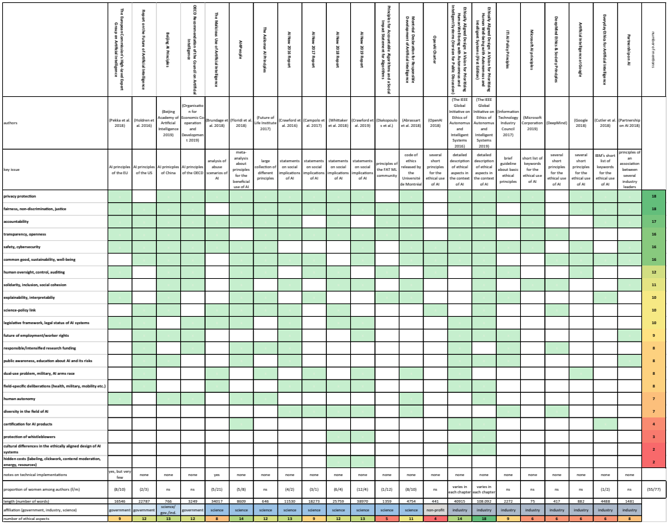
- The paper analyzes and compares 22 AI ethics guidelines and finds that accountability, privacy, and fairness appear in about 80% of them, making them the closest thing to a common minimum standard.
- The author reports that guidelines from industrial contexts name on average 9.1 distinct ethical aspects, while science-based ethics codes average 10.8.
- Only two guidelines contain genuinely technical explanations, and these are described as very sparse; the most extensive technical commentary is in “The Malicious Use of AI”.
- The paper says a controlled study found the effectiveness of ethics guidelines or codes to be “almost zero”: among 63 software engineering students and 105 professional software developers, there was no statistically significant difference in responses between those who did and did not see the ACM code of ethics.
- The paper highlights major omissions across guidelines, including political abuse of AI, hidden social and ecological costs, lack of diversity, robot ethics, trolley problems, and public-private partnerships/industry-funded research.
## Methods
- Semi-systematic literature analysis of AI ethics guidelines, with a deliberate focus on comprehensive guideline documents rather than all AI-ethics-related writings.
- The final sample consisted of 22 major ethical guidelines, identified through searches in Google, Google Scholar, Web of Science, ACM Digital Library, arXiv, and SSRN, plus manual reference screening and the Algorithm Watch AI Ethics Guidelines Global Inventory.
- The paper compares which ethical issues are present or absent in the guidelines, and then relates those principles to practice using cited empirical studies and examples from AI development and deployment.
## Limitations
- The author states the sample is biased toward western/northern documents and excludes guidelines not written in English.
- The selection deliberately excludes guidelines focused on robot ethics, big data, algorithms, or robotics, so omissions in those areas are partly a result of the sampling method.
- The paper notes that its list of omissions is non-exhaustive.
- Evident from the text: the paper is primarily a theoretical/semi-systematic overview, not a direct empirical test of all AI ethics guideline implementations.
Model-written summary. Check it against the paper before relying on it.
Integrity signals
Registry
Cites
Statistics
Figures
Verification
Claims the paper makes
5 Valid · 3 Not valid · 62 Not checked · 64 Own results and interpretations
The cited sources support only part of this claim — read each source’s verdict below.
In the paper
“So far, some papers have been published on the subject of teaching ethics to data scientists (Garzcarek and Steuer 2019; Burton etal. 2017; Goldsmith and Burton 2017; Johnson 2017) but by and large very little to nothing has been written about the tangible implementation of ethical goals and values.”
What the sources say
- Supportedcites Garzcarek and Steuer 2019 matched to “Approaching Ethical Guidelines for Data Scientists” (2019) source
The citation is attached to the statement that papers have discussed teaching ethics to data scientists, not to the citing authors’ subsequent assessment of writing on tangible implementation. Section 5.2 (p. 14) explicitly argues that ethics should be part of the data-science curriculum. (LLM, conf=0.90)
- Not matchedcites Burton etal. 2017
An author–year citation the paper’s reference list doesn’t settle. We don’t search these by name.
- Supportedcites Goldsmith and Burton 2017 matched to “Why Teaching Ethics to AI Practitioners Is Important” (2017) source
The citation appears in a list of papers about teaching ethics to data scientists, not as support for the sentence’s later claim about how little has been written on implementation. The Introduction (p. 1) presents the paper as an argument for ethical training for AI students and practitioners, and the Conclusions (p. 4) advocate teaching ethics in AI classes. (LLM, conf=0.91)
plain- Asserted: passes — The authors put it forward as true.
- Checkable: passes — It can be checked against evidence.
- Load-bearing: passes — The paper’s conclusions depend on it.
- Based: passes — The paper gives a reason why it holds.
- Supported
The cited sources support only part of this claim — read each source’s verdict below.
In the paper
“Leading, of course, is the military use of AI in cyber warfare or regarding weaponized unmanned vehicles or drones (Ernest and Carroll 2016; Anderson and Waxman 2013).”
What the sources say
- Partly supportedcites Ernest and Carroll 2016 matched to “Genetic Fuzzy based Artificial Intelligence for Unmanned Combat Aerial Vehicle Control in Simulated Air Combat Missions” (2016) sourceExperimental — accuracy not yet measured
Our copy does support the drone half of the claim as an identification citation: the paper is squarely about applying AI to a weaponized unmanned vehicle (Introduction: UCAV research, 'this white paper will primarily focus on the increase in capabilities of real-time decision making'; Problem Statement: ALPHA controlling aircraft motion and firing in AFSIM). But it does not support the claim's core assertion that military AI is a leading area of unwanted side effects and malevolent use — the nearest passage (Introduction, 'There are a number of obstacles to a system being an effective AI within this context') frames the issues as engineering and verification difficulties (adversaries trying to 'fool and exploit the system', V&V, safety specifications, crashes/sensor failures), and the Results and Conclusions treat autonomy as 'a revolutionary leap in capability of airpower' and a way of 'reducing risk to our pilots'. Cyber appears only once, as an unrelated civilian/defence application domain of the GFT method ('Examples include robotic surgery, design automation, and cyber security'), not as cyber warfare, so that element of the claim is not from this source. (LLM, conf=0.72)
- Not checked — no full text of the sourcecites Anderson and Waxman 2013 matched to “Law and Ethics for Autonomous Weapon Systems: Why a Ban Won't Work and How the Laws of War Can” (2013) source
boostedstates an association- Asserted: passes — The authors put it forward as true.
- Checkable: passes — It can be checked against evidence.
- Load-bearing: unclear — It is unclear whether the paper’s conclusions depend on it.
- Based: passes — The paper gives a reason why it holds.
- Partly supported
The cited sources support only part of this claim — read each source’s verdict below.
In the paper
“In the light of these two approaches, the traditional type of AI ethics can be assigned to the deontological concept (Mittelstadt 2019).”
What the sources say
- Partly supportedcites Mittelstadt 2019 matched to “Principles alone cannot guarantee ethical AI” (2019) sourceExperimental — accuracy not yet measured
The paper describes a prominent, principle-based approach to AI ethics and says AI ethics initiatives have converged around principles resembling those of medical ethics (opening section; page unavailable). It does not classify that approach as deontological, so the claimed assignment to the deontological concept is not supported by our copy. (LLM, conf=0.78)
plainstates an association- Asserted: passes — The authors put it forward as true.
- Checkable: passes — It can be checked against evidence.
- Load-bearing: passes — The paper’s conclusions depend on it.
- Based: passes — The paper gives a reason why it holds.
- Partly supported
A result the paper reports from its own data — it cites no other source for it, so there is none to check. The quote shows it is in the paper.
In the paper
“My analysis of the distribution of female and male authors of the guidelines, as far as authors were indicated in the documents, showed that the proportion of women was 41.7%.”
plain- Asserted: passes — The authors put it forward as true.
- Checkable: passes — It can be checked against evidence.
- Load-bearing: passes — The paper’s conclusions depend on it.
- Based: passes — The paper gives a reason why it holds.
A result the paper reports from its own data — it cites no other source for it, so there is none to check. The quote shows it is in the paper.
In the paper
“Finally, yet importantly, it is noteworthy that almost all guidelines suggest that technical solutions exist for many of the problems described.”
hedged- Asserted: passes — The authors put it forward as true.
- Checkable: passes — It can be checked against evidence.
- Load-bearing: unclear — It is unclear whether the paper’s conclusions depend on it.
- Based: passes — The paper gives a reason why it holds.
54 more claims
Create a free account to see all 134 claims and to verify the 1 reference still open.
- Probably not a substantial claim. 59
- It may state two separate claims as one. 29
Claims other papers make about this one
Each is checked against this paper’s own text: does it say what the citing paper says it does?
The source backs part of the claim, not all of it — or backs it for a different population, condition or comparison.
In the citing paper
“Ethical concerns arising from the design and deployment of AI technology have motivated a number of initiatives [47]—such as the Ethical Guidelines for Trustworthy AI by the European Commission expert group on AI, and Microsoft’s FATE: Fairness, Accountability, Transparency, and Ethics in AI—addressing issues including mitigating bias and discrimination in AI systems and fairness in the use of AI”
From Future directions for chatbot research: An interdisciplinary research agenda (2021) · cites this paper as [47]
Experimental — accuracy not yet measuredThe source backs part of the claim, not all of it — or backs it for a different population, condition or comparison.
In the citing paper
“Additional recommendations on AI ethics teaching content include “explainability,” “liability,” and “accountability,” which are also considered important by available guidelines [30,40].”
From Proposing a Principle-Based Approach for Teaching AI Ethics in Medical Education (2024) · cites this paper as [30]
Experimental — accuracy not yet measuredThe source backs part of the claim, not all of it — or backs it for a different population, condition or comparison.
In the citing paper
“This emphasis is also echoed by existing guidelines and frameworks regarding AI ethics [30].”
From Proposing a Principle-Based Approach for Teaching AI Ethics in Medical Education (2024) · cites this paper as [30]
Experimental — accuracy not yet measuredThe source backs part of the claim, not all of it — or backs it for a different population, condition or comparison.
In the citing paper
“En dépit de nombreuses chartes, discussions et nombreux documents sur les bonnes pratiques éthiques, l’espoir est faible que l’IA puisse éventuellement se montrer généralement conforme (Hagendorff, 2020) :”
From Gouvernance algorithmique, intelligence artificielle, enjeux, éthique : esquisse d’une analyse critique (2021) · cites this paper as Hagendorff, 2020
Experimental — accuracy not yet measuredThe source backs part of the claim, not all of it — or backs it for a different population, condition or comparison.
In the citing paper
“The experience of mixed emotional responses and ethnical navigation was supported by literature (Hagendorff, 2020;Mamo et al., 2024;Mittelstadt, 2019).”
From Into the Unknown: AI Adoption and Job Satisfaction of Christian Faculty (2026) · cites this paper as Hagendorff, 2020
Experimental — accuracy not yet measured
13 more claims about this paper
Create a free account to see every claim other papers make about this one.
Citations
Cites
The spread of true and false news online
Vosoughi, S., Roy, D., & Aral, S. (2018) · Science · doi:10.1126/science.aap9559 · Cited by 8,847
The future of employment: How susceptible are jobs to computerisation?
Frey, C. B., & Osborne, M. A. (2017) · Technological Forecasting and Social Change · doi:10.1016/j.techfore.2016.08.019 · Cited by 8,727
The global landscape of AI ethics guidelines
Jobin, A., Ienca, M., & Vayena, E. (2019) · Nature Machine Intelligence · doi:10.1038/s42256-019-0088-2 · Cited by 6,220
Floridi, L., Cowls, J., Beltrametti, M., Chatila, R., Chazerand, P., Dignum, V., Luetge, C., Madelin, R., Pagallo, U., Rossi, F., et al. (2018) · Minds and Machines · doi:10.1007/s11023-018-9482-5 · Cited by 4,774 · cited 2×
“They include the adoption of legal framework conditions, the establishment of mechanisms for an independent auditing of technologies, the establishment of institutions for complaints, which also compensate for harms caused by AI systems, and the expansion of university curricula in particular through content from ethi…”
Background(2011) · Cited by 4,430
Lazer, D. M. J., Baum, M. A., Benkler, Y., Berinsky, A. J., Greenhill, K. M., Menczer, F., Metzger, M. J., Nyhan, B., Pennycook, G., Rothschild, D., et al. (2018) · Science · doi:10.1126/science.aao2998 · Cited by 4,160
The Black Box Society: The Secret Algorithms That Control Money and Information
Pasquale, F. (2015) · doi:10.4159/harvard.9780674736061 · Cited by 3,796
Experimental evidence of massive-scale emotional contagion through social networks
Kramer, A. D. I., Guillory, J. E., & Hancock, J. T. (2014) · Proceedings of the National Academy of Sciences · doi:10.1073/pnas.1320040111 · Cited by 3,687
(2018) · Cited by 3,510
Private traits and attributes are predictable from digital records of human behavior
Kosinski, M., Stillwell, D., & Graepel, T. (2013) · Proceedings of the National Academy of Sciences · doi:10.1073/pnas.1218772110 · Cited by 2,829
Research works printed but not linked: 24
- Abrassart, C., Bengio, Y., Chicoisne, G., de Marcellis-Warin, N., Dilhac, M.-A., Gambs, S., Gautrais, V., etal. (2018). Montréal declaration for responsible development of artificial intelligence (pp. 1-21).
- Asimov, I. (2004). I, Robot . New York: Random House LLC.
- Bakewell, J. D., Clement-Jones, T. F., Giddens, A., Grender, R. M., Hollick, C. R., Holmes, C., Levene, P. K. etal. (2018). AI in the UK: Ready, willing and able?. Select committee on artificial intelligence (pp. 1-183).
- Baron, B., Musolesi, M. (2017). Interpretable machine learning for privacy-preserving pervasive systems. arXiv (pp. 1-10).
- Bourdieu, P. (1984). Distinction: A social critique of the judgement of taste . Cambridge: Harvard University Press.
- Brahnam, S. (2006). Gendered bots and bot abuse. In Antonella de Angeli, Sheryl Brahnam, Peter Wallis, & Peter Dix (Eds.), Misuse and abuse of interactive technologies (pp. 1-4). Montreal: ACM.
- Derrida, J. (1997). Of grammatology . Baltimore: Johns Hopkins Univ. Press.
- Gebru, T., Morgenstern, J., Vecchione, B., Vaughan, J. W., Wallach, H., Daumeé, III, H., Crawford, K. (2018). Datasheets for datasets. arXiv (pp. 1-17).
- Google. (2019). Perspectives on issues in AI governance (pp. 1-34). Retrieved February 11, 2019. https :// ai.googl e/stati c/docum ents/persp ectiv es-on-issue s-in-ai-gover nance .pdf.
- Helbing, D. (Ed.). (2019). Towards digital enlightment: Essays on the darf and light sides of the digital revolution. Cham: Springer.
- Johnson, D. G. (2017). Can engineering ethics be taught? The Bridge, 47 (1), 59-64.
- Luhmann, N. (1988). Die Wirtschaft der Gesellschaft . Frankfurt A.M: Suhrkamp.
- Morley, J., Floridi, L., Kinsey, L., Elhalal, A. (2019). From what to how. An overview of AI ethics tools, methods and research to translate principles into practices. arXiv (pp. 1-21).
- Organisation for Economic Co-operation and Development. (2019). Recommendation of the Council on Artificial Intelligence (pp. 1-12). Retrieved June 18, 2019. https ://legal instr ument s.oecd.org/en/ instr ument s/OECD-LEGAL -0449.
- Pekka, A.-P., Bauer, W., Bergmann, U., Bieliková, M., Bonefeld-Dahl, C., Bonnet, Y., Bouarfa, L. etal. (2018). The European Commission's high-level expert group on artificial intelligence: Ethics guidelines for trustworthy ai . Working Document for stakeholders' consultation. Brussels (pp. 1-37).
- Pistono, F., Yampolskiy, R. (2016). Unethical research: How to create a malevolent artificial intelligence. arXiv (pp. 1-6).
- Podgaiska, I., Shklovski, I. Nordic engineers’ stand on artificial intelligence and ethics: Policy recommendations and guidelines (pp. 1–40).
- Rawls, J. (1975). Eine Theorie Der Gerechtigkeit . Frankfurt am Main: Suhrkamp.
- Shoham, Y., Perrault, R., Brynjolfsson, E., Clark, J., Manyika, J., Niebles, J. C., Lyons, T., Etchemendy, J., Grosz, B., Bauer, Z. (2018). The AI index 2018 annual report. Stanford, Kalifornien (pp. 1-94). <!-- image --> 1 3
- Sitawarin, C., Bhagoji, A. N., Mosenia, A., Chiang, M., Mittal, P. (2018). DARTS: Deceiving autonomous cars with toxic signs. arXiv (pp. 1-27).
- Tegmark, A. (2017). Life 3.0: Being human in the age of artificial intelligence . New York: Alfred A. Knopf.
- The IEEE Global Initiative on Ethics of Autonomous and Intelligent Systems. (2016). Ethically aligned design: A vision for prioritizing human well-being with artificial intelligence and autonomous systems (pp. 1-138).
- Whittaker, M., Crawford, K., Dobbe, R., Fried, G., Kaziunas, E., Mathur, V., West, S. M., Richardson, R., Schultz, J., Schwartz, O. (2018). AI now report 2018 (pp. 1-62).
- Zeng, Y., Lu, E., Huangfu, C. (2018). Linking artificial intelligence principles. arXiv (pp. 1-4). Publisher's Note Springer Nature remains neutral with regard to jurisdictional claims in published maps and institutional affiliations. <!-- image --> 1 3
Cited by
Items 301–400 of 1,821
Inherent Limitations of AI Fairness
Buyl, M., & Bie, T. D. (2024) · Communications of the ACM · doi:10.1145/3624700 · Cited by 73
“24 The complexity of fairness may not only lead to obscure commitments toward it; its many degrees of freedom may also be abused to create or intensify injustice.”
BackgroundMøller, L. A. (2023) · Digital Journalism · doi:10.1080/21670811.2023.2215832 · Cited by 58
“These written value definitions generally reflect how scholars have specified the ethical behaviour of technical systems (see Hagendorff 2020 for an overview).”
Artificial Intelligence in Education - Ethical framework
Gartner, S., & Krašna, M. (2023) · Mediterranean Conference on Embedded Computing (MECO) · doi:10.1109/meco58584.2023.10155012 · Cited by 61
“Codes [28] change rapidly and indicate a rapidly changing field, inconsistencies and sometimes also a misunderstanding of society or a misunderstanding of AI.”
BackgroundWho is responsible? US Public perceptions of AI governance through the lenses of trust and ethics
David, P., Choung, H., & Seberger, J. S. (2024) · Public Understanding of Science · doi:10.1177/09636625231224592 · Cited by 62
“Furthermore, technology companies, professional organizations, and multinational coalitions have offered ethical frameworks for corporate self-governance (Hagendorff, 2020; Jobin et al., 2019).”
AI-powered growth hacking: benefits, challenges and pathways
Santoro, G., Jabeen, F., Klieštik, T., & Bresciani, S. (2024) · Management Decision · doi:10.1108/md-10-2023-1964 · Cited by 59
Kacperski, C., Ulloa, R., Bonnay, D., Kulshrestha, J., Selb, P., & Spitz, A. (2025) · PLoS ONE · doi:10.1371/journal.pone.0309047 · Cited by 63
“The AI field also lacks diversity: Hagendorff highlights this within the AI community, pointing out that this leads to spaces and algorithms that do not represent a diverse user base [97].”
From Learning to Relearning: A Framework for Diminishing Bias in Social Robot Navigation
Hurtado, J. V., Londoño, L., & Valada, A. (2021) · Frontiers in Robotics and AI · doi:10.3389/frobt.2021.650325 · Cited by 51
Automated scholarly paper review: Concepts, technologies, and challenges
Lin, J., Song, J., Zhou, Z., Chen, Y., & Shi, X. (2023) · Information Fusion · doi:10.1016/j.inffus.2023.101830 · Cited by 37
“The rapid development of AI has been accompanied by increasing discussions about its morality and ethics (Jobin et al, 2019; Hagendorff, 2020).”
BackgroundAchieving a data-driven risk assessment methodology for ethical AI
Felländer, A., Rebane, J., Larsson, S., Wiggberg, M., & Heintz, F. (2022) · Digital Society · doi:10.1007/s44206-022-00016-0 · Cited by 36
A Systematic Review of Fairness in Artificial Intelligence Algorithms
Xivuri, K., & Twinomurinzi, H. (2021) · Lecture notes in computer science · doi:10.1007/978-3-030-85447-8_24 · Cited by 52
The AI ethics maturity model: a holistic approach to advancing ethical data science in organizations
Krijger, J., Thuis, T., de Ruiter, M., Ligthart, E., & Broekman, I. (2022) · AI and Ethics · doi:10.1007/s43681-022-00228-7 · Cited by 63
“…approach in AI ethics has been criticized for the ambiguity of the principles (Dignum and Theodorou [26]; [13], the lack of accountability mechanisms to enforce normative claims [11] and the missing infrastructure for practical implementation [18] have grown significantly in recent years.”
BackgroundMoore, S., Liao, Q. V., & Subramonyam, H. (2023) · CHI Conference on Human Factors in Computing Systems · doi:10.1145/3544548.3581242 · Cited by 51
“In many cases, this results in an isolated AI experience design and development (AIX) process in which engineers develop the model with a limited understanding of its precise usage context while designers conceptualize the user experience with little direct exposure to the underlying technology.”
BackgroundBecker, S. J., Nemat, A. T., Lucas, S., Heinitz, R. M., Klevesath, M., & Charton, J. E. (2022) · AI & Society · doi:10.1007/s00146-021-01376-w · Cited by 75
“…attempts to compare this abundance of heterogeneous and yet overlapping documents, to extract common core principles and recurring topics from them and to synthesise these into unified frameworks of digital or AI ethics (Floridi et al. 2018; Jobin et al. 2019; Fjeld et al. 2020; Hagendorff 2020).”
Revisiting PR professionalism and ethics in the generative AI era through PR practitioners’ insights
Dong, C., & van den Berg, M. (2025) · Public Relations Review · doi:10.1016/j.pubrev.2025.102582 · Cited by 36
Politics by Automatic Means? A Critique of Artificial Intelligence Ethics at Work
Cole, M., Cant, C., Ustek Spilda, F., & Graham, M. (2022) · Frontiers in Artificial Intelligence · doi:10.3389/frai.2022.869114 · Cited by 31
Data privacy: From transparency to fairness
Wu, C. (2024) · Technology in Society · doi:10.1016/j.techsoc.2024.102457 · Cited by 62
Objective metrics for ethical AI: a systematic literature review
Palumbo, G., Carneiro, D. R., & Alves, V. (2024) · International Journal of Data Science and Analytics · doi:10.1007/s41060-024-00541-w · Cited by 69
Harnessing Artificial Intelligence: Pioneering Sustainable Solutions for a Greener Future
Durai, S., Manoharan, G., & Ashtikar, S. P. (2024) · Advances in finance, accounting, and economics book series · doi:10.4018/979-8-3693-2881-1.ch003 · Cited by 38
Khan, N. A. (2024) · Journal of Hospitality and Tourism Insights · doi:10.1108/jhti-10-2023-0725 · Cited by 44
Tomášik, J., Zsoldos, M., Majdáková, K., Fleischmann, A., Oravcová, Ľ., Ballová, D., & Thurzo, A. (2024) · Applied Sciences · doi:10.3390/app14177837 · Cited by 40
Biases in AI: acknowledging and addressing the inevitable ethical issues
Hofmann, B. (2025) · Frontiers in Digital Health · doi:10.3389/fdgth.2025.1614105 · Cited by 63
“Especially economic incentives are easily overriding commitment to ethical principles and values ” (18).”
InfluentialAI human impact: toward a model for ethical investing in AI-intensive companies
Brusseau, J. (2020) · Journal of Sustainable Finance & Investment · doi:10.1080/20430795.2021.1874212 · Cited by 58
Towards intellectual freedom in an AI Ethics Global Community
Ebell, C., Baeza-Yates, R., Benjamins, R., Cai, H., Coeckelbergh, M., Duarte, T., Hickok, M., Jacquet, A., Kim, A., Krijger, J., et al. (2021) · AI and Ethics · doi:10.1007/s43681-021-00052-5 · Cited by 34
Integrating a Blockchain-Based Governance Framework for Responsible AI
Asif, R., Hassan, S. R., & Parr, G. P. (2023) · Future Internet · doi:10.3390/fi15030097 · Cited by 57
A Systematic Review of Fairness, Accountability, Transparency, and Ethics in Information Retrieval
Bernard, N., & Balog, K. (2025) · ACM Computing Surveys · doi:10.1145/3637211 · Cited by 67
“Indeed, there are surveys of ethical guidelines for AI [44, 50] as well as work on the ethical design of AI systems [14].”
Camaréna, S. (2021) · Sustainability · doi:10.3390/su13169314 · Cited by 41
Caring in the in-between: a proposal to introduce responsible AI and robotics to healthcare
Vallès-Peris, N., & Domènech, M. (2021) · AI & Society · doi:10.1007/s00146-021-01330-w · Cited by 48
“…issue can be seen, for example, in the scarce attention given to the tensions that might arise between commercial or business interests and issues linked to the needs and organization of care, in the various guidelines and regulatory mechanisms for AI systems, including robots (Hagendorff 2020).”
BackgroundInfluentialTaddeo, M., Blanchard, A., & King, T. C. (2024) · Philosophy & Technology · doi:10.1007/s13347-024-00710-6 · Cited by 48
““[…] considered as extraneous, as surplus or some kind of “add-on” to technical concerns, as unbinding framework that is imposed from institutions “out-side” of the technical community” (Hagendorff, 2020, 113).”
Ethics in AI through the practitioner’s view: a grounded theory literature review
Pant, A., Hoda, R., Tantithamthavorn, C. K., & Turhan, B. (2024) · Empirical Software Engineering · doi:10.1007/s10664-024-10465-5 · Cited by 66
“There are numerous and divergent views on the topic of ethics in AI (Vakkuri et al. 2020b; Mittelstadt2019;Hagendorff2020),asithasbeenincreasinglyappliedinvariouscontextsand industries(Kessing2021).”
A consumer acceptance model in the artificial intelligence era
Pramanik, P., & Jana, R. K. (2025) · Management Decision · doi:10.1108/md-03-2024-0574 · Cited by 45
Regulation of Artificial Intelligence in BRICS and the European Union
Cyman, D., Gromova, E. A., & Juchnevicius, E. (2021) · BRICS Law Journal · doi:10.21684/2412-2343-2021-8-1-86-115 · Cited by 53
Enter the metrics: critical theory and organizational operationalization of AI ethics
Krijger, J. (2021) · Ai & Society · doi:10.1007/s00146-021-01256-3 · Cited by 29
Future Shock: Generative AI and the International AI Policy and Governance Crisis
Leslie, D., & Perini, A. M. (2024) · Harvard Data Science Review · doi:10.1162/99608f92.88b4cc98 · Cited by 33
An external stability audit framework to test the validity of personality prediction in AI hiring
Rhea, A. K., Markey, K., D’Arinzo, L., Schellmann, H., Sloane, M., Squires, P., Khan, F. A., & Stoyanovich, J. (2022) · Data Mining and Knowledge Discovery · doi:10.1007/s10618-022-00861-0 · Cited by 57
All that glitters is not gold: trustworthy and ethical AI principles
Rees, C., & Müller, B. (2022) · AI and Ethics · doi:10.1007/s43681-022-00232-x · Cited by 47
“In a paper considering the ethical nature of AI ethics documents Hagendorff found policies not just by smaller bodies but as large in scale as Google to have vague and superficial principles set to provide a guideline and a framework, but in actuality suggests and provides little in the way of practical resources to t…”
Background(Re)politicising data-driven education: from ethical principles to radical participation
Knox, J. (2022) · Learning Media and Technology · doi:10.1080/17439884.2022.2158466 · Cited by 45
“…criticism, chie fl y in the form of questioning the extent to which ethical principles for data-driven technologies are published cynically, often as a way of private companies avoiding regulation or the need to take practical action (Hagendor ff 2020; Benkler 2019; Yeung, Howes, and Pogrebna 2020).”
BackgroundInfluentialThe emergent role of explainable artificial intelligence in the materials sciences
Liu, T., & Barnard, A. S. (2023) · Cell Reports Physical Science · doi:10.1016/j.xcrp.2023.101630 · Cited by 47
Kozak, J., & Fel, S. (2024) · Religions · doi:10.3390/rel15030331 · Cited by 41
Lukkien, D., Stolwijk, N. E., Askari, S. I., Hofstede, B. M., Nap, H. H., Boon, W., Peine, A., Moors, E. H. M., & Minkman, M. M. N. (2024) · JMIR Nursing · doi:10.2196/55962 · Cited by 69
“Studies that have compared responsible AI frameworks emphasize a general consensus around high-level principles, such as transparency, justice, fairness, and nonmaleficence [28-30].”
BackgroundVandemeulebroucke, T. (2024) · Pflügers Archiv - European Journal of Physiology · doi:10.1007/s00424-024-02984-3 · Cited by 44
Pawelec, M. (2024) · AI and Ethics · doi:10.1007/s43681-024-00542-2 · Cited by 54
“Moreover, AI princi - ples are criticized on practical grounds, e.g., for their lack of operationalization [22] and the “principles-practice gap” [38, 39 ].”
Reconstructing AI Ethics Principles: Rawlsian Ethics of Artificial Intelligence
Westerstrand, S. (2024) · Science and Engineering Ethics · doi:10.1007/s11948-024-00507-y · Cited by 48
“Rawlsian guidelines also offer a philosophically justified ground called for by Franzke (2022), and keep in mind the societal context created by democratic institutions—the lack of which was previously noted by Hagendorff (2020).”
BackgroundMethodInfluentialFactors influencing trust in algorithmic decision-making: An indirect scenario-based experiment
Marmolejo-Ramos, F., Marrone, R., Korolkiewicz, M., Gabriel, F., Siemens, G., Joksimovic, S., Yamada, Y., Mori, Y., Rahwan, T., Sahakyan, M., et al. (2025) · Frontiers in Artificial Intelligence · doi:10.3389/frai.2024.1465605 · Cited by 33
Henriksen, A., Enni, S. A., & Bechmann, A. (2021) · Proceedings of the AAAI/ACM Conference on AI Ethics and Society · doi:10.1145/3461702.3462564 · Cited by 54
Why Do Companies Employ Prohibited Unethical Artificial Intelligence Practices?
Méndez-Suárez, M., de Obesso, M. D. L. M., Márquez, Ó. C., & Palacios, C. M. (2023) · IEEE Transactions on Engineering Management · doi:10.1109/tem.2023.3258686 · Cited by 37
“However, there is no legal framework that truly regulates companies’ ethics of AI; rather companies try to convince legis-lators that there is no need for it and that self-management is suf-ficient [25].”
BackgroundNon-western AI ethics guidelines: implications for intercultural ethics of technology
Hongladarom, S., & Bandasak, J. (2023) · AI & Society · doi:10.1007/s00146-023-01665-6 · Cited by 47
“In another important study, Thilo Hagendorff (Hagen-dorff 2020) focuses on only 22 AI ethics guidelines, and found that the five most frequently mentioned principles are privacy protection, justice and fairness, accountability, transparency, and cybersecurity or safety (Hagendorff 2020, p. 102).”
InfluentialAI ethics as subordinated innovation network
Steinhoff, J. (2023) · AI & Society · doi:10.1007/s00146-023-01658-5 · Cited by 47
“This is striking because these aspects “are those for which technical fixes can be or have already been developed” and “those which may be “most easily operationalized mathematically and … implemented in terms of technical solutions” (Hagendorff 2020, p. 103).”
Bridging the public administration‐AI divide: A skills perspective
Trajkovski, G. (2024) · Public Administration and Development · doi:10.1002/pad.2061 · Cited by 53
Nguyen, H., Nguyen, V., Ludovise, S., & Santagata, R. (2025) · British Journal of Educational Technology · doi:10.1111/bjet.13568 · Cited by 54
Nandutu, I., Atemkeng, M., & Okouma, P. (2021) · AI & Society · doi:10.1007/s00146-021-01285-y · Cited by 43
“This prevalence is partially due to (1) the non-existence of guidelines that focus on AI Ethics, (2) the lack of normative values, and (3) the limited implementation of these guidelines into AI tools and technologies (Hagendorff 2020).”
BackgroundCultivating Moral Attention: a Virtue-Oriented Approach to Responsible Data Science in Healthcare
Ratti, E., & Graves, M. (2021) · Philosophy & Technology · doi:10.1007/s13347-021-00490-3 · Cited by 39
“We consider our approach a “microethics” (Bezuidenhout & Ratti, 2020; Hagendorff, 2020a; Komesaroff, 1995), and we conceive it as a form of ethical training and exercise in which the goal for a data scientist is to learn how to identify the ethical relevance of his/her day-to-day activities.”
BackgroundMethodInfluentialArtificial intelligence ELSI score for science and technology: a comparison between Japan and the US
Hartwig, T., Ikkatai, Y., Takanashi, N., & Yokoyama, H. (2022) · AI & Society · doi:10.1007/s00146-021-01323-9 · Cited by 38
“In the World Values Survey Wave 7 (2017–2020), the respondents who agreed (those who chose option 6–10 (= a lot better off) among 10 scales) that the world is better off because of S&T was higher in the US (75”
BackgroundAI ethics and learning: EdTech companies’ challenges and solutions
Kousa, P., & Niemi, H. (2022) · Interactive Learning Environments · doi:10.1080/10494820.2022.2043908 · Cited by 54
“According to Hagendor ff (2020), ethical guidelines rarely help companies in their decision-making processes and self-regulation is much more preferred.”
BackgroundInfluentialWho is Helping Whom? Student Concerns about AI-Teacher Collaboration in Higher Education Classrooms
Han, B., Coghlan, S., Buchanan, G., & McKay, D. (2025) · Proceedings of the ACM on Human-Computer Interaction · doi:10.1145/3711104 · Cited by 31
“We would therefore re-emphasize to the CSCW and HCI communities the importance of a holistic approach, one that considers AI, teachers, students, and the learning environment as an interconnected whole, rather than isolating AI in a technical vacuum [53].”
YEŞİLKAYA, N. (2022) · e-Şarkiyat İlmi Araştırmaları Dergisi/Journal of Oriental Scientific Research (JOSR) · doi:10.26791/sarkiat.1189864 · Cited by 41
Discerning Between the “Easy” and “Hard” Problems of AI Governance
Minkkinen, M., & Mäntymäki, M. (2023) · IEEE Transactions on Technology and Society · doi:10.1109/tts.2023.3267382 · Cited by 43
“Concerning the ethical basis of AI governance, the current approaches to the “easy problem” primarily build on deontology—that is, the obligation to adhere to principles and rules—although virtue ethics has also been promoted as a promising approach [54].”
BackgroundDutta, D., & Poyil, A. K. (2023) · Personnel Review · doi:10.1108/pr-09-2022-0658 · Cited by 45
Lessons Learned from Assessing Trustworthy AI in Practice
Vetter, D., Amann, J., Bruneault, F., Coffee, M. P., Düdder, B., Gallucci, A., Gilbert, T. K., Hagendorff, T., van Halem, I., Hickman, E., et al. (2023) · Digital Society · doi:10.1007/s44206-023-00063-1 · Cited by 42
“These efforts have resulted in the existence of nearly 100 high-level guidelines for the development of ethical AI (Datenethikkommission, 2019; Hagendorff, 2020; Jobin et al., 2019; Mittelstadt et al., 2016; Morley et al., 2021; Schiff et al., 2020; Zeng et al., 2018).”
Self-citationEthics of artificial intelligence in embryo assessment: mapping the terrain
Koplin, J. J., Johnston, M., Webb, A. N. S., Whittaker, A. M., & Mills, C. (2024) · Human Reproduction · doi:10.1093/humrep/deae264 · Cited by 34
Türk, N., Batuk, B., Kaya, A., & YILDIRIM, O. (2025) · BMC Psychology · doi:10.1186/s40359-025-03559-2 · Cited by 50
On the risk of confusing interpretability with explicability
Herzog, C. (2021) · AI and Ethics · doi:10.1007/s43681-021-00121-9 · Cited by 36
“Calls for rendering artificial intelligence (AI) explainable have surfaced in many proposals for AI ethics guidelines, oftentimes even elevating ‘explicability’ to an ethical principle [10].”
BackgroundLehoux, P., Rivard, L., de Oliveira, R. R., Mörch, C., & Alami, H. (2022) · International Journal of Medical Informatics · doi:10.1016/j.ijmedinf.2022.104933 · Cited by 38
No such thing as one-size-fits-all in AI ethics frameworks: a comparative case study
Qiang, V., Rhim, J., & Moon, A. (2023) · AI & Society · doi:10.1007/s00146-023-01653-w · Cited by 38
“Unlike hard governance mechanisms such as the rule of law, ethics does not have enforcement mechanisms beyond voluntary and non-binding cooperation between stakeholders in AI (Hagendorff 2020).”
Towards a Human-Centred Artificial Intelligence Maturity Model
Hartikainen, M., Väänänen, K., & Olsson, T. (2023) · CHI Conference Extended Abstracts on Human Factors in Computing Systems (CHI EA) · doi:10.1145/3544549.3585752 · Cited by 41
Ethics and Transparency Issues in Digital Platforms: An Overview
Mirghaderi, L., Sziron, M., & Hildt, E. (2023) · AI · doi:10.3390/ai4040042 · Cited by 47
TAI-PRM: trustworthy AI—project risk management framework towards Industry 5.0
Vyhmeister, E., & Castañé, G. G. (2024) · AI and Ethics · doi:10.1007/s43681-023-00417-y · Cited by 51
“However, the study does not provide specific definitions for handling AI assets throughout their life cycle [15, 21].”
Kurata, L., Ayanwale, M. A., Molefi, R. R., & Sanni, T. (2024) · International Journal of Educational Research Open · doi:10.1016/j.ijedro.2024.100417 · Cited by 67
Intelligent Edge Computing and Machine Learning: A Survey of Optimization and Applications
Cajas, S. A., Samanta, J., Suárez‐Cetrulo, A. L., & Carbajo, R. S. (2025) · Future Internet · doi:10.3390/fi17090417 · Cited by 57
“This includes addressing data privacy, algorithmic bias, intellectual property protection, and embedding ethical reflection into development practices for network applications [279].”
Chatterjee, S., Chakraborty, S., Fulk, H. K., & Sarker, S. (2020) · International Journal of Information Management · doi:10.1016/j.ijinfomgt.2020.102261 · Cited by 36
Cremer, D. D., Narayanan, D., Deppeler, A., Nagpal, M., & McGuire, J. (2021) · AI and Ethics · doi:10.1007/s43681-021-00116-6 · Cited by 22
“The past few years have seen numerous frameworks, principles and policy documents, but little in the way of actually enforceable regulation [15, 16].”
BackgroundFrom the ground up: developing a practical ethical methodology for integrating AI into industry
Anderson, M. M., & Fort, K. (2022) · AI & Society · doi:10.1007/s00146-022-01531-x · Cited by 39
“…general, it covers a broad field, and focuses on many issues which are sometimes not directly relevant to the industrial context, e.g., social cohesion, diversity in the field of AI, public awareness of AI, and field specific deliberations (health, military, etc.), among others (Hagendorff 2020).”
BackgroundGrasping AI: experiential exercises for designers
Murray-Rust, D., Lupetti, M. L., Nicenboim, I. P., & van der Hoog, W. (2023) · AI & Society · doi:10.1007/s00146-023-01794-y · Cited by 42
“AI ethics is a broad field (Hagendorff 2020), and well as directly affecting sys-tem properties, work from the Fairness Accountability and Transparency (FAccT) community looks to support documentation that helps maintain these properties in communities, such as documentation for models and datasets…”
Weidener, L., & Fischer, M. (2024) · JMIR AI · doi:10.2196/51204 · Cited by 39
“In the context of AI-based applications in medicine, the principle of autonomy often refers to the development of technologies that support and enhance patient decision-making while maintaining transparency, explainability, and accountability [23,24].”
BackgroundAI Guidelines and Ethical Readiness Inside SMEs: A Review and Recommendations
Soudi, M., & Bauters, M. (2024) · Digital Society · doi:10.1007/s44206-024-00087-1 · Cited by 53
“…Golbin et al., 2020; Hengstler et al., 2016; Hickman & Petrin, 2020; Jobin et al., 2019; Larson et al., 2020; Milosevic, 2021; Pillai & Matus, 2020; Sharma et al., 2022; Shneiderman, 2020; Tao et al., 2020; Vică et al., 2021) simply serving the purpose of calming critical voices (Hagendorff, 2020)?”
InfluentialCrossing Boundaries: The Ethics of AI and Geographic Information Technologies
Oluoch, I. (2024) · ISPRS International Journal of Geo-Information · doi:10.3390/ijgi13030087 · Cited by 44
Pham, B.-C., & Davies, S. R. (2024) · Critical Policy Studies · doi:10.1080/19460171.2024.2373786 · Cited by 45
“While policy efforts include best practice and voluntary guidelines – often published and promoted by industry actors (Hagendorff 2020; Munn 2023) – ‘regulation seems to emerge as a potential answer’ for governmental actors (Smuha 2021, 59).”
Tuzov, V., & Lin, F. (2024) · Telecommunications Policy · doi:10.1016/j.telpol.2024.102850 · Cited by 42
Constructing a mutually supportive interface between ethics and regulation
Delacroix, S., & Wagner, B. (2021) · Computer law & security review · doi:10.1016/j.clsr.2020.105520 · Cited by 34
Converged AI, IoT, and blockchain technologies: a conceptual ethics framework
Nehme, E., Sibai, R. E., Abdo, J. B., Taylor, A. R., & Demerjian, J. (2021) · AI and Ethics · doi:10.1007/s43681-021-00079-8 · Cited by 35
Actionable Approaches to Promote Ethical AI in Libraries
Bubinger, H., & Dinneen, J. D. (2021) · Proceedings of the Association for Information Science and Technology · doi:10.1002/pra2.528 · Cited by 45
“…reviews and syntheses of many guidelines from different perspectives, which can help give a useful overview, understand their uses and limitations (Hagendorff, 2020), and quickly establish which are relevant to an institution based on (a) their concerns (Ryan & Stahl, 2020) or (b) their…”
BackgroundComputational Scientific Discovery in Psychology
Bartlett, L., Pirrone, A., Javed, N., & Gobet, F. R. (2022) · Perspectives on Psychological Science · doi:10.1177/17456916221091833 · Cited by 45
Leverage zones in Responsible AI: towards a systems thinking conceptualization
Nabavi, E., & Browne, C. (2023) · Humanities and Social Sciences Communications · doi:10.1057/s41599-023-01579-0 · Cited by 40
“This is particularly common in areas such as robustness, privacy, and fairness where technical fixes seem feasible and the principles are easier to be quantified (Greene et al., 2019; Hagendorff, 2020).”
BackgroundAI ethics with Chinese characteristics? Concerns and preferred solutions in Chinese academia
Zhu, J. (2022) · AI & Society · doi:10.1007/s00146-022-01578-w · Cited by 42
“He, therefore, argued that male dominance was the reason why transparency, justice and fairness, responsibility, and privacy are the most frequently mentioned principles while AI in contexts of care, help, welfare, or ecological networks are barely mentioned (Hagendorff 2020).”
Dolmestch, R. N. (2023) · Derecho PUCP · doi:10.18800/derechopucp.202302.007 · Cited by 89
Khan, N. A., Maialeh, R., Akhtar, M., & Ramzan, M. (2024) · Public Organization Review · doi:10.1007/s11115-024-00770-4 · Cited by 29
“Robust AI data protection protocols, informed consent procedures, and transparent policies must be implemented to ensure the responsible and secure use of AI technologies (Hagendorff, 2020; Ryan, 2020).”
The Role of AI Ethics in Cost and Complexity Reduction
Tariq, M. U. (2024) · Advances in business information systems and analytics book series · doi:10.4018/979-8-3693-2643-5.ch004 · Cited by 28
Trust and acceptance of AI caregiving robots: The role of ethics and self-efficacy
Lin, C. S., Kuo, Y., & Wang, T. (2024) · Computers in Human Behavior Artificial Humans · doi:10.1016/j.chbah.2024.100115 · Cited by 44
Duarte, E. F., Palomino, P. T., Falcão, T. P., Porto, G. L., Portela, C. D. S., Ribeiro, D. F., do Nascimento, A. C. A., Aguiar, Y. P. C., Souza, M. R. D. A., Gasparotto, A. M. S., et al. (2024) · Brazilian Symposium on Human Factors in Computing Systems (IHC) · doi:10.1145/3702038.3702059 · Cited by 29
“Additionally, a significant number of guidelines also do not emphasize human autonomy [23], and there is no clear concern with expanding access to these new technologies for populations in remote locations and in situations of social vulnerability [35].”
InfluentialCategorization and eccentricity of AI risks: a comparative study of the global AI guidelines
Jia, K., & Zhang, N. (2021) · Electronic Markets · doi:10.1007/s12525-021-00480-5 · Cited by 41
“First, some scholars criticized the limited number of stakeholders included in the process of drafting these guidelines, especially the inclination to technocrats and males, which would inevitably cause the contents to address moral problems primarily through rational and logic-oriented justice rather than empathic an…”
BackgroundMethodInfluentialAI for development: implications for theory and practice
Bjola, C. (2021) · Oxford Development Studies · doi:10.1080/13600818.2021.1960960 · Cited by 50
“Calls have been thus made for a transition to ‘a situation-sensitive ethical approach based on virtues and personality dispositions, knowledge expansions, responsible autonomy and freedom of action’ (Hagendorff, 2020, p. 114).”
BackgroundPapyshev, G., & Yarime, M. (2024) · AI & SOCIETY · doi:10.1007/s00146-022-01611-y · Cited by 27
“Those studies that do exist are focused on finding differences and similarities between the texts of soft AI laws (Hagendorff 2020; Jobin et al. 2019), little attention is paid to how and by whom a regulatory regime is developed, particularly at an early stage (Howlett and Newman 2013).”
Dumitru, C., Muttashar Abdulsahib, G., Ibrahim Khalaf, O., & Bennour, A. (2026) · Technology and Disability · doi:10.1177/10554181251355428 · Cited by 27
“10,5,52 AI bias remains a critical concern in education, as machine learning algorithms have the potential to unintentionally reinforce societal inequalities.”
Principles Governing Ethical Development and Deployment of AI
Shukla, S. (2024) · International Journal of Engineering Business and Management · doi:10.22161/ijebm.8.2.5 · Cited by 26
Governing artificial intelligence in the media and communications sector
Pierson, J., Kerr, A., Robinson, S. C., Fanni, R., Steinkogler, V. E., Milan, S., & Zampedri, G. (2023) · Internet Policy Review · doi:10.14763/2023.1.1683 · Cited by 50
The ethics of sustainable AI : Why animals (should) matter for a sustainable use of AI
Bossert, L. N., & Hagendorff, T. (2023) · Sustainable Development · doi:10.1002/sd.2596 · Cited by 33
Self-citationTrustworthy artificial intelligence: A decision‐making taxonomy of potential challenges
Akbar, M. A., Khan, A. A., Mahmood, S., Rafi, S., & Demi, S. (2023) · Software Practice and Experience · doi:10.1002/spe.3216 · Cited by 47
Ethics dumping in artificial intelligence
Bélisle-Pipon, J.-C., & Victor, G. (2024) · Frontiers in Artificial Intelligence · doi:10.3389/frai.2024.1426761 · Cited by 26
“In the wake of rising concerns over AI’s societal impacts, a flourishing ecosystem of scholarship and initiatives has emerged to develop ethical frameworks and guidelines for responsible AI development and use (Hagendorff, 2020).”
The Human Digitalisation Journey: Technology First at the Expense of Humans?
Hassani, H., Huang, X., & Silva, E. S. (2021) · Information · doi:10.3390/info12070267 · Cited by 45
“A very detailed and comprehensive review of AI ethics issues and guidelines can be found in [50], which we do not reproduce here.”
BackgroundKurshan, E., Chen, J., Storchan, V., & Shen, H. (2021) · ACM International Conference on AI in Finance (ICAIF) · doi:10.1145/3490354.3494408 · Cited by 45
Dual-Use and Trustworthy? A Mixed Methods Analysis of AI Diffusion Between Civilian and Defense R&D
Schmid, S., Riebe, T., & Reuter, C. (2022) · Science and Engineering Ethics · doi:10.1007/s11948-022-00364-7 · Cited by 48
“…R&D. Thiebes et al. (2020) have compared current approaches of trustworthy AI, highlighting requirements like robustness, law-fulness, as well as various principles (e.g., beneficence), which summarize the core values of different ethical frameworks on AI (Hagendorff, 2020; Thiebes et al., 2020).”
Background
Metadata
- Authors
- Hagendorff, T.
- Affiliations
- University of Tübingen (DE)
- Corresponding author
- Hagendorff, Thilo
- ORCID
- Hagendorff, Thilo
- Venue
- Minds and Machines
- Published
- 2020-02-01
- Volume
- 30
- Issue
- 1
- Pages
- 99-120
- ISSN
- 0924-6495 (ISSN-L)
- 1572-8641
- OpenAlex
- W3003385079
- Semantic Scholar
- 11159bdb213aaa243916f42f576396d483ba474b
- Cited by
- 1,911
- References
- 86
- Citations by year
- 2026: 370 · 2025: 446 · 2024: 361 · 2023: 290 · 2022: 239 · 2021: 160 · 2020: 41
- FWCI
- 248.38
- Type
- journal article
- Language
- en
- Update notices
- correction (2020-07-28)
- Open access
- hybrid
- doi.org
- Licence
- cc-by
- creativecommons.org/licenses/by/4.0 (tdm)
- creativecommons.org/licenses/by/4.0 (vor)
- Locations
- Minds and Machines (publishedVersion, cc-by)
- arXiv (Cornell University) (submittedVersion)
- arXiv (Cornell University)
- Funders
- Deutsche Forschungsgemeinschaft (390727645)
- Topics
- Physical Sciences › Computer Science › Artificial Intelligence › Ethics and Social Impacts of AI
- Social Sciences › Law › Digitalization, Law, and Regulation
- Social Sciences › Business, Management and Accounting › Organizational Behavior and Human Resource Management › Ethics in Business and Education
- Keywords
- AI ethics, ethics guidelines, normative principles, moral values
About these checks
Registry, retraction, Cites and statistics results are computed, not judged, with one exception: a printed reference that no index lists is read once by a model before it counts as a citation error. Claims are extracted by a model and kept only when their quote appears verbatim in the text; each cited source is then checked, with a model’s help, for whether it says what the claim relies on. Those verdicts can be wrong — read the claim’s quote and the cited source before relying on one.
The claim verdicts this report counts are experimental: their accuracy is not yet measured.
A language model drew the claims from the paper on 2026-10-12, under version 3 of the claim definition (model deepseek-v4.1-flash, prompt extract-v3).
A second model labelled each claim on 2026-10-12 (model jev-1.13-20260917, definition revision gold-guideline-v0.2).
Cited sources are checked with a language model’s help (gpt-6-sol and qwen3.8-omni-flash).
Statistics and arithmetic are recomputed, not judged.
Confidence bands are shown only for fields calibrated on our annotated test set. None is calibrated yet, so no band is shown.
What counts as a claim ›How we measure confidence ›How we check this ›
Are you an author, or do you see a problem with this page? Request a review
Data sources
Bibliographic data: Semantic Scholar, OpenAlex, Crossref.
Contains information from the Semantic Scholar Academic Graph Datasets, made available under the ODC Attribution License (ODC-BY 1.0).
Semantic Scholar’s data is described in: Kinney, R., et al. (2023). The Semantic Scholar Open Data Platform. arXiv:2301.10140.
