

Using information and communication technology (ICT)-based data systems to support teacher data-driven decision-making: Insights from the literature (2013–2023)
Open accessThe DOI matches its Crossref record; 49 of the 49 references it cites were found in a registry or an index; 12 of the 130 sources its claims cite were checked for support.
Abstract
The use of information and communication technology-based data systems to support teachers in data-driven decision-making (DDDM) remains limited. Despite the growing number of data systems available, their uptake remains limited, and there is a limited understanding of what data system characteristics increase and factors that influence teacher adoption and use. To address this gap, we reviewed the literature using the Preferred Reporting Items for Systematic Reviews and Meta-Analyses (PRISMA) guidelines. Synthesis of the 17 articles from three databases revealed six data systems commonly used in schools. Also, there are eight key data system characteristics that teachers find helpful. We have found several factors that influence teacher adoption of data systems related to data features, leadership, individual disposition, and the socio-cultural context. The findings of our review have critical implications for designing and using technology-based data systems for supporting teacher data-driven decision-making.
Overview
CoChat Summary
TL;DR
This PRISMA-based review synthesized 17 articles on ICT-based data systems for teacher data-driven decision-making (DDDM) published between 2013 and 2023. It identifies six commonly used school data systems, eight helpful system characteristics, and a set of enabling and hindering factors shaping teacher adoption and use.
Key findings
- The review synthesized 17 articles from three databases and found six commonly used school data systems: student information systems, assessment systems, data warehousing systems, learning management systems, human resource management systems, decision support systems, and classroom-based management systems.
- It identifies eight key data system characteristics teachers find helpful: integration, standard reporting and labelling, timeliness of data collection and feedback, log maintenance and utilisation, query tools and visualisation, quality content and display, online capability and remote access, and qualitative data capture.
- The review reports nine enabling factors for adoption: availability of support and professional development, leadership influence, time and workload to engage in data, usefulness of the data system, data triangulation, knowledge and awareness, efficient data access, teacher involvement, and a culture of data use within the school.
- It also reports nine barriers: inaccessibility and unavailability, low data literacy, perceived reliability and validity concerns, lack of time and preparation, negative leadership, inappropriate data system design, sustainability issues, and lack of user buy-in; the text says these barriers “need to be carefully addressed” when implementing systems in schools.
Methods
- The study is a literature review/scoping review conducted using PRISMA guidelines and thematic synthesis.
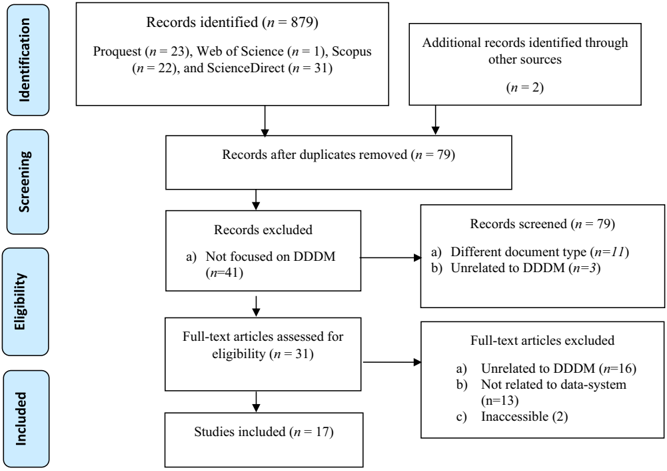
- Searches were run in ProQuest, Scopus, Web of Science, and ScienceDirect for 2013–2023, limited to English scholarly journal articles and conference proceedings; the initial search yielded 879 records, with 17 studies included after screening.
- The authors coded the final papers using NVivo and Zotero, then developed descriptive and analytical themes guided by the research questions.
Limitations
- The paper states it did not cover critical aspects of teacher DDDM such as the types and quality of data most useful, the competing uses of data for accountability/administration/pedagogy/behaviour, and teachers’ capacity for using technology-based data systems.
- The authors say the review was limited to four databases and English-language scholarly journal articles and conference proceedings, so relevant literature may have been missed.
- The text also makes evident that some full-text articles were inaccessible and excluded (2 articles), which could have affected the synthesis.
Model-written summary. Check it against the paper before relying on it.
Integrity signals
Registry
Cites
Statistics
Figures
Verification
Claims the paper makes
11 Valid · 12 Not valid · 99 Not checked · 66 Own results and interpretations
The cited sources support only part of this claim — read each source’s verdict below.
In the paper
“Another significant hindering factor revealed in this study is the perceived reliability and validity of data (Tyler, 2013).”
§ Using information and communication technology (ICT)-based data systems to support teacher data-driven decision-making: Insights from the literature (2013-2023) > 3.2.12 Perceived reliability and validity of data
What the sources say
- Partly supportedcites Tyler, 2013 sourceExperimental — accuracy not yet measured
The Prior Research section says teachers’ belief that test data contain valid information, and their perception of its validity, affect data use. But it summarizes earlier research rather than reporting a barrier revealed by Tyler’s own study, and it does not identify perceived reliability as a separate factor. The Introduction describes Tyler’s study as examining whether and how long teachers access the data, not their perceptions of it; page numbers were not provided in our copy. (LLM, conf=0.86)
plain- Asserted: passes — The authors put it forward as true.
- Checkable: passes — It can be checked against evidence.
- Load-bearing: unclear — It is unclear whether the paper’s conclusions depend on it.
- Based: passes — The paper gives a reason why it holds.
- Partly supported
The cited sources support only part of this claim — read each source’s verdict below.
In the paper
“Time allocated for teachers to review and discuss data in small groups and adopt procedures for discussing data is essential for data use (Tyler, 2013).”
§ Using information and communication technology (ICT)-based data systems to support teacher data-driven decision-making: Insights from the literature (2013-2023) > 3.2.3 Time and workload to engage in data
What the sources say
- Partly supportedcites Tyler, 2013 sourceExperimental — accuracy not yet measured
The Summary and Conclusions section says time needs to be allocated for teachers to access and analyze student data regularly; Prior Research also identifies allotted time as a factor that promotes data use. Neither passage specifies reviewing and discussing data in small groups or adopting procedures for those discussions. Page numbers are not available in our copy. (LLM, conf=0.87)
plainstates a cause- Asserted: passes — The authors put it forward as true.
- Checkable: passes — It can be checked against evidence.
- Load-bearing: unclear — It is unclear whether the paper’s conclusions depend on it.
- Based: passes — The paper gives a reason why it holds.
- Partly supported
The cited sources support only part of this claim — read each source’s verdict below.
In the paper
“If teachers' attitude towards data is negative, they will be less inclined to use data to inform practice (Tyler, 2013;van der Kleij & Eggen, 2013).”
§ Using information and communication technology (ICT)-based data systems to support teacher data-driven decision-making: Insights from the literature (2013-2023) > 3.2.17 Lack of user buy-in
What the sources say
- Partly supportedcites Tyler, 2013 sourceExperimental — accuracy not yet measured
In Prior Research (page unavailable), Tyler reports that teachers’ belief in the validity of test data affects data use, and describes teachers who were unconvinced that a data-analysis system was useful. This supports a link between particular negative perceptions and data use, but not the broader, categorical claim that any negative attitude toward data means teachers will be less inclined to use it to inform practice. (LLM, conf=0.82)
- Not checked — no full text of the sourcecites van der Kleij & Eggen, 2013 source
hedgedstates a possible cause- Asserted: passes — The authors put it forward as true.
- Checkable: passes — It can be checked against evidence.
- Load-bearing: unclear — It is unclear whether the paper’s conclusions depend on it.
- Based: passes — The paper gives a reason why it holds.
- Partly supported
The cited sources support only part of this claim — read each source’s verdict below.
In the paper
“In addition, the availability of training for teachers increases their skills and confidence in using data systems to extract useful insights to inform learning and teaching activities (Tyler, 2013;van der Kleij & Eggen, 2013).”
§ Using information and communication technology (ICT)-based data systems to support teacher data-driven decision-making: Insights from the literature (2013-2023) > 4 Discussion
What the sources say
- Partly supportedcites Tyler, 2013 sourceExperimental — accuracy not yet measured
The Summary and Conclusions (page unavailable) says teachers need training and support to use data effectively and translate analysis into instructional practice. But it does not establish that training increases teachers’ skills or confidence. In Results and Discussion, additional training may have increased printing of data, but did not increase interactive use of the Dashboard. (LLM, conf=0.85)
- Not checked — no full text of the sourcecites van der Kleij & Eggen, 2013 source
plainstates a cause- Asserted: passes — The authors put it forward as true.
- Checkable: passes — It can be checked against evidence.
- Load-bearing: unclear — It is unclear whether the paper’s conclusions depend on it.
- Based: passes — The paper gives a reason why it holds.
- Partly supported
The cited sources support only part of this claim — read each source’s verdict below.
In the paper
“The ability of a process or system to continue functioning effectively over a long period of time enables long-term school improvement (Schildkamp et al., 2016).”
§ Using information and communication technology (ICT)-based data systems to support teacher data-driven decision-making: Insights from the literature (2013-2023) > 3.2.16 Sustainability
What the sources say
- Partly supportedcites Schildkamp et al., 2016 sourceExperimental — accuracy not yet measured
The Implications for practice section says sustainability matters because a sustained focus on data use is crucial for long-term school improvement. It does not establish the broader claim that any process or system that continues functioning effectively enables long-term improvement; it also says the long-term effects of data teams need further study. No page number is available in our copy. (LLM, conf=0.82)
plainstates a cause- Asserted: passes — The authors put it forward as true.
- Checkable: passes — It can be checked against evidence.
- Load-bearing: unclear — It is unclear whether the paper’s conclusions depend on it.
- Based: passes — The paper gives a reason why it holds.
- Partly supported
101 more claims · 1 with their cited sources checked
Create a free account to see all 188 claims and to verify the 39 references still open.
- Probably not a substantial claim. 58
- Borderline: one of the tests for a substantial claim is unclear. 1
- It may state two separate claims as one. 41
Citations
Cites
Preferred Reporting Items for Systematic Reviews and Meta-Analyses: the PRISMA statement
Moher, D., Liberati, A., Tetzlaff, J., Altman, D. G., & for the PRISMA Group (2009) · BMJ · doi:10.1136/bmj.b2535 · Cited by 83,823
Methods for the thematic synthesis of qualitative research in systematic reviews
Thomas, J., & Harden, A. (2008) · BMC Medical Research Methodology · doi:10.1186/1471-2288-8-45 · Cited by 9,312 · cited 1×
“Three stages of thematic synthesis in systematic reviews highlighted by Thomas and Harden (2008) were used.”
Reprint—Preferred Reporting Items for Systematic Reviews and Meta-Analyses: The PRISMA Statement
Moher, D., Liberati, A., Tetzlaff, J., Altman, D. G., & and the PRISMA Group (2009) · Physical Therapy · doi:10.1093/ptj/89.9.873 · Cited by 2,486
Contemporary Issues in Technology and Teacher Education
(2025) · Contemporary issues in technology and teacher education · doi:10.70725/833004pqfpbd · Cited by 2,368
The acceptance and use of a virtual learning environment in China
van Raaij, E. M., & Schepers, J. J. L. (2008) · Computers & Education · doi:10.1016/j.compedu.2006.09.001 · Cited by 940 · cited 2×
“The individual dispositions cited by van Raaij and Schepers (2008) are expounded into teachers’ knowledge and awareness of data systems and teacher involvement.”
Tempelaar, D. T., Rienties, B., & Giesbers, B. (2015) · Computers in Human Behavior · doi:10.1016/j.chb.2014.05.038 · Cited by 449 · cited 1×
“Examples of popular LMS include Moodle, WebCT, Blackboard, and Sakai (Tempelaar et al., 2015).”
Mandinach, E. B., & Gummer, E. S. (2016) · Teaching and Teacher Education · doi:10.1016/j.tate.2016.07.011 · Cited by 363 · cited 1×
“Teacher data-driven decision-making (DDDM) to inform pedagogical practice and improve student outcomes is gaining significant prominence in many educational systems worldwide (Mandinach & Gummer, 2016; Mandinach & Schil-dkamp, 2021a, b).”
Datnow, A., & Hubbard, L. (2016) · Journal of Educational Change · doi:10.1007/s10833-015-9264-2 · Cited by 287 · cited 1×
“Research shows that workload influence how teachers perceive, utilise, and interpret data (Datnow & Hubbard, 2016).”
Wayman, J. C. (2005) · Journal of Education for Students Placed at Risk (JESPAR) · doi:10.1207/s15327671espr1003_5 · Cited by 249 · cited 1×
“…(e.g. demographics, test scores, enrolment information, attendance, and other student data) and related organisational data (e.g. staff data, organisational reports, school calendar, schedule data, and other school data) to inform various decisions institutions (Rankin, 2016, 2014; Wayman, 2005).”
Marsh, J. A., & Farrell, C. C. (2015) · Educational Management Administration & Leadership · doi:10.1177/1741143214537229 · Cited by 233
Data teams for school improvement
Schildkamp, K., Poortman, C. L., & Handelzalts, A. (2016) · School Effectiveness and School Improvement · doi:10.1080/09243453.2015.1056192 · Cited by 229 · cited 1×
“The ability of a process or system to continue functioning effectively over a long period of time enables long-term school improvement (Schildkamp et al., 2016).”
Misconceptions about data-based decision making in education: An exploration of the literature
Mandinach, E. B., & Schildkamp, K. (2021) · Studies in Educational Evaluation · doi:10.1016/j.stueduc.2020.100842 · Cited by 209 · cited 1×
“Teachers’ DDDM skills comprise both assessment literacy (Beck & Nunnaley, 2021) and data literacy (Mandinach & Schildkamp, 2021a, 2021b) to effectively design and implement effective assessment activities to gather a range of student data and use them to improve their teaching and support…”
(2009) · US Department of Education · Cited by 192
Exploring data use practices around Europe: Identifying enablers and barriers
Schildkamp, K., Karbautzki, L., & Vanhoof, J. (2014) · Studies in Educational Evaluation · doi:10.1016/j.stueduc.2013.10.007 · Cited by 168 · cited 8×
“Rankin (2016) and Schildkamp et al. (2014) argue that appropriate and effective display of comprehensive data ensures quick and accurate information retrieval to make timely informed decisions.”
InfluentialUsing technology to encourage student engagement with feedback: a literature review
Hepplestone, S., Holden, G., Irwin, B., Parkin, H. J., & Thorpe, L. (2011) · Research in Learning Technology · doi:10.3402/rlt.v19i2.10347 · Cited by 164 · cited 1×
“Furthermore, a “snowball” technique was also applied in which citations within articles were searched if they appeared significantly relevant (Hepplestone et al., 2011), and as a result, seven additional articles were extracted from this process.”
Impact of Management Information Systems (MIS) on School Administration: What the Literature Says
Shah, M. (2014) · Procedia - Social and Behavioral Sciences · doi:10.1016/j.sbspro.2014.01.659 · Cited by 108 · cited 3×
“…(e.g. demographics, test scores, enrolment information, attendance, and other student data) and related organisational data (e.g. staff data, organisational reports, school calendar, schedule data, and other school data) to inform various decisions institutions (Rankin, 2016, 2014; Wayman, 2005).”
Prenger, R., & Schildkamp, K. (2018) · Educational Psychology · doi:10.1080/01443410.2018.1426834 · Cited by 101 · cited 1×
“These issues are explored in other papers (e.g. Lee et al., 2024; Lin et al., 2024; Prenger & Schildkamp, 2018).”
A Systematic Review of Big Data Driven Education Evaluation
Lin, L., Zhou, D., Wang, J., & Wang, Y. (2024) · SAGE Open · doi:10.1177/21582440241242180 · Cited by 88 · cited 1×
“These issues are explored in other papers (e.g. Lee et al., 2024; Lin et al., 2024; Prenger & Schildkamp, 2018).”
How Do Teachers Make Sense of Data in the Context of High-Stakes Decision Making?
Vanlommel, K., & Schildkamp, K. (2019) · American Educational Research Journal · doi:10.3102/0002831218803891 · Cited by 79
Farley-Ripple, E. N., & Buttram, J. L. (2014) · Studies in Educational Evaluation · doi:10.1016/j.stueduc.2013.09.006 · Cited by 79 · cited 1×
“The accessibility and visualisation of data could increase teachers’ use of data to inform pedagogical decisions and provide feedback for individual students (Farley-Ripple & Buttram, 2014).”
Cho, V., & Wayman, J. C. (2014) · Teachers College Record: The Voice of Scholarship in Education · doi:10.1177/016146811411600203 · Cited by 75 · cited 8×
“Efficient data access means user-friendliness, system speed and updates, timely data, and longitudinal data (Cho & Wayman, 2014; Rankin, 2016; Wayman et al., 2017).”
InfluentialProfessional Learning for Using Data: Examining Teacher Needs & Supports
Jimerson, J. B., & Wayman, J. C. (2015) · Teachers College Record: The Voice of Scholarship in Education · doi:10.1177/016146811511700405 · Cited by 74 · cited 10×
“Ineffective school leaders’ preparation caused the inefficiencies of data initiatives in some schools (Jimerson & Wayman, 2015).”
InfluentialOn the value of data-based decision making in education: The evidence from six intervention studies
Visscher, A. J. (2021) · Studies in Educational Evaluation · doi:10.1016/j.stueduc.2020.100899 · Cited by 61 · cited 1×
“Real-time feedback afforded by new digital assessment systems is needed to monitor how students are progressing during a lesson and assessment results (Visscher, 2021).”
Farrell, C. C. (2015) · Educational Administration Quarterly · doi:10.1177/0013161x14539806 · Cited by 58 · cited 4×
“Developing a collaborative culture in data system use is another critical role of school leaders (Farrell, 2015).”
InfluentialMetrics Matter: How Properties and Perceptions of Data Shape Teachers’ Instructional Responses
Farrell, C. C., & Marsh, J. A. (2016) · Educational Administration Quarterly · doi:10.1177/0013161x16638429 · Cited by 54
Changes in educators' data literacy during a data-based decision making intervention
van Geel, M., Keuning, T., Visscher, A., & Fox, J.-P. (2017) · Teaching and Teacher Education · doi:10.1016/j.tate.2017.02.015 · Cited by 45 · cited 7×
“These include their negative perception of the reliability and validity of data (Farley-Ripple et al., 2021; Moss, 2013), lack of time and preparation (Jimerson & Wayman, 2015; Jimerson et al., 2021; van Geel et al., 2017), and low level of data literacy (Farley-Ripple et al., 2021).”
InfluentialA continuum of data literacy for teaching
Beck, J. S., & Nunnaley, D. (2021) · Studies in Educational Evaluation · doi:10.1016/j.stueduc.2020.100871 · Cited by 44 · cited 2×
“Teachers’ DDDM skills comprise both assessment literacy (Beck & Nunnaley, 2021) and data literacy (Mandinach & Schildkamp, 2021a, 2021b) to effectively design and implement effective assessment activities to gather a range of student data and use them to improve their teaching and support…”
Validity in Action: Lessons From Studies of Data Use
Moss, P. A. (2013) · Journal of Educational Measurement · doi:10.1111/jedm.12003 · Cited by 43 · cited 3×
“The usefulness of data largely depends on whether teachers can understand and meaningfully use the information it provides (Moss, 2013).”
The complexity of data-based decision making: An introduction to the special issue
Mandinach, E. B., & Schildkamp, K. (2020) · Studies In Educational Evaluation · doi:10.1016/j.stueduc.2020.100906 · Cited by 43 · cited 1×
“Teachers’ DDDM skills comprise both assessment literacy (Beck & Nunnaley, 2021) and data literacy (Mandinach & Schildkamp, 2021a, 2021b) to effectively design and implement effective assessment activities to gather a range of student data and use them to improve their teaching and support…”
Dimensions of teachers’ data literacy: A systematic review of literature from 1990 to 2021
Lee, J., Alonzo, D., Beswick, K., Abril, J. M. V., Chew, A. W., & Oo, C. Z. (2024) · Educational Assessment, Evaluation and Accountability · doi:10.1007/s11092-024-09435-8 · Cited by 40 · cited 2×
“These issues are explored in other papers (e.g. Lee et al., 2024; Lin et al., 2024; Prenger & Schildkamp, 2018).”
Self-citationWebster, T. E., & Son, J.-B. (2015) · Computers & Education · doi:10.1016/j.compedu.2014.08.012 · Cited by 40 · cited 1×
“For example, whilst positive outcomes were reported generally, the study by Webster and Son (2015) shows that the use of technology-based systems exacerbates pre-existing pedagogical and infrastructure issues that limit their potential use.”
(2014) · Contemporary issues in technology and teacher education · Cited by 36
A systematic review and meta-analysis of data use professional development interventions
Ansyari, M. F., Groot, W. N. J., & Witte, K. D. (2022) · Journal of Professional Capital and Community · doi:10.1108/jpcc-09-2021-0055 · Cited by 33
Exploring the factors influencing teachers’ instructional data use with electronic data systems
Luo, J., Wang, M., & Yu, S. (2022) · Computers & Education · doi:10.1016/j.compedu.2022.104631 · Cited by 32 · cited 5×
“Luo et al. (2022) argue that there must be interest and motivation to engage with data, utilise data systems for decision-making, and commit to change.”
InfluentialDatnow, A., Lockton, M., & Weddle, H. (2021) · Studies in Educational Evaluation · doi:10.1016/j.stueduc.2020.100869 · Cited by 31 · cited 1×
“Teachers want up-to-date data about their students to provide immediate feedback, supporting teachers to employ new strategies and approaches (Datnow et al., 2021).”
van der Kleij, F. M., & Eggen, T. J. H. M. (2013) · Studies in Educational Evaluation · doi:10.1016/j.stueduc.2013.04.002 · Cited by 31 · cited 5×
“The findings of van der Kleij and Eggen (2013) suggest that if DDDM is to be encouraged, teachers should be made aware of their usefulness in improving student learning.”
InfluentialLongitudinal Effects of Teacher Use of a Computer Data System on Student Achievement
Wayman, J. C., Shaw, S., & Cho, V. (2017) · AERA Open · doi:10.1177/2332858416685534 · Cited by 30 · cited 2×
“Teachers’ low level of data literacy is widely documented in the literature (e.g. Farley-Ripple et al., 2021; Hellmuth & Stewart, 2015; Jimerson & Wayman, 2015; Jimerson et al., 2021; van Geel et al., 2017; Wayman et al., 2017).”
Affordances of narrative and numerical data: A social-semiotic approach to data use
Fjørtoft, H., & Lai, M. K. (2021) · Studies in Educational Evaluation · doi:10.1016/j.stueduc.2020.100846 · Cited by 26 · cited 1×
“Qualitative data must be adequately theorised to understand their affordances properly (Fjørtoft & Lai, 2021) This will enable better integration of qualitative and quantitative data for more effective decision-making.”
Implementation of a collaborative data use model in a United States context
Jimerson, J. B., Garry, V., Poortman, C. L., & Schildkamp, K. (2021) · Studies in Educational Evaluation · doi:10.1016/j.stueduc.2020.100866 · Cited by 21 · cited 6×
“These include their negative perception of the reliability and validity of data (Farley-Ripple et al., 2021; Moss, 2013), lack of time and preparation (Jimerson & Wayman, 2015; Jimerson et al., 2021; van Geel et al., 2017), and low level of data literacy (Farley-Ripple et al., 2021).”
InfluentialIf You Build it Will They Come? Teachers’ Online Use of Student Performance Data
Tyler, J. H. (2013) · Education Finance and Policy · doi:10.1162/edfp_a_00089 · Cited by 19 · cited 7×
“Time allocated for teachers to review and discuss data in small groups and adopt procedures for discussing data is essential for data use (Tyler, 2013).”
InfluentialTools of the trade: a look at educators’ use of assessment systems
Farley-Ripple, E. N., Jennings, A., & Jennings, A. B. (2021) · School Effectiveness and School Improvement · doi:10.1080/09243453.2020.1777171 · Cited by 14
Development and Application of a Teacher Assessment for Learning (AfL) Literacy Tool
Alonzo, D. (2022) · UNSWorks (UNSW Sydney) · doi:10.26190/unsworks/18809 · Cited by 10
Self-citationVilleneuve, A., & Bouchamma, Y. (2023) · Teaching and Teacher Education · doi:10.1016/j.tate.2023.104198 · Cited by 9 · cited 2×
“Villeneuve and Bouchamma (2023) argue that it is important that teachers are proficient in using data systems for everyday practice.”
Reed, D. K. (2015) · RMLE Online · doi:10.1080/19404476.2015.11462119 · Cited by 5 · cited 1×
“Despite the range of research supporting the use of DDDM in increasing student outcomes, the use of data in schools remains limited (Reed, 2015; Vanlommel & Schild-kamp, 2019).”
Drake, T. A. (2021) · NASSP Bulletin · doi:10.1177/01926365211015311 · Cited by 5 · cited 2×
“At times, the manifestation of the lack of buy-in is fuelled by the resistance to change or hesitation to challenge the status quo (Drake, 2021).”
Data Systems and Reports as Active Participants in Data Interpretation
Rankin, J. G. (2016) · Universal Journal of Educational Research · doi:10.13189/ujer.2016.041101 · Cited by 5 · cited 10×
“Efficient data access means user-friendliness, system speed and updates, timely data, and longitudinal data (Cho & Wayman, 2014; Rankin, 2016; Wayman et al., 2017).”
InfluentialPhelps, D., & Santo, R. (2022) · Policy Futures in Education · doi:10.1177/14782103221126317 · Cited by 4 · cited 1×
“According to Phelps and Santo (2022), schools must not rely on one single source of data but use multiple data sources (i.e. student achievement data and teacher observation data) for triangulation.”
Reporting Data with “Over-the-Counter” Data Analysis Supports Improves Educators’ Data Analyses
Rankin, J. G. (2014) · Society for Information Technology & Teacher Education International Conference · Cited by 4
(2015) · Journal of the Association for Information Systems
Cited by
Moradi, H. (2025) · Humanities and Social Sciences Communications · doi:10.1057/s41599-025-04524-5 · Cited by 45
“…between perceived ICT support and ease of use (r = 0.587) exceeds that of similar relationships reported in several Western studies (e.g., Alonzo et al. 2024; Tondeur et al. 2017), suggesting that institutional support may be particularly crucial for Chinese teachers ’ con fi dence in…”
InfluentialTorres-Santos, M. C., & Castulo, N. J. (2025) · Education 3-13 · doi:10.1080/03004279.2025.2468398 · Cited by 5
Sam, R., Voeun, N., Vando, P., Vet, K., No, S., Hour, R., Em, S., Sou, S., Phuong, S., & Da, V. (2025) · IGI Global eBooks · doi:10.4018/979-8-3373-3291-8.ch007 · Cited by 2
Alt, D., & Oved, O. (2026) · Teaching and Teacher Education · doi:10.1016/j.tate.2026.105483 · Cited by 1
Metadata
- Authors
- Alonzo, D., Quimno, V., Townend, G., & Oo, C. Z.
- Affiliations
- UNSW Sydney (AU)
- Corresponding author
- Alonzo, Dennis
- Venue
- Educational Assessment, Evaluation and Accountability
- Published
- 2024-10-05
- Volume
- 36
- Issue
- 4
- Pages
- 433-451
- ISSN
- 1874-8597 (ISSN-L)
- 1874-8600
- OpenAlex
- W4403117743
- Cited by
- 16
- References
- 47
- Citations by year
- 2026: 10 · 2025: 5 · 2024: 1
- FWCI
- 5.99
- Type
- journal article
- Language
- en
- Open access
- hybrid
- doi.org
- Licence
- cc-by
- creativecommons.org/licenses/by/4.0 (tdm)
- creativecommons.org/licenses/by/4.0 (vor)
- Locations
- Educational Assessment Evaluation and Accountability (publishedVersion, cc-by)
- Funders
- University of New South Wales
- Topics
- Social Sciences › Education › Educational Assessment and Improvement
- Physical Sciences › Computer Science › Information Systems › Educational Management and Quality
- Physical Sciences › Computer Science › Computer Science Applications › Online Learning and Analytics
- Keywords
- educational information systems, information and communication technologies, technology adoption, school leadership, teacher dispositions, sociocultural context, educational technology design
About these checks
Registry, retraction, Cites and statistics results are computed, not judged, with one exception: a printed reference that no index lists is read once by a model before it counts as a citation error. Claims are extracted by a model and kept only when their quote appears verbatim in the text; each cited source is then checked, with a model’s help, for whether it says what the claim relies on. Those verdicts can be wrong — read the claim’s quote and the cited source before relying on one.
The claim verdicts this report counts are experimental: their accuracy is not yet measured.
A language model drew the claims from the paper on 2026-10-10, under version 3 of the claim definition (model deepseek-v4.1-flash, prompt extract-v3).
A second model labelled each claim on 2026-10-10 (model jev-1.13-20260917, definition revision gold-guideline-v0.2).
Cited sources are checked with a language model’s help (gpt-6-sol).
Statistics and arithmetic are recomputed, not judged.
Confidence bands are shown only for fields calibrated on our annotated test set. None is calibrated yet, so no band is shown.
What counts as a claim ›How we measure confidence ›How we check this ›
Are you an author, or do you see a problem with this page? Request a review
Data sources
Bibliographic data: Semantic Scholar, OpenAlex, Crossref.
Contains information from the Semantic Scholar Academic Graph Datasets, made available under the ODC Attribution License (ODC-BY 1.0).
Semantic Scholar’s data is described in: Kinney, R., et al. (2023). The Semantic Scholar Open Data Platform. arXiv:2301.10140.
