

Deep Learning for Generic Object Detection: A Survey
Open accessThe DOI matches its Crossref record; 365 of the 368 references it cites were found in a registry or an index; 17 of the 301 sources its claims cite were checked for support.
Abstract
Object detection, one of the most fundamental and challenging problems in computer vision, seeks to locate object instances from a large number of predefined categories in natural images. Deep learning techniques have emerged as a powerful strategy for learning feature representations directly from data and have led to remarkable breakthroughs in the field of generic object detection. Given this period of rapid evolution, the goal of this paper is to provide a comprehensive survey of the recent achievements in this field brought about by deep learning techniques. More than 300 research contributions are included in this survey, covering many aspects of generic object detection: detection frameworks, object feature representation, object proposal generation, context modeling, training strategies, and evaluation metrics. We finish the survey by identifying promising directions for future research.
Overview
CoChat Summary
TL;DR
This survey reviews deep learning for generic object detection, covering more than 300 research contributions across detection frameworks, feature representation, proposal generation, context modeling, training strategies, and evaluation metrics. It organizes the field into two-stage and one-stage detectors, summarizes datasets and benchmarks, and identifies open challenges such as small-object detection, context reasoning, weak/few-shot learning, and open-world detection.
Key findings
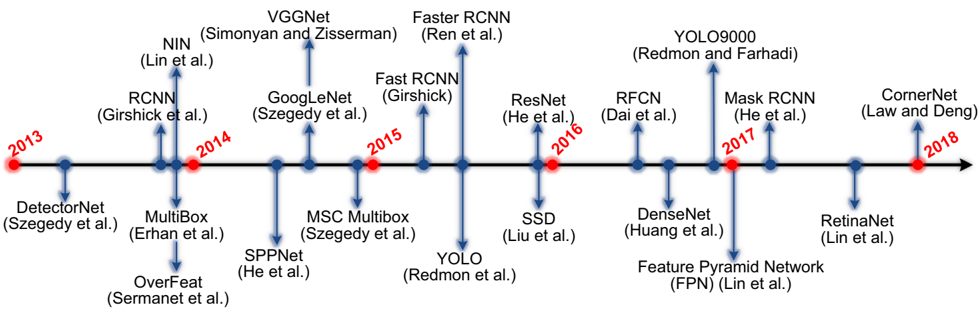
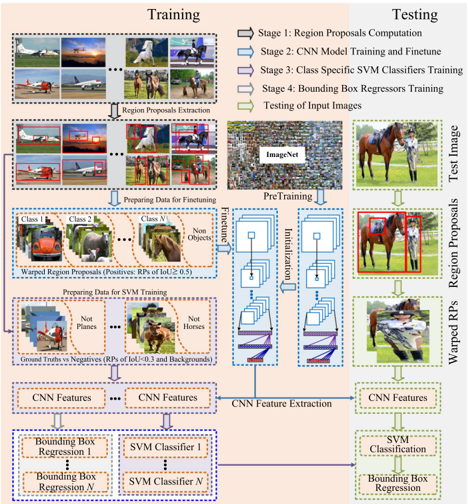
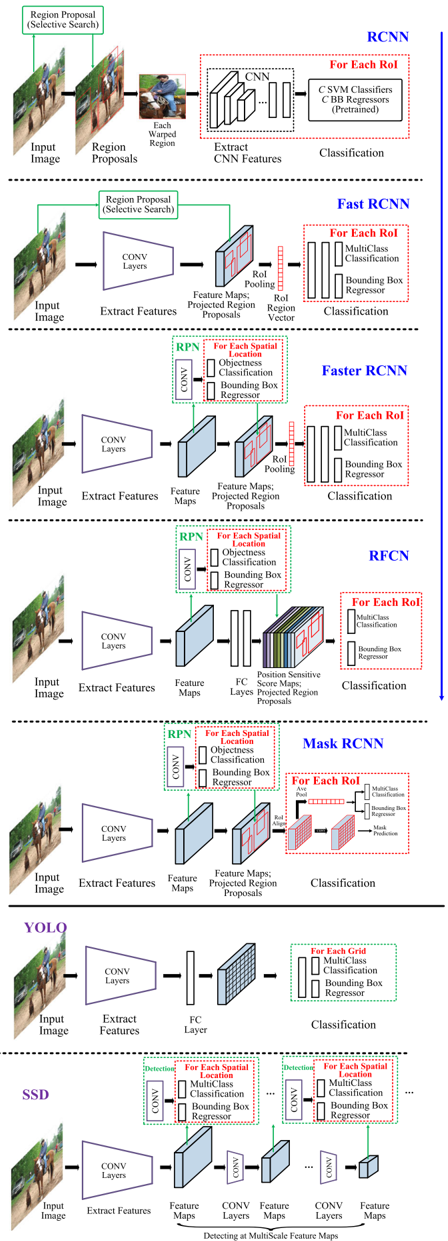
- The survey provides a taxonomy of deep learning based generic object detection, including region-based/two-stage frameworks (RCNN, Fast RCNN, Faster RCNN, RFCN, Mask RCNN) and unified/one-stage frameworks (YOLO, SSD), plus backbone CNN architectures, multiscale feature fusion, context modeling, detection proposals, and training strategies.
- Two-stage detectors generally achieve higher accuracy when large computation is allowed, while one-stage detectors are generally faster but weaker on small objects; for example, SSD achieves 74.3% mAP on VOC2007 test at 59 FPS versus Faster RCNN at 7 FPS / 73.2% mAP and YOLO at 45 FPS / 63.4% mAP. YOLO runs at 45 FPS and Fast YOLO at 155 FPS.
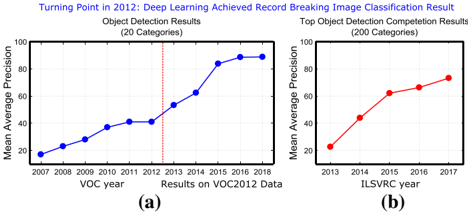
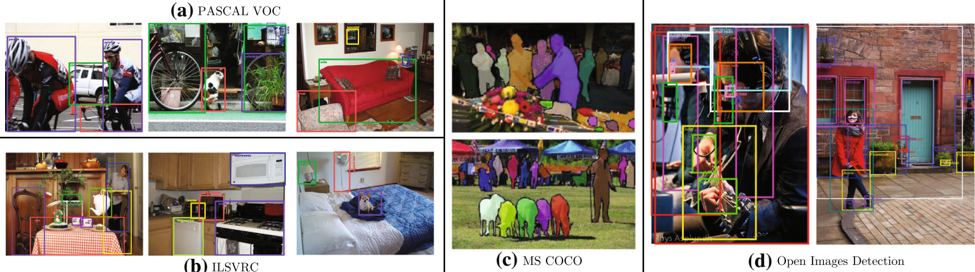
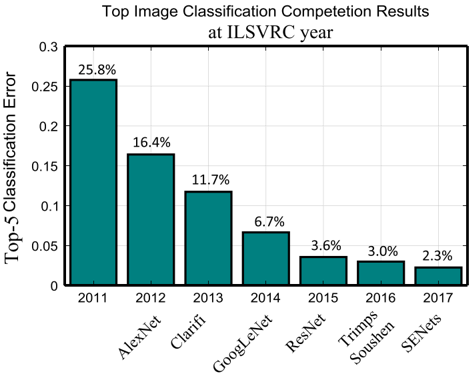
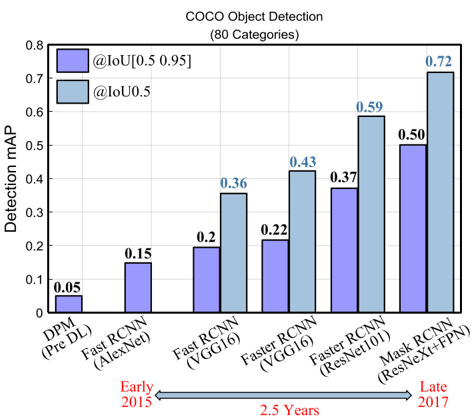
- The main datasets are PASCAL VOC, ImageNet/ILSVRC, MS COCO, and Open Images; COCO contains 41% small and 24% large objects, and the best COCO detector trained on 80 classes reaches only 73% mAP even at 0.5 IoU, while ImageNet Top-5 classification error dropped from 16% to 2% in less than five years. The Open Images challenge winner achieved 61.71% mAP on the public leaderboard and 58.66% mAP on the private leaderboard.
- Future directions include open-world learning, better and more efficient detection frameworks, compact CNN features, automatic neural architecture search, object instance segmentation, weakly supervised detection, few/zero-shot detection, other modalities, and universal object detection.
Methods
- Design: a comprehensive literature survey of deep learning based generic object detection, focusing on major progress of the last 5 years, restricted to still pictures and to top journal and conference papers, with more than 300 research contributions included.
- Organization: the survey presents a taxonomy covering detection frameworks, object feature representation, object proposal generation, context modeling, training strategies, and evaluation metrics, and summarizes popular datasets and evaluation criteria such as AP/mAP and IOU thresholds.
- Analysis: no new experiments are reported; the paper synthesizes and compares reported results across PASCAL VOC, ILSVRC, MS COCO, and Open Images, and discusses representative methods in tables and figures.
Limitations
- Stated: the survey limits its focus to top journal and conference papers, covers mainly the last 5 years, restricts attention to still pictures, and leaves video object detection for separate future consideration; the authors apologize to authors whose works are not included.
- Stated: comparing detectors by their originally reported performance may be misleading because methods differ in meta-frameworks, backbone networks, pretraining datasets, proposal methods, augmentation, and ensembling; there has been very limited unified comparison work.
- Evident: the survey is not exhaustive given the breadth of the field, and it excludes extensive work on specific object detection such as face, pedestrian, vehicle, and traffic sign detection; the provided text also contains fragmented tables and figures, which limits some detail.
Model-written summary. Check it against the paper before relying on it.
Integrity signals
Registry
Cites
Statistics
Figures



Verification
Claims the paper makes
14 Valid · 16 Not valid · 154 Not checked · 108 Own results and interpretations
The cited sources support only part of this claim — read each source’s verdict below.
In the paper
“To the best of our knowledge, for the evaluation of generic object detection algorithms, it is bounding boxes which are most widely used in the current literature (Everingham et al. 2010;Russakovsky et al. 2015), and therefore this is also the approach we adopt in this survey.”
§ Deep Learning for Generic Object Detection: A Survey > 2.1 The Problem
What the sources say
- Partly supportedcites Everingham et al. 2010 matched to “The pascal visual object classes (VOC) challenge” (2010) sourceExperimental — accuracy not yet measured
Section 2.2 (Detection) and “Bounding box evaluation” show that the VOC challenge evaluated object detections using predicted bounding boxes and their overlap with ground truth. The paper does not establish the broader comparative claim that bounding boxes were the most widely used evaluation approach in the literature. (LLM, conf=0.84)
- Not checked yetcites Russakovsky et al. 2015 matched to “ImageNet Large Scale Visual Recognition Challenge” (2015) source
hedged- Asserted: passes — The authors put it forward as true.
- Checkable: passes — It can be checked against evidence.
- Load-bearing: passes — The paper’s conclusions depend on it.
- Based: passes — The paper gives a reason why it holds.
- Partly supported
The sources with a verdict support this claim; the rest weren’t checked yet, have no full text we could read, or their verdicts aren’t rated yet.
In the paper
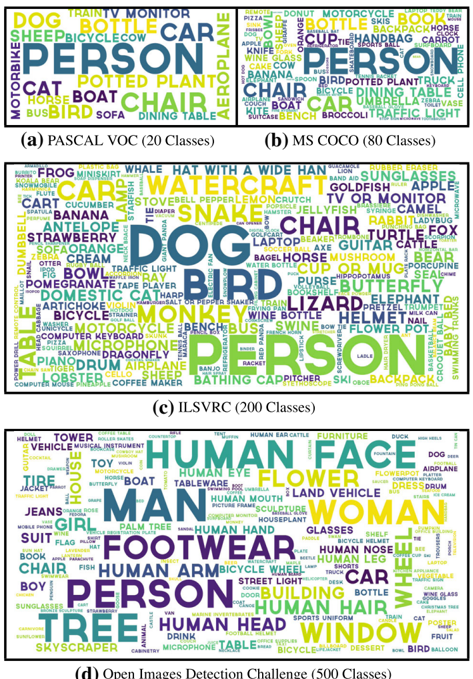
“In practice, current detectors focus mainly on structured object categories, such as the 20, 200 and 91 object classes in PASCAL VOC (Everingham et al. 2010), ILSVRC (Russakovsky et al. 2015) and MS COCO (Lin et al. 2014) respectively.”
§ Deep Learning for Generic Object Detection: A Survey > 2.2.1 Accuracy Related Challenges
What the sources say
- Supportedcites Everingham et al. 2010 matched to “The pascal visual object classes (VOC) challenge” (2010) source
The citation is offered for the identification of PASCAL VOC as the benchmark with 20 object classes. Our copy states this repeatedly: Sect. 3.2 'Choice of Classes' says 'Fig. 2 shows the 20 classes selected for annotation in the VOC2007 dataset' and that the count rose from 4 (VOC2005) to 10 (VOC2006) to 20 (VOC2007); Sect. 3.1 refers to 'each of the 20 object classes to be annotated'; Sect. 3.5 notes 'the number of classes doubled from 10 to 20'. The surrounding framing about detectors focusing on structured categories is the citing authors' own conclusion, not attributed to this source. (LLM, conf=0.90)
- Not checked yetcites Russakovsky et al. 2015 matched to “ImageNet Large Scale Visual Recognition Challenge” (2015) source
- Not checked yetcites Lin et al. 2014
plain- Asserted: passes — The authors put it forward as true.
- Checkable: passes — It can be checked against evidence.
- Load-bearing: unclear — It is unclear whether the paper’s conclusions depend on it.
- Based: passes — The paper gives a reason why it holds.
- Supported
The sources with a verdict support this claim; the rest weren’t checked yet, have no full text we could read, or their verdicts aren’t rated yet.
In the paper
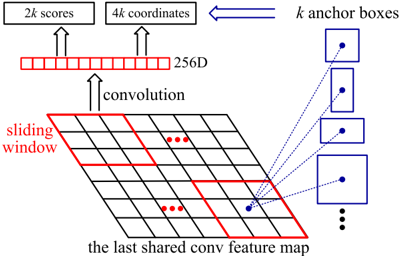
“The Faster RCNN framework proposed by Ren et al. (2015Ren et al. ( , 2017) ) offered an efficient and accurate Region Proposal Network (RPN) for generating region proposals.”
§ Deep Learning for Generic Object Detection: A Survey > 5.1 Region Based (Two Stage) Frameworks
What the sources say
- Not checked yetcites Ren et al. 2015
- Supportedcites Ren et al. 2017 matched to “Faster R-CNN: Towards Real-Time Object Detection with Region Proposal Networks” (2017) source
The Abstract (p. 1) states the paper introduces an RPN that shares full-image convolutional features, enabling 'nearly cost-free region proposals' trained end-to-end 'to generate high-quality region proposals', and the Introduction (p. 1) gives the marginal cost as ~10ms per image. Efficiency and accuracy are both borne out: Section 3 (p. 3) defines the RPN as the proposal module of Faster R-CNN, and p. 2 reports it beats the Selective Search baseline in detection accuracy while waiving nearly all of its computational burden. The paraphrase matches the source at the same level of specificity. (LLM, conf=0.92)
plain- Asserted: passes — The authors put it forward as true.
- Checkable: passes — It can be checked against evidence.
- Load-bearing: unclear — It is unclear whether the paper’s conclusions depend on it.
- Based: passes — The paper gives a reason why it holds.
The sources with a verdict support this claim; the rest weren’t checked yet, have no full text we could read, or their verdicts aren’t rated yet.
In the paper
“In contrast, deep learning methods (especially deep CNNs) can learn powerful feature representations with multiple levels of abstraction directly from raw images (Bengio et al. 2013;LeCun et al. 2015).”
§ Deep Learning for Generic Object Detection: A Survey > 6 Object Representation
What the sources say
- Supportedcites Bengio et al. 2013 matched to “Representation Learning: A Review and New Perspectives” (2013) source
Section 3.4 (pp. 4-5) states that deep architectures 'can potentially lead to progressively more abstract features at higher layers' and that in the convolutional neural network this abstraction is built in explicitly via pooling, making representations 'generally highly non-linear functions of the raw input'. The Introduction (p. 1) frames the whole point as reducing dependence on labor-intensive feature engineering so that algorithms can extract discriminative information from low-level sensory data, and Section 11.2 (p. 24) applies this to the 2D layout of pixels in images via local receptive fields, convolution and pooling. Section 10.1 (p. 22-23) reinforces the 'powerful' element with the ImageNet deep convolutional result. Together these support the paraphrased claim, including the CNN emphasis and the multiple-levels-of-abstraction-from-raw-images core. (LLM, conf=0.90)
- Not checked yetcites LeCun et al. 2015 matched to “Deep learning” (2015) source
plainstates a cause- Asserted: passes — The authors put it forward as true.
- Checkable: passes — It can be checked against evidence.
- Load-bearing: passes — The paper’s conclusions depend on it.
- Based: passes — The paper gives a reason why it holds.
- Supported
The cited sources support only part of this claim — read each source’s verdict below.
In the paper
“Furthermore, the relationship between the source and target datasets plays a critical role, for example that ImageNet based CNN features show better performance for object detection than for human action (Zhou et al. 2015;Azizpour et al. 2016).”
§ Deep Learning for Generic Object Detection: A Survey > 6.1 Popular CNN Architectures
What the sources say
- Not checked yetcites Zhou et al. 2015
- Partly supportedcites Azizpour et al. 2016 matched to “Factors of Transferability for a Generic ConvNet Representation” (2016) sourceExperimental — accuracy not yet measured
The Introduction (p. 2) and Table I say that optimal transfer settings depend on the distance between the ImageNet source task and the target task, supporting the general point. The paper does not establish the citing sentence’s specific comparison that ImageNet-based features perform better for object detection than for human action recognition; its discussion of object detection in the Closing Discussion (p. 11) does not make that comparison. (LLM, conf=0.84)
plainstates an association- Asserted: passes — The authors put it forward as true.
- Checkable: passes — It can be checked against evidence.
- Load-bearing: unclear — It is unclear whether the paper’s conclusions depend on it.
- Based: passes — The paper gives a reason why it holds.
98 more claims · 5 with their cited sources checked
Create a free account to see all 292 claims and to verify the 284 references still open.
- Probably not a substantial claim. 108
- It may state two separate claims as one. 121
- The quote only partly states this claim. 2
Claims other papers make about this one
Each is checked against this paper’s own text: does it say what the citing paper says it does?
The cited source says what the claim attributes to it.
In the citing paper
“Modern object detectors employ many hand-crafted components (Liu et al., 2020), e.g., anchor generation, rule-based training target assignment, non-maximum suppression (NMS) post-processing.”
From Deformable DETR: Deformable Transformers for End-to-End Object Detection (2020) · cites this paper as Liu et al., 2020
The check wasn’t confident either way, so it gives no verdict — never disputed.
In the citing paper
“Over the last few decades, most deep learning-based object tracking systems have been based on CNN architectures [84, 139].”
From A survey on deep multimodal learning for computer vision: advances, trends, applications, and datasets (2022) · cites this paper as [84]
Experimental — accuracy not yet measuredIn the citing paper
“Fortunately, advanced imaging techniques and emerging machine learning methods jointly resist the challenges of unsatisfactory imaging environments and quasi real-time requirements [5], forcefully driving the progress of defect recognition, especially in learning classification [8].”
From Automated Visual Defect Classification for Flat Steel Surface: A Survey (2020) · cites this paper as [8]
Self-check
Percentages, sums and reported differences re-computed from the paper’s own numbers.
Rated minor: it would not touch a result — a value no result rests on, a p-value that stays on the same side of the significance level, or a conflict that is clerical, resolved elsewhere in the paper, or outside its own findings.
In the paper
“| VOC10 | 20 | 4998 | 5105 | 9637 | 11,577(13,339) 11,797(13,352) 10,103 | 23,374 | 2.4 | | |”
§ Deep Learning for Generic Object Detection: A Survey > 10.3 Research Directions
Reported 2.4 · recomputed 2.31357
Rated minor: it would not touch a result — a value no result rests on, a p-value that stays on the same side of the significance level, or a conflict that is clerical, resolved elsewhere in the paper, or outside its own findings.
In the paper
“| VOC09 | 20 | 3473 | 3581 | 6650 | 8505(9760) | 8713(9779) | 7054 | 17,218 | 2.3 |”
§ Deep Learning for Generic Object Detection: A Survey > 10.3 Research Directions
Reported 2.3 · recomputed 2.440885
Citations
Cites
Items 201–368 of 368
Learning to Segment Object Candidates
Pinheiro, P. O., Collobert, R., & Dollár, P. (2015) · arXiv (Cornell University) · doi:10.48550/arxiv.1506.06204 · Cited by 648 · cited 6×
“An emerging class of object proposal algorithms [67, 229, 142, 81, 213, 292] using DCNNs has attracted broad attention.”
BackgroundMethodInfluentialDSOD: Learning Deeply Supervised Object Detectors from Scratch
Shen, Z., Liu, Z., Li, J., Jiang, Y.-G., Chen, Y., & Xue, X. (2017) · 2017 IEEE International Conference on Computer Vision (ICCV) · doi:10.1109/iccv.2017.212 · Cited by 646 · cited 2×
“number of recent approaches improve detection by predicting objects of different resolutions at different layers and then combining these predictions: SSD [175] and MSCNN [24], RBFNet [173], and DSOD [242]. SSD [175] spreads out default boxes of different scales to multiple layers within a CNN, and forces each layer t…”
BackgroundBounding Box Regression With Uncertainty for Accurate Object Detection
He, Y., Zhu, C., Wang, J., Savvides, M., & Zhang, X. (2019) · 2019 IEEE/CVF Conference on Computer Vision and Pattern Recognition (CVPR) · doi:10.1109/cvpr.2019.00300 · Cited by 623 · cited 1×
“tion. Recently, there are some works [124,228,117] formulating IOU directly as the optimization objective and consider it as an indicator of localization confidence. In addition, there are a few works [18,101,107,263] proposed to improve NMS results, such as Soft NMS [18] and learning NMS [107]. Class Imbalance Handlin…”
BackgroundHigh-Resolution Representations for Labeling Pixels and Regions
Sun, K., Zhao, Y. S., Jiang, B., Cheng, T., Xiao, B., Liu, D., Mu, Y., Wang, X., Liu, W., & Wang, J. (2019) · arXiv (Cornell University) · doi:10.48550/arxiv.1904.04514 · Cited by 614
Self-citationYang, F., Choi, W., & Lin, Y. (2016) · 2016 IEEE Conference on Computer Vision and Pattern Recognition (CVPR) · doi:10.1109/cvpr.2016.234 · Cited by 608 · cited 1×
“(2 )D et ec tio n at m ul tip le la ye rs SDP+CRC [293] EB VGG16 Fast RCNN 69.”
BackgroundLearning multiple visual domains with residual adapters
Rebuffi, S.-A., Bilen, H., & Vedaldi, A. (2017) · arXiv · doi:10.48550/arxiv.1705.08045 · Cited by 605
Detect to Track and Track to Detect
Feichtenhofer, C., Pinz, A., & Zisserman, A. (2017) · 2017 IEEE International Conference on Computer Vision (ICCV) · doi:10.1109/iccv.2017.330 · Cited by 595 · cited 1×
“These modalities raise new challenges in effectively using depth [36, 211, 289, 286], video [70, 130], and point clouds [217, 218].”
BackgroundRabinovich, A., Vedaldi, A., Galleguillos, C., Wiewiora, E., & Belongie, S. (2007) · 2007 IEEE 11th International Conference on Computer Vision · doi:10.1109/iccv.2007.4408986 · Cited by 594 · cited 3×
“a large pool of accurate object segmentation proposals and score the agreement between them. In [241], semantic segmentation was used as a form of contextual priming. 7.2 Local Context Local context [302,76,216] considers the relationship among locally nearby objects, as well as the interactions between an object and…”
BackgroundMethodInfluentialCPMC: Automatic Object Segmentation Using Constrained Parametric Min-Cuts
Carreira, J., & Sminchisescu, C. (2012) · IEEE Transactions on Pattern Analysis and Machine Intelligence · doi:10.1109/tpami.2011.231 · Cited by 592
Harmonic Networks: Deep Translation and Rotation Equivariance
Worrall, D. E., Garbin, S. J., Turmukhambetov, D., & Brostow, G. J. (2017) · 2017 IEEE Conference on Computer Vision and Pattern Recognition (CVPR) · doi:10.1109/cvpr.2017.758 · Cited by 563 · cited 1×
“そのため,頑健性向上のために多くのアプローチが 提示され,スケール [131, 21],回転 [21, 42, 284, 323],または その両方 [126] など,様々な種類の変換に対して不変な CNN 表現の学習が目指されてきた.”
A survey of physics-based attack detection in cyber-physical systems
Giraldo, J., Urbina, D., Cardenas, A., Valente, J., Faisal, M., Ruths, J., Tippenhauer, N. O., Sandberg, H., & Candell, R. (2019) · ACM Computing Surveys · doi:10.1145/3203245 · Cited by 535
Gradient Harmonized Single-Stage Detector
Li, B., Liu, Y., & Wang, X. (2019) · Proceedings of the AAAI Conference on Artificial Intelligence · doi:10.1609/aaai.v33i01.33018577 · Cited by 530
Self-citationFloatBoost learning and statistical face detection
Li, S. Z., & Zhang, Z. (2004) · IEEE Transactions on Pattern Analysis and Machine Intelligence · doi:10.1109/tpami.2004.68 · Cited by 525 · cited 1×
“Chained Cascade Network と Cascade RCNN:カスケー ド [73, 20, 159] の本質は,多段階の分類器を使用し,後期段 階がより難しい例の処理に集中できるよう早い段階で多数の 簡単な負例を廃棄することで,識別性の高い分類器を学習す ることである.”
Object Detectors Emerge in Deep Scene CNNsPreprint
Zhou, B., Khosla, A., Lapedriza, À., Oliva, A., & Torralba, A. B. (2015) · DSpace@MIT (Massachusetts Institute of Technology) · Cited by 523
Diagnosing Error in Object Detectors
Hoiem, D., Chodpathumwan, Y., & Dai, Q. (2012) · Lecture Notes in Computer Science · doi:10.1007/978-3-642-33712-3_25 · Cited by 520 · cited 1×
“More details on these metrics can be found in [53, 54, 179, 84].”
BackgroundGraph-Based Global Reasoning Networks
Chen, Y., Rohrbach, M., Yan, Z., Shuicheng, Y., Feng, J., & Kalantidis, Y. (2019) · 2019 IEEE/CVF Conference on Computer Vision and Pattern Recognition (CVPR) · doi:10.1109/cvpr.2019.00052 · Cited by 512 · cited 1×
“active, and a number of backbone networks are still emerging such as Hourglass [142], Dilated Residual Networks [292], Xception [43], DetNet [160], Dual Path Networks (DPN) [37], FishNet [250], GLoRe [38], etc. The training of a CNN requires a large scale labeled dataset with intraclass diversity. Unlike image classifi…”
BackgroundScene Graph Generation from Objects, Phrases and Region Captions
Li, Y., Ouyang, W., Zhou, B., Wang, K., & Wang, X. (2017) · 2017 IEEE International Conference on Computer Vision (ICCV) · doi:10.1109/iccv.2017.142 · Cited by 500 · cited 1×
“o efficiently and effectively incorporate contextual information remains to be explored, ideally guided by how human use the context in recognizing objects. The recent progress on building scene graph [157] may be another way of building structured understanding of objects in the scene. The full segmentation of objects…”
BackgroundSelf-citationAn empirical study of context in object detection
Divvala, S. K., Hoiem, D., Hays, J. H., Efros, A. A., & Hebert, M. (2009) · 2009 IEEE Conference on Computer Vision and Pattern Recognition · doi:10.1109/cvpr.2009.5206532 · Cited by 490 · cited 3×
“s, global scene statistics) helps object detection and recognition [155], especially in situations of small or occluded objects or poor image quality. There was extensive work preceding deep learning [143,152,171,47,59], however since the deep learning era there has been only very limited progress in exploiting contex…”
BackgroundAssociative Embedding: End-to-End Learning for Joint Detection and Grouping
Newell, A., Huang, Z., & Deng, J. H. (2016) · arXiv (Cornell University) · doi:10.48550/arxiv.1611.05424 · Cited by 461 · cited 1×
“les, slowing down training and introducing extra hyperparameters. Therefore, to avoid the use of anchor boxes and to borrow ideas from the work on Associative Embedding in multiperson pose estimation [191], Law et al. [142] proposed CornerNet by formulating bounding box object detection as detecting paired keypoints9:…”
MethodA survey on face detection in the wild: Past, present and future
Zafeiriou, S., Zhang, C., & Zhang, Z. (2015) · Computer Vision and Image Understanding · doi:10.1016/j.cviu.2015.03.015 · Cited by 458 · cited 2×
“A Survey on Face Detection in the Wild: Past, Present and Future [301] 2015 CVIU 2000 年以降の “in the wild”(非制約環境,実環境)顔検出のサーベイ”
Object Detection Networks on Convolutional Feature Maps
Ren, S., He, K., Girshick, R., Zhang, X., & Sun, J. (2017) · IEEE Transactions on Pattern Analysis and Machine Intelligence · doi:10.1109/tpami.2016.2601099 · Cited by 454
Object Detection Networks on Convolutional Feature Maps
Ren, S., He, K., Girshick, R., Zhang, X., & Sun, J. (2015) · arXiv · doi:10.48550/arxiv.1504.06066 · Cited by 454
Towards Accurate Binary Convolutional Neural Network
Lin, X., Zhao, C., & Pan, W. (2017) · arXiv · doi:10.48550/arxiv.1711.11294 · Cited by 453 · cited 1×
“ネットワークの冗長性を低減または除去するため,コン パクトで軽量なネットワークの設計 [29, 4, 119, 112, 169, 300] やネットワークの高速化 [44, 122, 253, 155, 158, 282]を行う研 究への関心が高まっている.”
Efficient Parametrization of Multi-domain Deep Neural Networks
Rebuffi, S.-A., Vedaldi, A., & Bilen, H. (2018) · IEEE Computer Society Conference on Computer Vision and Pattern Recognition/Proceedings - IEEE Computer Society Conference on Computer Vision and Pattern Recognition/Proceedings · doi:10.1109/cvpr.2018.00847 · Cited by 445
RON: Reverse Connection with Objectness Prior Networks for Object Detection
Kong, T., Sun, F., Yao, A., Liu, H., Lu, M., & Chen, Y. (2017) · 2017 IEEE Conference on Computer Vision and Pattern Recognition (CVPR) · doi:10.1109/cvpr.2017.557 · Cited by 442
SNIPER: Efficient Multi-Scale Training
Singh, B., Najibi, M., & Davis, L. S. (2018) · arXiv · doi:10.48550/arxiv.1805.09300 · Cited by 438
Video google: A text retrieval approach to object matching in videos
Šivic, J., & Zisserman, A. (2003) · Cited by 436
Category Independent Object Proposals
Endres, I., & Hoiem, D. (2010) · Lecture Notes in Computer Science · doi:10.1007/978-3-642-15555-0_42 · Cited by 432 · cited 1×
“The success of object detection based on detection proposals [273, 271] has attracted broad interest [25, 7, 3, 43, 330, 65, 138, 186].”
BackgroundDeepID-Net: Deformable deep convolutional neural networks for object detection
Ouyang, W., Wang, X., Zeng, X., Qiu, S., Luo, P., Tian, Y., Li, H., Yang, S., Wang, Z., Loy, C.-C., et al. (2015) · 2015 IEEE Conference on Computer Vision and Pattern Recognition (CVPR) · doi:10.1109/cvpr.2015.7298854 · Cited by 430 · cited 13×
“The second is based on deformable part-based model [72], which finds the max response to a part filter with spatial constraint taken into consideration [199, 84, 270].”
BackgroundMethodInfluentialSelf-citationAnalyzing the Performance of Multilayer Neural Networks for Object Recognition
Agrawal, P., Girshick, R., & Malik, J. (2014) · Lecture Notes in Computer Science · doi:10.1007/978-3-319-10584-0_22 · Cited by 427 · cited 1×
“Pretrained CNNs without finetuning were explored for object classification and detection in [49, 67, 1], where it was shown that features performance is a function of the extracted layer; for example, for AlexNet pretrained on ImageNet, FC6 / FC7 / Pool5 are in descending order of detection accuracy [49, 67]; finetuni…”
MethodWeakly Supervised Object Localization with Multi-Fold Multiple Instance Learning
Cinbis, R. G., Verbeek, J., & Schmid, C. (2017) · IEEE Transactions on Pattern Analysis and Machine Intelligence · doi:10.1109/tpami.2016.2535231 · Cited by 420
Instance-Sensitive Fully Convolutional Networks
Dai, J., He, K., Li, Y., Ren, S., & Sun, J. (2016) · Lecture Notes in Computer Science · doi:10.1007/978-3-319-46466-4_32 · Cited by 413 · cited 1×
“Motivated by Fully Convolutional Networks (FCN) for semantic segmentation [138] and DeepMask [167], Dai et al. proposed InstanceFCN [38] for generating instance segment proposals.”
MethodDeformable part models are convolutional neural networks
Girshick, R., Iandola, F., Darrell, T., & Malik, J. (2015) · 2015 IEEE Conference on Computer Vision and Pattern Recognition (CVPR) · doi:10.1109/cvpr.2015.7298641 · Cited by 411 · cited 3×
“features according to the deformation field [49]. The second is based on deformable part-based model [72], which finds the max response to a part filter with spatial constraint taken into consideration [199,84,270]. Rotation invariance may be attractive in certain applications such as detection from satellite image. But…”
BackgroundMethodInfluentialCheng, G., Han, J., Zhou, P., & Xu, D. (2019) · IEEE Transactions on Image Processing · doi:10.1109/tip.2018.2867198 · Cited by 408
International Conference on Computer Vision(ICCV '95)
阿部圭一 (1995) · 電子情報通信学会誌 · Cited by 400
Chen, Y., Li, J., Xiao, H., Jin, X., Yan, S., & Feng, J. (2017) · arXiv (Cornell University) · doi:10.48550/arxiv.1707.01629 · Cited by 397 · cited 2×
“tional cost. on CNN architectures remain active, and a numer of backbone networks are still emerging such as Dilated Residual Networks [230], Xception [35], DetNet [127], and Dual Path Networks (DPN) [31]. The training of a CNN requires a large labelled dataset with sufficient label and intraclass diversity. Unlike ima…”
BackgroundObject Detection from Video Tubelets with Convolutional Neural Networks
Kang, K., Ouyang, W., Li, H., & Wang, X. (2016) · 2016 IEEE Conference on Computer Vision and Pattern Recognition (CVPR) · doi:10.1109/cvpr.2016.95 · Cited by 386 · cited 1×
“These modalities raise new challenges in effectively using depth [36, 211, 289, 286], video [70, 130], and point clouds [217, 218].”
BackgroundSelf-citationRepMet: Representative-Based Metric Learning for Classification and Few-Shot Object Detection
Karlinsky, L., Shtok, J., Harary, S., Schwartz, E., Aides, A., Feris, R., Giryes, R., & Bronstein, A. M. (2019) · 2019 IEEE/CVF Conference on Computer Vision and Pattern Recognition (CVPR) · doi:10.1109/cvpr.2019.00534 · Cited by 386
Occluded Pedestrian Detection Through Guided Attention in CNNs
Zhang, S., Yang, J., & Schiele, B. (2018) · 2018 IEEE/CVF Conference on Computer Vision and Pattern Recognition · doi:10.1109/cvpr.2018.00731 · Cited by 385 · cited 1×
“ly fixed geometric structures. Wang et al. [280] propose to learn an adversarial network that generates examples with occlusions and deformations, and context may be helpful in dealing with occlusions [309]. Despite these efforts, the occlusion problem is far from being solved; applying GANs to this problem may be a pr…”
BackgroundMimicking Very Efficient Network for Object Detection
Li, Q., Jin, S., & Yan, J. (2017) · 2017 IEEE Conference on Computer Vision and Pattern Recognition (CVPR) · doi:10.1109/cvpr.2017.776 · Cited by 379 · cited 1×
“In order reduce or remove network redundancy, there has been growing research interest in designing compact and lightweight networks [29, 4, 119, 112, 169, 300] and network acceleration [44, 122, 253, 155, 158, 282].”
BackgroundScale-Transferrable Object Detection
Zhou, P., Ni, B., Geng, C., Hu, J., & Xu, Y. (2018) · 2018 IEEE/CVF Conference on Computer Vision and Pattern Recognition · doi:10.1109/cvpr.2018.00062 · Cited by 373 · cited 2×
“15 DenseNet201 [118] 18 200 − [321] Concatenate each layer with every other layer in a feed forward fashion.”
BackgroundLSTD: A Low-Shot Transfer Detector for Object Detection
Chen, H., Wang, Y., Wang, G., & Qiao, Y. (2018) · Proceedings of the AAAI Conference on Artificial Intelligence · doi:10.1609/aaai.v32i1.11716 · Cited by 370
Generic object recognition with boosting
Opelt, A., Pinz, A., Fussenegger, M., & Auer, P. (2006) · IEEE Transactions on Pattern Analysis and Machine Intelligence · doi:10.1109/tpami.2006.54 · Cited by 369
Local binary features for texture classification: Taxonomy and experimental study
Liu, L., Fieguth, P., Guo, Y., Wang, X., & Pietikäinen, M. (2017) · Pattern Recognition · doi:10.1016/j.patcog.2016.08.032 · Cited by 369 · cited 1×
“データの幾何学的変換に対して空間的に不変となる能力が不 足している [152, 172, 28].”
Self-citationBansal, A., Sikka, K., Sharma, G., Chellappa, R., & Divakaran, A. (2018) · Lecture Notes in Computer Science · doi:10.1007/978-3-030-01246-5_24 · Cited by 366
Taking Human out of Learning Applications: A Survey on Automated Machine LearningPreprint
Yao, Q., Wang, M., Escalante, H. J., Guyon, I., Hu, Y.-Q., Li, Y., Tu, W.-W., Yang, Q., & Yang, Y. (2018) · arXiv (Cornell University) · Cited by 353
Using the Forest to See the Trees: A Graphical Model Relating Features, Objects, and Scenes
Murphy, K. P., Torralba, A. B., & Freeman, W. T. (2003) · neural information processing systems · Cited by 352
Path Aggregation Network for Instance SegmentationPreprint
Liu, S., Qi, L., Qin, H., et al. (2018) · arXiv (Cornell University) · doi:10.48550/arxiv.1803.01534 · Cited by 352 · cited 4×
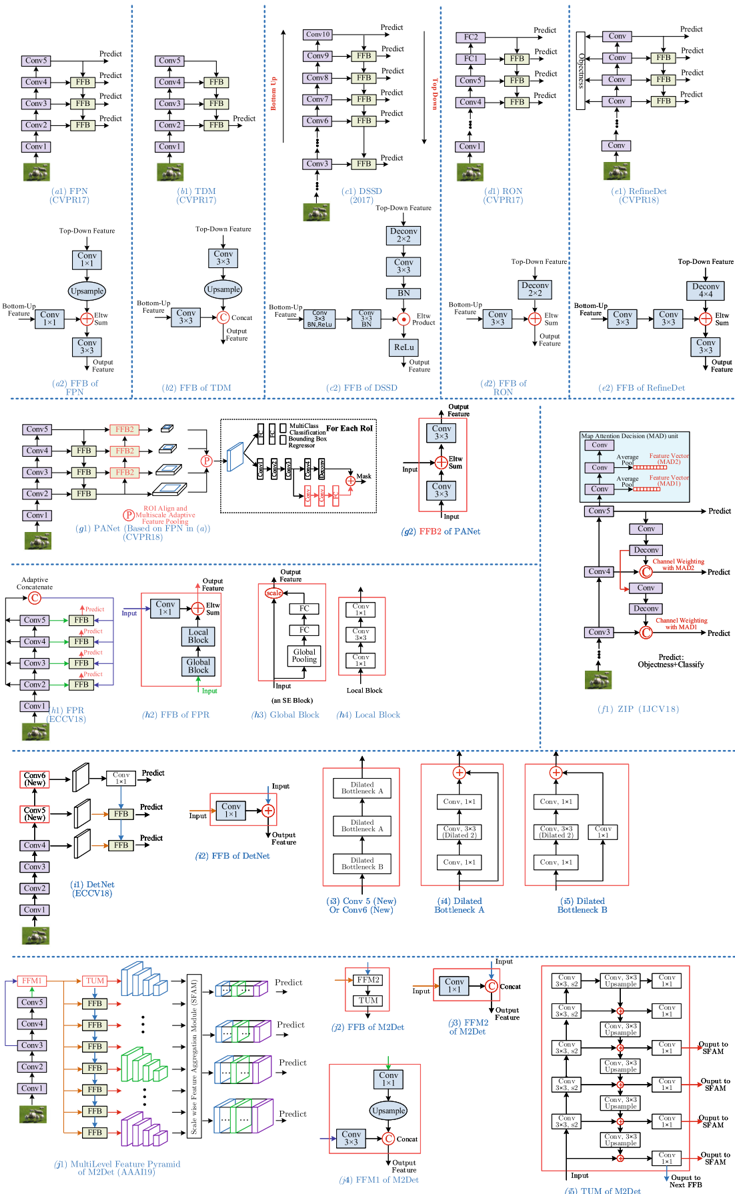
“More recent work, such as PANet [174], FPR [137], DetNet [164], and M2Det [315], as shown in Fig.”
BackgroundMethodInfluentialContext based object categorization: A critical survey
Galleguillos, C., & Belongie, S. (2010) · Computer Vision and Image Understanding · doi:10.1016/j.cviu.2010.02.004 · Cited by 351
50 Years of object recognition: Directions forward
Andreopoulos, A., & Tsotsos, J. K. (2013) · Computer Vision and Image Understanding · doi:10.1016/j.cviu.2013.04.005 · Cited by 347 · cited 5×
“11 50 Years of Object Recognition: Directions Forward [5] 2013 CVIU A review of the evolution of object recognition systems in the last five decades”
BackgroundInfluentialLearning Deep Object Detectors from 3D Models
Peng, X., Sun, B., Ali, K., & Saenko, K. (2015) · 2015 IEEE International Conference on Computer Vision (ICCV) · doi:10.1109/iccv.2015.151 · Cited by 338 · cited 1×
“theless, it has obvious limitations. The time required for training increases significantly, limiting its usage in some applications. In addition, data augmentation by synthesizing new training images [206,273] is also used. However, it is hard to guarantee that the synthetic images generalize well to real images. Some…”
BackgroundDetNet: Design Backbone for Object Detection
Li, Z., Peng, C., Yu, G., Zhang, X., Deng, Y., & Sun, J. (2018) · Lecture Notes in Computer Science · doi:10.1007/978-3-030-01240-3_21 · Cited by 337
Krähenbühl, P., & Koltun, V. (2014) · Lecture Notes in Computer Science · doi:10.1007/978-3-319-10602-1_47 · Cited by 336 · cited 1×
“The success of object detection based on detection proposals given by selective search [210, 209] has attracted broad interest [21, 7, 3, 33, 254, 50, 105, 144].”
BackgroundScalable, High-Quality Object Detection
Szegedy, C., Reed, S., Erhan, D., Anguelov, D., & Ioffe, S. (2014) · arXiv · doi:10.48550/arxiv.1412.1441 · Cited by 333 · cited 3×
“6, DetectorNet [198], OverFeat [183], MultiBox [52] and RCNN [65] independently and almost simultaneously proposed using CNNs for generic object detection.”
BackgroundRobust Object Detection via Soft Cascade
Bourdev, L., & Brandt, J. (2005) · 2005 IEEE Computer Society Conference on Computer Vision and Pattern Recognition (CVPR'05) · doi:10.1109/cvpr.2005.310 · Cited by 319 · cited 1×
“ssifiers at early stages discard large number of easy negative samples so that classifiers at latter stage can focus on handling more difficult examples. Cascade has been widely used in object detection [71,20,155]. Two-stage object detection can be considered as cascade of two object detectors, the first object detector…”
BackgroundDeep Learning for Environmentally Robust Speech Recognition: An Overview of Recent Developments
Zhang, Z., Geiger, J., Pohjalainen, J., Mousa, A. E.-D., Jin, W., & Schuller, B. (2018) · ACM Transactions on Intelligent Systems and Technology · doi:10.1145/3178115 · Cited by 313
MegDet: A Large Mini-Batch Object Detector
Peng, C., Xiao, T., Li, Z., Jiang, Y., Zhang, X., Jia, K., Yu, G., & Sun, J. (2018) · 2018 IEEE/CVF Conference on Computer Vision and Pattern Recognition · doi:10.1109/cvpr.2018.00647 · Cited by 311
CoupleNet: Coupling Global Structure with Local Parts for Object Detection
Zhu, Y., Zhao, C., Wang, J., Zhao, X., Wu, Y., & Lu, H. (2017) · 2017 IEEE International Conference on Computer Vision (ICCV) · doi:10.1109/iccv.2017.444 · Cited by 304 · cited 4×
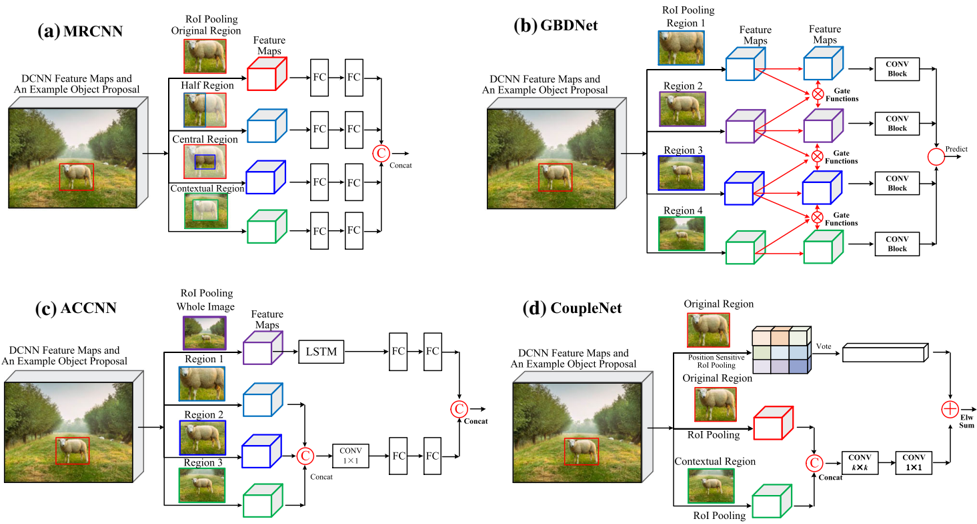
“obal contextual locations, through multiple stacked LSTM layers. To encode local surroundings context, Li et al. [123] adopted a method similar to that in MRCNN [62]. As shown in Fig.13(d), CoupleNet [251] is conceptually similar to ACCNN [123], but built upon RFCN [40]. In addition to the original branch in RFCN [40]…”
BackgroundMethodInfluentialFactors of Transferability for a Generic ConvNet Representation
Azizpour, H., Razavian, A. S., Sullivan, J., Maki, A., & Carlsson, S. (2016) · IEEE Transactions on Pattern Analysis and Machine Intelligence · doi:10.1109/tpami.2015.2500224 · Cited by 301
Combining efficient object localization and image classification
Harzallah, H., Jurie, F., & Schmid, C. (2009) · 2009 IEEE 12th International Conference on Computer Vision · doi:10.1109/iccv.2009.5459257 · Cited by 295
Beyond Skip Connections: Top-Down Modulation for Object Detection
Shrivastava, A., Sukthankar, R., Malik, J., & Gupta, A. K. (2016) · arXiv (Cornell University) · doi:10.48550/arxiv.1612.06851 · Cited by 294 · cited 5×
“rchy layer by layer, the subsampling layers in the feature hierarchy already lead to an inherent multiscale pyramid, producing feature maps at different spatial resolutions, but subject to challenges [97,177,247]. In particular, the higher layers have a large receptive field and strong semantics, and are the most robus…”
BackgroundMethodInfluentialSwitchable Normalization for Learning-to-Normalize Deep Representation
Luo, P., Zhang, R., Ren, J., Peng, Z., & Li, J. (2019) · IEEE Transactions on Pattern Analysis and Machine Intelligence · doi:10.1109/tpami.2019.2932062 · Cited by 293 · cited 1×
“ing the design of specific deep model suitable for object detection. In the research community, training from scratch becomes possible, as more training data and better training strategy are available [278,179,178]. More backbone deep models will be specifically designed for object detection. (3) Improving the Robustnes…”
BackgroundLight-Head R-CNN: In Defense of Two-Stage Object Detector
Li, Z., Peng, C., Yu, G., Zhang, X., Deng, Y., & Sun, J. (2017) · arXiv · doi:10.48550/arxiv.1711.07264 · Cited by 292 · cited 3×
“Light Head RCNN:RFCN [50]の検出を更に高速化するた め,Li ら [165] は検出ネットワークの head をできるだけ軽 くし RoI ごとの計算を削減する Light Head RCNN を提案し た.”
Toward Category-Level Object Recognition
(2006) · Lecture Notes in Computer Science · doi:10.1007/11957959 · Cited by 290
Weakly Supervised Cascaded Convolutional Networks
Diba, A., Sharma, V., Pazandeh, A., Pirsiavash, H., & Van Gool, L. (2017) · 2017 IEEE Conference on Computer Vision and Pattern Recognition (CVPR) · doi:10.1109/cvpr.2017.545 · Cited by 287 · cited 1×
“rvised learning is not scalable in the absence of fully labelled training data, therefore it is valuable to study how the power of CNNs can be leveraged in weakly supervised or unsupervised detection [15,45,187]. (8) 3D Object Detection: The progress of depth cameras has enabled the acquisition of depth information in…”
MethodTaking a deeper look at pedestrians
Hosang, J., Omran, M., Benenson, R., & Schiele, B. (2015) · 2015 IEEE Conference on Computer Vision and Pattern Recognition (CVPR) · doi:10.1109/cvpr.2015.7299034 · Cited by 285 · cited 1×
“Since our focus is on generic object detection, the extensive work on DCNNs for specific object detection, such as face detection [154, 306, 116], pedestrian detection [307, 109], vehicle detection [322] and traffic sign detection [329] will not be considered.”
BackgroundLSDA: Large Scale Detection Through Adaptation
Hoffman, J., Guadarrama, S., Tzeng, E., Hu, R., Donahue, J., Girshick, R., Darrell, T., & Saenko, K. (2014) · arXiv · doi:10.48550/arxiv.1407.5035 · Cited by 284 · cited 1×
“egories [144,95]. Current detection datasets [68,234,166] contain only a few dozen to hundreds of categories, significantly fewer than those which can be recognized by humans. New largerscale datasets [107,250,226] with significantly more categories will need to be developed. (2) Better and More Efficient Detection Frame…”
BackgroundRevisiting RCNN: On Awakening the Classification Power of Faster RCNN
Cheng, B., Wei, Y., Shi, H., Feris, R., Xiong, J., & Huang, T. (2018) · Lecture Notes in Computer Science · doi:10.1007/978-3-030-01267-0_28 · Cited by 282
Learning to Segment Every Thing
Hu, R., Dollar, P., He, K., Darrell, T., & Girshick, R. (2018) · 2018 IEEE/CVF Conference on Computer Vision and Pattern Recognition · doi:10.1109/cvpr.2018.00445 · Cited by 281
Original approach for the localisation of objects in images
Vaillant, R. (1994) · IEE Proceedings - Vision, Image, and Signal Processing · doi:10.1049/ip-vis:19941301 · Cited by 280
Zhou, Y., Ye, Q., Qiu, Q., & Jiao, J. (2017) · 2017 IEEE Conference on Computer Vision and Pattern Recognition (CVPR) · doi:10.1109/cvpr.2017.527 · Cited by 280 · cited 1×
“refore, many approaches have been presented to enhance robustness, aiming at learning invariant CNN representations with respect to different types of transformations such as scale [131,21], rotation [21,42,284,323], or both [126]. 20 Li Liu et al. One representative work is Spatial Transformer Network (STN) [126], wh…”
BackgroundPrime Object Proposals with Randomized Prim's Algorithm
Manen, S., Guillaumin, M., & Gool, L. V. (2013) · 2013 IEEE International Conference on Computer Vision · doi:10.1109/iccv.2013.315 · Cited by 278 · cited 1×
“物体領域候補生成に基づく物体検出の成功 [273, 271] は幅 広い関心を集めている [25, 7, 3, 43, 330, 65, 138, 186].”
Semantic segmentation using regions and parts
Arbelaez, P., Hariharan, B., Gu, C., Gupta, S., Bourdev, L., & Malik, J. (2012) · 2012 IEEE Conference on Computer Vision and Pattern Recognition · doi:10.1109/cvpr.2012.6248077 · Cited by 274 · cited 1×
“A comprehensive review of object proposal algorithms is outside the scope of this paper, because object proposals have applications beyond object detection [6, 72, 252].”
BackgroundLearning and example selection for object and pattern detection
Sung, K.-K., & Poggio, T. (1996) · DSpace@MIT (Massachusetts Institute of Technology) · Cited by 260
Structure Inference Net: Object Detection Using Scene-Level Context and Instance-Level Relationships
Liu, Y., Wang, R., Shan, S., & Chen, X. (2018) · 2018 IEEE/CVF Conference on Computer Vision and Pattern Recognition · doi:10.1109/cvpr.2018.00730 · Cited by 252
Modeling Visual Context Is Key to Augmenting Object Detection Datasets
Dvornik, N., Mairal, J., & Schmid, C. (2018) · Lecture Notes in Computer Science · doi:10.1007/978-3-030-01258-8_23 · Cited by 250
PolyNet: A Pursuit of Structural Diversity in Very Deep Networks
Zhang, X., Li, Z., Loy, C. C., & Lin, D. (2017) · 2017 IEEE Conference on Computer Vision and Pattern Recognition (CVPR) · doi:10.1109/cvpr.2017.415 · Cited by 249 · cited 1×
“GBDNet [304, 305] CRAFT [292] Inception v2 ResNet269 PolyNet [311] Fast RCNN 77.”
Attentive Contexts for Object Detection
Li, J., Wei, Y., Liang, X., Dong, J., Xu, T., Feng, J., & Yan, S. (2017) · IEEE Transactions on Multimedia · doi:10.1109/tmm.2016.2642789 · Cited by 249
Automated Machine Learning: From Principles to Practices
Shen, Z., Zhang, Y., Wei, L., Zhao, H., & Yao, Q. (2018) · arXiv (Cornell University) · doi:10.48550/arxiv.1810.13306 · Cited by 241
An End-to-End TextSpotter with Explicit Alignment and Attention
He, T., Tian, Z., Huang, W., Shen, C., Qiao, Y., & Sun, C. (2018) · 2018 IEEE/CVF Conference on Computer Vision and Pattern Recognition · doi:10.1109/cvpr.2018.00527 · Cited by 234
A MultiPath Network for Object Detection
Zagoruyko, S., Lerer, A., Lin, T.-Y., Pinheiro, P., Gross, S., Chintala, S., & Dollar, P. (2016) · Procedings of the British Machine Vision Conference 2016 · doi:10.5244/c.30.15 · Cited by 228
Single-Shot Object Detection with Enriched Semantics
Zhang, Z., Qiao, S., Xie, C., Shen, W., Wang, B., & Yuille, A. L. (2018) · 2018 IEEE/CVF Conference on Computer Vision and Pattern Recognition · doi:10.1109/cvpr.2018.00609 · Cited by 228
Deep Feature Pyramid Reconfiguration for Object Detection
Kong, T., Sun, F., Huang, W., & Liu, H. (2018) · Lecture Notes in Computer Science · doi:10.1007/978-3-030-01228-1_11 · Cited by 224
DetNet: A Backbone network for Object Detection
Li, Z., Peng, C., Yu, G., Zhang, X., Deng, Y. S., & Sun, J. (2018) · arXiv (Cornell University) · doi:10.48550/arxiv.1804.06215 · Cited by 216 · cited 2×
“rmance at minimal additional computational cost. on CNN architectures remain active, and a numer of backbone networks are still emerging such as Dilated Residual Networks [230], Xception [35], DetNet [127], and Dual Path Networks (DPN) [31]. The training of a CNN requires a large labelled dataset with sufficient label…”
BackgroundMethodImproving Object Localization with Fitness NMS and Bounded IoU Loss
Tychsen-Smith, L., & Petersson, L. (2018) · 2018 IEEE/CVF Conference on Computer Vision and Pattern Recognition · doi:10.1109/cvpr.2018.00719 · Cited by 215
Classification and evaluation of cost aggregation methods for stereo correspondence
Tombari, F., Mattoccia, S., Di Stefano, L., & Addimanda, E. (2008) · 2008 IEEE Conference on Computer Vision and Pattern Recognition · doi:10.1109/cvpr.2008.4587677 · Cited by 212
Towards Universal Object Detection by Domain Attention
Wang, X., Cai, Z., Gao, D., & Vasconcelos, N. (2019) · 2019 IEEE/CVF Conference on Computer Vision and Pattern Recognition (CVPR) · doi:10.1109/cvpr.2019.00746 · Cited by 206 · cited 1×
“Most such research focuses on image classification, rarely targeting object detection (Wang et al. 2019), and developed detectors are usually domain specific.”
BackgroundSelf-citationDetNAS: Backbone Search for Object Detection
Chen, Y., Yang, T., Zhang, X., Meng, G., Xiao, X., & Sun, J. (2019) · arXiv · doi:10.48550/arxiv.1903.10979 · Cited by 205 · cited 1×
“ural to consider automated design of detection backbone architectures, such as the recent Automated Machine Learning (AutoML) [219], which has been applied to image classification and object detection [22,39,80,171,331, 332]. (5) Object Instance Segmentation: For a richer and more detailed understanding of image conten…”
MethodDo We Need More Training Data?
Zhu, X., Vondrick, C., Fowlkes, C. C., & Ramanan, D. (2016) · International Journal of Computer Vision · doi:10.1007/s11263-015-0812-2 · Cited by 204
Factors in Finetuning Deep Model for Object Detection with Long-Tail Distribution
Ouyang, W., Wang, X., Zhang, C., & Yang, X. (2016) · 2016 IEEE Conference on Computer Vision and Pattern Recognition (CVPR) · doi:10.1109/cvpr.2016.100 · Cited by 186
Self-citationZero-Shot Object Detection: Learning to Simultaneously Recognize and Localize Novel Concepts
Rahman, S., Khan, S. H., & Porikli, F. (2019) · Lecture notes in computer science · doi:10.1007/978-3-030-20887-5_34 · Cited by 184
PVANET: Deep but Lightweight Neural Networks for Real-time Object Detection
Kim, K.-H., Hong, S., Roh, B., Cheon, Y., & Park, M. (2016) · arXiv (Cornell University) · doi:10.48550/arxiv.1608.08021 · Cited by 183 · cited 1×
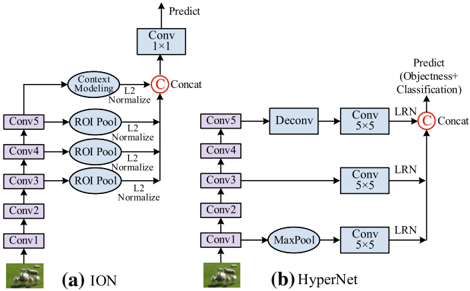
“n the COCO detection challenge 2015. HyperNet [135] RPN VGG16 Faster RCNN 76:3 (07+12) 71:4 (07T+12) CVPR16 Use features from multiple layers for both region proposal and region classification. PVANet [132] RPN PVANet Faster RCNN 84.9 (07+12+CO) 84.2 (07T+12+CO) NIPSW16 Deep but lightweight; Combine ideas from concaten…”
MethodInfluentialDeepID-Net: Object Detection with Deformable Part Based Convolutional Neural Networks
Ouyang, W., Zeng, X., Wang, X., Qiu, S., Luo, P., Tian, Y., Li, H., Yang, S., Wang, Z., Li, H., et al. (2017) · IEEE Transactions on Pattern Analysis and Machine Intelligence · doi:10.1109/tpami.2016.2587642 · Cited by 177
Self-citationDeepBox: Learning Objectness with Convolutional Networks
Kuo, W., Hariharan, B., & Malik, J. (2015) · 2015 IEEE International Conference on Computer Vision (ICCV) · doi:10.1109/iccv.2015.285 · Cited by 176 · cited 3×
“Finally, recent work which deserves mention includes Deepbox [142], which proposed a lightweight CNN to learn to rerank proposals generated by EdgeBox, and DeNet [269] which introduces bounding box corner estimation to predict object proposals efficiently to replace RPN in a Faster RCNN style detector.”
BackgroundMethodMeta-Learning for Semi-Supervised Few-Shot ClassificationPreprint
Triantafillou, E., Larochelle, H., Snell, J., Tenenbaum, J. B., Swersky, K., Ren, M., Zemel, R. S., & Ravi, S. (2018) · arXiv (Cornell University) · Cited by 176
Cheng, G., Zhou, P., & Han, J. (2016) · 2016 IEEE Conference on Computer Vision and Pattern Recognition (CVPR) · doi:10.1109/cvpr.2016.315 · Cited by 175 · cited 1×
“Some approaches have been presented to enhance the robustness of CNN representations, aiming at learning invariant CNN representations with respect to different types of transformations such as scale [101, 18], rotation [18, 32, 218, 248], or both [100].”
BackgroundHybrid Task Cascade for Instance SegmentationPreprint
Chen, K., Pang, J., Wang, J., et al. (2019) · arXiv (Cornell University) · doi:10.48550/arxiv.1901.07518 · Cited by 175 · cited 2×
“s for generic object detection were proposed in the Chained Cascade Network [205], extended in Cascade RCNN [23], and more recently applied for simultaneous object detection and instance segmentation [31], winning the COCO 2018 Detection Challenge. Light Head RCNN: In order to further increase the detection speed of R…”
BackgroundMethodImageNet Auto-Annotation with Segmentation Propagation
Guillaumin, M., Kuettel, D., & Ferrari, V. (2014) · International Journal of Computer Vision · doi:10.1007/s11263-014-0713-9 · Cited by 173
Progressive Neural Architecture Search
Liu, C., Zoph, B., Neumann, M., Shlens, J., Hua, W., Li, L.-J., Fei-Fei, L., Yuille, A., Huang, J., & Murphy, K. (2017) · arXiv · doi:10.48550/arxiv.1712.00559 · Cited by 171
CenterNet: Keypoint Triplets for Object DetectionPreprint
Duan, K., Bai, S., Xie, L., et al. (2019) · arXiv (Cornell University) · doi:10.48550/arxiv.1904.08189 · Cited by 168 · cited 1×
“[60] proposed CenterNet to detect each object as a triplet of keypoints, by introducing one extra keypoint, i.”
BackgroundSpatial Memory for Context Reasoning in Object Detection
Chen, X., & Gupta, A. (2017) · 2017 IEEE International Conference on Computer Vision (ICCV) · doi:10.1109/iccv.2017.440 · Cited by 167 · cited 5×
“In SMN, spatial memory essentially assembles object instances back into a pseudo image representation that is easy to be fed into another CNN for object relations reasoning, leading to a new sequential reasoning architecture where image and memory are processed in parallel to obtain detections which further update mem…”
BackgroundInfluentialFew-Example Object Detection with Model Communication
Dong, X., Zheng, L., Ma, F., Yang, Y., & Meng, D. (2019) · IEEE Transactions on Pattern Analysis and Machine Intelligence · doi:10.1109/tpami.2018.2844853 · Cited by 167 · cited 1×
“学習する少数ショット(few shot)検出の能力は非常に魅力的 である [30, 61, 75, 129, 144, 228, 237].”
Learning the Number of Neurons in Deep Networks
Álvarez, J. M., & Salzmann, M. (2016) · arXiv (Cornell University) · doi:10.48550/arxiv.1611.06321 · Cited by 164 · cited 1×
“In order reduce or remove network redundancy, there has been growing research interest in designing compact and lightweight networks [29, 4, 119, 112, 169, 300] and network acceleration [44, 122, 253, 155, 158, 282].”
BackgroundBoosting chain learning for object detection
Xiao, R., Zhu, L., & Zhang, H.-J. (2003) · Proceedings Ninth IEEE International Conference on Computer Vision · doi:10.1109/iccv.2003.1238417 · Cited by 162 · cited 1×
“n geometric representations [190,215], with the focus later moving away from geometry and prior models towards the use of statistical classifiers (such as Neural Networks [233], SVM [201] and Adaboost [276,290]) based on appearance features [191,236]. This successful family of object detectors set the stage for most su…”
MethodUnderstanding and Improving Convolutional Neural Networks via Concatenated Rectified Linear Units
Shang, W., Sohn, K., Almeida, D., & Lee, H. (2016) · arXiv (Cornell University) · doi:10.48550/arxiv.1603.05201 · Cited by 162 · cited 1×
“2 (07++12+CO) − − NIPSW16 A newly designed deep but lightweight network with the principle “less channels with more layers”; Combine ideas from concatenated ReLU [184], Inception [200], and HyperNet [103].”
BackgroundSoft Proposal Networks for Weakly Supervised Object Localization
Zhu, Y., Zhou, Y., Ye, Q., Qiu, Q., & Jiao, J. (2017) · 2017 IEEE International Conference on Computer Vision (ICCV) · doi:10.1109/iccv.2017.204 · Cited by 156 · cited 1×
“A comprehensive review of object proposal algorithms is beyond the scope of this paper, because object proposals have applications beyond object detection [6, 93, 328].”
BackgroundContextual Priming and Feedback for Faster R-CNN
Shrivastava, A., & Gupta, A. (2016) · Lecture Notes in Computer Science · doi:10.1007/978-3-319-46448-0_20 · Cited by 153 · cited 2×
“IEEE TPAMI 39(12):2525–2538 27 [245] Shrivastava A.”
Gated Bi-directional CNN for Object Detection
Zeng, X., Ouyang, W., Yang, B., Yan, J., & Wang, X. (2016) · Lecture notes in computer science · doi:10.1007/978-3-319-46478-7_22 · Cited by 145 · cited 11×
“深層学習の 普及前に広範な研究が行われ [185, 193, 220, 58, 78],深層学習 の時代にもかなりの数の研究が行われている [82, 304, 305, 35, 114].”
InfluentialSelf-citationWeakly Supervised Deep Detection Networks
Bilen, H., & Vedaldi, A. (2016) · 2016 IEEE Conference on Computer Vision and Pattern Recognition (CVPR) · doi:10.1109/cvpr.2016.311 · Cited by 144 · cited 1×
“rvised learning is not scalable in the absence of fully labelled training data, therefore it is valuable to study how the power of CNNs can be leveraged in weakly supervised or unsupervised detection [15,45,187]. (8) 3D Object Detection: The progress of depth cameras has enabled the acquisition of depth information in…”
MethodCrafting GBD-Net for Object Detection
Zeng, X., Ouyang, W., Yan, J., Li, H., Xiao, T., Wang, K., Liu, Y., Zhou, Y., Yang, B., Wang, Z., et al. (2018) · IEEE Transactions on Pattern Analysis and Machine Intelligence · doi:10.1109/tpami.2017.2745563 · Cited by 142 · cited 2×
“Nevertheless, there is value in exploring contextual information explicitly in DCNN based detectors (Hu et al. 2018a; Chen and Gupta 2017; Zeng et al. 2017), so the following reviews recent work in exploiting contextual cues in DCNN- based object detectors, organized into categories of global and local contexts, motiv…”
BackgroundMethodSelf-citationPath-Level Network Transformation for Efficient Architecture Search
Cai, H., Yang, J., Zhang, W., Han, S., & Yu, Y. H. (2018) · arXiv (Cornell University) · doi:10.48550/arxiv.1806.02639 · Cited by 135
segDeepM: Exploiting segmentation and context in deep neural networks for object detection
Zhu, Y., Urtasun, R., Salakhutdinov, R., & Fidler, S. (2015) · 2015 IEEE Conference on Computer Vision and Pattern Recognition (CVPR) · doi:10.1109/cvpr.2015.7299102 · Cited by 129 · cited 2×
“G lo ba lC on te xt SegDeepM [250] SS+CMPC VGG16 RCNN VOC10 VOC12 − CVPR15 Use an additional feature extracted from an enlarged object proposal as context information; Frame the detection problem as inference in a Markov Random Field.”
MethodGrauman, K., & Leibe, B. (2011) · Synthesis Lectures on Artificial Intelligence and Machine Learning · doi:10.2200/s00332ed1v01y201103aim011 · Cited by 126 · cited 3×
“Object detection can be grouped into one of two types [69, 240]: detection of specific instance and detection of specific categories.”
BackgroundDeNet: Scalable Real-Time Object Detection with Directed Sparse Sampling
Tychsen-Smith, L., & Petersson, L. (2017) · 2017 IEEE International Conference on Computer Vision (ICCV) · doi:10.1109/iccv.2017.54 · Cited by 121 · cited 2×
“*15物体検出のためにキーポイントを使用するというアイディアは,DeNet [269] で既出.”
Beyond Categories: The Visual Memex Model for Reasoning About Object Relationships
Malisiewicz, T., & Efros, A. (2018) · Figshare · doi:10.1184/r1/6552179.v1 · Cited by 120
Yang, B., Yan, J., Lei, Z., & Li, S. Z. (2016) · 2016 IEEE Conference on Computer Vision and Pattern Recognition (CVPR) · doi:10.1109/cvpr.2016.650 · Cited by 120 · cited 5×
“dding a branch to compute the scalar zoom indicator in parallel with the existing branch. There is further work attempting to generate object proposals by exploiting multilayer convolutional features [103,61,224,122]. 18 Li Liu et al. Table 5 Summarization of object proposal methods using DCNN. The numbers in blue col…”
BackgroundMethodInfluentialQuantization Mimic: Towards Very Tiny CNN for Object Detection
Wei, Y., Pan, X., Qin, H., Ouyang, W., & Yan, J. (2018) · Lecture notes in computer science · doi:10.1007/978-3-030-01237-3_17 · Cited by 119
Self-citationDeepProposal: Hunting Objects by Cascading Deep Convolutional Layers
Ghodrati, A., Diba, A., Pedersoli, M., Tuytelaars, T., & Gool, L. V. (2015) · 2015 IEEE International Conference on Computer Vision (ICCV) · doi:10.1109/iccv.2015.296 · Cited by 116 · cited 3×
“S15 The first to generate object proposals by sharing full image convolutional features with detection. Most widely used object proposal method. Significant improvements in detection speed. DeepProposal[81] VGG16 Fast RCNN 0:74 (100) 0.92 (1000) 0:58 (100) 0.80 (1000) 0:12 (100) 0.16 (1000) 53:2 (100) (07) ICCV15 Genera…”
BackgroundMethodInfluentialObject Categorization: Computer and Human Vision Perspectives
(2009) · doi:10.1017/cbo9780511635465 · Cited by 110
Beyond Categories: The Visual Memex Model for Reasoning About Object Relationships
Malisiewicz, T., & Efros, A. (2018) · Figshare · doi:10.1184/r1/6552179 · Cited by 110
Object class detection: A survey
Zhang, X., Yang, Y.-H., Han, Z., Wang, H., & Gao, C. (2013) · ACM Computing Surveys · doi:10.1145/2522968.2522978 · Cited by 107 · cited 5×
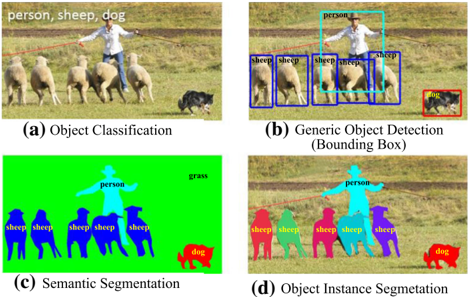
“gmentation, (d) Instance level semantic segmentation. 2 Generic Object Detection 2.1 The Problem Generic object detection (i.e., generic object category detection), also called object class detection [302] or object category detection, is defined as follows. Given an image, the goal of generic object detection is to de…”
BackgroundMethodInfluentialR-FCN-3000 at 30fps: Decoupling Detection and Classification
Singh, B., Li, H., Sharma, A., & Davis, L. S. (2018) · 2018 IEEE/CVF Conference on Computer Vision and Pattern Recognition · doi:10.1109/cvpr.2018.00119 · Cited by 107
Learning RoI Transformer for Detecting Oriented Objects in Aerial Images
Ding, J., Xue, N., Long, Y., Xia, G.-S., & Lu, Q. (2018) · arXiv (Cornell University) · doi:10.48550/arxiv.1812.00155 · Cited by 105 · cited 1×
“2018), and aerial imagery (Ding et al. 2018; Xia et al. 2018), there is limited generic object detectionwork focusing on rotation invariance because popular benchmark detection datasets (e.”
BackgroundReal-Time Rotation-Invariant Face Detection with Progressive Calibration Networks
Shi, X., Shan, S., Kan, M., Wu, S., & Chen, X. (2018) · 2018 IEEE/CVF Conference on Computer Vision and Pattern Recognition · doi:10.1109/cvpr.2018.00244 · Cited by 105
Feature representation for statistical-learning-based object detection: A review
Li, Y., Wang, S., Tian, Q., & Ding, X. (2015) · Pattern Recognition · doi:10.1016/j.patcog.2015.04.018 · Cited by 102 · cited 2×
“Feature Representation for Statistical Learning based Object Detection: A Review [160] 2015 PR 統計的学習ベースの物体検出における,ハンドクラフト特徴・深層学 習ベース特徴を含む特徴表現手法”
Object Instance Segmentation and Fine-Grained Localization Using Hypercolumns
Hariharan, B., Arbelaez, P., Girshick, R., & Malik, J. (2017) · IEEE Transactions on Pattern Analysis and Machine Intelligence · doi:10.1109/tpami.2016.2578328 · Cited by 102
Contextualizing Object Detection and Classification
Chen, Q., Song, Z., Dong, J., Huang, Z., Hua, Y., & Yan, S. (2015) · IEEE Transactions on Pattern Analysis and Machine Intelligence · doi:10.1109/tpami.2014.2343217 · Cited by 101
StairNet: Top-Down Semantic Aggregation for Accurate One Shot Detection
Woo, S., Hwang, S., & Kweon, I. S. (2018) · 2018 IEEE Winter Conference on Applications of Computer Vision (WACV) · doi:10.1109/wacv.2018.00125 · Cited by 101
Object Recognition in the Geometric Era: A Retrospective
Mundy, J. L. (2006) · Lecture Notes in Computer Science · doi:10.1007/11957959_1 · Cited by 100
Locally Scale-Invariant Convolutional Neural Networks
Kanazawa, A., Sharma, A., & Jacobs, D. W. (2014) · arXiv (Cornell University) · doi:10.48550/arxiv.1412.5104 · Cited by 99 · cited 1×
“そのため,頑健性向上のために多くのアプローチが 提示され,スケール [131, 21],回転 [21, 42, 284, 323],または その両方 [126] など,様々な種類の変換に対して不変な CNN 表現の学習が目指されてきた.”
Understanding Image Representations by Measuring Their Equivariance and Equivalence
Lenc, K., & Vedaldi, A. (2019) · International Journal of Computer Vision · doi:10.1007/s11263-018-1098-y · Cited by 98 · cited 1×
“ns to alleviate these problems. Handling of geometric transformations. DCNNs are inherently limited by the lack of ability to be spatially invariant to the geometric transformations of the input data [148,168,28]. The introduction of local max pooling layers has allowed DCNNs to enjoy small translation invariance. How…”
BackgroundZero-Shot Object Detection by Hybrid Region EmbeddingPreprint
Demirel, B., Cinbiş, R. G., & İkizler-Cinbiş, N. (2018) · arXiv (Cornell University) · doi:10.48550/arxiv.1805.06157 · Cited by 96 · cited 1×
“amples, few shot detection, is very appealing [30,61,75,129,144,228, 237]. Even more constrained, zero shot object detection localizes and recognizes object classes that have never been seen16 before [9,53,222,221], essential for life-long learning machines that need to intelligently and incrementally discover new obj…”
BackgroundAdaptive Object Detection Using Adjacency and Zoom Prediction
Lu, Y., Javidi, T., & Lazebnik, S. (2016) · 2016 IEEE Conference on Computer Vision and Pattern Recognition (CVPR) · doi:10.1109/cvpr.2016.258 · Cited by 90 · cited 1×
“[141] proposed to generate anchor locations by using a recursive search strategy which can adaptively guide computational resources to focus on subregions likely to contain objects.”
BackgroundZoom Out-and-In Network with Map Attention Decision for Region Proposal and Object Detection
Li, H., Liu, Y., Ouyang, W., & Wang, X. (2019) · International Journal of Computer Vision · doi:10.1007/s11263-018-1101-7 · Cited by 90
Self-citationWan, L., Eigen, D., & Fergus, R. (2015) · 2015 IEEE Conference on Computer Vision and Pattern Recognition (CVPR) · doi:10.1109/cvpr.2015.7298686 · Cited by 86 · cited 4×
“In generic object detection, recent work to address geometric transformations and part deformations [49, 84, 184, 199, 270] can be summarized as follows.”
BackgroundMethodInfluentialScale-Aware Trident Networks for Object DetectionPreprint
Li, Y., Chen, Y., Wang, N., et al. (2019) · arXiv (Cornell University) · doi:10.48550/arxiv.1901.01892 · Cited by 86 · cited 2×
“[159] proposed TridentNet by constructing a parallel multibranch architecture where each branch shares the same transformation parameters but with different receptive fields.”
BackgroundMethodDetNAS: Neural Architecture Search on Object Detection.Preprint
Chen, Y., Yang, T., Zhang, X., Meng, G., Pan, C., & Sun, J. (2019) · arXiv (Cornell University) · Cited by 84
Multi-scale Location-Aware Kernel Representation for Object Detection
Wang, H., Wang, Q., Gao, M., Li, P., & Zuo, W. (2018) · 2018 IEEE/CVF Conference on Computer Vision and Pattern Recognition · doi:10.1109/cvpr.2018.00136 · Cited by 83
DAVE: A Unified Framework for Fast Vehicle Detection and Annotation
Zhou, Y., Liu, L., Shao, L., & Mellor, M. (2016) · Lecture Notes in Computer Science · doi:10.1007/978-3-319-46475-6_18 · Cited by 82 · cited 1×
“Extensive work on CNNs for specific object detection, such as face detection [120, 237, 92], pedestrian detection [238, 85], vehicle detection [247] and traffic sign detection [253] will not be included in our discussion.”
BackgroundSelf-citationFishNet: A Versatile Backbone for Image, Region, and Pixel Level Prediction
Sun, S., Pang, J., Shi, J., Yi, S., & Ouyang, W. (2019) · arXiv (Cornell University) · doi:10.48550/arxiv.1901.03495 · Cited by 80 · cited 1×
“ures remains active, and a number of backbone networks are still emerging such as Hourglass [142], Dilated Residual Networks [292], Xception [43], DetNet [160], Dual Path Networks (DPN) [37], FishNet [250], GLoRe [38], etc. The training of a CNN requires a large scale labeled dataset with intraclass diversity. Unlike…”
BackgroundSelf-citationSAN: Learning Relationship Between Convolutional Features for Multi-scale Object Detection
Kim, Y., Kang, B.-N., & Kim, D. (2018) · Lecture notes in computer science · doi:10.1007/978-3-030-01228-1_20 · Cited by 79
Attend Refine Repeat: Active Box Proposal Generation via In-Out Localization
Komodakis, N., & Gidaris, S. (2016) · HAL (Le Centre pour la Communication Scientifique Directe) · Cited by 79
Lenc, K., & Vedaldi, A. (2015) · Procedings of the British Machine Vision Conference 2015 · doi:10.5244/c.29.5 · Cited by 73
Object-Proposal Evaluation Protocol is ‘Gameable’
Chavali, N., Agrawal, H., Mahendru, A., & Batra, D. (2016) · 2016 IEEE Conference on Computer Vision and Pattern Recognition (CVPR) · doi:10.1109/cvpr.2016.97 · Cited by 65 · cited 1×
“view of object proposal algorithms is outside the scope of this paper, because object proposals have applications beyond object detection [6,72,252]. We refer interested readers to the recent surveys [86,23] which provides an in-depth 3 We use the terminology detection proposals, object proposals and region proposals…”
MethodChained Cascade Network for Object Detection
Ouyang, W., Wang, K., Zhu, X., & Wang, X. (2017) · 2017 IEEE International Conference on Computer Vision (ICCV) · doi:10.1109/iccv.2017.214 · Cited by 65 · cited 1×
“ond stage classifying the remaining regions. Recently, end to end learning of more than two cascaded classifiers and DCNNs for generic object detection was first proposed in the Chained Cascade Network [201] and then extended in the Cascade RCNN [23]. Recently, cascade is further applied for simultaneous object detectio…”
BackgroundSelf-citationDecoupled Classification Refinement: Hard False Positive Suppression for Object DetectionPreprint
Cheng, B., Wei, Y., Feris, R., Xiong, J., Hwu, W., Huang, T. S., & Shi, H. (2018) · arXiv (Cornell University) · doi:10.48550/arxiv.1810.04002 · Cited by 53
Weakly-Supervised Image Annotation and Segmentation with Objects and Attributes
Shi, Z., Yang, Y., Hospedales, T. M., & Xiang, T. (2016) · IEEE Transactions on Pattern Analysis and Machine Intelligence · doi:10.1109/tpami.2016.2645157 · Cited by 51
segDeepM: Exploiting Segmentation and Context in Deep Neural Networks for Object DetectionPreprint
Zhu, Y., Urtasun, R., Salakhutdinov, R., et al. (2015) · arXiv (Cornell University) · doi:10.48550/arxiv.1502.04275 · Cited by 50 · cited 2×
“G lo ba lC on te xt SegDeepM [250] SS+CMPC VGG16 RCNN VOC10 VOC12 − CVPR15 Use an additional feature extracted from an enlarged object proposal as context information; Frame the detection problem as inference in a Markov Random Field.”
MethodEnd-to-End Learning of Latent Deformable Part-Based Representations for Object Detection
Mordan, T., Thome, N., Hénaff, G., & Cord, M. (2018) · International Journal of Computer Vision · doi:10.1007/s11263-018-1109-z · Cited by 48 · cited 4×
“DPM modeling is less sensitive to transformations in object pose, viewpoint and nonrigid deformations, motivating researchers [51, 86, 188, 203, 277] to explicitly model object composition to improve CNN based detection.”
MethodInfluentialTowards Understanding Regularization in Batch Normalization
Luo, P., Wang, X., Shao, W., & Peng, Z. (2018) · arXiv (Cornell University) · doi:10.48550/arxiv.1809.00846 · Cited by 48 · cited 1×
“ing the design of specific deep model suitable for object detection. In the research community, training from scratch becomes possible, as more training data and better training strategy are available [278,179,178]. More backbone deep models will be specifically designed for object detection. (3) Improving the Robustnes…”
BackgroundSelf-citationPolarity Loss for Zero-shot Object DetectionPreprint
Rahman, S., Khan, S. H., & Barnes, N. M. (2018) · arXiv (Cornell University) · doi:10.48550/arxiv.1811.08982 · Cited by 45 · cited 1×
“Even more constrained, zero shot object detection localizes and recognizes object classes that have never been seen16 before [9, 53, 222, 221], essential for life-long learning machines that need to intelligently and incrementally discover new object categories.”
BackgroundWhat Is Holding Back Convnets for Detection?
Pepik, B., Benenson, R., Ritschel, T., & Schiele, B. (2015) · Lecture Notes in Computer Science · doi:10.1007/978-3-319-24947-6_43 · Cited by 43 · cited 1×
“These modalities raise new challenges in effectively using depth (Chen et al. 2015c; Pepik et al. 2015; Xiang et al. 2014; Wu et al. 2015), video (Feichtenhofer et al.”
BackgroundWIDER Face and Pedestrian Challenge 2018: Methods and ResultsPreprint
Loy, C. C., Lin, D., Ouyang, W., Xiong, Y., Yang, S., Huang, Q., Zhou, D., Xia, W., Li, Q., Luo, P., et al. (2019) · arXiv (Cornell University) · doi:10.48550/arxiv.1902.06854 · Cited by 42 · cited 10×
“WIDER Challenge [176], has shown that multistage object detection could be a future framework for speed-accuracy trade-off.”
BackgroundInfluentialSelf-citationScaleNet: Guiding Object Proposal Generation in Supermarkets and Beyond
Qiao, S., Shen, W., Qiu, W., Liu, C., & Yuille, A. (2017) · 2017 IEEE International Conference on Computer Vision (ICCV) · doi:10.1109/iccv.2017.199 · Cited by 41
Parikh, D., Zitnick, C. L., & Chen, T. (2012) · IEEE Transactions on Pattern Analysis and Machine Intelligence · doi:10.1109/tpami.2011.276 · Cited by 40
FastMask: Segment Multi-scale Object Candidates in One Shot
Hu, H., Lan, S., Jiang, Y., Cao, Z., & Sha, F. (2017) · IEEE Computer Society Conference on Computer Vision and Pattern Recognition/Proceedings - IEEE Computer Society Conference on Computer Vision and Pattern Recognition/Proceedings · doi:10.1109/cvpr.2017.245 · Cited by 37 · cited 3×
“Hu et al. proposed FastMask [89] to efficiently generate instance segment proposals in a one-shot manner similar to SSD [136], in order to make use of multiscale convolutional features in a deep network.”
InfluentialRepMet: Representative-based metric learning for classification and one-shot object detection
Karlinsky, L., Shtok, J., Harary, S., Schwartz, E., Aides, A., Feris, R., Giryes, R., & Bronstein, A. M. (2018) · arXiv (Cornell University) · doi:10.48550/arxiv.1806.04728 · Cited by 36 · cited 2×
“学習する少数ショット(few shot)検出の能力は非常に魅力的 である [30, 61, 75, 129, 144, 228, 237].”
Oriented Response NetworksPreprint
Zhou, Y., Ye, Q., Qiu, Q., et al. (2017) · arXiv (Cornell University) · doi:10.48550/arxiv.1701.01833 · Cited by 33 · cited 1×
“refore, many approaches have been presented to enhance robustness, aiming at learning invariant CNN representations with respect to different types of transformations such as scale [131,21], rotation [21,42,284,323], or both [126]. 20 Li Liu et al. One representative work is Spatial Transformer Network (STN) [126], wh…”
BackgroundRevisiting RCNN: On Awakening the Classification Power of Faster RCNNPreprint
Cheng, B., Wei, Y., Shi, H., et al. (2018) · arXiv (Cornell University) · doi:10.48550/arxiv.1803.06799 · Cited by 25
Structure Inference Net: Object Detection Using Scene-Level Context and Instance-Level RelationshipsPreprint
Liu, Y., Wang, R., Shan, S., et al. (2018) · arXiv (Cornell University) · doi:10.48550/arxiv.1807.00119 · Cited by 24 · cited 2×
“SIN [137] considered two kinds of context including scene contextual information and object relationships within a single image.”
BackgroundSoft Proposal Networks for Weakly Supervised Object LocalizationPreprint
Zhu, Y., Zhou, Y., Ye, Q., et al. (2017) · arXiv (Cornell University) · doi:10.48550/arxiv.1709.01829 · Cited by 23 · cited 1×
“A comprehensive review of object proposal algorithms is beyond the scope of this paper, because object proposals have applications beyond object detection [6, 93, 328].”
BackgroundAttend Refine Repeat: Active Box Proposal Generation via In-Out Localization
Gidaris, S., & Komodakis, N. (2016) · Procedings of the British Machine Vision Conference 2016 · doi:10.5244/c.30.90 · Cited by 23
Towards Universal Object Detection by Domain AttentionPreprint
Wang, X., Cai, Z., Gao, D., et al. (2019) · arXiv (Cornell University) · doi:10.48550/arxiv.1904.04402 · Cited by 19 · cited 1×
“Most such research focuses on image classification, rarely targeting object detection (Wang et al. 2019), and developed detectors are usually domain specific.”
BackgroundSelf-citationFew-shot Object Detection via Feature ReweightingPreprint
Kang, B., Liu, Z., Wang, X., et al. (2018) · arXiv (Cornell University) · doi:10.48550/arxiv.1812.01866 · Cited by 16
Self-citationDeNet: Scalable Real-time Object Detection with Directed Sparse Sampling
Tychsen-Smith, L., & Petersson, L. (2017) · arXiv (Cornell University) · doi:10.48550/arxiv.1703.10295 · Cited by 9 · cited 2×
“*15物体検出のためにキーポイントを使用するというアイディアは,DeNet [269] で既出.”
The changing fortunes of pattern recognition and computer vision
Chellappa, R. (2016) · Image and Vision Computing · doi:10.1016/j.imavis.2016.04.005 · Cited by 8
DAVE: A Unified Framework for Fast Vehicle Detection and AnnotationPreprint
Zhou, Y., Liu, L., Shao, L., et al. (2016) · arXiv (Cornell University) · doi:10.48550/arxiv.1607.04564 · Cited by 7 · cited 1×
“Extensive work on CNNs for specific object detection, such as face detection [120, 237, 92], pedestrian detection [238, 85], vehicle detection [247] and traffic sign detection [253] will not be included in our discussion.”
BackgroundSelf-citationFastMask: Segment Object Multi-scale Candidates in One Shot.Preprint
Hu, H., Lan, S., Jiang, Y., Cao, Z., & Sha, F. (2016) · arXiv (Cornell University) · Cited by 2
Research works printed but not linked: 9
- 16. Biederman, I. (1987b). Recognition by components: A theory of human image understanding. Psychological Review, 94(2), 115. · DOI · Paper page
- 29. Chen, G., Choi, W., Yu, X., Han, T., & Chandraker M. (2017a). Learning efficient object detection models with knowledge distillation. In NIPS.
- 65. Endres, I., & Hoiem, D. (2010). Category independent object propos- als. In K. Daniilidis, P. Maragos, & N. Paragios (Eds.), European Conference on Computer Vision (pp. 575-588). Berlin: Springer.
- 128. Jaderberg, M., Simonyan, K., Zisserman, A., et al. (2015). Spatial trans- former networks. In NIPS (pp. 2017-2025).
- 143. Krizhevsky, A., Sutskever, I., & Hinton, G. (2012b). ImageNet clas- sification with deep convolutional neural networks. In NIPS (pp. 1097-1105).
- 195. Murase, H., & Nayar, S. (1995b). Visual learning and recognition of 3d objects from appearance. IJCV, 14(1), 5-24. · DOI · Paper page
- 231. Ren, M., Triantafillou, E., Ravi, S., Snell, J., Swersky, K., Tenenbaum, J. B., Larochelle, H., & Zemel R. S. (2018). Meta learning for semisupervised few shot classification. In ICLR.
- 279. Wan, L., Eigen, D., & Fergus, R. (2015). End to end integration of a convolution network, deformable parts model and nonmaximum suppression. In CVPR (pp. 851-859).
- 298. Yosinski, J., Clune, J., Bengio, Y., & Lipson, H. (2014). How trans- ferable are features in deep neural networks? In NIPS (pp. 3320-3328).
Cited by
SwinIR: Image Restoration Using Swin Transformer
Liang, J., Cao, J., Sun, G., Zhang, K., Van Gool, L., & Timofte, R. (2021) · 2021 IEEE/CVF International Conference on Computer Vision Workshops (ICCVW) · doi:10.1109/iccvw54120.2021.00210 · Cited by 4,734
“When used in vision problems such as image classification [66, 19, 84, 56, 45, 55, 75], object detection [6, 53, 74, 56], segmentation [84, 99, 56, 4] and crowd counting [47, 69], it learns to attend to important image regions by exploring the global interactions between different regions.”
MethodDeep Learning for 3D Point Clouds: A Survey
Guo, Y., Wang, H., Hu, Q., Liu, H., Liu, L., & Bennamoun, M. (2021) · IEEE Transactions on Pattern Analysis and Machine Intelligence · doi:10.1109/tpami.2020.3005434 · Cited by 2,398
Self-citationObject detection in optical remote sensing images: A survey and a new benchmark
Li, K., Wan, G., Cheng, G., Meng, L., & Han, J. (2020) · ISPRS Journal of Photogrammetry and Remote Sensing · doi:10.1016/j.isprsjprs.2019.11.023 · Cited by 2,317
“…learning based object detection approaches have achieved great success in natural scene images (Agarwal et al., 2018; Dai et al., 2016; Girshick, 2015; Girshick et al., 2014; Han et al., 2018; Liu et al., 2018a; Liu et al., 2016a; Redmon et al., 2016; Redmon and Farhadi, 2017; Ren et al., 2017).”
BackgroundA Survey of Autonomous Driving: Common Practices and Emerging Technologies
Yurtsever, E., Lambert, J., Carballo, A., & Takeda, K. (2020) · IEEE Access · doi:10.1109/access.2020.2983149 · Cited by 1,889
“There exists a number of extensive surveys on general image-based object detection [133]–[135].”
BackgroundDeformable DETR: Deformable Transformers for End-to-End Object Detection
Zhu, X., Su, W., Lu, L., Li, B., Wang, X., & Dai, J. (2020) · arXiv · doi:10.48550/arxiv.2010.04159 · Cited by 6,027
“Modern object detectors employ many hand-crafted components (Liu et al., 2020), e.g., anchor generation, rule-based training target assignment, non-maximum suppression (NMS) post-processing.”
BackgroundSelf-citation
Metadata
- Authors
- Liu, L., Ouyang, W., Wang, X., Fieguth, P., Chen, J., Liu, X., & Pietikäinen, M.
- Affiliations
- National University of Defense Technology (CN)
- The University of Sydney (AU)
- Chinese University of Hong Kong (HK)
- University of Waterloo (CA)
- University of Oulu (FI)
- Corresponding author
- Liu, Li
- Venue
- International Journal of Computer Vision
- Published
- 2019-10-31
- Volume
- 128
- Issue
- 2
- Pages
- 261-318
- ISSN
- 0920-5691 (ISSN-L)
- 1573-1405
- OpenAlex
- W2988916019
- Cited by
- 2,965
- References
- 349
- Citations by year
- 2026: 217 · 2025: 362 · 2024: 396 · 2023: 485 · 2022: 538 · 2021: 544 · 2020: 319 · 2019: 92
- FWCI
- 166.93
- Type
- journal article
- Language
- en
- Open access
- hybrid
- doi.org
- Licence
- cc-by
- creativecommons.org/licenses/by/4.0 (tdm)
- creativecommons.org/licenses/by/4.0 (vor)
- Locations
- International Journal of Computer Vision (publishedVersion, cc-by)
- arXiv (Cornell University) (submittedVersion)
- arXiv (Cornell University)
- Funders
- NSFC China (61872379)
- Topics
- Physical Sciences › Computer Science › Computer Vision and Pattern Recognition › Advanced Neural Network Applications
- Physical Sciences › Computer Science › Computer Vision and Pattern Recognition › Advanced Image and Video Retrieval Techniques
- Physical Sciences › Computer Science › Computer Vision and Pattern Recognition › Visual Attention and Saliency Detection
- Keywords
- generic object detection, instance segmentation, object proposal generation, context modeling, training strategies, evaluation metrics, detection framework, deep learning
About these checks
Registry, retraction, Cites and statistics results are computed, not judged, with one exception: a printed reference that no index lists is read once by a model before it counts as a citation error. Claims are extracted by a model and kept only when their quote appears verbatim in the text; each cited source is then checked, with a model’s help, for whether it says what the claim relies on. Those verdicts can be wrong — read the claim’s quote and the cited source before relying on one.
The claim verdicts this report counts are experimental: their accuracy is not yet measured.
A language model drew the claims from the paper on 2026-09-28, under version 3 of the claim definition (prompt extract-v3).
A second model labelled each claim on 2026-09-28 (model jev-1.13-20260917, definition revision gold-guideline-v0.2).
Cited sources are checked with a language model’s help (gpt-6-sol and qwen3.8-omni-flash).
Statistics and arithmetic are recomputed, not judged.
Confidence bands are shown only for fields calibrated on our annotated test set. None is calibrated yet, so no band is shown.
What counts as a claim ›How we measure confidence ›How we check this ›
Are you an author, or do you see a problem with this page? Request a review
Data sources
Bibliographic data: Semantic Scholar, OpenAlex, Crossref.
Contains information from the Semantic Scholar Academic Graph Datasets, made available under the ODC Attribution License (ODC-BY 1.0).
Semantic Scholar’s data is described in: Kinney, R., et al. (2023). The Semantic Scholar Open Data Platform. arXiv:2301.10140.
