

The diagnostic accuracy of digital, infrared and mercury-in-glass thermometers in measuring body temperature: a systematic review and network meta-analysis
Open accessThe DOI matches its Crossref record; 67 of the 69 references it cites were found in a registry or an index; 4 of the 16 sources its claims cite were checked for support.
Abstract
Not much is known about how accurate and reproducible different thermometers are at diagnosing patients with suspected fever. The study aims at evaluating which peripheral thermometers are more accurate and reproducible. We searched Medline, Embase, Scopus, WOS, CENTRAL, and Cinahl to perform: (1) diagnostic accuracy meta-analysis (MA) using rectal mercury-in-glass or digital thermometry as reference, and bivariate models for pooling; (2) network MA to estimate differences in mean temperature between devices; (3) Bland-Altman method to estimate 95% coefficient of reproducibility. PROSPERO registration: CRD42020174996. We included 46 studies enrolling more than 12,000 patients. Using 38 °C (100.4 ℉) as cut-off temperature, temporal infrared thermometry had a sensitivity of 0.76 (95% confidence interval, 0.65, 0.84; low certainty) and specificity of 0.96 (0.92, 0.98; moderate certainty); tympanic infrared thermometry had a sensitivity of 0.77 (0.60, 0.88; low certainty) and specificity of 0.98 (0.95, 0.99; moderate certainty). For all the other index devices, it was not possible to pool the estimates. Compared to the rectal mercury-in-glass thermometer, mean temperature differences were not statistically different from zero for temporal or tympanic infrared thermometry; the median coefficient of reproducibility ranged between 0.53 °C [0.95 ℉] for infrared temporal and 1.2 °C [2.16 ℉] for axillary digital thermometry. Several peripheral thermometers proved specific, but not sensitive for diagnosing fever with rectal thermometry as a reference standard, meaning that finding a temperature below 38 °C does not rule out fever. Fixed differences between temperatures together with random error means facing differences between measurements in the order of 2 °C [4.5 ℉]. This study informs practitioners of the limitations associated with different thermometers; peripheral ones are specific but not sensitive.
Overview
CoChat Summary
## TL;DR
This systematic review and network meta-analysis found that peripheral thermometers are generally specific but not sensitive for detecting fever when compared with rectal thermometry at a 38 °C threshold. Temporal artery infrared and tympanic infrared thermometers performed best overall, but substantial random error remained across devices.
## Key findings
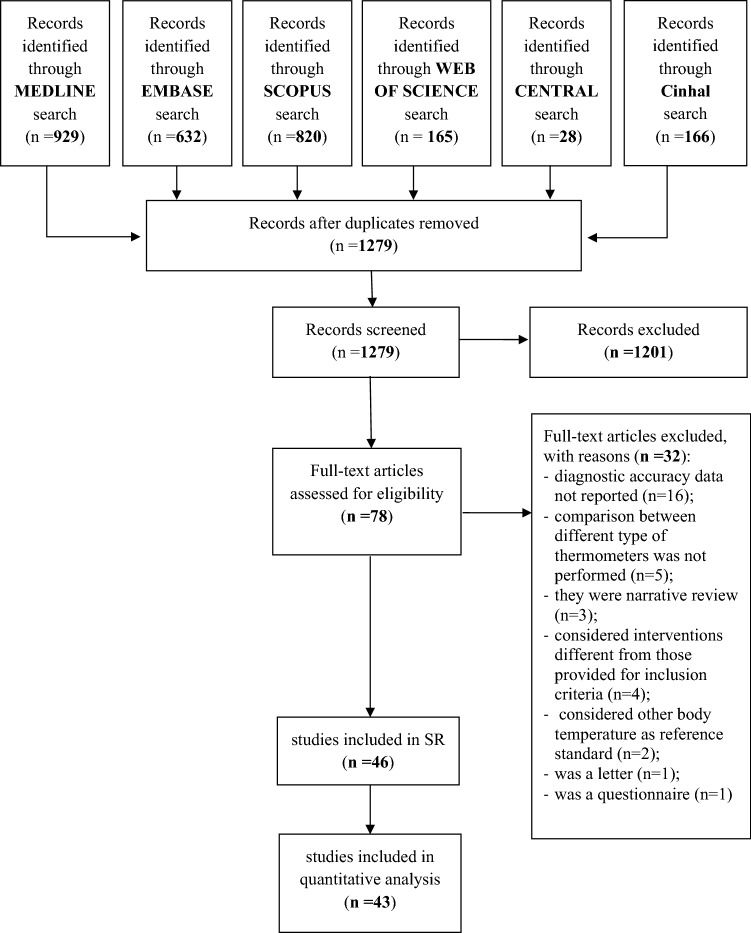
- The review included 46 studies with 12,602 patients; 43 studies contributed to quantitative analyses.
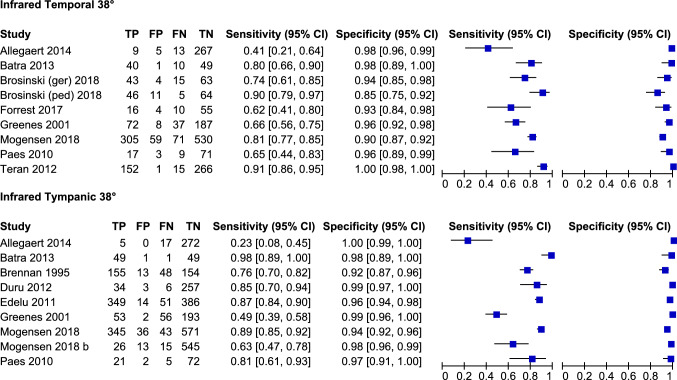
- For fever detection at 38 °C, temporal artery infrared thermometry had pooled sensitivity 0.76 (95% CI 0.65–0.84) and specificity 0.96 (0.92–0.98) in 9 studies (2,533 participants; 885 with fever).
- For fever detection at 38 °C, tympanic infrared thermometry had pooled sensitivity 0.77 (0.60–0.88) and specificity 0.98 (0.95–0.99) in 9 studies (3,862 participants; 1,279 with fever).
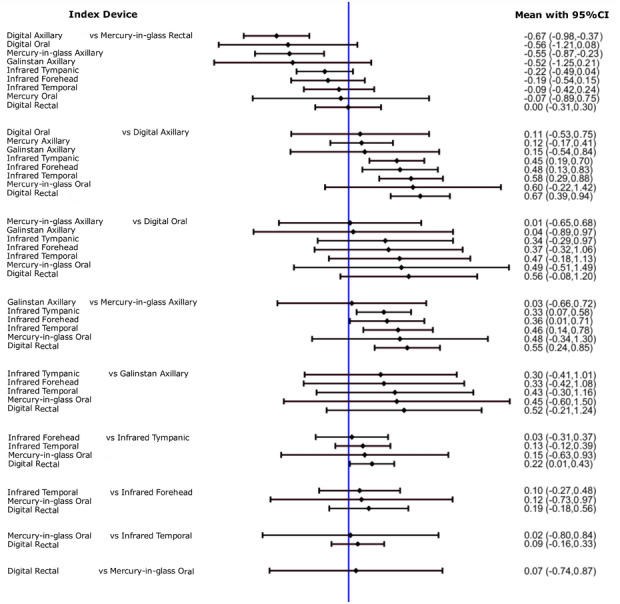
- Compared with rectal mercury-in-glass thermometry, axillary digital temperature was significantly lower by −0.67 °C (−0.98, −0.37), and axillary mercury-in-glass by −0.55 °C (−0.87, −0.23); the median 95% coefficient of reproducibility ranged from 0.53 °C for infrared temporal to 1.2 °C for axillary digital thermometry.
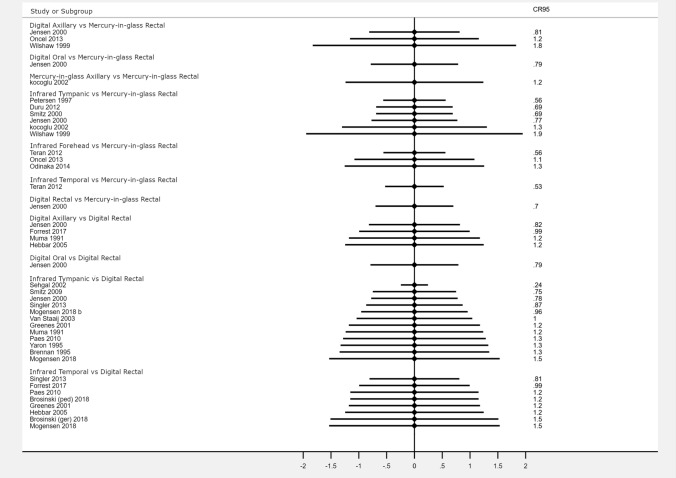
- The authors report that the mean 95% coefficient of reproducibility across 73 direct comparisons was 1.06 °C, and that fixed plus random error could lead to differences of about 2 °C in the worst case.
## Methods
- Systematic review and meta-analysis conducted according to Cochrane DTA guidance and reported per PRISMA-DTA; registered on PROSPERO CRD42020174996.
- Searched Medline, Embase, Web of Science, Scopus, CENTRAL, and CINAHL up to March 2020 for studies of adults or children in emergency, hospital inpatient, or neonatal settings comparing thermometer types.
- Used bivariate meta-analysis for diagnostic accuracy, and network meta-analysis for mean differences between thermometer types; analyses were centered on a 38 °C fever threshold and rectal mercury-in-glass or digital thermometry as reference standard.
## Limitations
- The paper states that there were too few studies to estimate accuracy for some devices/sites and settings, including a specific setting such as the ED.
- The authors state that overall certainty was moderate because of limitations in study design and considerable heterogeneity across studies, including different body sites, mixed child/adult populations, threshold effects, and operator variability.
- Evident from the text: many studies had unclear enrollment, limited blinding, and some thermometers/sites had only one to three studies, which restricts precision and generalizability.
Model-written summary. Check it against the paper before relying on it.
Integrity signals
Registry
Cites
Statistics
Figures
Verification
Claims the paper makes
4 Valid · 0 Not valid · 7 Not checked · 41 Own results and interpretations
A result the paper reports from its own data — it cites no other source for it, so there is none to check. The quote shows it is in the paper.
In the paper
“axillary digital thermometry was significantly lower by − 0.67 °C (− 0.98, − 0.37)”
§ The diagnostic accuracy of digital, infrared and mercury-in-glass thermometers in measuring body temperature: a systematic review and network meta-analysis > Results > Mean differences between thermometers using network meta-analyses
plain- Asserted: passes — The authors put it forward as true.
- Checkable: passes — It can be checked against evidence.
- Load-bearing: passes — The paper’s conclusions depend on it.
- Based: passes — The paper gives a reason why it holds.
A result the paper reports from its own data — it cites no other source for it, so there is none to check. The quote shows it is in the paper.
In the paper
“The mean 95% CR value of 73 direct comparisons between devices was 1.06 °C”
§ The diagnostic accuracy of digital, infrared and mercury-in-glass thermometers in measuring body temperature: a systematic review and network meta-analysis > Results > Description of random error for each direct comparison
plain- Asserted: passes — The authors put it forward as true.
- Checkable: passes — It can be checked against evidence.
- Load-bearing: passes — The paper’s conclusions depend on it.
- Based: passes — The paper gives a reason why it holds.
A result the paper reports from its own data — it cites no other source for it, so there is none to check. The quote shows it is in the paper.
In the paper
“Compared to the rectal mercury-in-glass thermometer, mean temperature differences were not statistically different from zero for temporal or tympanic infrared thermometry”
§ The diagnostic accuracy of digital, infrared and mercury-in-glass thermometers in measuring body temperature: a systematic review and network meta-analysis > Abstract
plain- Asserted: passes — The authors put it forward as true.
- Checkable: passes — It can be checked against evidence.
- Load-bearing: passes — The paper’s conclusions depend on it.
- Based: passes — The paper gives a reason why it holds.
A result the paper reports from its own data — it cites no other source for it, so there is none to check. The quote shows it is in the paper.
In the paper
“For all the other index devices, it was not possible to pool the estimates.”
- Also stated in: § Diagnostic accuracy estimates · plain
“There were three or fewer studies on other devices/sites and cut-offs (Appendix 2), thus meta-analyses were not possible.”
§ The diagnostic accuracy of digital, infrared and mercury-in-glass thermometers in measuring body temperature: a systematic review and network meta-analysis > Abstract
plain- Asserted: passes — The authors put it forward as true.
- Checkable: passes — It can be checked against evidence.
- Load-bearing: passes — The paper’s conclusions depend on it.
- Based: passes — The paper gives a reason why it holds.
- Also stated in: § Diagnostic accuracy estimates · plain
A result the paper reports from its own data — it cites no other source for it, so there is none to check. The quote shows it is in the paper.
In the paper
“the median coefficient of reproducibility ranged between 0.53 °C [0.95 ℉] for infrared temporal and 1.2 °C [2.16 ℉] for axillary digital thermometry.”
- Also stated in: § Description of random error for each direct comparison · plain
“The median 95%CR vs. rectal mercury-in-glass thermometry was 1.16 °C for axillary digital thermometry (three studies), 0.79 °C for digital oral thermometry (one study), 0.70 °C for digital rectal thermometry (one study), 0.73 °C for tympanic infrared thermometry (six studies), 1.08 °C for infrared forehead thermometry (three studies) and 0.53 °C for infrared temporal thermometry (one study).”
§ The diagnostic accuracy of digital, infrared and mercury-in-glass thermometers in measuring body temperature: a systematic review and network meta-analysis > Abstract
plain- Asserted: passes — The authors put it forward as true.
- Checkable: passes — It can be checked against evidence.
- Load-bearing: passes — The paper’s conclusions depend on it.
- Based: passes — The paper gives a reason why it holds.
- Also stated in: § Description of random error for each direct comparison · plain
13 more claims
Create a free account to see all 52 claims and to verify the 3 references still open.
- Probably not a substantial claim. 17
- It may state two separate claims as one. 23
Citations
Cites
QUADAS-2: a revised tool for the quality assessment of diagnostic accuracy studies
Whiting, P. F., Rutjes, A. W. S., Westwood, M. E., Mallett, S., Deeks, J. J., Reitsma, J. B., Leeflang, M. M. G., Sterne, J. A. C., Bossuyt, P. M. M., & the QUADAS-2 Group* (2011) · Annals of Internal Medicine · doi:10.7326/0003-4819-155-8-201110180-00009 · Cited by 14,199
Measuring agreement in method comparison studies
Bland, J. M., & Altman, D. G. (1999) · Statistical Methods in Medical Research · doi:10.1177/096228029900800204 · Cited by 9,619 · cited 2×
“96 times the standard deviation (SD) of these differences (random error), which are the two components of the 95% coefficient of reproducibility [14].”
Reitsma, J. B., Glas, A. S., Rutjes, A. W. S., Scholten, R. J. P. M., Bossuyt, P. M., & Zwinderman, A. H. (2005) · Journal of Clinical Epidemiology · doi:10.1016/j.jclinepi.2005.02.022 · Cited by 3,369 · cited 1×
“We used mixed models to fit bivariate meta-analyses, which model sensitivity and specificity while accounting for their correlation [16].”
McInnes, M. D. F., Moher, D., Thombs, B. D., McGrath, T. A., Bossuyt, P. M., and the PRISMA-DTA Group, Clifford, T., Cohen, J. F., Deeks, J. J., Gatsonis, C., et al. (2018) · JAMA · doi:10.1001/jama.2017.19163 · Cited by 3,210 · cited 1×
“The reporting was in accordance with the Preferred Reporting Items for Systematic reviews and Meta-Analyses of Diagnostic Test Accuracy Studies (PRISMA-DTA) criteria [10].”
Graphical tools for network meta-analysis in STATA
Chaimani, A., Higgins, J. P. T., Mavridis, D., Spyridonos, P., & Salanti, G. (2013) · PLoS ONE · doi:10.1371/journal.pone.0076654 · Cited by 2,473 · cited 11×
“(Mercury-in-glass or digital rectal at 38 °C as cut-off as reference device) NMA Device No.”
InfluentialMeta-analyses involving cross-over trials: methodological issues
Elbourne, D. R., Altman, D. G., Higgins, J. P., Curtin, F., Worthington, H. V., & Vail, A. (2002) · International Journal of Epidemiology · doi:10.1093/ije/31.1.140 · Cited by 2,305 · cited 3×
“Niven et al. calculated 95% coefficients of reproducibility as twice the SDs but did not explain how SDs were pooled across studies [2].”
InfluentialGrading quality of evidence and strength of recommendations for diagnostic tests and strategies
Schünemann, H. J., Oxman, A. D., Brozek, J., Glasziou, P., Jaeschke, R., Vist, G. E., Williams, J. W., Kunz, R., Craig, J., Montori, V. M., et al. (2008) · BMJ · doi:10.1136/bmj.39500.677199.ae · Cited by 1,782
White, I. R. (2015) · The Stata Journal: Promoting communications on statistics and Stata · doi:10.1177/1536867x1501500403 · Cited by 766
metandi: Meta-analysis of diagnostic accuracy using hierarchical logistic regression
Harbord, R. M., & Whiting, P. (2009) · The Stata Journal: Promoting communications on statistics and Stata · doi:10.1177/1536867x0900900203 · Cited by 453 · cited 1×
“We used the STATA metandi package [20] to fit bivariate models, the STATA network routine to perform NMA [21] and the STATA metan function to obtain pairwise metaanalyses [22].”
Nikolakopoulou, A., White, I. R., & Salanti, G. (2020) · Handbook of Meta-Analysis · doi:10.1201/9781315119403-10 · Cited by 303
Niven, D. J., Gaudet, J. E., Laupland, K. B., Mrklas, K. J., Roberts, D. J., & Stelfox, H. T. (2015) · Annals of Internal Medicine · doi:10.7326/m15-1150 · Cited by 240 · cited 3×
“calculated 95% coefficients of reproducibility as twice the SDs but did not explain how SDs were pooled across studies [2].”
Fever: Its Biology, Evolution, and Function
Kluger, M. J. (2015) · doi:10.1515/9781400869831 · Cited by 166 · cited 1×
“3 °C is usually considered a febrile response [1].”
Thermometry in paediatric practice
El-Radhi, A. S. (2006) · Archives of Disease in Childhood · doi:10.1136/adc.2005.088831 · Cited by 160 · cited 1×
“rectal, pulmonary artery, urinary bladder, and oesophageal sites) [12, 13].”
Accuracy of a Noninvasive Temporal Artery Thermometer for Use in Infants
Greenes, D. S., & Fleisher, G. R. (2001) · Archives of Pediatrics & Adolescent Medicine · doi:10.1001/archpedi.155.3.376 · Cited by 140 · cited 1×
“Greenes 2001 [38] Cross-sectional ED Children 304 Rectal, digital Tympanic, infrared Temporal artery, infrared”
Accuracy of Peripheral Thermometers for Estimating Temperature
Niven, D. J., Laupland, K. B., & Stelfox, H. T. (2016) · Annals of Internal Medicine · doi:10.7326/l16-0069 · Cited by 135
Richardson, M., & Lakhanpaul, M. (2007) · BMJ · doi:10.1136/bmj.39218.495255.ae · Cited by 120
Comparison of rectal, axillary, and tympanic membrane temperatures in infants and young children
Muma, B. K., Treloar, D. J., Wurmlinger, K., Peterson, E., & Vitae, A. (1991) · Annals of Emergency Medicine · doi:10.1016/s0196-0644(05)81116-3 · Cited by 116
2016 Update of the Italian Pediatric Society Guidelines for Management of Fever in Children
Chiappini, E., Venturini, E., Remaschi, G., Principi, N., Longhi, R., Tovo, P.-A., Becherucci, P., Bonsignori, F., Esposito, S., Festini, F., et al. (2017) · The Journal of Pediatrics · doi:10.1016/j.jpeds.2016.09.043 · Cited by 104
Accuracy of tympanic temperature measurement using an infrared tympanic membrane thermometer
Gasim, G. I., Musa, I. R., Abdien, M. T., & Adam, I. (2013) · BMC Research Notes · doi:10.1186/1756-0500-6-194 · Cited by 98 · cited 1×
“Gasim 2013 [36] Cross sectional ED Adult and children 174 Axillary, mercury-inglass Tympanic, infrared”
Davis, T. (2013) · Archives of Disease in Childhood Education & Practice · doi:10.1136/archdischild-2013-304792 · Cited by 94
Clinical accuracy of a non‐contact infrared skin thermometer in paediatric practice
Teran, C. G., Torrez‐Llanos, J., Teran‐Miranda, T. E., Balderrama, C., Shah, N. S., & Villarroel, P. (2012) · Child: Care, Health and Development · doi:10.1111/j.1365-2214.2011.01264.x · Cited by 91 · cited 1×
“Teran 2012 [65] Cross-sectional Inpatient unit and ED Children 434 Rectal, mercury-inglass Forehead, infrared Temporal artery, infrared”
Dodd, S. R., Lancaster, G. A., Craig, J. V., Smyth, R. L., & Williamson, P. R. (2006) · Journal of Clinical Epidemiology · doi:10.1016/j.jclinepi.2005.10.004 · Cited by 90 · cited 1×
“Previous reviews, despite the variability in the methodology used and in the included studies, also concluded that tympanic and temporal artery thermometers are more accurate, achieving high specificity but insufficient sensitivity when assessed against rectal thermometry [2, 69, 70].”
Hebbar, K., Fortenberry, J. D., Rogers, K., Merritt, R., & Easley, K. (2005) · Pediatric Critical Care Medicine · doi:10.1097/01.pcc.0000163671.69197.16 · Cited by 83 · cited 2×
“Hebbar 2005 [41] Cohort Pediatric unit Children 44 Rectal, digital Axillary, digital Temporal artery, infrared”
Jensen, B. N. (2000) · The European Journal of Surgery · doi:10.1080/110241500447218 · Cited by 80 · cited 1×
“Jensen 2000 [44] RCT Surgical unit Adult 200 Rectal, mercury-inglass Tympanic, infrared Oral, digital Axillary, digital Rectal, digital”
Reliability of Infrared Tympanic Thermometry in the Detection of Rectal Fever in Children
Brennan, D. F., FALK, J., Rothrock, S. G., & KERR, R. (1995) · Annals of Emergency Medicine · doi:10.1016/s0196-0644(95)70350-0 · Cited by 78 · cited 1×
“Brennan 1995 [28] Cohort ED Children 370 Rectal, digital Tympanic, infrared”
Chiappini, E., Sollai, S., Longhi, R., Morandini, L., Laghi, A., Osio, C. E., Persiani, M., Lonati, S., Picchi, R., Bonsignori, F., et al. (2011) · Journal of Clinical Nursing · doi:10.1111/j.1365-2702.2010.03565.x · Cited by 77 · cited 1×
“Chiappini 2011 [30] Cross sectional Pediatric ED Children 252 Axillary, mercury-inglass Forehead, infrared”
Kocoglu, H., Goksu, S., Isik, M., Akturk, Z., & Bayazit, Y. A. (2002) · International Journal of Pediatric Otorhinolaryngology · doi:10.1016/s0165-5876(02)00129-5 · Cited by 76 · cited 1×
“Kocoglu 2002 [46] Cohort Hospital Children 110 Rectal, mercury-inglass Axillary, mercuryin-glass Tympanic, infrared”
Accuracy of tympanic and infrared skin thermometers in children
Paes, B. F., Vermeulen, K., Brohet, R. M., van der Ploeg, T., & de Winter, J. P. (2010) · Archives of Disease in Childhood · doi:10.1136/adc.2010.185801 · Cited by 71 · cited 1×
“Paes 2010 [54] Cohort Pediatric unit Children 100 Rectal, digital Tympanic, infrared Temporal, infrared”
Temperature measurements with a temporal scanner: systematic review and meta-analysis
Geijer, H., Udumyan, R., Lohse, G., & Nilsagård, Y. (2016) · BMJ Open · doi:10.1136/bmjopen-2015-009509 · Cited by 66 · cited 1×
“Previous reviews, despite the variability in the methodology used and in the included studies, also concluded that tympanic and temporal artery thermometers are more accurate, achieving high specificity but insufficient sensitivity when assessed against rectal thermometry [2, 69, 70].”
Allegaert, K., Casteels, K., van Gorp, I., & Bogaert, G. (2014) · Current Therapeutic Research · doi:10.1016/j.curtheres.2013.11.005 · Cited by 61 · cited 1×
“Allegaert 2014 [23] RCT ED Children 294 Rectal, digital Tympanic, infrared Forehead, infrared Temporal artery, infrared”
van Staaij, B. K., Rovers, M. M., Schilder, A. G., & Hoes, A. W. (2003) · International Journal of Pediatric Otorhinolaryngology · doi:10.1016/s0165-5876(03)00198-8 · Cited by 61 · cited 2×
“Van Staaij 2003 [66] Cohort Pediatric unit Children 41 Rectal, digital Tympanic, infrared”
Comparison of the Temporal Artery and Rectal Thermometry in Children in the Emergency Department
Schuh, S., Komar, L., Stephens, D., Chu, L., Read, S., & Allen, U. (2004) · Pediatric Emergency Care · doi:10.1097/01.pec.0000144915.78124.26 · Cited by 60 · cited 1×
“Schuh 2004 [59] Cohort ED Children 327 Rectal Forehead”
Comparison of Rectal and Infrared Ear Temperatures in Older Hospital Inpatients
Smitz, S., Giagoultsis, T., Dewé, W., & Albert, A. (2000) · Journal of the American Geriatrics Society · doi:10.1111/j.1532-5415.2000.tb03030.x · Cited by 56 · cited 1×
“Smitz 2000 [63] Cohort Geriatric unit Adult 45 Rectal, mercury-inglass Tympanic, infrared”
Measurement Accuracy of Fever by Tympanic and Axillary Thermometry
Devrim, L., Kara, A., Ceyhan, M., Tezer, H., Uludag, A. K., Cengiz, A. B., Yi??itkanl, ?., & Se??meer, G. (2007) · Pediatric Emergency Care · doi:10.1097/pec.0b013e31802c61e6 · Cited by 56 · cited 1×
“Devrim 2007 [32] Cross sectional Pediatric hospital Children 102 Axillary, mercury-inglass Tympanic, infrared”
Bijur, P. E., Shah, P. D., & Esses, D. (2016) · Emergency Medicine Journal · doi:10.1136/emermed-2015-205122 · Cited by 55 · cited 1×
“rectal, pulmonary artery, urinary bladder, and oesophageal sites) [12, 13].”
Mogensen, C. B., Wittenhoff, L., Fruerhøj, G., & Hansen, S. (2018) · BMC Pediatrics · doi:10.1186/s12887-018-0994-1 · Cited by 54 · cited 1×
“Mogensen 2018 [48] Cross-sectional Pediatric department Children 995 Rectal, digital Tympanic, infrared Temporal artery, infrared”
Jean-Mary, M. B., DiCanzio, J., Shaw, J. S., & Bernstein, H. H. (2002) · The Journal of Pediatrics · doi:10.1067/mpd.2002.127664 · Cited by 48 · cited 1×
“Jean Mary 2002 [43] Cohort Hospital Children 198 Rectal, digital Axillary, infrared Tympanic, infrared”
Batra, P., & Goyal, S. (2013) · Pediatric Emergency Care · doi:10.1097/pec.0b013e31827b5427 · Cited by 43 · cited 1×
“Batra 2013 [26] Cohort Pediatric ED Children 100 Rectal, mercury-inglass Axillary, digital Tympanic, infrared Temporal artery, infrared”
Apa, H., Gözmen, S., Bayram, N., Çatkoğlu, A., Devrim, F., Karaarslan, U., Günay, İ., Ünal, N., & Devrim, İ. (2013) · Pediatric Emergency Care · doi:10.1097/pec.0b013e3182a2d419 · Cited by 43 · cited 2×
“Apa 2013 [24] Cohort Pediatric unit Children 50 Axillary, digital Tympanic, infrared Forehead, infrared”
Accuracy of tympanic and forehead thermometers in private paediatric practice
Teller, J., Ragazzi, M., Simonetti, G., & Lava, S. (2014) · Acta Paediatrica · doi:10.1111/apa.12464 · Cited by 42 · cited 1×
“Teller 2014 [64] Cross-sectional Private pediatric practice Children 254 Rectal, digital Tympanic, infrared Forehead, infrared”
Measuring the accuracy of the infrared tympanic thermometer: Correlation does not signify agreement
Yaron, M., Lowenstein, S. R., & Koziol‐McLain, J. (1995) · Journal of Emergency Medicine · doi:10.1016/0736-4679(95)00065-i · Cited by 42 · cited 1×
“Yaron 1995 [68] RCT ED Adult 100 Rectal, digital Tympanic, infrared”
A comparison of the use of tympanic, axillary, and rectal thermometers in infants
Wilshaw, R., Beckstrand, R. L., Waid, D., & Schaalje, G. B. (1999) · Journal of Pediatric Nursing · doi:10.1016/s0882-5963(99)80042-6 · Cited by 42 · cited 1×
“Wilshaw 1999 [67] Cohort Clinic Children 120 Rectal, mercury Tympanic, infrared Axillary, digital”
Can training improve the results with infrared tympanic thermometers?
PETERSEN, M. H., & Hauge, H. (1997) · Acta Anaesthesiologica Scandinavica · doi:10.1111/j.1399-6576.1997.tb04837.x · Cited by 38 · cited 2×
“Petersen 1997 [55] Cohort Neurosurgical unit Adult 65 Rectal, mercury-inglass Tympanic, infrared”
Singler, K., Bertsch, T., Heppner, H. J., Kob, R., Hammer, K., Biber, R., Sieber, C. C., & Christ, M. (2013) · Age and Ageing · doi:10.1093/ageing/aft121 · Cited by 35 · cited 1×
“Singler 2013 [61] Cohort ED Adult 427 Rectal, digital Tympanic, infrared Temporal artery, infrared”
Use of noncontact infrared thermography to measure temperature in children in a triage room
Berksoy, E., Bag, O. I., Yazıcı, S., & Çelik, T. (2018) · Medicine · doi:10.1097/md.0000000000009737 · Cited by 34 · cited 2×
“Berksoy 2018 [27] Cohort Pediatric ED Children 319 Axillary, digital Forehead, infrared”
Hamilton, P. A., Marcos, L. S., & Secic, M. (2013) · Journal of Clinical Nursing · doi:10.1111/jocn.12060 · Cited by 33 · cited 1×
“Hamilton 2013 [39] Cohort ED Children 205 Rectal or oral, digital Tympanic, infrared Temporal artery, infrared”
The use of infrared thermometry for the detection of fever.
Hay, A. D., Peters, T. J., Wilson, A., & Fahey, T. P. (2004) · Europe PMC (PubMed Central) · Cited by 31
Edelu, B. O., Ojinnaka, N. C., & Ikefuna, A. (2011) · The Italian Journal of Pediatrics/Italian journal of pediatrics · doi:10.1186/1824-7288-37-8 · Cited by 30
A comparison of tympanic and rectal temperatures in term NIGERIAN neonates
Duru, C. O., Akinbami, F. O., & Orimadegun, A. E. (2012) · BMC Pediatrics · doi:10.1186/1471-2431-12-86 · Cited by 29 · cited 1×
“Duru 2012 [33] Cohort Pediatric unit and ED Children 300 Rectal, mercury-inglass Tympanic, infrared”
Reliability of infrared ear thermometry in the prediction of rectal temperature in older inpatients
Smitz, S., de Winckel, A. V., & Smitz, M. (2009) · Journal of Clinical Nursing · doi:10.1111/j.1365-2702.2008.02565.x · Cited by 25 · cited 1×
“Smitz 2009 [62] Cohort Geriatric unit Adult 100 Rectal, digital Tympanic, infrared”
(2001) · PubMed · Cited by 22
Mogensen, C. B., Vilhelmsen, M. B., Jepsen, J., Boye, L. K. G., Persson, M. H., & Skyum, F. (2018) · BMC Emergency Medicine · doi:10.1186/s12873-018-0202-5 · Cited by 21 · cited 1×
“Mogensen 2018b [49] Cohort ED Adult 599 Rectal, digital Tympanic, infrared”
Comparison of tympanic and rectal temperature in febrile patients
Sehgal, A., Dubey, N. K., Jyothi, M. C., & Jain, S. (2002) · The Indian Journal of Pediatrics · doi:10.1007/bf02723215 · Cited by 21 · cited 1×
“Sehgal 2002 [60] Cohort ED Children 60 Rectal, digital Tympanic, infrared”
Schreiber, S., Minute, M., Tornese, G., Giorgi, R., Duranti, M., Ronfani, L., & Barbi, E. (2013) · Pediatric Emergency Care · doi:10.1097/pec.0b013e3182809c29 · Cited by 21 · cited 1×
“Schreiber 2013 [58] Cross-sectional Pediatric ED Children 284 Axillary, mercury Axillary, digital Axillary, galinstan”
Infrared ear thermometry in the critically ill patient
León, C., Rodríguez, A. H., Fernández-Palacín, A., & Flores, L. (2005) · Journal of Critical Care · doi:10.1016/j.jcrc.2004.08.011 · Cited by 19 · cited 3×
“Leon 2005 [47] Cross sectional Intensive care unit Adult 50 Axillary, mercury-inglass Tympanic, infrared”
Temporal Artery Thermometry in Children Younger Than 5 Years: A Comparison With Rectal Thermometry
Odinaka, K. K., Edelu, B. O., Nwolisa, C. E., Amamilo, I. B., & Okolo, S. N. (2014) · Pediatric Emergency Care · doi:10.1097/pec.0000000000000289 · Cited by 16 · cited 1×
“Odinaka 2014 [52] Cohort Pediatric unit Children 156 Rectal, mercury-inglass Forehead, infrared”
Comparison of temporal artery to mercury and digital temperature measurement in pediatrics
İşler, A., Aydin, R., Güven, Ş. T., & Günay, S. (2013) · International Emergency Nursing · doi:10.1016/j.ienj.2013.09.003 · Cited by 15 · cited 1×
“Isler 2014 [42] Cohort Pediatric ED Children 218 Temporal artery, infrared Axillary, mercuryin-glass Axillary, digital”
Zsuzsanna Balla, H., Theodorsson, E., & Ström, J. O. (2019) · Scandinavian Journal of Clinical and Laboratory Investigation · doi:10.1080/00365513.2018.1519722 · Cited by 14 · cited 2×
“Balla 2019 [25] Cross-sectional Neurological and infection wards Adult 15 Rectal, digital Axillary, thermistor”
Forrest, A. J., Juliano, M. L., Conley, S. P., Cronyn, P. D., McGlynn, A. F., & Auten, J. D. (2017) · The American Journal of Emergency Medicine · doi:10.1016/j.ajem.2017.06.017 · Cited by 14
Dakappa, P. H. (2016) · JOURNAL OF CLINICAL AND DIAGNOSTIC RESEARCH · doi:10.7860/jcdr/2016/21617.8586 · Cited by 13 · cited 1×
“Dakappa 2016 [31] RCT Hospital Adult 55 Axillary, mercury-inglass Tympanic, infrared”
The relative accuracy of mercury, Tempa-DOT and FeverScan thermometers
Morley, C. J., Murray, M. J., & Whybrew, K. (1998) · Early Human Development · doi:10.1016/s0378-3782(98)00050-4 · Cited by 11 · cited 1×
“Morley 1998 [50] Cohort Hospital Children 1090 Axillary, mercury-inglass Forehead, infrared”
Öncel, M. Y., Tekgündüz, K. Ş., Оздемир, Р., Çalışıcı, E., Karahan, S., Erdeve, Ö., Oğuz, Ş. S., & Dilmen, U. (2012) · The Indian Journal of Pediatrics · doi:10.1007/s12098-012-0790-0 · Cited by 11 · cited 1×
“Oncel 2013 [53] Cohort Maternity unit Children 120 Rectal, mercury-inglass Axillary, digital Forehead, infrared”
Rajee, M., & Sultana, R. (2006) · Emergency Medicine Australasia · doi:10.1111/j.1742-6723.2006.00847.x · Cited by 11 · cited 1×
“Rajee 2006 [57] Cohort ED Adult 200 Oral, mercury-inglass Tympanic, infrared”
Tympanic temperature comparison with oral mercury thermometer readings in an OPD setting.
Rabbani, M. Z., Amir, M., Malik, M., Mufti, M., Pervez, M. B., & Iftekhar, S. (2010) · PubMed · Cited by 9
Is the axilla the right site for temperature measurement in children by chemical thermometer?
Kara, A., Devrim, İ., Cengiz, A. B., et al. (2010) · PubMed · Cited by 9
Comparison of Temporal Artery Thermometry with Axillary and Rectal Thermometry in Full Term Neonates
Goswami, E., Batra, P., Khurana, R., et al. (2016) · The Indian Journal of Pediatrics · doi:10.1007/s12098-016-2259-z · Cited by 6 · cited 2×
“Goswami 2017 [37] Cohort Pediatric unit Children 210 Rectal, digital Axillary, digital Temporal artery, infrared”
Brosinski, C. M., Valdez, S., Riddell, A., & Riffenburgh, R. H. (2017) · Journal of Emergency Nursing · doi:10.1016/j.jen.2017.04.015 · Cited by 6
Cited by
Exploring Thermal Dynamics in Wound Healing: The Impact of Temperature and Microenvironment
Huang, J., Fan, C., Ma, Y., & Huang, G. (2024) · Clinical Cosmetic and Investigational Dermatology · doi:10.2147/ccid.s468396 · Cited by 53
“The archetypical modalities for quantifying thermal variations predominantly rely on single-point detection mechanisms, incorporating instruments such as thermocouple thermometers, 21 infrared thermometers, 22 and infrared thermographic cameras (Figure 1).”
BackgroundAjčević, M., Stella, A. B., Furlanis, G., Caruso, P., Naccarato, M., Accardo, A., & Manganotti, P. (2022) · Sensors · doi:10.3390/s22134760 · Cited by 41
Chen, A., Zhu, J., Lin, Q., & Liu, W. (2022) · International Journal of Environmental Research and Public Health · doi:10.3390/ijerph192315883 · Cited by 35
“[3] provided a summary of the research on detecting body temperature in hospital systems using electronic thermometers, infrared thermometers, and mercury thermometers.”
BackgroundMicrogels sense wounds' temperature, pH and glucose
Xiao, Y., Xu, K., Zhao, P., Ji, L., Hua, C., Jia, X., Wu, X., Diao, L., Zhong, W., Lyu, G., et al. (2024) · Biomaterials · doi:10.1016/j.biomaterials.2024.122813 · Cited by 35
Comparative Analysis of Human Body Temperatures Measured with Noncontact and Contact Thermometers
Dolibog, P., Pietrzyk, B., Kierszniok, K., & Pawlicki, K. (2022) · Healthcare · doi:10.3390/healthcare10020331 · Cited by 40
“Their disadvantage is the fact that, like traditional thermometers, they are contact devices, which require the implementation of disinfecting agents [7].”
Background
Metadata
- Authors
- Pecoraro, V., Petri, D., Costantino, G., Squizzato, A., Moja, L., Virgili, G., & Lucenteforte, E.
- Affiliations
- University of Pisa (IT)
- University of Milan (IT)
- University of Insubria (IT)
- Azienda Ospedaliero-Universitaria Careggi (IT)
- Corresponding author
- Lucenteforte, Ersilia
- ORCID
- Venue
- Internal and Emergency Medicine
- Published
- 2020-11-25
- Volume
- 16
- Issue
- 4
- Pages
- 1071-1083
- ISSN
- 1828-0447 (ISSN-L)
- 1970-9366
- PMC
- PMC7686821
- OpenAlex
- W3107110570
- Semantic Scholar
- e6bfbad0712f698c2c504dda8d4670280ed1075b
- Cited by
- 49
- References
- 69
- Citations by year
- 2026: 9 · 2025: 10 · 2024: 9 · 2023: 6 · 2022: 12 · 2021: 3
- FWCI
- 0.77
- Type
- journal article
- Language
- en
- Open access
- hybrid
- doi.org
- Licence
- cc-by
- creativecommons.org/licenses/by/4.0 (tdm)
- creativecommons.org/licenses/by/4.0 (vor)
- Locations
- Internal and Emergency Medicine (publishedVersion, cc-by)
- PubMed Central (publishedVersion, cc-by)
- PubMed (publishedVersion)
- Florence Research (University of Florence) (submittedVersion, cc-by)
- Archivio Istituzionale della Ricerca (Universita Degli Studi Di Milano) (submittedVersion, other-oa)
- CINECA IRIS Institutial research information system (University of Pisa) (submittedVersion)
- IrInSubria (University of Insubria) (submittedVersion)
- Funders
- Fondazione Cassa si Risparmio di Firenze (24383)
- Università di Pisa
- Topics
- Health Sciences › Medicine › Radiology, Nuclear Medicine and Imaging › Infrared Thermography in Medicine
- Health Sciences › Medicine › Critical Care and Intensive Care Medicine › Thermal Regulation in Medicine
- Health Sciences › Medicine › Physiology (medical) › Thermoregulation and physiological responses
- Keywords
- body temperature measurement, fever diagnosis, infrared thermometry, tympanic thermometer, digital thermometer, mercury-in-glass thermometer, rectal thermometry, diagnostic accuracy, reproducibility, sensitivity and specificity
- MeSH terms
- Body Temperature, Diagnostic Tests, Routine, Equipment Design, Humans, Sensitivity and Specificity, Thermometers, Reproducibility of Results
About these checks
Registry, retraction, Cites and statistics results are computed, not judged, with one exception: a printed reference that no index lists is read once by a model before it counts as a citation error. Claims are extracted by a model and kept only when their quote appears verbatim in the text; each cited source is then checked, with a model’s help, for whether it says what the claim relies on. Those verdicts can be wrong — read the claim’s quote and the cited source before relying on one.
The claim verdicts this report counts are experimental: their accuracy is not yet measured.
A language model drew the claims from the paper on 2026-10-10, under version 3 of the claim definition (model deepseek-v4.1-flash, prompt extract-v3).
A second model labelled each claim on 2026-10-10 (model jev-1.13-20260917, definition revision gold-guideline-v0.2).
Statistics and arithmetic are recomputed, not judged.
Confidence bands are shown only for fields calibrated on our annotated test set. None is calibrated yet, so no band is shown.
What counts as a claim ›How we measure confidence ›How we check this ›
Are you an author, or do you see a problem with this page? Request a review
Data sources
Bibliographic data: Semantic Scholar, OpenAlex, Crossref.
Contains information from the Semantic Scholar Academic Graph Datasets, made available under the ODC Attribution License (ODC-BY 1.0).
Semantic Scholar’s data is described in: Kinney, R., et al. (2023). The Semantic Scholar Open Data Platform. arXiv:2301.10140.
