

The Gut Microbiome Alterations and Inflammation-Driven Pathogenesis of Alzheimer’s Disease—a Critical Review
Open accessThe DOI matches its Crossref record; 105 of the 105 references it cites were found in a registry or an index.
Abstract
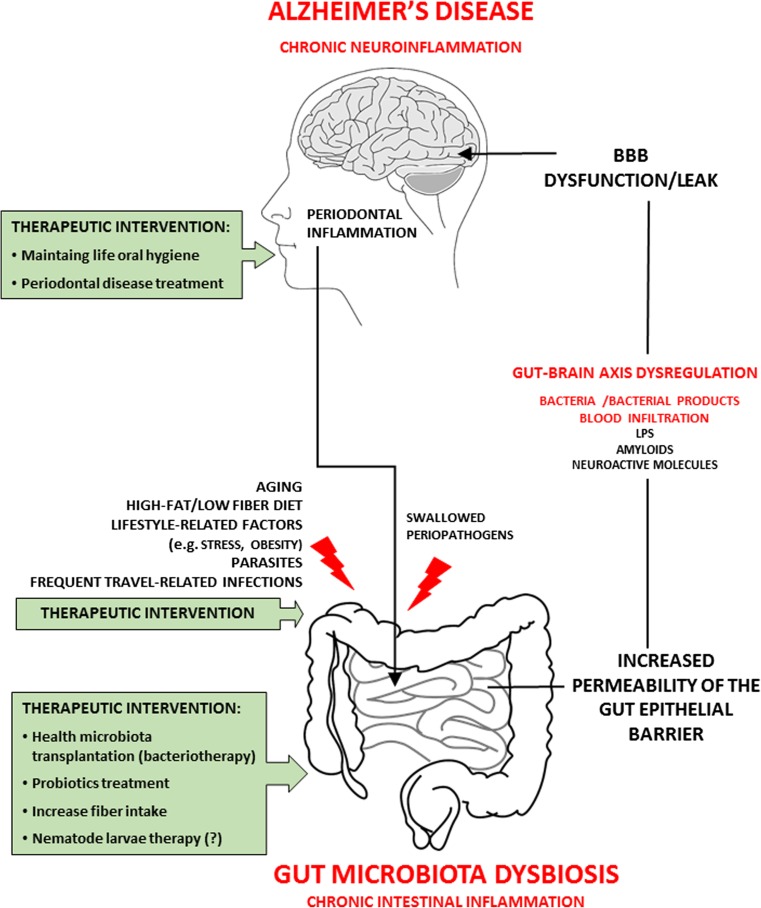
One of the most important scientific discoveries of recent years was the disclosure that the intestinal microflora takes part in bidirectional communication between the gut and the brain. Scientists suggest that human gut microflora may even act as the "second brain" and be responsible for neurodegenerative disorders like Alzheimer's disease (AD). Although human-associated microbial communities are generally stable, they can be altered by common human actions and experiences. Enteric bacteria, commensal, and pathogenic microorganisms, may have a major impact on immune system, brain development, and behavior, as they are able to produce several neurotransmitters and neuromodulators like serotonin, kynurenine, catecholamine, etc., as well as amyloids. However, brain destructive mechanisms, that can lead to dementia and AD, start with the intestinal microbiome dysbiosis, development of local and systemic inflammation, and dysregulation of the gut-brain axis. Increased permeability of the gut epithelial barrier results in invasion of different bacteria, viruses, and their neuroactive products that support neuroinflammatory reactions in the brain. It seems that, inflammatory-infectious hypothesis of AD, with the great role of the gut microbiome, starts to gently push into the shadow the amyloid cascade hypothesis that has dominated for decades. It is strongly postulated that AD may begin in the gut, and is closely related to the imbalance of gut microbiota. This is promising area for therapeutic intervention. Modulation of gut microbiota through personalized diet or beneficial microbiota intervention, alter microbial partners and their products including amyloid protein, will probably become a new treatment for AD.
Overview
The claims and statistics of this paper haven’t been checked yet.
Free: it reads the open-access text and checks the first 5 claims that cite a source we can check. Create a free account to check every claim.
Integrity signals
Registry
Cites
Statistics
Figures
Verification
Claims the paper makes
The claims and statistics of this paper haven’t been checked yet.
Free: it reads the open-access text and checks the first 5 claims that cite a source we can check. Create a free account to check every claim.
Claims other papers make about this one
Each is checked against this paper’s own text: does it say what the citing paper says it does?
The cited source says what the claim attributes to it.
In the citing paper
“The onset of systemic inflammation may allow inflammatory mediators to cross over the BBB and impact microglia, further exacerbating neuroinflammation.213,217”
From Recent advances in Alzheimer's disease: Mechanisms, clinical trials and new drug development strategies. (2024) · cites this paper as [217]
Self-check
Percentages, sums and reported differences re-computed from the paper’s own numbers.
The self-check needs the paper’s full text.
Citations
Cites
An obesity-associated gut microbiome with increased capacity for energy harvest
Turnbaugh, P. J., Ley, R. E., Mahowald, M. A., Magrini, V., Mardis, E. R., & Gordon, J. I. (2006) · Nature · doi:10.1038/nature05414 · Cited by 12,444 · cited 1×
“In turn, those microbial disturbances may increase pathogen susceptibility [29], obesity [28, 36], and auto-inflammatory disease [30], diseases which are becoming more frequent in the developed world.”
BackgroundDiet rapidly and reproducibly alters the human gut microbiome
David, L. A., Maurice, C. F., Carmody, R. N., Gootenberg, D. B., Button, J. E., Wolfe, B. E., Ling, A. V., Devlin, A. S., Varma, Y., Fischbach, M. A., et al. (2014) · Nature · doi:10.1038/nature12820 · Cited by 10,100 · cited 1×
“biotics [33–35], bowel surgery [37], and short-term diet shifts [38, 39].”
BackgroundHuman gut microbes associated with obesity
Ley, R. E., Turnbaugh, P. J., Klein, S., & Gordon, J. I. (2006) · Nature · doi:10.1038/4441022a · Cited by 8,785 · cited 1×
“In turn, those microbial disturbances may increase pathogen susceptibility [29], obesity [28, 36], and auto-inflammatory disease [30], diseases which are becoming more frequent in the developed world.”
BackgroundLinking long-term dietary patterns with gut microbial enterotypes
Wu, G. D., Chen, J., Hoffmann, C., Bittinger, K., Chen, Y.-Y., Keilbaugh, S. A., Bewtra, M., Knights, D., Walters, W. A., Knight, R., et al. (2011) · Science · doi:10.1126/science.1208344 · Cited by 6,513 · cited 1×
“biotics [33–35], bowel surgery [37], and short-term diet shifts [38, 39].”
BackgroundNeuroinflammation in Alzheimer's disease
Heneka, M. T., Carson, M. J., Khoury, J. E., Landreth, G. E., Brosseron, F., Feinstein, D. L., Jacobs, A. H., Wyss-Coray, T., Vitorica, J., Ransohoff, R. M., et al. (2015) · The Lancet Neurology · doi:10.1016/s1474-4422(15)70016-5 · Cited by 6,226 · cited 1×
“response that supports the neurotoxic processes, which cause brain injury and neuronal death [5, 6].”
BackgroundIntroduction to the human gut microbiota
Thursby, E., & Juge, N. (2017) · Biochemical Journal · doi:10.1042/bcj20160510 · Cited by 3,600 · cited 7×
“The reason is that the GI represents one of the largest interfaces (250–400 m(2)) between the host, environmental factors, and antigens in the human body [23].”
BackgroundInfluentialBacterial Community Variation in Human Body Habitats Across Space and Time
Costello, E. K., Lauber, C. L., Hamady, M., Fierer, N., Gordon, J. I., & Knight, R. (2009) · Science · doi:10.1126/science.1177486 · Cited by 3,231 · cited 1×
“Hence, many microbiome time series have featured limited longitudinal host metadata [32, 42], making it difficult to link microbial dynamics to host behavior.”
BackgroundThe Effect of Diet on the Human Gut Microbiome: A Metagenomic Analysis in Humanized Gnotobiotic Mice
Turnbaugh, P. J., Ridaura, V. K., Faith, J. J., Rey, F. E., Knight, R., & Gordon, J. I. (2009) · Science Translational Medicine · doi:10.1126/scitranslmed.3000322 · Cited by 3,058 · cited 1×
“However, studies across mice and humans suggest that common aspects of the modern Western lifestyle, including antibiotics [26, 33–35] and high-fat diets [27], can alter commensal microbial communities.”
BackgroundPeriodontitis: from microbial immune subversion to systemic inflammation
Hajishengallis, G. (2015) · Nature Reviews Immunology · doi:10.1038/nri3785 · Cited by 3,046 · cited 6×
“Travel from the developed to the developing world in one subject led to a nearly twofold increase in the Bacteroidetes to Firmicutes ratio, which reversed upon return.”
BackgroundInfluentialSuccession of microbial consortia in the developing infant gut microbiome
Koenig, J. E., Spor, A., Scalfone, N., Fricker, A. D., Stombaugh, J., Knight, R., Angenent, L. T., & Ley, R. E. (2011) · Proceedings of the National Academy of Sciences · doi:10.1073/pnas.1000081107 · Cited by 2,540
Research works printed but not linked: 1
- Hill JM, Bhattacharjee S, Pogue AI, Lukiw WJ (2014) The gas- trointestinal tract microbiome and potential link to Alzheimer's disease. Front Neurol 5:43
Cited by
Wang, X., Sun, G., Feng, T., Zhang, J., Huang, X., Wang, T., Xie, Z., Chu, X., Yang, J., Wang, H., et al. (2019) · Cell Research · doi:10.1038/s41422-019-0216-x · Cited by 1,144
Zhang, J., Zhang, Y., Wang, J., Xia, Y., Zhang, J., & Chen, L. (2024) · Signal Transduction and Targeted Therapy · doi:10.1038/s41392-024-01911-3 · Cited by 1,138
Chen, Y., Xu, J., & Chen, Y. (2021) · Nutrients · doi:10.3390/nu13062099 · Cited by 917
The gut microbiota in anxiety and depression—A systematic review
Simpson, C. A., Diaz-Arteche, C., Eliby, D., Schwartz, O. S., Simmons, J. G., & Cowan, C. S. M. (2021) · Clinical Psychology Review · doi:10.1016/j.cpr.2020.101943 · Cited by 912
Brain-Gut-Microbiota Axis in Alzheimer’s Disease
Kowalski, K., & Mulak, A. (2019) · Journal of Neurogastroenterology and Motility · doi:10.5056/jnm18087 · Cited by 826
“dysfunction and increased intestinal permeability (“leaky gut”) may contribute to the process of neurodegeneration.(48,49) The intestinal barrier is composed of the mucus layer, intes-”
BackgroundGut microbiota and dysbiosis in Alzheimer's disease: Implications for pathogenesis and treatment
Liu, S., Gao, J., Zhu, M., Liu, K., & Zhang, H.-L. (2020) · Molecular Neurobiology · doi:10.1007/s12035-020-02073-3 · Cited by 516
Role of gut-brain axis, gut microbial composition, and probiotic intervention in Alzheimer's disease
Kesika, P., Suganthy, N., Sivamaruthi, B. S., & Chaiyasut, C. (2021) · Life Sciences · doi:10.1016/j.lfs.2020.118627 · Cited by 479
Haran, J. P., Bhattarai, S. K., Foley, S. E., Dutta, P., Ward, D. V., Bucci, V., & McCormick, B. A. (2019) · mBio · doi:10.1128/mbio.00632-19 · Cited by 412
“neurodegenerative disorders, including Alzheimer’s disease (AD) (1).”
Diet and Inflammation in Cognitive Ageing and Alzheimer’s Disease
McGrattan, A. M., McGuinness, B., McKinley, M. C., Kee, F., Passmore, P., Woodside, J. V., & McEvoy, C. T. (2019) · Current Nutrition Reports · doi:10.1007/s13668-019-0271-4 · Cited by 385
Facchin, S., Bertin, L., Bonazzi, E., Lorenzon, G., De Barba, C., Barberio, B., Zingone, F., Maniero, D., Scarpa, M., Ruffolo, C., et al. (2024) · Life · doi:10.3390/life14050559 · Cited by 380
“The microbiome of patients with Parkinson’s and/or Alzheimer’s disease exhibits a reduction in SCFAs-producing bacteria [195,198].”
BackgroundPathogenesis, diagnostics, and therapeutics for Alzheimer's disease: Breaking the memory barrier
Kamatham, P. T., Shukla, R., Khatri, D. K., & Vora, L. K. (2024) · Ageing Research Reviews · doi:10.1016/j.arr.2024.102481 · Cited by 371
“Permeability to the blood brain barrier is increased due to the overproduction of LPS in the gut, which is a consequence of gut microbiota dysbiosis (Sochocka et al., 2019).”
BackgroundGut microbiome composition may be an indicator of preclinical Alzheimer’s disease
Ferreiro, A. L., Choi, J., Ryou, J., Newcomer, E. P., Thompson, R., Bollinger, R. M., Hall-Moore, C., Ndao, I. M., Sax, L., Benzinger, T. L. S., et al. (2023) · Science Translational Medicine · doi:10.1126/scitranslmed.abo2984 · Cited by 356
“DISCUSSION The prevalence of AD continues to grow globally as life expectancies increase (53), but therapies remain elusive (14).”
Song, J., He, Y., Luo, C., Feng, B., Ran, F., Xu, H., Ci, Z., Xu, R., Han, L., & Zhang, D. (2020) · Pharmacological Research · doi:10.1016/j.phrs.2020.105109 · Cited by 303
Inflammatory bowel disease is associated with higher dementia risk: a nationwide longitudinal study
Zhang, B., Wang, H. E., Bai, Y.-M., Tsai, S.-J., Su, T.-P., Chen, T.-J., Wang, Y.-P., & Chen, M.-H. (2021) · Gut · doi:10.1136/gutjnl-2020-320789 · Cited by 292
Zhang, J., Sun, Z., Jiang, S., Bai, X., Ma, C., Peng, Q., Chen, K., Chang, H., Fang, T., & Zhang, H. (2019) · mSystems · doi:10.1128/msystems.00017-19 · Cited by 282
“Emerging evidence indicates that there is a close relationship between the intestinal microbiota and various chronic metabolic diseases, including type 2 diabetes (2), liver cirrhosis (3), gout (4), colorectal cancer (5), arthritis (6), and even brain disorders such as Alzheimer’s disease (7, 8) and Parkinson’s diseas…”
BackgroundFernández-Calle, R., Konings, S. C., Frontiñán-Rubio, J., García-Revilla, J., Camprubí-Ferrer, L., Svensson, M., Martinson, I., Boza-Serrano, A., Venero, J. L., Nielsen, H. M., et al. (2022) · Molecular Neurodegeneration · doi:10.1186/s13024-022-00566-4 · Cited by 278
“The inflammatory-infectious hypothesis of AD suggests that dysbiosis of human intestinal microflora is responsible for AD [18].”
BackgroundNew approaches to symptomatic treatments for Alzheimer’s disease
Cummings, J. (2021) · Molecular Neurodegeneration · doi:10.1186/s13024-021-00424-9 · Cited by 226
Yang, C., Chowdhury, D., Zhang, Z., Cheung, W. K., Lu, A., Bian, Z., & Zhang, L. (2021) · Computational and Structural Biotechnology Journal · doi:10.1016/j.csbj.2021.11.028 · Cited by 223
Ganesan, K., Chung, S. K., Vanamala, J., & Xu, B. (2018) · International Journal of Molecular Sciences · doi:10.3390/ijms19123720 · Cited by 221
“The stool pH becomes more alkaline, with the increase in age and differs significantly between genders [29,52].”
BackgroundThe human microbiome in disease and pathology
Manos, J. (2022) · APMIS · doi:10.1111/apm.13225 · Cited by 220
Microbial-derived metabolites as a risk factor of age-related cognitive decline and dementia
Connell, E., Le Gall, G., Pontifex, M. G., Sami, S., Cryan, J. F., Clarke, G., Müller, M., & Vauzour, D. (2022) · Molecular Neurodegeneration · doi:10.1186/s13024-022-00548-6 · Cited by 208
“Thirdly, the influence of the microbiome on cognition is not the totality of microbial metabolites produced in the gut as the varying capabilities of these metabolites to penetrate the BBB play a key role [79].”
BackgroundMechanisms of Short-Chain Fatty Acids Derived from Gut Microbiota in Alzheimer's Disease
Qian, X.-H., Xie, R.-Y., Liu, X.-L., Chen, S.-D., & Tang, H.-D. (2022) · Aging and disease · doi:10.14336/ad.2021.1215 · Cited by 208
Goyal, D., Ali, S. A., & Singh, R. K. (2021) · Progress in Neuro-Psychopharmacology and Biological Psychiatry · doi:10.1016/j.pnpbp.2020.110112 · Cited by 205
Serotonin—Its Synthesis and Roles in the Healthy and the Critically Ill
Kanova, M., & Kohout, P. (2021) · International Journal of Molecular Sciences · doi:10.3390/ijms22094837 · Cited by 193
“Increased gut permeability results in invasion of different bacteria, viruses and their neuroactive products that support neuroinflammatory reactions in the brain [14].”
BackgroundLee, K.-E., Kim, J.-K., Han, S.-K., Lee, D. Y., Lee, H.-J., Yim, S.-V., & Kim, D.-H. (2020) · Microbiome · doi:10.1186/s40168-020-00881-2 · Cited by 188
Emerging role of gut microbiota dysbiosis in neuroinflammation and neurodegeneration
Solanki, R., Karande, A., & Ranganathan, P. (2023) · Frontiers in Neurology · doi:10.3389/fneur.2023.1149618 · Cited by 186
“Increased intestinal permeability (“leaky gut”) as a result of gut inflammation and dysbiosis associated with gut barrier dysfunction may contribute to the process of neurodegeneration (4, 66).”
BackgroundThe State of The Art on Acetylcholinesterase Inhibitors in the Treatment of Alzheimer’s Disease
Vecchio, I., Sorrentino, L., Paoletti, A., Marra, R., & Arbitrio, M. (2021) · Journal of Central Nervous System Disease · doi:10.1177/11795735211029113 · Cited by 178
Novel Therapeutic Approaches for Alzheimer’s Disease: An Updated Review
Yu, T.-W., Lane, H.-Y., & Lin, C.-H. (2021) · International Journal of Molecular Sciences · doi:10.3390/ijms22158208 · Cited by 176
“Astrocyte Modulators The astrocyte reaction impairs the clearance of Aβ at the BBB.”
BackgroundInfluentialGut microbiota and pro/prebiotics in Alzheimer’s disease
Pluta, R., Ułamek-Kozioł, M., Januszewski, S., & Czuczwar, S. J. (2020) · Aging · doi:10.18632/aging.102930 · Cited by 167
“lifestyle habits such as diet, exercise, education history, cognition and aging, immunosenescence, chronic infections, chronic inflammation, latent infections, sleep problems and other [1, 2].”
BackgroundCunha, S., Forbes, B., Sousa Lobo, J. M., & Silva, A. C. (2021) · International Journal of Nanomedicine · doi:10.2147/ijn.s305851 · Cited by 144
Inflammatory pathways in Alzheimer’s disease mediated by gut microbiota
Qian, X.-H., Song, X.-X., Liu, X.-L., Chen, S.-D., & Tang, H.-D. (2021) · Ageing Research Reviews · doi:10.1016/j.arr.2021.101317 · Cited by 153
Chen, Y., Fang, L., Chen, S., Zhou, H., Fan, Y., Lin, L., Li, J., Xu, J., Chen, Y., Ma, Y., et al. (2020) · BioMed Research International · doi:10.1155/2020/8456596 · Cited by 146
Eicher, T. P., & Mohajeri, M. H. (2022) · Nutrients · doi:10.3390/nu14132661 · Cited by 142
Roles and Mechanisms of Gut Microbiota in Patients With Alzheimer’s Disease
Wu, S., Liu, X., Jiang, R., Yan, X., & Ling, Z. (2021) · Frontiers in Aging Neuroscience · doi:10.3389/fnagi.2021.650047 · Cited by 143
The Immunopathogenesis of Alzheimer’s Disease Is Related to the Composition of Gut Microbiota
Leblhuber, F., Ehrlich, D., Steiner, K., Geisler, S., Fuchs, D., Lanser, L., & Kurz, K. (2021) · Nutrients · doi:10.3390/nu13020361 · Cited by 157
Lu, J., Zhang, S., Huang, Y., Qian, J., Tan, B., Qian, X., Jia, Z., Zou, X., Li, Y., & Yan, F. (2022) · Gut Microbes · doi:10.1080/19490976.2022.2126272 · Cited by 155
“Recent studies have presented compelling evidence that the pathogenesis and progression of AD are correlated with dysbiosis of the gut microbiota, systemic inflammation, and neuroinflammation.(21,22) Gut microbiota changes in AD include a reduction in diversity of bacterial species and an increase in the abundance of…”
BackgroundDi Santo, S. G., Franchini, F., Filiputti, B., Martone, A., & Sannino, S. (2020) · Frontiers in Psychiatry · doi:10.3389/fpsyt.2020.578628 · Cited by 135
“(6) Physical activity was assessed with a modified version of the “International Physical Activity Questionnaire—short form” (IPAQ-SF) (44).”
BackgroundMethodSofield, C. E., Anderton, R. S., & Gorecki, A. M. (2024) · Current Issues in Molecular Biology · doi:10.3390/cimb46050256 · Cited by 124
“…disease including Alzheimer’s disease (AD) and Parkinson’s disease (PD), where exposure to environmental pollutants (e.g., pesticides) is a crucial trigger in this pro-inflammatory cycle [18,23–25]—although the influence of orally ingested microplastics has not been extensively investigated.”
BackgroundRole of Microbiota-Derived Extracellular Vesicles in Gut-Brain Communication
Cuesta, C. M., Guerri, C., Ureña, J., & Pascual, M. (2021) · International Journal of Molecular Sciences · doi:10.3390/ijms22084235 · Cited by 131
Chen, C., Zhou, Y., Wang, H., Alam, A., Kang, S. S., Ahn, E. H., Liu, X., Jia, J., & Ye, K. (2021) · The EMBO Journal · doi:10.15252/embj.2020106320 · Cited by 136
“Most recently, it has been proposed that AD may begin in the gut, and is closely related to the imbalance of gut microbiota (Sochocka et al , 2019).”
Microbiome or Infections: Amyloid-Containing Biofilms as a Trigger for Complex Human Diseases
Miller, A. L., Bessho, S., Grando, K. C. M., & Tükel, Ç. (2021) · Frontiers in Immunology · doi:10.3389/fimmu.2021.638867 · Cited by 141
The gut-brain vascular axis in neuroinflammation
Carloni, S., & Rescigno, M. (2023) · Seminars in Immunology · doi:10.1016/j.smim.2023.101802 · Cited by 141
The roles of catechins in regulation of systemic inflammation
Kim, J. M., & Heo, H. J. (2022) · Food Science and Biotechnology · doi:10.1007/s10068-022-01069-0 · Cited by 145
Shared Risk Factors between Dementia and Atherosclerotic Cardiovascular Disease
Nordestgaard, L. T., Christoffersen, M., & Frikke‐Schmidt, R. (2022) · International Journal of Molecular Sciences · doi:10.3390/ijms23179777 · Cited by 141
Cerovic, M., Forloni, G., & Balducci, C. (2019) · Frontiers in Aging Neuroscience · doi:10.3389/fnagi.2019.00284 · Cited by 128
“The passage of harmful agents from the gut to the brain is still not adequately explained, but compromised the integrity of epithelial barriers might play a role (Sochocka et al., 2019).”
BackgroundStudy of gut microbiota alterations in Alzheimer's dementia patients from Kazakhstan
Kaiyrlykyzy, A., Kozhakhmetov, S., Babenko, D., Zholdasbekova, G., Alzhanova, D., Olzhayev, F., Baibulatova, A., Kushugulova, A. R., & Askarova, S. (2022) · Scientific Reports · doi:10.1038/s41598-022-19393-0 · Cited by 128
Zhou, Y., Wang, Y., Quan, M., Zhao, H., & Jia, J. (2021) · Journal of Alzheimer s Disease · doi:10.3233/jad-201497 · Cited by 136
Gut microbiome-mediated regulation of neuroinflammation
Bostick, J. W., Schonhoff, A. M., & Mazmanian, S. K. (2022) · Current Opinion in Immunology · doi:10.1016/j.coi.2022.102177 · Cited by 126
He, X., Li, L., Xian, W., Li, M., Zhang, L., Xu, J., Pei, Z., Zheng, H., & Hu, X. (2021) · Journal of Neuroinflammation · doi:10.1186/s12974-021-02199-8 · Cited by 128
Vinuesa, Á., Pomilio, C. J., Gregosa, A., Bentivegna, M., Presa, J., Bellotto, M., Saravia, F., & Beauquis, J. (2021) · Frontiers in Neuroscience · doi:10.3389/fnins.2021.653651 · Cited by 122
Multi-pathogen infections and Alzheimer’s disease
Vigašová, D., Nemergut, M., Lišková, B., & Damborský, J. (2021) · Microbial Cell Factories · doi:10.1186/s12934-021-01520-7 · Cited by 125
Diet and Alzheimer's dementia – Nutritional approach to modulate inflammation
Szczechowiak, K., Diniz, B. S., & Leszek, J. (2019) · Pharmacology Biochemistry and Behavior · doi:10.1016/j.pbb.2019.172743 · Cited by 112
Self-citationThe Microbiota-Gut-Immune-Glia (MGIG) Axis in Major Depression
Rudzki, L., & Maes, M. (2020) · Molecular Neurobiology · doi:10.1007/s12035-020-01961-y · Cited by 111
Bile acids as key modulators of the brain-Gut-Microbiota axis in alzheimer’s disease
Mulak, A. (2021) · Journal of Alzheimer s Disease · doi:10.3233/jad-210608 · Cited by 114
“affect BA metabolism and signaling [4, 5].”
BackgroundThe Developing Microbiome From Birth to 3 Years: The Gut-Brain Axis and Neurodevelopmental Outcomes
Laue, H. E., Coker, M. O., & Madan, J. C. (2022) · Frontiers in Pediatrics · doi:10.3389/fped.2022.815885 · Cited by 120
Perov, S., Lidor, O., Salinas, N., Golan, N., Tayeb- Fligelman, E., Deshmukh, M., Willbold, D., & Landau, M. (2019) · PLOS Pathogens · doi:10.1371/journal.ppat.1007978 · Cited by 105
Dilmore, A. H., Martino, C., Neth, B. J., West, K., Zemlin, J., Rahman, G., Panitchpakdi, M. W., Meehan, M. J., Weldon, K. C., Blach, C., et al. (2023) · Alzheimer s & Dementia · doi:10.1002/alz.13007 · Cited by 116
“It is hypothesized that gut microbiome disruptions may lead to local gastrointestinal inflammation or disturbance of the intestinal mucosal barrier, resulting in dysregulation of the signaling pathways between the gut and brain (19).”
BackgroundInflammatory Cascade in Alzheimer’s Disease Pathogenesis: A Review of Experimental Findings
de Oliveira, J., Kucharska, E., Garcez, M. L., Rodrigues, M. S., Quevedo, J., Moreno-Gonzalez, I., & Budni, J. (2021) · Cells · doi:10.3390/cells10102581 · Cited by 102
Mullane, K., & Williams, M. (2020) · Biochemical Pharmacology · doi:10.1016/j.bcp.2020.113945 · Cited by 105
Simanenkov, V. I., Maev, I. V., Ткачева, О. Н., Alekseenko, S. A., Андреев, Д. Н., Bordin, D. S., Vlasov, T. D., Vorobyeva, N. M., Grinevich, V. B., Владимировна, Г. И., et al. (2020) · CARDIOVASCULAR THERAPY AND PREVENTION · doi:10.15829/1728-8800-2021-2758 · Cited by 113
Neurodegenerative disorders and gut-brain interactions
Singh, A., Dawson, T. M., & Kulkarni, S. (2021) · Journal of Clinical Investigation · doi:10.1172/jci143775 · Cited by 108
“1172/JCI143775 (30), suggesting that dysregulated cell-extrinsic factors can cause pathological changes in cell-intrinsic pathways.”
BackgroundAnesthesia and surgery induce age-dependent changes in behaviors and microbiota
Liufu, N., Liu, L., Shen, S., Jiang, Z., Dong, Y., Wang, Y., Culley, D. J., Crosby, G. J., Cao, M., Shen, Y., et al. (2020) · Aging · doi:10.18632/aging.102736 · Cited by 107
“The gut microbiota contains up to 95% of the entire human microbiota [8].”
BackgroundProbiotics in Treatment of Viral Respiratory Infections and Neuroinflammatory Disorders
Shahbazi, R., Yasavoli‐Sharahi, H., Alsadi, N., Ismail, N., & Matar, C. (2020) · Molecules · doi:10.3390/molecules25214891 · Cited by 115
The Interaction of Polyphenols and the Gut Microbiota in Neurodegenerative Diseases
Zhang, Y., Yu, W., Zhang, L., Wang, M., & Chang, W. (2022) · Nutrients · doi:10.3390/nu14245373 · Cited by 110
“Intestinal microecological dysregulation is observed in patients with NND; for example, the richness and diversity of intestinal microbiota are reduced, the relative abundance of beneficial bacteria is decreased, and the abundance of inflammation-related taxa is increased [11].”
BackgroundLi, H., Liu, C.-C., Zheng, H., & Huang, T. Y. (2018) · Translational Neurodegeneration · doi:10.1186/s40035-018-0139-3 · Cited by 103
Alzheimer's disease: Molecular aspects and treatment opportunities using herbal drugs
Thakral, S., Yadav, A., Singh, V., Kumar, M., Kumar, P., Narang, R., Sudhakar, K., Verma, A., Khalilullah, H., Jaremko, M., et al. (2023) · Ageing Research Reviews · doi:10.1016/j.arr.2023.101960 · Cited by 113
Khan, M. S., Ikram, M. A., Park, J. S., Park, T. J., & Kim, M. O. (2020) · Cells · doi:10.3390/cells9040853 · Cited by 120
Therapeutic, Prophylactic, and Functional Use of Probiotics: A Current Perspective
Aponte, M., Murru, N., & Shoukat, M. (2020) · Frontiers in Microbiology · doi:10.3389/fmicb.2020.562048 · Cited by 110
“This systematic mechanism is based on the genetic configuration enhancement that is further responsible for inflammation and neural dysfunction (Sochocka et al., 2019).”
BackgroundMelrose, J. (2023) · Antioxidants · doi:10.3390/antiox12030663 · Cited by 106
Park, S., Zhang, T., Wu, X., & Qiu, J. Y. (2020) · Journal of Clinical Biochemistry and Nutrition · doi:10.3164/jcbn.19-87 · Cited by 102
Influence of the Mediterranean Diet on Healthy Aging
Andreo-López, M. C., Contreras-Bolívar, V., Muñoz‐Torres, M., García-Fontana, B., & García‐Fontana, C. (2023) · International Journal of Molecular Sciences · doi:10.3390/ijms24054491 · Cited by 105
Henriques, J. F., Serra, D., Dinis, T. C. P., & Almeida, L. M. (2020) · International Journal of Molecular Sciences · doi:10.3390/ijms21228653 · Cited by 99
Linking mechanisms of periodontitis to Alzheimer's disease
Sadrameli, M., Bathini, P., & Alberi, L. (2020) · Current Opinion in Neurology · doi:10.1097/wco.0000000000000797 · Cited by 89
Dietary Patterns, Physical Activity, Sleep, and Risk for Dementia and Cognitive Decline
Zhao, C., Noble, J. M., Marder, K. S., Hartman, J. S., Gu, Y., & Scarmeas, N. (2018) · Current Nutrition Reports · doi:10.1007/s13668-018-0247-9 · Cited by 107
Lipocalin 2 as a link between ageing, risk factor conditions and age-related brain diseases
Dekens, D. W., Eisel, U. L. M., Gouweleeuw, L., Schoemaker, R. G., Deyn, P. P. D., & Naudé, P. J. W. (2021) · Ageing Research Reviews · doi:10.1016/j.arr.2021.101414 · Cited by 96
Materials Used for the Microencapsulation of Probiotic Bacteria in the Food Industry
Kowalska, E., Ziarno, M., Ekielski, A., & Żelaziński, T. (2022) · Molecules · doi:10.3390/molecules27103321 · Cited by 98
“Many factors contribute to the development of Alzheimer’s disease, such as lifestyle, diet, cognitive abilities, education, past diseases and infections, inflammation, and even the quality and duration of sleep [2].”
BackgroundGut–Brain Axis as a Pathological and Therapeutic Target for Neurodegenerative Disorders
Toledo, A. R. L., Monroy, G. R., Salazar, F. E., Lee, J.-Y., Jain, S., Yadav, H., & Borlongan, C. V. (2022) · International Journal of Molecular Sciences · doi:10.3390/ijms23031184 · Cited by 93
“Pathologic bacteria expression of LPS and inflammatory cytokines, which are commonly associated with dysbiotic gut microbiomes, exacerbates chronic microglial activation [55,56].”
BackgroundThe intestinal immune system and gut barrier function in obesity and ageing
Shemtov, S. J., Emani, R., Bielska, O., Covarrubias, A. J., Verdin, E. M., Andersen, J. K., & Winer, D. A. (2022) · FEBS Journal · doi:10.1111/febs.16558 · Cited by 87
Bardos, J. D., Fiorentino, D. G., Longman, R. E., & Paidas, M. J. (2020) · Frontiers in Immunology · doi:10.3389/fimmu.2019.02823 · Cited by 92
“The suggested reasoning is that the changes in the microbiome can increase immune system sensitivity to pathogens thereby causing increased inflammation (159).”
BackgroundGut Microbiota: Implications in Alzheimer’s Disease
He, Y., Li, B., Sun, D., & Chen, S. (2020) · Journal of Clinical Medicine · doi:10.3390/jcm9072042 · Cited by 81
Liang, L., Saunders, C., & Sanossian, N. (2023) · Food Science & Nutrition · doi:10.1002/fsn3.3229 · Cited by 85
Plasma Microbiome in COVID-19 Subjects: An Indicator of Gut Barrier Defects and Dysbiosis
Prasad, R., Patton, M. J., Floyd, J. L., Vieira, C. P., Fortmann, S., DuPont, M., Harbour, A., Jeremy, C. S., Wright, J., Lamendella, R., et al. (2022) · International Journal of Molecular Sciences · doi:10.3390/ijms23169141 · Cited by 83
Ketogenic Diet: An Effective Treatment Approach for Neurodegenerative Diseases
Zhang, H., Tao, Y., & Leng, S. X. (2022) · Current Neuropharmacology · doi:10.2174/1570159x20666220830102628 · Cited by 82
“The dysbiosis of the intestinal microbiome is associated with neurodegenerative diseases, such as AD [20, 109, 110], PD [111-113], and ALS [114-116].”
Zhong, H., Xu, J., Yang, M., Hussain, M., Liu, X., Feng, F., & Guan, R. (2023) · Nutrients · doi:10.3390/nu15030496 · Cited by 87
When a Neonate Is Born, So Is a Microbiota
Coscia, A., Bardanzellu, F., Caboni, E., Fanos, V., & Peroni, D. G. (2021) · Life · doi:10.3390/life11020148 · Cited by 89
Review: The Role of Intestinal Dysbiosis in Parkinson’s Disease
Huang, Y., Liao, J., Liu, X., Zhong, Y., Cai, X., & Long, L. (2021) · Frontiers in Cellular and Infection Microbiology · doi:10.3389/fcimb.2021.615075 · Cited by 75
Altered gut microbiota in adults with subjective cognitive decline: the SILCODE study
Sheng, C., Lin, L., Lin, H., Wang, X., Han, Y., & Liu, S.-L. (2021) · Journal of Alzheimer s Disease · doi:10.3233/jad-210259 · Cited by 78
The intestinal microbiome and Alzheimer's disease: A review
Li, Z., Zhu, H., Zhang, L., & Qin, C. (2018) · Animal Models and Experimental Medicine · doi:10.1002/ame2.12033 · Cited by 82
“taneously, intestinal mucosal lymphoid tissue is the largest and most important human immune organ, containing 70%‐80% of the immune system in the whole body.(15) The human gastrointestinal tract is inhabited by nearly 10(14) microorganisms from at least 1000 distinct microbial species which are collectively known as…”
BackgroundChen, H., Dong, L., Chen, X., Ding, C., Hao, M., Peng, X., Zhang, Y., Zhu, H., & Liu, W. (2022) · Experimental Gerontology · doi:10.1016/j.exger.2022.111769 · Cited by 78
“Studies have shown that through the “gut-brain axis”, a bacterialdominated microbiota can induce autoimmune and widespread neuroinflammatory diseases such as AD (Sochocka et al., 2019).”
BackgroundXu, Q., Su, Z., Yang, W., Zhong, M., Xian, Y., & Lin, Z. (2023) · Journal of Neuroinflammation · doi:10.1186/s12974-023-02704-1 · Cited by 79
“Accumulating evidence suggests that gut dysbiosis is closely associated with AD pathology via the microbiota–gut–brain axis [6].”
BackgroundLiang, Y., Liu, C., Cheng, M., Geng, L., Li, J., Du, W., Song, M., Chen, N., Yeleen, T. A. N., Li, S., et al. (2024) · Alzheimer s & Dementia · doi:10.1002/alz.14057 · Cited by 83
“For instance, using 2-deoxy-2-[ 18 F] FDG-PET, one study revealed that C57BL/6Jmicetreatedwith27-hydroxycholesterolalteredgutmicro-bial compositions and decreased brain glucose uptake value, finally inducingmemoryimpairment.”
Wu, X., Yang, H., He, S., Xia, T., Chen, D., Zhou, Y., Liu, J., Liu, M., & Sun, Z. (2022) · Frontiers in Immunology · doi:10.3389/fimmu.2022.872542 · Cited by 73
Gadhave, K., Kumar, D., Uversky, V. N., & Giri, R. (2021) · Medicinal Research Reviews · doi:10.1002/med.21719 · Cited by 68
Short-chain fatty acids: Important components of the gut-brain axis against AD
Huang, Y., Wang, Y. F., Miao, J., Zheng, R. F., & Li, J. Y. (2024) · Biomedicine & Pharmacotherapy · doi:10.1016/j.biopha.2024.116601 · Cited by 70
What Are the Key Gut Microbiota Involved in Neurological Diseases? A Systematic Review
Bonnechère, B., Amin, N., & van Duijn, C. M. (2022) · International Journal of Molecular Sciences · doi:10.3390/ijms232213665 · Cited by 76
Nagu, P., Parashar, A., Behl, T., & Mehta, V. (2021) · Journal of Molecular Neuroscience · doi:10.1007/s12031-021-01829-3 · Cited by 70
“systemic concentration of inflammatory mediators such as cytokines and bacterial metabolites, which in turn may impair the integrity of the blood–brain barrier (BBB) and promote neuroinflammation and neurodegeneration, thereby contributing to the development and progression of CNS disorders such as AD (Sochocka et al.…”
BackgroundContribution of Gut Microbiota to Immunological Changes in Alzheimer’s Disease
van Olst, L., Roks, S. J. M., Kamermans, A., Verhaar, B. J. H., van der Geest, A. M., Muller, M., van der Flier, W. M., & de Vries, H. E. (2021) · Frontiers in Immunology · doi:10.3389/fimmu.2021.683068 · Cited by 74
“Alzheimer’s disease (AD) is a neurodegenerative disorder of which the prevalence and disease burden are increasing simultaneously with an aging population (1, 2).”
BackgroundSeaweed Derived Lipids Are a Potential Anti-Inflammatory Agent: A Review
Jaworowska, A., & Murtaza, A. (2022) · International Journal of Environmental Research and Public Health · doi:10.3390/ijerph20010730 · Cited by 70
Gut microbiota in dementia. Critical review of novel findings and their potential application
Łuc, M., Misiak, B., Pawłowski, M., Stańczykiewicz, B., Zabłocka, A., Szcześniak, D. M., Pałęga, A., & Rymaszewska, J. (2020) · Progress in Neuro-Psychopharmacology and Biological Psychiatry · doi:10.1016/j.pnpbp.2020.110039 · Cited by 74
The amphibian antimicrobial peptide uperin 3.5 is a cross-α/cross-β chameleon functional amyloid
Salinas, N., Tayeb-Fligelman, E., Sammito, M. D., Bloch, D. N., Jelinek, R., Noy, D., Usón, I., & Landau, M. (2021) · Proceedings of the National Academy of Sciences · doi:10.1073/pnas.2014442118 · Cited by 69
Metadata
- Authors
- Sochocka, M., Donskow-Łysoniewska, K., Diniz, B. S., Kurpas, D., Brzozowska, E., & Leszek, J.
- Affiliations
- Ludwik Hirszfeld Institute of Immunology and Experimental Therapy (PL)
- The University of Texas Health Science Center at Houston (US)
- Wroclaw Medical University (PL)
- Corresponding author
- Leszek, Jerzy
- Venue
- Molecular Neurobiology
- Published
- 2018-06-23
- Volume
- 56
- Issue
- 3
- Pages
- 1841-1851
- ISSN
- 0893-7648 (ISSN-L)
- 1559-1182
- PMC
- PMC6394610
- OpenAlex
- W2811371297
- Cited by
- 584
- References
- 105
- Citations by year
- 2026: 40 · 2025: 80 · 2024: 84 · 2023: 79 · 2022: 115 · 2021: 84 · 2020: 70 · 2019: 22 · 2018: 9
- FWCI
- 4.59
- Type
- journal article
- Language
- en
- Open access
- hybrid
- doi.org
- Licence
- cc-by
- creativecommons.org/licenses/by/4.0 (tdm)
- Locations
- Molecular Neurobiology (publishedVersion, cc-by)
- Europe PMC (PubMed Central) (publishedVersion, cc-by)
- PubMed Central (publishedVersion, cc-by)
- PubMed (publishedVersion)
- Topics
- Life Sciences › Biochemistry, Genetics and Molecular Biology › Molecular Biology › Gut microbiota and health
- Life Sciences › Neuroscience › Cellular and Molecular Neuroscience › Alzheimer's disease research and treatments
- Life Sciences › Neuroscience › Neurology › Neuroinflammation and Neurodegeneration Mechanisms
- Keywords
- Alzheimer's disease, gut microbiota, gut-brain axis, dysbiosis, neuroinflammation, intestinal permeability, amyloid hypothesis, neuroactive metabolites, dietary modulation of microbiota, microbiota-based therapy
- MeSH terms
- Gastrointestinal Microbiome, Alzheimer Disease, Animals, Brain, Humans, Inflammation
About these checks
Registry, retraction, Cites and statistics results are computed, not judged, with one exception: a printed reference that no index lists is read once by a model before it counts as a citation error. Claims are extracted by a model and kept only when their quote appears verbatim in the text; each cited source is then checked, with a model’s help, for whether it says what the claim relies on. Those verdicts can be wrong — read the claim’s quote and the cited source before relying on one.
Statistics and arithmetic are recomputed, not judged.
Confidence bands are shown only for fields calibrated on our annotated test set. None is calibrated yet, so no band is shown.
What counts as a claim ›How we measure confidence ›How we check this ›
Are you an author, or do you see a problem with this page? Request a review
Data sources
Bibliographic data: Semantic Scholar, OpenAlex, Crossref.
Contains information from the Semantic Scholar Academic Graph Datasets, made available under the ODC Attribution License (ODC-BY 1.0).
Semantic Scholar’s data is described in: Kinney, R., et al. (2023). The Semantic Scholar Open Data Platform. arXiv:2301.10140.
