

Gait speed at usual pace as a predictor of adverse outcomes in community-dwelling older people an International Academy on Nutrition and Aging (IANA) Task Force
Open accessThe DOI matches its Crossref record; 56 of the 56 references it cites were found in a registry or an index; 10 of the 62 sources its claims cite were checked for support.
Abstract
INTRODUCTION: The use of a simple, safe, and easy to perform assessment tool, like gait speed, to evaluate vulnerability to adverse outcomes in community-dwelling older people is appealing, but its predictive capacity is still questioned. The present manuscript summarises the conclusions of an expert panel in the domain of physical performance measures and frailty in older people, who reviewed and discussed the existing literature in a 2-day meeting held in Toulouse, France on March 12-13, 2009. The aim of the IANA Task Force was to state if, in the light of actual scientific evidence, gait speed assessed at usual pace had the capacity to identify community-dwelling older people at risk of adverse outcomes, and if gait speed could be used as a single-item tool instead of more comprehensive but more time-consuming assessment instruments. METHODS: A systematic review of literature was performed prior to the meeting (Medline search and additional pearling of reference lists and key-articles supplied by Task Force members). Manuscripts were retained for the present revision only when a high level of evidence was present following 4 pre-selected criteria: a) gait speed, at usual pace, had to be specifically assessed as a single-item tool, b) gait speed should be measured over a short distance, c) at baseline, participants had to be autonomous, community-dwelling older people, and d) the evaluation of onset of adverse outcomes (i.e. disability, cognitive impairment, institutionalisation, falls, and/or mortality) had to be assessed longitudinally over time. Based on the prior criteria, a final selection of 27 articles was used for the present manuscript. RESULTS: Gait speed at usual pace was found to be a consistent risk factor for disability, cognitive impairment, institutionalisation, falls, and/or mortality. In predicting these adverse outcomes over time, gait speed was at least as sensible as composite tools. CONCLUSIONS: Although more specific surveys needs to be performed, there is sufficient evidence to state that gait speed identifies autonomous community-dwelling older people at risk of adverse outcomes and can be used as a single-item assessment tool. The assessment at usual pace over 4 meters was the most often used method in literature and might represent a quick, safe, inexpensive and highly reliable instrument to be implemented.
Overview
CoChat Summary
TL;DR
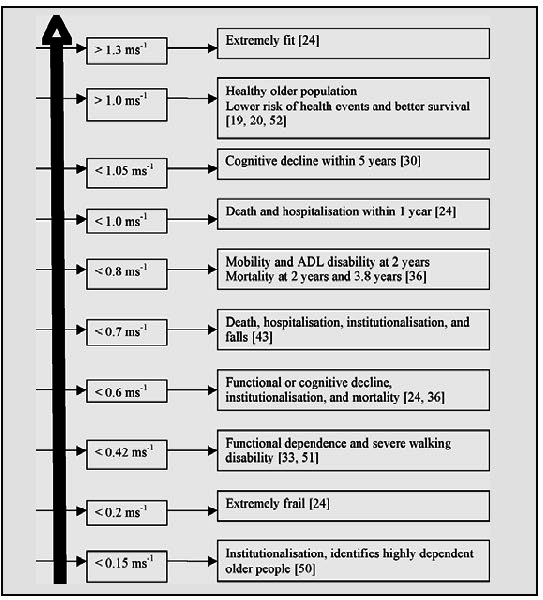
This IANA Task Force systematic review and expert-panel report concludes that usual-pace gait speed is a consistent predictor of adverse outcomes in autonomous community-dwelling older people and performs at least as well as composite tools. The panel recommends gait speed as a single-item assessment, with an “easy-to-remember” cutpoint of 0.8 m/s using a 4-meter course.
Key findings
- Gait speed at usual pace was a consistent risk factor for disability, cognitive impairment, institutionalisation, falls, and/or mortality across the 27 selected articles.
- In Health ABC, slow gait speed (<1.0 m/s) predicted persistent lower extremity limitation with RR 2.20 (95% CI 1.76–2.74) over 4.9 years and mortality with RR 1.64 (95% CI 1.14–2.37).
- In H-EPESE, the lowest versus highest gait-speed quartile predicted mortality with OR 3.64 (95% CI 1.93–6.85), and inability to perform the task raised mortality risk to OR 7.47 (95% CI 3.83–14.55).
- Gait speed alone was nearly as good as the SPPB for predicting ADL disability at 4 years: AUC 0.67 for gait speed versus 0.69 for SPPB, p=0.18; the panel proposed 0.8 m/s (5 seconds for 4 meters) as the clinical cutpoint for adverse outcomes.
Methods
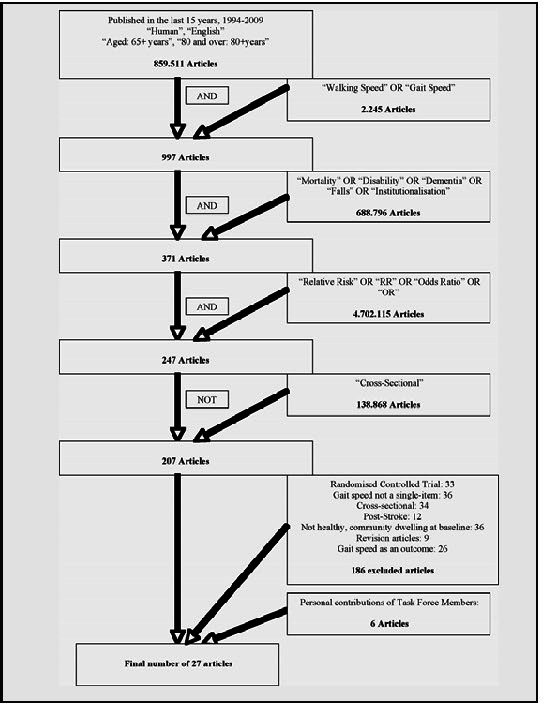
- Systematic literature review using Medline from January 1994 to March 2009, with MeSH terms including “Walking Speed” and “Gait Speed,” yielding 207 articles before final selection of 27 articles.
- Inclusion required usual-pace gait speed assessed as a single-item tool over a short distance, autonomous community-dwelling older participants at baseline, and longitudinal assessment of adverse outcomes (disability, cognitive impairment, institutionalisation, falls, and/or mortality).
- Abstracts were independently evaluated by two reviewers using the STROBE checklist; findings were discussed and revised by an international expert panel at a 2-day meeting in Toulouse, France on March 12–13, 2009.
Limitations
- The paper states that more specific surveys are needed, and that most cohort studies assessed community-dwelling well-functioning older people, so identified cutpoints may differ from frail older people seen in clinical practice.
- The paper notes that many cutpoints are based on tertiles or quartiles used for statistical analyses and may not be easy to remember for clinical practice; the Health ABC cohort’s well-functioning inclusion also limits generalisation of its cutpoints.
- Evident from the text: this is a narrative expert-panel review of 27 selected articles rather than a meta-analysis, and some recommendations, such as using gait speed as an inclusion/exclusion criterion in trials, were explicitly described as not soundly based on existing literature.
Model-written summary. Check it against the paper before relying on it.
Integrity signals
Registry
Cites
Statistics
Figures
Verification
Claims the paper makes
9 Valid · 1 Not valid · 37 Not checked · 21 Own results and interpretations
Every source the paper cites for this claim was checked and supports it.
In the paper
“participants in the lowest quartile (<1.05 ms-1) were more likely to decline in DSST with an Odds Ratio, OR of 1.74 (95% CI 1.21-2.51)”
§ Gait speed at usual pace as a predictor of adverse outcomes in community-dwelling older people an International Academy on Nutrition and Aging (IANA) Task Force > Results: Gait speed as a predictor of adverse outcomes > Gait speed as a predictor of cognitive decline (Table 2)
What the sources say
- Supportedcites [30] Inzitari M. Newman A.B. Yaffe K. Gait speed predicts decline in attention and psychomotor speed in older adults: The Health Aging and Body Composition Study Neuroepidemiology 29 2007 156 162 10.1159/000111577 PubMed PMID: 18042999 18042999 PMC2824580 source
The Results report that, compared with the highest gait-speed quartile, participants in the lowest quartile (<1.05 m/s) had greater odds of DSST decline over five years (OR 1.74, 95% CI 1.21–2.51). This matches the attributed claim. (LLM, conf=0.95)
plainstates an associationn = 2,776- Asserted: passes — The authors put it forward as true.
- Checkable: passes — It can be checked against evidence.
- Load-bearing: passes — The paper’s conclusions depend on it.
- Based: passes — The paper gives a reason why it holds.
- Supported
The cited sources support only part of this claim — read each source’s verdict below.
In the paper
“Gait speed was an independent predictor of falls with a RR of 5.4 (2-14.3)”
§ Gait speed at usual pace as a predictor of adverse outcomes in community-dwelling older people an International Academy on Nutrition and Aging (IANA) Task Force > Results: Gait speed as a predictor of adverse outcomes > Gait speed as a predictor of falls (Table 4)
What the sources say
- Partly supportedcites [43] Montero-Odasso M. Schapira M. Soriano E.R. Gait velocity as a single predictor of adverse events in healthy senior aged 75 years and older J Gerontol Med Sci 60 10 2005 1304 1309 16282564 sourceExperimental — accuracy not yet measured
The Results (p. 3) report an RR of 5.4 (95% CI, 2.0–14.3) for low gait velocity and new falls, but that estimate is from the univariate analysis. The association remained significant after multivariate adjustment, where the reported measure was an OR of 10.9 (95% CI, 2.0–57.9). Thus, the claim combines the unadjusted RR with the independent-predictor finding. (LLM, conf=0.91)
plainstates an associationn = 102- Asserted: passes — The authors put it forward as true.
- Checkable: passes — It can be checked against evidence.
- Load-bearing: unclear — It is unclear whether the paper’s conclusions depend on it.
- Based: passes — The paper gives a reason why it holds.
- Partly supported
Every source the paper cites for this claim was checked and supports it.
In the paper
“Compared to the fastest quartile, the participants who were unable to perform the task raised their risk of death to an OR of 7.47 (95% CI 3.83-14.55).”
§ Gait speed at usual pace as a predictor of adverse outcomes in community-dwelling older people an International Academy on Nutrition and Aging (IANA) Task Force > Results: Gait speed as a predictor of adverse outcomes > Gait speed as a predictor of cognitive decline (Table 2)
What the sources say
- Supportedcites [39] Markides K.S. Black S.A. Ostir G.V. Lower body function and mortality in Mexican American elderly people J Gerontol Biol Sci Med Sci 56 2001 243 247 11283198 source
The Measures section identifies the task as a timed 8-foot walk and scores the fastest quartile as 4 and those unable to complete it as 0. Results, Table 3, reports a mortality odds ratio of 7.47 (95% CI 3.83–14.55) for short-walk score 0 versus score 4 in Model 4. (LLM, conf=0.95)
plainstates an association- Asserted: passes — The authors put it forward as true.
- Checkable: passes — It can be checked against evidence.
- Load-bearing: unclear — It is unclear whether the paper’s conclusions depend on it.
- Based: passes — The paper gives a reason why it holds.
- Supported
The cited sources support only part of this claim — read each source’s verdict below.
In the paper
“Gait speed over 1 ms-1 presented a Hazard Ratio, HR of 0.88 (95% CI 0.81-0.97) in predicting incident disability”
§ Gait speed at usual pace as a predictor of adverse outcomes in community-dwelling older people an International Academy on Nutrition and Aging (IANA) Task Force > Results: Gait speed as a predictor of adverse outcomes > Gait speed as a predictor of mobility disability (Table 1)
What the sources say
- Partly supportedcites [21] Rosano C. Newman A.B. Katz R. Association between lower digit symbol substitution test score and slower gait and greater risk of mortality and of developing incident disability in well-functioning older adults J Am Geriatr Soc 56 2008 1618 1625 10.1111/j.1532-5415.2008.01856.x PubMed PMID: 18691275 18691275 PMC2631090 sourceExperimental — accuracy not yet measured
The Methods (Gait Speed; page unavailable) use 1.0 m/s as a gait-speed threshold, and the Discussion (page unavailable) reports that gait speed was associated with incident disability in the Cardiovascular Health Study participants analyzed. The retrieved Results and other passages do not report the claimed hazard ratio of 0.88 or its 95% confidence interval of 0.81–0.97, so the numerical claim is not supported by our copy. (LLM, conf=0.84)
plainstates an association- Asserted: passes — The authors put it forward as true.
- Checkable: passes — It can be checked against evidence.
- Load-bearing: passes — The paper’s conclusions depend on it.
- Based: passes — The paper gives a reason why it holds.
- Partly supported
The sources with a verdict support this claim; the rest weren’t checked yet, have no full text we could read, or their verdicts aren’t rated yet.
In the paper
“The 1.0 ms-1 cutpoint was used to predict mortality (19, 20)”
§ Gait speed at usual pace as a predictor of adverse outcomes in community-dwelling older people an International Academy on Nutrition and Aging (IANA) Task Force > Results: Gait speed as a single-item tool > Distance and cut-points reported in literature for a single-item tool (Figure 2)
What the sources say
- Not checked yetcites [19] Cesari M. Kritchevsky S.B. Penninx B.W.H.J. Pronostic value of usual gait speed in well-functioning older people. Results from the Health, Aging and Body Composition Study J Am Geriatr Soc 53 2005 1675 1680 10.1111/j.1532-5415.2005.53501.x PubMed PMID: 16181165 16181165 source
- Supportedcites [20] Cesari M. Kritchevsky S.B. Newman A.B. Added value of physical performance measures in predicting adverse health-related events: results from the Health, Aging and Body Composition Study J Am Geriatr Soc 57 2009 251 259 10.1111/j.1532-5415.2008.02126.x PubMed PMID: 19207142 19207142 PMC2695653 source
The Methods section says the study used the 1 m/sec gait-speed cutpoint to classify participants into high- and low-risk groups. The Results section reports that the resulting high-risk gait-speed group was more likely to experience death, so the cutpoint was used to predict mortality. (LLM, conf=0.93)
plainstates an association- Asserted: passes — The authors put it forward as true.
- Checkable: passes — It can be checked against evidence.
- Load-bearing: unclear — It is unclear whether the paper’s conclusions depend on it.
- Based: passes — The paper gives a reason why it holds.
32 more claims · 1 with their cited sources checked
Create a free account to see all 68 claims and to verify the 52 references still open.
- The quote only partly states this claim. 2
- It may state two separate claims as one. 18
- Probably not a substantial claim. 14
Claims other papers make about this one
Each is checked against this paper’s own text: does it say what the citing paper says it does?
In the citing paper
“Slowing gait may reflect both damaged systems and a high-energy cost of walking.13,39–54”
From Gait speed and survival in older adults. (2011) · cites this paper as [13]
In the citing paper
“Others propose one cutoff around 0.8 m/s.13”
From Gait speed and survival in older adults. (2011) · cites this paper as [13]
In the citing paper
“Gait speed has been widely used as a single measure of frailty and is supported by a robust body of literature demonstrating its prognostic importance across a wide range of patient populations and performance levels.85”
In the citing paper
“Gait speed has also been demonstrated to be a consistent risk factor for disability, cognitive impairment, institutionalization, falls, and postoperative outcomes.85”
In the citing paper
“Accumulating evidence indicates slow walking speed (<1 m/sec indicating a high risk and < 0.8 m/sec indicating a very high risk), as well as reductions in walking speed, strongly predict functional decline, major health outcomes, and mortality in older adults.”
From Successful aging: Advancing the science of physical independence in older adults (2015) · cites this paper as Abellan Van, Rolland, Andrieu, Bauer, Beauchet, Bonnefoy, Cesari, Donini, Gillette, Inzitari, Nourhashemi, Onder, Ritz, Salva, Visser, and Vellas 2009
1 more claim about this paper
Create a free account to see every claim other papers make about this one.
Self-check
Percentages, sums and reported differences re-computed from the paper’s own numbers.
Each contradiction between two passages listed here was confirmed by an independent check.
Rated minor: it would not touch a result — a value no result rests on, a p-value that stays on the same side of the significance level, or a conflict that is clerical, resolved elsewhere in the paper, or outside its own findings.
In the paper
“After 5 years, of the assessed 2776 baseline participants, 389 (17.1%) declined in DSST.”
§ Gait speed at usual pace as a predictor of adverse outcomes in community-dwelling older people an International Academy on Nutrition and Aging (IANA) Task Force > Results: Gait speed as a predictor of adverse outcomes > Gait speed as a predictor of cognitive decline (Table 2)
Reported 17.1 · recomputed 14.012968
Rated minor: it would not touch a result — a value no result rests on, a p-value that stays on the same side of the significance level, or a conflict that is clerical, resolved elsewhere in the paper, or outside its own findings.
In the paper
§ Gait speed at usual pace as a predictor of adverse outcomes in community-dwelling older people an International Academy on Nutrition and Aging (IANA) Task Force > Results: Gait speed as a predictor of adverse outcomes > Gait speed as a predictor of cognitive decline (Table 2)
“| | Follow-up 6 years | | |”
§ Gait speed at usual pace as a predictor of adverse outcomes in community-dwelling older people an International Academy on Nutrition and Aging (IANA) Task Force > Results: Gait speed as a predictor of adverse outcomes > Gait speed as a predictor of cognitive decline (Table 2)
“In a prospective cohort study of 2288 persons, 65 years and older without dementia with a mean follow-up of 9 years, 319 participants developed dementia.”
Rated minor: it would not touch a result — a value no result rests on, a p-value that stays on the same side of the significance level, or a conflict that is clerical, resolved elsewhere in the paper, or outside its own findings.
In the paper
§ Gait speed at usual pace as a predictor of adverse outcomes in community-dwelling older people an International Academy on Nutrition and Aging (IANA) Task Force > Results: Gait speed as a single-item tool > Distance and cut-points reported in literature for a single-item tool (Figure 2)
“The walking distance used in the selected articles was found to be between 2.44 meters (8 feet) and 6 meters”
§ Gait speed at usual pace as a predictor of adverse outcomes in community-dwelling older people an International Academy on Nutrition and Aging (IANA) Task Force > Results: Gait speed as a predictor of adverse outcomes > Gait speed as a predictor of falls (Table 4)
“| Estudio de Evaluación | N= 102 | 10 meter walk | Gait speed was an independent predictor of falls with a RR of 5.4 (2-14.3) |”
Rated minor: it would not touch a result — a value no result rests on, a p-value that stays on the same side of the significance level, or a conflict that is clerical, resolved elsewhere in the paper, or outside its own findings.
In the paper
§ Gait speed at usual pace as a predictor of adverse outcomes in community-dwelling older people an International Academy on Nutrition and Aging (IANA) Task Force > Results: Gait speed as a predictor of adverse outcomes > Gait speed as a predictor of mobility disability (Table 1)
“| | Free from disability, cognitively intact | 15-foot walk | Incident ADL disability HR 0.88 (0.80-0.96) |”
§ Gait speed at usual pace as a predictor of adverse outcomes in community-dwelling older people an International Academy on Nutrition and Aging (IANA) Task Force > Results: Gait speed as a predictor of adverse outcomes > Gait speed as a predictor of mobility disability (Table 1)
“Gait speed over 1 ms-1 presented a Hazard Ratio, HR of 0.88 (95% CI 0.81-0.97) in predicting incident disability”
Rated minor: it would not touch a result — a value no result rests on, a p-value that stays on the same side of the significance level, or a conflict that is clerical, resolved elsewhere in the paper, or outside its own findings.
In the paper
§ Gait speed at usual pace as a predictor of adverse outcomes in community-dwelling older people an International Academy on Nutrition and Aging (IANA) Task Force > Methods
“The assessment of gait speed had to be performed over a short distance (long distance assessment instruments were excluded from the present review)”
§ Gait speed at usual pace as a predictor of adverse outcomes in community-dwelling older people an International Academy on Nutrition and Aging (IANA) Task Force > Results: Gait speed as a predictor of adverse outcomes > Gait speed as a predictor of mobility disability (Table 1)
“| Health ABC study (25) | N=3056 | LDCW 400 meter walk | New mobility limitations |”
2 more findings
Create a free account to see every finding of this check.
Citations
Cites
von Elm, E., Altman, D. G., Egger, M., Pocock, S. J., Gøtzsche, P. C., Vandenbroucke, J. P., & Initiative, F. T. S. (2007) · PLoS Medicine · doi:10.1371/journal.pmed.0040296 · Cited by 23,020
von Elm, E., Altman, D. G., Egger, M., Pocock, S. J., Gøtzsche, P. C., & Vandenbroucke, J. P. (2008) · Journal of Clinical Epidemiology · doi:10.1016/j.jclinepi.2007.11.008 · Cited by 17,893
von Elm, E., Altman, D. G., Egger, M., Pocock, S. J., Gøtzsche, P. C., Vandenbroucke, J. P., & Initiative, F. T. S. (2007) · Annals of Internal Medicine · doi:10.7326/0003-4819-147-8-200710160-00010 · Cited by 17,796
Lower-extremity function in persons over the age of 70 years as a predictor of subsequent disability
Guralnik, J. M., Ferrucci, L., Simonsick, E. M., Salive, M. E., & Wallace, R. B. (1995) · New England Journal of Medicine · doi:10.1056/nejm199503023320902 · Cited by 4,083
Guralnik, J. M., Ferrucci, L., Pieper, C. F., Leveille, S. G., Markides, K. S., Ostir, G. V., Studenski, S., Berkman, L. F., & Wallace, R. B. (2000) · The Journals of Gerontology Series A: Biological Sciences and Medical Sciences · doi:10.1093/gerona/55.4.m221 · Cited by 2,898 · cited 5×
“18) in between the curves when predicting ADL disability at 4 years of follow-up (3).”
Influentialvon Elm, E., Altman, D. G., Egger, M., Pocock, S. J., Gøtzsche, P. C., & Vandenbroucke, J. P. (2007) · Preventive Medicine · doi:10.1016/j.ypmed.2007.08.012 · Cited by 2,698
Comfortable and maximum walking speed of adults aged 20—79 years: reference values and determinants
BOHANNON, R. W. (1997) · Age and Ageing · doi:10.1093/ageing/26.1.15 · Cited by 2,341
Physical performance measures in the clinical setting
Studenski, S., Perera, S., Wallace, D., Chandler, J. M., Duncan, P. W., Rooney, E., Fox, M., & Guralnik, J. M. (2003) · Journal of the American Geriatrics Society · doi:10.1046/j.1532-5415.2003.51104.x · Cited by 1,218 · cited 7×
“2 ms-1 organisation, HMO, and > 65 years Fast walkers >1 ms-1 increase Veterans Affairs, VA (24) Cognitively intact No mobility disability 1-year follow-up Hong Kong Chinese cohort N=2032 16-feet walk Institutionalisation”
InfluentialCesari, M., Kritchevsky, S. B., Penninx, B. W. H. J., Nicklas, B. J., Simonsick, E. M., Newman, A. B., Tylavsky, F. A., Brach, J. S., Satterfield, S., Bauer, D. C., et al. (2005) · Journal of the American Geriatrics Society · doi:10.1111/j.1532-5415.2005.53501.x · Cited by 1,192
Self-citationThe I.A.N.A. task force on frailty assessment of older people in clinical practice
Van Kan, G. A., Rolland, Y., Bergman, H., Morley, J. E., Kritchevsky, S. B., & Vellas, B. (2008) · The Journal of nutrition, health and aging · doi:10.1007/bf02982161 · Cited by 1,099
Self-citation
Cited by
Items 201–300 of 1,005
Reidy, P. T., McKenzie, A. I., Brunker, P., Nelson, D. S., Barrows, K. M., Supiano, M., LaStayo, P. C., & Drummond, M. J. (2017) · Rejuvenation Research · doi:10.1089/rej.2017.1942 · Cited by 79
Frailty: Past, present, and future?
Kwak, D., & Thompson, L. V. (2020) · Sports Medicine and Health Science · doi:10.1016/j.smhs.2020.11.005 · Cited by 104
Low physical fitness levels in older adults with ID: Results of the HA-ID study
Hilgenkamp, T. I. M., van Wijck, R., & Evenhuis, H. M. (2012) · Research in Developmental Disabilities · doi:10.1016/j.ridd.2012.01.013 · Cited by 104
Disentangling the Disabling Process: Insights From the Precipitating Events Project
Gill, T. M. (2014) · The Gerontologist · doi:10.1093/geront/gnu067 · Cited by 103
Romero-Ortuno, R., & Soraghan, C. (2014) · BMJ Open · doi:10.1136/bmjopen-2014-006645 · Cited by 81
Sánchez‐Rodríguez, D., Marco, E., Ronquillo-Moreno, N., Miralles, R., Vázquez‐Ibar, O., Escalada, F., & Muniesa, J. M. (2016) · Clinical Nutrition · doi:10.1016/j.clnu.2016.08.024 · Cited by 101
“The 4-m walk test has been used extensively in previous studies, with validity and sensitivity to change confirmed in large epidemiological studies [29].”
MethodDePew, Z. S., Karpman, C., Novotny, P. J., & Benzo, R. P. (2013) · Respiratory Care · doi:10.4187/respcare.02471 · Cited by 105
Portegijs, E., Karavirta, L., Saajanaho, M., Rantalainen, T., & Rantanen, T. (2019) · BMC Public Health · doi:10.1186/s12889-019-7869-8 · Cited by 100
Adam, C. E., Fitzpatrick, A. L., Leary, C. S., Hajat, A., Ilango, S. D., Park, C., Phelan, E. A., & Semmens, E. O. (2023) · BMC Geriatrics · doi:10.1186/s12877-023-03890-6 · Cited by 100
The role of physical activity in changes in walking mechanics with age
Boyer, K. A., Andriacchi, T. P., & Beaupré, G. S. (2012) · Gait & Posture · doi:10.1016/j.gaitpost.2012.02.007 · Cited by 100
Relationship of Gait and Cognition in the Elderly
Parihar, R., Mahoney, J. R., & Verghese, J. (2013) · Current Translational Geriatrics and Experimental Gerontology Reports · doi:10.1007/s13670-013-0052-7 · Cited by 102
“In our studies, a computerized walkway with embedded pressure sensors (GAITRite, CIR systems) is used to measure gait [29, 33, 34].”
MethodSyddall, H. E., Westbury, L. D., Cooper, C. C., & Sayer, A. A. (2014) · Journal of the American Medical Directors Association · doi:10.1016/j.jamda.2014.11.004 · Cited by 104
Hunter, S. W., Divine, A., Frengopoulos, C., & Montero‐Odasso, M. (2018) · BMC Geriatrics · doi:10.1186/s12877-018-0894-0 · Cited by 99
“0 m/sec is also associated with an increased fall risk among community-dwelling older adults [20].”
BackgroundFrailty: Diagnosis and management
Morley, J. E. (2011) · The journal of nutrition health & aging · doi:10.1007/s12603-011-0338-4 · Cited by 99
The Frailty Syndrome: Clinical measurements and basic underpinnings in humans and animals
Mohler, M. J., Fain, M. J., Wertheimer, A. M., Najafi, B., & Nikolich‐Žugich, J. (2014) · Experimental Gerontology · doi:10.1016/j.exger.2014.01.024 · Cited by 99
Vasconcelos, K. S. S., Dias, J. M. D., Araújo, M. C., Pinheiro, A. C., Moreira, B. S., & Dias, R. C. (2016) · Brazilian Journal of Physical Therapy · doi:10.1590/bjpt-rbf.2014.0174 · Cited by 97
Tyrrell, D. J., Bharadwaj, M. S., Van Horn, C. G., Kritchevsky, S. B., Nicklas, B. J., & Molina, A. J. A. (2015) · The Journals of Gerontology Series A: Biological Sciences and Medical Sciences · doi:10.1093/gerona/glu096 · Cited by 92
Vasconcelos, K. S. D. S., Dias, J. M. D., Bastone, A. D. C., Vieira, R. A., Andrade, A. C. D. S., Perracini, M. R., Guerra, R. O., & Dias, R. C. (2015) · The journal of nutrition health & aging · doi:10.1007/s12603-015-0584-y · Cited by 98
“Additionally, reduced gait speed is considered a major predictor of adverse effects among older people, such as falls, hospitalization and death (19).”
Ezzati, A., Katz, M. J., Lipton, M. L., Lipton, R. B., & Verghese, J. (2015) · Neuroradiology · doi:10.1007/s00234-015-1536-2 · Cited by 97
Gait Speed, Body Composition, and Dementia. The EPIDOS-Toulouse Cohort
Abellan van Kan, G., Rolland, Y., Gillette-Guyonnet, S., Gardette, V., Annweiler, C., Beauchet, O., Andrieu, S., & Vellas, B. (2012) · The Journals of Gerontology Series A: Biological Sciences and Medical Sciences · doi:10.1093/gerona/glr177 · Cited by 94
Self-citationThe detection of age groups by dynamic gait outcomes using machine learning approaches
Zhou, Y., Romijnders, R., Hansen, C., van Campen, J., Maetzler, W., Hortobágyi, T., & Lamoth, C. J. C. (2020) · Scientific Reports · doi:10.1038/s41598-020-61423-2 · Cited by 96
Rehabilitation Therapy in Older Acute Heart Failure Patients (REHAB-HF) trial: Design and rationale
Reeves, G. R., Whellan, D. J., Duncan, P., O'Connor, C. M., Pastva, A. M., Eggebeen, J. D., Hewston, L. A., Morgan, T. M., Reed, S. D., Rejeski, W. J., et al. (2017) · American Heart Journal · doi:10.1016/j.ahj.2016.12.012 · Cited by 90
Implementing frailty into clinical practice: We cannot wait
Vellas, B. J., Cestac, P., & Morley, J. E. (2012) · The journal of nutrition health & aging · doi:10.1007/s12603-012-0096-y · Cited by 97
Self-citationReliability of 4-meter and 10-meter walk tests after lower extremity surgery
Ünver, B., Baris, R. H., Yüksel, E., Cekmece, S., Kalkan, S., & Karatosun, V. (2016) · Disability and Rehabilitation · doi:10.1080/09638288.2016.1236153 · Cited by 96
Gait Speed in Ambulant Older People in Long Term Care: A Systematic Review and Meta-Analysis
Kuys, S. S., Peel, N. M., Klein, K., Slater, A., & Hubbard, R. E. (2014) · Journal of the American Medical Directors Association · doi:10.1016/j.jamda.2013.10.015 · Cited by 99
The mental representation of the human gait in young and older adults
Stöckel, T., Jacksteit, R., Behrens, M., Skripitz, R., Bader, R., & Mau‐Moeller, A. (2015) · Frontiers in Psychology · doi:10.3389/fpsyg.2015.00943 · Cited by 95
“…measure for evaluating lower extremity function (Guralnik et al., 2000; Shinkai et al., 2000; Verghese et al., 2011) and adverse outcomes, i.e., disability, cognitive impairment, institutionalization, falls and/or mortality (Abellan van Kan et al., 2009; see Peel et al., 2012 for a review).”
BackgroundUsual Gait Speed Independently Predicts Mortality in Very Old People: A Population-Based Study
Toots, A., Rosendahl, E., Lundin‐Olsson, L., Nordström, P., Gustafson, Y., & Littbrand, H. (2013) · Journal of the American Medical Directors Association · doi:10.1016/j.jamda.2013.04.006 · Cited by 97
The Effect of Omega-3 Fatty Acids on Sarcopenia: Mechanism of Action and Potential Efficacy
Therdyothin, A., Phiphopthatsanee, N., & Isanejad, M. (2023) · Marine Drugs · doi:10.3390/md21070399 · Cited by 94
“Gait speed is a quick and easy test to perform in clinics and is also a predictor of poor quality of life and increased mortality in both community-dwelling and diseased elderly [82].”
BackgroundVerceles, A. C., Wells, C. L., Sorkin, J. D., Terrin, M. L., Beans, J., Jenkins, T., & Goldberg, A. P. (2018) · Journal of Critical Care · doi:10.1016/j.jcrc.2018.07.006 · Cited by 94
“Patients received serial functional assessments (identical to baseline testing) every 2weeks that consisted of validated functionalmeasures: 1) handgrip [24];2) Short Physical Performance Battery (SPPB) [25]; 3) 4 m walk gait speed [26]; 4) 6 min walk distance (6MWD) [27];5) manual muscle testing [28]; and 6) bedside…”
Ezzatvar, Y., Ramírez‐Vélez, R., de Asteasu, M. L. S., Martínez‐Velilla, N., Zambom-Ferraresi, F., Izquierdo, M., & García‐Hermoso, A. (2020) · The Journals of Gerontology Series A · doi:10.1093/gerona/glaa305 · Cited by 92
What can gait tell us about dementia? Review of epidemiological and neuropsychological evidence
Valkanova, V., & Ebmeier, K. P. (2017) · Gait & Posture · doi:10.1016/j.gaitpost.2017.01.024 · Cited by 93
Gobbens, R. J. J., & van Assen, M. A. L. M. (2014) · Current Gerontology and Geriatrics Research · doi:10.1155/2014/358137 · Cited by 91
Mobility Assessment: Sensitivity and Specificity of Measurement Sets in Older Adults
Panzer, V. P., Wakefield, D. B., Hall, C. B., & WOLFSON, L. I. (2011) · Archives of Physical Medicine and Rehabilitation · doi:10.1016/j.apmr.2011.01.004 · Cited by 91
Oppewal, A., Hilgenkamp, T. I. M., van Wijck, R., Schoufour, J. D., & Evenhuis, H. M. (2014) · Research in Developmental Disabilities · doi:10.1016/j.ridd.2014.05.027 · Cited by 93
“…balance, cardiorespiratory fitness, and manual dexterity have indeed been found to be predictive for limitations in daily functioning (Abellan van Kan et al., 2009; den Ouden, Schuurmans, Arts, & van der Schouw, 2011; Paterson & Warburton, 2010; Vermeulen, Neyens, van Rossum, Spreeuwenberg, & de…”
BackgroundResultMotoric Cognitive Risk Syndrome: Predictor of Dementia and Age-Related Negative Outcomes
Chhetri, J. K., Chan, P., Vellas, B. J., & Cesari, M. (2017) · Frontiers in Medicine · doi:10.3389/fmed.2017.00166 · Cited by 92
“The cut-point has been suggested to predict adverse events in older adults by the International Academy on Nutrition and Aging task force (29) and recommended for further clinical investigation by the European consensus on sarcopenia (30).”
BackgroundSelf-citationRodríguez‐Molinero, A., Herrero-Larrea, A., Miñarro, A., Narvaiza, L., Gálvez‐Barrón, C., Gonzalo, N., Valldosera, E., de Mingo-Fernández, E., Macho, O., Aivar, D., et al. (2019) · Scientific Reports · doi:10.1038/s41598-019-45113-2 · Cited by 90
Heiland, E. G., Welmer, A.-K., Wang, R., Santoni, G., Angleman, S., Fratiglioni, L., & Qiu, C. (2016) · Age and Ageing · doi:10.1093/ageing/afw076 · Cited by 79
Lipnicki, D. M., Crawford, J., Kochan, N. A., Trollor, J. N., Draper, B., Reppermund, S., Maston, K., Mather, K. A., Brodaty, H., Sachdev, P. S., et al. (2017) · Journal of the American Medical Directors Association · doi:10.1016/j.jamda.2016.10.014 · Cited by 82
Influences of dopaminergic system dysfunction on late-life depression
Taylor, W. D., Zald, D. H., Felger, J. C., Christman, S., Claassen, D. O., Horga, G., Miller, J. M., Gifford, K., Rogers, B., Szymkowicz, S. M., et al. (2022) · Molecular Psychiatry · doi:10.1038/s41380-021-01265-0 · Cited by 89
Yang, X., Li, S., Xu, L., Liu, H., Li, Y., Song, X., Bao, J., Liao, S., Xi, Y., & Guo, G. (2024) · Experimental Gerontology · doi:10.1016/j.exger.2024.112604 · Cited by 92
Saum, K.-U., Müller, H., Stegmaier, C., Hauer, K. A., Raum, E., & Brenner, H. (2012) · Journal of the American Geriatrics Society · doi:10.1111/j.1532-5415.2012.04192.x · Cited by 89
“b Population-independent cutoff for gait speed.(20,21) c McNemar-Test for differences between the two approaches was statistically significant.”
BackgroundWalker, K. Z., Woods, J., Luliano-Burns, S., King, S., & Strauss, B. J. (2011) · Clinical Interventions in Aging · doi:10.2147/cia.s16979 · Cited by 91
“6 m/sec are at increased risk of functional decline and death.(19) In our elderly population, 43% of women had WS , 0.”
BackgroundHealth and functional status among older people with HIV/AIDS in Uganda
Scholten, F., Mugisha, J. O., Seeley, J., Kinyanda, E., Nakubukwa, S., Kowal, P. R., Naidoo, N., Boerma, T., Chatterji, S., & Grosskurth, H. (2011) · BMC Public Health · doi:10.1186/1471-2458-11-886 · Cited by 88
Moreira, N. B., Rodacki, A. L. F., Pereira, G., & Bento, P. C. B. (2018) · Archives of Gerontology and Geriatrics · doi:10.1016/j.archger.2018.04.002 · Cited by 88
Christiansen, C. L., Fields, T. T., Lev, G., Stephenson, R. O., & Stevens‐Lapsley, J. E. (2015) · PM&R · doi:10.1016/j.pmrj.2015.05.006 · Cited by 87
“8 m/s has been proposed as an indicator of predicted life expectancy for older adults and functional limitations [25,40].”
Gait initiation: The first four steps in adults aged 20–25 years, 65–79 years, and 80–91 years
Muir, B. C., Rietdyk, S., & Haddad, J. M. (2013) · Gait & Posture · doi:10.1016/j.gaitpost.2013.08.037 · Cited by 87
Welmer, A., Angleman, S. B., Rydwik, E., Fratiglioni, L., & Qiu, C. (2013) · PLoS ONE · doi:10.1371/journal.pone.0065815 · Cited by 89
Sipilä, S., Tirkkonen, A., Hänninen, T., Laukkanen, P., Alén, M., Fielding, R. A., Kivipelto, M., Kokko, K., Kulmala, J., Rantanen, T., et al. (2018) · BMC Geriatrics · doi:10.1186/s12877-018-0906-0 · Cited by 86
Planella-Farrugia, C., Comas, F., Sabater-Masdeu, M., Moreno, M., Moreno-Navarrete, J. M., Rovira, O., Ricart, W., & Fernández-Real, J. M. (2019) · Frontiers in Physiology · doi:10.3389/fphys.2019.00871 · Cited by 73
“A lower driving speed is usually associated with disability, cognitive deterioration, accidental falls, various neurological diseases, cardiopulmonary and orthopedic diseases that contribute to increase mortality rate (Abellan van Kan et al., 2009; Studenski et al., 2011).”
BackgroundPrevalence and Associates of Fear of Falling among Community-Dwelling Older Adults
Bahat, G., Kılıç, C., Bozkurt, M. E., & Karan, M. A. (2020) · The journal of nutrition health & aging · doi:10.1007/s12603-020-1535-9 · Cited by 86
Malmstrom, T. K., Miller, D. K., Herning, M. M., & Morley, J. E. (2013) · Journal of Cachexia, Sarcopenia and Muscle · doi:10.1007/s13539-013-0106-x · Cited by 80
Toosizadeh, N., Joseph, B. A., Heusser, M. R., Jokar, T. O., Mohler, J. M., Phelan, H. A., & Najafi, B. (2016) · Journal of the American College of Surgeons · doi:10.1016/j.jamcollsurg.2016.03.030 · Cited by 84
“In the previous study we determined strong correlations between upper-extremity motion and gait speed (8), and since gait speed and fall risk are associated (9, 10), we, therefore, hypothesized significant associations would exist between UEF parameters and the number of retrospective falls.”
The importance of physical function as a clinical outcome: Assessment and enhancement
O’Neill, D., & Forman, D. E. (2019) · Clinical Cardiology · doi:10.1002/clc.23311 · Cited by 84
“A gait speed of 1.4 m/s indicates the patient is more likely to be independent in ADLs, whereas a gait speed of 0.8 m/s suggests the patient is more likely to be frail, have increased fall risk and have functional dependency in ADLs and IADLs.29 3.”
BackgroundInfluentialOwusu, C., Margevicius, S. P., Schluchter, M., Koroukian, S. M., & Berger, N. A. (2017) · Journal of Geriatric Oncology · doi:10.1016/j.jgo.2017.07.004 · Cited by 86
Ehlenbach, W. J., Larson, E. B., Curtis, J. R., & Hough, C. L. (2015) · Journal of the American Geriatrics Society · doi:10.1111/jgs.13663 · Cited by 83
Strike, S. C., Carlisle, A., Gibson, E. L., & Dyall, S. C. (2016) · The Journals of Gerontology Series A: Biological Sciences and Medical Sciences · doi:10.1093/gerona/glv109 · Cited by 82
Ekram, A. S., Woods, R. L., Britt, C. J., Espinoza, S. E., Ernst, M. E., & Ryan, J. L. (2021) · The Journal of Frailty & Aging · doi:10.14283/jfa.2021.20 · Cited by 83
“, gait speed (30, 31), sarcopenia (32), various health indicators (33) or geriatric syndromes (34); outcomes other than mortality were examined, e.”
BackgroundKameniar, K., Mackintosh, S. F., van Kessel, G., & Kumar, S. (2022) · Journal of Geriatric Physical Therapy · doi:10.1519/jpt.0000000000000337 · Cited by 83
Selecting lung transplant candidates: where do current guidelines fall short?
Hook, J. L., & Lederer, D. J. (2012) · Expert Review of Respiratory Medicine · doi:10.1586/ers.11.83 · Cited by 73
Idland, G., Pettersen, R., Avlund, K., & Bergland, A. (2013) · Archives of Gerontology and Geriatrics · doi:10.1016/j.archger.2012.12.005 · Cited by 84
Frailty in geriatric head and neck cancer: A contemporary review
Noor, A., Gibb, C. L., Boase, S., Hodge, J.-C., Krishnan, S., & Foreman, A. (2018) · The Laryngoscope · doi:10.1002/lary.27339 · Cited by 83
Hospers, G. P., Smulders, Y. M., Maier, A. B., Deeg, D. J. H., & Muller, M. (2014) · Journal of Internal Medicine · doi:10.1111/joim.12284 · Cited by 82
Exercise and physical performance in older adults with sarcopenic obesity: A systematic review
Ghiotto, L., Muollo, V., Tatangelo, T., Schena, F., & Rossi, A. P. (2022) · Frontiers in Endocrinology · doi:10.3389/fendo.2022.913953 · Cited by 65
“(15) reported that gait speed at usual pace is a consistent risk factor for disability, cognitive impairment, institutionalization, falls, and/or mortality.”
BackgroundMethodInfluentialNutritional determinants of mobility
Milaneschi, Y., Tanaka, T., & Ferrucci, L. (2010) · Current Opinion in Clinical Nutrition & Metabolic Care · doi:10.1097/mco.0b013e32833e337d · Cited by 80
Hörder, H., Skoog, I. G., & Frändin, K. (2012) · Quality of Life Research · doi:10.1007/s11136-012-0267-7 · Cited by 82
“institutionalization, falls and mortality, and has been recommended as a possible ‘‘vital sign’’ [43].”
BackgroundPredicting Survival in Oldest Old People
Taekema, D. G., Gussekloo, J., Westendorp, R. G. J., de Craen, A. J. M., & Maier, A. B. (2012) · The American Journal of Medicine · doi:10.1016/j.amjmed.2012.01.034 · Cited by 83
“This finding is in line with earlier studies reporting on positive association between slow walking speed and future cognitive decline.(2) Also, applying earlier reported cutoff points or gait speed(2,3) of 0.”
BackgroundResultFrailty Scores and Their Utility in Older Patients with Cardiovascular Disease
Chung, K. J. N. C., Wilkinson, C., Veerasamy, M., & Kunadian, V. (2021) · Interventional Cardiology Reviews Research Resources · doi:10.15420/icr.2020.18 · Cited by 80
Association between Dysphagia and Frailty in Community Dwelling Older Adults
Bahat, G., Yılmaz, Ö., Durmazoglu, S., Kilic, C., Tascioglu, C., & Karan, M. A. (2019) · The journal of nutrition health & aging · doi:10.1007/s12603-019-1191-0 · Cited by 82
Ellis, T. D., Cavanaugh, J. T., Earhart, G. M., Ford, M. P., Foreman, K. B., Thackeray, A., Thiese, M. S., & Dibble, L. E. (2016) · Parkinsonism & Related Disorders · doi:10.1016/j.parkreldis.2016.02.006 · Cited by 79
Gait Speed and Dependence in Activities of Daily Living in Older Adults With Severe Aortic Stenosis
Green, P., Woglom, A. E., Genereux, P., Maurer, M. S., Kirtane, A. J., Hawkey, M., Schnell, S., Sohn, J., Moses, J. W., Leon, M. B., et al. (2012) · Clinical Cardiology · doi:10.1002/clc.21974 · Cited by 68
“Glomerular filtration rate, mL/min 56 (26) 56 (22) 49 (19) 62 (33) 0.”
Marcos-Pardo, P. J., González-Gálvez, N., López-Vivancos, A., Espeso-García, A., Martínez-Aranda, L. M., Gea-García, G. M., Orquín-Castrillón, F. J., Carbonell‐Baeza, A., Jiménez‐García, J. D., Velázquez‐Díaz, D., et al. (2020) · Nutrients · doi:10.3390/nu13010008 · Cited by 80
Dommershuijsen, L. J., Ragunathan, J., Ruiter, R., Groothof, D., Mattace-Raso, F. U. S., Ikram, M. A., & Polinder‐Bos, H. A. (2021) · Experimental Gerontology · doi:10.1016/j.exger.2021.111646 · Cited by 79
Pathways linking regional hyperintensities in the brain and slower gait
Bolandzadeh, N., Liu-Ambrose, T. Y. L., Aizenstein, H. J., Harris, T. B., Launer, L. J., Yaffe, K. S., Kritchevsky, S. B., Newman, A. B., & Rosano, C. (2014) · NeuroImage · doi:10.1016/j.neuroimage.2014.05.017 · Cited by 79
“Slower gait in older adults is a significant predictor of disability and mortality (Abellan van Kan et al., 2009; Studenski et al., 2011).”
BackgroundDiem, S. J., Greer, N. L., MacDonald, R. H., McKenzie, L. G., Dahm, P., Ercan-Fang, N. G., Estrada, A., Hemmy, L. S., Rosebush, C. E., Fink, H. A., et al. (2020) · Annals of Internal Medicine · doi:10.7326/m19-0830 · Cited by 80
Bone is Not Alone: the Effects of Skeletal Muscle Dysfunction in Chronic Kidney Disease
Avin, K. G., & Moorthi, R. N. (2015) · Current Osteoporosis Reports · doi:10.1007/s11914-015-0261-4 · Cited by 77
Manor, B. D., Newton, E. K., Abduljalil, A., & Novak, V. (2012) · Diabetes Care · doi:10.2337/dc11-2463 · Cited by 79
The Effects of Frailty in Patients Undergoing Elective Cardiac Surgery
Ad, N., Holmes, S. D., Halpin, L. S., Shuman, D. J., Miller, C. E., & Lamont, D. (2016) · Journal of Cardiac Surgery · doi:10.1111/jocs.12699 · Cited by 78
Cut Points for Clinical Muscle Weakness Among Older Americans
Duchowny, K. A., Peterson, M. D., & Clarke, P. J. (2017) · American Journal of Preventive Medicine · doi:10.1016/j.amepre.2016.12.022 · Cited by 71
Ambagtsheer, R. C., Visvanathan, R., Dent, E., Yu, S., Schultz, T., & Beilby, J. (2019) · The Journals of Gerontology Series A · doi:10.1093/gerona/glz260 · Cited by 77
The slowing down phenomenon: What is the age of major gait velocity decline?
Kirkwood, R. N., Moreira, B. D. S., Mingoti, S. A., Faria, B. F., Sampaio, R. F., & Resende, R. A. (2018) · Maturitas · doi:10.1016/j.maturitas.2018.06.005 · Cited by 76
Gallucci, M., Mazzuco, S., Ongaro, F., Di Giorgi, E., Mecocci, P., Cesari, M., Albani, D., Forloni, G. L., Durante, E., Gajo, G. B., et al. (2013) · The Journal of nutrition, health and aging · doi:10.1007/s12603-012-0397-1 · Cited by 63
“On the contrary many studies have demonstrated that baseline physical performance predicts declines in cognitive function and/or incident cognitive impairment or dementia (13-16, 87-98).”
Self-citationSanders, J. B., Bremmer, M. A., Deeg, D. J. H., & Beekman, A. T. F. (2012) · Journal of the American Geriatrics Society · doi:10.1111/j.1532-5415.2012.04114.x · Cited by 77
“Objectively measured slow gait speed has been shown to predict a number of health-related outcomes such as functional decline, institutionalization, and death, but to the knowledge of the authors of the current study, the association between gait speed and depressive symptoms has never been investigated in a longitudi…”
Lee, S. Y., Choo, P. L., Pang, B. W. J., Lau, L. K., Jabbar, K. B. A., Seah, W. T., Chen, K. K., Ng, T. P., & Wee, S. L. (2021) · BMC Geriatrics · doi:10.1186/s12877-021-02147-4 · Cited by 78
Ahmed, U., Karimi, H., Amir, S., & Ahmed, A. (2021) · Journal of International Medical Research · doi:10.1177/03000605211059413 · Cited by 77
“institutionalization, and mortality.(46) Both trunk regimes passed this cutoff level; therefore, the likelihood of participants’ function and survival was high.”
BackgroundDeterminants of Gait Speed in COPD
Karpman, C., DePew, Z. S., LeBrasseur, N. K., Novotny, P. J., & Benzo, R. P. (2014) · CHEST Journal · doi:10.1378/chest.13-2017 · Cited by 77
The Walking Trail-Making Test is an early detection tool for mild cognitive impairment
Perrochon, A., & Kemoun, G. (2014) · Clinical Interventions in Aging · doi:10.2147/cia.s53645 · Cited by 76
Dunlop, D. D., Song, J., Lee, J. J., Gilbert, A. L., Semanik, P. A., Ehrlich‐Jones, L., Pellegrini, C. A., Pinto, D., Ainsworth, B. E., & Chang, R. W. (2017) · Arthritis Care & Research · doi:10.1002/acr.23181 · Cited by 75
“Physical function assessed by gait speed reflects functional status and health (10).”
BackgroundA pilot trial to predict frailty syndrome: The Japanese Health Research Volunteer Study
Doba, N., Tokuda, Y., Goldstein, N. E., Kushiro, T., & Hinohara, S. (2012) · Experimental Gerontology · doi:10.1016/j.exger.2012.05.016 · Cited by 75
GARY, R. A. (2012) · The Journal of Cardiovascular Nursing · doi:10.1097/jcn.0b013e318239f4a4 · Cited by 75
“These MDC values may be particularly useful for monitoring change over time in patients with CVD.(69,75,76)”
BackgroundLourenço, R. A., Pérez-Zepeda, M., Gutiérrez-Robledo, L., García-García, F. J., & Rodríguez Mañas, L. (2015) · Age and Ageing · doi:10.1093/ageing/afu192 · Cited by 63
Deshpande, N., Simonsick, E. M., Metter, E. J., Ko, S.-U., Ferrucci, L., & Studenski, S. A. (2016) · AGE · doi:10.1007/s11357-016-9918-x · Cited by 74
“However, the average usual speed of Q5 was >0.8 m/s which is an indicator of mobility-related disability (Abellan van Kan et al. 2009).”
BackgroundMethodInfluentialAltered spatiotemporal characteristics of gait in older adults with chronic low back pain
Hicks, G. E., Sions, J. M., Coyle, P. C., & Pohlig, R. T. (2017) · Gait & Posture · doi:10.1016/j.gaitpost.2017.04.027 · Cited by 74
Hvid, L. G., Strotmeyer, E. S., Skjødt, M., Magnussen, L. V., Andersen, M., & Caserotti, P. (2016) · Experimental Gerontology · doi:10.1016/j.exger.2016.03.018 · Cited by 73
Supported Treadmill Ambulation for Amyotrophic Lateral Sclerosis: A Pilot Study
Sanjak, M., Bravver, E. K., Bockenek, W. L., Norton, H. J., & Brooks, B. R. (2010) · Archives of Physical Medicine and Rehabilitation · doi:10.1016/j.apmr.2010.08.009 · Cited by 74
Cognitive frailty: Frontiers and challenges
Woods, A. J., Cohen, R. A., & Pahor, M. (2013) · The Journal of nutrition, health and aging · doi:10.1007/s12603-013-0398-8 · Cited by 69
Figgins, E., Pieruccini‐Faria, F., Speechley, M. R., & Montero‐Odasso, M. (2021) · Ageing Research Reviews · doi:10.1016/j.arr.2020.101253 · Cited by 72
Puthoff, M. L., & Saskowski, D. (2013) · Cardiopulmonary Physical Therapy Journal · doi:10.1097/01823246-201324010-00005 · Cited by 73
Bonanad, S., de la Rubia, J., Gironella, M., Persona, E. P., González, B., Fernández-Lago, C., Arnán, M., Zudaire, I., Hernández‐Rivas, J., Soler, A., et al. (2015) · Journal of Geriatric Oncology · doi:10.1016/j.jgo.2015.03.003 · Cited by 72
Gait patterns in COPD: the Rotterdam Study
Lahousse, L., Verlinden, V. J. A., van der Geest, J. N., Joos, G., Hofman, A., Stricker, B. H. C., Brusselle, G., & Ikram, M. A. (2015) · European Respiratory Journal · doi:10.1183/09031936.00213214 · Cited by 73
Campos‐Staffico, A. M., Moura, F. A., dos Santos, S. N., de Freitas, W. M., & Sposito, A. C. (2017) · Atherosclerosis · doi:10.1016/j.atherosclerosis.2017.01.005 · Cited by 72
Metadata
- Authors
- Abellan Van Kan, G., Rolland, Y., Andrieu, S., Bauer, J., Beauchet, O., Bonnefoy, M., Cesari, M., Donini, L. M., Gillette-Guyonnet, S., Inzitari, M., Nourhashemi, F., Onder, G., Ritz, P., Salva, A., Visser, M., & Vellas, B.
- Affiliations
- Université Toulouse III - Paul Sabatier (FR)
- Friedrich-Alexander-Universität Erlangen-Nürnberg (DE)
- Centre Hospitalier Universitaire d'Angers (FR)
- Hôpital Lyon Sud (FR)
- University of Florida (US)
- Sapienza University of Rome (IT)
- Universitat Autònoma de Barcelona (ES)
- Università Cattolica del Sacro Cuore (IT)
- Centre Hospitalier Universitaire de Toulouse (FR)
- Amsterdam Public Health (NL)
- ORCID
- Venue
- The Journal of nutrition, health and aging
- Publisher
- Elsevier BV
- Published
- 2009-12
- Volume
- 13
- Issue
- 10
- Pages
- 881-889
- ISSN
- 1279-7707 (ISSN-L)
- PMC
- PMC12878092
- OpenAlex
- W2104750100
- Semantic Scholar
- 10553b18ba60c073f881cfe6be4b7f453a2f15b0
- Cited by
- 2,003
- References
- 56
- Citations by year
- 2026: 96 · 2025: 117 · 2024: 113 · 2023: 137 · 2022: 141 · 2021: 172 · 2020: 153 · 2019: 156 · 2018: 122 · 2017: 155 · 2016: 154 · 2015: 135 · 2014: 117 · 2013: 75 · 2012: 94
- FWCI
- 5.47
- Type
- journal article
- Language
- en
- Open access
- hybrid
- doi.org
- Licence
- cc-by-nc-nd
- www.elsevier.com/tdm/userlicense/1.0/ (tdm)
- www.elsevier.com/legal/tdmrep-license (tdm)
- creativecommons.org/licenses/by-nc-nd/4.0/ (vor, 5125 d)
- Locations
- The journal of nutrition health & aging (publishedVersion, cc-by-nc-nd)
- Europe PMC (PubMed Central) (publishedVersion, cc-by-nc-nd)
- PubMed (publishedVersion)
- PubMed Central (publishedVersion, cc-by-nc-nd)
- VU Research Portal (publishedVersion)
- IRIS Research product catalog (Sapienza University of Rome) (submittedVersion)
- Data Archiving and Networked Services (DANS) (submittedVersion)
- Topics
- Health Sciences › Medicine › Geriatrics and Gerontology › Frailty in Older Adults
- Health Sciences › Health Professions › Physical Therapy, Sports Therapy and Rehabilitation › Balance, Gait, and Falls Prevention
- Health Sciences › Medicine › Physiology (medical) › Nutrition and Health in Aging
- Keywords
- walking speed, community-dwelling older adults, frailty, physical performance, adverse outcomes, disability, cognitive impairment, institutionalization, falls, mortality, risk prediction
- MeSH terms
- Activities of Daily Living, Aged, Aged, 80 and over, Aging, Cognition Disorders, Disability Evaluation, Female, Gait, Humans, Kinetics, Male, Predictive Value of Tests, Geriatric Assessment, Frail Elderly, Mobility Limitation
About these checks
Registry, retraction, Cites and statistics results are computed, not judged, with one exception: a printed reference that no index lists is read once by a model before it counts as a citation error. Claims are extracted by a model and kept only when their quote appears verbatim in the text; each cited source is then checked, with a model’s help, for whether it says what the claim relies on. Those verdicts can be wrong — read the claim’s quote and the cited source before relying on one.
The claim verdicts this report counts are experimental: their accuracy is not yet measured.
A language model drew the claims from the paper on 2026-10-05, under version 3 of the claim definition (model deepseek-v4.1-flash, prompt extract-v3).
A second model labelled each claim on 2026-10-05 (model jev-1.13-20260917, definition revision gold-guideline-v0.2).
Cited sources are checked with a language model’s help (gpt-6-sol).
Statistics and arithmetic are recomputed, not judged.
Confidence bands are shown only for fields calibrated on our annotated test set. None is calibrated yet, so no band is shown.
What counts as a claim ›How we measure confidence ›How we check this ›
Are you an author, or do you see a problem with this page? Request a review
Data sources
Bibliographic data: Semantic Scholar, OpenAlex, Crossref.
Contains information from the Semantic Scholar Academic Graph Datasets, made available under the ODC Attribution License (ODC-BY 1.0).
Semantic Scholar’s data is described in: Kinney, R., et al. (2023). The Semantic Scholar Open Data Platform. arXiv:2301.10140.
