

Gait speed at usual pace as a predictor of adverse outcomes in community-dwelling older people an International Academy on Nutrition and Aging (IANA) Task Force
Open accessThe DOI matches its Crossref record; 56 of the 56 references it cites were found in a registry or an index; 10 of the 62 sources its claims cite were checked for support.
Abstract
INTRODUCTION: The use of a simple, safe, and easy to perform assessment tool, like gait speed, to evaluate vulnerability to adverse outcomes in community-dwelling older people is appealing, but its predictive capacity is still questioned. The present manuscript summarises the conclusions of an expert panel in the domain of physical performance measures and frailty in older people, who reviewed and discussed the existing literature in a 2-day meeting held in Toulouse, France on March 12-13, 2009. The aim of the IANA Task Force was to state if, in the light of actual scientific evidence, gait speed assessed at usual pace had the capacity to identify community-dwelling older people at risk of adverse outcomes, and if gait speed could be used as a single-item tool instead of more comprehensive but more time-consuming assessment instruments. METHODS: A systematic review of literature was performed prior to the meeting (Medline search and additional pearling of reference lists and key-articles supplied by Task Force members). Manuscripts were retained for the present revision only when a high level of evidence was present following 4 pre-selected criteria: a) gait speed, at usual pace, had to be specifically assessed as a single-item tool, b) gait speed should be measured over a short distance, c) at baseline, participants had to be autonomous, community-dwelling older people, and d) the evaluation of onset of adverse outcomes (i.e. disability, cognitive impairment, institutionalisation, falls, and/or mortality) had to be assessed longitudinally over time. Based on the prior criteria, a final selection of 27 articles was used for the present manuscript. RESULTS: Gait speed at usual pace was found to be a consistent risk factor for disability, cognitive impairment, institutionalisation, falls, and/or mortality. In predicting these adverse outcomes over time, gait speed was at least as sensible as composite tools. CONCLUSIONS: Although more specific surveys needs to be performed, there is sufficient evidence to state that gait speed identifies autonomous community-dwelling older people at risk of adverse outcomes and can be used as a single-item assessment tool. The assessment at usual pace over 4 meters was the most often used method in literature and might represent a quick, safe, inexpensive and highly reliable instrument to be implemented.
Overview
CoChat Summary
TL;DR
This IANA Task Force systematic review and expert-panel report concludes that usual-pace gait speed is a consistent predictor of adverse outcomes in autonomous community-dwelling older people and performs at least as well as composite tools. The panel recommends gait speed as a single-item assessment, with an “easy-to-remember” cutpoint of 0.8 m/s using a 4-meter course.
Key findings
- Gait speed at usual pace was a consistent risk factor for disability, cognitive impairment, institutionalisation, falls, and/or mortality across the 27 selected articles.
- In Health ABC, slow gait speed (<1.0 m/s) predicted persistent lower extremity limitation with RR 2.20 (95% CI 1.76–2.74) over 4.9 years and mortality with RR 1.64 (95% CI 1.14–2.37).
- In H-EPESE, the lowest versus highest gait-speed quartile predicted mortality with OR 3.64 (95% CI 1.93–6.85), and inability to perform the task raised mortality risk to OR 7.47 (95% CI 3.83–14.55).
- Gait speed alone was nearly as good as the SPPB for predicting ADL disability at 4 years: AUC 0.67 for gait speed versus 0.69 for SPPB, p=0.18; the panel proposed 0.8 m/s (5 seconds for 4 meters) as the clinical cutpoint for adverse outcomes.
Methods
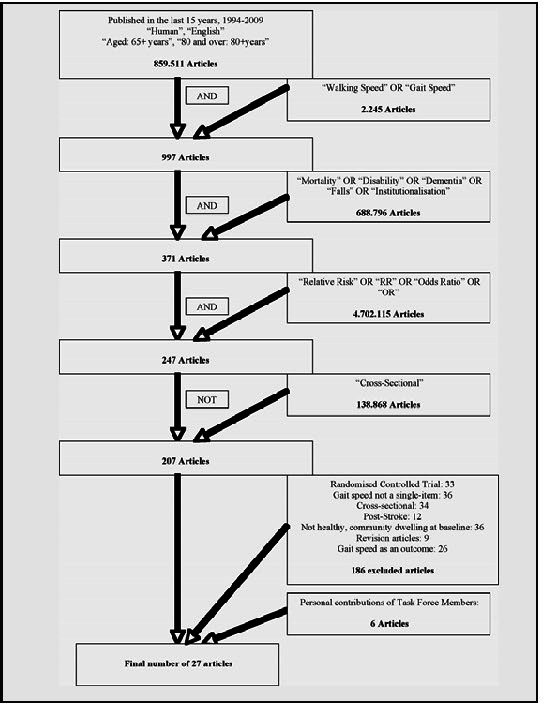
- Systematic literature review using Medline from January 1994 to March 2009, with MeSH terms including “Walking Speed” and “Gait Speed,” yielding 207 articles before final selection of 27 articles.
- Inclusion required usual-pace gait speed assessed as a single-item tool over a short distance, autonomous community-dwelling older participants at baseline, and longitudinal assessment of adverse outcomes (disability, cognitive impairment, institutionalisation, falls, and/or mortality).
- Abstracts were independently evaluated by two reviewers using the STROBE checklist; findings were discussed and revised by an international expert panel at a 2-day meeting in Toulouse, France on March 12–13, 2009.
Limitations
- The paper states that more specific surveys are needed, and that most cohort studies assessed community-dwelling well-functioning older people, so identified cutpoints may differ from frail older people seen in clinical practice.
- The paper notes that many cutpoints are based on tertiles or quartiles used for statistical analyses and may not be easy to remember for clinical practice; the Health ABC cohort’s well-functioning inclusion also limits generalisation of its cutpoints.
- Evident from the text: this is a narrative expert-panel review of 27 selected articles rather than a meta-analysis, and some recommendations, such as using gait speed as an inclusion/exclusion criterion in trials, were explicitly described as not soundly based on existing literature.
Model-written summary. Check it against the paper before relying on it.
Integrity signals
Registry
Cites
Statistics
Figures
Verification
Claims the paper makes
9 Valid · 1 Not valid · 37 Not checked · 21 Own results and interpretations
Every source the paper cites for this claim was checked and supports it.
In the paper
“participants in the lowest quartile (<1.05 ms-1) were more likely to decline in DSST with an Odds Ratio, OR of 1.74 (95% CI 1.21-2.51)”
§ Gait speed at usual pace as a predictor of adverse outcomes in community-dwelling older people an International Academy on Nutrition and Aging (IANA) Task Force > Results: Gait speed as a predictor of adverse outcomes > Gait speed as a predictor of cognitive decline (Table 2)
What the sources say
- Supportedcites [30] Inzitari M. Newman A.B. Yaffe K. Gait speed predicts decline in attention and psychomotor speed in older adults: The Health Aging and Body Composition Study Neuroepidemiology 29 2007 156 162 10.1159/000111577 PubMed PMID: 18042999 18042999 PMC2824580 source
The Results report that, compared with the highest gait-speed quartile, participants in the lowest quartile (<1.05 m/s) had greater odds of DSST decline over five years (OR 1.74, 95% CI 1.21–2.51). This matches the attributed claim. (LLM, conf=0.95)
plainstates an associationn = 2,776- Asserted: passes — The authors put it forward as true.
- Checkable: passes — It can be checked against evidence.
- Load-bearing: passes — The paper’s conclusions depend on it.
- Based: passes — The paper gives a reason why it holds.
- Supported
The cited sources support only part of this claim — read each source’s verdict below.
In the paper
“Gait speed was an independent predictor of falls with a RR of 5.4 (2-14.3)”
§ Gait speed at usual pace as a predictor of adverse outcomes in community-dwelling older people an International Academy on Nutrition and Aging (IANA) Task Force > Results: Gait speed as a predictor of adverse outcomes > Gait speed as a predictor of falls (Table 4)
What the sources say
- Partly supportedcites [43] Montero-Odasso M. Schapira M. Soriano E.R. Gait velocity as a single predictor of adverse events in healthy senior aged 75 years and older J Gerontol Med Sci 60 10 2005 1304 1309 16282564 sourceExperimental — accuracy not yet measured
The Results (p. 3) report an RR of 5.4 (95% CI, 2.0–14.3) for low gait velocity and new falls, but that estimate is from the univariate analysis. The association remained significant after multivariate adjustment, where the reported measure was an OR of 10.9 (95% CI, 2.0–57.9). Thus, the claim combines the unadjusted RR with the independent-predictor finding. (LLM, conf=0.91)
plainstates an associationn = 102- Asserted: passes — The authors put it forward as true.
- Checkable: passes — It can be checked against evidence.
- Load-bearing: unclear — It is unclear whether the paper’s conclusions depend on it.
- Based: passes — The paper gives a reason why it holds.
- Partly supported
Every source the paper cites for this claim was checked and supports it.
In the paper
“Compared to the fastest quartile, the participants who were unable to perform the task raised their risk of death to an OR of 7.47 (95% CI 3.83-14.55).”
§ Gait speed at usual pace as a predictor of adverse outcomes in community-dwelling older people an International Academy on Nutrition and Aging (IANA) Task Force > Results: Gait speed as a predictor of adverse outcomes > Gait speed as a predictor of cognitive decline (Table 2)
What the sources say
- Supportedcites [39] Markides K.S. Black S.A. Ostir G.V. Lower body function and mortality in Mexican American elderly people J Gerontol Biol Sci Med Sci 56 2001 243 247 11283198 source
The Measures section identifies the task as a timed 8-foot walk and scores the fastest quartile as 4 and those unable to complete it as 0. Results, Table 3, reports a mortality odds ratio of 7.47 (95% CI 3.83–14.55) for short-walk score 0 versus score 4 in Model 4. (LLM, conf=0.95)
plainstates an association- Asserted: passes — The authors put it forward as true.
- Checkable: passes — It can be checked against evidence.
- Load-bearing: unclear — It is unclear whether the paper’s conclusions depend on it.
- Based: passes — The paper gives a reason why it holds.
- Supported
The cited sources support only part of this claim — read each source’s verdict below.
In the paper
“Gait speed over 1 ms-1 presented a Hazard Ratio, HR of 0.88 (95% CI 0.81-0.97) in predicting incident disability”
§ Gait speed at usual pace as a predictor of adverse outcomes in community-dwelling older people an International Academy on Nutrition and Aging (IANA) Task Force > Results: Gait speed as a predictor of adverse outcomes > Gait speed as a predictor of mobility disability (Table 1)
What the sources say
- Partly supportedcites [21] Rosano C. Newman A.B. Katz R. Association between lower digit symbol substitution test score and slower gait and greater risk of mortality and of developing incident disability in well-functioning older adults J Am Geriatr Soc 56 2008 1618 1625 10.1111/j.1532-5415.2008.01856.x PubMed PMID: 18691275 18691275 PMC2631090 sourceExperimental — accuracy not yet measured
The Methods (Gait Speed; page unavailable) use 1.0 m/s as a gait-speed threshold, and the Discussion (page unavailable) reports that gait speed was associated with incident disability in the Cardiovascular Health Study participants analyzed. The retrieved Results and other passages do not report the claimed hazard ratio of 0.88 or its 95% confidence interval of 0.81–0.97, so the numerical claim is not supported by our copy. (LLM, conf=0.84)
plainstates an association- Asserted: passes — The authors put it forward as true.
- Checkable: passes — It can be checked against evidence.
- Load-bearing: passes — The paper’s conclusions depend on it.
- Based: passes — The paper gives a reason why it holds.
- Partly supported
The sources with a verdict support this claim; the rest weren’t checked yet, have no full text we could read, or their verdicts aren’t rated yet.
In the paper
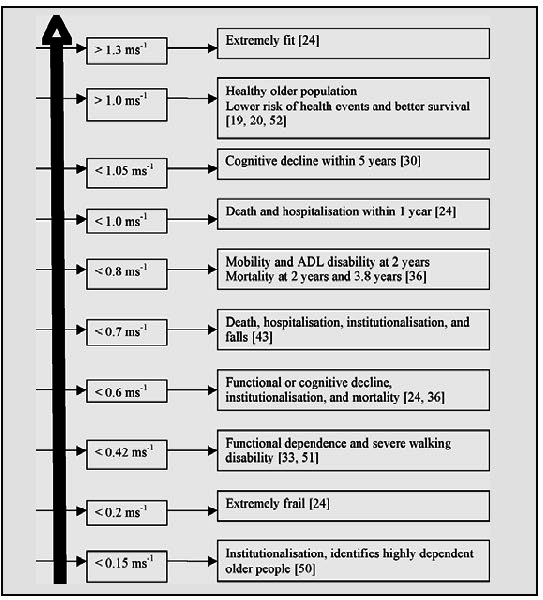
“The 1.0 ms-1 cutpoint was used to predict mortality (19, 20)”
§ Gait speed at usual pace as a predictor of adverse outcomes in community-dwelling older people an International Academy on Nutrition and Aging (IANA) Task Force > Results: Gait speed as a single-item tool > Distance and cut-points reported in literature for a single-item tool (Figure 2)
What the sources say
- Not checked yetcites [19] Cesari M. Kritchevsky S.B. Penninx B.W.H.J. Pronostic value of usual gait speed in well-functioning older people. Results from the Health, Aging and Body Composition Study J Am Geriatr Soc 53 2005 1675 1680 10.1111/j.1532-5415.2005.53501.x PubMed PMID: 16181165 16181165 source
- Supportedcites [20] Cesari M. Kritchevsky S.B. Newman A.B. Added value of physical performance measures in predicting adverse health-related events: results from the Health, Aging and Body Composition Study J Am Geriatr Soc 57 2009 251 259 10.1111/j.1532-5415.2008.02126.x PubMed PMID: 19207142 19207142 PMC2695653 source
The Methods section says the study used the 1 m/sec gait-speed cutpoint to classify participants into high- and low-risk groups. The Results section reports that the resulting high-risk gait-speed group was more likely to experience death, so the cutpoint was used to predict mortality. (LLM, conf=0.93)
plainstates an association- Asserted: passes — The authors put it forward as true.
- Checkable: passes — It can be checked against evidence.
- Load-bearing: unclear — It is unclear whether the paper’s conclusions depend on it.
- Based: passes — The paper gives a reason why it holds.
32 more claims · 1 with their cited sources checked
Create a free account to see all 68 claims and to verify the 52 references still open.
- The quote only partly states this claim. 2
- It may state two separate claims as one. 18
- Probably not a substantial claim. 14
Claims other papers make about this one
Each is checked against this paper’s own text: does it say what the citing paper says it does?
In the citing paper
“Slowing gait may reflect both damaged systems and a high-energy cost of walking.13,39–54”
From Gait speed and survival in older adults. (2011) · cites this paper as [13]
In the citing paper
“Others propose one cutoff around 0.8 m/s.13”
From Gait speed and survival in older adults. (2011) · cites this paper as [13]
In the citing paper
“Gait speed has been widely used as a single measure of frailty and is supported by a robust body of literature demonstrating its prognostic importance across a wide range of patient populations and performance levels.85”
In the citing paper
“Gait speed has also been demonstrated to be a consistent risk factor for disability, cognitive impairment, institutionalization, falls, and postoperative outcomes.85”
In the citing paper
“Accumulating evidence indicates slow walking speed (<1 m/sec indicating a high risk and < 0.8 m/sec indicating a very high risk), as well as reductions in walking speed, strongly predict functional decline, major health outcomes, and mortality in older adults.”
From Successful aging: Advancing the science of physical independence in older adults (2015) · cites this paper as Abellan Van, Rolland, Andrieu, Bauer, Beauchet, Bonnefoy, Cesari, Donini, Gillette, Inzitari, Nourhashemi, Onder, Ritz, Salva, Visser, and Vellas 2009
1 more claim about this paper
Create a free account to see every claim other papers make about this one.
Self-check
Percentages, sums and reported differences re-computed from the paper’s own numbers.
Each contradiction between two passages listed here was confirmed by an independent check.
Rated minor: it would not touch a result — a value no result rests on, a p-value that stays on the same side of the significance level, or a conflict that is clerical, resolved elsewhere in the paper, or outside its own findings.
In the paper
“After 5 years, of the assessed 2776 baseline participants, 389 (17.1%) declined in DSST.”
§ Gait speed at usual pace as a predictor of adverse outcomes in community-dwelling older people an International Academy on Nutrition and Aging (IANA) Task Force > Results: Gait speed as a predictor of adverse outcomes > Gait speed as a predictor of cognitive decline (Table 2)
Reported 17.1 · recomputed 14.012968
Rated minor: it would not touch a result — a value no result rests on, a p-value that stays on the same side of the significance level, or a conflict that is clerical, resolved elsewhere in the paper, or outside its own findings.
In the paper
§ Gait speed at usual pace as a predictor of adverse outcomes in community-dwelling older people an International Academy on Nutrition and Aging (IANA) Task Force > Results: Gait speed as a predictor of adverse outcomes > Gait speed as a predictor of cognitive decline (Table 2)
“| | Follow-up 6 years | | |”
§ Gait speed at usual pace as a predictor of adverse outcomes in community-dwelling older people an International Academy on Nutrition and Aging (IANA) Task Force > Results: Gait speed as a predictor of adverse outcomes > Gait speed as a predictor of cognitive decline (Table 2)
“In a prospective cohort study of 2288 persons, 65 years and older without dementia with a mean follow-up of 9 years, 319 participants developed dementia.”
Rated minor: it would not touch a result — a value no result rests on, a p-value that stays on the same side of the significance level, or a conflict that is clerical, resolved elsewhere in the paper, or outside its own findings.
In the paper
§ Gait speed at usual pace as a predictor of adverse outcomes in community-dwelling older people an International Academy on Nutrition and Aging (IANA) Task Force > Results: Gait speed as a single-item tool > Distance and cut-points reported in literature for a single-item tool (Figure 2)
“The walking distance used in the selected articles was found to be between 2.44 meters (8 feet) and 6 meters”
§ Gait speed at usual pace as a predictor of adverse outcomes in community-dwelling older people an International Academy on Nutrition and Aging (IANA) Task Force > Results: Gait speed as a predictor of adverse outcomes > Gait speed as a predictor of falls (Table 4)
“| Estudio de Evaluación | N= 102 | 10 meter walk | Gait speed was an independent predictor of falls with a RR of 5.4 (2-14.3) |”
Rated minor: it would not touch a result — a value no result rests on, a p-value that stays on the same side of the significance level, or a conflict that is clerical, resolved elsewhere in the paper, or outside its own findings.
In the paper
§ Gait speed at usual pace as a predictor of adverse outcomes in community-dwelling older people an International Academy on Nutrition and Aging (IANA) Task Force > Results: Gait speed as a predictor of adverse outcomes > Gait speed as a predictor of mobility disability (Table 1)
“| | Free from disability, cognitively intact | 15-foot walk | Incident ADL disability HR 0.88 (0.80-0.96) |”
§ Gait speed at usual pace as a predictor of adverse outcomes in community-dwelling older people an International Academy on Nutrition and Aging (IANA) Task Force > Results: Gait speed as a predictor of adverse outcomes > Gait speed as a predictor of mobility disability (Table 1)
“Gait speed over 1 ms-1 presented a Hazard Ratio, HR of 0.88 (95% CI 0.81-0.97) in predicting incident disability”
Rated minor: it would not touch a result — a value no result rests on, a p-value that stays on the same side of the significance level, or a conflict that is clerical, resolved elsewhere in the paper, or outside its own findings.
In the paper
§ Gait speed at usual pace as a predictor of adverse outcomes in community-dwelling older people an International Academy on Nutrition and Aging (IANA) Task Force > Methods
“The assessment of gait speed had to be performed over a short distance (long distance assessment instruments were excluded from the present review)”
§ Gait speed at usual pace as a predictor of adverse outcomes in community-dwelling older people an International Academy on Nutrition and Aging (IANA) Task Force > Results: Gait speed as a predictor of adverse outcomes > Gait speed as a predictor of mobility disability (Table 1)
“| Health ABC study (25) | N=3056 | LDCW 400 meter walk | New mobility limitations |”
2 more findings
Create a free account to see every finding of this check.
Citations
Cites
von Elm, E., Altman, D. G., Egger, M., Pocock, S. J., Gøtzsche, P. C., Vandenbroucke, J. P., & Initiative, F. T. S. (2007) · PLoS Medicine · doi:10.1371/journal.pmed.0040296 · Cited by 23,020
von Elm, E., Altman, D. G., Egger, M., Pocock, S. J., Gøtzsche, P. C., & Vandenbroucke, J. P. (2008) · Journal of Clinical Epidemiology · doi:10.1016/j.jclinepi.2007.11.008 · Cited by 17,893
von Elm, E., Altman, D. G., Egger, M., Pocock, S. J., Gøtzsche, P. C., Vandenbroucke, J. P., & Initiative, F. T. S. (2007) · Annals of Internal Medicine · doi:10.7326/0003-4819-147-8-200710160-00010 · Cited by 17,796
Lower-extremity function in persons over the age of 70 years as a predictor of subsequent disability
Guralnik, J. M., Ferrucci, L., Simonsick, E. M., Salive, M. E., & Wallace, R. B. (1995) · New England Journal of Medicine · doi:10.1056/nejm199503023320902 · Cited by 4,083
Guralnik, J. M., Ferrucci, L., Pieper, C. F., Leveille, S. G., Markides, K. S., Ostir, G. V., Studenski, S., Berkman, L. F., & Wallace, R. B. (2000) · The Journals of Gerontology Series A: Biological Sciences and Medical Sciences · doi:10.1093/gerona/55.4.m221 · Cited by 2,898 · cited 5×
“18) in between the curves when predicting ADL disability at 4 years of follow-up (3).”
Influentialvon Elm, E., Altman, D. G., Egger, M., Pocock, S. J., Gøtzsche, P. C., & Vandenbroucke, J. P. (2007) · Preventive Medicine · doi:10.1016/j.ypmed.2007.08.012 · Cited by 2,698
Comfortable and maximum walking speed of adults aged 20—79 years: reference values and determinants
BOHANNON, R. W. (1997) · Age and Ageing · doi:10.1093/ageing/26.1.15 · Cited by 2,341
Physical performance measures in the clinical setting
Studenski, S., Perera, S., Wallace, D., Chandler, J. M., Duncan, P. W., Rooney, E., Fox, M., & Guralnik, J. M. (2003) · Journal of the American Geriatrics Society · doi:10.1046/j.1532-5415.2003.51104.x · Cited by 1,218 · cited 7×
“2 ms-1 organisation, HMO, and > 65 years Fast walkers >1 ms-1 increase Veterans Affairs, VA (24) Cognitively intact No mobility disability 1-year follow-up Hong Kong Chinese cohort N=2032 16-feet walk Institutionalisation”
InfluentialCesari, M., Kritchevsky, S. B., Penninx, B. W. H. J., Nicklas, B. J., Simonsick, E. M., Newman, A. B., Tylavsky, F. A., Brach, J. S., Satterfield, S., Bauer, D. C., et al. (2005) · Journal of the American Geriatrics Society · doi:10.1111/j.1532-5415.2005.53501.x · Cited by 1,192
Self-citationThe I.A.N.A. task force on frailty assessment of older people in clinical practice
Van Kan, G. A., Rolland, Y., Bergman, H., Morley, J. E., Kritchevsky, S. B., & Vellas, B. (2008) · The Journal of nutrition, health and aging · doi:10.1007/bf02982161 · Cited by 1,099
Self-citation
Cited by
Items 801–900 of 1,005
Crockett, K. L., Kontulainen, S. A., Farthing, J. P., Chilibeck, P. D., Bath, B. L., Baxter-Jones, A. D. G., & Arnold, C. M. (2017) · Journal of Aging and Physical Activity · doi:10.1123/japa.2016-0132 · Cited by 21
Prediction of Reduced Gait Speed Using 5-Time Sit-to-Stand Test in Healthy Older Adults
de Abreu, D. C. C., Porto, J. M., Tofani, P. S., Braghin, R. D. M. B., & Júnior, R. C. F. (2021) · Journal of the American Medical Directors Association · doi:10.1016/j.jamda.2021.11.002 · Cited by 21
Werner, C., Bauknecht, L., Heldmann, P., Hummel, S., Günther-Lange, M., Bauer, J. M., & Hauer, K. A. (2023) · European Geriatric Medicine · doi:10.1007/s41999-023-00869-9 · Cited by 21
Self-citationVerlinden, V. J. A., van der Geest, J. N., Heeringa, J., Hofman, A., & Ikram, M. A. (2014) · Gait & Posture · doi:10.1016/j.gaitpost.2014.09.003 · Cited by 21
Kitayuguchi, J., Kamada, M., Hamano, T., Nabika, T., Shiwaku, K., Kamioka, H., Okada, S., & Mutoh, Y. (2015) · Geriatrics and gerontology international/Geriatrics & gerontology international · doi:10.1111/ggi.12432 · Cited by 21
Aubertin‐Leheudre, M., Martel, D., Narici, M. V., & Bonnefoy, M. (2019) · Experimental Gerontology · doi:10.1016/j.exger.2019.110678 · Cited by 23
Self-citationAssociation between Dietary Habits and Physical Function in Brazilian and Italian Older Women
Coelho‐Júnior, H. J., Calvani, R., Picca, A., Gonçalves, I. O., Landi, F., Bernabei, R., Cesari, M., Uchida, M. C., & Marzetti, E. (2020) · Nutrients · doi:10.3390/nu12061635 · Cited by 22
Self-citationNierenberg, J. L., He, J., Li, C., Gu, X., Shi, M., Razavi, A. C., Mi, X., Li, S., Bazzano, L., Anderson, A. H., et al. (2020) · Aging · doi:10.18632/aging.103362 · Cited by 21
Temporal trends in 6-minute walking distance for older Japanese adults between 1998 and 2017
Tomkinson, G. R., Kidokoro, T., Dufner, T. J., Noi, S., Fitzgerald, J. S., & Brown‐Borg, H. M. (2020) · Journal of sport and health science/Journal of Sport and Health Science · doi:10.1016/j.jshs.2020.06.007 · Cited by 21
Xiu, S., Mu, Z., Zhao, L., & Sun, L. (2020) · Experimental Gerontology · doi:10.1016/j.exger.2020.111013 · Cited by 21
Mechanisms used to increase propulsive forces on a treadmill in older adults
Hinton, E. H., Parker, S. M., Hsiao, H., & Knarr, B. A. (2020) · Journal of Biomechanics · doi:10.1016/j.jbiomech.2020.110139 · Cited by 21
Gobbens, R. J. J., & van der Ploeg, T. (2021) · Quality of Life Research · doi:10.1007/s11136-021-02790-9 · Cited by 21
“In addition, this finding was confirmed by a systematic review conducted by the International Academy on Nutrition and Aging (IANA) Task Force [39].”
MethodGrootswagers, P., Smeets, E. T. H. C., Oteng, A., & de Groot, C. P. G. M. (2021) · Aging · doi:10.18632/aging.202912 · Cited by 21
“The improvements in gait speed that we observed are clinically relevant [37, 38] and might lower the chance of falls, hospitalization and mortality [39, 40].”
BackgroundHairu, R., Close, J., Lord, S. R., Delbaere, K., Wen, W. X., Jiang, J., & Taylor, M. E. (2021) · Archives of Gerontology and Geriatrics · doi:10.1016/j.archger.2021.104427 · Cited by 21
Walking Speed and Mortality: An Updated Systematic Review
Rosmaninho, I., Ribeirinho-Soares, P., & Nunes, J. P. L. (2021) · Southern Medical Journal · doi:10.14423/smj.0000000000001318 · Cited by 21
“It is a quick, simple, safe, and inexpensive method.(4,6) It usually takes 1 to 2 minutes to be evaluated and requires little space and only a stopwatch.”
BackgroundMiyazaki, T., Kiyama, R., Nakai, Y., Kawada, M., Takeshita, Y., Araki, S., & Makizako, H. (2021) · Healthcare · doi:10.3390/healthcare9111571 · Cited by 21
“Gait is usually assessed by various parameters, with gait speed being one of the most common gait parameters [10,11].”
BackgroundImpact of strength and balance on Functional Gait Assessment performance in older adults
Harter, M. J., Sparto, P. J., Rosano, C., & Redfern, M. S. (2021) · Gait & Posture · doi:10.1016/j.gaitpost.2021.10.045 · Cited by 21
Taraldsen, K., Helbostad, J. L., Follestad, T., Bergh, S., Selbæk, G., & Saltvedt, I. T. (2021) · BMC Geriatrics · doi:10.1186/s12877-021-02598-9 · Cited by 21
“Gait speed is a robust measure of health and function [25].”
BackgroundRoca, F., Rougette, K., Zmuda, L., Noel, G., Larose, S., Bordage, M., & Chassagne, P. (2022) · BMC Geriatrics · doi:10.1186/s12877-022-02844-8 · Cited by 21
Huang, S., Zhou, X., Liu, Y., Luo, J., Lv, Z., Shang, P., Zhang, W., Lin, B., Huang, Q., Feng, Y., et al. (2022) · Frontiers in Neuroscience · doi:10.3389/fnins.2022.896437 · Cited by 21
“Several studies have demonstrated an association between slow stride speed and increased fall risk in normal older adults (Abellan et al., 2009; Middleton et al., 2015; Hsu et al., 2017).”
BackgroundAssessing Locomotion Ability in West African Stroke Patients: Validation of ABILOCO-Benin Scale
Sogbossi, E. S., Thonnard, J., & Batcho, C. S. (2014) · Archives of Physical Medicine and Rehabilitation · doi:10.1016/j.apmr.2014.03.002 · Cited by 21
“Walking ability is considered fundamental for activities of daily living and social participation,(2) reflecting an individual’s health and functional states.(3) Its recovery is a crucial goal during poststroke rehabilitation.”
BackgroundParameters of Gait Among Community-Dwelling Older Adults
Paulson, S., & Gray, M. (2014) · Journal of Geriatric Physical Therapy · doi:10.1519/jpt.0000000000000018 · Cited by 21
Roberts‐Clarke, D., Fornusek, C., Saigal, N., Halaki, M., Burns, J., Nicholson, G. A., Singh, M. F., & Hackett, D. A. (2016) · Journal of the Peripheral Nervous System · doi:10.1111/jns.12191 · Cited by 23
“Physical performance has been linked to QoL in a variety of clinical populations (Hyatt et al., 1990; Guralnik et al., 2000; Carter et al., 2002; Enright et al., © 2016 Peripheral Nerve Society 357 2003; Abellan van Kan et al., 2009).”
BackgroundPower Training–induced Increases in Muscle Activation during Gait in Old Adults
Beijersbergen, C. M. I., Granacher, U., Gäbler, M., DeVita, P., & Hortobágyi, T. (2017) · Medicine & Science in Sports & Exercise · doi:10.1249/mss.0000000000001345 · Cited by 21
“6 mIs substantially increases the risk for mobility disability, falls, and even for early mortality (2,36).”
BackgroundValidation of the ADAMO Care Watch for step counting in older adults
Magistro, D., Brustio, P. R., Ivaldi, M., Esliger, D., Zecca, M., Rainoldi, A., & Boccia, G. (2018) · PLoS ONE · doi:10.1371/journal.pone.0190753 · Cited by 21
Delirium, Frailty, and Fast-Track Surgery in Oncogeriatrics: Is There a Link?
Monacelli, F., Signori, A., Prefumo, M., Giannotti, C., Nencioni, A., Romairone, E., Scabini, S., & Odetti, P. R. (2018) · Dementia and Geriatric Cognitive Disorders Extra · doi:10.1159/000486519 · Cited by 21
What Factors Predict Falls in Older Adults Living in Nursing Homes: A Pilot Study
Datta, A., Datta, R., & Elkins, J. (2018) · Journal of Functional Morphology and Kinesiology · doi:10.3390/jfmk4010003 · Cited by 21
Walking speed changes in response to user-driven treadmill control after stroke
Ray, N. T., Reisman, D. S., & Higginson, J. S. (2020) · Journal of Biomechanics · doi:10.1016/j.jbiomech.2020.109643 · Cited by 21
“Increased walking speeds correspond to improved quality of life for communitydwelling older adults and indicate decreased fall risks and increased community involvement for stroke survivors (Abellan van Kan et al., 2009; Fritz and Lusardi, 2009).”
Backgroundvon Bonsdorff, M. B., Groffen, D. A. I., Vidal, J., Rantanen, T., Jónsson, P. V., García, M., Aspelund, T., Eiríksdóttir, G., Siggeirsdóttir, K., Launer, L. J., et al. (2013) · International Journal of Cardiology · doi:10.1016/j.ijcard.2013.01.067 · Cited by 21
“8 m/s) [29,17].”
The predictive value of physical fitness for falls in older adults with intellectual disabilities
Oppewal, A., Hilgenkamp, T. I. M., van Wijck, R., Schoufour, J. D., & Evenhuis, H. M. (2014) · Research in Developmental Disabilities · doi:10.1016/j.ridd.2014.03.022 · Cited by 21
Nguyen, B. T. T., Lin, A. P., Yang, W.-W., Cheng, S.-J., Kuo, Y.-J., Nguyen, T. T., & Chen, Y.-P. (2024) · Aging Clinical and Experimental Research · doi:10.1007/s40520-024-02902-8 · Cited by 20
Psychosocial modification of general self-efficacy in older adults: a restricted review
FitzGerald, J., Wells, Y. D., & Ellis, J. M. (2022) · Australasian Journal on Ageing · doi:10.1111/ajag.13052 · Cited by 20
Fien, S., Henwood, T. R., Climstein, M., Rathbone, E. N., & Keogh, J. (2017) · Journal of Geriatric Physical Therapy · doi:10.1519/jpt.0000000000000160 · Cited by 22
“Older adults with slower gait speeds are at higher risk of disability, 41 cognitive impairment, institutionalization, falls, and mortality.(3) While a variety of 42”
BackgroundElshehabi, M., Din, S. D., Hobert, M. A., Warmerdam, E., Suenkel, U., Schmitz‐Hübsch, T., Behncke, L. M., Heinzel, S., Brockmann, K., Metzger, F. G., et al. (2022) · Frontiers in Aging Neuroscience · doi:10.3389/fnagi.2022.789220 · Cited by 20
Wu, Z., Woods, R. L., Chong, T. T. ‐., Orchard, S. G., Shah, R. C., Wolfe, R. S., Storey, E., Sheets, K. M., Murray, A. M., McNeil, J. J., et al. (2023) · Alzheimer s & Dementia Diagnosis Assessment & Disease Monitoring · doi:10.1002/dad2.12388 · Cited by 21
The association between cognitive impairment, gait speed, and Walk ratio
Knapstad, M. K., Naterstad, I. F., & Bogen, B. E. (2023) · Frontiers in Aging Neuroscience · doi:10.3389/fnagi.2023.1092990 · Cited by 20
Alcock, L., Vitório, R., Stuart, S., Rochester, L., & Pantall, A. (2023) · Sensors · doi:10.3390/s23156921 · Cited by 20
Polypharmacy Is Associated With Slow Gait Speed and Recurrent Falls in Older People With HIV
Kosana, P., Wu, K., Tassiopoulos, K., Letendre, S. L., Ma, Q., Paul, R. H., Ellis, R. J., Erlandson, K. M., & Farhadian, S. (2023) · Clinical Infectious Diseases · doi:10.1093/cid/ciad782 · Cited by 20
“In the general population, slow gait speed (slower than 1 meter/second walk time [23]) predicts adverse prognoses in older adults (eg, hospitalization, all-cause mortality), even among well-functioning older adults, and as such is an important “pre-disability” measure of frailty [24, 25].”
Backgroundde Almeida, S. I. L., Marques, A. S. P. D. D., & Santos, J. M. L. G. (2017) · Revista Portuguesa de Clínica Geral · doi:10.32385/rpmgf.v33i2.12039 · Cited by 20
Júnior, R. C. F., Pieruccini‐Faria, F., & Montero‐Odasso, M. (2017) · Experimental Gerontology · doi:10.1016/j.exger.2017.12.001 · Cited by 21
“In a systematic review, Abellan Van Kan et al. (2009) concluded that gait speed was able to identify autonomous community-dwelling older people at risk of adverse outcomes.”
Jacobs, E., McCrum, C. L., Senden, R. H. J., van Rhijn, L. W., Meijer, K., & Willems, P. C. P. H. (2019) · Aging Clinical and Experimental Research · doi:10.1007/s40520-019-01203-9 · Cited by 20
“This may imply that the OVCF population is at a greater risk for incident disability, such as falling, than their healthy counterparts even 6 months after conservative treatment [24].”
BackgroundOlsen, P. Ø., Termannsen, A., Bramming, M., Tully, M. A., & Caserotti, P. (2019) · European Review of Aging and Physical Activity · doi:10.1186/s11556-019-0230-5 · Cited by 20
Effects of age and speed on the ankle–foot system’s power during walking
da Silva, L. S., Fukuchi, R., Watanabe, R. N., Fukuchi, C. A., & Duarte, M. (2020) · Scientific Reports · doi:10.1038/s41598-020-71763-8 · Cited by 20
Öhlin, J., Gustafson, Y., Littbrand, H., Olofsson, B., & Toots, A. (2021) · Journal of Aging and Physical Activity · doi:10.1123/japa.2020-0266 · Cited by 20
Cohen, A. A., Leung, D. L., Legault, V., Gravel, D., Blanchet, F. G., Côté, A., Fülöp, T., Lee, J., Dufour, F., Liu, M., et al. (2022) · iScience · doi:10.1016/j.isci.2022.104385 · Cited by 20
“In comparison, gait speed, a common test to screen for frailty and predict adverse outcomes in elders (Abellan Van Kan et al., 2009), generates AUC of 0.64 to 0.80 for predicting 5-year mortality in individuals aged 65 years or older, when combined to age and sex (Studenski et al., 2011).”
BackgroundInfluentialGoins, R. T., Innes, K. E., & Dong, L. (2012) · Journal of the American Geriatrics Society · doi:10.1111/j.1532-5415.2011.03869.x · Cited by 20
Gait speed and hospitalization among ambulatory hemodialysis patients: USRDS special study data
Kutner, N. G., Zhang, R., Huang, Y., & Wasse, H. (2014) · World Journal of Nephrology · doi:10.5527/wjn.v3.i3.101 · Cited by 21
Sobhani, S., Sinaei, E., Motealleh, A., Hooshyar, F., Kashkooli, N. S., & Yoosefinejad, A. K. (2018) · Archives of Gerontology and Geriatrics · doi:10.1016/j.archger.2018.05.016 · Cited by 20
Utilising LiDAR for fall detection
Frøvik, N., Malekzai, B. A., & Øvsthus, K. (2021) · Healthcare Technology Letters · doi:10.1049/htl2.12001 · Cited by 19
“Gait speed is important as it can be used as a predictor of cognitive decline, falls, institutionalisation and survival in elderly people [22, 23].”
BackgroundLi, R., Qü, P., Hu, X., Li, X., Zeng, H., Gao, B., & Sun, Z. (2024) · PeerJ · doi:10.7717/peerj.18306 · Cited by 19
Stroke-Related Sarcopenia: Pathophysiology and Diagnostic Tools
Chon, J., Soh, Y., & Shim, G. Y. (2024) · Brain & Neurorehabilitation · doi:10.12786/bn.2024.17.e23 · Cited by 19
Cruz-Jentoft, A. J., Baeyens, J., Bauer, J. M., Boirie, Y., Cederholm, T., Landi, F., Martin, F. C., Michel, J. P., Rolland, Y., Schneider, S. M., et al. (2010) · Cited by 21
Self-citationCognitive profile associated with functional and anthropometric aspects in elderly
de Brito, W. A., Mendes, L., Sales, M. M., Neto, J. B., Brito, C. J., Silva‐Grigoletto, M. E. D., & Ferreira, A. P. (2016) · Revista Andaluza de Medicina del Deporte · doi:10.1016/j.ramd.2015.02.008 · Cited by 19
Rothe, D., Cox-Kennett, N., Buijs, D. M., Venner, C. P., Paterson, D. I., Gyenes, G. T., & Pituskin, E. (2018) · Canadian Journal of Cardiology · doi:10.1016/j.cjca.2018.07.001 · Cited by 19
What Is the Relationship Between Orthostatic Blood Pressure and Spatiotemporal Gait in Later Life?
Briggs, R., Donoghue, O. A., Carey, D., O’Connell, M. D. L., Newman, L., & Kenny, R. A. (2020) · Journal of the American Geriatrics Society · doi:10.1111/jgs.16379 · Cited by 19
Unobtrusive Sensors for the Assessment of Older Adult’s Frailty: A Scoping Review
Cobo, A., Villalba‐Mora, E., Pérez‐Rodríguez, R., Ferré, X., & Rodríguez‐Mañas, L. (2021) · Sensors · doi:10.3390/s21092983 · Cited by 19
de Sousa, O. V., Mendes, J., & do Amaral, T. F. (2021) · Nutrition & Dietetics · doi:10.1111/1747-0080.12679 · Cited by 20
Self-Rated Health and Frailty in Older Adults from the Population-Based Three-City Bordeaux Cohort
Pilleron, S., Goff, M. L., Ajana, S., Helmer, C., Pérès, K., Dartigues, J., Tabué-Teguo, M., & Féart, C. (2021) · Gerontology · doi:10.1159/000518864 · Cited by 19
Effectiveness and Approach of Rehabilitation in Patients With Acute Heart Failure: A Review
Ueno, K., Kaneko, H., Itoh, H., Takeda, N., Morita, H., Fujiu, K., Kamiya, K., & Komuro, I. (2022) · Korean Circulation Journal · doi:10.4070/kcj.2022.0181 · Cited by 19
Makino, K., Raina, P. S., Griffith, L. E., Lee, S., Harada, K., Katayama, O., Tomida, K., Morikawa, M., Yamaguchi, R., Nishijima, C., et al. (2024) · Journal of the American Medical Directors Association · doi:10.1016/j.jamda.2023.12.006 · Cited by 19
Statin Use and Decline in Gait Speed in Community‐Dwelling Older Adults
Lo‐Ciganic, W., Perera, S., Gray, S. L., Boudreau, R. M., Zgibor, J. C., Strotmeyer, E. S., Donohue, J. M., Bunker, C. H., Newman, A. B., Simonsick, E. M., et al. (2014) · Journal of the American Geriatrics Society · doi:10.1111/jgs.13134 · Cited by 19
“Gait speed is a simple but important indicator of functional status in older adults and a strong predictor of mortality and other health-related outcomes.(1,2) A growing body of evidence has identified a relationship between chronic inflammation, age-related functional decline, and risk of disability.”
BackgroundGait Speeds Associated with Anxiety Responses to Pain in Osteoarthritis Patients
Hayashi, K., Kako, M., Suzuki, K., Hattori, K., Fukuyasu, S., Sato, K., Kadono, I., Sakai, T., Hasegawa, Y., & Nishida, Y. (2015) · Pain Medicine · doi:10.1111/pme.12897 · Cited by 19
Dalton, C., Sciadas, R., & Nantel, J. (2015) · Aging Clinical and Experimental Research · doi:10.1007/s40520-015-0499-9 · Cited by 21
Multicomponent Fitness Training Improves Walking Economy in Older Adults
Valenti, G., BONOMI, A. G., & Westerterp, K. R. (2016) · Medicine & Science in Sports & Exercise · doi:10.1249/mss.0000000000000893 · Cited by 19
“Higher walking speed at older age indicates preserved functional and health status and it is related to lower death rates (1).”
BackgroundLeutwyler, H. C., Hubbard, E. M., Cooper, B. A., & Dowling, G. A. (2017) · Community Mental Health Journal · doi:10.1007/s10597-017-0208-6 · Cited by 19
Huang, C., Sun, S., Wang, W., Li, Y., Feng, W., & Wu, Y. (2019) · Journal of Alzheimer s Disease · doi:10.3233/jad-190364 · Cited by 19
Reliability of accelerometric assessment of balance in children aged 6–12 years
García-Liñeira, J., Soidán, J. L. G., Romo-Pérez, V., & Leirós‐Rodríguez, R. (2020) · BMC Pediatrics · doi:10.1186/s12887-020-02073-1 · Cited by 19
Kauppi, M., Stenholm, S., Impivaara, O., Mäki, J., Heliövaara, M., & Jula, A. (2014) · Osteoporosis International · doi:10.1007/s00198-014-2674-9 · Cited by 19
Felício, D. C., Diz, J. B. M., Pereira, D. S., de Queiroz, B. Z., da Silva, J. P., Moreira, B. D. S., Oliveira, V. C., & Pereira, L. S. M. (2017) · Maturitas · doi:10.1016/j.maturitas.2017.07.006 · Cited by 19
Gait biomechanics after proximal femoral nailing of intertrochanteric fractures
Sivakumar, A., Rickman, M. S., & Thewlis, D. (2022) · Journal of Orthopaedic Research® · doi:10.1002/jor.25427 · Cited by 18
“Gait speed in older adults above 60 years has been reported to serve as a significant predictor of adverse outcomes including severe disability, cognitive impairment, falls, and mortality.(42) Population‐level studies in older adults report gait speeds of between 0.”
BackgroundHsu, C. L., Manor, B. D., Travison, T. G., Pascual‐Leone, Á., & Lipsitz, L. A. (2022) · The Journals of Gerontology Series A · doi:10.1093/gerona/glac193 · Cited by 18
Yoon, J., García‐Esquinas, E., Kim, J., Kwak, J. H., Kim, H., Kim, S., Kim, K., Hong, Y., & Choi, Y. (2023) · Environmental Health Perspectives · doi:10.1289/ehp10549 · Cited by 18
“…m = s) has been shown to predict mild physical disability and has been associated with a higher risk of hospitalization and lower extremity functional limitations, 3 whereas the other two de fi nitions have been associated with severe physical disability and an increased risk of falls and mortality.”
Changes in Physical Performance among Community-Dwelling Older Adults in Six Years
Gomes, D. R. D. P., Santos, L. P., González, M. C., Vieira, E. R., & Bielemann, R. M. (2023) · International Journal of Environmental Research and Public Health · doi:10.3390/ijerph20085579 · Cited by 18
High-velocity resistance training improves executive function in mobility-limited older adults
Feter, N., Schaun, G. Z., Smith, E. C., Cassuriaga, J., Alt, R., Redig, L., Alberton, C. L., Coombes, J. S., & Rombaldi, A. J. (2023) · Archives of Gerontology and Geriatrics · doi:10.1016/j.archger.2023.105081 · Cited by 19
Life-space mobility among community-dwelling older persons: A scoping review
Wang, G.-M., Teng, M.-Y., Yu, W.-J., Ren, H. L., & Cui, X.-S. (2023) · Geriatric Nursing · doi:10.1016/j.gerinurse.2023.08.021 · Cited by 18
Hernandez, H. H. C., Yang, D. Z., Tan, C. N., Kua, J., Ismail, N. H., & Lim, W. S. (2023) · Annals of Geriatric Medicine and Research · doi:10.4235/agmr.23.0164 · Cited by 19
Walking and psychomotor speed in the elderly: Concordance, correlates and prediction of death
Tabué-Teguo, M., Goff, M. L., Ávila‐Funes, J. A., Frison, É., Helmer, C., Féart, C., Amieva, H., & Dartigues, J. (2014) · The journal of nutrition health & aging · doi:10.1007/s12603-014-0560-y · Cited by 18
“Yet, the relationship between WS and cognitive function has been previously reported in several studies (3-5 , 12-13).”
Carlos, C. A., Grimes, B. A., Segal, M. R., & Johansen, K. L. (2019) · Nephrology Dialysis Transplantation · doi:10.1093/ndt/gfz272 · Cited by 18
Lees, M. J., Nolan, D. A., Amigo‐Benavent, M., Raleigh, C. J., Khatib, N., Harnedy‐Rothwell, P. A., Fitzgerald, R. J., Egan, B., & Carson, B. P. (2021) · Nutrients · doi:10.3390/nu13020647 · Cited by 18
Wang, W., Song, H.-N., Huang, D., Luo, X., Cai, H.-Y., Yan, J., Chen, W., Xing, C.-G., Dong, Q., & Chen, X.-L. (2022) · Frontiers in Surgery · doi:10.3389/fsurg.2021.832351 · Cited by 18
“Aging (IANA) research shows that the usual gait as a single item tool is as sensitive as comprehensive tools in predicting adverse outcomes (19).”
BackgroundZanotto, T., Sosnoff, J. J., Ofori, E., Golan, D., Zarif, M., Bumstead, B., Buhse, M., Kaczmarek, O., Wilken, J. A., Muratori, L. M., et al. (2022) · Multiple Sclerosis and Related Disorders · doi:10.1016/j.msard.2022.103645 · Cited by 18
de Araújo, F. C., da Silva, K. S., Ohara, D. G., Matos, A. P., Pinto, A. C. P. N., & Pegorari, M. S. (2022) · Ciência & Saúde Coletiva · doi:10.1590/1413-81232022272.01122021 · Cited by 19
The identification of fall risk through tests of mediolateral stability during gait
Sidaway, B., Bennett, J., Berenyi, S., Bryant, P., Cushman, K., DiMonte, R., Downing, K., Gleeson, S., McGibney, S., Minard, H., et al. (2022) · Experimental Gerontology · doi:10.1016/j.exger.2022.111803 · Cited by 18
Pereira, J. P. D. C., Diniz, A. D. S., de Lemos, M. D. C. C., Pinho, C. P. S., & Cabral, P. C. (2023) · Geriatrics and gerontology international/Geriatrics & gerontology international · doi:10.1111/ggi.14660 · Cited by 18
Thingstad, P., Taraldsen, K., Hagen, G., Sand, S., Saltvedt, I. T., Sletvold, O., & Helbostad, J. L. (2014) · Physiotherapy Research International · doi:10.1002/pri.1599 · Cited by 18
Heffernan, K. S., Manini, T. M., Hsu, F., Blair, S. N., Nicklas, B. J., Kritchevsky, S. B., Newman, A. B., Sutton-Tyrrell, K., Church, T. S., Haskell, W. L., et al. (2012) · PLoS ONE · doi:10.1371/journal.pone.0049544 · Cited by 18
“Reduced gait speed has been associated with falls, late-life disability, hospitalization and institutionalization [4].”
BackgroundH-Index Is Important for Postural Control for People with Impaired Foot Sole Sensation
Zhang, S., Manor, B. D., & Li, L. (2015) · PLoS ONE · doi:10.1371/journal.pone.0121847 · Cited by 18
Hazzouri, A. Z. A., Mayeda, E. R., Elfassy, T., Lee, A., Odden, M. C., Thekkethala, D., Wright, C. B., Glymour, M. M., & Haan, M. N. (2016) · The Journals of Gerontology Series A · doi:10.1093/gerona/glw169 · Cited by 19
“Measured walking speed is associated with functional and disability status (1) and is predictive of institutionalization (2), adverse health outcomes (3,4), and all-cause mortality (5,6).”
BackgroundBeauchet, O., Launay, C. P., Barden, J. M., Liu-Ambrose, T. Y. L., Chester, V. L., Szturm, T. J., Grenier, S., Léonard, G., Bherer, L., Annweiler, C., et al. (2016) · Brain Topography · doi:10.1007/s10548-016-0533-z · Cited by 18
Self-citationInfluence of age, gender and test conditions on the reproducibility of Dual-Task walking performance
Wollesen, B., Mattes, K., & Rönnfeldt, J. (2016) · Aging Clinical and Experimental Research · doi:10.1007/s40520-016-0664-9 · Cited by 18
Chang, C., Hsu, C., Huang, P., Liu, L.-K., Chen, L., Chen, J., & Lin, S. (2017) · Geriatrics and gerontology international/Geriatrics & gerontology international · doi:10.1111/ggi.13099 · Cited by 18
Vancampfort, D., Stubbs, B., Hallgren, M. Å., Veronese, N., Mugisha, J., Probst, M., & Koyanagi, A. (2017) · International Psychogeriatrics · doi:10.1017/s1041610217002216 · Cited by 19
Breccia, M., Palandri, F., Luciano, L., Benevolo, G., Bonifacio, M., Caocci, G., Castagnetti, F., Palumbo, G. A., Iurlo, A., & Landi, F. (2018) · Annals of Hematology · doi:10.1007/s00277-018-3258-0 · Cited by 18
Yamamoto, S., Matsunaga, A., Kamiya, K., Miida, K., Ebina, Y., Hotta, K., Shimizu, R., Matsuzawa, R., Abe, Y., Kimura, M., et al. (2012) · International Heart Journal · doi:10.1536/ihj.53.347 · Cited by 18
Cornman, J. C., Glei, D. A., Rodriguez, G., Goldman, N., Hurng, B., & Weinstein, M. (2010) · The Journals of Gerontology Series B · doi:10.1093/geronb/gbq087 · Cited by 18
“Older adults with mobility limitations are also at higher risk of falling, developing disability, and dying earlier (Abellan van Kan et al., 2009; de Rekeneire et al., 2003; Newman et al., 2006; Simonsick et al., 2008).”
BackgroundPavon, J. M., Sloane, R. J., Morey, M. C., & Hastings, S. N. (2017) · Journal of the American Geriatrics Society · doi:10.1111/jgs.14577 · Cited by 18
“For better interpretability, gait speed was operationalized into four categories using clinically meaningful cut points derived from the sample’s quartile distribution and the literature.(10) Both methods resulted in almost equivalent gait speed categories, which supported use of these categories.”
MethodAffective well-being in the last years of life: The role of health decline.
Schilling, O. K., Deeg, D. J. H., & Huisman, M. A. (2018) · Psychology and Aging · doi:10.1037/pag0000279 · Cited by 18
A Proposed Method of Converting Gait Speed and TUG Test in Older Subjects
Kostka, J., Sosowska, N., Guligowska, A., & Kostka, T. (2022) · International Journal of Environmental Research and Public Health · doi:10.3390/ijerph191912145 · Cited by 17
Gait speed in older adults: exploring the impact of functional, physical and social factors
Virto, N., Río, X., Muñoz‐Pérez, I., Zorrilla, A. M., & García-Zapirain, B. (2024) · Retos · doi:10.47197/retos.v61.109902 · Cited by 17
“However, the walking speed generally used and associated with adverse health outcomes is less than 0.8 m/s (Abellan Van Kan et al., 2009; Studenski et al., 2011).”
BackgroundResultInfluentialZanghelini, F., Ponzo, A., Xydopoulos, G., Fordham, R. J., & Khanal, S. (2024) · Geriatrics · doi:10.3390/geriatrics9050129 · Cited by 17
“This is a universally recognised measure, with established values for a mean detectable change (MDC) of 0.05 m/s and a minimally clinically significant change of 0.1 m/s [23].”
BackgroundInfluential
Metadata
- Authors
- Abellan Van Kan, G., Rolland, Y., Andrieu, S., Bauer, J., Beauchet, O., Bonnefoy, M., Cesari, M., Donini, L. M., Gillette-Guyonnet, S., Inzitari, M., Nourhashemi, F., Onder, G., Ritz, P., Salva, A., Visser, M., & Vellas, B.
- Affiliations
- Université Toulouse III - Paul Sabatier (FR)
- Friedrich-Alexander-Universität Erlangen-Nürnberg (DE)
- Centre Hospitalier Universitaire d'Angers (FR)
- Hôpital Lyon Sud (FR)
- University of Florida (US)
- Sapienza University of Rome (IT)
- Universitat Autònoma de Barcelona (ES)
- Università Cattolica del Sacro Cuore (IT)
- Centre Hospitalier Universitaire de Toulouse (FR)
- Amsterdam Public Health (NL)
- ORCID
- Venue
- The Journal of nutrition, health and aging
- Publisher
- Elsevier BV
- Published
- 2009-12
- Volume
- 13
- Issue
- 10
- Pages
- 881-889
- ISSN
- 1279-7707 (ISSN-L)
- PMC
- PMC12878092
- OpenAlex
- W2104750100
- Semantic Scholar
- 10553b18ba60c073f881cfe6be4b7f453a2f15b0
- Cited by
- 2,003
- References
- 56
- Citations by year
- 2026: 96 · 2025: 117 · 2024: 113 · 2023: 137 · 2022: 141 · 2021: 172 · 2020: 153 · 2019: 156 · 2018: 122 · 2017: 155 · 2016: 154 · 2015: 135 · 2014: 117 · 2013: 75 · 2012: 94
- FWCI
- 5.47
- Type
- journal article
- Language
- en
- Open access
- hybrid
- doi.org
- Licence
- cc-by-nc-nd
- www.elsevier.com/tdm/userlicense/1.0/ (tdm)
- www.elsevier.com/legal/tdmrep-license (tdm)
- creativecommons.org/licenses/by-nc-nd/4.0/ (vor, 5125 d)
- Locations
- The journal of nutrition health & aging (publishedVersion, cc-by-nc-nd)
- Europe PMC (PubMed Central) (publishedVersion, cc-by-nc-nd)
- PubMed (publishedVersion)
- PubMed Central (publishedVersion, cc-by-nc-nd)
- VU Research Portal (publishedVersion)
- IRIS Research product catalog (Sapienza University of Rome) (submittedVersion)
- Data Archiving and Networked Services (DANS) (submittedVersion)
- Topics
- Health Sciences › Medicine › Geriatrics and Gerontology › Frailty in Older Adults
- Health Sciences › Health Professions › Physical Therapy, Sports Therapy and Rehabilitation › Balance, Gait, and Falls Prevention
- Health Sciences › Medicine › Physiology (medical) › Nutrition and Health in Aging
- Keywords
- walking speed, community-dwelling older adults, frailty, physical performance, adverse outcomes, disability, cognitive impairment, institutionalization, falls, mortality, risk prediction
- MeSH terms
- Activities of Daily Living, Aged, Aged, 80 and over, Aging, Cognition Disorders, Disability Evaluation, Female, Gait, Humans, Kinetics, Male, Predictive Value of Tests, Geriatric Assessment, Frail Elderly, Mobility Limitation
About these checks
Registry, retraction, Cites and statistics results are computed, not judged, with one exception: a printed reference that no index lists is read once by a model before it counts as a citation error. Claims are extracted by a model and kept only when their quote appears verbatim in the text; each cited source is then checked, with a model’s help, for whether it says what the claim relies on. Those verdicts can be wrong — read the claim’s quote and the cited source before relying on one.
The claim verdicts this report counts are experimental: their accuracy is not yet measured.
A language model drew the claims from the paper on 2026-10-05, under version 3 of the claim definition (model deepseek-v4.1-flash, prompt extract-v3).
A second model labelled each claim on 2026-10-05 (model jev-1.13-20260917, definition revision gold-guideline-v0.2).
Cited sources are checked with a language model’s help (gpt-6-sol).
Statistics and arithmetic are recomputed, not judged.
Confidence bands are shown only for fields calibrated on our annotated test set. None is calibrated yet, so no band is shown.
What counts as a claim ›How we measure confidence ›How we check this ›
Are you an author, or do you see a problem with this page? Request a review
Data sources
Bibliographic data: Semantic Scholar, OpenAlex, Crossref.
Contains information from the Semantic Scholar Academic Graph Datasets, made available under the ODC Attribution License (ODC-BY 1.0).
Semantic Scholar’s data is described in: Kinney, R., et al. (2023). The Semantic Scholar Open Data Platform. arXiv:2301.10140.
