

Gait speed at usual pace as a predictor of adverse outcomes in community-dwelling older people an International Academy on Nutrition and Aging (IANA) Task Force
Open accessThe DOI matches its Crossref record; 56 of the 56 references it cites were found in a registry or an index; 10 of the 62 sources its claims cite were checked for support.
Abstract
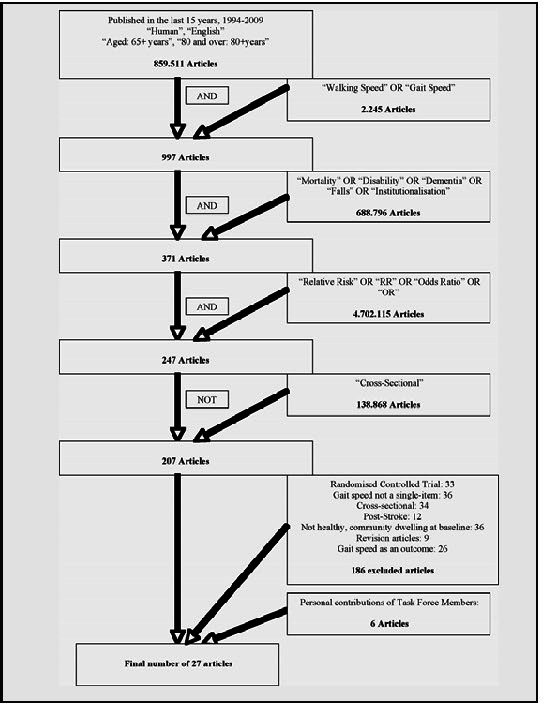
INTRODUCTION: The use of a simple, safe, and easy to perform assessment tool, like gait speed, to evaluate vulnerability to adverse outcomes in community-dwelling older people is appealing, but its predictive capacity is still questioned. The present manuscript summarises the conclusions of an expert panel in the domain of physical performance measures and frailty in older people, who reviewed and discussed the existing literature in a 2-day meeting held in Toulouse, France on March 12-13, 2009. The aim of the IANA Task Force was to state if, in the light of actual scientific evidence, gait speed assessed at usual pace had the capacity to identify community-dwelling older people at risk of adverse outcomes, and if gait speed could be used as a single-item tool instead of more comprehensive but more time-consuming assessment instruments. METHODS: A systematic review of literature was performed prior to the meeting (Medline search and additional pearling of reference lists and key-articles supplied by Task Force members). Manuscripts were retained for the present revision only when a high level of evidence was present following 4 pre-selected criteria: a) gait speed, at usual pace, had to be specifically assessed as a single-item tool, b) gait speed should be measured over a short distance, c) at baseline, participants had to be autonomous, community-dwelling older people, and d) the evaluation of onset of adverse outcomes (i.e. disability, cognitive impairment, institutionalisation, falls, and/or mortality) had to be assessed longitudinally over time. Based on the prior criteria, a final selection of 27 articles was used for the present manuscript. RESULTS: Gait speed at usual pace was found to be a consistent risk factor for disability, cognitive impairment, institutionalisation, falls, and/or mortality. In predicting these adverse outcomes over time, gait speed was at least as sensible as composite tools. CONCLUSIONS: Although more specific surveys needs to be performed, there is sufficient evidence to state that gait speed identifies autonomous community-dwelling older people at risk of adverse outcomes and can be used as a single-item assessment tool. The assessment at usual pace over 4 meters was the most often used method in literature and might represent a quick, safe, inexpensive and highly reliable instrument to be implemented.
Overview
CoChat Summary
TL;DR
This IANA Task Force systematic review and expert-panel report concludes that usual-pace gait speed is a consistent predictor of adverse outcomes in autonomous community-dwelling older people and performs at least as well as composite tools. The panel recommends gait speed as a single-item assessment, with an “easy-to-remember” cutpoint of 0.8 m/s using a 4-meter course.
Key findings
- Gait speed at usual pace was a consistent risk factor for disability, cognitive impairment, institutionalisation, falls, and/or mortality across the 27 selected articles.
- In Health ABC, slow gait speed (<1.0 m/s) predicted persistent lower extremity limitation with RR 2.20 (95% CI 1.76–2.74) over 4.9 years and mortality with RR 1.64 (95% CI 1.14–2.37).
- In H-EPESE, the lowest versus highest gait-speed quartile predicted mortality with OR 3.64 (95% CI 1.93–6.85), and inability to perform the task raised mortality risk to OR 7.47 (95% CI 3.83–14.55).
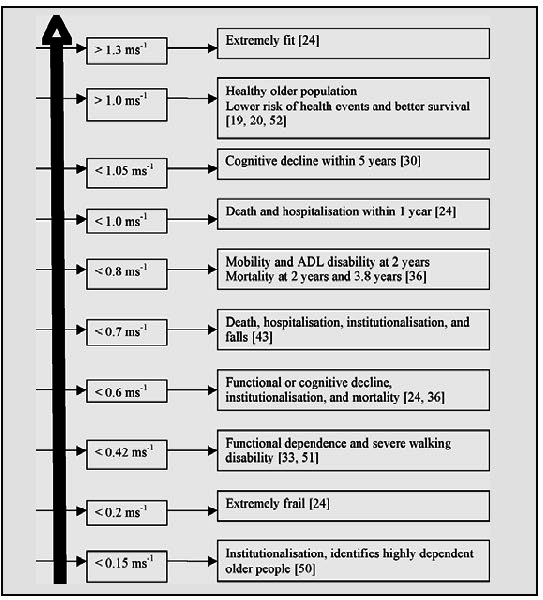
- Gait speed alone was nearly as good as the SPPB for predicting ADL disability at 4 years: AUC 0.67 for gait speed versus 0.69 for SPPB, p=0.18; the panel proposed 0.8 m/s (5 seconds for 4 meters) as the clinical cutpoint for adverse outcomes.
Methods
- Systematic literature review using Medline from January 1994 to March 2009, with MeSH terms including “Walking Speed” and “Gait Speed,” yielding 207 articles before final selection of 27 articles.
- Inclusion required usual-pace gait speed assessed as a single-item tool over a short distance, autonomous community-dwelling older participants at baseline, and longitudinal assessment of adverse outcomes (disability, cognitive impairment, institutionalisation, falls, and/or mortality).
- Abstracts were independently evaluated by two reviewers using the STROBE checklist; findings were discussed and revised by an international expert panel at a 2-day meeting in Toulouse, France on March 12–13, 2009.
Limitations
- The paper states that more specific surveys are needed, and that most cohort studies assessed community-dwelling well-functioning older people, so identified cutpoints may differ from frail older people seen in clinical practice.
- The paper notes that many cutpoints are based on tertiles or quartiles used for statistical analyses and may not be easy to remember for clinical practice; the Health ABC cohort’s well-functioning inclusion also limits generalisation of its cutpoints.
- Evident from the text: this is a narrative expert-panel review of 27 selected articles rather than a meta-analysis, and some recommendations, such as using gait speed as an inclusion/exclusion criterion in trials, were explicitly described as not soundly based on existing literature.
Model-written summary. Check it against the paper before relying on it.
Integrity signals
Registry
Cites
Statistics
Figures
Verification
Claims the paper makes
9 Valid · 1 Not valid · 37 Not checked · 21 Own results and interpretations
Every source the paper cites for this claim was checked and supports it.
In the paper
“participants in the lowest quartile (<1.05 ms-1) were more likely to decline in DSST with an Odds Ratio, OR of 1.74 (95% CI 1.21-2.51)”
§ Gait speed at usual pace as a predictor of adverse outcomes in community-dwelling older people an International Academy on Nutrition and Aging (IANA) Task Force > Results: Gait speed as a predictor of adverse outcomes > Gait speed as a predictor of cognitive decline (Table 2)
What the sources say
- Supportedcites [30] Inzitari M. Newman A.B. Yaffe K. Gait speed predicts decline in attention and psychomotor speed in older adults: The Health Aging and Body Composition Study Neuroepidemiology 29 2007 156 162 10.1159/000111577 PubMed PMID: 18042999 18042999 PMC2824580 source
The Results report that, compared with the highest gait-speed quartile, participants in the lowest quartile (<1.05 m/s) had greater odds of DSST decline over five years (OR 1.74, 95% CI 1.21–2.51). This matches the attributed claim. (LLM, conf=0.95)
plainstates an associationn = 2,776- Asserted: passes — The authors put it forward as true.
- Checkable: passes — It can be checked against evidence.
- Load-bearing: passes — The paper’s conclusions depend on it.
- Based: passes — The paper gives a reason why it holds.
- Supported
The cited sources support only part of this claim — read each source’s verdict below.
In the paper
“Gait speed was an independent predictor of falls with a RR of 5.4 (2-14.3)”
§ Gait speed at usual pace as a predictor of adverse outcomes in community-dwelling older people an International Academy on Nutrition and Aging (IANA) Task Force > Results: Gait speed as a predictor of adverse outcomes > Gait speed as a predictor of falls (Table 4)
What the sources say
- Partly supportedcites [43] Montero-Odasso M. Schapira M. Soriano E.R. Gait velocity as a single predictor of adverse events in healthy senior aged 75 years and older J Gerontol Med Sci 60 10 2005 1304 1309 16282564 sourceExperimental — accuracy not yet measured
The Results (p. 3) report an RR of 5.4 (95% CI, 2.0–14.3) for low gait velocity and new falls, but that estimate is from the univariate analysis. The association remained significant after multivariate adjustment, where the reported measure was an OR of 10.9 (95% CI, 2.0–57.9). Thus, the claim combines the unadjusted RR with the independent-predictor finding. (LLM, conf=0.91)
plainstates an associationn = 102- Asserted: passes — The authors put it forward as true.
- Checkable: passes — It can be checked against evidence.
- Load-bearing: unclear — It is unclear whether the paper’s conclusions depend on it.
- Based: passes — The paper gives a reason why it holds.
- Partly supported
Every source the paper cites for this claim was checked and supports it.
In the paper
“Compared to the fastest quartile, the participants who were unable to perform the task raised their risk of death to an OR of 7.47 (95% CI 3.83-14.55).”
§ Gait speed at usual pace as a predictor of adverse outcomes in community-dwelling older people an International Academy on Nutrition and Aging (IANA) Task Force > Results: Gait speed as a predictor of adverse outcomes > Gait speed as a predictor of cognitive decline (Table 2)
What the sources say
- Supportedcites [39] Markides K.S. Black S.A. Ostir G.V. Lower body function and mortality in Mexican American elderly people J Gerontol Biol Sci Med Sci 56 2001 243 247 11283198 source
The Measures section identifies the task as a timed 8-foot walk and scores the fastest quartile as 4 and those unable to complete it as 0. Results, Table 3, reports a mortality odds ratio of 7.47 (95% CI 3.83–14.55) for short-walk score 0 versus score 4 in Model 4. (LLM, conf=0.95)
plainstates an association- Asserted: passes — The authors put it forward as true.
- Checkable: passes — It can be checked against evidence.
- Load-bearing: unclear — It is unclear whether the paper’s conclusions depend on it.
- Based: passes — The paper gives a reason why it holds.
- Supported
The cited sources support only part of this claim — read each source’s verdict below.
In the paper
“Gait speed over 1 ms-1 presented a Hazard Ratio, HR of 0.88 (95% CI 0.81-0.97) in predicting incident disability”
§ Gait speed at usual pace as a predictor of adverse outcomes in community-dwelling older people an International Academy on Nutrition and Aging (IANA) Task Force > Results: Gait speed as a predictor of adverse outcomes > Gait speed as a predictor of mobility disability (Table 1)
What the sources say
- Partly supportedcites [21] Rosano C. Newman A.B. Katz R. Association between lower digit symbol substitution test score and slower gait and greater risk of mortality and of developing incident disability in well-functioning older adults J Am Geriatr Soc 56 2008 1618 1625 10.1111/j.1532-5415.2008.01856.x PubMed PMID: 18691275 18691275 PMC2631090 sourceExperimental — accuracy not yet measured
The Methods (Gait Speed; page unavailable) use 1.0 m/s as a gait-speed threshold, and the Discussion (page unavailable) reports that gait speed was associated with incident disability in the Cardiovascular Health Study participants analyzed. The retrieved Results and other passages do not report the claimed hazard ratio of 0.88 or its 95% confidence interval of 0.81–0.97, so the numerical claim is not supported by our copy. (LLM, conf=0.84)
plainstates an association- Asserted: passes — The authors put it forward as true.
- Checkable: passes — It can be checked against evidence.
- Load-bearing: passes — The paper’s conclusions depend on it.
- Based: passes — The paper gives a reason why it holds.
- Partly supported
The sources with a verdict support this claim; the rest weren’t checked yet, have no full text we could read, or their verdicts aren’t rated yet.
In the paper
“The 1.0 ms-1 cutpoint was used to predict mortality (19, 20)”
§ Gait speed at usual pace as a predictor of adverse outcomes in community-dwelling older people an International Academy on Nutrition and Aging (IANA) Task Force > Results: Gait speed as a single-item tool > Distance and cut-points reported in literature for a single-item tool (Figure 2)
What the sources say
- Not checked yetcites [19] Cesari M. Kritchevsky S.B. Penninx B.W.H.J. Pronostic value of usual gait speed in well-functioning older people. Results from the Health, Aging and Body Composition Study J Am Geriatr Soc 53 2005 1675 1680 10.1111/j.1532-5415.2005.53501.x PubMed PMID: 16181165 16181165 source
- Supportedcites [20] Cesari M. Kritchevsky S.B. Newman A.B. Added value of physical performance measures in predicting adverse health-related events: results from the Health, Aging and Body Composition Study J Am Geriatr Soc 57 2009 251 259 10.1111/j.1532-5415.2008.02126.x PubMed PMID: 19207142 19207142 PMC2695653 source
The Methods section says the study used the 1 m/sec gait-speed cutpoint to classify participants into high- and low-risk groups. The Results section reports that the resulting high-risk gait-speed group was more likely to experience death, so the cutpoint was used to predict mortality. (LLM, conf=0.93)
plainstates an association- Asserted: passes — The authors put it forward as true.
- Checkable: passes — It can be checked against evidence.
- Load-bearing: unclear — It is unclear whether the paper’s conclusions depend on it.
- Based: passes — The paper gives a reason why it holds.
32 more claims · 1 with their cited sources checked
Create a free account to see all 68 claims and to verify the 52 references still open.
- The quote only partly states this claim. 2
- It may state two separate claims as one. 18
- Probably not a substantial claim. 14
Claims other papers make about this one
Each is checked against this paper’s own text: does it say what the citing paper says it does?
In the citing paper
“Slowing gait may reflect both damaged systems and a high-energy cost of walking.13,39–54”
From Gait speed and survival in older adults. (2011) · cites this paper as [13]
In the citing paper
“Others propose one cutoff around 0.8 m/s.13”
From Gait speed and survival in older adults. (2011) · cites this paper as [13]
In the citing paper
“Gait speed has been widely used as a single measure of frailty and is supported by a robust body of literature demonstrating its prognostic importance across a wide range of patient populations and performance levels.85”
In the citing paper
“Gait speed has also been demonstrated to be a consistent risk factor for disability, cognitive impairment, institutionalization, falls, and postoperative outcomes.85”
In the citing paper
“Accumulating evidence indicates slow walking speed (<1 m/sec indicating a high risk and < 0.8 m/sec indicating a very high risk), as well as reductions in walking speed, strongly predict functional decline, major health outcomes, and mortality in older adults.”
From Successful aging: Advancing the science of physical independence in older adults (2015) · cites this paper as Abellan Van, Rolland, Andrieu, Bauer, Beauchet, Bonnefoy, Cesari, Donini, Gillette, Inzitari, Nourhashemi, Onder, Ritz, Salva, Visser, and Vellas 2009
1 more claim about this paper
Create a free account to see every claim other papers make about this one.
Self-check
Percentages, sums and reported differences re-computed from the paper’s own numbers.
Each contradiction between two passages listed here was confirmed by an independent check.
Rated minor: it would not touch a result — a value no result rests on, a p-value that stays on the same side of the significance level, or a conflict that is clerical, resolved elsewhere in the paper, or outside its own findings.
In the paper
“After 5 years, of the assessed 2776 baseline participants, 389 (17.1%) declined in DSST.”
§ Gait speed at usual pace as a predictor of adverse outcomes in community-dwelling older people an International Academy on Nutrition and Aging (IANA) Task Force > Results: Gait speed as a predictor of adverse outcomes > Gait speed as a predictor of cognitive decline (Table 2)
Reported 17.1 · recomputed 14.012968
Rated minor: it would not touch a result — a value no result rests on, a p-value that stays on the same side of the significance level, or a conflict that is clerical, resolved elsewhere in the paper, or outside its own findings.
In the paper
§ Gait speed at usual pace as a predictor of adverse outcomes in community-dwelling older people an International Academy on Nutrition and Aging (IANA) Task Force > Results: Gait speed as a predictor of adverse outcomes > Gait speed as a predictor of cognitive decline (Table 2)
“| | Follow-up 6 years | | |”
§ Gait speed at usual pace as a predictor of adverse outcomes in community-dwelling older people an International Academy on Nutrition and Aging (IANA) Task Force > Results: Gait speed as a predictor of adverse outcomes > Gait speed as a predictor of cognitive decline (Table 2)
“In a prospective cohort study of 2288 persons, 65 years and older without dementia with a mean follow-up of 9 years, 319 participants developed dementia.”
Rated minor: it would not touch a result — a value no result rests on, a p-value that stays on the same side of the significance level, or a conflict that is clerical, resolved elsewhere in the paper, or outside its own findings.
In the paper
§ Gait speed at usual pace as a predictor of adverse outcomes in community-dwelling older people an International Academy on Nutrition and Aging (IANA) Task Force > Results: Gait speed as a single-item tool > Distance and cut-points reported in literature for a single-item tool (Figure 2)
“The walking distance used in the selected articles was found to be between 2.44 meters (8 feet) and 6 meters”
§ Gait speed at usual pace as a predictor of adverse outcomes in community-dwelling older people an International Academy on Nutrition and Aging (IANA) Task Force > Results: Gait speed as a predictor of adverse outcomes > Gait speed as a predictor of falls (Table 4)
“| Estudio de Evaluación | N= 102 | 10 meter walk | Gait speed was an independent predictor of falls with a RR of 5.4 (2-14.3) |”
Rated minor: it would not touch a result — a value no result rests on, a p-value that stays on the same side of the significance level, or a conflict that is clerical, resolved elsewhere in the paper, or outside its own findings.
In the paper
§ Gait speed at usual pace as a predictor of adverse outcomes in community-dwelling older people an International Academy on Nutrition and Aging (IANA) Task Force > Results: Gait speed as a predictor of adverse outcomes > Gait speed as a predictor of mobility disability (Table 1)
“| | Free from disability, cognitively intact | 15-foot walk | Incident ADL disability HR 0.88 (0.80-0.96) |”
§ Gait speed at usual pace as a predictor of adverse outcomes in community-dwelling older people an International Academy on Nutrition and Aging (IANA) Task Force > Results: Gait speed as a predictor of adverse outcomes > Gait speed as a predictor of mobility disability (Table 1)
“Gait speed over 1 ms-1 presented a Hazard Ratio, HR of 0.88 (95% CI 0.81-0.97) in predicting incident disability”
Rated minor: it would not touch a result — a value no result rests on, a p-value that stays on the same side of the significance level, or a conflict that is clerical, resolved elsewhere in the paper, or outside its own findings.
In the paper
§ Gait speed at usual pace as a predictor of adverse outcomes in community-dwelling older people an International Academy on Nutrition and Aging (IANA) Task Force > Methods
“The assessment of gait speed had to be performed over a short distance (long distance assessment instruments were excluded from the present review)”
§ Gait speed at usual pace as a predictor of adverse outcomes in community-dwelling older people an International Academy on Nutrition and Aging (IANA) Task Force > Results: Gait speed as a predictor of adverse outcomes > Gait speed as a predictor of mobility disability (Table 1)
“| Health ABC study (25) | N=3056 | LDCW 400 meter walk | New mobility limitations |”
2 more findings
Create a free account to see every finding of this check.
Citations
Cites
von Elm, E., Altman, D. G., Egger, M., Pocock, S. J., Gøtzsche, P. C., Vandenbroucke, J. P., & Initiative, F. T. S. (2007) · PLoS Medicine · doi:10.1371/journal.pmed.0040296 · Cited by 23,020
von Elm, E., Altman, D. G., Egger, M., Pocock, S. J., Gøtzsche, P. C., & Vandenbroucke, J. P. (2008) · Journal of Clinical Epidemiology · doi:10.1016/j.jclinepi.2007.11.008 · Cited by 17,893
von Elm, E., Altman, D. G., Egger, M., Pocock, S. J., Gøtzsche, P. C., Vandenbroucke, J. P., & Initiative, F. T. S. (2007) · Annals of Internal Medicine · doi:10.7326/0003-4819-147-8-200710160-00010 · Cited by 17,796
Lower-extremity function in persons over the age of 70 years as a predictor of subsequent disability
Guralnik, J. M., Ferrucci, L., Simonsick, E. M., Salive, M. E., & Wallace, R. B. (1995) · New England Journal of Medicine · doi:10.1056/nejm199503023320902 · Cited by 4,083
Guralnik, J. M., Ferrucci, L., Pieper, C. F., Leveille, S. G., Markides, K. S., Ostir, G. V., Studenski, S., Berkman, L. F., & Wallace, R. B. (2000) · The Journals of Gerontology Series A: Biological Sciences and Medical Sciences · doi:10.1093/gerona/55.4.m221 · Cited by 2,898 · cited 5×
“18) in between the curves when predicting ADL disability at 4 years of follow-up (3).”
Influentialvon Elm, E., Altman, D. G., Egger, M., Pocock, S. J., Gøtzsche, P. C., & Vandenbroucke, J. P. (2007) · Preventive Medicine · doi:10.1016/j.ypmed.2007.08.012 · Cited by 2,698
Comfortable and maximum walking speed of adults aged 20—79 years: reference values and determinants
BOHANNON, R. W. (1997) · Age and Ageing · doi:10.1093/ageing/26.1.15 · Cited by 2,341
Physical performance measures in the clinical setting
Studenski, S., Perera, S., Wallace, D., Chandler, J. M., Duncan, P. W., Rooney, E., Fox, M., & Guralnik, J. M. (2003) · Journal of the American Geriatrics Society · doi:10.1046/j.1532-5415.2003.51104.x · Cited by 1,218 · cited 7×
“2 ms-1 organisation, HMO, and > 65 years Fast walkers >1 ms-1 increase Veterans Affairs, VA (24) Cognitively intact No mobility disability 1-year follow-up Hong Kong Chinese cohort N=2032 16-feet walk Institutionalisation”
InfluentialCesari, M., Kritchevsky, S. B., Penninx, B. W. H. J., Nicklas, B. J., Simonsick, E. M., Newman, A. B., Tylavsky, F. A., Brach, J. S., Satterfield, S., Bauer, D. C., et al. (2005) · Journal of the American Geriatrics Society · doi:10.1111/j.1532-5415.2005.53501.x · Cited by 1,192
Self-citationThe I.A.N.A. task force on frailty assessment of older people in clinical practice
Van Kan, G. A., Rolland, Y., Bergman, H., Morley, J. E., Kritchevsky, S. B., & Vellas, B. (2008) · The Journal of nutrition, health and aging · doi:10.1007/bf02982161 · Cited by 1,099
Self-citation
Cited by
Items 101–200 of 1,005
Scott, D., Seibel, M., Cumming, R., Naganathan, V., Blyth, F., Le Couteur, D. G., Handelsman, D. J., Waite, L. M., & Hirani, V. (2017) · Journal of Bone and Mineral Research · doi:10.1002/jbmr.3016 · Cited by 174
“The finding that higher gait speed but not hand-grip strength was associated with reduced falls is consistent with lower-limb muscle function beingmore relevant for falls than upper-limb strength; however, higher gait speed may also reflect better function in other physiological dimensions (eg, cognition) important fo…”
ResultGarcia, M., Agar, M. R., Soo, W. K., To, T. H. M., & Phillips, J. L. (2021) · JAMA Oncology · doi:10.1001/jamaoncol.2020.6736 · Cited by 174
Role of Gait Speed in the Assessment of Older Patients
Cesari, M. (2011) · JAMA · doi:10.1001/jama.2010.1970 · Cited by 150
Self-citationSmith, E., Cusack, T., & Blake, C. (2016) · Gait & Posture · doi:10.1016/j.gaitpost.2015.12.017 · Cited by 172
“We know that gait speed decreases with age and that the speed of walking can help us to evaluate functional capabilities and predict functional decline [2] including function in the community [3,4].”
Plummer, P., Zukowski, L. A., Giuliani, C., Hall, A. M., & Zurakowski, D. (2016) · Gerontology · doi:10.1159/000371577 · Cited by 171
Vetrano, D. L., Rizzuto, D., Calderón-Larrañaga, A., Onder, G., Welmer, A.-K., Bernabei, R., Marengoni, A., & Fratiglioni, L. (2018) · PLOS Medicine · doi:10.1371/journal.pmed.1002503 · Cited by 170
Self-citationVieira, R. A., Guerra, R. O., Giacomin, K. C., Vasconcelos, K. S. D. S., Andrade, A. C. D. S., Pereira, L. S. M., Dias, J. M. D., & Dias, R. C. (2013) · Cadernos de Saúde Pública · doi:10.1590/0102-311x00126312 · Cited by 174
Bradypedia: Is gait speed ready for clinical use?
Studenski, S. (2009) · The Journal of nutrition, health and aging · doi:10.1007/s12603-009-0245-0 · Cited by 169
Frailty and the Selection of Patients for Destination Therapy Left Ventricular Assist Device
Flint, K. M., Matlock, D. D., Lindenfeld, J., & Allen, L. A. (2012) · Circulation: Heart Failure · doi:10.1161/circheartfailure.111.963215 · Cited by 169
Treating frailty-a practical guide
Fairhall, N., Langron, C., Sherrington, C., Lord, S. R., Kurrle, S. E., Lockwood, K., Monaghan, N., Aggar, C., Gill, L., & Cameron, I. D. (2011) · BMC Medicine · doi:10.1186/1741-7015-9-83 · Cited by 168
“8 m/sec was proposed as the result of a recent systematic review [21] and seems a useful starting point for further validation studies.”
BackgroundWalking ability to predict future cognitive decline in old adults: A scoping review
Kikkert, L. H. J., Vuillerme, N., van Campen, J. P., Hortobágyi, T., & Lamoth, C. J. (2016) · Ageing Research Reviews · doi:10.1016/j.arr.2016.02.001 · Cited by 168
Frailty Phenotype and Healthcare Costs and Utilization in Older Women
Ensrud, K. E., Kats, A. M., Schousboe, J. T., Taylor, B. C., Cawthon, P. M., Hillier, T. A., Yaffe, K. S., Cummings, S., Cauley, J. A., Langsetmo, L., et al. (2018) · Journal of the American Geriatrics Society · doi:10.1111/jgs.15381 · Cited by 168
Association Between Purpose in Life and Objective Measures of Physical Function in Older Adults
Kim, E. S., Kawachi, I., Chen, Y., & Kubzansky, L. D. (2017) · JAMA Psychiatry · doi:10.1001/jamapsychiatry.2017.2145 · Cited by 167
van het Reve, E., Silveira, P., Daniel, F., Casati, F., & de Bruin, E. D. (2014) · Journal of Medical Internet Research · doi:10.2196/jmir.3055 · Cited by 167
“Usual gait speed is a predictor for disability, falls, and mortality [26].”
BackgroundStrandberg, T. E., Pitkälä, K. H., & Tilvis, R. S. (2011) · European Geriatric Medicine · doi:10.1016/j.eurger.2011.08.003 · Cited by 169
Physical Functional Assessment in Older Adults
Patrizio, E., Calvani, R., Marzetti, E., & Cesari, M. (2021) · The Journal of Frailty & Aging · doi:10.14283/jfa.2020.61 · Cited by 166
“, hospitalization and institutionalization) (11, 18, 28).”
BackgroundInfluentialSelf-citationThe integration of frailty into clinical practice: Preliminary results from the Gérontopôle
Subra, J., Gillette-Guyonnet, S., Cesari, M., Oustric, S., & Vellas, B. (2012) · The Journal of nutrition, health and aging · doi:10.1007/s12603-012-0391-7 · Cited by 166
“After all, its predictive value for adverse outcome is widely demonstrated (13, 14).”
Self-citationLiu, D., Wang, S., Liu, S., Wang, Q., Che, X., & Wu, G. (2024) · Molecular Aspects of Medicine · doi:10.1016/j.mam.2024.101270 · Cited by 168
Painter, P., & Roshanravan, B. (2013) · Current Opinion in Nephrology & Hypertension · doi:10.1097/mnh.0b013e328365b43a · Cited by 165
Menant, J. C., Schoene, D., Sarofim, M., & Lord, S. R. (2014) · Ageing Research Reviews · doi:10.1016/j.arr.2014.06.001 · Cited by 163
Kim, H., Hirano, H., Edahiro, A., Ohara, Y., Watanabe, Y., Kojima, N., Kim, M., Hosoi, E., Yoshida, Y., Yoshida, H., et al. (2016) · Geriatrics & Gerontology International · doi:10.1111/ggi.12723 · Cited by 163
Rondanelli, M., Cereda, E., Klersy, C., Faliva, M. A., Peroni, G., Nichetti, M., Gasparri, C., Iannello, G., Spadaccini, D., Infantino, V., et al. (2020) · Journal of Cachexia, Sarcopenia and Muscle · doi:10.1002/jcsm.12532 · Cited by 133
“Specifically, the patient was asked to walk down a hallway through a 1 m zone for acceleration, a central 4 m “testing” zone, and a 1 m zone for deceleration (the patient should not start to slow down before the 4 m mark), starting and stopping the timer with the first footfall after the 0 m line and the 4 m line, res…”
Kim, H., Suzuki, T., Saito, K., Yoshida, H., Kojima, N., Kim, M., Sudo, M., Yamashiro, Y., & Tokimitsu, I. (2013) · Geriatrics & Gerontology International · doi:10.1111/j.1447-0594.2012.00923.x · Cited by 162
How Different Forms of Health Matter to Political Participation
Burden, B. C., Fletcher, J. M., Herd, P., Jones, B. M., & Moynihan, D. P. (2016) · The Journal of Politics · doi:10.1086/687536 · Cited by 165
“Indeed, gait speed is considered the most valid and reliable measures of allaround physical functioning among older adults currently available (van Kan et al. 2009).”
BackgroundGobbens, R. J. J., & van Assen, M. A. L. M. (2014) · Quality of Life Research · doi:10.1007/s11136-014-0672-1 · Cited by 161
“In addition, slowness is also a predictor for the onset of functional dependence [49, 50], cognitive impairment [49], institutionalization [49, 51] and mortality [49, 52].”
BackgroundGait Speed and Decline in Gait Speed as Predictors of Incident Dementia
Dumurgier, J., Artaud, F., Touraine, C., Rouaud, O., Tavernier, B., Dufouil, C., Singh-Manoux, A., Tzourio, C., & Elbaz, A. (2016) · The Journals of Gerontology Series A: Biological Sciences and Medical Sciences · doi:10.1093/gerona/glw110 · Cited by 159
“0 m/s that has been recommended for use in clinical practice (24).”
BackgroundFuentes-Abolafio, I. J., Stubbs, B., Pérez-Belmonte, L. M., Bernal-López, M. R., Gómez-Huelgas, R., & Cuesta-Vargas, A. I. (2020) · BMC Cardiovascular Disorders · doi:10.1186/s12872-020-01725-5 · Cited by 158
Relationship Between Fear of Falling, Fear‐Related Activity Restriction, Frailty, and Sarcopenia
Merchant, R. A., Chen, M. Z., Wong, B. L. L., Ng, S. E., Shirooka, H., Lim, J. Y., Sandrasageran, S., & Morley, J. E. (2020) · Journal of the American Geriatrics Society · doi:10.1111/jgs.16719 · Cited by 158
“0 m/s.(23) Hand grip strength was assessed using a hand-held dynamometer (Jamar).”
BackgroundMethodKuspinar, A., Verschoor, C. P., Beauchamp, M., Dushoff, J. G., Ma, J., Amster, E., Bassim, C. W., Bello-Haas, V. P. M. D., Gregory, M. A., Harris, J., et al. (2020) · BMC Geriatrics · doi:10.1186/s12877-020-1431-5 · Cited by 163
Smith, E., Cusack, T., Cunningham, C., & Blake, C. M. (2017) · Journal of Aging and Physical Activity · doi:10.1123/japa.2016-0265 · Cited by 157
“…strong evidence supporting the idea that reduced walking speed is associated with increased risk of falling in older adults (Quach et al., 2011; Van Kan et al., 2009; Verghese, Holtzer, Lipton, & Wang, 2009) and the results of this meta-analysis shows that even a relatively simple dual task…”
ResultInfluentialSarcopenia and cognitive impairment in elderly women: results from the EPIDOS cohort
van Kan, G. A., Cesari, M., Guyonnet, S., Dupuy, C., Nourhashémi, F., Schott, A., Beauchet, O., Annweiler, C., Vellas, B. J., & Rolland, Y. (2012) · Age and Ageing · doi:10.1093/ageing/afs173 · Cited by 157
Self-citationSanders, L. M. J., Hortobágyi, T., Karssemeijer, E. G. A., Van der Zee, E. A., Scherder, E. J. A., & van Heuvelen, M. J. G. (2020) · Alzheimer's Research & Therapy · doi:10.1186/s13195-020-00597-3 · Cited by 154
The Role of Energetic Cost in the Age‐Related Slowing of Gait Speed
Schrack, J. A., Simonsick, E. M., Chaves, P. H. M., & Ferrucci, L. (2012) · Journal of the American Geriatrics Society · doi:10.1111/j.1532-5415.2012.04153.x · Cited by 131
“impending death and disability(16,18) and may represent the progression of multisystem decline, and subclinical disease.(19) Metabolically demanding conditions, including acute infections, chronic diseases, and gait abnormalities, have been shown to reduce activity and slow movement 20,21 as less energy is available f…”
BackgroundVerghese, J., Holtzer, R., Lipton, R. B., & Wang, C. (2012) · Journal of the American Geriatrics Society · doi:10.1111/j.1532-5415.2012.04145.x · Cited by 139
van Abbema, R., de Greef, M., Crajé, C., Krijnen, W. P., Hobbelen, H. J. S. M., & van der Schans, C. P. (2015) · BMC Geriatrics · doi:10.1186/s12877-015-0061-9 · Cited by 154
“Reduced preferred gait speed is associated with a higher risk for falls, disability, hospitalization, and increased mortality in both frail and well-functioning healthy older persons [2–4].”
BackgroundPhysical Exercise in the Oldest Old
Valenzuela, P. L., Castillo‐García, A., Morales, J. S., Izquierdo, M., Serra‐Rexach, J. A., Santos‐Lozano, A., & Lucia, A. (2019) · Comprehensive Physiology · doi:10.1002/cphy.c190002 · Cited by 152
Cao, L., Chen, S., Zou, C., Ding, X., Gao, L., Liao, Z., Liu, G., Malmstrom, T. K., Morley, J. E., Flaherty, J. H., et al. (2014) · The Journal of nutrition, health and aging · doi:10.1007/s12603-013-0410-3 · Cited by 142
Zhao, Y., Feng, H., Wu, X., Du, Y. N., Yang, X., Hu, M., Ning, H., Liao, L., Chen, H., & Zhao, Y. (2020) · JMIR Serious Games · doi:10.2196/16841 · Cited by 155
Muscle Quantity Is Not Synonymous With Muscle Quality
Barbat‐Artigas, S., Rolland, Y., Vellas, B. J., & Aubertin‐Leheudre, M. (2013) · Journal of the American Medical Directors Association · doi:10.1016/j.jamda.2013.06.003 · Cited by 152
Self-citationLowry, K. A., Vallejo, A. N., & Studenski, S. A. (2012) · Europe PMC (PubMed Central) · Cited by 153
Seino, S., Shinkai, S., Fujiwara, Y., Obuchi, S., Yoshida, H., Hirano, H., Kim, H. K., Ishizaki, T., Takahashi, R., & on behalf of the TMIG-LISA Research Group (2014) · PLoS ONE · doi:10.1371/journal.pone.0099487 · Cited by 133
Bortone, I., Sardone, R., Lampignano, L., Castellana, F., Zupo, R., Lozupone, M., Moretti, B., Giannelli, G., & Panza, F. (2021) · Journal of Cachexia Sarcopenia and Muscle · doi:10.1002/jcsm.12667 · Cited by 148
Tools for Observational Gait Analysis in Patients With Stroke: A Systematic Review
Ferrarello, F., Bianchi, V. A. M., Baccini, M., Rubbieri, G., Mossello, E., Cavallini, M. C., Marchionni, N., & Bari, M. D. (2013) · Physical Therapy · doi:10.2522/ptj.20120344 · Cited by 146
Screening for frailty in primary care: Accuracy of gait speed and hand-grip strength.
Lee, L. S., Patel, T., Costa, A. P., Bryce, E., Hillier, L. M., Slonim, K., Hunter, S. W., Heckman, G. A., & Molnar, F. (2017) · Europe PMC (PubMed Central) · Cited by 147
Treatment Strategies for Sarcopenia and Frailty
Rolland, Y., Dupuy, C., van Kan, G. A., Guyonnet, S., & Vellas, B. J. (2011) · Medical Clinics of North America · doi:10.1016/j.mcna.2011.02.008 · Cited by 145
Self-citationHearing loss and gait speed among older adults in the United States
Li, L., Simonsick, E. M., Ferrucci, L., & Lin, F. R. (2013) · Gait & Posture · doi:10.1016/j.gaitpost.2012.10.006 · Cited by 112
“Walking constitutes a complex task that requires the coordinated functioning of multiple organ systems, and, therefore, gait speed is considered a robust indicator of health status [1,2].”
BackgroundAncum, J. M. V., van Schooten, K. S., Jonkman, N. H., Huijben, B., van Lummel, R. C., Meskers, C. G. M., Maier, A. B., & Pijnappels, M. A. G. M. (2018) · Maturitas · doi:10.1016/j.maturitas.2018.12.008 · Cited by 139
Yadav, A., Chang, Y., Carpenter, S., Silva, A. C., Rakela, J., Aqel, B. A., Byrne, T. J., Douglas, D. D., Vargas, H. E., & Carey, E. J. (2015) · Clinical Transplantation · doi:10.1111/ctr.12493 · Cited by 130
Beijersbergen, C. M. I., Granacher, U., Vandervoort, A. A., DeVita, P., & Hortobágyi, T. (2013) · Ageing Research Reviews · doi:10.1016/j.arr.2013.03.001 · Cited by 136
Patient frailty: the elephant in the operating room
Hubbard, R. E., & Story, D. (2013) · Anaesthesia · doi:10.1111/anae.12490 · Cited by 135
“In community-dwelling older people, those who walk more slowly are at greater risk of adverse outcomes, including disability, cognitive impairment and mortality [26].”
Backgroundda Silva Alexandre, T., De Oliveira Duarte, Y. A., Ferreira Santos, J. L., Wong, R., & Lebrão, M. L. (2014) · The Journal of nutrition, health and aging · doi:10.1007/s12603-014-0465-9 · Cited by 120
“(31), in a systematic review, showed that gait speed is an important predictor of impairment in mobility and ADL disability in the elderly.”
Physical function and perceived quality of life in older persons
Fusco, O., Ferrini, A., Santoro, M., Monaco, M. R. L., Gambassi, G., & Cesari, M. (2012) · Aging Clinical and Experimental Research · doi:10.1007/bf03325356 · Cited by 138
Self-citationNeuromuscular determinants of maximum walking speed in well-functioning older adults
Clark, D. J., Manini, T. M., Fielding, R. A., & Patten, C. (2013) · Experimental Gerontology · doi:10.1016/j.exger.2013.01.010 · Cited by 133
“As expected due to the study design, both groups had usual 10m walking speeds that were well within the range of “normal” function (i.e., > 1.0 m/s) (Abellan van Kan et al., 2009; Cesari et al., 2005; Fielding et al., 2011; Morley et al., 2011; Studenski, 2009).”
BackgroundResultInfluentialFrequency of sarcopenia and associated factors among hospitalized elderly patients
Martinez, B. P., Batista, A. K. M. S., Gomes, I. B., Olivieri, F. M., Camelier, F. W. R., & Camelier, A. A. (2015) · BMC Musculoskeletal Disorders · doi:10.1186/s12891-015-0570-x · Cited by 95
“8 m/s indicated poor physical performance [25].”
The 4-metre gait speed in COPD: responsiveness and minimal clinically important difference
Kon, S. S. C., Canavan, J. L., Nolan, C. M., Clark, A. L., Jones, S. E., Cullinan, P., Polkey, M. I., & Man, W. D. (2013) · European Respiratory Journal · doi:10.1183/09031936.00088113 · Cited by 133
Bergland, A., Jørgensen, L., Emaus, N., & Strand, B. H. (2017) · BMC Health Services Research · doi:10.1186/s12913-016-1950-0 · Cited by 130
“reflect an individual’s vitality because walking requires energy and puts demand on body functions and structures [66].”
BackgroundFrailty: Identifying elderly patients at high risk of poor outcomes.
Lee, L. S., Heckman, G. A., & Molnar, F. (2015) · PubMed Central · Cited by 129
Quan, M., Xun, P., Chen, C., Ju, W., Wang, Y., Wang, R., Chen, P., & He, K. (2016) · The Journals of Gerontology Series A · doi:10.1093/gerona/glw121 · Cited by 130
“One review (10) focusing on the associations between objective measures of physical capability and health end points concluded that people with slow walking pace had a higher risk of cognitive dysfunction based only on two prospective cohort studies.”
BackgroundThaler-Kall, K., Peters, A., Thorand, B., Grill, E., Autenrieth, C. S., Horsch, A., & Meisinger, C. (2015) · BMC Geriatrics · doi:10.1186/s12877-015-0032-1 · Cited by 129
Prevalence and associated factors of sarcopenia in older adults with intellectual disabilities
Bastiaanse, L. P., Hilgenkamp, T. I. M., Echteld, M. A., & Evenhuis, H. M. (2012) · Research in Developmental Disabilities · doi:10.1016/j.ridd.2012.06.002 · Cited by 129
Cesari, M., Landi, F., Calvani, R., Cherubini, A., Bari, M. D., KORTEBEIN, P. M., Signore, S. D., Lain, R. L., Vellas, B. J., Pahor, M., et al. (2017) · Aging Clinical and Experimental Research · doi:10.1007/s40520-016-0716-1 · Cited by 128
Self-citationKilgour, A. H., Todd, O. M., & Starr, J. M. (2014) · BMC Geriatrics · doi:10.1186/1471-2318-14-85 · Cited by 109
Measurement error and minimum detectable change in 4-meter gait speed in older adults
Goldberg, A., & Niemiec, S. L. S. (2011) · Aging Clinical and Experimental Research · doi:10.1007/bf03325236 · Cited by 126
Wu, I., Lin, C., Hsiung, C. A., Wang, C., Wu, C., Chan, D. D., Li, T., Lin, W., Huang, K., Chen, C., et al. (2014) · Geriatrics & Gerontology International · doi:10.1111/ggi.12193 · Cited by 124
Mobility in Old Age: Capacity Is Not Performance
Giannouli, E., Bock, O. L., Mellone, S., & Zijlstra, W. (2016) · BioMed Research International · doi:10.1155/2016/3261567 · Cited by 123
Ávila‐Funes, J. A., Piña‐Escudero, S. D., Aguilar-Navarro, S. G., Gutiérrez‐Robledo, L. M., Ruiz-Arreguí, L., & Amieva, H. (2011) · The journal of nutrition health & aging · doi:10.1007/s12603-011-0111-8 · Cited by 124
“However, walking speed has been found to be associated with disability in several studies (11, 18, 23, 53, 54 ).”
Walking speed of older people and pedestrian crossing time
Duim, E., Lebrão, M. L., & Antunes, J. L. F. (2017) · Journal of Transport & Health · doi:10.1016/j.jth.2017.02.001 · Cited by 121
Quantitative Normative Gait Data in a Large Cohort of Ambulatory Persons with Parkinson’s Disease
Hass, C. J., Malczak, P., Nocera, J. R., Stegemöller, E. L., Shukala, A., Malaty, I. A., Jacobson, C. E., Okun, M. S., & McFarland, N. (2012) · PLoS ONE · doi:10.1371/journal.pone.0042337 · Cited by 121
Impact of resistance training on sarcopenia in nursing care facilities: A pilot study
Hassan, B. H., Hewitt, J., Keogh, J. W. L., Bermeo, S., Duque, G., & Henwood, T. R. (2016) · Geriatric Nursing · doi:10.1016/j.gerinurse.2015.11.001 · Cited by 102
Effects of physical exercise programme on happiness among older people
Khazaee-Pool, M., Sadeghi, R., Majlessi, F., & Foroushani, A. R. (2014) · Journal of Psychiatric and Mental Health Nursing · doi:10.1111/jpm.12168 · Cited by 124
“…age of the population has produced an increased need to identify factors that contribute to the ability of the older adults to maintain their activity and independent lifestyle, specifically to identify factors that may delay or prevent frailty and disability (Abellan van Kan et al. 2009).”
BackgroundFragilidade física e velocidade da marcha em idosos da comunidade: uma revisão sistemática
Binotto, M. A., Lenardt, M. H., & Rodríguez-Martínez, M. D. C. (2018) · Revista da Escola de Enfermagem da USP · doi:10.1590/s1980-220x2017028703392 · Cited by 124
Verghese, J., Wang, C., & Holtzer, R. (2011) · Archives of Physical Medicine and Rehabilitation · doi:10.1016/j.apmr.2010.12.030 · Cited by 121
Pilates Reformer exercises for fall risk reduction in older adults: A randomized controlled trial
Roller, M. L., Kachingwe, A. F., Beling, J., Ickes, D.-M., Cabot, A., & Shrier, G. (2017) · Journal of Bodywork and Movement Therapies · doi:10.1016/j.jbmt.2017.09.004 · Cited by 121
Taveggia, G., Borboni, A., Mulè, C., Villafañe, J. H., & Négrini, S. (2015) · International Journal of Rehabilitation Research · doi:10.1097/mrr.0000000000000137 · Cited by 120
“Gait speed is a predictor of adverse outcomes (Abellan van Kan et al., 2009) and the experimental group showed a significant increase in this parameter at the end of the treatment and at the followup.”
BackgroundResultInfluentialReeve, T. E., Ur, R., Craven, T. E., Kaan, J. H., Goldman, M. P., Edwards, M. S., Hurie, J., Velázquez-Ramírez, G. A., & Corriere, M. A. (2017) · Journal of Vascular Surgery · doi:10.1016/j.jvs.2017.08.078 · Cited by 120
McAuley, S. A., Trawley, S., Vogrin, S., Ward, G. M., Fourlanos, S., Grills, C. A., Lee, M. H., Alipoor, A. M., O’Neal, D. N., O’Regan, N. A., et al. (2022) · Diabetes Care · doi:10.2337/dc21-1667 · Cited by 117
Gielen, E., O'Neill, T. W., Pye, S. R., Adams, J. E., Wu, F. C., Laurent, M. R., Claessens, F., Ward, K. A., Boonen, S., Bouillon, R., et al. (2015) · Journal of Cachexia, Sarcopenia and Muscle · doi:10.1002/jcsm.12030 · Cited by 97
Mazya, A. L., Garvin, P., & Ekdahl, A. (2018) · Aging Clinical and Experimental Research · doi:10.1007/s40520-018-1004-z · Cited by 118
Moghetti, P., Balducci, S., Guidetti, L., Mazzuca, P., Rossi, E., & Schena, F. F. (2020) · Nutrition Metabolism and Cardiovascular Diseases · doi:10.1016/j.numecd.2020.08.021 · Cited by 118
Screening for frailty in Canada’s health care system: A time for action
Muscedere, J., Andrew, M. K., Bagshaw, S. M., Estabrooks, C., Hogan, D., Holroyd-Leduc, J., Howlett, S., Lahey, W., Maxwell, C., McNally, M., et al. (2016) · Canadian Journal on Aging / La Revue canadienne du vieillissement · doi:10.1017/s0714980816000301 · Cited by 112
Özsürekçi, C., Balcı, C., Kızılarslanoğlu, M. C., Çalışkan, H., Doğrul, R. T., Ayçiçek, G. Ş., Sümer, F., Karabulut, E., Doğu, B. B., Cankurtaran, M., et al. (2019) · Acta Clinica Belgica · doi:10.1080/17843286.2019.1597457 · Cited by 114
“8 m/s according to previous studies [22].”
Ostir, G. V., Berges, I., Yong-Fang, K., Goodwin, J. S., Ottenbacher, K. J., & Guralnik, J. M. (2012) · Archives of Internal Medicine · doi:10.1001/archinternmed.2011.1615 · Cited by 114
“6 m/s is considered abnormally slow and is associated with declines in functional independence.(3) Using data from 9 large cohort studies that included persons 65 years or older living in the community, Studenski et al(4) reported in 2011 that those with gait speeds of about 0.”
White matter changes and gait decline in cerebral small vessel disease
van der Holst, H. M., Tuladhar, A. M., Zerbi, V., van Uden, I. W. M., de Laat, K. F., van Leijsen, E. M. C., Ghafoorian, M., Platel, B., Bergkamp, M. I., van Norden, A. G. W., et al. (2017) · NeuroImage Clinical · doi:10.1016/j.nicl.2017.12.007 · Cited by 111
Automated In-Home Fall Risk Assessment and Detection Sensor System for Elders
Rantz, M., Skubic, M., Abbott, C. C., Galambos, C. M., Popescu, M., Keller, J. M., Stone, E. E., Back, J., Miller, S. J., & Petroski, G. F. (2015) · The Gerontologist · doi:10.1093/geront/gnv044 · Cited by 110
Streicher, M., van Zwienen-Pot, J., Bardon, L. A., Nagel, G., Teh, R., Meisinger, C., Colombo, M. G., Torbahn, G., Kiesswetter, E., Flechtner‐Mors, M., et al. (2018) · Journal of the American Geriatrics Society · doi:10.1111/jgs.15553 · Cited by 111
Self-citationKon, S. S. C., Jones, S. E., Schofield, S. J., BANYA, W. A. S., Dickson, M. J., Canavan, J. L., Nolan, C. M., Haselden, B. M., Polkey, M. I., Cullinan, P., et al. (2015) · Thorax · doi:10.1136/thoraxjnl-2015-207046 · Cited by 111
Risk Factors for Injurious Falls in Older Adults: The Role of Sex and Length of Follow‐Up
Ek, S., Rizzuto, D., Fratiglioni, L., Calderón‐Larrañaga, A., Johnell, K., Sjöberg, L., Xu, W., & Welmer, A. (2018) · Journal of the American Geriatrics Society · doi:10.1111/jgs.15657 · Cited by 110
Lee, H.-K., Hong, W., & Lee, Y.-H. (2019) · International Journal of Disaster Risk Reduction · doi:10.1016/j.ijdrr.2019.101198 · Cited by 109
Split-belt walking: adaptation differences between young and older adults
Bruijn, S. M., Impe, A. V., Duysens, J., & Swinnen, S. P. (2012) · Journal of Neurophysiology · doi:10.1152/jn.00018.2012 · Cited by 110
Home‐Based Exercise in Patients Awaiting Liver Transplantation: A Feasibility Study
Williams, F. R., Vallance, A., Faulkner, T., Towey, J., Durman, S., Kyte, D., Elsharkawy, A. M., Perera, T., Holt, A., Ferguson, J., et al. (2019) · Liver Transplantation · doi:10.1002/lt.25442 · Cited by 99
“Furthermore, Abellan van Kan et al.(39) have shown that a reduction in 4-m gait speed of 0.1 m/s is associated with a 22% increase in hospital length of stay and higher health care costs.”
MethodInfluentialMoreira, B. D. S., dos Anjos, D. M. D. C., Pereira, D. S., Sampaio, R. F., Pereira, L. S. M., Dias, R. C., & Kirkwood, R. N. (2016) · BMC Geriatrics · doi:10.1186/s12877-016-0234-1 · Cited by 109
Inertial sensors versus standard systems in gait analysis: a systematic review and meta-analysis
Petraglia, F., Scarcella, L., Pedrazzi, G., Brancato, L., Puers, R., & Costantino, C. (2019) · European Journal of Physical and Rehabilitation Medicine · doi:10.23736/s1973-9087.18.05306-6 · Cited by 112
SARCOPENIA EM IDOSOS: UM ESTUDO DE REVISÃO
Martinez, B. P., Camelier, F. W. R., & Camelier, A. A. (2014) · Revista Pesquisa em Fisioterapia · doi:10.17267/2238-2704rpf.v4i1.349 · Cited by 109
Frimenko, R. E., Goodyear, C. D., & Bruening, D. A. (2015) · Physiotherapy · doi:10.1016/j.physio.2015.01.003 · Cited by 106
“[5] van Kan GA, Rolland Y, Andrieu S, Bauer J, Beauchet O, Bonnefoy M, et al.”
BackgroundMethodInfluentialda Silva, S. L. A., Neri, A. L., Ferriolli, E., Lourenço, R. A., & Dias, R. C. (2016) · Ciência & Saúde Coletiva · doi:10.1590/1413-812320152111.23292015 · Cited by 108
Accuracy of the Timed Up and Go test for predicting sarcopenia in elderly hospitalized patients
Martinez, B. P., Gomes, I. B., de Oliveira, C. S., Ramos, Í. R., Rocha, M. D. M., Forgiarini, L. A., Camelier, F. W. R., & Camelier, A. A. (2015) · Clinics · doi:10.6061/clinics/2015(05)11 · Cited by 106
Fall Risk Assessment Tools for Elderly Living in the Community: Can We Do Better?
Palumbo, P., Palmerini, L., Bandinelli, S., & Chiari, L. (2015) · PLoS ONE · doi:10.1371/journal.pone.0146247 · Cited by 106
“Gait speed is an indicator of health state in geriatric populations [19].”
BackgroundMotl, R. W., Sandroff, B. M., Suh, Y., & Sosnoff, J. J. (2012) · Neurorehabilitation and neural repair · doi:10.1177/1545968312437943 · Cited by 105
“Importantly, the mean gait velocity from the GAITRite for the sample with MS was within the range for usual gait speed among adults.(18) The fixed, constant walking speed used for measuring C w was considerably slower than usual for those with MS and this difference could have meaningfully(19) affected gait kinematics…”
BackgroundWilson, C. M., Kostsuca, S. R., & Boura, J. (2013) · Cardiopulmonary Physical Therapy Journal · doi:10.1097/01823246-201324030-00006 · Cited by 108
Giné‐Garriga, M., Sansano-Nadal, O., Tully, M. A., Caserotti, P., Coll‐Planas, L., Rothenbacher, D., Dallmeier, D., Denkinger, M. D., Wilson, J. J., Martín-Borràs, C., et al. (2020) · The Journals of Gerontology Series A · doi:10.1093/gerona/glaa016 · Cited by 106
Metadata
- Authors
- Abellan Van Kan, G., Rolland, Y., Andrieu, S., Bauer, J., Beauchet, O., Bonnefoy, M., Cesari, M., Donini, L. M., Gillette-Guyonnet, S., Inzitari, M., Nourhashemi, F., Onder, G., Ritz, P., Salva, A., Visser, M., & Vellas, B.
- Affiliations
- Université Toulouse III - Paul Sabatier (FR)
- Friedrich-Alexander-Universität Erlangen-Nürnberg (DE)
- Centre Hospitalier Universitaire d'Angers (FR)
- Hôpital Lyon Sud (FR)
- University of Florida (US)
- Sapienza University of Rome (IT)
- Universitat Autònoma de Barcelona (ES)
- Università Cattolica del Sacro Cuore (IT)
- Centre Hospitalier Universitaire de Toulouse (FR)
- Amsterdam Public Health (NL)
- ORCID
- Venue
- The Journal of nutrition, health and aging
- Publisher
- Elsevier BV
- Published
- 2009-12
- Volume
- 13
- Issue
- 10
- Pages
- 881-889
- ISSN
- 1279-7707 (ISSN-L)
- PMC
- PMC12878092
- OpenAlex
- W2104750100
- Semantic Scholar
- 10553b18ba60c073f881cfe6be4b7f453a2f15b0
- Cited by
- 2,003
- References
- 56
- Citations by year
- 2026: 96 · 2025: 117 · 2024: 113 · 2023: 137 · 2022: 141 · 2021: 172 · 2020: 153 · 2019: 156 · 2018: 122 · 2017: 155 · 2016: 154 · 2015: 135 · 2014: 117 · 2013: 75 · 2012: 94
- FWCI
- 5.47
- Type
- journal article
- Language
- en
- Open access
- hybrid
- doi.org
- Licence
- cc-by-nc-nd
- www.elsevier.com/tdm/userlicense/1.0/ (tdm)
- www.elsevier.com/legal/tdmrep-license (tdm)
- creativecommons.org/licenses/by-nc-nd/4.0/ (vor, 5125 d)
- Locations
- The journal of nutrition health & aging (publishedVersion, cc-by-nc-nd)
- Europe PMC (PubMed Central) (publishedVersion, cc-by-nc-nd)
- PubMed (publishedVersion)
- PubMed Central (publishedVersion, cc-by-nc-nd)
- VU Research Portal (publishedVersion)
- IRIS Research product catalog (Sapienza University of Rome) (submittedVersion)
- Data Archiving and Networked Services (DANS) (submittedVersion)
- Topics
- Health Sciences › Medicine › Geriatrics and Gerontology › Frailty in Older Adults
- Health Sciences › Health Professions › Physical Therapy, Sports Therapy and Rehabilitation › Balance, Gait, and Falls Prevention
- Health Sciences › Medicine › Physiology (medical) › Nutrition and Health in Aging
- Keywords
- walking speed, community-dwelling older adults, frailty, physical performance, adverse outcomes, disability, cognitive impairment, institutionalization, falls, mortality, risk prediction
- MeSH terms
- Activities of Daily Living, Aged, Aged, 80 and over, Aging, Cognition Disorders, Disability Evaluation, Female, Gait, Humans, Kinetics, Male, Predictive Value of Tests, Geriatric Assessment, Frail Elderly, Mobility Limitation
About these checks
Registry, retraction, Cites and statistics results are computed, not judged, with one exception: a printed reference that no index lists is read once by a model before it counts as a citation error. Claims are extracted by a model and kept only when their quote appears verbatim in the text; each cited source is then checked, with a model’s help, for whether it says what the claim relies on. Those verdicts can be wrong — read the claim’s quote and the cited source before relying on one.
The claim verdicts this report counts are experimental: their accuracy is not yet measured.
A language model drew the claims from the paper on 2026-10-05, under version 3 of the claim definition (model deepseek-v4.1-flash, prompt extract-v3).
A second model labelled each claim on 2026-10-05 (model jev-1.13-20260917, definition revision gold-guideline-v0.2).
Cited sources are checked with a language model’s help (gpt-6-sol).
Statistics and arithmetic are recomputed, not judged.
Confidence bands are shown only for fields calibrated on our annotated test set. None is calibrated yet, so no band is shown.
What counts as a claim ›How we measure confidence ›How we check this ›
Are you an author, or do you see a problem with this page? Request a review
Data sources
Bibliographic data: Semantic Scholar, OpenAlex, Crossref.
Contains information from the Semantic Scholar Academic Graph Datasets, made available under the ODC Attribution License (ODC-BY 1.0).
Semantic Scholar’s data is described in: Kinney, R., et al. (2023). The Semantic Scholar Open Data Platform. arXiv:2301.10140.
