

Gait speed at usual pace as a predictor of adverse outcomes in community-dwelling older people an International Academy on Nutrition and Aging (IANA) Task Force
Open accessThe DOI matches its Crossref record; 56 of the 56 references it cites were found in a registry or an index; 10 of the 62 sources its claims cite were checked for support.
Abstract
INTRODUCTION: The use of a simple, safe, and easy to perform assessment tool, like gait speed, to evaluate vulnerability to adverse outcomes in community-dwelling older people is appealing, but its predictive capacity is still questioned. The present manuscript summarises the conclusions of an expert panel in the domain of physical performance measures and frailty in older people, who reviewed and discussed the existing literature in a 2-day meeting held in Toulouse, France on March 12-13, 2009. The aim of the IANA Task Force was to state if, in the light of actual scientific evidence, gait speed assessed at usual pace had the capacity to identify community-dwelling older people at risk of adverse outcomes, and if gait speed could be used as a single-item tool instead of more comprehensive but more time-consuming assessment instruments. METHODS: A systematic review of literature was performed prior to the meeting (Medline search and additional pearling of reference lists and key-articles supplied by Task Force members). Manuscripts were retained for the present revision only when a high level of evidence was present following 4 pre-selected criteria: a) gait speed, at usual pace, had to be specifically assessed as a single-item tool, b) gait speed should be measured over a short distance, c) at baseline, participants had to be autonomous, community-dwelling older people, and d) the evaluation of onset of adverse outcomes (i.e. disability, cognitive impairment, institutionalisation, falls, and/or mortality) had to be assessed longitudinally over time. Based on the prior criteria, a final selection of 27 articles was used for the present manuscript. RESULTS: Gait speed at usual pace was found to be a consistent risk factor for disability, cognitive impairment, institutionalisation, falls, and/or mortality. In predicting these adverse outcomes over time, gait speed was at least as sensible as composite tools. CONCLUSIONS: Although more specific surveys needs to be performed, there is sufficient evidence to state that gait speed identifies autonomous community-dwelling older people at risk of adverse outcomes and can be used as a single-item assessment tool. The assessment at usual pace over 4 meters was the most often used method in literature and might represent a quick, safe, inexpensive and highly reliable instrument to be implemented.
Overview
CoChat Summary
TL;DR
This IANA Task Force systematic review and expert-panel report concludes that usual-pace gait speed is a consistent predictor of adverse outcomes in autonomous community-dwelling older people and performs at least as well as composite tools. The panel recommends gait speed as a single-item assessment, with an “easy-to-remember” cutpoint of 0.8 m/s using a 4-meter course.
Key findings
- Gait speed at usual pace was a consistent risk factor for disability, cognitive impairment, institutionalisation, falls, and/or mortality across the 27 selected articles.
- In Health ABC, slow gait speed (<1.0 m/s) predicted persistent lower extremity limitation with RR 2.20 (95% CI 1.76–2.74) over 4.9 years and mortality with RR 1.64 (95% CI 1.14–2.37).
- In H-EPESE, the lowest versus highest gait-speed quartile predicted mortality with OR 3.64 (95% CI 1.93–6.85), and inability to perform the task raised mortality risk to OR 7.47 (95% CI 3.83–14.55).
- Gait speed alone was nearly as good as the SPPB for predicting ADL disability at 4 years: AUC 0.67 for gait speed versus 0.69 for SPPB, p=0.18; the panel proposed 0.8 m/s (5 seconds for 4 meters) as the clinical cutpoint for adverse outcomes.
Methods
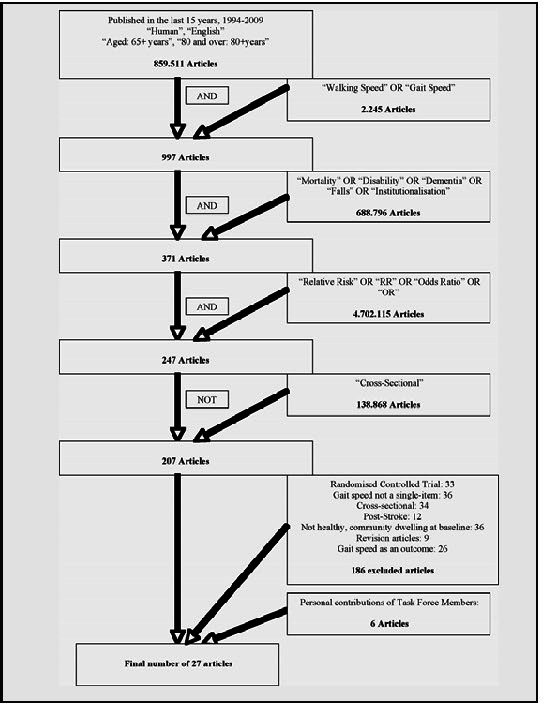
- Systematic literature review using Medline from January 1994 to March 2009, with MeSH terms including “Walking Speed” and “Gait Speed,” yielding 207 articles before final selection of 27 articles.
- Inclusion required usual-pace gait speed assessed as a single-item tool over a short distance, autonomous community-dwelling older participants at baseline, and longitudinal assessment of adverse outcomes (disability, cognitive impairment, institutionalisation, falls, and/or mortality).
- Abstracts were independently evaluated by two reviewers using the STROBE checklist; findings were discussed and revised by an international expert panel at a 2-day meeting in Toulouse, France on March 12–13, 2009.
Limitations
- The paper states that more specific surveys are needed, and that most cohort studies assessed community-dwelling well-functioning older people, so identified cutpoints may differ from frail older people seen in clinical practice.
- The paper notes that many cutpoints are based on tertiles or quartiles used for statistical analyses and may not be easy to remember for clinical practice; the Health ABC cohort’s well-functioning inclusion also limits generalisation of its cutpoints.
- Evident from the text: this is a narrative expert-panel review of 27 selected articles rather than a meta-analysis, and some recommendations, such as using gait speed as an inclusion/exclusion criterion in trials, were explicitly described as not soundly based on existing literature.
Model-written summary. Check it against the paper before relying on it.
Integrity signals
Registry
Cites
Statistics
Figures
Verification
Claims the paper makes
9 Valid · 1 Not valid · 37 Not checked · 21 Own results and interpretations
Every source the paper cites for this claim was checked and supports it.
In the paper
“participants in the lowest quartile (<1.05 ms-1) were more likely to decline in DSST with an Odds Ratio, OR of 1.74 (95% CI 1.21-2.51)”
§ Gait speed at usual pace as a predictor of adverse outcomes in community-dwelling older people an International Academy on Nutrition and Aging (IANA) Task Force > Results: Gait speed as a predictor of adverse outcomes > Gait speed as a predictor of cognitive decline (Table 2)
What the sources say
- Supportedcites [30] Inzitari M. Newman A.B. Yaffe K. Gait speed predicts decline in attention and psychomotor speed in older adults: The Health Aging and Body Composition Study Neuroepidemiology 29 2007 156 162 10.1159/000111577 PubMed PMID: 18042999 18042999 PMC2824580 source
The Results report that, compared with the highest gait-speed quartile, participants in the lowest quartile (<1.05 m/s) had greater odds of DSST decline over five years (OR 1.74, 95% CI 1.21–2.51). This matches the attributed claim. (LLM, conf=0.95)
plainstates an associationn = 2,776- Asserted: passes — The authors put it forward as true.
- Checkable: passes — It can be checked against evidence.
- Load-bearing: passes — The paper’s conclusions depend on it.
- Based: passes — The paper gives a reason why it holds.
- Supported
The cited sources support only part of this claim — read each source’s verdict below.
In the paper
“Gait speed was an independent predictor of falls with a RR of 5.4 (2-14.3)”
§ Gait speed at usual pace as a predictor of adverse outcomes in community-dwelling older people an International Academy on Nutrition and Aging (IANA) Task Force > Results: Gait speed as a predictor of adverse outcomes > Gait speed as a predictor of falls (Table 4)
What the sources say
- Partly supportedcites [43] Montero-Odasso M. Schapira M. Soriano E.R. Gait velocity as a single predictor of adverse events in healthy senior aged 75 years and older J Gerontol Med Sci 60 10 2005 1304 1309 16282564 sourceExperimental — accuracy not yet measured
The Results (p. 3) report an RR of 5.4 (95% CI, 2.0–14.3) for low gait velocity and new falls, but that estimate is from the univariate analysis. The association remained significant after multivariate adjustment, where the reported measure was an OR of 10.9 (95% CI, 2.0–57.9). Thus, the claim combines the unadjusted RR with the independent-predictor finding. (LLM, conf=0.91)
plainstates an associationn = 102- Asserted: passes — The authors put it forward as true.
- Checkable: passes — It can be checked against evidence.
- Load-bearing: unclear — It is unclear whether the paper’s conclusions depend on it.
- Based: passes — The paper gives a reason why it holds.
- Partly supported
Every source the paper cites for this claim was checked and supports it.
In the paper
“Compared to the fastest quartile, the participants who were unable to perform the task raised their risk of death to an OR of 7.47 (95% CI 3.83-14.55).”
§ Gait speed at usual pace as a predictor of adverse outcomes in community-dwelling older people an International Academy on Nutrition and Aging (IANA) Task Force > Results: Gait speed as a predictor of adverse outcomes > Gait speed as a predictor of cognitive decline (Table 2)
What the sources say
- Supportedcites [39] Markides K.S. Black S.A. Ostir G.V. Lower body function and mortality in Mexican American elderly people J Gerontol Biol Sci Med Sci 56 2001 243 247 11283198 source
The Measures section identifies the task as a timed 8-foot walk and scores the fastest quartile as 4 and those unable to complete it as 0. Results, Table 3, reports a mortality odds ratio of 7.47 (95% CI 3.83–14.55) for short-walk score 0 versus score 4 in Model 4. (LLM, conf=0.95)
plainstates an association- Asserted: passes — The authors put it forward as true.
- Checkable: passes — It can be checked against evidence.
- Load-bearing: unclear — It is unclear whether the paper’s conclusions depend on it.
- Based: passes — The paper gives a reason why it holds.
- Supported
The cited sources support only part of this claim — read each source’s verdict below.
In the paper
“Gait speed over 1 ms-1 presented a Hazard Ratio, HR of 0.88 (95% CI 0.81-0.97) in predicting incident disability”
§ Gait speed at usual pace as a predictor of adverse outcomes in community-dwelling older people an International Academy on Nutrition and Aging (IANA) Task Force > Results: Gait speed as a predictor of adverse outcomes > Gait speed as a predictor of mobility disability (Table 1)
What the sources say
- Partly supportedcites [21] Rosano C. Newman A.B. Katz R. Association between lower digit symbol substitution test score and slower gait and greater risk of mortality and of developing incident disability in well-functioning older adults J Am Geriatr Soc 56 2008 1618 1625 10.1111/j.1532-5415.2008.01856.x PubMed PMID: 18691275 18691275 PMC2631090 sourceExperimental — accuracy not yet measured
The Methods (Gait Speed; page unavailable) use 1.0 m/s as a gait-speed threshold, and the Discussion (page unavailable) reports that gait speed was associated with incident disability in the Cardiovascular Health Study participants analyzed. The retrieved Results and other passages do not report the claimed hazard ratio of 0.88 or its 95% confidence interval of 0.81–0.97, so the numerical claim is not supported by our copy. (LLM, conf=0.84)
plainstates an association- Asserted: passes — The authors put it forward as true.
- Checkable: passes — It can be checked against evidence.
- Load-bearing: passes — The paper’s conclusions depend on it.
- Based: passes — The paper gives a reason why it holds.
- Partly supported
The sources with a verdict support this claim; the rest weren’t checked yet, have no full text we could read, or their verdicts aren’t rated yet.
In the paper
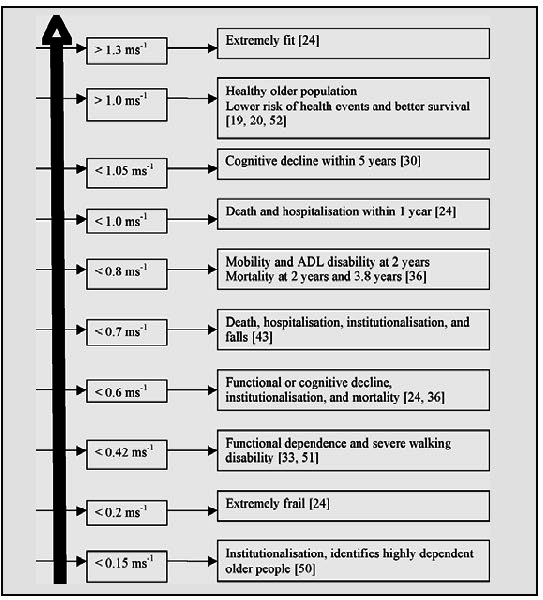
“The 1.0 ms-1 cutpoint was used to predict mortality (19, 20)”
§ Gait speed at usual pace as a predictor of adverse outcomes in community-dwelling older people an International Academy on Nutrition and Aging (IANA) Task Force > Results: Gait speed as a single-item tool > Distance and cut-points reported in literature for a single-item tool (Figure 2)
What the sources say
- Not checked yetcites [19] Cesari M. Kritchevsky S.B. Penninx B.W.H.J. Pronostic value of usual gait speed in well-functioning older people. Results from the Health, Aging and Body Composition Study J Am Geriatr Soc 53 2005 1675 1680 10.1111/j.1532-5415.2005.53501.x PubMed PMID: 16181165 16181165 source
- Supportedcites [20] Cesari M. Kritchevsky S.B. Newman A.B. Added value of physical performance measures in predicting adverse health-related events: results from the Health, Aging and Body Composition Study J Am Geriatr Soc 57 2009 251 259 10.1111/j.1532-5415.2008.02126.x PubMed PMID: 19207142 19207142 PMC2695653 source
The Methods section says the study used the 1 m/sec gait-speed cutpoint to classify participants into high- and low-risk groups. The Results section reports that the resulting high-risk gait-speed group was more likely to experience death, so the cutpoint was used to predict mortality. (LLM, conf=0.93)
plainstates an association- Asserted: passes — The authors put it forward as true.
- Checkable: passes — It can be checked against evidence.
- Load-bearing: unclear — It is unclear whether the paper’s conclusions depend on it.
- Based: passes — The paper gives a reason why it holds.
32 more claims · 1 with their cited sources checked
Create a free account to see all 68 claims and to verify the 52 references still open.
- The quote only partly states this claim. 2
- It may state two separate claims as one. 18
- Probably not a substantial claim. 14
Claims other papers make about this one
Each is checked against this paper’s own text: does it say what the citing paper says it does?
In the citing paper
“Slowing gait may reflect both damaged systems and a high-energy cost of walking.13,39–54”
From Gait speed and survival in older adults. (2011) · cites this paper as [13]
In the citing paper
“Others propose one cutoff around 0.8 m/s.13”
From Gait speed and survival in older adults. (2011) · cites this paper as [13]
In the citing paper
“Gait speed has been widely used as a single measure of frailty and is supported by a robust body of literature demonstrating its prognostic importance across a wide range of patient populations and performance levels.85”
In the citing paper
“Gait speed has also been demonstrated to be a consistent risk factor for disability, cognitive impairment, institutionalization, falls, and postoperative outcomes.85”
In the citing paper
“Accumulating evidence indicates slow walking speed (<1 m/sec indicating a high risk and < 0.8 m/sec indicating a very high risk), as well as reductions in walking speed, strongly predict functional decline, major health outcomes, and mortality in older adults.”
From Successful aging: Advancing the science of physical independence in older adults (2015) · cites this paper as Abellan Van, Rolland, Andrieu, Bauer, Beauchet, Bonnefoy, Cesari, Donini, Gillette, Inzitari, Nourhashemi, Onder, Ritz, Salva, Visser, and Vellas 2009
1 more claim about this paper
Create a free account to see every claim other papers make about this one.
Self-check
Percentages, sums and reported differences re-computed from the paper’s own numbers.
Each contradiction between two passages listed here was confirmed by an independent check.
Rated minor: it would not touch a result — a value no result rests on, a p-value that stays on the same side of the significance level, or a conflict that is clerical, resolved elsewhere in the paper, or outside its own findings.
In the paper
“After 5 years, of the assessed 2776 baseline participants, 389 (17.1%) declined in DSST.”
§ Gait speed at usual pace as a predictor of adverse outcomes in community-dwelling older people an International Academy on Nutrition and Aging (IANA) Task Force > Results: Gait speed as a predictor of adverse outcomes > Gait speed as a predictor of cognitive decline (Table 2)
Reported 17.1 · recomputed 14.012968
Rated minor: it would not touch a result — a value no result rests on, a p-value that stays on the same side of the significance level, or a conflict that is clerical, resolved elsewhere in the paper, or outside its own findings.
In the paper
§ Gait speed at usual pace as a predictor of adverse outcomes in community-dwelling older people an International Academy on Nutrition and Aging (IANA) Task Force > Results: Gait speed as a predictor of adverse outcomes > Gait speed as a predictor of cognitive decline (Table 2)
“| | Follow-up 6 years | | |”
§ Gait speed at usual pace as a predictor of adverse outcomes in community-dwelling older people an International Academy on Nutrition and Aging (IANA) Task Force > Results: Gait speed as a predictor of adverse outcomes > Gait speed as a predictor of cognitive decline (Table 2)
“In a prospective cohort study of 2288 persons, 65 years and older without dementia with a mean follow-up of 9 years, 319 participants developed dementia.”
Rated minor: it would not touch a result — a value no result rests on, a p-value that stays on the same side of the significance level, or a conflict that is clerical, resolved elsewhere in the paper, or outside its own findings.
In the paper
§ Gait speed at usual pace as a predictor of adverse outcomes in community-dwelling older people an International Academy on Nutrition and Aging (IANA) Task Force > Results: Gait speed as a single-item tool > Distance and cut-points reported in literature for a single-item tool (Figure 2)
“The walking distance used in the selected articles was found to be between 2.44 meters (8 feet) and 6 meters”
§ Gait speed at usual pace as a predictor of adverse outcomes in community-dwelling older people an International Academy on Nutrition and Aging (IANA) Task Force > Results: Gait speed as a predictor of adverse outcomes > Gait speed as a predictor of falls (Table 4)
“| Estudio de Evaluación | N= 102 | 10 meter walk | Gait speed was an independent predictor of falls with a RR of 5.4 (2-14.3) |”
Rated minor: it would not touch a result — a value no result rests on, a p-value that stays on the same side of the significance level, or a conflict that is clerical, resolved elsewhere in the paper, or outside its own findings.
In the paper
§ Gait speed at usual pace as a predictor of adverse outcomes in community-dwelling older people an International Academy on Nutrition and Aging (IANA) Task Force > Results: Gait speed as a predictor of adverse outcomes > Gait speed as a predictor of mobility disability (Table 1)
“| | Free from disability, cognitively intact | 15-foot walk | Incident ADL disability HR 0.88 (0.80-0.96) |”
§ Gait speed at usual pace as a predictor of adverse outcomes in community-dwelling older people an International Academy on Nutrition and Aging (IANA) Task Force > Results: Gait speed as a predictor of adverse outcomes > Gait speed as a predictor of mobility disability (Table 1)
“Gait speed over 1 ms-1 presented a Hazard Ratio, HR of 0.88 (95% CI 0.81-0.97) in predicting incident disability”
Rated minor: it would not touch a result — a value no result rests on, a p-value that stays on the same side of the significance level, or a conflict that is clerical, resolved elsewhere in the paper, or outside its own findings.
In the paper
§ Gait speed at usual pace as a predictor of adverse outcomes in community-dwelling older people an International Academy on Nutrition and Aging (IANA) Task Force > Methods
“The assessment of gait speed had to be performed over a short distance (long distance assessment instruments were excluded from the present review)”
§ Gait speed at usual pace as a predictor of adverse outcomes in community-dwelling older people an International Academy on Nutrition and Aging (IANA) Task Force > Results: Gait speed as a predictor of adverse outcomes > Gait speed as a predictor of mobility disability (Table 1)
“| Health ABC study (25) | N=3056 | LDCW 400 meter walk | New mobility limitations |”
2 more findings
Create a free account to see every finding of this check.
Citations
Cites
von Elm, E., Altman, D. G., Egger, M., Pocock, S. J., Gøtzsche, P. C., Vandenbroucke, J. P., & Initiative, F. T. S. (2007) · PLoS Medicine · doi:10.1371/journal.pmed.0040296 · Cited by 23,020
von Elm, E., Altman, D. G., Egger, M., Pocock, S. J., Gøtzsche, P. C., & Vandenbroucke, J. P. (2008) · Journal of Clinical Epidemiology · doi:10.1016/j.jclinepi.2007.11.008 · Cited by 17,893
von Elm, E., Altman, D. G., Egger, M., Pocock, S. J., Gøtzsche, P. C., Vandenbroucke, J. P., & Initiative, F. T. S. (2007) · Annals of Internal Medicine · doi:10.7326/0003-4819-147-8-200710160-00010 · Cited by 17,796
Lower-extremity function in persons over the age of 70 years as a predictor of subsequent disability
Guralnik, J. M., Ferrucci, L., Simonsick, E. M., Salive, M. E., & Wallace, R. B. (1995) · New England Journal of Medicine · doi:10.1056/nejm199503023320902 · Cited by 4,083
Guralnik, J. M., Ferrucci, L., Pieper, C. F., Leveille, S. G., Markides, K. S., Ostir, G. V., Studenski, S., Berkman, L. F., & Wallace, R. B. (2000) · The Journals of Gerontology Series A: Biological Sciences and Medical Sciences · doi:10.1093/gerona/55.4.m221 · Cited by 2,898 · cited 5×
“18) in between the curves when predicting ADL disability at 4 years of follow-up (3).”
Influentialvon Elm, E., Altman, D. G., Egger, M., Pocock, S. J., Gøtzsche, P. C., & Vandenbroucke, J. P. (2007) · Preventive Medicine · doi:10.1016/j.ypmed.2007.08.012 · Cited by 2,698
Comfortable and maximum walking speed of adults aged 20—79 years: reference values and determinants
BOHANNON, R. W. (1997) · Age and Ageing · doi:10.1093/ageing/26.1.15 · Cited by 2,341
Physical performance measures in the clinical setting
Studenski, S., Perera, S., Wallace, D., Chandler, J. M., Duncan, P. W., Rooney, E., Fox, M., & Guralnik, J. M. (2003) · Journal of the American Geriatrics Society · doi:10.1046/j.1532-5415.2003.51104.x · Cited by 1,218 · cited 7×
“2 ms-1 organisation, HMO, and > 65 years Fast walkers >1 ms-1 increase Veterans Affairs, VA (24) Cognitively intact No mobility disability 1-year follow-up Hong Kong Chinese cohort N=2032 16-feet walk Institutionalisation”
InfluentialCesari, M., Kritchevsky, S. B., Penninx, B. W. H. J., Nicklas, B. J., Simonsick, E. M., Newman, A. B., Tylavsky, F. A., Brach, J. S., Satterfield, S., Bauer, D. C., et al. (2005) · Journal of the American Geriatrics Society · doi:10.1111/j.1532-5415.2005.53501.x · Cited by 1,192
Self-citationThe I.A.N.A. task force on frailty assessment of older people in clinical practice
Van Kan, G. A., Rolland, Y., Bergman, H., Morley, J. E., Kritchevsky, S. B., & Vellas, B. (2008) · The Journal of nutrition, health and aging · doi:10.1007/bf02982161 · Cited by 1,099
Self-citation
Cited by
Items 601–700 of 1,005
Antidepressants are Independently Associated with Gait Deficits in Single and Dual Task Conditions
Donoghue, O. A., O’Hare, C., King‐Kallimanis, B. L., & Kenny, R. A. (2014) · American Journal of Geriatric Psychiatry · doi:10.1016/j.jagp.2014.04.005 · Cited by 35
“Slow gait speed during normal walking is a risk factor for many adverse outcomes including falls, cognitive decline, hospitalization and mortality (27, 28).”
BackgroundJotheeswaran, A. T., Dias, A., Philp, I., Beard, J., Patel, V., & Prince, M. J. (2015) · BMC Geriatrics · doi:10.1186/s12877-015-0121-1 · Cited by 35
Perrochon, A., Tchalla, A. E., Bonis, J., Perucaud, F., & Mandigout, S. (2015) · Dementia and Geriatric Cognitive Disorders Extra · doi:10.1159/000435772 · Cited by 36
Wang, C., Lin, Y.-H., Chen, T.-R., Liu, M.-H., & Chen, Y. (2012) · Perceptual and Motor Skills · doi:10.2466/10.25.26.pms.114.2.469-478 · Cited by 34
Serum uric acid concentrations and risk of frailty in older adults
García‐Esquinas, E., Guallar‐Castillón, P., Carnicero, J. A. C., Soto, A. B., García‐García, F. J., Rodríguez‐Mañas, L., & Rodríguez‐Artalejo, F. (2016) · Experimental Gerontology · doi:10.1016/j.exger.2016.07.002 · Cited by 34
Zhang, T., Brinkley, T. E., Liu, K., Feng, X., Marsh, A. P., Kritchevsky, S. B., Zhou, X., & Nicklas, B. J. (2017) · Aging · doi:10.18632/aging.101199 · Cited by 34
“Among those physical function measurements, gait speed has been reported to be a useful predictor of adverse outcomes, including incident mobility disability and mortality in older adults [3-6].”
Beauchet, O., Sekhon, H., Launay, C. P., Rolland, Y., Schott, A., & Allali, G. (2019) · European Journal of Neurology · doi:10.1111/ene.14093 · Cited by 35
Self-citationIn-Home Floor Based Sensor System-Smart Carpet- to Facilitate Healthy Aging in Place (AIP)
Muheidat, F., & Tawalbeh, L. (2020) · IEEE Access · doi:10.1109/access.2020.3027535 · Cited by 35
Zhao, W., Ukawa, S., Tsushita, K., Kawamura, T., Wakai, K., Ando, M., & Tamakoshi, A. (2014) · Age and Ageing · doi:10.1093/ageing/afu121 · Cited by 34
Connell, N., Grevendonk, L., Fealy, C., Moonen-Kornips, E., Bruls, Y., Schrauwen-Hinderling, V., de Vogel, J., Hageman, R., Geurts, J., Zapata-Perez, R., et al. (2021) · The Journal of Nutrition · doi:10.1093/jn/nxab193 · Cited by 33
Fougère, B., Vellas, B. J., van Kan, G. A., & Cesari, M. (2015) · Translational Neuroscience · doi:10.1515/tnsci-2015-0009 · Cited by 33
Self-citationRetractedThe nature of functional variability in plantar pressure during a range of controlled walking speeds
McClymont, J. M., Pataky, T. C., Crompton, R. H., Savage, R., & Bates, K. T. (2016) · Royal Society Open Science · doi:10.1098/rsos.160369 · Cited by 33
Coelho‐Júnior, H. J., Calvani, R., Gonçalves, I. O., Rodrigues, B., Picca, A., Landi, F., Bernabei, R., Uchida, M. C., & Marzetti, E. (2019) · Aging Clinical and Experimental Research · doi:10.1007/s40520-019-01216-4 · Cited by 34
Tam, K., Wong‐Pack, M., Liu, T., Adachi, J. D., Lau, A. N., Ma, J., Παπαϊωάννου, Α., & Rodrigues, I. B. (2023) · JCR Journal of Clinical Rheumatology · doi:10.1097/rhu.0000000000001980 · Cited by 34
Dulohery, M. M., Benzo, R., & Schroeder, D. R. (2015) · International Journal of COPD · doi:10.2147/copd.s88035 · Cited by 33
“8 m/s has been associated with frailty.(16) The 4 m gait speed was measured at the patient’s usual pace in an unobstructed clinic hallway.”
BackgroundBlackwood, J., Shubert, T. E., Fogarty, K. J., & Chase, C. A. (2015) · The journal of nutrition health & aging · doi:10.1007/s12603-015-0598-5 · Cited by 33
Atrial Fibrillation Is Associated With Impaired Mobility in Community-Dwelling Older Adults
Donoghue, O. A., Jansen, S., Dooley, C., de Rooij, S. E., van der Velde, N., & Kenny, R. A. (2014) · Journal of the American Medical Directors Association · doi:10.1016/j.jamda.2014.08.005 · Cited by 33
Chung, J., Demiris, G., Thompson, H. J., Chen, K., Burr, R. L., Patel, S., & Fogarty, J. A. (2016) · International Journal of Older People Nursing · doi:10.1111/opn.12127 · Cited by 33
Takahashi, P., Quigg, S., Croghan, I., Schroeder, D., & Ebbert, J. (2016) · Clinical Interventions in Aging · doi:10.2147/cia.s107626 · Cited by 31
Barbat‐Artigas, S., Carvalho, L. P., Rolland, Y., Vellas, B. J., & Aubertin‐Leheudre, M. (2016) · Journal of the American Medical Directors Association · doi:10.1016/j.jamda.2016.06.026 · Cited by 34
Self-citationThe complex genetics of gait speed: genome-wide meta-analysis approach
Ben-Avraham, D., Karasik, D., Verghese, J., Lunetta, K. L., Smith, J. A., Eicher, J. D., Vered, R., Deelen, J., Arnold, A. M., Buchman, A. S., et al. (2017) · Aging · doi:10.18632/aging.101151 · Cited by 33
“Slow gait speed is a consistent risk factor for disability, cognitive impairment, institutionalization, falls, hospitalization and mortality [8-10].”
BackgroundZhong, R., Rau, P. P., & Yan, X. (2018) · Geriatrics and gerontology international/Geriatrics & gerontology international · doi:10.1111/ggi.13492 · Cited by 33
Hvid, L. G., Feys, P., Baert, I., Kalron, A., & Dalgas, U. (2020) · Neurorehabilitation and neural repair · doi:10.1177/1545968320907074 · Cited by 33
Effect of Treadmill Training on Specific Gait Parameters in Older Adults With Frailty: Case Series
Oh‐Park, M., Holtzer, R., Mahoney, J. R., Wang, C., & Verghese, J. (2011) · Journal of Geriatric Physical Therapy · doi:10.1519/jpt.0b013e3182193165 · Cited by 33
Combined effects of mild cognitive impairment and slow gait on risk of dementia
Doi, T., Makizako, H., Tsutsumimoto, K., Hotta, R., Nakakubo, S., Makino, K., Suzuki, T., & Shimada, H. (2018) · Experimental Gerontology · doi:10.1016/j.exger.2018.06.002 · Cited by 32
Adam, C. E., Fitzpatrick, A. L., Leary, C. S., Hajat, A., Phelan, E. A., Park, C., & Semmens, E. O. (2021) · International Journal of Environmental Research and Public Health · doi:10.3390/ijerph18073712 · Cited by 32
“Numerous studies have demonstrated an association between slower gait speed and increased fall risk in the general population of older adults [4,10,11].”
BackgroundRoss, D., Wagshul, M. E., İzzetoğlu, M., & Holtzer, R. (2021) · GeroScience · doi:10.1007/s11357-021-00379-1 · Cited by 32
Standardized Gait Speed Ratio in Elderly Patients with Heart Failure
Ozawa, T., Yamashita, M., Seino, S., Kamiya, K., Kagiyama, N., Konishi, M., Saito, H., Saito, K., Ogasahara, Y., Maekawa, E., et al. (2021) · ESC Heart Failure · doi:10.1002/ehf2.13392 · Cited by 34
“Gait speed, a metric of slowness, is considered a valid measure of frailty and is associated with functional status and mortality in the general population.(3,4) Furthermore, as frailty plays a crucial prognostic role in heart failure, gait speed has also been shown to be associated with the prognosis in numerous stud…”
BackgroundVive, S., Elam, C., & Käll, L. B. (2021) · Journal of Stroke and Cerebrovascular Diseases · doi:10.1016/j.jstrokecerebrovasdis.2021.106023 · Cited by 33
Online physical exercise intervention in older adults during lockdown: Can we improve the recipe?
Granet, J., Peyrusqué, É., Ruiz, F., Buckinx, F., Abdelkader, L. B., Dang-Vu, T., Sirois, M., Gouin, J.-P., Pageaux, B., & Aubertin‐Leheudre, M. (2023) · Aging Clinical and Experimental Research · doi:10.1007/s40520-022-02329-z · Cited by 34
Considerations in the Development of Drugs to Treat Sarcopenia
Brass, E. P., & Sietsema, K. E. (2011) · Journal of the American Geriatrics Society · doi:10.1111/j.1532-5415.2010.03285.x · Cited by 31
Gait speed and one-leg standing time each add to the predictive ability of FRAX
Lundin, H. R., Sääf, M., Strender, L., Nyrén, S., Johansson, S.-E., & Salminen, H. (2016) · Osteoporosis International · doi:10.1007/s00198-016-3818-x · Cited by 32
“The effect on fracture risk is probably mediated by an increased fall risk since slow gait speed has been associated with an increased fall risk in other studies [10, 14, 15].”
BackgroundHvid, L. G., Nielsen, M. K. F., Simonsen, C., Andersen, M., & Caserotti, P. (2017) · Experimental Gerontology · doi:10.1016/j.exger.2017.03.019 · Cited by 32
O’Connell, M. D. L., Savva, G. M., Finucane, C., Romero‐Ortuño, R., Fan, C. W., & Kenny, R. A. (2018) · Journal of the American Geriatrics Society · doi:10.1111/jgs.15327 · Cited by 32
“Slower gait is strongly related to subsequent health outcomes in older adults and has been suggested as a measure of frailty in its own right.(33,34) The lack of consistent association with the other criteria indirectly suggests that slow gait may be a more useful measure of physiological frailty than the frailty phen…”
BackgroundEffects of Mobility and Multimorbidity on Inpatient and Postacute Health Care Utilization
Ensrud, K. E., Lui, L., Langsetmo, L., Vo, T., Taylor, B. C., Cawthon, P. M., Kilgore, M. L., McCulloch, C. E., Cauley, J. A., Stefanick, M. L., et al. (2017) · The Journals of Gerontology Series A · doi:10.1093/gerona/glx128 · Cited by 33
Association Between Visual Field Damage and Gait Dysfunction in Patients With Glaucoma
Jian‐Yu, E., Mihailović, A., Garzón, C., Schrack, J. A., Li, T., West, S. K., Gitlin, L. N., Friedman, D. S., & Ramulu, P. Y. (2021) · JAMA Ophthalmology · doi:10.1001/jamaophthalmol.2021.2617 · Cited by 32
Venugobal, S., Tai, Y. K., Goh, J., Teh, S. W., Wong, C. J. K., Goh, I., Maier, A. B., Kennedy, B. K., & Franco‐Obregón, A. (2023) · Aging · doi:10.18632/aging.204597 · Cited by 31
“8 m/s indicative of safety from physical failing reported for the TUG [29], 5xSTS [30], and 4mNGS [31], respectively.”
BackgroundCheng, X., Chen, W., Yan, J., Yang, Z., Li, C., Wu, D., Wang, T., Zhang, Y., & Zhu, Y. (2023) · International Journal of Surgery · doi:10.1097/js9.0000000000000497 · Cited by 31
Gait and cognition in older adults: Insights from the Bronx and Kerala
Ambrose, A. F., Noone, M., Pradeep, V., Johnson, B. B., Salam, K., & Verghese, J. (2010) · Annals of Indian Academy of Neurology · doi:10.4103/0972-2327.74253 · Cited by 32
“We select eight gait parameters to report based on their associations with adverse health outcomes such as dementia and falls reported in our and other studies;[11,14-16] velocity (cm/s), cadence (steps/min), stride length (cm), swing time (s), stance time (s), and double support phase (%).”
Walking speed and high blood pressure mortality risk in a Spanish elderly population
Gutiérrez-Misis, A., Sanchez-Santos, M. T., Banegas, J. R., Castell, M. V., González-Montalvo, J. I., & Otero, Á. (2015) · Journal of Human Hypertension · doi:10.1038/jhh.2015.32 · Cited by 31
Moreira, B. S., Sampaio, R. F., & Kirkwood, R. N. (2015) · Brazilian Journal of Physical Therapy · doi:10.1590/bjpt-rbf.2014.0067 · Cited by 34
Vancampfort, D., Stubbs, B., Veronese, N., Mugisha, J., Swinnen, N., & Koyanagi, A. (2017) · International Journal of Geriatric Psychiatry · doi:10.1002/gps.4796 · Cited by 32
“Slow gait was defined as a gait speed of ≤1 m/second.(41) Weak handgrip was defined as <30 kg for men and <20 kg for women using the average value of the 2 handgrip measurements of the dominant hand.”
MethodCharlon, Y., Campo, É., & Brulin, D. (2017) · Expert Systems with Applications · doi:10.1016/j.eswa.2017.11.024 · Cited by 32
“…of the relationship between gait speed at usual pace and risk of adverse events, and because of the amount of change for a 0.1 m/s variation (Abellan van Kan et al, 2009), we are seeking 0.1 m/s accuracy (accuracy greater than 95% for 1 m/s), which is not provided by commercial devices and…”
InfluentialVascular and dopaminergic contributors to mild parkinsonian signs in older adults
Rosso, A. L., Bohnen, N. I., Launer, L. J., Aizenstein, H. J., Yaffe, K. S., & Rosano, C. (2017) · Neurology · doi:10.1212/wnl.0000000000004842 · Cited by 31
Young, A., Mudge, A., Banks, M., Rogers, L., Demedio, K., & Isenring, E. A. (2018) · Nutrition & Dietetics · doi:10.1111/1747-0080.12408 · Cited by 32
Lee, A. S. Y., Bhatt, T. S., Smith-Ray, R. L., Wang, E., & Pai, Y. (2018) · Journal of Geriatric Physical Therapy · doi:10.1519/jpt.0000000000000171 · Cited by 31
Effect of Hospitalizations on Physical Activity Patterns in Mobility‐Limited Older Adults
Wanigatunga, A. A., Gill, T. M., Marsh, A. P., Hsu, F., Yaghjyan, L., Woods, A. J., Glynn, N. W., King, A. C., Newton, R. L., Fielding, R. A., et al. (2018) · Journal of the American Geriatrics Society · doi:10.1111/jgs.15631 · Cited by 32
Buchman, A. S., Leurgans, S. E., Wang, T., Beeri, M. S., Agarwal, P., Dawe, R. J., Delbono, O., & Bennett, D. A. (2021) · PLoS ONE · doi:10.1371/journal.pone.0245680 · Cited by 31
Taraldsen, K., Polhemus, A. M., Engdal, M., Jansen, C.-P., Becker, C., Brenner, N., Blain, H., Johnsen, L. G., & Vereijken, B. (2023) · Osteoporosis International · doi:10.1007/s00198-023-06922-4 · Cited by 30
Minghetti, A., Donath, L., Zahner, L., Hanssen, H., & Faude, O. (2021) · PeerJ · doi:10.7717/peerj.11292 · Cited by 30
Baltasar‐Fernandez, I., Alcázar, J., Losa‐Reyna, J., Soto-Paniagua, H., Alegre, L. M., Takai, Y., Ruiz-Cárdenas, J. D., Signorile, J. F., Rodríguez‐Mañas, L., García‐García, F. J., et al. (2021) · Experimental Gerontology · doi:10.1016/j.exger.2021.111619 · Cited by 32
Age and walking conditions differently affect domains of gait
Hagoort, I., Vuillerme, N., Hortobágyi, T., & Lamoth, C. J. C. (2023) · Human Movement Science · doi:10.1016/j.humov.2023.103075 · Cited by 30
A systematic review on fall detection systems for elderly healthcare
Purwar, A., & Chawla, I. (2023) · Multimedia Tools and Applications · doi:10.1007/s11042-023-17190-z · Cited by 31
Buttery, S. C., Williams, P. J., Alghamdi, S. M., Philip, K. E. J., Perkins, A., Kallis, C., Quint, J. K., Polkey, M. I., Breuls, S., Buekers, J., et al. (2023) · European Respiratory Review · doi:10.1183/16000617.0134-2023 · Cited by 31
Piau, A., Charlon, Y., Campo, É., Vellas, B. J., & Nourhashémi, F. (2015) · JMIR Rehabilitation and Assistive Technologies · doi:10.2196/rehab.4084 · Cited by 30
“1-m/s variation [19], we are seeking 0.”
Self-citationPhysical Functioning in Elderly Persons With Kidney Disease
Odden, M. C. (2010) · Advances in Chronic Kidney Disease · doi:10.1053/j.ackd.2010.02.002 · Cited by 30
Predisability and gait patterns in older adults
Verghese, J., & Xue, X. (2010) · Gait & Posture · doi:10.1016/j.gaitpost.2010.10.004 · Cited by 30
“It is less likely that progression of disability may be independent of gait performance as speed and other gait measures have been shown to be predictive of disability over long term follow-up [7,31].”
Fernandes, J., Pérez‐Zepeda, M. U., Béland, F., Guralnik, J. M., Zunzunegui, M. V., & Guerra, R. O. (2016) · AGE · doi:10.1007/s11357-016-9888-z · Cited by 32
Determinants of Slow Walking Speed in Ambulatory Patients Undergoing Maintenance Hemodialysis
Abe, Y., Matsunaga, A., Matsuzawa, R., Kutsuna, T., Yamamoto, S., Yoneki, K., Harada, M., Ishikawa, R., Watanabe, T., & Yoshida, A. (2016) · PLoS ONE · doi:10.1371/journal.pone.0151037 · Cited by 30
Fernandes, J., Gomes, C. D. S., Costa, J. V., Ahmed, T., Zunzunegui, M. V., Curcio, C., Gómez, F., & Guerra, R. O. (2018) · The journal of nutrition health & aging · doi:10.1007/s12603-018-1100-y · Cited by 30
Sekhon, H., Launay, C. P., Chabot, J. ‐., Allali, G., & Beauchet, O. (2019) · Frontiers in Aging Neuroscience · doi:10.3389/fnagi.2018.00434 · Cited by 30
Self-citationIbrahim, W., Harvey‐Dunstan, T. C., & Greening, N. J. (2019) · Respirology · doi:10.1111/resp.13516 · Cited by 30
Öhlin, J., Ahlgren, A., Folkesson, R., Gustafson, Y., Littbrand, H., Olofsson, B., & Toots, A. (2020) · BMC Geriatrics · doi:10.1186/s12877-020-1433-3 · Cited by 30
“Barthel ADL Index correlated with nursing home resident (r = − 0.61), dementia (r = − 0.57), and use of walking aids (r = − 0.52) and was excluded from multivariate analyses, since the latter two were variables of interest.”
BackgroundInfluentialde Sousa, O. V., Mendes, J., & do Amaral, T. F. (2020) · American Journal of Alzheimer s Disease & Other Dementias® · doi:10.1177/1533317520907168 · Cited by 30
Physical performance and daily walking duration: associations in 1271 women and men aged 65–90 years
Rapp, K., Klenk, J., Benzinger, P., Franke, S., Denkinger, M. D., Peter, R., & ActiFE Ulm Study Group (2012) · Aging Clinical and Experimental Research · doi:10.1007/bf03654813 · Cited by 30
Deterioro cognitivo y riesgo de caída en el anciano
Herrero, Á. C., Martínez‐Velilla, N., & Renedo, F. J. A. (2011) · Revista Española de Geriatría y Gerontología · doi:10.1016/j.regg.2011.05.006 · Cited by 31
Differential changes in the spinal segmental locomotor output in Hereditary Spastic Paraplegia
Martino, G., Ivanenko, Y. P., Serrao, M., Ranavolo, A., Draicchio, F., Rinaldi, M., Casali, C., & Lacquaniti, F. (2017) · Clinical Neurophysiology · doi:10.1016/j.clinph.2017.11.028 · Cited by 29
Noh, B., Youm, C., Lee, M., & Park, H. (2020) · PeerJ · doi:10.7717/peerj.8820 · Cited by 29
“Numerous studies have obtained findings similar to our study (Van Kan et al., 2009; Cesari et al., 2005; Studenski et al., 2011).”
ResultWerner, C., Heldmann, P., Hummel, S., Bauknecht, L., Bauer, J. M., & Hauer, K. A. (2020) · Sensors · doi:10.3390/s20174866 · Cited by 31
Self-citationGoel, K., O’Leary, J., Barker, C. M., Levack, M. M., Rajagopal, V., Makkar, R., BAJWA, T. K., Kleiman, N. S., Linke, A. H.-P., Kereiakes, D. J., et al. (2020) · Journal of the American Heart Association · doi:10.1161/jaha.120.017075 · Cited by 29
Possible association of early menopause with worse physical function: a systematic review
Macêdo, P. R. D. S., Rocha, T. N., Fernandes, S. G. G., Vieira, M. C. A., Jerez‐Roig, J., & da Câmara, S. M. A. (2021) · Menopause The Journal of The North American Menopause Society · doi:10.1097/gme.0000000000001712 · Cited by 30
“measure is also widely used in the literature and can predict disability and death.(43) However, although it has been shown that women with age at menopause 55 years exhibit faster gait speed than those aged between 50 and 54, Velez et al(31) did not find worse results in those who experienced premature menopause (<40…”
MethodFrailty in people living with HIV: an update
Jones, H. T., Levett, T. J., & Barber, T. (2021) · Current Opinion in Infectious Diseases · doi:10.1097/qco.0000000000000798 · Cited by 30
Does gait speed contribute to sarcopenia case-finding in a postacute rehabilitation setting?
Sánchez‐Rodríguez, D., Marco, E., Miralles, R., Guillén-Solà, A., Vázquez‐Ibar, O., Escalada, F., & Muniesa, J. M. (2015) · Archives of Gerontology and Geriatrics · doi:10.1016/j.archger.2015.05.008 · Cited by 29
de Groot, M. H., van Campen, J. P. C. M., Kosse, N. M., de Vries, O. J., Beijnen, J. H., & Lamoth, C. J. C. (2016) · PLoS ONE · doi:10.1371/journal.pone.0149888 · Cited by 29
Self-Reported Unsteadiness Predicts Fear of Falling, Activity Restriction, Falls, and Disability
Donoghue, O. A., Setti, A., O’Leary, N., & Kenny, R. A. (2017) · Journal of the American Medical Directors Association · doi:10.1016/j.jamda.2017.01.022 · Cited by 29
Preventing cardiovascular disease in older adults: One size does not fit all
Orkaby, A. R., Onuma, O. K., Qazi, S., Gaziano, J. M., & Driver, J. A. (2018) · Cleveland Clinic Journal of Medicine · doi:10.3949/ccjm.85a.16119 · Cited by 29
“Gait speed is usually measured over a distance of 4 meters (13.1 feet), 17 and the patient is asked to walk comfortably in an unobstruct-ed, marked area.”
BackgroundInfluentialLower extremity power training improves healthy old adults’ gait biomechanics
Uematsu, A., Hortobágyi, T., Tsuchiya, K., Kadono, N., Kobayashi, H., Ogawa, T., & Suzuki, S. (2018) · Gait & Posture · doi:10.1016/j.gaitpost.2018.03.036 · Cited by 29
Wearable Biofeedback System to Induce Desired Walking Speed in Overground Gait Training
Zhang, H., Yin, Y., Chen, Z., Zhang, Y., Rao, A. K., Guo, Y. P., & Zanotto, D. (2020) · Sensors · doi:10.3390/s20144002 · Cited by 29
Peper, C. E., de Dreu, M. J., & Roerdink, M. (2015) · Gait & Posture · doi:10.1016/j.gaitpost.2015.02.016 · Cited by 31
Using Walking Speed in Clinical Practice: Interpreting Age-, Gender-, and Function-Specific Norms
Lusardi, M. M. (2012) · Topics in Geriatric Rehabilitation · doi:10.1097/tgr.0b013e31823d7b9f · Cited by 31
Subgroups associated with lower physical fitness in older adults with ID: Results of the HA-ID study
Hilgenkamp, T. I. M., van Wijck, R., & Evenhuis, H. M. (2013) · Research in Developmental Disabilities · doi:10.1016/j.ridd.2013.11.015 · Cited by 29
“Balance was measured with the Berg balance scale (BBS) (Berg, WoodDauphinee, Williams, & Maki, 1992), and with measuring comfortable (WSC) and fast walking speed (WSF) (Abellan van Kan et al., 2009; Bohannon & Williams Andrews, 2011; Connelly, Stevenson, & Vandervoort, 1996).”
MethodKuhman, D. J., Willson, J. D., Mizelle, J. C., & DeVita, P. (2018) · Journal of Biomechanics · doi:10.1016/j.jbiomech.2018.01.006 · Cited by 29
Spatiotemporal and variability gait data in community-dwelling elderly women from Brazil
Kirkwood, R. N., Gomes, H. A., Sampaio, R. F., Furtado, S. R. C., & Moreira, B. S. (2016) · Brazilian Journal of Physical Therapy · doi:10.1590/bjpt-rbf.2014.0157 · Cited by 28
“There was a significant effect on groups for the primary outcomes of the components rhythm, variability, and support (F(10, 292) = 3.”
BackgroundCesari, M. (2012) · The Journal of Frailty & Aging · doi:10.14283/jfa.2012.1 · Cited by 28
Self-citationPetersen, C. L., Christensen, B. C., & Batsis, J. A. (2021) · Clinical Epigenetics · doi:10.1186/s13148-021-01031-7 · Cited by 29
Andersen, A. L., Houlind, M. B., Nielsen, R. L., Jørgensen, L. M., Treldal, C., Damgaard, M., Bengaard, A. K., Juul‐Larsen, H. G., Laursen, L. B., Iversen, E., et al. (2021) · Trials · doi:10.1186/s13063-021-05456-6 · Cited by 28
Age affects the relationships between kinematics and postural stability during gait
Macie, A., Matson, T., & Schinkel-Ivy, A. (2023) · Gait & Posture · doi:10.1016/j.gaitpost.2023.03.004 · Cited by 28
Ensrud, K. E., Schousboe, J. T., Kats, A. M., Taylor, B. C., Boyd, C. M., & Langsetmo, L. (2023) · Annals of Internal Medicine · doi:10.7326/m22-2626 · Cited by 28
Omega-3 polyunsatured fatty acids and physical performance across the lifespan: a narrative review
Azzolino, D., Bertoni, C., Cosmi, V. D., Spolidoro, G. C. I., Agostoni, C. V., Lucchi, T. A., & Mazzocchi, A. (2024) · Frontiers in Nutrition · doi:10.3389/fnut.2024.1414132 · Cited by 28
Britton, H. (2017) · British Journal of Community Nursing · doi:10.12968/bjcn.2017.22.9.440 · Cited by 29
Ortiz, P. J., Tello, T., Aliaga, E., Casas, P. M., Peinado, J., Miranda, J. J., & Varela, L. F. (2017) · Geriatrics and gerontology international/Geriatrics & gerontology international · doi:10.1111/ggi.13182 · Cited by 29
The association between gait and physical fitness in adults with intellectual disabilities
Oppewal, A., & Hilgenkamp, T. I. M. (2018) · Journal of Intellectual Disability Research · doi:10.1111/jir.12484 · Cited by 29
Calle, A., Onder, G., Morandi, A., Bellelli, G., Ortolani, E., Pérez, L. M., Cervilla, M. M., Sanniti, A., Mazzanti, P., Platto, C., et al. (2018) · The journal of nutrition health & aging · doi:10.1007/s12603-018-1060-2 · Cited by 28
“BI at admission 40 (25-60) 35 (25-55) 50 (25-70) 0.”
Self-citationSocioeconomic disparities in gait speed and associated characteristics in early old age
Plouvier, S., Carton, M., Cyr, D., Sabia, S., Leclerc, A., Zins, M., & Descatha, A. (2016) · BMC Musculoskeletal Disorders · doi:10.1186/s12891-016-1033-8 · Cited by 28
Kozicka, I., & Kostka, T. (2016) · Clinical Interventions in Aging · doi:10.2147/cia.s101043 · Cited by 28
Santoni, G., Angleman, S. B., Ek, S., Heiland, E. G., Lågergren, M., Fratiglioni, L., & Welmer, A. (2018) · Age and Ageing · doi:10.1093/ageing/afy085 · Cited by 27
“We selected the cut-off points based on previous literature that have shown that physical performance (balance [25, 27], chair stands [28] and walking speed [24, 29, 30]) below these thresholds has been associated with an increased likelihood of adverse outcomes, such as injurious falls, disability, morbidity and mort…”
MethodMotor function and the probability of prodromal Parkinson's disease in older adults
Maraki, M. I., Stefanis, L., Yannakoulia, M., Kosmidis, M. H., Xiromerisiou, G., Dardiotis, E., Hadjigeorgiou, G. M., Sakka, P., Scarmeas, N., & Stamelou, M. (2019) · Movement Disorders · doi:10.1002/mds.27792 · Cited by 27
Roca, F., Lang, P. O., & Chassagne, P. (2019) · Handbook of clinical neurology · doi:10.1016/b978-0-12-804766-8.00007-8 · Cited by 27
Pérez-Sousa, M. Á., del Pozo-Cruz, J., Olivares, P. R., Cano, C. A., Izquierdo, M., & Ramírez‐Vélez, R. (2021) · International Journal of Environmental Research and Public Health · doi:10.3390/ijerph18020751 · Cited by 28
Vakula, M. N., Garcia, S. A., Holmes, S. C., & Pamukoff, D. N. (2021) · Gait & Posture · doi:10.1016/j.gaitpost.2021.12.019 · Cited by 27
Metadata
- Authors
- Abellan Van Kan, G., Rolland, Y., Andrieu, S., Bauer, J., Beauchet, O., Bonnefoy, M., Cesari, M., Donini, L. M., Gillette-Guyonnet, S., Inzitari, M., Nourhashemi, F., Onder, G., Ritz, P., Salva, A., Visser, M., & Vellas, B.
- Affiliations
- Université Toulouse III - Paul Sabatier (FR)
- Friedrich-Alexander-Universität Erlangen-Nürnberg (DE)
- Centre Hospitalier Universitaire d'Angers (FR)
- Hôpital Lyon Sud (FR)
- University of Florida (US)
- Sapienza University of Rome (IT)
- Universitat Autònoma de Barcelona (ES)
- Università Cattolica del Sacro Cuore (IT)
- Centre Hospitalier Universitaire de Toulouse (FR)
- Amsterdam Public Health (NL)
- ORCID
- Venue
- The Journal of nutrition, health and aging
- Publisher
- Elsevier BV
- Published
- 2009-12
- Volume
- 13
- Issue
- 10
- Pages
- 881-889
- ISSN
- 1279-7707 (ISSN-L)
- PMC
- PMC12878092
- OpenAlex
- W2104750100
- Semantic Scholar
- 10553b18ba60c073f881cfe6be4b7f453a2f15b0
- Cited by
- 2,003
- References
- 56
- Citations by year
- 2026: 96 · 2025: 117 · 2024: 113 · 2023: 137 · 2022: 141 · 2021: 172 · 2020: 153 · 2019: 156 · 2018: 122 · 2017: 155 · 2016: 154 · 2015: 135 · 2014: 117 · 2013: 75 · 2012: 94
- FWCI
- 5.47
- Type
- journal article
- Language
- en
- Open access
- hybrid
- doi.org
- Licence
- cc-by-nc-nd
- www.elsevier.com/tdm/userlicense/1.0/ (tdm)
- www.elsevier.com/legal/tdmrep-license (tdm)
- creativecommons.org/licenses/by-nc-nd/4.0/ (vor, 5125 d)
- Locations
- The journal of nutrition health & aging (publishedVersion, cc-by-nc-nd)
- Europe PMC (PubMed Central) (publishedVersion, cc-by-nc-nd)
- PubMed (publishedVersion)
- PubMed Central (publishedVersion, cc-by-nc-nd)
- VU Research Portal (publishedVersion)
- IRIS Research product catalog (Sapienza University of Rome) (submittedVersion)
- Data Archiving and Networked Services (DANS) (submittedVersion)
- Topics
- Health Sciences › Medicine › Geriatrics and Gerontology › Frailty in Older Adults
- Health Sciences › Health Professions › Physical Therapy, Sports Therapy and Rehabilitation › Balance, Gait, and Falls Prevention
- Health Sciences › Medicine › Physiology (medical) › Nutrition and Health in Aging
- Keywords
- walking speed, community-dwelling older adults, frailty, physical performance, adverse outcomes, disability, cognitive impairment, institutionalization, falls, mortality, risk prediction
- MeSH terms
- Activities of Daily Living, Aged, Aged, 80 and over, Aging, Cognition Disorders, Disability Evaluation, Female, Gait, Humans, Kinetics, Male, Predictive Value of Tests, Geriatric Assessment, Frail Elderly, Mobility Limitation
About these checks
Registry, retraction, Cites and statistics results are computed, not judged, with one exception: a printed reference that no index lists is read once by a model before it counts as a citation error. Claims are extracted by a model and kept only when their quote appears verbatim in the text; each cited source is then checked, with a model’s help, for whether it says what the claim relies on. Those verdicts can be wrong — read the claim’s quote and the cited source before relying on one.
The claim verdicts this report counts are experimental: their accuracy is not yet measured.
A language model drew the claims from the paper on 2026-10-05, under version 3 of the claim definition (model deepseek-v4.1-flash, prompt extract-v3).
A second model labelled each claim on 2026-10-05 (model jev-1.13-20260917, definition revision gold-guideline-v0.2).
Cited sources are checked with a language model’s help (gpt-6-sol).
Statistics and arithmetic are recomputed, not judged.
Confidence bands are shown only for fields calibrated on our annotated test set. None is calibrated yet, so no band is shown.
What counts as a claim ›How we measure confidence ›How we check this ›
Are you an author, or do you see a problem with this page? Request a review
Data sources
Bibliographic data: Semantic Scholar, OpenAlex, Crossref.
Contains information from the Semantic Scholar Academic Graph Datasets, made available under the ODC Attribution License (ODC-BY 1.0).
Semantic Scholar’s data is described in: Kinney, R., et al. (2023). The Semantic Scholar Open Data Platform. arXiv:2301.10140.
