

Online University Teaching During and After the Covid-19 Crisis: Refocusing Teacher Presence and Learning Activity
Open accessThe DOI matches its Crossref record; 71 of the 75 references it cites were found in a registry or an index; 6 of the 42 sources its claims cite were checked for support.
Abstract
The Covid-19 pandemic has raised significant challenges for the higher education community worldwide. A particular challenge has been the urgent and unexpected request for previously face-to-face university courses to be taught online. Online teaching and learning imply a certain pedagogical content knowledge (PCK), mainly related to designing and organising for better learning experiences and creating distinctive learning environments, with the help of digital technologies.
Overview
CoChat Summary
TL;DR
This article is an expert-interview piece offering pedagogical guidance for university teachers suddenly moving online during Covid-19. Its central message is that effective online teaching depends less on tools or materials alone and more on careful learning design, multiple forms of teacher presence, and continuous assessment.
Key findings
- The four experts argue that online learning should be built around carefully designed learning activities, with a mix of synchronous, asynchronous, online, and offline tasks that are clear, appropriately difficult, authentic, and accessible to students.
- They propose a tripartite teaching presence for online courses: cognitive presence, social presence, and facilitatory presence.
- Successful online learning requires students not to feel alone, and it benefits from timely feedback, peer collaboration, and student co-design/co-configuration of activities.
- The paper states that continuous assessment is needed in online learning, and suggests self-reflections, portfolios, self-paced asynchronous activities, and use of learning analytics as part of evaluation.
Methods
- Exploratory qualitative study using expert interviews administered by e-mail.
- Sample: 4 online pedagogy experts/co-authors, selected for research expertise, more than a decade of online teaching experience, and experience across different national education systems; they worked in Switzerland, Australia, Spain, and Canada.
- Main analysis: the first author organized the responses into a panel-like article, then the authors jointly revised and synthesized the material; the discussion summarizes themes under learning design, teacher presence, and assessment.
Limitations
- The paper states that all four experts came from “rich parts of the world” (Switzerland, Canada, Australia, and North of Spain), which limits the lens to a “monofocal” view of educational reality.
- The paper itself says the study used a heuristic method based on expert viewpoints and “by no means can replace rigorous, systematic research” following the scientific method.
- Evident from the text: the sample is very small (4 experts) and highly selected, so the findings are expert-opinion guidance rather than generalizable empirical results.
Model-written summary. Check it against the paper before relying on it.
Integrity signals
Registry
Cites
Statistics
Figures
Verification
Claims the paper makes
5 Valid · 0 Not valid · 32 Not checked · 24 Own results and interpretations
The sources with a verdict support this claim; the rest weren’t checked yet, have no full text we could read, or their verdicts aren’t rated yet.
In the paper
“On top of that, a significant challenge for university teachers has been their lack of the pedagogical content knowledge (PCK) (Shulman 1987) needed for teaching online (Angeli and Valanides 2005; Kali, Goodyear and Markauskaite 2011; Ching, Hsu and Baldwin 2018).”
§ Springer Nature Switzerland AG 2020 Published online: 7 July 2020 > Introduction
What the sources say
- Supportedcites Shulman 1987 matched to “Knowledge and teaching: Foundations of the new reform” (1987) source
The parenthetical (Shulman 1987) is attached to the term 'pedagogical content knowledge (PCK)' — an identification citation — while the online-teaching studies are credited to Angeli & Valanides, Kali et al. and Ching et al. Our copy (the Portuguese edition of Shulman's 1987 Harvard Educational Review article) establishes exactly that concept: the 'Categorias da base de conhecimento' section lists 'conhecimento pedagógico do conteúdo' as one of the categories of the knowledge base for teaching, 'esse amálgama especial de conteúdo e pedagogia que é o terreno exclusivo dos professores', and the 'Novas compreensões' section calls it 'a categoria que melhor distingue a compreensão de um especialista em conteúdo daquela de um pedagogo'. The paper itself says nothing about online teaching or about university teachers lacking PCK, but that part of the sentence is not attributed to this source. (LLM, conf=0.85)
- Not checked — no full text of the sourcecites Angeli and Valanides 2005 matched to “Preservice elementary teachers as information and communication technology designers: an instructional systems design model based on an expanded view of pedagogical content knowledge” (2005) source
- Could not verifycites Ching, Hsu and Baldwin 2018 matched to “Online Course Design and Development among College and University Instructors: An Analysis using Grounded Theory” (2018) sourceExperimental — accuracy not yet measured
Our copy of Baldwin, Ching & Friesen (2018) never mentions pedagogical content knowledge, PCK, Shulman, or TPACK; searches for 'pedagogical content knowledge PCK online teaching', 'TPACK technological pedagogical content knowledge', 'Shulman pedagogical content knowledge Angeli Valanides' and 'challenge lack of knowledge training online instructors pedagogy' returned only the References list and design-process passages. The paper's content is a grounded-theory account of how 14 four-year-institution instructors design online courses (Abstract; Results themes; Discussion mapping to ADDIE), and its nearest statements — that instructors 'must develop new curriculum with instructional strategies effective for online learning' (Discussion) and 'rarely use formal instructional design models' (Results) — concern design practice, not a PCK deficiency framed as a significant challenge. Nothing in our copy either states or contradicts the attributed claim. (LLM, conf=0.72)
plain- Asserted: passes — The authors put it forward as true.
- Checkable: passes — It can be checked against evidence.
- Load-bearing: passes — The paper’s conclusions depend on it.
- Based: passes — The paper gives a reason why it holds.
- Supported
The cited sources support only part of this claim — read each source’s verdict below.
In the paper
“Assessment can possibly be considered the most challenging part of the transition to distance learning for an institution used to face-to-face oral or written exam, as the control shift towards the students makes it hardly possible to ensure that students are not cheating (Munoz and Mackay 2019).”
§ Springer Nature Switzerland AG 2020 Published online: 7 July 2020 > Assessment
What the sources say
- Partly supportedcites Munoz and Mackay 2019 matched to “An online testing design choice typology towards cheating threat minimisation” (2019) sourceExperimental — accuracy not yet measured
Split into 2 atoms — 0 confirmed, 2 partially supported, 0 disputed, 0 misattributed, 0 unverifiable. Expand the claim to see per-atom verdicts.
hedgedstates a possible cause- Asserted: passes — The authors put it forward as true.
- Checkable: passes — It can be checked against evidence.
- Load-bearing: unclear — It is unclear whether the paper’s conclusions depend on it.
- Based: passes — The paper gives a reason why it holds.
- Partly supported
A result the paper reports from its own data — it cites no other source for it, so there is none to check. The quote shows it is in the paper.
In the paper
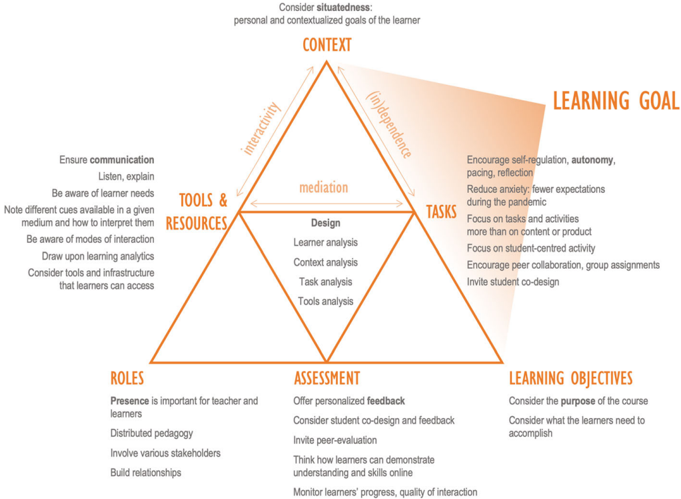
“Our findings point at the design of learning activities with certain characteristics, the combination of three types of presence (social, cognitive and facilitatory) and the need for adapting assessment to the new learning requirements.”
§ Springer Nature Switzerland AG 2020 Published online: 7 July 2020 > Abstract
plainstates an association- Asserted: passes — The authors put it forward as true.
- Checkable: passes — It can be checked against evidence.
- Load-bearing: passes — The paper’s conclusions depend on it.
- Based: passes — The paper gives a reason why it holds.
None of the sources cited for this claim have been checked yet.
In the paper
“What all four experts focus on as a prime ' piece ' of pedagogical knowledge (Kali et al. 2011) is the careful design of activities.”
§ Springer Nature Switzerland AG 2020 Published online: 7 July 2020 > Learning Design
plain- Asserted: passes — The authors put it forward as true.
- Checkable: passes — It can be checked against evidence.
- Load-bearing: unclear — It is unclear whether the paper’s conclusions depend on it.
- Based: passes — The paper gives a reason why it holds.
A result the paper reports from its own data — it cites no other source for it, so there is none to check. The quote shows it is in the paper.
In the paper
“Inspired by Anderson et al. ' s (2001) understanding of teaching presence and how it can be re-conceived in the current Covid-19 situation in which educators are the designers, the tutors and the evaluators of the learning experience, a tripartite framework emerges from the interviews, with three main sub-presences of the teaching presence, namely:”
§ Springer Nature Switzerland AG 2020 Published online: 7 July 2020 > Teacher Presence
plain- Asserted: passes — The authors put it forward as true.
- Checkable: passes — It can be checked against evidence.
- Load-bearing: passes — The paper’s conclusions depend on it.
- Based: passes — The paper gives a reason why it holds.
5 more claims
Create a free account to see all 61 claims and to verify the 9 references still open.
- Probably not a substantial claim. 50
- It may state two separate claims as one. 18
Claims other papers make about this one
Each is checked against this paper’s own text: does it say what the citing paper says it does?
The source backs part of the claim, not all of it — or backs it for a different population, condition or comparison.
In the citing paper
“while it is known that for learning success, input formats usually depend on both attention and interest from the students (Rapanta et al., 2020).”
From Impact of Synchronous and Asynchronous Settings of Online Teaching and Learning in Higher Education on Students' Learning Experience During COVID-19 (2021) · cites this paper as Rapanta et al., 2020
Experimental — accuracy not yet measuredIn the citing paper
“Evaluating AI applications could be beneficial for enhancing their motivation and interest in teaching with AI [40].”
From Developing AI Literacy for Primary and Middle School Teachers in China: Based on a Structural Equation Modeling Analysis (2022) · cites this paper as [40]
Citations
Cites
The Reflective Practitioner: How Professionals Think in Action
Checkoway, B., & Schon, D. A. (1985) · Journal of Policy Analysis and Management · doi:10.2307/3324262 · Cited by 21,268
The reflective practitioner: How professionals think in action
Stewart, C. J. (1984) · Patient Education and Counseling · doi:10.1016/0738-3991(84)90022-3 · Cited by 19,752
Knowledge and teaching: Foundations of the new reform
Shulman, L. (1987) · Harvard Educational Review · doi:10.17763/haer.57.1.j463w79r56455411 · Cited by 16,787
Phenomenological research methods
Moustakas, C. (1994) · doi:10.4135/9781412995658 · Cited by 13,919 · cited 1×
“’ This study ’ s participants, i.e. the four online pedagogy experts, also functioned as co-researchers, following Moustakas ’ (1994) idea (l).”
BackgroundDetermining Validity in Qualitative Inquiry
Creswell, J. W., & Miller, D. L. (2000) · Theory Into Practice · doi:10.1207/s15430421tip3903_2 · Cited by 9,184
Speech Genres and Other Late Essays
Bakhtin, M. M. (1986) · University of Texas Press eBooks · doi:10.7560/720466 · Cited by 8,470
The Difference between Emergency Remote Teaching and Online Learning
Hodges, C. B., Moore, S., Lockee, B. B., Trust, T., & Bond, M. A. (2024) · Handbook of Research in Online Learning · doi:10.1163/9789004702813_021 · Cited by 6,253
Blended learning: Uncovering its transformative potential in higher education
Garrison, D. R., & Kanuka, H. (2004) · The Internet and Higher Education · doi:10.1016/j.iheduc.2004.02.001 · Cited by 4,849
Speech Genres and Other Late Essays
Melaver, M., Bakhtin, M. M., McGee, V. W., Emerson, C., & Holquist, M. (1987) · Poetics Today · doi:10.2307/1772598 · Cited by 3,185
ASSESSING TEACHING PRESENCE IN A COMPUTER CONFERENCING CONTEXT
Anderson, T., Rourke, L., Garrison, R., & Archer, W. (2001) · Online Learning · doi:10.24059/olj.v5i2.1875 · Cited by 1,885
Research works printed but not linked: 2
- Bates, A. W. (2019). Teaching in a digital age. 2nd Edition. Vancouver: Tony Bates Associates. https://pressbooks.bccampus.ca/teachinginadigitalagev2/. Accessed 15 June 2020.
- Shor, I., & Freire, P. (1987). A pedagogy for deliberation: dialogues on transforming education . Westport: Bergin & Garvey Publishers.
Cited by
Items 1,701–1,800 of 2,106
Marlina, M. A. E., & Basuki, B. (2023) · Jurnal Ilmiah Akuntansi dan Bisnis · doi:10.24843/jiab.2023.v18.i01.p12 · Cited by 1
Post COVID-19: New breakthroughs and the future of behavioural research data collection
Jinadu, A. T., Akere, O. M., & Balogun, R. (2023) · Interdisciplinary Journal of Sociality Studies · doi:10.38140/ijss-2023.vol3.02 · Cited by 1
HISTÓRIA DO DIREITO EM TEMPOS DE “PESTE”: UM ESTUDO DE CASO NO ENSINO REMOTO EMERGENCIAL
da Fonseca, A. G., Araújo, A. L. V. B., Nogueira, C. L. S., et al. (2023) · doi:10.29327/1181078.1-5
Göbel, K., Makarova, E., Neuber, K., et al. (2023) · Springer eBooks · doi:10.1007/978-3-658-40163-4_20
Khalid, S., Aman, M., Javed, M., Asim, A., Jabbar, M., & Salman, F. (2023) · Journal of Gandhara Medical and Dental Science · doi:10.37762/jgmds.10-2.340
Apprendre l’anatomie radiographique en présentiel ou en ligne ? Une étude randomisée contrôlée
Hontoir, F., Simon, V., Raeve, Y. D., Dumortier, L., Dugdale, A., & Vandeweerd, J. (2023) · Journal of Veterinary Medical Education · doi:10.3138/jvme-2021-0153.fr
Jia, Z., Mohamed, S. B., Xu, Y., & Xu, P. (2023) · International Journal of Academic Research in Business and Social Sciences · doi:10.6007/ijarbss/v13-i4/16756 · Cited by 2
تصمیم برنامج لإعداد معلم مدارس السیاحة والفنادق فی ضوء الاقتصاد الرقمى وتوجهات المستقبل
علی, م. س. م. (2022) · مجلة دراسات تربوية واجتماعية · doi:10.21608/jsu.2022.294767
Pembuatan Multimedia Pembelajaran Bagi Guru SD Negeri 14 Banyuasin
Murjainah, Pratiwi, A., Kuswidyanarko, A., et al. (2023) · International Journal of Community Service Learning · doi:10.23887/ijcsl.v7i1.54563
Lazzari, M., Agrati, L. S., Baroni, F., et al. (2023) · Communications in computer and information science · doi:10.1007/978-3-031-29800-4_31
Rompegading, A. B., Basriadi, M., Nasir, M., & Satar, S. (2023) · Jurnal Penelitian Pendidikan IPA · doi:10.29303/jppipa.v9i4.3111 · Cited by 2
Mock Up Based on Android Through Multimedia Development Live Cycle : Science Meaningfull Learning
Kumala, F. N., Ibrahim, J., Ambarwati, H. A., Mafulah, S., & Rahayu, S. E. P. (2023) · Journal of Education Technology · doi:10.23887/jet.v7i1.51890 · Cited by 11
“Learning which is carried out face-to-face is replaced by face-to-face via mobile phones or laptops and computer (Firman & Rahman, 2020; Rapanta et al., 2020).”
BackgroundSalo, V., Laitila, M., & Halmesmäki, R. (2023) · Gerontologia · doi:10.23989/gerontologia.121547 · Cited by 4
Key Insights From Emergency Remote Teaching (ERT) and Beyond: Looking to the Future
Luongo, N., & Case, K. (2023) · Advances in educational technologies and instructional design book series · doi:10.4018/978-1-6684-8292-6.ch018
Pratama, T. G., Yuliarto, H., Rinaldy, M., et al. (2023) · INTERNATIONAL JOURNAL OF MULTIDISCIPLINARY RESEARCH AND ANALYSIS · doi:10.47191/ijmra/v6-i5-25
“The presence of internet facilities has helped support the activities of students and educators, especially in its use as a medium and learning resource to find references related to learning needs (Rapanta et al., 2020).”
BackgroundZulhalim, Z., Sianipar, A. Z., & Saprudin, S. (2023) · doi:10.46254/an12.20221055
“Universities today need to invest more than ever in developing their faculty expertise so that they can effectively update their teaching methods, with or without the use of online technology (Rapanta et al. 2020).”
BackgroundMedina, V. E., Go, I. X., Bacani, M. N., et al. (2023) · doi:10.46254/an12.20220569
بسيوني, ع. ب. (2023) · Tuknūlūǧyā Al-Taʿlīm wa Al-Taʿalum Al-Raqamī · doi:10.21608/jetdl.2023.207040.1070
Benton, C. F. (2022) · Louisiana State University · doi:10.31390/gradschool_dissertations.5964
Boczkowska, M. A., & Gabryś, A. (2023) · Acta Universitatis Nicolai Copernici Pedagogika · doi:10.12775/aunc_ped.2022.016
ACADEMIC INTEGRITY AND ETHICAL LEADERSHIP: SHAPING THE PATH FOR FUTURE MANAGERS
Yuliia, K., & Духаніна, Н. (2023) · Наукові інновації та передові технології · doi:10.52058/2786-5274-2023-6(20
ACADEMIC INTEGRITY AND ETHICAL LEADERSHIP: SHAPING THE PATH FOR FUTURE MANAGERS
Корницька, Ю., & Dukhanina, N. (2023) · Наукові інновації та передові технології · doi:10.52058/2786-5274-2023-6(20)-382-388
Sun, M.-J., & Sun, W.-J. (2023) · International Journal of Educational Reform · doi:10.1177/10567879231178255
“To enhance student learning, we have also made some plans for online learning policies and have discussed and negotiated with some relevant countries and schools (Rapanta et al., 2020).”
Best practices in the implementation of pandemic era learning in non-formal education institution
Adityo, A., Sudiran, S., Rachmayani, A., & Sharafie, D. (2023) · Research and Development in Education (RaDEn) · doi:10.22219/raden.v3i2.25670 · Cited by 1
Collaborative Digital Storytelling Via. The StoryLogicNet Tool During COVID-19 School Closure
Korosidou, E., & Bratitsis, T. (2023) · Springer eBooks · doi:10.1007/978-3-031-34291-2_9
The Impact of Social Media and Its Influence in the World of Education
Tuhuteru, L., Sitinjak, I. Y., Tukiyo, T., Nainggolan, R., & Gavin, H. (2023) · al-fikrah Jurnal Manajemen Pendidikan · doi:10.31958/jaf.v11i1.8638 · Cited by 3
“Education and technological developments are one thing that cannot be separated, especially in this day and age (Rapanta et al., 2020).”
Alawadi, I. A., & Hasan, H. A. (2023) · Dirasat: Educational Sciences · doi:10.35516/edu.v50i2.700
عليم متخصصي شرطة المستقبل وسط كوفيد -19 من منظور الإمارات العربية المتحدة
امي, ا., & أماندا, د. (2023) · Policing A Journal of Policy and Practice · doi:10.1093/police/paac089
Adaptation of Assessment Techniques and Procedures of Music Learning Outcomes in The New Normal Era
Aprilyawan, A., & Utomo, U. (2023) · JURNAL SENI MUSIK · doi:10.15294/jsm.v12i1.68539
“Strengthening this opinion, Rapanta et al. (2020) in their research state that the implementation of online learning and its assessment can use technology.”
BackgroundWagbara, C. D. (2023) · British Journal of Education · doi:10.37745/bje.2013/vol11n84964 · Cited by 1
Onyishi, C. N., & Sefotho, M. M. (2023) · Advances in educational technologies and instructional design book series · doi:10.4018/978-1-6684-6995-8.ch003
Vukašinović, N., Becattini, N., Schramek, M., Grafinger, M., & Škec, S. (2023) · Smart innovation, systems and technologies · doi:10.1007/978-981-99-0428-0_87
Surviving the Hive in Global Crisis?
Hayes, C. (2023) · Advances in higher education and professional development book series · doi:10.4018/978-1-6684-7717-5.ch008
Survey Study on the Increase of Arabic Learning Due to Smartphones
Salam, M. Y., Xavier, M., & Elliot, M. (2023) · International Journal of Educational Narratives · doi:10.55849/ijen.v1i4.385
“(Rapanta et al., 2020).”
Research Productivity of Design Education
Pramalystianto, A. (2023) · Art Science Culture and Technology of Indonesian Journal · doi:10.24821/asctij.v1i1.9635
“Online University Teaching During and After the Covid-19 Crisis: Refocusing Teacher Presence and Learning Activity [7] Rapanta, C.”
BackgroundInstructor Perceptions of Teaching in Undergraduate Equine Programs During the COVID-19 Pandemic
Splan, R. K., Porr, C. A. S., Biddle, A. S., Luck, L. M., Cole, K., & Stowe, C. J. (2023) · NACTA Journal · doi:10.56103/nactaj.v66i1.31
Rahmawati, F. (2023) · English Review Journal of English Education · doi:10.25134/erjee.v10i3.6256
“ICT can improve the assessment process by providing immediate feedback, generating self, peer, and group assessments, and using learning analytics to notify teachers and students about the learning process (Rapanta et al., 2020).”
BackgroundPredictors of Instructors’ Teaching Performance: Basis for Online Teaching Enhancement
Baluyos, G. R., & Clarin, A. R. (2021) · Indonesian Journal of Curriculum and Educational Technology Studies · doi:10.15294/ijcets.v9i2.49525
Reflections on Technology: Building Instructional Technology into Community T&I Education
Eser, O. (2023) · Palgrave studies in translating and interpreting · doi:10.1007/978-3-031-32677-6_15
Random interval query and face recognition based attendance system for virtual classroom
Jayaprakasam, S., Yuvaraj, S., Subramaian, S., et al. (2023) · AIP conference proceedings · doi:10.1063/5.0165184
Tutors and Their Feedback in Online Tutorials: The Case in a Distance Teaching University
Setiani, M. Y., Scott, C. F., & Susanti, S. (2022) · The Qualitative Report · doi:10.46743/2160-3715/2023.5738 · Cited by 1
Rahmayumita, R., & Hidayati, N. (2023) · Biosfer Jurnal Tadris Biologi · doi:10.24042/biosfer.v14i1.15792 · Cited by 1
“…from the student's perspective, crucial factors for the success of online learning are accessibility (the suitable connection or device) and autonomy (the ability to set goals, manage time, and avoid distractions), and student-centered learning (Bringula et al., 2021; Rapanta et al., 2020)”
Gul, S., Bano, S., & Ullah, F. (2023) · Journal of Humanities Social and Management Sciences (JHSMS) · doi:10.47264/idea.jhsms/4.1.9
“This instruction style is novel for both teachers and pupils (Rapanta et al., 2020).”
BackgroundMoniea, H. M., Miah, M. K., Tarannum, T., & Osegueda, C. M. (2023) · Advances in logistics, operations, and management science book series · doi:10.4018/978-1-7998-9213-7.ch003
Lei, J., Liu, Y., & Salim, Z. (2023) · International Journal of Technology in Teaching and Learning · doi:10.37120/ijttl.2022.18.2.02 · Cited by 1
“…the quality of ERE highly relies on teachers’ meaningful technology integration in teaching (Crompton et al., 2021), students and their families’ access to digital learning resources (Rapanta et al., 2020), and students and guardians’ readiness to adopt remote learning (Ewing & Cooper, 2021).”
International experience of distance medical education in the context of the COVID-19 pandemic
Toksambayev, G. S., Pak, L. A., Kabildina, N., Bekisheva, A. A., Poluektova, Y. L., Kruk, Y. V., Жумакаева, А. М., & Maratkyzy, M. (2023) · Medicine and ecology · doi:10.59598/me-2305-6045-2023-107-2-53-59
Exploring the Impact of Covid-19 on Academic Library Services and Strategy: A Systematic ReviewPreprint
Madni, Y. M. W. S., & Ganie, S. A. (2023) · SSRN Electronic Journal · doi:10.2139/ssrn.4561083
Khan, S., & Dhurumraj, T. (2023) · International Journal of Research in Business and Social Science (2147-4478) · doi:10.20525/ijrbs.v12i6.2763 · Cited by 2
Hussein, N., Rusdi, S. D., Mohamad, I. H., Omar, M. K., & Aluwi, A. H. (2023) · Information Management and Business Review · doi:10.22610/imbr.v15i3(si).3456 · Cited by 4
Spirituality and leadership in hospitality industry: A qualitativestudy from an emerging economy
Abbas, R., & Siddiqui, A. (2023) · BOHR International Journal of Advances in Management Research · doi:10.54646/bijamr.2023.22
Changing to Online Teaching Successfully: Evidence from Student Learning
Sathasivam, R. V. (2023) · Springer eBooks · doi:10.1007/978-3-031-38129-4_3
Blended Learning for Generation Alpha during the COVID-19 Pandemic
Ngui, W. Y. X., Ishak, M. Z., Han, C. G. K., Keong, T. C., & Satu, H. U. (2023) · International Journal of Academic Research in Progressive Education and Development · doi:10.6007/ijarped/v12-i3/17923 · Cited by 1
Toxic Femininity in Higher Education
Hayes, C. (2023) · Advances in higher education and professional development book series · doi:10.4018/978-1-6684-8597-2.ch003
An Evaluation of Online Science Classes Based on Students’ Science Learning Experiences
Efe, H. A. (2023) · International e-Journal of Educational Studies · doi:10.31458/iejes.1341206 · Cited by 1
e-Learning Interactions and Academic Outcomes: an Analysis of Undergraduates in Sri Lanka
de Silva, T., Karunarathne, B., Nanayakkara, V., et al. (2023) · European Conference on e-Learning · doi:10.34190/ecel.22.1.1629
“…ranged from merely changing the delivery of a lecture from on-site to a video-conferencing tool to redesigning courses to encourage more interactive learning in an online environment (Brancaccio-Taras et al, 2021; Pagoto et al, 2021; Lee et al, 2021; Means and Neisler, 2020; Rapanta et al, 2020).”
BackgroundAdamoli, M., Tiziana, P., & Masiero, J. (2023) · US-China Education Review A · doi:10.17265/2161-623x/2023.05.001 · Cited by 2
Rasmitadila, R., Effane, A., Kurniasari, D., Erlina, E., & Sumarni, D. (2023) · International Journal of Special Education (IJSE) · doi:10.52291/ijse.2023.38.21 · Cited by 9
Varachia, Z., Cerbone, D., & Segal, T. (2023) · International Journal of African Higher Education · doi:10.6017/ijahe.v10i1.17191
Online English Courses to ODL: Instructors’ Perspectives and Implications in Higher Education
Ramamurthy, L., Nawi, N. S. M., Hussein, N. H., et al. (2023) · Environment-Behaviour Proceedings Journal · doi:10.21834/e-bpj.v8i26.5194
EXPLORING ENGINEERING STUDENTS’ PERCEPTION ON THE EFFECTIVENESS OF COMMUNITY PROJECTS
Yih, M. B., Shukor, F., & Ul–Saufie, A. Z. (2023) · Jurnal e-Bangi/e-Bangi · doi:10.17576/ebangi.2023.2004.40
Nasruddin, Z. A., Abidin, A. W. Z., Ariffin, N. H. M., et al. (2023) · doi:10.1109/iceee59925.2023.00049
Findyartini, A., Soemantri, D., Greviana, N., & Sueningrum, A. S. (2023) · Springer eBooks · doi:10.1007/978-981-99-5076-8_7
Mukhtar, Rozal, E., Mesalina, J., & Kurniati, I. (2020) · JR-ELT (Journal of Research in English Language Teaching) · doi:10.30631/jr-elt.v4i2.55
Digital Education of British Universities in the Post-Pandemic Era
Zhao, S., & Hupang, S. (2023) · Open Journal of Social Sciences · doi:10.4236/jss.2023.1110042
Kannan, P., Bhawra, J., Patel, P., & Katapally, T. R. (2023) · doi:10.32920/24624906.v1
Kannan, P., Bhawra, J., Patel, P., & Katapally, T. R. (2023) · doi:10.32920/24624906
Teaching in a COVID-19 pandemic: perceptions and practices of university faculty in Spain
Sánchez‐Tarazaga, L., Ribés, A. S., Diago, C. C., & Ferrández-Berrueco, R. (2023) · Tuning Journal for Higher Education · doi:10.18543/tjhe.2385 · Cited by 2
Digitalisation of Examination Formats in Higher Education Corona-Related Changes
Donner, M.-T., & Hummel, S. (2023) · Doing higher education · doi:10.1007/978-3-658-42253-0_5
Online Assessment from a Broader Perspective with Practical Applications
Ilgaz, H., & Yıldırım, D. (2023) · Doing higher education · doi:10.1007/978-3-658-42253-0_8
New methodological strategy for online teaching-learning with “Digital Capsules”
Cuevas, L. S., & Tiscornia, C. (2023) · Revista Española de Educación Médica · doi:10.6018/edumed.569191
Nasir, N. I., Mukhtar, M. I., Roddin, R. B., Yusof, Y. B., & Halimoon, H. (2023) · International Journal of Creative Future and Heritage (TENIAT) · doi:10.47252/teniat.v11i2.1150
“According to a different research, teachers lacked knowledge of their own instructional strategies and self-learning training (Rapanta et al., 2020).”
BackgroundFOSTERING RESILIENCE: CHALLENGES AND ACHIEVMENTS OF UKRAINE’S HIGHER EDUCATION AMIDST ADVERSITY
Kornytska, Y. (2023) · Izdevniecība “Baltija Publishing” eBooks · doi:10.30525/978-9934-26-368-2-8 · Cited by 3
Topper, P. S. (2023) · Digital Commons - URI (University of Rhode Island) · doi:10.23860/diss-topper-p-2023
A Comparison Between Law and Shareea Faculties Experiences in Elearning During the Pandemic
Affouneh, S. J., Kilani, J. Z., Salameh, N., et al. (2023) · Lecture notes in educational technology · doi:10.1007/978-981-99-7293-7_11
Røkenes, F. M., Andreasen, J. K., Aagaard, T., Nagel, I., Amdam, S. H., Pedersen, C., & Vika, K. S. (2023) · Nordic Journal of Digital Literacy · doi:10.18261/njdl.18.4.3 · Cited by 4
The Effects of COVID-19 on Higher-Education Teaching Practices
Power, R., Kay, R. H., & Craig, C. D. (2023) · International journal of e-learning & distance education · doi:10.55667/10.55667/ijede.2023.v38.i2.1255 · Cited by 5
“With access to funding and infrastructure support, Canadian universities pivoted to online learning to support student learning in early 2020 (Masri & Sabzalieva, 2020; Rapanta et al., 2020; Statistics Canada, 2020).”
BackgroundHumanising online learning through the lens of engaged pedagogy
Molloy, K., & Thomson, C. (2023) · doi:10.59668/279.10563 · Cited by 1
Challenges and acceptance of e-teaching among medical professionals during the COVID-19 pandemic
Arthanareeswaran, A., & Ezhilarasan, S. (2023) · Research and Development in Medical Education · doi:10.34172/rdme.2023.32038
Pedagogy on the Fly: Faculty Experiences during a Pandemic
Willis, J. E., Howard, B. S., Ridgway, A., & Spencer, A. (2023) · Journal of the Scholarship of Teaching and Learning · doi:10.14434/josotl.v23i4.34618
“…has explored the shift to online learning through case-based research (Ghazi-Saidi et al., 2020; Kang & Zhang, 2020; Mishra et al., 2020); survey of faculty in higher education institutions (Kummitha et al., 2021; Moralista & Oducado, 2020); and qualitative interviews (Rapanta et al., 2020).”
BackgroundOcampo, J. M., Salvador, C., Luen, L. C., Yahya, A. Y., & Peña, S. M. D. (2023) · The Normal Lights · doi:10.56278/tnl.v17i2.2161 · Cited by 2
Uludağ, O. (2024) · SSRN Electronic Journal · doi:10.2139/ssrn.4668811
Johnston, P., Zarb, M., & Moreno‐García, C. F. (2023) · 2022 IEEE Frontiers in Education Conference (FIE) · doi:10.1109/fie58773.2023.10343048
“Learning analytics have been recently highlighted as some of the key indicators of student engagement in a time when physical interaction is restricted [7].”
BackgroundDas, A., Sil, D., Saha, A., et al. (2024) · Indian Journal of Public Health Research & Development · doi:10.37506/ddqtkt17
“[21] This allowed continuation of the process of imparting education during the difficult times.”
BackgroundChen, T., Xu, Y., & Gu, G. (2024) · Communications in computer and information science · doi:10.1007/978-981-99-9492-2_17
Bagiwa, Z. L., & Ahmed, Z. M. (2023) · African Multidisciplinary Journal of Development · doi:10.59568/amjd-2023-12-2-02
Women and Crisis Management in Higher Education
Hayes, C. (2023) · Advances in educational marketing, administration, and leadership book series · doi:10.4018/978-1-6684-8332-9.ch004
Lege, R. P. (2023) · Journal of NELTA · doi:10.3126/nelta.v28i1.61803
“But, as Table 3 suggests, strong instructor presence may have had a positive eff ect on social interaction (Rapanta, 2020), though more study in this area is needed.”
BackgroundEmotional Intelligence and Online Learning: Implications for the Online Adjunct Instructor
Walker-Andrews, L. M. (2024) · Advances in mobile and distance learning book series · doi:10.4018/978-1-6684-9855-2.ch005
Harb, M. (2024) · Research Square · doi:10.21203/rs.3.rs-3870974/v1 · Cited by 1
Learning Arabic with Animaker-Based Learning Videos for Elementary School Students
Rafi, R. M. (2023) · Lingeduca Journal of Language and Education Studies · doi:10.55849/lingeduca.v2i3.586
تأثير التدريس عبر المنصات الالكترونية على المهارات التربوية: دراسة حالة التعليم السياحي والفندقي
القصراوی, س. (2023) · مجلة کلية السياحة والفنادق - جامعة مدينة السادات · doi:10.21608/mfth.2023.336603
(2021) · مجلة دراسات تربوية واجتماعية · doi:10.21608/jsu.2021.337081
Development of Pocket Book of Tissue Culture Based on Case Method
Harahap, F., Sihombing, J. G. M., Suriani, C., et al. (2024) · Biosfer Jurnal Tadris Biologi · doi:10.24042/biosfer.v14i2.17305
Doing Design Differently: Hybrid Teaching in the age of Covid-19
Chadha, D., Williams, D., Hale, C. P., & Luckham, P. F. (2024) · ASEE Annual Conference & Exposition · doi:10.18260/1-2--40548
“The onset of COVID-19 accelerated a teaching and learning revolution, especially with respect to technology, with the higher education community developing a greater appreciation of how technology could be used to support student learning [6].”
BackgroundRe-Examining Online Learning Practices Now and Beyond
Obonyo, C. N. (2024) · Advances in mobile and distance learning book series · doi:10.4018/979-8-3693-0268-2.ch001
Kiatkheeree, P. (2024) · Asian Journal of Education and Training · doi:10.20448/edu.v10i1.5360 · Cited by 1
Štilić, A., Krstić, B., Puška, A., & Ničić, M. (2023) · International Review · doi:10.5937/intrev2304053s
Macías, J. A. S. (2024) · Revista d Innovació Docent Universitària · doi:10.1344/ridu2024.16.4
Mpya, N. G. (2024) · Advances in educational marketing, administration, and leadership book series · doi:10.4018/979-8-3693-1147-9.ch019 · Cited by 1
Metadata
- Authors
- Rapanta, C., Botturi, L., Goodyear, P., Guàrdia, L., & Koole, M.
- Affiliations
- Universidade Nova de Lisboa (PT)
- University of Applied Sciences and Arts of Southern Switzerland (CH)
- The University of Sydney (AU)
- University of Saskatchewan (CA)
- Corresponding author
- Rapanta, Chrysi
- ORCID
- Rapanta, Chrysi
- Venue
- Postdigital Science and Education
- Published
- 2020-07-07
- Volume
- 2
- Issue
- 3
- Pages
- 923-945
- ISSN
- 2524-485X (ISSN-L)
- 2524-4868
- PMC
- PMC7339092
- OpenAlex
- W3042009104
- Semantic Scholar
- fed495af71b417de8d60cf16b6da44926faf24a0
- Cited by
- 2,130
- References
- 75
- Citations by year
- 2026: 134 · 2025: 158 · 2024: 261 · 2023: 426 · 2022: 556 · 2021: 509 · 2020: 73
- FWCI
- 454.18
- Type
- journal article
- Language
- en
- Open access
- hybrid
- doi.org
- Licence
- other-oa
- www.springer.com/tdm (tdm)
- www.springer.com/tdm (vor)
- Locations
- Postdigital Science and Education (publishedVersion, other-oa)
- PubMed (publishedVersion)
- PubMed Central (submittedVersion)
- The Sydney eScholarship Repository (The University of Sydney) (submittedVersion)
- Funders
- Fundação para a Ciência e a Tecnologia (DL 57/2016/CP1453/CT0066)
- Australian Research Council (DP150104163)
- Topics
- Social Sciences › Education › Digital Education and Society
- Social Sciences › Education › Higher Education Practises and Engagement
- Social Sciences › Education › Educational Innovations and Technology
- Keywords
- online learning, COVID-19 pandemic, higher education, teacher presence, pedagogical content knowledge, learning activities, social presence, cognitive presence
About these checks
Registry, retraction, Cites and statistics results are computed, not judged, with one exception: a printed reference that no index lists is read once by a model before it counts as a citation error. Claims are extracted by a model and kept only when their quote appears verbatim in the text; each cited source is then checked, with a model’s help, for whether it says what the claim relies on. Those verdicts can be wrong — read the claim’s quote and the cited source before relying on one.
The claim verdicts this report counts are experimental: their accuracy is not yet measured.
A language model drew the claims from the paper on 2026-10-10, under version 3 of the claim definition (model deepseek-v4.1-flash, prompt extract-v3).
A second model labelled each claim on 2026-10-10 (model jev-1.13-20260917, definition revision gold-guideline-v0.2).
Cited sources are checked with a language model’s help (qwen3.8-omni-flash).
Statistics and arithmetic are recomputed, not judged.
Confidence bands are shown only for fields calibrated on our annotated test set. None is calibrated yet, so no band is shown.
What counts as a claim ›How we measure confidence ›How we check this ›
Are you an author, or do you see a problem with this page? Request a review
Data sources
Bibliographic data: Semantic Scholar, OpenAlex, Crossref.
Contains information from the Semantic Scholar Academic Graph Datasets, made available under the ODC Attribution License (ODC-BY 1.0).
Semantic Scholar’s data is described in: Kinney, R., et al. (2023). The Semantic Scholar Open Data Platform. arXiv:2301.10140.
