

Online University Teaching During and After the Covid-19 Crisis: Refocusing Teacher Presence and Learning Activity
Open accessThe DOI matches its Crossref record; 71 of the 75 references it cites were found in a registry or an index; 6 of the 42 sources its claims cite were checked for support.
Abstract
The Covid-19 pandemic has raised significant challenges for the higher education community worldwide. A particular challenge has been the urgent and unexpected request for previously face-to-face university courses to be taught online. Online teaching and learning imply a certain pedagogical content knowledge (PCK), mainly related to designing and organising for better learning experiences and creating distinctive learning environments, with the help of digital technologies.
Overview
CoChat Summary
TL;DR
This article is an expert-interview piece offering pedagogical guidance for university teachers suddenly moving online during Covid-19. Its central message is that effective online teaching depends less on tools or materials alone and more on careful learning design, multiple forms of teacher presence, and continuous assessment.
Key findings
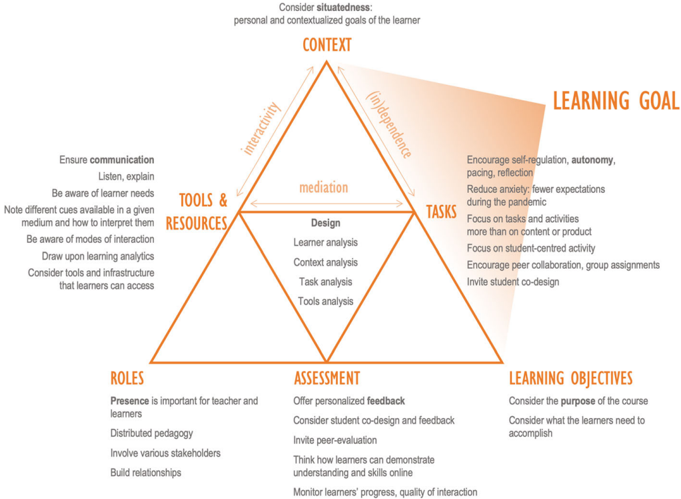
- The four experts argue that online learning should be built around carefully designed learning activities, with a mix of synchronous, asynchronous, online, and offline tasks that are clear, appropriately difficult, authentic, and accessible to students.
- They propose a tripartite teaching presence for online courses: cognitive presence, social presence, and facilitatory presence.
- Successful online learning requires students not to feel alone, and it benefits from timely feedback, peer collaboration, and student co-design/co-configuration of activities.
- The paper states that continuous assessment is needed in online learning, and suggests self-reflections, portfolios, self-paced asynchronous activities, and use of learning analytics as part of evaluation.
Methods
- Exploratory qualitative study using expert interviews administered by e-mail.
- Sample: 4 online pedagogy experts/co-authors, selected for research expertise, more than a decade of online teaching experience, and experience across different national education systems; they worked in Switzerland, Australia, Spain, and Canada.
- Main analysis: the first author organized the responses into a panel-like article, then the authors jointly revised and synthesized the material; the discussion summarizes themes under learning design, teacher presence, and assessment.
Limitations
- The paper states that all four experts came from “rich parts of the world” (Switzerland, Canada, Australia, and North of Spain), which limits the lens to a “monofocal” view of educational reality.
- The paper itself says the study used a heuristic method based on expert viewpoints and “by no means can replace rigorous, systematic research” following the scientific method.
- Evident from the text: the sample is very small (4 experts) and highly selected, so the findings are expert-opinion guidance rather than generalizable empirical results.
Model-written summary. Check it against the paper before relying on it.
Integrity signals
Registry
Cites
Statistics
Figures
Verification
Claims the paper makes
5 Valid · 0 Not valid · 32 Not checked · 24 Own results and interpretations
The sources with a verdict support this claim; the rest weren’t checked yet, have no full text we could read, or their verdicts aren’t rated yet.
In the paper
“On top of that, a significant challenge for university teachers has been their lack of the pedagogical content knowledge (PCK) (Shulman 1987) needed for teaching online (Angeli and Valanides 2005; Kali, Goodyear and Markauskaite 2011; Ching, Hsu and Baldwin 2018).”
§ Springer Nature Switzerland AG 2020 Published online: 7 July 2020 > Introduction
What the sources say
- Supportedcites Shulman 1987 matched to “Knowledge and teaching: Foundations of the new reform” (1987) source
The parenthetical (Shulman 1987) is attached to the term 'pedagogical content knowledge (PCK)' — an identification citation — while the online-teaching studies are credited to Angeli & Valanides, Kali et al. and Ching et al. Our copy (the Portuguese edition of Shulman's 1987 Harvard Educational Review article) establishes exactly that concept: the 'Categorias da base de conhecimento' section lists 'conhecimento pedagógico do conteúdo' as one of the categories of the knowledge base for teaching, 'esse amálgama especial de conteúdo e pedagogia que é o terreno exclusivo dos professores', and the 'Novas compreensões' section calls it 'a categoria que melhor distingue a compreensão de um especialista em conteúdo daquela de um pedagogo'. The paper itself says nothing about online teaching or about university teachers lacking PCK, but that part of the sentence is not attributed to this source. (LLM, conf=0.85)
- Not checked — no full text of the sourcecites Angeli and Valanides 2005 matched to “Preservice elementary teachers as information and communication technology designers: an instructional systems design model based on an expanded view of pedagogical content knowledge” (2005) source
- Could not verifycites Ching, Hsu and Baldwin 2018 matched to “Online Course Design and Development among College and University Instructors: An Analysis using Grounded Theory” (2018) sourceExperimental — accuracy not yet measured
Our copy of Baldwin, Ching & Friesen (2018) never mentions pedagogical content knowledge, PCK, Shulman, or TPACK; searches for 'pedagogical content knowledge PCK online teaching', 'TPACK technological pedagogical content knowledge', 'Shulman pedagogical content knowledge Angeli Valanides' and 'challenge lack of knowledge training online instructors pedagogy' returned only the References list and design-process passages. The paper's content is a grounded-theory account of how 14 four-year-institution instructors design online courses (Abstract; Results themes; Discussion mapping to ADDIE), and its nearest statements — that instructors 'must develop new curriculum with instructional strategies effective for online learning' (Discussion) and 'rarely use formal instructional design models' (Results) — concern design practice, not a PCK deficiency framed as a significant challenge. Nothing in our copy either states or contradicts the attributed claim. (LLM, conf=0.72)
plain- Asserted: passes — The authors put it forward as true.
- Checkable: passes — It can be checked against evidence.
- Load-bearing: passes — The paper’s conclusions depend on it.
- Based: passes — The paper gives a reason why it holds.
- Supported
The cited sources support only part of this claim — read each source’s verdict below.
In the paper
“Assessment can possibly be considered the most challenging part of the transition to distance learning for an institution used to face-to-face oral or written exam, as the control shift towards the students makes it hardly possible to ensure that students are not cheating (Munoz and Mackay 2019).”
§ Springer Nature Switzerland AG 2020 Published online: 7 July 2020 > Assessment
What the sources say
- Partly supportedcites Munoz and Mackay 2019 matched to “An online testing design choice typology towards cheating threat minimisation” (2019) sourceExperimental — accuracy not yet measured
Split into 2 atoms — 0 confirmed, 2 partially supported, 0 disputed, 0 misattributed, 0 unverifiable. Expand the claim to see per-atom verdicts.
hedgedstates a possible cause- Asserted: passes — The authors put it forward as true.
- Checkable: passes — It can be checked against evidence.
- Load-bearing: unclear — It is unclear whether the paper’s conclusions depend on it.
- Based: passes — The paper gives a reason why it holds.
- Partly supported
A result the paper reports from its own data — it cites no other source for it, so there is none to check. The quote shows it is in the paper.
In the paper
“Our findings point at the design of learning activities with certain characteristics, the combination of three types of presence (social, cognitive and facilitatory) and the need for adapting assessment to the new learning requirements.”
§ Springer Nature Switzerland AG 2020 Published online: 7 July 2020 > Abstract
plainstates an association- Asserted: passes — The authors put it forward as true.
- Checkable: passes — It can be checked against evidence.
- Load-bearing: passes — The paper’s conclusions depend on it.
- Based: passes — The paper gives a reason why it holds.
None of the sources cited for this claim have been checked yet.
In the paper
“What all four experts focus on as a prime ' piece ' of pedagogical knowledge (Kali et al. 2011) is the careful design of activities.”
§ Springer Nature Switzerland AG 2020 Published online: 7 July 2020 > Learning Design
plain- Asserted: passes — The authors put it forward as true.
- Checkable: passes — It can be checked against evidence.
- Load-bearing: unclear — It is unclear whether the paper’s conclusions depend on it.
- Based: passes — The paper gives a reason why it holds.
A result the paper reports from its own data — it cites no other source for it, so there is none to check. The quote shows it is in the paper.
In the paper
“Inspired by Anderson et al. ' s (2001) understanding of teaching presence and how it can be re-conceived in the current Covid-19 situation in which educators are the designers, the tutors and the evaluators of the learning experience, a tripartite framework emerges from the interviews, with three main sub-presences of the teaching presence, namely:”
§ Springer Nature Switzerland AG 2020 Published online: 7 July 2020 > Teacher Presence
plain- Asserted: passes — The authors put it forward as true.
- Checkable: passes — It can be checked against evidence.
- Load-bearing: passes — The paper’s conclusions depend on it.
- Based: passes — The paper gives a reason why it holds.
5 more claims
Create a free account to see all 61 claims and to verify the 9 references still open.
- Probably not a substantial claim. 50
- It may state two separate claims as one. 18
Claims other papers make about this one
Each is checked against this paper’s own text: does it say what the citing paper says it does?
The source backs part of the claim, not all of it — or backs it for a different population, condition or comparison.
In the citing paper
“while it is known that for learning success, input formats usually depend on both attention and interest from the students (Rapanta et al., 2020).”
From Impact of Synchronous and Asynchronous Settings of Online Teaching and Learning in Higher Education on Students' Learning Experience During COVID-19 (2021) · cites this paper as Rapanta et al., 2020
Experimental — accuracy not yet measuredIn the citing paper
“Evaluating AI applications could be beneficial for enhancing their motivation and interest in teaching with AI [40].”
From Developing AI Literacy for Primary and Middle School Teachers in China: Based on a Structural Equation Modeling Analysis (2022) · cites this paper as [40]
Citations
Cites
The Reflective Practitioner: How Professionals Think in Action
Checkoway, B., & Schon, D. A. (1985) · Journal of Policy Analysis and Management · doi:10.2307/3324262 · Cited by 21,268
The reflective practitioner: How professionals think in action
Stewart, C. J. (1984) · Patient Education and Counseling · doi:10.1016/0738-3991(84)90022-3 · Cited by 19,752
Knowledge and teaching: Foundations of the new reform
Shulman, L. (1987) · Harvard Educational Review · doi:10.17763/haer.57.1.j463w79r56455411 · Cited by 16,787
Phenomenological research methods
Moustakas, C. (1994) · doi:10.4135/9781412995658 · Cited by 13,919 · cited 1×
“’ This study ’ s participants, i.e. the four online pedagogy experts, also functioned as co-researchers, following Moustakas ’ (1994) idea (l).”
BackgroundDetermining Validity in Qualitative Inquiry
Creswell, J. W., & Miller, D. L. (2000) · Theory Into Practice · doi:10.1207/s15430421tip3903_2 · Cited by 9,184
Speech Genres and Other Late Essays
Bakhtin, M. M. (1986) · University of Texas Press eBooks · doi:10.7560/720466 · Cited by 8,470
The Difference between Emergency Remote Teaching and Online Learning
Hodges, C. B., Moore, S., Lockee, B. B., Trust, T., & Bond, M. A. (2024) · Handbook of Research in Online Learning · doi:10.1163/9789004702813_021 · Cited by 6,253
Blended learning: Uncovering its transformative potential in higher education
Garrison, D. R., & Kanuka, H. (2004) · The Internet and Higher Education · doi:10.1016/j.iheduc.2004.02.001 · Cited by 4,849
Speech Genres and Other Late Essays
Melaver, M., Bakhtin, M. M., McGee, V. W., Emerson, C., & Holquist, M. (1987) · Poetics Today · doi:10.2307/1772598 · Cited by 3,185
ASSESSING TEACHING PRESENCE IN A COMPUTER CONFERENCING CONTEXT
Anderson, T., Rourke, L., Garrison, R., & Archer, W. (2001) · Online Learning · doi:10.24059/olj.v5i2.1875 · Cited by 1,885
Research works printed but not linked: 2
- Bates, A. W. (2019). Teaching in a digital age. 2nd Edition. Vancouver: Tony Bates Associates. https://pressbooks.bccampus.ca/teachinginadigitalagev2/. Accessed 15 June 2020.
- Shor, I., & Freire, P. (1987). A pedagogy for deliberation: dialogues on transforming education . Westport: Bergin & Garvey Publishers.
Cited by
Items 2,001–2,100 of 2,106
Revolutionizing Education: Evaluating the Impact of AI and Ed Tech Tools on Learning Outcomes
Thomas, A. A., Baby, R., Davidson, B. G. J., & George, J. P. (2026) · Advances in computational intelligence and robotics book series · doi:10.4018/979-8-3373-4521-5.ch014 · Cited by 1
Chuang, H., Singco, M. D., & Wei, J. (2026) · Education and Information Technologies · doi:10.1007/s10639-026-13913-5 · Cited by 1
“This perspective represents a significant shift from earlier technology adoption paradigms, suggesting that per - ceived complexity may initiate positive organizational adaptations rather than merely deterring implementation (Cutri et al., 2020 ; Rapanta et al., 2020 ; Trust & Whalen, 2021).”
Planning Education in the United Kingdom: Impacts of COVID-19 and Future Scenarios
Ahmadpoor, N. (2026) · Journal of Planning Education and Research · doi:10.1177/0739456x261420773
Piurko, E. (2026) · Creativity Studies · doi:10.3846/cs.2026.24678 · Cited by 1
Chauhan, R., & Patel, A. (2026) · Discover Education · doi:10.1007/s44217-026-01185-7 · Cited by 5
Albishri, B., & Blackmore, K. L. (2025) · International Conference on Artificial Intelligence and Teacher Education (ICAITE) · doi:10.1109/icaite68636.2025.11442571
“After COVID, Australia had shorter lockdown periods and returned to relatively individualistic campus teaching and learning practices, stressing individual expectations [24].”
Teaching behind the Screen: K-12 EFL Teachers’ Perceptions on the Online Teaching Implementation
Ak, N. Y., Altın, R., & İşler, E. E. (2026) · Eğitim Ve İnsani Bilimler Dergisi Teori Ve Uygulama · doi:10.58689/eibd.1766231
Ariani, D., Andinnari, S. R., Setiasih, R. M., & Anis, A. Z. (2026) · Tadris Jurnal Keguruan dan Ilmu Tarbiyah · doi:10.24042/tadris.v11i1.28820
Adaptation and evidences of validity of the Remote Teaching Reactions Scale in Exact Sciences
Zerbini, T., & Kaizer, B. M. (2026) · Estudos de Psicologia (Campinas) · doi:10.1590/1982-0275202643e230050
AI and ICT are reshaping higher education in the digital era
RAJKUMAR, S., Dan, M., & Shah, S. H. (2026) · Global Education Insights · doi:10.65140/gei202601.14
“[23] AI-Driven Student Support and Advising Systems The findings show that universities globally are implementing AI-based student support systems, such as chatbots and predictive analytics tools, to enhance academic advising and student services.”
Che, L., Bridges, S., & Jackson, L. (2026) · Springer eBooks · doi:10.1007/60490_2026_2
Teaching beyond the screen: Virtual accounting education and the future of learning in Saudi Arabia
Fallatah, R. A. (2026) · International Journal of Accounting Research · doi:10.65453/ijar.v11i1.1410
“This quote reflects findings made globally by Rapanta et al. (2020) and Hodges et al. (2020), that quality online learning requires purposeful design, rather than a simple technological substitute.”
Jahanbakhsh, M., Mousavi, A., Rarani, M. A., & Rahimi, F. (2026) · BMC Medical Education · doi:10.1186/s12909-026-09016-x
“Beyond interpersonal skills, digital competencies such as online instructional design, assessment literacy, and adaptive use of technology are increasingly recognised as core professional requirements [24, 25].”
Brás, G. R. (2026) · Education + Training · doi:10.1108/et-09-2024-0422
Digital Teaching Aptitudes and Self-Efficacy of Tunisian Foreign Languages Teachers
Bel’Kiry, L. N. (2026) · Advances in computational intelligence and robotics book series · doi:10.4018/407552
Powell, S. J. (2026) · Early Childhood Education Journal · doi:10.1007/s10643-026-02205-9
“Rapanta et al. (2020 ) argue that effective online teaching requires careful and deliberate planning, and the “explicit use of some type of design process” (p. 3) and the use of specific pedagogies relevant to this environ - ment and particular subject areas (Power & Kannara, 2016).”
From patchwork policy to the policy of sustainability: digitalization of German higher education
Ananin, D. P. (2026) · Вестник Тамбовского университета. Серия: Гуманитарные науки · doi:10.20310/1810-0201-2026-31-2-435-459
Jang, Y., Nam, K., PARK, E., & Song, J. H. (2026) · Teacher Development · doi:10.1080/13664530.2026.2661224
Drivers of Hybrid Teaching in Higher Education: A Post-Adoption Usage Analysis
Singh, H., Singh, P. P., & Sharma, D. (2026) · Journal of College Reading and Learning · doi:10.1080/10790195.2026.2664151
“While some research suggests that online-based instruction can be as effective as traditional in-class pedagogy (Rapanta et al., 2020), a few studies highlight potential drawbacks, particularly for specific groups, such as those who require direct and hands-on training, students with disabilities,…”
Irmawanti, M. M. D., Listyani, L., & Satyawati, S. T. (2026) · Primary Jurnal Pendidikan Guru Sekolah Dasar · doi:10.33578/jpfkip.v15i2.386-402
Integrating TPACK in online pedagogies: effects on science postgraduate students’ competence
Mavenge, L., Ncanywa, T., Dyantyi, N., & Asaleye, A. J. (2026) · Frontiers in Education · doi:10.3389/feduc.2026.1751227 · Cited by 3
Bernardino, M. N. R., & Garcia, P. G. (2026) · ASEAN Journal of Open and Distance Learning · doi:10.64233/njbq7466
Benítez, M. A. M., Mora‐Vargas, J., Medina-Marín, J., Rivera-Gómez, H., & Ramírez-Reyna, S. B. (2026) · EAI/Springer Innovations in Communication and Computing · doi:10.1007/978-3-032-13703-6_15
Students' and Teachers’ Perception Towards Online Education: A Confirmatory Study
Tiwari, P., Malati, N., & Taneja, S. (2022) · DIAS Technology Review · doi:10.65301/dias.2022.18.2.12
“One of the major challenges among all this is faculty readiness in terms of professionalism required and pedagogical content knowledge (PCK) in designing better experience for the learners (Rapanta et al., 2020).”
Impact of Digital Learning Platforms on Students’ Outcome - A Review Dr. Vinod Vishwas Patil
Patil, V. V. (2026) · International Journal of Research & Technology · doi:10.64882/ijrt.v14.i2.1283
Lata, S., & Rana, K. (2026) · IGI Global eBooks · doi:10.4018/979-8-3373-5057-8.ch004
Qualitative analysis of university postgraduate students’ experience in remote supervision
Opesemowo, O. A. G., & Plessis, D. (2026) · Discover Education · doi:10.1007/s44217-026-01591-x
“The strategic use of digital tools, such as online tutorials and reference management software, further reflects adaptive resource management in response to remote supervisory conditions, a defining characteristic of effective self-regulated learning [46].”
Yalçınkaya, D., & ÖZDEMİR, O. (2026) · Eğitim Ve İnsani Bilimler Dergisi Teori Ve Uygulama · doi:10.58689/eibd.1889950
Sansone, N. (2026) · CSR, sustainability, ethics & governance · doi:10.1007/978-3-032-16077-5_13 · Cited by 1
Inostroza, C., Quijada, Y., Novoa, C., Quiñones, A. V. S., Lobos, K., Saldivia, S., Méndez-Bustos, P., Bustos, C., & Vega-Reyes, N. (2026) · Frontiers in Education · doi:10.3389/feduc.2026.1777704
Trends, impact, and thematic evolution of research on university teaching in blended models
Polanía, L. R., Forero, F. E. M., & Castillo, V. S. (2024) · Data & Metadata · doi:10.56294/dm2024340
Inclusion and Equity with Multimodality During Covid-19
Boivin, N., & CohenMiller, A. (2022) · Emerald Group Publishing Limited eBooks · doi:10.1108/978-1-64802-808-320251006
Findings from the Document Reviews
Nguyen, T. V., & Sit, H. H. W. (2026) · Springer eBooks · doi:10.1007/978-981-92-0048-1_6
Levy, R., & Blass, E. (2026) · SAGE Open · doi:10.1177/21582440261443148
“Whenconsidering online learning design and how this impacts the role of the teacher, Rapanta et al. (2020, p. 929) note: The design of an online course is a strongly student-centred approach.”
Nurdin, J. A., Wahyudin, W., Dimyati, E., Nurjamin, A., Rahayu, A. P., & Jalaludin, D. M. (2026) · Academia Open · doi:10.21070/acopen.11.2026.13854
Steyn, R. (2026) · Perspectives Policy and Practice in Higher Education · doi:10.1080/13603108.2026.2683390
Engaging Gen Z in STEM higher education: Faculty presence as a catalyst for classroom connection
Gupta, A. K., Sawhney, S., Nanda, A., & Gupta, A. (2026) · Innovations in Education and Teaching International · doi:10.1080/14703297.2026.2685602
Ajani, O. A., & Govender, S. (2026) · Multidisciplinary Reviews · doi:10.31893/multirev.2026547
“This raises critical questions regarding the technological implementation of pedagogical innovation, thereby reinforcing the need to integrate ICT into university teaching and learning strategies (Rapanta et al., 2020).”
Morala, E. R. M., Arcon, E., Cenita, E. A., Cunanan, A. F. I., & Pucot, J. (2026) · Journal of interdisciplinary perspectives · doi:10.69569/jip.2026.146
Addressing the COVID-19 Sudden Switch to Remote and Online Teaching with a Framework
Popovich, K., & Pangborn, G. (2022) · Information Systems Education Journal · doi:10.62273/dnad1469
Samman, A. M. A. (2026) · ASU International Conference in Emerging Technologies for Sustainability and Intelligent Systems (ICETSIS) · doi:10.1109/icetsis68266.2026.11549335 · Cited by 1
“Online learning spaces [7], digital repositories, and online communities have been shown to work already in the sphere of professional development and organizational communication [8] [9].”
Noor, N. M., & Sutrisno, N. D. (2026) · Issues and Perspectives in Business and Social Sciences · doi:10.33093/ipbss.2026.6.2.19 · Cited by 1
Turgumbayeva, A., & Kassymzhanova, A. A. (2026) · Eurasian Journal of Current Research in Psychology and Pedagogy · doi:10.46914/2959-3999-2026-1-2-34-45
Mokoena, S., Ajani, O. A., & Khumalo, N. P. (2026) · Frontiers in Education · doi:10.3389/feduc.2026.1861671 · Cited by 1
Pérez, O. J. P., Cedeño, E. I. B., & Quintero, A. R. T. (2026) · ASCE MAGAZINE · doi:10.70577/asce.v5i2.958
Priročnik za razvijanje digitalnih kompetenc v pedagoških študijskih programih
Šumak, B., Pušnik, M., Grašić, S., & Györkös, J. (2026) · doi:10.18690/um.pef.2.2026
A Continuity-Oriented Architectural Approach for Open-Source and Scalable Distance Education Systems
Erzurumlu, K. (2026) · Ordu Üniversitesi Bilim ve Teknoloji Dergisi · doi:10.54370/ordubtd.1877894
Impact of virtual on-the-job training on undergraduate student development
Napalit, A. P. (2026) · International Journal of Research Studies in Education · doi:10.5861/ijrse.2026.26265
Çakmak, M. (2026) · Ufuk Üniversitesi Sosyal Bilimler Enstitüsü Dergisi · doi:10.58635/ufuksbedergi.1714277
Development of transmedia strategy intervention and primer in teaching academic writing
-, A. P. C. T., & Sad-ayan-Lacambra, J. (2026) · International Journal of Research Studies in Education · doi:10.5861/ijrse.2026.26287
Uzaktan eğitim kalite standartları ölçeği: geçerlik ve güvenirlik çalışması
Can, E., & Sezer, Ş. (2026) · Açıköğretim Uygulamaları ve Araştırmaları Dergisi · doi:10.51948/auad.1927564
Olarte, M. E. O., & Naranjo, M. L. G. (2026) · Digital Education Review · doi:10.1344/der.2026.49.233-246
Serra, G. A., Agbon, J., Baradillo, D., Barroga, I. T., Dungog, K., & Garrido, B. (2026) · Psychology and Education A Multidisciplinary Journal · doi:10.70838/pemj.590506
Hamzaoui, O. (2026) · Research Square · doi:10.21203/rs.3.rs-10335379/v1
Eak, A. D., & Annamalai, N. (2026) · AAOU Journal/AAOU journal · doi:10.1108/aaouj-11-2025-0192 · Cited by 1
Karim, A., Mamun, M. A. A., Sultana, S., & Kabilan, M. K. (2026) · PLoS ONE · doi:10.1371/journal.pone.0353171
“Teachers, ranging from lecturers to senior professors, and students in many countries shifted to online teaching and learning (OTL), whereby teachers had to carefully prepare lectures and materials for the students to digest and absorb the learning fully [28–32].”
Gunnoo, L., Geerawo, T. S., & Padachi, K. (2026) · Emerald Group Publishing Limited eBooks · doi:10.1108/978-1-80592-995-620261003
SAFE-CBL: a Legitimation Code Theory-informed framework for large-cohort practice-based teaching
MCGUIRE, M. (2026) · Cogent Education · doi:10.1080/2331186x.2026.2706206
Career Adaptability and Life Satisfaction Among Academics: A Moderated Mediation Model
Tarhan, S., Demir, B., & Köksal, E. Ç. (2026) · Journal of Career Development · doi:10.1177/08948453261470426
“…and the changes brought by the COVID-19 pandemic, which required academics to quickly adapt to online teaching, develop synchronous and asynchronous learning materials, and maintain research productivity under uncertain and changing working conditions (Hanelt et al., 2021; Rapanta et al., 2020).”
Mobile Learning Application Design and Development: Insights from Technology Acceptance Models
Rafiq, K. R. M., Pazilah, F. N., Rani, M. F. C. A., Bazlan, M. S. A. M., & Yunus, M. M. (2026) · Communications in computer and information science · doi:10.1007/978-3-032-33997-3_24
Harry, N. (2026) · SA Journal of Industrial Psychology · doi:10.4102/sajip.v52i0.2360
Change Management and Organizational Culture in Digital HEIs
Velmurugan, R., Kumuthadevi, K., Bhuvanendran, D., et al. (2026) · IGI Global eBooks · doi:10.4018/979-8-3373-8959-2.ch010
Aftimos, S., Diab-Bahman, R., & Hassoun, D. (2026) · IGI Global eBooks · doi:10.4018/979-8-3373-8959-2.ch003
Hamzan, & Rofiah, T. D. (2026) · Jurnal Imiah Pendidikan dan Pembelajaran · doi:10.23887/jipp.v10i2.120201
Adedeji, A. S., Babalola, J. A., Odeh, O. O., Ikpeamanam, E. U., & Odeode, E. A. (2026) · Research Square · doi:10.21203/rs.3.rs-10553243/v1
Kenaphoom, S., Jantanukul, W., Pawala, T., Taghipour, A., & Niyomves, B. (2026) · IGI Global eBooks · doi:10.4018/979-8-2600-0853-9.ch003
Silva, L. C. S., & Lima, V. D. O. (2026) · Springer proceedings in business and economics · doi:10.1007/978-3-032-23282-3_51
Increasing Authentic Online Experiences for Workplace Practices in Early Childhood Education
Schwenger, B. K. (2026) · Journal of ExoTechnology and Education · doi:10.36615/4pnq3z51
Shaw, R., & WALKER, R. A. (2026) · Knowledge · doi:10.3390/knowledge6030020
“In a paper aiming to draw together expert insights into the key pedagogical requirements for effective online teaching given in the throes of the immediate crisis, Rapanta et al. [18] also emphasised this difference.”
>Postdigital Future Classrooms
Forsler, I. (2026) · Springer eBooks · doi:10.1007/978-3-032-31322-5_110
Kayabaş, B. K., Yılmaz, S., & KAYABAŞ, İ. (2026) · American Journal of Distance Education · doi:10.1080/08923647.2026.2715218
Irmayanti, Khoiron, A. M., Suryani, H., et al. (2026) · MATEC Web of Conferences · doi:10.1051/matecconf/202642303003
“According to [1] the vocational education learning process is transitioning from conventional learning to digital-era learning to align with industrial advancements.”
Oweis, T. I., Riegler, P., Karain, K., Abudayah, M. A., Arjah, O. A., Alnuman, N., Numan, A., & Al-Jandabi, H. (2026) · Discover Education · doi:10.1007/s44217-026-02011-w
“These findings are consistent with contemporary research on digital pedagogy, which emphasizes that effective online teaching depends on instructional presence, learner engagement, technological accessibility, meaningful interaction, and the effective use of digital learning resources [6, 7, 64].”
InfluentialEssential requirements of smart learning environments: A case study in the Arab region
Bataineh, R. F., AlAli, R. M., Bataineh, R. F., & Al‐Barakat, A. A. (2026) · Elsevier eBooks · doi:10.1016/b978-0-443-41632-3.00009-6
Kavitha, D. T. S. (2026) · International Journal of Technology & Emerging Research · doi:10.64823/ijter.2606018
Swathi, N. N. S., Jufri, A. W., Sukarso, A., Artayasa, I. P., & Rokhmat, J. (2026) · Jurnal Penelitian dan Pengembangan Pendidikan · doi:10.23887/jppp.v10i1.102390
Edutainment-flipped classroom model and its impact on prospective teachers’ numeracy competence
Firdaus, F. M., Kenedi, A. K., Prasojo, L. D., Yuliana, L., Zainil, M., & Ramdani, Z. (2026) · Journal of Applied Research in Higher Education · doi:10.1108/jarhe-02-2026-0283
BURBYGA, V. A., SHALIMOVA, I. M., Marková, V., & KHOROSHUN, D. А. (2026) · Academic Visions · doi:10.66556/2786-586x.55.burbyha-v
Vejvodová, J., & Rohlíková, L. (2026) · EAI/Springer Innovations in Communication and Computing · doi:10.1007/978-3-032-32104-6_38
Ortiz, J. D. J. A. (2026) · Educational Regent Multidisciplinary Journal · doi:10.63969/9v5gp470
Silva, A., Canever, B. P., & Silva, V. S. E. (2026) · Nurse Education Today · doi:10.1016/j.nedt.2026.107382
Dimopoulos, K., & Karadimitriou, K. (2026) · Έρευνα στην Εκπαίδευση · doi:10.12681/hjre.46678
ROLE OF VIRTUAL CLASSROOMS IN IMPROVING TEACHING-LEARNING OUTCOMES IN TEACHER EDUCATIONPreprint
Kumar, A. (2026) · SSRN Electronic Journal · doi:10.2139/ssrn.7403071
The AFK (Away from Keyboard) Tutor Paradox in Islamic Digital Education Management
Rahman, R., Sarifudin, S., Idharudin, A. J., Raharjo, R., Fatkuroji, F., & Aisy, S. R. (2026) · International Journal of Social Learning (IJSL) · doi:10.47134/ijsl.v6i3.592
Mokhtar, R., Khambari, M. N. M., Mokhtar, M. M., & Ghazali, N. (2026) · Pertanika Journal of Vocational Science and Technology Education · doi:10.47836/pjvste.2.1.03
Chandiran, S., & Abdullah, S. I. S. S. (2026) · Pertanika Journal of Vocational Science and Technology Education · doi:10.47836/pjvste.2.1.08
-, N. F., & Wu, Y. (2026) · Journal of Digital Pedagogy · doi:10.61071/jdp.2690
DADA, A. A., Boor, M. C. H., AWOLUSI, B. E., et al. (2026) · Journal of Educational Research and Development · doi:10.67203/jerd.2026.zzwt6w85
Klippen, M. I. F., Türken, S., & Keleş, S. (2026) · European Journal of Teacher Education · doi:10.1080/02619768.2026.2733413
Miler, D., Mašović, R., Škec, M. M., et al. (2026) · Education Sciences · doi:10.3390/educsci16091559
Hochhauser, M., & Akselrud, R. (2026) · British Journal of Occupational Therapy · doi:10.1177/03080226261484046
Arsenijević, J., Kastratović, E., Arsenijević, O., & Šprajc, P. (2026) · International Review · doi:10.5937/intrev2602013a
“Developing online teaching that achieves good results and the desired effects does not mean transferring teaching that has been carried out in vivo to the online environment (Huang et al., 2020; Rapanta et al., 2020).”
Yavuz, M. (2026) · İnönü Üniversitesi Eğitim Bilimleri Enstitüsü Dergisi · doi:10.29129/inujgse.1969285
Sánchez, C. X. M., Sánchez, N. K. M., & Merino, M. J. M. (2026) · Revista Multidisciplinaria Voces de América y el Caribe · doi:10.69821/remuvac.v3i4.419
Yamada, R. (2026) · IntechOpen eBooks · doi:10.5772/intechopen.1017946
de Moraes, R. M., Santos, C., & Pedro, N. (2026) · Texto Livre Linguagem e Tecnologia · doi:10.1590/1983-3652.2026.63442
Kariri, K. A. (2026) · Eurasia Journal of Mathematics Science and Technology Education · doi:10.29333/ejmste/19424 · Cited by 2
“Rapanta et al. (2020) identify assessment as a systemic challenge in online contexts, and teachers in this study echoed this concern.”
Hermawan, T. (2026) · Journal of Education and Teaching Learning · doi:10.59211/mjpjetl.v4i1.167
“Meanwhile, ADDIE remains relevant as an instructional design framework because it guides the systematic stages of analysis, design, development, implementation, and evaluation [29], [30], [31].”
Ampofo, J., Li, J., Zou, W., & Zhu, W. (2026) · Review of Educational Research · doi:10.3102/00346543261484193 · Cited by 2
Metadata
- Authors
- Rapanta, C., Botturi, L., Goodyear, P., Guàrdia, L., & Koole, M.
- Affiliations
- Universidade Nova de Lisboa (PT)
- University of Applied Sciences and Arts of Southern Switzerland (CH)
- The University of Sydney (AU)
- University of Saskatchewan (CA)
- Corresponding author
- Rapanta, Chrysi
- ORCID
- Rapanta, Chrysi
- Venue
- Postdigital Science and Education
- Published
- 2020-07-07
- Volume
- 2
- Issue
- 3
- Pages
- 923-945
- ISSN
- 2524-485X (ISSN-L)
- 2524-4868
- PMC
- PMC7339092
- OpenAlex
- W3042009104
- Semantic Scholar
- fed495af71b417de8d60cf16b6da44926faf24a0
- Cited by
- 2,130
- References
- 75
- Citations by year
- 2026: 134 · 2025: 158 · 2024: 261 · 2023: 426 · 2022: 556 · 2021: 509 · 2020: 73
- FWCI
- 454.18
- Type
- journal article
- Language
- en
- Open access
- hybrid
- doi.org
- Licence
- other-oa
- www.springer.com/tdm (tdm)
- www.springer.com/tdm (vor)
- Locations
- Postdigital Science and Education (publishedVersion, other-oa)
- PubMed (publishedVersion)
- PubMed Central (submittedVersion)
- The Sydney eScholarship Repository (The University of Sydney) (submittedVersion)
- Funders
- Fundação para a Ciência e a Tecnologia (DL 57/2016/CP1453/CT0066)
- Australian Research Council (DP150104163)
- Topics
- Social Sciences › Education › Digital Education and Society
- Social Sciences › Education › Higher Education Practises and Engagement
- Social Sciences › Education › Educational Innovations and Technology
- Keywords
- online learning, COVID-19 pandemic, higher education, teacher presence, pedagogical content knowledge, learning activities, social presence, cognitive presence
About these checks
Registry, retraction, Cites and statistics results are computed, not judged, with one exception: a printed reference that no index lists is read once by a model before it counts as a citation error. Claims are extracted by a model and kept only when their quote appears verbatim in the text; each cited source is then checked, with a model’s help, for whether it says what the claim relies on. Those verdicts can be wrong — read the claim’s quote and the cited source before relying on one.
The claim verdicts this report counts are experimental: their accuracy is not yet measured.
A language model drew the claims from the paper on 2026-10-10, under version 3 of the claim definition (model deepseek-v4.1-flash, prompt extract-v3).
A second model labelled each claim on 2026-10-10 (model jev-1.13-20260917, definition revision gold-guideline-v0.2).
Cited sources are checked with a language model’s help (qwen3.8-omni-flash).
Statistics and arithmetic are recomputed, not judged.
Confidence bands are shown only for fields calibrated on our annotated test set. None is calibrated yet, so no band is shown.
What counts as a claim ›How we measure confidence ›How we check this ›
Are you an author, or do you see a problem with this page? Request a review
Data sources
Bibliographic data: Semantic Scholar, OpenAlex, Crossref.
Contains information from the Semantic Scholar Academic Graph Datasets, made available under the ODC Attribution License (ODC-BY 1.0).
Semantic Scholar’s data is described in: Kinney, R., et al. (2023). The Semantic Scholar Open Data Platform. arXiv:2301.10140.
