

Online University Teaching During and After the Covid-19 Crisis: Refocusing Teacher Presence and Learning Activity
Open accessThe DOI matches its Crossref record; 71 of the 75 references it cites were found in a registry or an index; 6 of the 42 sources its claims cite were checked for support.
Abstract
The Covid-19 pandemic has raised significant challenges for the higher education community worldwide. A particular challenge has been the urgent and unexpected request for previously face-to-face university courses to be taught online. Online teaching and learning imply a certain pedagogical content knowledge (PCK), mainly related to designing and organising for better learning experiences and creating distinctive learning environments, with the help of digital technologies.
Overview
CoChat Summary
TL;DR
This article is an expert-interview piece offering pedagogical guidance for university teachers suddenly moving online during Covid-19. Its central message is that effective online teaching depends less on tools or materials alone and more on careful learning design, multiple forms of teacher presence, and continuous assessment.
Key findings
- The four experts argue that online learning should be built around carefully designed learning activities, with a mix of synchronous, asynchronous, online, and offline tasks that are clear, appropriately difficult, authentic, and accessible to students.
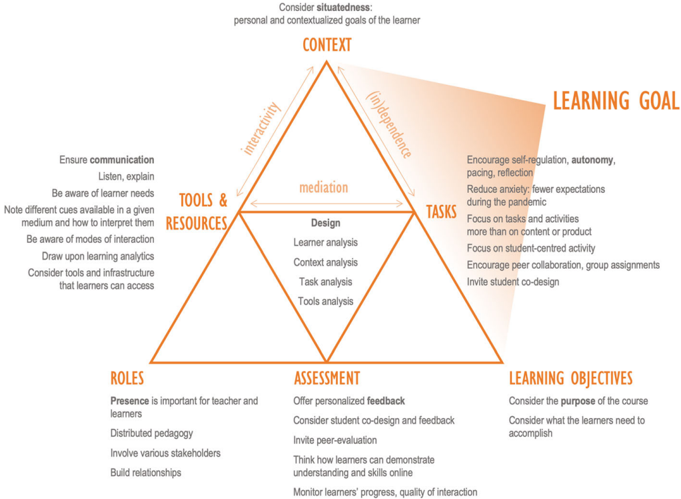
- They propose a tripartite teaching presence for online courses: cognitive presence, social presence, and facilitatory presence.
- Successful online learning requires students not to feel alone, and it benefits from timely feedback, peer collaboration, and student co-design/co-configuration of activities.
- The paper states that continuous assessment is needed in online learning, and suggests self-reflections, portfolios, self-paced asynchronous activities, and use of learning analytics as part of evaluation.
Methods
- Exploratory qualitative study using expert interviews administered by e-mail.
- Sample: 4 online pedagogy experts/co-authors, selected for research expertise, more than a decade of online teaching experience, and experience across different national education systems; they worked in Switzerland, Australia, Spain, and Canada.
- Main analysis: the first author organized the responses into a panel-like article, then the authors jointly revised and synthesized the material; the discussion summarizes themes under learning design, teacher presence, and assessment.
Limitations
- The paper states that all four experts came from “rich parts of the world” (Switzerland, Canada, Australia, and North of Spain), which limits the lens to a “monofocal” view of educational reality.
- The paper itself says the study used a heuristic method based on expert viewpoints and “by no means can replace rigorous, systematic research” following the scientific method.
- Evident from the text: the sample is very small (4 experts) and highly selected, so the findings are expert-opinion guidance rather than generalizable empirical results.
Model-written summary. Check it against the paper before relying on it.
Integrity signals
Registry
Cites
Statistics
Figures
Verification
Claims the paper makes
5 Valid · 0 Not valid · 32 Not checked · 24 Own results and interpretations
The sources with a verdict support this claim; the rest weren’t checked yet, have no full text we could read, or their verdicts aren’t rated yet.
In the paper
“On top of that, a significant challenge for university teachers has been their lack of the pedagogical content knowledge (PCK) (Shulman 1987) needed for teaching online (Angeli and Valanides 2005; Kali, Goodyear and Markauskaite 2011; Ching, Hsu and Baldwin 2018).”
§ Springer Nature Switzerland AG 2020 Published online: 7 July 2020 > Introduction
What the sources say
- Supportedcites Shulman 1987 matched to “Knowledge and teaching: Foundations of the new reform” (1987) source
The parenthetical (Shulman 1987) is attached to the term 'pedagogical content knowledge (PCK)' — an identification citation — while the online-teaching studies are credited to Angeli & Valanides, Kali et al. and Ching et al. Our copy (the Portuguese edition of Shulman's 1987 Harvard Educational Review article) establishes exactly that concept: the 'Categorias da base de conhecimento' section lists 'conhecimento pedagógico do conteúdo' as one of the categories of the knowledge base for teaching, 'esse amálgama especial de conteúdo e pedagogia que é o terreno exclusivo dos professores', and the 'Novas compreensões' section calls it 'a categoria que melhor distingue a compreensão de um especialista em conteúdo daquela de um pedagogo'. The paper itself says nothing about online teaching or about university teachers lacking PCK, but that part of the sentence is not attributed to this source. (LLM, conf=0.85)
- Not checked — no full text of the sourcecites Angeli and Valanides 2005 matched to “Preservice elementary teachers as information and communication technology designers: an instructional systems design model based on an expanded view of pedagogical content knowledge” (2005) source
- Could not verifycites Ching, Hsu and Baldwin 2018 matched to “Online Course Design and Development among College and University Instructors: An Analysis using Grounded Theory” (2018) sourceExperimental — accuracy not yet measured
Our copy of Baldwin, Ching & Friesen (2018) never mentions pedagogical content knowledge, PCK, Shulman, or TPACK; searches for 'pedagogical content knowledge PCK online teaching', 'TPACK technological pedagogical content knowledge', 'Shulman pedagogical content knowledge Angeli Valanides' and 'challenge lack of knowledge training online instructors pedagogy' returned only the References list and design-process passages. The paper's content is a grounded-theory account of how 14 four-year-institution instructors design online courses (Abstract; Results themes; Discussion mapping to ADDIE), and its nearest statements — that instructors 'must develop new curriculum with instructional strategies effective for online learning' (Discussion) and 'rarely use formal instructional design models' (Results) — concern design practice, not a PCK deficiency framed as a significant challenge. Nothing in our copy either states or contradicts the attributed claim. (LLM, conf=0.72)
plain- Asserted: passes — The authors put it forward as true.
- Checkable: passes — It can be checked against evidence.
- Load-bearing: passes — The paper’s conclusions depend on it.
- Based: passes — The paper gives a reason why it holds.
- Supported
The cited sources support only part of this claim — read each source’s verdict below.
In the paper
“Assessment can possibly be considered the most challenging part of the transition to distance learning for an institution used to face-to-face oral or written exam, as the control shift towards the students makes it hardly possible to ensure that students are not cheating (Munoz and Mackay 2019).”
§ Springer Nature Switzerland AG 2020 Published online: 7 July 2020 > Assessment
What the sources say
- Partly supportedcites Munoz and Mackay 2019 matched to “An online testing design choice typology towards cheating threat minimisation” (2019) sourceExperimental — accuracy not yet measured
Split into 2 atoms — 0 confirmed, 2 partially supported, 0 disputed, 0 misattributed, 0 unverifiable. Expand the claim to see per-atom verdicts.
hedgedstates a possible cause- Asserted: passes — The authors put it forward as true.
- Checkable: passes — It can be checked against evidence.
- Load-bearing: unclear — It is unclear whether the paper’s conclusions depend on it.
- Based: passes — The paper gives a reason why it holds.
- Partly supported
A result the paper reports from its own data — it cites no other source for it, so there is none to check. The quote shows it is in the paper.
In the paper
“Our findings point at the design of learning activities with certain characteristics, the combination of three types of presence (social, cognitive and facilitatory) and the need for adapting assessment to the new learning requirements.”
§ Springer Nature Switzerland AG 2020 Published online: 7 July 2020 > Abstract
plainstates an association- Asserted: passes — The authors put it forward as true.
- Checkable: passes — It can be checked against evidence.
- Load-bearing: passes — The paper’s conclusions depend on it.
- Based: passes — The paper gives a reason why it holds.
None of the sources cited for this claim have been checked yet.
In the paper
“What all four experts focus on as a prime ' piece ' of pedagogical knowledge (Kali et al. 2011) is the careful design of activities.”
§ Springer Nature Switzerland AG 2020 Published online: 7 July 2020 > Learning Design
plain- Asserted: passes — The authors put it forward as true.
- Checkable: passes — It can be checked against evidence.
- Load-bearing: unclear — It is unclear whether the paper’s conclusions depend on it.
- Based: passes — The paper gives a reason why it holds.
A result the paper reports from its own data — it cites no other source for it, so there is none to check. The quote shows it is in the paper.
In the paper
“Inspired by Anderson et al. ' s (2001) understanding of teaching presence and how it can be re-conceived in the current Covid-19 situation in which educators are the designers, the tutors and the evaluators of the learning experience, a tripartite framework emerges from the interviews, with three main sub-presences of the teaching presence, namely:”
§ Springer Nature Switzerland AG 2020 Published online: 7 July 2020 > Teacher Presence
plain- Asserted: passes — The authors put it forward as true.
- Checkable: passes — It can be checked against evidence.
- Load-bearing: passes — The paper’s conclusions depend on it.
- Based: passes — The paper gives a reason why it holds.
5 more claims
Create a free account to see all 61 claims and to verify the 9 references still open.
- Probably not a substantial claim. 50
- It may state two separate claims as one. 18
Claims other papers make about this one
Each is checked against this paper’s own text: does it say what the citing paper says it does?
The source backs part of the claim, not all of it — or backs it for a different population, condition or comparison.
In the citing paper
“while it is known that for learning success, input formats usually depend on both attention and interest from the students (Rapanta et al., 2020).”
From Impact of Synchronous and Asynchronous Settings of Online Teaching and Learning in Higher Education on Students' Learning Experience During COVID-19 (2021) · cites this paper as Rapanta et al., 2020
Experimental — accuracy not yet measuredIn the citing paper
“Evaluating AI applications could be beneficial for enhancing their motivation and interest in teaching with AI [40].”
From Developing AI Literacy for Primary and Middle School Teachers in China: Based on a Structural Equation Modeling Analysis (2022) · cites this paper as [40]
Citations
Cites
The Reflective Practitioner: How Professionals Think in Action
Checkoway, B., & Schon, D. A. (1985) · Journal of Policy Analysis and Management · doi:10.2307/3324262 · Cited by 21,268
The reflective practitioner: How professionals think in action
Stewart, C. J. (1984) · Patient Education and Counseling · doi:10.1016/0738-3991(84)90022-3 · Cited by 19,752
Knowledge and teaching: Foundations of the new reform
Shulman, L. (1987) · Harvard Educational Review · doi:10.17763/haer.57.1.j463w79r56455411 · Cited by 16,787
Phenomenological research methods
Moustakas, C. (1994) · doi:10.4135/9781412995658 · Cited by 13,919 · cited 1×
“’ This study ’ s participants, i.e. the four online pedagogy experts, also functioned as co-researchers, following Moustakas ’ (1994) idea (l).”
BackgroundDetermining Validity in Qualitative Inquiry
Creswell, J. W., & Miller, D. L. (2000) · Theory Into Practice · doi:10.1207/s15430421tip3903_2 · Cited by 9,184
Speech Genres and Other Late Essays
Bakhtin, M. M. (1986) · University of Texas Press eBooks · doi:10.7560/720466 · Cited by 8,470
The Difference between Emergency Remote Teaching and Online Learning
Hodges, C. B., Moore, S., Lockee, B. B., Trust, T., & Bond, M. A. (2024) · Handbook of Research in Online Learning · doi:10.1163/9789004702813_021 · Cited by 6,253
Blended learning: Uncovering its transformative potential in higher education
Garrison, D. R., & Kanuka, H. (2004) · The Internet and Higher Education · doi:10.1016/j.iheduc.2004.02.001 · Cited by 4,849
Speech Genres and Other Late Essays
Melaver, M., Bakhtin, M. M., McGee, V. W., Emerson, C., & Holquist, M. (1987) · Poetics Today · doi:10.2307/1772598 · Cited by 3,185
ASSESSING TEACHING PRESENCE IN A COMPUTER CONFERENCING CONTEXT
Anderson, T., Rourke, L., Garrison, R., & Archer, W. (2001) · Online Learning · doi:10.24059/olj.v5i2.1875 · Cited by 1,885
Research works printed but not linked: 2
- Bates, A. W. (2019). Teaching in a digital age. 2nd Edition. Vancouver: Tony Bates Associates. https://pressbooks.bccampus.ca/teachinginadigitalagev2/. Accessed 15 June 2020.
- Shor, I., & Freire, P. (1987). A pedagogy for deliberation: dialogues on transforming education . Westport: Bergin & Garvey Publishers.
Cited by
Items 1,801–1,900 of 2,106
Eyasu, N. (2024) · doi:10.14507/mcf-eli.i1
“However, university instructors who have tried to develop and deliver content online have faced serious problems in developing countries (Steele et al., 2018; Rapanta et al., 2020).”
BackgroundPORTRAYING TEACHERS' STRATEGIES TO TEACH ENGLISH IN THE LEARNING-FROM-HOME MODEL
Arrasyid, F. I. (2023) · Wiralodra English Journal · doi:10.31943/wej.v7i2.238 · Cited by 3
Evaluation Model for Online Nursing Education (EM-ONE): Update to the Billings' Framework
Davis, R. G., Lanz, A. S., Frith, K. H., & Guerra, D. S. (2024) · Journal of Nursing Education · doi:10.3928/01484834-20231205-02 · Cited by 1
Failasofah, F., Yanto, Y., & Nurulsabila, D. (2023) · Langue (Journal of Language and Education) · doi:10.22437/langue.v2i2.29331
Ahzan, S., Prayogi, S., Azmi, I., Asy’ari, M., & Samsuri, T. (2024) · Prisma Sains Jurnal Pengkajian Ilmu dan Pembelajaran Matematika dan IPA IKIP Mataram · doi:10.33394/j-ps.v12i1.10895 · Cited by 8
“In practical terms, educators incorporate learning theories or concepts into their instructional methodologies to foster more impactful and meaningful learning encounters for students (Rapanta et al., 2020).”
BackgroundParticipation and real-life projects to improve Design education in Brazil
Nunes, V. D. G. A. (2023) · LearnXDesign Conference · doi:10.21606/drslxd2024.116
Bedir, S. (2024) · International Journal of Information and Education Technology · doi:10.18178/ijiet.2024.14.3.2069
“[5] refer to this Competence as Pedagogical Content Knowledge (PCK) which include the knowledge to design, facilitate, and provide meaningful online learning experiences.”
BackgroundSetiawan, M. A., Sari, N. P., Makaria, E. C., Dinanty, N. S., & Rahman, G. (2024) · PAEDAGOGIA · doi:10.20961/paedagogia.v27i1.84673 · Cited by 16
“The counseling program plays a strategic role in assisting students in developing their potential, overcoming academic obstacles, and achieving success in the world of work (Rapanta et al., 2020).”
BackgroundDigital case-based learning of ecosystem (DEco) for form 2 students
Man, S. C., Azid, N., Shuib, R., Yahya, F., & Nelliraharti, N. (2023) · AIP conference proceedings · doi:10.1063/5.0148844
Dispositivos para la formación docente en educación y tecnologías: ¿la pandemia como oportunidad?
Schwartzman, G., Berk, M., Jalley, V., et al. (2023) · CODES · doi:10.15443/codes1953
Development of CTL-Based Teaching Material Supplements in Biological Literacy Training
Islamiyanti, D. F., Lisdiana, L., & Yuniastuti, A. (2023) · Journal of Innovative Science Education · doi:10.15294/jise.v12i2.71935
“…make connection between knowledge and its application in daily they life, which involves seven component main from learning effective main, that is constructivism, inquiry, inquiry, community learning, modeling and authentic evaluation (Pangemanan, 2020; Rapanta et al., 2020; Mishra et al., 2020).”
BackgroundLione, S. V. (2023) · CHAKIÑAN REVISTA DE CIENCIAS SOCIALES Y HUMANIDADES · doi:10.37135/chk.002.22.02
“Esta situación, a su vez, impacta tanto en estudiantes de grado (Franchi, 2020), posgrado (Byrom, 2020) como en docentes (Rapanta et al., 2020) e investigadores formados (Kappel et al., 2021) de instituciones de educación superior.”
BackgroundReview on Inclusive Education Teachers’ Digital Professional Development
Miaomiao, W., DeWitt, D., Nazry, N. N. M., & Alias, N. (2024) · Asian Journal of Research in Education and Social Sciences · doi:10.55057/ajress.2024.6.1.48 · Cited by 2
Készletezési modellek oktatása GeoGebrában
Csóti, B. N., & Kovács, E. A. (2023) · Gradus · doi:10.47833/2023.2.csc.020
Impact of Online Learning on University Students in Jiangxi, China
Wu, X., & Samu, Q. B. (2024) · International Journal of Advanced Research in Education and Society · doi:10.55057/ijares.2024.6.1.42
The Effect of Google Classroom-Assisted Learning on the Academic Achievement of Students
Sari, N. M., Yin, K. Y., & Zakariya, Z. (2024) · International Journal of Academic Research in Business and Social Sciences · doi:10.6007/ijarbss/v14-i4/21165
“Teachers and students have limited time in the short term to learn media, technology, and visual literacy (Rapanta et al., 2020).”
BackgroundNajafabadi, E. H., & Ayat, S. (2023) · Quarterly Journal of Managing Education In Organizations · doi:10.61186/meo.12.4.205
Aluko, F. R., Coetzee, D., Maphosa, C., van den Berg, G., Mays, T., Landman, M., Blignaut, J. H., du Toit-Brits, C., Ndayambaje, I., Niyibizi, E., et al. (2023) · doi:10.35293/esi.22 · Cited by 1
Improvement of remote professional training of students of pedagogical specialties
Semenova, L. A., Kazantseva, A. I., Suleimenova, G. A., Kairbekova, B. D., & Sadirbaeva, K. K. (2024) · Scientific Herald of Uzhhorod University Series Physics · doi:10.54919/physics/55.2024.22se2 · Cited by 1
Explore Chinese People's Nostalgia for Online Learning in the Post-epidemic Era in 2023
Xue, R. (2024) · Communications in Humanities Research · doi:10.54254/2753-7064/29/20230790
EDUCATIONAL PLATFORMS FOR LEARNING ENGLISH DURING DISTANCE LEARNING
Palaguta, I. (2024) · Collection of Scientific Papers of Uman State Pedagogical University · doi:10.31499/2307-4906.1.2024.302162
Jonathan, H., & Magd, H. A. E. (2024) · Advances in higher education and professional development book series · doi:10.4018/979-8-3693-1698-6.ch002 · Cited by 1
Bibliometric Analysis of Oral Presentations with Mobile Technology in Tertiary Education
Rachman, D., Khatimah, K., Kusuma, I. P. I., & Roni, M. (2024) · Script Journal Journal of Linguistic and English Teaching · doi:10.24903/sj.v9i1.1578 · Cited by 2
Re-thinking doctoral education for future commerce academics and business leaders
Lamberti, P., & Benvenuti, S. (2024) · doi:10.4102/aosis.2024.bk454.09
van den Berg, L., Leendertz, V., Surujlal, J., & van der Merwe, H. (2024) · doi:10.4102/aosis.2024.bk454.08
Loots, E., & Oberholster, J. (2024) · doi:10.4102/aosis.2024.bk454.00
Developing ethics competence of future business leaders: Challenges in higher education
Wentzel, M., & Plant, K. (2024) · doi:10.4102/aosis.2024.bk454.12
Antonites, A. J., & Rosslyn-Smith, W. (2024) · doi:10.4102/aosis.2024.bk454.03
Exploring User Experience and Emotion During Open Distance Learning Among University Students
Nasruddin, Z. A., Abidin, A. W. Z., Ariffin, N. H. M., Hassan, M. K. A., & Mokhtar, R. B. (2024) · The European Proceedings of Social & Behavioural Sciences · doi:10.15405/epsbs.2024.05.19 · Cited by 1
“According to Rapanta et al. (2020), with ODL, most students feel difficult to interact with lecturers because they feel less connected.”
BackgroundReference Framework for Inclusive Digital Education – A project report
Hammoda, B., Ellyton, M., Foli, S., Mallarge, J., Durst, S., & Rothenberger, S. (2023) · Bogucki Wydawnictwo Naukowe eBooks · doi:10.12657/9788379863761-8 · Cited by 1
Gulotta, M. C. (2024) · Digital Repository Service (Northeastern University) · doi:10.17760/d20649872
The Cybernetic Revolution, COVID-19 and the E-state
Grinin, L. E., Леонидович, Г. А., & Korotayev, A. (2024) · World-systems evolution and global futures · doi:10.1007/978-3-031-56764-3_14
The Lived Experiences of the Special Program in the Arts Learners in their Online Performance Tasks
Escorial, R. V., & Escorial, I. S. (2024) · EduLine Journal of Education and Learning Innovation · doi:10.35877/454ri.eduline1895 · Cited by 2
“Online learning and teaching entail wide range of tools, resources, educational techniques, roles, organizational preparations, and modes of communication, monitoring, and support—with numerous substitution and integration possibilities (Rapanta, Botturi, Goodyear, Guàrdia, & Koole, 2020).”
BackgroundHyper-Blended Learning in China During Covid-19
Ryan, A. (2024) · doi:10.18573/conf2.n
Revitalising Higher Education: Insights from Te Puna Aurei LearnFest 2022
Bowell, T., Pepperell, N., Richardson, A., & Corino, M.-T. (2024) · doi:10.18573/conf2 · Cited by 3
Faculty Expectations and Experiences: The Return to On-Campus Teaching and Learning
DiPlacito-DeRango, M. L. (2024) · Advances in mental health and addiction · doi:10.1007/978-3-031-56192-4_14
Post-Pandemic Agents and Culture Vultures
Hayes, C. (2024) · Advances in higher education and professional development book series · doi:10.4018/979-8-3693-0102-9.ch002
Setiawan, A., Wati, D. N. K., Hassan, H., Sharmil, H., Sukihananto, S., Syamsir, S. B., Rachmawati, U., & Eriska, W. (2024) · Heliyon · doi:10.1016/j.heliyon.2024.e32486 · Cited by 1
“The pandemic has disrupted the education system, increased the workload of lecturers and staff, and forced many colleges, universities, and schools to modify learning methods with very limited resources to minimize the risk of infection [30,31].”
BackgroundAdoption of New Pedagogies for Curriculum Delivery in the Post Covid-19
Masenya, M. J., Molefe, P., & Mokumo, P. (2024) · International Journal of Scientific Research and Management (IJSRM) · doi:10.18535/ijsrm/v12i06.el02 · Cited by 1
“Rapanta et al. (2020) indicate that the efficacy of online teaching and learning is judged by the characteristics of the learning activities designed for students and integrates social and cognitive aspects, organized facilitation, and flexible assessment.”
BackgroundInfluentialMusa, M., Lwin, K., & Rebecca, S. (2024) · Asian Journal of Social Sciences and Management Studies · doi:10.20448/ajssms.v11i3.5713
“The veneer of easy access to technology belies the labyrinthine complexities of transitioning from in-person to online learning (Ali, 2020; Rapanta, Botturi, Goodyear, Guàrdia, & Koole, 2020).”
BackgroundHamdi, M., & Pitriyani, P. (2024) · Jurnal Pengembangan dan Pengabdian Masyarakat Multikultural · doi:10.57152/batik.v2i1.1069
Asynchronous Learning Experiences for Visually Impaired Students: Exploring Processes and Challenges
Fatimatuzzahra, A., Khoirunnisa, C., Meiyani, N., et al. (2024) · Proceeding of International Conference on Special Education in South East Asia Region · doi:10.57142/picsar.v3i1.572
Sophatsathit, N. (2024) · International Journal of Religion · doi:10.61707/2w5sy997
“…many elements ranging from effective instructional planning, learner preparation, interaction via traditional/web based (Aggarwal et al. 2003, Rapanta et al. 2020), student learning readiness, organization, and self-directedness (Joosten et al. 2020), instructors, technology, personal and…”
Bezzina, C. G. (2024) · Emerald Group Publishing Limited eBooks · doi:10.1108/978-1-83797-504-420241005 · Cited by 2
García, J. A. (2024) · University of North Texas Digital Library (University of North Texas) · doi:10.12794/metadc2332586
Estrés docente en la enseñanza universitaria durante y después de la pandemia por COVID-19
Rojas-Contreras, M., Rojas-Contreras, L., & Reyes-Pinilla, R. (2022) · Mundo FESC · doi:10.61799/2216-0388.1096
Learning models and achievements of the most gifted students
Ivanović, L., Lukić, N., & Miljković, B. D. (2024) · The Journal of Educational Research · doi:10.1080/00220671.2024.2364690
“Huang et al. (2020), as well as Rapanta et al. (2020), claim that the realization of online teaching that achieves good results and the desired effects does not mean only the digitalization of the traditional teaching process.”
Cepa-Rodríguez, E., & Murgiondo, J. E. (2024) · Uztaro: giza eta gizarte-zientzien aldizkaria · doi:10.26876/uztaro.129.2024.5069
“Pandemiak erronka espezifikoak aurkeztu ditu goi-mailako hezkuntzako ikasleentzat, adibidez, laguntza-zerbitzuak eta ikaskuntza-prozesuak online inguruneetara egindako migrazioarekin bat datozenak (Rapanta et al., 2020).”
BackgroundTABORA, M. F. (2024) · International Journal of Research Publications · doi:10.47119/ijrp1001521720246942
A Multisystem View at Teacher Training Colleges during the COVID-19 Pandemic
Zach, S., & Lidor, R. (2024) · Physical Culture and Sport Studies and Research · doi:10.2478/pcssr-2025-0001
Hornay, P. M. A., Talok, D., & Erom, K. (2024) · Jurnal Paedagogy · doi:10.33394/jp.v11i3.12082
Learning Technology Increases the Perception of Online Learning
Kuswanto, K., Velasquez-Fajanela, J. V., & Abidin, Z. (2024) · al-fikrah Jurnal Manajemen Pendidikan · doi:10.31958/jaf.v12i1.9071 · Cited by 22
Succi, C., Nobile, T. H., Cantoni, L., & Tardini, S. (2024) · Interacting with Computers · doi:10.1093/iwc/iwae033
Yu, S., Chen, Y., & Chen, X. (2024) · International Conference on Computer Information and Big Data Applications (CIBDA) · doi:10.1145/3671151.3671302
“The ultimate objective remains organizing learning activities and fulfilling learning goals [ 22 ] .”
Cespedes, A. A., & Lee, K. (2024) · Proceedings of the International Conference on Networked Learning · doi:10.54337/nlc.v13.8492
“Many would argue that their learning networks, both in connection to other people and online resources, played a significant role during this disruptive event since institutional support was deemed minimal as universities were caught off guard (Rapanta et al., 2020; Hodges et al., 2020).”
BackgroundRosin, V., Westbrooke, V., Lucock, X. K. S., & Bailey, A. (2024) · The Journal of Agricultural Education and Extension · doi:10.1080/1389224x.2024.2382727 · Cited by 1
“…course adaptations (Barnes, Ramsey, and Dunlap 2021; Gerhart et al. 2021; Logothetis and Flowers 2020), comparison of in-person and ERT courses (Kawasaki et al. 2021) and faculty ability to adapt (Colclasure et al. 2021; Erlam et al. 2021; Lee, Soleimani, and Harmon 2021; Rapanta et al. 2020).”
Umeohana, T. E. (2024) · Social Education Research · doi:10.37256/ser.5220244807
Sustainability Challenges of Universities’ Online Learning Practices
Adhikari, Y. N., & Rana, K. (2024) · International Journal of Technology in Education and Science · doi:10.46328/ijtes.558 · Cited by 7
“One could see the pandemic as a spark that demonstrated the necessity of changing educational processes and paradigms to be more adaptable (Rapanta et al., 2020).”
BackgroundEducation Resilience Amidst Crisis
Irizarry, S. I., & Rodríguez, C. E. P. (2024) · Advances in educational marketing, administration, and leadership book series · doi:10.4018/979-8-3693-8125-0.ch004
English Language Teachers' Experiences of Transitioning to Emergency Remote Teaching in Malta
Calleja, R., & Xerri, D. (2024) · Advances in educational technologies and instructional design book series · doi:10.4018/979-8-3693-3382-2.ch004
Lizki, A. C., & Pardede, R. (2024) · International Journal of Social Service and Research · doi:10.46799/ijssr.v4i8.899
“However, challenges such as the lack of face-to-face interaction can lead to feelings of isolation and decreased motivation, as noted by Rapanta et al. (2020).”
BackgroundBravo, O., & White, L. A. (2024) · Media Practice and Education · doi:10.1080/25741136.2024.2397164
“During this period of emergency remote teaching (ERT), instructors had to teach courses in an unfamiliar virtual space (Rapanta et al. 2020).”
Balushi, S. A., & Khan, M. A. (2024) · Springer eBooks · doi:10.1007/978-981-97-5246-1_13 · Cited by 1
Tarannum, T., Moniea, H. M., & Miah, M. K. (2024) · Advances in educational technologies and instructional design book series · doi:10.4018/979-8-3693-1854-6.ch008 · Cited by 2
Education as a tool for ensuring sustainable recovery and development in emergencies
Usyk, V. (2023) · Scientific notes · doi:10.33111/vz_kneu.33.23.04.18.124.130
Instructional Method Shifts: Instructors’ Plans Post Emergency Remote Teaching
Kaiser, L. M. R., Lopes, T., Manson, M., Zarestky, J., McKenna, K., & Saade, D. J. (2024) · New Horizons in Adult Education and Human Resource Development · doi:10.1177/19394225241287599
“It is also necessary to recognize the concerns that arose regarding the lack of support and experience in teaching online during the pandemic (Foo et al., 2021; Rapanta et al., 2020).”
InfluentialNamakula, H., & Kadenge, E. (2024) · Journal of Educational Studies · doi:10.59915/jes.2024.si2.6
University Lecturers’ Experiences from the Classroom to a MOOC. Are they ready?
Johnson, J. H., Thune, E.-M. C. C., & Caruso, C. (2024) · Distances et médiations des savoirs · doi:10.4000/12jk3
Digital Spaces and Pedagogical Mapping
Chattaraj, D., & Vijayaraghavan, A. P. (2024) · Springer eBooks · doi:10.1007/978-981-97-8768-5_5
Munyanyo, J., & Simunja, C. (2024) · The Independent Journal of Teaching and Learning · doi:10.17159/k8k3tv68
“During the COVID-19 pandemic, ERT presented various challenges for teachers and learners (Rapanta et al., 2020).”
Angarita‐Díaz, M. D. P., Colmenares-Pedraza, J. A., Ramírez, J. C. A., Arango, C. L. C., Hidalgo, C. A. C., Muñoz-Espitia, S. D., & Garzon-Baquero, J. A. (2024) · PLoS ONE · doi:10.1371/journal.pone.0312288 · Cited by 1
Wang, X., & Lei, L. (2024) · International Symposium on Artificial Intelligence for Education (ISAIE) · doi:10.1145/3700297.3700354 · Cited by 2
“Some teachers do not have sufficient mastery of the platform’s functions to fully utilize the platform for effective instructional design and interaction, resulting in a gap between the effectiveness of online education and traditional classroom teaching [ 9 ] .”
An Adaptable Gamification Design in Online Education Based on the D6 Gamification Model
Özmen, E., & Kan, A. Ü. (2024) · Educational Academic Research · doi:10.33418/education.1466294
Fung, H. T. Y., Tan, M., & Saltiel, I. M. (2024) · Springer eBooks · doi:10.1007/978-3-031-69449-3_6 · Cited by 1
Digital Detection of Attention and Distraction Behaviors
Hafez, O. F., Nossei, A., Seepold, R., & Madrid, N. M. (2024) · Procedia Computer Science · doi:10.1016/j.procs.2024.09.332 · Cited by 1
Amin, N. M., & Bakar, M. S. A. (2024) · Sains Insani · doi:10.33102/sainsinsani.vol9no2.637
The Use of Solar Power Plant Media to Increase Literacy Ability Solar Energy of Students
Sianturi, M., Giawa, E. N., Faradiba, F., Masta, N., Guswantoro, T., & Murniarti, E. (2024) · Journal of Education Research and Evaluation · doi:10.23887/jere.v8i3.77438 · Cited by 8
INFLUENCE OF ATTRIBUTES OF SELF-REGULATED LEARNING ON E-LEARNING IN SECONDARY SCHOOL STUDENTS
Vijayan, V., Harikrishnan, M., & Kachroo, A. K. (2024) · ShodhKosh Journal of Visual and Performing Arts · doi:10.29121/shodhkosh.v5.i5.2024.3337 · Cited by 1
National and International Policies and Guidelines on Blended Learning in Higher Education
Yang, D., & Lim, C. P. (2024) · Springer eBooks · doi:10.1007/978-981-97-9388-4_1
TÜRKER, E. F. (2024) · Journal of Educational Technology and Online Learning · doi:10.31681/jetol.1503312 · Cited by 1
Impact of Emergency Remote Teaching on Student Anxiety:
Zygmont, C. S., Reinecke, C. R., & Plooy, D. (2024) · Pan-African journal of education and social sciences · doi:10.56893/pajes2024v05i02.05
Percepción de estudiantes universitarios sobre el uso de podcast para retroalimentar aprendizajes
Cabrera-Murcia, E. P., & Bruna, C. (2025) · Revista Colombiana de Educación · doi:10.17227/rce.num94-18380 · Cited by 2
“…en línea durante la pandemia, la evaluación se manifestó reiteradamente como una debilidad (Almonacid Fierro et al. , 2020; Radu et al. , 2020; Rapanta et al. , 2020) y la retroalimentación continúa reportándose como un elemento esencial por atender (Muthuprasad et al. , 2021; Şenel y Şenel,…”
Lessons from the Virtual Delivery of Building Information Modelling Modules in the COVID-19 Era
Abanda, F. H., Almukhtar, A., & Austin, M. (2025) · Buildings · doi:10.3390/buildings15020215
Hsu, H.-T., & Lee, C. (2025) · Forum for Linguistic Studies · doi:10.30564/fls.v7i1.7852 · Cited by 2
Development and Validation of a Tool to Measure Learners’ Sense of Control in Online Classes
Ga-young, Y. U. N., Park, I., & Han, I. (2025) · Technology Knowledge and Learning · doi:10.1007/s10758-024-09811-9
“…strategies, and tools necessary to achieve them (Dick et al., 2015), online learning environments offer significant flexibility in terms of time and location, allowing learners to decide when and where they want to learn (Choi, 2021; Dina et al., 2021; Florence et al., 2020; Rapanta et al., 2020).”
López-Baldominos, I., Pospelova, V., & Sanz, L. F. (2025) · Springer eBooks · doi:10.1007/978-981-97-9034-0_15
Simanullang, R., Gumala, Y., & Widodo, A. (2023) · Konstruktivisme Jurnal Pendidikan dan Pembelajaran · doi:10.35457/konstruk.v15i2.2932 · Cited by 8
“Proses menanggapi hasil kerja dalam pembelajaran sains akan membuat belajar semakin bermakna [33].”
Bramley, D. R. (2025) · EDUCATION SCIENCES AND SOCIETY · doi:10.3280/ess2-2024oa18383 · Cited by 1
Moussa, K. A., Selmaoui, S., & Ouzennou, N. (2025) · Revue Francophone Internationale de Recherche Infirmière · doi:10.1016/j.refiri.2025.100361
Kidenda, M. C. A. (2025) · Yearbook of arts education research for cultural diversity and sustainable development · doi:10.1007/978-981-96-0344-2_11
Metadata
- Authors
- Rapanta, C., Botturi, L., Goodyear, P., Guàrdia, L., & Koole, M.
- Affiliations
- Universidade Nova de Lisboa (PT)
- University of Applied Sciences and Arts of Southern Switzerland (CH)
- The University of Sydney (AU)
- University of Saskatchewan (CA)
- Corresponding author
- Rapanta, Chrysi
- ORCID
- Rapanta, Chrysi
- Venue
- Postdigital Science and Education
- Published
- 2020-07-07
- Volume
- 2
- Issue
- 3
- Pages
- 923-945
- ISSN
- 2524-485X (ISSN-L)
- 2524-4868
- PMC
- PMC7339092
- OpenAlex
- W3042009104
- Semantic Scholar
- fed495af71b417de8d60cf16b6da44926faf24a0
- Cited by
- 2,130
- References
- 75
- Citations by year
- 2026: 134 · 2025: 158 · 2024: 261 · 2023: 426 · 2022: 556 · 2021: 509 · 2020: 73
- FWCI
- 454.18
- Type
- journal article
- Language
- en
- Open access
- hybrid
- doi.org
- Licence
- other-oa
- www.springer.com/tdm (tdm)
- www.springer.com/tdm (vor)
- Locations
- Postdigital Science and Education (publishedVersion, other-oa)
- PubMed (publishedVersion)
- PubMed Central (submittedVersion)
- The Sydney eScholarship Repository (The University of Sydney) (submittedVersion)
- Funders
- Fundação para a Ciência e a Tecnologia (DL 57/2016/CP1453/CT0066)
- Australian Research Council (DP150104163)
- Topics
- Social Sciences › Education › Digital Education and Society
- Social Sciences › Education › Higher Education Practises and Engagement
- Social Sciences › Education › Educational Innovations and Technology
- Keywords
- online learning, COVID-19 pandemic, higher education, teacher presence, pedagogical content knowledge, learning activities, social presence, cognitive presence
About these checks
Registry, retraction, Cites and statistics results are computed, not judged, with one exception: a printed reference that no index lists is read once by a model before it counts as a citation error. Claims are extracted by a model and kept only when their quote appears verbatim in the text; each cited source is then checked, with a model’s help, for whether it says what the claim relies on. Those verdicts can be wrong — read the claim’s quote and the cited source before relying on one.
The claim verdicts this report counts are experimental: their accuracy is not yet measured.
A language model drew the claims from the paper on 2026-10-10, under version 3 of the claim definition (model deepseek-v4.1-flash, prompt extract-v3).
A second model labelled each claim on 2026-10-10 (model jev-1.13-20260917, definition revision gold-guideline-v0.2).
Cited sources are checked with a language model’s help (qwen3.8-omni-flash).
Statistics and arithmetic are recomputed, not judged.
Confidence bands are shown only for fields calibrated on our annotated test set. None is calibrated yet, so no band is shown.
What counts as a claim ›How we measure confidence ›How we check this ›
Are you an author, or do you see a problem with this page? Request a review
Data sources
Bibliographic data: Semantic Scholar, OpenAlex, Crossref.
Contains information from the Semantic Scholar Academic Graph Datasets, made available under the ODC Attribution License (ODC-BY 1.0).
Semantic Scholar’s data is described in: Kinney, R., et al. (2023). The Semantic Scholar Open Data Platform. arXiv:2301.10140.
