

Online University Teaching During and After the Covid-19 Crisis: Refocusing Teacher Presence and Learning Activity
Open accessThe DOI matches its Crossref record; 71 of the 75 references it cites were found in a registry or an index; 6 of the 42 sources its claims cite were checked for support.
Abstract
The Covid-19 pandemic has raised significant challenges for the higher education community worldwide. A particular challenge has been the urgent and unexpected request for previously face-to-face university courses to be taught online. Online teaching and learning imply a certain pedagogical content knowledge (PCK), mainly related to designing and organising for better learning experiences and creating distinctive learning environments, with the help of digital technologies.
Overview
CoChat Summary
TL;DR
This article is an expert-interview piece offering pedagogical guidance for university teachers suddenly moving online during Covid-19. Its central message is that effective online teaching depends less on tools or materials alone and more on careful learning design, multiple forms of teacher presence, and continuous assessment.
Key findings
- The four experts argue that online learning should be built around carefully designed learning activities, with a mix of synchronous, asynchronous, online, and offline tasks that are clear, appropriately difficult, authentic, and accessible to students.
- They propose a tripartite teaching presence for online courses: cognitive presence, social presence, and facilitatory presence.
- Successful online learning requires students not to feel alone, and it benefits from timely feedback, peer collaboration, and student co-design/co-configuration of activities.
- The paper states that continuous assessment is needed in online learning, and suggests self-reflections, portfolios, self-paced asynchronous activities, and use of learning analytics as part of evaluation.
Methods
- Exploratory qualitative study using expert interviews administered by e-mail.
- Sample: 4 online pedagogy experts/co-authors, selected for research expertise, more than a decade of online teaching experience, and experience across different national education systems; they worked in Switzerland, Australia, Spain, and Canada.
- Main analysis: the first author organized the responses into a panel-like article, then the authors jointly revised and synthesized the material; the discussion summarizes themes under learning design, teacher presence, and assessment.
Limitations
- The paper states that all four experts came from “rich parts of the world” (Switzerland, Canada, Australia, and North of Spain), which limits the lens to a “monofocal” view of educational reality.
- The paper itself says the study used a heuristic method based on expert viewpoints and “by no means can replace rigorous, systematic research” following the scientific method.
- Evident from the text: the sample is very small (4 experts) and highly selected, so the findings are expert-opinion guidance rather than generalizable empirical results.
Model-written summary. Check it against the paper before relying on it.
Integrity signals
Registry
Cites
Statistics
Figures
Verification
Claims the paper makes
5 Valid · 0 Not valid · 32 Not checked · 24 Own results and interpretations
The sources with a verdict support this claim; the rest weren’t checked yet, have no full text we could read, or their verdicts aren’t rated yet.
In the paper
“On top of that, a significant challenge for university teachers has been their lack of the pedagogical content knowledge (PCK) (Shulman 1987) needed for teaching online (Angeli and Valanides 2005; Kali, Goodyear and Markauskaite 2011; Ching, Hsu and Baldwin 2018).”
§ Springer Nature Switzerland AG 2020 Published online: 7 July 2020 > Introduction
What the sources say
- Supportedcites Shulman 1987 matched to “Knowledge and teaching: Foundations of the new reform” (1987) source
The parenthetical (Shulman 1987) is attached to the term 'pedagogical content knowledge (PCK)' — an identification citation — while the online-teaching studies are credited to Angeli & Valanides, Kali et al. and Ching et al. Our copy (the Portuguese edition of Shulman's 1987 Harvard Educational Review article) establishes exactly that concept: the 'Categorias da base de conhecimento' section lists 'conhecimento pedagógico do conteúdo' as one of the categories of the knowledge base for teaching, 'esse amálgama especial de conteúdo e pedagogia que é o terreno exclusivo dos professores', and the 'Novas compreensões' section calls it 'a categoria que melhor distingue a compreensão de um especialista em conteúdo daquela de um pedagogo'. The paper itself says nothing about online teaching or about university teachers lacking PCK, but that part of the sentence is not attributed to this source. (LLM, conf=0.85)
- Not checked — no full text of the sourcecites Angeli and Valanides 2005 matched to “Preservice elementary teachers as information and communication technology designers: an instructional systems design model based on an expanded view of pedagogical content knowledge” (2005) source
- Could not verifycites Ching, Hsu and Baldwin 2018 matched to “Online Course Design and Development among College and University Instructors: An Analysis using Grounded Theory” (2018) sourceExperimental — accuracy not yet measured
Our copy of Baldwin, Ching & Friesen (2018) never mentions pedagogical content knowledge, PCK, Shulman, or TPACK; searches for 'pedagogical content knowledge PCK online teaching', 'TPACK technological pedagogical content knowledge', 'Shulman pedagogical content knowledge Angeli Valanides' and 'challenge lack of knowledge training online instructors pedagogy' returned only the References list and design-process passages. The paper's content is a grounded-theory account of how 14 four-year-institution instructors design online courses (Abstract; Results themes; Discussion mapping to ADDIE), and its nearest statements — that instructors 'must develop new curriculum with instructional strategies effective for online learning' (Discussion) and 'rarely use formal instructional design models' (Results) — concern design practice, not a PCK deficiency framed as a significant challenge. Nothing in our copy either states or contradicts the attributed claim. (LLM, conf=0.72)
plain- Asserted: passes — The authors put it forward as true.
- Checkable: passes — It can be checked against evidence.
- Load-bearing: passes — The paper’s conclusions depend on it.
- Based: passes — The paper gives a reason why it holds.
- Supported
The cited sources support only part of this claim — read each source’s verdict below.
In the paper
“Assessment can possibly be considered the most challenging part of the transition to distance learning for an institution used to face-to-face oral or written exam, as the control shift towards the students makes it hardly possible to ensure that students are not cheating (Munoz and Mackay 2019).”
§ Springer Nature Switzerland AG 2020 Published online: 7 July 2020 > Assessment
What the sources say
- Partly supportedcites Munoz and Mackay 2019 matched to “An online testing design choice typology towards cheating threat minimisation” (2019) sourceExperimental — accuracy not yet measured
Split into 2 atoms — 0 confirmed, 2 partially supported, 0 disputed, 0 misattributed, 0 unverifiable. Expand the claim to see per-atom verdicts.
hedgedstates a possible cause- Asserted: passes — The authors put it forward as true.
- Checkable: passes — It can be checked against evidence.
- Load-bearing: unclear — It is unclear whether the paper’s conclusions depend on it.
- Based: passes — The paper gives a reason why it holds.
- Partly supported
A result the paper reports from its own data — it cites no other source for it, so there is none to check. The quote shows it is in the paper.
In the paper
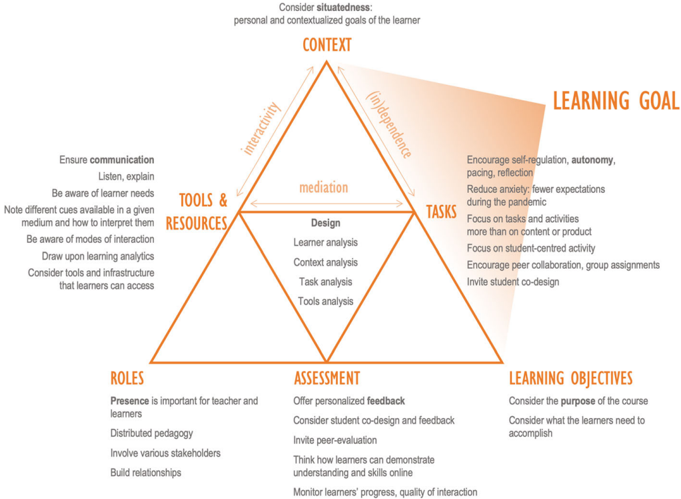
“Our findings point at the design of learning activities with certain characteristics, the combination of three types of presence (social, cognitive and facilitatory) and the need for adapting assessment to the new learning requirements.”
§ Springer Nature Switzerland AG 2020 Published online: 7 July 2020 > Abstract
plainstates an association- Asserted: passes — The authors put it forward as true.
- Checkable: passes — It can be checked against evidence.
- Load-bearing: passes — The paper’s conclusions depend on it.
- Based: passes — The paper gives a reason why it holds.
None of the sources cited for this claim have been checked yet.
In the paper
“What all four experts focus on as a prime ' piece ' of pedagogical knowledge (Kali et al. 2011) is the careful design of activities.”
§ Springer Nature Switzerland AG 2020 Published online: 7 July 2020 > Learning Design
plain- Asserted: passes — The authors put it forward as true.
- Checkable: passes — It can be checked against evidence.
- Load-bearing: unclear — It is unclear whether the paper’s conclusions depend on it.
- Based: passes — The paper gives a reason why it holds.
A result the paper reports from its own data — it cites no other source for it, so there is none to check. The quote shows it is in the paper.
In the paper
“Inspired by Anderson et al. ' s (2001) understanding of teaching presence and how it can be re-conceived in the current Covid-19 situation in which educators are the designers, the tutors and the evaluators of the learning experience, a tripartite framework emerges from the interviews, with three main sub-presences of the teaching presence, namely:”
§ Springer Nature Switzerland AG 2020 Published online: 7 July 2020 > Teacher Presence
plain- Asserted: passes — The authors put it forward as true.
- Checkable: passes — It can be checked against evidence.
- Load-bearing: passes — The paper’s conclusions depend on it.
- Based: passes — The paper gives a reason why it holds.
5 more claims
Create a free account to see all 61 claims and to verify the 9 references still open.
- Probably not a substantial claim. 50
- It may state two separate claims as one. 18
Claims other papers make about this one
Each is checked against this paper’s own text: does it say what the citing paper says it does?
The source backs part of the claim, not all of it — or backs it for a different population, condition or comparison.
In the citing paper
“while it is known that for learning success, input formats usually depend on both attention and interest from the students (Rapanta et al., 2020).”
From Impact of Synchronous and Asynchronous Settings of Online Teaching and Learning in Higher Education on Students' Learning Experience During COVID-19 (2021) · cites this paper as Rapanta et al., 2020
Experimental — accuracy not yet measuredIn the citing paper
“Evaluating AI applications could be beneficial for enhancing their motivation and interest in teaching with AI [40].”
From Developing AI Literacy for Primary and Middle School Teachers in China: Based on a Structural Equation Modeling Analysis (2022) · cites this paper as [40]
Citations
Cites
The Reflective Practitioner: How Professionals Think in Action
Checkoway, B., & Schon, D. A. (1985) · Journal of Policy Analysis and Management · doi:10.2307/3324262 · Cited by 21,268
The reflective practitioner: How professionals think in action
Stewart, C. J. (1984) · Patient Education and Counseling · doi:10.1016/0738-3991(84)90022-3 · Cited by 19,752
Knowledge and teaching: Foundations of the new reform
Shulman, L. (1987) · Harvard Educational Review · doi:10.17763/haer.57.1.j463w79r56455411 · Cited by 16,787
Phenomenological research methods
Moustakas, C. (1994) · doi:10.4135/9781412995658 · Cited by 13,919 · cited 1×
“’ This study ’ s participants, i.e. the four online pedagogy experts, also functioned as co-researchers, following Moustakas ’ (1994) idea (l).”
BackgroundDetermining Validity in Qualitative Inquiry
Creswell, J. W., & Miller, D. L. (2000) · Theory Into Practice · doi:10.1207/s15430421tip3903_2 · Cited by 9,184
Speech Genres and Other Late Essays
Bakhtin, M. M. (1986) · University of Texas Press eBooks · doi:10.7560/720466 · Cited by 8,470
The Difference between Emergency Remote Teaching and Online Learning
Hodges, C. B., Moore, S., Lockee, B. B., Trust, T., & Bond, M. A. (2024) · Handbook of Research in Online Learning · doi:10.1163/9789004702813_021 · Cited by 6,253
Blended learning: Uncovering its transformative potential in higher education
Garrison, D. R., & Kanuka, H. (2004) · The Internet and Higher Education · doi:10.1016/j.iheduc.2004.02.001 · Cited by 4,849
Speech Genres and Other Late Essays
Melaver, M., Bakhtin, M. M., McGee, V. W., Emerson, C., & Holquist, M. (1987) · Poetics Today · doi:10.2307/1772598 · Cited by 3,185
ASSESSING TEACHING PRESENCE IN A COMPUTER CONFERENCING CONTEXT
Anderson, T., Rourke, L., Garrison, R., & Archer, W. (2001) · Online Learning · doi:10.24059/olj.v5i2.1875 · Cited by 1,885
Research works printed but not linked: 2
- Bates, A. W. (2019). Teaching in a digital age. 2nd Edition. Vancouver: Tony Bates Associates. https://pressbooks.bccampus.ca/teachinginadigitalagev2/. Accessed 15 June 2020.
- Shor, I., & Freire, P. (1987). A pedagogy for deliberation: dialogues on transforming education . Westport: Bergin & Garvey Publishers.
Cited by
Items 1,601–1,700 of 2,106
An Evaluation Study of Nurse Educators’ Learning Experience in a Digital Modular Course
Ličen, S., Karnjuš, I., & Prosen, M. (2022) · Andragoška spoznanja · doi:10.4312/as/10547 · Cited by 3
“…appropriate infrastructure which would enable quality digital education experiences through a targeted development of interactive pedagogical tools, effective online student engagement tools, and training for their academic staff (Rapanta et al., 2020), a new teaching paradigm began to emerge.”
BackgroundInfluentialWulandari, M. (2022) · ELTR Journal · doi:10.37147/eltr.v6i1.124 · Cited by 1
“(TP/Resp01) From those interview result, it can be concluded that even in the online setting, students can still have teacher presence through the interaction occurred in the writing and discussion activities (Rapanta, Botturi, Goodyear, Guàrdia, & Koole, 2020).”
BackgroundSenior, J., & Eli, T. B. (2022) · International Conference on Business Analytics for Technology and Security (ICBATS) · doi:10.1109/icbats54253.2022.9759083 · Cited by 1
“(Rapanta et al., 2020; Bates, 2020) Students faced many other personal issues due to the pandemic and resulting online teaching.”
BackgroundApplying social media for studying challenges of COVID-19 for students
Elenurm, T. (2022) · European Conference on Social Media · doi:10.34190/ecsm.9.1.262
“We agree with Rapanta et al (2020) that experience with different online learning tools will increase the readiness of both teachers and students for the post-digital era, where organisations are implementing disruptive technologies using mobile, cloud and artificial intelligence applications.”
BackgroundTomas, C. M. M., Pinto-López, I. N., & Amsler, A. (2022) · Advances in higher education and professional development book series · doi:10.4018/978-1-7998-7693-9.ch008
Таран, Г., Chornomordenko, D., Bondarenko, N., Bohatyrov, D., & Spiridonov, M. (2022) · Revista Tempos e Espaços em Educação · doi:10.20952/revtee.v15i34.17256 · Cited by 1
REMOVED DUE TO POLICY VIOLATIONSPreprint
Quarm, R. S., & Sam-Quarm, R. (2020) · doi:10.31219/osf.io/nxjbv
Visual and Verbal Engagement of Higher Education Students in VideoconferencingPreprint
Händel, M., Bedenlier, S., Kopp, B., Gläser‐Zikuda, M., Kammerl, R., & Ziegler, A. (2021) · PsyArXiv (OSF Preprints) · doi:10.31234/osf.io/my4ze
Soykurt, M., Alt?nay, F., & Alt?nay, G. D. A. Z. (2021) · IADIS International Conference on e-Society (ES) · doi:10.33965/es2021_202101l008
Public relations in the digital era: New methods and tools
Arsenijević, J., & Arsenijević, D. (2021) · Univerzitetska misao - casopis za nauku kulturu i umjetnost Novi Pazar · doi:10.5937/univmis2120054a
REMOVED DUE TO POLICY VIOLATIONSPreprint
Quarm, R. S., & Sam-Quarm, R. (2020) · doi:10.31235/osf.io/xrz6f
Lived experience of literature teachers and students in the new normal
Pordunzalan, R. (2021) · International Journal of Research Studies in Education · doi:10.5861/ijrse.2021.a045
“Rapanta et al. (2020) stated that the term ‘online learning’ is widely used but with a variety of meanings.”
Scherer, R., Siddiq, F., Howard, S. K., & Tondeur, J. (2022) · PsyArXiv (OSF Preprints) · doi:10.31234/osf.io/mvx8t
Challenges for Teaching Online in Higher Education
Kurdadze, E. (2022) · enadakultura · doi:10.52340/lac.2022.963 · Cited by 1
Lokhtina, I. A., & Tyler, M. A. (2022) · Advances in educational technologies and instructional design book series · doi:10.4018/978-1-6684-4240-1.ch011
Computational Modeling and Assessment of Acceptance Level of Virtual Learning Platforms
Agangiba, W. A., Agangiba, M. A., & Okai, G. E. Y. (2022) · International Journal of Computer Applications · doi:10.5120/ijca2022922108
New Legal Reality: Challenges and Perspectives. I
konference, L. U. J. F. 8. S. Z. (2022) · doi:10.22364/iscflul.8.1
augstskola, R. J., & Ratniece, L. (2022) · doi:10.22364/iscflul.8.1.05
Gaikwad, H. V., Pardeshi, A. S., & Pandey, S. (2022) · Advances in educational technologies and instructional design book series · doi:10.4018/978-1-7998-8904-5.ch009 · Cited by 2
SOME BENEFICIAL STRATEGIES FOR DISTANCE INTERACTIVE TEACHING THE LANGUAGE THROUGH THE PANDEMIC
Kovalska, N., & Присяжнюк, Н. (2022) · Наукові інновації та передові технології · doi:10.52058/2786-5274-2022-6(8)-15-26
Social Self-Care: The Necessity of Turning Outward
Ray, N., & Majumdar, A. (2022) · Advances in higher education and professional development book series · doi:10.4018/978-1-6684-2334-9.ch004
Periyakaruppan, K., Aravindhan, K., Balaji, K., Christabel Rishmi, C., Ravanya, R., & Sirakez, P. S. (2022) · International Conference on Applied Artificial Intelligence and Computing (ICAAIC) · doi:10.1109/icaaic53929.2022.9792919
“information, after increase the durability of CNN features to make adjustments and closures [10].”
BackgroundBashyal, R., Devbhandari, R. P., Pradhan, P., Byanju, J., Aryal, S., & Maharjan, B. R. (2022) · Journal of Patan Academy of Health Sciences · doi:10.3126/jpahs.v9i1.42002
E-Learning Virtual Platform with Attendance and Query Using Deep Learning
Supriya, V. N., Swetha, M., Neela, S., & R, M. G. M. N. (2022) · International Journal for Research in Applied Science and Engineering Technology · doi:10.22214/ijraset.2022.44200
CHALLENGES AND OPPORTUNITIES DURING THE NEW NORMAL: PERCEPTION OF ENGLISH LANGUAGE TEACHERS
CERVO, M. C. B. (2022) · International Journal of Research Publications · doi:10.47119/ijrp1001021620223352
Critical Issues On Learning Process Amidst Covid-19 Perceived From Pedagogical Perspectives
Sembiring, M. G. (2022) · Jurnal Pendidikan Terbuka Dan Jarak Jauh · doi:10.33830/ptjj.v23i1.3318.2022
Translated Booklet as Supplementary Material in Science 5
RACOMA, R. B. (2022) · International Journal of Research Publications · doi:10.47119/ijrp1001031620223442 · Cited by 1
GENERAL HEALTH STATUS AND ONLINE TEACHING READINESS AMONG EDUCATORS DURING COVID-19 PANDEMIC
Kamarulzaman, W. B., & Shafie, N. (2022) · International Journal of Education Psychology and Counseling · doi:10.35631/ijepc.746030
“Studies also reported that the participants struggled with designing assessments, especially summative assessments using digital tools (Cutri et al., 2020; Perifanou et al., 2021; Rapanta et al., 2020).”
BackgroundThe Insights of Online Teaching Readiness Among Novice Teachers
Jabal, M. F. A., Ng, S. F., Saad, N. B., et al. (2022) · International Journal of Academic Research in Progressive Education and Development · doi:10.6007/ijarped/v11-i2/14101
Student Perceptions of Online and Hybrid Teaching During the Pandemic
Karpava, S. (2022) · Advances in educational technologies and instructional design book series · doi:10.4018/978-1-6684-4446-7.ch001
Salem, M., El-Dohdar, M., Enshasy, H., Serdah, K., & Qazaer, R. (2022) · Lecture notes in networks and systems · doi:10.1007/978-3-031-08954-1_20 · Cited by 1
Gudžinskienė, V., & Mačiuikienė, D. (2022) · Social Inquiry into Well-Being · doi:10.13165/sd-22-20-1-01
Vasetska, L., & Solovyova, O. V. (2021) · Pedagogical Sciences Theory and Practice · doi:10.26661/2786-5622-2021-4-36
ON-LINE LEARNING IN HIGHER EDUCATION: CURRENT CHALLENGES FOR UKRAINIAN UNIVERSITIES
Zakaulova, Y. V. (2021) · Pedagogical Sciences Theory and Practice · doi:10.26661/2786-5622-2021-4-37
“Слід засто-совувати різні підходи до організації навчального процесу [6].”
Introduction to digitally enhanced learning
Dale, V. H. M., Beggs, R., & Ogamba, I. K. (2022) · doi:10.20919/opxr1032/86
Afzal, S., Din, M., & Malik, H. D. (2022) · International Journal of Distance Education and E-Learning · doi:10.36261/ijdeel.v7i2.2439 · Cited by 2
“Rapanta et al. (2020) in their study suggested that online learning needs pedagogical content knowledge for healthier learning experiences with the help of technologies.”
BackgroundStudents' Perception Regarding the Development of E-learning Activities in Higher Education
Popa, A., Georgescu, C. E., & Trandafir, R. A. (2022) · Ovidius University Annals Economic Sciences Series · doi:10.61801/ouaess.2021.2.64
Communicative Thematic Learning in Madrasah Ibtidaiyah Negeri (MIN) 1 Kota Pariaman
Trinova, Z., Hb, Z., & Hamidah, W. (2020) · JIP Jurnal Ilmiah PGMI · doi:10.19109/jip.v6i2.5475
Calle, M., Ullauri, M., Torres, E., & Peralta, N. (2022) · Lecture notes in networks and systems · doi:10.1007/978-3-031-11438-0_7
Mediatization of Musical and Theatrical Practice on the Moodle Platform
Agrati, L. S., & Karkina, S. V. (2022) · Advances in human and social aspects of technology book series · doi:10.4018/978-1-6684-6015-3.ch002
Amzaourou, O. (2022) · International Journal of Higher Education Pedagogies · doi:10.33422/ijhep.v2i3.48
UNIVERSITIES AND THE PANDEMIC: GETTING COMFORTABLE WITH AMBIGUITY
Miulescu, M. L., & Stîngu, M. M. (2022) · Revista de Pedagogie - Journal of Pedagogy · doi:10.26755/revped/2022.1/49
Learner Engagement in Online Learning During Covid-19 Period for Future Projections
Beyoğlu, D., Altınay, F., Altınay, Z., et al. (2022) · Lecture notes in educational technology · doi:10.1007/978-981-19-5967-7_8
Online Teaching-Learning Experience During COVID-19 Pandemic – A Case Report
Mane, S. U., Patil, S. R., & Kulkarni, S. S. (2021) · Journal of Engineering Education/Journal of engineering education transformations/Journal of engineering education transformation · doi:10.16920/jeet/2021/v35i2/22078
ESL Learners’ Perceptions of Online Learning in a Tertiary Institute
Jeyaraja, S. S. B., & Maniam, M. (2022) · International Journal of English Language Education · doi:10.5296/ijele.v10i2.20183 · Cited by 1
Uzaktan Eğitimde Tıp Fakültesi Öğretim Üyelerinin Hazırbulunuşluk ve Tükenmişliklerinin İncelenmesi
Kocaay, F., Demir, B. T., & Biçer, B. K. (2022) · International Journal of Entrepreneurship and Management Inquiries · doi:10.55775/ijemi.1141124
Hersan, H., Ogara, D. O., & Jariah, T. K. (2022) · International Journal of Ethno-Sciences and Education Research · doi:10.46336/ijeer.v2i3.308 · Cited by 1
“The factors of influence learning activities as follows (Rapanta et al., 2020): a. Endogenous factors, namely factors that exist within the child itself, for example interests, talents, willingness, attitudes, motivation, intelligence, and health. b. Exogenous factors, namely factors that come from…”
BackgroundCOVID-19 and Massage Therapy Education Impact and Future Implications
Torns-Barker, B., & Kennedy, A. B. (2022) · International Journal of Therapeutic Massage & Bodywork Research Education & Practice · doi:10.3822/ijtmb.v15i3.761
Huang, J. (2022) · Advances in Multimedia · doi:10.1155/2022/7288871 · Cited by 1
“At the same time, it is also an objective requirement for the comprehensive development of individual characteristics and needs [3] at the individual level.”
The Impact of the COVID Crisis on Anatomical Education: A Systematic Review
Gajic, N., & Rea, P. (2022) · Biomedical visualization · doi:10.1007/978-3-031-06735-8_10
Tat, C., Gay, S. E. K. P., Colpitts, B. D. F., Stones, T. P., Dickerson, L. A., & Rakhshandehroo, M. (2022) · Advances in educational technologies and instructional design book series · doi:10.4018/978-1-6684-4205-0.ch006
Introducing the Road to Inclusion During the COVID-19 Global Pandemic
Meda, L., & Chitiyo, J. (2022) · Inclusive learning and educational equity · doi:10.1007/978-3-031-10642-2_1
Divekar, N. (2022) · Cardiometry · doi:10.18137/cardiometry.2022.23.710717 · Cited by 1
Bachri, B. S., Mariono, A., & Arianto, F. (2022) · IJORER International Journal of Recent Educational Research · doi:10.46245/ijorer.v3i5.246
“development of science and technology can also facilitate increasingly diverse learning needs by providing a variety of learning resources needed, so that learning becomes much more meaningful (Christin, 2019; Montiel et al., 2020; Rapanta et al., 2020; Syaharuddin et al., 2022).”
BackgroundThe Impact of Covid-19 Pandemic on the Mental Health Among University Going Students in Aligarh City
Aslam, I. (2022) · International Journal for Research in Applied Science and Engineering Technology · doi:10.22214/ijraset.2022.46916
THE IMPACT OF COVID-19 ON THE DESIGN OF ONLINE LANGUAGE TEACHING THROUGH ZOOM
Rozhdestvenska, I. Y., & Cherniavska, O. (2022) · Naukovì zapiski Nacìonalʹnogo unìversitetu «Ostrozʹka akademìâ» Serìâ «Fìlologìâ» · doi:10.25264/2519-2558-2022-13(81)-202-207
Factors Influencing Student Engagement During COVID-19 Emergency Remote Teaching
Ekici, M., & Ekici, D. İ. (2022) · IGI Global eBooks · doi:10.4018/978-1-6684-7540-9.ch077 · Cited by 1
State of the Art About COVID-19's Impact on Santiago University, Cape Verde
Sarmento, E. M., & Monteiro, J. M. (2022) · IGI Global eBooks · doi:10.4018/978-1-6684-7540-9.ch079
Chitiyo, R. A., & Nyemba, F. (2022) · IGI Global eBooks · doi:10.4018/978-1-6684-7540-9.ch064
Pastor, M. D. G. (2022) · IGI Global eBooks · doi:10.4018/978-1-6684-7540-9.ch048
Tshishonga, N. S. (2022) · Advances in educational marketing, administration, and leadership book series · doi:10.4018/978-1-6684-5039-0.ch008
Contrastes en el proceso de aprendizaje en estudiantes de la carrera de Ingeniería Forestal
Valverde, J. C., Romero-Zúñiga, M., & Vargas-Fonseca, L. (2022) · Uniciencia · doi:10.15359/ru.36-1.43
“…del estudiante conforme adquiere conocimiento y cambia su percepción de la carrera (Fine-lli et al ., 2018), por tanto, se debe dar una diferenciación y adecuación de los cursos según el nivel del estudiante conduce a per-der funcionalidad en los cursos y motiva-ción (Rapanta et al ., 2020).”
BackgroundPUBLIC ADMINISTRATION OF EDUCATIONAL SPHERE IN EMERGENCIES: GENERAL APPROACHES AND NATIONAL FEATURES
Радіонова, І. Ф., & Usyk, V. (2022) · Management Theory and Studies for Rural Business and Infrastructure Development · doi:10.15544/mts.2022.34
Random Interval Tracking System for Virtual Learning
P, A. M., & Meera, K. (2022) · International Journal of Engineering Research in Computer Science and Engineering · doi:10.36647/ijercse/09.10.art004
Pandemins påverkan på universitetslärares pedagogiska praktik
Leijon, M., & Stigmar, M. (2022) · Dansk Universitetspædagogisk Tidsskrift · doi:10.7146/dut.v17i33.131719 · Cited by 2
“Det är en uppskattad modell bland vissa lärare och studenter (Raes et al., 2020) där studenterna har möjlighet att påverka tid och plats för sitt lärande (Beatty, 2019; Leijon & Lundgren, 2019; Rapanta et al., 2020).”
BackgroundQayyum, S., Abid, H., & Younas, F. (2024) · Journal of Management Info · doi:10.31580/jmi.v9i2.2665
Shahid, N. (2022) · Discover Education · doi:10.1007/s44217-022-00020-z
“A multitude of scholarly efforts have been conducted to highlight and address the challenges of digital or remote education [1–4, 7, 9, 13, 16, 18, 19, 21, 23, 24, 29, 34, 37].”
BackgroundKenney, T. (2022) · Digital Commons - URI (University of Rhode Island) · doi:10.23860/diss-kenney-timothy-2022
Online teaching during Covid-19 Pandemic – challenges and solutions around the world
Bonta, E., & Galița, R. (2022) · Studies in Linguistics Culture and FLT · doi:10.46687/xodk6156
Pelea, C.-I. (2022) · Akdeniz Üniversitesi İletişim Fakültesi Dergisi · doi:10.31123/akil.1143076
The Impact of Work-Family Conflict on Job Satisfaction in Teachers: A Conceptual Framework
Dong, Z., & Aziz, M. F. A. (2022) · Journal of Public Administration and Governance · doi:10.5296/jpag.v12i4s.20567 · Cited by 1
Tampubolon, E. H. M., Situmorang, M., & Riris, I. D. (2022) · AIP conference proceedings · doi:10.1063/5.0121836 · Cited by 1
Ranđelović Dušan, J., Lazarević, D., & Pavićević, M. (2022) · Zbornik radova Filozofskog fakulteta u Pristini · doi:10.5937/zrffp52-40673
“…over the traditional teaching method, and some of them relate to flexibility in terms of time and place of transfer and reception of knowledge, reduction of the use of travel resources and other costs, as well as the possibility to participate in classes with any device (Rapanta et al., 2020).”
BackgroundPathways to Creative Learning and Teaching Online: An Ecological Model
Philip, R. (2022) · Professional and practice-based learning · doi:10.1007/978-981-19-5587-7_14
The Past Informing the Future: Learning Logs in Online Education
Fatania, T., Andrews, J., & Clark, R. (2022) · Springer eBooks · doi:10.1007/978-3-030-92979-4_28
Rad, F. H., Khodarahmi, S., & Momeni, H. (2021) · Iranian Journal of Educational Sociology · doi:10.52547/ijes.4.4.19 · Cited by 1
“Rapanta & et al (2020) found out the necessity for adaptation of assessments to the new educational conditions in this period.”
BackgroundСОСТОЯНИЕ, ПРОБЛЕМЫ И ПЕРСПЕКТИВЫ РАЗВИТИЯ СОВРЕМЕННОГО ОБРАЗОВАНИЯ
университет», Ф. В. «. Г. Т., Артюхина, А. И., Игоревич, Ч. В., университет», Ф. В. «. Г. Т., Velikanova, O. F., университет», Ф. В. «. Г. Т., Великанов, В. В., университет», Ф. В. «. Г. Т., Владимировна, Я. Н., Вернадского», Ф. В. «. И. В. И., et al. (2022) · ICSP «NEW SCIENCE» eBooks · doi:10.46916/07122022-978-5-00174-782-6
Wei, L., & Chow, K. K. N. (2022) · [ ] With Design: Reinventing Design Modes · doi:10.1007/978-981-19-4472-7_28 · Cited by 3
Alshehri, S. Z. (2022) · Springer eBooks · doi:10.1007/978-3-030-92979-4_15
WALKER, R. A., & Forbes, D. (2022) · Professional and practice-based learning · doi:10.1007/978-981-19-5587-7_1 · Cited by 1
Pivoting a Business School’s Teaching Online
Avery, B., & Wason, H. (2022) · Springer eBooks · doi:10.1007/978-3-030-92979-4_20
Nuniary, S., & Lartutul, E. (2022) · Jurnal Ilmiah Pendidikan Holistik (JIPH) · doi:10.55927/jiph.v1i3.1994
“…siswa masih kurang terlihat dalam kegiatan pembelajaran, selain itu juga proses pembelajaran pada mata pelajaran IPS yang dilakukan oleh guru belum mampu menumbuhkan budaya belajar di kalangan siswa yang nanti pada gilirannya akan sangat berpengaruh pada hasil belajar siswa (Rapanta et al., 2020).”
BackgroundValentine Joseph Owan, P. D., Ekpenyong, J. A., & Udida, U. J. (2022) · ÜNİVERSİTEPARK Bülten · doi:10.22521/unibulletin.2022.111.6
New Literacy Instruction Strategies Considering Higher Education Hybridization
Dumitru, C. (2022) · Advances in mobile and distance learning book series · doi:10.4018/978-1-6684-6071-9.ch001 · Cited by 1
Spaces to care and places to share
Pendergast, D., Sammel, A. J., Rowan, L., et al. (2023) · Routledge eBooks · doi:10.4324/9781003315797-11
Ecology fieldwork during pandemic: Attitudes of science education students
Fardhani, I. (2023) · AIP conference proceedings · doi:10.1063/5.0112064
Teaching Effectiveness Self-Assessment (TESA) among Lecturers during the COVID-19 Pandemic
Abdullah, M. H. T., Roslim, N., Roshdan, N. F. M., et al. (2023) · International Journal of Academic Research in Business and Social Sciences · doi:10.6007/ijarbss/v13-i1/16181
Kutasi, R. (2022) · Acta Marisiensis Philologia · doi:10.2478/amph-2022-0071
KIMANJE, E., & Lunyolo, O. (2022) · doi:10.58653/nche.v10i1.11
Does Covid-19 Accelerate the Cybernetic Revolution and Transition from E-Government to E-State?
Grinin, L. E., Леонидович, Г. А., & Korotayev, A. (2022) · doi:10.30884/978-5-7057-6191-3_05 · Cited by 2
The Effect of Portable Laboratory Integrated with Local Wisdom (PL-ILW) for Physics Learning
Susanto, R., Husen, M. N., & Lajis, A. (2023) · International Conference on Ubiquitous Information Management and Communication (IMCOM) · doi:10.1109/imcom56909.2023.10035589
“For this reason, distance learning becomes a challenge for education actors to give the best learning experience for students with the help of information technology [2].”
BackgroundCheating in Online Exams at Vietnamese Mid-Ranked Universities
Thi, H. N. (2022) · International Conference on Digital Technology in Education (ICDTE) · doi:10.1145/3568739.3568773
“Amongst these areas, fair and accurate assessment of student learning performance became a focal point [6].”
BackgroundYaqin, M. H. A., Utami, Y. W., & Ismail, D. D. S. L. (2022) · Jurnal Aisyah Jurnal Ilmu Kesehatan · doi:10.30604/jika.v7i3.1037 · Cited by 1
The Impact of Remote Teaching on Teachers’ Pedagogical Insight
Kelly, M. C. M. E. (2023) · International Journal for Digital Society · doi:10.20533/ijds.2040.2570.2023.0226
Using Teacher Presence in Online Higher Education to Foster Global Citizenship among Adult Learners
Tarbutton, T., & Doyle, L. B. (2022) · Athens Journal of Education · doi:10.30958/aje.10-2-3 · Cited by 7
PHARMACY STUDENTS’ATTITUDES AND EXPERIENCES IN ONLINE LEARNING DURING GLOBAL PANDEMIC
Xhaferi, A. (2022) · PALIMPSEST/ ПАЛИМПСЕСТ · doi:10.46763/palim22714213dj
Digital Learning Trends Post Covid-19
Madhani, N., Shah, E., Swarnalatha, P., Sivaraman, A., & Furniturewala, M. (2022) · International Conference on Advanced Technologies in Intelligent Control, Environment, Computing & Communication Engineering (ICATIECE) · doi:10.1109/icatiece56365.2022.10047548 · Cited by 1
“[6 ] gives some master exposure to this internet-based education PCK, fully intent on aiding non-master college fellows (for example the ones who do not have hands-on experience about how to use the internet to it’s best of their abilities in the education sector) to be aware of such tedious…”
BackgroundDas, P., & Singha, R. (2022) · Towards Excellence · doi:10.37867/te1402155
Metadata
- Authors
- Rapanta, C., Botturi, L., Goodyear, P., Guàrdia, L., & Koole, M.
- Affiliations
- Universidade Nova de Lisboa (PT)
- University of Applied Sciences and Arts of Southern Switzerland (CH)
- The University of Sydney (AU)
- University of Saskatchewan (CA)
- Corresponding author
- Rapanta, Chrysi
- ORCID
- Rapanta, Chrysi
- Venue
- Postdigital Science and Education
- Published
- 2020-07-07
- Volume
- 2
- Issue
- 3
- Pages
- 923-945
- ISSN
- 2524-485X (ISSN-L)
- 2524-4868
- PMC
- PMC7339092
- OpenAlex
- W3042009104
- Semantic Scholar
- fed495af71b417de8d60cf16b6da44926faf24a0
- Cited by
- 2,130
- References
- 75
- Citations by year
- 2026: 134 · 2025: 158 · 2024: 261 · 2023: 426 · 2022: 556 · 2021: 509 · 2020: 73
- FWCI
- 454.18
- Type
- journal article
- Language
- en
- Open access
- hybrid
- doi.org
- Licence
- other-oa
- www.springer.com/tdm (tdm)
- www.springer.com/tdm (vor)
- Locations
- Postdigital Science and Education (publishedVersion, other-oa)
- PubMed (publishedVersion)
- PubMed Central (submittedVersion)
- The Sydney eScholarship Repository (The University of Sydney) (submittedVersion)
- Funders
- Fundação para a Ciência e a Tecnologia (DL 57/2016/CP1453/CT0066)
- Australian Research Council (DP150104163)
- Topics
- Social Sciences › Education › Digital Education and Society
- Social Sciences › Education › Higher Education Practises and Engagement
- Social Sciences › Education › Educational Innovations and Technology
- Keywords
- online learning, COVID-19 pandemic, higher education, teacher presence, pedagogical content knowledge, learning activities, social presence, cognitive presence
About these checks
Registry, retraction, Cites and statistics results are computed, not judged, with one exception: a printed reference that no index lists is read once by a model before it counts as a citation error. Claims are extracted by a model and kept only when their quote appears verbatim in the text; each cited source is then checked, with a model’s help, for whether it says what the claim relies on. Those verdicts can be wrong — read the claim’s quote and the cited source before relying on one.
The claim verdicts this report counts are experimental: their accuracy is not yet measured.
A language model drew the claims from the paper on 2026-10-10, under version 3 of the claim definition (model deepseek-v4.1-flash, prompt extract-v3).
A second model labelled each claim on 2026-10-10 (model jev-1.13-20260917, definition revision gold-guideline-v0.2).
Cited sources are checked with a language model’s help (qwen3.8-omni-flash).
Statistics and arithmetic are recomputed, not judged.
Confidence bands are shown only for fields calibrated on our annotated test set. None is calibrated yet, so no band is shown.
What counts as a claim ›How we measure confidence ›How we check this ›
Are you an author, or do you see a problem with this page? Request a review
Data sources
Bibliographic data: Semantic Scholar, OpenAlex, Crossref.
Contains information from the Semantic Scholar Academic Graph Datasets, made available under the ODC Attribution License (ODC-BY 1.0).
Semantic Scholar’s data is described in: Kinney, R., et al. (2023). The Semantic Scholar Open Data Platform. arXiv:2301.10140.
