

Online University Teaching During and After the Covid-19 Crisis: Refocusing Teacher Presence and Learning Activity
Open accessThe DOI matches its Crossref record; 71 of the 75 references it cites were found in a registry or an index; 6 of the 42 sources its claims cite were checked for support.
Abstract
The Covid-19 pandemic has raised significant challenges for the higher education community worldwide. A particular challenge has been the urgent and unexpected request for previously face-to-face university courses to be taught online. Online teaching and learning imply a certain pedagogical content knowledge (PCK), mainly related to designing and organising for better learning experiences and creating distinctive learning environments, with the help of digital technologies.
Overview
CoChat Summary
TL;DR
This article is an expert-interview piece offering pedagogical guidance for university teachers suddenly moving online during Covid-19. Its central message is that effective online teaching depends less on tools or materials alone and more on careful learning design, multiple forms of teacher presence, and continuous assessment.
Key findings
- The four experts argue that online learning should be built around carefully designed learning activities, with a mix of synchronous, asynchronous, online, and offline tasks that are clear, appropriately difficult, authentic, and accessible to students.
- They propose a tripartite teaching presence for online courses: cognitive presence, social presence, and facilitatory presence.
- Successful online learning requires students not to feel alone, and it benefits from timely feedback, peer collaboration, and student co-design/co-configuration of activities.
- The paper states that continuous assessment is needed in online learning, and suggests self-reflections, portfolios, self-paced asynchronous activities, and use of learning analytics as part of evaluation.
Methods
- Exploratory qualitative study using expert interviews administered by e-mail.
- Sample: 4 online pedagogy experts/co-authors, selected for research expertise, more than a decade of online teaching experience, and experience across different national education systems; they worked in Switzerland, Australia, Spain, and Canada.
- Main analysis: the first author organized the responses into a panel-like article, then the authors jointly revised and synthesized the material; the discussion summarizes themes under learning design, teacher presence, and assessment.
Limitations
- The paper states that all four experts came from “rich parts of the world” (Switzerland, Canada, Australia, and North of Spain), which limits the lens to a “monofocal” view of educational reality.
- The paper itself says the study used a heuristic method based on expert viewpoints and “by no means can replace rigorous, systematic research” following the scientific method.
- Evident from the text: the sample is very small (4 experts) and highly selected, so the findings are expert-opinion guidance rather than generalizable empirical results.
Model-written summary. Check it against the paper before relying on it.
Integrity signals
Registry
Cites
Statistics
Figures
Verification
Claims the paper makes
5 Valid · 0 Not valid · 32 Not checked · 24 Own results and interpretations
The sources with a verdict support this claim; the rest weren’t checked yet, have no full text we could read, or their verdicts aren’t rated yet.
In the paper
“On top of that, a significant challenge for university teachers has been their lack of the pedagogical content knowledge (PCK) (Shulman 1987) needed for teaching online (Angeli and Valanides 2005; Kali, Goodyear and Markauskaite 2011; Ching, Hsu and Baldwin 2018).”
§ Springer Nature Switzerland AG 2020 Published online: 7 July 2020 > Introduction
What the sources say
- Supportedcites Shulman 1987 matched to “Knowledge and teaching: Foundations of the new reform” (1987) source
The parenthetical (Shulman 1987) is attached to the term 'pedagogical content knowledge (PCK)' — an identification citation — while the online-teaching studies are credited to Angeli & Valanides, Kali et al. and Ching et al. Our copy (the Portuguese edition of Shulman's 1987 Harvard Educational Review article) establishes exactly that concept: the 'Categorias da base de conhecimento' section lists 'conhecimento pedagógico do conteúdo' as one of the categories of the knowledge base for teaching, 'esse amálgama especial de conteúdo e pedagogia que é o terreno exclusivo dos professores', and the 'Novas compreensões' section calls it 'a categoria que melhor distingue a compreensão de um especialista em conteúdo daquela de um pedagogo'. The paper itself says nothing about online teaching or about university teachers lacking PCK, but that part of the sentence is not attributed to this source. (LLM, conf=0.85)
- Not checked — no full text of the sourcecites Angeli and Valanides 2005 matched to “Preservice elementary teachers as information and communication technology designers: an instructional systems design model based on an expanded view of pedagogical content knowledge” (2005) source
- Could not verifycites Ching, Hsu and Baldwin 2018 matched to “Online Course Design and Development among College and University Instructors: An Analysis using Grounded Theory” (2018) sourceExperimental — accuracy not yet measured
Our copy of Baldwin, Ching & Friesen (2018) never mentions pedagogical content knowledge, PCK, Shulman, or TPACK; searches for 'pedagogical content knowledge PCK online teaching', 'TPACK technological pedagogical content knowledge', 'Shulman pedagogical content knowledge Angeli Valanides' and 'challenge lack of knowledge training online instructors pedagogy' returned only the References list and design-process passages. The paper's content is a grounded-theory account of how 14 four-year-institution instructors design online courses (Abstract; Results themes; Discussion mapping to ADDIE), and its nearest statements — that instructors 'must develop new curriculum with instructional strategies effective for online learning' (Discussion) and 'rarely use formal instructional design models' (Results) — concern design practice, not a PCK deficiency framed as a significant challenge. Nothing in our copy either states or contradicts the attributed claim. (LLM, conf=0.72)
plain- Asserted: passes — The authors put it forward as true.
- Checkable: passes — It can be checked against evidence.
- Load-bearing: passes — The paper’s conclusions depend on it.
- Based: passes — The paper gives a reason why it holds.
- Supported
The cited sources support only part of this claim — read each source’s verdict below.
In the paper
“Assessment can possibly be considered the most challenging part of the transition to distance learning for an institution used to face-to-face oral or written exam, as the control shift towards the students makes it hardly possible to ensure that students are not cheating (Munoz and Mackay 2019).”
§ Springer Nature Switzerland AG 2020 Published online: 7 July 2020 > Assessment
What the sources say
- Partly supportedcites Munoz and Mackay 2019 matched to “An online testing design choice typology towards cheating threat minimisation” (2019) sourceExperimental — accuracy not yet measured
Split into 2 atoms — 0 confirmed, 2 partially supported, 0 disputed, 0 misattributed, 0 unverifiable. Expand the claim to see per-atom verdicts.
hedgedstates a possible cause- Asserted: passes — The authors put it forward as true.
- Checkable: passes — It can be checked against evidence.
- Load-bearing: unclear — It is unclear whether the paper’s conclusions depend on it.
- Based: passes — The paper gives a reason why it holds.
- Partly supported
A result the paper reports from its own data — it cites no other source for it, so there is none to check. The quote shows it is in the paper.
In the paper
“Our findings point at the design of learning activities with certain characteristics, the combination of three types of presence (social, cognitive and facilitatory) and the need for adapting assessment to the new learning requirements.”
§ Springer Nature Switzerland AG 2020 Published online: 7 July 2020 > Abstract
plainstates an association- Asserted: passes — The authors put it forward as true.
- Checkable: passes — It can be checked against evidence.
- Load-bearing: passes — The paper’s conclusions depend on it.
- Based: passes — The paper gives a reason why it holds.
None of the sources cited for this claim have been checked yet.
In the paper
“What all four experts focus on as a prime ' piece ' of pedagogical knowledge (Kali et al. 2011) is the careful design of activities.”
§ Springer Nature Switzerland AG 2020 Published online: 7 July 2020 > Learning Design
plain- Asserted: passes — The authors put it forward as true.
- Checkable: passes — It can be checked against evidence.
- Load-bearing: unclear — It is unclear whether the paper’s conclusions depend on it.
- Based: passes — The paper gives a reason why it holds.
A result the paper reports from its own data — it cites no other source for it, so there is none to check. The quote shows it is in the paper.
In the paper
“Inspired by Anderson et al. ' s (2001) understanding of teaching presence and how it can be re-conceived in the current Covid-19 situation in which educators are the designers, the tutors and the evaluators of the learning experience, a tripartite framework emerges from the interviews, with three main sub-presences of the teaching presence, namely:”
§ Springer Nature Switzerland AG 2020 Published online: 7 July 2020 > Teacher Presence
plain- Asserted: passes — The authors put it forward as true.
- Checkable: passes — It can be checked against evidence.
- Load-bearing: passes — The paper’s conclusions depend on it.
- Based: passes — The paper gives a reason why it holds.
5 more claims
Create a free account to see all 61 claims and to verify the 9 references still open.
- Probably not a substantial claim. 50
- It may state two separate claims as one. 18
Claims other papers make about this one
Each is checked against this paper’s own text: does it say what the citing paper says it does?
The source backs part of the claim, not all of it — or backs it for a different population, condition or comparison.
In the citing paper
“while it is known that for learning success, input formats usually depend on both attention and interest from the students (Rapanta et al., 2020).”
From Impact of Synchronous and Asynchronous Settings of Online Teaching and Learning in Higher Education on Students' Learning Experience During COVID-19 (2021) · cites this paper as Rapanta et al., 2020
Experimental — accuracy not yet measuredIn the citing paper
“Evaluating AI applications could be beneficial for enhancing their motivation and interest in teaching with AI [40].”
From Developing AI Literacy for Primary and Middle School Teachers in China: Based on a Structural Equation Modeling Analysis (2022) · cites this paper as [40]
Citations
Cites
The Reflective Practitioner: How Professionals Think in Action
Checkoway, B., & Schon, D. A. (1985) · Journal of Policy Analysis and Management · doi:10.2307/3324262 · Cited by 21,268
The reflective practitioner: How professionals think in action
Stewart, C. J. (1984) · Patient Education and Counseling · doi:10.1016/0738-3991(84)90022-3 · Cited by 19,752
Knowledge and teaching: Foundations of the new reform
Shulman, L. (1987) · Harvard Educational Review · doi:10.17763/haer.57.1.j463w79r56455411 · Cited by 16,787
Phenomenological research methods
Moustakas, C. (1994) · doi:10.4135/9781412995658 · Cited by 13,919 · cited 1×
“’ This study ’ s participants, i.e. the four online pedagogy experts, also functioned as co-researchers, following Moustakas ’ (1994) idea (l).”
BackgroundDetermining Validity in Qualitative Inquiry
Creswell, J. W., & Miller, D. L. (2000) · Theory Into Practice · doi:10.1207/s15430421tip3903_2 · Cited by 9,184
Speech Genres and Other Late Essays
Bakhtin, M. M. (1986) · University of Texas Press eBooks · doi:10.7560/720466 · Cited by 8,470
The Difference between Emergency Remote Teaching and Online Learning
Hodges, C. B., Moore, S., Lockee, B. B., Trust, T., & Bond, M. A. (2024) · Handbook of Research in Online Learning · doi:10.1163/9789004702813_021 · Cited by 6,253
Blended learning: Uncovering its transformative potential in higher education
Garrison, D. R., & Kanuka, H. (2004) · The Internet and Higher Education · doi:10.1016/j.iheduc.2004.02.001 · Cited by 4,849
Speech Genres and Other Late Essays
Melaver, M., Bakhtin, M. M., McGee, V. W., Emerson, C., & Holquist, M. (1987) · Poetics Today · doi:10.2307/1772598 · Cited by 3,185
ASSESSING TEACHING PRESENCE IN A COMPUTER CONFERENCING CONTEXT
Anderson, T., Rourke, L., Garrison, R., & Archer, W. (2001) · Online Learning · doi:10.24059/olj.v5i2.1875 · Cited by 1,885
Research works printed but not linked: 2
- Bates, A. W. (2019). Teaching in a digital age. 2nd Edition. Vancouver: Tony Bates Associates. https://pressbooks.bccampus.ca/teachinginadigitalagev2/. Accessed 15 June 2020.
- Shor, I., & Freire, P. (1987). A pedagogy for deliberation: dialogues on transforming education . Westport: Bergin & Garvey Publishers.
Cited by
Items 1,201–1,300 of 2,106
Ekoç, A. (2022) · TEFLIN Journal - A publication on the teaching and learning of English · doi:10.15639/teflinjournal.v33i2/257-271 · Cited by 6
“Apparently, being a good teacher in face-to-face teaching may not necessarily mean that s/he is a good video actor in remote teaching as a result of different factors including distractions, lack of focus, etc. (Rapanta et al., 2020).”
BackgroundNingsih, S. R., Hartati, S., Trisnawati, L., et al. (2022) · ABDISOSHUM Jurnal Pengabdian Masyarakat Bidang Sosial dan Humaniora · doi:10.55123/abdisoshum.v1i3.882 · Cited by 2
Maulana, A. E., & Arli, D. I. (2022) · The Electronic Journal of e-Learning · doi:10.34190/ejel.20.5.2644 · Cited by 10
“Likewise, previous studies have discussed face-to-face learning, indicating that support from institutions significantly influences the success of a lecturer's teaching process (Rapanta et al., 2020).”
BackgroundResultInfluentialTeachers’ Perspectives on Teaching and Learning during the Pandemic in the United States
Burgin, X. D., Daniel, M. C., & Wasonga, T. A. (2022) · Educational Process International Journal · doi:10.22521/edupij.2022.113.7 · Cited by 7
“Keeping abreast of emerging platforms, familiarity with tools to deliver online instruction, and acquiring sufficient knowledge of the appropriate methodology to facilitate meaningful online learning experiences requires time (Graves & Bowers, 2018; Rapanta et al., 2020).”
Práticas projetuais participativas no ensino de Design: estudo de caso da disciplina Projeto VII
Nunes, V. D. G. A., JORGE, V. A., & Carvalho, A. R. D. L. (2022) · doi:10.5151/ped2022-6477178 · Cited by 2
Archila, P. A., de Mejía, A. T., & Restrepo, S. (2022) · Online Learning · doi:10.24059/olj.v26i4.2985 · Cited by 4
“It is, therefore, rational and reasonable that some scholars consider that the Covid-19 crisis is an invaluable opportunity to create university student-centered online learning environments (e.g., Rapanta et al., 2020; Zhu & Liu, 2020).”
BackgroundUmaro, M., Rejekiningsih, T., & Ardianto, D. T. (2022) · Journal of Education Technology · doi:10.23887/jet.v6i4.48041 · Cited by 4
“Compared to conventional training, online classroom training can allow for a more professional experience (Rapanta et al., 2020).”
BackgroundSahoo, S., Megarani, R., & Mahesh, V. (2022) · IEEE India Conference · doi:10.1109/indicon56171.2022.10039978 · Cited by 2
“Primarily the knowledge transmission to the student community is takes place through instructor-led lecture classes [10] before the Covid situation.”
BackgroundSimulating an engineering workplace: a new approach to prototype-based team project
Chan, B., Asad, T. B., & Bairaktarova, D. (2022) · Annual Conference of the European Society for Engineering Education (SEFI) · doi:10.5821/conference-9788412322262.1346 · Cited by 2
Saúde emocional e pandemia: percepção docente e discente do curso de administração
Nunes, A. D. F. P., de Castro, B. L. G., Pontelli, G. E., Costa, V. M. F., & Kneipp, J. M. (2023) · Revista Gestão Universitária na América Latina - GUAL · doi:10.5007/1983-4535.2023.e91280 · Cited by 2
Pérez, L., García, I. C., Madrigal, M., Montero-Cuadrado, F., Sobas, E. M., & Cámara, R. S. (2023) · International Journal of Environmental Research and Public Health · doi:10.3390/ijerph20054470 · Cited by 5
“Therefore, university students changed their practices very abruptly, and without a period of adaptation, to a new model of virtual teaching [3] during the first and second waves of COVID 19 when the study was carried out.”
BackgroundVirtual Distance in Project Work: What We Have Learned From the Pandemic
Hafner, C. A., & Xia, S. A. (2023) · RELC Journal · doi:10.1177/00336882231158162 · Cited by 4
“…to quickly adjust the design of their courses, in-class activities and other aspects of their teaching to fit the new online teaching environment (Rapanta et al., 2020) – for example, by making greater use of ‘flipped’ models of instructional design and activities like polls to foster…”
BackgroundLeinonen, R., Kesonen, M., & Asikainen, M. A. (2023) · SN Social Sciences · doi:10.1007/s43545-023-00647-1 · Cited by 2
“Interaction (Delgado 2021; Lemay et al. 2020; O’Brien 2021; Rapanta et al. 2020; Romadhon et al. 2021) Challenges and opportunities related to interaction in online teaching Changes in the amount and modes of interaction Changes in giving feedback The sense of community”
BackgroundBoyd, V., Wilson, C. J. N., & Smith, C. E. (2023) · Journal of University Teaching and Learning Practice · doi:10.53761/1.20.4.06 · Cited by 5
Naidoo, J. T., Pillay, D., & Naicker, I. (2023) · International Journal of Qualitative Methods · doi:10.1177/16094069231180167 · Cited by 4
“The migration to online platforms increased the stress levels and the workloads of academics who prior to the pandemic were already weighed down by burdensome teaching loads, research, and community service responsibilities (Rapanta et al., 2020).”
BackgroundShared uncertainties: mapping digital teaching artistry in youth performing arts during COVID-19
Trezise, B., Vengurlekar, N., & Whittaker, M. (2023) · Research in Drama Education The Journal of Applied Theatre and Performance · doi:10.1080/13569783.2023.2227579 · Cited by 2
“It witnessed equally rapid pivots in multiple tiers of the educational sector, and in the case of the tertiary sector, necessitated rapid innovation where demand for interactive digital learning appears set to remain (Rapanta et al. 2020).”
BackgroundTeaching interpreting in times of Covid: perspectives, experience and satisfaction
Castillo-Rodríguez, C., Báez, M. C. T., & Seghiri, M. (2023) · Revista de Lingüística y Lenguas Aplicadas · doi:10.4995/rlyla.2023.18747 · Cited by 2
Tadros, O. K., Arabiyat, S., Al-Daghastani, T., Tabbalat, N., Albooz, R., & ALSalamat, H. (2023) · Cureus · doi:10.7759/cureus.42994 · Cited by 2
“Furthermore, the shift to online learning called for the adaptation of assessment methods to meet the new demands of remote education [2,5].”
BackgroundIdika, E. O., Obiagu, A. N., & Ibe, E. (2023) · Journal of Black Psychology · doi:10.1177/00957984231195250 · Cited by 3
“…that educational literature involved the implementation and effectiveness of e-learning and teachers ’ preparedness to transition to online teaching, especially in developed contexts (Anwar and Adnan, 2020; Consortium for School Networking [COSN], 2020; Levinson et al., 2020; Rapanta et al., 2020).”
The Role and Application of Learning Theories in the Virtual University
Czaplinski, I., & Huijser, H. (2023) · University development and administration · doi:10.1007/978-981-99-4170-4_13 · Cited by 4
Manata, B., Bozeman, J., Boynton, K., & Neal, Z. P. (2023) · Communication Studies · doi:10.1080/10510974.2023.2263922 · Cited by 4
“This problem is also likely compounded by the recent pandemic, where faculty members were forced to work primarily in a virtual environment (e.g., see Rapanta et al., 2020).”
BackgroundKaličanin, M., & Novaković, A. M. (2023) · Facta Universitatis Series Teaching Learning and Teacher Education · doi:10.22190/futlte230404029k · Cited by 2
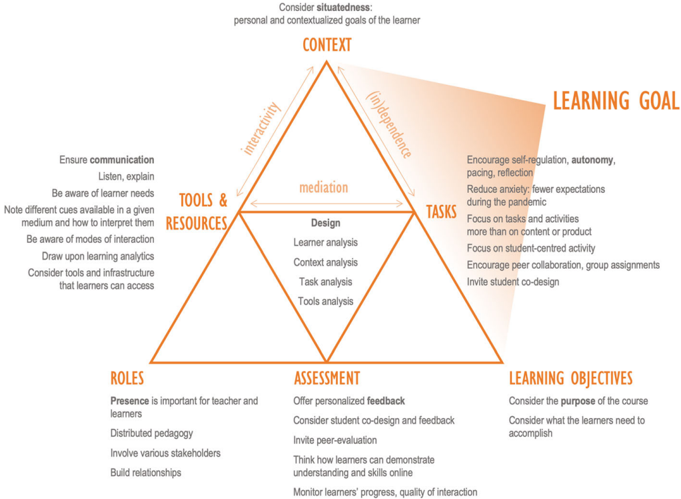
“The main components that determine the character of online teaching are the following: 1) content (goals); 2) tools and resources; 3) particular tasks; and 4) the interconnectedness and reciprocal influence of the aforementioned elements (Rapanta et al., 2020).”
BackgroundLooi, K. H. (2023) · Information Discovery and Delivery · doi:10.1108/idd-01-2023-0005 · Cited by 3
Developing Science-Based Modules with MIKiR and Literacy Learning in the Grade V
Asmaryadi, A. I. (2023) · PPSDP International Journal of Education · doi:10.59175/pijed.v2i2.104 · Cited by 2
“Experiencing in the learning procedure is an activity that connects students directly during the learning process, so it can create more meaningful learning (Rapanta et al., 2020).”
The Moderating Role of Learning Performance on Teaching Competencies and Student Satisfaction
Wajahat, A., & Zia, S. (2022) · Reviews of Management Sciences · doi:10.53909/rms.04.01.094 · Cited by 2
“To be a successful teacher, teachers need to work on some competencies such as intellectual ability, management, interpersonal and professionalism (Rapanta et al., 2020).”
BackgroundSanjaya, I., Suprianti, G. A. P., & Paramartha, A. A. G. Y. (2023) · The Art of Teaching English as a Foreign Language · doi:10.36663/tatefl.v4i2.628 · Cited by 3
Giffi, V., Fantinelli, S., & Galanti, T. (2023) · Social Sciences · doi:10.3390/socsci12120664 · Cited by 4
Online instructors’ pedagogical beliefs and choice of student learning activities
Inan, F. A., & Bolliger, D. U. (2023) · Educational Technology Research and Development · doi:10.1007/s11423-023-10331-z · Cited by 4
“…experience, instructors develop familiarity with course management systems, pedagogical knowledge of designing and developing online courses, adaptability to challenges and obstacles, and the ability to make adjustments based on their observations and feedback from students (Rapanta et al., 2020).”
Online Assessment in Large Undergraduate Courses During COVID-19 Emergency Response Teaching
Williams, K. M., & Donlan, A. E. (2023) · Journal of Educational Research and Practice · doi:10.5590/jerap.2023.13.1.31 · Cited by 4
“However, as the pandemic continued, there was more need to create sustainable online learning environments and assess complex learning outcomes (Korkmaz & Toraman, 2020; Olsen, 2021; Rapanta et al., 2020).”
BackgroundStudent and Staff Experiences of Online Learning: Lessons from Covid-19 in an Australian Law School
Blake, M., Ricciardo, A., Clare, J., McGaughey, F., Skead, N., & McCutcheon, J. (2022) · Legal Education Review · doi:10.53300/001c.38775 · Cited by 2
Temporal changes in procrastination in online and face-to-face learning environments
Sun, T., Tjuandi, G., & Kim, J.-E. (2024) · International Journal of Industrial Ergonomics · doi:10.1016/j.ergon.2024.103546 · Cited by 4
Salazar, D., & Guillaumier, C. (2024) · Open Book Publishers · doi:10.11647/obp.0353.07 · Cited by 2
Thanh, L. P., Trang, T. N. Q., Minh, N. N., & Hoang, V. H. (2024) · Human Behavior and Emerging Technologies · doi:10.1155/2024/5560967 · Cited by 9
“Prior research during the pandemic predominantly focused on strategies for online education, facilitation of teaching, resources, policies, and the impact of lockdowns on student learning [10 – 12].”
BackgroundMethodIS DISTANCE e-LEARNING OPTION ACCEPTABLE BY NIGERIANS AMIDST COVID-19 PANDEMIC?
Hassan, Z., Sa’id, A. S., & Mohammed, H. A. (2021) · African Journal of Education and Practice · doi:10.47604/ajep.1193 · Cited by 3
“DL becomes a priority requiring teachers to move to online delivery of lessons (4).”
BackgroundAn Analysis of Fully Synchronous Pandemic Secondary Education
Ryan, M. P. (2021) · Advances in educational technologies and instructional design book series · doi:10.4018/978-1-7998-7275-7.ch013 · Cited by 2
PERSEPSI MAHASISWA TENTANG PENGGUNAAN VIDEO PEMBELAJARAN PADA MATERI PERSAMAAN DIFERENSIAL
Ningsih, Y. L., & Fitriasari, P. (2021) · Indiktika Jurnal Inovasi Pendidikan Matematika · doi:10.31851/indiktika.v3i2.5517 · Cited by 2
Végh, V., Soltész-Várhelyi, K., & Pusztafalvi, H. (2021) · Emerald Group Publishing Limited eBooks · doi:10.1108/s2055-364120210000041019 · Cited by 2
Digital Education at University: The Process of Adjustment Under Turbulence
Репина, Е. Г. (2021) · Lecture notes in networks and systems · doi:10.1007/978-3-030-83175-2_107 · Cited by 2
Shareefa, M., Muneez, M., Hammad, A., & Shihamaa, M. (2021) · International Journal of Learning Teaching and Educational Research · doi:10.26803/ijlter.20.11.26 · Cited by 3
“…the globe, academics did not seem to be fully ready and equipped with the tools and knowledge required for a rapid switch in the nature of delivery, from face-to-ace to fully virtual mode, which was forced by the crisis of full lockdown that confined people to their homes (Rapanta et al., 2020).”
BackgroundStudents’ Satisfaction with Virtual Interaction Mediated Online Learning: An Empirical Investigation
Iqbal, M. H., Rahaman, M. M., Mahamud, M. S., Munira, S., Haque, M. A., Islam, M. A., Mazid, M. A., & Hossain, M. E. (2021) · Lecture notes on data engineering and communications technologies · doi:10.1007/978-981-16-6636-0_58 · Cited by 3
impact of COVID-19 in an ESP course: An unforeseen adaptation to distance teaching
Zurita, P. L. (2022) · Didacticae Revista de Investigación en Didácticas Específicas · doi:10.1344/did.2022.11.42-58 · Cited by 2
“teaching approaches and methodologies (Rapanta et al., 2020), we should learn from our mistakes as we move on, taking into account the students’ perception all along this process (Baladrón et al.”
BackgroundThe pedagogy of hyperlinkages: Knowledge curatorialism and the archive of kindness
Auerbach, J. (2022) · South African Journal of Higher Education · doi:10.20853/36-5-4602 · Cited by 5
“…across the globe in 2020, when educational institutions were compelled to shift online at an unprecedented pace (Bao 2020; Rajab, Gazal, and Alkattan 2020; Rapanta, Botturi, and Goodyear 2020) and academics suddenly needed to “curate” their student’s learning experiences through digital means.”
Adaptation of Music Practice Learning Assessment During the Covid-19 Pandemic
Utomo, U., Suharto, S., & Wafa, M. U. (2022) · Advances in Social Science, Education and Humanities Research/Advances in social science, education and humanities research · doi:10.2991/assehr.k.220601.064 · Cited by 2
“This is following the results of research which confirms that in online learning as it is today, it is necessary to adjust the assessment procedure and use technology in its implementation [14].”
ResultClemente, G., García-Prats, A., Lisón, P., Rubio, C., Vidal‐Puig, S., Ricarte, B., Estruch, V., Fenollosa, L., Manzano, J., Rovira-Más, F., et al. (2022) · Sustainability · doi:10.3390/su141710607 · Cited by 2
Perceptions of participants on Online Learning in the Outbreak of COVID-19: Case StudyPreprint
Polgampala, S., Edirisinghe, M. N. S., Sudaraka, G. A. D., & Patabedige, A. S. (2021) · SSRN Electronic Journal · doi:10.2139/ssrn.3808994 · Cited by 2
Understanding University Engagement: The impact of COVID-19 on collaborations and partnerships
Law, S. F., Cattlin, J., & Locke, W. (2021) · doi:10.46580/124365 · Cited by 2
Shuchi, M. S., Tabassum, S. C., & Toufique, M. M. K. (2021) · SSRN Electronic Journal · doi:10.2139/ssrn.3861135 · Cited by 2
Masjaya, Sardjono, M. A., Paramita, S., & Rahmadi, A. (2020) · EdArXiv (OSF Preprints) · doi:10.35542/osf.io/fjm4q · Cited by 2
LearnxDesign 2021: Engaging with challenges in design education
Bohemia, E., Nielsen, L. M., Pan, L., Börekçi, N. A. G. Z., & Zhang, Y. (2021) · doi:10.21606/drs_lxd2021.001 · Cited by 2
Gender Differences in Teachers' ReadinessPreprint
Scherer, R., Siddiq, F., Tondeur, J., & Howard, S. K. (2022) · PsyArXiv (OSF Preprints) · doi:10.31234/osf.io/svdfp · Cited by 3
Scherer, R., Siddiq, F., Howard, S. K., & Tondeur, J. (2022) · OSF Preprints (OSF Preprints) · doi:10.31219/osf.io/upt98 · Cited by 2
Rice, M. F. (2022) · Online Learning · doi:10.24059/olj.v26i3.3621 · Cited by 2
Making media for learning musical instruments using the Scratch application
Julia, J., Gunara, S., & Iswara, P. D. (2021) · Journal of Physics Conference Series · doi:10.1088/1742-6596/1987/1/012019 · Cited by 1
“Thus, both teachers and students can improve their technology literacy to deal with current learning conditions that demand a touch of technology [10-12].”
BackgroundTurrubiartes, M. M. M. C., Turrubiartes, I. R. C., Posadas, M. G., et al. (2020) · doi:10.1109/jicv51605.2020.9375694 · Cited by 1
“Advances ininformation andcommunication technologies (ICT) contribute directly to generating new forms of learning, especially to the development of the educational process through the Internet [1-4].”
BackgroundGOING ONLINE: THE INFLUENCE OF COVID-19 ON STUDENT`S LEARNING EXPERIENCE
Corboș, R.-A., Bunea, O.-I., ZAMFIR, A., & Gora, A. A. (2020) · Proccedings of the International Management Conference · doi:10.24818/imc/2020/02.11 · Cited by 1
An Inquiry Based Learning Experience Using K-W-L in Business Communication Presentations
Bhattacharyya, E., & Eizamly, N. U. E. N. (2021) · Journal of Creative Practices in Language Learning and Teaching (CPLT) · doi:10.24191/cplt.v9i2.16402 · Cited by 2
A Systematic Review of Online Teaching during COVID-19 Pandemic: A Lock Opened in Lockdown
Padwal, M. K., & Takale, L. R. (2022) · Indian Journal of Medical Biochemistry · doi:10.5005/jp-journals-10054-0189 · Cited by 1
Cruz, A. L. D., Balontong, M. G. L., Lumogdang, A. B. B., Dequito, S. D., Diesto, R. F. G., Salam, A. U., Camlayan, I. E., Mahinay, H. M., & Florague, A. P. (2022) · American Journal of Education and Technology · doi:10.54536/ajet.v1i2.482 · Cited by 1
Ntuli, H., Muchapondwa, E., Ntuli, V., & Mangwende, L. (2022) · IGI Global eBooks · doi:10.4018/978-1-6684-7540-9.ch007 · Cited by 1
Herliana, F., Susanna, S., Elisa, E., et al. (2022) · Jurnal Penelitian Pendidikan IPA · doi:10.29303/jppipa.v8i4.1636 · Cited by 1
“, 2020) because online teaching and learning imply knowledge of specific pedagogical content knowledge (PCK), mainly related to designing and organizing for a better learning experience and creating a distinctive learning environment, with the help of digital technologies (Rapanta et al., 2020).”
BackgroundImpact Of Online Teaching And Learning Towards Mental Health Of University Students
Othman, S. I. T., Johari, M. S. M., Rahman, M. D. A., Baharun, N. B., Darawi, M. N., Noor, H. M., & Mukhtar, F. (2022) · European Proceedings of Multidisciplinary Sciences · doi:10.15405/epms.2022.10.24 · Cited by 1
“To use technologies more effectively, any university must work out various options of online pedagogical approaches (Rapanta et al., 2020).”
BackgroundAmeyaw, S. (2023) · University of Dar es Salaam Library Journal · doi:10.4314/udslj.v17i2.8 · Cited by 2
Teaching-learning via telepresence classrooms: does telepresence really provide ‘presence’?
Cheruvalath, R. (2023) · Education and Information Technologies · doi:10.1007/s10639-023-11782-w · Cited by 2
“The presence is manifested throughout the course design (Guàrdia et al., 2013), and ensuring presence leads to improved teaching-learning practices (Rapanta et al., 2020).”
BackgroundQuality and Inequality: Students’ Online Learning Experiences Amidst the COVID-19 Pandemic in Taiwan
Lin, A. F. Y., & Hou, A. Y. C. (2023) · Higher education in Asia · doi:10.1007/978-981-99-1874-4_10 · Cited by 1
Exploring Online College Students’ Satisfaction with Distance Education During the COVID-19
Zhao, G. (2023) · Research and Advances in Education · doi:10.56397/rae.2023.06.01 · Cited by 2
Digital Assessment Literacy: English Assessment Practice in Vietnam
Thai, T., Sheehan, S., Quynh, N. T. N., Nguyen, T. T. P., Nguyen, Y., Tran, H. T. T., Nguyen, C. T., Nguyen, H. Q., & Bui, S. (2023) · Advances in educational technologies and instructional design book series · doi:10.4018/978-1-6684-6227-0.ch009 · Cited by 4
Narlu, G., & Kahraman, A. (2023) · Advanced Linguistics · doi:10.20535/2617-5339.2023.11.279004 · Cited by 2
Mohebi, L., AlMohsen, F., & Alshamsi, A. (2023) · Journal of Education and e-Learning Research · doi:10.20448/jeelr.v10i4.5092 · Cited by 2
“This sudden shift has presented numerous challenges for educators, including pre-service and in-service teachers, who are required to adapt to new teaching methods and technologies (Rapanta, Botturi, Goodyear, Guàrdia, & Koole, 2020).”
BackgroundLamba, N., Kishore, S., & Khokhlova, O. (2023) · Frontiers in Education · doi:10.3389/feduc.2023.1237672 · Cited by 7
THE IMPACT OF DIGITAL TRANSFORMATION READINESS TOWARDS THE NEW NORMALCY IN THE EDUCATION SYSTEM
Tharwat, A., Al-Qassem, A. H., & Marwaha, S. (2024) · Emirati Journal of Business Economics & Social Studies · doi:10.54878/63rqyn42 · Cited by 3
Mukherji, P., & Khedlekar-Bodas, H. (2023) · International Conference on Cognitive Computing and Engineering Education (ICCCEE) · doi:10.1109/icccee55951.2023.10424546 · Cited by 1
“As the traditional classroom teaching-learning method is adopted for many years, faculties are very well aware of various pedagogical approaches to be followed in a classroom which can result in achievement of the learning outcomes of the course they are teaching [2].”
BackgroundUnlocking the power of micro-credentials in commerce degrees: A practical example
Steyn, R., & Eybers, S. (2024) · doi:10.4102/aosis.2024.bk454.15 · Cited by 1
Factors influencing undergraduate students’ engagement in online learning: a PLS-SEM approach
Abdullah, M. N. L. Y., Hsien, O. L., Nagaratnam, S., & Leong, H. J. (2024) · Learning Research and Practice · doi:10.1080/23735082.2024.2348997 · Cited by 3
“The COVID-19 pandemic prompted an abrupt shift from traditional in-person teaching to online instruction (Krishnan & Hassan, 2021; Rapanta et al., 2020).”
Ummi, R., Baker, D., Kerr-Sims, S., & Galib, M. H. (2024) · Journal of Educational Technology Development and Exchange · doi:10.18785/jetde.1701.06 · Cited by 1
“In this respect, integration of online teaching can be associated with technical and pedagogical support, the school vision about online learning, and strong leadership (Bao, 2020; Rapanta et al., 2020).”
BackgroundYou, Y., Zou, B., & Wang, C. (2024) · Advances in higher education and professional development book series · doi:10.4018/979-8-3693-2857-6.ch012 · Cited by 1
Öğretmenlerin eTwinning Eğitim Modeli Hakkındaki Görüşlerinin Değerlendirilmesi
Arıcan, İ., & Ateş, Ö. T. (2024) · Öğretmen Eğitimi ve Öğretim · doi:10.55661/jnate.1307177 · Cited by 1
Wani, Y. M., & Ganaie, S. A. (2024) · Journal of Library Resource Sharing · doi:10.1080/26915979.2024.2425389 · Cited by 1
Paloș, R., & Vîrgă, D. (2024) · Lecture notes in educational technology · doi:10.1007/978-981-97-6136-4_14 · Cited by 1
The Effect of Canvas LMS on Motivation, Engagement, and Interaction in Al Ain Private Schools
Dagamseh, R. A., & Osman, S. Z. M. (2024) · International Journal of Academic Research in Progressive Education and Development · doi:10.6007/ijarped/v13-i4/23586 · Cited by 5
Navigating Learning: Teaching Map Skills in Grade 6 Social Sciences
Ramsaroop, S., & Kwayi, A. M. (2024) · The Journal of Geography Education in Africa · doi:10.46622/jogea.v7i1.5407 · Cited by 5
Fasinu, V. G. (2024) · Interdisciplinary Journal of Education · doi:10.53449/ije.v7i2.659 · Cited by 1
“However, several studies have reported the different approaches adopted when teaching mathematics among high school and university students during the COVID-19 pandemic era (Bates, 2020; Rapanta et al., 2020).”
Ariati, J., Vogler, J. S., & Pham, T. (2025) · Educational Psychology · doi:10.1080/01443410.2025.2468735 · Cited by 3
“More recent studies have also reported online students face obstacles, ranging from financial constraints and basic internet connectivity to mental and physical wellbeing, which in turn impacts their ability to understand course content (Gonzalez et al., 2020; Rapanta et al., 2020).”
Teixeira, K., & Li, X. (2024) · IEEE Frontiers in Education Conference (FIE) · doi:10.1109/fie61694.2024.10893488 · Cited by 2
“Since most instructors have never been trained on using online tools, this situation created new challenges for the vast majority of them [5]– [7].”
Kavuran, E., Hamdan‐Mansour, A. M., & Fawaz, M. A. (2025) · Contemporary Nurse · doi:10.1080/10376178.2025.2461541 · Cited by 4
“However, the results do not agree with other studies (Rajabalee & San-tally, 2021; Rapanta et al., 2020) where demographics of students were affecting their engagement.”
Keskikallio, J., Ulvsgärd, A., Villavicencio, V., Faraon, M., & Rönkkö, K. (2024) · International Workshop on Artificial Intelligence and Education (WAIE) · doi:10.1109/waie63876.2024.00064 · Cited by 1
“The foundation of the guided process is illustrated horizontally and divided into five different stages: pre-analysis , conceptualization , authoring , implementation , and evaluation [29], [30].”
Annamalai, N., Hashim, M., Yatim, S. A. M., Raju, G., Yunus, N. M., & Kamal, S. S. L. A. (2025) · Library Hi Tech · doi:10.1108/lht-01-2024-0036 · Cited by 9
English Learning Interest in High School Students: TPACK-Based Problem-Based Learning Model
Hamsia, H., Sunra, L., & Iryani, N. (2024) · ETDC Indonesian Journal of Research and Educational Review · doi:10.51574/ijrer.v3i4.360 · Cited by 1
“The success of learning will achieve its goals if the teacher can deliver the material well using the right learning model (Bojović et al., 2020; Rapanta et al., 2020).”
Grynyova, V. (2025) · Health Technologies · doi:10.58962/ht.2025.3.1.26-35 · Cited by 1
Balancing tradition and innovation: university teachers’ perspectives on HyFlex teaching
Badiozaman, I. F. A., & Segar, A. R. (2025) · Asia Pacific Journal of Education · doi:10.1080/02188791.2025.2497271 · Cited by 1
Harianto, J. E., Tahir, M., Palandi, E. H., & Armini, N. W. Y. (2025) · International Journal for Science Review · doi:10.71364/ijfsr.v2i4.40 · Cited by 2
Inclusion in Higher Education During Natural Disruptions: Lessons from the COVID-19 Pandemic
Nthontho, M. A., & Moepya, P. (2025) · Emerald Group Publishing Limited eBooks · doi:10.1108/978-1-83608-944-520251043 · Cited by 1
Rafiq, K. R. M., Hashim, H. B., Yunus, M. M., et al. (2025) · Communications in computer and information science · doi:10.1007/978-3-031-98003-9_5 · Cited by 1
Özdemir, O. (2025) · Kastamonu Eğitim Dergisi · doi:10.24106/kefdergi.1750697 · Cited by 2
The Future of Digital Learning in the Era of Misinformation
Das, S. K., Karmakar, S., & Das, T. (2025) · IGI Global eBooks · doi:10.4018/979-8-3693-9067-2.ch012 · Cited by 1
The role of network culture and digital etiquette in student learning: a systematic review
Syzdykbayeva, A., Abdigapbarova, U. M., Aitenova, E. A., Иминова, Ю. Б., & Khassanova, I. (2025) · The Education and science journal · doi:10.17853/1994-5639-2025-7-72-91 · Cited by 1
“C. Rapanta, L. Botturi, P. Goodyear et al. [36] emphasised the need to rethink pedagogical presence and learning activities in an online format.”
Taridi, M., Chowdhury, R., Yaakob, M. F. M., Ridwan, A., Habibi, A., & Anwar, K. (2025) · Technology Pedagogy and Education · doi:10.1080/1475939x.2025.2553583 · Cited by 3
Thriving in Disruption: Enhancing Satisfaction Through Collaborative Engagement
Das, M., Ramalingam, M., Priyadarshini, S., Agrawal, M., & Goyal, K. (2025) · Global Business and Organizational Excellence · doi:10.1002/joe.70014 · Cited by 3
How COVID-19 Shaped University Students’ Perspectives of Poor Teaching
Rayner, G. M., & Papakonstantinou, T. (2025) · College Teaching · doi:10.1080/87567555.2025.2571630 · Cited by 1
Bekešienė, S., Smaliukienė, R., & Vasiliauskas, A. V. (2025) · Sustainability · doi:10.3390/su17209151 · Cited by 4
Z-test in the Study of Student Engagement in Online Education: Mobile Application and Web Version
Tsarev, R. Y., Senapati, B., Nikolaeva, I. V., Abduboriyevna, I. F., Nikulushkin, A., & Muracova, N. (2025) · Lecture notes in networks and systems · doi:10.1007/978-3-032-00715-5_29 · Cited by 1
Metadata
- Authors
- Rapanta, C., Botturi, L., Goodyear, P., Guàrdia, L., & Koole, M.
- Affiliations
- Universidade Nova de Lisboa (PT)
- University of Applied Sciences and Arts of Southern Switzerland (CH)
- The University of Sydney (AU)
- University of Saskatchewan (CA)
- Corresponding author
- Rapanta, Chrysi
- ORCID
- Rapanta, Chrysi
- Venue
- Postdigital Science and Education
- Published
- 2020-07-07
- Volume
- 2
- Issue
- 3
- Pages
- 923-945
- ISSN
- 2524-485X (ISSN-L)
- 2524-4868
- PMC
- PMC7339092
- OpenAlex
- W3042009104
- Semantic Scholar
- fed495af71b417de8d60cf16b6da44926faf24a0
- Cited by
- 2,130
- References
- 75
- Citations by year
- 2026: 134 · 2025: 158 · 2024: 261 · 2023: 426 · 2022: 556 · 2021: 509 · 2020: 73
- FWCI
- 454.18
- Type
- journal article
- Language
- en
- Open access
- hybrid
- doi.org
- Licence
- other-oa
- www.springer.com/tdm (tdm)
- www.springer.com/tdm (vor)
- Locations
- Postdigital Science and Education (publishedVersion, other-oa)
- PubMed (publishedVersion)
- PubMed Central (submittedVersion)
- The Sydney eScholarship Repository (The University of Sydney) (submittedVersion)
- Funders
- Fundação para a Ciência e a Tecnologia (DL 57/2016/CP1453/CT0066)
- Australian Research Council (DP150104163)
- Topics
- Social Sciences › Education › Digital Education and Society
- Social Sciences › Education › Higher Education Practises and Engagement
- Social Sciences › Education › Educational Innovations and Technology
- Keywords
- online learning, COVID-19 pandemic, higher education, teacher presence, pedagogical content knowledge, learning activities, social presence, cognitive presence
About these checks
Registry, retraction, Cites and statistics results are computed, not judged, with one exception: a printed reference that no index lists is read once by a model before it counts as a citation error. Claims are extracted by a model and kept only when their quote appears verbatim in the text; each cited source is then checked, with a model’s help, for whether it says what the claim relies on. Those verdicts can be wrong — read the claim’s quote and the cited source before relying on one.
The claim verdicts this report counts are experimental: their accuracy is not yet measured.
A language model drew the claims from the paper on 2026-10-10, under version 3 of the claim definition (model deepseek-v4.1-flash, prompt extract-v3).
A second model labelled each claim on 2026-10-10 (model jev-1.13-20260917, definition revision gold-guideline-v0.2).
Cited sources are checked with a language model’s help (qwen3.8-omni-flash).
Statistics and arithmetic are recomputed, not judged.
Confidence bands are shown only for fields calibrated on our annotated test set. None is calibrated yet, so no band is shown.
What counts as a claim ›How we measure confidence ›How we check this ›
Are you an author, or do you see a problem with this page? Request a review
Data sources
Bibliographic data: Semantic Scholar, OpenAlex, Crossref.
Contains information from the Semantic Scholar Academic Graph Datasets, made available under the ODC Attribution License (ODC-BY 1.0).
Semantic Scholar’s data is described in: Kinney, R., et al. (2023). The Semantic Scholar Open Data Platform. arXiv:2301.10140.
