

Online University Teaching During and After the Covid-19 Crisis: Refocusing Teacher Presence and Learning Activity
Open accessThe DOI matches its Crossref record; 71 of the 75 references it cites were found in a registry or an index; 6 of the 42 sources its claims cite were checked for support.
Abstract
The Covid-19 pandemic has raised significant challenges for the higher education community worldwide. A particular challenge has been the urgent and unexpected request for previously face-to-face university courses to be taught online. Online teaching and learning imply a certain pedagogical content knowledge (PCK), mainly related to designing and organising for better learning experiences and creating distinctive learning environments, with the help of digital technologies.
Overview
CoChat Summary
TL;DR
This article is an expert-interview piece offering pedagogical guidance for university teachers suddenly moving online during Covid-19. Its central message is that effective online teaching depends less on tools or materials alone and more on careful learning design, multiple forms of teacher presence, and continuous assessment.
Key findings
- The four experts argue that online learning should be built around carefully designed learning activities, with a mix of synchronous, asynchronous, online, and offline tasks that are clear, appropriately difficult, authentic, and accessible to students.
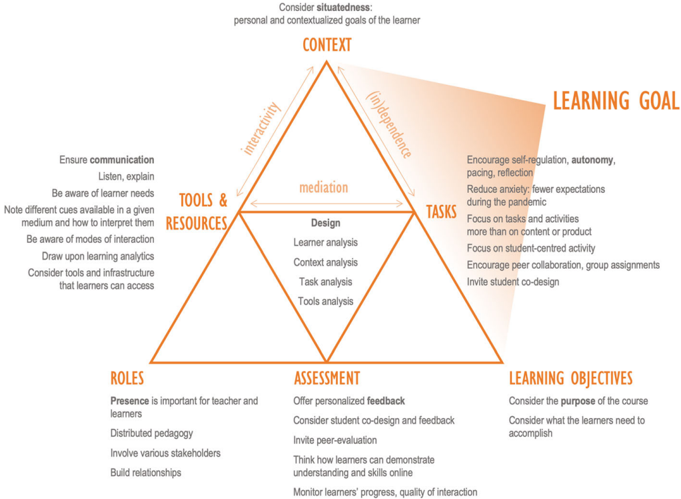
- They propose a tripartite teaching presence for online courses: cognitive presence, social presence, and facilitatory presence.
- Successful online learning requires students not to feel alone, and it benefits from timely feedback, peer collaboration, and student co-design/co-configuration of activities.
- The paper states that continuous assessment is needed in online learning, and suggests self-reflections, portfolios, self-paced asynchronous activities, and use of learning analytics as part of evaluation.
Methods
- Exploratory qualitative study using expert interviews administered by e-mail.
- Sample: 4 online pedagogy experts/co-authors, selected for research expertise, more than a decade of online teaching experience, and experience across different national education systems; they worked in Switzerland, Australia, Spain, and Canada.
- Main analysis: the first author organized the responses into a panel-like article, then the authors jointly revised and synthesized the material; the discussion summarizes themes under learning design, teacher presence, and assessment.
Limitations
- The paper states that all four experts came from “rich parts of the world” (Switzerland, Canada, Australia, and North of Spain), which limits the lens to a “monofocal” view of educational reality.
- The paper itself says the study used a heuristic method based on expert viewpoints and “by no means can replace rigorous, systematic research” following the scientific method.
- Evident from the text: the sample is very small (4 experts) and highly selected, so the findings are expert-opinion guidance rather than generalizable empirical results.
Model-written summary. Check it against the paper before relying on it.
Integrity signals
Registry
Cites
Statistics
Figures
Verification
Claims the paper makes
5 Valid · 0 Not valid · 32 Not checked · 24 Own results and interpretations
The sources with a verdict support this claim; the rest weren’t checked yet, have no full text we could read, or their verdicts aren’t rated yet.
In the paper
“On top of that, a significant challenge for university teachers has been their lack of the pedagogical content knowledge (PCK) (Shulman 1987) needed for teaching online (Angeli and Valanides 2005; Kali, Goodyear and Markauskaite 2011; Ching, Hsu and Baldwin 2018).”
§ Springer Nature Switzerland AG 2020 Published online: 7 July 2020 > Introduction
What the sources say
- Supportedcites Shulman 1987 matched to “Knowledge and teaching: Foundations of the new reform” (1987) source
The parenthetical (Shulman 1987) is attached to the term 'pedagogical content knowledge (PCK)' — an identification citation — while the online-teaching studies are credited to Angeli & Valanides, Kali et al. and Ching et al. Our copy (the Portuguese edition of Shulman's 1987 Harvard Educational Review article) establishes exactly that concept: the 'Categorias da base de conhecimento' section lists 'conhecimento pedagógico do conteúdo' as one of the categories of the knowledge base for teaching, 'esse amálgama especial de conteúdo e pedagogia que é o terreno exclusivo dos professores', and the 'Novas compreensões' section calls it 'a categoria que melhor distingue a compreensão de um especialista em conteúdo daquela de um pedagogo'. The paper itself says nothing about online teaching or about university teachers lacking PCK, but that part of the sentence is not attributed to this source. (LLM, conf=0.85)
- Not checked — no full text of the sourcecites Angeli and Valanides 2005 matched to “Preservice elementary teachers as information and communication technology designers: an instructional systems design model based on an expanded view of pedagogical content knowledge” (2005) source
- Could not verifycites Ching, Hsu and Baldwin 2018 matched to “Online Course Design and Development among College and University Instructors: An Analysis using Grounded Theory” (2018) sourceExperimental — accuracy not yet measured
Our copy of Baldwin, Ching & Friesen (2018) never mentions pedagogical content knowledge, PCK, Shulman, or TPACK; searches for 'pedagogical content knowledge PCK online teaching', 'TPACK technological pedagogical content knowledge', 'Shulman pedagogical content knowledge Angeli Valanides' and 'challenge lack of knowledge training online instructors pedagogy' returned only the References list and design-process passages. The paper's content is a grounded-theory account of how 14 four-year-institution instructors design online courses (Abstract; Results themes; Discussion mapping to ADDIE), and its nearest statements — that instructors 'must develop new curriculum with instructional strategies effective for online learning' (Discussion) and 'rarely use formal instructional design models' (Results) — concern design practice, not a PCK deficiency framed as a significant challenge. Nothing in our copy either states or contradicts the attributed claim. (LLM, conf=0.72)
plain- Asserted: passes — The authors put it forward as true.
- Checkable: passes — It can be checked against evidence.
- Load-bearing: passes — The paper’s conclusions depend on it.
- Based: passes — The paper gives a reason why it holds.
- Supported
The cited sources support only part of this claim — read each source’s verdict below.
In the paper
“Assessment can possibly be considered the most challenging part of the transition to distance learning for an institution used to face-to-face oral or written exam, as the control shift towards the students makes it hardly possible to ensure that students are not cheating (Munoz and Mackay 2019).”
§ Springer Nature Switzerland AG 2020 Published online: 7 July 2020 > Assessment
What the sources say
- Partly supportedcites Munoz and Mackay 2019 matched to “An online testing design choice typology towards cheating threat minimisation” (2019) sourceExperimental — accuracy not yet measured
Split into 2 atoms — 0 confirmed, 2 partially supported, 0 disputed, 0 misattributed, 0 unverifiable. Expand the claim to see per-atom verdicts.
hedgedstates a possible cause- Asserted: passes — The authors put it forward as true.
- Checkable: passes — It can be checked against evidence.
- Load-bearing: unclear — It is unclear whether the paper’s conclusions depend on it.
- Based: passes — The paper gives a reason why it holds.
- Partly supported
A result the paper reports from its own data — it cites no other source for it, so there is none to check. The quote shows it is in the paper.
In the paper
“Our findings point at the design of learning activities with certain characteristics, the combination of three types of presence (social, cognitive and facilitatory) and the need for adapting assessment to the new learning requirements.”
§ Springer Nature Switzerland AG 2020 Published online: 7 July 2020 > Abstract
plainstates an association- Asserted: passes — The authors put it forward as true.
- Checkable: passes — It can be checked against evidence.
- Load-bearing: passes — The paper’s conclusions depend on it.
- Based: passes — The paper gives a reason why it holds.
None of the sources cited for this claim have been checked yet.
In the paper
“What all four experts focus on as a prime ' piece ' of pedagogical knowledge (Kali et al. 2011) is the careful design of activities.”
§ Springer Nature Switzerland AG 2020 Published online: 7 July 2020 > Learning Design
plain- Asserted: passes — The authors put it forward as true.
- Checkable: passes — It can be checked against evidence.
- Load-bearing: unclear — It is unclear whether the paper’s conclusions depend on it.
- Based: passes — The paper gives a reason why it holds.
A result the paper reports from its own data — it cites no other source for it, so there is none to check. The quote shows it is in the paper.
In the paper
“Inspired by Anderson et al. ' s (2001) understanding of teaching presence and how it can be re-conceived in the current Covid-19 situation in which educators are the designers, the tutors and the evaluators of the learning experience, a tripartite framework emerges from the interviews, with three main sub-presences of the teaching presence, namely:”
§ Springer Nature Switzerland AG 2020 Published online: 7 July 2020 > Teacher Presence
plain- Asserted: passes — The authors put it forward as true.
- Checkable: passes — It can be checked against evidence.
- Load-bearing: passes — The paper’s conclusions depend on it.
- Based: passes — The paper gives a reason why it holds.
5 more claims
Create a free account to see all 61 claims and to verify the 9 references still open.
- Probably not a substantial claim. 50
- It may state two separate claims as one. 18
Claims other papers make about this one
Each is checked against this paper’s own text: does it say what the citing paper says it does?
The source backs part of the claim, not all of it — or backs it for a different population, condition or comparison.
In the citing paper
“while it is known that for learning success, input formats usually depend on both attention and interest from the students (Rapanta et al., 2020).”
From Impact of Synchronous and Asynchronous Settings of Online Teaching and Learning in Higher Education on Students' Learning Experience During COVID-19 (2021) · cites this paper as Rapanta et al., 2020
Experimental — accuracy not yet measuredIn the citing paper
“Evaluating AI applications could be beneficial for enhancing their motivation and interest in teaching with AI [40].”
From Developing AI Literacy for Primary and Middle School Teachers in China: Based on a Structural Equation Modeling Analysis (2022) · cites this paper as [40]
Citations
Cites
The Reflective Practitioner: How Professionals Think in Action
Checkoway, B., & Schon, D. A. (1985) · Journal of Policy Analysis and Management · doi:10.2307/3324262 · Cited by 21,268
The reflective practitioner: How professionals think in action
Stewart, C. J. (1984) · Patient Education and Counseling · doi:10.1016/0738-3991(84)90022-3 · Cited by 19,752
Knowledge and teaching: Foundations of the new reform
Shulman, L. (1987) · Harvard Educational Review · doi:10.17763/haer.57.1.j463w79r56455411 · Cited by 16,787
Phenomenological research methods
Moustakas, C. (1994) · doi:10.4135/9781412995658 · Cited by 13,919 · cited 1×
“’ This study ’ s participants, i.e. the four online pedagogy experts, also functioned as co-researchers, following Moustakas ’ (1994) idea (l).”
BackgroundDetermining Validity in Qualitative Inquiry
Creswell, J. W., & Miller, D. L. (2000) · Theory Into Practice · doi:10.1207/s15430421tip3903_2 · Cited by 9,184
Speech Genres and Other Late Essays
Bakhtin, M. M. (1986) · University of Texas Press eBooks · doi:10.7560/720466 · Cited by 8,470
The Difference between Emergency Remote Teaching and Online Learning
Hodges, C. B., Moore, S., Lockee, B. B., Trust, T., & Bond, M. A. (2024) · Handbook of Research in Online Learning · doi:10.1163/9789004702813_021 · Cited by 6,253
Blended learning: Uncovering its transformative potential in higher education
Garrison, D. R., & Kanuka, H. (2004) · The Internet and Higher Education · doi:10.1016/j.iheduc.2004.02.001 · Cited by 4,849
Speech Genres and Other Late Essays
Melaver, M., Bakhtin, M. M., McGee, V. W., Emerson, C., & Holquist, M. (1987) · Poetics Today · doi:10.2307/1772598 · Cited by 3,185
ASSESSING TEACHING PRESENCE IN A COMPUTER CONFERENCING CONTEXT
Anderson, T., Rourke, L., Garrison, R., & Archer, W. (2001) · Online Learning · doi:10.24059/olj.v5i2.1875 · Cited by 1,885
Research works printed but not linked: 2
- Bates, A. W. (2019). Teaching in a digital age. 2nd Edition. Vancouver: Tony Bates Associates. https://pressbooks.bccampus.ca/teachinginadigitalagev2/. Accessed 15 June 2020.
- Shor, I., & Freire, P. (1987). A pedagogy for deliberation: dialogues on transforming education . Westport: Bergin & Garvey Publishers.
Cited by
Items 1,301–1,400 of 2,106
Arzeman, A., Haines, J., Pritchard, C., Rutherford, S., & Francis, N. (2025) · FEBS Open Bio · doi:10.1002/2211-5463.70151 · Cited by 10
“Nonetheless, the transition to online learning sparked change and new teaching practices, prompting a re-evaluation of effective learning, teaching and assessment in higher education [5 – 7].”
Shaw, R., & WALKER, R. A. (2025) · Technology Pedagogy and Education · doi:10.1080/1475939x.2025.2580325 · Cited by 1
“…of unfamiliar tools and techniques: teaching staff were expected to become familiar with new skills as online learning designers and tutors with unprecedented speed (Rapanta et al., 2020), whilst students were expected to quickly develop the skills to engage as fully online learners (Weller, 2020).”
Time Management and Wellbeing for Educators and Students
Subrahmanyam, S., & Khalil, F. C. (2025) · IGI Global eBooks · doi:10.4018/979-8-3373-3902-3.ch012 · Cited by 2
Addressing Challenges Towards Online Learning Framework
Santiago, C., Jr. (2026) · Journal of interdisciplinary perspectives · doi:10.69569/jip.2025.765 · Cited by 1
Domínguez, F. I. R., Antequera, J. G., Pérez, A. G., & Arriazu-Muñoz, R. (2026) · Education Sciences · doi:10.3390/educsci16020319 · Cited by 2
RESILIENT PEDAGOGY: COMPARATIVE APPROACHES IN TIMES OF CRISIS
Lukianenko, N. (2025) · The Scientific Notes of the Pedagogical Department · doi:10.26565/2074-8167-2025-57-15 · Cited by 1
Kpum, M. M., & Gasa, V. (2026) · Discover Education · doi:10.1007/s44217-026-01434-9 · Cited by 5
“Global studies suggest that over 40% of university students experience symptoms of depression, 30% anxiety, and nearly half report high levels of stress - challenges that are often exacerbated by limited digital access [66].”
Sanabria‐Mazo, J. P., Bentil, H., Bonilla, I., Cladellas, R., Dudenaite, D., Tillmanns, T., Dobler, I., Muro, A., & Riva, E. (2026) · Cogent Education · doi:10.1080/2331186x.2026.2652188 · Cited by 2
Kurniaman, O., Fabros, B. G., Noviana, E., et al. (2026) · Primary Jurnal Pendidikan Guru Sekolah Dasar · doi:10.33578/jpfkip.v15i2.288-303 · Cited by 1
“The CRIS instrument is adapted from Anuar et al. (2023), which is grounded in the Theory of Planned Behavior (TPB).”
InfluentialZbenovich, C., & Scott-Monkhouse, A. R. (2026) · Education Sciences · doi:10.3390/educsci16050707 · Cited by 2
Urban planning to support the conservation of freshwater biodiversity
Currie, H. A. L., Kirkwood, A. E., Imhof, J. G., Piczak, M. L., Creed, I. F., Lapointe, N. W. R., Mandrak, N. E., Null, S. E., Harding, J. S., Rooney, R. C., et al. (2026) · Journal of Environmental Planning and Management · doi:10.1080/09640568.2026.2638827 · Cited by 1
“In both sectors, institutions have, and must, continue to invest in support systems and contingency strategies that enable proactive responses to unexpected challenges (Rapanta et al .”
Nwaigwe, H. C., Ayanwale, M. A., Ukeje, I. O., Ngene, I. A., Ekwunife, R. A., Atukpa, E. I., Nwigwe, C. N., & Egba, V. N. (2026) · Sustainability · doi:10.3390/su18105125 · Cited by 9
Digital technology in entrepreneurship education: A bibliometric analysis
Asrul, Rusijono, Dewi, U., Darman, R. A., Benufinit, Y. A., Zarvianti, E., Mustopa, D., & Elisa, D. (2026) · Social Sciences & Humanities Open · doi:10.1016/j.ssaho.2026.102838 · Cited by 3
Ayodeji, M., Ojobola, F. B., Ogundare, A. A., Aremu, B. V., Ayanwoye, O. K., & Babalola, F. E. (2026) · Discover Education · doi:10.1007/s44217-026-01817-y · Cited by 1
“At the same time, other educators increasingly recognize digital pedagogy as necessary for differentiated instruction, personalized learning, resource sharing, and continuity during disruptions [12, 50, 59].”
Yamada, R. (2026) · Springer eBooks · doi:10.1007/978-981-92-1606-2_6 · Cited by 1
Panadero, E., Amezua-Urrutia, A., Ruiz, J. F., Rodríguez-Hernández, C. F., & Fraile, J. (2026) · Assessment & Evaluation in Higher Education · doi:10.1080/02602938.2026.2707269 · Cited by 1
Engineering Faculty Perspectives on Curricular Preparedness for Disruption
Raju, G. M., Balart, T., Ligler, G. T., Shryock, K. J., & Brumbelow, K. (2026) · ASEE Annual Conference & Exposition · doi:10.18260/1-2--59317 · Cited by 3
Vallejos, M. C., de Céspedes, I. S. S., Núñez-Pérez, J., & Pais-Chanfrau, J.-M. (2026) · International Journal of Sustainability in Higher Education · doi:10.1108/ijshe-12-2025-1524 · Cited by 1
Kumar, S. (2020) · International Journal of Applied Science and Engineering · doi:10.30954/2322-0465.2.2020.5 · Cited by 1
Semantic Features of Students’ Attitude to Interaction in the Digital Educational Environment
Shcherbakova, T. N., Misirov, D. N., Loseva, I., et al. (2021) · E3S Web of Conferences · doi:10.1051/e3sconf/202125807089 · Cited by 1
“…abilities are important, but also the semantic features of his relations to what is happening in real and virtual environments, a positive image of his future, which perform an important function in choosing a development strategy and building a trajectory for the future professional path [14-15].”
BackgroundZooming?! - Higher Education Faculty Perspectives
Leiba, M., & Gafni, R. (2021) · Informing Science and IT Education Conference · doi:10.28945/4768 · Cited by 2
“123 a good time to reconsider how we might better invest time and resources in course design (Rapanta et al., 2020).”
BackgroundInfluentialUsing Mathematics Digital Interactive Notebooks as Authentic Integrated Online Assessments
Galanti, T. M., Baker, C. K., Kraft, T., & Morrow-Leong, K. (2021) · Advances in mobile and distance learning book series · doi:10.4018/978-1-7998-7222-1.ch023 · Cited by 2
Bayrak, G., Şavkın, R., & Büker, N. (2021) · Türk fizyoterapi ve rehabilitasyon dergisi · doi:10.21653/tjpr.786507 · Cited by 1
IMPLEMENTASI COLLABORATIVE PROJECT BASED LEARNING MENGGUNAKAN PODCAST DI MASA PANDEMI
Wicaksono, S. R., & Mustapa, K. (2021) · Zenodo (CERN European Organization for Nuclear Research) · doi:10.5281/zenodo.5209086 · Cited by 1
Ardid, M., Ardid, M., & Herrero, A. (2021) · Congreso de Innovación Educativa y Docencia en Red (IN-RED) · doi:10.4995/inred2021.2021.13448 · Cited by 1
Leberecht, V. (2021) · Journal of Learning Development in Higher Education · doi:10.47408/jldhe.vi22.767 · Cited by 1
“See: Gardner, 2011; Rapanta et al., 2020).”
BackgroundPranckūnienė, E., Girdzijauskienė, R., Bubnys, R., et al. (2021) · Human, Technologies and Quality of Education · doi:10.22364/htqe.2021.56 · Cited by 1
“…students, to apply a greater variety of information sources and assessment methods, to use more diverse means of communication with students, and to monitor the quality of studies more effectively (Bryson & Lauren, 2020; Rapanta et al., 2020; Mollenkopf & Gaskill, 2020; Wargadinata et al., 2020).”
BackgroundBaloyi, M. E. (2021) · Advances in Developmental and Educational Psychology · doi:10.25082/adep.2021.01.005 · Cited by 1
“Reilly (2020) quotes a teacher as saying: “I’ve not been trained to do any of this, and I don’t want my students to be at a loss because I am in uncharted territory”. The teacher in question argues that she is not an online teacher and it is this frankness about the situation in which teachers find themselves that nee…”
BackgroundInfluentialDesigning Tools and Activities for Educational Robotics in Online Learning
Negrini, L., Giang, C., & Bonnet, E. (2021) · Advances in educational technologies and instructional design book series · doi:10.4018/978-1-7998-7443-0.ch010 · Cited by 1
Deconstructing Self-Regulated Learning Skills in the Emergency Remote Learning
Mahmud, M. M., Wong, S. F., & Ramachandiran, C. R. (2021) · International Conference on Distance Education and Learning (ICDEL) · doi:10.1145/3474995.3475029 · Cited by 6
“Students may not know if their ideas were received by their teachers or classmates clearly as progressive refinements through interactions are difficult in an online setting [36].”
BackgroundEmancipatory action of teaching praxis in critical pedagogy
Palomino-Flores, P., & Cristi-López, R. (2021) · IEEE Sciences and Humanities International Research Conference (SHIRCON) · doi:10.1109/shircon53068.2021.9652246 · Cited by 1
The Role of Higher Education in Recovery, Resilience, and Prosperity After the Coronavirus
Gowan, S. (2022) · Advances in educational marketing, administration, and leadership book series · doi:10.4018/978-1-7998-8402-6.ch021 · Cited by 1
Challenges at Technology Adoption in Academic Learning among Students during the COVID-19 Lockdown
Rodrigues, D. E., Kamath, N., & Souza, R. P. D. (2022) · Journal of Health and Allied Sciences NU · doi:10.1055/s-0041-1741507 · Cited by 1
Virtual Instruction Support for Faculty
McLaughlin, L. A., & Ricevuto, J. (2021) · Issues in Informing Science and Information Technology · doi:10.28945/4792 · Cited by 1
Atri, M., Oberoi, S. S., & Sharma, N. (2022) · Journal of Indian Association of Public Health Dentistry · doi:10.4103/jiaphd.jiaphd_204_20 · Cited by 2
Response: Physical Education Learning Assignment Amid the Covid-19 Pandemic
Candra, O., Wahyudi, W., & Prasetyo, T. (2022) · INSPIREE Indonesian Sport Innovation Review · doi:10.53905/inspiree.v3i03.89 · Cited by 1
Methods of Coping with the Class Engagement Crisis in the Philippines’ COVID-19 New Normal
Ramos, S. V. (2022) · ASR Chiang Mai University Journal of Social Sciences and Humanities · doi:10.12982/cmujasr.2021.006 · Cited by 1
Li, J. (2022) · Wireless Communications and Mobile Computing · doi:10.1155/2022/9162580 · Cited by 1
“At present, the internet-based network teaching model has become an indispensable learning tool for young people [2].”
BackgroundRetractedTowards authentic online assessment in higher education: Lessons learnt during the COVID-19 period
Mwangi, S. K., Mutwiri, C., & Muthima, P. (2022) · Elsevier eBooks · doi:10.1016/b978-0-323-91185-6.00016-1 · Cited by 3
COVID-19-Related Challenges in Business Information Systems Education: Experiences from Slovenia
Marolt, M., Pucihar, A., Lenart, G., Vidmar, D., Gašperlin, B., & Borštnar, M. K. (2022) · Lecture notes in business information processing · doi:10.1007/978-3-031-04216-4_7 · Cited by 1
Fitriani, Z. N., Setyaningsih, Y., & Denny, H. M. (2022) · Jurnal Keperawatan · doi:10.32583/keperawatan.v14i1.91 · Cited by 1
Applying Digital Storytelling to Improve Students’ Writing Narrative Text Learning
Goestina, G., Mayasari, K. R., & Nugrawati, S. (2022) · BATARA DIDI English Language Journal · doi:10.56209/badi.v1i1.14 · Cited by 1
“…with producing material, constructing organizational structures, setting objectives, performing the technical components of writing, rewriting the text, and redefining their goals (See for example: Fiorella & Kuhlmann, 2020; van Alten et al., 2020; Rapanta et al., 2020; Bikowski & Casal, 2018).”
BackgroundInfluentialImpact and Perception of Students towards Online Learning during COVID-19
G., D. M., & Pushpa, J. (2022) · Asian Journal of Agricultural Extension Economics & Sociology · doi:10.9734/ajaees/2022/v40i1031034 · Cited by 1
Teaching Reflections and Insights From a 38-Year Sport Management Career
Weese, W. J. (2022) · Sport Management Education Journal · doi:10.1123/smej.2022-0008 · Cited by 1
Li, J., Liu, S.-F., Ho, M.-X., et al. (2021) · doi:10.21606/drs_lxd2021.05.128 · Cited by 1
“…of assessing teaching and learning, including the selection of online platforms, teaching tools and the planning of their operational processes (Rapanta, Botturi, Goodyear, Guàrdia & Koole, 2020); the establishment of forms of teacher-student interaction (Bervell, Umar & Kamilin, 2020); the…”
Morales-Arsenal, R., & Pinar-Pérez, J. M. (2022) · Lecture notes on data engineering and communications technologies · doi:10.1007/978-3-031-10385-8_55 · Cited by 1
Object-based learning: active learning through enquiry
Dale, V. H. M., Tasler, N., & Sánchez-Jáuregui, L. (2022) · doi:10.20919/opxr1032/69 · Cited by 3
The Effect of Android-Based Learning Media Using Crossword Puzzles On English Vocabulary Mastery
Yudiati, R., & Rizqi, H. (2022) · Prisma Sains Jurnal Pengkajian Ilmu dan Pembelajaran Matematika dan IPA IKIP Mataram · doi:10.33394/j-ps.v10i3.5695 · Cited by 1
“Global changes in the development of knowledge and technology, especially those related to the education system in schools, require changes in the attitudes of educators/ teachers in implementing classroom learning (Serdyukov, 2017; Rapanta et al., 2020).”
BackgroundNtsobi, M. P., & Singh, P. (2022) · doi:10.55162/mcet.03.065 · Cited by 1
“In a world of digital transformation, disruptive technology innovation, and rapid change in the educational framework, the university system must be prepared to provide high-quality education [59].”
BackgroundA new way of doing business during the COVID-19 pandemic
Almaz, F. (2022) · Management · doi:10.30924/mjcmi.27.1.19 · Cited by 1
Rumahlewang, E., Ratnaya, I. G., & Matitaputty, J. (2022) · Jurnal Kependidikan Jurnal Hasil Penelitian dan Kajian Kepustakaan di Bidang Pendidikan Pengajaran dan Pembelajaran · doi:10.33394/jk.v8i3.5705 · Cited by 4
“In addition, offline learning is self-directed because it learns without the guidance of an instructor and allows students to learn to be responsible for their learning (Rapanta et al., 2020).”
BackgroundTHE ONLINE STUDY OF LITERATURE IN ISRAELI TEACHER-EDUCATION COLLEGES: FRAMEWORK AND GUIDELINES
Segev, Y., & Levin, O. (2022) · L1 Educational Studies in Language and Literature · doi:10.21248/l1esll.2022.22.1.456 · Cited by 2
Every Challenge is an Opportunity: Teaching Reading in the Post-Pandemic Period
David, M. K., & Ali, A. (2022) · Unisia · doi:10.20885/unisia.vol40.iss1.art2 · Cited by 1
Šácha, J., Konderla, T., & Říhová, D. (2022) · Journal of Applied Research in Higher Education · doi:10.1108/jarhe-05-2022-0142 · Cited by 2
Students’ Online Assessments in Higher Education Context: Indonesian Teacher Educators’ Voice
Sucahyo, D., Hermagustiana, I., & Rusmawaty, D. (2022) · Script Journal Journal of Linguistic and English Teaching · doi:10.24903/sj.v7i2.1090 · Cited by 1
Culturally Responsive Schooling during COVID-19: A Study of Six Elementary Level Educators’ Reality
Burgin, X. D., Daniel, M. C., & Coli, S. (2022) · The Educational Forum · doi:10.1080/00131725.2022.2153189 · Cited by 1
Safitri, W. D., Situmorang, M., Silaban, R., & Sudrajat, A. (2022) · AIP conference proceedings · doi:10.1063/5.0113544 · Cited by 3
Griffiths, T.-L., Dickinson, J., & Kellock, A. (2022) · Springer eBooks · doi:10.1007/978-3-030-92979-4_9 · Cited by 1
Joseph, D., & Merrick, B. (2022) · Advances in mobile and distance learning book series · doi:10.4018/978-1-6684-6071-9.ch013 · Cited by 3
HIỀN, N. N., & UYÊN, N. T. H. (2022) · Journal of Science and Technology - IUH · doi:10.46242/jstiuh.v58i04.4497 · Cited by 1
Dimensiones de la interacción e importancia del diálogo en la relación docente-estudiante
Puccio, F. D. M., & Albujar, O. A. S. (2022) · Revista Pedagogía Universitaria y Didáctica del Derecho · doi:10.5354/0719-5885.2022.67269 · Cited by 3
Teacher Communication Strategy in Online Teaching
Kannareth, T. (2022) · Journal of Asian Multicultural Research for Educational Study · doi:10.47616/jamres.v3i4.352 · Cited by 2
Distant science practicals–COVID-19 experience from Czech lower secondary schools
Janštová, V., & Zdobinská, H. (2023) · Eurasia Journal of Mathematics Science and Technology Education · doi:10.29333/ejmste/12795 · Cited by 1
Factors Influencing Adoption of Accrual Basis International Public Sector Accounting Standards
Din, B. H., & Elharon, E. O. (2026) · International Journal of Accounting and Management Sciences · doi:10.56830/puty6689 · Cited by 6
Yue, X., Yan, Y., & Zou, L. (2023) · Education and human development · doi:10.5772/intechopen.108663 · Cited by 1
ICT tools in Designing Preschool Educational Activities on Historical Events
Pange, J., Degteva, A., & Nikiforidou, Z. (2022) · Technical Annals · doi:10.12681/ta.32178 · Cited by 1
Tafonao, T., & Ditakristi, A. H. V. (2022) · Electronic Journal of Education Social Economics and Technology · doi:10.33122/ejeset.v3i2.74 · Cited by 1
The Use of Whatsapp for Online Learning among Malaysian Students
Yoke, S. K. (2023) · International Journal of Academic Research in Progressive Education and Development · doi:10.6007/ijarped/v12-i1/14498 · Cited by 1
Teaching English Online in the Times of Covid-19 at a Saudi University: Opportunities and Challenges
Alsulami, A. S., & Alsolami, T. G. (2023) · International Journal of Linguistics · doi:10.5296/ijl.v15i1.20708 · Cited by 1
Applying Financial Information to Manage Corporate Risks from the COVID-19 Pandemic
Dahel, M. S. D., Анатольевич, К. В., & Agarkov, G. A. (2023) · Journal of Applied Economic Research · doi:10.15826/vestnik.2023.22.1.009 · Cited by 1
Librizzi, F., Parkes, C., & Simaens, A. (2023) · Humanism in business series · doi:10.1007/978-3-031-15632-8_11 · Cited by 2
Use of Media and Technology among Preschool Teachers
Tajuddin, S. K. N., & Bakar, K. A. (2023) · International Journal of Academic Research in Progressive Education and Development · doi:10.6007/ijarped/v12-i1/16429 · Cited by 3
Julaihi, A. A. (2023) · Journal of Cognitive Sciences and Human Development · doi:10.33736/jcshd.4877.2023 · Cited by 6
BELKHOU, A., & GHALMAT, M. (2023) · Advances in educational marketing, administration, and leadership book series · doi:10.4018/978-1-6684-7869-1.ch011 · Cited by 1
Katsouli, M., Giannou, V., & Taoukis, P. (2023) · International Journal of Food Studies · doi:10.7455/ijfs/12.1.2023.a1 · Cited by 1
Alger, M., & Eyckmans, J. (2023) · English language education · doi:10.1007/978-3-031-27825-9_4 · Cited by 1
ASYNCHRONOUS MODE: PRACTICES TO SUCCEED IN A WARTIME
Kornytska, Y. A., Kolisnyk, M. P., & SOKYRSKA, O. (2023) · Innovate Pedagogy · doi:10.32782/2663-6085/2023/57.1.52 · Cited by 4
Can gadget manage the classroom?
Eppendi, J., Muliawaty, W., & Aisyah, A. (2021) · Celt A Journal of Culture English Language Teaching & Literature · doi:10.24167/celt.v22i1.3636 · Cited by 5
Galdospín, T. M., Ayerdi, K. M., Dasilva, J. P., & Learreta, M. G. (2023) · Hipertext net Revista Académica sobre Documentación Digital y Comunicación Interactiva · doi:10.31009/hipertext.net.2023.i26.13 · Cited by 3
Puteri, D. A. R., Ibrahim, N., & Priyono, P. (2023) · Journal of Education Research and Evaluation · doi:10.23887/jere.v7i2.38784 · Cited by 4
“The use of technology in learning activities has an important role in improving the quality of learning that is more effective and efficient (Japar et al., 2021; Rapanta et al., 2020; Salmia & Yusri, 2021).”
Future work skills response: A teaching transformation using agility and evidence
Collins, H. (2023) · doi:10.21428/8c225f6e.9b1a2982 · Cited by 1
Welsen, S., & Shah, J. A. (2022) · IEEE International Conference on Teaching, Assessment, and Learning for Engineering · doi:10.1109/tale54877.2022.00089 · Cited by 2
“Numerous universities have adopted "the best that we can do" as their initial online instruction strategy [6].”
BackgroundCandaş, B., & Özmen, H. (2023) · Bayburt Eğitim Fakültesi Dergisi · doi:10.35675/befdergi.1210816 · Cited by 1
Re-Strategizing Tourism and Hospitality Assessments in a Post-COVID-19 Higher Education Landscape
Wang, M.-J. S., Opoku, E. K., Bu, N. T., Chen, H. C., & Tham, A. (2023) · Tourism · doi:10.37741/t.71.3.10 · Cited by 3
“…face-to-face courses onto existing and new digital learning platforms within a short timeframe generated heightened stress and well-being issues for instructors seeking to salvage their teaching semesters and ensure student progress following their learning plan (Pan, 2021; Rapanta et al., 2020).”
Inclusive Remote Pedagogy: Instructional Considerations and Praxis
Butler, S. L., & Mathew, S. A. (2023) · Springer eBooks · doi:10.1007/978-3-031-31214-4_4 · Cited by 2
The Role and Application of Learning Theories in the Virtual University
Czaplinski, I., & Huijser, H. (2023) · University development and administration · doi:10.1007/978-981-19-9438-8_13-1 · Cited by 1
Fawns, T., & Schaepkens, S. P. C. (2023) · CRC Press eBooks · doi:10.1201/9781003263463-9 · Cited by 4
Campos, L., Dias, P., & Cruz, M. (2023) · Análise Psicológica · doi:10.14417/ap.2030 · Cited by 1
“Higher education students were one of the social groups most affected by the COVID-19 pandemic (Rapanta et al., 2020; Shah et al., 2020; Sun et al., 2020; Sundarasen et al., 2020; YoungMinds, 2021).”
BackgroundDalton, D. S., Hassan, A., Mejri, S., & Omer, A. (2023) · Journal of Comparative & International Higher Education · doi:10.32674/jcihe.v15i3.4691 · Cited by 1
Talosa, A. D., Javier, B. S., & Dirain, E. L. (2023) · Multidisciplinary Science Journal · doi:10.31893/multiscience.2024017 · Cited by 9
“In this regard, several studies shown that strong leadership, technical and pedagogical assistance, the school's online learning goal, and the integration of online teaching are all related (Bao 2020; Rapanta et al 2020).”
Organisational Philosophy and Culture
Hayes, C. (2023) · Advances in human resources management and organizational development book series · doi:10.4018/978-1-6684-6567-7.ch003 · Cited by 1
Attitude Of Post Graduate Students Towards Online Education
Nilima, M. (2023) · i-manager’s Journal on Educational Psychology · doi:10.26634/jet.20.1.19403 · Cited by 1
Educative performance transitions in engineering students through the COVID-19 pandemic
Vázquez-Sánchez, A., & Delgado, F. (2023) · Frontiers in Education · doi:10.3389/feduc.2023.1156724 · Cited by 4
Vision to Action: Exploring Online Reader’s Theatre as an Alternative Assessment Tool
Bakar, E. W., & Sulaiman, F. (2023) · European Proceedings of Educational Sciences · doi:10.15405/epes.23097.5 · Cited by 2
“In addition, through the re-enactment of the characters, learners can understand the literary text further as they established connections by immersing themselves into the characters (Kabilan & Kamarudin, 2010; Rapanta et al., 2020).”
BackgroundChawla, U., Sondhi, S. S., Jabbar, M. A., Mishra, V., & Singh, H. V. (2023) · International Social Science Journal · doi:10.1111/issj.12457 · Cited by 1
The Complex Evaluation of the Impact of COVID-19 Pandemic at Universities: A Soft Computing Approach
Zapletal, F., Hudec, M., Švaňa, M., Chytilová, L., Hlaváček, K., Lokaj, A., Urbanek, A., Glova, J., Samartinho, J., Rodriguez, C. M. C., et al. (2023) · Journal on Efficiency and Responsibility in Education and Science · doi:10.7160/eriesj.2023.160307 · Cited by 2
Bachynska, N., Novalska, T., Kasian, V., et al. (2023) · Journal of Curriculum and Teaching · doi:10.5430/jct.v12n5p47 · Cited by 1
Amin, M. A., Hossain, M. A., & Sharmin, R. (2023) · Khulna University Studies · doi:10.53808/kus.si.2023.icssi75-ss · Cited by 1
Thoradeniya, D. L., Ranasinghe, M., Nanayakkara, V., Karunarathne, B., Ranasinghe, E., Jayathilaka, G. S., & Gunawardena, N. (2023) · European Conference on e-Learning · doi:10.34190/ecel.22.1.1850 · Cited by 1
“This includes knowledge of instructional design, assessment strategies and the ability to create meaningful learning experiences (Rapanta et al., 2020).”
BackgroundGeduld, D. C., Nthimbane, K., & Kagola, O. (2023) · Educational Research for Social Change · doi:10.17159/2221-4070/2023/v12i2a5 · Cited by 1
“Nonetheless, online teaching and learning imply a certain pedagogical content knowledge, and an ability to navigate online technologies (Rapanta et al., 2020) and hybrid modalities for teaching and learning (UNESCO, 2020).”
Background
Metadata
- Authors
- Rapanta, C., Botturi, L., Goodyear, P., Guàrdia, L., & Koole, M.
- Affiliations
- Universidade Nova de Lisboa (PT)
- University of Applied Sciences and Arts of Southern Switzerland (CH)
- The University of Sydney (AU)
- University of Saskatchewan (CA)
- Corresponding author
- Rapanta, Chrysi
- ORCID
- Rapanta, Chrysi
- Venue
- Postdigital Science and Education
- Published
- 2020-07-07
- Volume
- 2
- Issue
- 3
- Pages
- 923-945
- ISSN
- 2524-485X (ISSN-L)
- 2524-4868
- PMC
- PMC7339092
- OpenAlex
- W3042009104
- Semantic Scholar
- fed495af71b417de8d60cf16b6da44926faf24a0
- Cited by
- 2,130
- References
- 75
- Citations by year
- 2026: 134 · 2025: 158 · 2024: 261 · 2023: 426 · 2022: 556 · 2021: 509 · 2020: 73
- FWCI
- 454.18
- Type
- journal article
- Language
- en
- Open access
- hybrid
- doi.org
- Licence
- other-oa
- www.springer.com/tdm (tdm)
- www.springer.com/tdm (vor)
- Locations
- Postdigital Science and Education (publishedVersion, other-oa)
- PubMed (publishedVersion)
- PubMed Central (submittedVersion)
- The Sydney eScholarship Repository (The University of Sydney) (submittedVersion)
- Funders
- Fundação para a Ciência e a Tecnologia (DL 57/2016/CP1453/CT0066)
- Australian Research Council (DP150104163)
- Topics
- Social Sciences › Education › Digital Education and Society
- Social Sciences › Education › Higher Education Practises and Engagement
- Social Sciences › Education › Educational Innovations and Technology
- Keywords
- online learning, COVID-19 pandemic, higher education, teacher presence, pedagogical content knowledge, learning activities, social presence, cognitive presence
About these checks
Registry, retraction, Cites and statistics results are computed, not judged, with one exception: a printed reference that no index lists is read once by a model before it counts as a citation error. Claims are extracted by a model and kept only when their quote appears verbatim in the text; each cited source is then checked, with a model’s help, for whether it says what the claim relies on. Those verdicts can be wrong — read the claim’s quote and the cited source before relying on one.
The claim verdicts this report counts are experimental: their accuracy is not yet measured.
A language model drew the claims from the paper on 2026-10-10, under version 3 of the claim definition (model deepseek-v4.1-flash, prompt extract-v3).
A second model labelled each claim on 2026-10-10 (model jev-1.13-20260917, definition revision gold-guideline-v0.2).
Cited sources are checked with a language model’s help (qwen3.8-omni-flash).
Statistics and arithmetic are recomputed, not judged.
Confidence bands are shown only for fields calibrated on our annotated test set. None is calibrated yet, so no band is shown.
What counts as a claim ›How we measure confidence ›How we check this ›
Are you an author, or do you see a problem with this page? Request a review
Data sources
Bibliographic data: Semantic Scholar, OpenAlex, Crossref.
Contains information from the Semantic Scholar Academic Graph Datasets, made available under the ODC Attribution License (ODC-BY 1.0).
Semantic Scholar’s data is described in: Kinney, R., et al. (2023). The Semantic Scholar Open Data Platform. arXiv:2301.10140.
