

Online University Teaching During and After the Covid-19 Crisis: Refocusing Teacher Presence and Learning Activity
Open accessThe DOI matches its Crossref record; 71 of the 75 references it cites were found in a registry or an index; 6 of the 42 sources its claims cite were checked for support.
Abstract
The Covid-19 pandemic has raised significant challenges for the higher education community worldwide. A particular challenge has been the urgent and unexpected request for previously face-to-face university courses to be taught online. Online teaching and learning imply a certain pedagogical content knowledge (PCK), mainly related to designing and organising for better learning experiences and creating distinctive learning environments, with the help of digital technologies.
Overview
CoChat Summary
TL;DR
This article is an expert-interview piece offering pedagogical guidance for university teachers suddenly moving online during Covid-19. Its central message is that effective online teaching depends less on tools or materials alone and more on careful learning design, multiple forms of teacher presence, and continuous assessment.
Key findings
- The four experts argue that online learning should be built around carefully designed learning activities, with a mix of synchronous, asynchronous, online, and offline tasks that are clear, appropriately difficult, authentic, and accessible to students.
- They propose a tripartite teaching presence for online courses: cognitive presence, social presence, and facilitatory presence.
- Successful online learning requires students not to feel alone, and it benefits from timely feedback, peer collaboration, and student co-design/co-configuration of activities.
- The paper states that continuous assessment is needed in online learning, and suggests self-reflections, portfolios, self-paced asynchronous activities, and use of learning analytics as part of evaluation.
Methods
- Exploratory qualitative study using expert interviews administered by e-mail.
- Sample: 4 online pedagogy experts/co-authors, selected for research expertise, more than a decade of online teaching experience, and experience across different national education systems; they worked in Switzerland, Australia, Spain, and Canada.
- Main analysis: the first author organized the responses into a panel-like article, then the authors jointly revised and synthesized the material; the discussion summarizes themes under learning design, teacher presence, and assessment.
Limitations
- The paper states that all four experts came from “rich parts of the world” (Switzerland, Canada, Australia, and North of Spain), which limits the lens to a “monofocal” view of educational reality.
- The paper itself says the study used a heuristic method based on expert viewpoints and “by no means can replace rigorous, systematic research” following the scientific method.
- Evident from the text: the sample is very small (4 experts) and highly selected, so the findings are expert-opinion guidance rather than generalizable empirical results.
Model-written summary. Check it against the paper before relying on it.
Integrity signals
Registry
Cites
Statistics
Figures
Verification
Claims the paper makes
5 Valid · 0 Not valid · 32 Not checked · 24 Own results and interpretations
The sources with a verdict support this claim; the rest weren’t checked yet, have no full text we could read, or their verdicts aren’t rated yet.
In the paper
“On top of that, a significant challenge for university teachers has been their lack of the pedagogical content knowledge (PCK) (Shulman 1987) needed for teaching online (Angeli and Valanides 2005; Kali, Goodyear and Markauskaite 2011; Ching, Hsu and Baldwin 2018).”
§ Springer Nature Switzerland AG 2020 Published online: 7 July 2020 > Introduction
What the sources say
- Supportedcites Shulman 1987 matched to “Knowledge and teaching: Foundations of the new reform” (1987) source
The parenthetical (Shulman 1987) is attached to the term 'pedagogical content knowledge (PCK)' — an identification citation — while the online-teaching studies are credited to Angeli & Valanides, Kali et al. and Ching et al. Our copy (the Portuguese edition of Shulman's 1987 Harvard Educational Review article) establishes exactly that concept: the 'Categorias da base de conhecimento' section lists 'conhecimento pedagógico do conteúdo' as one of the categories of the knowledge base for teaching, 'esse amálgama especial de conteúdo e pedagogia que é o terreno exclusivo dos professores', and the 'Novas compreensões' section calls it 'a categoria que melhor distingue a compreensão de um especialista em conteúdo daquela de um pedagogo'. The paper itself says nothing about online teaching or about university teachers lacking PCK, but that part of the sentence is not attributed to this source. (LLM, conf=0.85)
- Not checked — no full text of the sourcecites Angeli and Valanides 2005 matched to “Preservice elementary teachers as information and communication technology designers: an instructional systems design model based on an expanded view of pedagogical content knowledge” (2005) source
- Could not verifycites Ching, Hsu and Baldwin 2018 matched to “Online Course Design and Development among College and University Instructors: An Analysis using Grounded Theory” (2018) sourceExperimental — accuracy not yet measured
Our copy of Baldwin, Ching & Friesen (2018) never mentions pedagogical content knowledge, PCK, Shulman, or TPACK; searches for 'pedagogical content knowledge PCK online teaching', 'TPACK technological pedagogical content knowledge', 'Shulman pedagogical content knowledge Angeli Valanides' and 'challenge lack of knowledge training online instructors pedagogy' returned only the References list and design-process passages. The paper's content is a grounded-theory account of how 14 four-year-institution instructors design online courses (Abstract; Results themes; Discussion mapping to ADDIE), and its nearest statements — that instructors 'must develop new curriculum with instructional strategies effective for online learning' (Discussion) and 'rarely use formal instructional design models' (Results) — concern design practice, not a PCK deficiency framed as a significant challenge. Nothing in our copy either states or contradicts the attributed claim. (LLM, conf=0.72)
plain- Asserted: passes — The authors put it forward as true.
- Checkable: passes — It can be checked against evidence.
- Load-bearing: passes — The paper’s conclusions depend on it.
- Based: passes — The paper gives a reason why it holds.
- Supported
The cited sources support only part of this claim — read each source’s verdict below.
In the paper
“Assessment can possibly be considered the most challenging part of the transition to distance learning for an institution used to face-to-face oral or written exam, as the control shift towards the students makes it hardly possible to ensure that students are not cheating (Munoz and Mackay 2019).”
§ Springer Nature Switzerland AG 2020 Published online: 7 July 2020 > Assessment
What the sources say
- Partly supportedcites Munoz and Mackay 2019 matched to “An online testing design choice typology towards cheating threat minimisation” (2019) sourceExperimental — accuracy not yet measured
Split into 2 atoms — 0 confirmed, 2 partially supported, 0 disputed, 0 misattributed, 0 unverifiable. Expand the claim to see per-atom verdicts.
hedgedstates a possible cause- Asserted: passes — The authors put it forward as true.
- Checkable: passes — It can be checked against evidence.
- Load-bearing: unclear — It is unclear whether the paper’s conclusions depend on it.
- Based: passes — The paper gives a reason why it holds.
- Partly supported
A result the paper reports from its own data — it cites no other source for it, so there is none to check. The quote shows it is in the paper.
In the paper
“Our findings point at the design of learning activities with certain characteristics, the combination of three types of presence (social, cognitive and facilitatory) and the need for adapting assessment to the new learning requirements.”
§ Springer Nature Switzerland AG 2020 Published online: 7 July 2020 > Abstract
plainstates an association- Asserted: passes — The authors put it forward as true.
- Checkable: passes — It can be checked against evidence.
- Load-bearing: passes — The paper’s conclusions depend on it.
- Based: passes — The paper gives a reason why it holds.
None of the sources cited for this claim have been checked yet.
In the paper
“What all four experts focus on as a prime ' piece ' of pedagogical knowledge (Kali et al. 2011) is the careful design of activities.”
§ Springer Nature Switzerland AG 2020 Published online: 7 July 2020 > Learning Design
plain- Asserted: passes — The authors put it forward as true.
- Checkable: passes — It can be checked against evidence.
- Load-bearing: unclear — It is unclear whether the paper’s conclusions depend on it.
- Based: passes — The paper gives a reason why it holds.
A result the paper reports from its own data — it cites no other source for it, so there is none to check. The quote shows it is in the paper.
In the paper
“Inspired by Anderson et al. ' s (2001) understanding of teaching presence and how it can be re-conceived in the current Covid-19 situation in which educators are the designers, the tutors and the evaluators of the learning experience, a tripartite framework emerges from the interviews, with three main sub-presences of the teaching presence, namely:”
§ Springer Nature Switzerland AG 2020 Published online: 7 July 2020 > Teacher Presence
plain- Asserted: passes — The authors put it forward as true.
- Checkable: passes — It can be checked against evidence.
- Load-bearing: passes — The paper’s conclusions depend on it.
- Based: passes — The paper gives a reason why it holds.
5 more claims
Create a free account to see all 61 claims and to verify the 9 references still open.
- Probably not a substantial claim. 50
- It may state two separate claims as one. 18
Claims other papers make about this one
Each is checked against this paper’s own text: does it say what the citing paper says it does?
The source backs part of the claim, not all of it — or backs it for a different population, condition or comparison.
In the citing paper
“while it is known that for learning success, input formats usually depend on both attention and interest from the students (Rapanta et al., 2020).”
From Impact of Synchronous and Asynchronous Settings of Online Teaching and Learning in Higher Education on Students' Learning Experience During COVID-19 (2021) · cites this paper as Rapanta et al., 2020
Experimental — accuracy not yet measuredIn the citing paper
“Evaluating AI applications could be beneficial for enhancing their motivation and interest in teaching with AI [40].”
From Developing AI Literacy for Primary and Middle School Teachers in China: Based on a Structural Equation Modeling Analysis (2022) · cites this paper as [40]
Citations
Cites
The Reflective Practitioner: How Professionals Think in Action
Checkoway, B., & Schon, D. A. (1985) · Journal of Policy Analysis and Management · doi:10.2307/3324262 · Cited by 21,268
The reflective practitioner: How professionals think in action
Stewart, C. J. (1984) · Patient Education and Counseling · doi:10.1016/0738-3991(84)90022-3 · Cited by 19,752
Knowledge and teaching: Foundations of the new reform
Shulman, L. (1987) · Harvard Educational Review · doi:10.17763/haer.57.1.j463w79r56455411 · Cited by 16,787
Phenomenological research methods
Moustakas, C. (1994) · doi:10.4135/9781412995658 · Cited by 13,919 · cited 1×
“’ This study ’ s participants, i.e. the four online pedagogy experts, also functioned as co-researchers, following Moustakas ’ (1994) idea (l).”
BackgroundDetermining Validity in Qualitative Inquiry
Creswell, J. W., & Miller, D. L. (2000) · Theory Into Practice · doi:10.1207/s15430421tip3903_2 · Cited by 9,184
Speech Genres and Other Late Essays
Bakhtin, M. M. (1986) · University of Texas Press eBooks · doi:10.7560/720466 · Cited by 8,470
The Difference between Emergency Remote Teaching and Online Learning
Hodges, C. B., Moore, S., Lockee, B. B., Trust, T., & Bond, M. A. (2024) · Handbook of Research in Online Learning · doi:10.1163/9789004702813_021 · Cited by 6,253
Blended learning: Uncovering its transformative potential in higher education
Garrison, D. R., & Kanuka, H. (2004) · The Internet and Higher Education · doi:10.1016/j.iheduc.2004.02.001 · Cited by 4,849
Speech Genres and Other Late Essays
Melaver, M., Bakhtin, M. M., McGee, V. W., Emerson, C., & Holquist, M. (1987) · Poetics Today · doi:10.2307/1772598 · Cited by 3,185
ASSESSING TEACHING PRESENCE IN A COMPUTER CONFERENCING CONTEXT
Anderson, T., Rourke, L., Garrison, R., & Archer, W. (2001) · Online Learning · doi:10.24059/olj.v5i2.1875 · Cited by 1,885
Research works printed but not linked: 2
- Bates, A. W. (2019). Teaching in a digital age. 2nd Edition. Vancouver: Tony Bates Associates. https://pressbooks.bccampus.ca/teachinginadigitalagev2/. Accessed 15 June 2020.
- Shor, I., & Freire, P. (1987). A pedagogy for deliberation: dialogues on transforming education . Westport: Bergin & Garvey Publishers.
Cited by
Items 1,501–1,600 of 2,106
Jaelani, A. (2022) · Al-Amwal Jurnal Ekonomi dan Perbankan Syari ah · doi:10.24235/amwal.v14i2.11835 · Cited by 5
Sharp, E. A., Brooks-Hurst, E., Vélez-Gómez, P., Fang, D., Nickles, D., Oblad, T., Parker, A., Samtani, S., & Yuan, S. (2023) · Family Science Review · doi:10.26536/glcu4159
Kelayakan Video Berbasis Pembelajaran Jarak Jauh untuk Mahasiswa
Agustina, D. A., & Noviantari, I. (2023) · Social Humanities and Educational Studies (SHEs) Conference Series · doi:10.20961/shes.v6i1.71024 · Cited by 1
Gupta, S., & Kumari, C. (2023) · Advances in psychology, mental health, and behavioral studies (APMHBS) book series · doi:10.4018/978-1-6684-8565-1.ch012 · Cited by 1
Power, R., & Kay, R. H. (2023) · Journal of Educational Informatics · doi:10.51357/jei.v4i1.191 · Cited by 1
Asfawi, S., Yuantari, M. C., Manglapy, Y. M., et al. (2022) · VISIKES Jurnal Kesehatan Masyarakat · doi:10.33633/visikes.v21i1supp.5963 · Cited by 1
Ugwuanyi, C. S., Okeke, C. I. O., & Alex, J. K. (2023) · Perspectives in Education · doi:10.38140/pie.v41i2.6272 · Cited by 2
Nofal, M. B., Khalifeh, I. T. A., & Rommaneh, A. K. (2023) · Dirasat: Educational Sciences · doi:10.35516/edu.v50i2.4529 · Cited by 1
The Strategies of Post-COVID Age in Iranian Higher Education: A Qualitative Approach
Jafari, E. (2023) · The Qualitative Report · doi:10.46743/2160-3715/2023.5857 · Cited by 2
Anwar, M. S., Zaid, A. H., Ahmad, B. M. B., & Qomari, N. (2023) · Al Mahāra Jurnal Pendidikan Bahasa Arab · doi:10.14421/almahara.2023.091-04 · Cited by 2
Winkel, C., Strachan, L. M., & Aamir, S. (2022) · International Journal of Emerging Multidisciplinaries Social Science · doi:10.54938/ijemdss.2022.01.1.117 · Cited by 2
“Instructors focus more on the facilitation of the course content and material while students are required to take charge of their own learning process (Rapanta et al., 2020).”
Background‘Maslow before Bloom’: Implementing a caring pedagogy during Covid-19
Mutch, C., & Peung, S. (2023) · Teachers Work · doi:10.24135/teacherswork.v20i2.616 · Cited by 1
Leveraging marker-based augmented reality for interactive Construction education
Din, Z. U., Patel, M., & lakshminarayanan, K. (2024) · ASEE Annual Conference & Exposition · doi:10.18260/1-2--40862 · Cited by 2
DAMAYANTI, T. D. (2022) · AKSIOMA Jurnal Matematika dan Pendidikan Matematika · doi:10.26877/aks.v13i1.9088 · Cited by 1
Persepsi Pelajar Terhadap Kesan Pembelajaran Kesusasteraan Melayu Secara Dalam Talian
Veeramuthu, S. P., & Rahman, M. L. A. (2021) · Pendeta Journal of Malay Language Education and Literature · doi:10.37134/pendeta.vol12.edisikhas.6.2021 · Cited by 1
Bewick, S. A., Ludden, E., Robertson, S. L., et al. (2020) · medRxiv · doi:10.1101/2020.07.31.20165761 · Cited by 1
Gerlach, T., Schauer, L., Rademacher, M., Heiden, W., & Kirschner, K. N. (2021) · ChemRxiv · doi:10.26434/chemrxiv.14356970 · Cited by 1
Sustaining Place Transformations in Urban Design Education
Kamalipour, H., & Peimani, N. (2022) · Wiley eBooks · doi:10.1002/9781119852858.ch11 · Cited by 4
Acheampong, J. O. (2022) · Research Square · doi:10.21203/rs.3.rs-1873729/v1 · Cited by 1
Dhlamini, S. S. (2022) · DUT Open Scholar (Durban University of Technology) · doi:10.51415/10321/4542 · Cited by 4
The Hacking Innovative Pedagogies (HIP) framework: - Rewilding the digital learning ecology
Lyngdorf, N. E. R., Ruggaard, S. T., Otrel-Cass, K., & Costello, E. (2023) · VBN Forskningsportal (Aalborg Universitet) · doi:10.54337/aau602808725 · Cited by 4
“On the contrary, much online learning has been described as counter intuitive and as obstructions for good education (Lyngdorf et al., 2021; Rapanta et al., 2020).”
BackgroundAdoption of Technology Acceptance and Interfaces for Academic Information System ApplicationsPreprint
Pakaja, F., Panjiranatha, G. D., Rahman, M., & HM, H. A. (2024) · Qeios · doi:10.32388/tyzlol · Cited by 5
Enabling TEL capacity across complexity
Bone, E. K. (2024) · Pacific Journal of Technology Enhanced Learning · doi:10.24135/pjtel.v6i1.188 · Cited by 1
Islam, T., Rahman, M. A., Anni, T. T., Juie, I. J., Al-Mahde, A. E., Hassan, S. A., Islam, M. A., & Tohan, M. M. (2024) · Research Square · doi:10.21203/rs.3.rs-4219581/v1 · Cited by 1
Yakobi, K., & Yakobi, S. (2024) · Preprints.org · doi:10.20944/preprints202408.0421.v1 · Cited by 1
Digital Gamification: Application of Kahoot in teaching Biology SubjectPreprint
Indiaka, S., WAWERU, R., & Wekesa, J. S. (2025) · Research Square · doi:10.21203/rs.3.rs-6908501/v1 · Cited by 1
Sanyang, S., & Weller, G. (2026) · Research Square · doi:10.21203/rs.3.rs-8491437/v1 · Cited by 1
Yadav, A. R., Talati, K. N., & Gurjwar, R. K. (2020) · Research Technologies of Pandemic Coronavirus Impact (RTCOV) · doi:10.2991/assehr.k.201105.095
Clemente, G., García-Prats, A., Lisón, P., Rubio, C., Ricarte, B., Estruch, V., Fenollosa, L., Manzano, J., Rovira, F., Vidal, S., et al. (2020) · ICERI proceedings · doi:10.21125/iceri.2020.0889
“Those activities were planned to be held face-to-face and are expected will return to that format once the pandemic be over [5].”
BackgroundLutskovskaia, L. (2021) · International Conference on Education and Education of Social Sciences (INTCESS) · doi:10.51508/intcess.202191
“These issues are also focused on in recent researches (Rapanta et al. 2020).”
BackgroundLeveraging Cloud Infrastructures for Teaching Advanced Computer Engineering Classes
Cisternino, A., Ducange, P., Tonellotto, N., et al. (2021) · Communications in computer and information science · doi:10.1007/978-3-030-67435-9_20
A G-READY model to support subject design for software engineering
Sabharwal, J. K., & Chawla, S. (2020) · ResearchOnline - JCU (James Cook University)
The Role of E-Education in Preserving Educational Outcomes During Covid-19 Pandemic
Almoslamani, Y. (2020) · doi:10.7176/jep/11-32-15
“However, it seems that the current pandemic added a new layer of challenges that needs to be carefully examined in future research (Bao, 2020; Rapanta et al., 2020; Rose, 2020, p. 19; Sahu, 2020).”
BackgroundCalafate, C. T., Cecilia, J. M., & Cano, J. (2020) · International Conference on e-Learning (econf) · doi:10.1109/econf51404.2020.9385472 · Cited by 1
Gerlach, T., Schauer, L., Rademacher, M., Heiden, W., & Kirschner, K. N. (2021) · ChemRxiv · doi:10.26434/chemrxiv.14356970.v1
“Due to the Covid-19 pandemic, educators across the world are faced with the challenge of how to create a customized remote learning experience for their students [1, 2, 3].”
BackgroundMerchant, A. A. H., Khan, M. A. S., Abbas, S., Inam, M., Noorali, A. A., Shahbaz, H., Musharraf, M. D., Aamir, F. B., Rauf, H., Khalid, F., et al. (2021) · Research Square · doi:10.21203/rs.3.rs-384338/v1
الشریف, ا. ز. م. م. (2021) · المجلة العلمية المحکمة للجمعية المصرية للکمبيوتر التعليمي · doi:10.21608/eaec.2021.64896.1045
Ntuli, H., Muchapondwa, E., Ntuli, V., & Mangwende, L. (2021) · Advances in mobile and distance learning book series · doi:10.4018/978-1-7998-6533-9.ch018 · Cited by 1
Hayes, C., Corrie, I., Graham, Y. N. H., Crane-Kramer, G. M. M., & Rowland, T. L. (2021) · Advances in educational marketing, administration, and leadership book series · doi:10.4018/978-1-7998-6491-2.ch002
“Facing ethical dilemmas, institutional leaders also have to grapple with compounding intraneous and extraneous variables which exacerbate the current crisis situations HEIs now face (Rapanta et al, 2020).”
BackgroundDue decadi di tecnologie digitali in educazione.
Losa, S. A., Botturi, L., Hermida, M., & Boéchat-Heer, S. (2021) · Swiss Journal of Educational Research · doi:10.24452/sjer.43.1.8
Self-citationChitiyo, R. A., & Nyemba, F. (2021) · Advances in mobile and distance learning book series · doi:10.4018/978-1-7998-6533-9.ch007
Deliou, C., & Malagkoniari, M. (2023) · International Conference on Business and Economics - Hellenic Open University · doi:10.12681/icbe-hou.5298 · Cited by 2
Virtual Instruction Support for Faculty
McLaughlin, L. A., & Ricevuto, J. (2021) · Informing Science and IT Education Conference · doi:10.28945/4765
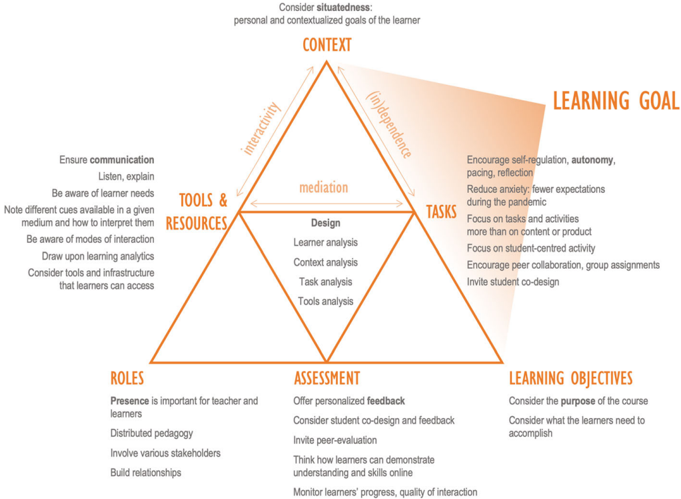
“In addition, one group of experts concluded the need for flexibility along the way based on the evaluation of the learner, tasks, tools and context all guided by the online teacher ( Rapanta et al., 2020).”
BackgroundInfluentialOlivencia, J. J. L., Aguilera, F. J. G., Terrón, A. M., & Márquez, E. P. (2021) · UMA Editorial eBooks · doi:10.24310/mumaedmumaed.76 · Cited by 2
Babić, T., & Grgić, S. (2021) · International Convention on Information and Communication Technology, Electronics and Microelectronics · doi:10.23919/mipro52101.2021.9597187
95. Virtual pedagogy: design and delivery of an eWorkshop on PA under COVID-19 restrictions
Pang, A. (2021) · Wageningen Academic Publishers eBooks · doi:10.3920/978-90-8686-916-9_95
Migration to Online Teaching-Learning in School Education during COVID-19
Hassan, M. M., & Mirza, T. (2021) · Journal on Today s Ideas-Tomorrow s Technologies · doi:10.15415/jotitt.2020.82010
“Teacher preparedness, presence of technological infrastructure and availability of high speed internet access are the main challenges faced by the stakeholders to switch from classroom teaching to online mode possible mainly related to designing and organising for better learning experiences and creating distinctive l…”
BackgroundTEORIJSKA RAZMATRANJA ELEKTRONSKOG UČENJA U SAVREMENOM OBRAZOVANJU
Dimitrijević, M. (2021) · ГОДИШЊАК ЗА ПЕДАГОГИЈУ · doi:10.46630/gped.1.2021.4
Haque, M. A., Khayal, A., & Khan, J. (2021) · Indian Journal of Forensic and Community Medicine · doi:10.18231/j.ijfcm.2021.021
Genco, D., Arquilla, V., Guaricci, F., & Caruso, F. (2021) · EDULEARN proceedings · doi:10.21125/edulearn.2021.1585
Sustainability of Wetlands in the Eyes of the New Generation of Environmental Engineering Students
Amiraslani, F. (2021) · Conservation · doi:10.3390/conservation1030015 · Cited by 1
“Furthermore, field survey costs are rising, while unprecedented events such as the COVID19 pandemic may impose restrictions [49,50].”
BackgroundМЕТАПРЕДМЕТНИЙ ПІДХІД ДО ОРГАНІЗАЦІЇ НАВЧАЛЬНОЇ ДІЯЛЬНОСТІ В АКАДЕМІЧНИХ УМОВАХ
ЧУМАК, М. (2021) · Human Studies Series of Pedagogy · doi:10.24919/2413-2039.12/44.33
Breakout Rooms, Polling, and Chat, Oh My! The Development and Validation of Online COPUSPreprint
Pusey, T. S., Valencia, A. P., Signorini, A., & Kranzfelder, P. (2021) · bioRxiv (Cold Spring Harbor Laboratory) · doi:10.1101/2021.07.21.453286 · Cited by 1
“Is Online Teaching–Learning Process an Effective Tool for Academic Advancement”
Verma, S., Tyagi, D., & Verma, R. (2021) · Advances in Science, Technology & Innovation/Advances in science, technology & innovation · doi:10.1007/978-3-030-66218-9_9
Perceptions of University Students towards Online Teaching-Learning Process during COVID-19 Pandemic
Parveen, A., & Husain, N. (2021) · Journal of Emerging Technologies and Innovative Research
REFLEKSI SISWA DAN GURU TENTANG MANAJEMEN PENDIDIKAN DI MASA PANDEMI
Khardin, A., Giatman, M., & Ernawati, E. (2021) · Educate Jurnal Teknologi Pendidikan · doi:10.32832/educate.v6i2.5121
الثمالي, ع. ب. ع., & الجهنـی, س. ع. ع. (2021) · مجلة شباب الباحثين في العلوم التربوية لكلية التربية جامعة سوهاج · doi:10.21608/jyse.2021.187759
Kuok, K. K., Rahman, M. R., Bakri, M. K. B., et al. (2021) · Turkish Online Journal of Qualitative Inquiry
Vera, F. (2021) · Transformar · Cited by 6
Mahesh, S., Bansal, S., Hemalata, K., & Varghese, A. M. (2021) · Journal of Evolution of Medical and Dental Sciences · doi:10.14260/jemds/2021/557
Grau, F. X. D. I., Clarabuch, C. F., Blanch, V. A. I., et al. (2021) · doi:10.3998/mpub.11778416.ch11.ca
“A tots els nivells educatius ja s’està proposant una reformulació dels enfocaments didàctics, amb l'addició de nous entorns d'aprenentatge a distància que siguin agradables i la inserció de les tecnologies d’ús que definiran les noves generacions (Rapanta et al., 2020).”
BackgroundExperiential Learning in the Canadian Communications Landscape
Smeltzer, S., Pieber, D. A., & Brooks, M. (2021) · Canadian Journal of Communication · doi:10.22230/cjc.2021v46n3a4011
Teaching Mathematics Online with Increased Empathy in the COVID-19 Pandemic
Fülöp, O., & Nagy, M. (2021) · Opus et Educatio · doi:10.3311/ope.468 · Cited by 1
“Fortunately, the lack of a satisfactory Internet connection and an own proper computer was not a problem for the students, making the transition smooth.”
BackgroundChandran, S. K., Nair, S. S., Vilambil, S., Vijayan, S. M., & Thomas, P. E. (2021) · Journal of Evidence Based Medicine and Healthcare · doi:10.18410/jebmh/2021/539
Coaching Pre-Service Teachers in Planning and Teaching English Online
Hadijah, S., & Shalawati (2021) · Advances in Social Science, Education and Humanities Research/Advances in social science, education and humanities research · doi:10.2991/assehr.k.210914.002 · Cited by 1
“In addition, providing a concrete task that can facilitate the students to work collaboratively should be included in online assessment, [15].”
BackgroundCalafate, C. T., Cecilia, J. M., & Cano, J. (2021) · Congreso de Innovación Educativa y Docencia en Red (IN-RED) · doi:10.4995/inred2021.2021.13686
Engagement of Higher Education Teachers During COVID-19 Pandemic in India
Majumdar, A., & Majumdar, S. (2021) · Springer eBooks · doi:10.1007/978-3-030-79926-7_3
Counter Application Trainer for Teaching Aids in Digital Electronic Course
Madar, A. R., Sumarwati, S., Hamid, H. B., et al. (2021) · Jurnal Pendidikan Teknologi dan Kejuruan · doi:10.21831/jptk.v27i2.42672
“Pedagogy is the strategy of how a lesson is delivered through the teaching and learning process to get results [5].”
BackgroundE-learning Acceptance Among Students: Evidence from UiTM Melaka City Campus
Abdullah, M., Hanapiyah, Z. M., & Arham, A. F. (2021) · International Journal of Academic Research in Progressive Education and Development · doi:10.6007/ijarped/v10-i3/11095
“Firstly, University support includes university library, digital and online materials, digital resources, training, academic tools, and others (Rapanta et al., 2020).”
BackgroundPeña, M. B. M., Bailera, M., Zabalza, I., & Zalba, B. (2021) · Congreso de Innovación Educativa y Docencia en Red (IN-RED) · doi:10.4995/inred2021.2021.13801
Leading Remotely During the COVID-19 Pandemic: Implications for Faculty Activities and Teamwork
Hamid, S. (2021) · Springer eBooks · doi:10.1007/978-3-030-76591-0_10 · Cited by 2
Abdel-Jalil, M. (2020) · International Journal of Heritage, Tourism, and Hospitality · doi:10.21608/ijhth.2021.196596
Savindi, C., Desha, C., & Les, D. (2021) · Australasian journal of engineering education · doi:10.1080/22054952.2021.2001128 · Cited by 1
Assessment for an Unprecedented Education
Victorița, T. (2021) · Advances in linguistics and communication studies · doi:10.4018/978-1-7998-8247-3.ch008
Piña-Stranger, Á., Varas, G., & Mobuchon, G. (2021) · Preprints.org · doi:10.20944/preprints202111.0292.v1
AlDousari, S. (2021) · International Journal of Business and Management · doi:10.5539/ijbm.v16n12p88
“On the other hand, this finding is not in line with a study conducted by Rapanta et al. (2020) which states that the faculty members found it challenging and complex to use online teaching mode for delivering their lessons and end up finding loopholes in the online system of education.”
BackgroundResultTeaching online for all: multiperspective professors
Grillo, A. H. (2021) · International Conference on Virtual Campus (JICV) · doi:10.1109/jicv53222.2021.9600320
Marobela, M. N. (2021) · International Journal of Innovation and Knowledge Management in Middle East and North Africa · doi:10.47556/j.ijikmmena.9.1.2021.3
Egede, B. A. J., & Awuja, S. A. (2021) · Frontiers in Education Technology · doi:10.22158/fet.v4n4p59
“The students’ choices of WhatsApp chat and voice messaging connote a leaning on material-based approach to online teaching (Rapanta et al., 2020), which requires students to access learning materials.”
BackgroundFelhőbe fel! Szakirodalmazás oktatása az Állatorvostudományi Egyetemen COVID-19 előtt és alatt
Júlia, B. K. (2021) · Műszaki könyvtárosok tájékoztatója/Tudományos és műszaki tájékoztatás · doi:10.3311/tmt.13115
eLearning for Tourism During COVID-19 - Learning from Students’ Perspectives. A Pilot Study
Hasenzahl, L., Ghezili, S., & Cantoni, L. (2022) · Springer eBooks · doi:10.1007/978-3-030-94751-4_41
(España), U. D. L. L., & Rodríguez, J. L. G. (2021) · Asociación Española de Geografía, AGE (España) eBooks · doi:10.25145/c.27.asociacion.geografia.2021.15
Lectures in distant format: certain methodological techniques
Paimakova, E. A., & Tavberidze, D. V. (2021) · Педагогика и просвещение · doi:10.7256/2454-0676.2021.4.37144
Traetta, L. (2021) · MeTis - Mondi educativi Temi indagini suggestioni · doi:10.30557/mt00186
Technological trends of higher education development
Arsenijević, J., & Arsenijević, D. (2021) · Norma · doi:10.5937/norma2102177a
Suherlan, H., Arnadi, A., Liriwati, F. Y., Kafrawi, K., & Syahid, A. (2021) · Nazhruna Jurnal Pendidikan Islam · doi:10.31538/nzh.v4i3.1738
Technology During A Pandemic: Friend or Foe?
Bester, M. E. (2021) · International Journal of Nursing & Clinical Practices · doi:10.15344/2394-4978/2021/343
“, [29] mention the importance of maintaining an online presence.”
BackgroundDialogic Learning in the Time of a Global Pandemic and Beyond
Nagda, B. A., Rappeport, A., King, R. U., et al. (2021) · Springer eBooks · doi:10.1007/978-3-030-89043-8_10
Barriers to Online Learning during COVID-19 Pandemic: Students’ Perspective
Shakir, M. (2021) · Educational Quest- An International Journal of Education and Applied Social Sciences · doi:10.30954/2230-7311.3.2021.8
Influence of Leadership Behavior Attributes on Work-Related Lecturer’s Attitudes
(2021) · Quality - Access to Success · doi:10.47750/qas/22.185.02
Aprilla, D., & Komalasari, K. (2022) · Advances in Social Science, Education and Humanities Research/Advances in social science, education and humanities research · doi:10.2991/assehr.k.220108.106
Zeyab, A. J., Larkins, R. J., Alsalim, M., & Albloushi, S. A. (2022) · World Journal of Education · doi:10.5430/wje.v12n1p52
Koti, K., & Krishnamurthy, R. M. (2022) · Studies in computational intelligence · doi:10.1007/978-3-030-93921-2_23
Supportive Curriculum Framework for Remote Learning in Tanzania Early Childhood Education
Mtenzi, F. J., & Saimon, M. (2022) · Advances in early childhood and K-12 education · doi:10.4018/978-1-7998-8405-7.ch030 · Cited by 1
López-Baldominos, I., Pospelova, V., & Sanz, L. F. (2022) · Advances in sustainability science and technology · doi:10.1007/978-981-16-9101-0_15
Ng, N. C. K. T. (2022) · International Journal of Social Science and Human Research · doi:10.47191/ijsshr/v5-i3-56
“These tools or Technology Enhanced Learning (TEL) helped to narrow the gap between the educator and the students where the students is at a distance from the educators (Rapanta et al., 2020).”
Background(2022) · EL LE · doi:10.30687/elle/2280-6792/2022/01
Metadata
- Authors
- Rapanta, C., Botturi, L., Goodyear, P., Guàrdia, L., & Koole, M.
- Affiliations
- Universidade Nova de Lisboa (PT)
- University of Applied Sciences and Arts of Southern Switzerland (CH)
- The University of Sydney (AU)
- University of Saskatchewan (CA)
- Corresponding author
- Rapanta, Chrysi
- ORCID
- Rapanta, Chrysi
- Venue
- Postdigital Science and Education
- Published
- 2020-07-07
- Volume
- 2
- Issue
- 3
- Pages
- 923-945
- ISSN
- 2524-485X (ISSN-L)
- 2524-4868
- PMC
- PMC7339092
- OpenAlex
- W3042009104
- Semantic Scholar
- fed495af71b417de8d60cf16b6da44926faf24a0
- Cited by
- 2,130
- References
- 75
- Citations by year
- 2026: 134 · 2025: 158 · 2024: 261 · 2023: 426 · 2022: 556 · 2021: 509 · 2020: 73
- FWCI
- 454.18
- Type
- journal article
- Language
- en
- Open access
- hybrid
- doi.org
- Licence
- other-oa
- www.springer.com/tdm (tdm)
- www.springer.com/tdm (vor)
- Locations
- Postdigital Science and Education (publishedVersion, other-oa)
- PubMed (publishedVersion)
- PubMed Central (submittedVersion)
- The Sydney eScholarship Repository (The University of Sydney) (submittedVersion)
- Funders
- Fundação para a Ciência e a Tecnologia (DL 57/2016/CP1453/CT0066)
- Australian Research Council (DP150104163)
- Topics
- Social Sciences › Education › Digital Education and Society
- Social Sciences › Education › Higher Education Practises and Engagement
- Social Sciences › Education › Educational Innovations and Technology
- Keywords
- online learning, COVID-19 pandemic, higher education, teacher presence, pedagogical content knowledge, learning activities, social presence, cognitive presence
About these checks
Registry, retraction, Cites and statistics results are computed, not judged, with one exception: a printed reference that no index lists is read once by a model before it counts as a citation error. Claims are extracted by a model and kept only when their quote appears verbatim in the text; each cited source is then checked, with a model’s help, for whether it says what the claim relies on. Those verdicts can be wrong — read the claim’s quote and the cited source before relying on one.
The claim verdicts this report counts are experimental: their accuracy is not yet measured.
A language model drew the claims from the paper on 2026-10-10, under version 3 of the claim definition (model deepseek-v4.1-flash, prompt extract-v3).
A second model labelled each claim on 2026-10-10 (model jev-1.13-20260917, definition revision gold-guideline-v0.2).
Cited sources are checked with a language model’s help (qwen3.8-omni-flash).
Statistics and arithmetic are recomputed, not judged.
Confidence bands are shown only for fields calibrated on our annotated test set. None is calibrated yet, so no band is shown.
What counts as a claim ›How we measure confidence ›How we check this ›
Are you an author, or do you see a problem with this page? Request a review
Data sources
Bibliographic data: Semantic Scholar, OpenAlex, Crossref.
Contains information from the Semantic Scholar Academic Graph Datasets, made available under the ODC Attribution License (ODC-BY 1.0).
Semantic Scholar’s data is described in: Kinney, R., et al. (2023). The Semantic Scholar Open Data Platform. arXiv:2301.10140.
