

Online University Teaching During and After the Covid-19 Crisis: Refocusing Teacher Presence and Learning Activity
Open accessThe DOI matches its Crossref record; 71 of the 75 references it cites were found in a registry or an index; 6 of the 42 sources its claims cite were checked for support.
Abstract
The Covid-19 pandemic has raised significant challenges for the higher education community worldwide. A particular challenge has been the urgent and unexpected request for previously face-to-face university courses to be taught online. Online teaching and learning imply a certain pedagogical content knowledge (PCK), mainly related to designing and organising for better learning experiences and creating distinctive learning environments, with the help of digital technologies.
Overview
CoChat Summary
TL;DR
This article is an expert-interview piece offering pedagogical guidance for university teachers suddenly moving online during Covid-19. Its central message is that effective online teaching depends less on tools or materials alone and more on careful learning design, multiple forms of teacher presence, and continuous assessment.
Key findings
- The four experts argue that online learning should be built around carefully designed learning activities, with a mix of synchronous, asynchronous, online, and offline tasks that are clear, appropriately difficult, authentic, and accessible to students.
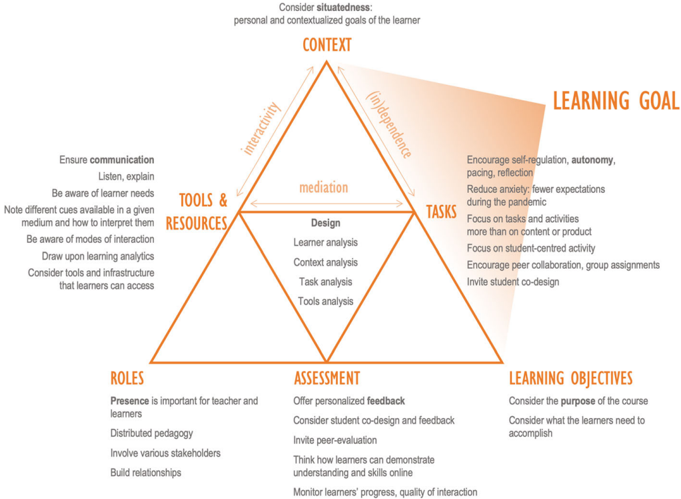
- They propose a tripartite teaching presence for online courses: cognitive presence, social presence, and facilitatory presence.
- Successful online learning requires students not to feel alone, and it benefits from timely feedback, peer collaboration, and student co-design/co-configuration of activities.
- The paper states that continuous assessment is needed in online learning, and suggests self-reflections, portfolios, self-paced asynchronous activities, and use of learning analytics as part of evaluation.
Methods
- Exploratory qualitative study using expert interviews administered by e-mail.
- Sample: 4 online pedagogy experts/co-authors, selected for research expertise, more than a decade of online teaching experience, and experience across different national education systems; they worked in Switzerland, Australia, Spain, and Canada.
- Main analysis: the first author organized the responses into a panel-like article, then the authors jointly revised and synthesized the material; the discussion summarizes themes under learning design, teacher presence, and assessment.
Limitations
- The paper states that all four experts came from “rich parts of the world” (Switzerland, Canada, Australia, and North of Spain), which limits the lens to a “monofocal” view of educational reality.
- The paper itself says the study used a heuristic method based on expert viewpoints and “by no means can replace rigorous, systematic research” following the scientific method.
- Evident from the text: the sample is very small (4 experts) and highly selected, so the findings are expert-opinion guidance rather than generalizable empirical results.
Model-written summary. Check it against the paper before relying on it.
Integrity signals
Registry
Cites
Statistics
Figures
Verification
Claims the paper makes
5 Valid · 0 Not valid · 32 Not checked · 24 Own results and interpretations
The sources with a verdict support this claim; the rest weren’t checked yet, have no full text we could read, or their verdicts aren’t rated yet.
In the paper
“On top of that, a significant challenge for university teachers has been their lack of the pedagogical content knowledge (PCK) (Shulman 1987) needed for teaching online (Angeli and Valanides 2005; Kali, Goodyear and Markauskaite 2011; Ching, Hsu and Baldwin 2018).”
§ Springer Nature Switzerland AG 2020 Published online: 7 July 2020 > Introduction
What the sources say
- Supportedcites Shulman 1987 matched to “Knowledge and teaching: Foundations of the new reform” (1987) source
The parenthetical (Shulman 1987) is attached to the term 'pedagogical content knowledge (PCK)' — an identification citation — while the online-teaching studies are credited to Angeli & Valanides, Kali et al. and Ching et al. Our copy (the Portuguese edition of Shulman's 1987 Harvard Educational Review article) establishes exactly that concept: the 'Categorias da base de conhecimento' section lists 'conhecimento pedagógico do conteúdo' as one of the categories of the knowledge base for teaching, 'esse amálgama especial de conteúdo e pedagogia que é o terreno exclusivo dos professores', and the 'Novas compreensões' section calls it 'a categoria que melhor distingue a compreensão de um especialista em conteúdo daquela de um pedagogo'. The paper itself says nothing about online teaching or about university teachers lacking PCK, but that part of the sentence is not attributed to this source. (LLM, conf=0.85)
- Not checked — no full text of the sourcecites Angeli and Valanides 2005 matched to “Preservice elementary teachers as information and communication technology designers: an instructional systems design model based on an expanded view of pedagogical content knowledge” (2005) source
- Could not verifycites Ching, Hsu and Baldwin 2018 matched to “Online Course Design and Development among College and University Instructors: An Analysis using Grounded Theory” (2018) sourceExperimental — accuracy not yet measured
Our copy of Baldwin, Ching & Friesen (2018) never mentions pedagogical content knowledge, PCK, Shulman, or TPACK; searches for 'pedagogical content knowledge PCK online teaching', 'TPACK technological pedagogical content knowledge', 'Shulman pedagogical content knowledge Angeli Valanides' and 'challenge lack of knowledge training online instructors pedagogy' returned only the References list and design-process passages. The paper's content is a grounded-theory account of how 14 four-year-institution instructors design online courses (Abstract; Results themes; Discussion mapping to ADDIE), and its nearest statements — that instructors 'must develop new curriculum with instructional strategies effective for online learning' (Discussion) and 'rarely use formal instructional design models' (Results) — concern design practice, not a PCK deficiency framed as a significant challenge. Nothing in our copy either states or contradicts the attributed claim. (LLM, conf=0.72)
plain- Asserted: passes — The authors put it forward as true.
- Checkable: passes — It can be checked against evidence.
- Load-bearing: passes — The paper’s conclusions depend on it.
- Based: passes — The paper gives a reason why it holds.
- Supported
The cited sources support only part of this claim — read each source’s verdict below.
In the paper
“Assessment can possibly be considered the most challenging part of the transition to distance learning for an institution used to face-to-face oral or written exam, as the control shift towards the students makes it hardly possible to ensure that students are not cheating (Munoz and Mackay 2019).”
§ Springer Nature Switzerland AG 2020 Published online: 7 July 2020 > Assessment
What the sources say
- Partly supportedcites Munoz and Mackay 2019 matched to “An online testing design choice typology towards cheating threat minimisation” (2019) sourceExperimental — accuracy not yet measured
Split into 2 atoms — 0 confirmed, 2 partially supported, 0 disputed, 0 misattributed, 0 unverifiable. Expand the claim to see per-atom verdicts.
hedgedstates a possible cause- Asserted: passes — The authors put it forward as true.
- Checkable: passes — It can be checked against evidence.
- Load-bearing: unclear — It is unclear whether the paper’s conclusions depend on it.
- Based: passes — The paper gives a reason why it holds.
- Partly supported
A result the paper reports from its own data — it cites no other source for it, so there is none to check. The quote shows it is in the paper.
In the paper
“Our findings point at the design of learning activities with certain characteristics, the combination of three types of presence (social, cognitive and facilitatory) and the need for adapting assessment to the new learning requirements.”
§ Springer Nature Switzerland AG 2020 Published online: 7 July 2020 > Abstract
plainstates an association- Asserted: passes — The authors put it forward as true.
- Checkable: passes — It can be checked against evidence.
- Load-bearing: passes — The paper’s conclusions depend on it.
- Based: passes — The paper gives a reason why it holds.
None of the sources cited for this claim have been checked yet.
In the paper
“What all four experts focus on as a prime ' piece ' of pedagogical knowledge (Kali et al. 2011) is the careful design of activities.”
§ Springer Nature Switzerland AG 2020 Published online: 7 July 2020 > Learning Design
plain- Asserted: passes — The authors put it forward as true.
- Checkable: passes — It can be checked against evidence.
- Load-bearing: unclear — It is unclear whether the paper’s conclusions depend on it.
- Based: passes — The paper gives a reason why it holds.
A result the paper reports from its own data — it cites no other source for it, so there is none to check. The quote shows it is in the paper.
In the paper
“Inspired by Anderson et al. ' s (2001) understanding of teaching presence and how it can be re-conceived in the current Covid-19 situation in which educators are the designers, the tutors and the evaluators of the learning experience, a tripartite framework emerges from the interviews, with three main sub-presences of the teaching presence, namely:”
§ Springer Nature Switzerland AG 2020 Published online: 7 July 2020 > Teacher Presence
plain- Asserted: passes — The authors put it forward as true.
- Checkable: passes — It can be checked against evidence.
- Load-bearing: passes — The paper’s conclusions depend on it.
- Based: passes — The paper gives a reason why it holds.
5 more claims
Create a free account to see all 61 claims and to verify the 9 references still open.
- Probably not a substantial claim. 50
- It may state two separate claims as one. 18
Claims other papers make about this one
Each is checked against this paper’s own text: does it say what the citing paper says it does?
The source backs part of the claim, not all of it — or backs it for a different population, condition or comparison.
In the citing paper
“while it is known that for learning success, input formats usually depend on both attention and interest from the students (Rapanta et al., 2020).”
From Impact of Synchronous and Asynchronous Settings of Online Teaching and Learning in Higher Education on Students' Learning Experience During COVID-19 (2021) · cites this paper as Rapanta et al., 2020
Experimental — accuracy not yet measuredIn the citing paper
“Evaluating AI applications could be beneficial for enhancing their motivation and interest in teaching with AI [40].”
From Developing AI Literacy for Primary and Middle School Teachers in China: Based on a Structural Equation Modeling Analysis (2022) · cites this paper as [40]
Citations
Cites
The Reflective Practitioner: How Professionals Think in Action
Checkoway, B., & Schon, D. A. (1985) · Journal of Policy Analysis and Management · doi:10.2307/3324262 · Cited by 21,268
The reflective practitioner: How professionals think in action
Stewart, C. J. (1984) · Patient Education and Counseling · doi:10.1016/0738-3991(84)90022-3 · Cited by 19,752
Knowledge and teaching: Foundations of the new reform
Shulman, L. (1987) · Harvard Educational Review · doi:10.17763/haer.57.1.j463w79r56455411 · Cited by 16,787
Phenomenological research methods
Moustakas, C. (1994) · doi:10.4135/9781412995658 · Cited by 13,919 · cited 1×
“’ This study ’ s participants, i.e. the four online pedagogy experts, also functioned as co-researchers, following Moustakas ’ (1994) idea (l).”
BackgroundDetermining Validity in Qualitative Inquiry
Creswell, J. W., & Miller, D. L. (2000) · Theory Into Practice · doi:10.1207/s15430421tip3903_2 · Cited by 9,184
Speech Genres and Other Late Essays
Bakhtin, M. M. (1986) · University of Texas Press eBooks · doi:10.7560/720466 · Cited by 8,470
The Difference between Emergency Remote Teaching and Online Learning
Hodges, C. B., Moore, S., Lockee, B. B., Trust, T., & Bond, M. A. (2024) · Handbook of Research in Online Learning · doi:10.1163/9789004702813_021 · Cited by 6,253
Blended learning: Uncovering its transformative potential in higher education
Garrison, D. R., & Kanuka, H. (2004) · The Internet and Higher Education · doi:10.1016/j.iheduc.2004.02.001 · Cited by 4,849
Speech Genres and Other Late Essays
Melaver, M., Bakhtin, M. M., McGee, V. W., Emerson, C., & Holquist, M. (1987) · Poetics Today · doi:10.2307/1772598 · Cited by 3,185
ASSESSING TEACHING PRESENCE IN A COMPUTER CONFERENCING CONTEXT
Anderson, T., Rourke, L., Garrison, R., & Archer, W. (2001) · Online Learning · doi:10.24059/olj.v5i2.1875 · Cited by 1,885
Research works printed but not linked: 2
- Bates, A. W. (2019). Teaching in a digital age. 2nd Edition. Vancouver: Tony Bates Associates. https://pressbooks.bccampus.ca/teachinginadigitalagev2/. Accessed 15 June 2020.
- Shor, I., & Freire, P. (1987). A pedagogy for deliberation: dialogues on transforming education . Westport: Bergin & Garvey Publishers.
Cited by
Items 1,901–2,000 of 2,106
Karatsoli, M., Karakikes, I. D., Lambrou, M., & Pagoni, I. (2025) · Lecture notes in intelligent transportation and infrastructure · doi:10.1007/978-3-031-82714-3_46 · Cited by 3
Enhancing Video Projector Connectivity and Management with a Low-Cost Solution
Paulo, F., Oliveirat, P. F., & Matos, P. J. (2024) · International Conference on Engineering and Emerging Technologies (ICEET) · doi:10.1109/iceet65156.2024.10913936
“But it quickly went beyond that, being adopted in the context of face-to-face classes, as a much more agile and effective way of sharing content, not only presentations and videos, but also demonstrations in real time [2] [3].”
Diab, C. (2025) · SSRN Electronic Journal · doi:10.2139/ssrn.5175656
Phiri-Chibbonta, C., Muchangwe, R., & Mambwe, E. (2025) · Research Square · doi:10.21203/rs.3.rs-5813152/v1
Language Use in Crisis Decision-Making: A Case Study Approach
Al-Badawi, M. (2025) · Studies in computational intelligence · doi:10.1007/978-3-031-77925-1_46
Perceived Impact on the Efficacy of Learning Modality Implemented During the COVID-19 Pandemic
Cuñado, A. (2025) · Journal of interdisciplinary perspectives · doi:10.69569/jip.2025.075
Stress and Burnout amongst Business School Staff
Steyn, R. (2025) · International Journal of Educational Studies · doi:10.53935/2641533x.v8i2.341 · Cited by 1
“…has become a priority, adding new psychosocial stress factors such as isolation, feelings of technological inefficiency, lack of training, or the difficulty of reconciling personal and professional life (García-Gonzalez et al., 2020; Ozgür, 2020; Rapanta et al., 2020; Schildkamp et al., 2020).”
Li, X., van den Bogaard, M., Marlor, L. K., Carroll, L. J., & Finelli, C. (2025) · Research Square · doi:10.21203/rs.3.rs-6285934/v1
Khaleel, F., Harte, P., Avdukić, A., & Bonnett, J. M. (2025) · Education + Training · doi:10.1108/et-02-2024-0074 · Cited by 4
Innovación en el estilo formativo para transformar realidades en Educación Superior
Taborda, S. L. T., Martín, S. C., & González, M. C. (2024) · Revista de Estilos de Aprendizaje · doi:10.55777/rea.v17i34.7115
Effective Learning Strategies: Applying the Articulation Model in Teaching and Learning Activities
Tohet, M., Fajri, Z., & Nufus, R. M. (2025) · Journal Evaluation in Education (JEE) · doi:10.37251/jee.v6i2.1506
“As a result, students tend to be passive, receiving information without actively participating in discussions or activities [49], [51], [52].”
La transformación digitial en la educación superior y su impacto en la enseñanza-aprendizaje.
Aguilar-Muñoz, J. A., Gaibor-Bifarini, J. M., Vizcaino-Pusda, V. D., & Muyolema-Guayanlema, V. A. (2023) · Space Scientific Journal of Multidisciplinary · doi:10.63618/omd/ssjm/v1/n1/7 · Cited by 8
Beyond Game Blocks: Adolescent Girl Players' Perspectives During COVID-19
Hewett, K. J. E., & Pletcher, B. C. (2025) · Games and Culture · doi:10.1177/15554120251339519
“The pandemic exposed the education system ’ s lack of infrastructure for interactive virtual instruction (Rapanta et al., 2020).”
Sison, J. A. (2025) · SSRN Electronic Journal · doi:10.2139/ssrn.5257411
“Poor internet access makes it difficult for students to actively participate in online classes, which is consistent with prior research (Rapanta et al., 2020).”
Porcu, S., Floris, A., & Atzori, L. (2025) · IEEE Transactions on Learning Technologies · doi:10.1109/tlt.2025.3572175 · Cited by 1
Aheto, S.-P. K., Sasu, J. K., & Arkorful, V. (2025) · SAGE Open · doi:10.1177/21582440251340450 · Cited by 2
“Online learners gain knowledge through practice and experience (Rapanta et al., 2020).”
Development and Validation of Microbiology and Parasitology Laboratory Manual for Science Education
Beltran, K. A. (2025) · Integrated Science Education Journal · doi:10.37251/isej.v6i2.1543 · Cited by 15
“Moreover, the COVID-19 pandemic further amplified the need for flexible, validated, and accessible laboratory manuals that can support hybrid and remote learning environments [17].”
K-12 Teachers’ Online Education Competencies in Türkiye
Avcı, B., & Güven, M. (2025) · American Journal of Distance Education · doi:10.1080/08923647.2025.2513099 · Cited by 2
“Building on this evidence, Rapanta et al. (2020) found that educational institutions equipped with systematic competency frameworks for online instruction exhibited markedly greater resilience when navigating rapid educational transitions.”
Maeko, M. S. A. (2025) · African Journal of Teacher Education · doi:10.21083/ajote.v14i1.8334 · Cited by 2
From face-to-face to remote teaching during COVID-19: Lecturers at private colleges in Johannesburg
Maharaj, A., & Bayane, P. (2025) · African Journal of Career Development · doi:10.4102/ajcd.v7i1.163
Somerfeld, H. M., Vaterlaus, J. M., Wanago, N. C., Routh, B., & Brennan, A. (2025) · Journal of Human Sciences and Extension · doi:10.55533/2325-5226.1531
Dhingra, K., & Narula, I. (2025) · SN Computer Science · doi:10.1007/s42979-025-04100-3
“Rapanta et al. [51] has discussed about three types of educator presence, namely, cognitive presence, social presence and facilitatory presence.”
Teachers' Opinions with Hearing-Impaired Students on Distance Learning During Covid-19
Bağcı, Ö. A., & Sarı, H. (2025) · Journal of Teacher Education and Lifelong Learning · doi:10.51535/tell.1668965
Orih, D., Cheer, K., Morgan, R., Udah, H., & Tsey, K. (2025) · Frontiers in Education · doi:10.3389/feduc.2025.1562779 · Cited by 2
Chauhan, R., & Patel, A. (2025) · Research Square · doi:10.21203/rs.3.rs-6803576/v1
Assessment Strategies for Virtual Creative Collaboration in Higher Education
Kaddouri, M., Azzimani, T., Jmad, S., Begdouri, A., & Dadi, A. (2025) · IGI Global eBooks · doi:10.4018/979-8-3373-6102-4.ch006
Revealing the Inner World of Students: A Journey into Dynamics of Learning Management System Usage
Palma, H., & Genton, E. A. (2025) · Psychology and Education A Multidisciplinary Journal · doi:10.70838/pemj.430401
Silva, L. C. S., Spak, M. D. S., & Lima, V. D. O. (2025) · Revista de Estudios y Experiencias en Educación · doi:10.21703/rexe.v24i55.2842
Impact of Online Tutorial on Tutees' Speaking Performance and Tutors' Self- Efficacy
Esmero, J. A. (2025) · International Journal For Multidisciplinary Research · doi:10.36948/ijfmr.2025.v07i04.52151
Lyngdoh, D., & Kharbirymbai, B. B. (2025) · INTERNATIONAL JOURNAL OF CREATIVE RESEARCH THOUGHTS · doi:10.56975/ijcrt.v13i3.278561 · Cited by 1
“Institutional and policy support play a critical role in enabling teachers to navigate these changes and ensure equitable access to digital education (Rapanta et al., 2020).”
InfluentialDeveloping interactive animations as a learning tool for work integrated learning
Gigliotti, A., Cameron, J., Duncan, C., Sheridan, L., & Smedley, C. (2025) · The Curriculum Journal · doi:10.1002/curj.343 · Cited by 1
Nyongesa, W. J., & Westhuizen, J. V. D. (2025) · EUREKA Social and Humanities · doi:10.21303/2504-5571.2025.003794
Teaching Academic Writing Using Online Tools: An Experimental Study at Imam Abdulrahman UniversityPreprint
Mahmoud, M. M. A. (2025) · SSRN Electronic Journal · doi:10.2139/ssrn.5376691
ENHANCING DISTANCE LEARNING: A CASE STUDY OF THE HISTORY OF PHYSICAL CULTURE COURSE
Chukhlantseva, N. V., Чередниченко, І. А., & Porada, O. (2025) · Physical Culture and Sport Scientific Perspective · doi:10.31891/pcs.2025.2.19
Identifying the Needs of Faculty Members to Deliver Online Training after the Pandemic
Çevik, Y. D., Avcı, D., Aydoğdu, Ş., & Somyürek, S. (2025) · Uluslararası Türk Eğitim Bilimleri Dergisi · doi:10.46778/goputeb.1526791
“…found that the sudden transition to online education became a restrictive and stressful experience for faculty members, whereas experienced faculty members managed this process with less stress (Bolliger & Halupa, 2022; Cameron-Standerford et al., 2020; Rapanta et al., 2020; Orozco et al., 2023).”
Mente, I., & Delariarte, C. F. (2025) · Psychology and Education A Multidisciplinary Journal · doi:10.70838/pemj.420703
Chuenpraphanusorn, T., Snguanyat, O., & Bhulapatha, P. (2025) · SSRN Electronic Journal · doi:10.2139/ssrn.5364376
Smith, C. M., & Lane, S. H. (2025) · Journal of Professional Nursing · doi:10.1016/j.profnurs.2025.08.007
Berdin, M. (2025) · Psychology and Education A Multidisciplinary Journal · doi:10.70838/pemj.450304
Phipps, D. J., Hannan, T. E., Vasandani, M., Keech, J. J., Green, H. J., & Hamilton, K. (2025) · Psychology Learning & Teaching · doi:10.1177/14757257251359742 · Cited by 1
Mapping Online Engagement: A DEMATEL-Based Analysis of Instructor Perspectives
Aldowah, H. A., Al‐Samarraie, H., Rehman, S. U., Umar, I. N., & Alzahrani, A. I. (2025) · International Journal of Information Technology & Decision Making · doi:10.1142/s0219622025501056 · Cited by 1
Assessing Student Satisfaction Using Lectures Generated by Artificial Intelligence (AI)Preprint
Kallamadugu, A. H., Lawal, N. S., Burgett, J. M., Gajjar, D., & Bingenheimer, K. (2025) · Research Square · doi:10.21203/rs.3.rs-7394155/v1 · Cited by 2
John, Y. J. (2025) · Futurity Education · doi:10.57125/fed.2025.06.25.11
“For example, evidence suggests that teaching concepts like the PASS program can be significantly enhanced through problem-solving methods in teaching content, and through online engagement strategies that facilitate deeper learning (Rapanta et al., 2020; Chang et al., 2024).”
Librizzi, F., Parkes, C., & Simaens, A. (2025) · Springer eBooks · doi:10.1007/978-3-031-82358-9_11
Ahmed, N. (2025) · Problems and Perspectives in Management · doi:10.21511/ppm.23(3).2025.50 · Cited by 5
“The relevance of this issue has been heightened by global disruptions, including the COVID-19 pandemic, which accelerated the need for flexible digital infrastructures in higher education (Bond et al., 2021; Rapanta et al., 2020).”
Açık ve Uzaktan Eğitim Sistemlerine Yönelik Araştırma Önceliklerinin Belirlenmesi
Kılınç, H., Sösuncu, F., & Aydın, C. H. (2025) · Anadolu Journal Of Educational Sciences International · doi:10.18039/ajesi.1673280
Role of ICT in Higher Education: Online Learning Platforms and Their Effectiveness Post-COVID-19
Dimri, D. (2025) · International Journal of Latest Technology in Engineering Management & Applied Science · doi:10.51583/ijltemas.2025.1409000029 · Cited by 1
21st Century Attributes and Professional Skills of Elementary School Teachers
Borromeo, Y., & Labay, L. (2025) · Psychology and Education A Multidisciplinary Journal · doi:10.70838/pemj.470709 · Cited by 2
Self-directed learning strategy on blended learning model in new normal era: Is it a solution?
Hertiavi, M. A., Wiyanto, W., Linuwih, S., & Wardani, S. (2025) · Multidisciplinary Science Journal · doi:10.31893/multiscience.2026039
Duhaylungsod, J. B. (2026) · Social Sciences & Humanities Open · doi:10.1016/j.ssaho.2026.103162
Factors Influencing the Quality of Distance Learning—A Serbian Case
Pardanjac, M., Jokić, S. V., Berković, I., Radulović, B., Ljubojev, N., & Brtka, E. (2025) · Sustainability · doi:10.3390/su17198941
Zhang, H., Li, B. J., & Wu, Q. (2025) · Journal of Psychoeducational Assessment · doi:10.1177/07342829251389072
“For instance, when using videoconferencing for group discussions, improper operation might delay the course progress, affecting students ’ learning experiences and emotions (Rapanta et al., 2020).”
Das, S., & Chaturvedi, K. (2025) · IGI Global eBooks · doi:10.4018/979-8-3373-7513-7.ch006
Mena, J., Rodríguez, C., & Gratacós, G. (2025) · Palgrave studies on leadership and learning in teacher education · doi:10.1007/978-3-031-93961-7_5
Queroda, P. (2025) · Salud Ciencia y Tecnología · doi:10.56294/saludcyt20252434
Distance Learning Tools in Health Sciences: A Training Course for Higher Education Faculty
de Almeida, R. S., & Trigueiro, M. J. (2025) · Advances in computational intelligence and robotics book series · doi:10.4018/979-8-3373-7729-2.ch012
Kim, A. H., Im, S., & Bryant, F. K. (2025) · Journal of Education for Business · doi:10.1080/08832323.2025.2580253
“Moreover, faculty members must adapt their teaching methodologies, often requiring additional training and support to integrate technology effectively into their courses (Rapanta et al., 2020).”
Abellán, P. A. A. (2025) · European Journal of Education · doi:10.1111/ejed.70320 · Cited by 3
The Impact of COVID-19 on a Graduate Studentled Literacy Camp for Children
Impellizeri, W. E., Lee, V. J., & Mathew, K. A. (2022) · Emerald Group Publishing Limited eBooks · doi:10.1108/978-1-64802-817-520251021
Creating Culturally Relevant Online Learning Environments in Higher Education
Thomas-Woodard, S., Summer, C., & Lee, S. J. (2025) · Emerald Group Publishing Limited eBooks · doi:10.1108/979-8-88730-879-120251017
Bond, M., Bedenlier, S., Marín, V. I., & Händel, M. (2021) · Figshare · doi:10.6084/m9.figshare.16531443
Additional file 1 of Attitudes and awareness of regional Pacific Island students towards e-learning
Johnson, J. B., Reddy, P., Chand, R., & Naiker, M. (2021) · Figshare · doi:10.6084/m9.figshare.14411158
Bond, M., Bedenlier, S., Marín, V. I., & Händel, M. (2021) · Figshare · doi:10.6084/m9.figshare.16531449
Bond, M., Bedenlier, S., Marín, V. I., & Händel, M. (2021) · Figshare · doi:10.6084/m9.figshare.16531437
CASACCHIA, M., CIFONE, M. G., Giusti, L., Fabiani, L., Gatto, R., Lancia, L., Cinque, B., Petrucci, C., Giannoni, M., Ippoliti, R., et al. (2021) · Figshare · doi:10.6084/m9.figshare.14759486
Bond, M., Bedenlier, S., Marín, V. I., & Händel, M. (2021) · Figshare · doi:10.6084/m9.figshare.16531458
Bond, M., Bedenlier, S., Marín, V. I., & Händel, M. (2021) · Figshare · doi:10.6084/m9.figshare.16531446
Segbenya, M., Bervell, B., Minadzi, V. M., et al. (2022) · Figshare · doi:10.6084/m9.figshare.19335864
Bond, M., Bedenlier, S., Marín, V. I., & Händel, M. (2021) · Figshare · doi:10.6084/m9.figshare.16531455
Bond, M., Bedenlier, S., Marín, V. I., & Händel, M. (2021) · Figshare · doi:10.6084/m9.figshare.16531464
Safitri, S. I., Hidayati, Y. M., Kusuma, A. A. S., et al. (2025) · AIP conference proceedings · doi:10.1063/5.0262589
Bond, M., Bedenlier, S., Marín, V. I., & Händel, M. (2021) · Figshare · doi:10.6084/m9.figshare.16531440
Bond, M., Bedenlier, S., Marín, V. I., & Händel, M. (2021) · Figshare · doi:10.6084/m9.figshare.16531452
Bond, M., Bedenlier, S., Marín, V. I., & Händel, M. (2021) · Figshare · doi:10.6084/m9.figshare.16531461
NAIA: A Robust Artificial Intelligence Framework for Multi-Role Virtual Academic Assistance
M., A. F. P., Q., K. J. B., C., S. D. S., & M., C. G. Q. (2025) · Systems · doi:10.3390/systems13121091
“Faculty members struggle with mounting administrative burdens, such as making assignments and answering frequently asked questions [5].”
Hikmatiar, H., & Sulisworo, D. (2025) · Journal of Educational Technology Innovation and Applications · doi:10.56741/jetia.v1i02.1167
“Apart from using Phyphox, online learning itself has had a good impact on learning [8], but with this application's help, the practicum measurements have more precise results [1].”
Attachment, Attention, and Achievement Duringthe Covid-19 Pandemic: A Conceptual Literature Review
Banks, R. F., Campbell, M. B., Dillard, D. M., & Torres, J. A. (2025) · Emerald Group Publishing Limited eBooks · doi:10.1108/978-1-83708-504-020251012
Topçu, G., & Pekbay, C. (2025) · Manisa Celal Bayar Üniversitesi Eğitim Fakültesi Dergisi · doi:10.52826/mcbuefd.1777477
Muhkam, M. F., Rahmat, Abdulkarim, A., & Komalasari, K. (2025) · Journal of Pedagogy and Education Science · doi:10.56741/iistr.jpes.001321
Digital Pedagogy in Higher Education: Students’ Perceptions and Practices
Anghel, G. A., Matei, F. L., & Lincă, F. I. (2025) · Journal of Education Society & Multiculturalism · doi:10.2478/jesm-2025-0011 · Cited by 1
“…period has further emphasized the critical role of digital pedagogy in ensuring the continuity of university education and in developing the digital competences of all actors involved (Bozkurt & Sharma, 2020; Hodges et al., 2020; Bond et al., 2021; Rapanta et al., 2020; Miulescu & Matei, 2021).”
Bayan, R. J. (2025) · Diversitas Journal · doi:10.48017/dj.v10i4.3570
“Teachers must design technology-mediated lessons that sustain engagement, foster confidence, and reduce cognitive overload (Rapanta et al., 2021; Mseleku, 2022).”
How New Technologies Will Create the University of the Future
WALKER, R. A. (2025) · Springer eBooks · doi:10.1007/978-981-95-2415-0_14
Mangadang, J.-I. (2025) · NURSE EDUCATORS AND PRACTITIONERS JOURNAL · doi:10.64397/nepj.v01i02.2025.a14
Wu, W., & Ma, Q. (2026) · Springer eBooks · doi:10.1007/978-981-95-3159-2_11
Manopo, C. C., & Riyana, C. (2026) · Lecture notes in educational technology · doi:10.1007/978-981-95-2521-8_34
Institutional dependability and adolescent mental health in South African schools after COVID-19Preprint
Ramdin, R. Z., & Mabaso, N. P. M. (2026) · Research Square · doi:10.21203/rs.3.rs-8226551/v1
Besedová, P. (2025) · ACC Journal · doi:10.2478/acc-2025-0011
“…se zaměřuje na primární a sekundární vzdělávání, omezenou interakci, nižší kvalitu zpětné vazby a sníženou motivaci (Ulla & Perales, 2021; Betthäuser et al., 2023), jsou relevantní i pro terciární sféru (Rapanta et al., 2020) a mohou se projevit ve specifických znalost ech, jako jsou dějiny DACH.”
InfluentialTechnologies for Supporting Academic Development
Fusco, P., Paolo, A. D., & Todino, M. D. (2026) · Encyclopedia · doi:10.3390/encyclopedia6010018 · Cited by 1
“The digital revolution, accelerated by the COVID-19 pandemic, has made evident the necessity to rethink not only teaching modalities but the entire ecosystem of faculty professional development [1].”
The role of teaching advancement units in times of emergency as perceived by unit staff members
Linder, I., & Weissblueth, E. (2026) · Israel Affairs · doi:10.1080/13537121.2025.2502768 · Cited by 1
Developing Students' Ability to Adapt to Digital Learning Platforms for English Language Learning
Abannay, S., & Nicer, M. A. (2026) · IGI Global eBooks · doi:10.4018/979-8-3693-8352-0.ch006 · Cited by 1
A Comparative Analysis of Instructors' and Students' Perspectives and Needs in Online Courses
Hosek, V. A., & Percell, J. C. (2026) · Advances in knowledge acquisition, transfer, and management book series/Advances in knowledge acquisition, transfer and management book series · doi:10.4018/979-8-3693-7142-8.ch007
Sharath, K. C. R., & B., P. K. (2025) · i-manager’s Journal on Educational Psychology · doi:10.26634/jet.22.2.22218
Communication Barriers and Solution Approaches in Post-Pandemic Distance Education
Demir, İ. (2026) · Erciyes İletişim Dergisi · doi:10.17680/erciyesiletisim.1760653
Bayrak, G., Şavkın, R., & Büker, N. (2020) · DergiPark (Istanbul University)
Özdemir, O. (2024) · DergiPark (Istanbul University)
Vatankhah, H., Vatanparast, M., Royani, Z., & Mansouri, G. (2026) · Advances in Medical Education and Practice · doi:10.2147/amep.s561822
“43,44 These issues highlight three major challenges in teacher education at Iranian medical universities: The pedagogical gap: Many medical educators lacked training in creating digital learning experiences for skills training, like patient assessment and surgical procedures.”
Online EFL Learning in Ukraine: Comparing Secondary School Learners’ and Teachers’ Perceptions
Ивановна, Л. М., Vrabel, T., & Taranenko, A. (2025) · The Journal of V N Karazin Kharkiv National University Series Foreign Philology Methods of Foreign Language Teaching · doi:10.26565/2786-5312-2025-102-12
Mujahidin, A., Amir, D. R., Irahdtanto, B., & Pratama, A. R. W. (2025) · Jurnal Media dan Teknologi Pendidikan · doi:10.23887/jmt.v5i4.102528 · Cited by 3
Macabago, S. A., & Lim, G. M. (2026) · Psychology and Education A Multidisciplinary Journal · doi:10.70838/pemj.520901 · Cited by 1
Belay, G. T., Eneyew, B. G., & Merawi, T. M. (2026) · Citizenship Social and Economics Education · doi:10.1177/14788047261421142
“This is consistent with the fi ndings of the prior studies (Guérina et al., 2013: Oulton et al., 2004; Rapanta et al., 2020; Tadesse, 2020; Worku, 2025) which reported that the dialogue and debate have barely been applied by the citizenship education teachers.”
Metadata
- Authors
- Rapanta, C., Botturi, L., Goodyear, P., Guàrdia, L., & Koole, M.
- Affiliations
- Universidade Nova de Lisboa (PT)
- University of Applied Sciences and Arts of Southern Switzerland (CH)
- The University of Sydney (AU)
- University of Saskatchewan (CA)
- Corresponding author
- Rapanta, Chrysi
- ORCID
- Rapanta, Chrysi
- Venue
- Postdigital Science and Education
- Published
- 2020-07-07
- Volume
- 2
- Issue
- 3
- Pages
- 923-945
- ISSN
- 2524-485X (ISSN-L)
- 2524-4868
- PMC
- PMC7339092
- OpenAlex
- W3042009104
- Semantic Scholar
- fed495af71b417de8d60cf16b6da44926faf24a0
- Cited by
- 2,130
- References
- 75
- Citations by year
- 2026: 134 · 2025: 158 · 2024: 261 · 2023: 426 · 2022: 556 · 2021: 509 · 2020: 73
- FWCI
- 454.18
- Type
- journal article
- Language
- en
- Open access
- hybrid
- doi.org
- Licence
- other-oa
- www.springer.com/tdm (tdm)
- www.springer.com/tdm (vor)
- Locations
- Postdigital Science and Education (publishedVersion, other-oa)
- PubMed (publishedVersion)
- PubMed Central (submittedVersion)
- The Sydney eScholarship Repository (The University of Sydney) (submittedVersion)
- Funders
- Fundação para a Ciência e a Tecnologia (DL 57/2016/CP1453/CT0066)
- Australian Research Council (DP150104163)
- Topics
- Social Sciences › Education › Digital Education and Society
- Social Sciences › Education › Higher Education Practises and Engagement
- Social Sciences › Education › Educational Innovations and Technology
- Keywords
- online learning, COVID-19 pandemic, higher education, teacher presence, pedagogical content knowledge, learning activities, social presence, cognitive presence
About these checks
Registry, retraction, Cites and statistics results are computed, not judged, with one exception: a printed reference that no index lists is read once by a model before it counts as a citation error. Claims are extracted by a model and kept only when their quote appears verbatim in the text; each cited source is then checked, with a model’s help, for whether it says what the claim relies on. Those verdicts can be wrong — read the claim’s quote and the cited source before relying on one.
The claim verdicts this report counts are experimental: their accuracy is not yet measured.
A language model drew the claims from the paper on 2026-10-10, under version 3 of the claim definition (model deepseek-v4.1-flash, prompt extract-v3).
A second model labelled each claim on 2026-10-10 (model jev-1.13-20260917, definition revision gold-guideline-v0.2).
Cited sources are checked with a language model’s help (qwen3.8-omni-flash).
Statistics and arithmetic are recomputed, not judged.
Confidence bands are shown only for fields calibrated on our annotated test set. None is calibrated yet, so no band is shown.
What counts as a claim ›How we measure confidence ›How we check this ›
Are you an author, or do you see a problem with this page? Request a review
Data sources
Bibliographic data: Semantic Scholar, OpenAlex, Crossref.
Contains information from the Semantic Scholar Academic Graph Datasets, made available under the ODC Attribution License (ODC-BY 1.0).
Semantic Scholar’s data is described in: Kinney, R., et al. (2023). The Semantic Scholar Open Data Platform. arXiv:2301.10140.
