

Online University Teaching During and After the Covid-19 Crisis: Refocusing Teacher Presence and Learning Activity
Open accessThe DOI matches its Crossref record; 71 of the 75 references it cites were found in a registry or an index; 6 of the 42 sources its claims cite were checked for support.
Abstract
The Covid-19 pandemic has raised significant challenges for the higher education community worldwide. A particular challenge has been the urgent and unexpected request for previously face-to-face university courses to be taught online. Online teaching and learning imply a certain pedagogical content knowledge (PCK), mainly related to designing and organising for better learning experiences and creating distinctive learning environments, with the help of digital technologies.
Overview
CoChat Summary
TL;DR
This article is an expert-interview piece offering pedagogical guidance for university teachers suddenly moving online during Covid-19. Its central message is that effective online teaching depends less on tools or materials alone and more on careful learning design, multiple forms of teacher presence, and continuous assessment.
Key findings
- The four experts argue that online learning should be built around carefully designed learning activities, with a mix of synchronous, asynchronous, online, and offline tasks that are clear, appropriately difficult, authentic, and accessible to students.
- They propose a tripartite teaching presence for online courses: cognitive presence, social presence, and facilitatory presence.
- Successful online learning requires students not to feel alone, and it benefits from timely feedback, peer collaboration, and student co-design/co-configuration of activities.
- The paper states that continuous assessment is needed in online learning, and suggests self-reflections, portfolios, self-paced asynchronous activities, and use of learning analytics as part of evaluation.
Methods
- Exploratory qualitative study using expert interviews administered by e-mail.
- Sample: 4 online pedagogy experts/co-authors, selected for research expertise, more than a decade of online teaching experience, and experience across different national education systems; they worked in Switzerland, Australia, Spain, and Canada.
- Main analysis: the first author organized the responses into a panel-like article, then the authors jointly revised and synthesized the material; the discussion summarizes themes under learning design, teacher presence, and assessment.
Limitations
- The paper states that all four experts came from “rich parts of the world” (Switzerland, Canada, Australia, and North of Spain), which limits the lens to a “monofocal” view of educational reality.
- The paper itself says the study used a heuristic method based on expert viewpoints and “by no means can replace rigorous, systematic research” following the scientific method.
- Evident from the text: the sample is very small (4 experts) and highly selected, so the findings are expert-opinion guidance rather than generalizable empirical results.
Model-written summary. Check it against the paper before relying on it.
Integrity signals
Registry
Cites
Statistics
Figures
Verification
Claims the paper makes
5 Valid · 0 Not valid · 32 Not checked · 24 Own results and interpretations
The sources with a verdict support this claim; the rest weren’t checked yet, have no full text we could read, or their verdicts aren’t rated yet.
In the paper
“On top of that, a significant challenge for university teachers has been their lack of the pedagogical content knowledge (PCK) (Shulman 1987) needed for teaching online (Angeli and Valanides 2005; Kali, Goodyear and Markauskaite 2011; Ching, Hsu and Baldwin 2018).”
§ Springer Nature Switzerland AG 2020 Published online: 7 July 2020 > Introduction
What the sources say
- Supportedcites Shulman 1987 matched to “Knowledge and teaching: Foundations of the new reform” (1987) source
The parenthetical (Shulman 1987) is attached to the term 'pedagogical content knowledge (PCK)' — an identification citation — while the online-teaching studies are credited to Angeli & Valanides, Kali et al. and Ching et al. Our copy (the Portuguese edition of Shulman's 1987 Harvard Educational Review article) establishes exactly that concept: the 'Categorias da base de conhecimento' section lists 'conhecimento pedagógico do conteúdo' as one of the categories of the knowledge base for teaching, 'esse amálgama especial de conteúdo e pedagogia que é o terreno exclusivo dos professores', and the 'Novas compreensões' section calls it 'a categoria que melhor distingue a compreensão de um especialista em conteúdo daquela de um pedagogo'. The paper itself says nothing about online teaching or about university teachers lacking PCK, but that part of the sentence is not attributed to this source. (LLM, conf=0.85)
- Not checked — no full text of the sourcecites Angeli and Valanides 2005 matched to “Preservice elementary teachers as information and communication technology designers: an instructional systems design model based on an expanded view of pedagogical content knowledge” (2005) source
- Could not verifycites Ching, Hsu and Baldwin 2018 matched to “Online Course Design and Development among College and University Instructors: An Analysis using Grounded Theory” (2018) sourceExperimental — accuracy not yet measured
Our copy of Baldwin, Ching & Friesen (2018) never mentions pedagogical content knowledge, PCK, Shulman, or TPACK; searches for 'pedagogical content knowledge PCK online teaching', 'TPACK technological pedagogical content knowledge', 'Shulman pedagogical content knowledge Angeli Valanides' and 'challenge lack of knowledge training online instructors pedagogy' returned only the References list and design-process passages. The paper's content is a grounded-theory account of how 14 four-year-institution instructors design online courses (Abstract; Results themes; Discussion mapping to ADDIE), and its nearest statements — that instructors 'must develop new curriculum with instructional strategies effective for online learning' (Discussion) and 'rarely use formal instructional design models' (Results) — concern design practice, not a PCK deficiency framed as a significant challenge. Nothing in our copy either states or contradicts the attributed claim. (LLM, conf=0.72)
plain- Asserted: passes — The authors put it forward as true.
- Checkable: passes — It can be checked against evidence.
- Load-bearing: passes — The paper’s conclusions depend on it.
- Based: passes — The paper gives a reason why it holds.
- Supported
The cited sources support only part of this claim — read each source’s verdict below.
In the paper
“Assessment can possibly be considered the most challenging part of the transition to distance learning for an institution used to face-to-face oral or written exam, as the control shift towards the students makes it hardly possible to ensure that students are not cheating (Munoz and Mackay 2019).”
§ Springer Nature Switzerland AG 2020 Published online: 7 July 2020 > Assessment
What the sources say
- Partly supportedcites Munoz and Mackay 2019 matched to “An online testing design choice typology towards cheating threat minimisation” (2019) sourceExperimental — accuracy not yet measured
Split into 2 atoms — 0 confirmed, 2 partially supported, 0 disputed, 0 misattributed, 0 unverifiable. Expand the claim to see per-atom verdicts.
hedgedstates a possible cause- Asserted: passes — The authors put it forward as true.
- Checkable: passes — It can be checked against evidence.
- Load-bearing: unclear — It is unclear whether the paper’s conclusions depend on it.
- Based: passes — The paper gives a reason why it holds.
- Partly supported
A result the paper reports from its own data — it cites no other source for it, so there is none to check. The quote shows it is in the paper.
In the paper
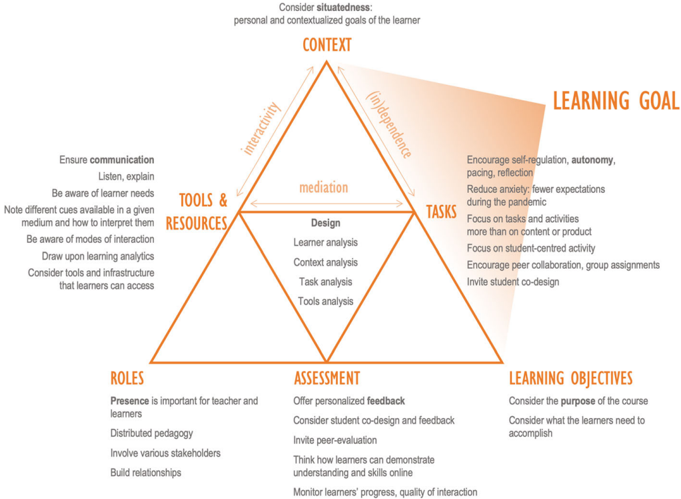
“Our findings point at the design of learning activities with certain characteristics, the combination of three types of presence (social, cognitive and facilitatory) and the need for adapting assessment to the new learning requirements.”
§ Springer Nature Switzerland AG 2020 Published online: 7 July 2020 > Abstract
plainstates an association- Asserted: passes — The authors put it forward as true.
- Checkable: passes — It can be checked against evidence.
- Load-bearing: passes — The paper’s conclusions depend on it.
- Based: passes — The paper gives a reason why it holds.
None of the sources cited for this claim have been checked yet.
In the paper
“What all four experts focus on as a prime ' piece ' of pedagogical knowledge (Kali et al. 2011) is the careful design of activities.”
§ Springer Nature Switzerland AG 2020 Published online: 7 July 2020 > Learning Design
plain- Asserted: passes — The authors put it forward as true.
- Checkable: passes — It can be checked against evidence.
- Load-bearing: unclear — It is unclear whether the paper’s conclusions depend on it.
- Based: passes — The paper gives a reason why it holds.
A result the paper reports from its own data — it cites no other source for it, so there is none to check. The quote shows it is in the paper.
In the paper
“Inspired by Anderson et al. ' s (2001) understanding of teaching presence and how it can be re-conceived in the current Covid-19 situation in which educators are the designers, the tutors and the evaluators of the learning experience, a tripartite framework emerges from the interviews, with three main sub-presences of the teaching presence, namely:”
§ Springer Nature Switzerland AG 2020 Published online: 7 July 2020 > Teacher Presence
plain- Asserted: passes — The authors put it forward as true.
- Checkable: passes — It can be checked against evidence.
- Load-bearing: passes — The paper’s conclusions depend on it.
- Based: passes — The paper gives a reason why it holds.
5 more claims
Create a free account to see all 61 claims and to verify the 9 references still open.
- Probably not a substantial claim. 50
- It may state two separate claims as one. 18
Claims other papers make about this one
Each is checked against this paper’s own text: does it say what the citing paper says it does?
The source backs part of the claim, not all of it — or backs it for a different population, condition or comparison.
In the citing paper
“while it is known that for learning success, input formats usually depend on both attention and interest from the students (Rapanta et al., 2020).”
From Impact of Synchronous and Asynchronous Settings of Online Teaching and Learning in Higher Education on Students' Learning Experience During COVID-19 (2021) · cites this paper as Rapanta et al., 2020
Experimental — accuracy not yet measuredIn the citing paper
“Evaluating AI applications could be beneficial for enhancing their motivation and interest in teaching with AI [40].”
From Developing AI Literacy for Primary and Middle School Teachers in China: Based on a Structural Equation Modeling Analysis (2022) · cites this paper as [40]
Citations
Cites
The Reflective Practitioner: How Professionals Think in Action
Checkoway, B., & Schon, D. A. (1985) · Journal of Policy Analysis and Management · doi:10.2307/3324262 · Cited by 21,268
The reflective practitioner: How professionals think in action
Stewart, C. J. (1984) · Patient Education and Counseling · doi:10.1016/0738-3991(84)90022-3 · Cited by 19,752
Knowledge and teaching: Foundations of the new reform
Shulman, L. (1987) · Harvard Educational Review · doi:10.17763/haer.57.1.j463w79r56455411 · Cited by 16,787
Phenomenological research methods
Moustakas, C. (1994) · doi:10.4135/9781412995658 · Cited by 13,919 · cited 1×
“’ This study ’ s participants, i.e. the four online pedagogy experts, also functioned as co-researchers, following Moustakas ’ (1994) idea (l).”
BackgroundDetermining Validity in Qualitative Inquiry
Creswell, J. W., & Miller, D. L. (2000) · Theory Into Practice · doi:10.1207/s15430421tip3903_2 · Cited by 9,184
Speech Genres and Other Late Essays
Bakhtin, M. M. (1986) · University of Texas Press eBooks · doi:10.7560/720466 · Cited by 8,470
The Difference between Emergency Remote Teaching and Online Learning
Hodges, C. B., Moore, S., Lockee, B. B., Trust, T., & Bond, M. A. (2024) · Handbook of Research in Online Learning · doi:10.1163/9789004702813_021 · Cited by 6,253
Blended learning: Uncovering its transformative potential in higher education
Garrison, D. R., & Kanuka, H. (2004) · The Internet and Higher Education · doi:10.1016/j.iheduc.2004.02.001 · Cited by 4,849
Speech Genres and Other Late Essays
Melaver, M., Bakhtin, M. M., McGee, V. W., Emerson, C., & Holquist, M. (1987) · Poetics Today · doi:10.2307/1772598 · Cited by 3,185
ASSESSING TEACHING PRESENCE IN A COMPUTER CONFERENCING CONTEXT
Anderson, T., Rourke, L., Garrison, R., & Archer, W. (2001) · Online Learning · doi:10.24059/olj.v5i2.1875 · Cited by 1,885
Research works printed but not linked: 2
- Bates, A. W. (2019). Teaching in a digital age. 2nd Edition. Vancouver: Tony Bates Associates. https://pressbooks.bccampus.ca/teachinginadigitalagev2/. Accessed 15 June 2020.
- Shor, I., & Freire, P. (1987). A pedagogy for deliberation: dialogues on transforming education . Westport: Bergin & Garvey Publishers.
Cited by
Items 1,401–1,500 of 2,106
Indayani, W. R., Asari, S., & Maruf, N. (2023) · English Review Journal of English Education · doi:10.25134/erjee.v11i3.8817 · Cited by 1
“By doing this, teachers intend to teach students crucial information that students might have yet to acquire in a regular assessment setting (Coomey & Stephenson, 2018), boosting student adaptability and practical methods of assessing their knowledge and skills Rapanta et al., 2020).”
BackgroundGashim, I. A., & Arshad, M. (2023) · International Journal of Information and Education Technology · doi:10.18178/ijiet.2023.13.11.1990 · Cited by 2
“From personal experience, many teachers are familiar with the category of working methods known as online teaching [8, 9].”
BackgroundKnowledge management system’s implementation in private universities through SECI model
Rukmana, A., & Widhianto, C. W. (2023) · Indonesian Journal of Multidisciplinary Science · doi:10.55324/ijoms.v3i1.712 · Cited by 3
Distance Education: Online Proctoring as a Tool for Assessing Learning Outcomes
Antonova, N. L., & Абрамова, С. Б. (2023) · University Management Practice and Analysis · doi:10.15826/umpa.2023.02.009 · Cited by 5
Aloka, P. J. O., Ajayi, O. B., & Olendo, R. A. (2023) · Springer eBooks · doi:10.1007/978-3-031-42402-1_9 · Cited by 1
URGENSI PERGURUAN TINGGI BAGI MAHASANTRI DI ERA SOCIETY 5.0
Warsah, B. A. A., & Warsah, I. (2023) · Al-Ikhtibar Jurnal Ilmu Pendidikan · doi:10.32505/ikhtibar.v10i1.6168 · Cited by 12
Capano, G., & Coletti, P. (2023) · European Journal of Higher Education · doi:10.1080/21568235.2023.2287461 · Cited by 2
“Furthermore, there is the question of whether and how this external shock has represented a constraint on universities, which raises the question of whether COVID-19 has been a potential trigger for activating changes in universities (Rapanta et al. 2020; Mottiar et al. 2022).”
Mediating Open & Distance e-Learning in the Advent of Global Crises
Letseka, M., Roberts, J. J., & Akintolu, M. (2023) · Unisa Press eBooks · doi:10.25159/146 · Cited by 3
Feedback strategies in distance education: a survey of university students
Pentucci, M., & Laici, C. (2023) · Research on Education and Media · doi:10.2478/rem-2023-0022 · Cited by 5
Assessment of Online Teaching Using Statistical and Unsupervised Learning Methods
Bisht, R. K., Jasola, S., Bisht, I. P., & Lohumi, Y. (2023) · Lecture notes in electrical engineering · doi:10.1007/978-981-99-7216-6_16 · Cited by 1
Higher education in times of war: vectors of innovative development
Kalinichenko, O. (2023) · SCIENTIA FRUCTUOSA · doi:10.31617/1.2023(152)08 · Cited by 1
Factors Affecting the Online Learning Outcomes of Higher Educational Institutions in Nepal
Duwal, B. R. (2023) · International Research Journal of Management Science · doi:10.3126/irjms.v8i1.60695 · Cited by 4
“Arbaughet. al., (2009), Patrick and Powell (2009), Dani, Sinhai and Hyde (2018), Hodges et. al., (2020), Patricia (2020), Gonzalez et.al., (2020) and Rapanta et.al.,(2020) explored its relation with learning outcome from pedagogical aspects.”
Background(2023) · European Journal of Contemporary Education · doi:10.13187/ejced.2023.4.1223 · Cited by 3
Mirici, İ. H., & Gümüş, Ö. (2024) · Advances in mobile and distance learning book series · doi:10.4018/978-1-6684-9855-2.ch014 · Cited by 1
Premawardhena, N. C. (2024) · Lecture notes in networks and systems · doi:10.1007/978-3-031-51979-6_31 · Cited by 2
Brijmohan, Y., Panther, G., & Diefes‐Dux, H. A. (2024) · ASEE Annual Conference & Exposition · doi:10.18260/1-2--41068 · Cited by 1
English learning model based on social media
Politeknik Negeri Malang, I., Imron, A., Wahyuni, E., Universitas Muhammadiyah Malang, I., Mandang, S. R. I., Politeknik Negeri Manado, I., Mustain, K., Politeknik Negeri Malang, I., Susanto, B., & Politeknik Negeri Bali, I. (2023) · Journal of Applied Studies in Language · doi:10.31940/jasl.v7i2.141-152 · Cited by 3
ONLINE ASSESSMENT CHALLENGES DURING THE PANDEMIC: LESSONS LEARNED FROM BANGLADESH FOR THE FUTURE
Hasnat, M. A., & Kabir, S. M. A. (2024) · International journal on innovations in online education · doi:10.1615/intjinnovonlineedu.2024049568 · Cited by 2
EFL Instructors’ Satisfaction with Teaching English Online at Tertiary Level
Karafil, B., & İLBAY, Ö. U. (2024) · Participatory Educational Research · doi:10.17275/per.24.20.11.2 · Cited by 3
Participation and real-life projects to improve Design education in Brazil
Nunes, V. D. G. A., Jorge, V., & Carvalho, A. (2023) · LearnXDesign Conference · doi:10.21606/drslxd.2023.116 · Cited by 1
Problem-Based Learning Model to Improve English Learning Achievement
Alias, H. (2023) · ETDC Indonesian Journal of Research and Educational Review · doi:10.51574/ijrer.v2i4.1020 · Cited by 1
“In addition to having a solid understanding of the subject matter and the classroom, a teacher needs to be proficient in several learning models that can be used to enhance learning activities (Uerz et al., 2018; Rapanta et al., 2020).”
BackgroundProblems of Learning Planning in The Time of The Covid Pandemic 19
Syafaruddin, B., Ruhaya, B., & Jamal, J. (2022) · ETDC Indonesian Journal of Research and Educational Review · doi:10.51574/ijrer.v1i2.187 · Cited by 2
“The presence of the COVID-19 pandemic in 2020 had an impact on educators, especially in the learning process (Aji, 2020; Assunção Flores & Gago, 2020; Carrillo & Flores, 2020; Lassoued et al., 2020; Rapanta et al., 2020; Sari et al., 2021; Tan, 2021).”
BackgroundReimagining Writing Centres Practices: A South African Perspective
Hotson, B., Bell, S., Rambiritch, A., Drennan, L., Clarence, S., Mtonjeni, T., Sefalane-Nkohla, P., George, F., Duke, L.-S., Alberts, R., et al. (2023) · doi:10.35293/esi.32 · Cited by 2
(2024) · Journal of International Business and Management · doi:10.37227/jibm-2024-04-6331/ · Cited by 1
Plıogou, V., Zaragas, H., Tromara, S., Koliopoulou, A., & Papatzikis, E. (2024) · The Educational Review USA · doi:10.26855/er.2024.01.001 · Cited by 2
Implications of COVID-19 for Mental Health among Different Sections of the Society
Ahmed, M., & Khan, S. T. (2022) · Molecular Medicine Communications · doi:10.55627/mmc.002.002.0135 · Cited by 1
Framework for academic success: Roles and responsibilities of both students and lecturers
Merino, A. R., Maroun, W., & Callaghan, C. W. (2024) · doi:10.4102/aosis.2024.bk454.06 · Cited by 2
Fostering Digital Skills and Competencies in Higher Education
Marta, G., Silvio, C., Barbara, K., & Giulia, A. (2023) · Bogucki Wydawnictwo Naukowe eBooks · doi:10.12657/9788379863761 · Cited by 2
Effective Teaching and Learning Method: Online Versus Face-To-Face
Amoah, C. (2024) · Springer eBooks · doi:10.1007/978-3-031-56953-1_7 · Cited by 1
Enseñanza remota de emergencia por COVID-19 en la Universidad Autónoma de la Ciudad de México
Ruíz, S. G. R., & Arrondo, V. M. (2024) · IE Revista de Investigación Educativa de la REDIECH · doi:10.33010/ie_rie_rediech.v15i0.2021 · Cited by 4
Nurlatifa, N., Murdiono, M., & Suyato (2024) · JPI (Jurnal Pendidikan Indonesia) · doi:10.23887/jpiundiksha.v13i1.65400 · Cited by 1
Gavranović, V., Michos, M. V., & Alčaković, S. (2024) · Didáctica Lengua y Literatura · doi:10.5209/dill.87558 · Cited by 6
Mosia, M. S. (2024) · Studies in Learning and Teaching · doi:10.46627/silet.v5i1.366 · Cited by 1
“The education sector, much like other spheres, was significantly impacted — higher education institutions, in particular, found themselves compelled to undertake abrupt and unplanned transitions to digital learning environments (Rapanta et al., 2020).”
BackgroundAlhammadi, M. M., Meda, L., Efthymiou, E., Williams, C., & Fteiha, M. A. (2024) · Springer eBooks · doi:10.1007/978-3-031-65215-8_18 · Cited by 1
Sulastri, Y. L., Ahmatika, D., Auliya, S., Septriani, A., Elsa, E., Khaerunnisa, N. K., & Sundhari, R. (2024) · UNION Jurnal Ilmiah Pendidikan Matematika · doi:10.30738/union.v12i2.17250 · Cited by 2
Behavioral insights in education: Intellectual data analysis for management
Usyk, V., Радіонова, І. Ф., & Fareniuk, Y. (2024) · Journal of Eastern European and Central Asian Research (JEECAR) · doi:10.15549/jeecar.v11i4.1573 · Cited by 3
“Hodges et al. (2020), Rapanta et al. (2020), Hu & Syang (2020), Jayadeva et al. (2022), and Brooks et al. (2021) assess education process participants' attitudes as well as the government's capacity to change education policy.”
BackgroundSah, B. K., Silwal, S., Adhikari, B., Pandey, A., & Gupta, B. (2024) · International Journal of Silkroad Institute of Research and Training · doi:10.3126/ijsirt.v1i2.68464
Haerani, R., Rahman, T. K. A., & Fatah, A. (2024) · Proceeding of The International Conference on Multidisciplinary Research for Sustainable Innovation. · doi:10.31098/icmrsi.v1i.825 · Cited by 2
Tomma, M. M. A. A. (2024) · E-Learning and Digital Media · doi:10.1177/20427530241279971 · Cited by 2
“According to (Rapanta et al., 2020; Rhema and Miliszewska, 2010), universities face a shortage of people and material resources, making implementing computerized accounting instruction successfully challenging.”
Larsari, V. N. (2024) · International Journal of Social Learning (IJSL) · doi:10.47134/ijsl.v4i3.290 · Cited by 6
“…of this transition varied across different education sectors, influenced by factors like the age and individual learning capacities of students, the nature of pedagogy at each educational level, and the extent of virtual learning’s integration into standard teaching methods (Rapanta et al., 2020).”
BackgroundOn Developing Model of Online Education in European Universities
Zhao, S. (2024) · International Conference on Education and Multimedia Technology (ICEMT) · doi:10.1145/3678726.3678775 · Cited by 1
“In order to comprehensively understand the development of educational informatization [2], the European Commission began a survey on the situation of educational informatization in European universities in 2013 and made the survey report public to the society.”
Korsah, D. P., Gbormittah, D., Abdulai, I. B., & Wireko-Ampem, J. K. (2024) · Educational Point · doi:10.71176/edup/15021 · Cited by 1
Dhamanti, I., & Salsabila, S. (2025) · Elsevier eBooks · doi:10.1016/b978-0-443-30168-1.00013-x · Cited by 5
AULAS VIRTUALES EN LA EDUCACIÓN SECUNDARIA. PROPUESTAS PARA LA INSPECCIÓN EDUCATIVA
Ruiz, P. A. (2025) · Supervisión 21: revista de educación e inspección · doi:10.52149/sp21/76.2 · Cited by 1
Crozier, A., Miller, G., Graves, L., Dawson, E. A., Osin, C., Sadler, I., Naylor, L. H., GREEN, D. J., Askew, C. D., & Jones, H. (2025) · BMJ Open · doi:10.1136/bmjopen-2025-099240 · Cited by 2
The impact of the COVID-19 pandemic on accounting education: evidence from Puerto Rico
Cardona, R. J., González-López, D., & Avilés-González, A. (2025) · Fórum Empresarial · doi:10.33801/fe.v29i2.22546 · Cited by 1
Phiri-Chibbonta, C., Muchangwe, R., & Mambwe, E. (2025) · Discover Education · doi:10.1007/s44217-025-00624-1 · Cited by 2
“Previous research [23, 53] supports the current findings, which suggest that difficulties encountered in online teaching and learning during the COVID-19 pandemic are largely attributed to insufficient technical expertise and inadequate internet connectivity.”
InfluentialAchuthan, A., Natarajan, T., & Fazili, I. (2025) · Advances in Science, Technology & Innovation/Advances in science, technology & innovation · doi:10.1007/978-3-031-56848-0_12 · Cited by 2
Face-to-Face vs. Online Language Courses
Kalogerou, V. (2020) · Advances in educational technologies and instructional design book series · doi:10.4018/978-1-7998-4658-1.ch012 · Cited by 1
“I Can Do This – Better Than I Thought” – Instructors’ Experiences of The Digital Summer Term 2020
Bedenlier, S., Schmidt, C., Gerl, S., Hetzner, S., Schliebs, M., & Sesselmann, K. (2020) · EDEN Conference Proceedings · doi:10.38069/edenconf-2020-rw-0002 · Cited by 1
“The ambivalence of videoconferencing is also noticed in Rapanta et al. (2020).”
BackgroundInfluentialOnline Teaching Amid COVID-19 Pandemic: Factors Affecting Teacher Satisfaction
Thach, P. N., Huong, D. Q., & Thanh, T. M. (2021) · VNU Journal of Science Education Research · doi:10.25073/2588-1159/vnuer.4475 · Cited by 1
FROM ON-CAMPUS TO ONLINE INSTRUCTION IN POSTGRADUATE BUILT HERITAGE MANAGEMENT STUDIES
Sansalvador, L. G., Blasco, M. J. V., Furió, M. E. C., Tamborero, E. C., & García, L. F. H. (2021) · INTED proceedings · doi:10.21125/inted.2021.1126 · Cited by 1
Structuring International University Students’ Reflection and Meta-reflection Experiences Online
Rapanta, C., & Pisano, C. (2021) · Communications in computer and information science · doi:10.1007/978-3-030-73988-1_10 · Cited by 1
Self-citationVolkova, N. P., Валеріївна, Л. О., Verchenko, L., et al. (2021) · SHS Web of Conferences · doi:10.1051/shsconf/202110403011 · Cited by 1
Ph.D., H. M. J., Giginyu, A., & Mutah, M. A. (2021) · Scholarly Journal of Advanced Legal Research · doi:10.46654/sjalr.1505 · Cited by 2
Escalas de Cultura de Dorfman y Howell. Análisis de Invarianza Factorial Progresiva
Pino, N., & Luna, J. F. (2021) · Revista Iberoamericana de Psicología · doi:10.33881/2027-1786.rip.13309 · Cited by 1
“…tardía (Turcan, 2016), los efectos de la pandemia COVID 19 en el mundo del trabajo y la educación (Organización Internacional del Trabajo, 2020; Rapanta et al., 2020), la transición desde la economía del conocimiento a la economía digital (Didier, 2020), hasta las prácticas segregadoras…”
Semester students’ perceptions about online class during COVID-19 pandemic
Dhami, B. S. (2020) · Scholars Journal · doi:10.3126/scholars.v3i0.37135 · Cited by 2
Maekawa, Y. (2021) · Medical Entomology and Zoology · doi:10.50924/letkansai.19.0_41 · Cited by 1
Pastor, M. D. G. (2021) · Advances in mobile and distance learning book series · doi:10.4018/978-1-7998-7681-6.ch006 · Cited by 1
Blau, G. J., & Goldberg, D. (2021) · Journal of Education and Development · doi:10.20849/jed.v5i2.910 · Cited by 1
Shuchi, M. S., Tabassum, S. C., & Toufique, M. M. K. (2021) · Journal of Applied Learning & Teaching · doi:10.37074/jalt.2021.4.2.3 · Cited by 1
“This paper uses ‘online learning’ and ‘online classes’ interchangeably and follows Rapanta et al. (2020) to define ‘online learning’ as the learning provided and received using the internet.”
MethodAssessment practices in Geography under COVID-19: Limitations and opportunities
Knight, J. (2021) · The Journal of Geography Education in Africa · doi:10.46622/jogea.v4i1.2908 · Cited by 1
Teaching Lexical Chunks in the Online English Language Classroom through Learning Management Systems
Deissl-O’Meara, M., & Tinkel, I. (2021) · MAP Social Sciences · doi:10.53880/2744-2454.2021.1.1.1 · Cited by 4
Pre- and Early-Pandemic Graduating Students’ Perceptions at a United States Business School
Blau, G. J. (2021) · Journal of Educational and Developmental Psychology · doi:10.5539/jedp.v11n2p47 · Cited by 1
“This is consistent with prior research showing the sudden shift in teaching to online learning with the pandemic onset (Rapanta et al., 2020).”
ResultState of the Art About COVID-19's Impact on Santiago University, Cape Verde
Sarmento, E. M., & Monteiro, J. M. (2021) · Advances in educational technologies and instructional design book series · doi:10.4018/978-1-7998-6963-4.ch016 · Cited by 1
Zakaria, N. Z., Eshak, E. S., Jidi, M. M., & Jamian, N. F. (2021) · International Journal of Academic Research in Progressive Education and Development · doi:10.6007/ijarped/v10-i3/11347 · Cited by 1
“Introduction Online learning has emerged two decades ago in tertiary education (Rapanta et al., 2020).”
BackgroundGimeno, N. G. (2021) · Doblele Revista de lengua y literatura · doi:10.5565/rev/doblele.94 · Cited by 1
The Effect of the Covid-19 Epidemic on the Self-Perception of Training Needs in STEAM Lecturers
García, A. L., Farran, J. D. P., Alier, M., Alcober, J., & Álvarez, D. L. (2021) · IEEE Frontiers in Education Conference (FIE) · doi:10.1109/fie49875.2021.9637259 · Cited by 1
Prodanović, M., & Gavranović, V. (2021) · Komunikacija i Kultura Online · doi:10.18485/kkonline.2021.12.12.13 · Cited by 3
A COVID-19 magyar egyetemi hallgatókra kifejtett hatásai
Kálmán, B. G., Juhász, T., & Tóth, A. (2021) · Magyar Pedagógia · doi:10.17670/mped.2021.1.25 · Cited by 1
A Meta-Analysis on Online Classes for Hotel Management Students at Chennai During Covid-19
Milton, T., & Moyeenudin, H. M. (2022) · Lecture notes in networks and systems · doi:10.1007/978-981-16-5655-2_57 · Cited by 3
A Study on the Learner’s Satisfaction of on-line PBL classes in Korean College
Jun, B. (2021) · Cypriot Journal of Educational Sciences · doi:10.18844/cjes.v16i6.6382 · Cited by 1
E-Learning: Global Perspectives, Challenges and Educational Implications
Donnie, A., & Kee-Man, C. (2022) · Nova Science Publishers eBooks · doi:10.52305/qgnz7440 · Cited by 1
The Perspective of the Bangladeshi Students About the Impact of COVID-19 on Higher Education
Akhtar, S., Joy, M. A. R., & Suchi, S. A. (2022) · Advances in educational marketing, administration, and leadership book series · doi:10.4018/978-1-7998-8402-6.ch020 · Cited by 1
Virtual University – Reality vs Evaluation by the Polish Pedagogy Students
Grzyb, B. (2022) · V&R unipress eBooks · doi:10.14220/9783737014229.79 · Cited by 1
Virtual-assessment performance hampered by slow adaptation to tech environment
Shahid, N. (2022) · Interactive Learning Environments · doi:10.1080/10494820.2022.2061011 · Cited by 1
“…perfected to augment the learning bene fi ts (Barrot et al., 2021; Batdi et al., 2021; Gupta et al., 2021; Kearns, 2012; Martin et al., 2020; Mishra et al., 2020; Rapanta et al., 2020; Ross, 2017; Wright, 2019; Zimmer & Matthews, 2021) and to prevent the waste of foundational years of student life.”
BackgroundImplementation of Design Learning Based Web Model in Pre-service Elementary School Teachers
Thohir, M. A., Untari, E., Sukamti, S., et al. (2022) · doi:10.1109/icite54466.2022.9759555 · Cited by 1
TEACHING SPEAKING IN THE REALITY OF COVID-19 IMPACT
Kovalska, N., & Ковалова, О. (2021) · Research Trends in Modern Linguistics and Literature · doi:10.29038/2617-6696.4.24.34 · Cited by 1
Carloni, G. (2022) · Elsevier eBooks · doi:10.1016/b978-0-323-91185-6.00012-4 · Cited by 3
Detyna, M., & Koch, M. (2022) · Journal of Education and Training Studies · doi:10.11114/jets.v10i3.5481 · Cited by 1
Ahdhianto, E., Mas’ula, S., & Thohir, M. A. (2022) · Jurnal ABDINUS Jurnal Pengabdian Nusantara · doi:10.29407/ja.v6i2.17704 · Cited by 1
Inclusive and Quality Online Learning for Sri Lankan Higher Education Institutions beyond Disruption
Yang, D., Hayashi, R., Ra, S., & Lim, C. P. (2022) · Innovation and Education · doi:10.55396/ined.22.0002 · Cited by 2
TEACHING AND LEARNING CHALLENGES IN THE PANDEMIC ERA OF COVID-19
Zain, N. M., Mut, N. A. I. C., Marzhuki, M., & Norhan, S. H. (2022) · European Journal of Education Studies · doi:10.46827/ejes.v9i6.4306 · Cited by 1
“Teachers are like designers and tutors at the same time in order to design worthwhile activities for students (Rapanta et al., 2020).”
BackgroundParlangeli, O., Bracci, M., Guidi, S., Marchigiani, E., & Palmitesta, P. (2022) · Lecture notes in computer science · doi:10.1007/978-3-031-05064-0_12 · Cited by 1
TEACHING DURING THE COVID-19 CRISIS AS REFLECTED AND SHARED ON FACEBOOK
Khôi, M. N., & Tuyet, K. T. A. (2021) · VNU Journal of Foreign Studies · doi:10.25073/2525-2445/vnufs.4780 · Cited by 1
“Rapanta et al. (2020) also pointed out that while face to face learning relies on direct personal interactions through discussions or presentations, online learning is more materials-based and should integrate more media such as videos or readings.”
BackgroundResultInfluentialLaeliyah, I., & Deta, U. A. (2022) · IPF Inovasi Pendidikan Fisika · doi:10.26740/ipf.v11n1.p11-19 · Cited by 1
Academic Procrastination in the Age of Online Education in the Philippines
Pacaol, N. F., & Siguan, A. A. (2022) · Emerald Group Publishing Limited eBooks · doi:10.1108/978-1-80262-497-720221006 · Cited by 1
Abhishikta, & Shiplu (2022) · The Review of Contemporary Scientific and Academic Studies · doi:10.55454/rcsas.2.7.2022.001 · Cited by 1
Computer Performance Evaluation for Virtual Classroom with Artificial Intelligence Features
Lim, K. Y., Joan, H., & Tew, Y. (2021) · International Conference on Digital Transformation and Applications (ICDXA) · doi:10.56453/icdxa.2021.1008 · Cited by 1
Sabina-Adina, L. U. C. A., & Gheorghiță, B. (2022) · Revista de Pedagogie - Journal of Pedagogy · doi:10.26755/revped/2022.1/129 · Cited by 1
Application of Task-Based Learning Module in Mathematics V
Anives, J. B., & Ching, D. A. (2022) · International Journal of Educational Management and Development Studies · doi:10.53378/352865 · Cited by 1
Yücel, N., Keleş, P., & Yıldırım, M. E. (2022) · Journal of Surgery and Medicine · doi:10.28982/josam.993865 · Cited by 1
“The role of the educator is to consult with the relevant pedagogy to ensure that online learning tools are well equipped to provide students with a clear learning path throughout the curriculum [11].”
BackgroundWhite, A. J., & LaBelle, S. (2022) · Southern Communication Journal · doi:10.1080/1041794x.2022.2108890 · Cited by 1
“It is important to note, however, that the COVID-19 pandemic and transition to online learning have also had a marked impact on instructors’ well-being (Rapanta et al., 2020).”
BackgroundOnline Education as Perceived by Teachers and Students
Gautam, P. (2022) · Prithvi Journal of Research and Innovation · doi:10.3126/pjri.v4i1.50162 · Cited by 1
Yahya, M. D., Tamjidnor, T., Pratiwi, E. Y. R., Basir, A., & Syahbudin, A. (2022) · Al-Ulum · doi:10.30603/au.v22i1.2616
The changes of biology learning activities in higher education during the COVID-19 pandemic
Nugroho, A. A., Yokhebed, Y., Nastiti, L. R., & Suranto, S. (2023) · AIP conference proceedings · doi:10.1063/5.0106640 · Cited by 1
Flores-Morales, P. (2023) · Educación Química · doi:10.22201/fq.18708404e.2023.1.82337 · Cited by 1
McCartney, M. L., Wan, X., Griep, C. D., & Lighthall, N. R. (2023) · Journal of Microbiology and Biology Education · doi:10.1128/jmbe.00122-22 · Cited by 5
Primahardani, I., & Isjoni, M. Y. R. (2022) · Lentera Pendidikan Jurnal Ilmu Tarbiyah dan Keguruan · doi:10.24252/lp.2022v25n2i1 · Cited by 1
Siregar, H. M., Solfitri, T., Syofni, S., & Anggraini, R. D. (2023) · Jurnal Ilmiah Mandala Education · doi:10.58258/jime.v9i1.4616 · Cited by 3
Metadata
- Authors
- Rapanta, C., Botturi, L., Goodyear, P., Guàrdia, L., & Koole, M.
- Affiliations
- Universidade Nova de Lisboa (PT)
- University of Applied Sciences and Arts of Southern Switzerland (CH)
- The University of Sydney (AU)
- University of Saskatchewan (CA)
- Corresponding author
- Rapanta, Chrysi
- ORCID
- Rapanta, Chrysi
- Venue
- Postdigital Science and Education
- Published
- 2020-07-07
- Volume
- 2
- Issue
- 3
- Pages
- 923-945
- ISSN
- 2524-485X (ISSN-L)
- 2524-4868
- PMC
- PMC7339092
- OpenAlex
- W3042009104
- Semantic Scholar
- fed495af71b417de8d60cf16b6da44926faf24a0
- Cited by
- 2,130
- References
- 75
- Citations by year
- 2026: 134 · 2025: 158 · 2024: 261 · 2023: 426 · 2022: 556 · 2021: 509 · 2020: 73
- FWCI
- 454.18
- Type
- journal article
- Language
- en
- Open access
- hybrid
- doi.org
- Licence
- other-oa
- www.springer.com/tdm (tdm)
- www.springer.com/tdm (vor)
- Locations
- Postdigital Science and Education (publishedVersion, other-oa)
- PubMed (publishedVersion)
- PubMed Central (submittedVersion)
- The Sydney eScholarship Repository (The University of Sydney) (submittedVersion)
- Funders
- Fundação para a Ciência e a Tecnologia (DL 57/2016/CP1453/CT0066)
- Australian Research Council (DP150104163)
- Topics
- Social Sciences › Education › Digital Education and Society
- Social Sciences › Education › Higher Education Practises and Engagement
- Social Sciences › Education › Educational Innovations and Technology
- Keywords
- online learning, COVID-19 pandemic, higher education, teacher presence, pedagogical content knowledge, learning activities, social presence, cognitive presence
About these checks
Registry, retraction, Cites and statistics results are computed, not judged, with one exception: a printed reference that no index lists is read once by a model before it counts as a citation error. Claims are extracted by a model and kept only when their quote appears verbatim in the text; each cited source is then checked, with a model’s help, for whether it says what the claim relies on. Those verdicts can be wrong — read the claim’s quote and the cited source before relying on one.
The claim verdicts this report counts are experimental: their accuracy is not yet measured.
A language model drew the claims from the paper on 2026-10-10, under version 3 of the claim definition (model deepseek-v4.1-flash, prompt extract-v3).
A second model labelled each claim on 2026-10-10 (model jev-1.13-20260917, definition revision gold-guideline-v0.2).
Cited sources are checked with a language model’s help (qwen3.8-omni-flash).
Statistics and arithmetic are recomputed, not judged.
Confidence bands are shown only for fields calibrated on our annotated test set. None is calibrated yet, so no band is shown.
What counts as a claim ›How we measure confidence ›How we check this ›
Are you an author, or do you see a problem with this page? Request a review
Data sources
Bibliographic data: Semantic Scholar, OpenAlex, Crossref.
Contains information from the Semantic Scholar Academic Graph Datasets, made available under the ODC Attribution License (ODC-BY 1.0).
Semantic Scholar’s data is described in: Kinney, R., et al. (2023). The Semantic Scholar Open Data Platform. arXiv:2301.10140.
