

Online University Teaching During and After the Covid-19 Crisis: Refocusing Teacher Presence and Learning Activity
Open accessThe DOI matches its Crossref record; 71 of the 75 references it cites were found in a registry or an index; 6 of the 42 sources its claims cite were checked for support.
Abstract
The Covid-19 pandemic has raised significant challenges for the higher education community worldwide. A particular challenge has been the urgent and unexpected request for previously face-to-face university courses to be taught online. Online teaching and learning imply a certain pedagogical content knowledge (PCK), mainly related to designing and organising for better learning experiences and creating distinctive learning environments, with the help of digital technologies.
Overview
CoChat Summary
TL;DR
This article is an expert-interview piece offering pedagogical guidance for university teachers suddenly moving online during Covid-19. Its central message is that effective online teaching depends less on tools or materials alone and more on careful learning design, multiple forms of teacher presence, and continuous assessment.
Key findings
- The four experts argue that online learning should be built around carefully designed learning activities, with a mix of synchronous, asynchronous, online, and offline tasks that are clear, appropriately difficult, authentic, and accessible to students.
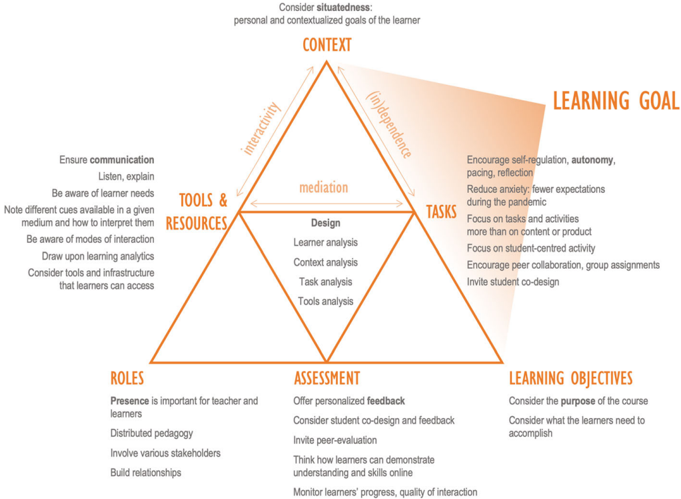
- They propose a tripartite teaching presence for online courses: cognitive presence, social presence, and facilitatory presence.
- Successful online learning requires students not to feel alone, and it benefits from timely feedback, peer collaboration, and student co-design/co-configuration of activities.
- The paper states that continuous assessment is needed in online learning, and suggests self-reflections, portfolios, self-paced asynchronous activities, and use of learning analytics as part of evaluation.
Methods
- Exploratory qualitative study using expert interviews administered by e-mail.
- Sample: 4 online pedagogy experts/co-authors, selected for research expertise, more than a decade of online teaching experience, and experience across different national education systems; they worked in Switzerland, Australia, Spain, and Canada.
- Main analysis: the first author organized the responses into a panel-like article, then the authors jointly revised and synthesized the material; the discussion summarizes themes under learning design, teacher presence, and assessment.
Limitations
- The paper states that all four experts came from “rich parts of the world” (Switzerland, Canada, Australia, and North of Spain), which limits the lens to a “monofocal” view of educational reality.
- The paper itself says the study used a heuristic method based on expert viewpoints and “by no means can replace rigorous, systematic research” following the scientific method.
- Evident from the text: the sample is very small (4 experts) and highly selected, so the findings are expert-opinion guidance rather than generalizable empirical results.
Model-written summary. Check it against the paper before relying on it.
Integrity signals
Registry
Cites
Statistics
Figures
Verification
Claims the paper makes
5 Valid · 0 Not valid · 32 Not checked · 24 Own results and interpretations
The sources with a verdict support this claim; the rest weren’t checked yet, have no full text we could read, or their verdicts aren’t rated yet.
In the paper
“On top of that, a significant challenge for university teachers has been their lack of the pedagogical content knowledge (PCK) (Shulman 1987) needed for teaching online (Angeli and Valanides 2005; Kali, Goodyear and Markauskaite 2011; Ching, Hsu and Baldwin 2018).”
§ Springer Nature Switzerland AG 2020 Published online: 7 July 2020 > Introduction
What the sources say
- Supportedcites Shulman 1987 matched to “Knowledge and teaching: Foundations of the new reform” (1987) source
The parenthetical (Shulman 1987) is attached to the term 'pedagogical content knowledge (PCK)' — an identification citation — while the online-teaching studies are credited to Angeli & Valanides, Kali et al. and Ching et al. Our copy (the Portuguese edition of Shulman's 1987 Harvard Educational Review article) establishes exactly that concept: the 'Categorias da base de conhecimento' section lists 'conhecimento pedagógico do conteúdo' as one of the categories of the knowledge base for teaching, 'esse amálgama especial de conteúdo e pedagogia que é o terreno exclusivo dos professores', and the 'Novas compreensões' section calls it 'a categoria que melhor distingue a compreensão de um especialista em conteúdo daquela de um pedagogo'. The paper itself says nothing about online teaching or about university teachers lacking PCK, but that part of the sentence is not attributed to this source. (LLM, conf=0.85)
- Not checked — no full text of the sourcecites Angeli and Valanides 2005 matched to “Preservice elementary teachers as information and communication technology designers: an instructional systems design model based on an expanded view of pedagogical content knowledge” (2005) source
- Could not verifycites Ching, Hsu and Baldwin 2018 matched to “Online Course Design and Development among College and University Instructors: An Analysis using Grounded Theory” (2018) sourceExperimental — accuracy not yet measured
Our copy of Baldwin, Ching & Friesen (2018) never mentions pedagogical content knowledge, PCK, Shulman, or TPACK; searches for 'pedagogical content knowledge PCK online teaching', 'TPACK technological pedagogical content knowledge', 'Shulman pedagogical content knowledge Angeli Valanides' and 'challenge lack of knowledge training online instructors pedagogy' returned only the References list and design-process passages. The paper's content is a grounded-theory account of how 14 four-year-institution instructors design online courses (Abstract; Results themes; Discussion mapping to ADDIE), and its nearest statements — that instructors 'must develop new curriculum with instructional strategies effective for online learning' (Discussion) and 'rarely use formal instructional design models' (Results) — concern design practice, not a PCK deficiency framed as a significant challenge. Nothing in our copy either states or contradicts the attributed claim. (LLM, conf=0.72)
plain- Asserted: passes — The authors put it forward as true.
- Checkable: passes — It can be checked against evidence.
- Load-bearing: passes — The paper’s conclusions depend on it.
- Based: passes — The paper gives a reason why it holds.
- Supported
The cited sources support only part of this claim — read each source’s verdict below.
In the paper
“Assessment can possibly be considered the most challenging part of the transition to distance learning for an institution used to face-to-face oral or written exam, as the control shift towards the students makes it hardly possible to ensure that students are not cheating (Munoz and Mackay 2019).”
§ Springer Nature Switzerland AG 2020 Published online: 7 July 2020 > Assessment
What the sources say
- Partly supportedcites Munoz and Mackay 2019 matched to “An online testing design choice typology towards cheating threat minimisation” (2019) sourceExperimental — accuracy not yet measured
Split into 2 atoms — 0 confirmed, 2 partially supported, 0 disputed, 0 misattributed, 0 unverifiable. Expand the claim to see per-atom verdicts.
hedgedstates a possible cause- Asserted: passes — The authors put it forward as true.
- Checkable: passes — It can be checked against evidence.
- Load-bearing: unclear — It is unclear whether the paper’s conclusions depend on it.
- Based: passes — The paper gives a reason why it holds.
- Partly supported
A result the paper reports from its own data — it cites no other source for it, so there is none to check. The quote shows it is in the paper.
In the paper
“Our findings point at the design of learning activities with certain characteristics, the combination of three types of presence (social, cognitive and facilitatory) and the need for adapting assessment to the new learning requirements.”
§ Springer Nature Switzerland AG 2020 Published online: 7 July 2020 > Abstract
plainstates an association- Asserted: passes — The authors put it forward as true.
- Checkable: passes — It can be checked against evidence.
- Load-bearing: passes — The paper’s conclusions depend on it.
- Based: passes — The paper gives a reason why it holds.
None of the sources cited for this claim have been checked yet.
In the paper
“What all four experts focus on as a prime ' piece ' of pedagogical knowledge (Kali et al. 2011) is the careful design of activities.”
§ Springer Nature Switzerland AG 2020 Published online: 7 July 2020 > Learning Design
plain- Asserted: passes — The authors put it forward as true.
- Checkable: passes — It can be checked against evidence.
- Load-bearing: unclear — It is unclear whether the paper’s conclusions depend on it.
- Based: passes — The paper gives a reason why it holds.
A result the paper reports from its own data — it cites no other source for it, so there is none to check. The quote shows it is in the paper.
In the paper
“Inspired by Anderson et al. ' s (2001) understanding of teaching presence and how it can be re-conceived in the current Covid-19 situation in which educators are the designers, the tutors and the evaluators of the learning experience, a tripartite framework emerges from the interviews, with three main sub-presences of the teaching presence, namely:”
§ Springer Nature Switzerland AG 2020 Published online: 7 July 2020 > Teacher Presence
plain- Asserted: passes — The authors put it forward as true.
- Checkable: passes — It can be checked against evidence.
- Load-bearing: passes — The paper’s conclusions depend on it.
- Based: passes — The paper gives a reason why it holds.
5 more claims
Create a free account to see all 61 claims and to verify the 9 references still open.
- Probably not a substantial claim. 50
- It may state two separate claims as one. 18
Claims other papers make about this one
Each is checked against this paper’s own text: does it say what the citing paper says it does?
The source backs part of the claim, not all of it — or backs it for a different population, condition or comparison.
In the citing paper
“while it is known that for learning success, input formats usually depend on both attention and interest from the students (Rapanta et al., 2020).”
From Impact of Synchronous and Asynchronous Settings of Online Teaching and Learning in Higher Education on Students' Learning Experience During COVID-19 (2021) · cites this paper as Rapanta et al., 2020
Experimental — accuracy not yet measuredIn the citing paper
“Evaluating AI applications could be beneficial for enhancing their motivation and interest in teaching with AI [40].”
From Developing AI Literacy for Primary and Middle School Teachers in China: Based on a Structural Equation Modeling Analysis (2022) · cites this paper as [40]
Citations
Cites
The Reflective Practitioner: How Professionals Think in Action
Checkoway, B., & Schon, D. A. (1985) · Journal of Policy Analysis and Management · doi:10.2307/3324262 · Cited by 21,268
The reflective practitioner: How professionals think in action
Stewart, C. J. (1984) · Patient Education and Counseling · doi:10.1016/0738-3991(84)90022-3 · Cited by 19,752
Knowledge and teaching: Foundations of the new reform
Shulman, L. (1987) · Harvard Educational Review · doi:10.17763/haer.57.1.j463w79r56455411 · Cited by 16,787
Phenomenological research methods
Moustakas, C. (1994) · doi:10.4135/9781412995658 · Cited by 13,919 · cited 1×
“’ This study ’ s participants, i.e. the four online pedagogy experts, also functioned as co-researchers, following Moustakas ’ (1994) idea (l).”
BackgroundDetermining Validity in Qualitative Inquiry
Creswell, J. W., & Miller, D. L. (2000) · Theory Into Practice · doi:10.1207/s15430421tip3903_2 · Cited by 9,184
Speech Genres and Other Late Essays
Bakhtin, M. M. (1986) · University of Texas Press eBooks · doi:10.7560/720466 · Cited by 8,470
The Difference between Emergency Remote Teaching and Online Learning
Hodges, C. B., Moore, S., Lockee, B. B., Trust, T., & Bond, M. A. (2024) · Handbook of Research in Online Learning · doi:10.1163/9789004702813_021 · Cited by 6,253
Blended learning: Uncovering its transformative potential in higher education
Garrison, D. R., & Kanuka, H. (2004) · The Internet and Higher Education · doi:10.1016/j.iheduc.2004.02.001 · Cited by 4,849
Speech Genres and Other Late Essays
Melaver, M., Bakhtin, M. M., McGee, V. W., Emerson, C., & Holquist, M. (1987) · Poetics Today · doi:10.2307/1772598 · Cited by 3,185
ASSESSING TEACHING PRESENCE IN A COMPUTER CONFERENCING CONTEXT
Anderson, T., Rourke, L., Garrison, R., & Archer, W. (2001) · Online Learning · doi:10.24059/olj.v5i2.1875 · Cited by 1,885
Research works printed but not linked: 2
- Bates, A. W. (2019). Teaching in a digital age. 2nd Edition. Vancouver: Tony Bates Associates. https://pressbooks.bccampus.ca/teachinginadigitalagev2/. Accessed 15 June 2020.
- Shor, I., & Freire, P. (1987). A pedagogy for deliberation: dialogues on transforming education . Westport: Bergin & Garvey Publishers.
Cited by
Items 201–300 of 2,106
Downie, S. R., Gao, X., Bedford, S. B., Bell, K., & Kuit, T. A. (2021) · Journal of University Teaching and Learning Practice · doi:10.53761/1.18.4.12 · Cited by 67
Abdallah, A. K., & Alriyami, R. (2022) · World Journal on Educational Technology Current Issues · doi:10.18844/wjet.v14i3.7193 · Cited by 49
Xie, N., Liu, Z., Li, Z., Pang, W., & Lu, B. (2023) · Multimedia Systems · doi:10.1007/s00530-023-01153-3 · Cited by 47
Younas, M. S., Dong, Y., Zhao, G., Menhas, R., Luan, L., & Noor, U. (2024) · European Journal of Education · doi:10.1111/ejed.12818 · Cited by 40
Bahar, N., Wahab, S. N., & Ahmad, N. D. (2020) · International Conference on e-Learning (econf) · doi:10.1109/econf51404.2020.9385474 · Cited by 40
“Recent studies discuss faculty’s readiness to teach online and explore their professional vulnerability [4], instructional strategies for university instructors to conduct online teaching in unprecedented time [5], expert insights into onlinelearning-related pedagogical content knowledge in helping non-expert universi…”
BackgroundTaking Art School Online in Response to COVID 19: From Rapid Response to Realising Potential
Charters, M., & Murphy, C. (2021) · International Journal of Art & Design Education · doi:10.1111/jade.12384 · Cited by 39
Synchronous meetings, community of inquiry, COVID-19, and online graduate teacher education
Oyarzun, B. A., Hancock, C., Salas, S., & Martin, F. (2021) · Journal of Digital Learning in Teacher Education · doi:10.1080/21532974.2021.1890653 · Cited by 47
Covid-19 Pandemi Sürecinde Verilen Uzaktan Eğitim Hakkında Veli Görüşleri
Arslan, K., Arı, A. G., & Kanat, M. H. (2021) · Ulakbilge Dergisi · doi:10.7816/ulakbilge-09-57-03 · Cited by 78
Education for sustainable development through research-based learning in an online environment
Ahel, O., & Schirmer, M. (2022) · International Journal of Sustainability in Higher Education · doi:10.1108/ijshe-07-2021-0305 · Cited by 48
Digital learning transformation: A study of teachers’ post-Covid-19 experiences
Imran, M., Almusharraf, N., & Abbasova, M. Y. (2024) · Social Sciences & Humanities Open · doi:10.1016/j.ssaho.2024.101228 · Cited by 62
Coping with English for Academic Purposes Provision during COVID-19
Kohnke, L., & Jarvis, A. (2021) · Sustainability · doi:10.3390/su13158642 · Cited by 44
Evaluation of an academic satisfaction model in E-learning education contexts
Zalazar-Jaime, M. F., Moretti, L. S., García-Batista, Z. E., & Medrano, L. A. (2021) · Interactive Learning Environments · doi:10.1080/10494820.2021.1979047 · Cited by 42
Maphalala, M. C., Khumalo, N. P., & Khumalo, P. N. (2021) · Perspectives in Education · doi:10.18820/2519593x/pie.v39.i3.4 · Cited by 46
“Rapanta et al. (2020) concur that the COVID-19 emergency situation demanded that teachers become designers and tutors overnight, using tools that few have fluently mastered. When it comes to online teaching strategies, Kebritchi, Lipschuetz and Santiague (2017) argue that the content for online learning should include…”
BackgroundRad, D., Magulod, G. C., Balaș, E., Roman, A. F., Egerău, A., Maier, R., Ignat, S., Dughi, T. S., Bălaş, V. E., Demeter, E., et al. (2022) · Frontiers in Psychology · doi:10.3389/fpsyg.2022.880753 · Cited by 58
“As a result, all preschool instructors were forced to rapidly and successfully acquire and implement instructional strategies with which they were unfamiliar (Hodges et al., 2020; Rapanta et al., 2020).”
BackgroundDavis, S., & Phillips, L. G. (2020) · NJ · doi:10.1080/14452294.2021.1943838 · Cited by 45
“…how millions of students across the world were being educated (Tam and El-Azar, 2020), with teachers moving swiftly to facilitate teaching and learning through remote, distance and online modes, most through using a range of digital technologies, learning tools and platforms (Rapanta et al. 2020).”
BackgroundPetrila, L., Goudenhooft, G., Gyarmati, B. F., Popescu, F.-A., Simuţ, C. C., & Brihan, A. C. (2022) · Sustainability · doi:10.3390/su14127269 · Cited by 33
The Use of Azhari Curriculum in Arabic Language Learning at Islamic Boarding School
Fidayani, E. F., & Ammar, F. M. (2023) · Nazhruna Jurnal Pendidikan Islam · doi:10.31538/nzh.v6i1.2866 · Cited by 29
Demuyakor, J. (2021) · Shanlax International Journal of Education · doi:10.34293/education.v9i3.3904 · Cited by 36
Córdova, M., Floriani, D. E., González-Pérez, M. A., Hermans, M., Mingo, S., Monje-Cueto, F., Aguirre, K. M. N., Rodríguez, C., & Salvaj, E. H. (2021) · Academia Revista Latinoamericana de Administración · doi:10.1108/arla-01-2021-0020 · Cited by 38
Seraj, P. M. I., Chakraborty, R., Mehdi, T., & Roshid, M. M. (2022) · Education Research International · doi:10.1155/2022/1534018 · Cited by 46
“[28] )is article offers professional perspective on this online learning-related PCK, with the objective of assisting nonexpert university teachers (i.”
BackgroundKaqinari, T., Makarova, E., Audran, J., Döring, A. K., Göbel, K., & Kern, D. (2022) · Education Sciences · doi:10.3390/educsci12090607 · Cited by 23
“Especially for ERT, which had to be conducted by both trained and inexperienced lecturers, the availability of directed technological and pedagogical support combined with strong leadership was crucial for a successful shift from conventional to online teaching [10,54,55].”
BackgroundScherer, R., Siddiq, F., Howard, S. K., & Tondeur, J. (2023) · Computers & Education · doi:10.1016/j.compedu.2023.104774 · Cited by 54
Digital learning and the ESL online classroom in higher education: teachers’ perspectives
Lo, N. (2023) · Asian-Pacific Journal of Second and Foreign Language Education · doi:10.1186/s40862-023-00198-1 · Cited by 59
“As the literature review below also demonstrates, however, the development of an entirely new classroom environment has brought about new demands upon teachers in terms of their pedagogical approaches, available resources and teaching practices (Rapanta et al., 2020).”
BackgroundVlachopoulos, D. (2022) · Higher Learning Research Communications · doi:10.18870/hlrc.v12i0.1357 · Cited by 29
Impacts of the COVID-19 pandemic on animal behaviour and welfare researchers
Camerlink, I., Nielsen, B. L., Windschnurer, I., & Vigors, B. (2021) · Applied Animal Behaviour Science · doi:10.1016/j.applanim.2021.105255 · Cited by 33
E-Learning during the Covid-19 Pandemic in Spain: A Case Study with High School Mathematics Students
Miravet, L. M., Valentín, G. L., & Alegre, F. (2021) · Journal of Education and e-Learning Research · doi:10.20448/journal.509.2021.82.179.184 · Cited by 34
Insights into emergency remote teaching in EFL
Can, İ., & Silman-Karanfil, L. (2021) · ELT Journal · doi:10.1093/elt/ccab073 · Cited by 43
“Echoing the literature, instructors being present seemed to have boosted teacher–student relationships, providing a sense of interaction in ERT, which in return increased satisfaction (Rapanta et al. 2020) and hence, in our case, positivity.”
BackgroundLufungulo, E. S., Mwila, K., Mudenda, S., Kampamba, M., Chulu, M., & Hikaambo, C. N. (2021) · Creative Education · doi:10.4236/ce.2021.1212216 · Cited by 28
“1212216 2888 Creative Education sations have examined the COVID-19 visa vis online teaching and learning (Ali, 2020; Dhawan, 2020; Mudenda et al., 2021; Rapanta et al., 2020; United Nations, 2020; World Bank, 2021).”
BackgroundInfluentialTransition to Distance Education in 2020 – Challenges among University Faculty in Sweden
Hietanen, M., & Svedholm‐Häkkinen, A. M. (2022) · Scandinavian Journal of Educational Research · doi:10.1080/00313831.2021.2021444 · Cited by 36
“Faculty did not agree that a live video-connection could substitute physical meetings, and the limitations negatively affected both the pedagogical and psychological aspects of teaching, both well-known challenges described in previous research (cf. a recent overview by Rapanta et al., 2020).”
BackgroundImpact of COVID-19 on the lives and mental health of children and adolescents
Li, F. (2022) · Frontiers in Public Health · doi:10.3389/fpubh.2022.925213 · Cited by 50
Almomani, L. M., Halalsheh, N. Z., Aldreabi, H., Al-Hyari, L., & Al-Quraan, R. (2023) · Heliyon · doi:10.1016/j.heliyon.2023.e20018 · Cited by 46
“These offerings aim to keep students in contact with their teachers and to provide immediate feedback so that students can constantly test themselves in different ways and this positively affects their educational attainment [13,66].”
Larsen, A., & James, T. (2022) · Journal of University Teaching and Learning Practice · doi:10.53761/1.19.4.5 · Cited by 52
Nauczyciele akademiccy wobec kryzysowej edukacji zdalnej
Warszawie, A. P. S. I. M. G. W., Romaniuk, M. W., Łukasiewicz-Wieleba, J., Warszawie, A. P. S. I. M. G. W., & Kohut, S. (2020) · e-mentor · doi:10.15219/em87.1489 · Cited by 27
Khokhlova, O., Lamba, N., & Kishore, S. (2023) · Frontiers in Education · doi:10.3389/feduc.2023.1158132 · Cited by 38
Noskova, A. V., Goloukhova, D. V., Proskurina, A. S., & Nguen, T. H. (2021) · Высшее образование в России · doi:10.31992/0869-3617-2021-30-1-156-167 · Cited by 26
Aina, A. Y., & Ogegbo, A. A. (2021) · Journal of Education and e-Learning Research · doi:10.20448/journal.509.2021.84.408.415 · Cited by 32
Shohel, M. M. C., Shams, S., Ashrafuzzaman, M., Alam, A. S., Mamun, M. A. A., & Kabir, M. M. (2022) · Advances in educational marketing, administration, and leadership book series · doi:10.4018/978-1-7998-8402-6.ch011 · Cited by 41
Mohammed, T. A. S. (2022) · The Electronic Journal of e-Learning · doi:10.34190/ejel.20.1.2177 · Cited by 66
Fawns, T., & Schaepkens, S. P. C. (2022) · Teaching and Learning in Medicine · doi:10.1080/10401334.2022.2048832 · Cited by 37
Impact of COVID-19 pandemic on academic performance and work–life balance of women academicians
Mukhopadhyay, U. (2022) · Asian journal of social science · doi:10.1016/j.ajss.2022.07.003 · Cited by 43
Samifanni, F., & Gumanit, R. L. R. (2021) · Studies in Learning and Teaching · doi:10.46627/silet.v2i3.87 · Cited by 27
Waghid, Y., Meda, L., & Chiroma, J. A. (2021) · International Journal of Information and Learning Technology · doi:10.1108/ijilt-01-2021-0006 · Cited by 29
ter Beek, M., Wopereis, I. G. J. H., & Schildkamp, K. (2022) · Education Sciences · doi:10.3390/educsci12090620 · Cited by 40
Linnes, C., Ronzoni, G., Agrusa, J. F., & Lema, J. D. (2022) · Education Sciences · doi:10.3390/educsci12100721 · Cited by 43
“Due to the fast-paced changes, emergency remote education (ERE) has demonstrated the need for faculty to participate in proactive self-learning to comprehend how to effectively teach courses online [3].”
BackgroundExploring the impact of instructor social presence on student engagement in online higher education
Shehzad, N., & Charles, T. (2023) · Contemporary Educational Technology · doi:10.30935/cedtech/13823 · Cited by 58
“Inspired by Anderson et al. (2001), Rapanta et al. (2020) identified that learning activities are a combination of three types of teacher presence; social, cognitive, and facilitatory, which depend on how teachers are teaching their courses and establishing a teacher-student relationship.”
BackgroundResultInfluentialThe rise and drop of online learning: adaptability and future prospects
Najjar, N., Rouphael, M., Bitar, T., & Hleihel, W. (2025) · Frontiers in Education · doi:10.3389/feduc.2025.1522905 · Cited by 60
Alwakid, W. N., Dahri, N. A., Humayun, M., & Alwakid, G. N. (2025) · Systems · doi:10.3390/systems13070517 · Cited by 76
Online Professional Learning in Response to COVID-19—Towards Robust Evaluation
Ahadi, A., Bower, M., Singh, A. K., & Garrett, M. J. (2021) · Future Internet · doi:10.3390/fi13030056 · Cited by 30
Distance education in higher education in Saudi Arabia in the post-COVID-19 era
Alghamdi, A. K. H., El-Hassan, W. S., Al-Ahdal, A. A. M. H., & Hassan, A. A. (2021) · World Journal on Educational Technology Current Issues · doi:10.18844/wjet.v13i3.5956 · Cited by 36
An agile educational framework: A response for the covid-19 pandemic
Al-Sholi, H. Y., Shadid, O. R., Alshare, K. A., & Lane, M. (2021) · Cogent Education · doi:10.1080/2331186x.2021.1980939 · Cited by 31
“One of the strategies that is highly recommended for an online education is the use of E-Portfolios (Rapanta et al., 2020).”
BackgroundInfluentialEl desarrollo de la competencia digital de futuros docentes en una universidad en línea
Gende, I. M. (2021) · Bordón. Revista de pedagogía · doi:10.13042/bordon.2021.89823 · Cited by 32
Alexa, L., Avasilcăi, S., Pîslaru, M., Bujor, A., Avram, E. G., & Lucescu, L. C. (2022) · The Electronic Journal of e-Learning · doi:10.34190/ejel.20.1.2190 · Cited by 28
Phan, A. N. Q., & Pham, L. T. T. (2023) · Policy Futures in Education · doi:10.1177/14782103231178644 · Cited by 31
“For instance, making digital learning experiences engaging requires teachers to have distinctive knowledge and skills (Rapanta et al., 2020).”
BackgroundSchwartzman, G., Roni, C., Berk, M., Delorenzi, É., Sánchez, M., & Eder, M. L. (2021) · RIED Revista Iberoamericana de Educación a Distancia · doi:10.5944/ried.24.2.29078 · Cited by 37
“La FVE se diferencia de propuestas que capacitan en el uso descontextualizado de herramientas tecnológicas o en la construcción de materiales didácticos digitales exclusivamente (Rapanta et al., 2020).”
BackgroundSun, T., & Kim, J.-E. (2022) · International Journal of Human-Computer Interaction · doi:10.1080/10447318.2022.2083462 · Cited by 33
“Online learning has become increasingly popular in recent years, especially now that most courses are being delivered online due to the COVID-19 pandemic (Adnan & Anwar, 2020; Dhawan, 2020; Hodges et al., 2020; Rapanta et al., 2020).”
BackgroundWidjaja, S. U. M., Wibowo, A., Narmaditya, B. S., Wardoyo, C., & Saptono, A. (2022) · Entrepreneurial Business and Economics Review · doi:10.15678/eber.2022.100306 · Cited by 48
New era of medical education: asynchronous and synchronous online teaching during and after COVID-19
Mao, S., Guo, L., Li, P., Shen, K., Jiang, M., & Liu, Y. (2023) · AJP Advances in Physiology Education · doi:10.1152/advan.00144.2021 · Cited by 37
Jaafar, N. H., Rahman, I. B. A., Ter, K. Z., & Ahmad, B. (2024) · Bulletin of pioneering researches of medical and clinical science · doi:10.51847/uz9dyvwurn · Cited by 22
Santo, L. D., Peña-Jimenez, M., Canzan, F., Saiani, L., & Battistelli, A. (2022) · Nurse Education Today · doi:10.1016/j.nedt.2022.105268 · Cited by 30
Kor, P. P. K., Liu, J. Y. W., & Kwan, R. Y. C. (2022) · Nurse Education Today · doi:10.1016/j.nedt.2022.105301 · Cited by 27
Syaiful, S., Huda, N., Mukminin, A., & Kamid, K. (2022) · SN Social Sciences · doi:10.1007/s43545-022-00325-8 · Cited by 47
“There are four reasons put forward regarding the need to be accustomed to developing MCTS, namely: (1) the demands of the times which require citizens to seek, choose and use the information for social and state life, (2) every citizen always air-to-face with many problems and choices that are supposedly able to think…”
BackgroundDeen, A. A. M. M. A. E. (2023) · Heliyon · doi:10.1016/j.heliyon.2023.e13342 · Cited by 41
Bahtiar, B., Yusuf, Y., Doyan, A., & Ibrahim, I. (2023) · Jurnal Penelitian Pendidikan IPA · doi:10.29303/jppipa.v9i5.3685 · Cited by 72
“Science learning is an instruction that gives students hands-on experience to strengthen their ability to absorb, retain, and apply the principles they have studied (Puspitarini & Hanif, 2019; Rapanta et al., 2020).”
BackgroundRandom field design and collaborative inference strategies for learning interaction activities
Xia, X. (2020) · Interactive Learning Environments · doi:10.1080/10494820.2020.1863236 · Cited by 22
“…there are great challenges in the research work, such as big data of learning behaviors, practical techniques and applicable methods, which also cause great obstacles to understand data-driven learning interaction activities (Morosanova et al., 2020; Rapanta et al., 2020; Wang et al., 2020).”
BackgroundMathematical disposition of students’, teachers, and parents in distance learning: A survey
Ulia, N., & Kusmaryono, I. (2021) · Premiere Educandum Jurnal Pendidikan Dasar dan Pembelajaran · doi:10.25273/pe.v11i1.8869 · Cited by 32
Karamuk, E. (2025) · Advances in Computational Intelligence and Robotics · doi:10.4018/979-8-3373-0122-8.ch007 · Cited by 22
Promising online learning and teaching in digital age: systematic review analysis
Rahmat, A., Syakhrani, A. W., & Satria, E. (2021) · International Research Journal of Engineering IT & Scientific Research · doi:10.21744/irjeis.v7n4.1578 · Cited by 38
“…this online learning methodology allows students to be dynamic individuals rather than just recipients of separate content is call promising as it allows Unique collaboration between organizers, educators, and students is very important using online instructional technology (Rapanta et al., 2020).”
BackgroundInfluentialAnzar, S. M., Subheesh, N. P., Panthakkan, A., Malayil, S., & Al-Ahmad, H. (2021) · IEEE Access · doi:10.1109/access.2021.3092260 · Cited by 26
Hussain, A., Chau, H. V., Bang, H., Meyer, L., & Islam, M. A. (2021) · American Journal of Pharmaceutical Education · doi:10.5688/ajpe8617 · Cited by 34
“In the context of this discussion, it is worth noting a recent analysis of refocusing instructor presence in higher education during remote learning.(35) Three major areas of instructor roles were emphasized: 1) A cognitive role to take into consideration student preparedness and engagement in online learning experien…”
BackgroundTeacher-Student Interaction in Distance Learning in Emergency Situations
Sason, H., & Kellerman, A. (2021) · Journal of Information Technology Education Research · doi:10.28945/4884 · Cited by 32
“This study and Rapanta et al. (2020) noted the importance of this interaction for students during distance learning in emergency situations as well.”
BackgroundResultJackson, J., Almos, H., Karibian, N., Lieb, C., Butts‐Wilmsmeyer, C. J., & Aranda, M. L. (2022) · Journal of Microbiology and Biology Education · doi:10.1128/jmbe.00233-21 · Cited by 24
“With the prevalent online and blended course modalities, this study aims to identify what academic and nonacademic factors influence biology students’ perceptions of stress in order to develop future mitigation strategies to support students’ learning experiences in biology courses in a variety of contexts (12, 13).”
BackgroundAl-Naabi, I., Kelder, J., & Carr, A. R. (2021) · Journal of University Teaching and Learning Practice · doi:10.53761/1.18.5.4 · Cited by 34
Interpretive case study to understand online communication in an e-tendering project implementation
Nurdin, N., & Pettalongi, S. S. (2022) · Jurnal Manajemen Komunikasi · doi:10.24198/jmk.v7i1.39715 · Cited by 46
Stable Knowledge Tracing Using Causal Inference
Zhu, J., Ma, X., & Huang, C. (2023) · IEEE Transactions on Learning Technologies · doi:10.1109/tlt.2023.3264772 · Cited by 26
Shao, X., Chen, R., Wang, Y., Zheng, P., & Huang, Y. (2023) · The Asia-Pacific Education Researcher · doi:10.1007/s40299-023-00754-w · Cited by 26
“Prior studies have summarized that a combination of technical, personal, teacher-level, and environmental factors contribute to the success of online learning (Barrot et al., 2021; De Barba et al., 2016; Jiang & Yu, 2021; Rapanta et al., 2020).”
Multimodality and Translanguaging in Video Interactions
Sindoni, M. G. (2023) · Cambridge University Press eBooks · doi:10.1017/9781009286947 · Cited by 33
Shamsir, M. S., Krauss, S. E., Ismail, I. A., Jalil, H. A., Johar, M. A., & Rahman, I. B. A. (2021) · Higher Education Policy · doi:10.1057/s41307-020-00221-x · Cited by 28
“Much of the IHE-related literature on COVID-19 responses has Higher Education Policy 2021 reported on the experiences and challenges in shifting to online learning and online pedagogies (Adnan and Anwar, 2020; Dhawan, 2020; Rapanta et al., 2020; Shenoy et al., 2020).”
BackgroundZapata-Garibay, R., González-Fagoaga, J. E., Asadi-González, A. A., Martínez-Alvarado, J. R., Chávez-Baray, S. M., López, I. P., & González-Fagoaga, C. J. (2021) · Frontiers in Education · doi:10.3389/feduc.2021.670400 · Cited by 38
Suárez, F., Feijóo, J. C. M., Chiyón, I., & Alberti, M. G. (2021) · Sustainability · doi:10.3390/su132112290 · Cited by 28
“Because of the digital profile and study habits of contemporary university students, the availability of pervasive digital media, and the relevance of digital resources, it seems reasonable to value reducing the cognitive load in favor of amplifying the core concepts and competencies of each discipline, boosting engag…”
BackgroundHess, K., McAuliffe, E. L., Gleckman-Krut, M., & Shapiro, S. (2021) · Teaching Sociology · doi:10.1177/0092055x211060344 · Cited by 21
“The COVID-19 pandemic (henceforth COVID-19) caused much of higher education to rely on remote teaching in the 2020–2021 academic year (Rapanta et al. 2020).”
BackgroundInfluentialZhang, J., Huang, Y., Wu, F., Wei, K., & Zhu, X. (2024) · The Internet and Higher Education · doi:10.1016/j.iheduc.2024.100988 · Cited by 30
Fargion, S., Sanfelici, M., & Sicora, A. (2020) · Social Work Education · doi:10.1080/02615479.2020.1829581 · Cited by 23
Sammen, hver for sig: universitetsstuderendes læringsstrategier under COVID19-nedlukningen
Andersen, M. H., Gerwien, R. G., & Kammer, A. (2020) · Tidsskriftet Læring og Medier (LOM) · doi:10.7146/lom.v13i23.122032 · Cited by 20
“…(Emergency Remote Teaching), som ellers ofte er anvendt om undervisningen under COVID-19-nedlukningen, da undervisning i onlinemiljøer trods særegne træk har væsentlige ligheder med alle mulige andre former for formelle uddannelseskontekster (se eksempelvis Rapanta et al., 2020, s. 925).”
BackgroundHigher School Teacher’s Competences and “Electronic” Pedagogical Culture in the Post-Pandemic World
Isaeva, T. E. (2021) · Высшее образование в России · doi:10.31992/0869-3617-2021-30-6-80-96 · Cited by 31
“По мнению группы исследователей из разных стран [18], при организации онлайн-обучения преподаватель несёт ответственность за подбор учебных материалов, их демонстрацию во время занятия, организацию работы студентов в различных режимах, а самое главное – за виртуозное владение техническими возможностями используемых ко…”
The Professionalism of Online Teaching in Arab Universities: Validation of Faculty Readiness
Khtere, A. R., & Yousef, A. M. F. (2021) · DOAJ (DOAJ: Directory of Open Access Journals) · Cited by 20
A Learning Analytics Approach to Monitoring the Quality of Online One-to-One Tutoring
Cukurova, M., Khan-Galaria, M., Millán, E., & Luckin, R. (2022) · Journal of Learning Analytics · doi:10.18608/jla.2022.7411 · Cited by 64
OKOYE, K. O., Daruich, S. D. N., José Francisco Enríquez de la, O., Castaño, R., Escamilla, J., & Hosseini, S. (2023) · IEEE Access · doi:10.1109/access.2023.3239779 · Cited by 28
“affected the students [61], [129], [135], have also discovered that both their academic and technological needs have proportionally increased, especially following the impact of crises such as the recent Covid-19 pandemic in edu-”
BackgroundInfluentialDistance Education under Oppression: The Case of Palestinian Higher Education
Smith, M., & Scott, H. (2023) · Education Sciences · doi:10.3390/educsci13070729 · Cited by 31
PERBANDINGAN TANGGUNG JAWAB KARAKTER DAN HASIL BELAJAR DI MEKSIKO DAN INDONESIA DI SMA PERTAMA
Vercaruz, C. A. P., Septiani, N., & Fitriani, R. (2023) · EduFisika Jurnal Pendidikan Fisika · doi:10.59052/edufisika.v8i2.26532 · Cited by 31
Teaching Sentiment in Emergency Online Learning—A Conceptual Model
Martinho, D., Sobreiro, P., & Vardasca, R. (2021) · Education Sciences · doi:10.3390/educsci11020053 · Cited by 28
“[14], who state that many non-specialist online lecturers have chosen to focus on materials/resources that they would use anyway to teach the course content, regardless of whether they are face-to-face or online.”
BackgroundEducation in Emergencies, Mental Wellbeing and E-Learning
Shohel, M. M. C., Mahmud, A., Urmee, M. A., Anwar, M. N., Rahman, M. M., Acharya, D. R., & Ashrafuzzaman, M. (2022) · IntechOpen eBooks · doi:10.5772/intechopen.97425 · Cited by 26
Accessible Maker-Based Approaches to Educational Robotics in Online Learning
Mehrotra, A., Giang, C., El‐Hamamsy, L., Guinchard, A., Dame, A., Zahnd, G., & Mondada, F. (2021) · IEEE Access · doi:10.1109/access.2021.3094158 · Cited by 25
“Indeed, in their work published during the Covid-19 pandemic, Rapanta et al. [57] suggested that online learning activities should comprise a mix of different designs (such as online/offline and synchronous/asynchronous).”
Teaching during COVID-19: faculty members’ perceptions during and after an “exceptional” semester
Zizka, L., & Probst, G. (2021) · Journal of International Education in Business · doi:10.1108/jieb-12-2020-0099 · Cited by 29
Online education in Covid-19: Limitations and improvements
Jindal, M., Bajal, E., Singh, P., Diwakar, M., Arya, C., & Sharma, K. (2021) · IEEE Uttar Pradesh Section International Conference on Electrical, Electronics and Computer Engineering (UPCON) · doi:10.1109/upcon52273.2021.9667605 · Cited by 19
Esteban, R. F. C., Mamani-Benito, O. J., Chaparro, J. E. T., Lingán-Huamán, S. K., & Pajares, A. E. (2022) · Heliyon · doi:10.1016/j.heliyon.2021.e08711 · Cited by 30
Hajar, A., & Manan, S. A. (2022) · Innovation in Language Learning and Teaching · doi:10.1080/17501229.2022.2050735 · Cited by 26
“The lion’s share of the existing research on emergency online teaching and learning relies on data obtained from adults, both in Kazakhstan (e.g. Bokayev et al. 2021; Durrani et al. 2021) and in other parts of the world (e.g. Hussein et al. 2020; Rahiem 2020; Rapanta et al. 2020).”
BackgroundHigher Education during Lockdown: Literature Review and Implications on Technology Design
Laato, S., Farooq, A., Vilppu, H., Airola, A., & Murtonen, M. (2022) · Education Research International · doi:10.1155/2022/7201043 · Cited by 25
Kallunki, V., Katajavuori, N., Kinnunen, P., Anttila, H., Tuononen, T., Haarala-Muhonen, A., Pyörälä, E., & Myyry, L. (2023) · Education and Information Technologies · doi:10.1007/s10639-022-11559-7 · Cited by 35
“Furthermore, there is a connection between the integration of online teaching and both pedagogical and technical support, as well as the institution’s vision of online learning and strong leadership (Rapanta et al., 2020).”
BackgroundTHE EFFECTIVENESS OF BLENDED LEARNING IN ENGLISH TEACHER TRAINING
Ihnatova, O., Zhovnych, O., & Drobakha, L. (2022) · Journal of Teaching English for Specific and Academic Purposes · doi:10.22190/jtesap2203377i · Cited by 29
“…allows flexible and self-paced learning and reflection, which gives the students time to review the learning materials and improve the lesson activities, and at the same time, allow the teachers to monitor students’ progress (Rapanta et al., 2020, Biedron, Mitręga, & Wawrzak-Chodaczek, 2021).”
BackgroundGlobal perspectives of the impact of the COVID-19 pandemic on learning science in higher education
Salehi, S., Ballen, C. J., Laksov, K. B., Ismayilova, K., Poronnik, P., Ross, P. M., Tzioumis, V., & Wieman, C. (2023) · PLoS ONE · doi:10.1371/journal.pone.0294821 · Cited by 24
Metadata
- Authors
- Rapanta, C., Botturi, L., Goodyear, P., Guàrdia, L., & Koole, M.
- Affiliations
- Universidade Nova de Lisboa (PT)
- University of Applied Sciences and Arts of Southern Switzerland (CH)
- The University of Sydney (AU)
- University of Saskatchewan (CA)
- Corresponding author
- Rapanta, Chrysi
- ORCID
- Rapanta, Chrysi
- Venue
- Postdigital Science and Education
- Published
- 2020-07-07
- Volume
- 2
- Issue
- 3
- Pages
- 923-945
- ISSN
- 2524-485X (ISSN-L)
- 2524-4868
- PMC
- PMC7339092
- OpenAlex
- W3042009104
- Semantic Scholar
- fed495af71b417de8d60cf16b6da44926faf24a0
- Cited by
- 2,130
- References
- 75
- Citations by year
- 2026: 134 · 2025: 158 · 2024: 261 · 2023: 426 · 2022: 556 · 2021: 509 · 2020: 73
- FWCI
- 454.18
- Type
- journal article
- Language
- en
- Open access
- hybrid
- doi.org
- Licence
- other-oa
- www.springer.com/tdm (tdm)
- www.springer.com/tdm (vor)
- Locations
- Postdigital Science and Education (publishedVersion, other-oa)
- PubMed (publishedVersion)
- PubMed Central (submittedVersion)
- The Sydney eScholarship Repository (The University of Sydney) (submittedVersion)
- Funders
- Fundação para a Ciência e a Tecnologia (DL 57/2016/CP1453/CT0066)
- Australian Research Council (DP150104163)
- Topics
- Social Sciences › Education › Digital Education and Society
- Social Sciences › Education › Higher Education Practises and Engagement
- Social Sciences › Education › Educational Innovations and Technology
- Keywords
- online learning, COVID-19 pandemic, higher education, teacher presence, pedagogical content knowledge, learning activities, social presence, cognitive presence
About these checks
Registry, retraction, Cites and statistics results are computed, not judged, with one exception: a printed reference that no index lists is read once by a model before it counts as a citation error. Claims are extracted by a model and kept only when their quote appears verbatim in the text; each cited source is then checked, with a model’s help, for whether it says what the claim relies on. Those verdicts can be wrong — read the claim’s quote and the cited source before relying on one.
The claim verdicts this report counts are experimental: their accuracy is not yet measured.
A language model drew the claims from the paper on 2026-10-10, under version 3 of the claim definition (model deepseek-v4.1-flash, prompt extract-v3).
A second model labelled each claim on 2026-10-10 (model jev-1.13-20260917, definition revision gold-guideline-v0.2).
Cited sources are checked with a language model’s help (qwen3.8-omni-flash).
Statistics and arithmetic are recomputed, not judged.
Confidence bands are shown only for fields calibrated on our annotated test set. None is calibrated yet, so no band is shown.
What counts as a claim ›How we measure confidence ›How we check this ›
Are you an author, or do you see a problem with this page? Request a review
Data sources
Bibliographic data: Semantic Scholar, OpenAlex, Crossref.
Contains information from the Semantic Scholar Academic Graph Datasets, made available under the ODC Attribution License (ODC-BY 1.0).
Semantic Scholar’s data is described in: Kinney, R., et al. (2023). The Semantic Scholar Open Data Platform. arXiv:2301.10140.
