

Online University Teaching During and After the Covid-19 Crisis: Refocusing Teacher Presence and Learning Activity
Open accessThe DOI matches its Crossref record; 71 of the 75 references it cites were found in a registry or an index; 6 of the 42 sources its claims cite were checked for support.
Abstract
The Covid-19 pandemic has raised significant challenges for the higher education community worldwide. A particular challenge has been the urgent and unexpected request for previously face-to-face university courses to be taught online. Online teaching and learning imply a certain pedagogical content knowledge (PCK), mainly related to designing and organising for better learning experiences and creating distinctive learning environments, with the help of digital technologies.
Overview
CoChat Summary
TL;DR
This article is an expert-interview piece offering pedagogical guidance for university teachers suddenly moving online during Covid-19. Its central message is that effective online teaching depends less on tools or materials alone and more on careful learning design, multiple forms of teacher presence, and continuous assessment.
Key findings
- The four experts argue that online learning should be built around carefully designed learning activities, with a mix of synchronous, asynchronous, online, and offline tasks that are clear, appropriately difficult, authentic, and accessible to students.
- They propose a tripartite teaching presence for online courses: cognitive presence, social presence, and facilitatory presence.
- Successful online learning requires students not to feel alone, and it benefits from timely feedback, peer collaboration, and student co-design/co-configuration of activities.
- The paper states that continuous assessment is needed in online learning, and suggests self-reflections, portfolios, self-paced asynchronous activities, and use of learning analytics as part of evaluation.
Methods
- Exploratory qualitative study using expert interviews administered by e-mail.
- Sample: 4 online pedagogy experts/co-authors, selected for research expertise, more than a decade of online teaching experience, and experience across different national education systems; they worked in Switzerland, Australia, Spain, and Canada.
- Main analysis: the first author organized the responses into a panel-like article, then the authors jointly revised and synthesized the material; the discussion summarizes themes under learning design, teacher presence, and assessment.
Limitations
- The paper states that all four experts came from “rich parts of the world” (Switzerland, Canada, Australia, and North of Spain), which limits the lens to a “monofocal” view of educational reality.
- The paper itself says the study used a heuristic method based on expert viewpoints and “by no means can replace rigorous, systematic research” following the scientific method.
- Evident from the text: the sample is very small (4 experts) and highly selected, so the findings are expert-opinion guidance rather than generalizable empirical results.
Model-written summary. Check it against the paper before relying on it.
Integrity signals
Registry
Cites
Statistics
Figures
Verification
Claims the paper makes
5 Valid · 0 Not valid · 32 Not checked · 24 Own results and interpretations
The sources with a verdict support this claim; the rest weren’t checked yet, have no full text we could read, or their verdicts aren’t rated yet.
In the paper
“On top of that, a significant challenge for university teachers has been their lack of the pedagogical content knowledge (PCK) (Shulman 1987) needed for teaching online (Angeli and Valanides 2005; Kali, Goodyear and Markauskaite 2011; Ching, Hsu and Baldwin 2018).”
§ Springer Nature Switzerland AG 2020 Published online: 7 July 2020 > Introduction
What the sources say
- Supportedcites Shulman 1987 matched to “Knowledge and teaching: Foundations of the new reform” (1987) source
The parenthetical (Shulman 1987) is attached to the term 'pedagogical content knowledge (PCK)' — an identification citation — while the online-teaching studies are credited to Angeli & Valanides, Kali et al. and Ching et al. Our copy (the Portuguese edition of Shulman's 1987 Harvard Educational Review article) establishes exactly that concept: the 'Categorias da base de conhecimento' section lists 'conhecimento pedagógico do conteúdo' as one of the categories of the knowledge base for teaching, 'esse amálgama especial de conteúdo e pedagogia que é o terreno exclusivo dos professores', and the 'Novas compreensões' section calls it 'a categoria que melhor distingue a compreensão de um especialista em conteúdo daquela de um pedagogo'. The paper itself says nothing about online teaching or about university teachers lacking PCK, but that part of the sentence is not attributed to this source. (LLM, conf=0.85)
- Not checked — no full text of the sourcecites Angeli and Valanides 2005 matched to “Preservice elementary teachers as information and communication technology designers: an instructional systems design model based on an expanded view of pedagogical content knowledge” (2005) source
- Could not verifycites Ching, Hsu and Baldwin 2018 matched to “Online Course Design and Development among College and University Instructors: An Analysis using Grounded Theory” (2018) sourceExperimental — accuracy not yet measured
Our copy of Baldwin, Ching & Friesen (2018) never mentions pedagogical content knowledge, PCK, Shulman, or TPACK; searches for 'pedagogical content knowledge PCK online teaching', 'TPACK technological pedagogical content knowledge', 'Shulman pedagogical content knowledge Angeli Valanides' and 'challenge lack of knowledge training online instructors pedagogy' returned only the References list and design-process passages. The paper's content is a grounded-theory account of how 14 four-year-institution instructors design online courses (Abstract; Results themes; Discussion mapping to ADDIE), and its nearest statements — that instructors 'must develop new curriculum with instructional strategies effective for online learning' (Discussion) and 'rarely use formal instructional design models' (Results) — concern design practice, not a PCK deficiency framed as a significant challenge. Nothing in our copy either states or contradicts the attributed claim. (LLM, conf=0.72)
plain- Asserted: passes — The authors put it forward as true.
- Checkable: passes — It can be checked against evidence.
- Load-bearing: passes — The paper’s conclusions depend on it.
- Based: passes — The paper gives a reason why it holds.
- Supported
The cited sources support only part of this claim — read each source’s verdict below.
In the paper
“Assessment can possibly be considered the most challenging part of the transition to distance learning for an institution used to face-to-face oral or written exam, as the control shift towards the students makes it hardly possible to ensure that students are not cheating (Munoz and Mackay 2019).”
§ Springer Nature Switzerland AG 2020 Published online: 7 July 2020 > Assessment
What the sources say
- Partly supportedcites Munoz and Mackay 2019 matched to “An online testing design choice typology towards cheating threat minimisation” (2019) sourceExperimental — accuracy not yet measured
Split into 2 atoms — 0 confirmed, 2 partially supported, 0 disputed, 0 misattributed, 0 unverifiable. Expand the claim to see per-atom verdicts.
hedgedstates a possible cause- Asserted: passes — The authors put it forward as true.
- Checkable: passes — It can be checked against evidence.
- Load-bearing: unclear — It is unclear whether the paper’s conclusions depend on it.
- Based: passes — The paper gives a reason why it holds.
- Partly supported
A result the paper reports from its own data — it cites no other source for it, so there is none to check. The quote shows it is in the paper.
In the paper
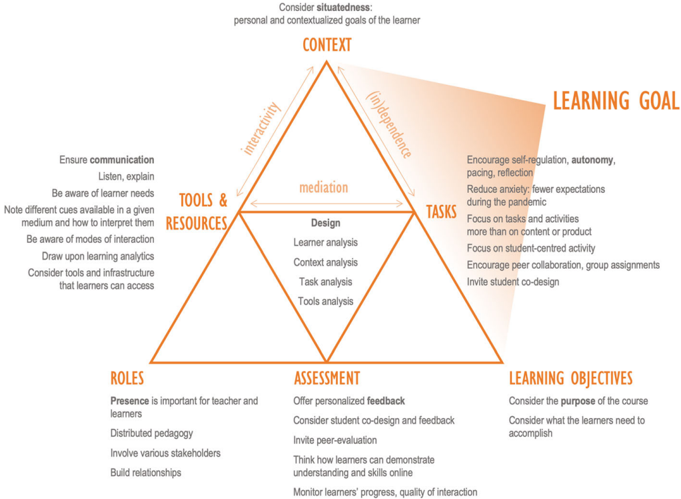
“Our findings point at the design of learning activities with certain characteristics, the combination of three types of presence (social, cognitive and facilitatory) and the need for adapting assessment to the new learning requirements.”
§ Springer Nature Switzerland AG 2020 Published online: 7 July 2020 > Abstract
plainstates an association- Asserted: passes — The authors put it forward as true.
- Checkable: passes — It can be checked against evidence.
- Load-bearing: passes — The paper’s conclusions depend on it.
- Based: passes — The paper gives a reason why it holds.
None of the sources cited for this claim have been checked yet.
In the paper
“What all four experts focus on as a prime ' piece ' of pedagogical knowledge (Kali et al. 2011) is the careful design of activities.”
§ Springer Nature Switzerland AG 2020 Published online: 7 July 2020 > Learning Design
plain- Asserted: passes — The authors put it forward as true.
- Checkable: passes — It can be checked against evidence.
- Load-bearing: unclear — It is unclear whether the paper’s conclusions depend on it.
- Based: passes — The paper gives a reason why it holds.
A result the paper reports from its own data — it cites no other source for it, so there is none to check. The quote shows it is in the paper.
In the paper
“Inspired by Anderson et al. ' s (2001) understanding of teaching presence and how it can be re-conceived in the current Covid-19 situation in which educators are the designers, the tutors and the evaluators of the learning experience, a tripartite framework emerges from the interviews, with three main sub-presences of the teaching presence, namely:”
§ Springer Nature Switzerland AG 2020 Published online: 7 July 2020 > Teacher Presence
plain- Asserted: passes — The authors put it forward as true.
- Checkable: passes — It can be checked against evidence.
- Load-bearing: passes — The paper’s conclusions depend on it.
- Based: passes — The paper gives a reason why it holds.
5 more claims
Create a free account to see all 61 claims and to verify the 9 references still open.
- Probably not a substantial claim. 50
- It may state two separate claims as one. 18
Claims other papers make about this one
Each is checked against this paper’s own text: does it say what the citing paper says it does?
The source backs part of the claim, not all of it — or backs it for a different population, condition or comparison.
In the citing paper
“while it is known that for learning success, input formats usually depend on both attention and interest from the students (Rapanta et al., 2020).”
From Impact of Synchronous and Asynchronous Settings of Online Teaching and Learning in Higher Education on Students' Learning Experience During COVID-19 (2021) · cites this paper as Rapanta et al., 2020
Experimental — accuracy not yet measuredIn the citing paper
“Evaluating AI applications could be beneficial for enhancing their motivation and interest in teaching with AI [40].”
From Developing AI Literacy for Primary and Middle School Teachers in China: Based on a Structural Equation Modeling Analysis (2022) · cites this paper as [40]
Citations
Cites
The Reflective Practitioner: How Professionals Think in Action
Checkoway, B., & Schon, D. A. (1985) · Journal of Policy Analysis and Management · doi:10.2307/3324262 · Cited by 21,268
The reflective practitioner: How professionals think in action
Stewart, C. J. (1984) · Patient Education and Counseling · doi:10.1016/0738-3991(84)90022-3 · Cited by 19,752
Knowledge and teaching: Foundations of the new reform
Shulman, L. (1987) · Harvard Educational Review · doi:10.17763/haer.57.1.j463w79r56455411 · Cited by 16,787
Phenomenological research methods
Moustakas, C. (1994) · doi:10.4135/9781412995658 · Cited by 13,919 · cited 1×
“’ This study ’ s participants, i.e. the four online pedagogy experts, also functioned as co-researchers, following Moustakas ’ (1994) idea (l).”
BackgroundDetermining Validity in Qualitative Inquiry
Creswell, J. W., & Miller, D. L. (2000) · Theory Into Practice · doi:10.1207/s15430421tip3903_2 · Cited by 9,184
Speech Genres and Other Late Essays
Bakhtin, M. M. (1986) · University of Texas Press eBooks · doi:10.7560/720466 · Cited by 8,470
The Difference between Emergency Remote Teaching and Online Learning
Hodges, C. B., Moore, S., Lockee, B. B., Trust, T., & Bond, M. A. (2024) · Handbook of Research in Online Learning · doi:10.1163/9789004702813_021 · Cited by 6,253
Blended learning: Uncovering its transformative potential in higher education
Garrison, D. R., & Kanuka, H. (2004) · The Internet and Higher Education · doi:10.1016/j.iheduc.2004.02.001 · Cited by 4,849
Speech Genres and Other Late Essays
Melaver, M., Bakhtin, M. M., McGee, V. W., Emerson, C., & Holquist, M. (1987) · Poetics Today · doi:10.2307/1772598 · Cited by 3,185
ASSESSING TEACHING PRESENCE IN A COMPUTER CONFERENCING CONTEXT
Anderson, T., Rourke, L., Garrison, R., & Archer, W. (2001) · Online Learning · doi:10.24059/olj.v5i2.1875 · Cited by 1,885
Research works printed but not linked: 2
- Bates, A. W. (2019). Teaching in a digital age. 2nd Edition. Vancouver: Tony Bates Associates. https://pressbooks.bccampus.ca/teachinginadigitalagev2/. Accessed 15 June 2020.
- Shor, I., & Freire, P. (1987). A pedagogy for deliberation: dialogues on transforming education . Westport: Bergin & Garvey Publishers.
Cited by
Items 801–900 of 2,106
Defining Formative Electronic Assessment in Undergraduate Mathematics: A Reflective Approach
Tatira, B., & Kariyana, I. (2022) · International Journal of Learning Teaching and Educational Research · doi:10.26803/ijlter.21.7.2 · Cited by 10
“Digital technologies will not replace the instruction and grading skills of a teacher, but be complementary (Rapanta et al., 2020).”
BackgroundEducational Robotics in Online Distance Learning: An Experience from Primary School
Giang, C., & Negrini, L. (2021) · Advances in intelligent systems and computing · doi:10.1007/978-3-030-82544-7_4 · Cited by 10
Scherer, R., Siddiq, F., Howard, S. K., & Tondeur, J. (2022) · PsyArXiv (OSF Preprints) · doi:10.31234/osf.io/zm9eh · Cited by 9
Rusli, F. A., Indah, R. N., & Syam, R. Z. A. (2024) · TADWIN: Jurnal Ilmu Perpustakaan dan Informasi · doi:10.19109/tadwin.v4i2.21003 · Cited by 5
Kapıcı, H. Ö. (2025) · The Teacher Educator · doi:10.1080/08878730.2025.2539706 · Cited by 6
“Integrating instructional technology in learning environments depends on many factors, but one of the most crucial is teachers’ skill and competence to make the technology effective in addressing their students’ needs (Rapanta et al., 2020).”
Stalmach, A., Reinck, C., D’Elia, P., Sano, S. D., & Casale, G. (2025) · Discover Education · doi:10.1007/s44217-025-00825-8 · Cited by 21
“The COVID-19 pandemic accelerated the shift toward flexible, digital educational approaches designed to address the complexities of contemporary society [1], opening new avenues for both knowledge acquisition and sharing [2].”
Mahyoub, R. A. M. (2025) · Dibon Journal of Education · doi:10.64169/dje.138 · Cited by 6
“Several teachers in this study cautioned that excessive reliance on digital tools could be distracting or reduce engagement, a concern that resonates with Rapanta et al.'s (2020) findings, which argued that digital tools should complement rather than replace the human dimension of teaching.”
High School Students’ Experience Using Learning Management System on Chemistry In Age of Pandemic
Putro, T. I., Utomo, S. B., & Indriyanti, N. Y. (2021) · Journal of Physics Conference Series · doi:10.1088/1742-6596/1842/1/012024 · Cited by 9
“Students were selected according to their experiences who have done online learning due to the COVID-19 pandemic [13].”
BackgroundCELTA tutors’ beliefs about online tutoring practices
Hasper, A., & Barkhuizen, G. (2023) · ELT Journal · doi:10.1093/elt/ccad014 · Cited by 4
Tiong, L. C. O., Lee, Y., Lim, K. L., & Lee, H.-J. (2024) · IEEE Access · doi:10.1109/access.2024.3434608 · Cited by 5
“For instance, [25] and [26] have shown that not all candidates have access to reliable internet connections in their homes, especially in remote or rural areas.”
BackgroundPortelles, R. E. P., & Velázquez, L. M. C. (2024) · Revista Interdisciplinaria de Educación, Salud, Actividad Física y Deporte. · doi:10.70262/riesafd.v1i1.2024.5 · Cited by 4
Violakis, P., & Tzakopoulos, T. (2024) · Heliyon · doi:10.1016/j.heliyon.2024.e39175 · Cited by 7
Akbarini, N. R. (2024) · Jurnal Pendidikan dan Pengajaran · doi:10.23887/jpp.v57i2.74301 · Cited by 15
Interactive Online Education Using LLMs: Foundations and Applications
Xie, Z., Huang, J., Xing, R., & Li, Q. (2025) · Lecture notes on data engineering and communications technologies · doi:10.1007/978-981-97-9255-9_1 · Cited by 4
Implementing the Hello Talk Application to Teach Speaking Skills in Vocational High Schools
Basir, A., Khamdanah, K., Umaemah, A., & Rizka, H. (2024) · International Journal of Educational Qualitative Quantitative Research · doi:10.58418/ijeqqr.v3i2.108 · Cited by 19
“The research by Archambault et al. (2022) and Rapanta et al. (2020) states that student learning activity is an important basic element for the success of the learning process.”
SissyLia, R., Siahaan, S. M., & Fathurohman, A. (2024) · Journal Evaluation in Education (JEE) · doi:10.37251/jee.v6i1.1287 · Cited by 4
“Many teachers continue to rely on traditional lecture methods and underutilize teaching materials and media, further exacerbating students’ disengagement from physics [11].”
Petrović, J., Šuvaković, U., & Nikolić, I. A. (2025) · Sustainability · doi:10.3390/su17062769 · Cited by 5
“…devices and the Internet [12,13,47–49], the accessibility of digital devices for attending remote lessons [40,42], and the quality and speed of the Internet connection [26,50,51], there is yet another factor potentially important for the implementation of ERT—the content followed by consumers.”
Students' online engagement in higher education: a DEMATEL study
Aldowah, H. A., Al‐Samarraie, H., & Noman, F. M. (2025) · Journal of Computers in Education · doi:10.1007/s40692-025-00353-2 · Cited by 9
Soundwaves of knowledge: using podcasts to facilitate learning in higher education
Engzell, J. V., Norrman, C., Norberg, A., & Lundvall, C. (2025) · Educational Media International · doi:10.1080/09523987.2025.2533120 · Cited by 10
“The teacher-learner rapport is critical (Rapanta et al., 2020) and part of effective learning.”
Towards a theory of materiality for quality learning and university education leadership
Ellis, R. A., Han, F., Kember, D. R., & Fan, S. (2025) · Review of Education · doi:10.1002/rev3.70094 · Cited by 4
Küçükler, H. (2021) · Adıyaman üniversitesi sosyal bilimler enstitüsü dergisi/Adıyaman üniversitesi sosyal bilimler enstitisü dergisi · doi:10.14520/adyusbd.808733 · Cited by 4
Sarkar, D. (2021) · IEEE Antennas and Propagation Magazine · doi:10.1109/map.2021.3070740 · Cited by 4
Priatna, W., Purnomo, R., & Putra, T. D. (2021) · Jurnal Kajian Ilmiah · doi:10.31599/jki.v21i3.521 · Cited by 4
Kögler, K., Ștefănică, F., Sälzer, C., Behrendt, S., Scherfer, M., & Atlihan, S. (2021) · MedienPädagogik Zeitschrift für Theorie und Praxis der Medienbildung · doi:10.21240/mpaed/40/2021.11.30.x · Cited by 7
“…organisatorischen, infrastrukturellen sowie hochschuldidaktischen Unterstützungsmassnahmen sowie Reflexionsprozessen, die vielfach auch durch empirische Evidenzen in Gestalt verschiedener Studien flankiert wurden (z. B. Hafer, Kostädt, und Lucke 2020; Skulmowski und Rey 2020; Rapanta et al. 2020).”
BackgroundMurakami, K., Kondo, S., & Hong, J. (2022) · Human Arenas · doi:10.1007/s42087-022-00292-9 · Cited by 4
Herrera, M. E. M., Cabral, G. R., Mamani-Benito, O. J., Tarqui, E. E. A., & Landa-Barzola, M. (2022) · Electronic Journal of Research in Educational Psychology · doi:10.25115/ejrep.v20i56.4917 · Cited by 17
Active Learning Network (2022) · doi:10.20919/opxr1032 · Cited by 6
Putera, A. R., Wijayanti, W., & Niyonsaba, T. (2021) · Jurnal Tarbiyatuna · doi:10.31603/tarbiyatuna.v12i2.5164 · Cited by 11
“According to Rapanta et al.(2020), developing online course content should combine collaborative and reflective activities, clear assessment criteria, and technology integration, which has proved to be a significant challenge.”
BackgroundLIVED EXPERIENCES OF TERTIARY PHYSICAL EDUCATION TEACHERS IN QUARANTEACHING
Nepangue, J. U., & Ibanez, W. (2022) · Malaysian Journal of Learning and Instruction · doi:10.32890/mjli2022.19.2.9 · Cited by 11
Students’ satisfaction and intention to continue online learning during the Covid-19 pandemic
Hamid, S. N. A., Zaki, H. O., & Senik, Z. C. (2022) · Malaysian Journal of Society and Space · doi:10.17576/geo-2022-1803-09 · Cited by 8
FACEBOOK AS A PROMOTIONAL TOOL FOR LEARNER AUTONOMY: THAI PRE-SERVICE EFL TEACHERS’ VOICES
Inpeng, S., & Nomnian, S. (2022) · TEFLIN Journal - A publication on the teaching and learning of English · doi:10.15639/teflinjournal.v33i2/292-309 · Cited by 5
“Moreover, pedagogical content knowledge (PCK), influenced by effective learning experiences and supportive learning environments via digital technologies, should integrate social, cognitive, and psychological aspects, and alternative assessment approaches to learning should be applied in the post-pandemic era (Rapanta…”
BackgroundTHE IMPACT OF LEARNING LOSS ON HIGHER EDUCATION STUDENTS IN INDONESIA: A CRITICAL REVIEW
Kadir, D., Sartika, I., Mirzachaerulsyah, E., & Hasudungan, A. N. (2023) · International Journal of Distance Education and E-Learning · doi:10.36261/ijdeel.v8i1.2648 · Cited by 11
“The campus has provided Zoom facilities for all teaching staff, provided that the lecturer submits the hours and days for the virtual meeting to be held (Rapanta et al., 2020; Pokhrel & Chhetri, 2021; Bashir et al., 2021).”
BackgroundRaveh, I., Morad, S., & Shacham, M. (2023) · Sustainability · doi:10.3390/su15054027 · Cited by 7
Ningsih, P. S. S., Santosa, M. H., & Kusuma, I. P. I. (2023) · ELSYA Journal of English Language Studies · doi:10.31849/elsya.v5i2.13148 · Cited by 7
“Easy communication and sharing of information are predicted (Rapanta et al., 2020).”
BackgroundBoyer-Davis, S., Berry, K. L., & Cooper, A. (2023) · International journal for business education · doi:10.30707/ijbe165.1.1690384197.882912 · Cited by 20
Hsu, L. (2023) · Asia Pacific Journal of Education · doi:10.1080/02188791.2023.2243042 · Cited by 4
“For most schools, this was the first time they moved all of their courses online (Camilleri, 2021; Lin et al., 2020; Neuwirth et al., 2020; Rapanta et al., 2020).”
Impact of digital capabilities of countries on the pedagogical transitions in business schools
Pandya, B., Cho, B., & Patterson, L. (2023) · Global Knowledge, Memory and Communication · doi:10.1108/gkmc-06-2023-0201 · Cited by 7
Stakeholders’ Perspective on the Quality of Virtual Learning Material in Google Classroom
Briones, M. R., Prudente, M. S., & Errabo, D. D. R. (2023) · International Journal of Technology in Education · doi:10.46328/ijte.571 · Cited by 7
“Rapanta et al. (2020) emphasized the aspects a teacher needs to consider in the instructional design for online learning.”
BackgroundChallenges of distance education: How to manage the pedagogical process of project-based learning
Došler, A. J., Zidarič, T. S., & Skubic, M. (2023) · Innovations in Education and Teaching International · doi:10.1080/14703297.2023.2281551 · Cited by 6
“This presents new challenges for developing educational services that combine teaching, learning, counselling, and mentoring with opportunities for distance learning and community participation (Rapanta et al., 2020; Scott et al., 2021).”
Implementing Digital Learning to Enhance Post-Pandemic Civil Engineering Teaching
Bao, A. (2024) · ASEE Annual Conference & Exposition · doi:10.18260/1-2--41197 · Cited by 4
Bhuiyan, A. A. M., & Islam, A. K. M. M. (2023) · Journal of language and cultural education · doi:10.2478/jolace-2023-0021 · Cited by 5
Innovation of Storytelling and Role-Playing Methods in Islamic Religious Education Learning
Rofiq, A., Nisa, K., & Muid, A. (2024) · At-tadzkir Islamic Education Journal · doi:10.59373/attadzkir.v3i1.52 · Cited by 4
Szcyrek, S., Stewart, B. E., & Miklas, E. P. (2024) · Research in Learning Technology · doi:10.25304/rlt.v32.3040 · Cited by 8
“However, particularly in the aftermath of the COVID-19 online pivot, faculty work in an environment marked by a distinctly datafied approach to pedagogy (Rapanta et al., 2020; Shin & Hickey, 2020; William-son et al., 2020b).”
BackgroundOnline Education And Students’ Wellbeing During Covid-19 Pandemic
Qureshi, F. H., Khawaja, S., Zia, T., & Javed, R. (2022) · International Journal of Private Higher Education · doi:10.60166/llhz3871 · Cited by 9
The impact of emerging technology in physics over the past three decades
Prahanı, B. K., Saphıra, H. V., Jatmiko, B., Suryanti, S., & Amelia, T. (2024) · Journal of Turkish Science Education · doi:10.36681/tused.2024.008 · Cited by 7
E-Learning Instructional Management For Students with Intellectual Disabilities
Pang, J. C., Lee, F. Y., Chin, L. H., Ng, P. L., & Te, S. Y. (2024) · International Journal of Special Education (IJSE) · doi:10.52291/ijse.2024.39.1 · Cited by 5
“Rapanta et al. (2020) found that the online curriculum design needs to consider the presence of cognitive, social, and facilitatory as well as adjust to the requirement of the online assessment.”
BackgroundYang, H., & Romero‐Hall, E. (2024) · TechTrends · doi:10.1007/s11528-024-00986-7 · Cited by 10
“…courses, instructors could promote their presence by guiding and supporting students throughout the learning process, such as providing timely feedback, individualized support, and facilitating discussions to help students stay on track and achieve learning goals (Rapanta et al., 2020).”
Ajani, O. A. (2024) · Interdisciplinary Journal of Education · doi:10.53449/ije.v7i1.328 · Cited by 8
“Despite these efforts, disparities remain, particularly among older faculty members or those in institutions with limited resources (Rapanta et al., 2020).”
BackgroundAlshaboul, Y. M. K., Alazaizeh, M., Abu-Tineh, A. M. H., Ghamrawi, N., & Shal, T. (2024) · Frontiers in Education · doi:10.3389/feduc.2024.1374641 · Cited by 11
Blended Learning: What Changes?
Cannaos, C., Onni, G., & Casu, A. (2024) · Sustainability · doi:10.3390/su16208988 · Cited by 16
Perspectives of teachers and concerns raised by parents regarding online classes
Shamma, F. M. (2024) · Sociological Spectrum · doi:10.1080/02732173.2024.2425632 · Cited by 4
“The teacher only gives home-work since online instruction makes communicating difficult and there isn’t much time for studying (Rapanta et al. 2020).”
Song, W., & Liu, D. (2025) · Journal of Cases on Information Technology · doi:10.4018/jcit.371408 · Cited by 6
Opportunities and Challenges of E-Learning in Spanish Institutions of Higher Education
Izquierdo-Álvarez, V., & Llorente, A. M. P. (2021) · Advances in educational technologies and instructional design book series · doi:10.4018/978-1-7998-7607-6.ch008 · Cited by 7
Post Covid-19 Effects on the Future of Students in Higher Education
Scholar, I. A., & Somani, D. P. (2021) · International Journal of Social Science and Human Research · doi:10.47191/ijsshr/v4-i4-39 · Cited by 4
“This transition requires students to possess the knowledge of hardware and software usage prior to commencing their education online, as the learning pedagogies during the covid-19 pandemic has used interactive videoconferencing software to educate students (Rapanta, 2020).”
MethodRees, G. L., Pressler, Y., Bates, G. W., Connolly, C., Sommerlad‐Rogers, D., Lay, A. M. D., Gill, S. J., Papathakis, P., Kronewitter, R. M., & Lammert, A. (2021) · Natural sciences education · doi:10.1002/nse2.20062 · Cited by 5
Almelhes, S. (2021) · International Education Studies · doi:10.5539/ies.v14n10p40 · Cited by 5
Ramírez, M. A. N., Atila-Lijerón, J. D., Rivero, R. A. B., & García, I. G. E. (2021) · Formación universitaria · doi:10.4067/s0718-50062021000600109 · Cited by 12
Dinh, H., & Dao, T. (2021) · Springer eBooks · doi:10.1007/978-3-030-84067-9_21 · Cited by 4
Online Learning Methods during COVID-19 Pandemic: On an Indonesian Nursing Student Experience
Mamnuah, M., & Wantonoro, W. (2022) · Open Access Macedonian Journal of Medical Sciences · doi:10.3889/oamjms.2022.8158 · Cited by 6
“A study by Rapanta et al. (2020) was informed that the learning process followed by an evaluation is very important to do considering the number of students has decreased drastically during the pandemic period [30].”
BackgroundInfluentialA Study of Role-Play Method and Human Augmentation to Enhance Digital Content Creator
Thongdee, P., Chatwattana, P., & Nilsook, P. (2022) · International Conference on Decision Aid Sciences and Applications (DASA) · doi:10.1109/dasa54658.2022.9764987 · Cited by 4
EXPERIENCE OF USING THE BLACKBOARD LEARNING MANAGEMENT SYSTEM IN JAZAN UNIVERSITY
Arshad, M. (2021) · Information Technologies and Learning Tools · doi:10.33407/itlt.v83i3.4185 · Cited by 5
“The author of [11] provides some expert insights into online learning-related pedagogical material awareness.”
BackgroundBäcklund, J., Hugo, M., & Ericson, K. (2022) · Problems of Education in the 21st Century · doi:10.33225/pec/22.80.273 · Cited by 5
Wetcho, S., Na-Songkhla, J., & Wang, C. X. (2022) · Policy Futures in Education · doi:10.1177/14782103221113166 · Cited by 11
“The recent pandemic posed signi fi cant challenges in terms of the design of online learning activities with pedagogical content knowledge, as well as the need to adapt assessments to meet new requirements (Rapanta et al., 2020).”
BackgroundContextos educativos en transformación. Revisión de investigaciones y experiencias en pandemia
Elisondo, R. C., de la Barrera, M. L., & Rigo, D. Y. (2022) · Recie. Revista Caribeña de Investigación Educativa · doi:10.32541/recie.2022.v6i2.pp144-158 · Cited by 5
Teaching Presence During the COVID-19 Pandemic: Practices of EAP Teachers in a Thai University
Ulla, M. B., & Nguyen, Q. N. (2022) · Advances in educational technologies and instructional design book series · doi:10.4018/978-1-6684-4148-0.ch002 · Cited by 6
Satkeeva, A. B., Ulanova, K. L., Filistova, N. Y., Гализина, Е. Г., & Fedotkina, E. V. (2022) · Revista EntreLinguas · doi:10.29051/el.v8iesp.1.16914 · Cited by 4
CIPP Model as a Mathematics Learning Evaluation Model in Elementary School
Qadriah, L., Wicaksono, B. A., Somadiyono, S., & Nindiasari, H. (2022) · International Journal of Science and Society · doi:10.54783/ijsoc.v4i3.536 · Cited by 10
“To determine the acquisition of learning outcomes, the teacher assesses student learning outcomes (Rapanta et al., 2020).”
BackgroundPedagogical Shift in Education During COVID-19 Pandemic: An SLR Approach
Hamal, J. B., & Aryal, N. P. (2022) · Interdisciplinary Journal of Management and Social Sciences · doi:10.3126/ijmss.v3i1.50234 · Cited by 6
Nizzolino, S., & Canals, A. (2023) · International Journal of e-Collaboration · doi:10.4018/ijec.315783 · Cited by 8
“…no more a meaningful descriptor to define the ordinary experiences of digital native students, especially in those countries where Internet-connected devices are the norm, and the differentiations between educational time and other human activities are not so sharp anymore (Rapanta et al., 2020).”
BackgroundDiscipline Culture Development at Thayaiwittaya School Khuang Lang Hatyai Songkhla Southern Thailand
Pusvitasari, R. (2023) · Nazhruna Jurnal Pendidikan Islam · doi:10.31538/nzh.v6i2.2746 · Cited by 4
Resilience in Higher Education in Times of Crisis
Kowler, S. M., Rubin, O., & Shpergel, S. (2023) · Journal of Higher Education Theory and Practice · doi:10.33423/jhetp.v23i4.5900 · Cited by 10
An exploration of the ideological becoming of online educators
Larty, J., & Hodgson, V. E. (2023) · British Journal of Educational Technology · doi:10.1111/bjet.13331 · Cited by 4
“Since 2020 there has been a raft of publications advocating guidance based on existing research models and frameworks to assist often beleaguered academics in making the rapid transfer to teaching online (e.g. Adedoyin & Soykan, 2020; Gardner, 2020; Hodges et al., 2020; Rapanta et al., 2020).”
BackgroundPangandaman, J. I., & Pangandaman, H. K. (2023) · Journal of Basic Education Research · doi:10.37251/jber.v4i2.313 · Cited by 6
Optimising students’ participation during emergency remote teaching in the Covid-19 pandemic
Svongoro, P., & Mudzi, F. (2023) · Perspectives in Education · doi:10.38140/pie.v41i1.6182 · Cited by 4
PERAN TEKNOLOGI PENDIDIKAN TERHADAP PERUBAHAN PEMBELAJARAN PENDIDIKAN JASMANI
Syafruddin, A. (2023) · Jurnal Teknologi Pendidikan · doi:10.37304/jtekpend.v3i2.9961 · Cited by 26
“Kenyataannya, sebagai hasil dari kemajuan ilmu pengetahuan dan teknologi, siswa akan lebih mudah memahami apa yang dikatakan guru, sehingga pembelajaran menjadi lebih efektif dan efisien [17].”
Lecturer decision-making in the context of pandemic teaching: Rationales and evidence
Brown, K., Reinhardt, A., & Körner, T. O. (2023) · The International Journal for Academic Development · doi:10.1080/1360144x.2023.2247387 · Cited by 4
“Some predicted that all the lessons learned from the extended online teaching and learning phase would fade away once classroom teaching became possible again (Jones & Sharma, 2020; Rapanta et al., 2020).”
Use of direct practice as an active learning innovation
Chantika, A., Wahyuni, N. F., Alamsyah, S. S., & Rifai, T. (2022) · Curricula Journal of Curriculum Development · doi:10.17509/curricula.v1i2.52076 · Cited by 7
Rahman, R. A., Isa, N. S. M., Zamri, N., Pitalok, E., Suyoto, Y. T., & Yunus, M. H. S. M. (2023) · International Journal of Public Health Science (IJPHS) · doi:10.11591/ijphs.v12i4.22832 · Cited by 7
Hanif, M. S., Hamid, A. B. A., & Khurshid, A. (2023) · The International Journal of Management Education · doi:10.1016/j.ijme.2023.100884 · Cited by 5
Burmistrova, V., & Makoelle, T. M. (2023) · Cogent Education · doi:10.1080/2331186x.2023.2282800 · Cited by 9
“Rapanta et al. (2020) postulates that the assessment strategies must be adapted to the online/distance mode to respond to students’ educational needs to minimise the impact on student performances.”
BackgroundRoossien, L., Boerboom, T., Spaai, G. G., van Klaveren, L., Dolmans, D. H. J. M., & de Vos, R. (2023) · Medical Teacher · doi:10.1080/0142159x.2023.2285249 · Cited by 6
“While F2F environments seem to allow for these types of interaction, online settings may limit possibilities for interactions which may influence deep learning (Decuyper et al. 2010; Hrastinski 2010; Cheng and Chau 2016; Dumford and Miller 2018; Rapanta et al. 2020; Fabriz et al. 2021).”
BackgroundWandi, W., Mardianti, F., Suwarma, I. R., & Liliawati, W. (2023) · Kasuari Physics Education Journal (KPEJ) · doi:10.37891/kpej.v6i2.483 · Cited by 18
“In parallel, the context in which learning takes place – encompassing curriculum design, pedagogical strategies, and assessment methods – emerges as another focal point of the scholarly discourse (Rapanta et al. 2020).”
BackgroundBóte-Vericad, J.-J., Urbano, C., Argudo, S., Dreisiebner, S., Feldvari, K., Softić, S. K., Santos-Hermosa, G., & Todorova, T. Y. (2023) · Open Information Science · doi:10.1515/opis-2022-0159 · Cited by 6
Muir, T., Livy, S., Murphy, C. J., & Trimble, A. (2022) · Journal of University Teaching and Learning Practice · doi:10.53761/1.19.5.3 · Cited by 8
An, R., Addas, A., Rehman, N., & Rehman, S. (2024) · Heliyon · doi:10.1016/j.heliyon.2024.e37159 · Cited by 6
DIGITAL LEARNING IN FOREIGN LANGUAGE TEACHER TRAINING IN HIGHER EDUCATION: A CASE STUDY
Carlon, G. (2020) · International Conference on Advances in Education (ADVED) · doi:10.47696/adved.2020156 · Cited by 6
“[…] [It] can be designed for” (Goodyear, 2015, p. 41); the design for learning approach highlights the necessity to foster active learning in online learning environments (Rapanta et al. , 2020).”
BackgroundKuganathan, A., Slifierz, M. J., Anderson, L. N., Álvarez, E., & Apatu, E. (2021) · Pedagogy in Health Promotion · doi:10.1177/23733799211021453 · Cited by 4
“Technical problems and difficulty navigating online content are significant challenges that can hinder student engagement in online courses (Rapanta et al., 2020).”
BackgroundJumareng, H., Setiawan, E., Budiarto, B., Kastrena, E., Patah, I. A., & Gani, R. A. (2021) · Jurnal Pendidikan Jasmani Indonesia · doi:10.21831/jpji.v17i1.34322 · Cited by 12
“Hasil studi terdahulu melaporkan bahwa pembelajaran online memberikan banyak pengalaman baru dan berharga bagi dosen (Goodyear 2015), karena dosen menjadi lebih memahami mengenai media atau alat yang dapat digunakan sebagai pendukung pembelajaran online (Rapanta et al., 2020).”
Kuruppu, K. A. D. D. (2021) · International Journal of Educational Reform · doi:10.1177/10567879211042327 · Cited by 4
Alexandra, Y., & Choirisa, S. F. (2021) · Journal of Learning Development in Higher Education · doi:10.47408/jldhe.vi21.627 · Cited by 8
“Anecdotal evidence further suggests that some lecturers have faced technical and practical difficulties which have served to limit the pedagogical preparedness needed to provide meaningful online learning experiences (Rapanta et al., 2020).”
BackgroundLearning Multimedia Management Strategy at Home During Learning from Home
Nugroho, B., Syakhrani, A. W., Hardiansyah, A., Pattiasina, P. J., & Pratiwi, E. Y. R. (2021) · Nidhomul Haq Jurnal Manajemen Pendidikan Islam · doi:10.31538/ndh.v6i3.1806 · Cited by 14
“So various studies must be conducted to understand how multimedia governance is good for business, work, and educational and teaching research that uses multimedia in normal conditions, especially during crises (Rapanta et al., 2020).”
BackgroundDesigning e-Local Content of Teaching Materials for Extensive Reading Course: Lecturer’s Voice
Umar, V. (2022) · EBONY Journal of English Language Teaching Linguistics and Literature · doi:10.37304/ebony.v2i1.4031 · Cited by 4
Mavridi, S. (2022) · doi:10.21428/8c225f6e.960f4016 · Cited by 3
Gianfredi, V., Oradini‐Alacreu, A., Sá, R., et al. (2023) · Journal of Public Health · doi:10.1007/s10389-023-02003-2 · Cited by 4
“…our life are settling back to the pre-COVID-19 emergency, several lessons should be retained to better respond to the complexity and fragility of our society, mainly taking advantages of the digital technologies that can improve connection and flexibility within the society (Rapanta et al. 2020).”
Auguskani, J. P. L. (2020) · Indian Journal of Science and Technology · doi:10.17485/ijst/v13i34.1205 · Cited by 5
Remote Teaching and Learning in Applied Engineering: A Post-pandemic Perspective
Abdulla, M., & Ma, W. (2022) · Lecture notes in educational technology · doi:10.1007/978-981-16-9812-5_9 · Cited by 7
Syno, V., Turchyn, A., Сивик, О., Glotov, O., Krut, O., & Babii, L. (2022) · Revista Romaneasca pentru Educatie Multidimensionala · doi:10.18662/rrem/14.2/590 · Cited by 4
“With this resource teachers have been offered hundreds of ‘tips and tricks’, mostly without the contextualizing knowledge needed to judge which teaching tactic is likely to work where (Rapanta et al., 2020), and just supporting students to learn and interact.”
BackgroundShahnama, M., Yazdanmehr, E., & Shirvan, M. E. (2021) · Research Square · doi:10.21203/rs.3.rs-141388/v1 · Cited by 4
Bank, A. D. (2023) · doi:10.22617/tcs230606 · Cited by 5
Forsler, I. (2026) · Springer eBooks · doi:10.1007/978-3-031-35469-4_110-1 · Cited by 4
Metadata
- Authors
- Rapanta, C., Botturi, L., Goodyear, P., Guàrdia, L., & Koole, M.
- Affiliations
- Universidade Nova de Lisboa (PT)
- University of Applied Sciences and Arts of Southern Switzerland (CH)
- The University of Sydney (AU)
- University of Saskatchewan (CA)
- Corresponding author
- Rapanta, Chrysi
- ORCID
- Rapanta, Chrysi
- Venue
- Postdigital Science and Education
- Published
- 2020-07-07
- Volume
- 2
- Issue
- 3
- Pages
- 923-945
- ISSN
- 2524-485X (ISSN-L)
- 2524-4868
- PMC
- PMC7339092
- OpenAlex
- W3042009104
- Semantic Scholar
- fed495af71b417de8d60cf16b6da44926faf24a0
- Cited by
- 2,130
- References
- 75
- Citations by year
- 2026: 134 · 2025: 158 · 2024: 261 · 2023: 426 · 2022: 556 · 2021: 509 · 2020: 73
- FWCI
- 454.18
- Type
- journal article
- Language
- en
- Open access
- hybrid
- doi.org
- Licence
- other-oa
- www.springer.com/tdm (tdm)
- www.springer.com/tdm (vor)
- Locations
- Postdigital Science and Education (publishedVersion, other-oa)
- PubMed (publishedVersion)
- PubMed Central (submittedVersion)
- The Sydney eScholarship Repository (The University of Sydney) (submittedVersion)
- Funders
- Fundação para a Ciência e a Tecnologia (DL 57/2016/CP1453/CT0066)
- Australian Research Council (DP150104163)
- Topics
- Social Sciences › Education › Digital Education and Society
- Social Sciences › Education › Higher Education Practises and Engagement
- Social Sciences › Education › Educational Innovations and Technology
- Keywords
- online learning, COVID-19 pandemic, higher education, teacher presence, pedagogical content knowledge, learning activities, social presence, cognitive presence
About these checks
Registry, retraction, Cites and statistics results are computed, not judged, with one exception: a printed reference that no index lists is read once by a model before it counts as a citation error. Claims are extracted by a model and kept only when their quote appears verbatim in the text; each cited source is then checked, with a model’s help, for whether it says what the claim relies on. Those verdicts can be wrong — read the claim’s quote and the cited source before relying on one.
The claim verdicts this report counts are experimental: their accuracy is not yet measured.
A language model drew the claims from the paper on 2026-10-10, under version 3 of the claim definition (model deepseek-v4.1-flash, prompt extract-v3).
A second model labelled each claim on 2026-10-10 (model jev-1.13-20260917, definition revision gold-guideline-v0.2).
Cited sources are checked with a language model’s help (qwen3.8-omni-flash).
Statistics and arithmetic are recomputed, not judged.
Confidence bands are shown only for fields calibrated on our annotated test set. None is calibrated yet, so no band is shown.
What counts as a claim ›How we measure confidence ›How we check this ›
Are you an author, or do you see a problem with this page? Request a review
Data sources
Bibliographic data: Semantic Scholar, OpenAlex, Crossref.
Contains information from the Semantic Scholar Academic Graph Datasets, made available under the ODC Attribution License (ODC-BY 1.0).
Semantic Scholar’s data is described in: Kinney, R., et al. (2023). The Semantic Scholar Open Data Platform. arXiv:2301.10140.
