

Online University Teaching During and After the Covid-19 Crisis: Refocusing Teacher Presence and Learning Activity
Open accessThe DOI matches its Crossref record; 71 of the 75 references it cites were found in a registry or an index; 6 of the 42 sources its claims cite were checked for support.
Abstract
The Covid-19 pandemic has raised significant challenges for the higher education community worldwide. A particular challenge has been the urgent and unexpected request for previously face-to-face university courses to be taught online. Online teaching and learning imply a certain pedagogical content knowledge (PCK), mainly related to designing and organising for better learning experiences and creating distinctive learning environments, with the help of digital technologies.
Overview
CoChat Summary
TL;DR
This article is an expert-interview piece offering pedagogical guidance for university teachers suddenly moving online during Covid-19. Its central message is that effective online teaching depends less on tools or materials alone and more on careful learning design, multiple forms of teacher presence, and continuous assessment.
Key findings
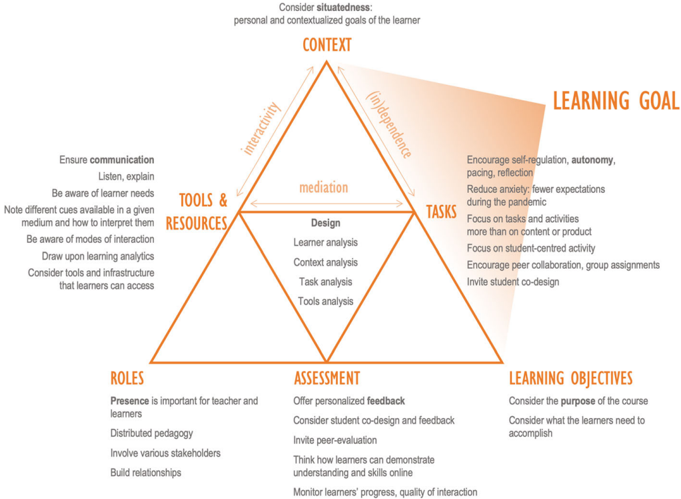
- The four experts argue that online learning should be built around carefully designed learning activities, with a mix of synchronous, asynchronous, online, and offline tasks that are clear, appropriately difficult, authentic, and accessible to students.
- They propose a tripartite teaching presence for online courses: cognitive presence, social presence, and facilitatory presence.
- Successful online learning requires students not to feel alone, and it benefits from timely feedback, peer collaboration, and student co-design/co-configuration of activities.
- The paper states that continuous assessment is needed in online learning, and suggests self-reflections, portfolios, self-paced asynchronous activities, and use of learning analytics as part of evaluation.
Methods
- Exploratory qualitative study using expert interviews administered by e-mail.
- Sample: 4 online pedagogy experts/co-authors, selected for research expertise, more than a decade of online teaching experience, and experience across different national education systems; they worked in Switzerland, Australia, Spain, and Canada.
- Main analysis: the first author organized the responses into a panel-like article, then the authors jointly revised and synthesized the material; the discussion summarizes themes under learning design, teacher presence, and assessment.
Limitations
- The paper states that all four experts came from “rich parts of the world” (Switzerland, Canada, Australia, and North of Spain), which limits the lens to a “monofocal” view of educational reality.
- The paper itself says the study used a heuristic method based on expert viewpoints and “by no means can replace rigorous, systematic research” following the scientific method.
- Evident from the text: the sample is very small (4 experts) and highly selected, so the findings are expert-opinion guidance rather than generalizable empirical results.
Model-written summary. Check it against the paper before relying on it.
Integrity signals
Registry
Cites
Statistics
Figures
Verification
Claims the paper makes
5 Valid · 0 Not valid · 32 Not checked · 24 Own results and interpretations
The sources with a verdict support this claim; the rest weren’t checked yet, have no full text we could read, or their verdicts aren’t rated yet.
In the paper
“On top of that, a significant challenge for university teachers has been their lack of the pedagogical content knowledge (PCK) (Shulman 1987) needed for teaching online (Angeli and Valanides 2005; Kali, Goodyear and Markauskaite 2011; Ching, Hsu and Baldwin 2018).”
§ Springer Nature Switzerland AG 2020 Published online: 7 July 2020 > Introduction
What the sources say
- Supportedcites Shulman 1987 matched to “Knowledge and teaching: Foundations of the new reform” (1987) source
The parenthetical (Shulman 1987) is attached to the term 'pedagogical content knowledge (PCK)' — an identification citation — while the online-teaching studies are credited to Angeli & Valanides, Kali et al. and Ching et al. Our copy (the Portuguese edition of Shulman's 1987 Harvard Educational Review article) establishes exactly that concept: the 'Categorias da base de conhecimento' section lists 'conhecimento pedagógico do conteúdo' as one of the categories of the knowledge base for teaching, 'esse amálgama especial de conteúdo e pedagogia que é o terreno exclusivo dos professores', and the 'Novas compreensões' section calls it 'a categoria que melhor distingue a compreensão de um especialista em conteúdo daquela de um pedagogo'. The paper itself says nothing about online teaching or about university teachers lacking PCK, but that part of the sentence is not attributed to this source. (LLM, conf=0.85)
- Not checked — no full text of the sourcecites Angeli and Valanides 2005 matched to “Preservice elementary teachers as information and communication technology designers: an instructional systems design model based on an expanded view of pedagogical content knowledge” (2005) source
- Could not verifycites Ching, Hsu and Baldwin 2018 matched to “Online Course Design and Development among College and University Instructors: An Analysis using Grounded Theory” (2018) sourceExperimental — accuracy not yet measured
Our copy of Baldwin, Ching & Friesen (2018) never mentions pedagogical content knowledge, PCK, Shulman, or TPACK; searches for 'pedagogical content knowledge PCK online teaching', 'TPACK technological pedagogical content knowledge', 'Shulman pedagogical content knowledge Angeli Valanides' and 'challenge lack of knowledge training online instructors pedagogy' returned only the References list and design-process passages. The paper's content is a grounded-theory account of how 14 four-year-institution instructors design online courses (Abstract; Results themes; Discussion mapping to ADDIE), and its nearest statements — that instructors 'must develop new curriculum with instructional strategies effective for online learning' (Discussion) and 'rarely use formal instructional design models' (Results) — concern design practice, not a PCK deficiency framed as a significant challenge. Nothing in our copy either states or contradicts the attributed claim. (LLM, conf=0.72)
plain- Asserted: passes — The authors put it forward as true.
- Checkable: passes — It can be checked against evidence.
- Load-bearing: passes — The paper’s conclusions depend on it.
- Based: passes — The paper gives a reason why it holds.
- Supported
The cited sources support only part of this claim — read each source’s verdict below.
In the paper
“Assessment can possibly be considered the most challenging part of the transition to distance learning for an institution used to face-to-face oral or written exam, as the control shift towards the students makes it hardly possible to ensure that students are not cheating (Munoz and Mackay 2019).”
§ Springer Nature Switzerland AG 2020 Published online: 7 July 2020 > Assessment
What the sources say
- Partly supportedcites Munoz and Mackay 2019 matched to “An online testing design choice typology towards cheating threat minimisation” (2019) sourceExperimental — accuracy not yet measured
Split into 2 atoms — 0 confirmed, 2 partially supported, 0 disputed, 0 misattributed, 0 unverifiable. Expand the claim to see per-atom verdicts.
hedgedstates a possible cause- Asserted: passes — The authors put it forward as true.
- Checkable: passes — It can be checked against evidence.
- Load-bearing: unclear — It is unclear whether the paper’s conclusions depend on it.
- Based: passes — The paper gives a reason why it holds.
- Partly supported
A result the paper reports from its own data — it cites no other source for it, so there is none to check. The quote shows it is in the paper.
In the paper
“Our findings point at the design of learning activities with certain characteristics, the combination of three types of presence (social, cognitive and facilitatory) and the need for adapting assessment to the new learning requirements.”
§ Springer Nature Switzerland AG 2020 Published online: 7 July 2020 > Abstract
plainstates an association- Asserted: passes — The authors put it forward as true.
- Checkable: passes — It can be checked against evidence.
- Load-bearing: passes — The paper’s conclusions depend on it.
- Based: passes — The paper gives a reason why it holds.
None of the sources cited for this claim have been checked yet.
In the paper
“What all four experts focus on as a prime ' piece ' of pedagogical knowledge (Kali et al. 2011) is the careful design of activities.”
§ Springer Nature Switzerland AG 2020 Published online: 7 July 2020 > Learning Design
plain- Asserted: passes — The authors put it forward as true.
- Checkable: passes — It can be checked against evidence.
- Load-bearing: unclear — It is unclear whether the paper’s conclusions depend on it.
- Based: passes — The paper gives a reason why it holds.
A result the paper reports from its own data — it cites no other source for it, so there is none to check. The quote shows it is in the paper.
In the paper
“Inspired by Anderson et al. ' s (2001) understanding of teaching presence and how it can be re-conceived in the current Covid-19 situation in which educators are the designers, the tutors and the evaluators of the learning experience, a tripartite framework emerges from the interviews, with three main sub-presences of the teaching presence, namely:”
§ Springer Nature Switzerland AG 2020 Published online: 7 July 2020 > Teacher Presence
plain- Asserted: passes — The authors put it forward as true.
- Checkable: passes — It can be checked against evidence.
- Load-bearing: passes — The paper’s conclusions depend on it.
- Based: passes — The paper gives a reason why it holds.
5 more claims
Create a free account to see all 61 claims and to verify the 9 references still open.
- Probably not a substantial claim. 50
- It may state two separate claims as one. 18
Claims other papers make about this one
Each is checked against this paper’s own text: does it say what the citing paper says it does?
The source backs part of the claim, not all of it — or backs it for a different population, condition or comparison.
In the citing paper
“while it is known that for learning success, input formats usually depend on both attention and interest from the students (Rapanta et al., 2020).”
From Impact of Synchronous and Asynchronous Settings of Online Teaching and Learning in Higher Education on Students' Learning Experience During COVID-19 (2021) · cites this paper as Rapanta et al., 2020
Experimental — accuracy not yet measuredIn the citing paper
“Evaluating AI applications could be beneficial for enhancing their motivation and interest in teaching with AI [40].”
From Developing AI Literacy for Primary and Middle School Teachers in China: Based on a Structural Equation Modeling Analysis (2022) · cites this paper as [40]
Citations
Cites
The Reflective Practitioner: How Professionals Think in Action
Checkoway, B., & Schon, D. A. (1985) · Journal of Policy Analysis and Management · doi:10.2307/3324262 · Cited by 21,268
The reflective practitioner: How professionals think in action
Stewart, C. J. (1984) · Patient Education and Counseling · doi:10.1016/0738-3991(84)90022-3 · Cited by 19,752
Knowledge and teaching: Foundations of the new reform
Shulman, L. (1987) · Harvard Educational Review · doi:10.17763/haer.57.1.j463w79r56455411 · Cited by 16,787
Phenomenological research methods
Moustakas, C. (1994) · doi:10.4135/9781412995658 · Cited by 13,919 · cited 1×
“’ This study ’ s participants, i.e. the four online pedagogy experts, also functioned as co-researchers, following Moustakas ’ (1994) idea (l).”
BackgroundDetermining Validity in Qualitative Inquiry
Creswell, J. W., & Miller, D. L. (2000) · Theory Into Practice · doi:10.1207/s15430421tip3903_2 · Cited by 9,184
Speech Genres and Other Late Essays
Bakhtin, M. M. (1986) · University of Texas Press eBooks · doi:10.7560/720466 · Cited by 8,470
The Difference between Emergency Remote Teaching and Online Learning
Hodges, C. B., Moore, S., Lockee, B. B., Trust, T., & Bond, M. A. (2024) · Handbook of Research in Online Learning · doi:10.1163/9789004702813_021 · Cited by 6,253
Blended learning: Uncovering its transformative potential in higher education
Garrison, D. R., & Kanuka, H. (2004) · The Internet and Higher Education · doi:10.1016/j.iheduc.2004.02.001 · Cited by 4,849
Speech Genres and Other Late Essays
Melaver, M., Bakhtin, M. M., McGee, V. W., Emerson, C., & Holquist, M. (1987) · Poetics Today · doi:10.2307/1772598 · Cited by 3,185
ASSESSING TEACHING PRESENCE IN A COMPUTER CONFERENCING CONTEXT
Anderson, T., Rourke, L., Garrison, R., & Archer, W. (2001) · Online Learning · doi:10.24059/olj.v5i2.1875 · Cited by 1,885
Research works printed but not linked: 2
- Bates, A. W. (2019). Teaching in a digital age. 2nd Edition. Vancouver: Tony Bates Associates. https://pressbooks.bccampus.ca/teachinginadigitalagev2/. Accessed 15 June 2020.
- Shor, I., & Freire, P. (1987). A pedagogy for deliberation: dialogues on transforming education . Westport: Bergin & Garvey Publishers.
Cited by
Items 301–400 of 2,106
The New Norm: Faculty Perceptions of Condensed Online Learning
Mellieon, H. I., & Robinson, P. A. (2020) · American Journal of Distance Education · doi:10.1080/08923647.2020.1847626 · Cited by 25
“As Rapanta, Botturi, Goodyear, Guàrdia, and Koole (2020) noted the transition to online education was a necessary swift for face to face courses at institutions to continue educating students.”
BackgroundSTUDENT PERCEPTIONS OF ECUADORIAN VIRTUAL PLATFORMS DURING THE COVID-19 PANDEMIC
Martínez, M. F. C., Cejas, M. N., Álvarez, G. S. V., Rodríguez, C. E. P., & Velazco, D. J. M. (2021) · Problems of Education in the 21st Century · doi:10.33225/pec/21.79.241 · Cited by 30
University students and study habits
Clarke, C., Mullin, M., McGrath, D., & Farrelly, N. (2021) · Irish Journal of Psychological Medicine · doi:10.1017/ipm.2021.28 · Cited by 26
“The COVID-19 crisis has ignited a plethora of advice aimed at educators to focus on tools and materials they can use to replace face-to-face classes and support the study behaviours of their students away from the university environment (Rapanta et al., 2020).”
InfluentialVoorhees, T., & Vorobel, O. (2021) · International Journal of Educational Research Open · doi:10.1016/j.ijedro.2021.100053 · Cited by 20
Gómez‐Rey, P., Fernández‐Navarro, F., & Francisco, M. J. V.-D. (2021) · Sustainability · doi:10.3390/su13116112 · Cited by 21
Perrin, S., & Wang, L. (2021) · Quality Assurance in Education · doi:10.1108/qae-12-2020-0167 · Cited by 29
Alblihed, M. A., Aly, S. M., Albrakati, A., Eldehn, A. F., Ali, S. A. A., Al-Hazani, T. M. I., Albarakati, M. H., Abdel‐Daim, M. M., Al-sharif, A., Albarakati, A. J. A., et al. (2021) · Sustainability · doi:10.3390/su14010224 · Cited by 21
Alam, A. (2021) · International Conference on Advances in Computing, Communication and Control (ICAC3) · doi:10.1109/icac353642.2021.9697130 · Cited by 26
Abdullah, M. H. T., Roslim, N., & Salleh, M. I. M. (2022) · Asian Journal of University Education · doi:10.24191/ajue.v18i1.17177 · Cited by 18
Jang, S. J., & Lee, H. (2023) · BMC Nursing · doi:10.1186/s12912-023-01223-x · Cited by 26
“Many students experienced difficulties in effectively engaging in online learning amid dramatic changes in the educational system owing to the pandemic [10, 11].”
BackgroundPostdigital Research: Genealogies, Challenges, and Future Perspectives
Jandrić, P., MacKenzie, A., & Knox, J. (2023) · Postdigital science and education · doi:10.1007/978-3-031-31299-1_1 · Cited by 36
Resnik, P., Dewaele, J., & Knechtelsdorfer, E. (2023) · IRAL - International Review of Applied Linguistics in Language Teaching · doi:10.1515/iral-2023-0076 · Cited by 29
Dimulescu, C. (2023) · Sustainability · doi:10.3390/su152216120 · Cited by 37
“Studies have shown a tendency for improved perceptions as educational institutions iterate on their e-learning offerings [38,39].”
InfluentialBai, X., & Gu, X. (2024) · Educational Technology Research and Development · doi:10.1007/s11423-024-10383-9 · Cited by 25
“In online learning, teachers can dedicate more time and effort to students’ learning (Rapanta et al., 2020), instead of handling administrative tasks, ultimately fostering stronger relationships between teachers and their students.”
Innovation in a Time of Crisis: Adapting Active Learning Approaches for Remote Biology Courses
Morrison, E. S., Naro‐Maciel, E., & Bonney, K. M. (2021) · Journal of Microbiology and Biology Education · doi:10.1128/jmbe.v22i1.2341 · Cited by 26
“Furthermore, students can now engage with course materials via a more diverse set of tools and resources and gain more control over how and where they learn (9, 21).”
BackgroundInfluentialStudy Survey of Increasing Arabic Learning Due to Smartphones
Yakir, J., Jiao, D., & Wang, Y. (2023) · Journal International of Lingua and Technology · doi:10.55849/jiltech.v1i3.227 · Cited by 17
“In addition to the flexibility of time and place, Online learning is also more affordable and able to provide broad insights (Rapanta et al., 2020).”
BackgroundBeyond Gaming: The Potential of Twitch for Online Learning and Teaching
Pirker, J., Steinmaurer, A., & Karakaš, A. (2021) · ACM Conference on Innovation and Technology in Computer Science Education (ITiCSE) · doi:10.1145/3430665.3456324 · Cited by 22
“the following features, according to [14]: (1) There is a (physical) distance between teachers and students.”
BackgroundMondragón, N. I., Sancho, N. B., Santamaría, M. D., & Ozamiz-Etxebarria, N. (2021) · International Journal of Environmental Research and Public Health · doi:10.3390/ijerph18157791 · Cited by 28
Sharma, G. V. S. S., Prasad, C. L. V. R. S., & Rambabu, V. (2021) · Knowledge and Process Management · doi:10.1002/kpm.1684 · Cited by 24
“Learning should be effective, efficient, and enjoyable through updated effective pedagogical methods in this postdigital era (Rapanta et al., 2020).”
BackgroundE-Learning and Digital Education in the Twenty-First Century
Shohel, M. M. C. (2020) · IntechOpen eBooks · doi:10.5772/intechopen.87797 · Cited by 23
Silva, E. P., Brandão, R. D. S., Pirozi, L. R. R., et al. (2022) · Research Society and Development · doi:10.33448/rsd-v11i10.32178 · Cited by 17
Burcă-Voicu, M. I., Cramarenco, R. E., & Dabija, D. (2022) · International Journal of Environmental Research and Public Health · doi:10.3390/ijerph191811563 · Cited by 20
“This unprecedented context challenged universities to adapt, find new innovative solutions, and rethink the entire learning–teaching–researching process so that education could be further ensured [29].”
BackgroundResultInfluentialIftikhar, S., Guerrero‐Roldán, A., & Mor, E. (2022) · Applied Sciences · doi:10.3390/app122412613 · Cited by 26
Gheshlagh, R. G., Ahsan, M., Jafari, M., & Mahmoodi, H. (2022) · BMC Medical Education · doi:10.1186/s12909-022-03980-w · Cited by 27
“On the other hand, effective online learning also requires careful educational planning and designing effective learning environments [8, 9].”
BackgroundPutri, A. H., Samsudin, A., Purwanto, M. G., & Suhandi, A. (2022) · Indonesian Journal on Learning and Advanced Education (IJOLAE) · doi:10.23917/ijolae.v4i3.18249 · Cited by 28
Learning in hybrid classes: the role of off-task activities
Ochs, C., Gahrmann, C., & Sonderegger, A. (2024) · Scientific Reports · doi:10.1038/s41598-023-50962-z · Cited by 31
“Investigating hybrid teaching during the pandemic is important since the experiences made during this period are bound to influence and shape future use and understanding of hybrid teaching 15,54–56 .”
BackgroundAn extended community of inquiry framework supporting students in online and digital education
Carroll, N., Lang, M., & Connolly, C. (2024) · Innovations in Education and Teaching International · doi:10.1080/14703297.2024.2326658 · Cited by 46
“The 2019 coronavirus (COVID-19) pandemic forced universities worldwide to swiftly transition from classroom-based to online learning models, disrupting the learning process (Carroll & Conboy, 2020; Chakraborty et al., 2021; Dhawan, 2020; Rapanta et al., 2020).”
International Master’s Degree Students’ Well-being at a Finnish University During COVID-19
Pappa, S., Yada, T., & Perälä‐Littunen, S. (2020) · Open Education Studies · doi:10.1515/edu-2020-0128 · Cited by 27
“The implications of this crisis for university teaching (e.g. Rapanta et al., 2020) and students’ well-being (e.g. Elmer et al., 2020; Li et al., 2020; Odriozola-González et al., 2020) are presently being studied.”
BackgroundCovid-19 transmission modelling of students returning home from university
Harper, P., Moore, J. W., & Woolley, T. E. (2021) · Health Systems · doi:10.1080/20476965.2020.1857214 · Cited by 18
“Governments tried to stem the infection spread by imposing national lockdowns, resulting in many services, such as education, rapidly transitioning to online spaces (Rapanta et al. 2020).”
BackgroundAmetepe, J. D., & Khan, N. (2021) · Physics Education · doi:10.1088/1361-6552/ac266f · Cited by 29
CSDLEEG: Identifying Confused Students Based on EEG Using Multi-View Deep Learning
Abu-gellban, H., Zhuang, Y., Nguyen, L., Zhang, Z., & Imhmed, E. (2022) · IEEE Annual International Computer Software and Applications Conference (COMPSAC) · doi:10.1109/compsac54236.2022.00192 · Cited by 19
Alshammarı, S. H., & Alrehaili, T. A. (2025) · Acta Psychologica · doi:10.1016/j.actpsy.2025.105183 · Cited by 41
Epps, A., Brown, M., Nijjar, B., & Hyland, L. (2021) · Journal of Digital Learning in Teacher Education · doi:10.1080/21532974.2021.1929587 · Cited by 25
“The study aimed to explore stakeholder experiences of the transition to emergency DL during the Covid-19 pandemic, a ‘reflection-on-action’ as suggested by Rapanta et al. (2020).”
BackgroundKhoza, N. G. (2022) · European Journal of Education · doi:10.26417/738tqq65 · Cited by 23
“Furthermore, a significant challenge for educators has been a lack of technological pedagogical content knowledge (TPCK) necessary for online teaching and learning (Rapanta et al., 2020).”
BackgroundPavlič, L., Beranič, T., Brezočnik, L., et al. (2022) · Computers & Education · doi:10.1016/j.compedu.2022.104470 · Cited by 16
Akcaoğlu, M., & Akçaoğlu, M. Ö. (2022) · The International Review of Research in Open and Distributed Learning · doi:10.19173/irrodl.v23i1.5717 · Cited by 26
“Furthermore, it has been revealed that neither learners nor teachers were fully prepared in terms of individual efficacies and using technological hardware and software facilities to teach and learn online (Mishra et al., 2020; Rapanta et al., 2020).”
BackgroundWilliams, T., Sayed, Y. M., & Singh, M. (2022) · Perspectives in Education · doi:10.18820/2519593x/pie.v40.i2.6 · Cited by 17
Using podcasts to cultivate learner–teacher rapport in higher education settings
Conroy, D., & Kidd, W. (2022) · Innovations in Education and Teaching International · doi:10.1080/14703297.2022.2102528 · Cited by 15
“One increasingly recognised challenge of online H.E. learning and teaching environments is how to utilise digital resources in a way that cultivates rapport between learners and teachers (Coman et al., 2020; Rapanta et al., 2020).”
BackgroundA Communication Study of Young Adults and Online Dependency during the COVID-19 Pandemic
Silveira, P., Morais, R. J. P., & Petrella, S. (2022) · Societies · doi:10.3390/soc12040109 · Cited by 26
“Besides this, as stated by distance education specialist Marguerite Koole, today, we know that many aspects must be considered in the transition from face-to-face to online learning, such as differences in space, social presence, self-presentation through technologies, and interaction patterns [70].”
BackgroundEshet, Y., Steinberger, P., & Grinautski, K. (2022) · International Journal for Educational Integrity · doi:10.1007/s40979-022-00117-w · Cited by 23
“Hence, online courses should be designed according to student-centred approaches (Rapanta et al. 2020).”
BackgroundTrinova, Z., Iskandar, A., Fathurrochman, I., Damayanto, A., & Fatmawati, E. (2022) · JURNAL IQRA · doi:10.25217/ji.v7i1.1460 · Cited by 22
Huynh, H. H., & Adams, M. (2022) · Journal of Silence Studies in Education · doi:10.31763/jsse.v1i2.10 · Cited by 22
“While there are extant studies that provide significant insight into online learning (see Badia et al., 2018; Derakhshan et al., 2021; Lenkaitis, 2020; Rapanta et al., 2020), there is a need to comprehend more about teacher educators’ understanding of silence in undergraduate EFL classrooms due to the exponential incr…”
BackgroundShoaib, M., Ali, N., Anwar, B., & Abdullah, F. (2022) · Journal of Information Science · doi:10.1177/01655515221141035 · Cited by 62
“In addition, students do not even have access to the available online databases due to different issues, that is, Internet issues and subscription issues, and partical aceess to databases [72–74].”
Designing online teaching curriculum to optimise learning for all students in higher education
Sheridan, L., & Gigliotti, A. (2023) · The Curriculum Journal · doi:10.1002/curj.208 · Cited by 33
Georgiou, D., Trikoili, A., & Kester, L. (2023) · Computers and Education Open · doi:10.1016/j.caeo.2023.100145 · Cited by 31
“and adopting online teaching techniques, they were not familiar with before [59].”
Qamar, M. T., Malik, A., Yasmeen, J., Sadiqe, M., & Ajmal, M. (2024) · AAOU Journal/AAOU journal · doi:10.1108/aaouj-08-2023-0097 · Cited by 33
Komarudin, K., Suherman, S., & Vidákovich, T. (2024) · Heliyon · doi:10.1016/j.heliyon.2024.e33877 · Cited by 60
“The teacher acts as a moderator, ensuring that the sharing sessions contribute to a collaborative and enriching learning experience for all involved students [29].”
BackgroundPreserving transferable skills in the accounting curriculum during the COVID-19 pandemic
Ng, F., & Harrison, J. A. (2021) · Accounting Research Journal · doi:10.1108/arj-09-2020-0297 · Cited by 21
Evaluating Research Support Facilities to University Students during COVID-19
Shoaib, M., Rasool, S., & Anwar, B. (2021) · Library philosophy and practice · Cited by 74
Finding Our Way Through a Pandemic: Teaching in Alternate Modes of Delivery
Howe, E. R., & Watson, G. C. (2021) · Frontiers in Education · doi:10.3389/feduc.2021.661513 · Cited by 26
“Teaching Strategies for Alternate Delivery Models All of the studies reviewed in the recent literature cite a need for presence in the alternate delivery mode (Cameron-Standerford et al., 2020; Coman et al., 2020; Jones & Kessler, 2020; Murdock and Williams, 2020; Prince et al., 2020; Rapanta et al., 2020; Thomas, 202…”
BackgroundInfluentialBasbeth, F., Saufi, R. A., & Sudharmin, K. B. (2021) · Quality Assurance in Education · doi:10.1108/qae-03-2021-0039 · Cited by 21
E-Learning Implementation Barriers during COVID-19: A Cross-Sectional Survey Design
Al-Naabi, I., & Al-Abri, A. (2021) · International Journal of Learning Teaching and Educational Research · doi:10.26803/ijlter.20.8.11 · Cited by 20
“As many teachers were not prepared for the sudden shift to online instruction, they faced issues in preparing online content, adapting face-to-face materials, and learning new instructional pedagogies for online teaching and learning (Crawford et al., 2020; Dhawan, 2020; Rapanta et al., 2020).”
BackgroundKeskin, S., Çınar, M., & Demir, Ö. (2021) · Education and Information Technologies · doi:10.1007/s10639-021-10744-4 · Cited by 27
“Previous findings suggest that the difficulties faced by instructors, whether experienced or novice, related to web-based education stem from the complexity of the teaching situations and deficiencies in planning and organization (Rapanta et al., 2020).”
BackgroundSandberg, B., Stasewitsch, E., & Prümper, J. (2022) · Education Sciences · doi:10.3390/educsci12070455 · Cited by 22
“Along with teaching presence of facilitators and cognitive presence, social presence is considered a prerequisite for a successful learning experience in virtual settings [123–125].”
A Novel Synchronous Hybrid Learning Method: Voices from Saudi Arabia
Alhusban, H. A. (2022) · The Electronic Journal of e-Learning · doi:10.34190/ejel.20.4.2340 · Cited by 26
Investigating university student engagement in online learning: A case study in EFL classroom
Yuyun, I. (2023) · Indonesian Journal of Applied Linguistics · doi:10.17509/ijal.v12i3.46035 · Cited by 32
Panda, D. S., Gamal, M., Zafar, A., Parambi, D. G. T., Senapati, A. K., Patro, S. K., Sahoo, P. K., & Bose, A. (2021) · Pharmacy Education · doi:10.46542/pe.2020.202.297301 · Cited by 19
Burt, K. G., & EUBANK, J. M. (2021) · Journal of Effective Teaching in Higher Education · doi:10.36021/jethe.v4i1.206 · Cited by 21
“…between students and Journal of Effective Teaching in Higher Education, vol. 4, no. 1 faculty is expected in face-to-face interaction and incorporating that social interaction when transitioning online has been cited as a best practice, particularly during COVID-19 (Rapanta et al., 2020).”
BackgroundOnline vs. Face-to-Face Lecture Courses: Factors Impacting the Effectiveness of Online LearningPreprint
Janmaimool, P., & Nunsunanon, S. (2021) · Preprints.org · doi:10.20944/preprints202107.0306.v1 · Cited by 16
“Introduction When the COVID-19 outbreak began in 2019 [1], most university courses shifted suddenly from face-to-face classrooms to online platforms, and both instructors and learners have faced diverse challenges related to learning and teaching [2-5].”
BackgroundAdvancing pedagogical excellence through reflective teaching practice and adaptation
Kolajo, Y. (2025) · Reflective Practice · doi:10.1080/14623943.2025.2504143 · Cited by 47
“Furthermore, while lectures can be effective when characterised by clear presentation and student interaction, they do not inherently create an active learning environment conducive to deep engagement (Rapanta et al., 2020).”
The Quality of Online Higher Education Teaching During the Covid-19 Pandemic
Arsenijević, J., Belousova, A., Tushnova, Y., Grosseck, G., & Živkov, A. M. (2022) · International Journal of Cognitive Research in Science Engineering and Education · doi:10.23947/2334-8496-2022-10-1-47-55 · Cited by 26
Herramientas digitales colaborativas para la formación de futuros docentes en una universidad online
Gende, I. M. (2022) · REDU Revista de Docencia Universitaria · doi:10.4995/redu.2022.16806 · Cited by 33
Yang, D., Tang, Y. M., Hayashi, R., Ra, S., & Lim, C. P. (2022) · Education Sciences · doi:10.3390/educsci12070494 · Cited by 26
Matthew, U. O., Kazaure, J. S., Kazaure, A. S., Onyedibe, O. N., & Okafor, A. N. (2022) · ICST Transactions on e-Education and e-Learning · doi:10.4108/eetel.v8i1.2342 · Cited by 24
“To adequately deploy the multimedia in the e-learning environment for effective and interactive pedagogy , the learners, facilitators and instructors can use communication tools such as electronic mails, discussion fora , chats option, application sharing specification, polls, whiteboards requirement, audio cast and v…”
MethodE-learning experiences in tertiary education: patterns and trends in research over the last 20 years
Nito, E. D., Gentile, T. A. R., Köhler, T., Misuraca, M., & Reina, R. (2022) · Studies in Higher Education · doi:10.1080/03075079.2022.2153246 · Cited by 26
“Several studies have been published that contribute to the debate about the implementation of online learning activities in tertiary education (e.g. Dhawan 2020; Rapanta et al. 2020; Wotto 2020).”
BackgroundAcharya, B. N., & Rana, K. (2023) · E-Learning and Digital Media · doi:10.1177/20427530231156166 · Cited by 19
“Never-theless, Rapanta et al. (2020) emphasised teachers ’ social and cognitive skills to facilitate students ’ remote learning during a crisis such as the COVID-19 pandemic.”
BackgroundBlended learning for the “multi-track” undergraduate students in Ghana in an adverse era
Adarkwah, M. A., & Huang, R. (2023) · Scientific African · doi:10.1016/j.sciaf.2023.e01772 · Cited by 28
Nawaz, S., Bhowmik, J., Linden, T., & Mitchell, M. (2024) · Entertainment Computing · doi:10.1016/j.entcom.2024.100726 · Cited by 26
Global Higher Education: Examining Response to the COVID-19 Pandemic Using Agility and Adaptability
McCormack, T. J., Lemoine, P. A., Waller, R. E., & Richardson, M. D. (2021) · Journal of Education and Development · doi:10.20849/jed.v5i1.848 · Cited by 20
Ruiz, L. M. S., Moll-López, S., Moraño, J.-A., & Roselló, M. ‐. (2021) · Mathematics · doi:10.3390/math9172082 · Cited by 23
Pre-service Teachers' Digital Experiences through Digital Pedagogical Practices in Norway
Jimarkon, P., Wanphet, P., & Dikilitaş, K. (2021) · Nordic Journal of Comparative and International Education (NJCIE) · doi:10.7577/njcie.4230 · Cited by 22
Sheerah, H. A. H., Yadav, M. S., Allah, M. A. E. F., & Abdin, G. J. (2022) · Arab World English Journal · doi:10.24093/awej/covid2.5 · Cited by 20
“In addition, online environments can facilitate engagement in profound, meaningful ways (Rapanta et al.,2020).”
BackgroundMethodInfluentialDigital Methods of Delivering Education and Training in Neuropsychology
Patten, R. V., Bellone, J. A., Schmitt, T. R., Gaynor, L. S., & Block, C. K. (2022) · Archives of Clinical Neuropsychology · doi:10.1093/arclin/acac033 · Cited by 18
Jitsupa, J., Takomsane, M., Bunyawanich, S., Songsom, N., & Nilsook, P. (2022) · International Journal of Information and Education Technology · doi:10.18178/ijiet.2022.12.7.1665 · Cited by 21
“[33] discloses that online teaching needs a design of unique learning activities and assessment corresponding to the nature of online learning.”
BackgroundEffectiveness of School Resources Management in Improving The Quality of Education
Muliati, A., Sihotang, W., Octaviany, R. A., et al. (2022) · East Asian Journal of Multidisciplinary Research · doi:10.55927/eajmr.v1i6.480 · Cited by 15
“…with planning, implementing, and guiding students during the learning process in the classroom, and are tasked with providing assessments of learning outcomes, conducting research, especially for educators in higher education (Keiler, 2018; (DarlingHammond et al., 2020; Rapanta et al., 2020).”
BackgroundHigher Education Institution beyond the COVID-19 Pandemic—Evidence from Romania
David, S., Manea, L., Virlanuta, F., Bărbuță-Mișu, N., & Șorcaru, I. (2022) · Education sciences · doi:10.3390/educsci12100693 · Cited by 14
“Others highlight changes in motivation and student satisfaction in the e-learning system [9].”
BackgroundUdvari, B., & Vizi, N. (2022) · The International Journal of Management Education · doi:10.1016/j.ijme.2022.100736 · Cited by 24
Dispersed assessment: A novel approach to enhancing student engagement during and beyond Covid-19
Thompson, Z., Yoon, H. C., & Booth, P. (2023) · The International Journal of Management Education · doi:10.1016/j.ijme.2023.100811 · Cited by 22
Ličen, S., Cassar, M., Filomeno, L., Yeratziotis, A., & Prosen, M. (2023) · Sustainability · doi:10.3390/su15086361 · Cited by 26
Covid-19 pandemi sürecindeki uzaktan öğreticilerin yeterlilik durumlarının belirlenmesi
Aydın, M., Atabay, M., & Aydın, M. (2021) · Açıköğretim Uygulamaları ve Araştırmaları Dergisi · doi:10.51948/auad.910592 · Cited by 17
Teacher identity continuum: A framework for teacher identity shifts online
El-Soussi, A. (2024) · International Journal of Educational Research Open · doi:10.1016/j.ijedro.2024.100411 · Cited by 39
When Covid-19 is only part of the picture: caring pedagogy in higher education in Guatemala
Westendorff, R. E. A., Mutch, C., & Mutch, N. T. (2021) · Pastoral Care in Education · doi:10.1080/02643944.2021.1938648 · Cited by 14
Gruber, A., Matt, E., & Leier, V. (2023) · Education Sciences · doi:10.3390/educsci13060601 · Cited by 24
“The research and teaching community promptly provided teacher trainers and practising teachers with pedagogical support during the forced migration to online teaching [2,3], including case studies of creative responses to the pandemic in language teaching (e.”
BackgroundConceptual framework for flexible learning design: The Context of flipped classroom
Dikilitaş, K., & Noguera, I. (2023) · doi:10.31265/usps.267 · Cited by 26
“By balancing both spontaneous and planned flexibility while keeping inclusivity in mind, educators can create a more effective and engaging learning environment for all students (See Rapanta et al., 2020).”
BackgroundAbeysekera, I., Sunga, E., Gonzales, A., & David, R. (2024) · Sustainability · doi:10.3390/su16041686 · Cited by 30
“Perfecting these requires time and resources (Rapanta et al., 2020) [73].”
BackgroundRe-prioritizing Teachers’ Social Emotional Learning in Rural Schools Beyond Covid-19
Klerk, E. D. D., Palmer, J. M., & Modise, M. A. (2021) · Journal of Ethnic and Cultural Studies · doi:10.29333/ejecs/563 · Cited by 23
“In the COVID-19 pandemic state, teachers have, almost instantaneously, been requested to be both creators and instructors, and to navigate their learning spaces using tools that few have confidently mastered (Rapanta et al., 2020).”
BackgroundThe Effective Use of Full Online Learning to Replace Classroom Learning During the Covid-19 Pandemic
Hadiyanto, H., Wulandari, S., Wilyanti, L. S., Supian, Afria, R., & Nazarudin, N. (2021) · International Journal of Current Research and Review · doi:10.31782/ijcrr.2021.sp205 · Cited by 13
Eady, M. J., Green, C. A., & Capocchiano, H. (2021) · Education Sciences · doi:10.3390/educsci11080401 · Cited by 15
“In order to do so, academics needed to develop and provide clearly designed and wellprepared learning material that could be understood just as well in an online context, as in a face-to-face lesson [14].”
BackgroundChurch, F., Cooper, S., Fortenberry, Y. M., Glasscock, L. N., & Hite, R. L. (2021) · Education Sciences · doi:10.3390/educsci11110752 · Cited by 16
Shyju, P. J., Vinodan, A., Sadekar, P. J., Sethu, M., & Lama, R. (2021) · Journal of Teaching in Travel & Tourism · doi:10.1080/15313220.2021.1998941 · Cited by 18
“I’m Doing the Best I Can”: Teaching General Music in the Time of Covid-19
Kuebel, C. R., & Haskett, E. (2022) · Update Applications of Research in Music Education · doi:10.1177/87551233211067766 · Cited by 19
A sudden shifting: Students’, teachers’, and parents’ adaptation during and after Covid-19 learning
Afrilyasanti, R., & Basthomi, Y. (2022) · Pegem Journal of Education and Instruction · doi:10.47750/pegegog.12.02.14 · Cited by 19
Fostering Graduate Students’ Interpersonal Communication Skills via Online Group Interactions
Yoel, S. R., Akiri, E., & Dori, Y. J. (2022) · Journal of Science Education and Technology · doi:10.1007/s10956-022-09998-5 · Cited by 46
“Universities need to invest in their faculty’s professional development so that they are up-to-date on effective pedagogical methods that include the use of online technologies (Rapanta et al., 2020).”
BackgroundThe COVID-19 Misinformation Challenge: An Asynchronous Approach to Information Literacy
Bonnet, J., & Sellers, S. (2019) · Internet Reference Services Quarterly · doi:10.1080/10875301.2020.1861161 · Cited by 15
“Literature Review Asynchronous learning has taken on great importance during the coronavirus pandemic as instruction has increasingly, and rapidly, moved to online environments (Daniel, 2020; Rapanta et al., 2020; St. Amour, 2020).”
BackgroundSports Training during COVID-19 First Lockdown—A Romanian Coaches’ Experience
Teodorescu, S., Bota, A., Popescu, V., Mezei, M., & Urzeală, C. (2021) · Sustainability · doi:10.3390/su131810275 · Cited by 18
“These data have also been confirmed by other studies [52].”
ResultUniversity students coping with COVID-19 challenges: Do they need help?
Schiff, M., Pat‐Horenczyk, R., & Benbenishty, R. (2022) · Journal of American College Health · doi:10.1080/07448481.2022.2048838 · Cited by 15
University Education in Algeria during the Covid-19 Pandemic: Limitations and Challenges
Kerras, N., & Salhi, S. E. (2021) · Arab World English Journal · doi:10.24093/awej/vol12no3.2 · Cited by 13
“The student must participate in this process to prepare or review the material that is written or orally communicated (Rapanta et al., 2020).”
BackgroundMavengere, N. B., Pondiwa, S., Matiyenga, T. C., Manzira, F. M., & Mutanga, A. (2021) · Advances in Computing and Engineering · doi:10.21622/ace.2021.01.2.037 · Cited by 16
Sapanca, H. F., & Kanbul, S. (2022) · Frontiers in Psychology · doi:10.3389/fpsyg.2022.986561 · Cited by 29
“Teachers were expected to use technology quickly during the pandemic, produce materials that would enable students to learn, and be executives that will enable students to learn (Rapanta et al., 2020).”
BackgroundAnalyzing online and offline mixed teaching model for university students during and after COVID-19
Wang, G., & Xie, Q. (2023) · Interactive Learning Environments · doi:10.1080/10494820.2022.2127781 · Cited by 21
“In an online environment, it is important to be a good instructor and have solid technical equipment for e ff ective teaching (Rapanta et al., 2020).”
Metadata
- Authors
- Rapanta, C., Botturi, L., Goodyear, P., Guàrdia, L., & Koole, M.
- Affiliations
- Universidade Nova de Lisboa (PT)
- University of Applied Sciences and Arts of Southern Switzerland (CH)
- The University of Sydney (AU)
- University of Saskatchewan (CA)
- Corresponding author
- Rapanta, Chrysi
- ORCID
- Rapanta, Chrysi
- Venue
- Postdigital Science and Education
- Published
- 2020-07-07
- Volume
- 2
- Issue
- 3
- Pages
- 923-945
- ISSN
- 2524-485X (ISSN-L)
- 2524-4868
- PMC
- PMC7339092
- OpenAlex
- W3042009104
- Semantic Scholar
- fed495af71b417de8d60cf16b6da44926faf24a0
- Cited by
- 2,130
- References
- 75
- Citations by year
- 2026: 134 · 2025: 158 · 2024: 261 · 2023: 426 · 2022: 556 · 2021: 509 · 2020: 73
- FWCI
- 454.18
- Type
- journal article
- Language
- en
- Open access
- hybrid
- doi.org
- Licence
- other-oa
- www.springer.com/tdm (tdm)
- www.springer.com/tdm (vor)
- Locations
- Postdigital Science and Education (publishedVersion, other-oa)
- PubMed (publishedVersion)
- PubMed Central (submittedVersion)
- The Sydney eScholarship Repository (The University of Sydney) (submittedVersion)
- Funders
- Fundação para a Ciência e a Tecnologia (DL 57/2016/CP1453/CT0066)
- Australian Research Council (DP150104163)
- Topics
- Social Sciences › Education › Digital Education and Society
- Social Sciences › Education › Higher Education Practises and Engagement
- Social Sciences › Education › Educational Innovations and Technology
- Keywords
- online learning, COVID-19 pandemic, higher education, teacher presence, pedagogical content knowledge, learning activities, social presence, cognitive presence
About these checks
Registry, retraction, Cites and statistics results are computed, not judged, with one exception: a printed reference that no index lists is read once by a model before it counts as a citation error. Claims are extracted by a model and kept only when their quote appears verbatim in the text; each cited source is then checked, with a model’s help, for whether it says what the claim relies on. Those verdicts can be wrong — read the claim’s quote and the cited source before relying on one.
The claim verdicts this report counts are experimental: their accuracy is not yet measured.
A language model drew the claims from the paper on 2026-10-10, under version 3 of the claim definition (model deepseek-v4.1-flash, prompt extract-v3).
A second model labelled each claim on 2026-10-10 (model jev-1.13-20260917, definition revision gold-guideline-v0.2).
Cited sources are checked with a language model’s help (qwen3.8-omni-flash).
Statistics and arithmetic are recomputed, not judged.
Confidence bands are shown only for fields calibrated on our annotated test set. None is calibrated yet, so no band is shown.
What counts as a claim ›How we measure confidence ›How we check this ›
Are you an author, or do you see a problem with this page? Request a review
Data sources
Bibliographic data: Semantic Scholar, OpenAlex, Crossref.
Contains information from the Semantic Scholar Academic Graph Datasets, made available under the ODC Attribution License (ODC-BY 1.0).
Semantic Scholar’s data is described in: Kinney, R., et al. (2023). The Semantic Scholar Open Data Platform. arXiv:2301.10140.
