

Online University Teaching During and After the Covid-19 Crisis: Refocusing Teacher Presence and Learning Activity
Open accessThe DOI matches its Crossref record; 71 of the 75 references it cites were found in a registry or an index; 6 of the 42 sources its claims cite were checked for support.
Abstract
The Covid-19 pandemic has raised significant challenges for the higher education community worldwide. A particular challenge has been the urgent and unexpected request for previously face-to-face university courses to be taught online. Online teaching and learning imply a certain pedagogical content knowledge (PCK), mainly related to designing and organising for better learning experiences and creating distinctive learning environments, with the help of digital technologies.
Overview
CoChat Summary
TL;DR
This article is an expert-interview piece offering pedagogical guidance for university teachers suddenly moving online during Covid-19. Its central message is that effective online teaching depends less on tools or materials alone and more on careful learning design, multiple forms of teacher presence, and continuous assessment.
Key findings
- The four experts argue that online learning should be built around carefully designed learning activities, with a mix of synchronous, asynchronous, online, and offline tasks that are clear, appropriately difficult, authentic, and accessible to students.
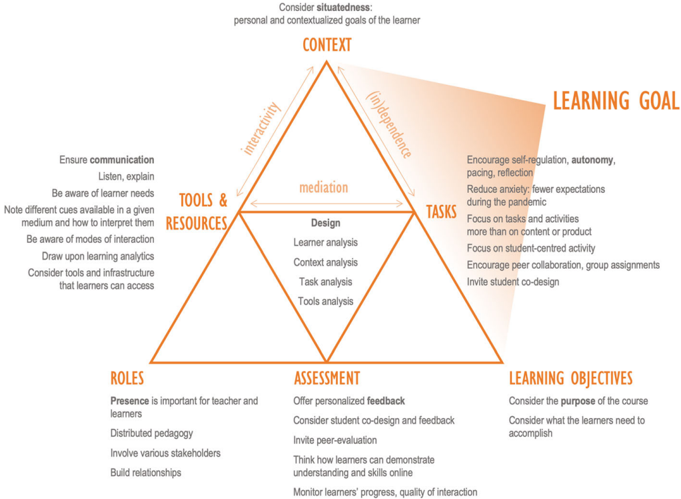
- They propose a tripartite teaching presence for online courses: cognitive presence, social presence, and facilitatory presence.
- Successful online learning requires students not to feel alone, and it benefits from timely feedback, peer collaboration, and student co-design/co-configuration of activities.
- The paper states that continuous assessment is needed in online learning, and suggests self-reflections, portfolios, self-paced asynchronous activities, and use of learning analytics as part of evaluation.
Methods
- Exploratory qualitative study using expert interviews administered by e-mail.
- Sample: 4 online pedagogy experts/co-authors, selected for research expertise, more than a decade of online teaching experience, and experience across different national education systems; they worked in Switzerland, Australia, Spain, and Canada.
- Main analysis: the first author organized the responses into a panel-like article, then the authors jointly revised and synthesized the material; the discussion summarizes themes under learning design, teacher presence, and assessment.
Limitations
- The paper states that all four experts came from “rich parts of the world” (Switzerland, Canada, Australia, and North of Spain), which limits the lens to a “monofocal” view of educational reality.
- The paper itself says the study used a heuristic method based on expert viewpoints and “by no means can replace rigorous, systematic research” following the scientific method.
- Evident from the text: the sample is very small (4 experts) and highly selected, so the findings are expert-opinion guidance rather than generalizable empirical results.
Model-written summary. Check it against the paper before relying on it.
Integrity signals
Registry
Cites
Statistics
Figures
Verification
Claims the paper makes
5 Valid · 0 Not valid · 32 Not checked · 24 Own results and interpretations
The sources with a verdict support this claim; the rest weren’t checked yet, have no full text we could read, or their verdicts aren’t rated yet.
In the paper
“On top of that, a significant challenge for university teachers has been their lack of the pedagogical content knowledge (PCK) (Shulman 1987) needed for teaching online (Angeli and Valanides 2005; Kali, Goodyear and Markauskaite 2011; Ching, Hsu and Baldwin 2018).”
§ Springer Nature Switzerland AG 2020 Published online: 7 July 2020 > Introduction
What the sources say
- Supportedcites Shulman 1987 matched to “Knowledge and teaching: Foundations of the new reform” (1987) source
The parenthetical (Shulman 1987) is attached to the term 'pedagogical content knowledge (PCK)' — an identification citation — while the online-teaching studies are credited to Angeli & Valanides, Kali et al. and Ching et al. Our copy (the Portuguese edition of Shulman's 1987 Harvard Educational Review article) establishes exactly that concept: the 'Categorias da base de conhecimento' section lists 'conhecimento pedagógico do conteúdo' as one of the categories of the knowledge base for teaching, 'esse amálgama especial de conteúdo e pedagogia que é o terreno exclusivo dos professores', and the 'Novas compreensões' section calls it 'a categoria que melhor distingue a compreensão de um especialista em conteúdo daquela de um pedagogo'. The paper itself says nothing about online teaching or about university teachers lacking PCK, but that part of the sentence is not attributed to this source. (LLM, conf=0.85)
- Not checked — no full text of the sourcecites Angeli and Valanides 2005 matched to “Preservice elementary teachers as information and communication technology designers: an instructional systems design model based on an expanded view of pedagogical content knowledge” (2005) source
- Could not verifycites Ching, Hsu and Baldwin 2018 matched to “Online Course Design and Development among College and University Instructors: An Analysis using Grounded Theory” (2018) sourceExperimental — accuracy not yet measured
Our copy of Baldwin, Ching & Friesen (2018) never mentions pedagogical content knowledge, PCK, Shulman, or TPACK; searches for 'pedagogical content knowledge PCK online teaching', 'TPACK technological pedagogical content knowledge', 'Shulman pedagogical content knowledge Angeli Valanides' and 'challenge lack of knowledge training online instructors pedagogy' returned only the References list and design-process passages. The paper's content is a grounded-theory account of how 14 four-year-institution instructors design online courses (Abstract; Results themes; Discussion mapping to ADDIE), and its nearest statements — that instructors 'must develop new curriculum with instructional strategies effective for online learning' (Discussion) and 'rarely use formal instructional design models' (Results) — concern design practice, not a PCK deficiency framed as a significant challenge. Nothing in our copy either states or contradicts the attributed claim. (LLM, conf=0.72)
plain- Asserted: passes — The authors put it forward as true.
- Checkable: passes — It can be checked against evidence.
- Load-bearing: passes — The paper’s conclusions depend on it.
- Based: passes — The paper gives a reason why it holds.
- Supported
The cited sources support only part of this claim — read each source’s verdict below.
In the paper
“Assessment can possibly be considered the most challenging part of the transition to distance learning for an institution used to face-to-face oral or written exam, as the control shift towards the students makes it hardly possible to ensure that students are not cheating (Munoz and Mackay 2019).”
§ Springer Nature Switzerland AG 2020 Published online: 7 July 2020 > Assessment
What the sources say
- Partly supportedcites Munoz and Mackay 2019 matched to “An online testing design choice typology towards cheating threat minimisation” (2019) sourceExperimental — accuracy not yet measured
Split into 2 atoms — 0 confirmed, 2 partially supported, 0 disputed, 0 misattributed, 0 unverifiable. Expand the claim to see per-atom verdicts.
hedgedstates a possible cause- Asserted: passes — The authors put it forward as true.
- Checkable: passes — It can be checked against evidence.
- Load-bearing: unclear — It is unclear whether the paper’s conclusions depend on it.
- Based: passes — The paper gives a reason why it holds.
- Partly supported
A result the paper reports from its own data — it cites no other source for it, so there is none to check. The quote shows it is in the paper.
In the paper
“Our findings point at the design of learning activities with certain characteristics, the combination of three types of presence (social, cognitive and facilitatory) and the need for adapting assessment to the new learning requirements.”
§ Springer Nature Switzerland AG 2020 Published online: 7 July 2020 > Abstract
plainstates an association- Asserted: passes — The authors put it forward as true.
- Checkable: passes — It can be checked against evidence.
- Load-bearing: passes — The paper’s conclusions depend on it.
- Based: passes — The paper gives a reason why it holds.
None of the sources cited for this claim have been checked yet.
In the paper
“What all four experts focus on as a prime ' piece ' of pedagogical knowledge (Kali et al. 2011) is the careful design of activities.”
§ Springer Nature Switzerland AG 2020 Published online: 7 July 2020 > Learning Design
plain- Asserted: passes — The authors put it forward as true.
- Checkable: passes — It can be checked against evidence.
- Load-bearing: unclear — It is unclear whether the paper’s conclusions depend on it.
- Based: passes — The paper gives a reason why it holds.
A result the paper reports from its own data — it cites no other source for it, so there is none to check. The quote shows it is in the paper.
In the paper
“Inspired by Anderson et al. ' s (2001) understanding of teaching presence and how it can be re-conceived in the current Covid-19 situation in which educators are the designers, the tutors and the evaluators of the learning experience, a tripartite framework emerges from the interviews, with three main sub-presences of the teaching presence, namely:”
§ Springer Nature Switzerland AG 2020 Published online: 7 July 2020 > Teacher Presence
plain- Asserted: passes — The authors put it forward as true.
- Checkable: passes — It can be checked against evidence.
- Load-bearing: passes — The paper’s conclusions depend on it.
- Based: passes — The paper gives a reason why it holds.
5 more claims
Create a free account to see all 61 claims and to verify the 9 references still open.
- Probably not a substantial claim. 50
- It may state two separate claims as one. 18
Claims other papers make about this one
Each is checked against this paper’s own text: does it say what the citing paper says it does?
The source backs part of the claim, not all of it — or backs it for a different population, condition or comparison.
In the citing paper
“while it is known that for learning success, input formats usually depend on both attention and interest from the students (Rapanta et al., 2020).”
From Impact of Synchronous and Asynchronous Settings of Online Teaching and Learning in Higher Education on Students' Learning Experience During COVID-19 (2021) · cites this paper as Rapanta et al., 2020
Experimental — accuracy not yet measuredIn the citing paper
“Evaluating AI applications could be beneficial for enhancing their motivation and interest in teaching with AI [40].”
From Developing AI Literacy for Primary and Middle School Teachers in China: Based on a Structural Equation Modeling Analysis (2022) · cites this paper as [40]
Citations
Cites
The Reflective Practitioner: How Professionals Think in Action
Checkoway, B., & Schon, D. A. (1985) · Journal of Policy Analysis and Management · doi:10.2307/3324262 · Cited by 21,268
The reflective practitioner: How professionals think in action
Stewart, C. J. (1984) · Patient Education and Counseling · doi:10.1016/0738-3991(84)90022-3 · Cited by 19,752
Knowledge and teaching: Foundations of the new reform
Shulman, L. (1987) · Harvard Educational Review · doi:10.17763/haer.57.1.j463w79r56455411 · Cited by 16,787
Phenomenological research methods
Moustakas, C. (1994) · doi:10.4135/9781412995658 · Cited by 13,919 · cited 1×
“’ This study ’ s participants, i.e. the four online pedagogy experts, also functioned as co-researchers, following Moustakas ’ (1994) idea (l).”
BackgroundDetermining Validity in Qualitative Inquiry
Creswell, J. W., & Miller, D. L. (2000) · Theory Into Practice · doi:10.1207/s15430421tip3903_2 · Cited by 9,184
Speech Genres and Other Late Essays
Bakhtin, M. M. (1986) · University of Texas Press eBooks · doi:10.7560/720466 · Cited by 8,470
The Difference between Emergency Remote Teaching and Online Learning
Hodges, C. B., Moore, S., Lockee, B. B., Trust, T., & Bond, M. A. (2024) · Handbook of Research in Online Learning · doi:10.1163/9789004702813_021 · Cited by 6,253
Blended learning: Uncovering its transformative potential in higher education
Garrison, D. R., & Kanuka, H. (2004) · The Internet and Higher Education · doi:10.1016/j.iheduc.2004.02.001 · Cited by 4,849
Speech Genres and Other Late Essays
Melaver, M., Bakhtin, M. M., McGee, V. W., Emerson, C., & Holquist, M. (1987) · Poetics Today · doi:10.2307/1772598 · Cited by 3,185
ASSESSING TEACHING PRESENCE IN A COMPUTER CONFERENCING CONTEXT
Anderson, T., Rourke, L., Garrison, R., & Archer, W. (2001) · Online Learning · doi:10.24059/olj.v5i2.1875 · Cited by 1,885
Research works printed but not linked: 2
- Bates, A. W. (2019). Teaching in a digital age. 2nd Edition. Vancouver: Tony Bates Associates. https://pressbooks.bccampus.ca/teachinginadigitalagev2/. Accessed 15 June 2020.
- Shor, I., & Freire, P. (1987). A pedagogy for deliberation: dialogues on transforming education . Westport: Bergin & Garvey Publishers.
Cited by
Items 501–600 of 2,106
COVID-19 online teaching intervention and learning performance of college foreign language students
Xu, Y., & Zou, Y. (2023) · Frontiers in Psychology · doi:10.3389/fpsyg.2022.1109032 · Cited by 12
“Therefore, the online learning environment in which an intervention is implemented is another powerful condition, and factors such as network fluency, platform stability, and strong information technology infrastructure are prerequisites for online learning (Ayeb-Arthur, 2017; Rapanta et al., 2020).”
BackgroundKeese, J., Ford, D. J., Luke, S. E., & Vaughn, S. M. (2023) · Education and Information Technologies · doi:10.1007/s10639-023-11792-8 · Cited by 12
“…university faculty to be proficient in utilizing instructional technology with their students (Arkorful & Abai - doo, 2015 ; Oliveira et al., 2021; Rapanta et al., 2020) such as online learning management systems, virtual meeting programs, and novel ways to engage with course content and…”
BackgroundElkington, S., & Chesterton, P. (2023) · doi:10.21428/8c225f6e.ef49a881 · Cited by 12
The status of digital innovation and data security in South African Higher Education
Adeyemo, K. S. (2023) · South African Journal of Higher Education · doi:10.20853/37-2-5001 · Cited by 27
Khanal, J. (2023) · Education and Information Technologies · doi:10.1007/s10639-023-12020-z · Cited by 21
“…recognized that increased ownership and authorship of learning for the students who were shifted from traditional teacher depended on learning environments to technology-integrated collaborative learning and co-construction of knowledge can be challenging in online education (Rapanta et al., 2020).”
Rasmitadila, R., Humaira, M. A., Prasetyo, T., Hasnin, H. D., & Rachmadtullah, R. (2023) · Journal of Education and e-Learning Research · doi:10.20448/jeelr.v10i4.5054 · Cited by 29
“…for elementary school teachers to promote inclusivity in their classrooms to enhance teacher competency in inclusive learning and offers various benefits such as improving their understanding of implementing inclusive education (Lindsay, 2003; Rapanta, Botturi, Goodyear, Guàrdia, & Koole, 2020).”
BackgroundAshari, M. K., Athoillah, S., & Faizin, M. (2023) · TA DIBUNA Jurnal Pendidikan Agama Islam · doi:10.30659/jpai.6.2.132-150 · Cited by 68
Dodson, E. M., & Blinn, C. R. (2021) · International Journal of Forest Engineering · doi:10.1080/14942119.2021.1907109 · Cited by 14
“For example, Rapanta et al. (2020) proposed three areas in which institutions and instructors should invest their time and resources in course design to better meet an uncertain future: ● Learning design – carefully design learning activities that enable students to reach the identified learning…”
BackgroundBrandão, E. D. C., Adelfio, M., Hagy, S., et al. (2021) · Lecture notes in networks and systems · doi:10.1007/978-3-030-80415-2_15 · Cited by 10
Al-Hashmi, S. (2021) · Higher Education Studies · doi:10.5539/hes.v11n3p78 · Cited by 18
“This sudden shift led several researchers to incorrectly describe this mode of teaching as online teaching at the beginning of the crisis (e.g., Dhawan, 2020; Rapanta et al., 2020).”
BackgroundBonsangue, M. V., & Clinkenbeard, J. (2021) · International Journal of Educational Research Open · doi:10.1016/j.ijedro.2021.100075 · Cited by 11
Learning media and strategies used by english students in practice teaching during the pandemic
Syahdan, S., Herlinawati, H., & Marwa, M. (2021) · ETERNAL (English Teaching Journal) · doi:10.26877/eternal.v12i2.9295 · Cited by 18
Burnout and Online Education: Adaptation and Validation of scale during Pandemic
Muñoz-Chávez, J. P., García-Contreras, R., & Valle-Cruz, D. (2022) · Telos Revista de Estudios Interdisciplinarios en Ciencias Sociales · doi:10.36390/telos241.03 · Cited by 11
Zaimakis, Y., & Papadaki, M. (2022) · SN Social Sciences · doi:10.1007/s43545-022-00380-1 · Cited by 23
Motivation and satisfaction in online learning during COVID-19 pandemic: A systematic review
Aznam, N., Perdana, R., Jumadi, J., Nurcahyo, H., & Wiyatmo, Y. (2022) · International Journal of Evaluation and Research in Education (IJERE) · doi:10.11591/ijere.v11i2.21961 · Cited by 19
Linh, P. M., Starčič, A. I., & Wu, T. (2022) · Lecture notes in computer science · doi:10.1007/978-3-031-15273-3_55 · Cited by 16
Diarsini, M. S., Artini, L. P., Padmadewi, N. N., Ratminingsih, N. M., Utami, I. L. P., & Marsakawati, N. P. E. (2022) · European Journal of Education and Pedagogy · doi:10.24018/ejedu.2022.3.6.421 · Cited by 15
“One of the efforts is to prepare online-based assessments (Divayana et al., 2021; Rapanta et al., 2020).”
BackgroundSugeng, B., & Suryani, A. W. (2023) · Accounting Education · doi:10.1080/09639284.2023.2168127 · Cited by 16
“These fi ndings gave evidence that Accounting educators were no longer focused on IT issues alone when designing online learning, as suggested by previous empirical studies (Atsoglou & Jimoyiannis, 2012; Garba et al., 2015; Jimoyiannis, 2008; Rapanta et al., 2020).”
BackgroundInfluentialDascălu, C. G., Antohe, M. E., Topoliceanu, C., & Purcărea, V. L. (2023) · Sustainability · doi:10.3390/su15043549 · Cited by 12
Göğüş, A. (2023) · Online Learning · doi:10.24059/olj.v27i2.3073 · Cited by 17
International Perspectives on the Transformation of Teaching in the New Normal
Bridges, S., Chan, C. K. Y., Ceperkovic, R., Nguyen, U. N. T., Prosser, M., Bone, E. K., French, S., & Sharifi, S. (2023) · Springer eBooks · doi:10.1007/978-981-99-0898-1_13 · Cited by 10
Analisis Kesesuaian Materi Himpunan Buku Teks Siswa Matematika Kelas VII terhadap Kurikulum 2013
Murniati, S., Roza, Y., & Roza, M. (2021) · Mosharafa Jurnal Pendidikan Matematika · doi:10.31980/mosharafa.v10i2.651 · Cited by 12
SCADA System for Online Electrical Engineering Education
Alcayde, A., Robalo, I., Montoya, F. G., & Manzano-Agugliaro, F. R. (2022) · Inventions · doi:10.3390/inventions7040115 · Cited by 13
Role of the Learning Management System in Resilience during the COVID-19 Pandemic
Eissa, E. (2022) · International Journal of Information and Education Technology · doi:10.18178/ijiet.2022.12.12.1764 · Cited by 9
Giusti, G., Farrapo, A. C., Sigahi, T. F. A. C., Saltorato, P., Vieira, J. G. V., & Silva, D. A. L. (2023) · The International Journal of Life Cycle Assessment · doi:10.1007/s11367-023-02225-2 · Cited by 9
“Classes can be considered a major HEI activity and one of the most impacted by Covid-19 (Pokhrel and Chhetri 2021; Rapanta et al. 2020; Sigahi et al. 2021).”
BackgroundEltahir, M. E., Annamalai, N., Uthayakumaran, A., Zyoud, S. H., García, A. R., Mažeikienė, V., Zakarneh, B. M., & Alsalhi, N. R. (2023) · SAGE Open · doi:10.1177/21582440231209816 · Cited by 19
“…as a wake-up call for higher education institutions to provide their instructors with relevant pedagogical and technological knowledge and skills related to assessment so that instructors can engage in ‘‘educational change toward more flexible models and practises’’ (Rapanta et al., 2020, p. 942).”
BackgroundShahrıll, M., Leong, E., Asamoah, D., Naing, L., Petra, M. I., Santos, J. H., & Aziz, A. B. Z. A. (2024) · Learning Environments Research · doi:10.1007/s10984-023-09489-3 · Cited by 12
“During COVID-19, blended instructional delivery modes through live video, audio lectures and tutorials have been the most preferred instructional space (Callo & Yazon, 2020; Muthuprasad et al., 2021; Rapanta et al., 2020; Schoenfeld-Tacher & Dorman, 2021).”
Papageorgiou, V., Meyer, E., & Ntonia, I. (2024) · Education Sciences · doi:10.3390/educsci14050504 · Cited by 17
Safaria, T., & Ariani, I. H. (2024) · Journal of Technology in Behavioral Science · doi:10.1007/s41347-024-00422-w · Cited by 13
“…they support online learning, Industry 4.0, e-commerce, energy management, e-logistics, public health, and more (Adedoyin & Soykan, 2020; Budd et al., 2020; Motlagh et al., 2020; Motlagh et al., 2020; Oztemel & Gursev, 2020; Oztemel & Gursev, 2020; Rapanta et al., 2020; Wang & Tang, 2020).”
InfluentialBülbül, A. E., & Özelçi, S. Y. (2024) · Education and Information Technologies · doi:10.1007/s10639-024-12868-9 · Cited by 19
“As teachers’ digital literacy levels increase, they become more competent in digital learning-teaching environments (Rapanta et al., 2020 ).”
Hu, X., Gao, J., & Romano, D. M. (2024) · Heliyon · doi:10.1016/j.heliyon.2024.e37619 · Cited by 14
“One prevailing issue identified in online L2 learning is probably insufficient interaction [13,14], and scholars have attempted to explain this issue further, considering both the quantity and quality of interaction.”
Zhu, J., El‐Zein, A., Hubble, T. C. T., & Miao, G. (2025) · Acta Geotechnica · doi:10.1007/s11440-025-02603-0 · Cited by 10
Zhao, X., Kung, M., & Cai, L. (2021) · Lecture notes in computer science · doi:10.1007/978-3-030-66906-5_26 · Cited by 15
Crisis Remote Education from the Perspective of One-year Experience of Academic Teachers
Romaniuk, M. W., & Łukasiewicz-Wieleba, J. (2021) · International Journal of Electronics and Telecommunications · doi:10.24425/ijet.2021.135967 · Cited by 11
Broussard, C., Gough, M., Dunn, S., Godde, K., & Preisler, V. (2021) · The journal of college science teaching · doi:10.1080/0047231x.2021.12290539 · Cited by 12
“…shown to correlate with faculty and students having some or more experience with online teaching or learning (Wojciechowski & Palmer, 2005), which few faculty reported to have at the start of the transition to remote learning (Rapanta et al., 2020; The Changing Landscape of Online Education, 2020).”
BackgroundSupporting Social Work Students during the COVID-19 Pandemic
Mirick, R. G., & Davis, A. (2021) · Journal of Teaching in Social Work · doi:10.1080/08841233.2021.1978612 · Cited by 9
“It also relied on access to technological devices, reliable internet service, sufficient space and privacy at home, and proper technical support (Rapanta et al., 2020).”
BackgroundOktariani, F., Fionasari, R., & Ramdha, T. (2021) · Edunesia Jurnal Ilmiah Pendidikan · doi:10.51276/edu.v3i1.203 · Cited by 9
“According to prior research (Rapanta et al., 2020), it is difficult to differentiate between classroom-based and online education because both are considered "heterogeneous."”
BackgroundMethodOnline Education in the COVID-19 Pandemic—Premise for Economic Competitiveness Growth?
Tănase, F.-D., Demyen, S., Manciu, V.-C., & Tănase, A.-C. (2022) · Sustainability · doi:10.3390/su14063503 · Cited by 13
Assessment in Sustainable Remote Teaching and Learning Environments During Emergency Situations
Mahlomaholo, M. R., & Mahlomaholo, S. M. (2022) · Journal of Culture and Values in Education · doi:10.46303/jcve.2022.17 · Cited by 9
Graduate school students’ self-efficacy toward online learning in the midst of the COVID-19 pandemic
Cadapan, R. R., Tindowen, D. J., Mendezabal, M. J., & Quilang, P. (2022) · International Journal of Evaluation and Research in Education (IJERE) · doi:10.11591/ijere.v11i2.21856 · Cited by 14
Teacher's Perspective on the Effectiveness of Online Learning during the COVID-19 Pandemic
Maydiantoro, A., Haenilah, E. Y., Hariri, H., Firdaus, R., Hestiningtyas, W., Putrawan, G. E., & Riadi, B. (2022) · International Journal of Information and Education Technology · doi:10.18178/ijiet.2022.12.9.1709 · Cited by 10
Husbands, M., & Prescott, J. (2022) · Mental Health and Social Inclusion · doi:10.1108/mhsi-09-2022-0065 · Cited by 9
Multimedia English Teaching Approach Based on Constructivist Learning Theory
Sasan, J. M., & Rabillas, A. R. (2022) · ELTALL English Language Teaching Applied Linguistic and Literature · doi:10.21154/eltall.v3i2.4607 · Cited by 24
Brown, A., Lawrence, J., Foote, S. M., Cohen, J. A., Redmond, P., Stone, C., Kimber, M., & Henderson, R. (2023) · Higher Education Research & Development · doi:10.1080/07294360.2022.2157798 · Cited by 13
Shah, S., & Arinze, B. (2023) · IEEE Transactions on Professional Communication · doi:10.1109/tpc.2022.3228025 · Cited by 11
“One important variable is the instructional technology itself [9].”
BackgroundStudent Readiness on Online Learning in Higher Education: An Empirical Study
Universitas Negeri Padang, I., Fadhilah, F., Husin, M., & Universitas Negeri Padang, I. (2023) · International Journal of Instruction · doi:10.29333/iji.2023.16326a · Cited by 22
The Use of Miro in Teaching Practice
Allah, R. K. (2023) · Exchanges The Interdisciplinary Research Journal · doi:10.31273/eirj.v10i3.1277 · Cited by 14
Ramli, F. N. A., & Arsad, N. M. (2023) · Journal of Nusantara Studies (JONUS) · doi:10.24200/jonus.vol8iss2pp316-333 · Cited by 27
“Rapanta et al. (2020) claimed that the more knowledgeable and competent teachers are in teaching, the better their digital literacy growth.”
BackgroundWiyanah, S., Aviory, K., & Nuryani, C. E. (2022) · J-ABDI Jurnal Pengabdian kepada Masyarakat · doi:10.53625/jabdi.v2i1.2266 · Cited by 9
Interactions in Online Versus Face-to-face Classes: Students' and Teachers' Perceptions
Gao, X., & Shi, L. (2023) · International Journal of Chinese Language Teaching · doi:10.46451/ijclt.20230305 · Cited by 16
“…the importance of teacher presence in online learning and the need for teachers to be more proactive and engaged with their students, despite the opportunities that online teaching offers, such as flexibility, access, and diversity (Rapanta et al., 2020; Sepulveda-Escobar & Morrison, 2020).”
BackgroundA moment in and out of time : precarity, liminality, and autonomy in crisis teaching
Glover, H., Myers, F., & Collins, H. (2024) · Teaching in Higher Education · doi:10.1080/13562517.2023.2298841 · Cited by 10
“The pandemic evidenced many cases where academics struggled with pedagogical practices for pivoting online (Rapanta et al. 2020) contributing to feelings of insecurity.”
BackgroundA FRAMEWORK IN ONLINE LEARNING PROCESS: A GUIDE TO EDUCATIONAL TEACHING DURING COVID 19 PANDEMIC
Mallillin, L. L. D., Mallillin, J. B., Carag, E. A., Collado, J. B., & Largo, M. G. D. (2020) · European Journal of Open Education and E-learning Studies · doi:10.46827/ejoe.v5i2.3274 · Cited by 10
Smeltzer, S., Leon, C., & Sperduti, V. R. (2020) · RIDAS Revista Iberoamericana de Aprendizaje y Servicio · doi:10.1344/ridas2020.10.9 · Cited by 10
Tajuddin, A. J. A., Romly, R. B., Hamzah, Y., et al. (2021) · Advances in Social Science, Education and Humanities Research/Advances in social science, education and humanities research · doi:10.2991/assehr.k.210312.088 · Cited by 9
“The fastpaced, constantly changing, dynamic and innovative online learning environment forces lecturers to think outside of the box in enabling students to have a meaningful learning experience [7].”
BackgroundTeaching Strategies Students Find Helpful in Online Learning Courses
Berlin, K. L., & Weavera, K. V. (2021) · College Teaching · doi:10.1080/87567555.2021.1940814 · Cited by 13
Effectiveness of Online Teaching during COVID-19
Akram, F., haq, M. A. U., Malik, H. A. M., & Mahmood, N. (2021) · International Conference on Innovation and Intelligence for Informatics, Computing, and Technologies (3ICT) · doi:10.1109/3ict53449.2021.9582144 · Cited by 12
Pereira, M. A. C., Ignacio, L. M. N. D. C., & Reis, C. E. R. (2021) · Sustainability · doi:10.3390/su14010363 · Cited by 14
Teaching Reform and Practice Using the Concept of Outcome-Based Education
Yang, P.-Y. O., Lai, S. F. H., Guan, H., et al. (2022) · International Journal of Emerging Technologies in Learning (iJET) · doi:10.3991/ijet.v17i03.29041 · Cited by 9
“[8] provided some expert insights into online-learning-related pedagogical content knowledge.”
BackgroundSetyaningsih, S., & Sukono, S. (2022) · Cypriot Journal of Educational Sciences · doi:10.18844/cjes.v17i2.6694 · Cited by 19
“The shift from face-to-face learning to online learning is supposed to be effective and efficient and does not ignore each learning element's necessity on the campus (Rapanta et al., 2020).”
BackgroundTangalakis, K., Kelly, K., Kon-yu, N., & Hall, D. P. (2022) · Journal of University Teaching and Learning Practice · doi:10.53761/1.19.1.10 · Cited by 12
Lecturers’ information literacy experience in remote teaching during the COVID-19 pandemic
Heriyanto, H., Christiani, L., & Rukiyah (2022) · PLoS ONE · doi:10.1371/journal.pone.0259954 · Cited by 13
“This only creates a teacher centered learning; instead, there is need to provide timely feedback to students’ questions and comments [10].”
BackgroundBabosová, R., Bartkova, A. R., Langraf, V., Vondráková, M., & Sandanusová, A. (2022) · Education Sciences · doi:10.3390/educsci12050292 · Cited by 9
“[40] also noted that teaching flexibility was an advantage.”
BackgroundThe teaching mix matters: Rethinking veterinary education at a South African university
Pienaar, M., & Mostert, E.-M. (2021) · Perspectives in Education · doi:10.18820/2519593x/pie.v39.i1.27 · Cited by 9
“As Rapanta et al. (2020) and Mohamedbhai (2020) emphasise, online learning is not merely adding notes and study material or recorded lectures to an online platform, and thus it requires that lecturers be trained in the pedagogy of delivering online teaching.”
BackgroundCLASSROOM CLIMATE AND STUDENT SELF-EFFICACY IN E-LEARNING
Davidovitch, N., & Yavich, R. (2022) · Problems of Education in the 21st Century · doi:10.33225/pec/22.80.304 · Cited by 16
Loyola-Hernández, L., Kahigi, C. M., Wangari-Jones, P., & Farrera, R. A. M. (2022) · Educational Review · doi:10.1080/00131911.2022.2071235 · Cited by 9
“Some important findings show online teaching has provided more flexibility for students with learning disabilities (Rapanta et al., 2020) and more innovative ways of delivering teaching (Peters et al., 2020).”
BackgroundUllah, H., Shoaib, M., Ali, N., & Ullah, R. (2022) · Journal of Electronic Resources Librarianship · doi:10.1080/1941126x.2022.2064118 · Cited by 22
Khazaal, Y., Abiddine, F. Z. E., Penzenstadler, L. E., Berbiche, D., Bteich, G., Valizadeh-Haghi, S., Rochat, L., Achab, S., Khan, R., & Chatton, A. (2022) · International Journal of Environmental Research and Public Health · doi:10.3390/ijerph191912099 · Cited by 10
Reitan, A. F., Waage, M., & Habib, L. (2022) · Teaching in Higher Education · doi:10.1080/13562517.2022.2162813 · Cited by 14
“…to online teaching has revealed that teaching sta ff lacked online-learn-ing-related pedagogical content knowledge, which includes ‘ the pedagogical foundations and knowledge of principles needed to design for, and facilitate, meaningful online learning experiences ’ (Rapanta et al. 2020, page 923).”
Jalali, M., Moradi, V., Babaee, T., Aminian, G., Mojgani, P., & Shahabi, S. (2023) · BMC Medical Education · doi:10.1186/s12909-023-04339-5 · Cited by 14
“Many did not have any experience designing online educational content or were not familiar with the technical aspects of educational platforms [41].”
BackgroundThe impact of sets education on disaster education on student mitigation skills and resilience
Atmojo, S. E., Rahmawati, R. D., & Anggriani, M. D. (2023) · NURTURE · doi:10.55951/nurture.v17i3.313 · Cited by 17
Qendraj, D. H., Xhafaj, E., Kosova, R., et al. (2023) · Interdisciplinary Journal of Research and Development · doi:10.56345/ijrdv10n212 · Cited by 9
Efficiency Online Learning During Covid-19 Pandemic
Omar, S. N. Z., Musa, R., Mohamad, M., Cob, C. M. S. C., Othman, A. Y., & Ramli, R. (2022) · WSEAS TRANSACTIONS ON BUSINESS AND ECONOMICS · doi:10.37394/23207.2023.20.4 · Cited by 12
Learning Continuity during COVID-19: An Analysis of the Higher Education Sector of Bangladesh
Mukherjee, D., & Hasan, K. K. (2023) · Journal of Education Culture and Society · doi:10.15503/jecs2023.1.650.671 · Cited by 14
“Technology intervention in the teaching-learning process took a phenomenal surge where the usage of learning technologies was augmented to fulfill the need for emergency remote teaching (Rapanta et al., 2020; Wang et al., 2020).”
BackgroundToroghi, H. H., Denney, F., & Simpson, A. V. (2024) · Frontiers in Sociology · doi:10.3389/fsoc.2024.1378665 · Cited by 31
The Evolution of Active Learning in Response to the Pandemic: The Role of Technology
Maldonado-Trapp, A., & Bruna, C. (2024) · Advances in experimental medicine and biology · doi:10.1007/978-3-031-61943-4_16 · Cited by 13
Teaching during Covid-19: Teacher and Students’ Experience
Mukhter, I., & Chowdhary, R. (2020) · Space and Culture India · doi:10.20896/saci.v8i2.1068 · Cited by 12
Harris, R. J., Blundell-Birtill, P., & Pownall, M. (2021) · Student Success · doi:10.5204/ssj.1781 · Cited by 9
Blended Learning During Pandemic Through Knowledge Management: An Analytical Study
Hasan, K. K., Mostofa, S. M., Othman, R., & Mukherjee, D. (2022) · Journal of Information & Knowledge Management · doi:10.1142/s0219649222400068 · Cited by 11
Tham, A., Iaquinto, B. L., & Driml, S. (2021) · Journal of Hospitality Leisure Sport & Tourism Education · doi:10.1016/j.jhlste.2021.100350 · Cited by 9
Itasanmi, S. A., Oni, M. T., Ekpenyong, V. O., Ajani, O. A., & Omorinkoba, O. G. (2022) · International Journal of Learning Teaching and Educational Research · doi:10.26803/ijlter.21.7.18 · Cited by 12
“This is likely to be compounded by a lack of pedagogical content knowledge, which entails technical and administrative aspects of online teaching, pedagogical foundations and knowledge of the principles needed to design and facilitate meaningful online learning experiences (Rapanta et al., 2020).”
BackgroundMtotywa, M. M., Seabi, M. A., Manqele, T. J., Ngwenya, S. P., & Moetsi, M. (2023) · Development Southern Africa · doi:10.1080/0376835x.2023.2234399 · Cited by 11
“This complexity was further exacerbated by the advent of the COVID-19 pandemic, which fundamentally changed approaches to education (Rapanta et al., 2020).”
BackgroundAcademic Procrastination of Spanish Pre-service Teachers during the COVID-19 Pandemic
Antón, L. J. M., Manzanares, M. C. S., Molinero-González, P., Arteaga-Cedeño, W. L., Soto, A., & Carbonero, M. Á. (2023) · Psicologí a Educativa · doi:10.5093/psed2023a17 · Cited by 8
Student Engagement Tracks with Success In-person and Online in a Hybrid-Flexible Course
Adeel, Z., Mladjenovic, S. M., Smith, S. J., Sahi, P., Dhand, A., Williams-Habibi, S., Brown, K., & Moisse, K. (2023) · The Canadian Journal for the Scholarship of Teaching and Learning · doi:10.5206/cjsotlrcacea.2023.2.14482 · Cited by 14
Designing for Social Justice: A Decolonial Exploration of How to Develop EdTech for Refugees
Barnes, K., Emerusenge, A. P., Rabi, A., Ullah, N., Mazari, H., Moustafa, N., Thakrar, J., Zhao, A., & Koomar, S. (2024) · Education Sciences · doi:10.3390/educsci14010077 · Cited by 15
“…[1–4 , In alignment with the “Design for scale” principle, Butcher [46] cites other scholars (e.g., Bozkurt et al. [47], Rapanta et al. [48]) who posit that the use of technology provides the most efficient, cost-effective, and perhaps the only method to continue learning at scale…”
BackgroundKılınç, H. (2021) · Advances in educational technologies and instructional design book series · doi:10.4018/978-1-7998-7275-7.ch010 · Cited by 9
Rising to the occasion: Exploring the changing emphasis on educational design during COVID-19
Bellaby, A., Sankey, M., & Albert, L. R. (2020) · Annual Conference of the Australasian Society for Computers in Learning in Tertiary Education (ASCILITE) · doi:10.14742/ascilite2020.0137 · Cited by 9
Analisis Kesesuaian Materi Himpunan Buku Teks Siswa Matematika Kelas VII terhadap Kurikulum 2013
Murniati, S., Roza, Y., & Maimunah, M. (2021) · Mosharafa Jurnal Pendidikan Matematika · doi:10.31980/mosharafa.v10i2.944 · Cited by 8
University Students’ Acceptance of Online Learning During the Pandemic in Indonesia
Harunasari, S. Y., Dwigustini, R., Halim, N., & Susillawati, S. (2021) · AL-ISHLAH Jurnal Pendidikan · doi:10.35445/alishlah.v13i1.491 · Cited by 11
Hite, R. L., Childers, G. M., Gottlieb, J. J., Velasco, R. C. L., Johnson, L., Williams, G. B., Griffith, K., & Dwyer, J. (2021) · International Journal of STEM Education · doi:10.1186/s40594-021-00312-0 · Cited by 12
“Findings are affirmed from a concurrent study for more empathetic and inclusive pedago-gies employed in online courses (Rapanta et al., 2020).”
BackgroundMoore, J. W., Lau, Z., Kaouri, K., Dale, T. C., & Woolley, T. E. (2021) · COVID · doi:10.3390/covid1040055 · Cited by 8
Balahadia, F. F. (2021) · International Journal of Computing Sciences Research · doi:10.25147/ijcsr.2017.001.1.79 · Cited by 8
Kannan, P., Bhawra, J., Patel, P., & Katapally, T. R. (2022) · AIMS Public Health · doi:10.3934/publichealth.2022016 · Cited by 8
Ecuadorian and Uruguayan teachers' perceptions and experiences of teaching online during COVID
Burgin, X. D., Coli, S., & Daniel, M. C. (2022) · International journal of comparative education and development · doi:10.1108/ijced-06-2021-0062 · Cited by 10
Eck, C. J., Layfield, K. D., DiBenedetto, C. A., Jordan, J., Scott, S., Thomas, W., Parisi, M., & Dobbins, T. R. (2022) · Journal of Extension · doi:10.34068/joe.60.01.09 · Cited by 10
“This situation challenged education systems across the world and forced educators to shift to an online mode of teaching overnight (Dhawan, 2020), asking them to become both instructional designers and tutors and to use tools which few have fluently mastered (Rapanta et al., 2020).”
BackgroundAcross continents: A comparison of African and Australian academics' online preparedness
Singh, U. G., Watson, R., & Nair, C. S. (2022) · Perspectives in Education · doi:10.18820/2519593x/pie.v40.i1.3 · Cited by 7
“…of the technologies used, the research on learner performance outcomes shows that the instructor’s design efforts that address learners’ cognitive and social needs rather than simply the technology itself (Oliver et al., 2015) make a positive difference in learning outcomes (Rapanta et al., 2020).”
BackgroundFidan, N. K., & Yıldırım, N. (2022) · Psycho-Educational Research Reviews · doi:10.52963/perr_biruni_v11.n1.06 · Cited by 10
Timpal, J. D. F., & Mokalu, V. R. (2022) · Dunamis Jurnal Teologi dan Pendidikan Kristiani · doi:10.30648/dun.v6i2.676 · Cited by 22
Moyo, R., Ngidi, S. A., Koai, M., & Lemeko, P. (2022) · Journal of Culture and Values in Education · doi:10.46303/jcve.2022.4 · Cited by 12
“Anderson (2011, as cited by Rapanta et al., 2020) describes online learning as instruction in which the learner is away from the tutor/instructor, and interaction as well as access to learning content is mediated using technology.”
BackgroundHigher Education Institutions‘ Emergency Remote Teaching amid the Pandemic
Bacus, R. C., Dayagbil, F. T., Monacillo, V. F., & Bustos, R. T. (2022) · International Journal of Information and Education Technology · doi:10.18178/ijiet.2022.12.8.1682 · Cited by 17
“In addition, [21] suggested that cost, privacy, computer requirements, and necessary bandwidth associated with the technologies pose significant barriers to students‘ access to ERT.”
BackgroundScience teachers innovation in overcoming learning challenges during Pandemic Covid-19: A Reflection
Sulung, M. H., & Erman, E. (2022) · JURNAL PIJAR MIPA · doi:10.29303/jpm.v17i5.3678 · Cited by 8
“Teachers of all backgrounds and ages should prepare and deliver their classes from home, with all the challenges faced and often without adequate technical support [23].”
Background
Metadata
- Authors
- Rapanta, C., Botturi, L., Goodyear, P., Guàrdia, L., & Koole, M.
- Affiliations
- Universidade Nova de Lisboa (PT)
- University of Applied Sciences and Arts of Southern Switzerland (CH)
- The University of Sydney (AU)
- University of Saskatchewan (CA)
- Corresponding author
- Rapanta, Chrysi
- ORCID
- Rapanta, Chrysi
- Venue
- Postdigital Science and Education
- Published
- 2020-07-07
- Volume
- 2
- Issue
- 3
- Pages
- 923-945
- ISSN
- 2524-485X (ISSN-L)
- 2524-4868
- PMC
- PMC7339092
- OpenAlex
- W3042009104
- Semantic Scholar
- fed495af71b417de8d60cf16b6da44926faf24a0
- Cited by
- 2,130
- References
- 75
- Citations by year
- 2026: 134 · 2025: 158 · 2024: 261 · 2023: 426 · 2022: 556 · 2021: 509 · 2020: 73
- FWCI
- 454.18
- Type
- journal article
- Language
- en
- Open access
- hybrid
- doi.org
- Licence
- other-oa
- www.springer.com/tdm (tdm)
- www.springer.com/tdm (vor)
- Locations
- Postdigital Science and Education (publishedVersion, other-oa)
- PubMed (publishedVersion)
- PubMed Central (submittedVersion)
- The Sydney eScholarship Repository (The University of Sydney) (submittedVersion)
- Funders
- Fundação para a Ciência e a Tecnologia (DL 57/2016/CP1453/CT0066)
- Australian Research Council (DP150104163)
- Topics
- Social Sciences › Education › Digital Education and Society
- Social Sciences › Education › Higher Education Practises and Engagement
- Social Sciences › Education › Educational Innovations and Technology
- Keywords
- online learning, COVID-19 pandemic, higher education, teacher presence, pedagogical content knowledge, learning activities, social presence, cognitive presence
About these checks
Registry, retraction, Cites and statistics results are computed, not judged, with one exception: a printed reference that no index lists is read once by a model before it counts as a citation error. Claims are extracted by a model and kept only when their quote appears verbatim in the text; each cited source is then checked, with a model’s help, for whether it says what the claim relies on. Those verdicts can be wrong — read the claim’s quote and the cited source before relying on one.
The claim verdicts this report counts are experimental: their accuracy is not yet measured.
A language model drew the claims from the paper on 2026-10-10, under version 3 of the claim definition (model deepseek-v4.1-flash, prompt extract-v3).
A second model labelled each claim on 2026-10-10 (model jev-1.13-20260917, definition revision gold-guideline-v0.2).
Cited sources are checked with a language model’s help (qwen3.8-omni-flash).
Statistics and arithmetic are recomputed, not judged.
Confidence bands are shown only for fields calibrated on our annotated test set. None is calibrated yet, so no band is shown.
What counts as a claim ›How we measure confidence ›How we check this ›
Are you an author, or do you see a problem with this page? Request a review
Data sources
Bibliographic data: Semantic Scholar, OpenAlex, Crossref.
Contains information from the Semantic Scholar Academic Graph Datasets, made available under the ODC Attribution License (ODC-BY 1.0).
Semantic Scholar’s data is described in: Kinney, R., et al. (2023). The Semantic Scholar Open Data Platform. arXiv:2301.10140.
