

Online University Teaching During and After the Covid-19 Crisis: Refocusing Teacher Presence and Learning Activity
Open accessThe DOI matches its Crossref record; 71 of the 75 references it cites were found in a registry or an index; 6 of the 42 sources its claims cite were checked for support.
Abstract
The Covid-19 pandemic has raised significant challenges for the higher education community worldwide. A particular challenge has been the urgent and unexpected request for previously face-to-face university courses to be taught online. Online teaching and learning imply a certain pedagogical content knowledge (PCK), mainly related to designing and organising for better learning experiences and creating distinctive learning environments, with the help of digital technologies.
Overview
CoChat Summary
TL;DR
This article is an expert-interview piece offering pedagogical guidance for university teachers suddenly moving online during Covid-19. Its central message is that effective online teaching depends less on tools or materials alone and more on careful learning design, multiple forms of teacher presence, and continuous assessment.
Key findings
- The four experts argue that online learning should be built around carefully designed learning activities, with a mix of synchronous, asynchronous, online, and offline tasks that are clear, appropriately difficult, authentic, and accessible to students.
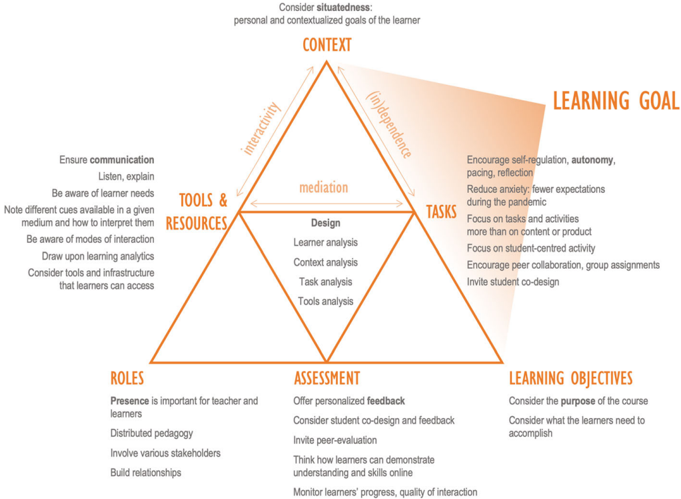
- They propose a tripartite teaching presence for online courses: cognitive presence, social presence, and facilitatory presence.
- Successful online learning requires students not to feel alone, and it benefits from timely feedback, peer collaboration, and student co-design/co-configuration of activities.
- The paper states that continuous assessment is needed in online learning, and suggests self-reflections, portfolios, self-paced asynchronous activities, and use of learning analytics as part of evaluation.
Methods
- Exploratory qualitative study using expert interviews administered by e-mail.
- Sample: 4 online pedagogy experts/co-authors, selected for research expertise, more than a decade of online teaching experience, and experience across different national education systems; they worked in Switzerland, Australia, Spain, and Canada.
- Main analysis: the first author organized the responses into a panel-like article, then the authors jointly revised and synthesized the material; the discussion summarizes themes under learning design, teacher presence, and assessment.
Limitations
- The paper states that all four experts came from “rich parts of the world” (Switzerland, Canada, Australia, and North of Spain), which limits the lens to a “monofocal” view of educational reality.
- The paper itself says the study used a heuristic method based on expert viewpoints and “by no means can replace rigorous, systematic research” following the scientific method.
- Evident from the text: the sample is very small (4 experts) and highly selected, so the findings are expert-opinion guidance rather than generalizable empirical results.
Model-written summary. Check it against the paper before relying on it.
Integrity signals
Registry
Cites
Statistics
Figures
Verification
Claims the paper makes
5 Valid · 0 Not valid · 32 Not checked · 24 Own results and interpretations
The sources with a verdict support this claim; the rest weren’t checked yet, have no full text we could read, or their verdicts aren’t rated yet.
In the paper
“On top of that, a significant challenge for university teachers has been their lack of the pedagogical content knowledge (PCK) (Shulman 1987) needed for teaching online (Angeli and Valanides 2005; Kali, Goodyear and Markauskaite 2011; Ching, Hsu and Baldwin 2018).”
§ Springer Nature Switzerland AG 2020 Published online: 7 July 2020 > Introduction
What the sources say
- Supportedcites Shulman 1987 matched to “Knowledge and teaching: Foundations of the new reform” (1987) source
The parenthetical (Shulman 1987) is attached to the term 'pedagogical content knowledge (PCK)' — an identification citation — while the online-teaching studies are credited to Angeli & Valanides, Kali et al. and Ching et al. Our copy (the Portuguese edition of Shulman's 1987 Harvard Educational Review article) establishes exactly that concept: the 'Categorias da base de conhecimento' section lists 'conhecimento pedagógico do conteúdo' as one of the categories of the knowledge base for teaching, 'esse amálgama especial de conteúdo e pedagogia que é o terreno exclusivo dos professores', and the 'Novas compreensões' section calls it 'a categoria que melhor distingue a compreensão de um especialista em conteúdo daquela de um pedagogo'. The paper itself says nothing about online teaching or about university teachers lacking PCK, but that part of the sentence is not attributed to this source. (LLM, conf=0.85)
- Not checked — no full text of the sourcecites Angeli and Valanides 2005 matched to “Preservice elementary teachers as information and communication technology designers: an instructional systems design model based on an expanded view of pedagogical content knowledge” (2005) source
- Could not verifycites Ching, Hsu and Baldwin 2018 matched to “Online Course Design and Development among College and University Instructors: An Analysis using Grounded Theory” (2018) sourceExperimental — accuracy not yet measured
Our copy of Baldwin, Ching & Friesen (2018) never mentions pedagogical content knowledge, PCK, Shulman, or TPACK; searches for 'pedagogical content knowledge PCK online teaching', 'TPACK technological pedagogical content knowledge', 'Shulman pedagogical content knowledge Angeli Valanides' and 'challenge lack of knowledge training online instructors pedagogy' returned only the References list and design-process passages. The paper's content is a grounded-theory account of how 14 four-year-institution instructors design online courses (Abstract; Results themes; Discussion mapping to ADDIE), and its nearest statements — that instructors 'must develop new curriculum with instructional strategies effective for online learning' (Discussion) and 'rarely use formal instructional design models' (Results) — concern design practice, not a PCK deficiency framed as a significant challenge. Nothing in our copy either states or contradicts the attributed claim. (LLM, conf=0.72)
plain- Asserted: passes — The authors put it forward as true.
- Checkable: passes — It can be checked against evidence.
- Load-bearing: passes — The paper’s conclusions depend on it.
- Based: passes — The paper gives a reason why it holds.
- Supported
The cited sources support only part of this claim — read each source’s verdict below.
In the paper
“Assessment can possibly be considered the most challenging part of the transition to distance learning for an institution used to face-to-face oral or written exam, as the control shift towards the students makes it hardly possible to ensure that students are not cheating (Munoz and Mackay 2019).”
§ Springer Nature Switzerland AG 2020 Published online: 7 July 2020 > Assessment
What the sources say
- Partly supportedcites Munoz and Mackay 2019 matched to “An online testing design choice typology towards cheating threat minimisation” (2019) sourceExperimental — accuracy not yet measured
Split into 2 atoms — 0 confirmed, 2 partially supported, 0 disputed, 0 misattributed, 0 unverifiable. Expand the claim to see per-atom verdicts.
hedgedstates a possible cause- Asserted: passes — The authors put it forward as true.
- Checkable: passes — It can be checked against evidence.
- Load-bearing: unclear — It is unclear whether the paper’s conclusions depend on it.
- Based: passes — The paper gives a reason why it holds.
- Partly supported
A result the paper reports from its own data — it cites no other source for it, so there is none to check. The quote shows it is in the paper.
In the paper
“Our findings point at the design of learning activities with certain characteristics, the combination of three types of presence (social, cognitive and facilitatory) and the need for adapting assessment to the new learning requirements.”
§ Springer Nature Switzerland AG 2020 Published online: 7 July 2020 > Abstract
plainstates an association- Asserted: passes — The authors put it forward as true.
- Checkable: passes — It can be checked against evidence.
- Load-bearing: passes — The paper’s conclusions depend on it.
- Based: passes — The paper gives a reason why it holds.
None of the sources cited for this claim have been checked yet.
In the paper
“What all four experts focus on as a prime ' piece ' of pedagogical knowledge (Kali et al. 2011) is the careful design of activities.”
§ Springer Nature Switzerland AG 2020 Published online: 7 July 2020 > Learning Design
plain- Asserted: passes — The authors put it forward as true.
- Checkable: passes — It can be checked against evidence.
- Load-bearing: unclear — It is unclear whether the paper’s conclusions depend on it.
- Based: passes — The paper gives a reason why it holds.
A result the paper reports from its own data — it cites no other source for it, so there is none to check. The quote shows it is in the paper.
In the paper
“Inspired by Anderson et al. ' s (2001) understanding of teaching presence and how it can be re-conceived in the current Covid-19 situation in which educators are the designers, the tutors and the evaluators of the learning experience, a tripartite framework emerges from the interviews, with three main sub-presences of the teaching presence, namely:”
§ Springer Nature Switzerland AG 2020 Published online: 7 July 2020 > Teacher Presence
plain- Asserted: passes — The authors put it forward as true.
- Checkable: passes — It can be checked against evidence.
- Load-bearing: passes — The paper’s conclusions depend on it.
- Based: passes — The paper gives a reason why it holds.
5 more claims
Create a free account to see all 61 claims and to verify the 9 references still open.
- Probably not a substantial claim. 50
- It may state two separate claims as one. 18
Claims other papers make about this one
Each is checked against this paper’s own text: does it say what the citing paper says it does?
The source backs part of the claim, not all of it — or backs it for a different population, condition or comparison.
In the citing paper
“while it is known that for learning success, input formats usually depend on both attention and interest from the students (Rapanta et al., 2020).”
From Impact of Synchronous and Asynchronous Settings of Online Teaching and Learning in Higher Education on Students' Learning Experience During COVID-19 (2021) · cites this paper as Rapanta et al., 2020
Experimental — accuracy not yet measuredIn the citing paper
“Evaluating AI applications could be beneficial for enhancing their motivation and interest in teaching with AI [40].”
From Developing AI Literacy for Primary and Middle School Teachers in China: Based on a Structural Equation Modeling Analysis (2022) · cites this paper as [40]
Citations
Cites
The Reflective Practitioner: How Professionals Think in Action
Checkoway, B., & Schon, D. A. (1985) · Journal of Policy Analysis and Management · doi:10.2307/3324262 · Cited by 21,268
The reflective practitioner: How professionals think in action
Stewart, C. J. (1984) · Patient Education and Counseling · doi:10.1016/0738-3991(84)90022-3 · Cited by 19,752
Knowledge and teaching: Foundations of the new reform
Shulman, L. (1987) · Harvard Educational Review · doi:10.17763/haer.57.1.j463w79r56455411 · Cited by 16,787
Phenomenological research methods
Moustakas, C. (1994) · doi:10.4135/9781412995658 · Cited by 13,919 · cited 1×
“’ This study ’ s participants, i.e. the four online pedagogy experts, also functioned as co-researchers, following Moustakas ’ (1994) idea (l).”
BackgroundDetermining Validity in Qualitative Inquiry
Creswell, J. W., & Miller, D. L. (2000) · Theory Into Practice · doi:10.1207/s15430421tip3903_2 · Cited by 9,184
Speech Genres and Other Late Essays
Bakhtin, M. M. (1986) · University of Texas Press eBooks · doi:10.7560/720466 · Cited by 8,470
The Difference between Emergency Remote Teaching and Online Learning
Hodges, C. B., Moore, S., Lockee, B. B., Trust, T., & Bond, M. A. (2024) · Handbook of Research in Online Learning · doi:10.1163/9789004702813_021 · Cited by 6,253
Blended learning: Uncovering its transformative potential in higher education
Garrison, D. R., & Kanuka, H. (2004) · The Internet and Higher Education · doi:10.1016/j.iheduc.2004.02.001 · Cited by 4,849
Speech Genres and Other Late Essays
Melaver, M., Bakhtin, M. M., McGee, V. W., Emerson, C., & Holquist, M. (1987) · Poetics Today · doi:10.2307/1772598 · Cited by 3,185
ASSESSING TEACHING PRESENCE IN A COMPUTER CONFERENCING CONTEXT
Anderson, T., Rourke, L., Garrison, R., & Archer, W. (2001) · Online Learning · doi:10.24059/olj.v5i2.1875 · Cited by 1,885
Research works printed but not linked: 2
- Bates, A. W. (2019). Teaching in a digital age. 2nd Edition. Vancouver: Tony Bates Associates. https://pressbooks.bccampus.ca/teachinginadigitalagev2/. Accessed 15 June 2020.
- Shor, I., & Freire, P. (1987). A pedagogy for deliberation: dialogues on transforming education . Westport: Bergin & Garvey Publishers.
Cited by
Items 601–700 of 2,106
Promoting inclusion and equity in Higher Education: Is this the role of distance learning in Brazil?
Mello, S. L. D. M., Meiriño, M. J., Filho, W. L., & Sampaio, T. N. D. R. (2022) · Ensaio Avaliação e Políticas Públicas em Educação · doi:10.1590/s0104-40362022003003736 · Cited by 22
“…It just broke me…”: exploring the psychological impact of the COVID-19 pandemic on academics
Thompson, L., & Christian, C. (2022) · BMC Psychology · doi:10.1186/s40359-022-01008-y · Cited by 12
Subjective Assessments of the Pandemic Situation and Academic Adaptation of University Students
Shamionov, R. М., Grigoryeva, M. V., Grinina, E. S., Владимирович, С. А., & Bolshakova, A. S. (2023) · OBM Neurobiology · doi:10.21926/obm.neurobiol.2301150 · Cited by 10
Saqr, M., Raspopović, M., Pancheva, K., Jovic, J., Peltekova, E., & Conde, M. Á. (2023) · Universal Access in the Information Society · doi:10.1007/s10209-023-00989-w · Cited by 12
“Regarding the “guidance” proposed in several cases, some of the guidance was related to teaching materials and methodologies [53, 68, 81, 82], the interaction with students and parents [3, 32, 52, 53, 68, 71, 72, 75, 82–83], ways to provide practical training [3, 68, 79, 82], assessments [32, 79, 83], ways of dealing…”
The shift from class-based to online learning during COVID-19: A student and academic perception
Bartolo, N. S., Pizzuto, M. A., Wirth, F., Szijj, J. V., Serracino‐Inglott, A., & Azzopardi, L. M. (2020) · Pharmacy Education · doi:10.46542/pe.2020.202.290296 · Cited by 9
“Uncertainties brought about by the pandemic and adjustment to the new norm may have also contributed to the anxiety level (Daniel, 2020; Rapanta et al., 2020).”
BackgroundOnline Learning during Covid-19 Pandemic: Does It Run Well?
Jhon, W., Mustadi, A., & Zubaidah, E. (2020) · Jurnal Pendidikan Progresif · doi:10.23960/jpp.v10.i3.202005 · Cited by 13
Leisterer, S., Lautenbach, F., Walter, N., Kronenberg, L., & Elbe, A. (2021) · Frontiers in Psychology · doi:10.3389/fpsyg.2021.612264 · Cited by 11
Investigating Virtual Learning on Students Learning Outcomes in Urban and Rural Areas
Hariyati, N., Wagino, W., & Mudjito, M. (2021) · Dinamika Pendidikan · doi:10.15294/dp.v16i1.28661 · Cited by 11
“Current studies related to the online learning implementation during Covid-19 have reported both benefits and drawbacks of online learning (Dhawan, 2020; Rapanta et al., 2020; Baber, 2020; Nambiar 2020; Dutta, 2020;).”
BackgroundResearch Skills for Information Management: Uses of Mobile Devices in Research Training
Villa, E. J. E., Marín, V. I., & Salinas, J. (2021) · Education Sciences · doi:10.3390/educsci11110749 · Cited by 18
Prodanović, M., & Gavranović, V. (2020) · Zbornik radova Filozofskog fakulteta u Pristini · doi:10.5937/zrffp50-27873 · Cited by 11
Adapting the Addie Instructional Design Model in Online Education
Szabo, D. A. (2022) · Studia Universitatis Babeș-Bolyai Psychologia-Paedagogia · doi:10.24193/subbpsyped.2022.1.08 · Cited by 55
Papageorgiou, V., Meyer, E., & Ntonia, I. (2025) · The Internet and Higher Education · doi:10.1016/j.iheduc.2025.100997 · Cited by 9
Postdigital Dissensus: On the Complexity of Debating Technology in Higher Education Futures
Rasa, T. (2025) · Postdigital Science and Education · doi:10.1007/s42438-025-00551-2 · Cited by 9
“Furthermore, even a much narrower case such as ‘using digital technology to facilitate distance (non-localised, online) learning’ quickly spills over into issues of learning design, presence, assessment, self-regulation, issues of cheating and so on (Rapanta et al. 2020).”
Dottin, P. (2021) · The Quality of Higher Education · doi:10.1080/13538322.2021.1935277 · Cited by 7
“The emergence of the covid-19 pandemic has necessitated a rethinking and repositioning of higher education (Rapanta et al., 2020) and the assurance of its quality.”
BackgroundEmerging Trends in and Strategies for Industry 4.0 During and Beyond Covid-19
Akkaya, B., Jermsittiparsert, K., Malik, M. A., & Koçyiğit, Y. (2021) · Sciendo eBooks · doi:10.2478/9788366675391 · Cited by 17
ICT effect on employees-related outcomes: higher education as a context
Farha, A. A., Obeidat, S. M., & Al-Kwifi, O. S. (2022) · Journal of Systems and Information Technology · doi:10.1108/jsit-04-2021-0073 · Cited by 9
Volodarets, S., Chernousova, N., Peleshenko, H., Sergiivna, M. H., Savchenko, A., & Netronina, O. (2022) · Biochemistry and Molecular Biology Education · doi:10.1002/bmb.21618 · Cited by 14
“However, GC should be combined with other elearning platforms in order to have live connections between teachers and students that complies with studies of scientists from different countries.(2,5,14)”
BackgroundImpact of Data Quality on Question Answering System Performances
Karra, R., & Lasfar, A. (2022) · Intelligent Automation & Soft Computing · doi:10.32604/iasc.2023.026695 · Cited by 8
Ghilay, Y. (2022) · Journal of Education and Learning · doi:10.5539/jel.v11n5p93 · Cited by 18
Mukherjee, M., & Maity, C. (2022) · AAOU Journal/AAOU journal · doi:10.1108/aaouj-03-2022-0042 · Cited by 9
Face-to-face versus online-based lectures: A COVID-19 induced study on assessments
Fisher, D. W., Solomons, D., & Makhathini, K. B. (2022) · Frontiers in Education · doi:10.3389/feduc.2022.1045311 · Cited by 9
“This led to a radical move away from face-to-face learning and teaching to investment in existing online platforms and exploration into the viability of the e-learning online environment as an alternative (Mishra et al., 2020; Rapanta et al., 2020).”
BackgroundCompetencies of Teachers in Game-based Pedagogy
due to ethical violation., T. A. I. R. F. T. I. (2023) · Pegem Journal of Education and Instruction · doi:10.47750/pegegog.13.02.39 · Cited by 25
Integrating AI in Higher Education: Applications, Strategies, Ethical Considerations
Daraai, S. B. A., Maqrashi, M. A., Zakwani, M. A., & Shaikh, Z. A. (2024) · Advances in educational technologies and instructional design book series · doi:10.4018/979-8-3693-2145-4.ch008 · Cited by 10
Haddad, M., Abbes, Z., & Abdel‐Salam, A. G. (2024) · Frontiers in Psychology · doi:10.3389/fpsyg.2024.1397588 · Cited by 12
Bitar, N., & Davidovich, N. (2024) · Education Sciences · doi:10.3390/educsci14080816 · Cited by 12
Maisano, D. A., Carrera, G., Mastrogiacomo, L., & Franceschini, F. (2024) · International Journal of Educational Technology in Higher Education · doi:10.1186/s41239-024-00497-8 · Cited by 16
Göbel, K., Makarova, E., Neuber, K., & Kaqinari, T. (2021) · Springer eBooks · doi:10.1007/978-3-658-32609-8_22 · Cited by 7
WALKER, R. A., Chong, S., & Chong, J. P. J. (2021) · Research in Learning Technology · doi:10.25304/rlt.v29.2520 · Cited by 7
“We subsequently combined the categories of comments that we had coded in groups to show different modes of participation, adapting a categorisation method on coding data developed by Rodriguez (2014).”
MethodTraining STEAM Educators in the COVID-19 emergency situation: Redesigning teaching
Sastre-Merino, S., Núñez, J. L. M., Pablo-Lerchundi, I., & Cristina, N.-D.-R. (2020) · International Conference on e-Learning (econf) · doi:10.1109/econf51404.2020.9385461 · Cited by 10
“Virtual teaching in such scenario cannot be compared to proposals specifically designed on an e-learning basis [6], as there was no time to plan and ensure that both students and faculty had the minimum required technological means, the necessary digital skills and attitudes prone to change [1,7].”
BackgroundSmith‐Keiling, B. L. (2021) · Frontiers in Microbiology · doi:10.3389/fmicb.2021.589569 · Cited by 9
Reflections of Faculty Teaching Online During the COVID-19 Pandemic
Akella, D., Rolla, K. P., & Sharma, L. S. (2021) · Advances in mobile and distance learning book series · doi:10.4018/978-1-7998-6533-9.ch003 · Cited by 8
Futra, D., Primahardani, I., Putra, R. A., & Albeta, S. W. (2021) · Jurnal Pendidikan Sains Indonesia · doi:10.24815/jpsi.v9i2.18810 · Cited by 7
Using lecture podcasts in the COVID‐19 transition to virtual post‐secondary education in agriculture
Barnes, J., Carraway, C. L., & Jones, S. (2021) · Natural sciences education · doi:10.1002/nse2.20064 · Cited by 8
Teaching Software Engineering During Covid-19 Constraint or Opportunity?
Fitoussi, R., & Chassidim, H. S. (2021) · IEEE Global Engineering Education Conference (EDUCON) · doi:10.1109/educon46332.2021.9453896 · Cited by 9
“Rapanta et al [1] discuss pedagogical content knowledge (PCK) which is a specific form knowledge that OL demands from teachers.”
BackgroundAssisting student knowledge and critical thinking by E-Learning media: Post-Harvest Fungi poster
Khastini, R. O., Maryani, N., Wahyuni, I., Leksono, S. M., & Lantafi, N. P. T. (2021) · Cypriot Journal of Educational Sciences · doi:10.18844/cjes.v16i4.6002 · Cited by 9
Cece, V., Guillet‐Descas, E., & Lentillon‐Kaestner, V. (2021) · The Teacher Educator · doi:10.1080/08878730.2021.1991540 · Cited by 11
“…this period, research have also documented positive opinions about distance organization and increased time for pedagogical reading and thinking (Rapanta et al., 2020), increased efficacy for classroom management and self-accomplishment (Sokal et al., 2020) and opportunities to develop digital…”
BackgroundOnline Flipped Classroom in English Language Grammar Learning during the Unprecedented Times
Annamalai, N., Ong, Q. K. L., Institut Pendidikan Guru, K. S. A. H., Leong, L.-M., & Mangaleswaran, S. (2022) · Asia Pacific Journal of Educators and Education · doi:10.21315/apjee2021.36.2.8 · Cited by 9
Educating Future Police Professionals Amid Covid-19 a UAE Perspective
Davies, A. J., & sharefeen, R. A. (2022) · Policing A Journal of Policy and Practice · doi:10.1093/police/paac009 · Cited by 12
Preliminary Indicators of EFL Essay Writing for Teachers’ Feedback Using Automatic Text Analysis
Phoophuangpairoj, R., & Pipattarasakul, P. (2022) · International Journal of Educational Methodology · doi:10.12973/ijem.8.1.55 · Cited by 10
“During the spread of global pandemic, online education has replaced face-to-face classes and facilitated the interactions among the students and the teachers (Rapanta et al., 2020).”
BackgroundMental and social burden of COVID-19 on the Iraqi people
Lafta, R., & Mawlood, N. A. (2022) · International Journal of Social Psychiatry · doi:10.1177/00207640221077618 · Cited by 9
“Moreover, feelings of isolation and being away from their community members were confirmed as negative impacts (Rapanta et al., 2020).”
BackgroundZooming?! - Higher Education Faculty Perspectives
Leiba, M., & Gafni, R. (2021) · Issues in Informing Science and Information Technology · doi:10.28945/4791 · Cited by 8
Assessment Patterns during Portuguese Emergency Remote Teaching
Rodrigues, C., Costa, J. M., & Moro, S. (2022) · Sustainability · doi:10.3390/su14053131 · Cited by 8
A hybridized approach of PLS-SEM and fuzzy Z-AHP to evaluate the UTAUT2 model for an LMS
Qendraj, D. H., Xhafaj, E., & Thanasi, T. (2022) · Journal of Intelligent & Fuzzy Systems · doi:10.3233/jifs-212396 · Cited by 12
“Previous studies show that Google Classroom has offered for the students some benefits because it is more flexible with the tools such as e-mail, forums, assignments etc [5].”
Reliability and Validity Evidence of Two Distance Education Learning Environments Scales
Brown, T., Robinson, L., Gledhill, K., Yu, M., Isbel, S. T., & Greber, C. (2022) · American Journal of Distance Education · doi:10.1080/08923647.2022.2065147 · Cited by 10
“One significant impact of the Covid-19 pandemic was the rapid and large-scale transition of the delivery of university curriculum to online learning (Dhawan, 2020; Gonzalez et al., 2020; Rapanta et al., 2020).”
BackgroundElalouf, A., Edelman, A., Sever, D., Cohen, S., Ovadia, R., Agami, O., & Shayhet, Y. (2022) · Frontiers in Education · doi:10.3389/feduc.2022.935997 · Cited by 14
“Thus, students should be given time slots to discuss their problems with the teacher (Rapanta et al., 2020).”
BackgroundOber, T. M., Carter, M. F., Coggins, M. R., Filonczuk, A., Kim, C., Hong, M. R., & Cheng, Y. (2022) · Computers in the Schools · doi:10.1080/07380569.2022.2090764 · Cited by 9
“Though recently published studies have examined the impact of the COVID-19 pandemic on teaching and learning (e.g., Crawford et al., 2020; Cutri et al., 2020; Johnson et al., 2020; Kozimor, 2020; Rapanta et al., 2020), many of these studies examine college students.”
BackgroundMaksum, M. A., Purwono, J., & Hidayatulloh, F. S. (2022) · AL-ISHLAH Jurnal Pendidikan · doi:10.35445/alishlah.v14i2.1898 · Cited by 9
“Enhanced student learning outcomes are supported by high teacher efficacy (Gacs et al., 2020; Hartiwi et al., 2020; Iglesias-Pradas et al., 2021; Rapanta et al., 2020).”
BackgroundAlqahtani, J. S., Aldhahir, A. M., Ghamdi, S. S. A., Aldakhil, A. M., Al-Otaibi, H. M., AlRabeeah, S. M., Alzahrani, E. M., Elsafi, S. H., Alqahtani, A. S., Al-Maqati, T. N., et al. (2022) · Frontiers in Education · doi:10.3389/feduc.2022.1015163 · Cited by 12
Predictors of Massive Open Online Courses (MOOC) Learning Satisfaction: A Recipe for Success
Yang, G. T., Yusop, F. D., & Leng, C. H. (2022) · Pertanika journal of social science & humanities · doi:10.47836/pjssh.30.4.17 · Cited by 10
Hybrid classroom approach: Virtual and live field data integration
Schlosser, W. E., Aumell, A. J., & Kilkenny, M. M. (2022) · Natural sciences education · doi:10.1002/nse2.20094 · Cited by 8
Etfita, F., Wahyuni, S. F., Satriani, E., Alber, A., & Asnawi, A. (2022) · Journal of English Language Teaching and Linguistics · doi:10.21462/jeltl.v7i2.819 · Cited by 16
“In line with that online teaching and learning necessitate specific knowledge, namely in the design and organization of greater learning experiences and the creation of different learning environments using the technology (Rapanta et al., 2020).”
BackgroundTonbuloğlu, B., & AKBEL, B. A. (2023) · Online Learning · doi:10.24059/olj.v27i1.3241 · Cited by 10
“The transition to ERT usually shocked institutions, teachers, and students (Rapanta et al., 2020), which led to the inevitable need to explore new ways for teaching and learning (Abel, 2020).”
BackgroundKohnke, L., Zou, D., & Zhang, R. (2023) · Knowledge Management & E-Learning An International Journal · doi:10.34105/j.kmel.2023.15.011 · Cited by 14
Suherman, S., Suhendra, A., & Ernastuti, E. (2023) · TEM Journal · doi:10.18421/tem123-49 · Cited by 7
Adult female learners’ perceptions of and experiences with distance education at University of Ghana
Adu-Marfo, A. O., Biney, I. K., & Asamoah, M. K. (2023) · Cogent Education · doi:10.1080/2331186x.2023.2292836 · Cited by 13
“The managerial and social aspects of online teaching and learning are therefore essential for ensuring success of online students, whilst effective planning, preparation and enhanced interaction need to be considered by designers of online teaching (Baran & Jones, 2020; Rapanta et al., 2020).”
Social media as an e-learning tool for understanding the challenges of COVID-19 for students
Elenurm, T. (2024) · E-Learning and Digital Media · doi:10.1177/20427530241229123 · Cited by 14
“We agree with Rapanta et al. (2020) that experience with various online learning tools will increase the readiness of both teachers and students for the post-digital era, where nations are implementing disruptive technologies using mobile, cloud, and arti fi cial intelligence applications.”
Ayuningtyas, A., Honggowibowo, A. S., Mulyani, S., et al. (2020) · doi:10.1109/econf51404.2020.9385520 · Cited by 7
“The COVID-19 pandemic has raised significant challenges for the higher education community worldwide [2].”
BackgroundMukh, Y. N. A., & Salhab, R. A. (2021) · International Journal of Humanities and Educational Research · doi:10.47832/2757-5403.4-3.8 · Cited by 8
Lance, Z., & Reynolds, C. (2021) · Journalism & Mass Communication Educator · doi:10.1177/10776958211023254 · Cited by 10
“Instructors, who may have already been unfamiliar with online learning, were forced to transition their classes without time to think about pedagogy (Rapanta et al., 2020).”
BackgroundKitcharoen, S. (2021) · ABAC Journal · Cited by 10
Vignery, K. (2021) · Review of Education · doi:10.1002/rev3.3308 · Cited by 14
Impact of Blended Learning on Engineering Student Attendance Post COVID-19
Welsen, S. (2021) · World Engineering Education Forum - Global Engineering Deans Council (WEEF-GEDC) · doi:10.1109/weef/gedc53299.2021.9657353 · Cited by 7
Rivers, D. J. (2022) · Human Behavior and Emerging Technologies · doi:10.1155/2022/9719729 · Cited by 8
Effective Practices for Educators to Increase Online Interaction Quality
Razak, A. A., Mohamed, A. A. R., & Shukor, F. (2022) · Utamax Journal of Ultimate Research and Trends in Education · doi:10.31849/utamax.v4i1.8355 · Cited by 10
de Silva, T., & Wickramasinghe, V. (2022) · International Journal of Educational Management · doi:10.1108/ijem-07-2021-0272 · Cited by 7
Milić, S., & Simeunović, V. (2022) · Interactive Learning Environments · doi:10.1080/10494820.2022.2081210 · Cited by 11
“Emergency remote teaching (ERT) (Hodges et al., 2020) is de fi ned as the sudden interim shift of teaching to the Internet as a delivery mode due to a huge catastrophe, in contrast to online courses that were initially planned and designed to be held virtually (Hodges et al., 2020), while high-quality online education…”
BackgroundPelaksanaan Pembelajaran Inovatif melalui Metode Flipped Learning
Hadijah, S., & Shalawati, S. (2021) · Community Education Engagement Journal · doi:10.25299/ceej.v2i2.6641 · Cited by 7
“Terkait dengan keterampilan digital, para guru perlu untuk diberikan pelatihan-pelatihan pengembangan profesi yang terkait dengan penggunaan teknologi pembelajaran, (Rapanta et al., 2020).”
BackgroundMONITORING SARS-COV-2 TRANSMISSION AND PREVALENCE IN POPULATIONS UNDER REPEATED TESTINGPreprint
Wascher, M., Schnell, P., KhudaBukhsh, W. R., et al. (2021) · medRxiv · doi:10.1101/2021.06.22.21259342 · Cited by 7
“In response to the COVID-19 pandemic, most American colleges and universities suspended on-campus residence and instruction in early March 2020, opting instead for predominantly online instruction (Rapanta et al., 2020).”
BackgroundHickey, R. (2023) · Oxford Review of Education · doi:10.1080/03054985.2023.2229246 · Cited by 15
“…will move towards greater blended or online learning provision in the post-Covid-19 world is at present unclear, but provides an opportunity for further diversification and market expansion depending on student preferences and potential funding incentives (Beatty, 2019; Rapanta et al., 2020).”
BackgroundUludağ, O. (2024) · Heliyon · doi:10.1016/j.heliyon.2024.e29507 · Cited by 17
“The advantages and constraints of this new learning environment compel teachers to get adapted to novel responsibilities in order to create meaningful and successful experiences of learning [40,41].”
BackgroundSomabut, A., Soodphakdee, D., Tuamsuk, K., & Kwangmuang, P. (2024) · Education and Information Technologies · doi:10.1007/s10639-024-13276-9 · Cited by 13
“…study’s findings on instructor readiness and perceptions align with previous research that highlights the challenges educators face in transitioning to emergency remote teaching, such as technical issues, student engagement, and assessment concerns (Hodges et al., 2020a, b; Rapanta et al., 2020).”
Yakobi, K., & Yakobi, S. (2025) · Cogent Education · doi:10.1080/2331186x.2025.2464310 · Cited by 11
“…studies report solely on domains of online learning adoption and usage (Bagarukayo & Kalema, 2015), access (Landa et al., 2021; Mpungose, 2020), pedagogical content knowledge (Rapanta et al., 2020), and barriers and limitations (Takalani, 2008) within the context of higher education institutions.”
Lan, Y., Liu, S., & Xia, L. (2025) · Frontiers in Psychology · doi:10.3389/fpsyg.2025.1652934 · Cited by 13
“Rapanta et al. (2020) argue that fostering a deeper understanding of AI through reflection can motivate students to incorporate AI tools into their learning processes.”
Ramesh, K., Vermette, L., & Chilana, P. K. (2021) · ACM Conference on Learning @ Scale (L@S) · doi:10.1145/3430895.3460133 · Cited by 8
“However, the ongoing COVID-19 pandemic has left few inperson help options for many instructors around the world who have had to quickly adapt to fully online or hybrid teaching methods [21, 28] on their own.”
BackgroundLow, S., Nash, R., Butler-Henderson, K. A., & Lloyd, S. (2021) · Journal of University Teaching and Learning Practice · doi:10.53761/1.18.8.4 · Cited by 9
Innovative elements in distance learning in a multicultural environment
Koda, S., Turkpenova, D., Kyrylenko, S., Malyk, V., & Lukіianchuk, A. (2022) · Revista Amazonia Investiga · doi:10.34069/ai/2022.56.08.23 · Cited by 10
“When we consider distance learning, an important point is to investigate the type of presence of education applicants and educators (social or cognitive) (Rapanta et al., 2020).”
BackgroundThe impact of COVID-19 on the delivery of preservice teacher education: a scoping review
Kan, L., Degotardi, S., & Li, H. (2022) · Asia Pacific Education Review · doi:10.1007/s12564-022-09816-y · Cited by 10
Chilton, J. K., Hanks, S., & Watson, H. (2023) · European Journal Of Dental Education · doi:10.1111/eje.12934 · Cited by 10
Mahlaba, S. C., & Mentz, E. (2023) · South African Journal of Higher Education · doi:10.20853/37-4-4858 · Cited by 11
Dusting for fingerprints: Tracking online student engagement
Armas-Cervantes, A., Abedin, E., & Taymouri, F. (2024) · Computers and Education Artificial Intelligence · doi:10.1016/j.caeai.2024.100232 · Cited by 10
Achuodho, H. O., & Piko, B. F. (2024) · The Hungarian Educational Research Journal · doi:10.1556/063.2024.00273 · Cited by 12
“Other obstacles according to (Rapanta et al., 2020) included a lack of supplies, interrupted internet service, improper engagement with students, dif fi culties in administering and grading online tests, and inadequate staff and student training.”
BackgroundCespedes, A. A. (2024) · Computers and Education Open · doi:10.1016/j.caeo.2024.100217 · Cited by 13
Meylani, R. (2024) · Edelweiss Applied Science and Technology · doi:10.55214/25768484.v8i6.3763 · Cited by 35
“Streamlined libraries have been critical during the COVID-19 pandemic, offering adaptable strategies for educational continuity [56].”
Nkohla, M. B. (2025) · African Identities · doi:10.1080/14725843.2024.2439412 · Cited by 9
“Mutongoza and Olawale (2022) and Rapanta et al. (2020) suggest that flexibility in teaching online is key for successful teaching.”
Abdullah, A., Kamaludin, A., & Romli, A. (2020) · Emerging Technology in Computing, Communication and Electronics (ETCCE) · doi:10.1109/etcce51779.2020.9350899 · Cited by 8
Managing campus parking demand through course scheduling – an approach to campus sustainability
Zhang, S., & Boamah, E. F. (2021) · International Journal of Sustainability in Higher Education · doi:10.1108/ijshe-11-2020-0461 · Cited by 6
Remote consultations, prescribing and virtual teaching during the COVID-19 pandemic
Churchouse, W., Griffiths, B., Sewell, P., Harries, R., Thomas, J., Bryant, C., & Greenwood, S. (2021) · Journal of Prescribing Practice · doi:10.12968/jprp.2021.3.7.264 · Cited by 6
Tales from Three Countries and One Academia: Academic Faculty in the Time of the Pandemic
Dali, K., Caidi, N., Thompson, K. M., et al. (2021) · The Library Quarterly · doi:10.1086/715923 · Cited by 6
“While student engagement and learning online are essential to students’ academic success and well-being (Rapanta et al. 2020; Katz et al. 2021), this responsibility rests in a significant way on faculty members (both tenure track and tenured, both permanent and adjunct), who are the backbone of our…”
BackgroundAhmad, J., Ahmad, A., Shoaib, M., & Shaukat, B. (2021) · Library philosophy and practice · Cited by 21
Effectiveness of English for Tourism E-Learning during the Covid-19 Pandemic
Ritonga, A. K. (2022) · Journal of Education Technology · doi:10.23887/jet.v6i1.42312 · Cited by 6
“Challenges that must be faced include the need for sufficient internet quota, supporting computer equipment, and especially mastery of computer technology (Garcia et al., 2018; Rapanta et al., 2020).”
BackgroundTransitioning to Emergency Online University Education: An Analysis of Key Factors
Aranyi, G., Tóth, Á. N., & Veisz, H. (2022) · International Journal of Instruction · doi:10.29333/iji.2022.15250a · Cited by 12
Gasparello, J., Papi, C., Zurlo, M., Cosenza, L. C., Breveglieri, G., Zuccato, C., Gambari, R., & Finotti, A. (2022) · PLoS ONE · doi:10.1371/journal.pone.0266419 · Cited by 7
Khandelwal, P., Shankar, P., & Upendra, R. S. (2022) · Elsevier eBooks · doi:10.1016/b978-0-323-91185-6.00032-x · Cited by 8
Subheesh, N. P., Sobin, C. C., Ali, J., & Varsha, M. (2022) · IEEE Global Engineering Education Conference (EDUCON) · doi:10.1109/educon52537.2022.9766572 · Cited by 6
Camariñas, R. P., & Tagare, R. L. (2022) · Edu Sportivo/Edu Sportivo · doi:10.25299/es:ijope.2022.vol3(1).8444 · Cited by 12
Syafrayani, P. R., Ginting, P., Hasnah, Y., & Saragih, M. (2022) · Englisia Journal of language education and humanities · doi:10.22373/ej.v9i2.10940 · Cited by 15
“As digital technology is utilized to organize and design learning experiences during the Covid-19 outbreak (Rapanta et al., 2020), upgrading students' technology skills is possible.”
MethodCantero‐Téllez, R., Galisteo, R. P. R., & Rodríguez‐Bailón, M. (2022) · Innoeduca International Journal of Technology and Educational Innovation · doi:10.24310/innoeduca.2022.v8i1.11920 · Cited by 10
“El empleo de medios alternativos para la docencia ha supuesto un reto no solo para los estudiantes, tal vez más familiarizados con las nuevas tecnologías, sino sobre todo, para los docentes y para la propia institución educativa (Dhawan, 2020; Rapanta et al., 2020).”
BackgroundSarkar, M., Liu, K., Kumar, A., Ilić, D., Morphet, J., Maloney, S. R., Davis, E. A., & Palermo, C. E. (2022) · Frontiers in Medicine · doi:10.3389/fmed.2022.834228 · Cited by 10
“This contradicts the advocated pedagogical approaches for effective student learning, especially in remote education settings (16, 42).”
BackgroundRabelo, L. P., Sodré, D., dos Santos, M. S., Lima, C. C. S., Ferrari, S. F., Sampaio, I., & Vallinoto, M. (2022) · Evolution Education and Outreach · doi:10.1186/s12052-022-00169-z · Cited by 12
“…of an Alexa skill developed by ForAlexa is to establish complementary extra-class contact between the educator and the student, which is extremely necessary in the context of the COVID-19 pandemic, that is, a forced scenario of online education (Basilaia and Kvava-dze 2020; Rapanta et al. 2020).”
BackgroundFlorez, C. C., Javier, Q. C. Y., Alejandra, B. P. M., & Toasa, R. M. (2022) · International Journal of Online Pedagogy and Course Design · doi:10.4018/ijopcd.305725 · Cited by 7
Metadata
- Authors
- Rapanta, C., Botturi, L., Goodyear, P., Guàrdia, L., & Koole, M.
- Affiliations
- Universidade Nova de Lisboa (PT)
- University of Applied Sciences and Arts of Southern Switzerland (CH)
- The University of Sydney (AU)
- University of Saskatchewan (CA)
- Corresponding author
- Rapanta, Chrysi
- ORCID
- Rapanta, Chrysi
- Venue
- Postdigital Science and Education
- Published
- 2020-07-07
- Volume
- 2
- Issue
- 3
- Pages
- 923-945
- ISSN
- 2524-485X (ISSN-L)
- 2524-4868
- PMC
- PMC7339092
- OpenAlex
- W3042009104
- Semantic Scholar
- fed495af71b417de8d60cf16b6da44926faf24a0
- Cited by
- 2,130
- References
- 75
- Citations by year
- 2026: 134 · 2025: 158 · 2024: 261 · 2023: 426 · 2022: 556 · 2021: 509 · 2020: 73
- FWCI
- 454.18
- Type
- journal article
- Language
- en
- Open access
- hybrid
- doi.org
- Licence
- other-oa
- www.springer.com/tdm (tdm)
- www.springer.com/tdm (vor)
- Locations
- Postdigital Science and Education (publishedVersion, other-oa)
- PubMed (publishedVersion)
- PubMed Central (submittedVersion)
- The Sydney eScholarship Repository (The University of Sydney) (submittedVersion)
- Funders
- Fundação para a Ciência e a Tecnologia (DL 57/2016/CP1453/CT0066)
- Australian Research Council (DP150104163)
- Topics
- Social Sciences › Education › Digital Education and Society
- Social Sciences › Education › Higher Education Practises and Engagement
- Social Sciences › Education › Educational Innovations and Technology
- Keywords
- online learning, COVID-19 pandemic, higher education, teacher presence, pedagogical content knowledge, learning activities, social presence, cognitive presence
About these checks
Registry, retraction, Cites and statistics results are computed, not judged, with one exception: a printed reference that no index lists is read once by a model before it counts as a citation error. Claims are extracted by a model and kept only when their quote appears verbatim in the text; each cited source is then checked, with a model’s help, for whether it says what the claim relies on. Those verdicts can be wrong — read the claim’s quote and the cited source before relying on one.
The claim verdicts this report counts are experimental: their accuracy is not yet measured.
A language model drew the claims from the paper on 2026-10-10, under version 3 of the claim definition (model deepseek-v4.1-flash, prompt extract-v3).
A second model labelled each claim on 2026-10-10 (model jev-1.13-20260917, definition revision gold-guideline-v0.2).
Cited sources are checked with a language model’s help (qwen3.8-omni-flash).
Statistics and arithmetic are recomputed, not judged.
Confidence bands are shown only for fields calibrated on our annotated test set. None is calibrated yet, so no band is shown.
What counts as a claim ›How we measure confidence ›How we check this ›
Are you an author, or do you see a problem with this page? Request a review
Data sources
Bibliographic data: Semantic Scholar, OpenAlex, Crossref.
Contains information from the Semantic Scholar Academic Graph Datasets, made available under the ODC Attribution License (ODC-BY 1.0).
Semantic Scholar’s data is described in: Kinney, R., et al. (2023). The Semantic Scholar Open Data Platform. arXiv:2301.10140.
