

Online University Teaching During and After the Covid-19 Crisis: Refocusing Teacher Presence and Learning Activity
Open accessThe DOI matches its Crossref record; 71 of the 75 references it cites were found in a registry or an index; 6 of the 42 sources its claims cite were checked for support.
Abstract
The Covid-19 pandemic has raised significant challenges for the higher education community worldwide. A particular challenge has been the urgent and unexpected request for previously face-to-face university courses to be taught online. Online teaching and learning imply a certain pedagogical content knowledge (PCK), mainly related to designing and organising for better learning experiences and creating distinctive learning environments, with the help of digital technologies.
Overview
CoChat Summary
TL;DR
This article is an expert-interview piece offering pedagogical guidance for university teachers suddenly moving online during Covid-19. Its central message is that effective online teaching depends less on tools or materials alone and more on careful learning design, multiple forms of teacher presence, and continuous assessment.
Key findings
- The four experts argue that online learning should be built around carefully designed learning activities, with a mix of synchronous, asynchronous, online, and offline tasks that are clear, appropriately difficult, authentic, and accessible to students.
- They propose a tripartite teaching presence for online courses: cognitive presence, social presence, and facilitatory presence.
- Successful online learning requires students not to feel alone, and it benefits from timely feedback, peer collaboration, and student co-design/co-configuration of activities.
- The paper states that continuous assessment is needed in online learning, and suggests self-reflections, portfolios, self-paced asynchronous activities, and use of learning analytics as part of evaluation.
Methods
- Exploratory qualitative study using expert interviews administered by e-mail.
- Sample: 4 online pedagogy experts/co-authors, selected for research expertise, more than a decade of online teaching experience, and experience across different national education systems; they worked in Switzerland, Australia, Spain, and Canada.
- Main analysis: the first author organized the responses into a panel-like article, then the authors jointly revised and synthesized the material; the discussion summarizes themes under learning design, teacher presence, and assessment.
Limitations
- The paper states that all four experts came from “rich parts of the world” (Switzerland, Canada, Australia, and North of Spain), which limits the lens to a “monofocal” view of educational reality.
- The paper itself says the study used a heuristic method based on expert viewpoints and “by no means can replace rigorous, systematic research” following the scientific method.
- Evident from the text: the sample is very small (4 experts) and highly selected, so the findings are expert-opinion guidance rather than generalizable empirical results.
Model-written summary. Check it against the paper before relying on it.
Integrity signals
Registry
Cites
Statistics
Figures
Verification
Claims the paper makes
5 Valid · 0 Not valid · 32 Not checked · 24 Own results and interpretations
The sources with a verdict support this claim; the rest weren’t checked yet, have no full text we could read, or their verdicts aren’t rated yet.
In the paper
“On top of that, a significant challenge for university teachers has been their lack of the pedagogical content knowledge (PCK) (Shulman 1987) needed for teaching online (Angeli and Valanides 2005; Kali, Goodyear and Markauskaite 2011; Ching, Hsu and Baldwin 2018).”
§ Springer Nature Switzerland AG 2020 Published online: 7 July 2020 > Introduction
What the sources say
- Supportedcites Shulman 1987 matched to “Knowledge and teaching: Foundations of the new reform” (1987) source
The parenthetical (Shulman 1987) is attached to the term 'pedagogical content knowledge (PCK)' — an identification citation — while the online-teaching studies are credited to Angeli & Valanides, Kali et al. and Ching et al. Our copy (the Portuguese edition of Shulman's 1987 Harvard Educational Review article) establishes exactly that concept: the 'Categorias da base de conhecimento' section lists 'conhecimento pedagógico do conteúdo' as one of the categories of the knowledge base for teaching, 'esse amálgama especial de conteúdo e pedagogia que é o terreno exclusivo dos professores', and the 'Novas compreensões' section calls it 'a categoria que melhor distingue a compreensão de um especialista em conteúdo daquela de um pedagogo'. The paper itself says nothing about online teaching or about university teachers lacking PCK, but that part of the sentence is not attributed to this source. (LLM, conf=0.85)
- Not checked — no full text of the sourcecites Angeli and Valanides 2005 matched to “Preservice elementary teachers as information and communication technology designers: an instructional systems design model based on an expanded view of pedagogical content knowledge” (2005) source
- Could not verifycites Ching, Hsu and Baldwin 2018 matched to “Online Course Design and Development among College and University Instructors: An Analysis using Grounded Theory” (2018) sourceExperimental — accuracy not yet measured
Our copy of Baldwin, Ching & Friesen (2018) never mentions pedagogical content knowledge, PCK, Shulman, or TPACK; searches for 'pedagogical content knowledge PCK online teaching', 'TPACK technological pedagogical content knowledge', 'Shulman pedagogical content knowledge Angeli Valanides' and 'challenge lack of knowledge training online instructors pedagogy' returned only the References list and design-process passages. The paper's content is a grounded-theory account of how 14 four-year-institution instructors design online courses (Abstract; Results themes; Discussion mapping to ADDIE), and its nearest statements — that instructors 'must develop new curriculum with instructional strategies effective for online learning' (Discussion) and 'rarely use formal instructional design models' (Results) — concern design practice, not a PCK deficiency framed as a significant challenge. Nothing in our copy either states or contradicts the attributed claim. (LLM, conf=0.72)
plain- Asserted: passes — The authors put it forward as true.
- Checkable: passes — It can be checked against evidence.
- Load-bearing: passes — The paper’s conclusions depend on it.
- Based: passes — The paper gives a reason why it holds.
- Supported
The cited sources support only part of this claim — read each source’s verdict below.
In the paper
“Assessment can possibly be considered the most challenging part of the transition to distance learning for an institution used to face-to-face oral or written exam, as the control shift towards the students makes it hardly possible to ensure that students are not cheating (Munoz and Mackay 2019).”
§ Springer Nature Switzerland AG 2020 Published online: 7 July 2020 > Assessment
What the sources say
- Partly supportedcites Munoz and Mackay 2019 matched to “An online testing design choice typology towards cheating threat minimisation” (2019) sourceExperimental — accuracy not yet measured
Split into 2 atoms — 0 confirmed, 2 partially supported, 0 disputed, 0 misattributed, 0 unverifiable. Expand the claim to see per-atom verdicts.
hedgedstates a possible cause- Asserted: passes — The authors put it forward as true.
- Checkable: passes — It can be checked against evidence.
- Load-bearing: unclear — It is unclear whether the paper’s conclusions depend on it.
- Based: passes — The paper gives a reason why it holds.
- Partly supported
A result the paper reports from its own data — it cites no other source for it, so there is none to check. The quote shows it is in the paper.
In the paper
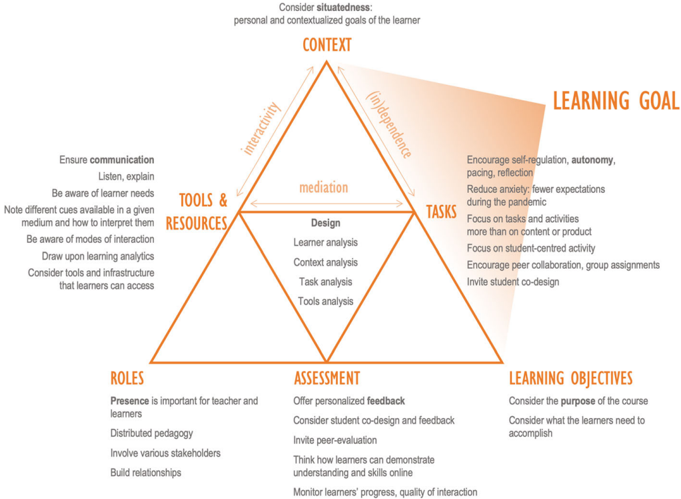
“Our findings point at the design of learning activities with certain characteristics, the combination of three types of presence (social, cognitive and facilitatory) and the need for adapting assessment to the new learning requirements.”
§ Springer Nature Switzerland AG 2020 Published online: 7 July 2020 > Abstract
plainstates an association- Asserted: passes — The authors put it forward as true.
- Checkable: passes — It can be checked against evidence.
- Load-bearing: passes — The paper’s conclusions depend on it.
- Based: passes — The paper gives a reason why it holds.
None of the sources cited for this claim have been checked yet.
In the paper
“What all four experts focus on as a prime ' piece ' of pedagogical knowledge (Kali et al. 2011) is the careful design of activities.”
§ Springer Nature Switzerland AG 2020 Published online: 7 July 2020 > Learning Design
plain- Asserted: passes — The authors put it forward as true.
- Checkable: passes — It can be checked against evidence.
- Load-bearing: unclear — It is unclear whether the paper’s conclusions depend on it.
- Based: passes — The paper gives a reason why it holds.
A result the paper reports from its own data — it cites no other source for it, so there is none to check. The quote shows it is in the paper.
In the paper
“Inspired by Anderson et al. ' s (2001) understanding of teaching presence and how it can be re-conceived in the current Covid-19 situation in which educators are the designers, the tutors and the evaluators of the learning experience, a tripartite framework emerges from the interviews, with three main sub-presences of the teaching presence, namely:”
§ Springer Nature Switzerland AG 2020 Published online: 7 July 2020 > Teacher Presence
plain- Asserted: passes — The authors put it forward as true.
- Checkable: passes — It can be checked against evidence.
- Load-bearing: passes — The paper’s conclusions depend on it.
- Based: passes — The paper gives a reason why it holds.
5 more claims
Create a free account to see all 61 claims and to verify the 9 references still open.
- Probably not a substantial claim. 50
- It may state two separate claims as one. 18
Claims other papers make about this one
Each is checked against this paper’s own text: does it say what the citing paper says it does?
The source backs part of the claim, not all of it — or backs it for a different population, condition or comparison.
In the citing paper
“while it is known that for learning success, input formats usually depend on both attention and interest from the students (Rapanta et al., 2020).”
From Impact of Synchronous and Asynchronous Settings of Online Teaching and Learning in Higher Education on Students' Learning Experience During COVID-19 (2021) · cites this paper as Rapanta et al., 2020
Experimental — accuracy not yet measuredIn the citing paper
“Evaluating AI applications could be beneficial for enhancing their motivation and interest in teaching with AI [40].”
From Developing AI Literacy for Primary and Middle School Teachers in China: Based on a Structural Equation Modeling Analysis (2022) · cites this paper as [40]
Citations
Cites
The Reflective Practitioner: How Professionals Think in Action
Checkoway, B., & Schon, D. A. (1985) · Journal of Policy Analysis and Management · doi:10.2307/3324262 · Cited by 21,268
The reflective practitioner: How professionals think in action
Stewart, C. J. (1984) · Patient Education and Counseling · doi:10.1016/0738-3991(84)90022-3 · Cited by 19,752
Knowledge and teaching: Foundations of the new reform
Shulman, L. (1987) · Harvard Educational Review · doi:10.17763/haer.57.1.j463w79r56455411 · Cited by 16,787
Phenomenological research methods
Moustakas, C. (1994) · doi:10.4135/9781412995658 · Cited by 13,919 · cited 1×
“’ This study ’ s participants, i.e. the four online pedagogy experts, also functioned as co-researchers, following Moustakas ’ (1994) idea (l).”
BackgroundDetermining Validity in Qualitative Inquiry
Creswell, J. W., & Miller, D. L. (2000) · Theory Into Practice · doi:10.1207/s15430421tip3903_2 · Cited by 9,184
Speech Genres and Other Late Essays
Bakhtin, M. M. (1986) · University of Texas Press eBooks · doi:10.7560/720466 · Cited by 8,470
The Difference between Emergency Remote Teaching and Online Learning
Hodges, C. B., Moore, S., Lockee, B. B., Trust, T., & Bond, M. A. (2024) · Handbook of Research in Online Learning · doi:10.1163/9789004702813_021 · Cited by 6,253
Blended learning: Uncovering its transformative potential in higher education
Garrison, D. R., & Kanuka, H. (2004) · The Internet and Higher Education · doi:10.1016/j.iheduc.2004.02.001 · Cited by 4,849
Speech Genres and Other Late Essays
Melaver, M., Bakhtin, M. M., McGee, V. W., Emerson, C., & Holquist, M. (1987) · Poetics Today · doi:10.2307/1772598 · Cited by 3,185
ASSESSING TEACHING PRESENCE IN A COMPUTER CONFERENCING CONTEXT
Anderson, T., Rourke, L., Garrison, R., & Archer, W. (2001) · Online Learning · doi:10.24059/olj.v5i2.1875 · Cited by 1,885
Research works printed but not linked: 2
- Bates, A. W. (2019). Teaching in a digital age. 2nd Edition. Vancouver: Tony Bates Associates. https://pressbooks.bccampus.ca/teachinginadigitalagev2/. Accessed 15 June 2020.
- Shor, I., & Freire, P. (1987). A pedagogy for deliberation: dialogues on transforming education . Westport: Bergin & Garvey Publishers.
Cited by
Items 901–1,000 of 2,106
Buric, M., Novovic Buric, M., Jaksic Stojanovic, A., Kascelan, L., & Zugić, D. (2022) · Sustainability · doi:10.3390/su142113717 · Cited by 3
Cecchi, G. (2024) · Quality & Quantity · doi:10.1007/s11135-024-01986-8 · Cited by 3
“…must design engaging and construc - tive learning experiences while grappling with obstacles such as the migration of teaching methods (from face-to-face to online) (Adedoyin and Soykan 2023 ), lack of technical support (Hodges et al. 2020), and implementation of assessments (Rapanta et al. 2020).”
Cronjé, F., & Enslin, C. (2024) · Discover Education · doi:10.1007/s44217-024-00369-3 · Cited by 6
“Thus, from the perspective of this paper, they can facilitate confident participation and collaboration [38, 39].”
Simelane, R. M., & Pillay, P. (2024) · Research in Educational Policy and Management · doi:10.46303/repam.2024.41 · Cited by 6
Ali, F., Khan, W. A., Treasurer, D., Bilal, A. R., & Nasir, S. (2025) · Current Psychology · doi:10.1007/s12144-025-07457-z · Cited by 6
“In parallel the findings of our research convey significant implications for how the institutes should force the teachers to design online activities and pedagogies that can reduce technological stress (Rapanta et al., 2020 ).”
Görgülü, D. (2025) · Educational Point · doi:10.71176/edup/16452 · Cited by 3
“This situation can be linked to the fundamental concepts of chaos theory, particularly the butterfly effect (Bozkurt & Sharma, 2020; Crawford et al., 2020; Dhawan, 2020; Rapanta et al., 2020; Watermeyer et al., 2021).”
‘ SOMS BrainSpace ’: A digital serious game for undergraduate neuroscience
Tran, A., Huang, J. Y., Campbell, C. R., & Hegedus, E. M. (2025) · Anatomical Sciences Education · doi:10.1002/ase.70086 · Cited by 8
du Preez, I., & Jacobs, L. (2025) · Interactive Learning Environments · doi:10.1080/10494820.2025.2523390 · Cited by 20
“Similarly, Rapanta et al. (2020) emphasise that teacher presence, scaffolding, and visual coherence remain underdeveloped in many online environments.”
InfluentialArtificial Intelligence (AI) and Human Mind: Struggles and Strengths in the Education Sector
Zahra, S. T., Bibi, E., & Younus, Z. (2025) · Future education and learning spaces · doi:10.1007/978-981-96-7937-9_12 · Cited by 3
Yeganeh, L. N., Chen, Y., Fenty, N. S., Simpson, A. M., & Hatami, M. (2025) · Future Internet · doi:10.3390/fi17120564 · Cited by 6
“…recorded lectures, and digital content, offers opportunities to study how various modalities of instructional delivery (e.g., live vs. recorded, structured vs. informal) affect the fidelity and richness of the content available for analysis, envisioned for real-time but examined offline [99].”
Assessment practices in Spanish universities: a nationwide update seven years on
Panadero, E., Amezua-Urrutia, A., Ruiz, J. F., Rodríguez-Hernández, C. F., & Fraile, J. (2026) · Assessment & Evaluation in Higher Education · doi:10.1080/02602938.2026.2621276 · Cited by 5
Ofem, U. J., Asuquo, E. N., Nwannunu, B. I., Madukwe, E. C., Nsan, N. N., Adie, J. A., Ukatu, J. O., Nyong, P. A., Ebaye, A. S., & Robert, A. I. (2026) · Social Sciences & Humanities Open · doi:10.1016/j.ssaho.2026.102547 · Cited by 12
University professor’s assessment in the conditions of digital transformation
Isaeva, T. E., Kotliarenko, I. Y., & Cherkasova, L. (2021) · E3S Web of Conferences · doi:10.1051/e3sconf/202127312078 · Cited by 3
Quinto, J. B. (2021) · European Journal of Teaching and Education · doi:10.33422/ejte.v3i2.551 · Cited by 4
“Due to unanticipated requests for formerly face-to-face courses to be taught online, the routine operation of schools has been hampered, as has the obstruction of face-to-face sessions, creating special problems (Jose Sa & Serpa, 2020; Rapanta et al., 2020).”
BackgroundGuerrero, C. S., Lloret-Catalá, C., & Lizandra, J. (2022) · Teknokultura Revista de Cultura Digital y Movimientos Sociales · doi:10.5209/tekn.77951 · Cited by 5
A Review on E-Learning During Covid-19 Pandemic Situation
Moran-Suarez, S. (2022) · Acta Pedagogia Asiana · doi:10.53623/apga.v1i1.99 · Cited by 3
“If online learning lessons are asynchronously recorded at any moment of the day, students can access the learning materials at a time that is convenient for them [11,14,21].”
BackgroundInfluentialStudents' Self-Directed Learning Techniques and Attitudes Toward Online English Language Learning
Aloka, P. J. O. (2022) · Advances in educational technologies and instructional design book series · doi:10.4018/978-1-6684-4205-0.ch003 · Cited by 3
Hong, W., Pallath, V., Adams, D., Lee, Y. K., Tan, K. M., & Foong, C. C. (2022) · Education in Medicine Journal · doi:10.21315/eimj2022.14.3.8 · Cited by 4
The Effect of COVID-19 Pandemic on the Academic Performance of Nursing Students
Agbo, J. J., Onayemi, T. O., & Edo, G. I. (2022) · Social Education Research · doi:10.37256/ser.4120232043 · Cited by 3
“COVID-19 forced the closure of colleges and universities across the world in early 2020 and as a result, a distinct increase in distance learning has occurred, in which teaching is done remotely and through digital platforms (Rapanta et al., 2020; Elfirdoussi et al., 2020).”
Peregrym, M., Turisová, I., Tashev, A., Kónya, E. P., Matsai, N., & Havrylіuk, Y. (2022) · Journal of Teacher Education for Sustainability · doi:10.2478/jtes-2022-0014 · Cited by 3
“…et al., 2020; Espinosa et al., 2021; Fayed & Cummings, 2021; Kapenieks & Kapenieks, 2020; Kumar et al., 2021; Kummitha et al., 2021; Morrison et al., 2021; Pokhrel & Chhetri, 2021; Rapanta et al., 2020; Reiss, 2020; Rudyatmi et al., 2021; Schnell et al., 2021; The United Nations, 2020).”
Lecturer Attitudes on Cross-Cultural Practices in EFL Online Teaching
Nurhikmah, A., Syam, A. F., & Sumrah, A. P. (2023) · ELSYA Journal of English Language Studies · doi:10.31849/elsya.v5i1.11588 · Cited by 9
Sun, T., Martin, F., Kim, S. Y., & Westine, C. D. (2023) · Online Learning · doi:10.24059/olj.v27i1.3228 · Cited by 8
EFL Online Teaching and Learning: The Impact of Environmental Factors
Sumrah, A. P. (2023) · Pegem Journal of Education and Instruction · doi:10.47750/pegegog.13.02.27 · Cited by 10
Gorospe, J. M. C., Barragán, A. G.-C., & Apraiz, E. J. D. A. (2023) · Lecture notes in networks and systems · doi:10.1007/978-3-031-31346-2_22 · Cited by 3
Salame, I. I., Gomes, V., Moreira, M. K., & Jihad, H. (2023) · International Journal of Instruction · doi:10.29333/iji.2023.16319a · Cited by 9
“Research reports that according to students, access to digital devices, internet connection and software, as well as the ability to manage time and avoid distractions, were most important in online learning during the Covid-19 pandemic (Rapanta et al., 2020).”
Exploring indicators of teaching presence in online learning from older adult learners’ perspectives
Pham, M. T. N., & Jahnke, I. (2023) · Technology Pedagogy and Education · doi:10.1080/1475939x.2023.2233973 · Cited by 5
“While prior studies examined the impacts of teaching presence on students’ online learning (Rapanta et al., 2020; Zhang et al., 2016), there is a need to explore how teaching presence in online courses is experienced specifically by older adult learners, who have been overlooked by previous research.”
BackgroundResultKoja, G., & Abazaj, E. (2023) · Environment and Social Psychology · doi:10.54517/esp.v8i3.1988 · Cited by 3
“More learners had challenges taking part successfully in online learning which resulted in rising anxiety and concerns about their educational achievements and future job prospects [18,19] .”
BackgroundOnline pedagogy: a changing higher education pedagogy and an emerging lecturer habitus
Mantashe, L. X. (2023) · The Independent Journal of Teaching and Learning · doi:10.17159/ijtl.v18i2.17293 · Cited by 7
Diseño de acciones formativas para mejorar las competencias digitales del profesorado
Martínez‐España, R., Muñoz, A., Cantabella, M., & Ayuso, B. L. (2024) · Revista Electrónica Interuniversitaria de Formación del Profesorado · doi:10.6018/reifop.575071 · Cited by 14
Ormilla, R. C. G., & Ongan, M. G. O. (2024) · International Journal of Learning Teaching and Educational Research · doi:10.26803/ijlter.23.1.1 · Cited by 6
Development of Physics Learning Media : A Literature Review
Maslakhah, I. F., Jatmiko, B., & Sanjaya, I. G. M. (2024) · IJORER International Journal of Recent Educational Research · doi:10.46245/ijorer.v5i2.558 · Cited by 12
“The use of learning media should be an engaging part of teaching activities (Ansari & Khan, 2020; Manca, 2020; Rapanta et al., 2020; Simamora, 2020; Wang et al., 2020).”
Argument-based teaching: A necessary 21st-century pedagogical practice
Rapanta, C. (2024) · Educação Sociedade & Culturas · doi:10.24840/esc.vi67.741 · Cited by 16
Self-citationMoyo, V., & Kanyane, M. H. (2024) · doi:10.4102/aosis.2024.bk454.04 · Cited by 3
Advancing Language Education through Multimodality: Insights from a Bibliographic Analysis
Li, Y. (2024) · Forum for Linguistic Studies · doi:10.30564/fls.v6i3.6691 · Cited by 6
“At the same, research shows educational approaches should be adapted to keep pace with the changing needs of learners and educators around the world, ensuring that education remains effective and engaging (Rapanta et al., 2020).”
BackgroundFormación docente: actualización y desarrollo profesional continuo en la era digital
Vizcaíno, C. D. L. M. P., Verdezoto, R. A. L., Nastul, K. M. V., Orellana, M. B. P., Santander, M. D. C. M., & Fajardo, Z. I. T. (2024) · South Florida Journal of Development · doi:10.46932/sfjdv5n9-049 · Cited by 6
Daud, M. S. M., & Wahid, H. (2024) · Journal of Islamic accounting and business research · doi:10.1108/jiabr-04-2024-0146 · Cited by 12
Mamun, A. A., Shohel, M. M. C., Roy, G., & Sall, W. (2024) · Social Education Research · doi:10.37256/ser.6120254641 · Cited by 4
Ruiz, S. V. C., & Muñoz, S. D. P. (2024) · Advances in human resources management and organizational development book series · doi:10.4018/979-8-3693-7086-5.ch002 · Cited by 12
Zakiyah, Z., Boonma, K., & Collado, R. C. (2024) · Journal of Educational Technology and Learning Creativity · doi:10.37251/jetlc.v2i2.1062 · Cited by 47
“To achieve good quality learning, it is important for teachers or instructors to plan and design the learning process well, including preparation of materials, methods, learning resources, and use of learning media [6], [7].”
Re-weaving learning ecologies: a pluriversal framework for higher education learning spaces
Garcés, K. C. (2025) · Higher Education Research & Development · doi:10.1080/07294360.2024.2429439 · Cited by 8
“…been accelerated by the COVID-19 pandemic, which has forced educational institutions worldwide to swiftly adapt to remote and hybrid learning models, precipitating a fundamental reap-praisal of the relationship between pedagogy, technology, and space (Crawford et al., 2020; Rapanta et al., 2020).”
Zhong, L. (2025) · International Journal of Education and Information Technologies · doi:10.46300/9109.2025.19.2 · Cited by 4
“This pandemic caused disruptions in traditional classrooms and led to faster adoption of remote and online learning methods worldwide [59], [60], and the flipped classroom also emerged as a promising pedagogical approach [61], aligns with advancements in the field of information and communication…”
Educación virtual y competencias tecnológicas docentes en el contexto universitario
Barrera, C. B. (2024) · Areté · doi:10.33881/1657-2513.art.24201 · Cited by 7
“…virtual y las habilidades tecnológicas requeridas para el uso de plataformas digitales y redes sociales en la educación (Al-Hail et al., 2023; Rapanta et al., 2020) En lo relacionado con desafíos y oportunidades Area y Adell, (2021) analizaron el impacto de las tecnologías digitales en la…”
Pedagogy of the Pandemic: Reflections of Mother-Scholar-Practitioners
Falk, A. F., & Orbon, K. (2021) · Advances in educational technologies and instructional design book series · doi:10.4018/978-1-7998-7275-7.ch018 · Cited by 3
History Learning through Online Learning During COVID-19 Pandemic: Teachers and Students Respond
Jamiludin, J., & Darnawati, D. (2021) · Jurnal Pendidikan Progresif · doi:10.23960/jpp.v11.i1.202102 · Cited by 3
Lecture Attendance among University Paramedic Students: A Sequential Mixed Methods Study
Beovich, B., Gosling, C. M., & Williams, B. A. (2021) · Australasian Journal of Paramedicine · doi:10.33151/ajp.18.906 · Cited by 3
“During the COVID-19 pandemic, face-to-face lectures were reduced or cancelled worldwide to decrease spread of the virus (50).”
BackgroundMikidenko, N. L., Storozheva, S. P., Ivanouskaya, I. V., & Borisova, A. (2021) · Science for Education Today · doi:10.15293/2658-6762.2103.06 · Cited by 6
The Impact of COVID-19 and the Role of Higher Education in Making a Sustainable Recovery
Gowan, S. (2021) · Advances in business strategy and competitive advantage book series · doi:10.4018/978-1-7998-6926-9.ch025 · Cited by 3
Toward A User-Centred Design Approach for AR Technologies in Online Higher Education
Peters, M., Simó, L. P., Amatller, A. M., Calvet, L., & Bourdin, P. (2021) · International Conference of the Immersive Learning Research Network (iLRN) · doi:10.23919/ilrn52045.2021.9459409 · Cited by 7
Gonța, I., & Tripon, C. (2021) · Revista de Pedagogie - Journal of Pedagogy · doi:10.26755/revped/2021.1/73 · Cited by 4
“…the context of the pandemic: “Our findings point at the design of learning activities with certain characteristics, the combination of three types of presence (social, cognitive and facilitatory) and the need for adapting assessment to the new learning requirements” (Rapanta et al., 2020, p. 923).”
BackgroundCapperucci, D., & Salvadori, I. (2021) · MATEC Web of Conferences · doi:10.1051/matecconf/202134311004 · Cited by 5
Strategies to Address Changes in Social Supports During the COVID-19 Pandemic
Johnston, A. C., Douglas, K. A., Martin, J. P., et al. (2024) · ASEE Annual Conference & Exposition · doi:10.18260/1-2--37735 · Cited by 3
The systematic review of studies about web-based learning in language teaching context
Ayar, Z. (2021) · e-Kafkas Eğitim Araştırmaları Dergisi · doi:10.30900/kafkasegt.957362 · Cited by 6
Identifying difficulties in teaching foreign language speaking in the online environment
Potemkina, T. V., Bondareva, L. V., Shchaveleva, E. N., Saulembekova, G. S., & Le, T. H. (2021) · SHS Web of Conferences · doi:10.1051/shsconf/202112701008 · Cited by 3
Gagnon, N. (2021) · Médiations et médiatisations · doi:10.52358/mm.vi8.266 · Cited by 3
Images and Text on PowerPoint Slides: “Tracking” Their Impact on Information Retention
Williams, J. L., McCarley, N. G., Willis, S. D., & Huddleson, A. N. (2022) · International Journal of Mobile and Blended Learning · doi:10.4018/ijmbl.291979 · Cited by 4
Oishi, J., Sato, T., Miller, R. T., Nagata, S., Fuchikami, M., Shimizu, S., Matsumoto, T., Yamaguchi, T., & Kim, S. E. (2022) · International Journal of Educational Reform · doi:10.1177/10567879221094302 · Cited by 6
“Rapanta et al. (2020) explain that the COVID-19 crisis is new to the students, and professors must take into account the time and effort students need to regulate themselves in order to adapt to the new learning situation.”
BackgroundPudaruth, S. K. (2022) · Elsevier eBooks · doi:10.1016/b978-0-323-91185-6.00004-5 · Cited by 4
Digital Based Learning Management With A Multimodal Approarch
Lestari, A. S. (2022) · AL-TANZIM JURNAL MANAJEMEN PENDIDIKAN ISLAM · doi:10.33650/al-tanzim.v6i2.3235 · Cited by 6
“Educational strategies, for example, can shift from teacher/subject matter-centered to student activitycentered (Rapanta et al., 2020).”
BackgroundSofroniou, A., & Premnath, B. (2022) · Journal of Education Society and Behavioural Science · doi:10.9734/jesbs/2022/v35i830440 · Cited by 5
“Educators prepare lectures beforehand and give assessments to students after the content is delivered and it is believed that there is more engagement amongst academics and students in this manner [16].”
BackgroundNyiringango, G., Umubyeyi, B., Nyirazigama, A., Mukankusi, J. N., Mukeshimana, M., Mugarura, J., Bagirisano, J., Kayiranga, D., Ryamukuru, D., Igikundiro, C., et al. (2022) · Rwanda Journal of Medicine and Health Sciences · doi:10.4314/rjmhs.v5i2.8 · Cited by 2
Patangia, B., Rahul, G. S., Sathiyaseelan, A., & Balasundaram, S. (2022) · i-manager’s Journal on Management · doi:10.26634/jmgt.16.3.18568 · Cited by 20
Hu, S. (2022) · International Journal of Distributed Systems and Technologies · doi:10.4018/ijdst.307951 · Cited by 3
COVID -19 Crisis and Alternative Learning: School Stakeholders' Perceptions
Magar, G. R., & Rana, K. (2022) · Bouddhik Abhiyan (बौद्धिक अभियान) · doi:10.3126/bdkan.v7i1.47563 · Cited by 5
Development of Adobe Flash-Based Multimedia in Learning Recognition of Parts of Human Body
Febriati, F., Nurhikmah, H., & Dolla, A. A. (2022) · AL-ISHLAH Jurnal Pendidikan · doi:10.35445/alishlah.v14i3.2126 · Cited by 3
“Teachers in implementing the 2013 curriculum need mastery of technology to support the learning carried out, especially learning media based on Information and Communication Technology (ICT) (Nurhikmah et al., 2021; & Rapanta et al, 2020).”
BackgroundBervell, B., Umar, I. N., Segbenya, M., Armah, J. K., Somuah, B. A., & Twum, R. (2022) · Online Journal of Communication and Media Technologies · doi:10.30935/ojcmt/12530 · Cited by 4
Mustafa, A., Psarikidou, K., & Pranjol, M. Z. I. (2022) · International Medical Education · doi:10.3390/ime1020011 · Cited by 5
“Furthermore, online teaching practices, similar to the conventional methods, have also been witnessed to allow for research-led, evidence-based, problem-based and technology-enhanced teaching to be delivered, also enabling higher order thinking such as evaluation and creativity [2,41].”
BackgroundTeaching during COVID-19: Relational-Cultural Theory in the Online Classroom
Purgason, L. L., Hammonds, D. S., Miller, G., et al. (2022) · Journal of Technology in Counselor Education and Supervision · doi:10.22371/tces/0014 · Cited by 3
“At a time when instructors most wanted to connect with students to help process their emotions, constraints of synchronous technology platforms, such as Zoom (Zoom Video Communications, Incorporated [Zoom], 2022), resulted in challenges reading the emotions of students and the class (Rapanta et al., 2020) Relational-C…”
BackgroundInfluentialLodge, J. M. (2023) · Journal of University Teaching and Learning Practice · doi:10.53761/1.20.01.03 · Cited by 9
Onan, K., Hakan, K. A. Y. A., & Özkoçak, Y. (2023) · Açıköğretim Uygulamaları ve Araştırmaları Dergisi · doi:10.51948/auad.1175712 · Cited by 3
A comparison of graduate university perspectives of online versus face-to-face during the pandemic
Fish, L. A., Snodgrass, C. R., & Kim, J.-H. (2023) · Journal of International Education in Business · doi:10.1108/jieb-07-2022-0049 · Cited by 3
Vaca, J. A., Flores, C. V., & Velásquez, C. (2023) · LATAM Revista Latinoamericana de Ciencias Sociales y Humanidades · doi:10.56712/latam.v4i1.337 · Cited by 6
Maaoui, A., Tsagari, D., & Dammak, H. (2023) · Languages · doi:10.3390/languages8010054 · Cited by 5
Kasule, G. W., Mugizi, W., & RWOTHUMIO, O. (2023) · doi:10.58653/nche.v10i2.02 · Cited by 4
Enhancing Notification Awareness for Online Presenters via a Wrist-Worn Device
Schäfer, R., Wagner, T., Lavnikevich, U., et al. (2023) · Extended Abstracts of the CHI Conference on Human Factors in Computing Systems (CHI EA) · doi:10.1145/3544549.3585855 · Cited by 3
Japanese Professors’ Experiences in Teaching Sport for Development in Online English-Medium Courses
Sato, T., Miller, R. T., Nagata, S., et al. (2023) · SAGE Open · doi:10.1177/21582440231176465 · Cited by 3
“These professors experienced the rapid close-off of face-to-face courses due to the COVID-19 pandemic and the differences between online teaching and other modes of course operation (e.g., pre-recorded on-demand and live online modes) (Rapanta et al., 2020).”
BackgroundHadiyanto, H., Mukminin, A., Ali, R. M., et al. (2023) · NURTURE · doi:10.55951/nurture.v17i3.290 · Cited by 3
Assessing the Scientific Literacy of Prospective Biology Teachers
Fatmawati, B., & Khotimah, H. (2023) · Jurnal Penelitian Pendidikan IPA · doi:10.29303/jppipa.v9i5.3526 · Cited by 3
“Rapanta et al. (2020), assert that a teacher must first have a solid understanding of those traits in order to properly explain science's aspects to pupils through a range of teaching strategies or approaches.”
BackgroundOloke, D., Gyoh, L., Daniel, E. I., Oladinrin, O. T., & Abdallah, N. (2023) · International Journal of Building Pathology and Adaptation · doi:10.1108/ijbpa-09-2022-0147 · Cited by 5
Gray, M. I., Pike, J., & Nyashanu, M. (2023) · Journal of Education and Training Studies · doi:10.11114/jets.v11i3.6119 · Cited by 3
Global Pandemic and Higher Education Institutions: Building Back Better in BRICS and Beyond
Niemczyk, E. K. (2023) · Space and Culture India · doi:10.20896/saci.v11i1.1291 · Cited by 3
“Moreover, the pandemic “added to the stresses and workloads experienced by university faculty and staff who were already struggling to balance teaching, research, and other obligations” (Rapanta et al., 2020, p. 924).”
BackgroundThe Use of Heuristic Reasoning in Christian Education
Kia, A. D. (2023) · AL-ISHLAH Jurnal Pendidikan · doi:10.35445/alishlah.v15i2.3888 · Cited by 3
Aldosemani, T. I. (2023) · International Journal of Online Pedagogy and Course Design · doi:10.4018/ijopcd.325240 · Cited by 14
“Alongside these professional hurdles, the isolation and overall stress induced by the pandemic exerted an emotional toll on teachers, who had to devise strategies to manage their stress levels and maintain their mental well-being (Rapanta et al., 2020, Jandrić et al., 2020).”
BackgroundCaregiving in academia: Examining educator well‐being and burnout during prolonged stressors
Bishop, R. E., & High, A. C. (2023) · Personal Relationships · doi:10.1111/pere.12513 · Cited by 5
Exploring the benefits of e-learning for life and earth sciences education in Moroccan high schools
Rachad, S., & Oughdir, L. (2023) · Journal of Education and e-Learning Research · doi:10.20448/jeelr.v10i3.4887 · Cited by 4
Solving Problems of Plant Physiology during Periods of Confinement or Online University Education
Molina, M. D. C., Palomino, J., & Costilla-Legaz, R. (2023) · The American Biology Teacher · doi:10.1525/abt.2023.85.7.390 · Cited by 5
Lee, K., Kim, T., Cefa, B., & Bozkurt, A. (2023) · The International Review of Research in Open and Distributed Learning · doi:10.19173/irrodl.v24i3.7220 · Cited by 4
“With social distancing measures in place, educational institutions turned to ODE (Bozkurt & Sharma, 2020; Lederman, 2020; Lee et al., 2021a; Rapanta et al., 2020).”
BackgroundCespedes, A. A., & Lee, K. (2023) · Research in networked learning · doi:10.1007/978-3-031-42718-3_14 · Cited by 4
Tinjauan Filsafat (Aksiologi) Pendidikan Sains Masa Depan Berbasis Teknologi
Verawati, N. N. S. P., & Sarjan, M. (2023) · Jurnal Ilmiah Profesi Pendidikan · doi:10.29303/jipp.v8i4.1650 · Cited by 22
“Dalam praktiknya, pendidik mengintegrasikan teori atau konsep belajar ke dalam pendekatan pengajaran mereka untuk menciptakan pengalaman pembelajaran yang lebih efektif dan bermakna bagi siswa (Rapanta et al., 2020).”
BackgroundLee, C., Manfreda, A., Bisson, A. J., Scerri, M. A., & Presbury, R. (2023) · Journal of Hospitality and Tourism Management · doi:10.1016/j.jhtm.2023.11.001 · Cited by 4
Zreık, M. (2023) · Advances in higher education and professional development book series · doi:10.4018/978-1-6684-9179-9.ch012 · Cited by 5
Rosita, E., Utomo, A. P., Azizah, S. A., & Sukoco, S. (2023) · Jurnal Biologi · doi:10.47134/biology.v1i3.1973 · Cited by 22
Stepić, G. M., Veličković, S., Cekić-Jovanović, O., & Miletić, A. (2023) · International Journal of Cognitive Research in Science Engineering and Education · doi:10.23947/2334-8496-2023-11-3-487-495 · Cited by 9
dos Santos, J. P. M., Serrão, C., Amorim-Lopes, T. S., Rodrigues, A. R., Marina, S., Teixeira, A., Castro, L., & Duarte, I. (2023) · SAGE Open · doi:10.1177/21582440231221318 · Cited by 6
“Rapanta et al. (2020, p. 926) stated that ‘‘teachers have, almost overnight, been asked to become both designers and tutors.’’”
BackgroundMaeda, E. G., & Juma, Z. R. (2024) · Journal of Research Innovation and Implications in Education · doi:10.59765/osra8457 · Cited by 7
Sabri, Z., Remaida, A., Abdellaoui, B., Qostal, A., Sellamy, K., Fakhri, Y., & Moumen, A. (2024) · Lecture notes in electrical engineering · doi:10.1007/978-981-97-0126-1_11 · Cited by 5
Miaomiao, W., Witt, D. D., Nazry, N. N. M., Alias, N., Hong, L. L., & Ujang, A. (2024) · International Journal of Modern Education and Computer Science · doi:10.5815/ijmecs.2024.01.07 · Cited by 9
Laksana, D. N. L., Kua, M. Y., Sudatha, I. G. W., Qondias, D., & Dinatha, N. M. (2024) · Pegem Journal of Education and Instruction · doi:10.47750/pegegog.14.02.26 · Cited by 12
Azrilia, W., Oktaviyanthi, R., Khotimah, K., & Garcia, M. L. B. (2024) · PAEDAGOGIA · doi:10.20961/paedagogia.v27i1.84145 · Cited by 8
“Additionally, the development of an Articulate Storyline can be tailored to local wisdom contexts, providing more meaningful and relevant learning for students (Fadli, 2020; Rapanta et al., 2020).”
BackgroundProfessional learning with ICT and music technology: Australian music educators’ insights
Merrick, B., & Joseph, D. (2022) · Journal of Music Technology and Education · doi:10.1386/jmte_00049_1 · Cited by 6
The learning styles of Australian exercise science and clinical exercise physiology students
Bennett, H., & Milanese, S. (2024) · Journal of Further and Higher Education · doi:10.1080/0309877x.2024.2338383 · Cited by 4
“This often involves theoretical concepts and knowledge being taught online, and the practical skills underpinned by this knowledge taught in clinical environments using a ‘flipped classroom’ approach (Rapanta et al. 2020; Strelan, Osborn, and Palmer 2020).”
Background
Metadata
- Authors
- Rapanta, C., Botturi, L., Goodyear, P., Guàrdia, L., & Koole, M.
- Affiliations
- Universidade Nova de Lisboa (PT)
- University of Applied Sciences and Arts of Southern Switzerland (CH)
- The University of Sydney (AU)
- University of Saskatchewan (CA)
- Corresponding author
- Rapanta, Chrysi
- ORCID
- Rapanta, Chrysi
- Venue
- Postdigital Science and Education
- Published
- 2020-07-07
- Volume
- 2
- Issue
- 3
- Pages
- 923-945
- ISSN
- 2524-485X (ISSN-L)
- 2524-4868
- PMC
- PMC7339092
- OpenAlex
- W3042009104
- Semantic Scholar
- fed495af71b417de8d60cf16b6da44926faf24a0
- Cited by
- 2,130
- References
- 75
- Citations by year
- 2026: 134 · 2025: 158 · 2024: 261 · 2023: 426 · 2022: 556 · 2021: 509 · 2020: 73
- FWCI
- 454.18
- Type
- journal article
- Language
- en
- Open access
- hybrid
- doi.org
- Licence
- other-oa
- www.springer.com/tdm (tdm)
- www.springer.com/tdm (vor)
- Locations
- Postdigital Science and Education (publishedVersion, other-oa)
- PubMed (publishedVersion)
- PubMed Central (submittedVersion)
- The Sydney eScholarship Repository (The University of Sydney) (submittedVersion)
- Funders
- Fundação para a Ciência e a Tecnologia (DL 57/2016/CP1453/CT0066)
- Australian Research Council (DP150104163)
- Topics
- Social Sciences › Education › Digital Education and Society
- Social Sciences › Education › Higher Education Practises and Engagement
- Social Sciences › Education › Educational Innovations and Technology
- Keywords
- online learning, COVID-19 pandemic, higher education, teacher presence, pedagogical content knowledge, learning activities, social presence, cognitive presence
About these checks
Registry, retraction, Cites and statistics results are computed, not judged, with one exception: a printed reference that no index lists is read once by a model before it counts as a citation error. Claims are extracted by a model and kept only when their quote appears verbatim in the text; each cited source is then checked, with a model’s help, for whether it says what the claim relies on. Those verdicts can be wrong — read the claim’s quote and the cited source before relying on one.
The claim verdicts this report counts are experimental: their accuracy is not yet measured.
A language model drew the claims from the paper on 2026-10-10, under version 3 of the claim definition (model deepseek-v4.1-flash, prompt extract-v3).
A second model labelled each claim on 2026-10-10 (model jev-1.13-20260917, definition revision gold-guideline-v0.2).
Cited sources are checked with a language model’s help (qwen3.8-omni-flash).
Statistics and arithmetic are recomputed, not judged.
Confidence bands are shown only for fields calibrated on our annotated test set. None is calibrated yet, so no band is shown.
What counts as a claim ›How we measure confidence ›How we check this ›
Are you an author, or do you see a problem with this page? Request a review
Data sources
Bibliographic data: Semantic Scholar, OpenAlex, Crossref.
Contains information from the Semantic Scholar Academic Graph Datasets, made available under the ODC Attribution License (ODC-BY 1.0).
Semantic Scholar’s data is described in: Kinney, R., et al. (2023). The Semantic Scholar Open Data Platform. arXiv:2301.10140.
