

Online University Teaching During and After the Covid-19 Crisis: Refocusing Teacher Presence and Learning Activity
Open accessThe DOI matches its Crossref record; 71 of the 75 references it cites were found in a registry or an index; 6 of the 42 sources its claims cite were checked for support.
Abstract
The Covid-19 pandemic has raised significant challenges for the higher education community worldwide. A particular challenge has been the urgent and unexpected request for previously face-to-face university courses to be taught online. Online teaching and learning imply a certain pedagogical content knowledge (PCK), mainly related to designing and organising for better learning experiences and creating distinctive learning environments, with the help of digital technologies.
Overview
CoChat Summary
TL;DR
This article is an expert-interview piece offering pedagogical guidance for university teachers suddenly moving online during Covid-19. Its central message is that effective online teaching depends less on tools or materials alone and more on careful learning design, multiple forms of teacher presence, and continuous assessment.
Key findings
- The four experts argue that online learning should be built around carefully designed learning activities, with a mix of synchronous, asynchronous, online, and offline tasks that are clear, appropriately difficult, authentic, and accessible to students.
- They propose a tripartite teaching presence for online courses: cognitive presence, social presence, and facilitatory presence.
- Successful online learning requires students not to feel alone, and it benefits from timely feedback, peer collaboration, and student co-design/co-configuration of activities.
- The paper states that continuous assessment is needed in online learning, and suggests self-reflections, portfolios, self-paced asynchronous activities, and use of learning analytics as part of evaluation.
Methods
- Exploratory qualitative study using expert interviews administered by e-mail.
- Sample: 4 online pedagogy experts/co-authors, selected for research expertise, more than a decade of online teaching experience, and experience across different national education systems; they worked in Switzerland, Australia, Spain, and Canada.
- Main analysis: the first author organized the responses into a panel-like article, then the authors jointly revised and synthesized the material; the discussion summarizes themes under learning design, teacher presence, and assessment.
Limitations
- The paper states that all four experts came from “rich parts of the world” (Switzerland, Canada, Australia, and North of Spain), which limits the lens to a “monofocal” view of educational reality.
- The paper itself says the study used a heuristic method based on expert viewpoints and “by no means can replace rigorous, systematic research” following the scientific method.
- Evident from the text: the sample is very small (4 experts) and highly selected, so the findings are expert-opinion guidance rather than generalizable empirical results.
Model-written summary. Check it against the paper before relying on it.
Integrity signals
Registry
Cites
Statistics
Figures
Verification
Claims the paper makes
5 Valid · 0 Not valid · 32 Not checked · 24 Own results and interpretations
The sources with a verdict support this claim; the rest weren’t checked yet, have no full text we could read, or their verdicts aren’t rated yet.
In the paper
“On top of that, a significant challenge for university teachers has been their lack of the pedagogical content knowledge (PCK) (Shulman 1987) needed for teaching online (Angeli and Valanides 2005; Kali, Goodyear and Markauskaite 2011; Ching, Hsu and Baldwin 2018).”
§ Springer Nature Switzerland AG 2020 Published online: 7 July 2020 > Introduction
What the sources say
- Supportedcites Shulman 1987 matched to “Knowledge and teaching: Foundations of the new reform” (1987) source
The parenthetical (Shulman 1987) is attached to the term 'pedagogical content knowledge (PCK)' — an identification citation — while the online-teaching studies are credited to Angeli & Valanides, Kali et al. and Ching et al. Our copy (the Portuguese edition of Shulman's 1987 Harvard Educational Review article) establishes exactly that concept: the 'Categorias da base de conhecimento' section lists 'conhecimento pedagógico do conteúdo' as one of the categories of the knowledge base for teaching, 'esse amálgama especial de conteúdo e pedagogia que é o terreno exclusivo dos professores', and the 'Novas compreensões' section calls it 'a categoria que melhor distingue a compreensão de um especialista em conteúdo daquela de um pedagogo'. The paper itself says nothing about online teaching or about university teachers lacking PCK, but that part of the sentence is not attributed to this source. (LLM, conf=0.85)
- Not checked — no full text of the sourcecites Angeli and Valanides 2005 matched to “Preservice elementary teachers as information and communication technology designers: an instructional systems design model based on an expanded view of pedagogical content knowledge” (2005) source
- Could not verifycites Ching, Hsu and Baldwin 2018 matched to “Online Course Design and Development among College and University Instructors: An Analysis using Grounded Theory” (2018) sourceExperimental — accuracy not yet measured
Our copy of Baldwin, Ching & Friesen (2018) never mentions pedagogical content knowledge, PCK, Shulman, or TPACK; searches for 'pedagogical content knowledge PCK online teaching', 'TPACK technological pedagogical content knowledge', 'Shulman pedagogical content knowledge Angeli Valanides' and 'challenge lack of knowledge training online instructors pedagogy' returned only the References list and design-process passages. The paper's content is a grounded-theory account of how 14 four-year-institution instructors design online courses (Abstract; Results themes; Discussion mapping to ADDIE), and its nearest statements — that instructors 'must develop new curriculum with instructional strategies effective for online learning' (Discussion) and 'rarely use formal instructional design models' (Results) — concern design practice, not a PCK deficiency framed as a significant challenge. Nothing in our copy either states or contradicts the attributed claim. (LLM, conf=0.72)
plain- Asserted: passes — The authors put it forward as true.
- Checkable: passes — It can be checked against evidence.
- Load-bearing: passes — The paper’s conclusions depend on it.
- Based: passes — The paper gives a reason why it holds.
- Supported
The cited sources support only part of this claim — read each source’s verdict below.
In the paper
“Assessment can possibly be considered the most challenging part of the transition to distance learning for an institution used to face-to-face oral or written exam, as the control shift towards the students makes it hardly possible to ensure that students are not cheating (Munoz and Mackay 2019).”
§ Springer Nature Switzerland AG 2020 Published online: 7 July 2020 > Assessment
What the sources say
- Partly supportedcites Munoz and Mackay 2019 matched to “An online testing design choice typology towards cheating threat minimisation” (2019) sourceExperimental — accuracy not yet measured
Split into 2 atoms — 0 confirmed, 2 partially supported, 0 disputed, 0 misattributed, 0 unverifiable. Expand the claim to see per-atom verdicts.
hedgedstates a possible cause- Asserted: passes — The authors put it forward as true.
- Checkable: passes — It can be checked against evidence.
- Load-bearing: unclear — It is unclear whether the paper’s conclusions depend on it.
- Based: passes — The paper gives a reason why it holds.
- Partly supported
A result the paper reports from its own data — it cites no other source for it, so there is none to check. The quote shows it is in the paper.
In the paper
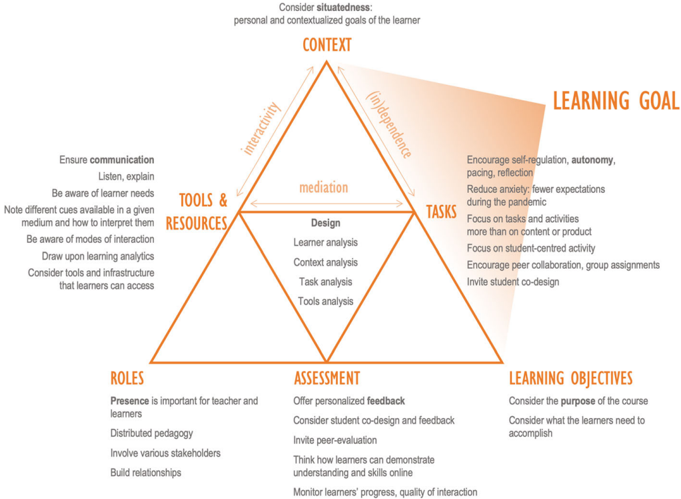
“Our findings point at the design of learning activities with certain characteristics, the combination of three types of presence (social, cognitive and facilitatory) and the need for adapting assessment to the new learning requirements.”
§ Springer Nature Switzerland AG 2020 Published online: 7 July 2020 > Abstract
plainstates an association- Asserted: passes — The authors put it forward as true.
- Checkable: passes — It can be checked against evidence.
- Load-bearing: passes — The paper’s conclusions depend on it.
- Based: passes — The paper gives a reason why it holds.
None of the sources cited for this claim have been checked yet.
In the paper
“What all four experts focus on as a prime ' piece ' of pedagogical knowledge (Kali et al. 2011) is the careful design of activities.”
§ Springer Nature Switzerland AG 2020 Published online: 7 July 2020 > Learning Design
plain- Asserted: passes — The authors put it forward as true.
- Checkable: passes — It can be checked against evidence.
- Load-bearing: unclear — It is unclear whether the paper’s conclusions depend on it.
- Based: passes — The paper gives a reason why it holds.
A result the paper reports from its own data — it cites no other source for it, so there is none to check. The quote shows it is in the paper.
In the paper
“Inspired by Anderson et al. ' s (2001) understanding of teaching presence and how it can be re-conceived in the current Covid-19 situation in which educators are the designers, the tutors and the evaluators of the learning experience, a tripartite framework emerges from the interviews, with three main sub-presences of the teaching presence, namely:”
§ Springer Nature Switzerland AG 2020 Published online: 7 July 2020 > Teacher Presence
plain- Asserted: passes — The authors put it forward as true.
- Checkable: passes — It can be checked against evidence.
- Load-bearing: passes — The paper’s conclusions depend on it.
- Based: passes — The paper gives a reason why it holds.
5 more claims
Create a free account to see all 61 claims and to verify the 9 references still open.
- Probably not a substantial claim. 50
- It may state two separate claims as one. 18
Claims other papers make about this one
Each is checked against this paper’s own text: does it say what the citing paper says it does?
The source backs part of the claim, not all of it — or backs it for a different population, condition or comparison.
In the citing paper
“while it is known that for learning success, input formats usually depend on both attention and interest from the students (Rapanta et al., 2020).”
From Impact of Synchronous and Asynchronous Settings of Online Teaching and Learning in Higher Education on Students' Learning Experience During COVID-19 (2021) · cites this paper as Rapanta et al., 2020
Experimental — accuracy not yet measuredIn the citing paper
“Evaluating AI applications could be beneficial for enhancing their motivation and interest in teaching with AI [40].”
From Developing AI Literacy for Primary and Middle School Teachers in China: Based on a Structural Equation Modeling Analysis (2022) · cites this paper as [40]
Citations
Cites
The Reflective Practitioner: How Professionals Think in Action
Checkoway, B., & Schon, D. A. (1985) · Journal of Policy Analysis and Management · doi:10.2307/3324262 · Cited by 21,268
The reflective practitioner: How professionals think in action
Stewart, C. J. (1984) · Patient Education and Counseling · doi:10.1016/0738-3991(84)90022-3 · Cited by 19,752
Knowledge and teaching: Foundations of the new reform
Shulman, L. (1987) · Harvard Educational Review · doi:10.17763/haer.57.1.j463w79r56455411 · Cited by 16,787
Phenomenological research methods
Moustakas, C. (1994) · doi:10.4135/9781412995658 · Cited by 13,919 · cited 1×
“’ This study ’ s participants, i.e. the four online pedagogy experts, also functioned as co-researchers, following Moustakas ’ (1994) idea (l).”
BackgroundDetermining Validity in Qualitative Inquiry
Creswell, J. W., & Miller, D. L. (2000) · Theory Into Practice · doi:10.1207/s15430421tip3903_2 · Cited by 9,184
Speech Genres and Other Late Essays
Bakhtin, M. M. (1986) · University of Texas Press eBooks · doi:10.7560/720466 · Cited by 8,470
The Difference between Emergency Remote Teaching and Online Learning
Hodges, C. B., Moore, S., Lockee, B. B., Trust, T., & Bond, M. A. (2024) · Handbook of Research in Online Learning · doi:10.1163/9789004702813_021 · Cited by 6,253
Blended learning: Uncovering its transformative potential in higher education
Garrison, D. R., & Kanuka, H. (2004) · The Internet and Higher Education · doi:10.1016/j.iheduc.2004.02.001 · Cited by 4,849
Speech Genres and Other Late Essays
Melaver, M., Bakhtin, M. M., McGee, V. W., Emerson, C., & Holquist, M. (1987) · Poetics Today · doi:10.2307/1772598 · Cited by 3,185
ASSESSING TEACHING PRESENCE IN A COMPUTER CONFERENCING CONTEXT
Anderson, T., Rourke, L., Garrison, R., & Archer, W. (2001) · Online Learning · doi:10.24059/olj.v5i2.1875 · Cited by 1,885
Research works printed but not linked: 2
- Bates, A. W. (2019). Teaching in a digital age. 2nd Edition. Vancouver: Tony Bates Associates. https://pressbooks.bccampus.ca/teachinginadigitalagev2/. Accessed 15 June 2020.
- Shor, I., & Freire, P. (1987). A pedagogy for deliberation: dialogues on transforming education . Westport: Bergin & Garvey Publishers.
Cited by
Items 701–800 of 2,106
The adaptation of academics to the Covid-19 crisis in terms of work time allocation
Horta, H., Алексеевна, П. А., Santos, J. M., & Yudkevich, M. (2022) · PLoS ONE · doi:10.1371/journal.pone.0273246 · Cited by 11
Transitioning to Online Learning amid COVID-19: Perspectives in a Civil Engineering Program
Maraqa, M. A., Hamouda, M. A., El-Hassan, H., El-Dieb, A., & Hassan, A. A. (2022) · Online Learning · doi:10.24059/olj.v26i3.2616 · Cited by 11
“Rapanta et al. (2020) provided experts opinions on the pedagogical knowledge needed by new online instructors, emphasizing the importance of instructional design and organization, faculty presence, and student assessment.”
BackgroundResultFerdian, F., & Suyuthie, H. (2022) · Jurnal Pendidikan Vokasi · doi:10.21831/jpv.v12i2.47570 · Cited by 10
“Online learning is a choice that helps deliver teaching materials to students (Rapanta et al., 2020).”
BackgroundPeacock, G. (2022) · SN Social Sciences · doi:10.1007/s43545-022-00533-2 · Cited by 12
Chakraborty, T., Bhandari, H., & Mittal, A. (2022) · Global Knowledge, Memory and Communication · doi:10.1108/gkmc-04-2022-0095 · Cited by 8
Live Streaming vs. Pre-Recorded Training during the COVID-19 Pandemic in Italian Rhythmic Gymnastics
Cardinali, L., Curzi, D., Maccarani, E., et al. (2022) · International Journal of Environmental Research and Public Health · doi:10.3390/ijerph192416441 · Cited by 6
“An inability to attend the live lesson at the scheduled time, a lack of appropriate support to young gymnasts from parents engaged in work activities, an absence of adequate home spaces, a scarce fluency of interaction which determines lower attention [24], and technical difficulties such as computer or internet crash…”
BackgroundKamble, A. A., Golhar, D., & Kalkar, P. (2022) · Educational Media International · doi:10.1080/09523987.2022.2153989 · Cited by 9
“However, since online education’s emphasis came as a knee-jerk reaction to the pandemic situation, it did not find the preparedness by colleges, teachers, and students adequate (Bao, 2020; Basilaia & Kvavadze, 2020; Rapanta et al., 2020).”
BackgroundFearnley, M. R., Malay, C. A., & Fabia, J. N. (2022) · International Journal of Information and Education Technology · doi:10.18178/ijiet.2022.12.12.1759 · Cited by 21
“Students expressed positive self-efficacy views about learning online and indicated confidence in their abilities to manage online tools, obtain material for course needs from Internet sources, and interact successfully with classmates and instructors [1].”
BackgroundInfluentialStewart, W. H., Lowenthal, P. R., & Richter, D. J. (2023) · Turkish Online Journal of Distance Education · doi:10.17718/tojde.1090810 · Cited by 8
“To date, studies have shown that ERT is often viewed as a major shock to students, educators, and schools (Jyoti et al., 2021; Peters et al., 2020; Rapanta et al., 2020).”
BackgroundStudy of Covid-19 - Related Ecological Habitat of College Students: A Survey
Hrynzovskyi, A., Khan, S., Srivastava, R., & Khan, A. R. (2023) · Ecological Questions · doi:10.12775/eq.2023.021 · Cited by 8
Larsari, V. N., Wildová, R., Dhuli, R., et al. (2023) · Lecture notes in networks and systems · doi:10.1007/978-3-031-29857-8_37 · Cited by 6
Nonthamand, N. (2023) · International Journal of Interactive Mobile Technologies (iJIM) · doi:10.3991/ijim.v17i10.37775 · Cited by 7
UNIVERSITY STUDENTS’ PERCEPTIONS OF TEACHING QUALITY BEFORE AND AFTER THE COVID-19 PANDEMIC
Tuomainen, S. (2023) · European Journal of Education Studies · doi:10.46827/ejes.v10i7.4863 · Cited by 10
Nguyen, U. N. T., & Kember, D. R. (2023) · Higher Education · doi:10.1007/s10734-023-01058-0 · Cited by 12
“…internet and involves a geographical separation between students and teachers and the utilisation of some forms of technology for interaction between learners and tutors/instructors and between learners and learners (Anderson, 2011; Rapanta et al., 2020; Singh & Thurman, 2019; Yang & Tsai, 2017).”
BackgroundDesigning and Developing Video Lessons in Mathematics Using Code-Switching: A Design-Based Research
Sagge, R. G., & Segura, R. T. (2023) · International Journal of Information and Education Technology · doi:10.18178/ijiet.2023.13.9.1942 · Cited by 6
“Most Higher Education Institutions (HEIs) have greater online learning environments now that internet-related infrastructure is more affordable and potent, and more video content is being sought after [4].”
BackgroundDigital Education in the Post-Covid Era: Challenges and Opportunities to Explore
Νικολοπούλου, Κ. (2023) · IFIP advances in information and communication technology · doi:10.1007/978-3-031-43393-1_1 · Cited by 6
Bower, M., Lai, J. W. M., Bergen, P. V., Hobson, L., & Stephens, R. (2023) · Australian Journal of Education · doi:10.1177/00049441231204069 · Cited by 7
“While autonomy-supportive parenting may help students to develop independent learning capabilities (Neubauer et al., 2021), speci fi c learning designs that enable autonomous learning for all students are likely to require careful learning design by teachers (Rapanta et al., 2020).”
BackgroundSasan, J. M. (2023) · Lingua Franca · doi:10.37680/lingua_franca.v2i2.2422 · Cited by 8
Student-centredness in physics laboratory teaching sessions
Lehesvuori, S., Lehtinen, A., Hämäläinen, R., Maunuksela, J., & Koskinen, P. (2023) · Learning Culture and Social Interaction · doi:10.1016/j.lcsi.2023.100773 · Cited by 21
Okoro, C., Takawira, O., & Baur, P. W. (2021) · Journal of University Teaching and Learning Practice · doi:10.53761/1.18.8.3 · Cited by 10
Espejo-Antúnez, L., Serrano, M. C., Zamora‐Polo, F., González, M., & Cardero‐Durán, M. D. L. Á. (2021) · International Journal of Environmental Research and Public Health · doi:10.3390/ijerph18157976 · Cited by 16
COVID-19 Effects on Communication Course and Faculty Evaluations
LeBlanc, H. P. (2021) · Journalism & Mass Communication Educator · doi:10.1177/10776958211034116 · Cited by 7
“Rapanta et al. (2020) suggest that reflections on development of online learning should spur leaders of educational institutions to focus on instructional design with different teaching modalities, reconceive teacher presence, and adopt a continuous assessment model.”
BackgroundThe Effect of Technology and Service on Learning Systems During the COVID-19 Pandemic
ULLAH, A., Dinler, Ö. B., & Şahin, C. B. (2021) · European Journal of Science and Technology · doi:10.31590/ejosat.990073 · Cited by 7
“Thus, education informatization has become a new paradigm of online education, called smart elearning, that allows for inserting the theory of modern education based on educational data and uses supporting technologies to make better use of intelligent e-learning services [17]-[18].”
BackgroundLiu, J., Lu, C., & Lu, S. (2021) · Healthcare · doi:10.3390/healthcare9091159 · Cited by 7
“In terms of education, screen-mediated online education has become the mainstream during the epidemic [8], forcing urgent changes in education methods and posing new challenges to educators [9,10].”
BackgroundPerception of University Students toward the Effectiveness of E- Learning during Covid-19 Pandemic
Amin, S. M., & Hussien, N. K. A. (2021) · Egyptian Journal of Health Care · doi:10.21608/ejhc.2021.197885 · Cited by 6
Compassionate love: improving international student online learning through new literacies
Karkar-Esperat, T. M. (2021) · International Journal of Qualitative Studies in Education · doi:10.1080/09518398.2021.1982056 · Cited by 10
“Ideally, instructors in online classes engage learners with their presence and use a variety of instructional materials (see for instance, Dixson, 2010; Kumar et al., 2019; Rapanta et al., 2020).”
BackgroundPapp, D., Győri, K., Kovács, K. E., & Csukonyi, C. (2021) · The Hungarian Educational Research Journal · doi:10.1556/063.2021.00101 · Cited by 8
STUDENTS’ ADAPTABILITY IN ONLINE LEARNING BASED ON MALAYSIAN STUDENTS’ PERCEPTION
Razak, A. A., Nawi, N. H. M., Noor, A. L. M., Daud, B. C., & ISMAIL, M. (2021) · MALIM JURNAL PENGAJIAN UMUM ASIA TENGGARA (SEA JOURNAL OF GENERAL STUDIES) · doi:10.17576/malim-2021-2201-11 · Cited by 6
“It refers to the preparation of students to partake in online learning, thus learners having well-planned preparation is essential in order to obtain a satisfying and effective learning experience (Rapanta et al. 2020).”
BackgroundE - Learning during Covid-19 – Perspectives of Academics in a Crisis
Chingara, R., Muparuri, P., & Muzenda, D. (2021) · International Journal of Asian Social Science · doi:10.18488/journal.1.2021.1112.564.576 · Cited by 6
“Some kind of support is required for students to successfully adopt e-learning (Rapanta et al., 2020) and yet in this instance both students and lecturers complained about lack of such (Section D).”
BackgroundKoller, E. C., Abel, R., & Milton, L. E. (2022) · The Open Journal of Occupational Therapy · doi:10.15453/2168-6408.1847 · Cited by 11
“…of online education can be as efficacious as face-to-face instruction when course curriculum maximizes on the appropriate use of pedagogy (Driscoll et al., 2012), including execution of a mixed-modality curriculum of asynchronous, synchronous, online, and offline components (Rapanta et al., 2020).”
The motivation and teaching strategies in pre-service physical education teachers
Tulyakul, S., Werathummo, A., Khun-Inkeeree, H., Rotsuwan, W., & Reudhabibadh, R. (2022) · Journal of Education and Learning (EduLearn) · doi:10.11591/edulearn.v16i2.20396 · Cited by 14
“without Wi-Fi signal, teaching methods or teaching strategies are not interesting via online teaching, and so on [15], [16].”
MethodVempalli, S., Reddy, R. N., Viresh, G. A., Somayaji, N. S., Rajguru, J. P., Vibhuti, & Singh, J. (2022) · Journal of Advanced Pharmaceutical Technology amp Research · doi:10.4103/japtr.japtr_115_22 · Cited by 10
“This pandemic has forced various colleges, all universities, and schools to remain nonfunctional and even forced them to operate using extreme limitations of resources for minimizing one’s risk of contracting COVID-19 infection.[19,20] This pandemic has affected the practical skills of students as well as their intera…”
BackgroundLaBelle, S., Johnson, Z. D., & Journeay, J. M. (2022) · Communication Education · doi:10.1080/03634523.2022.2142624 · Cited by 12
“The COVID-19 pandemic and transition to online learning had a marked impact on instructors’ well-being (Rapanta et al., 2020).”
BackgroundExploring critical media health literacy (CMHL) in the online classroom
Squires, L. A., Peters, A. M. F., & Rohr, L. E. (2023) · Journal of Media Literacy Education · doi:10.23860/jmle-2023-15-1-5 · Cited by 11
“…Based on our findings and the research demonstrating that clear communication of expectations has been found to improve the quality of student work, especially in lowerlevel university courses (Rapanta et al., 2020), the health and wellness course examined here will be amended to reflect this.”
BackgroundUniversitas Pendidikan Indonesia, B., Nur, L., Hong, F., Ardha, M. A. A., Burhaeın, E., Universitas Ma'arif Nahdlatul Ulama Kebumen, I., Malik, A. A., & Universitas Siliwangi, T. (2023) · International Journal of Instruction · doi:10.29333/iji.2023.16345a · Cited by 12
“Rapanta et al. (2020) mentioned that the significant challenge in online learning during the pandemic is pedagogical content knowledge (PCK) which covers the pedagogical foundations and knowledge about the principles needed to design and facilitate meaningful online learning.”
Work-life balance of teaching staff at higher education during COVID 19 pandemic
Ilić-Kosanović, T. (2021) · Serbian Journal of Engineering Management · doi:10.5937/sjem2101064i · Cited by 10
“…has been prerequisite for smooth transition to online teaching methods (Marinoni and van’t Land, 2020; Ashencaen Crabtree et al., 2020; Langford and Damsa, 2020; Rapanta et al., 2020; Coman et al., 2020) as almost all higher education institutions had to promptly shift to online models of teaching.”
BackgroundEducación Superior: Pandemia COVID-19
Vizarreta, P. V. (2020) · Revista Digital de Investigación en Docencia Universitaria · doi:10.19083/ridu.2020.1388 · Cited by 16
A Learning Analytics Approach to Monitoring the Quality of Online One-to-one TutoringPreprint
Cukurova, M., Khan-Galaria, M., Millán, E., et al. (2021) · doi:10.35542/osf.io/qfh7z · Cited by 6
Eslit, E. R. (2023) · Preprints.org · doi:10.20944/preprints202308.1494.v1 · Cited by 8
Reconceptualise a dynamic framework of the learning constructs in higher education
Geng, G. H., Zhu, Y., & Disney, L. (2023) · Higher Education Quarterly · doi:10.1111/hequ.12427 · Cited by 8
Lemana, H. E., Ulla, M. B., & Kohnke, L. (2024) · Heliyon · doi:10.1016/j.heliyon.2024.e34388 · Cited by 21
“As reported by previous studies ([18,19]), many teachers experienced difficulties handling their responsibilities in a context where the rules and expectations differed significantly from face-to-face settings.”
Antecedents and consequences of academic help-seeking in online STEM learning
Won, S., & Chang, Y. (2024) · Frontiers in Psychology · doi:10.3389/fpsyg.2024.1438299 · Cited by 12
Bedeker, M. (2023) · The Journal of Educators Online · doi:10.9743/jeo.2023.20.2.2 · Cited by 8
Mangundu, J. (2023) · African Journal of Research in Mathematics Science and Technology Education · doi:10.1080/18117295.2023.2232667 · Cited by 11
“The implication is that teacher training institutions and the schools where preservice teachers conduct their practicum should take leadership roles in getting preservice teachers ready, as supported by Rapanta et al. ’ s (2020).”
BackgroundBone, E. K., French, S., Deneen, C. C., & Prosser, M. (2024) · Teaching in Higher Education · doi:10.1080/13562517.2024.2394038 · Cited by 5
“The impact of the COVID-19 pandemic has been felt across the global higher education sector, with a mass move to online learning resulting in a general destabilisation of teaching and learning and university operations (e.g. Crawford et al. 2020; Rapanta et al. 2020).”
Al-Nuaimi, M. N. (2021) · Studies in systems, decision and control · doi:10.1007/978-3-030-64987-6_3 · Cited by 6
Blessings of COVID-19 Lockdown on Virtual Learning: A Higher Education Faculty Perspective
Hiteshkumar Patel, E. A. (2021) · Türk bilgisayar ve matematik eğitimi dergisi · doi:10.17762/turcomat.v12i10.5383 · Cited by 8
“(ChrysiRapanta, 2020) , With this article, authors provide some expert insights into this online-learning-related PCK, with the goal of helping non-expert university teachers (i.e., those who have little experience with online learning)tonavigateinthesechallengingtimes.”
BackgroundWellness, blaming and coping during a pandemic: an analysis of perceptions on reddit
Callaghan, S. A., Drysdale, M., & Lee, J. (2021) · Mental Health and Social Inclusion · doi:10.1108/mhsi-05-2021-0021 · Cited by 6
Test Anxiety and Its Impact on Diverse Undergraduate Engineering Students During Remote Learning
Copp, D. A., & Headley, A. J. (2024) · ASEE Annual Conference & Exposition · doi:10.18260/1-2--37832 · Cited by 8
“This will be particularly important to understand as, given the advancement of online instruction during the COVID-19 pandemic, educators worldwide are imagining an educational system where remote instruction will remain part of the norm even after self-isolation guidelines are relaxed [25–28].”
BackgroundArsarkij, J., & Laohajaratsang, T. (2021) · International Journal of Emerging Technologies in Learning (iJET) · doi:10.3991/ijet.v16i18.25159 · Cited by 5
“Teachers and educators have attempted to find the most suitable teaching and learning frameworks and methods to implement in their pedagogy (Cha et al., 2020; Rapanta et al., 2020).”
BackgroundEscuelas cerradas, aulas abiertas: estrategias de enseñanza remota en una comunidad rural de Yucatán
Marín-Che, A. J., & Sosa, J. E. P. (2021) · Revista Latinoamericana de Estudios Educativos · doi:10.48102/rlee.2021.51.especial.463 · Cited by 12
Emergency Remote Education and Smart Working at Three European Higher Education Institutions
Marzano, G., & Zając, A. (2021) · International Journal of Web-Based Learning and Teaching Technologies · doi:10.4018/ijwltt.287553 · Cited by 7
Egyptian Educators’ Online Teaching Challenges and Coping Strategies during COVID-19
Hafez, O., & El‐Din, Y. S. (2021) · Arab World English Journal · doi:10.24093/awej/vol12no4.19 · Cited by 5
Assessing Repurchase Intention of Learning Apps during COVID-19
Dash, G., Chakraborty, D., & Alhathal, F. (2022) · Electronics · doi:10.3390/electronics11091309 · Cited by 13
The Online Education in the Higher Education, a Complete System Rather Than Just a Platform
Abdelaziz, S. (2022) · Business and Management Studies · doi:10.11114/bms.v8i1.5536 · Cited by 8
“The online learning context, which encompasses the course content, teachers, and students, demands the use of technological tools for access (Rapanta et al., 2020).”
BackgroundEffect of COVID-19 Pandemic on Traditional Teaching
Ghosh, M., Jansz, J., & Ghosh, A. K. (2022) · International Journal on Studies in Education · doi:10.46328/ijonse.63 · Cited by 9
“, (2018) wrote that the complex nature of the instructional situation and inadequacies in planning and organization are some of the main difficulties described by university teachers with respect to transforming their teaching to web-based courses The COVID-19 crisis has contributed to a profusion of advice to assist…”
BackgroundFactors influencing faculty’s online teaching decisions
Gulinna, A., Xie, J., & Korkmaz, N. (2022) · Distance Education · doi:10.1080/01587919.2022.2088474 · Cited by 5
“…with the emergency remote teaching (ERT) response, many instructors struggled with pedagogical content knowledge (PCK) and purposeful integration of technology tools with best practices to support students’ online learning experience (Hodges et al., 2020; Rapanta et al., 2020; Xie et al., 2021).”
BackgroundModeling of Interactive Teaching and Learning System for Students Based on Artificial Intelligence
Liu, J., & Zou, H. (2022) · Advances in Multimedia · doi:10.1155/2022/7218721 · Cited by 6
“)ere-fore, in order to improve teaching efficiency and ensure the successful completion of online teaching tasks, teachers usually choose a simple and direct way to interact [9].”
Khattak, A. S., Ali, M. K., & Awadh, M. A. (2022) · Sustainability · doi:10.3390/su141610387 · Cited by 10
Teaching in Physical Education during Pandemic COVID-19: A Study of University Teachers
Fierro, A. A., Philominraj, A. S., Vitoria, R. V., & Grisales, N. E. M. (2022) · International journal of human movement and sports sciences · doi:10.13189/saj.2022.100514 · Cited by 10
The First Edition of the World Nanotechnology Marathon [Spotlight Column]
Lodi, M. B., Sivasubramani, S., Berkenbrock, J. A., Vieira, D., Welsch, T. A., Li, Y., & Sliz, R. (2022) · IEEE Nanotechnology Magazine · doi:10.1109/mnano.2022.3195077 · Cited by 5
Managing the shift to online: lecturers’ strategies during and beyond lockdown
Ogegbo, A. A., & Tijani, F. (2022) · Educational Research · doi:10.1080/00131881.2022.2154687 · Cited by 8
Khodabandelou, R., Chaharbashloo, H., Ghaderi, M., Zeinabadi, H., & Karimi, L. (2022) · Interactive Learning Environments · doi:10.1080/10494820.2022.2152057 · Cited by 10
“Second, from the instructor ’ s perspective (Ally, 2019; McGee et al., 2017; Rapanta et al., 2020).”
(2023) · The Journal of Educators Online · doi:10.9743/jeo.2023.20.1.6 · Cited by 5
Nygren, Å., Alégroth, E., Eriksson, A., & Pettersson, E. (2023) · Education Sciences · doi:10.3390/educsci13020181 · Cited by 7
“A literary review of papers reveals that the emergency remote teaching during the pandemic can indeed give way to a more long-term integration of physical and digital tools and methods that can sustain a more active, flexible and meaningful learning environment [7].”
Mugizi, W., & Rwothumio, J. (2023) · doi:10.58653/nche.v10i2.04 · Cited by 11
case study on effective teaching strategies for attaining course learning outcomes
Ahmed, A. O. A., & Ibrahim, I. Z. A. (2021) · Linguistics and Culture Review · doi:10.21744/lingcure.v5ns4.2272 · Cited by 5
Simanjuntak, M. P., Sihite, E. I., & Suyanti, R. D. (2023) · International Journal of Instruction · doi:10.29333/iji.2023.1649a · Cited by 5
Al-Naabi, I., Cifuentes‐Faura, J., To, L., & Obor, D. O. (2024) · Journal of University Teaching and Learning Practice · doi:10.53761/1.20.7.06 · Cited by 11
The Paradox of Educational Inequality in Indonesia
Zreık, M. (2023) · Advances in educational marketing, administration, and leadership book series · doi:10.4018/979-8-3693-0693-2.ch004 · Cited by 6
Inovasi Manajemen Perencanaan untuk Peningkatan Mutu Madrasah dalam Situasi Covid-19
Susanto, S., Ritonga, A. W., & Desrani, A. (2022) · Aspirasi Jurnal Masalah-masalah Sosial · doi:10.46807/aspirasi.v13i1.3001 · Cited by 22
Towards inclusive teaching and learning practices: A guideline for commerce academics
Musundwa, S. (2024) · doi:10.4102/aosis.2024.bk454.07 · Cited by 5
Culajara, C. J. (2024) · International Journal of Social Learning (IJSL) · doi:10.47134/ijsl.v4i2.194 · Cited by 9
“This is done using technology to innovate in education (Rapanta et al. 2020).”
MethodMa, W., & Chu, N. (2024) · Journal of Intelligent Systems · doi:10.1515/jisys-2023-0312 · Cited by 5
“With the help of wireless network coverage and logistics overall analysis and control in smart classrooms, information resources can be reasonably allocated and used optimally [10].”
MethodHadiyanto, H. (2024) · Education Sciences · doi:10.3390/educsci14090938 · Cited by 27
Güntem, O., & Kılıç, Y. (2025) · Sustainability · doi:10.3390/su17094166 · Cited by 18
Schwartzman, G., Berk, M., & Reboiras, F. (2021) · Revista Iberoamericana de Tecnología en Educación y Educación en Tecnología · doi:10.24215/18509959.28.e56 · Cited by 8
Factors Influencing Student Engagement During COVID-19 Emergency Remote Teaching
Ekici, M., & Ekici, D. İ. (2021) · Advances in educational technologies and instructional design book series · doi:10.4018/978-1-7998-7275-7.ch007 · Cited by 6
Gastaldi, M. D. V., & Grimaldi, E. (2021) · doi:10.14705/rpnet.2021.52.1267 · Cited by 5
“Quoting Rapanta et al. (2020), “the current pandemic can be understood as a catalyst” (p. 941) that will speed up educational change, models, and practices in response to the society of the future.”
BackgroundPre-service teacher perceptions of teaching health education online
Cruickshank, V. J., & Mainsbridge, C. P. (2021) · Health Education · doi:10.1108/he-01-2021-0004 · Cited by 10
Sojuel, D. E., & Nanne-Lippmann, I. (2021) · Recie. Revista Caribeña de Investigación Educativa · doi:10.32541/recie.2021.v5i2.pp107-123 · Cited by 11
Hamid, M. M., Alam, T., Rabbi, M. F., et al. (2021) · Lecture notes in computer science · doi:10.1007/978-3-030-78224-5_16 · Cited by 5
O’Dea, X. (2021) · Journal of Learning Development in Higher Education · doi:10.47408/jldhe.vi22.658 · Cited by 5
Karasu, G., & Kaya, Z. (2021) · Ege Eğitim Dergisi · doi:10.12984/egeefd.938443 · Cited by 5
Zaman, H. N. S. (2021) · Pakistan Journal of Educational Research · doi:10.52337/pjer.v4i3.273 · Cited by 6
Using a video presentation on variance and covariance in the teaching of statistics
Austerschmidt, K. L., Stappert, A., Heusel, H., et al. (2021) · Teaching Statistics · doi:10.1111/test.12292 · Cited by 5
“Regarding more general implications, we expect flexible blended learning materials to become even more important during the present shift from attendance to distance learning, due to COVID-19, which, at least partially, is expected to be retained after the pandemic [19].”
BackgroundQuro, Q., & Choiriyah, C. (2022) · Journal of Early Childhood Education (JECE) · doi:10.15408/jece.v0i0.22202 · Cited by 5
“Such a big challenge for educators during the current Covid-19 outbreak (Rapanta et al., 2020).”
To What Extent Are Preparatory School Students Ready for Online Learning?
Korkmaz, S. (2022) · Kuramsal Eğitimbilim · doi:10.30831/akukeg.991017 · Cited by 8
“The forced shift from face-to-face education to online education due to the covid-19 pandemic has generated some challenges in higher education (Rapanta et al., 2020).”
BackgroundHontoir, F., Simon, V., Raeve, Y. D., Dumortier, L., Dugdale, A., & Vandeweerd, J. (2022) · Journal of Veterinary Medical Education · doi:10.3138/jvme-2021-0153 · Cited by 7
Evaluative Knowledge and Skills of Student Teachers Within the Adapted Degree Courses
Agrati, L. S., & Vinci, V. (2022) · Frontiers in Education · doi:10.3389/feduc.2022.817963 · Cited by 6
The Open Cage: A Force for Transformative Learning in Professional Doctoral Studies During COVID-19
Fulton, J. A., Hall, L. E., Watson, D., & Hagan-Green, G. (2022) · International journal of doctoral studies · doi:10.28945/4987 · Cited by 6
“…re-crafting and systematic transition of teaching pedagogies moving from physical or face-to-face teaching to a hybrid approach (Iglesias-Pradas et al., 2021) and with further restrictions to online delivery or ‘emergency remote teaching’ (González-González et al., 2020; Rapanta et al., 2020).”
BackgroundCOVID-19 IMPACTS ON DIGITAL EDUCATION IN MAURITIUS: A DIGITAL READINESS ANALYSIS
Atchia, S. M. C., & Chinapah, V. (2022) · KnowEx Social Sciences · doi:10.17501/27059901.2021.2107 · Cited by 8
Hasim, M. A., Jabar, J. B., Sufian, A., & Ibrahim, N. F. (2022) · International Journal of Learning Teaching and Educational Research · doi:10.26803/ijlter.21.10.9 · Cited by 25
“The impact of the pandemic on universities’ pedagogical activities was lessened by the implementation of mitigation strategies, such as flexible online learning and E-assessment (Rapanta et al., 2020).”
BackgroundAn Evaluation of Virtual Classroom Performance with Artificial Intelligence Components
Tew, Y., Lim, K. Y., & Joan, H. (2022) · IEM Journal · doi:10.54552/v82i3.116 · Cited by 6
Enhancing active learning in remote collaboration: An experience in teaching functional materials
Marinelli, A., Papile, F., Sossini, L., & Curto, B. D. (2022) · International Journal of Mechanical Engineering Education · doi:10.1177/03064190221143312 · Cited by 7
“3–5 Internet connection stability, digital expertise, and social issues were, among others, key drawbacks.(6,7) Of them, sociality is one of the pillars of the learning process due to communication and sharing of opinions and perspectives(8); this may be even truer if sociality occurs among learners that do not share…”
BackgroundAnimation with Problem-Based Learning to Improve Student High Level Thinking Skills
Sari, Y. R., Marini, A., & Rahmawati, Y. (2023) · Cypriot Journal of Educational Sciences · doi:10.18844/cjes.v18i1.8176 · Cited by 8
Laksmiwati, P. A., Adams, D., & Sulistyawati, E. (2021) · Lecture notes in networks and systems · doi:10.1007/978-3-030-82616-1_29 · Cited by 9
Penilaian Mahasiswa BIPA terhadap Pembelajaran Tatap Muka dan Online
Defina, D. (2021) · Jurnal Bahasa Indonesia bagi Penutur Asing (JBIPA) · doi:10.26499/jbipa.v3i1.3482 · Cited by 13
Emergency remote learning acceptance among higher education students during COVID-19 pandemic
Pilav-Velić, A., Jahić, H., Okičić, J., Selimović, J., & Grabovica, E. (2021) · Zbornik radova Ekonomskog fakulteta u Rijeci · doi:10.18045/zbefri.2021.2.325 · Cited by 6
“Authors Hodges et al. (2020), Milman (2020), Rapanta et al. (2020) argue, remote teaching caused by the pandemic can only be understood as “an emergency remote teaching.””
BackgroundSubekti, A. S. (2021) · JEELS (Journal of English Education and Linguistics Studies) · doi:10.30762/jeels.v8i1.221 · Cited by 12
Metadata
- Authors
- Rapanta, C., Botturi, L., Goodyear, P., Guàrdia, L., & Koole, M.
- Affiliations
- Universidade Nova de Lisboa (PT)
- University of Applied Sciences and Arts of Southern Switzerland (CH)
- The University of Sydney (AU)
- University of Saskatchewan (CA)
- Corresponding author
- Rapanta, Chrysi
- ORCID
- Rapanta, Chrysi
- Venue
- Postdigital Science and Education
- Published
- 2020-07-07
- Volume
- 2
- Issue
- 3
- Pages
- 923-945
- ISSN
- 2524-485X (ISSN-L)
- 2524-4868
- PMC
- PMC7339092
- OpenAlex
- W3042009104
- Semantic Scholar
- fed495af71b417de8d60cf16b6da44926faf24a0
- Cited by
- 2,130
- References
- 75
- Citations by year
- 2026: 134 · 2025: 158 · 2024: 261 · 2023: 426 · 2022: 556 · 2021: 509 · 2020: 73
- FWCI
- 454.18
- Type
- journal article
- Language
- en
- Open access
- hybrid
- doi.org
- Licence
- other-oa
- www.springer.com/tdm (tdm)
- www.springer.com/tdm (vor)
- Locations
- Postdigital Science and Education (publishedVersion, other-oa)
- PubMed (publishedVersion)
- PubMed Central (submittedVersion)
- The Sydney eScholarship Repository (The University of Sydney) (submittedVersion)
- Funders
- Fundação para a Ciência e a Tecnologia (DL 57/2016/CP1453/CT0066)
- Australian Research Council (DP150104163)
- Topics
- Social Sciences › Education › Digital Education and Society
- Social Sciences › Education › Higher Education Practises and Engagement
- Social Sciences › Education › Educational Innovations and Technology
- Keywords
- online learning, COVID-19 pandemic, higher education, teacher presence, pedagogical content knowledge, learning activities, social presence, cognitive presence
About these checks
Registry, retraction, Cites and statistics results are computed, not judged, with one exception: a printed reference that no index lists is read once by a model before it counts as a citation error. Claims are extracted by a model and kept only when their quote appears verbatim in the text; each cited source is then checked, with a model’s help, for whether it says what the claim relies on. Those verdicts can be wrong — read the claim’s quote and the cited source before relying on one.
The claim verdicts this report counts are experimental: their accuracy is not yet measured.
A language model drew the claims from the paper on 2026-10-10, under version 3 of the claim definition (model deepseek-v4.1-flash, prompt extract-v3).
A second model labelled each claim on 2026-10-10 (model jev-1.13-20260917, definition revision gold-guideline-v0.2).
Cited sources are checked with a language model’s help (qwen3.8-omni-flash).
Statistics and arithmetic are recomputed, not judged.
Confidence bands are shown only for fields calibrated on our annotated test set. None is calibrated yet, so no band is shown.
What counts as a claim ›How we measure confidence ›How we check this ›
Are you an author, or do you see a problem with this page? Request a review
Data sources
Bibliographic data: Semantic Scholar, OpenAlex, Crossref.
Contains information from the Semantic Scholar Academic Graph Datasets, made available under the ODC Attribution License (ODC-BY 1.0).
Semantic Scholar’s data is described in: Kinney, R., et al. (2023). The Semantic Scholar Open Data Platform. arXiv:2301.10140.
