

A taxonomy of epistemic injustice in the context of AI and the case for generative hermeneutical erasure
Open accessThe DOI matches its Crossref record; 67 of the 69 references it cites were found in a registry or an index, and 1 are not checked yet; 21 of the 64 sources its claims cite were checked for support.
Abstract
Epistemic injustice related to AI is a growing concern. In relation to machine learning models, epistemic injustice can have a diverse range of sources, ranging from epistemic opacity, the discriminatory automation of testimonial prejudice, and the distortion of human beliefs via generative AI’s hallucinations to the exclusion of the global South in global AI governance, the execution of bureaucratic violence via algorithmic systems, and interactions with conversational artificial agents. Based on a proposed general taxonomy of epistemic injustice, this paper first sketches a taxonomy of the types of epistemic injustice in the context of AI, relying on the work of scholars from the fields of philosophy of technology, political philosophy and social epistemology. Secondly, an additional conceptualization on epistemic injustice in the context of AI is provided: generative hermeneutical erasure. I argue that this injustice the automation of ‘epistemicide’, the injustice done to epistemic agents in their capacity for collective sense-making through the suppression of difference in epistemology and conceptualization by LLMs. AI systems’ ‘view from nowhere’ epistemically inferiorizes non-Western epistemologies and thereby contributes to the erosion of their epistemic particulars, gradually contributing to hermeneutical erasure. This work’s relevance lies in proposal of a taxonomy that allows epistemic injustices to be mapped in the AI domain and the proposal of a novel form of AI-related epistemic injustice.
Verified 2026-11-22 · 1 reference not checked yet
Overview
CoChat Summary
TL;DR
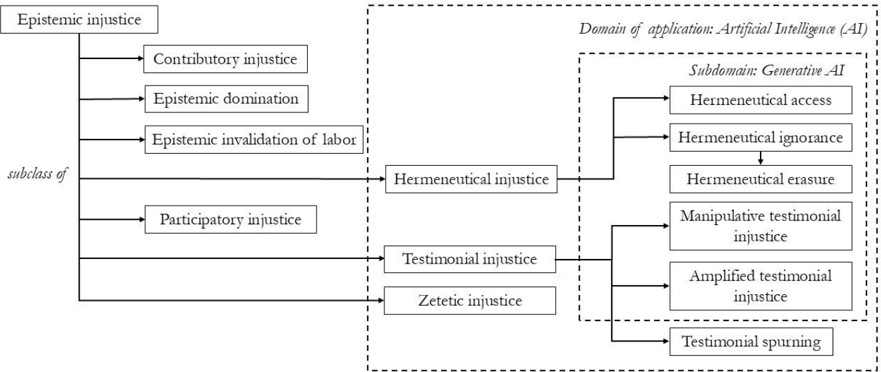
The paper proposes a general taxonomy of epistemic injustice and extends it to AI, adding algorithmic variants such as generative hermeneutical ignorance, access, manipulative and amplified testimonial injustice. It then argues for a novel, speculative subclass—generative hermeneutical erasure—where LLMs’ Western “view from nowhere” erodes non-Western epistemic particulars, especially through epistemic colonization.
Key findings
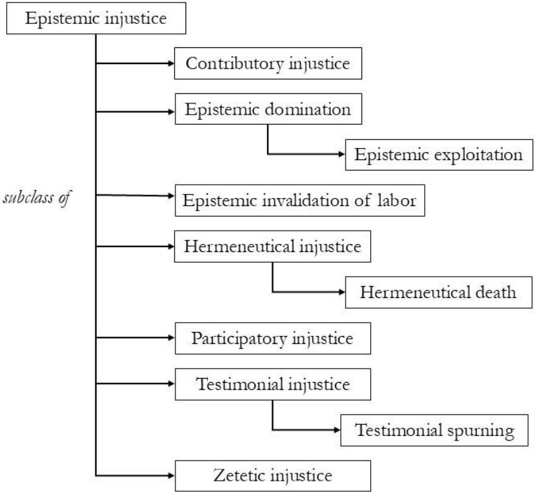
- The paper provides a general taxonomy of epistemic injustice with “eleven initial elements,” starting from Fricker’s testimonial and hermeneutical injustice and integrating participatory injustice, contributory injustice, epistemic labor invalidation, epistemic domination, epistemic exploitation, zetetic injustice, testimonial spurning, and hermeneutical death.
- It extends the taxonomy to AI and covers four forms of epistemic injustice arising in interaction with generative AI: generative hermeneutical ignorance, generative hermeneutical access, generative manipulative testimonial injustice, and generative amplified testimonial injustice.
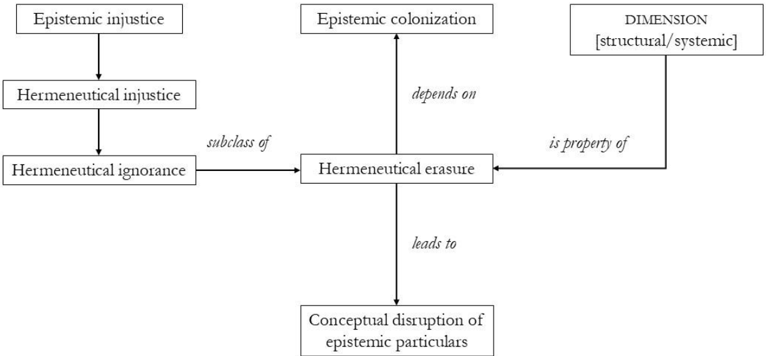
- It proposes generative hermeneutical erasure as an extreme subclass of generative hermeneutical ignorance, reversing the schema of epistemic silence: instead of gaining a concept, one moves from having an epistemic particular to its absence through conceptual disruption imposed by LLMs.
- It cites evidence that ImageNet is 60% Western source images (US: 45%) and only 2.2% from China and India, and that GPT “inherits a WEIRD psychology” and most resembles a cluster including the USA, Canada, Northern Ireland, New Zealand, Great Britain, Australia, Andorra, Germany, and the Netherlands.
Methods
- Conceptual/philosophical taxonomy construction, relying on scholars from philosophy of technology, political philosophy, and social epistemology, including Fricker, Báez-Vizcaíno, Pohlhaus, Medina, Miragoli, and Kay et al.
- The taxonomy follows three rules: adequate description, hierarchical tree-introduction, and mono-inheritance; it is then extended to the AI domain and used to formulate generative hermeneutical erasure via Wittgensteinian hinge epistemology and decolonial approaches.
- No empirical data collection or sample is reported; the analysis is literature-based conceptual synthesis, with an illustrative mapping to the MIT AI Risk Repository.
Limitations
- The paper states the taxonomy is not complete, is “minimally viable,” open-ended, and based only on readily available conceptual resources; generative hermeneutical erasure is described as speculative with contours “yet to be further elucidated.”
- The paper states that the mono-inheritance rule rules out overlaps and hybrid cases, though it cannot rule out that a phenomenon in the AI domain may deserve “manifold labeling.”
- Evident from the text: the proposed taxonomy and generative hermeneutical erasure are not empirically validated or tested through case studies; support comes from secondary literature and illustrative examples.
Model-written summary. Check it against the paper before relying on it.
Integrity signals
Registry
Cites
Statistics
Figures
Verification
Claims the paper makes
19 Valid · 6 Not valid · 35 Not checked · 74 Own results and interpretations
Every source the paper cites for this claim was checked and supports it.
In the paper
“Furthermore, [31] explain that algorithmic profiling can lead to hermeneutical injustice.”
§ A taxonomy of epistemic injustice in the context of AI and the case for generative hermeneutical erasure > 3.1. How do epistemic injustices manifest in the context of AI?
What the sources say
- Supportedcites [31] 31. Mihalcea, R., Ignat, O., Bai, L., Borah, A., Chiruzzo, L., Zhijing, J., Kwizera, C., Nwatu, J., Poria, S., and Solorio, T. (2024). Why AI Is WEIRD and Should Not Be This Way: Towards AI For Everyone, With Everyone, By Everyone. arXiv. https://doi.org/10.48550/arXiv.2410.16315. source
The Hermeneutical injustice section says algorithmic profiling may prevent people from making sense of their experiences and identifies this as hermeneutical injustice. The Algorithmic epistemic injustice section also explains how profiling can create or maintain epistemic injustice. The claim preserves the paper’s qualified ‘can’ framing. (LLM, conf=0.94)
plainstates a cause- Asserted: passes — The authors put it forward as true.
- Checkable: passes — It can be checked against evidence.
- Load-bearing: passes — The paper’s conclusions depend on it.
- Based: passes — The paper gives a reason why it holds.
- Supported
Every source the paper cites for this claim was checked and supports it.
In the paper
“The model's responses most resemble a cluster of WEIRD countries including the USA, Canada, Northern Ireland, New Zealand, Great Britain, Australia, Andorra, Germany, and the Netherlands.”
§ A taxonomy of epistemic injustice in the context of AI and the case for generative hermeneutical erasure > 3.1. How do epistemic injustices manifest in the context of AI?
What the sources say
- Supportedcites Atari et al. [2] 2. Atari, M., Xue, M. J., Park, P. S., Blasi, D. E., & Henrich, J. (2023). Which Humans?. PsyArXiv. https://doi.org/10.31234/osf.io/5b26t source
The Results section reports that GPT was closest to the United States and Uruguay, followed by a cluster containing every other country named in the claim. The claim’s use of “including” allows it to omit Uruguay. (LLM, conf=0.94)
plainstates an association- Asserted: passes — The authors put it forward as true.
- Checkable: passes — It can be checked against evidence.
- Load-bearing: passes — The paper’s conclusions depend on it.
- Based: passes — The paper gives a reason why it holds.
- Supported
The cited sources support only part of this claim — read each source’s verdict below.
In the paper
“To illustrate, ImageNet, the most used image database, is comprised of 60% Western sources images (US: 45%) and only 2.2% from China and India [38], pp.14-15).”
§ A taxonomy of epistemic injustice in the context of AI and the case for generative hermeneutical erasure > 3.2. Four novel forms of algorithmic epistemic injustice
What the sources say
- Partly supportedcites [38] 38. Moyal-Sharrock, D. (2016). Wittgenstein Today. Wittgenstein-Studien, 7(1), 1-14. https://doi.org/10.1515/witt-2016-0103 sourceExperimental — accuracy not yet measured
Section 6 (p. 15) reports that 45% of ImageNet images came from the US, over 60% from a selection of Western countries, and 1% and 1.2% from China and India respectively. It calls ImageNet foundational and globally utilised, but does not establish that it is the most used image database; it also says over 60%, not exactly 60%. (LLM, conf=0.88)
plain- Asserted: passes — The authors put it forward as true.
- Checkable: passes — It can be checked against evidence.
- Load-bearing: passes — The paper’s conclusions depend on it.
- Based: passes — The paper gives a reason why it holds.
- Partly supported
Every source the paper cites for this claim was checked and supports it.
In the paper
“Giving testimony concerns one's role as knowledge giver, but, as we learned from Miragoli, AI systems can also negatively affect the capacity of knowledge seeking.”
§ A taxonomy of epistemic injustice in the context of AI and the case for generative hermeneutical erasure > 3.1. How do epistemic injustices manifest in the context of AI?
What the sources say
- Supportedcites Miragoli [33] matched to “Conformism, Ignorance & Injustice: AI as a Tool of Epistemic Oppression” (2025) source
Section 3 states that AI's toxic deficiency can impair people's ability to inquire into topics or obtain knowledge, harming them as knowledge seekers. The Coda likewise says that ML-based AIs can erect barriers to seeking knowledge, particularly for members of minority groups. (LLM, conf=0.93)
plainstates a cause- Asserted: passes — The authors put it forward as true.
- Checkable: passes — It can be checked against evidence.
- Load-bearing: passes — The paper’s conclusions depend on it.
- Based: passes — The paper gives a reason why it holds.
- Supported
Every source the paper cites for this claim was checked and supports it.
In the paper
“According to Miragoli [33], this is also especially salient in the context of algorithmic systems.”
§ A taxonomy of epistemic injustice in the context of AI and the case for generative hermeneutical erasure > 3.1. How do epistemic injustices manifest in the context of AI?
What the sources say
- Supportedcites Miragoli [33] matched to “Conformism, Ignorance & Injustice: AI as a Tool of Epistemic Oppression” (2025) source
Section 3.1 explicitly identifies Google algorithms as capable of perpetrating zetetic injustice. It also argues that design flaws in ML-based AI can produce conditions in which people relying on online resources suffer zetetic injustice. (LLM, conf=0.91)
plainstates an association- Asserted: passes — The authors put it forward as true.
- Checkable: passes — It can be checked against evidence.
- Load-bearing: unclear — It is unclear whether the paper’s conclusions depend on it.
- Based: passes — The paper gives a reason why it holds.
- Supported
37 more claims · 3 with their cited sources checked
Create a free account to see all 134 claims and to verify the 2 references still open.
- Probably not a substantial claim. 75
- It may state two separate claims as one. 30
- The quote only partly states this claim. 1
Self-check
Percentages, sums and reported differences re-computed from the paper’s own numbers.
Each contradiction between two passages listed here was confirmed by an independent check.
Rated minor: it would not touch a result — a value no result rests on, a p-value that stays on the same side of the significance level, or a conflict that is clerical, resolved elsewhere in the paper, or outside its own findings.
In the paper
§ A taxonomy of epistemic injustice in the context of AI and the case for generative hermeneutical erasure > 2.2. The taxonomy of epistemic injustice
“As Pohlhaus [42], p. 20) describes it:”
§ A taxonomy of epistemic injustice in the context of AI and the case for generative hermeneutical erasure > References
“42. Pettit, P. (2012). On the People's Terms: A Republican Theory and Model of Democracy (1st ed.). Cambridge University Press. https://doi.org/10.1017/CBO9781139017428”
Rated minor: it would not touch a result — a value no result rests on, a p-value that stays on the same side of the significance level, or a conflict that is clerical, resolved elsewhere in the paper, or outside its own findings.
In the paper
§ A taxonomy of epistemic injustice in the context of AI and the case for generative hermeneutical erasure > 2.2. The taxonomy of epistemic injustice
“the racial contract [22] that grants full personhood to a dominant group”
§ A taxonomy of epistemic injustice in the context of AI and the case for generative hermeneutical erasure > References
“22. Kidd, C., & Birhane, A. (2023). How AI can distort human beliefs. Science, 380(6651), 1222- 1223. https://doi.org/10.1126/science.adi0248”
Rated minor: it would not touch a result — a value no result rests on, a p-value that stays on the same side of the significance level, or a conflict that is clerical, resolved elsewhere in the paper, or outside its own findings.
In the paper
§ A taxonomy of epistemic injustice in the context of AI and the case for generative hermeneutical erasure > 6. Conclusion
“In short, the background condition of epistemic decolonization extends the hegemonic knowledge production of colonialism into the effects of AI systems.”
§ A taxonomy of epistemic injustice in the context of AI and the case for generative hermeneutical erasure > 4. Generative hermeneutical erasure
“I will explain how the background condition of epistemic colonization -in interplay with the deployment of generative AI -could lead to hermeneutical erasure.”
Rated minor: it would not touch a result — a value no result rests on, a p-value that stays on the same side of the significance level, or a conflict that is clerical, resolved elsewhere in the paper, or outside its own findings.
In the paper
§ A taxonomy of epistemic injustice in the context of AI and the case for generative hermeneutical erasure > 4. Generative hermeneutical erasure
“two new relations have been introduced:”
§ A taxonomy of epistemic injustice in the context of AI and the case for generative hermeneutical erasure > 4. Generative hermeneutical erasure
“(i) depends on, (ii) is property of, and (iii) leads to”
Citations
Cites
Epistemic Injustice: Power and the Ethics of Knowing
Fricker, M. (2007) · doi:10.1093/acprof:oso/9780198237907.001.0001 · Cited by 9,198 · cited 7×
“Instead of those experiences being recognized and valued as valid perspectives, they are excluded from public discourse, institutions and the like [11], pp. 156-159).”
InfluentialOn the Dangers of Stochastic Parrots: Can Language Models Be Too Big? 🦜
Bender, E. M., Gebru, T., McMillan-Major, A., & Shmitchell, S. (2021) · Proceedings of the 2021 ACM Conference on Fairness, Accountability, and Transparency · doi:10.1145/3442188.3445922 · Cited by 6,988
Justice and the Politics of Difference
(2011) · Princeton University Press eBooks · doi:10.2307/j.ctvcm4g4q · Cited by 2,872
Atlas of AI: Power, Politics, and the Planetary Costs of Artificial Intelligence
Crawford, K. (2021) · doi:10.12987/9780300252392 · Cited by 1,361
On the People's Terms: A Republican Theory and Model of Democracy
Pettit, P. (2012) · doi:10.1017/cbo9781139017428 · Cited by 1,243
Conceptualizing Epistemic Oppression
Dotson, K. (2014) · Social Epistemology · doi:10.1080/02691728.2013.782585 · Cited by 1,232 · cited 1×
“Finally, in §5, I provide a discussion of these results and directions for future work on the epistemic injustice related to AI.”
Decolonial AI: Decolonial Theory as Sociotechnical Foresight in Artificial Intelligence
Mohamed, S., Png, M.-T., & Isaac, W. (2020) · Philosophy & Technology · doi:10.1007/s13347-020-00405-8 · Cited by 912 · cited 2×
“When colonization lies at the root of the erasure, we should try to opt for ‘decolonial AI’ [1, 34] – resisting and reversing the peripheralization of social groups and cultural peoples in the space of AI development and deployment.”
Evolving Concepts of Epistemic Injustice
Fricker, M. (2017) · The Routledge Handbook of Epistemic Injustice · doi:10.4324/9781315212043-5 · Cited by 515
Data Epistemologies, The Coloniality of Power, and Resistance
Ricaurte, P. (2019) · Television & New Media · doi:10.1177/1527476419831640 · Cited by 378 · cited 1×
“As I, following Achille Mbembe and others [25, 44] state it elsewhere: “AI systems are in need of epistemic decolonization because of their capacity for reify ing Western knowledge and values as universal and the viral reproduction of the colonialist superstructure’s cognitive content” [35].”
The philosophical novelty of computer simulation methods
Humphreys, P. (2009) · Synthese · doi:10.1007/s11229-008-9435-2 · Cited by 362 · cited 2×
“Whether related to machine learning models’ epistemic opacity [20], algorithmic classification systems ’ discriminatory automation of testimonial prejudice [31], the distortion of human beliefs via the hallucinations of generative AI [5, 22], the inclusion of the global South in global AI…”
Evolving Concepts of Epistemic Injustice
Fricker, M. (2017) · The Routledge Handbook of Epistemic Injustice · doi:10.4324/9781315212043.ch4 · Cited by 340
Some Varieties of Epistemic Injustice: Reflections on Fricker
Hookway, C. (2010) · Episteme · doi:10.3366/epi.2010.0005 · Cited by 305
Exploitation, Vulnerability, and Social Domination
VROUSALIS, N. (2013) · Philosophy & Public Affairs · doi:10.1111/papa.12013 · Cited by 267
The AI risk repository: A meta-review, database, and taxonomy of risks from artificial intelligence
Slattery, P., Saeri, A. K., Grundy, E. A. C., Graham, J., Noetel, M., Uuk, R., Dao, J., Pour, S., Casper, S., & Thompson, N. (2026) · Patterns · doi:10.1016/j.patter.2026.101517 · Cited by 264
Varieties of Epistemic Injustice 1
Pohlhaus, G. (2017) · The Routledge Handbook of Epistemic Injustice · doi:10.4324/9781315212043-2 · Cited by 240
Varieties of Hermeneutical Injustice 1
Medina, J. (2017) · The Routledge Handbook of Epistemic Injustice · doi:10.4324/9781315212043-4 · Cited by 222
Can artificial intelligence be decolonized?
Adams, R. (2021) · Interdisciplinary Science Reviews · doi:10.1080/03080188.2020.1840225 · Cited by 194 · cited 1×
“When colonization lies at the root of the erasure, we should try to opt for ‘decolonial AI’ [1, 34] – resisting and reversing the peripheralization of social groups and cultural peoples in the space of AI development and deployment.”
Floridi, L. (2025) · Philosophy & Technology · doi:10.1007/s13347-025-00858-9 · Cited by 154 · cited 1×
“This extension yields not only the figuration of elements of the current taxonomy within this domain, but also sketches the inclusion of novel subclasses of the current taxonomy that only emerge in the context of AI.”
Atari, M., Xue, M. J., Park, P. S., Blasi, D. E., & Henrich, J. (2023) · doi:10.31234/osf.io/5b26t · Cited by 151
How AI can distort human beliefs
Kidd, C., & Birhane, A. (2023) · Science · doi:10.1126/science.adi0248 · Cited by 151 · cited 3×
“…systems ’ discriminatory automation of testimonial prejudice [31], the distortion of human beliefs via the hallucinations of generative AI [5, 22], the inclusion of the global South in global AI governance [17] the execution of bureaucratic violence via algorithmic systems [26], or located…”
Artificial Intelligence in the Colonial Matrix of Power
Muldoon, J., & Wu, B. A. (2023) · Philosophy & Technology · doi:10.1007/s13347-023-00687-8 · Cited by 148 · cited 2×
“The facet of ‘hegemony’ resides, as Muldoon & Wu [38], pp. 15-16 ) think, in the implicit aspiration to Aligning with Boaventura de Sousa Santos’ [9] introduction of the term ‘epistemicide’, we should think of this in terms of the displacement and eradication of non-Western ‘ecologies of knowledge’…”
Gwagwa, A. E., Kazim, E., & Hilliard, A. (2022) · Patterns · doi:10.1016/j.patter.2022.100462 · Cited by 145 · cited 1×
“Also, this means for the alignment of AI systems embedded in epistemic practices with local moral cultural values, like Ubuntu for Sub-Saharan Africa [14, 16] and moral religious values such as Islam and Hinduism [10, 47] depending on the cultural locus for and in which AI is deployed.”
Alvarado, R. (2023) · Science and Engineering Ethics · doi:10.1007/s11948-023-00451-3 · Cited by 137 · cited 3×
“This extension yields not only the figuration of elements of the current taxonomy within this domain, but also sketches the inclusion of novel subclasses of the current taxonomy that only emerge in the context of AI.”
Wiredu, K. (2002) · Rue Descartes · doi:10.3917/rdes.036.0053 · Cited by 126 · cited 1×
“The conceptual effects of colonialism have been highlighted for example by Kwasi Wiredu [51] who discusses the effects of imposing foreign languages and the related patterns of thought and conceptual distinction on the (formerly) colonized, leading to the erasure of socioculturally inherited…”
If Black English isn't a Language, Then Tell Me, What Is?
Baldwin, J. M. (1997) · The Black Scholar · doi:10.1080/00064246.1997.11430831 · Cited by 119
Epistemic injustice and epistemic positioning: towards an intersectional political economy
Baćević, J. (2021) · Current Sociology · doi:10.1177/00113921211057609 · Cited by 116 · cited 1×
“Finally, the property dimension can have N possible qualifications.”
Varieties of Testimonial Injustice
Wanderer, J. (2017) · The Routledge Handbook of Epistemic Injustice · doi:10.4324/9781315212043-3 · Cited by 105
Epistemic Injustice in Science
Grasswick, H. (2017) · The Routledge Handbook of Epistemic Injustice · doi:10.4324/9781315212043-31 · Cited by 100
Artificial Whiteness: Politics and Ideology in Artificial Intelligence
Katz, Y. (2020) · doi:10.7312/katz19490 · Cited by 83 · cited 4×
“AI-scholar Yarden Katz (2020), for example, explains that AI development has been imbued with forms of white universalism, militarism and racial bias ever since the 1950s.”
InfluentialDecolonizing AI Ethics: Relational Autonomy as a Means to Counter AI Harms
Mhlambi, S., & Tiribelli, S. (2023) · Topoi · doi:10.1007/s11245-022-09874-2 · Cited by 82 · cited 1×
“Afflicted native concepts can be reintroduced or new concepts can be crafted as alternatives better attuned with the context of deployment [29].”
Resisting AI: An Anti-fascist Approach to Artificial Intelligence
McQuillan, D. (2022) · Policy Press eBooks · doi:10.1332/policypress/9781529213492.001.0001 · Cited by 81
Epistemic Injustice in Generative AI
Kay, J., Kasirzadeh, A., & Mohamed, S. (2024) · arXiv · doi:10.48550/arxiv.2408.11441 · Cited by 76
Epistemic Injustice in Generative AI
Kay, J., Kasirzadeh, A., & Mohamed, S. (2024) · Proceedings of the AAAI/ACM Conference on AI, Ethics, and Society · doi:10.1609/aies.v7i1.31671 · Cited by 76
Automated opioid risk scores: a case for machine learning-induced epistemic injustice in healthcare
Pozzi, G. (2023) · Ethics and Information Technology · doi:10.1007/s10676-023-09676-z · Cited by 66 · cited 1×
“As Pozzi [43] has carefully worked out regarding the example of machine learning (ML) systems mediating opioid (medical drugs) subscriptions, AI systems based on ML “hermeneutically appropriate” the resources it regulates and thereby “deprives human agents of understanding and hinders their…”
Epistemic injustice and data science technologies
Symons, J., & Alvarado, R. (2022) · Synthese · doi:10.1007/s11229-022-03631-z · Cited by 65 · cited 2×
“As a data science technology, AI systems can cause hermeneutical injustices, so Symons & Alvarado [46] explain, because of the epistemic opacity of their workings, which obscures the computational path towards the 4 Floridi (2023) neatly describes the “Brussels - Washington consensus on the legal…”
Epistemic Injustice in Science
Grasswick, H. (2017) · doi:10.4324/9781315212043.ch30 · Cited by 63
The Ethics of Advanced AI Assistants
Gabriel, I., Manzini, A., Keeling, G., Hendricks, L. A., Rieser, V., Iqbal, H., Tomašev, N., Ktena, I., Kenton, Z., Rodriguez, M., et al. (2024) · arXiv · doi:10.48550/arxiv.2404.16244 · Cited by 57 · cited 1×
“Hence the forms of epistemic injustice we pass in the following are deserving of the adjective ‘algorithmic’.”
The AI risk repository: A meta-review, database, and taxonomy of risks from artificial intelligence
Slattery, P., Saeri, A. K., Grundy, E. A. C., Graham, J., Noetel, M., Uuk, R., Dao, J., Pour, S., Casper, S., & Thompson, N. (2024) · arXiv · doi:10.48550/arxiv.2408.12622 · Cited by 51
Resisting AI: An Anti-fascist Approach to Artificial Intelligence
McQuillan, D. (2022) · Bristol University Press eBooks · doi:10.2307/j.ctv2rcnp21 · Cited by 48
Decolonizing AI ethics in Africa’s healthcare: An ethical perspective
Grancia, M. K. (2024) · AI and Ethics · doi:10.1007/s43681-024-00650-z · Cited by 43 · cited 1×
“Also, this means for the alignment of AI systems embedded in epistemic practices with local moral cultural values, like Ubuntu for Sub-Saharan Africa [14, 16] and moral religious values such as Islam and Hinduism [10, 47] depending on the cultural locus for and in which AI is deployed.”
Varieties of hermeneutical injustice
Medina, J. (2017) · doi:10.4324/9781315212043.ch3 · Cited by 42
Algorithmic profiling as a source of hermeneutical injustice
Milano, S., & Prunkl, C. (2025) · Philosophical Studies · doi:10.1007/s11098-023-02095-2 · Cited by 38 · cited 3×
“…related to machine learning models’ epistemic opacity [20], algorithmic classification systems ’ discriminatory automation of testimonial prejudice [31], the distortion of human beliefs via the hallucinations of generative AI [5, 22], the inclusion of the global South in global AI governance [17]…”
Recognizing Artificial Minds: A Philosophical Defense of AI CognitionPreprint
Cappelen, H., & Dever, J. (2025) · arXiv (Cornell University) · doi:10.48550/arxiv.2504.13988 · Cited by 38
Okeja, U. B. (2022) · Indiana University Press eBooks · doi:10.2307/j.ctv26qj8xw · Cited by 36
Vrousalis, N. (2018) · Philosophy Compass · doi:10.1111/phc3.12486 · Cited by 35 · cited 1×
“Following Nicholas Vrousalis [48, 49] I conceive of exploitation as a dominating relationship in which a party X takes unfair advantage of a party Y ’s relational vulnerability in order to make profit in some form or the other.”
Conformism, Ignorance & Injustice: AI as a Tool of Epistemic Oppression
Miragoli, M. (2025) · Episteme · doi:10.1017/epi.2024.11 · Cited by 31 · cited 9×
“I bring together (among others) the epistemic concepts of zetetic injustice and epistemic spurning [33], algorithmic hermeneutical injustice [31] , amplified and manipulative testimonial injustice and hermeneutical ignorance and access [21].”
InfluentialMollema, W. J. T. (2024) · Open Journal of Social Sciences · doi:10.4236/jss.2024.122032 · Cited by 26 · cited 2×
“As I, following Achille Mbembe and others [25, 44] state it elsewhere: “AI systems are in need of epistemic decolonization because of their capacity for reify ing Western knowledge and values as universal and the viral reproduction of the colonialist superstructure’s cognitive content” [35].”
Self-citationGwagwa, A. E., & Mollema, W. J. T. (2024) · Patterns · doi:10.1016/j.patter.2024.101078 · Cited by 26 · cited 2×
“…introducing global legislation that is inclusive and also builds upon the voice of the global South, allows the tailoring to the local cultural, moral and religious values to proceed in geographical contexts, thereby suppressing the potency of cultural imposition and hermeneutical injustice [17).”
Self-citationKraft, A., & Soulier, E. (2024) · The 2024 ACM Conference on Fairness, Accountability, and Transparency · doi:10.1145/3630106.3658981 · Cited by 25 · cited 2×
“As Kraft & Soulier [23] argue, the discipline of machine learning has construed knowledge as universal and readily gleanable from observable patterns in data, thereby enforcing the view from nowhere via the attribution of objectivity to the syst ems’ outputs.”
On the Brussels-Washington Consensus About the Legal Definition of Artificial Intelligence
Floridi, L. (2023) · Philosophy & Technology · doi:10.1007/s13347-023-00690-z · Cited by 23 · cited 3×
“This definition is broader than the current legal consensus that Luciano Floridi (2023) discerns, 4 which is intentional.”
Varieties of Epistemic Injustice 1
Pohlhaus, G. M. (2017) · doi:10.4324/9781315212043.ch1 · Cited by 21
Conversational Artificial Intelligence and the Potential for Epistemic Injustice
De Proost, M., & Pozzi, G. (2023) · The American Journal of Bioethics · doi:10.1080/15265161.2023.2191020 · Cited by 18 · cited 2×
“What’s more, De Proost & Pozzi [8] point one to the danger of hermeneutical marginalization when conversational AI are employed in the context of psychotherapy: the AI system – because of its reflection of the dominant worldviews from its training data – can take up hermeneutical privilege and…”
Speaking Silences: A Wittgensteinian Inquiry into Hermeneutical Injustice
Lobo, C. (2022) · Nordic Wittgenstein Review · doi:10.15845/nwr.v11.3643 · Cited by 10
Generative AI, Plagiarism, and Copyright Infringement in Legal Documents
Cyphert, A. B. (2024) · Minnesota journal of law, science & technology · doi:10.24926/15529541.3896 · Cited by 10
Harris, K. R., & Philosophy Documentation Center (2022) · Thought: A Journal of Philosophy · doi:10.5840/tht202341317 · Cited by 9 · cited 4×
“But others, for example Harris [18], and later Fricker 1 Were we not to use this rule, a subclass of testimonial injustice for instance, could also inherit properties from ‘sibling concepts’ like hermeneutical injustice.”
InfluentialFırıncı, Y. (2024) · Marmara Üniversitesi İlahiyat Fakültesi Dergisi · doi:10.15370/maruifd.1565884 · Cited by 7 · cited 1×
“Finally, I discussed how decolonial AI could contribute to mitigating the risk of generative hermeneutical erasure, and how the concepts of informational asymmetry and domination relate to the provided taxonomy of epistemic injustice.”
Decolonial AI Alignment: Openness, Viśe\d{s}a-Dharma, and Including Excluded KnowledgesPreprint
Varshney, K. R. (2023) · arXiv (Cornell University) · doi:10.48550/arxiv.2309.05030 · Cited by 6
Moyal-Sharrock, D. (2016) · Wittgenstein-Studien · doi:10.1515/witt-2016-0103 · Cited by 5 · cited 1×
“Without diving too deep into this philosophy, on which there is other work available [36, 37], it is clear that we can say that some epistemic particulars come to play the role of a hinge in our everyday epistemological practices.”
Why AI Is WEIRD and Should Not Be This Way: Towards AI For Everyone, With Everyone, By Everyone
Mihalcea, R., Ignat, O., Bai, L., Borah, A., Chiruzzo, L., Jin, Z., Kwizera, C., Nwatu, J., Poria, S., & Solorio, T. (2024) · arXiv · doi:10.48550/arxiv.2410.16315 · Cited by 4
On informational injustice and epistemic exclusions
Bagwala, A. (2024) · Synthese · doi:10.1007/s11229-024-04636-6 · Cited by 3 · cited 1×
“Bagwala [4] however considers the concept of epistemic exclusion to be broader than epistemic injustice.”
On certainty, Left Wittgensteinianism and conceptual change
Mollema, W. J. T. (2024) · Theoria · doi:10.1111/theo.12558 · Cited by 2 · cited 1×
“Without diving too deep into this philosophy, on which there is other work available [36, 37], it is clear that we can say that some epistemic particulars come to play the role of a hinge in our everyday epistemological practices.”
Self-citationFrom Theory to Practice: A Taxonomic Approach to Epistemic Injustice in Education
Báez-Vizcaíno, K. (2023) · Proceedings of the Academy of Latin American Business and Sustainability Studies (ALBUS) · doi:10.5281/zenodo.10155339 · Cited by 2
Varieties of Testimonial Injustice
Wanderer, J. (2017) · PhilPapers (PhilPapers Foundation) · doi:10.4324/9781315212043.ch2 · Cited by 2
Dekolonizacja wiedzy w erze cyfrowej
Bremer, J. (2023) · Studia Etnologiczne i Antropologiczne · doi:10.31261/seia.2023.23.02.02 · Cited by 1
From Theory to Practice: A Taxonomic Approach to Epistemic Injustice in Education
Báez-Vizcaíno, K. (2023) · ALBUS · doi:10.5281/zenodo.10155340 · Cited by 1
Báez-Vizcaíno, K., & Santana-Soriano, E. (2024) · Ciencia y Sociedad · doi:10.22206/cys.2024.v49i3.3235
THE SOCIAL NATURE OF INDIVIDUAL SELF-IDENTITY: AKAN AND NARRATIVE CONCEPTIONS OF PERSONHOOD
BARNES, C. L. (2015) · Comparative Philosophy: An International Journal of Constructive Engagement of Distinct Approaches toward World Philosophy · doi:10.31979/2151-6014(2016).070104
Resisting AI: An Anti-fascist Approach to Artificial Intelligence
McQuillan, D. (2022) · doi:10.51952/9781529213522
Research works printed but not linked: 6
- 9. de Sousa Santos, B. (2014). Epistemologies of the South: Justice Against Epistemicide. Routledge. https://unescochair-cbrsr.org/pdf/resource/Epistemologies_of_the_South.pdf
- 33. Mills, C. (1997). The Racial Contract. Cornell University Press.
- 41. Pasquinelli, M. (n.d.). Three Thousand Years of Algorithmic Rituals: The Emergence of AI from the Computation of Space. E-Flux Journal, 101. https://www.e- flux.com/journal/101/273221/three-thousand-years-of-algorithmic-rituals-the-emergence- of-ai-from-the-computation-of-space/
- 53. Wittgenstein, L. (1975). On Certainty (Anscombe, G. E. M. & von Wright, G. H. (eds.). Trans. Paul, D.). Blackwell.
- Wittgenstein, L.: Philosophical Investigations (Trans. Anscombe, G. E. M., Hacker, P. M. S. & Schulte, J.). Wiley-Blackwell. (2009)
- Mollema, W.J.T.: Social AI and the equation of wittgenstein’s Language user with calvino’s literature machine. Int. Rev. Literary Stud. 6(1), 39–55 (2024c). https://irlsjournal.com/index.php/Irls/article/view/54
Cited by
Joseph, J., Jose, B., & Jose, J. (2025) · Frontiers in Public Health · doi:10.3389/fpubh.2025.1683498 · Cited by 28
Epistemic Compression and Symbolic Absence: Rethinking the Human and the Political
Lutfi, R. (2026) · Dia-noesis. · doi:10.12681/dia.45799 · Cited by 4
From 'objectivity' to obedience: LLMs as discourse, discipline, and power
Kouros, T. (2026) · AI & Society · doi:10.1007/s00146-026-02994-y · Cited by 4
Fair or flawed? Rethinking grant review with generative AI
Sikimić, V. (2025) · Synthese · doi:10.1007/s11229-025-05366-z · Cited by 3
“(Mollema, 2025).”
Lykhatskyi, A. (2025) · Philosophy Economics and Law Review · doi:10.63341/2786-491x-2025-1-35 · Cited by 1
Metadata
- Authors
- Mollema, W. J. T.
- Corresponding author
- Mollema, Warmhold Jan Thomas
- Venue
- AI and Ethics
- Published
- 2025-07-30
- Volume
- 5
- Issue
- 5
- Pages
- 5535-5555
- ISSN
- 2730-5953 (ISSN-L)
- 2730-5961
- OpenAlex
- W4412750889
- Cited by
- 24
- References
- 54
- Citations by year
- 2026: 19 · 2025: 5
- FWCI
- 24.68
- Type
- journal article
- Language
- en
- Open access
- green
- arxiv.org
- Licence
- cc-by-nc-nd
- www.springernature.com/gp/researchers/text-and-data-mining (tdm)
- www.springernature.com/gp/researchers/text-and-data-mining (vor)
- Locations
- AI and Ethics (publishedVersion)
- arXiv (Cornell University) (submittedVersion, cc-by-nc-nd)
- PhilPapers (PhilPapers Foundation) (submittedVersion)
- arXiv (Cornell University)
- Topics
- Physical Sciences › Computer Science › Artificial Intelligence › Ethics and Social Impacts of AI
- Social Sciences › Sociology and Political Science › Feminist Epistemology and Gender Studies
- Social Sciences › Arts and Humanities › Philosophy › Epistemology, Ethics, and Metaphysics
- Keywords
- epistemic injustice, generative AI, machine learning, epistemic opacity, algorithmic discrimination, global AI governance, conversational AI agents, epistemicide, non-Western epistemologies, collective sensemaking
About these checks
Registry, retraction, Cites and statistics results are computed, not judged, with one exception: a printed reference that no index lists is read once by a model before it counts as a citation error. Claims are extracted by a model and kept only when their quote appears verbatim in the text; each cited source is then checked, with a model’s help, for whether it says what the claim relies on. Those verdicts can be wrong — read the claim’s quote and the cited source before relying on one.
The claim verdicts this report counts are experimental: their accuracy is not yet measured.
A language model drew the claims from the paper on 2026-10-12, under version 3 of the claim definition (model deepseek-v4.1-flash, prompt extract-v3).
A second model labelled each claim on 2026-10-12 (model jev-1.13-20260917, definition revision gold-guideline-v0.2).
Cited sources are checked with a language model’s help (gpt-6-sol).
Statistics and arithmetic are recomputed, not judged.
Confidence bands are shown only for fields calibrated on our annotated test set. None is calibrated yet, so no band is shown.
What counts as a claim ›How we measure confidence ›How we check this ›
Are you an author, or do you see a problem with this page? Request a review
Data sources
Bibliographic data: Semantic Scholar, OpenAlex, Crossref.
Contains information from the Semantic Scholar Academic Graph Datasets, made available under the ODC Attribution License (ODC-BY 1.0).
Semantic Scholar’s data is described in: Kinney, R., et al. (2023). The Semantic Scholar Open Data Platform. arXiv:2301.10140.
