

Improving the mental health of farmers: what types of remote support are acceptable, feasible, and improve outcomes? A feasibility RCT
Open accessThe DOI matches its Crossref record; 34 of the 35 references it cites were found in a registry or an index; 16 of the 31 sources its claims cite were checked for support.
Abstract
Background: The farming community have high rates of poor mental health, and are relatively ‘hard to reach’ with mental health services. The aim of this study was therefore to undertake a feasibility RCT, based on two mental health interventions. These were (1) CBT based ‘Living Life to the Full for Farming Communities’ (LLTTF-F; www.llttf.com), and (2) a holistic social and emotional support service delivered by the Royal Scottish Agricultural Benevolent Institution (RSABI). The feasibility was supplemented by process evaluation. Methods: This feasibility study aimed to recruit 40 individuals from the farming community who were experiencing a common health problem defined as a score of > = 8 on PHQ-9. A snowball approach was used to recruit interested individuals who had an association with farming. An initial telephone call screened for eligibility and obtained consent to randomisation to the two specified interventions, or to a thirdly group receiving a combination of both LLTTF-F and ‘Social and emotional support’. Participants were permitted to override the randomised option if they expressed a strong preference before the interventions began. Results: Thirty-two participants provided baseline and three-month data. All three interventions showed positive improvements on PHQ-9 scores as follows: the ‘combined intervention’ mean baseline score was 18.1 compared to 12.0 at 3-month follow-up (mean change 6.1). ‘Social and emotional support’ mean baseline score was 11.3 compared to 6.7 at 3-month follow-up (mean change 4.6). ‘LLTTF-F CBT-based intervention only’ mean baseline score was 11.8 compared to 4.5 at 3-month follow-up (mean change 7.3). The retention rate was 81% at three months. In a sub-group of the LLTTF-F CBT-based intervention online materials were supplemented by telephone guided support. This approach received very positive feedback. Conclusions: Recruitment from the farming community required intense effort, and good engagement can then be retained for at least three months. There is evidence that the interventions used were feasible, and tentative evidence that they had a demonstrable effect on mental wellbeing, with the LLTTFF providing the largest effect on PHQ-9 scores. Trial Registration Number ISRCTN27173711, submitted 25/08/2023, confirmed 22/092023. © 2023, The Author(s).
Overview
CoChat Summary
## TL;DR
This feasibility RCT tested two remote supports for farmers’ mental health: a CBT-based “Living Life to the Full for Farming Communities” (LLTTF-F) intervention and RSABI social/emotional support, alone and in combination. Recruitment and retention were feasible but hard-won, and all three arms showed reduced PHQ-9 scores at 3 months, with the largest mean reduction in the LLTTF-F arm.
## Key findings
- The study recruited and randomised 32 participants out of a target of 40 (80%); 26/32 (81%) provided 3-month follow-up data, and 16/22 (73%) completed 6-month follow-up among those reached at that time.
- All three intervention arms improved on PHQ-9 from baseline to 3 months: combined 18.1 to 12.0 (mean change 6.1), social/emotional support 11.3 to 6.7 (mean change 4.6), and LLTTF-F only 11.8 to 4.5 (mean change 7.3).
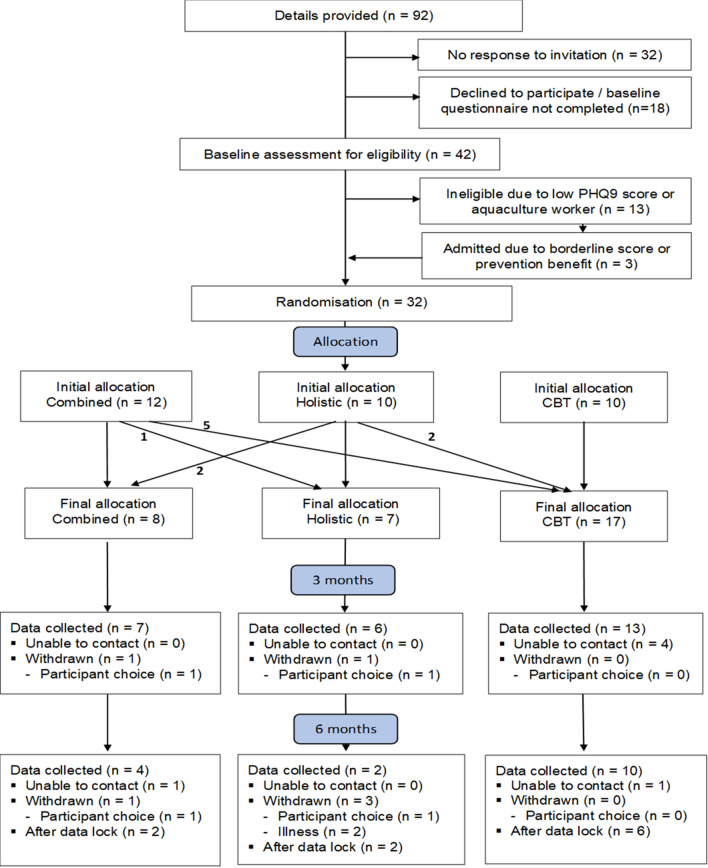
- Allocation after preference changes favored LLTTF-F: final allocations were social/emotional support n = 7, LLTTF-F ± telephone support n = 17, and combined n = 8.
- Process evaluation suggested the interventions were acceptable, but engagement was limited by “lack of time”; guided telephone support was “very valued,” and 23/25 (92%) of LLTTF-F recipients opted for telephone support.
## Methods
- Design: Feasibility randomized controlled trial with a mixed-methods/process evaluation; participants could override randomization if they had a strong preference, and the paper reports per-protocol rather than intention-to-treat analysis.
- Sample/data: Farmers or wider farming-community members in Scotland and northern England, age 18+, with PHQ-9 ≥ 8; 32 provided baseline and 3-month data.
- Analysis: Random allocation to LLTTF-F, RSABI social/emotional support, or both; outcomes focused on change in PHQ-9 and feasibility metrics (recruitment, retention, engagement). The paper reports no statistical analysis beyond baseline vs 3-month PHQ-9 differences because the sample was small.
## Limitations
- The paper states the sample was small, so it did not conduct statistical analysis beyond PHQ-9 differences, and results are only tentative.
- The paper states there was no control group because of logistical and ethical reasons; it notes a waiting-list control could have been an alternative.
- The paper says generalisability is limited by the predominantly male sample and white Scottish or British ethnicity.
- Evident from the text: COVID-19-related delays shortened follow-up for some late recruits, and some outcome/engagement details were incomplete or not reported in detail (for example, RSABI contact outcomes).
Model-written summary. Check it against the paper before relying on it.
Integrity signals
Registry
Cites
Statistics
Figures
Verification
Claims the paper makes
9 Valid · 1 Not valid · 4 Not checked · 58 Own results and interpretations
Every source the paper cites for this claim was checked and supports it.
In the paper
“Recent systematic reviews indicate that farmers are at particular risk of mental health disorders [1, 2].”
§ Improving the mental health of farmers: what types of remote support are acceptable, feasible, and improve outcomes? A feasibility RCT > Introduction
What the sources say
- Supportedcites [1] Daghagh Yazd S Wheeler SA Zuo A Key risk factors affecting farmers’ mental health: a systematic review Int J Environ Res Public Health 2019 16 23 4849 10.3390/ijerph16234849 31810320 PMC6926562 source
The Systematic Review Results (§3.3) report that 20 of 28 studies comparing farmers with other groups suggested worse mental health among farmers. The Discussion (§4) also notes elevated levels of mental disorders in farming populations, while acknowledging mixed comparative evidence. This supports the citing sentence’s broad statement of particular risk. (LLM, conf=0.91)
- Supportedcites [2] Younker T Radunovich HL Farmer mental health interventions: a systematic review Int J Environ Res Public Health 2021 19 1 244 10.3390/ijerph19010244 35010504 PMC8751007 source
The Introduction reports that studies worldwide have documented significantly higher rates of depression, anxiety, and suicide among farmers than in the general population. This supports the claim that farmers are at particular risk of mental health disorders. (LLM, conf=0.94)
hedgedstates an association- Asserted: passes — The authors put it forward as true.
- Checkable: passes — It can be checked against evidence.
- Load-bearing: passes — The paper’s conclusions depend on it.
- Based: passes — The paper gives a reason why it holds.
- Supported
The cited sources support only part of this claim — read each source’s verdict below.
In the paper
“and are often well accepted in rural settings [13, 14].”
§ Improving the mental health of farmers: what types of remote support are acceptable, feasible, and improve outcomes? A feasibility RCT > Introduction
What the sources say
- Partly supportedcites [13] Schure MB Howard M Bailey SJ Bryan B Greist J Exploring perceptions of a computerized cognitive behavior therapy program in a U.S. Rural Western State Rural Mental Health 2018 42 3 174 183 10.1037/rmh0000102 30740195 PMC6366631 sourceExperimental — accuracy not yet measured
The Discussion’s Conclusions say computerized CBT may be acceptable in rural Western communities, and the Abstract reports favorable acceptability findings from rural communities in other countries. But the study concerns computerized CBT specifically, and its Discussion cautions against generalizing its findings to other U.S. regions; it does not establish that CBT-based interventions broadly are often well accepted across rural settings. (LLM, conf=0.85)
- Partly supportedcites [14] Freund J Buntrock C Braun L Thielecke J Baumeister H Berking M Ebert DD Titzler I Digital prevention of depression for farmers? A qualitative study on participants' experiences regarding determinants of acceptance and satisfaction with a tailored guided internet intervention program Internet Interv 2022 29 100566 10.1016/j.invent.2022.100566 36039069 PMC9418375 sourceExperimental — accuracy not yet measured
The Results (Participants and intervention use; page unavailable) report high satisfaction with the online interventions among interviewed farmers, many of whom lived in rural areas. But the Methods (Intervention; page unavailable) say the most frequently chosen training was not CBT-based, and the Limitations note that the small, self-selected interview sample limits representativeness. The study therefore does not establish that CBT-based interventions are often well accepted across rural settings. (LLM, conf=0.87)
plain- Asserted: passes — The authors put it forward as true.
- Checkable: passes — It can be checked against evidence.
- Load-bearing: passes — The paper’s conclusions depend on it.
- Based: passes — The paper gives a reason why it holds.
- Partly supported
The sources with a verdict support this claim; the rest weren’t checked yet, have no full text we could read, or their verdicts aren’t rated yet.
In the paper
“Social factors and community characteristics have an important mediating role in the mental health of the farming population [8, 9].”
§ Improving the mental health of farmers: what types of remote support are acceptable, feasible, and improve outcomes? A feasibility RCT > Introduction
What the sources say
- Not checked — no full text of the sourcecites [8] Stain HJ Kelly B Lewin TJ Higginbotham N Beard JR Hourihan F Social networks and mental health among a farming population Soc Psychiatry Psychiatr Epidemiol 2008 43 10 843 849 10.1007/s00127-008-0374-5 18500480 source
- Supportedcites [9] Roy P Tremblay G Robertson S Houle J “Do it all by myself”: a salutogenic approach of masculine health practice among farming men coping with stress Am J Mens Health 2017 11 5 1536 1546 10.1177/1557988315619677 26634855 PMC5675206 source
The Introduction describes belonging and local social support as key to farmers’ health and wellbeing. The Conceptual framework says these community factors can buffer the effects of stress, supporting the claim’s broad description of their role in mental health. (LLM, conf=0.88)
plainstates an association- Asserted: passes — The authors put it forward as true.
- Checkable: passes — It can be checked against evidence.
- Load-bearing: unclear — It is unclear whether the paper’s conclusions depend on it.
- Based: passes — The paper gives a reason why it holds.
A result the paper reports from its own data — it cites no other source for it, so there is none to check. The quote shows it is in the paper.
In the paper
“The majority (4/6 responders) felt they had followed the advice received.”
§ Improving the mental health of farmers: what types of remote support are acceptable, feasible, and improve outcomes? A feasibility RCT > Results > Engagement with the interventions
plain- Asserted: passes — The authors put it forward as true.
- Checkable: passes — It can be checked against evidence.
- Load-bearing: unclear — It is unclear whether the paper’s conclusions depend on it.
- Based: passes — The paper gives a reason why it holds.
A result the paper reports from its own data — it cites no other source for it, so there is none to check. The quote shows it is in the paper.
In the paper
“with the LLTTF-F CBT-based intervention showing most improvement”
- Also stated in: § Conclusions · plain
“with the LLTTFF providing the largest effect on PHQ-9 scores.”
§ Improving the mental health of farmers: what types of remote support are acceptable, feasible, and improve outcomes? A feasibility RCT > Results > Changes to PHQ-9 scores
plainstates a cause- Asserted: passes — The authors put it forward as true.
- Checkable: passes — It can be checked against evidence.
- Load-bearing: passes — The paper’s conclusions depend on it.
- Based: passes — The paper gives a reason why it holds.
- Also stated in: § Conclusions · plain
23 more claims
Create a free account to see all 72 claims and to verify the 2 references still open.
- Probably not a substantial claim. 26
- It may state two separate claims as one. 22
- The quote only partly states this claim. 1
Self-check
Percentages, sums and reported differences re-computed from the paper’s own numbers.
Rated major: it would touch a result — a value a result rests on, reported and recomputed p-values on opposite sides of the significance level, two passages that conflict with no sign which is right, or a cited work retracted before this paper was published.
In the paper
“where there was a mean fall in PHQ-9 scores of 7.3 (from 111.8 to 4.5).”
§ Improving the mental health of farmers: what types of remote support are acceptable, feasible, and improve outcomes? A feasibility RCT > Discussion
Reported 7.3 · recomputed 107.3
Citations
Cites
R: A Language and Environment for Statistical Computing
R Core Team (2025) · doi:10.32614/r.manuals · Cited by 352,181
Designing and Conducting Mixed Methods Research
Robinson, P. (2007) · Australian and New Zealand Journal of Public Health · doi:10.1111/j.1753-6405.2007.00096.x · Cited by 23,258
(2006) · Cited by 7,081
Baum, F., MacDougall, C., & Smith, D. (2006) · Journal of Epidemiology and Community Health · doi:10.1136/jech.2004.028662 · Cited by 2,420
Psychometric comparison of PHQ-9 and HADS for measuring depression severity in primary care
Cameron, I. M., Crawford, J. R., Lawton, K., & Reid, I. C. (2008) · British Journal of General Practice · doi:10.3399/bjgp08x263794 · Cited by 590 · cited 1×
“The Inclusion criteria were: 18 years and over; a member of the farming community; and experiencing mental health problems based on the completion over the phone of a PHQ-9 questionnaire and a score of > = 8 [25, 26].”
BackgroundKey Risk Factors Affecting Farmers’ Mental Health: A Systematic Review
Daghagh Yazd, S., Wheeler, S. A., & Zuo, A. (2019) · International Journal of Environmental Research and Public Health · doi:10.3390/ijerph16234849 · Cited by 393
Behavioral bibliotherapy: a review of self-help behavior therapy manuals
Glasgow, R. E., & Rosen, G. M. (1978) · Psychological Bulletin · doi:10.1037/0033-2909.85.1.1 · Cited by 351 · cited 1×
“The study would have been strengthened by using a formal structure to assess the components of the low intensity support that was provided by RSABI volunteers, in line with the taxonomy developed by Glasgow and Rosen[27].”
MethodComparison of two self-rating scales to detect depression: HADS and PHQ-9
Hansson, M., Chotai, J., Nordstöm, A., & Bodlund, O. (2009) · British Journal of General Practice · doi:10.3399/bjgp09x454070 · Cited by 246 · cited 1×
“The Inclusion criteria were: 18 years and over; a member of the farming community; and experiencing mental health problems based on the completion over the phone of a PHQ-9 questionnaire and a score of > = 8 [25, 26].”
BackgroundPatterns of suicide by occupation in England and Wales: 2001-2005
Meltzer, H., Griffiths, C., Brock, A., Rooney, C., & Jenkins, R. (2008) · British Journal of Psychiatry · doi:10.1192/bjp.bp.107.040550 · Cited by 147 · cited 3×
“Depression in the farming community is increasing and suicide rates are among the highest in any occupational group in the UK [3].”
BackgroundInfluentialTheoretical versus pragmatic design in qualitative research
Smith, J., Bekker, H., & Cheater, F. (2011) · Nurse Researcher · doi:10.7748/nr2011.01.18.2.39.c8283 · Cited by 140
Farmer Mental Health Interventions: A Systematic Review
Younker, T., & Radunovich, H. L. (2021) · International Journal of Environmental Research and Public Health · doi:10.3390/ijerph19010244 · Cited by 115 · cited 1×
“Recent systematic reviews indicate that farmers are at particular risk of mental health disorders [1, 2].”
BackgroundPsychological Morbidity of Farmers and Non-farming Population: Results from a UK Survey
Hounsome, B., Edwards, R. T., Hounsome, N., & Edwards-Jones, G. (2012) · Community Mental Health Journal · doi:10.1007/s10597-011-9415-8 · Cited by 103
Anxiety and Depression Symptoms Among Farmers: The HUNT Study, Norway
Torske, M. O., Hilt, B., Glasscock, D., Lundqvist, P., & Krokstad, S. (2016) · Journal of Agromedicine · doi:10.1080/1059924x.2015.1106375 · Cited by 96
Social networks and mental health among a farming population
Stain, H. J., Kelly, B., Lewin, T. J., Higginbotham, N., Beard, J. R., & Hourihan, F. (2008) · Social Psychiatry and Psychiatric Epidemiology · doi:10.1007/s00127-008-0374-5 · Cited by 94 · cited 1×
“Social factors and community characteristics have an important mediating role in the mental health of the farming population [8, 9].”
BackgroundRoy, P., Tremblay, G., Robertson, S., & Houle, J. (2017) · American Journal of Men's Health · doi:10.1177/1557988315619677 · Cited by 94
Mental health of British farmers
Thomas, H. V., Lewis, G., Thomas, D. R., Salmon, R. L., Chalmers, R. M., Coleman, T. J., Kench, S. M., Morgan-Capner, P., Meadows, D., Sillis, M., et al. (2003) · Occupational and Environmental Medicine · doi:10.1136/oem.60.3.181 · Cited by 77
Johansson, P., Westas, M., Andersson, G., Alehagen, U., Broström, A., Jaarsma, T., Mourad, G., & Lundgren, J. (2019) · JMIR Mental Health · doi:10.2196/14648 · Cited by 77
King, E., Stephen, K., Wendelboe‐Nelson, C., Williams, C., Stark, C. R., van Woerden, H. C., & Maxwell, M. (2023) · BMC Psychiatry · doi:10.1186/s12888-023-04806-9 · Cited by 64 · cited 3×
“The qualitative aspects of this study have been published elsewhere [17].”
BackgroundMethodInfluentialSelf-citationPsycho-social intervention following attempted suicide: is there a case for better services?
House, A., Owens, D., & Storer, D. (1992) · International Review of Psychiatry · doi:10.3109/09540269209066298 · Cited by 38 · cited 1×
“Psychological and social interventions provide different types of support, and combined approaches may be optimal [15, 16].”
BackgroundExploring Community-Based Suicide Prevention in the Context of Rural Australia: A Qualitative Study
Grattidge, L., Hoang, H., Mond, J., Lees, D., Visentin, D., & Auckland, S. (2023) · International Journal of Environmental Research and Public Health · doi:10.3390/ijerph20032644 · Cited by 25 · cited 1×
“There has been a recent encouraging growth in studies addressing mental health and suicide prevention in farming communities, with the publication of a range of qualitative studies in different parts of the world [14, 28–31], and a number of intervention studies [32–34].”
BackgroundBalcombe, L., & Leo, D. D. (2022) · Frontiers in Psychology · doi:10.3389/fpsyg.2021.796371 · Cited by 24
Gunn, K. M., Skaczkowski, G., Dollman, J., Vincent, A. D., Brumby, S., Short, C. E., & Turnbull, D. (2023) · Journal of Agromedicine · doi:10.1080/1059924x.2022.2156642 · Cited by 20
Farmer Suicide in Wisconsin: A Qualitative Analysis
Kohlbeck, S., Schramm, A., deRoon‐Cassini, T., Hargarten, S., & Quinn, K. (2022) · The Journal of Rural Health · doi:10.1111/jrh.12622 · Cited by 18
Nye, C., Winter, M., & Lobley, M. (2023) · Journal of Agromedicine · doi:10.1080/1059924x.2023.2176959 · Cited by 18 · cited 1×
“…to their own communities for support than to health or social work authorities, with many preferring to engage with advice from respected members within their communities, such as veterinary surgeons (Vets), or use anonymous sources of support such as the internet or self-help booklets [10, 11].”
Background“I’ve given up”: Biopsychosocial factors preceding farmer suicide in Wisconsin.
Kohlbeck, S. A., Quinn, K., deRoon-Cassini, T., Hargarten, S., Nelson, D., & Cassidy, L. (2023) · American Journal of Orthopsychiatry · doi:10.1037/ort0000662 · Cited by 12 · cited 1×
“There has been a recent encouraging growth in studies addressing mental health and suicide prevention in farming communities, with the publication of a range of qualitative studies in different parts of the world [14, 28–31], and a number of intervention studies [32–34].”
BackgroundFreund, J., Buntrock, C., Braun, L., Thielecke, J., Baumeister, H., Berking, M., Ebert, D. D., & Titzler, I. (2022) · Internet Interventions · doi:10.1016/j.invent.2022.100566 · Cited by 11 · cited 2×
“There has been a recent encouraging growth in studies addressing mental health and suicide prevention in farming communities, with the publication of a range of qualitative studies in different parts of the world [14, 28–31], and a number of intervention studies [32–34].”
BackgroundSchure, M. B., Howard, M., Bailey, S. J., Bryan, B., & Greist, J. (2018) · Journal of Rural Mental Health · doi:10.1037/rmh0000102 · Cited by 10 · cited 2×
“Interactive computerised cognitive behaviour therapy has been found to be acceptable in U.S. rural communities in relation to privacy, accessibility, user-friendliness and cultural appropriateness [13].”
BackgroundThe Agrarian distress: Factors explaining the will to live among rural and distressed family farmers
Kandlur, R., Sardana, S. M., & Richardson-Vejlgaard, R. (2021) · Psychiatry Research Communications · doi:10.1016/j.psycom.2021.100019 · Cited by 10 · cited 1×
“Supportive interventions clearly need to be incorporated into national strategy on farming and agricultural community development [35–37].”
BackgroundDabkowski, E., Porter, J. E., Barbagallo, M. S., Prokopiv, V., & Jackson, M. R. (2022) · International Journal of Environmental Research and Public Health · doi:10.3390/ijerph19127007 · Cited by 9 · cited 1×
“Supportive interventions clearly need to be incorporated into national strategy on farming and agricultural community development [35–37].”
BackgroundThielecke, J., Buntrock, C., Titzler, I., Braun, L., Freund, J., Berking, M., Baumeister, H., & Ebert, D. D. (2024) · Journal of Telemedicine and Telecare · doi:10.1177/1357633x221106027 · Cited by 8 · cited 1×
“There has been a recent encouraging growth in studies addressing mental health and suicide prevention in farming communities, with the publication of a range of qualitative studies in different parts of the world [14, 28–31], and a number of intervention studies [32–34].”
Symptoms of depression and all-cause mortality in farmers, a cohort study: the HUNT study, Norway
Letnes, J. M., Torske, M. O., Hilt, B., Bjørngaard, J. H., & Krokstad, S. (2016) · BMJ Open · doi:10.1136/bmjopen-2015-010783 · Cited by 7 · cited 1×
“Depression in farmers increases with age, and is higher in males, and symptoms of depression are associated with a 13% increase in sex-adjusted and age-adjusted mortality [4–7].”
BackgroundNason, E. E., Blankenship, A. S., Benevides, E., & Stump, K. (2023) · Social Work in Public Health · doi:10.1080/19371918.2022.2093305 · Cited by 5 · cited 1×
“Psychological and social interventions provide different types of support, and combined approaches may be optimal [15, 16].”
BackgroundKaur, H., Singh, A., & Singh, S. (2022) · Understanding Psychology in the Context of Relationship, Community, Workplace and Culture · doi:10.1007/978-981-19-2693-8_6 · Cited by 3
Rural Perspectives on Suicide Prevention in Canada
Thomson, A. E., Waddell-Henowitch, C., Herron, R., Epp, D., Rauch, K., Ryan, K. D., & Mullins, S. (2023) · Canadian Journal of Community Mental Health · doi:10.7870/cjcmh-2023-003 · Cited by 2
Research works printed but not linked: 1
- Health NIf, Guideline CE: National clinical practice guideline 90: depression the NICE guidelines on the treatment and management of depression in adults-the updated edition. In. London: The British Psychological Society and The Royal College of Psychiatrists; 2010.
Cited by
Purc‐Stephenson, R. J., Dedrick, S., & Hood, D. (2024) · BMC Psychology · doi:10.1186/s40359-024-01929-w · Cited by 12
Creating an Age-Friendly Environment in Farming – The Farmer’s Yards Approach
Conway, S. F., Farrell, M., McDonagh, J., & Nolan, N. (2024) · Journal of Agromedicine · doi:10.1080/1059924x.2024.2383730 · Cited by 8
“7,12 A thorough investigation into the extent to which older farmers themselves can be involved in the co-production of a comprehensive set of age-friendly policies, strategies and practices that are responsive to their needs and requirements in the agricultural sector as they age is also…”
Farmer Stress & Coping: Qualitative Study from Hawaiʻi
Le, T. N., & Brown, E. (2024) · OBM Integrative and Complementary Medicine · doi:10.21926/obm.icm.2404070 · Cited by 1
Farmers’ Mental Health in the Fourth Agricultural Revolution
Rose, D. C. (2026) · Springer eBooks · doi:10.1007/978-3-032-24552-6_6 · Cited by 1
Metadata
- Authors
- Lamont, K., van Woerden, H. C., King, E., Wendelboe-Nelson, C., Humphry, R. W., Stark, C., Williams, C., & Maxwell, M.
- Affiliations
- University of Stirling (GB)
- Scotland's Rural College (GB)
- University of the Highlands and Islands (GB)
- University of Glasgow (GB)
- Corresponding author
- Maxwell, Margaret
- Venue
- Discover Mental Health
- Published
- 2024-01-04
- Volume
- 4
- Issue
- 1
- Pages
- 4-4
- ISSN
- 2731-4383 (ISSN-L)
- PMC
- PMC10766572
- OpenAlex
- W4390579792
- Cited by
- 5
- References
- 35
- Citations by year
- 2026: 2 · 2024: 3
- FWCI
- 2.36
- Type
- journal article
- Language
- en
- Open access
- gold
- doi.org
- Licence
- cc-by
- creativecommons.org/licenses/by/4.0 (tdm)
- creativecommons.org/licenses/by/4.0 (vor)
- Locations
- Discover Mental Health (publishedVersion, cc-by)
- PubMed Central (publishedVersion, cc-by)
- PubMed (publishedVersion)
- ENLIGHTEN (Jurnal Bimbingan dan Konseling Islam) (acceptedVersion, cc-by-sa)
- Stirling Online Research Repository (University of Stirling) (submittedVersion, cc-by)
- DOAJ (DOAJ: Directory of Open Access Journals) (submittedVersion, cc-by-sa)
- Edinburgh Research Explorer (University of Edinburgh) (submittedVersion, cc-by)
- Funders
- Chief Scientist Office, Scottish Government Health and Social Care Directorate (HIPS 19/51)
- Topics
- Health Sciences › Medicine › Psychiatry and Mental health › Mental Health Treatment and Access
- Social Sciences › Psychology › Applied Psychology › Digital Mental Health Interventions
- Health Sciences › Medicine › Public Health, Environmental and Occupational Health › Agriculture and Farm Safety
- Keywords
- farmer mental health, depression, cognitive behavioral therapy, remote support, socioemotional support, PHQ-9, intervention feasibility, participant recruitment, participant retention, rural mental health services
About these checks
Registry, retraction, Cites and statistics results are computed, not judged, with one exception: a printed reference that no index lists is read once by a model before it counts as a citation error. Claims are extracted by a model and kept only when their quote appears verbatim in the text; each cited source is then checked, with a model’s help, for whether it says what the claim relies on. Those verdicts can be wrong — read the claim’s quote and the cited source before relying on one.
The claim verdicts this report counts are experimental: their accuracy is not yet measured.
A language model drew the claims from the paper on 2026-10-11, under version 3 of the claim definition (model deepseek-v4.1-flash, prompt extract-v3).
A second model labelled each claim on 2026-10-11 (model jev-1.13-20260917, definition revision gold-guideline-v0.2).
Cited sources are checked with a language model’s help (gpt-6-sol).
Statistics and arithmetic are recomputed, not judged.
Confidence bands are shown only for fields calibrated on our annotated test set. None is calibrated yet, so no band is shown.
What counts as a claim ›How we measure confidence ›How we check this ›
Are you an author, or do you see a problem with this page? Request a review
Data sources
Bibliographic data: Semantic Scholar, OpenAlex, Crossref.
Contains information from the Semantic Scholar Academic Graph Datasets, made available under the ODC Attribution License (ODC-BY 1.0).
Semantic Scholar’s data is described in: Kinney, R., et al. (2023). The Semantic Scholar Open Data Platform. arXiv:2301.10140.
