

Identity rather than 3D position informs splicing of rare introns in the human genome
Open accessThe DOI matches its Crossref record; 122 of the 122 references it cites were found in a registry or an index; none of the 48 sources its claims cite is checked for support yet.
Abstract
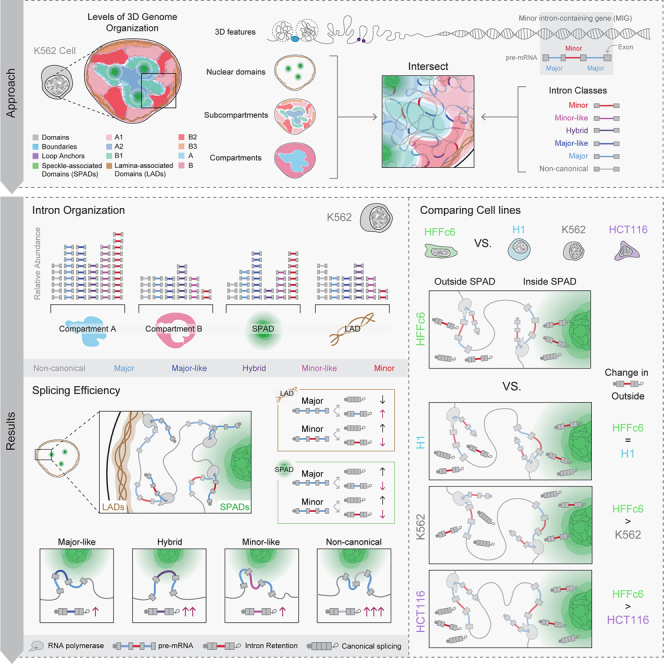
Three-dimensional genome organization influences splicing, yet how introns, particularly rare introns, are arranged within the nucleus and whether this organization contributes to splicing have not been fully explored. We mapped the organization of six intron classes, major, minor, minor-like, hybrid, major-like, and non-canonical, across four human cell lines using Hi-C, TSA-seq, and DamID-seq. Minor intron-containing genes and their introns were enriched in compartment A and speckle-associated domains (SPADs) and depleted from lamina-associated domains. Integrating TSA-seq with RNA-seq indicated that splicing efficiency depends on intron identity rather than position. For example, despite shared SPAD proximity, major-like and minor-like introns were less efficiently spliced than major and minor introns. While minor introns in SPADs were consistently efficiently spliced, minor introns outside SPADs were more efficiently spliced in cancer cells. These findings reveal subclass-specific intron organization, yet identity rather than position governs splicing efficiency, particularly for minor introns in cancer cells.
Overview
CoChat Summary
TL;DR
This study maps six intron classes across four human cell lines and finds that minor introns are enriched in compartment A and speckle-associated domains (SPADs) and depleted from lamina-associated domains (LADs). Splicing efficiency is governed primarily by intron identity rather than 3D position, with minor introns consistently efficiently spliced in SPADs and, in cancer cells, also outside SPADs.
Key findings
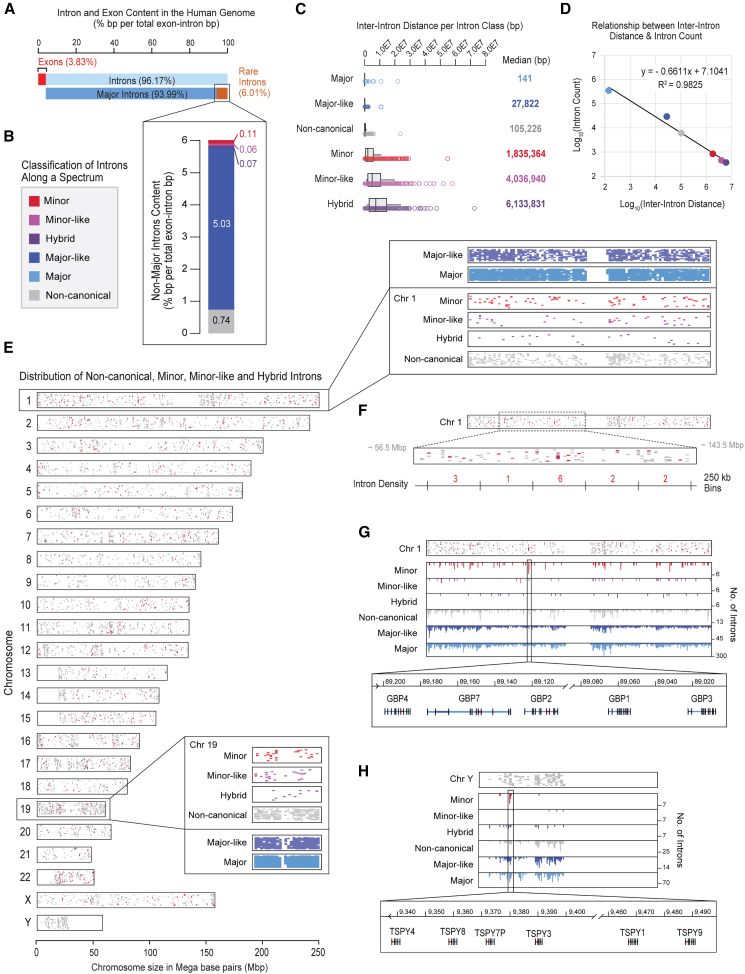
- Rare introns are dispersed across the linear genome; median inter-intron distance increases with rarity: major 141 bp, major-like 27 kb, non-canonical 105 kb, minor 1.8e06 bp, minor-like 4.0e06 bp, and hybrid 6.1e06 bp, with a near-linear relationship between inter-intron distance and intron abundance (R² = 0.98).
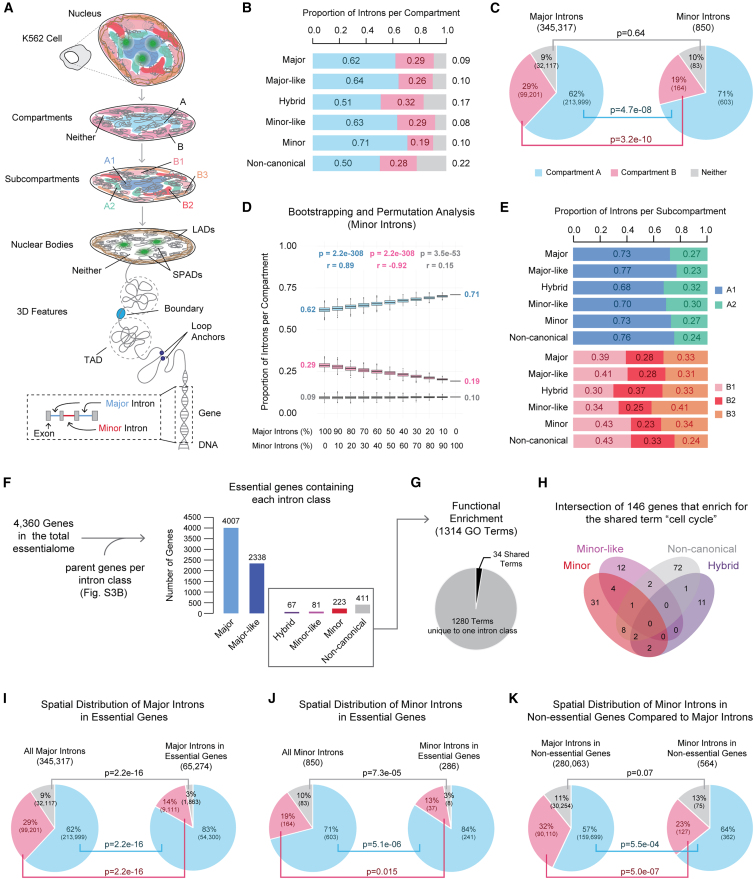
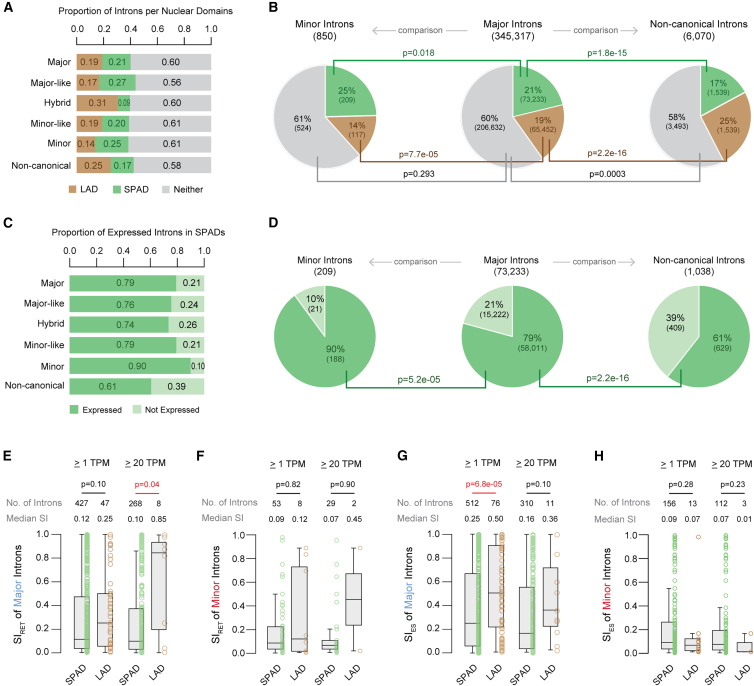
- Minor introns are enriched in compartment A (71% vs 62% of major introns; p = 4.7e-08) and SPADs (25% vs 21% of major introns; p = 0.018), and depleted from LADs (14% vs 19% of major introns; p = 7.7e-05).
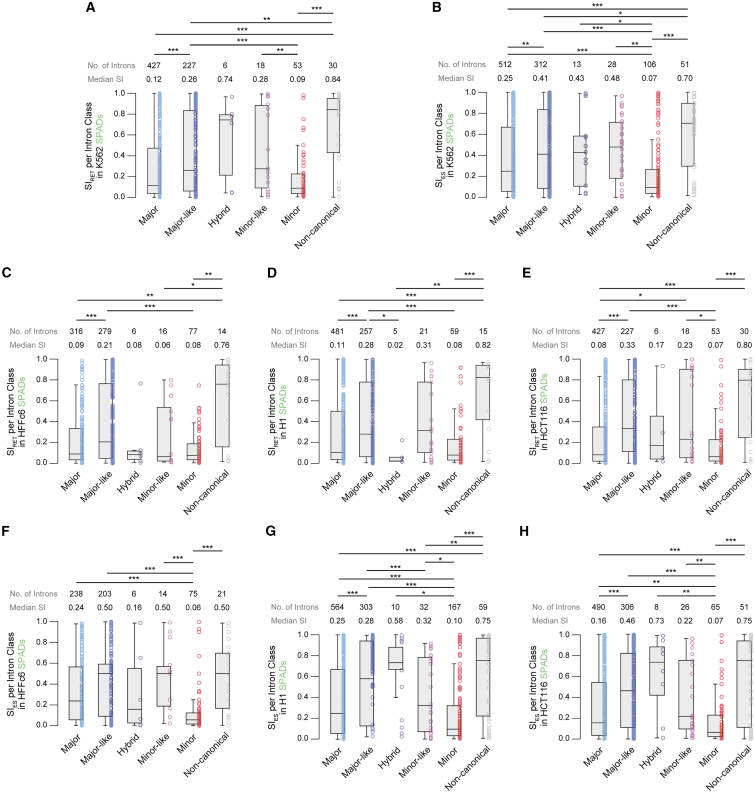
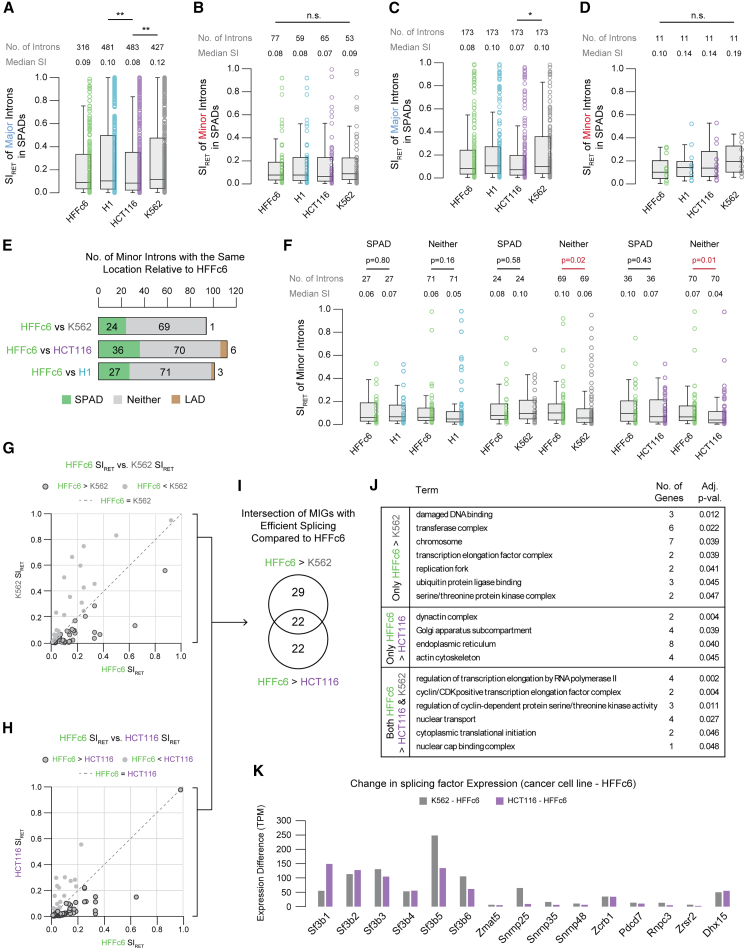
- Within SPADs, major and minor introns are efficiently spliced, whereas major-like and minor-like introns show higher intron retention than their major/minor counterparts; non-canonical introns show high retention and exon skipping. Minor introns in SPADs are consistently efficiently spliced across K562, HFFc6, H1, and HCT116 cells.
- Minor introns outside SPADs are more efficiently spliced in cancer cells (K562 and HCT116) than in non-cancerous HFFc6 fibroblasts; MIGs with enhanced splicing in both cancer cell lines are enriched for cell cycle regulators.
Methods
- Public Hi-C, TSA-seq, DamID-seq, and RNA-seq datasets from K562, HFFc6, H1, and HCT116 cells were used; introns were classified into major, major-like, hybrid, minor-like, minor, and non-canonical classes using position weight matrices and mapped to compartments, subcompartments, SPADs, LADs, TADs, loop anchors, and boundaries.
- Bootstrapping and pollution analyses tested whether spatial biases were tethered to intron identity; splicing was quantified as intron retention and exon skipping using modified bioinformatics pipelines, with statistical testing by Fisher’s exact test, Mann-Whitney U, Kruskal-Wallis with Dunn post hoc, and Gene Ontology enrichment.
Limitations
- Stated in the paper: small numbers of minor-like and hybrid introns limit statistical power; strict expression and read-coverage thresholds further reduce analyzable introns; the chosen cell lines had vertically integrated datasets, so additional cell lines or new data could not be included; donor sex, gender, ancestry, race, and ethnicity were not reported and were not evaluated.
- Evident from the text: minor intron LAD comparisons were based on only 8 and 2 minor introns at ≥1 and ≥20 TPM thresholds, respectively; only 6 hybrid introns in SPADs had sufficient data for splicing analysis; the shared minor intron set across all four cell lines was 11 introns.
Model-written summary. Check it against the paper before relying on it.
Integrity signals
Registry
Cites
Statistics
Figures
Verification
Claims the paper makes
0 Valid · 0 Not valid · 25 Not checked · 185 Own results and interpretations
A result the paper reports from its own data — it cites no other source for it, so there is none to check. The quote shows it is in the paper.
In the paper
“For example, despite shared SPAD proximity, major-like and minor-like introns were less efficiently spliced than major and minor introns.”
§ Identity rather than 3D position informs splicing of rare introns in the human genome > Abstract
plainstates an association- Asserted: passes — The authors put it forward as true.
- Checkable: passes — It can be checked against evidence.
- Load-bearing: passes — The paper’s conclusions depend on it.
- Based: passes — The paper gives a reason why it holds.
- Rests on an assumption not shown here.
A result the paper reports from its own data — it cites no other source for it, so there is none to check. The quote shows it is in the paper.
In the paper
“While minor introns in SPADs were consistently efficiently spliced, minor introns outside SPADs were more efficiently spliced in cancer cells.”
§ Identity rather than 3D position informs splicing of rare introns in the human genome > Abstract
plainn = 4- Asserted: passes — The authors put it forward as true.
- Checkable: passes — It can be checked against evidence.
- Load-bearing: unclear — It is unclear whether the paper’s conclusions depend on it.
- Based: passes — The paper gives a reason why it holds.
- Rests on an assumption not shown here.
A result the paper reports from its own data — it cites no other source for it, so there is none to check. The quote shows it is in the paper.
In the paper
“Minor intron-containing genes and their introns were enriched in compartment A and speckle-associated domains (SPADs) and depleted from lamina-associated domains.”
- Also stated in: § Intron classes show distinct spatial biases, notably the enrichment of minor introns in compartment A · plain
“71% of minor introns were significantly enriched in compartment A (Figures 2B and 2C; p = 4.7e-08)”
§ Identity rather than 3D position informs splicing of rare introns in the human genome > Abstract
plainstates an associationn = 4 ·- Asserted: passes — The authors put it forward as true.
- Checkable: passes — It can be checked against evidence.
- Load-bearing: unclear — It is unclear whether the paper’s conclusions depend on it.
- Based: passes — The paper gives a reason why it holds.
- Also stated in: § Intron classes show distinct spatial biases, notably the enrichment of minor introns in compartment A · plain
A result the paper reports from its own data — it cites no other source for it, so there is none to check. The quote shows it is in the paper.
In the paper
“While minor introns in SPADs were consistently efficiently spliced, minor introns outside SPADs were more efficiently spliced in cancer cells.”
§ Identity rather than 3D position informs splicing of rare introns in the human genome > Abstract
plainstates an association- Asserted: passes — The authors put it forward as true.
- Checkable: passes — It can be checked against evidence.
- Load-bearing: passes — The paper’s conclusions depend on it.
- Based: passes — The paper gives a reason why it holds.
- Rests on 2 assumptions not shown here.
A result the paper reports from its own data — it cites no other source for it, so there is none to check. The quote shows it is in the paper.
In the paper
“Minor intron-containing genes and their introns were enriched in compartment A and speckle-associated domains (SPADs) and depleted from lamina-associated domains.”
§ Identity rather than 3D position informs splicing of rare introns in the human genome > Abstract
plainstates an associationn = 4- Asserted: passes — The authors put it forward as true.
- Checkable: passes — It can be checked against evidence.
- Load-bearing: passes — The paper’s conclusions depend on it.
- Based: passes — The paper gives a reason why it holds.
117 more claims
Create a free account to see all 210 claims and to verify the 48 references still open.
- It may state two separate claims as one. 72
- Probably not a substantial claim. 24
Citations
Cites
BEDTools: a flexible suite of utilities for comparing genomic features
Quinlan, A. R., & Hall, I. M. (2010) · Bioinformatics · doi:10.1093/bioinformatics/btq033 · Cited by 27,437
HISAT: a fast spliced aligner with low memory requirements
Kim, D., Langmead, B., & Salzberg, S. L. (2015) · Nature Methods · doi:10.1038/nmeth.3317 · Cited by 24,112
Graph-based genome alignment and genotyping with HISAT2 and HISAT-genotype
Kim, D., Paggi, J. M., Park, C., Bennett, C., & Salzberg, S. L. (2019) · Nature Biotechnology · doi:10.1038/s41587-019-0201-4 · Cited by 15,022
Data Structures for Statistical Computing in Python
McKinney, W. (2010) · Proceedings of the Python in Science Conference · doi:10.25080/majora-92bf1922-00a · Cited by 11,032
MultiQC: summarize analysis results for multiple tools and samples in a single report
Ewels, P., Magnusson, M., Lundin, S., & Käller, M. (2016) · Bioinformatics · doi:10.1093/bioinformatics/btw354 · Cited by 10,143
A 3D Map of the Human Genome at Kilobase Resolution Reveals Principles of Chromatin Looping
Rao, S. S. P., Huntley, M. H., Durand, N. C., Stamenova, E. K., Bochkov, I. D., Robinson, J. T., Sanborn, A. L., Machol, I., Omer, A. D., Lander, E. S., et al. (2014) · Cell · doi:10.1016/j.cell.2014.11.021 · Cited by 9,212
Comprehensive Mapping of Long-Range Interactions Reveals Folding Principles of the Human Genome
Lieberman-Aiden, E., van Berkum, N. L., Williams, L., Imakaev, M., Ragoczy, T., Telling, A., Amit, I., Lajoie, B. R., Sabo, P. J., Dorschner, M. O., et al. (2009) · Science · doi:10.1126/science.1181369 · Cited by 8,898
Topological domains in mammalian genomes identified by analysis of chromatin interactions
Dixon, J. R., Selvaraj, S., Yue, F., Kim, A., Li, Y., Shen, Y., Hu, M., Liu, J. S., & Ren, B. (2012) · Nature · doi:10.1038/nature11082 · Cited by 6,829
Landscape of transcription in human cells
Djebali, S., Davis, C. A., Merkel, A., Dobin, A., Lassmann, T., Mortazavi, A., Tanzer, A., Lagarde, J., Lin, W., Schlesinger, F., et al. (2012) · Nature · doi:10.1038/nature11233 · Cited by 5,187
Aligning sequence reads, clone sequences and assembly contigs with BWA-MEM
Li, H. (2013) · DROPS (Schloss Dagstuhl – Leibniz Center for Informatics) · doi:10.48550/arxiv.1303.3997 · Cited by 5,159
Juicer Provides a One-Click System for Analyzing Loop-Resolution Hi-C Experiments
Durand, N. C., Shamim, M. S., Machol, I., Rao, S. S. P., Huntley, M. H., Lander, E. S., & Aiden, E. L. (2016) · Cell Systems · doi:10.1016/j.cels.2016.07.002 · Cited by 3,836
Human chronic myelogenous leukemia cell-line with positive Philadelphia chromosome
Lozzio, C., & Lozzio, B. (1975) · Blood · doi:10.1182/blood.v45.3.321.321 · Cited by 2,995
Spatial partitioning of the regulatory landscape of the X-inactivation centre
Nora, E. P., Lajoie, B. R., Schulz, E. G., Giorgetti, L., Okamoto, I., Servant, N., Piolot, T., van Berkum, N. L., Meisig, J., Sedat, J., et al. (2012) · Nature · doi:10.1038/nature11049 · Cited by 2,895
Leinonen, R., Sugawara, H., Shumway, M., & on behalf of the International Nucleotide Sequence Database Collaboration (2011) · Nucleic Acids Research · doi:10.1093/nar/gkq1019 · Cited by 2,746
Formation of chromosomal domains by loop extrusion
Fudenberg, G., Imakaev, M., Lu, C., Goloborodko, A., Abdennur, N., & Mirny, L. A. (2016) · Cell Reports · doi:10.1016/j.celrep.2016.04.085 · Cited by 2,003
Three-dimensional folding and functional organization principles of the Drosophila genome
Sexton, T., Yaffe, E., Kenigsberg, E., Bantignies, F., Leblanc, B., Hoichman, M., Parrinello, H., Tanay, A., & Cavalli, G. (2012) · Cell · doi:10.1016/j.cell.2012.01.010 · Cited by 1,983
Meyers, R. M., Bryan, J. G., McFarland, J. M., Weir, B. A., Sizemore, A. E., Xu, H., Dharia, N. V., Montgomery, P. G., Cowley, G. S., Pantel, S., et al. (2017) · Nature Genetics · doi:10.1038/ng.3984 · Cited by 1,952
Sanborn, A. L., Rao, S. S. P., Huang, S.-C., Durand, N. C., Huntley, M. H., Jewett, A. I., Bochkov, I. D., Chinnappan, D., Cutkosky, A., Li, J., et al. (2015) · Proceedings of the National Academy of Sciences · doi:10.1073/pnas.1518552112 · Cited by 1,730
Kolberg, L., Raudvere, U., Kuzmin, I., Adler, P., Vilo, J., & Peterson, H. (2023) · Nucleic Acids Research · doi:10.1093/nar/gkad347 · Cited by 1,673
Multiscale 3D Genome Rewiring during Mouse Neural Development
Bonev, B., Mendelson Cohen, N., Szabo, Q., Fritsch, L., Papadopoulos, G. L., Lubling, Y., Xu, X., Lv, X., Hugnot, J.-P., Tanay, A., et al. (2017) · Cell · doi:10.1016/j.cell.2017.09.043 · Cited by 1,338
Lamina-Associated Domains: Links with Chromosome Architecture, Heterochromatin, and Gene Repression
van Steensel, B., & Belmont, A. S. (2017) · Cell · doi:10.1016/j.cell.2017.04.022 · Cited by 1,140
Exon Recognition in Vertebrate Splicing
Berget, S. M. (1995) · Journal of Biological Chemistry · doi:10.1074/jbc.270.6.2411 · Cited by 1,086
Nuclear speckles: a model for nuclear organelles
Lamond, A. I., & Spector, D. L. (2003) · Nature Reviews Molecular Cell Biology · doi:10.1038/nrm1172 · Cited by 1,000
Nonparametric Pairwise Multiple Comparisons in Independent Groups using Dunn's Test
Dinno, A. (2015) · The Stata Journal: Promoting communications on statistics and Stata · doi:10.1177/1536867x1501500117 · Cited by 957
Higher-Order Inter-chromosomal Hubs Shape 3D Genome Organization in the Nucleus
Quinodoz, S. A., Ollikainen, N., Tabak, B., Palla, A., Schmidt, J. M., Detmar, E., Lai, M. M., Shishkin, A. A., Bhat, P., Takei, Y., et al. (2018) · Cell · doi:10.1016/j.cell.2018.05.024 · Cited by 892 · cited 1×
“4,32,59,62,63,90,91 Given the observed enrichment of minor introns and expressed MIGs in compartment A, we next asked whether minor introns were also enriched near nuclear speckles.”
Spector, D. L., & Lamond, A. I. (2011) · Cold Spring Harbor Perspectives in Biology · doi:10.1101/cshperspect.a000646 · Cited by 819
Lerner, E. A., Lerner, M. R., Janeway, C. A., & Steitz, J. A. (1981) · Proceedings of the National Academy of Sciences · doi:10.1073/pnas.78.5.2737 · Cited by 718
The dynamics of a pre-mRNA splicing factor in living cells
Misteli, T., Cáceres, J. F., & Spector, D. L. (1997) · Nature · doi:10.1038/387523a0 · Cited by 619
The β-globin nuclear compartment in development and erythroid differentiation
Palstra, R.-J., Tolhuis, B., Splinter, E., Nijmeijer, R., Grosveld, F., & de Laat, W. (2003) · Nature Genetics · doi:10.1038/ng1244 · Cited by 559
U2 as well as U1 small nuclear ribonucleoproteins are involved in premessenger RNA splicing
Black, D. L., Chabot, B., & Steitz, J. A. (1985) · Cell · doi:10.1016/0092-8674(85)90270-3 · Cited by 535
Pybedtools: a flexible Python library for manipulating genomic datasets and annotations
Dale, R. K., Pedersen, B. S., & Quinlan, A. R. (2011) · Bioinformatics · doi:10.1093/bioinformatics/btr539 · Cited by 520
Dynamics of CTCF- and cohesin-mediated chromatin looping revealed by live-cell imaging
Gabriele, M., Brandão, H. B., Grosse-Holz, S., Jha, A., Dailey, G. M., Cattoglio, C., Hsieh, T.-H. S., Mirny, L., Zechner, C., & Hansen, A. S. (2022) · Science · doi:10.1126/science.abn6583 · Cited by 506
Splicing double: insights from the second spliceosome
Patel, A. A., & Steitz, J. A. (2003) · Nature Reviews Molecular Cell Biology · doi:10.1038/nrm1259 · Cited by 478
Biomolecular Condensates in the Nucleus
Sabari, B. R., Dall’Agnese, A., & Young, R. A. (2020) · Trends in Biochemical Sciences · doi:10.1016/j.tibs.2020.06.007 · Cited by 467
Rogozin, I. B., Wolf, Y. I., Sorokin, A. V., Mirkin, B. G., & Koonin, E. V. (2003) · Current Biology · doi:10.1016/s0960-9822(03)00558-x · Cited by 445
Mapping 3D genome organization relative to nuclear compartments using TSA-Seq as a cytological ruler
Chen, Y., Zhang, Y., Wang, Y., Zhang, L., Brinkman, E. K., Adam, S. A., Goldman, R., van Steensel, B., Ma, J., & Belmont, A. S. (2018) · Journal of Cell Biology · doi:10.1083/jcb.201807108 · Cited by 441
A multicomponent complex is involved in the splicing of messenger RNA precursors
GRABOWSKI, P., SEILER, S., & SHARP, P. (1985) · Cell · doi:10.1016/s0092-8674(85)80130-6 · Cited by 433
Small RNA species of the HeLa cell: Metabolism and subcellular localization
Zieve, G., & Penman, S. (1976) · Cell · doi:10.1016/0092-8674(76)90181-1 · Cited by 417
Comprehensive splice-site analysis using comparative genomics
Sheth, N., Roca, X., Hastings, M. L., Roeder, T., Krainer, A. R., & Sachidanandam, R. (2006) · Nucleic Acids Research · doi:10.1093/nar/gkl556 · Cited by 412
RNA promotes the formation of spatial compartments in the nucleus
Quinodoz, S. A., Jachowicz, J. W., Bhat, P., Ollikainen, N., Banerjee, A. K., Goronzy, I. N., Blanco, M. R., Chovanec, P., Chow, A., Markaki, Y., et al. (2021) · Cell · doi:10.1016/j.cell.2021.10.014 · Cited by 388
The spliceosome: the most complex macromolecular machine in the cell?
Nilsen, T. W. (2003) · BioEssays · doi:10.1002/bies.10394 · Cited by 378
The significant other: splicing by the minor spliceosome
Turunen, J. J., Niemelä, E. H., Verma, B., & Frilander, M. J. (2013) · WIREs RNA · doi:10.1002/wrna.1141 · Cited by 349
Live-cell imaging reveals enhancer-dependent Sox2 transcription in the absence of enhancer proximity
Alexander, J. M., Guan, J., Li, B., Maliskova, L., Song, M., Shen, Y., Huang, B., Lomvardas, S., & Weiner, O. D. (2019) · eLife · doi:10.7554/elife.41769 · Cited by 346
A Novel Spliceosome Containing U11, U12, and U5 snRNPs Excises a Minor Class (AT–AC) Intron In Vitro
Tarn, W.-Y., & Steitz, J. A. (1996) · Cell · doi:10.1016/s0092-8674(00)81057-0 · Cited by 340
Decreased Enhancer-Promoter Proximity Accompanying Enhancer Activation
Benabdallah, N. S., Williamson, I., Illingworth, R. S., Kane, L., Boyle, S., Sengupta, D., Grimes, G. R., Therizols, P., & Bickmore, W. A. (2019) · Molecular Cell · doi:10.1016/j.molcel.2019.07.038 · Cited by 335
A reappraisal of non-consensus mRNA splice sites
Jackson, L. J. (1991) · Nucleic Acids Research · doi:10.1093/nar/19.14.3795 · Cited by 318
Proteomic Analysis of Interchromatin Granule Clusters
Saitoh, N., Spahr, C. S., Patterson, S. D., Bubulya, P., Neuwald, A. F., & Spector, D. L. (2004) · Molecular Biology of the Cell · doi:10.1091/mbc.e04-03-0253 · Cited by 305
The relationship between genome structure and function
Oudelaar, A. M., & Higgs, D. R. (2021) · Nature Reviews Genetics · doi:10.1038/s41576-020-00303-x · Cited by 304
Evolutionary Fates and Origins of U12-Type Introns
Burge, C. B., Padgett, R. A., & Sharp, P. A. (1998) · Molecular Cell · doi:10.1016/s1097-2765(00)80292-0 · Cited by 304
ggplot2:Elegant Graphics for Data Analysis
Valero-Mora, P. M. (2010) · Journal of Statistical Software · doi:10.18637/jss.v035.b01 · Cited by 303
Pairtools: From sequencing data to chromosome contacts
Open2C, Abdennur, N., Fudenberg, G., Flyamer, I. M., Galitsyna, A. A., Goloborodko, A., Imakaev, M., & Venev, S. V. (2024) · PLOS Computational Biology · doi:10.1371/journal.pcbi.1012164 · Cited by 279
Dundr, M., & Misteli, T. (2010) · Cold Spring Harbor Perspectives in Biology · doi:10.1101/cshperspect.a000711 · Cited by 273
Region Capture Micro-C reveals coalescence of enhancers and promoters into nested microcompartments
Goel, V. Y., Huseyin, M. K., & Hansen, A. S. (2023) · Nature Genetics · doi:10.1038/s41588-023-01391-1 · Cited by 271
Cohesin and CTCF control the dynamics of chromosome folding
Mach, P., Kos, P. I., Zhan, Y., Cramard, J., Gaudin, S., Tünnermann, J., Marchi, E., Eglinger, J., Zuin, J., Kryzhanovska, M., et al. (2022) · Nature Genetics · doi:10.1038/s41588-022-01232-7 · Cited by 269
SON and SRRM2 are essential for nuclear speckle formation
Ilik, İ. A., Malszycki, M., Lübke, A. K., Schade, C., Meierhofer, D., & Aktaş, T. (2020) · eLife · doi:10.7554/elife.60579 · Cited by 267
Vernimmen, D., Gobbi, M. D., Sloane‐Stanley, J. A., Wood, W. G., & Higgs, D. R. (2007) · The EMBO Journal · doi:10.1038/sj.emboj.7601654 · Cited by 244
Nuclear compartmentalization as a mechanism of quantitative control of gene expression
Bhat, P., Honson, D., & Guttman, M. (2021) · Nature Reviews Molecular Cell Biology · doi:10.1038/s41580-021-00387-1 · Cited by 238
Highly Diverged U4 and U6 Small Nuclear RNAs Required for Splicing Rare AT-AC Introns
Tarn, W.-Y., & Steitz, J. A. (1996) · Science · doi:10.1126/science.273.5283.1824 · Cited by 227
Immunoelectron microscopic localization of snRNPs
Spector, D. L., Schrier, W. H., & Busch, H. (1984) · Biology of the Cell · doi:10.1111/j.1768-322x.1984.tb00215.x · Cited by 223
Anand, L., & Rodriguez Lopez, C. M. (2022) · BMC Bioinformatics · doi:10.1186/s12859-021-04556-z · Cited by 216
In vivo evidence that transcription and splicing are coordinated by a recruiting mechanism
JIMENEZGARCIA, L. (1993) · Cell · doi:10.1016/0092-8674(93)90159-n · Cited by 193
Chromatin alternates between A and B compartments at kilobase scale for subgenic organization
Harris, H. L., Gu, H., Olshansky, M., Wang, A., Farabella, I., Eliaz, Y., Kalluchi, A., Krishna, A., Jacobs, M., Cauer, G., et al. (2023) · Nature Communications · doi:10.1038/s41467-023-38429-1 · Cited by 184
Genome organization around nuclear speckles drives mRNA splicing efficiency
Bhat, P., Chow, A., Emert, B., Ettlin, O., Quinodoz, S. A., Strehle, M., Takei, Y., Burr, A., Goronzy, I. N., Chen, A. W., et al. (2024) · Nature · doi:10.1038/s41586-024-07429-6 · Cited by 177
Enhancer–promoter contact formation requires RNAPII and antagonizes loop extrusion
Zhang, S., Übelmesser, N., Barbieri, M., & Papantonis, A. (2023) · Nature Genetics · doi:10.1038/s41588-023-01364-4 · Cited by 173
The splicing of U12‐type introns can be a rate‐limiting step in gene expression
Patel, A. A., McCarthy, M., & STEITZ, J. A. (2002) · The EMBO Journal · doi:10.1093/emboj/cdf297 · Cited by 168
Csuros, M., Rogozin, I. B., & Koonin, E. V. (2011) · PLoS Computational Biology · doi:10.1371/journal.pcbi.1002150 · Cited by 167
Revealing Hi-C subcompartments by imputing inter-chromosomal chromatin interactions
Xiong, K., & Ma, J. (2019) · Nature Communications · doi:10.1038/s41467-019-12954-4 · Cited by 163
U12DB: a database of orthologous U12-type spliceosomal introns
Alioto, T. S. (2007) · Nucleic Acids Research · doi:10.1093/nar/gkl796 · Cited by 163
Global reorganisation of cis-regulatory units upon lineage commitment of human embryonic stem cells
Freire-Pritchett, P., Schoenfelder, S., Várnai, C., Wingett, S. W., Cairns, J., Collier, A. J., García-Vílchez, R., Furlan-Magaril, M., Osborne, C. S., Fraser, P., et al. (2017) · eLife · doi:10.7554/elife.21926 · Cited by 161 · cited 1×
“However, there were regions in chromosomes 1, 11, 17, 19, 22, and Y that appeared to have a higher density of rare intron classes (Figure 1E, insets of chromosomes 1 and 19).”
U1 and U2 small nuclear RNAs are present in nuclear speckles.
Huang, S., & Spector, D. L. (1992) · Proceedings of the National Academy of Sciences · doi:10.1073/pnas.89.1.305 · Cited by 159
Zhang, L., Zhang, Y., Chen, Y., Gholamalamdari, O., Wang, Y., Ma, J., & Belmont, A. S. (2021) · Genome Research · doi:10.1101/gr.266239.120 · Cited by 159
Additional low-abundance human small nuclear ribonucleoproteins: U11, U12, etc.
Montzka, K. A., & STEITZ, J. A. (1988) · Proceedings of the National Academy of Sciences · doi:10.1073/pnas.85.23.8885 · Cited by 158
Barutcu, A. R., Wu, M., Braunschweig, U., Dyakov, B. J. A., Luo, Z., Turner, K. M., Durbic, T., Lin, Z.-Y., Weatheritt, R. J., Maass, P. G., et al. (2022) · Molecular Cell · doi:10.1016/j.molcel.2021.12.010 · Cited by 146
Intron-dependent recruitment of pre-mRNA splicing factors to sites of transcription
Huang, S., & Spector, D. L. (1996) · The Journal of cell biology · doi:10.1083/jcb.133.4.719 · Cited by 140
An early evolutionary origin for the minor spliceosome
Russell, A. G., Charette, J. M., Spencer, D. F., & Gray, M. W. (2006) · Nature · doi:10.1038/nature05228 · Cited by 136
A comprehensive survey of non-canonical splice sites in the human transcriptome
Parada, G. E., Munita, R., Cerda, C., & Gysling, K. (2014) · Nucleic Acids Research · doi:10.1093/nar/gku744 · Cited by 132
Comprehensive, integrated, and phased whole-genome analysis of the primary ENCODE cell line K562
Zhou, B., Ho, S. S., Greer, S. U., Zhu, X., Bell, J. M., Arthur, J. G., Spies, N., Zhang, X., Byeon, S., Pattni, R., et al. (2019) · Genome Research · doi:10.1101/gr.234948.118 · Cited by 123
Dynamics of the 4D Genome during in Vivo Lineage Specification and Differentiation
Oudelaar, A. M., Beagrie, R. A., Gosden, M., de Ornellas, S., Georgiades, E., Kerry, J., Hidalgo, D., Carrelha, J., Shivalingam, A., El-Sagheer, A. H., et al. (2020) · Nature Communications · doi:10.1038/s41467-020-16598-7 · Cited by 119
Mokrý, M., Feitsma, H., Nijman, I. J., de Bruijn, E., van der Zaag, P. J., Guryev, V., & Cuppen, E. P. J. G. (2010) · Nucleic Acids Research · doi:10.1093/nar/gkq072 · Cited by 117
Evolution of Spliceosomal snRNA Genes in Metazoan Animals
Marz, M., Kirsten, T., & Stadler, P. F. (2008) · Journal of Molecular Evolution · doi:10.1007/s00239-008-9149-6 · Cited by 111
Role of small nuclear RNAs in eukaryotic gene expression
Valadkhan, S., & Gunawardane, L. S. (2013) · Essays in Biochemistry · doi:10.1042/bse0540079 · Cited by 102
Minor introns are embedded molecular switches regulated by highly unstable U6atac snRNA
Younis, I., Dittmar, K., Wang, W., Foley, S. W., Berg, M. G., Hu, K. Y., Wei, Z., Wan, L., & Dreyfuss, G. (2013) · eLife · doi:10.7554/elife.00780 · Cited by 99
Hennig, T., Michalski, M., Rutkowski, A. J., Djakovic, L., Whisnant, A. W., Friedl, M.-S., Jha, B. A., Baptista, M. A. P., L’Hernault, A., Erhard, F., et al. (2018) · PLOS Pathogens · doi:10.1371/journal.ppat.1006954 · Cited by 95
Olthof, A. M., Hyatt, K. C., & Kanadia, R. N. (2019) · BMC Genomics · doi:10.1186/s12864-019-6046-x · Cited by 95
Self-citationTyramide signal amplification mass spectrometry (TSA-MS) ratio identifies nuclear speckle proteins
Dopie, J., Sweredoski, M. J., Moradian, A., & Belmont, A. S. (2020) · Journal of Cell Biology · doi:10.1083/jcb.201910207 · Cited by 91
Chen, H., Zhang, Z., Jiang, S., Li, R., Li, W., Zhao, C., Hong, H., Huang, X., Li, H., & Bo, X. (2019) · Briefings in Bioinformatics · doi:10.1093/bib/bbz072 · Cited by 91
Large distances separate coregulated genes in living Drosophila embryos
Heist, T., Fukaya, T., & Levine, M. (2019) · Proceedings of the National Academy of Sciences · doi:10.1073/pnas.1908962116 · Cited by 89 · cited 1×
“However, there were regions in chromosomes 1, 11, 17, 19, 22, and Y that appeared to have a higher density of rare intron classes (Figure 1E, insets of chromosomes 1 and 19).”
Patterns of intron gain and conservation in eukaryotic genes
Carmel, L., Rogozin, I. B., Wolf, Y. I., & Koonin, E. V. (2007) · BMC Evolutionary Biology · doi:10.1186/1471-2148-7-192 · Cited by 89
Gene architecture directs splicing outcome in separate nuclear spatial regions
Tammer, L., Hameiri, O., Keydar, I., Roy, V. R., Ashkenazy-Titelman, A., Custódio, N., Sason, I., Shayevitch, R., Rodríguez-Vaello, V., Rino, J., et al. (2022) · Molecular Cell · doi:10.1016/j.molcel.2022.02.001 · Cited by 87
Constitutive splicing and economies of scale in gene expression
Ding, F., & Elowitz, M. B. (2019) · Nature Structural & Molecular Biology · doi:10.1038/s41594-019-0226-x · Cited by 80
Lamina-associated domains: Tethers and looseners
Manzo, S. G., Dauban, L., & van Steensel, B. (2022) · Current Opinion in Cell Biology · doi:10.1016/j.ceb.2022.01.004 · Cited by 67
Lorković, Z. J., Lopato, S., Pexa, M., Lehner, R., & Barta, A. (2004) · Journal of Biological Chemistry · doi:10.1074/jbc.m400270200 · Cited by 67
U1-Mediated Exon Definition Interactions Between AT-AC and GT-AG Introns
Wu, Q., & Krainer, A. R. (1996) · Science · doi:10.1126/science.274.5289.1005 · Cited by 64
Calandrelli, R., Wen, X., Richard, J. L. C., Luo, Z., Nguyen, T. C., Chen, C.-J., Qi, Z., Xue, S., Chen, W., Yan, Z., et al. (2023) · Nature Communications · doi:10.1038/s41467-023-42274-7 · Cited by 62
Reed, K. S. M., Davis, E. S., Bond, M. L., Cabrera, A., Thulson, E., Quiroga, I. Y., Cassel, S., Woolery, K. T., Hilton, I. B., Won, H., et al. (2022) · Cell Reports · doi:10.1016/j.celrep.2022.111567 · Cited by 62
Mandric, I., Temate‐Tiagueu, Y., Shcheglova, T. V., Seesi, S. A., Zelikovsky, A., & Măndoiu, I. (2017) · Bioinformatics · doi:10.1093/bioinformatics/btx365 · Cited by 61
Baumgartner, M., Olthof, A. M., Aquino, G. S., Hyatt, K. C., Lemoine, C., Drake, K., Sturrock, N., Nguyen, N., al Seesi, S., & Kanadia, R. N. (2018) · Development · doi:10.1242/dev.166322 · Cited by 61
Self-citationVosseberg, J., & Snel, B. (2017) · Biology Direct · doi:10.1186/s13062-017-0201-6 · Cited by 53
Akinyi, M. V., & Frilander, M. J. (2021) · Frontiers in Genetics · doi:10.3389/fgene.2021.700744 · Cited by 51
Introns: the “dark matter” of the eukaryotic genome
Girardini, K. N., Olthof, A. M., & Kanadia, R. (2023) · Frontiers in Genetics · doi:10.3389/fgene.2023.1150212 · Cited by 48
Self-citationNiemelä, E. H., Oghabian, A., Staals, R. H. J., Greco, D., Pruijn, G. J. M., & Frilander, M. J. (2014) · Nucleic Acids Research · doi:10.1093/nar/gku391 · Cited by 43
Essential Roles for RNA in Shaping Nuclear Organization
Quinodoz, S. A., & Guttman, M. (2021) · Cold Spring Harbor Perspectives in Biology · doi:10.1101/cshperspect.a039719 · Cited by 40
Minor Intron Splicing from Basic Science to Disease
Marabti, E. E., Malek, J. A., & Younis, I. (2021) · International Journal of Molecular Sciences · doi:10.3390/ijms22116062 · Cited by 38
Olthof, A. M., White, A. K., Mieruszynski, S., Doggett, K., Lee, M. F., Chakroun, A., Abdel Aleem, A. K., Rousseau, J., Magnani, C., Roifman, C. M., et al. (2021) · Nucleic Acids Research · doi:10.1093/nar/gkab118 · Cited by 37
Self-citationRegulation of gene expression through inefficient splicing of U12-type introns
Niemelä, E. H., & Frilander, M. J. (2014) · RNA Biology · doi:10.1080/15476286.2014.996454 · Cited by 36
Ultraconserved Elements Occupy Specific Arenas of Three-Dimensional Mammalian Genome Organization
McCole, R. B., Erceg, J., Saylor, W., & Wu, C.-T. (2018) · Cell Reports · doi:10.1016/j.celrep.2018.06.031 · Cited by 32
Self-citationMinor intron splicing is critical for survival of lethal prostate cancer
Augspach, A., Drake, K. D., Roma, L., Qian, E., Lee, S. R., Clarke, D., Kumar, S., Jaquet, M., Gallon, J., Bolis, M., et al. (2023) · Molecular Cell · doi:10.1016/j.molcel.2023.05.017 · Cited by 29
Self-citationAn Integrated Model of Minor Intron Emergence and Conservation
Baumgartner, M., Drake, K., & Kanadia, R. N. (2019) · Frontiers in Genetics · doi:10.3389/fgene.2019.01113 · Cited by 27
Self-citationGhavi-Helm, Y. (2019) · Journal of Molecular Biology · doi:10.1016/j.jmb.2019.09.010 · Cited by 24
The emerging significance of splicing in vertebrate development
Olthof, A. M., White, A. K., & Kanadia, R. N. (2022) · Development · doi:10.1242/dev.200373 · Cited by 21
Self-citationLarue, G. E., Eliáš, M., & Roy, S. W. (2021) · Current Biology · doi:10.1016/j.cub.2021.04.050 · Cited by 21
Loss of U11 small nuclear RNA in the developing mouse limb results in micromelia
Drake, K. D., Lemoine, C., Aquino, G. S., Vaeth, A. M., & Kanadia, R. (2020) · Development · doi:10.1242/dev.190967 · Cited by 18
Self-citationTaxonomy of introns and the evolution of minor introns
Olthof, A. M., Schwoerer, C. F., Girardini, K. N., Weber, A. L., Doggett, K., Mieruszynski, S., Heath, J. K., Moore, T. E., Biran, J., & Kanadia, R. N. (2024) · Nucleic Acids Research · doi:10.1093/nar/gkae550 · Cited by 18
Self-citationMajor nuclear locales define nuclear genome organization and function beyond A and B compartments
Gholamalamdari, O., van Schaik, T., Wang, Y., Kumar, P., Zhang, L., Zhang, Y., Gonzalez, G. A. H., Vouzas, A. E., Zhao, P. A., Gilbert, D. M., et al. (2025) · eLife · doi:10.7554/elife.99116.4 · Cited by 17
Trp53 ablation fails to prevent microcephaly in mouse pallium with impaired minor intron splicing
White, A. K., Baumgartner, M., Lee, M. F., Drake, K. D., Aquino, G. S., & Kanadia, R. N. (2021) · Development · doi:10.1242/dev.199591 · Cited by 11
Self-citationNurick, I., Shamir, R., & Elkon, R. (2018) · Epigenetics & Chromatin · doi:10.1186/s13072-018-0220-2 · Cited by 10
Xu, B., Gao, X., Li, X., Jia, Y., Li, F., & Zhang, Z. (2022) · Genome Research · doi:10.1101/gr.276554.122 · Cited by 8
Accelerating 3D genomics data analysis with Microcket
Zhao, Y. F., Yang, M., Gong, F., Pan, Y., Hu, M., Qin, P., Lu, L., Lyu, X., & Sun, K. (2024) · Communications Biology · doi:10.1038/s42003-024-06382-4 · Cited by 7
Inhibition of the minor spliceosome restricts the growth of a broad spectrum of cancers
Doggett, K., Morgan, K. J., Olthof, A. M., Mieruszynski, S., Williams, B. B., Garnham, A. L., Milevskiy, M. J. G., Whitehead, L., Coates, J., Buchert, M., et al. (2025) · EMBO Reports · doi:10.1038/s44319-025-00511-8 · Cited by 6
Self-citationDistinct Minor Splicing Patterns across Cancers
Levesque, L., Salazar, N., & Roy, S. W. (2022) · Genes · doi:10.3390/genes13020387 · Cited by 6
Fleck, K., Luria, V., Garag, N., Karger, A., Hunter, T., Marten, D., Phu, W., Nam, K.-M., Šestan, N., O’Donnell‐Luria, A., et al. (2024) · bioRxiv (Cold Spring Harbor Laboratory) · doi:10.1101/2024.03.17.585403 · Cited by 5
Self-citation
Cited by
Kanadia, R., Springer, S. M., Afriyie, K. O., Boria, A., Stevens, I., Micin, K., & Aguiar‐Pulido, V. (2026) · Research Square · doi:10.21203/rs.3.rs-10348246/v1
Self-citationHirano, M. (2026) · ResearchWorks at the University of Washington (University of Washington)
Metadata
- Authors
- Springer, S. M., Fleck, K., Girardini, K. N., Riccard, S. M., Erceg, J., & Kanadia, R. N.
- Affiliations
- University of Connecticut (US)
- Corresponding author
- Erceg, Jelena
- Kanadia, Rahul N.
- Venue
- iScience
- Publisher
- Elsevier BV
- Published
- 2026-01
- Volume
- 29
- Issue
- 1
- Pages
- 114532
- ISSN
- 2589-0042 (ISSN-L)
- PMC
- PMC12814444
- OpenAlex
- W7117128063
- Cited by
- 2
- References
- 121
- Citations by year
- 2026: 2
- FWCI
- 0.39
- Type
- journal article
- Language
- en
- Open access
- gold
- doi.org
- Licence
- cc-by-nc-nd
- www.elsevier.com/tdm/userlicense/1.0/ (tdm)
- www.elsevier.com/legal/tdmrep-license (tdm)
- creativecommons.org/licenses/by-nc-nd/4.0/ (vor)
- Locations
- iScience (publishedVersion, cc-by-nc-nd)
- bioRxiv (Cold Spring Harbor Laboratory) (submittedVersion, cc-by)
- PubMed Central (publishedVersion, cc-by-nc-nd)
- PubMed (publishedVersion)
- PubMed Central (submittedVersion, cc-by)
- PubMed (submittedVersion)
- Funders
- Prostate Cancer Foundation
- National Institutes of Health
- University of Connecticut
- National Institute of General Medical Sciences (R35GM146922)
- Topics
- Life Sciences › Biochemistry, Genetics and Molecular Biology › Molecular Biology › RNA Research and Splicing
- Life Sciences › Biochemistry, Genetics and Molecular Biology › Molecular Biology › Genomics and Chromatin Dynamics
- Life Sciences › Biochemistry, Genetics and Molecular Biology › Cancer Research › Cancer-related molecular mechanisms research
- Keywords
- alternative splicing, 3D genome organization, lamina-associated domains, splicing efficiency, cancer cells, human cell lines
About these checks
Registry, retraction, Cites and statistics results are computed, not judged, with one exception: a printed reference that no index lists is read once by a model before it counts as a citation error. Claims are extracted by a model and kept only when their quote appears verbatim in the text; each cited source is then checked, with a model’s help, for whether it says what the claim relies on. Those verdicts can be wrong — read the claim’s quote and the cited source before relying on one.
A language model drew the claims from the paper on 2026-11-22, under version 3 of the claim definition (model deepseek-v4.1-flash, prompt extract-v3).
A second model labelled each claim on 2026-11-22 (model jev-1.13-20260917, definition revision gold-guideline-v0.2).
Statistics and arithmetic are recomputed, not judged.
Confidence bands are shown only for fields calibrated on our annotated test set. None is calibrated yet, so no band is shown.
What counts as a claim ›How we measure confidence ›How we check this ›
Are you an author, or do you see a problem with this page? Request a review
Data sources
Bibliographic data: Semantic Scholar, OpenAlex, Crossref.
Contains information from the Semantic Scholar Academic Graph Datasets, made available under the ODC Attribution License (ODC-BY 1.0).
Semantic Scholar’s data is described in: Kinney, R., et al. (2023). The Semantic Scholar Open Data Platform. arXiv:2301.10140.
