

The DOI matches its Crossref record; 67 of the 67 references it cites were found in a registry or an index.
Gambling Near-Misses Enhance Motivation to Gamble and Recruit Win-Related Brain Circuitry
Open accessAbstract
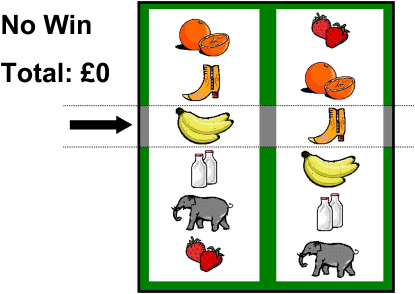
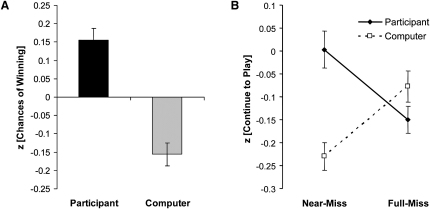
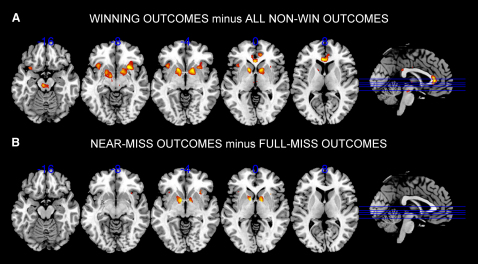
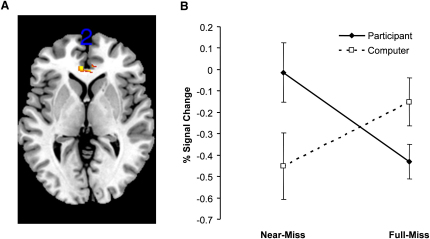
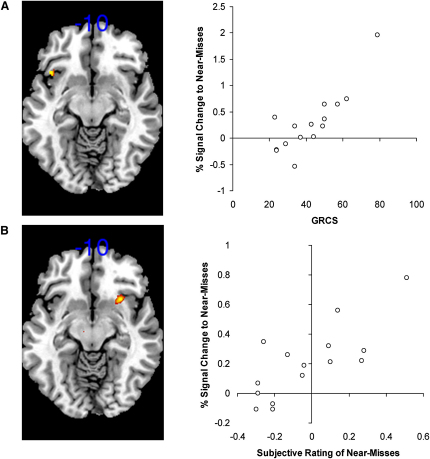
"Near-miss" events, where unsuccessful outcomes are proximal to the jackpot, increase gambling propensity and may be associated with the addictiveness of gambling, but little is known about the neurocognitive mechanisms that underlie their potency. Using a simplified slot machine task, we measured behavioral and neural responses to gambling outcomes. Compared to "full-misses," near-misses were experienced as less pleasant, but increased desire to play. This effect was restricted to trials where the subject had personal control over arranging their gamble. Near-miss outcomes recruited striatal and insula circuitry that also responded to monetary wins; in addition, near-miss-related activity in the rostral anterior cingulate cortex varied as a function of personal control. Insula activity to near-misses correlated with self-report ratings as well as a questionnaire measure of gambling propensity. These data indicate that near-misses invigorate gambling through the anomalous recruitment of reward circuitry, despite the objective lack of monetary reinforcement on these trials.
Overview
The claims and statistics of this paper haven’t been checked yet.
Run the check — free, no account needed. It reads the open-access text and checks the sources it cites.
Integrity signals
Registry
Cites
Statistics
Figures
Verification
Claims the paper makes
The claims and statistics of this paper haven’t been checked yet.
Run the check — free, no account needed. It reads the open-access text and checks the sources it cites.
Claims other papers make about this one
Each is checked against this paper’s own text: does it say what the citing paper says it does?
In the citing paper
“The rewarding/motivating nature of “near misses” has been reported for gambling where they increase the desire to play (Clark et al., 2009; Daw et al., 2006; Kakade and Dayan, 2002).”
From Rethinking motor learning and savings in adaptation paradigms: model-free memory for successful actions combines with internal models (2011) · cites this paper as Clark et al., 2009
In the citing paper
“Participants in this study reported that near-misses were significantly less pleasant than full misses, but triggered their urge to play more (L. Clark, Lawrence, Astley-Jones, & Gray, 2009)”
From Cued for Risk: Evidence for an Incentive Sensitization Framework to Explain the Interplay between Stress and Anxiety, Substance Abuse, and Reward Uncertainty in Disordered Gambling Behavior (2019) · cites this paper as L. Clark, Lawrence, Astley-Jones, & Gray, 2009
In the citing paper
“Additionally, a study by Clark and colleagues found that near-misses (or almost winning) in a slot machine gambling task, recruited areas of the brain that respond to wins.”
From Cued for Risk: Evidence for an Incentive Sensitization Framework to Explain the Interplay between Stress and Anxiety, Substance Abuse, and Reward Uncertainty in Disordered Gambling Behavior (2019) · cites this paper as L. Clark, Lawrence, Astley-Jones, & Gray, 2009
Self-check
Percentages, sums and reported differences re-computed from the paper’s own numbers.
The self-check needs the paper’s full text.
Citations
Cites
Co-Planar Stereotaxic Atlas of the Human Brain
Talairach, J., & Tournoux, P. (1988) · Medical Entomology and Zoology · Cited by 11,798
Co-planar stereotaxic atlas of the human brain
Laitinen, L. (1989) · Clinical Neurology and Neurosurgery · doi:10.1016/0303-8467(89)90128-5 · Cited by 7,565
How do you feel? Interoception: The sense of the physiological condition of the body
Craig, A. D. (2002) · Nature Reviews Neuroscience · doi:10.1038/nrn894 · Cited by 6,006
Maldjian, J. A., Laurienti, P. J., Kraft, R., & Burdette, J. H. (2003) · NeuroImage · doi:10.1016/s1053-8119(03)00169-1 · Cited by 5,066
Langer, E. J. (1975) · Journal of Personality and Social Psychology · doi:10.1037/0022-3514.32.2.311 · Cited by 3,909
(1987) · American Journal of Psychiatry · doi:10.1176/ajp.144.9.1184 · Cited by 2,948
Region of interest analysis using an SPM toolbox
Brett, M. (2002) · NeuroImage · Cited by 2,273
Cortical substrates for exploratory decisions in humans
Daw, N. D., O'Doherty, J. P., Dayan, P., Seymour, B., & Dolan, R. J. (2006) · Nature · doi:10.1038/nature04766 · Cited by 2,224
Dissociable Roles of Ventral and Dorsal Striatum in Instrumental Conditioning
O'Doherty, J., Dayan, P., Schultz, J., Deichmann, R., Friston, K., & Dolan, R. J. (2004) · Science · doi:10.1126/science.1094285 · Cited by 2,088
Discrete coding of reward probability and uncertainty by dopamine neurons
Fiorillo, C. D., Tobler, P. N., & Schultz, W. (2003) · Science · doi:10.1126/science.1077349 · Cited by 2,085
Learning the value of information in an uncertain world
Behrens, T. E. J., Woolrich, M. W., Walton, M. E., & Rushworth, M. F. S. (2007) · Nature Neuroscience · doi:10.1038/nn1954 · Cited by 2,053
The neural correlates of subjective value during intertemporal choice
Kable, J. W., & Glimcher, P. W. (2007) · Nature Neuroscience · doi:10.1038/nn2007 · Cited by 1,916
Behavioral Theories and the Neurophysiology of Reward
Schultz, W. (2006) · Annual Review of Psychology · doi:10.1146/annurev.psych.56.091103.070229 · Cited by 1,637
A specific neural substrate for perceiving facial expressions of disgust
Phillips, M. L., Young, A. W., Senior, C., Brammer, M., Andrew, C., Calder, A. J., Bullmore, E. T., Perrett, D. I., Rowland, D., Williams, S. C. R., et al. (1997) · Nature · doi:10.1038/39051 · Cited by 1,609
Temporal difference models and reward-related learning in the human brain
O'Doherty, J. P., Dayan, P., Friston, K., Critchley, H., & Dolan, R. J. (2003) · Neuron · doi:10.1016/s0896-6273(03)00169-7 · Cited by 1,522
Functional imaging of neural responses to expectancy and experience of monetary gains and losses
Breiter, H. C., Aharon, I., Kahneman, D., Dale, A., & Shizgal, P. (2001) · Neuron · doi:10.1016/s0896-6273(01)00303-8 · Cited by 1,404
Acute effects of cocaine on human brain activity and emotion
Breiter, H. C., Gollub, R. L., Weisskoff, R. M., Kennedy, D. N., Makris, N., Berke, J. D., Goodman, J. M., Kantor, H. L., Gastfriend, D. R., Riorden, J. P., et al. (1997) · Neuron · doi:10.1016/s0896-6273(00)80374-8 · Cited by 1,270
Damage to the insula disrupts addiction to cigarette smoking
Naqvi, N. H., Rudrauf, D., Damasio, H., & Bechara, A. (2007) · Science · doi:10.1126/science.1135926 · Cited by 1,245
Dissociating pain from its anticipation in the human brain
Ploghaus, A., Tracey, I., Gati, J. S., Clare, S., Menon, R. S., Matthews, P. M., & Rawlins, J. N. P. (1999) · Science · doi:10.1126/science.284.5422.1979 · Cited by 1,151
Tracking the Hemodynamic Responses to Reward and Punishment in the Striatum
Delgado, M. R., Nystrom, L. E., Fissell, C., Noll, D. C., & Fiez, J. A. (2000) · Journal of Neurophysiology · doi:10.1152/jn.2000.84.6.3072 · Cited by 1,116
Optimal decision making and the anterior cingulate cortex
Kennerley, S. W., Walton, M. E., Behrens, T. E. J., Buckley, M. J., & Rushworth, M. F. S. (2006) · Nature Neuroscience · doi:10.1038/nn1724 · Cited by 948
Cue-induced cocaine craving: neuroanatomical specificity for drug users and drug stimuli
Garavan, H., Pankiewicz, J., Bloom, A., Cho, J.-K., Sperry, L., Ross, T. J., Salmeron, B. J., Risinger, R., Kelley, D., & Stein, E. A. (2000) · American Journal of Psychiatry · doi:10.1176/appi.ajp.157.11.1789 · Cited by 931
Temporal Prediction Errors in a Passive Learning Task Activate Human Striatum
McClure, S. M., Berns, G. S., & Montague, P. R. (2003) · Neuron · doi:10.1016/s0896-6273(03)00154-5 · Cited by 917
Knutson, B. D., Fong, G., Bennett, S. M., Adams, C. M., & Hommer, D. W. (2003) · NeuroImage · doi:10.1016/s1053-8119(02)00057-5 · Cited by 868
Processing of Social and Monetary Rewards in the Human Striatum
Izuma, K., Saito, D. N., & Sadato, N. (2008) · Neuron · doi:10.1016/j.neuron.2008.03.020 · Cited by 855
Paulus, M. P., Rogalsky, C., Simmons, A., Feinstein, J. S., & Stein, M. B. (2003) · NeuroImage · doi:10.1016/s1053-8119(03)00251-9 · Cited by 745
Dissociable Neural Responses in Human Reward Systems
Elliott, R., Friston, K. J., & Dolan, R. J. (2000) · The Journal of Neuroscience · doi:10.1523/jneurosci.20-16-06159.2000 · Cited by 740
Pathological gambling is linked to reduced activation of the mesolimbic reward system
Reuter, J., Raedler, T., Rose, M., Hand, I., Gläscher, J., & Büchel, C. (2005) · Nature Neuroscience · doi:10.1038/nn1378 · Cited by 734
Predictability modulates human brain response to reward
Berns, G. S., McClure, S. M., Pagnoni, G., & Montague, P. R. (2001) · The Journal of Neuroscience · doi:10.1523/jneurosci.21-08-02793.2001 · Cited by 711
Toward a syndrome model of addiction: Multiple expressions, common etiology
Shaffer, H. J., LaPlante, D. A., LaBrie, R. A., Kidman, R. C., Donato, A. N., & Stanton, M. V. (2004) · Harvard Review of Psychiatry · doi:10.1080/10673220490905705 · Cited by 682 · cited 1×
“Gambling is a prevalent and culturally ubiquitous form of entertainment that becomes dysfunctional in a small but significant minority (1%–5%), in whom it resembles a substance addiction in several core respects (Potenza, 2006; Shaffer et al., 2004).”
BackgroundShould addictive disorders include non-substance-related conditions?
Potenza, M. N. (2006) · Addiction · doi:10.1111/j.1360-0443.2006.01591.x · Cited by 663
BOLD responses reflecting dopaminergic signals in the human ventral tegmental area
D'Ardenne, K., McClure, S. M., Nystrom, L. E., & Cohen, J. D. (2008) · Science · doi:10.1126/science.1150605 · Cited by 661
Differential effects of insular and ventromedial prefrontal cortex lesions on risky decision-making
Clark, L., Bechara, A., Damasio, H., Aitken, M. R. F., Sahakian, B. J., & Robbins, T. W. (2008) · Brain · doi:10.1093/brain/awn066 · Cited by 613
Modulation of Caudate Activity by Action Contingency
Tricomi, E. M., Delgado, M. R., & Fiez, J. A. (2004) · Neuron · doi:10.1016/s0896-6273(03)00848-1 · Cited by 592
Separate neural pathways process different decision costs
Rudebeck, P. H., Walton, M. E., Smyth, A. N., Bannerman, D. M., & Rushworth, M. F. S. (2006) · Nature Neuroscience · doi:10.1038/nn1756 · Cited by 580
ERP Correlates of Feedback and Reward Processing in the Presence and Absence of Response Choice
Yeung, N., Holroyd, C. B., & Cohen, J. D. (2005) · Cerebral Cortex · doi:10.1093/cercor/bhh153 · Cited by 520
Raylu, N., & Oei, T. P. S. (2004) · Addiction · doi:10.1111/j.1360-0443.2004.00753.x · Cited by 504
Absolute Coding of Stimulus Novelty in the Human Substantia Nigra/VTA
Bunzeck, N., & Düzel, E. (2006) · Neuron · doi:10.1016/j.neuron.2006.06.021 · Cited by 503
Dysfunction of reward processing correlates with alcohol craving in detoxified alcoholics
Wrase, J., Schlagenhauf, F., Kienast, T., Wüstenberg, T., Bermpohl, F., Kahnt, T., Beck, A., Ströhle, A., Juckel, G., Knutson, B. D., et al. (2007) · NeuroImage · doi:10.1016/j.neuroimage.2006.11.043 · Cited by 497
Dopamine: generalization and bonuses
Kakade, S. M., & Dayan, P. (2002) · Neural Networks · doi:10.1016/s0893-6080(02)00048-5 · Cited by 495
Nicotine-Induced Limbic Cortical Activation in the Human Brain: A Functional MRI Study
Stein, E. A., Pankiewicz, J., Harsch, H. H., Cho, J.-K., Fuller, S. A., Hoffmann, R. G., Hawkins, M., Rao, S. M., Bandettini, P. A., & Bloom, A. S. (1998) · American Journal of Psychiatry · doi:10.1176/ajp.155.8.1009 · Cited by 483
Interactions between decision making and performance monitoring within prefrontal cortex
Walton, M. E., Devlin, J. T., & Rushworth, M. F. S. (2004) · Nature Neuroscience · doi:10.1038/nn1339 · Cited by 445
Walker, M. B. (2026) · Routledge eBooks · doi:10.4324/9781003781257 · Cited by 426
Fruit machine gambling: The importance of structural characteristics
Griffiths, M. (1993) · Journal of Gambling Studies · doi:10.1007/bf01014863 · Cited by 390
Regional brain metabolic activation during craving elicited by recall of previous drug experiences
Wang, G.-J., Volkow, N. D., Fowler, J. S., Cervany, P., Hitzemann, R. J., Pappas, N. R., Wong, C. T., & Felder, C. (1999) · Life Sciences · doi:10.1016/s0024-3205(98)00619-5 · Cited by 336
Nieuwenhuis, S., Slagter, H. A., von Geusau, N. J. A., Heslenfeld, D. J., & Holroyd, C. B. (2005) · European Journal of Neuroscience · doi:10.1111/j.1460-9568.2005.04152.x · Cited by 327
Human striatal response to salient nonrewarding stimuli
Zink, C. F., Pagnoni, G., Martin, M. E., Dhamala, M., & Berns, G. S. (2003) · The Journal of Neuroscience · doi:10.1523/jneurosci.23-22-08092.2003 · Cited by 312
Inactivation of the Interoceptive Insula Disrupts Drug Craving and Malaise Induced by Lithium
Contreras, M., Ceric, F., & Torrealba, F. (2007) · Science · doi:10.1126/science.1145590 · Cited by 297
Activity in human reward-sensitive brain areas is strongly context dependent
Nieuwenhuis, S., Heslenfeld, D. J., Alting von Geusau, N. J., Mars, R. B., Holroyd, C. B., & Yeung, N. (2005) · NeuroImage · doi:10.1016/j.neuroimage.2004.12.043 · Cited by 289
Activation of the human brain by monetary reward
Thut, G., Schultz, W., Roelcke, U., Nienhusmeier, M., Missimer, J. H., Maguire, R. P., & Leenders, K. L. (1997) · Neuroreport · doi:10.1097/00001756-199703240-00033 · Cited by 273
Gilman, J. M., Ramchandani, V. A., Davis, M. B., Bjork, J. M., & Hommer, D. W. (2008) · The Journal of Neuroscience · doi:10.1523/jneurosci.0086-08.2008 · Cited by 267 · cited 1×
“…al., 2000; Elliott et al., 2000; Knutson et al., 2003), as well as primary rewards (e.g., fruit juice) (Berns et al., 2001; McClure et al., 2003), social rewards (acquisition of good reputation; Izuma et al., 2008), and drugs of abuse (Breiter et al., 1997; Gilman et al., 2008; Stein et al., 1998).”
BackgroundGoldstein, R. Z., Alia-Klein, N., Tomasi, D., Zhang, L., Cottone, L. A., Maloney, T., Telang, F., Caparelli, E. C., Chang, L., Ernst, T., et al. (2007) · American Journal of Psychiatry · doi:10.1176/ajp.2007.164.1.43 · Cited by 258
The psychology of the near miss
Reid, R. L. (1986) · Journal of Gambling Studies · doi:10.1007/bf01019932 · Cited by 257
Paradoxes of Gambling Behaviour
Wagenaar, W. A. (2016) · Routledge eBooks · doi:10.4324/9781315542409 · Cited by 254
Henslin, J. M. (1967) · American Journal of Sociology · doi:10.1086/224479 · Cited by 237
Interoceptive basis to craving
Gray, M. A., & Critchley, H. D. (2007) · Neuron · doi:10.1016/j.neuron.2007.03.024 · Cited by 189
Knowing When to Stop: The Brain Mechanisms of Chasing Losses
Campbell-Meiklejohn, D. K., Woolrich, M. W., Passingham, R. E., & Rogers, R. D. (2007) · Biological Psychiatry · doi:10.1016/j.biopsych.2007.05.014 · Cited by 186
Near Wins Prolong Gambling on a Video Lottery Terminal
Côté, D., Caron, A., Aubert, J., Desrochers, V., & Ladouceur, R. (2003) · Journal of Gambling Studies · doi:10.1023/a:1026384011003 · Cited by 173
Effects of the "near miss" and the "big win" on persistence at slot machine gambling.
Kassinove, J. I., & Schare, M. L. (2001) · Psychology of Addictive Behaviors · doi:10.1037//0893-164x.15.2.155 · Cited by 165
Effects of the "near miss" and the "big win" on persistence at slot machine gambling.
Kassinove, J. I., & Schare, M. L. (2001) · Psychology of Addictive Behaviors · doi:10.1037/0893-164x.15.2.155 · Cited by 156
The rule of three: How the third event signals the emergence of a streak
Carlson, K. A., & Shu, S. B. (2007) · Organizational Behavior and Human Decision Processes · doi:10.1016/j.obhdp.2007.03.004 · Cited by 123
Psychobiology of the Near-Miss in Fruit Machine Gambling
Griffiths, M. D. (1991) · The Journal of Psychology · doi:10.1080/00223980.1991.10543298 · Cited by 121
Differences in Cognitive Distortions between Problem and Social Gamblers
Joukhador, J., Maccallum, F., & Blaszczynski, A. P. (2003) · Psychological Reports · doi:10.2466/pr0.2003.92.3c.1203 · Cited by 116
Illusory Personal Control as a Determinant of Bet Size and Type in Casino Craps Games1
Davis, D., Sundahl, I., & Lesbo, M. (2000) · Journal of Applied Social Psychology · doi:10.1111/j.1559-1816.2000.tb02518.x · Cited by 68
Slot Machine Structural Characteristics: Creating Near Misses Using High Award Symbol Ratios
Harrigan, K. A. (2007) · International Journal of Mental Health and Addiction · doi:10.1007/s11469-007-9066-8 · Cited by 45
The Level of Involvement and the Timing of Betting in Roulette
Ladouceur, R., & Mayrand, M. (1987) · The Journal of Psychology · doi:10.1080/00223980.1987.9712654 · Cited by 39
Worsley (1996) · doi:10.1002/(sici)1097-0193(1996)4:1
Cited by
Sorted by citations
Sescousse, G., Caldú, X., Segura, B., & Dreher, J.-C. (2013) · Neuroscience & Biobehavioral Reviews · doi:10.1016/j.neubiorev.2013.02.002 · Cited by 782
Decision-making in the adolescent brain
Blakemore, S.-J., & Robbins, T. W. (2012) · Nature Neuroscience · doi:10.1038/nn.3177 · Cited by 711
Huang, V. S., Haith, A., Mazzoni, P., & Krakauer, J. W. (2011) · Neuron · doi:10.1016/j.neuron.2011.04.012 · Cited by 472
Leeman, R. F., & Potenza, M. N. (2012) · Psychopharmacology · doi:10.1007/s00213-011-2550-7 · Cited by 448
Potenza, M. N., Balodis, I. M., Derevensky, J., Grant, J. E., Petry, N. M., Verdejo-Garcia, A., & Yip, S. W. (2019) · Nature Reviews Disease Primers · doi:10.1038/s41572-019-0099-7 · Cited by 437
Metadata
- Authors
- Clark, L., Lawrence, A. J., Astley-Jones, F., & Gray, N.
- Affiliations
- University of Cambridge (GB)
- Corresponding author
- Clark, Luke
- Venue
- Neuron
- Publisher
- Elsevier BV
- Published
- 2009-02
- Volume
- 61
- Issue
- 3
- Pages
- 481-490
- ISSN
- 0896-6273 (ISSN-L)
- PMC
- PMC2658737
- OpenAlex
- W1992824053
- Cited by
- 410
- References
- 66
- Citations by year
- 2026: 25 · 2025: 21 · 2024: 18 · 2023: 14 · 2022: 11 · 2021: 17 · 2020: 17 · 2019: 32 · 2018: 21 · 2017: 23 · 2016: 22 · 2015: 36 · 2014: 39 · 2013: 33 · 2012: 19
- FWCI
- 27.62
- Type
- journal article
- Language
- en
- Open access
- hybrid
- doi.org
- Licence
- Locations
- Neuron (publishedVersion, cc-by)
- PubMed Central (publishedVersion, cc-by)
- PubMed (publishedVersion)
- St George's Online Research Archive (St George's University of London) (acceptedVersion)
- Research Portal (King's College London) (submittedVersion)
- Funders
- Wellcome Trust
- Economic and Social Research Council (ES/D000599/1)
- Topics
- Social Sciences › Psychology › Clinical Psychology › Gambling Behavior and Treatments
- Life Sciences › Neuroscience › Cognitive Neuroscience › Neural and Behavioral Psychology Studies
- Social Sciences › Decision Sciences › General Decision Sciences › Decision-Making and Behavioral Economics
- Keywords
- gambling addiction, personal control, reward systems, striatum, insula, rostral anterior cingulate cortex, gambling motivation
- MeSH terms
- Adolescent, Brain, Brain Mapping, Cerebral Cortex, Emotions, Female, Gambling, Gyrus Cinguli, Humans, Magnetic Resonance Imaging, Male, Motivation, Nerve Net, Neural Pathways, Neuropsychological Tests, Reinforcement, Psychology, Reward, Young Adult
About these checks
Registry, retraction, Cites and statistics results are computed, not judged, with one exception: a printed reference that no index lists is read once by a model before it counts as a citation error. Claims are extracted by a model and kept only when their quote appears verbatim in the text; each cited source is then checked, with a model’s help, for whether it says what the claim relies on. Those verdicts can be wrong — read the claim’s quote and the cited source before relying on one.
Statistics and arithmetic are recomputed, not judged.
Confidence bands are shown only for fields calibrated on our annotated test set. None is calibrated yet, so no band is shown.
What counts as a claim ›How we measure confidence ›How we check this ›
Are you an author, or do you see a problem with this page? Request a review
