

The DOI matches its Crossref record; 66 of the 67 references it cites were found in a registry or an index.
Bassoon Speeds Vesicle Reloading at a Central Excitatory Synapse
Open accessAbstract
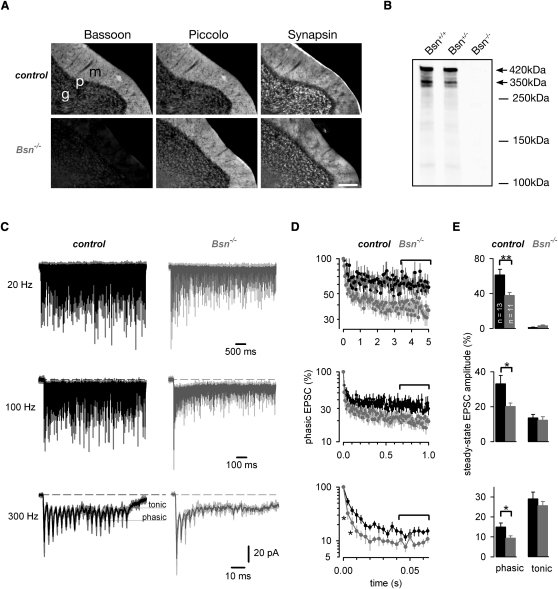
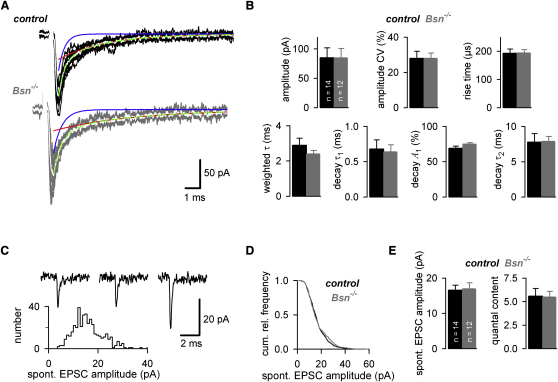
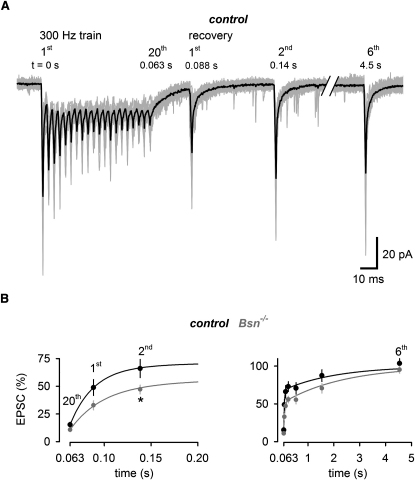
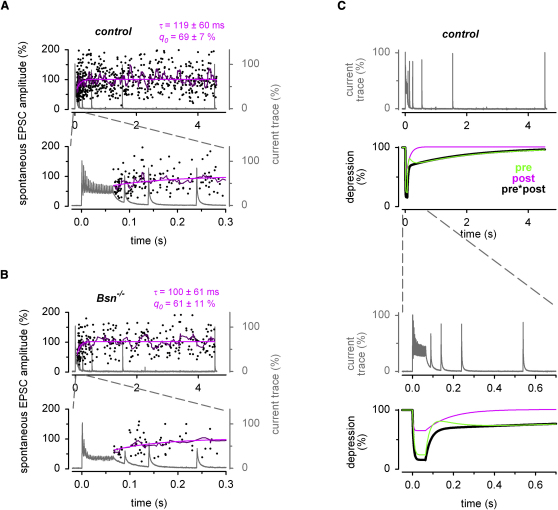
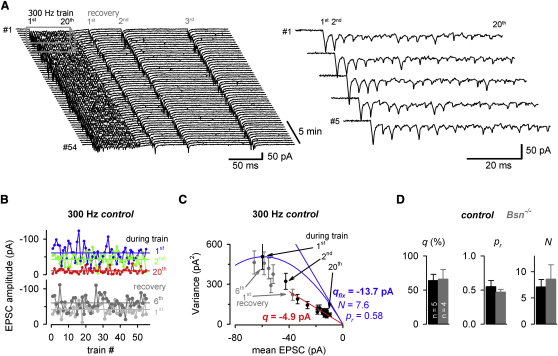
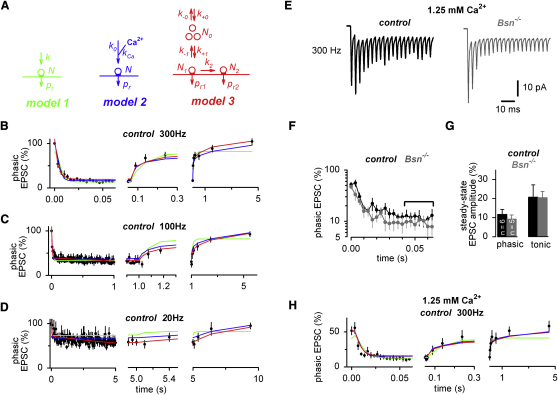
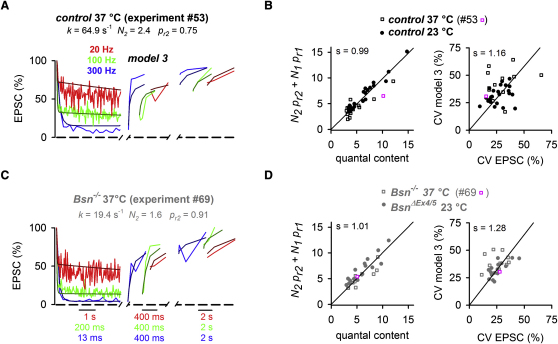
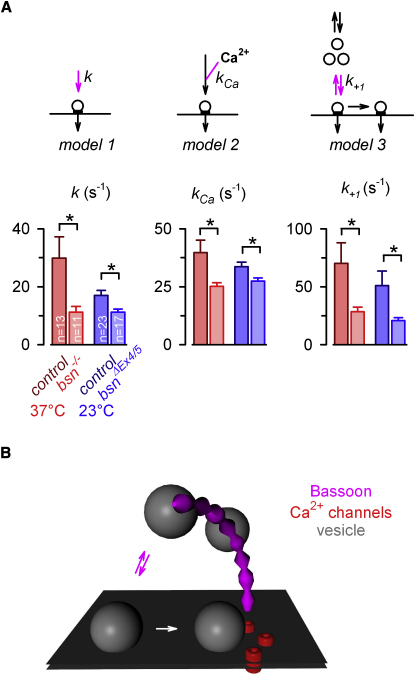
Sustained rate-coded signals encode many types of sensory modalities. Some sensory synapses possess specialized ribbon structures, which tether vesicles, to enable high-frequency signaling. However, central synapses lack these structures, yet some can maintain signaling over a wide bandwidth. To analyze the underlying molecular mechanisms, we investigated the function of the active zone core component Bassoon in cerebellar mossy fiber to granule cell synapses. We show that short-term synaptic depression is enhanced in Bassoon knockout mice during sustained high-frequency trains but basal synaptic transmission is unaffected. Fluctuation and quantal analysis as well as quantification with constrained short-term plasticity models revealed that the vesicle reloading rate was halved in the absence of Bassoon. Thus, our data show that the cytomatrix protein Bassoon speeds the reloading of vesicles to release sites at a central excitatory synapse.
Overview
The claims and statistics of this paper haven’t been checked yet.
Run the check — free, no account needed. It reads the open-access text and checks the sources it cites.
Integrity signals
Registry
Cites
Statistics
Figures
Verification
Claims the paper makes
The claims and statistics of this paper haven’t been checked yet.
Run the check — free, no account needed. It reads the open-access text and checks the sources it cites.
Claims other papers make about this one
Each is checked against this paper’s own text: does it say what the citing paper says it does?
The source backs part of the claim, not all of it — or backs it for a different population, condition or comparison.
In the citing paper
“Piccolo and bassoon are large proteins specific to vertebrates whose major function appears to be to guide synaptic vesicles from the backfield of the synapse to the active zone (Mukherjee et al., 2010; Hallermann et al., 2010).”
From The Presynaptic Active Zone (2012) · cites this paper as Hallermann et al., 2010
Experimental — accuracy not yet measuredThe cited source says what the claim attributes to it.
In the citing paper
“Recovery at MF–GC synapses follows a bi‐exponential time course (Hallermann et al., 2010).”
From MicroRNA‐138‐5p suppresses excitatory synaptic strength at the cerebellar input layer (2025) · cites this paper as Hallermann et al., 2010
The check wasn’t confident either way, so it gives no verdict — never disputed.
In the citing paper
“a deletion of the 17 C-terminal residues of bruchpilot (which are part of the plectin-homology region) impaired attachment of synaptic vesicles to t bars in Drosophila synapses and altered synaptic transmission”
From The Presynaptic Active Zone (2012) · cites this paper as Hallermann et al., 2010
Experimental — accuracy not yet measuredThe check wasn’t confident either way, so it gives no verdict — never disputed.
In the citing paper
“suggesting that a major contribution to bruchpilot function is derived from the plectin-homology region (Hallermann et al., 2010).”
From The Presynaptic Active Zone (2012) · cites this paper as Hallermann et al., 2010
Experimental — accuracy not yet measured
Self-check
Percentages, sums and reported differences re-computed from the paper’s own numbers.
The self-check needs the paper’s full text.
Citations
Cites
Südhof, T. C. (2004) · Annual Review of Neuroscience · doi:10.1146/annurev.neuro.26.041002.131412 · Cited by 2,491
Quantal components of the end‐plate potential
del Castillo, J., & Katz, B. (1954) · The Journal of Physiology · doi:10.1113/jphysiol.1954.sp005129 · Cited by 2,201
Synaptic depression and cortical gain control
Abbott, L. F., Varela, J. A., Sen, K., & Nelson, S. B. (1997) · Science · doi:10.1126/science.275.5297.221 · Cited by 1,690
Edwards, F. A., Konnerth, A., Sakmann, B. J., & Takahashi, T. (1989) · Pflügers Archiv - European Journal of Physiology · doi:10.1007/bf00580998 · Cited by 1,282
Differential signaling via the same axon of neocortical pyramidal neurons
Markram, H., Wang, Y., & Tsodyks, M. (1998) · Proceedings of the National Academy of Sciences · doi:10.1073/pnas.95.9.5323 · Cited by 1,102
Multiple Roles of Calcium Ions in the Regulation of Neurotransmitter Release
Neher, E., & Sakaba, T. (2008) · Neuron · doi:10.1016/j.neuron.2008.08.019 · Cited by 966
Hair cell synaptic ribbons are essential for synchronous auditory signalling
Khimich, D., Nouvian, R., Pujol, R., Dieck, S. T., Egner, A., Gundelfinger, E. D., & Moser, T. (2005) · Nature · doi:10.1038/nature03418 · Cited by 583
Self-citationDieck, S., Sanmartí-Vila, L., Langnaese, K., Richter, K., Kindler, S., Soyke, A., Wex, H., Smalla, K.-H., Kämpf, U., Fränzer, J.-T., et al. (1998) · The Journal of Cell Biology · doi:10.1083/jcb.142.2.499 · Cited by 482
Self-citationDick, O., Dieck, S. T., Altrock, W. D., Ammermüller, J., Weiler, R., Garner, C., Gundelfinger, E., & Brandstätter, J. (2003) · Neuron · doi:10.1016/s0896-6273(03)00086-2 · Cited by 453
Self-citationDittman, J. S., & Regehr, W. G. (1998) · Journal of Neuroscience · doi:10.1523/jneurosci.18-16-06147.1998 · Cited by 410
Detection of spontaneous synaptic events with an optimally scaled template
Clements, J. D., & Bekkers, J. M. (1997) · Biophysical Journal · doi:10.1016/s0006-3495(97)78062-7 · Cited by 401
Optimizing Synaptic Architecture and Efficiency for High-Frequency Transmission
Taschenberger, H., Leão, R. M., Rowland, K. C., Spirou, G. A., & von Gersdorff, H. (2002) · Neuron · doi:10.1016/s0896-6273(02)01137-6 · Cited by 389
Calmodulin Mediates Rapid Recruitment of Fast-Releasing Synaptic Vesicles at a Calyx-Type Synapse
Sakaba, T., & Neher, E. (2001) · Neuron · doi:10.1016/s0896-6273(01)00543-8 · Cited by 363
Molecular organization of the presynaptic active zone
Schoch, S., & Gundelfinger, E. D. (2006) · Cell and Tissue Research · doi:10.1007/s00441-006-0244-y · Cited by 346
Self-citationThree-Dimensional Architecture of Presynaptic Terminal Cytomatrix
Siksou, L., Rostaing, P., Lechaire, J., Boudier, T., Ohtsuka, T., Fejtová, A., Kao, H., Greengard, P., Gundelfinger, E. D., Triller, A., et al. (2007) · Journal of Neuroscience · doi:10.1523/jneurosci.1773-07.2007 · Cited by 340
Self-citationMovement-related inputs to intermediate cerebellum of the monkey
van Kan, P. L. E., Gibson, A. R., & Houk, J. C. (1993) · Journal of Neurophysiology · doi:10.1152/jn.1993.69.1.74 · Cited by 318
The Architecture of the Active Zone in the Presynaptic Nerve Terminal
Zhai, R. G., & Bellen, H. J. (2004) · Physiology · doi:10.1152/physiol.00014.2004 · Cited by 305
Frank, T., Rutherford, M. A., Strenzke, N., Neef, A., Pangršič, T., Khimich, D., Fejtová, A., Gundelfinger, E. D., Liberman, M. C., Harke, B., et al. (2010) · Neuron · doi:10.1016/j.neuron.2010.10.027 · Cited by 298
Self-citationProperties of Somatosensory Synaptic Integration in Cerebellar Granule Cells In Vivo
Jörntell, H., & Ekerot, C. ‐. (2006) · Journal of Neuroscience · doi:10.1523/jneurosci.2939-06.2006 · Cited by 298
High-fidelity transmission of sensory information by single cerebellar mossy fibre boutons
Rancz, E. A., Ishikawa, T., Duguid, I., Chadderton, P. T., Mahon, S., & Häusser, M. (2007) · Nature · doi:10.1038/nature05995 · Cited by 291
Hearing requires otoferlin-dependent efficient replenishment of synaptic vesicles in hair cells
Pangršič, T., Lasarow, L., Reuter, K., Takago, H., Schwander, M., Riedel, D., Frank, T., Tarantino, L. M., Bailey, J. S., Strenzke, N., et al. (2010) · Nature Neuroscience · doi:10.1038/nn.2578 · Cited by 290
Silver, R., Momiyama, A., & Cull-Candy, S. (1998) · Journal of Physiology · doi:10.1111/j.1469-7793.1998.881bj.x · Cited by 279
Self-citationBucurenciu, I., Kulik, A., Schwaller, B., Frotscher, M., & Jonas, P. (2008) · Neuron · doi:10.1016/j.neuron.2007.12.026 · Cited by 274
Temporal and spatial coordination of exocytosis and endocytosis
Gundelfinger, E. D., Kessels, M. M., & Qualmann, B. (2003) · Nature Reviews Molecular Cell Biology · doi:10.1038/nrm1016 · Cited by 272
Self-citationQuantitative analysis of the native presynaptic cytomatrix by cryoelectron tomography
Fernández-Busnadiego, R., Zuber, B., Maurer, U. E., Cyrklaff, M., Baumeister, W., & Lučić, V. (2010) · Journal of Cell Biology · doi:10.1083/jcb.200908082 · Cited by 267
Silver, R. A., Cull-Candy, S. G., & Takahashi, T. (1996) · The Journal of Physiology · doi:10.1113/jphysiol.1996.sp021487 · Cited by 260
Self-citationRIM1 confers sustained activity and neurotransmitter vesicle anchoring to presynaptic Ca2+ channels
Kiyonaka, S., Wakamori, M., Miki, T., Uriu, Y., Nonaka, M., Bito, H., Beedle, A. M., Mori, E., Hara, Y., WAARD, M. M. D., et al. (2007) · Nature Neuroscience · doi:10.1038/nn1904 · Cited by 259
Altrock, W. D., tom Dieck, S., Sokolov, M., Meyer, A. C., Sigler, A., Brakebusch, C., Fässler, R., Richter, K., Boeckers, T. M., Potschka, H., et al. (2003) · Neuron · doi:10.1016/s0896-6273(03)00088-6 · Cited by 258
Self-citationCalcium Dependence of Exo- and Endocytotic Coupling at a Glutamatergic Synapse
Hosoi, N., Holt, M., & Sakaba, T. (2009) · Neuron · doi:10.1016/j.neuron.2009.06.010 · Cited by 256
Synaptic depression enables neuronal gain control
Rothman, J. S., Cathala, L., Steuber, V., & Silver, R. A. (2009) · Nature · doi:10.1038/nature07604 · Cited by 249
Self-citationFast vesicle reloading and a large pool sustain high bandwidth transmission at a central synapse
Saviane, C., & Silver, R. A. (2006) · Nature · doi:10.1038/nature04509 · Cited by 241
Self-citationOnset coding is degraded in auditory nerve fibers from mutant mice lacking synaptic ribbons
Buran, B., Strenzke, N., Neef, A., Gundelfinger, E., Moser, T., & Liberman, M. C. (2010) · Journal of Neuroscience · doi:10.1523/jneurosci.0389-10.2010 · Cited by 200
Self-citationMukherjee, K., Yang, X., Gerber, S. H., Kwon, H.-B., Ho, A., Castillo, P. E., Liu, X., & Südhof, T. C. (2010) · Proceedings of the National Academy of Sciences · doi:10.1073/pnas.1002307107 · Cited by 195
The Contribution of Single Synapses to Sensory Representation in Vivo
Arenz, A., Silver, R. A., Schaefer, A. T., & Margrie, T. W. (2008) · Science · doi:10.1126/science.1158391 · Cited by 193
Self-citationReliability and Precision of the Mouse Calyx of Held Synapse
Lorteije, J. A. M., Rusu, S. I., Kushmerick, C., & Borst, J. G. G. (2009) · Journal of Neuroscience · doi:10.1523/jneurosci.3285-09.2009 · Cited by 192
Hámori, J., & Somogyi, J. (1983) · The Journal of Comparative Neurology · doi:10.1002/cne.902200402 · Cited by 181
A large pool of releasable vesicles in a cortical glutamatergic synapse
Hallermann, S., Pawlu, C., Jonas, P., & Heckmann, M. (2003) · Proceedings of the National Academy of Sciences · doi:10.1073/pnas.1432836100 · Cited by 181
Self-citationPhysiological properties of inhibitory interneurons in cat striate cortex
Azouz, R. (1997) · Cerebral Cortex · doi:10.1093/cercor/7.6.534 · Cited by 173
Silver, R. A. (2003) · Journal of Neuroscience Methods · doi:10.1016/j.jneumeth.2003.09.030 · Cited by 168
Self-citationSubmillisecond Kinetics of Glutamate Release from a Sensory Synapse
von Gersdorff, H., Sakaba, T., Berglund, K., & Tachibana, M. (1998) · Neuron · doi:10.1016/s0896-6273(00)80634-0 · Cited by 157
Kushmerick, C., Renden, R., & von Gersdorff, H. (2006) · Journal of Neuroscience · doi:10.1523/jneurosci.3889-05.2006 · Cited by 156
Hosoi, N., Sakaba, T., & Neher, E. (2007) · Journal of Neuroscience · doi:10.1523/jneurosci.4122-07.2007 · Cited by 154
Structure suggests function: the case for synaptic ribbons as exocytotic nanomachines
Lenzi, D., & von Gersdorff, H. (2001) · BioEssays · doi:10.1002/bies.1118 · Cited by 154
Dick, O., Hack, I., Altrock, W. D., Garner, C. C., Gundelfinger, E. D., & Brandstätter, J. H. (2001) · The Journal of Comparative Neurology · doi:10.1002/cne.1344 · Cited by 153
Self-citationMaturation of EPSCs and Intrinsic Membrane Properties Enhances Precision at a Cerebellar Synapse
Cathala, L., Brickley, S. G., Cull-Candy, S. G., & Farrant, M. (2003) · Journal of Neuroscience · doi:10.1523/jneurosci.23-14-06074.2003 · Cited by 149
Ultrastructural Contributions to Desensitization at Cerebellar Mossy Fiber to Granule Cell Synapses
Xu‐Friedman, M. A., & Regehr, W. G. (2003) · Journal of Neuroscience · doi:10.1523/jneurosci.23-06-02182.2003 · Cited by 142
Young, S., & Neher, E. (2009) · Neuron · doi:10.1016/j.neuron.2009.07.028 · Cited by 134
Scheuß, V., Schneggenburger, R., & Neher, E. (2002) · Journal of Neuroscience · doi:10.1523/jneurosci.22-03-00728.2002 · Cited by 130
Yang, Y., Fedchyshyn, M., Grande, G., Aitoubah, J., Tsang, C. W., Xie, H., Ackerley, C., Trimble, W., & Wang, L.-Y. (2010) · Neuron · doi:10.1016/j.neuron.2010.06.003 · Cited by 127
Heterogeneous presynaptic release probabilities: functional relevance for short-term plasticity.
Trommershäuser, J., Schneggenburger, R., Zippelius, A., & Neher, E. (2003) · Biophysical Journal · doi:10.1016/s0006-3495(03)74967-4 · Cited by 124
The quality of maximum likelihood estimates of ion channel rate constants
Colquhoun, D., Hatton, C. J., & Hawkes, A. G. (2003) · The Journal of Physiology · doi:10.1111/j.1469-7793.2003.00699.x · Cited by 122
Kawasaki, F., Hazen, M., & Ordway, R. W. (2000) · Nature Neuroscience · doi:10.1038/78753 · Cited by 117
Neher, E. (2006) · Pflügers Archiv - European Journal of Physiology · doi:10.1007/s00424-006-0143-9 · Cited by 116
Dynein light chain regulates axonal trafficking and synaptic levels of Bassoon
Fejtová, A., Davydova, D., Bischof, F., Lazarevic, V., Altrock, W. D., Romorini, S., Schöne, C., Zuschratter, W., Kreutz, M. R., Garner, C. C., et al. (2009) · The Journal of Cell Biology · doi:10.1083/jcb.200807155 · Cited by 113
Self-citationELKS2α/CAST deletion selectively increases neurotransmitter release at inhibitory synapses
Kaeser, P. S., Deng, L., Chávez, A. E., Liu, X., Castillo, P. E., & Südhof, T. C. (2009) · Neuron · doi:10.1016/j.neuron.2009.09.019 · Cited by 102
Properties of a Model of Ca++-Dependent Vesicle Pool Dynamics and Short Term Synaptic Depression
Weis, S., Schneggenburger, R., & Neher, E. (1999) · Biophysical Journal · doi:10.1016/s0006-3495(99)77079-7 · Cited by 97
Wang, X., Hu, B., Zieba, A., Neumann, N. G., Kasper-Sonnenberg, M., Honsbein, A., Hultqvist, G., Conze, T., Witt, W., Limbach, C., et al. (2009) · The Journal of Neuroscience · doi:10.1523/jneurosci.1255-09.2009 · Cited by 96
Sargent, P. B., Saviane, C., Nielsen, T. A., DiGregorio, D. A., & Silver, R. A. (2005) · Journal of Neuroscience · doi:10.1523/jneurosci.2051-05.2005 · Cited by 95
Self-citationDesensitization Properties of AMPA Receptors at the Cerebellar Mossy Fiber–Granule Cell Synapse
DiGregorio, D. A., Rothman, J. S., Nielsen, T. A., & Silver, R. A. (2007) · Journal of Neuroscience · doi:10.1523/jneurosci.2399-07.2007 · Cited by 89
Self-citationFrequency-Independent Synaptic Transmission Supports a Linear Vestibular Behavior
Bagnall, M. W., McElvain, L. E., Faulstich, M., & du Lac, S. (2008) · Neuron · doi:10.1016/j.neuron.2008.10.002 · Cited by 76
Dondzillo, A., Sätzler, K., Horstmann, H., Altrock, W., Gundelfinger, E., & Kuner, T. (2010) · The Journal of comparative neurology · doi:10.1002/cne.22260 · Cited by 72
Self-citationPresynaptic calcium signalling in cerebellar mossy fibres
Thomsen, L. B. (2010) · Frontiers in Neural Circuits · doi:10.3389/neuro.04.001.2010 · Cited by 63
Mechanisms of short‐term plasticity at neuromuscular active zones of Drosophila
Hallermann, S., Heckmann, M., & Kittel, R. J. (2010) · HFSP journal · doi:10.2976/1.3338710 · Cited by 58
Self-citationRegulated exocytosis: merging ideas on fusing membranes
Verhage, M., & Toonen, R. F. G. (2007) · Current Opinion in Cell Biology · doi:10.1016/j.ceb.2007.05.002 · Cited by 49
Errors in the estimation of the variance: Implications for multiple-probability fluctuation analysis
Saviane, C., & Silver, R. A. (2005) · Journal of Neuroscience Methods · doi:10.1016/j.jneumeth.2005.11.003 · Cited by 30
Self-citationTraffic Jams during Vesicle Cycling Lead to Synaptic Depression
Kim, J. H., & von Gersdorff, H. (2009) · Neuron · doi:10.1016/j.neuron.2009.07.006 · Cited by 8
Cited by
Sorted by citations
Südhof, T. C. (2012) · Neuron · doi:10.1016/j.neuron.2012.06.012 · Cited by 1,062
Short-Term Presynaptic Plasticity
Regehr, W. G. (2012) · Cold Spring Harbor Perspectives in Biology · doi:10.1101/cshperspect.a005702 · Cited by 482
Sterling, P., & Laughlin, S. (2015) · doi:10.7551/mitpress/9780262028707.001.0001 · Cited by 482
Short-term forms of presynaptic plasticity
Fioravante, D., & Regehr, W. G. (2011) · Current Opinion in Neurobiology · doi:10.1016/j.conb.2011.02.003 · Cited by 375
Synaptic vesicle recycling: steps and principles
Rizzoli, S. O. (2014) · The EMBO Journal · doi:10.1002/embj.201386357 · Cited by 317
Metadata
- Authors
- Hallermann, S., Fejtova, A., Schmidt, H., Weyhersmüller, A., Silver, R. A., Gundelfinger, E. D., & Eilers, J.
- Affiliations
- Leipzig University (DE)
- University College London (GB)
- Leibniz Institute for Neurobiology (DE)
- Corresponding author
- Hallermann, Stefan
- Venue
- Neuron
- Publisher
- Elsevier BV
- Published
- 2010-11
- Volume
- 68
- Issue
- 4
- Pages
- 710-723
- ISSN
- 0896-6273 (ISSN-L)
- PMC
- PMC3004039
- OpenAlex
- W2050878615
- Cited by
- 223
- References
- 67
- Citations by year
- 2026: 7 · 2025: 13 · 2024: 7 · 2023: 12 · 2022: 15 · 2021: 11 · 2020: 16 · 2019: 17 · 2018: 13 · 2017: 16 · 2016: 17 · 2015: 13 · 2014: 17 · 2013: 15 · 2012: 16
- FWCI
- 6.34
- Type
- journal article
- Language
- en
- Open access
- hybrid
- doi.org
- Licence
- Locations
- Neuron (publishedVersion, cc-by)
- PubMed Central (publishedVersion, cc-by)
- PubMed (publishedVersion)
- UCL Discovery (University College London) (submittedVersion)
- Funders
- Wellcome Trust
- Topics
- Life Sciences › Neuroscience › Cellular and Molecular Neuroscience › Neuroscience and Neuropharmacology Research
- Life Sciences › Biochemistry, Genetics and Molecular Biology › Cell Biology › Cellular transport and secretion
- Life Sciences › Biochemistry, Genetics and Molecular Biology › Genetics › Genetics and Neurodevelopmental Disorders
- Keywords
- bassoon, short-term synaptic depression, cerebellum, active zone, quantal analysis, rate coding
- MeSH terms
- Animals, Cells, Cultured, Cerebellum, Hippocampus, Mice, Inbred C57BL, Mice, Transgenic, Nerve Tissue Proteins, Neural Inhibition, Reaction Time, Synapses, Synaptic Vesicles, Time Factors, Mice, Knockout, Excitatory Postsynaptic Potentials, Mice, Mice, 129 Strain
About these checks
Registry, retraction, Cites and statistics results are computed, not judged, with one exception: a printed reference that no index lists is read once by a model before it counts as a citation error. Claims are extracted by a model and kept only when their quote appears verbatim in the text; each cited source is then checked, with a model’s help, for whether it says what the claim relies on. Those verdicts can be wrong — read the claim’s quote and the cited source before relying on one.
Statistics and arithmetic are recomputed, not judged.
Confidence bands are shown only for fields calibrated on our annotated test set. None is calibrated yet, so no band is shown.
What counts as a claim ›How we measure confidence ›How we check this ›
Are you an author, or do you see a problem with this page? Request a review
