

Restoration of reaching and grasping movements through brain-controlled muscle stimulation in a person with tetraplegia: a proof-of-concept demonstration
Open accessThe DOI matches its Crossref record; 31 of the 32 references it cites were found in a registry or an index.
Abstract
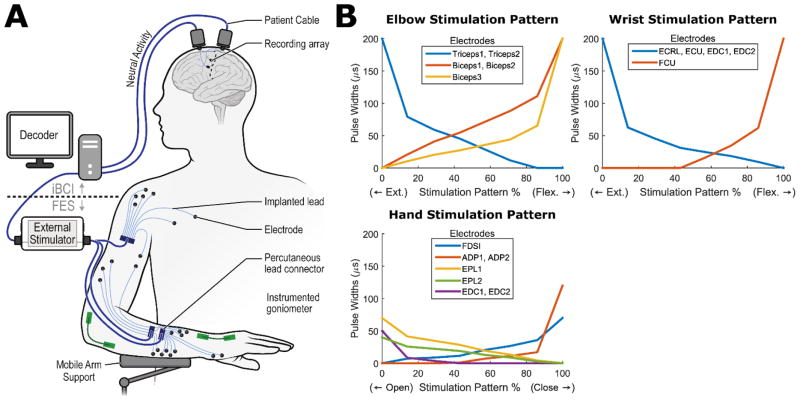
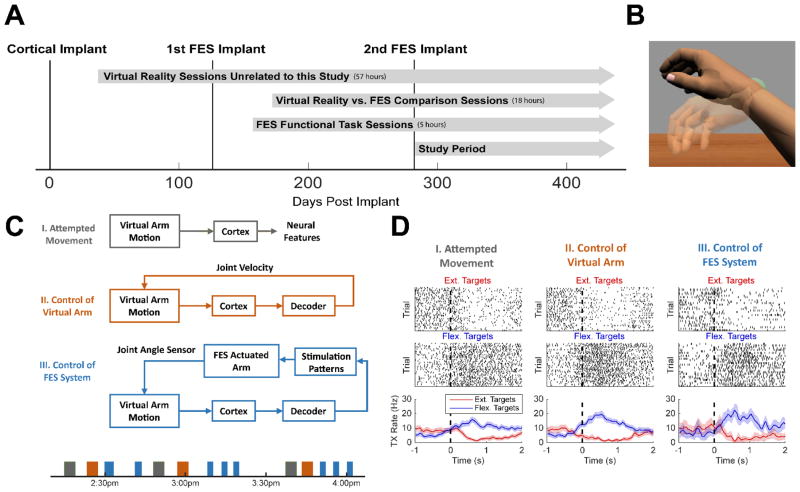
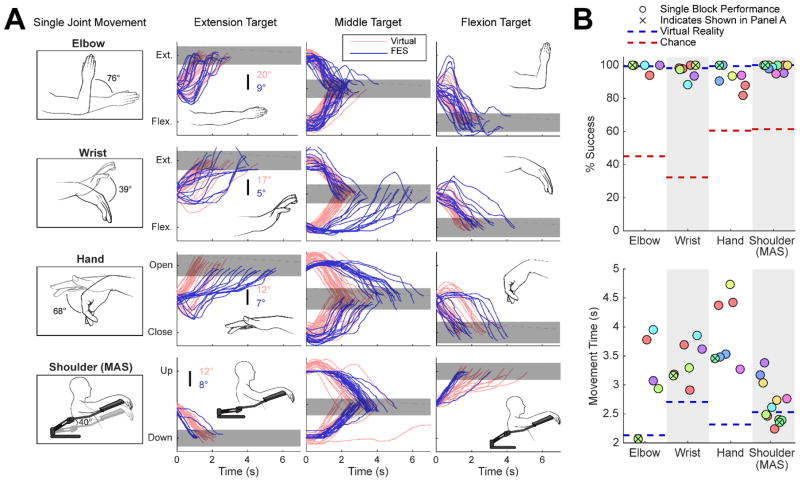
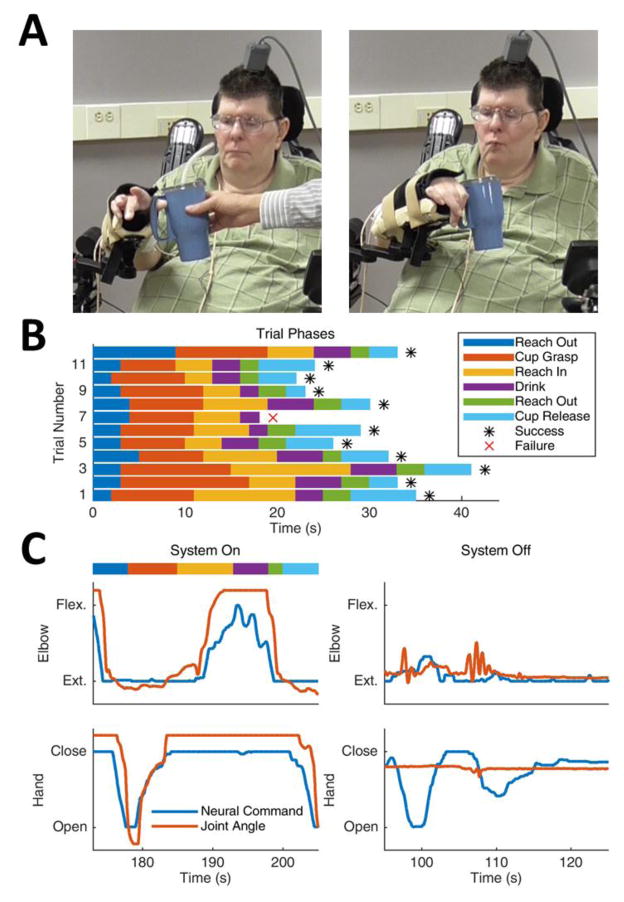
Background People with chronic tetraplegia, due to high-cervical spinal cord injury, can regain limb movements through coordinated electrical stimulation of peripheral muscles and nerves, known as functional electrical stimulation (FES). Users typically command FES systems through other preserved, but unrelated and limited in number, volitional movements (eg, facial muscle activity, head movements, shoulder shrugs). We report the findings of an individual with traumatic high-cervical spinal cord injury who coordinated reaching and grasping movements using his own paralysed arm and hand, reanimated through implanted FES, and commanded using his own cortical signals through an intracortical brain-computer interface (iBCI).Methods We recruited a participant into the BrainGate2 clinical trial, an ongoing study that obtains safety information regarding an intracortical neural interface device, and investigates the feasibility of people with tetraplegia controlling assistive devices using their cortical signals. Surgical procedures were performed at University Hospitals Cleveland Medical Center (Cleveland, OH, USA). Study procedures and data analyses were performed at Case Western Reserve University (Cleveland, OH, USA) and the US Department of Veterans Affairs, Louis Stokes Cleveland Veterans Affairs Medical Center (Cleveland, OH, USA). The study participant was a 53-year-old man with a spinal cord injury (cervical level 4, American Spinal Injury Association Impairment Scale category A). He received two intracortical microelectrode arrays in the hand area of his motor cortex, and 4 months and 9 months later received a total of 36 implanted percutaneous electrodes in his right upper and lower arm to electrically stimulate his hand, elbow, and shoulder muscles. The participant used a motorised mobile arm support for gravitational assistance and to provide humeral abduction and adduction under cortical control. We assessed the participant's ability to cortically command his paralysed arm to perform simple single-joint arm and hand movements and functionally meaningful multi-joint movements. We compared iBCI control of his paralysed arm with that of a virtual three-dimensional arm. This study is registered with ClinicalTrials.gov, number NCT00912041.Findings The intracortical implant occurred on Dec 1, 2014, and we are continuing to study the participant. The last session included in this report was Nov 7, 2016. The point-to-point target acquisition sessions began on Oct 8, 2015 (311 days after implant). The participant successfully cortically commanded single-joint and coordinated multi-joint arm movements for point-to-point target acquisitions (80-100% accuracy), using first a virtual arm and second his own arm animated by FES. Using his paralysed arm, the participant volitionally performed self-paced reaches to drink a mug of coffee (successfully completing 11 of 12 attempts within a single session 463 days after implant) and feed himself (717 days after implant).Interpretation To our knowledge, this is the first report of a combined implanted FES+iBCI neuroprosthesis for restoring both reaching and grasping movements to people with chronic tetraplegia due to spinal cord injury, and represents a major advance, with a clear translational path, for clinically viable neuroprostheses for restoration of reaching and grasping after paralysis.Funding National Institutes of Health, Department of Veterans Affairs.
Overview
The claims and statistics of this paper haven’t been checked yet.
Free: it reads the open-access text and checks the first 5 claims that cite a source we can check. Create a free account to check every claim.
Integrity signals
Registry
Cites
Statistics
Figures
Verification
Claims the paper makes
The claims and statistics of this paper haven’t been checked yet.
Free: it reads the open-access text and checks the first 5 claims that cite a source we can check. Create a free account to check every claim.
Claims other papers make about this one
Each is checked against this paper’s own text: does it say what the citing paper says it does?
The source backs part of the claim, not all of it — or backs it for a different population, condition or comparison.
In the citing paper
“and has enabled the highest BCI performance to date compared to other recording technologies (EEG, ECoG) for restoring communication7, arm control2,5, and general-purpose computer use39.”
From High-performance brain-to-text communication via handwriting (2021) · cites this paper as [5]
Experimental — accuracy not yet measuredThe cited source says what the claim attributes to it.
In the citing paper
“Prior BCI studies have shown that the motor intention for gross motor skills, such as reaching, grasping or moving a computer cursor, remains neurally encoded in motor cortex after paralysis1–7.”
From High-performance brain-to-text communication via handwriting (2021) · cites this paper as [5]
Self-check
Percentages, sums and reported differences re-computed from the paper’s own numbers.
The self-check needs the paper’s full text.
Citations
Cites
Isolated Hand Paresis: A Case Series
Alstadhaug, K. B., & Sjulstad, A. (2013) · Cerebrovascular Diseases Extra · doi:10.1159/000350708 · Cited by 4,058
Neuronal ensemble control of prosthetic devices by a human with tetraplegia
Hochberg, L. R., Serruya, M. D., Friehs, G. M., Mukand, J. A., Saleh, M., Caplan, A. H., Branner, A., Chen, D., Penn, R. D., & Donoghue, J. P. (2006) · Nature · doi:10.1038/nature04970 · Cited by 3,295
Self-citationReach and grasp by people with tetraplegia using a neurally controlled robotic arm
Hochberg, L. R., Bacher, D., Jarosiewicz, B., Masse, N. Y., Simeral, J. D., Vogel, J., Haddadin, S., Liu, J., Cash, S. S., van der Smagt, P., et al. (2012) · Nature · doi:10.1038/nature11076 · Cited by 2,719
Self-citationHigh-performance neuroprosthetic control by an individual with tetraplegia
Collinger, J. L., Wodlinger, B., Downey, J. E., Wang, W., Tyler-Kabara, E. C., Weber, D. J., McMorland, A. J., Velliste, M., Boninger, M. L., & Schwartz, A. B. (2013) · The Lancet · doi:10.1016/s0140-6736(12)61816-9 · Cited by 1,848
Localization of the motor hand area to a knob on the precentral gyrus. A new landmark
Yousry, T. (1997) · Brain · doi:10.1093/brain/120.1.141 · Cited by 1,837
Cortical control of a prosthetic arm for self-feeding
Velliste, M., Perel, S., Spalding, M. C., Whitford, A. S., & Schwartz, A. B. (2008) · Nature · doi:10.1038/nature06996 · Cited by 1,591
Direct Cortical Control of 3D Neuroprosthetic Devices
Taylor, D. M., Tillery, S. I. H., & Schwartz, A. B. (2002) · Science · doi:10.1126/science.1070291 · Cited by 1,540
Instant neural control of a movement signal
Serruya, M. D., Hatsopoulos, N. G., Paninski, L., Fellows, M. R., & Donoghue, J. P. (2002) · Nature · doi:10.1038/416141a · Cited by 1,409
Self-citationRestoring cortical control of functional movement in a human with quadriplegia
Bouton, C. E., Shaikhouni, A., Annetta, N. V., Bockbrader, M. A., Friedenberg, D. A., Nielson, D. M., Sharma, G., Sederberg, P. B., Glenn, B. C., Mysiw, W. J., et al. (2016) · Nature · doi:10.1038/nature17435 · Cited by 924
Intracortical microstimulation of human somatosensory cortex
Flesher, S. N., Collinger, J. L., Foldes, S. T., Weiss, J. M., Downey, J. E., Tyler-Kabara, E. C., Bensmaia, S. J., Schwartz, A. B., Boninger, M. L., & Gaunt, R. A. (2016) · Science Translational Medicine · doi:10.1126/scitranslmed.aaf8083 · Cited by 704
Cited by
Items 701–800 of 896
Design and Application of Digital Twin‐Based Brain Control System
Wang, Y., Jin, H., Yao, Z., Chang, Z., & Wang, D. (2025) · Journal of Advanced Transportation · doi:10.1155/atr/2432974 · Cited by 1
New Applications of Neurotechnologies for Neurological Disorders
Orsborn, A. L., Pirondini, E., Capogrosso, M., Gaunt, R. A., & Stavisky, S. D. (2025) · Springer eBooks · doi:10.1007/978-3-031-89307-0_25 · Cited by 1
Sahai, E., Hickman, J. L., & Denman, D. J. (2025) · Scientific Reports · doi:10.1038/s41598-025-07568-4 · Cited by 1
Rethink the motor cortical control via the experiment-analysis-model flywheel: an overview
Jiang, H., Bu, X., Shi, Q., Zheng, Z., Zhu, D., Tang, H., & Chen, Y. (2025) · Med-X · doi:10.1007/s44258-025-00059-1 · Cited by 1
Rusev, G., Yordanov, S., Nedelcheva, S., Banderov, A., de Micheaux, H. L., Sauter-Starace, F., Aksenova, T., Koprinkova‐Hristova, P., & Kasabov, N. K. (2025) · Biomimetics · doi:10.3390/biomimetics10080518 · Cited by 1
Rubin, D. B. (2025) · Neuron · doi:10.1016/j.neuron.2025.10.013 · Cited by 1
Neurorestoration – A New Synthesis: Repair, Replace, and Optimize
Liu, C. Y., Abedi, A., Lam, J. L. W., Lo, Y. T., & Young, C. C. (2025) · Cambridge University Press eBooks · doi:10.1017/9781009597852.006 · Cited by 1
Graham, F., Hutchinson, D. W., Moon, T. J., Wang, J., Flores-Jimenez, H., Druschel, L. N., Ogunnaike, L., Gao, Y., Smith, T., DeTillio, S., et al. (2026) · Acta Biomaterialia · doi:10.1016/j.actbio.2026.01.055 · Cited by 1
Bergeron, D., Barthélemy, D., Hadjinicolaou, A., Bonizzato, M., Martinez, M., Dancause, N., & Weil, A. G. (2026) · Journal of Child Neurology · doi:10.1177/08830738251413830 · Cited by 1
Antony, V. A., & Muthukumaran, N. (2026) · IETE Journal of Research · doi:10.1080/03772063.2026.2624599 · Cited by 1
İpek, B. M., & Akıncı, E. N. (2026) · AI & Society · doi:10.1007/s00146-026-02964-4 · Cited by 3
Meyer, L. M., & Zamani, M. (2026) · Journal of Neural Engineering · doi:10.1088/1741-2552/ae6dfd · Cited by 1
Análisis de registros multicanal en el comportamiento humano
Manzanares, M. C. S., Sánchez, R. M., & García, D. G. (2026) · Universidad de Burgos eBooks · doi:10.36443/9791387585402 · Cited by 1
Nanostructured coatings on soft-polymer based neural probes for addressing neuroinflammation
Ocoko, M. Y. M., Kasthuri, N. M., Lugo, I., Hanzlicek, B., Wang, J., Duncan, J., Wang, H., Capadona, J. R., Hamedani, H. A., & Hess‐Dunning, A. (2026) · Acta Biomaterialia · doi:10.1016/j.actbio.2026.06.052 · Cited by 1
Duration-modulated neural population dynamics in humans during BMI controls
Yin, F., Guan, C., Aflalo, T., Gámez, J., Pejsa, K., Rosario, E., Liu, C. Y., Bari, A., & Andersen, R. A. (2026) · Communications Biology · doi:10.1038/s42003-026-10369-8 · Cited by 1
Zhu, H., Du, L., Liu, X., & Richardson, A. G. (2026) · Annals of Biomedical Engineering · doi:10.1007/s10439-026-04297-1 · Cited by 1
Rigotti-Thompson, M., Nason, S. R., Bechefsky, P. H., Acosta, A. J., Hahn, N. V., Avansino, D. T., Richards, B. A., Nicolas, C., Ali, Y. H., Henderson, J. M., et al. (2026) · Current Biology · doi:10.1016/j.cub.2026.07.040 · Cited by 1
Self-citationStimulation for Return of Upper-Extremity Function
Kilgore, K. L., & Peckham, P. H. (2018) · Elsevier eBooks · doi:10.1016/b978-0-12-805353-9.00096-6 · Cited by 1
Self-citationMatsunaga, T., Miyakoshi, N., Kudo, D., Saito, K., Kimura, R., Inoue, J., Chida, S., Hatakeyama, K., & Shimada, Y. (2019) · リハビリテーション医学 : 日本リハビリテーション医学会誌 · doi:10.2490/jjrmc.56.555 · Cited by 1
Review article: the key technologies of brain-computer interface
Cui, H., Jiang, Q., Lin, W., & Liu, X. (2020) · Journal of Physics Conference Series · doi:10.1088/1742-6596/1544/1/012190 · Cited by 1
Goal-Directed BCI Feedback Using Cortical Microstimulation
Ghenbot, Y. G., Liu, X., Hao, H., Rinehart, C., DeLuccia, S., Maldonado, S. T., Boyek, G., Zhang, M., Aflatouni, F., der Spiegel, J. V., et al. (2020) · Springer briefs in electrical and computer engineering · doi:10.1007/978-3-030-49583-1_7 · Cited by 1
Research progress of neuronal relay strategies in repairing spinal cord injuries
Lai, B., Ding, Y., Zeng, Y., Li, G., & Zeng, X. (2020) · Scientia Sinica Vitae · doi:10.1360/ssv-2020-0017 · Cited by 1
Neuromodulation in the treatment of symptoms of spinal cord injury
Niemirski, D., Machowiec, P. A., Komisarczuk, M., Maksymowicz, M., Leszczyk, P., & Piecewicz‐Szczęsna, H. (2020) · Journal of Education Health and Sport · doi:10.12775/jehs.2020.10.09.045 · Cited by 1
Toward Non-invasive BCI-Based Movement Decoding
Müller-Putz, G. (2021) · Springer eBooks · doi:10.1007/978-3-030-68545-4_10 · Cited by 1
Tallman, R. (2020) · IEEE International Symposium on Technology and Society (ISTAS) · doi:10.1109/istas50296.2020.9462191 · Cited by 1
Tabouy, L. (2021) · Annales des Mines - Réalités industrielles · doi:10.3917/rindu1.213.0065 · Cited by 1
“Dans le cadre du traitement d’une pathologie, elles permettent déjà aux personnes souffrant de graves handicaps moteurs ou sensoriels de retrouver l’usage de leurs membres, leur sensibilité ou leur capacité de communiquer avec le monde extérieur, comme l’ont montré des chercheurs de Grenoble en mettant au point un exo…”
BackgroundHughes, C. L. (2021) · D-Scholarship@Pitt (University of Pittsburgh) · Cited by 4
Guo, L. (2021) · Springer eBooks · doi:10.1007/978-3-030-77677-0_14 · Cited by 1
Motor BMIs Have Entered the Clinical Realm
Caldwell, D. J., Herron, J. A., Ko, A. L., & Ojemann, J. G. (2022) · Handbook of Neuroengineering · doi:10.1007/978-981-15-2848-4_108-1 · Cited by 1
Zaidi, S. M. T., Kocatürk, S., Baykaş, T., & Kocatürk, M. (2022) · Journal of Neuroscience Methods · doi:10.1016/j.jneumeth.2022.109555 · Cited by 1
Francis, J. T., Rozenboym, A. V., von Kraus, L. M., Xu, S., Chhatbar, P. Y., Semework, M., Hawley, E. S., & Chapin, J. K. (2022) · Frontiers in Neuroscience · doi:10.3389/fnins.2022.812837 · Cited by 1
Trauma Products: Spinal Cord Injury Implants
Cadena, G., Xu, J. C., & Zhang, A. (2021) · Springer eBooks · doi:10.1007/978-3-319-44424-6_48 · Cited by 1
Kennedy, P., & Cervantes, A. J. (2022) · Frontiers in Human Neuroscience · doi:10.3389/fnhum.2022.864983 · Cited by 1
Artificial Intelligence (AI) in Neurosurgery
Zhu, A. P. J., & Xu, B. (2022) · Springer eBooks · doi:10.1007/978-3-031-02078-0_25 · Cited by 1
Design and performance study of a BMI-based hand-assisted robot
Cai, J., & Cai, J. (2022) · IEEE International Conference on Data Science and Computer Application (ICDSCA) · doi:10.1109/icdsca56264.2022.9987939 · Cited by 1
“, hand-assisted robot or external assistive device), with real-time placement of electrical stages in the test person's head through the BMI device, real-time recording of brainwave signals, and detection of multiple unit signals of the brain through multiple neural detection units (SUA) by uniformly distributed signa…”
MethodYang, Y., Xie, J., Xiao, Y., Ren, Z., Zhang, H., Xiao, X., Dong, Y., Tang, X., Li, G., & Fang, P. (2022) · IEEE International Conference on Robotics and Biomimetics (ROBIO) · doi:10.1109/robio55434.2022.10011772 · Cited by 2
Functional electrical stimulation of the upper extremities of persons with quadriplegia
Ogurlić, R., Vukičević, A., & Švraka, E. (2022) · AFMN Biomedicine · doi:10.5937/afmnai40-39107 · Cited by 1
Advanced age is not a barrier to chronic intracortical single-unit recording in rat cortex
Nolta, N. F., Christensen, M. B., & Tresco, P. A. (2024) · Frontiers in Neuroscience · doi:10.3389/fnins.2024.1389556 · Cited by 1
Reducing power requirements for high-accuracy decoding in iBCIs
Karpowicz, B. M., Bhaduri, B., Nason, S. R., Jacques, B. G., Ali, Y. H., Flint, R. D., Bechefsky, P. H., Hochberg, L. R., Yong, N. A., Slutzky, M. W., et al. (2024) · Journal of Neural Engineering · doi:10.1088/1741-2552/ad88a4 · Cited by 1
Self-citationAdvancing Stimulator Technology with Digital Goniometer Feedback: Design and Assessment
Praveen, K., J, A. L. J., Aathilakshmi, S., Balaji, S., Aravind, E., & Sarithra, P. (2024) · International Conference on Advanced Computing and Communication Systems (ICACCS) · doi:10.1109/icaccs60874.2024.10716915 · Cited by 1
Speed-enhanced Subdomain Alignment for Long-term Stable Neural Decoding in Brain-computer Interfaces
Wei, J., Rong, D., Zhu, X., He, Q., & Wang, Y. (2024) · IEEE International Conference on Bioinformatics and Biomedicine (BIBM) · doi:10.1109/bibm62325.2024.10822151 · Cited by 1
Challenges and Trends in Brain-Computer Interface Technology
Yang, J. (2025) · Applied and Computational Engineering · doi:10.54254/2755-2721/2025.23006 · Cited by 1
Ferrea, E., Morel, P., & Gail, A. (2025) · PLoS Biology · doi:10.1371/journal.pbio.3003408 · Cited by 2
“Intracortical brain–computer interfaces (BCIs) have shown success in restoring lost motor functions in individuals with tetraplegia and chronic stroke, primarily by extracting signals from the motor cortex [1–6].”
Shaeri, M., Liu, J., & Shoaran, M. (2025) · IEEE Interregional NEWCAS Conference (NEWCAS) · doi:10.1109/newcas64648.2025.11107105 · Cited by 3
Concurrent Multimodal Data Acquisition During Brain Scanning is within ReachPreprint
Molina, R. S., Lamp, G., Hugrass, L., Beaton, R., Man, M. D., Wise, L. Z., Crewther, D. P., Goodale, M. A., & Crewther, S. G. (2021) · bioRxiv (Cold Spring Harbor Laboratory) · doi:10.1101/2021.09.07.459353 · Cited by 1
“Further, these multimodal methods offer a means to further develop technological applications using brain-controlled robotic devices aiming to restore autonomy in individuals with spinal injuries resulting in tetraplegia and paraplegia (Ajiboye et al., 2017; Soekadar et al., 2016).”
BackgroundLiu, L., Liang, F., Wang, W., Jin, M., Qu, X., Zhang, L., Zhang, Q., Jin, L., & Jin, L. (2022) · Research Square · doi:10.21203/rs.3.rs-1889822/v1 · Cited by 1
Loriette, C. (2022) · theses.fr (ABES) · doi:10.70675/202352e0z857fz4171z8953zf43f1d44da96 · Cited by 3
An emerging view of neural geometry in motor cortex supports high-performance decodingPreprint
Perkins, S. M., Amematsro, E. A., Cunningham, J. P., Wang, Q., & Churchland, M. M. (2024) · eLife · doi:10.7554/elife.89421.2 · Cited by 2
Sparse neural networks enable low-power, implantable neural interfacesPreprint
Costello, J. T., Temmar, H., Cubillos, L. H., Mender, M. J., Wallace, D. M., Kelberman, M. M., Benharush, O., Simons, J., Willsey, M. S., Kumar, N. G., et al. (2024) · bioRxiv (Cold Spring Harbor Laboratory) · doi:10.1101/2024.12.17.628936 · Cited by 1
Guo, X., Lau, K., Bai, M., Liu, R., He, B., Xie, J. J., Lin, J., Yuen, V. K. H., Chan, P. P. K., Law, S. L. S., et al. (2025) · medRxiv · doi:10.1101/2025.04.30.25326772 · Cited by 1
Cortically Interfaced Human Avatar Enables Remote Volitional Grasp and Shared Discriminative TouchPreprint
Cater, E., Wandelt, S. K., Jangam, A., Elias, Z., Ibroçi, E., Maffei, C., Griffin, D., Bickel, S., Ben-Shalom, N., Stein, A., et al. (2025) · medRxiv · doi:10.1101/2025.09.21.25336267 · Cited by 1
A Surgical Planning Pipeline for Human Implantable Brain-Computer InterfacesPreprint
Hadar, P., Li, J., Coughlin, B. F., Munoz, W., Hsueh, B., Williams, Z. M., Yee, S., Rapalino, O., Brandman, D. M., Stavisky, S. D., et al. (2026) · medRxiv · doi:10.64898/2026.02.01.26345325 · Cited by 2
Self-citationNeural networks learn forward dynamics when freed from numerical integrationPreprint
Bahdasariants, S., & Yakovenko, S. (2026) · bioRxiv (Cold Spring Harbor Laboratory) · doi:10.64898/2026.05.27.728310 · Cited by 1
Stability of recording and neural tuning during intracortical brain-computer interface arm control
Downey, J. E. (2017) · D-Scholarship@Pitt (University of Pittsburgh)
Quoi de neuf en médecine interne ?
Fardet, L. (2017) · Annales de Dermatologie et de Vénéréologie · doi:10.1016/s0151-9638(17)31062-1
Partially Mixed Selectivity and Parietal Cortex
Zhang, C. Y. (2018) · CaltechTHESIS (California Institute of Technology) · doi:10.7907/r1rs-rj59
Huffman, M. (2018) · EngagedScholarship @ Cleveland State University (Cleveland State University)
Cortically Controlled FES for Restoration and Rehabilitation of Function Following SCI in Rats
Barroso, F. O., Yoder, B., Wallner, J. J., Jantz, M., Tostado-Marcos, P., Pei, E., Tysseling, V. M., Miller, L. E., & Tresch, M. C. (2018) · Biosystems & biorobotics · doi:10.1007/978-3-030-01845-0_187
Badi, M., Wurth, S. M., Kaeser, M., C̆̆vanc̆ara, P., Stieglitz, T., Courtine, G., Bloch, J., Capogrosso, M., Rouiller, E. M., & Micera, S. (2018) · Biosystems & biorobotics · doi:10.1007/978-3-030-01845-0_22
Feedback-controlled functional electrical stimulation to restore upper extremity functions
Klauer, C. (2019) · DepositOnce · doi:10.14279/depositonce-8098
Decoding Electrocorticography Signals by Deep Learning for Brain-Computer Interface
Jubien, G. (2019) · KTH Publication Database DiVA (KTH Royal Institute of Technology)
Development of an STDP neural network for unsupervised online spike-sorting
Bernert, M. (2019) · theses.fr (ABES) · doi:10.70675/3c360a1czee42z498bzbf6dz89b294ac76bb
Real-time Closed Loop Neural Decoding on a Neuromorphic ChipPreprint
Shaikh, S., So, R. Q., Sibindi, T. M., Libedinsky, C., & Basu, A. (2018) · arXiv (Cornell University) · doi:10.48550/arxiv.1812.03991
Case study: traditional motor cortex control features in ALS and brainstem stroke
Freudenburg, Z. V., Vansteensel, M. J., van der Vijgh, B. H., Branco, M. P., Leinders, S., Pels, E., van den Boom, M., Aarnoutse, E. J., & Ramsey, N. F. (2019) · TUGraz OPEN Library (Graz University of Technology) · doi:10.3217/978-3-85125-682-6-14
“Whereas multiple studies using EEG [7-8], ECoG [4, 9-10], and intracortical electrodes [11-12] have now proven the feasibility of SMC BCI control in individuals with severe paralysis, little is”
ResultUser Intent Detection and Control of a Soft Poly-Limb
Vale, N. M. (2018) · Arizona State University Library Digital Repository (Arizona State University)
Evaluation of Non-collocated Force Feedback Driven by Signal-independent Noise
Chua, Z., Okamura, A. M., & Deo, D. R. (2020) · Proceedings - IEEE International Conference on Robotics and Automation/Proceedings · doi:10.1109/icra40945.2020.9197112
“Among the different types of BCIs, the iBCIs have enabled the control of motor prostheses, such as robotic arms [1] and exoskeletons [2], and communication prostheses [3] in both clinical and experimental studies with best in class information throughput.”
BackgroundNeuroethical Issues in Times of Health Crisis. What Roles for Neurosciences, IA, Neurotechnologies?Preprint
Tabouy, L. (2020) · Preprints.org · doi:10.20944/preprints202006.0192.v1
Trauma Products: Spinal Cord Injury Implants
Cadena, G., Xu, J. C., & Zhang, A. (2020) · Springer eBooks · doi:10.1007/978-3-319-33037-2_48-1
Evaluating the Usability of Passthought Authentication
Carr, J. (2020) · Carleton University's Institutional Repository (MacOdrum Library, Carleton University) · doi:10.22215/etd/2020-14132 · Cited by 1
Zaidi, S. M. T., Kocatürk, S., Baykaş, T., & Kocatürk, M. (2021) · bioRxiv (Cold Spring Harbor Laboratory) · doi:10.1101/2021.01.24.427325
“Mostly monkeys and humans are used to study the performance of neural decoders and the adaptation of the brain to the neuroprosthetic devices (Ganguly et al., 2011; Simeral et al., 2011; Ajiboye et al., 2017; Prins et al., 2017; Li et al., 2020).”
BackgroundApplications and Statistical Modeling of Electroencephalograms using Identity Vectors
Ward, C. R. (2019) · TUScholarShare (Temple University)
Operant Conditioning of Single Neuron Activity in Brain-Machine Interfaces
Garcia, G., & Gabriela, M. (2020)
Low-power machine learners for implantable decoding
Shaikh, S. D. (2021) · DR-NTU (Nanyang Technological University) · doi:10.32657/10356/146463
Semantic processing for neurotechnology: Exploiting the N400 for Brain Computer Interfacing
Dijkstra, K. (2021) · Radboud Repository (Radboud University)
Les neuroprothèses pour l’humain : entre thérapeutique et augmentation
Fourneret, É., Hébert, C., & Yvert, B. (2021) · Revue des Sciences Humaines · doi:10.4000/rsh.435 · Cited by 1
Khorasani, A., Samejima, S., Shalchyan, V., Daliri, M. R., & Moritz, C. T. (2021) · International IEEE/EMBS Conference on Neural Engineering · doi:10.1109/ner49283.2021.9441165
Mylavarapu, R. V., Prins, N. W., Pohlmeyer, E. A., Shoup, A. M., Debnath, S., Geng, S., Sanchez, J. C., Schwartz, O., & Prasad, A. (2021) · Journal of Neural Engineering · doi:10.1088/1741-2552/ac115c
Biomechanically Inspired Assistive Technology to Restore Movement of the Upper Limbs After Stroke
Thomas, A. (2021) · The Research Repository @ WVU (West Virginia University) · doi:10.33915/etd.8217
Bridges, N. R., & Moxon, K. A. (2017) · iDEA - Drexel University Institutional Repository · doi:10.17918/etd-7453
Mablekos-Alexiou, A., Kontogiannopoulos, S., Bertos, G. A., & Papadopoulos, E. G. (2021) · Biomedical Signal Processing and Control · doi:10.1016/j.bspc.2021.103454 · Cited by 1
“(iii) Brain Machine Interface (BMI), uses chip implant in the brain to control a prosthetic arm for tetraplegic patients [56].”
BackgroundGschwind, C. R., Ledgard, J. P., & Scott, T. R. D. (2022) · Handbook of Neuroengineering · doi:10.1007/978-981-15-2848-4_55-1
Torres, S. M. S. (2021) · doi:10.24275/uami.jq085k196
Gait regulation of hindlimb based on central pattern generator in rats with a spinal cord injury
Shen, X., Lou, X., Shao, W., Li, Z., Wu, Y., & Lu, S. (2022) · Proceedings of the Institution of Mechanical Engineers Part H Journal of Engineering in Medicine · doi:10.1177/09544119221095341
“Ajiboye et al.(11) used hundreds of electrodes combined with a brain– computer interface to restore hand reaching and grasping in patients with SCI.”
BackgroundSong, S., Bedell, H. W., Regan, B., Ereifej, E. S., Chan, R., & Capadona, J. R. (2021) · SSRN Electronic Journal · doi:10.2139/ssrn.3948206
Millán, J. D. R., & Perdikis, S. (2020) · Elsevier eBooks · doi:10.1016/b978-0-12-818422-6.00059-9 · Cited by 1
Functional electrical stimulators
Baura, G. (2020) · Elsevier eBooks · doi:10.1016/b978-0-12-811984-6.00016-7
Ho, A. D., Holstein, T. W., & Häfner, H. (2022) · Schriften der Mathematisch-naturwissenschaftlichen Klasse · doi:10.1007/978-3-658-34859-5
Hybrid Robotics and Neuroprosthetics for Associative Neurorehabilitation
Barroso, F. O., Moreno, J. C., Torricelli, D., & Pons, J. L. (2022) · Handbook of Neuroengineering · doi:10.1007/978-981-15-2848-4_54-1
Towards a Wireless Implantable Brain-Machine Interface for Locomotion Control
So, R. Q., & Libedinsky, C. (2022) · Handbook of Neuroengineering · doi:10.1007/978-981-15-2848-4_125-1
Implantable Neural Interfaces for Direct Control of Hand Prostheses
Vaskov, A. K. (2021) · Deep Blue (University of Michigan) · doi:10.7302/2843
Cai, J., & Cai, J. (2022) · IEEE International Conference on Artificial Intelligence and Computer Applications (ICAICA) · doi:10.1109/icaica54878.2022.9844555
Riggins, T. E., Li, W., & Purcell, E. K. (2022) · Annual International Conference of the IEEE Engineering in Medicine and Biology Society (EMBC) · doi:10.1109/embc48229.2022.9871216
A novel closed-loop BCI system based on comparison of multiple methods (Withdrawal Notice)
Ai, Y. (2022) · International Conference on Computer, Artificial Intelligence and Control Engineering (CAICE) · doi:10.1117/12.2641147
Repercussões da terapia de estimulação elétrica da medula no traumatismo raquimedular
Oliveira, N., Malina, C., Bertollo, J. C., Duarte, K. S. B., Martins, M. E. Z., Monteiro, M. J. R., de Oliveira, V. L. P., & Veloso, B. M. (2022) · Revista Científica Multidisciplinar Núcleo do Conhecimento · doi:10.32749/nucleodoconhecimento.com.br/saude/traumatismo-raquimedular
Motor BMIs Have Entered the Clinical Realm
Caldwell, D. J., Herron, J. A., Ko, A. L., & Ojemann, J. G. (2023) · Handbook of Neuroengineering · doi:10.1007/978-981-16-5540-1_108
Hybrid Robotics and Neuroprosthetics for Associative Neurorehabilitation
Barroso, F. O., Moreno, J. C., Torricelli, D., & Pons, J. L. (2023) · Handbook of Neuroengineering · doi:10.1007/978-981-16-5540-1_54
Towards a Wireless Implantable Brain-Machine Interface for Locomotion Control
So, R. Q., & Libedinsky, C. (2023) · Handbook of Neuroengineering · doi:10.1007/978-981-16-5540-1_125
Metadata
- Authors
- Ajiboye, A. B., Willett, F. R., Young, D. R., Memberg, W. D., Murphy, B. A., Miller, J. P., Walter, B. L., Sweet, J. A., Hoyen, H. A., Keith, M. W., Peckham, P. H., Simeral, J. D., Donoghue, J. P., Hochberg, L. R., & Kirsch, R. F.
- Affiliations
- United States Department of Veterans Affairs (US)
- MetroHealth (US)
- Brown University (US)
- Harvard University (US)
- Corresponding author
- Ajiboye, A Bolu
- ORCID
- Venue
- The Lancet
- Publisher
- Elsevier BV
- Published
- 2017-05
- Volume
- 389
- Issue
- 10081
- Pages
- 1821-1830
- ISSN
- 0099-5355 (ISSN-L)
- 0140-6736
- PMC
- PMC5516547
- OpenAlex
- W2603380332
- Cited by
- 862
- References
- 32
- Citations by year
- 2026: 60 · 2025: 104 · 2024: 97 · 2023: 87 · 2022: 107 · 2021: 106 · 2020: 107 · 2019: 85 · 2018: 79 · 2017: 29
- FWCI
- 47.07
- Type
- journal article
- Language
- en
- Open access
- green
- www.ncbi.nlm.nih.gov
- Licence
- cc-by-nc-nd
- www.elsevier.com/tdm/userlicense/1.0/ (tdm)
- Locations
- The Lancet (publishedVersion)
- PubMed (publishedVersion)
- Europe PMC (PubMed Central) (acceptedVersion, cc-by-nc-nd)
- PubMed Central (acceptedVersion, cc-by-nc-nd)
- Digital Access to Scholarship at Harvard (DASH) (Harvard University) (submittedVersion, cc-by)
- Funders
- U.S. Department of Veterans Affairs (B6453-R)
- National Institutes of Health (n01hd53403-6-0-1)
- National Institute on Deafness and Other Communication Disorders (R01DC009899)
- National Institute of Biomedical Imaging and Bioengineering (T32EB004314)
- Eunice Kennedy Shriver National Institute of Child Health and Human Development (R01HD077220, N01 HD053403)
- Topics
- Life Sciences › Neuroscience › Cognitive Neuroscience › EEG and Brain-Computer Interfaces
- Health Sciences › Medicine › Clinical Neurology › Spinal Cord Injury Research
- Life Sciences › Neuroscience › Cellular and Molecular Neuroscience › Neuroscience and Neural Engineering
- Keywords
- tetraplegia, high cervical spinal cord injury, intracortical brain-computer interfaces, functional electrical stimulation, reach-to-grasp, upper limb rehabilitation, assistive devices, neuroprosthetics
- MeSH terms
- Brain, Electrodes, Implanted, Electric Stimulation Therapy, Feasibility Studies, Hand, Humans, Male, Microelectrodes, Middle Aged, Motor Cortex, Movement, Quadriplegia, Self-Help Devices, Spinal Cord Injuries, United States, United States Department of Veterans Affairs, User-Computer Interface, Muscle, Skeletal, Hand Strength, Brain-Computer Interfaces
About these checks
Registry, retraction, Cites and statistics results are computed, not judged, with one exception: a printed reference that no index lists is read once by a model before it counts as a citation error. Claims are extracted by a model and kept only when their quote appears verbatim in the text; each cited source is then checked, with a model’s help, for whether it says what the claim relies on. Those verdicts can be wrong — read the claim’s quote and the cited source before relying on one.
Statistics and arithmetic are recomputed, not judged.
Confidence bands are shown only for fields calibrated on our annotated test set. None is calibrated yet, so no band is shown.
What counts as a claim ›How we measure confidence ›How we check this ›
Are you an author, or do you see a problem with this page? Request a review
Data sources
Bibliographic data: Semantic Scholar, OpenAlex, Crossref.
Contains information from the Semantic Scholar Academic Graph Datasets, made available under the ODC Attribution License (ODC-BY 1.0).
Semantic Scholar’s data is described in: Kinney, R., et al. (2023). The Semantic Scholar Open Data Platform. arXiv:2301.10140.
