

Global trends in insufficient physical activity among adolescents: a pooled analysis of 298 population-based surveys with 1·6 million participants
Open accessThe DOI matches its Crossref record; 25 of the 25 references it cites were found in a registry or an index.
Abstract
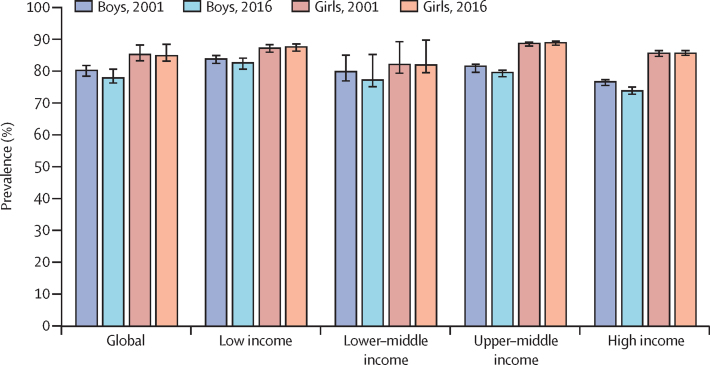
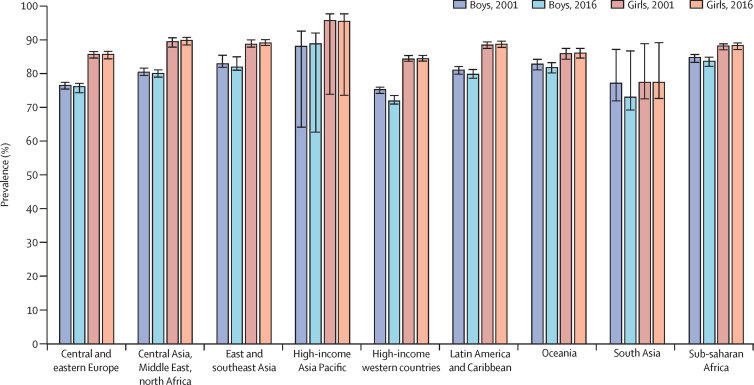
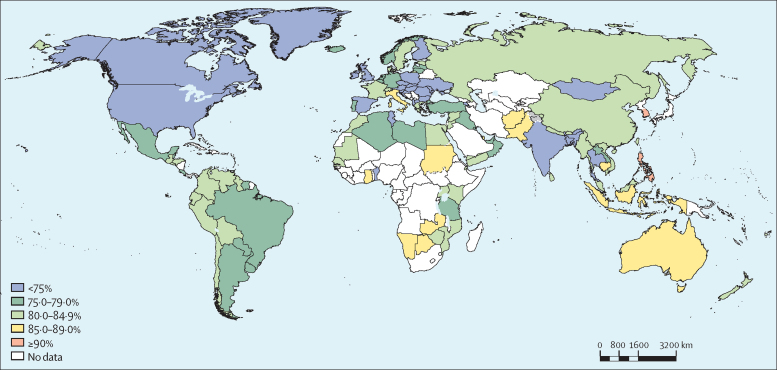
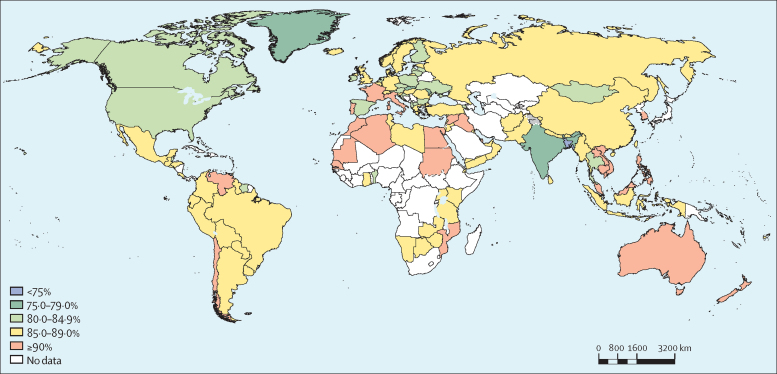
BACKGROUND: Physical activity has many health benefits for young people. In 2018, WHO launched More Active People for a Healthier World, a new global action on physical activity, including new targets of a 15% relative reduction of global prevalence of insufficient physical activity by 2030 among adolescents and adults. We describe current prevalence and trends of insufficient physical activity among school-going adolescents aged 11-17 years by country, region, and globally. METHODS: We did a pooled analysis of cross-sectional survey data that were collected through random sampling with a sample size of at least 100 individuals, were representative of a national or defined subnational population, and reported prevalence of of insufficient physical activity by sex in adolescents. Prevalence had to be reported for at least three of the years of age within the 10-19-year age range. We estimated the prevalence of insufficient physical activity in school-going adolescents aged 11-17 years (combined and by sex) for individual countries, for four World Bank income groups, nine regions, and globally for the years 2001-16. To derive a standard definition of insufficient physical activity and to adjust for urban-only survey coverage, we used regression models. We estimated time trends using multilevel mixed-effects modelling. FINDINGS: We used data from 298 school-based surveys from 146 countries, territories, and areas including 1·6 million students aged 11-17 years. Globally, in 2016, 81·0% (95% uncertainty interval 77·8-87·7) of students aged 11-17 years were insufficiently physically active (77·6% [76·1-80·4] of boys and 84·7% [83·0-88·2] of girls). Although prevalence of insufficient physical activity significantly decreased between 2001 and 2016 for boys (from 80·1% [78·3-81·6] in 2001), there was no significant change for girls (from 85·1% [83·1-88·0] in 2001). There was no clear pattern according to country income group: insufficient activity prevalence in 2016 was 84·9% (82·6-88·2) in low-income countries, 79·3% (77·2-87·5) in lower-middle-income countries, 83·9% (79·5-89·2) in upper-middle-income countries, and 79·4% (74·0-86·2) in high-income countries. The region with the highest prevalence of insufficient activity in 2016 was high-income Asia Pacific for both boys (89·0%, 62·8-92·2) and girls (95·6%, 73·7-97·9). The regions with the lowest prevalence were high-income western countries for boys (72·1%, 71·1-73·6), and south Asia for girls (77·5%, 72·8-89·3). In 2016, 27 countries had a prevalence of insufficient activity of 90% or more for girls, whereas this was the case for two countries for boys. INTERPRETATION: The majority of adolescents do not meet current physical activity guidelines. Urgent scaling up of implementation of known effective policies and programmes is needed to increase activity in adolescents. Investment and leadership at all levels to intervene on the multiple causes and inequities that might perpetuate the low participation in physical activity and sex differences, as well as engagement of youth themselves, will be vital to strengthen the opportunities for physical activity in all communities. Such action will improve the health of this and future young generations and support achieving the 2030 Sustainable Development Goals. FUNDING: WHO.
Overview
The claims and statistics of this paper haven’t been checked yet.
Free: it reads the open-access text and checks the first 5 claims that cite a source we can check. Create a free account to check every claim.
Integrity signals
Registry
Cites
Statistics
Figures
Verification
Claims the paper makes
The claims and statistics of this paper haven’t been checked yet.
Free: it reads the open-access text and checks the first 5 claims that cite a source we can check. Create a free account to check every claim.
Claims other papers make about this one
Each is checked against this paper’s own text: does it say what the citing paper says it does?
The source backs part of the claim, not all of it — or backs it for a different population, condition or comparison.
In the citing paper
“These data also reveal no overall improvement in global levels of participation over the last two decades and substantial gender differences.3 4”
From World Health Organization 2020 guidelines on physical activity and sedentary behaviour (2020) · cites this paper as [4]
Experimental — accuracy not yet measuredThe source backs part of the claim, not all of it — or backs it for a different population, condition or comparison.
In the citing paper
“Given that the most recent global estimates show that one in four (27.5%) adults3 and more than three-quarters (81%) of adolescents4 do not meet the recommendations for aerobic exercise, as outlined in the 2010 Global Recommendations on Physical Activity for Health,2”
From World Health Organization 2020 guidelines on physical activity and sedentary behaviour (2020) · cites this paper as [4]
Experimental — accuracy not yet measuredThe cited source says what the claim attributes to it.
In the citing paper
“a large proportion of children and youth, including those living in low and middle-income countries, are either sedentary or not achieving recommended levels of physical activity.8–11”
From Physical activity and health in Chinese children and adolescents: expert consensus statement (2020) (2020) · cites this paper as [11]
Self-check
Percentages, sums and reported differences re-computed from the paper’s own numbers.
The self-check needs the paper’s full text.
Citations
Cites
Abarca-Gómez, L., Abdeen, Z. A., Hamid, Z. A., Abu-Rmeileh, N. M., Acosta-Cazares, B., Acuin, C., Adams, R. J., Aekplakorn, W., Afsana, K., Aguilar-Salinas, C. A., et al. (2017) · The Lancet · doi:10.1016/s0140-6736(17)32129-3 · Cited by 7,482
Self-citationGlobal physical activity levels: surveillance progress, pitfalls, and prospects
Hallal, P. C., Andersen, L. B., Bull, F. C., Guthold, R., Haskell, W., & Ekelund, U. (2012) · The Lancet · doi:10.1016/s0140-6736(12)60646-1 · Cited by 5,711
Self-citationGuthold, R., Stevens, G. A., Riley, L. M., & Bull, F. C. (2018) · The Lancet Global Health · doi:10.1016/s2214-109x(18)30357-7 · Cited by 4,819
Self-citationA Physical Activity Screening Measure for Use With Adolescents in Primary Care
Prochaska, J. J., Sallis, J. F., & Long, B. (2001) · Archives of Pediatrics & Adolescent Medicine · doi:10.1001/archpedi.155.5.554 · Cited by 1,002
Progress in physical activity over the Olympic quadrennium
Sallis, J. F., Bull, F., Guthold, R., Heath, G. W., Inoue, S., Kelly, P., Oyeyemi, A. L., Perez, L. G., Richards, J., & Hallal, P. C. (2016) · The Lancet · doi:10.1016/s0140-6736(16)30581-5 · Cited by 935
Self-citationAubert, S., Barnes, J. D., Abdeta, C., Abi Nader, P., Adeniyi, A. F., Aguilar-Farias, N., Andrade Tenesaca, D. S., Bhawra, J., Brazo-Sayavera, J., Cardon, G., et al. (2018) · Journal of Physical Activity and Health · doi:10.1123/jpah.2018-0472 · Cited by 799
Biddle, S. J., Gorely, T., Pearson, N., & Bull, F. C. (2011) · International Journal of Behavioral Nutrition and Physical Activity · doi:10.1186/1479-5868-8-1 · Cited by 711
Self-citationGlobal Prevalence of Vision Impairment and Blindness
Stevens, G. A., White, R. A., Flaxman, S. R., Price, H., Jonas, J. B., Keeffe, J., Leasher, J., Naidoo, K., Pesudovs, K., Resnikoff, S., et al. (2013) · Ophthalmology · doi:10.1016/j.ophtha.2013.05.025 · Cited by 510
Self-citationStalsberg, R., & Pedersen, A. V. (2010) · Scandinavian Journal of Medicine & Science in Sports · doi:10.1111/j.1600-0838.2009.01047.x · Cited by 481
Farooq, M. A., Parkinson, K. N., Adamson, A. J., Pearce, M. S., Reilly, J. K., Hughes, A. R., Janssen, X., Basterfield, L., & Reilly, J. J. (2018) · British Journal of Sports Medicine · doi:10.1136/bjsports-2016-096933 · Cited by 418
Research works printed but not linked: 1
- WHO Global Recommendations on Physical Activity for Health 2010 World Health Organization Geneva 26180873
Cited by
Items 801–900 of 1,006
Correlates of Active Commuting to School among Portuguese Adolescents: An Ecological Model Approach
Loureiro, N., Loureiro, V., Grao‐Cruces, A., Martins, J., & de Matos, M. G. (2022) · International Journal of Environmental Research and Public Health · doi:10.3390/ijerph19052733 · Cited by 16
“However, globally, it is estimated that only some adolescents (19%) are active enough [7] to achieve the recommendation of 60 min of moderate-to-vigorous PA (MVPA) a day [8].”
BackgroundEngberg, E., Hietajärvi, L., Maksniemi, E., Lahti, J. M. T., Lonka, K., Salmela‐Aro, K., & Viljakainen, H. T. (2022) · Mental health and physical activity · doi:10.1016/j.mhpa.2022.100448 · Cited by 20
Sociocultural Influences on Exercise Behaviors and Attitudes in Adolescence
Reynolds, K. A., Haycraft, E., & Plateau, C. R. (2022) · Journal of Physical Activity and Health · doi:10.1123/jpah.2021-0797 · Cited by 16
Campisi, T., Nahiduzzaman, K. M., Nikiforiadis, A., Stamatiadis, N., & Basbas, S. (2022) · Sustainability · doi:10.3390/su14105780 · Cited by 13
“This, in turn, has worsened people’s quality of life, especially for the elderly and frail people with obesity, among others [16,17].”
BackgroundSanz-Martín, D., Melguizo-Ibáñez, E., Tendero, G. R., & Ubago-Jiménez, J. L. (2022) · International Journal of Environmental Research and Public Health · doi:10.3390/ijerph19127463 · Cited by 14
“Females engage in less PA than males [6,11], and PA decreases with increasing age [12,13].”
BackgroundCatch me if you can! How French adolescents seize social occasions and opportunities to be active
Derigny, T., Schnitzler, C., Remmers, T., van Kann, D., Gandrieau, J., Seye, N., Baquet, G., & Potdevin, F. (2022) · BMC Public Health · doi:10.1186/s12889-022-13746-0 · Cited by 18
“Background Despite growing evidence of positive relationships between physical activity (PA) and health, a consensus has emerged on insufficient levels of PA in adolescents [1].”
BackgroundMcQuinn, S., Belton, S., Staines, A. S., & Sweeney, M. R. (2022) · Pilot and Feasibility Studies · doi:10.1186/s40814-022-01149-2 · Cited by 11
“Background Despite evidence continuing to accumulate on the health benefits of regular physical activity (PA) for adolescents [1, 2], globally, 85% of adolescent females (aged 11–17) are insufficiently physically active [3].”
BackgroundAdebusoye, B., Chattopadhyay, K., Ekezie, W. C., Phalkey, R. K., & Leonardi‐Bee, J. (2022) · JBI Evidence Synthesis · doi:10.11124/jbies-21-00295 · Cited by 13
Merica, C. B., Egan, C. A., Webster, C. A., Mîndrilă, D., Karp, G. G., Paul, D. R., & Orendorff, K. L. (2022) · International Journal of Environmental Research and Public Health · doi:10.3390/ijerph191912005 · Cited by 18
“Participating in regular physical activity (PA) reduces adverse health effects related to sedentarism, but 81% of adolescents do not meet PA guidelines [2].”
BackgroundLiu, H., Bi, C., Lin, H., Ma, W., Zhang, J., Hu, Y.-Y., & Liu, J. (2022) · BMC Pediatrics · doi:10.1186/s12887-022-03646-y · Cited by 20
Adebusoye, B., Leonardi‐Bee, J., Phalkey, R. K., & Chattopadhyay, K. (2022) · Health Science Reports · doi:10.1002/hsr2.997 · Cited by 15
“8% of school adolescents are reported to reach the recommended level.(5) The WHO recommends that”
BackgroundModerate-to-Vigorous Physical Activity in Physical Education: A Review of Reviews
Gallego, D. I., Fernández‐Río, J., & Saiz-González, P. (2022) · Journal of Teaching in Physical Education · doi:10.1123/jtpe.2022-0084 · Cited by 18
Villalba-Heredia, L., Rodríguez, C., Amador, Z. S., Núñez, J. C., & Mendez‐Giménez, A. (2022) · Children · doi:10.3390/children10010050 · Cited by 16
“Despite that, many children and adolescents do not do the recommended amount of physical activity, with over 80% of the world’s adolescent population being insufficiently physically active in 2016 [13].”
BackgroundEvaluating Changes in Perceived Enjoyment throughout a 12-Week School-Based Exergaming Intervention
Röglin, L., Stoll, O., Ketelhut, K., Martin‐Niedecken, A. L., & Ketelhut, S. (2023) · Children · doi:10.3390/children10010144 · Cited by 19
“Despite the knowledge of the positive effects of PA, physical inactivity among children and adolescents is a major public health concern [4].”
BackgroundKim, G., Jeong, H., & Yim, H. W. (2023) · Epidemiology and Health · doi:10.4178/epih.e2023012 · Cited by 17
“Only 2.8% of female Korean students met the WHO physical activity guideline level, a rate significantly lower than the 19.5% of female students reported in the United States, a representative North American country, and 8.5% of Italian female students, a representative Southern European country [2].”
BackgroundInfluentialCao, Y., Zhu, L., Chen, Z., Li, Z., Xie, W., & Liang, M. (2023) · Frontiers in Physiology · doi:10.3389/fphys.2023.1041622 · Cited by 17
“0% (Guthold et al., 2020), which is an important contributing factor to the increased incidence of cardiovascular disease in children.”
BackgroundInfluentialPrieto, J. L., Rodríguez, B. R., Palacio, E. S., & Duarte, M. M. (2023) · Retos · doi:10.47197/retos.v48.96741 · Cited by 23
Kolunsarka, I., Gråstén, A., Stodden, D. F., Huhtiniemi, M., & Jaakkola, T. T. (2023) · Medicine & Science in Sports & Exercise · doi:10.1249/mss.0000000000003196 · Cited by 19
“As majority of youth do not meet current physical activity guidelines (3)”
BackgroundSales, D. R. L., da Silva, J. P., Bergamo, R. R., de Oliveira, L. C., Ferrari, G., & Matsudo, V. K. R. (2023) · Scientific Reports · doi:10.1038/s41598-023-33732-9 · Cited by 25
Brindley, C., Hamřík, Z., Kleszczewska, D. W., Dzielska, A., Mazur, J., Haug, E., Kopčáková, J., Marques, A., Altenburg, T. M., Demetriou, Y., et al. (2023) · Frontiers in Public Health · doi:10.3389/fpubh.2023.1190045 · Cited by 21
Gesek, M., Fornal, A., & Zarzycka, D. (2023) · Medical Science Monitor · doi:10.12659/msm.940742 · Cited by 19
“However, among child and adolescent populations, there is a global epidemic of insufficient physical activity [89,90] and obesity [91], further exacerbated by the effects of the COVID-19 pandemic [92].”
BackgroundMatheson, E. L., Schneider, J., Gentili, C., Tinoco, A., Silva-Breen, H. L., White, P., LaVoi, N. M., & Diedrichs, P. C. (2023) · International Review of Sport and Exercise Psychology · doi:10.1080/1750984x.2023.2258379 · Cited by 17
“Given that body image and movement participation are closely intertwined, as well as disproportionately problematic among this demographic (Guthold et al., 2018, 2020), establishing which interventions are e ff ective and recommendable is paramount.”
Ljungmann, C. K., Christensen, J. H., Johnsen, H. R., Klinker, C. D., & Pawlowski, C. S. (2023) · Sport in Society · doi:10.1080/17430437.2023.2286013 · Cited by 20
“…global level, however, only one out of five adolescents adhere to international recommendations of at least 60 min of moderate to vigorous PA a day (Guthold et al. 2020), and adolescent girls are consistently reported to be less active compared to their male counterparts (Guthold et al. 2020;…”
BackgroundRyan, M., Ricardo, L. I. C., Nathan, N., Hofmann, R., & van Sluijs, E. M. F. (2024) · Journal of sport and health science/Journal of Sport and Health Science · doi:10.1016/j.jshs.2024.02.003 · Cited by 18
Inteligencia artificial en pediatría: actualidad y retos
Galdo, B., García, C. P., Pardo, J., Solar, A., Llamas, D., Fernández-Blanco, E., & Pazos, A. (2024) · Anales de Pediatría · doi:10.1016/j.anpedi.2024.02.006 · Cited by 24
Aznar, S., Jiménez-Zazo, F., Romero, C., Gómez, S. F., Homs, C., Wärnberǵ, J., Medrano, M., Gusi, N., González‐Gross, M., Marín‐Cascales, E., et al. (2024) · PLoS ONE · doi:10.1371/journal.pone.0296816 · Cited by 17
Marrero-Rivera, J. P., Sobkowiak, O., Sgourakis, A., Bagnato, S. J., Kline, C. E., Gordon, B. D. H., & Ross, S. E. T. (2024) · Children · doi:10.3390/children11030363 · Cited by 20
“Despite this recommendation, up to 81% of school-aged children—globally—are reported to be insufficiently physically active [4].”
Motor competence and compliance with physical activity recommendations in Chilean schoolchildren
Martínez-López, N., Estevan, I., Candia-Cabrera, P., Aguilar-Farías, N., & Cárcamo-Oyarzún, J. (2024) · Frontiers in Psychology · doi:10.3389/fpsyg.2024.1371766 · Cited by 20
Scheller, D. A., Sterr, K., Humpe, A., Mess, F., & Bachner, J. (2024) · Health & Place · doi:10.1016/j.healthplace.2024.103361 · Cited by 19
Paap, H., Koka, A., Meerits, P.-R., & Tilga, H. (2025) · Children · doi:10.3390/children12010056 · Cited by 28
Tekalegn, Y., Roder, D. M., Shi, Z., & Li, M. (2025) · Nutrients · doi:10.3390/nu17040609 · Cited by 21
“This finding aligns with the global trend reported in a previous study, which reported that over 80% of adolescents worldwide fail to meet the WHO-recommended guideline of at least 60 min of moderate-to-vigorous physical activity per day [50].”
Results from the Japan 2022 report card on physical activity for children and youth
Tanaka, C., Abe, T., Tanaka, S., Hatamoto, Y., Miyachi, M., Inoue, S., & Reilly, J. J. (2022) · Journal of Exercise Science & Fitness · doi:10.1016/j.jesf.2022.08.001 · Cited by 13
Cumming, S. P., Harrington, D. M., Davis, M. J., Edwardson, C. L., Gorely, T., Khunti, K., Rowlands, A. V., Yates, T. E., & Sherar, L. B. (2020) · Annals of Human Biology · doi:10.1080/03014460.2020.1784277 · Cited by 14
Kidokoro, T., Fuku, N., Yanagiya, T., Takeshita, T., Takaragawa, M., Annear, M. J., Tian, X., Waiganjo, L. B., Bogonko, L. F., Isika, J. K., et al. (2020) · International Journal of Environmental Research and Public Health · doi:10.3390/ijerph17124254 · Cited by 15
“Although previous cross-country comparison studies evaluating physical activity levels among children including both developed and developing countries have provided useful insights [3,4], those studies predominantly used questionnaires to evaluate physical activity levels.”
BackgroundBachner, J., Sturm, D. J., Haug, S., & Demetriou, Y. (2020) · BMC Public Health · doi:10.1186/s12889-020-09096-4 · Cited by 15
“Although not even the most popular devicebased approaches like accelerometry offer perfectly reliable PA data [12–14], a vast majority of studies indicates that PA in adolescence does not comply with the respective recommendation [15, 16].”
BackgroundGuddal, M. H., Stensland, S. Ø., Småstuen, M. C., Johnsen, M. B., Heuch, I., Zwart, J., & Storheim, K. (2020) · International Journal of Environmental Research and Public Health · doi:10.3390/ijerph17124603 · Cited by 19
“Young people commonly drift away from engagement in regular physical activity throughout their adolescent years [13], and the majority of adolescents worldwide (81%) do not adhere to the current recommendations of daily PA [6].”
BackgroundKhan, A., & Uddin, R. (2020) · Public Health · doi:10.1016/j.puhe.2020.08.024 · Cited by 15
Telford, D. M., Signal, D., Hofman, P. L., & Gusso, S. (2021) · International Journal of Environmental Research and Public Health · doi:10.3390/ijerph18094475 · Cited by 16
“Since participation in competitive sports and activities is highest between the ages of 8 and 14, the lack of organised sporting activities may have had a greater impact on PA in younger adolescents [17].”
BackgroundInfluentialSasayama, K., Watanabe, M., & Ogawa, T. (2021) · Journal of Transport & Health · doi:10.1016/j.jth.2021.101077 · Cited by 15
Gale, J. T., Haszard, J. J., Scott, T., & Peddie, M. C. (2021) · International Journal of Environmental Research and Public Health · doi:10.3390/ijerph18158077 · Cited by 13
“However, globally in 2016, 81% of adolescents (85% of females and 78% of males) were not meeting country specific guidelines [10].”
BackgroundWidyastari, D. A., Saonuam, P., Rasri, N., Pongpradit, K., & Katewongsa, P. (2021) · International Journal of Environmental Research and Public Health · doi:10.3390/ijerph181910088 · Cited by 21
“Nevertheless, despite the global effort to improve the health of young people, 80 percent of children and young people worldwide remain physically inactive or do not meet the recommended level of PA daily [13,14].”
BackgroundKesic, M. G., Gilić, B., Zovko, I. Č., Drid, P., Korovljev, D., & Sekulić, D. (2021) · Medycyna Pracy · doi:10.13075/mp.5893.01180 · Cited by 17
“However, it is a worrying fact that 81% of adolescents do not have adequate PA levels (PAL) globally, which is a major public health concern [2].”
BackgroundMaterová, E., Pelclová, J., Gába, A., & Frömel, K. (2022) · BMC Public Health · doi:10.1186/s12889-022-12766-0 · Cited by 13
“BMC Public Health (2022) 22:363 active [6].”
Bardid, F., Tomaz, S. A., Johnstone, A., Robertson, J., Craig, L. C. A., & Reilly, J. J. (2022) · Journal of Exercise Science & Fitness · doi:10.1016/j.jesf.2022.07.002 · Cited by 16
Simultaneous augmentation of muscle and bone by locomomimetism through calcium-PGC-1α signaling
Ono, T., Denda, R., Tsukahara, Y., Nakamura, T., Okamoto, K., Takayanagi, H., & Nakashima, T. (2022) · Bone Research · doi:10.1038/s41413-022-00225-w · Cited by 16
Amholt, T. T., Jespersen, J. F., Zacho, M., Timperio, A. F., & Schipperijn, J. (2022) · Landscape and Urban Planning · doi:10.1016/j.landurbplan.2022.104546 · Cited by 16
Rynders, C. A., Bowen, A. E., Cooper, E., Brinton, J. T., HIGGINS, J. A., Nadeau, K. J., Wright, K. P., & Simon, S. L. (2022) · Journal of Biological Rhythms · doi:10.1177/07487304221123455 · Cited by 14
“parent study required participants to have a typical low level of physical activity (< 3 h of reported physical activity per week), although this is broadly representative of the adolescent population (Guthold et al., 2020).”
BackgroundMonacis, D., Trecroci, A., Invernizzi, P. L., & Colella, D. (2022) · International Journal of Environmental Research and Public Health · doi:10.3390/ijerph191912567 · Cited by 24
“Guthold et al. (2020), in a recent survey study based on a sample of 1.6 million subjects from 146 countries, noted that (a) over 80% of boys between 11 and 17 years do not follow WHO recommendations to perform at least one hour of physical activity per day, and (b) girls are more inactive than…”
BackgroundInfluentialAnindya, K., Marthias, T., Biruni, M. Z., Hage, S., Ng, N., Laverty, A. A., McPake, B., Millett, C. J., Haregu, T., Hulse, E. S. G., et al. (2022) · Frontiers in Cardiovascular Medicine · doi:10.3389/fcvm.2022.972461 · Cited by 27
Wearable Artificial Intelligence for Assessing Physical Activity in High School Children
Ahmed, A., Aziz, S., Qidwai, U. A., Farooq, F., Shan, J., Subramanian, M., Chouchane, L., EINatour, R., Abd-Alrazaq, A. A., Pandas, S., et al. (2022) · Sustainability · doi:10.3390/su15010638 · Cited by 21
Mateo‐Orcajada, A., Vaquero‐Cristóbal, R., & Abenza‐Cano, L. (2023) · Child Care Health and Development · doi:10.1111/cch.13146 · Cited by 17
Snack frequency, size, and energy density are associated with diet quality among US adolescents
Tripicchio, G. L., Bailey, R. L., Davey, A., Croce, C. M., & Fisher, J. O. (2023) · Public Health Nutrition · doi:10.1017/s1368980023001635 · Cited by 19
“A ‘ low active ’ level of physical activity ( ≥ 1·4 to 1·6) was assumed for all adolescents since objective physical activity data were not available and other surveillance studies among adolescents demonstrate insufficient/low physical activity trends in this group (33,34) .”
Ng, K., Sudeck, G., Marques, A., Borraccino, A., Boberová, Z., Vašíčková, J., Tesler, R., Kokko, S. P., & Samdal, O. (2020) · Journal of Physical Activity and Health · doi:10.1123/jpah.2019-0522 · Cited by 18
“…MVPA than girls in the HBSC study between 2001 and 2010, and this pattern continued into the 2013 – 14 HBSC data, as also reported by Guthold et al. 5 There were few countries with individual differences from the pooled results (Armenia, Germany, Greece, Latvia, Malta, Poland, Russian Federation,…”
Kemp, B. J., Cliff, D. P., Kariippanon, K. E., Crowe, R. K., & Parrish, A. (2020) · Sport Education and Society · doi:10.1080/13573322.2020.1822795 · Cited by 18
The Efficacy of School-Based Interventions in Preventing Adolescent Obesity in Australia
Buru, K., Emeto, T. I., Malau‐Aduli, A. E. O., & Malau‐Aduli, B. S. (2020) · Healthcare · doi:10.3390/healthcare8040514 · Cited by 21
“6 million adolescents aged 11 to 17 years) in 146 countries worldwide [1].”
BackgroundThe World Cancer Declaration: time to consolidate wins and work towards 2025
Johnson, S., Tittenbrun, Z., Romero, Y., Torode, J., Frech, S., Abdel–Wahab, M., Juric, A., Stevens, L. M., Bray, F., Piñeros, M., et al. (2021) · The Lancet Oncology · doi:10.1016/s1470-2045(21)00012-7 · Cited by 13
Shen, C., Tseng, Y.-H., Shen, M.-C. S., & Lin, H. (2021) · International Journal of Environmental Research and Public Health · doi:10.3390/ijerph18095013 · Cited by 18
“It is evident that, in addition to the current health problems arising from low activity levels and inadequate physical adaptability [7,15], living under the COVID-19 environmental risk and response protocols poses a deeper negative impact on the well-being and growth of adolescents [8,13–18].”
BackgroundFlis, M., Rodziewicz-Flis, E. A., Micielska, K., Kortas, J. A., Jaworska, J., Borkowska, A., Sansoni, V., Perego, S., Lombardi, G., & Ziemann, E. (2021) · Frontiers in Bioscience-Landmark · doi:10.52586/5015 · Cited by 16
“5% of adults [1] and 81% of adolescents were physically inactive [2], and did not meet the recommended 150 min weekly dose of physical activity”
BackgroundCaiHong, H., Memon, A. R., Liang, C., Hong, J.-T., Lin, Y., & Chen, S. (2021) · Frontiers in Public Health · doi:10.3389/fpubh.2021.719742 · Cited by 21
“**ST Screen time, excessive denotes not meeting the guidelines; limited denotes meeting the guidelines (4).”
BackgroundInfluentialThe International Society for Physical Activity and Health (2021) · British Journal of Sports Medicine · doi:10.1136/bjsports-2020-103635 · Cited by 15
Nie, Y., Wang, W., Guo, M., Tang, W., Qu, G., Wang, X., Zhou, F., Ma, W., Qiu, W., Gao, J., et al. (2025) · BMC Psychology · doi:10.1186/s40359-025-02847-1 · Cited by 20
“Additionally, adolescents’PA levels decline during puberty, with one study showing a decrease from 30 to 21% daily PA for boys and from 21 to 11% for girls between the ages of 11 and 15 [18], showing a particularly pronounced in girls [19].”
Li, G., Li, H., Su, Y., Li, Y., Jiang, S., & Zhang, G. (2025) · BMC Public Health · doi:10.1186/s12889-025-22739-8 · Cited by 26
“Inclusion criteria required participants to be aged 18–25 years, aligning with the demographic most affected by rising obesity trends in young adulthood [22].”
Renninger, D., Sturm, D. J., Marques, A., Peralta, M., Popovic, S. R., Gardašević, J., Mašanović, B., & Demetriou, Y. (2021) · Sustainability · doi:10.3390/su13136992 · Cited by 16
“Previous research reported similar findings: gender differences in the prevalence of physical inactivity are evident [32].”
ResultCasado-Robles, C., Viciana, J., Guijarro-Romero, S., & Mayorga-Vega, D. (2021) · Journal of Teaching in Physical Education · doi:10.1123/jtpe.2020-0132 · Cited by 15
Gerber, M., Ayekoé, S. A., Beckmann, J., Bonfoh, B., Kouassi, K. B., Gba, B. C., Traoré, G. S., Coulibaly, J. T., Dao, D., du Randt, R., et al. (2021) · Frontiers in Public Health · doi:10.3389/fpubh.2021.671782 · Cited by 14
Maulida, R., Ikeda, E., Oni, T., & van Sluijs, E. M. F. (2022) · BMJ Open · doi:10.1136/bmjopen-2021-057082 · Cited by 13
Sick, K., Sabiston, C. M., Maharaj, A., & Pila, E. (2022) · Psychology of sport and exercise · doi:10.1016/j.psychsport.2022.102215 · Cited by 16
Pan, X., Wang, H., Wu, D., Liu, X., Deng, P., & Zhang, Y. (2022) · International Journal of Environmental Research and Public Health · doi:10.3390/ijerph19148319 · Cited by 13
“An international survey involving 16 million people showed that only 20% of young people experience the pleasure of sport and benefit physically and mentally from regular physical activity [1].”
BackgroundLoh, V. H. Y., Sahlqvist, S., Veitch, J., Thornton, L. E., Salmon, J., Cerin, E., Schipperijn, J., & Timperio, A. F. (2022) · BMC Public Health · doi:10.1186/s12889-022-13947-7 · Cited by 12
“However, fewer than one in five adolescents worldwide [3] and only one in 12 adolescents in Australia [4] achieve the recommendation of 60 min of daily moderate-to-vigorous-intensity physical activity (MVPA).”
BackgroundImpact of COVID-19 on 1000 m Running and Pull-Up Performance among College Men Living in China
Xiao-lu, F., Qiu, J., Wang, Y., Wen, X., Bai, L., & Yu, H. (2022) · International Journal of Environmental Research and Public Health · doi:10.3390/ijerph19169930 · Cited by 13
“Globally, nearly 80% of adolescents are insufficiently active [18,19].”
BackgroundImproving access to public physical activity events for disadvantaged communities in Australia
Smith, J. L., Reece, L. J., Rose, C. L., & Owen, K. B. (2022) · BMC Public Health · doi:10.1186/s12889-022-13981-5 · Cited by 12
Khudair, M., Marcuzzi, A., Ng, K., Tempest, G. D., Bartos̆, F., Peric, R., Maier, M., Beccia, F., Boccia, S., Brandes, M., et al. (2022) · BMJ Open · doi:10.1136/bmjopen-2021-059202 · Cited by 15
Noonan, R. J. (2022) · International Journal of Environmental Research and Public Health · doi:10.3390/ijerph192315579 · Cited by 16
“As such, sport programmes at this age are vitally important as overall physical activity participation levels typically decline too [58].”
BackgroundCompensation of overall physical activity in (pre)adolescent girls – the CReActivity project
Beck, F., Dettweiler, U., Sturm, D. J., Demetriou, Y., & Reimers, A. K. (2022) · Archives of Public Health · doi:10.1186/s13690-022-01002-1 · Cited by 14
Huotari, P., Gråstén, A., Huhtiniemi, M., & Jaakkola, T. T. (2022) · Scandinavian Journal of Medicine and Science in Sports · doi:10.1111/sms.14290 · Cited by 12
Sun, Y., Liu, Y., Yin, X., Li, M., Zhang, T., Zhang, F., Guo, Y., & Sun, P. (2023) · International Journal of Environmental Research and Public Health · doi:10.3390/ijerph20021408 · Cited by 15
“[34] analyzed 298 population studies from 2001 to 2016 and found that the average MVPA compliance rate in global children and adolescents in 2016 was only 19.”
BackgroundOdunitan-Wayas, F. A., Smith, J., Lambert, E. V., Guthrie-Dixon, N. G., Wasnyo, Y. F., West, S. J., Oni, T., & Foley, L. S. (2023) · International Journal of Environmental Research and Public Health · doi:10.3390/ijerph20032449 · Cited by 14
“7%) was higher compared to the global finding (less than 20% of children aged 11–17 years) [2] but lower than in a study conducted in South Africa with children aged 8–14 that indicated that 69% of the children met guidelines [5].”
BackgroundResultInfluentialJussila, J. J., Pulakka, A., Halonen, J. I., Salo, P., Allaouat, S., Mikkonen, S. J., & Lanki, T. (2023) · European Journal of Public Health · doi:10.1093/eurpub/ckad128 · Cited by 28
de Paula, D., Crochemore‐Silva, I., Griep, R. H., Duncan, B. B., & Schmidt, M. I. (2023) · Journal of Physical Activity and Health · doi:10.1123/jpah.2023-0106 · Cited by 15
Kilgour, G. M., Stott, N. S., Steele, M. C., Adair, B., Hogan, A., & Imms, C. (2023) · Disability and Rehabilitation · doi:10.1080/09638288.2023.2251395 · Cited by 13
“…study. the term adolescents will be used in reporting results, as it is more reflective of the included age range, than the words child or children [23]. the adolescents’ mobility was classified at GMFcs level i-ii ( n = 5 GMFcs i, n = 3 GMFcs ii) [19], upper limb skills at Manual ability…”
Early Childhood Teachers’ Perceptions of Physical Activity: A Scoping Review
Santiago-Saamong, C. R., Deogracias, P. K. E., Saltmarsh, S., Chan, D. K. C., & Capio, C. M. (2023) · Early Childhood Education Journal · doi:10.1007/s10643-023-01575-8 · Cited by 17
Pedroso, C. F., Pereira, C. C., Cavalcante, Á. M. R. Z., & Guimarães, R. A. (2023) · PLoS ONE · doi:10.1371/journal.pone.0292612 · Cited by 35
Messing, S., Tcymbal, A., Abu‐Omar, K., & Gelius, P. C. (2023) · Health Research Policy and Systems · doi:10.1186/s12961-023-01068-5 · Cited by 16
The availability between recreational facilities and physical activity of US adolescents
Valencia, J. G., Jhon, J., Lanza, K., Castro, G., & Barengo, N. C. (2024) · Preventive Medicine Reports · doi:10.1016/j.pmedr.2024.102592 · Cited by 20
Ryan, S. T., Okely, A. D., Chong, K. H., Stanley, R. M., Randle, M., Waqa, G., Yamanaka, A. B., Guerrero, R. T. L., COLEMAN, P. H., Shallcross, L., et al. (2024) · Journal of Physical Activity and Health · doi:10.1123/jpah.2023-0463 · Cited by 15
Vuletić, P. R., Gilić, B., Zenić, N., Pavlinović, V., Kesic, M. G., Idrizović, K., Šunda, M., Manojlović, M., & Sekulić, D. (2024) · Education Sciences · doi:10.3390/educsci14040391 · Cited by 23
“Unfortunately, most of the young population is not physically active, i.e., 81% of children and adolescents do not have a sufficient level of PA [12], and studies that state that children and adolescents have an insufficient level of PF emphasize that the reason is mainly insufficient PA [12–14].”
Rutberg, S., Henriksson, M., Andersson, M., Palstam, A., & Lindqvist, A.-K. (2024) · Health Promotion Practice · doi:10.1177/15248399241255376 · Cited by 12
“the recommended 60 min of daily physical activity (Guthold et al., 2020).”
Menstrual Dysfunction in Adolescent Female Athletes
Calcaterra, V., Vandoni, M., Bianchi, A., Pirazzi, A., Tiranini, L., Baldassarre, P., Diotti, M., Cavallo, C., Nappi, R. E., & Zuccotti, G. (2024) · Sports · doi:10.3390/sports12090245 · Cited by 27
“Despite that, a recent global survey revealed that 84.7% of girls aged 11–17 years are insufficiently physically active [5], thus becoming at risk of overweight and obesity with a detrimental effect on reproductive function [6].”
BackgroundInfluentialPérez-Ramírez, J. A., González-Férnandez, F. T., & Villa‐González, E. (2024) · Applied Sciences · doi:10.3390/app14209200 · Cited by 30
Rangul, V., Sund, E. R., Ingul, J. M., Rimehaug, T., Pape, K., & Kvaløy, K. (2024) · International Journal of Environmental Research and Public Health · doi:10.3390/ijerph21111417 · Cited by 14
Chen, X., Wang, F., Zhang, H., Yang, L., Zhu, S., & Yang, Y. (2025) · BMC Public Health · doi:10.1186/s12889-025-22170-z · Cited by 29
“%) of the global population [6], appear to show significant decline in PA levels [7, 8].”
González‐Serrano, M. H., Gómez-Tafalla, A. M., & Moreno, F. C. (2020) · International Journal of Environmental Research and Public Health · doi:10.3390/ijerph17124308 · Cited by 17
“Moreover, although the prevalence of insufficient physical activity significantly decreased between 2001 and 2016 for boys, there was no significant change for girls [6].”
BackgroundInfluentialda Costa, R. M., Minatto, G., da Costa, B. G. G., & da Silva, K. S. (2020) · European Journal of Pediatrics · doi:10.1007/s00431-020-03719-z · Cited by 14
“, leisure time physical activity) [45] and spend more time in front of screens (e.”
BackgroundActive Breaks and Motor Competencies Development in Primary School: A Systematic Review
Colella, D., Monacis, D., & Limone, P. (2020) · Advances in Physical Education · doi:10.4236/ape.2020.103020 · Cited by 26
Rose, L. T., & Soundy, A. (2020) · Behavioral Sciences · doi:10.3390/bs10110171 · Cited by 24
“6 million adolescents, conducted in 2016, stated that 81% of the sample were insufficiently physically active [9].”
BackgroundScholes, S., & Mindell, J. S. (2021) · BMJ Open · doi:10.1136/bmjopen-2020-040540 · Cited by 14
Haapala, E. A., Gao, Y., Hartikainen, J., Rantalainen, T., & Finni, T. J. (2021) · Scientific Reports · doi:10.1038/s41598-021-92040-2 · Cited by 15
Haverinen, E., Elonheimo, H., Tolonen, H. K., Jousilahti, P., & Wennman, H. (2021) · Scandinavian Journal of Public Health · doi:10.1177/14034948211020599 · Cited by 16
“In this review, PA consists of both leisure time pursuits and PA in work-, school- or community-based settings, in households and in relation to transport [3,4].”
BackgroundFinnish late adolescents’ physical activity during COVID-19 spring 2020 lockdown
Ng, K., Koski, P., Lyyra, N., Palomäki, S. H., Mononen, K., Blomqvist, M., Vasankari, T. J., & Kokko, S. P. (2021) · BMC Public Health · doi:10.1186/s12889-021-12263-w · Cited by 23
“Despite these known advantages, adolescents struggle to maintain a physically active lifestyle and PA levels drop as age increases [3].”
BackgroundLópez‐Seoane, J., Sáiz, S. L. J., Coso, J. D., & Pareja-Galeano, H. (2022) · Critical Reviews in Food Science and Nutrition · doi:10.1080/10408398.2022.2034734 · Cited by 13
“Quality assessment and risk of bias The quality of each investigation was assessed following the Cochrane Collaboration Guidelines (Higgins and Green 2011).”
Metadata
- Authors
- Guthold, R., Stevens, G. A., Riley, L. M., & Bull, F. C.
- Affiliations
- World Health Organization (CH)
- Imperial College London (GB)
- The University of Western Australia (AU)
- Corresponding author
- Guthold, Regina
- Venue
- The Lancet Child & Adolescent Health
- Publisher
- Elsevier BV
- Published
- 2020-01
- Volume
- 4
- Issue
- 1
- Pages
- 23-35
- ISSN
- 2352-4642 (ISSN-L)
- PMC
- PMC6919336
- OpenAlex
- W2989617484
- Semantic Scholar
- f46a550ac37c8a6425eb044c3c76e0da5d9756a8
- Cited by
- 4,033
- References
- 25
- Citations by year
- 2026: 622 · 2025: 654 · 2024: 638 · 2023: 562 · 2022: 567 · 2021: 496 · 2020: 485
- FWCI
- 266.68
- Type
- journal article
- Language
- en
- Open access
- hybrid
- doi.org
- Licence
- cc-by
- www.elsevier.com/tdm/userlicense/1.0/ (tdm)
- www.elsevier.com/legal/tdmrep-license (tdm)
- creativecommons.org/licenses/by/3.0/igo/ (vor)
- Locations
- The Lancet Child & Adolescent Health (publishedVersion, cc-by)
- PubMed Central (publishedVersion, cc-by)
- PubMed (publishedVersion)
- UWA Profiles and Research Repository (UWA) (submittedVersion, cc-by)
- Funders
- World Health Organization
- Topics
- Health Sciences › Medicine › Public Health, Environmental and Occupational Health › Physical Activity and Health
- Health Sciences › Medicine › Public Health, Environmental and Occupational Health › Obesity, Physical Activity, Diet
- Social Sciences › Life-span and Life-course Studies › Recreational Sport and Physical Activity
- Keywords
- physical inactivity, adolescents, global trends, sex differences, school-based survey, country income groups, physical activity guidelines, low-income countries
- MeSH terms
- Adolescent, Child, Cross-Sectional Studies, Developing Countries, Female, Health Surveys, Humans, Income, Male, Sex Factors, Global Health, Exercise, Prevalence, Developed Countries
About these checks
Registry, retraction, Cites and statistics results are computed, not judged, with one exception: a printed reference that no index lists is read once by a model before it counts as a citation error. Claims are extracted by a model and kept only when their quote appears verbatim in the text; each cited source is then checked, with a model’s help, for whether it says what the claim relies on. Those verdicts can be wrong — read the claim’s quote and the cited source before relying on one.
Statistics and arithmetic are recomputed, not judged.
Confidence bands are shown only for fields calibrated on our annotated test set. None is calibrated yet, so no band is shown.
What counts as a claim ›How we measure confidence ›How we check this ›
Are you an author, or do you see a problem with this page? Request a review
Data sources
Bibliographic data: Semantic Scholar, OpenAlex, Crossref.
Contains information from the Semantic Scholar Academic Graph Datasets, made available under the ODC Attribution License (ODC-BY 1.0).
Semantic Scholar’s data is described in: Kinney, R., et al. (2023). The Semantic Scholar Open Data Platform. arXiv:2301.10140.
