

How Censorship in China Allows Government Criticism but Silences Collective Expression
Open accessThe DOI matches its Crossref record; 53 of the 54 references it cites were found in a registry or an index, and 1 are not checked yet; none of the 12 sources its claims cite is checked for support yet.
Abstract
We offer the first large scale, multiple source analysis of the outcome of what may be the most extensive effort to selectively censor human expression ever implemented. To do this, we have devised a system to locate, download, and analyze the content of millions of social media posts originating from nearly 1,400 different social media services all over China before the Chinese government is able to find, evaluate, and censor (i.e., remove from the Internet) the subset they deem objectionable. Using modern computer-assisted text analytic methods that we adapt to and validate in the Chinese language, we compare the substantive content of posts censored to those not censored over time in each of 85 topic areas. Contrary to previous understandings, posts with negative, even vitriolic, criticism of the state, its leaders, and its policies are not more likely to be censored. Instead, we show that the censorship program is aimed at curtailing collective action by silencing comments that represent, reinforce, or spur social mobilization, regardless of content. Censorship is oriented toward attempting to forestall collective activities that are occurring now or may occur in the future—and, as such, seem to clearly expose government intent.
Checked 2026-11-22 · 1 reference not checked yet
Overview
CoChat Summary
TL;DR
The paper uses large-scale, real-time collection of Chinese social media posts to test why China censors online expression. It finds that censorship does not target criticism of the state or leaders; instead, it targets posts with collective action potential, regardless of whether they support or criticize the government.
Key findings
- Across the data, an average of approximately 13% of all social media posts were censored. Ex ante political sensitivity had only a weak relationship with censorship: Low and Medium categories were censored at 16% and 17%, respectively, versus 24% for High.
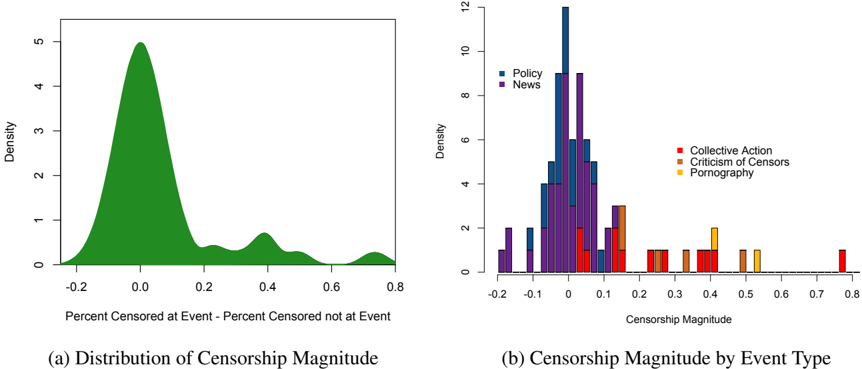
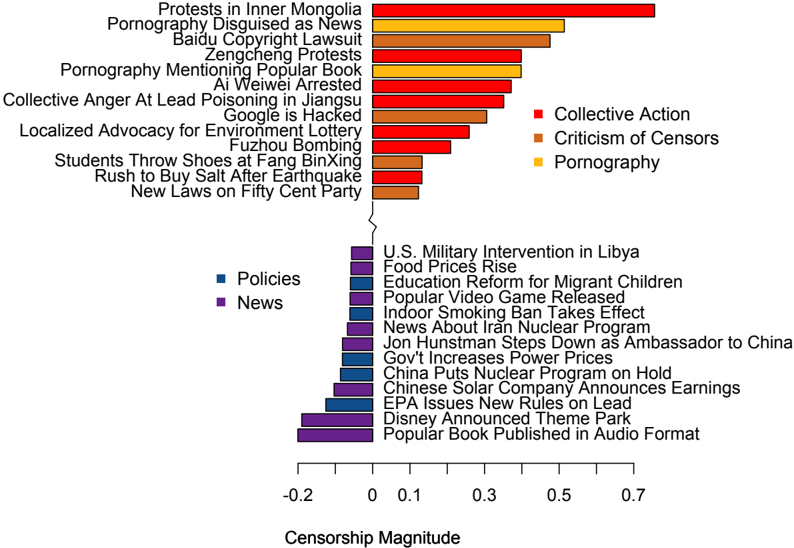
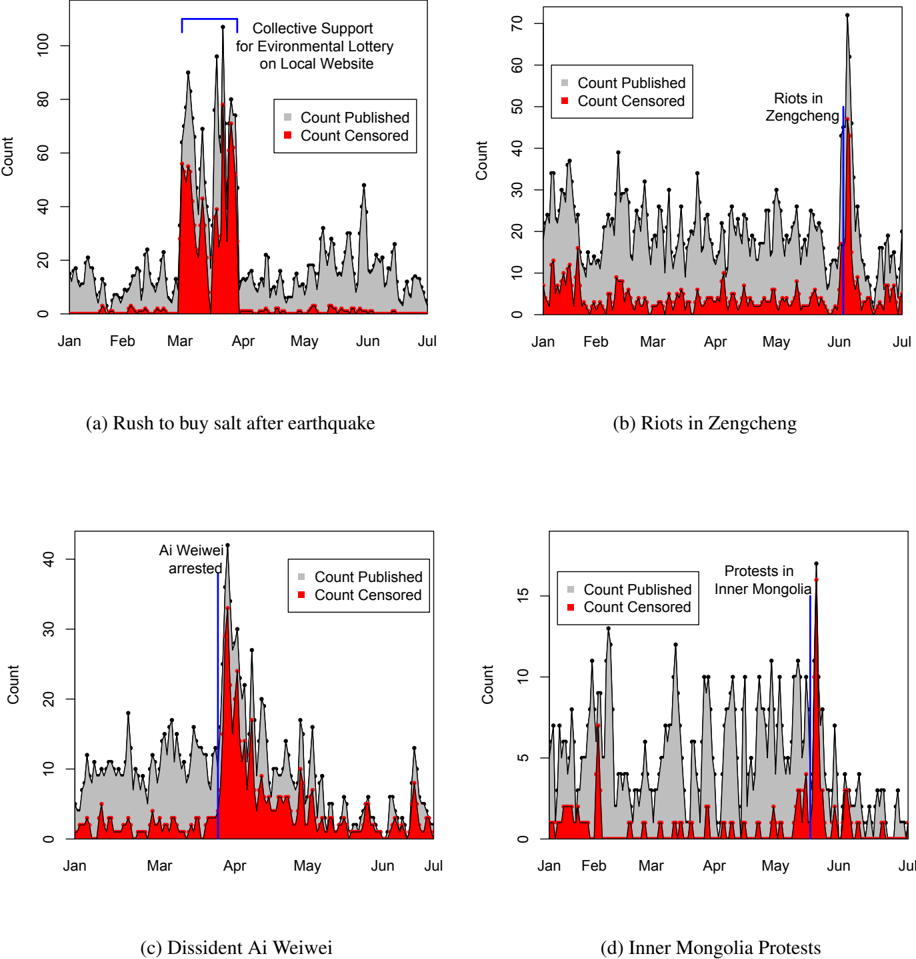
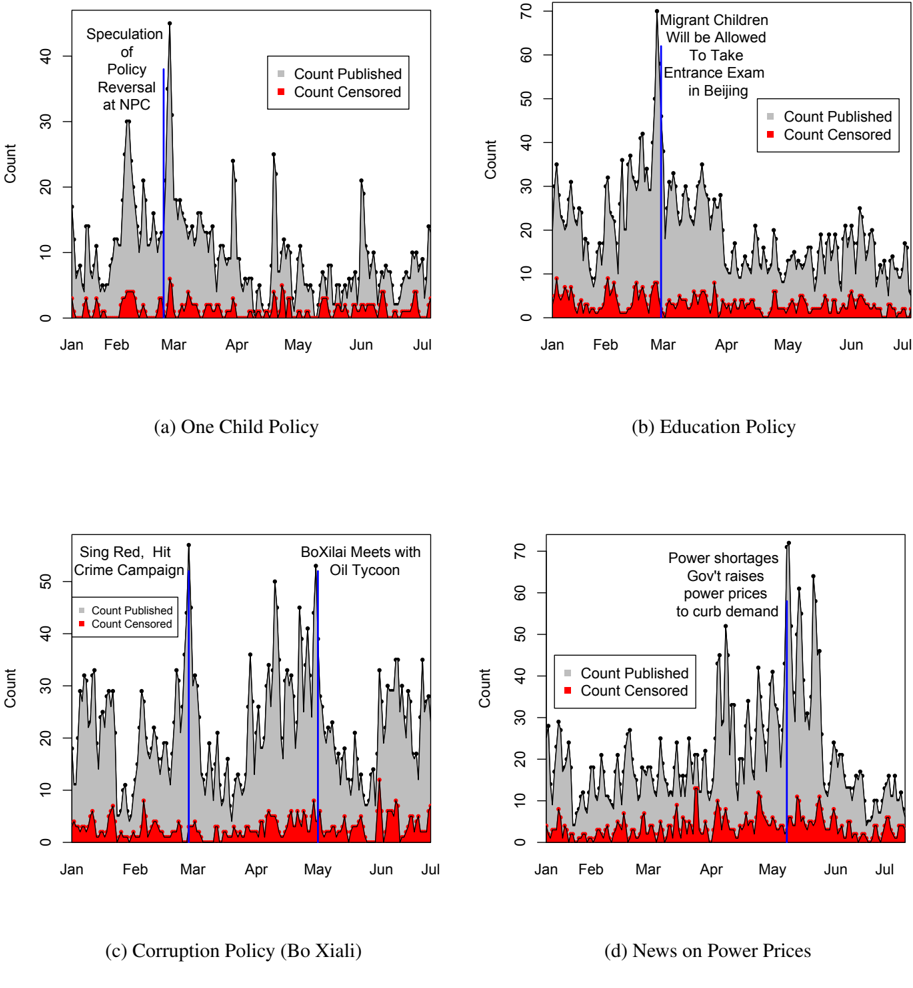
- Censorship was much higher during volume bursts tied to collective action: average censorship magnitude was 27% for collective action, compared with -1% for policy and -4% for news.
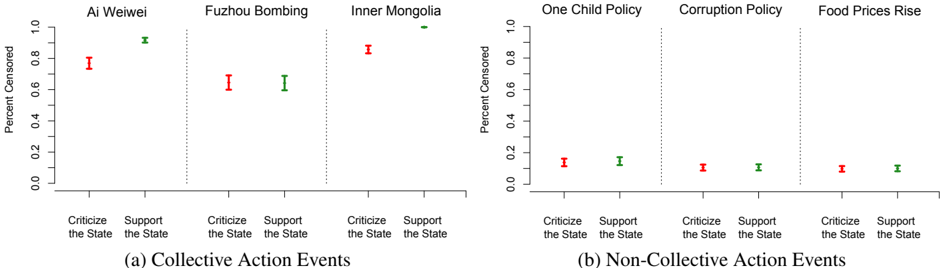
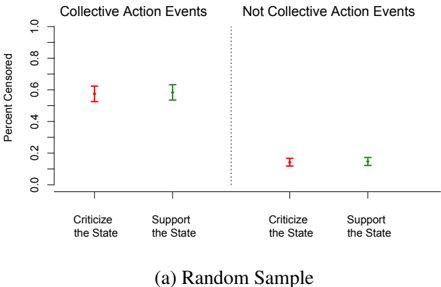
- For collective action events such as Ai Weiwei’s arrest, Inner Mongolia protests, and Fuzhou bombings, posts were censored at about 80% on average whether they criticized or supported the state. For non-collective-action events such as the one child policy, corruption policy, and food prices, censorship was about 10% on average for both critical and supportive posts.
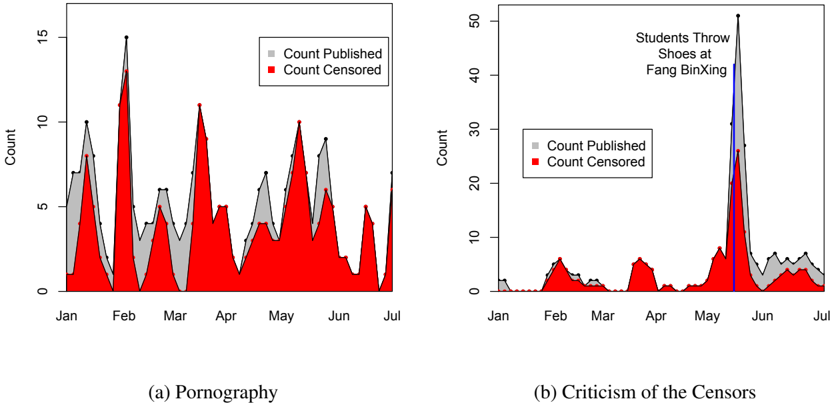
- Censorship also targeted pornography and criticism of the censors, but not government policy or other news. The authors argue censorship is aimed at curtailing collective action by silencing comments that represent, reinforce, or spur social mobilization.
Methods
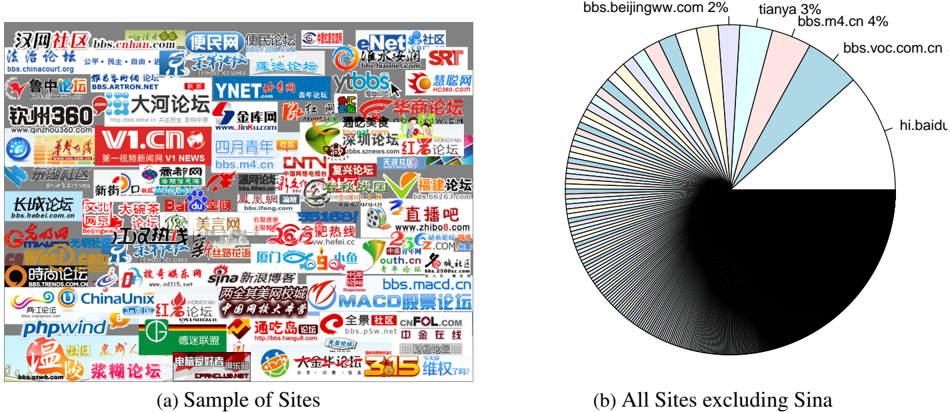
- The authors built a system to locate, download, and analyze posts from 1,382 Chinese websites during the first half of 2011, before government censors could remove them. They collected 3,674,698 posts, randomly selected 127,283 for further analysis, and overall collected and analyzed 11,382,221 posts.
- They used a stratified random sampling design covering 85 topic areas across three hypothesized political sensitivity levels, detected 87 volume bursts in 67 of the 85 topic areas using robust regression-based burst detection, and classified events into collective action potential, criticism of censors, pornography, government policies, and other news.
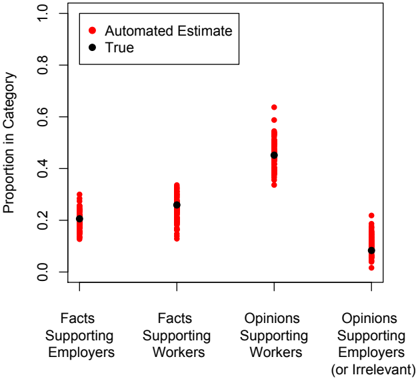
- To analyze content, they adapted the Hopkins and King “ReadMe” automated text analysis method to Chinese and extended it with a Bayesian procedure to estimate the percent censored within categories. Validation used native Chinese speakers coding 1,000 posts about 2010 labor strikes, with 100 as training and 900 as test; event coding reliability was 98.9% (86 of 87 events).
Limitations
- The paper states that its methodology misses self-censorship and censorship that may occur before the post is obtained; it also does not quantify the direct effects of the Great Firewall, keyword blocking, or search filtering.
- The authors state they have not studied physical violence, such as arrest of bloggers, or threats of the same; although many officials and levels of government influence censorship decisions, their data only sometimes distinguish among these sources, and they cannot determine the consequences of these limitations.
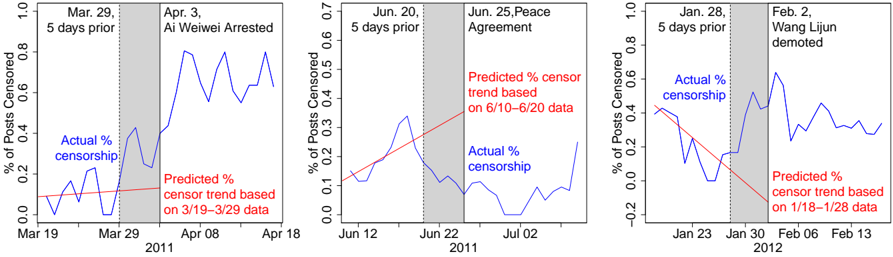
- The authors note that the presumably smaller number of discussions they cannot observe are likely to be those of most interest to the Chinese government, and they offer little evidence connecting social media findings to press freedom or other types of human expression in China. They also state that the predictive analysis was conducted retrospectively and with only three events, so further prospective validation would be valuable.
Model-written summary. Check it against the paper before relying on it.
Integrity signals
Registry
Cites
Statistics
Figures
Verification
Claims the paper makes
0 Valid · 7 Not valid · 7 Not checked · 88 Own results and interpretations
A result the paper reports from its own data — it cites no other source for it, so there is none to check. The quote shows it is in the paper.
In the paper
“Our data show that the Chinese censorship program allows for a wide variety of criticisms of the Chinese government, its officials, and its policies.”
§ How Censorship in China Allows Government Criticism but Silences Collective Expression * > Outline of Results
plain- Asserted: passes — The authors put it forward as true.
- Checkable: passes — It can be checked against evidence.
- Load-bearing: passes — The paper’s conclusions depend on it.
- Based: passes — The paper gives a reason why it holds.
A result the paper reports from its own data — it cites no other source for it, so there is none to check. The quote shows it is in the paper.
In the paper
“Contrary to previous understandings, posts with negative, even vitriolic, criticism of the state, its leaders, and its policies are not more likely to be censored.”
- Also stated in: § 1 Introduction · plain
“we find that when the Chinese people write scathing criticisms of their government and its leaders, the probability that their post will be censored does not increase.”
§ How Censorship in China Allows Government Criticism but Silences Collective Expression * > Abstract
plain- Asserted: passes — The authors put it forward as true.
- Checkable: passes — It can be checked against evidence.
- Load-bearing: passes — The paper’s conclusions depend on it.
- Based: passes — The paper gives a reason why it holds.
- Also stated in: § 1 Introduction · plain
A result the paper reports from its own data — it cites no other source for it, so there is none to check. The quote shows it is in the paper.
In the paper
“Large increases in online volume are good predictors of censorship when these increases are associated with events related to collective action, e.g., protest on the ground.”
§ How Censorship in China Allows Government Criticism but Silences Collective Expression * > Outline of Results
plainstates an association- Asserted: passes — The authors put it forward as true.
- Checkable: passes — It can be checked against evidence.
- Load-bearing: passes — The paper’s conclusions depend on it.
- Based: passes — The paper gives a reason why it holds.
A result the paper reports from its own data — it cites no other source for it, so there is none to check. The quote shows it is in the paper.
In the paper
“In addition, we measure sentiment within each of these events and show that during these events, the government censors views that are both supportive and critical of the state.”
§ How Censorship in China Allows Government Criticism but Silences Collective Expression * > Outline of Results
plainstates a cause- Asserted: passes — The authors put it forward as true.
- Checkable: passes — It can be checked against evidence.
- Load-bearing: passes — The paper’s conclusions depend on it.
- Based: passes — The paper gives a reason why it holds.
A result the paper reports from its own data — it cites no other source for it, so there is none to check. The quote shows it is in the paper.
In the paper
“We thus conduct the same analysis for the demotion of Wang Lijun in Panel (c) of Figure 11, and again see a large difference in actual and predicted percent censorship before Wang's demotion.”
§ How Censorship in China Allows Government Criticism but Silences Collective Expression * > Additional information
plainSingle case- Asserted: passes — The authors put it forward as true.
- Checkable: passes — It can be checked against evidence.
- Load-bearing: unclear — It is unclear whether the paper’s conclusions depend on it.
- Based: passes — The paper gives a reason why it holds.
46 more claims
Create a free account to see all 102 claims and every source verdict.
- Probably not a substantial claim. 26
- It may state two separate claims as one. 33
Claims other papers make about this one
Each is checked against this paper’s own text: does it say what the citing paper says it does?
The source backs part of the claim, not all of it — or backs it for a different population, condition or comparison.
In the citing paper
“Authorities are keen to review social media posts and have contentious messages removed (King etal., 2013) to ensure that potential threats remain invisible.”
From How Dictators Control the Internet: A Review Essay (2020) · cites this paper as King et al., 2013
Experimental — accuracy not yet measuredThe source backs part of the claim, not all of it — or backs it for a different population, condition or comparison.
In the citing paper
“In most autocratic regimes, governmental interference in digital infrastructure and communication is commonplace.”
From How Dictators Control the Internet: A Review Essay (2020) · cites this paper as King et al., 2013
Experimental — accuracy not yet measuredThe source backs part of the claim, not all of it — or backs it for a different population, condition or comparison.
In the citing paper
“First, the timing of censorship during a coup is consistent with many studies that have shown that Internet censorship is targeted during sensitive political time periods and periods of potential power transitions, such as elections and large-scale protests [23,25,44,47,73].”
From A multi-perspective view of Internet censorship in Myanmar (2021) · cites this paper as [44]
Experimental — accuracy not yet measuredThe cited source says what the claim attributes to it.
In the citing paper
“research has shown how mobilization organized through public coordination is repressed using that very same public information-for instance, repression is preemptively increased before focal days (Truex 2019); and autocracies censor online calls for collective action (King, Pan, and Roberts 2013), coerce online opinion leaders (Pan and Siegel 2020), and at times, turn off the internet entirely.”
From Coordinated Dis-Coordination (2024) · cites this paper as King, Pan, and Roberts 2013
The check wasn’t confident either way, so it gives no verdict — never disputed.
In the citing paper
“In China, for instance, two virtual police officers remind citizens that their browsing behavior is monitored (King etal., 2013).”
From How Dictators Control the Internet: A Review Essay (2020) · cites this paper as King et al., 2013
Experimental — accuracy not yet measured
1 more claim about this paper
Create a free account to see every claim other papers make about this one.
Citations
Cites
Robust estimation of a location parameter
Huber, P. J. (1964) · The Annals of Mathematical Statistics · doi:10.1214/aoms/1177703732 · Cited by 7,228
Robust Regression and Outlier Detection
Piepel, G. F. (1989) · Technometrics · doi:10.1080/00401706.1989.10488524 · Cited by 6,144
Robust Regression and Outlier Detection
Rousseeuw, P. J., & Leroy, A. M. (1987) · Wiley Series in Probability and Statistics · doi:10.1002/0471725382 · Cited by 5,609
Logistic Regression in Rare Events Data
King, G., & Zeng, L. (2001) · Political Analysis · doi:10.1093/oxfordjournals.pan.a004868 · Cited by 4,316 · cited 1×
“We do this via well-known and widely used case-control methodology (King and Zeng 2001).”
MethodSelf-citationDemocracy and Development: Political Institutions and Well-Being in the World, 1950–1990
Przeworski, A., Alvarez, M. E., Cheibub, J. A., & Limongi, F. (2000) · doi:10.1017/cbo9780511804946 · Cited by 2,845
Rightful Resistance in Rural China
O'Brien, K. J., & Li, L. (2006) · Cambridge University Press eBooks · doi:10.1017/cbo9780511791086 · Cited by 1,104
The Dynamics of Informational Cascades: The Monday Demonstrations in Leipzig, East Germany, 1989–91
Lohmann, S. (1994) · World Politics · doi:10.2307/2950679 · Cited by 1,035 · cited 1×
“Protests in East Germany, Eastern Europe, and most recently the Middle East have all preceded regime change (Ash 2002; Lohmann 1994; Przeworski et al. 2000).”
BackgroundRightful Resistance in Rural China
O'Brien, K., & Li, L.-J. (2006) · doi:10.1017/cbo9780511791086.003 · Cited by 987
China's Changing of the Guard: Authoritarian Resilience
Nathan, A. J. (2003) · Journal of Democracy · doi:10.1353/jod.2003.0019 · Cited by 927
Sparks and prairie fires: A theory of unanticipated political revolution
Kuran, T. (1989) · Public Choice · doi:10.1007/bf00116762 · Cited by 905 · cited 1×
“In fact, Kuran (1989) and Lohmann (2002) show that it is information about a collective action event that propels collective action and so distinguishing this from explicit calls for collective action would be difficult if not impossible.”
Background
Research works printed but not linked: 13
- 22. Freedom House. 2012. "Freedom of the Press, 2012." www.freedomhouse.org.
- 8. Chang, Parris. 1983. Elite Conflict in the Post-Mao China. New York: Occasional Papers Reprints.
- 26. Hinton, Harold. 1955. The "Unprincipled Dispute" Within Chinese Communist Top Lead- ership. Washington, DC: U.S. Information Agency.
- 44. Perry, Elizabeth. 2002. Challenging the Mandate of Heaven: Social Protest and State Power in China. Armork, NY: M. E. Sharpe.
- 52. Schurmann, Franz. 1966. Ideology and Organization in Communist China. Berkeley, CA: University of California Press.
- Tsai, 2007, Capitalism without Democracy: The Private Sector in Contemporary China
- 48. Qiang, Xiao. 2011. The Rise of Online Public Opinion and Its Political Impact. In Chang- ing Media, Changing China, ed. Susan Shirk. New York: Oxford University Press pp. 202-224.
- 9. Charles, David. 1966. The Dismissal of Marshal P'eng Teh-huai. In China Under Mao: Politics Takes Command, ed. Roderick MacFarquhar. Cambridge: MIT University Press pp. 20-33.
- 54. Shirk, Susan. 2007. China: Fragile Superpower: How China's Internal Politics Could Derail Its Peaceful Rise. New York: Oxford University Press.
- 56. Teiwes, Frederick. 1979. Politics and Purges in China: Retification and the Decline of Party Norms. Armork, NY: M. E. Sharpe. Tsai, Kellee. 2007a. Capitalism without Democracy: The Private Sector in Contemporary China. Ithaca, NY: Cornell University Press.
- 15. Duan, Qing. 2007. China's IT Leadership. Vdm Verlag.
- 38. MacFarquhar, Roderick. 1974. The Origins of the Cultural Revolution Volume 1: Contra- dictions Among the People 1956-1957. New York: Columbia University Press.
- 12. Chen, Xiaoyan and Peng Hwa Ang. 2011. Internet Police in China: Regulation, Scope and Myths. In Online Society in China: Creating, Celebrating, and Instrumentalising the Online Carnival, ed. David Herold and Peter Marolt. New York: Routledge pp. 40-52.
Cited by
Items 901–1,000 of 2,443
Social Movements and Mass Media in a Global Context
Rohlinger, D. A., & Corrigall‐Brown, C. (2018) · Wiley eBooks · doi:10.1002/9781119168577.ch7 · Cited by 21
Intergovernmental Conflict and Censorship: Evidence From China’s Anti-Corruption CampaignPreprint
Zhuang, M. (2018) · SSRN Electronic Journal · doi:10.2139/ssrn.3267445 · Cited by 9
Su, Y., & Borah, P. (2019) · International Communication Gazette · doi:10.1177/1748048519853765 · Cited by 9
“The Chinese government implements long-standing and strict press censorship (King et al., 2013); it not only blocks foreign media channels but also practices censorship on its domestic media platforms such as Weibo and WeChat (Bradsher, 2017).”
BackgroundThe great wall of silence: voice–silence dynamics in authoritarian regimes
Vieira, M. B. (2020) · Critical Review of International Social and Political Philosophy · doi:10.1080/13698230.2020.1796333 · Cited by 11
“As a 2013 study of online censorship in China concluded, in respect to critical speech online, the Chinese people were ‘individually free but collectively in chains’ (King et al., 2013, p. 339).”
BackgroundFreyburg, T., Garbe, L., & Wavre, V. (2023) · The Review of International Organizations · doi:10.1007/s11558-022-09483-z · Cited by 9
Zhang, C. (2023) · Environmental Policy and Governance · doi:10.1002/eet.2089 · Cited by 21
Zhen, L., Lin, Y., Hooimeijer, P., & Monstadt, J. (2024) · Geoforum · doi:10.1016/j.geoforum.2024.103959 · Cited by 14
“This is more relevant in restrictive political systems where information flow can be strictly controlled by the authorities (King et al., 2013).”
Balla, S. J., Wan, A., Xie, Z., Yeung, Y. T., & Zhai, G. (2024) · Governance · doi:10.1111/gove.12901 · Cited by 12
Anti-corruption and political trust: Evidence from China
Fang, M., Lai, W., & Xia, C. (2025) · Journal of Economic Behavior & Organization · doi:10.1016/j.jebo.2025.107015 · Cited by 16
MiTextExplorer: Linked brushing and mutual information for exploratory text data analysis
O'Connor, B. (2014) · doi:10.3115/v1/w14-3101 · Cited by 11
“Comparisons of word statistics across covariates are absolutely essential to many interesting questions or social measurement problems, such as • What topics tend to get censored by the Chinese government online, and why (Bamman et al., 2012; King et al., 2013)?”
BackgroundMethodMedia Freedom and the Escalation of State Violence
Carey, S. C., González, B., & Mitchell, N. J. (2021) · Political Studies · doi:10.1177/00323217211020243 · Cited by 11
“But this ‘new information age’ also enables governments to monitor these information flows and to flood the news environment with their preferred stories and interpretation of events (King et al., 2013, 2017).”
BackgroundLi, Z., & Nardi, B. A. (2021) · Proceedings of the ACM on Human-Computer Interaction · doi:10.1145/3476070 · Cited by 11
Zhang, B., Gearhart, S., & Perlmutter, D. D. (2022) · Global Media and Communication · doi:10.1177/17427665221100596 · Cited by 9
“Wallis, 2011; Xiao, 2011), certain political and/or social issues remain censored, especially anything related to collective action (King et al., 2013).”
BackgroundInfluentialTo subdue the enemies without fighting: Chinese state-sponsored disinformation as digital warfare
Lu, I. F. (2022) · Digital War · doi:10.1057/s42984-022-00052-7 · Cited by 12
Community Deception in Attributed Networks
Fionda, V., & Pirrò, G. (2022) · IEEE Transactions on Computational Social Systems · doi:10.1109/tcss.2022.3213722 · Cited by 16
“However, the same tools can be leveraged to block forms of society self-organization [17].”
BackgroundInvestigating Privacy Perception and Behavior on Weibo
Amos, C., Zhang, L., & Pentina, I. (2014) · Journal of Organizational and End User Computing · doi:10.4018/joeuc.2014100103 · Cited by 12
Segmented Publics and the Regulation of Critical Speech in China
Woodman, S. (2014) · Asian Studies Review · doi:10.1080/10357823.2014.991271 · Cited by 9
Mobile Communication and Relational Mobilization in China
Liu, J. (2014) · Asiascape Digital Asia · doi:10.1163/22142312-12340003 · Cited by 12
Desmarchelier, B., & Fang, E. S. (2016) · Kyklos · doi:10.1111/kykl.12120 · Cited by 11
Politics @Pontifex: International Crises and Political Patterns of Papal Tweets
Genovese, F. (2018) · PS Political Science & Politics · doi:10.1017/s1049096518001038 · Cited by 14
“…between politics and technology and its increasing relevance, a vibrant field of social science scholarship has arisen to explore the media-based language of political leaders and its connection to audience preferences and real-life events (Jamal et al. 2015; King, Pan, and Roberts 2013).”
BackgroundXia, L., Zhao, R., Wu, Y., & Tong, X. (2020) · Journal of the American Statistical Association · doi:10.1080/01621459.2020.1740711 · Cited by 10
“King et al. (2013) and Ceron et al. (2014) use supervised learning algorithms to study government censorship in China and citizens’ policy in Italy and France.”
BackgroundMethodInfluentialElectronic Participation in a Comparative Perspective: Institutional Determinants of Performance
Tavares, A. F., Martins, J., & Lameiras, M. (2020) · Advances in electronic government, digital divide, and regional development book series · doi:10.4018/978-1-7998-1526-6.ch005 · Cited by 16
Sun, Y., Graham, T., & Broersma, M. (2021) · Journal of Information Technology & Politics · doi:10.1080/19331681.2021.1950096 · Cited by 11
Scaling Court Decisions with Citation Networks
Arnold, C., Engst, B. G., & Gschwend, T. (2021) · Journal of Law and Courts · doi:10.1086/717420 · Cited by 11
Historical and Comparative Research on Social Diffusion: Mechanisms, Methods, and Data
Everton, S. F., & Pfaff, S. J. (2022) · Social Science History · doi:10.1017/ssh.2021.46 · Cited by 13
“His paper contributes to the growing awareness that social ties need not facilitate mobilization and that repressive regimes may exploit network structures and manipulate digital media to hinder protest diffusion (King et al. 2013; Kitts 2000; Siegel 2011).”
BackgroundCommunity Deception in Networks: Where We Are and Where We Should Go
Fionda, V., & Pirrò, G. (2022) · Studies in computational intelligence · doi:10.1007/978-3-030-93413-2_13 · Cited by 10
Internet, Political Regime and Terrorism: A Quantitative Analysis
Khokhlov, N., & Korotayev, A. (2022) · Cross-Cultural Research · doi:10.1177/10693971221085343 · Cited by 14
“Thus, autocratic leaders control all aspects of the political, social, and economic realm, including access to independent media and freedom of speech on the Internet (Guriev & Treisman, 2019; King et al., 2013; Rød & Weidmann, 2015).”
BackgroundThe impact of social media on risk perceptions during COVID-19 in Saudi Arabia
Angawi, K., & Albugmi, M. (2022) · Frontiers in Public Health · doi:10.3389/fpubh.2022.898041 · Cited by 12
“In addition, the Chinese population distrusted the reliability of information constructed by their government due to the lack of transparency in disseminating information on the outbreak (7).”
BackgroundLing, S. (2023) · Chinese Political Science Review · doi:10.1007/s41111-023-00234-y · Cited by 13
“…and location of protesters in cyberspace by imposing strict self-censorship system on web-sites and internet companies, hiring the internet police and public opinion monitor etc., thus limiting the political opportunities for the emergence and development of social protest (King and Roberts 2013).”
Ko, J. (2023) · doi:10.1093/oso/9780197684566.001.0001 · Cited by 14
Accountability in One-Party Government: Rethinking the Success of Chinese Economic Reform
Gilli, M., & Li, Y. (2014) · Journal of Institutional and Theoretical Economics JITE · doi:10.1628/093245614x14113700937488 · Cited by 10
Ma Ying-jeou's Presidential Discourse
Sullivan, J., & Sapir, E. V. (2012) · Journal of Current Chinese Affairs · doi:10.1177/186810261204100303 · Cited by 11
Kornai, J. (2017) · Revue d’études comparatives Est-Ouest · doi:10.3917/receo.481.0239 · Cited by 9
Pan, H.-H., Wu, W., & Chang, Y.-T. (2018) · International Relations of the Asia-Pacific · doi:10.1093/irap/lcy016 · Cited by 9
Calls to Action on Social Media: Detection, Social Impact, and Censorship Potential
Rogers, A., Kovaleva, O., & Rumshisky, A. (2019) · Workshop on Natural Language Processing for Internet Freedom: Censorship, Disinformation, and Propaganda (NLP4IF) · doi:10.18653/v1/d19-5005 · Cited by 26
“In particular, King et al. (2013, 2014) report that sometimes the censors let through materials that are simply critical of government, but flag materials with collective action potential (such as calls to attend a rally or support opposition).”
BackgroundEssays on Energy Technology Innovation Policy
Chan, G. (2015) · Digital Access to Scholarship at Harvard (DASH) (Harvard University) · Cited by 16
Newspaper Censorship in China: Evidence from Tunneling ScandalsPreprint
Hope, O., Li, Y., Liu, Q., et al. (2017) · SSRN Electronic Journal · doi:10.2139/ssrn.2897758 · Cited by 9
Greene, Z., Cerón, A., Schumacher, G., & Fazekas, Z. (2016) · OSF Preprints (OSF Preprints) · doi:10.31219/osf.io/ghxj8 · Cited by 9
“…Lowe 2015), news reports (Van Atteveldt et al. 2008; Coscia and Rios 2012; Stockmann 2012), intra-party divisions (Ceron 2012, 2013, 2014; Greene and Haber 2014; Lo et al. 2014), social media (King et al. 2013; Barbera 2015) and US government treaties with Native American tribes (Spirling 2012).”
BackgroundSelf-Censorship in Authoritarian States: Response Bias in Measures of Popular Support in ChinaPreprint
Robinson, D., & Tannenberg, M. (2018) · SSRN Electronic Journal · doi:10.2139/ssrn.3161915 · Cited by 8
Regional Variation in Chinese Internet FilteringPreprint
Wright, J. (2013) · SSRN Electronic Journal · doi:10.2139/ssrn.2265775 · Cited by 9
Hong, Y., & Xu, J. L. (2019) · SSRN Electronic Journal · Cited by 9
Image Clustering: An Unsupervised Approach to Categorize Visual Data in Social Science ResearchPreprint
Zhang, H., & Peng, Y. (2021) · doi:10.31235/osf.io/mw57x · Cited by 9
Node-Centric Community Deception Based on Safeness
Madi, S. A., & Pirrò, G. (2023) · IEEE Transactions on Computational Social Systems · doi:10.1109/tcss.2023.3306787 · Cited by 12
“…in human social networks such as social media platforms or transaction networks, where we can imagine detection algorithms being misused to suppress legitimate activities on political grounds or to expose private interuser relationships for mere profit, ignoring fundamental user rights [11].”
BackgroundChina deserves its hamburger: the controversy over WildAid’s Shu Shi campaign in China
Du, J., Liu, J. C., & Mix, T. L. (2024) · Environmental Sociology · doi:10.1080/23251042.2024.2319370 · Cited by 22
“King, Pan, and Roberts (2013) identify three primary characteristics signifying a high possibility of removal from online media in China: collective action potential, pornographic elements, and criticism towards censors.”
BackgroundVahabli, D. (2024) · International Journal of Comparative Sociology · doi:10.1177/00207152241269783 · Cited by 11
“In the inter-section of local and transnational oppression of the government (Earl, 2011; King et al., 2013; Moss et al., 2022; Pan and Siegel, 2020; Tanash et al., 2017), global information flow patterns (Chang, 1998; Golan and Himelboim, 2016; Segev, 2010), and power hierarchies in global civil…”
Zhao, L., & Zhang, R. (2024) · New Media & Society · doi:10.1177/14614448241274457 · Cited by 14
“Some unpack what gets filtered and what survives through reverse engineering methods based on large datasets (King et al., 2013), but little is known from human moderators’ rule-abiding and rule-adjusting.”
The Adaptability of the Chinese Communist Party
Dimitrov, M. K. (2024) · Cambridge University Press eBooks · doi:10.1017/9781009184335 · Cited by 12
Hanley, H. W. A., Lu, Y., & Pan, J. (2024) · Proceedings of the National Academy of Sciences · doi:10.1073/pnas.2420607122 · Cited by 8
Self-citationUnderstanding China’s environmental challenges: lessons from documentaries
Liu, J. C., Huang, H., & Ma, J. (2018) · Journal of Environmental Studies and Sciences · doi:10.1007/s13412-018-0526-1 · Cited by 8
Du, J., Han, R., & Wei-xia, L. (2021) · Environmental Policy and Governance · doi:10.1002/eet.1971 · Cited by 11
Kreps, S. E., George, J., Watson, N., Cai, G., & Ding, K. (2022) · JMIR Infodemiology · doi:10.2196/31793 · Cited by 8
“As King et al [13] note, individuals in China have access to a number of different social media platforms, but Weibo is a widely used microblogging platform, with over 430 million monthly active users, a large proportion of China’s population [14], compared to Twitter’s 326 million users a month.”
BackgroundHostile Forces: How the Chinese Communist Party Resists International Pressure on Human Rights
Gruffydd-Jones, J. J. (2022) · doi:10.1093/oso/9780197643198.001.0001 · Cited by 12
Challenges in Cybersecurity: Lessons from Biological Defense Systems
Schrom, E. C., Kinzig, A. P., Forrest, S., Graham, A. L., Levin, S. A., Bergstrom, C. T., Castillo‐Chávez, C., Collins, J. P., de Boer, R. J., Doupé, A., et al. (2023) · Mathematical Biosciences · doi:10.1016/j.mbs.2023.109024 · Cited by 12
Chang, C., & Wang, Y. (2023) · Comparative Political Studies · doi:10.1177/00104140231194057 · Cited by 14
Environmental Politics in East Asia
Haddad, M. A. (2023) · Cambridge University Press eBooks · doi:10.1017/9781108966085 · Cited by 12
Creation, Consumption, and Control of Sensitive Content
Wu, Y. (2023) · Marketing Science · doi:10.1287/mksc.2022.0453 · Cited by 10
Gao, X., Hamedi, M. A., & Changsong, W. (2024) · Frontiers in Communication · doi:10.3389/fcomm.2024.1306309 · Cited by 21
Constructing Public Space: Global Perspectives on Social Media and Popular Contestation
Poell, T., & van Dijck, J. (2016) · International journal of communication · Cited by 55
From Control to Chaos, and Back Again
McNair, B. (2017) · Journalism Studies · doi:10.1080/1461670x.2017.1389297 · Cited by 8
“To this day, those events remain a prohibited topic in Chinese media, although they are discussed by at least some Chinese on social media and the internet (King, Pan, and Roberts 2013).”
BackgroundFrenkiel, É., & Shpakovskaya, A. (2019) · Politics and Governance · doi:10.17645/pag.v7i3.2151 · Cited by 13
Polarised Security: How do Chinese Netizens Respond to the Securitisation of Terrorism?
Guan, T., & Liu, T. (2019) · Asian Studies Review · doi:10.1080/10357823.2019.1697205 · Cited by 11
A Pattern Recognition Framework for Detecting Changes in Chinese Internet Management System
Su, Y., Ruan, Y., Sun, S., & Chang, Y.-T. (2020) · Journal of Social Computing · doi:10.23919/jsc.2020.0004 · Cited by 8
“Scholars have suggested that Chinese government is deliberately avoiding actively engaging in online discussions with netizens [5,8] .”
BackgroundThe internet’s role in promoting civic engagement in China and Singapore: A Confucian view
Yu, A. (2022) · Human Affairs · doi:10.1515/humaff-2022-0015 · Cited by 8
“In China, according to King, Pan and Roberts (2013), there are three types of censorship, which are the 1) Great Firewall of China, 2) keyword blocking, and 3) manual censorship.”
InfluentialMirić, S., & Pechenkina, A. (2022) · Political Research Quarterly · doi:10.1177/10659129221091576 · Cited by 11
Zhang, L., Tandoc, E. C., & Han, S. (2022) · Policy & Internet · doi:10.1002/poi3.314 · Cited by 11
Information manipulation and repression: Theory and evidence from the COVID-19 response in Russia
Lamberova, N., & Сонин, К. И. (2026) · Journal of Public Economics · doi:10.1016/j.jpubeco.2026.105740 · Cited by 7
Responsive Propaganda: The Sharp Shift in the Propaganda of Human Gene Editing in China
Jin, S. (2022) · Journal of Chinese Political Science · doi:10.1007/s11366-022-09827-x · Cited by 9
“In dealing with rising public opinion crises, the main strategies of authoritarian regimes include censorship [3, 17, 25, 31, 36], discourse management [15, 23, 28, 46], and upgraded propaganda [9, 32, 37].”
BackgroundState and Social Protests in China
Cai, Y., & Chen, C.-J. J. (2022) · Cambridge University Press eBooks · doi:10.1017/9781108982924 · Cited by 10
Utopia Lost – Human Rights in a Digital World
Brantly, A. F. (2022) · Applied Cybersecurity & Internet Governance · doi:10.5604/01.3001.0016.1238 · Cited by 13
How governance shaped military responses to the COVID-19 pandemic
Dietrich, N., Eck, K., & Ruffa, C. (2023) · European Political Science Review · doi:10.1017/s1755773923000024 · Cited by 8
“Second, autocracies usually pick and choose which topics they consider to be threatening (King et al. , 2013).”
Information Disclosure on a Chinese Social Media Platform
Zhang, L., Amos, C., & Pentina, I. (2015) · Journal of Information Privacy and Security · doi:10.1080/15536548.2015.1010981 · Cited by 12
“According to a recent study, censors delete approximately 13% of China’s social media content (King, Pan, & Roberts, 2013).”
BackgroundWang, H., Cai, T., Xin, Y., & Chen, B. (2018) · Sociological Inquiry · doi:10.1111/soin.12252 · Cited by 11
Wibbels, E. M. (2019) · Cambridge University Press eBooks · doi:10.1017/9781108615594.002 · Cited by 13
“One growing branch of work on the relationship between ICT and politics explicitly focuses on the network characteristics inherent to cell phones, SMS and social media (Pierskalla and Hollenbach 2013; Shapiro and Wedmann 2011; King et al. 2013; Lawrence forthcoming; Steinert-Threlkeld 2015; Berger et al. 2015).”
BackgroundSchmitt, E., & Li, H. (2019) · Journal of Political Ecology · doi:10.2458/v26i1.23118 · Cited by 8
Huang, R., & Sun, X. (2019) · Social movement studies · doi:10.1080/14742837.2019.1682539 · Cited by 14
Chinese Government Responsiveness to Internet Opinion: Promising but DangerousPreprint
Hassid, J. (2013) · SSRN Electronic Journal · doi:10.2139/ssrn.2308813 · Cited by 8
Media, Protest Diffusion, and Authoritarian ResiliencePreprint
Huang, H., Boranbay, S., & Huang, L. (2016) · SSRN Electronic Journal · doi:10.2139/ssrn.2770149 · Cited by 8
Dasgupta, A. (2017) · SSRN Electronic Journal · doi:10.2139/ssrn.2931182 · Cited by 8
Opposition Media, State Censorship, and Political Accountability: Evidence from Chavez's Venezuela
Knight, B. G., & Tribin, A. M. (2019) · National Bureau of Economic Research · doi:10.3386/w25916 · Cited by 18
How Autocrats Manipulate Economic News: Evidence from Russia's State-Controlled TelevisionPreprint
Rozenas, A., & Стукал, Д. (2017) · SSRN Electronic Journal · doi:10.2139/ssrn.3023254 · Cited by 8
The Political Economics of Non-democracyPreprint
Egorov, G., & Sonin, K. (2020) · Social Science Research Network · doi:10.2139/ssrn.3706331 · Cited by 53
The Art of Self-Criticism: How Autocrats Propagate Their Own Political Scandals
Chang, C. (2024) · Political Communication · doi:10.1080/10584609.2024.2303166 · Cited by 9
“Existing studies show that the CCP is more interested in suppressing speech that potentially incites collective action rather than critical speech (King et al., 2013, 2014).”
BackgroundMethodInfluentialProtest and repression in China’s digital surveillance state
Rothschild, V. (2024) · Journal of Information Technology & Politics · doi:10.1080/19331681.2024.2326464 · Cited by 11
The Art of State Persuasion: China's Strategic Use of Media in Interstate Disputes
Wang, F. Y. (2024) · doi:10.1093/oso/9780197757505.001.0001 · Cited by 13
Exporting the Tools of Dictatorship: The Politics of China’s Technology Transfers
Carter, E. B., & Carter, B. L. (2025) · Perspectives on Politics · doi:10.1017/s1537592724002226 · Cited by 11
“These middleboxes power China ’ s Great Firewall, the most extensive censor-ship operation in human history (King, Pan and Roberts 2013).”
Motivations to connect with like-minded audiences increase partisan sharing on social media
Marie, A., & Petersen, M. B. (2025) · PNAS Nexus · doi:10.1093/pnasnexus/pgaf197 · Cited by 12
“In China where the administration massively censors the internet, sharing explicitly critical political content publicly might not even be envisaged (66, 67).”
Yan, X., & Schäfer, M. S. (2025) · Climatic Change · doi:10.1007/s10584-025-03980-x · Cited by 13
“Thus, censorship remains a central mechanism through which the Chinese state governs social media, but instead of suppressing all dissent, it specifically targets content that threat - ens social stability by provoking conflicts and encouraging collective mobilization (King et al. 2013).”
Liang, F., & Li, G. M. (2025) · Policy & Internet · doi:10.1002/poi3.70014 · Cited by 13
State, society, and market: Interpreting the norms and dynamics of China's AI governance
Chen, X., & Xu, L. (2025) · Computer law & security review · doi:10.1016/j.clsr.2025.106206 · Cited by 14
Political censorship in large language models originating from China
Pan, J., & Xu, X. (2026) · PNAS Nexus · doi:10.1093/pnasnexus/pgag013 · Cited by 36
“(23, 30), (b) events covered in Human Rights Watch China reports from 2015 to 2022, and (c) Chinese-language Wikipedia pages that were individually blocked by the Chinese government before China imposed a wholesale ban on Chinese-language Wikipedia in 2015 (31).”
Self-citationDeliberate Differentiation by the Chinese State: Outsourcing Responsibility for Governance
Sun, T. (2019) · The China Quarterly · doi:10.1017/s0305741019000420 · Cited by 14
Social Media, State Control and Religious Freedom in China
Hu, J., & Zheng, Y. (2019) · Political Theology · doi:10.1080/1462317x.2019.1624038 · Cited by 42
Managing digital contention in China
Miao, Y. (2020) · Journal of Cyber Policy · doi:10.1080/23738871.2020.1748079 · Cited by 9
Who Wants Peace? Predicting Civilian Preferences in Conflict Negotiations
Montoya, A. M., & Tellez, J. (2020) · Journal of Politics in Latin America · doi:10.1177/1866802x20960281 · Cited by 13
State as Salesman: International Economic Engagement and Foreign News Coverage in China
Ji, C., & Liu, H. (2021) · Political Communication · doi:10.1080/10584609.2021.1960451 · Cited by 8
“regimes control information on domestic affairs (e.g., Egorov et al., 2009; King et al., 2013; Lorentzen, 2014), less is known about their motives and strategies pertaining to international information, especially with regard to individual foreign countries.”
Resource dependency, perceived political environment, and ENGO advocacy under authoritarian rule
Li, H., Tang, S., & Lo, C. W. (2022) · Journal of Environmental Policy & Planning · doi:10.1080/1523908x.2022.2031928 · Cited by 8
“Nonetheless, social media in authoritarian China is porously censored (King et al., 2013), driving ENGO media advocacy toward a softer approach.”
BackgroundHou, R. C. (2022) · Ethnography · doi:10.1177/14661381221120208 · Cited by 25
“…researchers contribute to capturing the digital path of the state through social media data and experiment data (Distelhorst and Hou, 2017; King et al., 2013; Meng et al., 2017), their research regards the state as a uni fi ed entity and therefore takes the risk of obscuring the dynamics,…”
Kwong, Y. (2023) · Asia Pacific Viewpoint · doi:10.1111/apv.12398 · Cited by 9
Internet Censorship in China: Looking Through the Lens of Categorisation
Liu, J. (2024) · Journal of Current Chinese Affairs · doi:10.1177/18681026231220948 · Cited by 14
Metadata
- Authors
- KING, G., PAN, J., & ROBERTS, M. E.
- Affiliations
- Harvard University (US)
- Corresponding author
- KING, GARY
- PAN, JENNIFER
- Venue
- American Political Science Review
- Publisher
- Cambridge University Press (CUP)
- Published
- 2013-05
- Volume
- 107
- Issue
- 2
- Pages
- 326-343
- ISSN
- 0003-0554 (ISSN-L)
- 1537-5943
- OpenAlex
- W2144188763
- Cited by
- 2,415
- References
- 48
- Citations by year
- 2026: 161 · 2025: 206 · 2024: 249 · 2023: 272 · 2022: 230 · 2021: 193 · 2020: 206 · 2019: 157 · 2018: 178 · 2017: 153 · 2016: 137 · 2015: 120 · 2014: 91 · 2013: 54
- FWCI
- 395.09
- Type
- journal article
- Language
- en
- Open access
- green
- nrs.harvard.edu
- Licence
- Locations
- American Political Science Review (publishedVersion)
- Digital Access to Scholarship at Harvard (DASH) (Harvard University) (submittedVersion, cc-by)
- RePEc: Research Papers in Economics (submittedVersion)
- Topics
- Social Sciences › Communication › Social Media and Politics
- Social Sciences › Law › Freedom of Expression and Defamation
- Social Sciences › Sociology and Political Science › Media Influence and Politics
- Keywords
- internet censorship, Chinese government, social media, collective action, social mobilization, political criticism, online speech
About these checks
Registry, retraction, Cites and statistics results are computed, not judged, with one exception: a printed reference that no index lists is read once by a model before it counts as a citation error. Claims are extracted by a model and kept only when their quote appears verbatim in the text; each cited source is then checked, with a model’s help, for whether it says what the claim relies on. Those verdicts can be wrong — read the claim’s quote and the cited source before relying on one.
A language model drew the claims from the paper on 2026-10-11, under version 3 of the claim definition (model deepseek-v4.1-flash, prompt extract-v3).
A second model labelled each claim on 2026-10-11 (model jev-1.13-20260917, definition revision gold-guideline-v0.2).
Statistics and arithmetic are recomputed, not judged.
Confidence bands are shown only for fields calibrated on our annotated test set. None is calibrated yet, so no band is shown.
What counts as a claim ›How we measure confidence ›How we check this ›
Are you an author, or do you see a problem with this page? Request a review
Data sources
Bibliographic data: Semantic Scholar, OpenAlex, Crossref.
Contains information from the Semantic Scholar Academic Graph Datasets, made available under the ODC Attribution License (ODC-BY 1.0).
Semantic Scholar’s data is described in: Kinney, R., et al. (2023). The Semantic Scholar Open Data Platform. arXiv:2301.10140.
