

How Censorship in China Allows Government Criticism but Silences Collective Expression
Open accessThe DOI matches its Crossref record; 53 of the 54 references it cites were found in a registry or an index, and 1 are not checked yet; none of the 12 sources its claims cite is checked for support yet.
Abstract
We offer the first large scale, multiple source analysis of the outcome of what may be the most extensive effort to selectively censor human expression ever implemented. To do this, we have devised a system to locate, download, and analyze the content of millions of social media posts originating from nearly 1,400 different social media services all over China before the Chinese government is able to find, evaluate, and censor (i.e., remove from the Internet) the subset they deem objectionable. Using modern computer-assisted text analytic methods that we adapt to and validate in the Chinese language, we compare the substantive content of posts censored to those not censored over time in each of 85 topic areas. Contrary to previous understandings, posts with negative, even vitriolic, criticism of the state, its leaders, and its policies are not more likely to be censored. Instead, we show that the censorship program is aimed at curtailing collective action by silencing comments that represent, reinforce, or spur social mobilization, regardless of content. Censorship is oriented toward attempting to forestall collective activities that are occurring now or may occur in the future—and, as such, seem to clearly expose government intent.
Checked 2026-11-22 · 1 reference not checked yet
Overview
CoChat Summary
TL;DR
The paper uses large-scale, real-time collection of Chinese social media posts to test why China censors online expression. It finds that censorship does not target criticism of the state or leaders; instead, it targets posts with collective action potential, regardless of whether they support or criticize the government.
Key findings
- Across the data, an average of approximately 13% of all social media posts were censored. Ex ante political sensitivity had only a weak relationship with censorship: Low and Medium categories were censored at 16% and 17%, respectively, versus 24% for High.
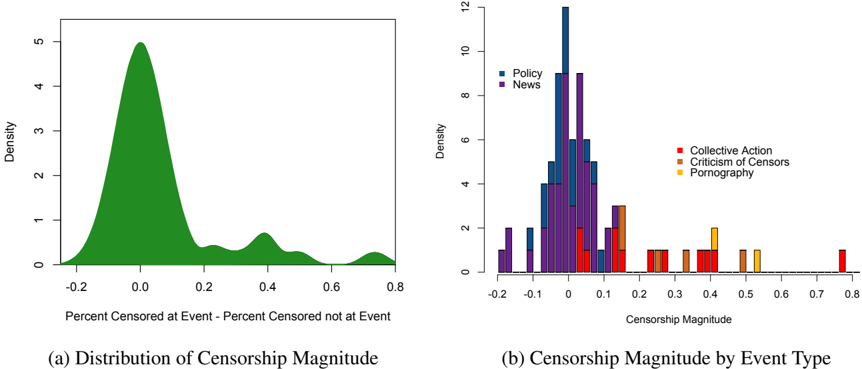
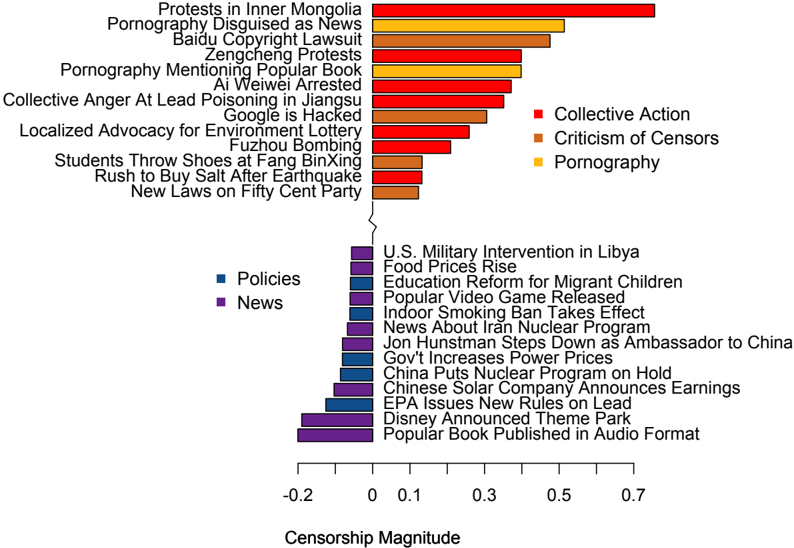
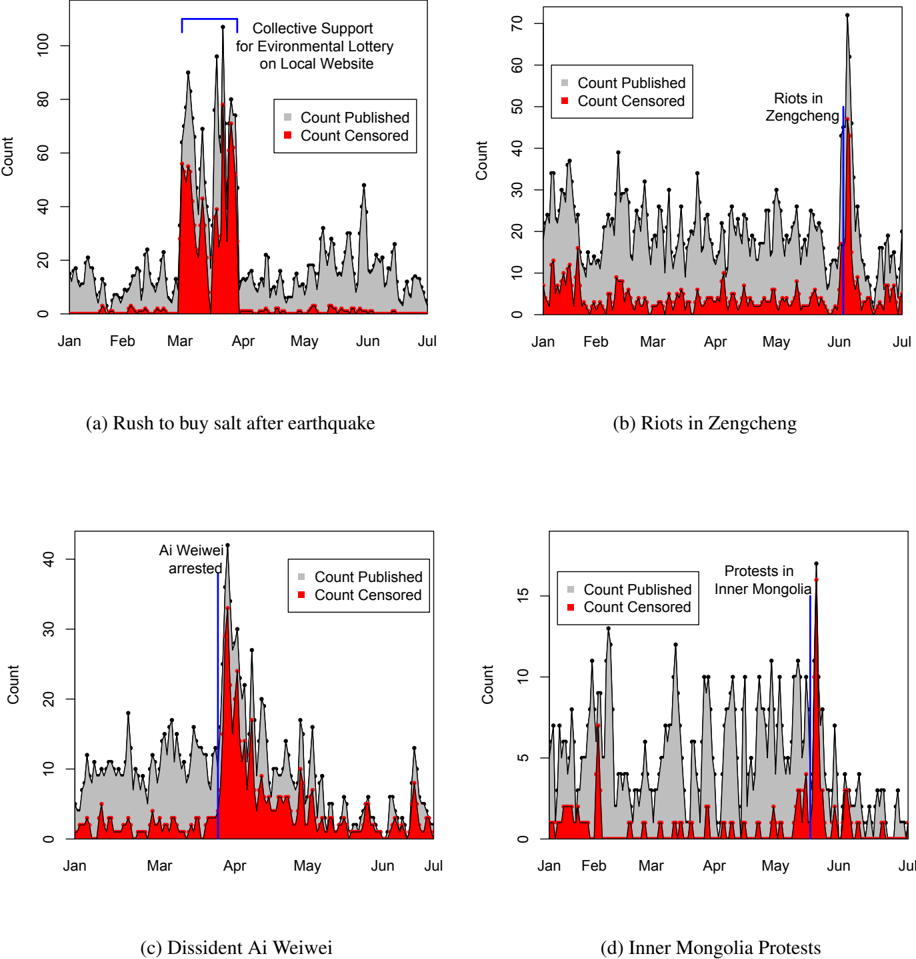
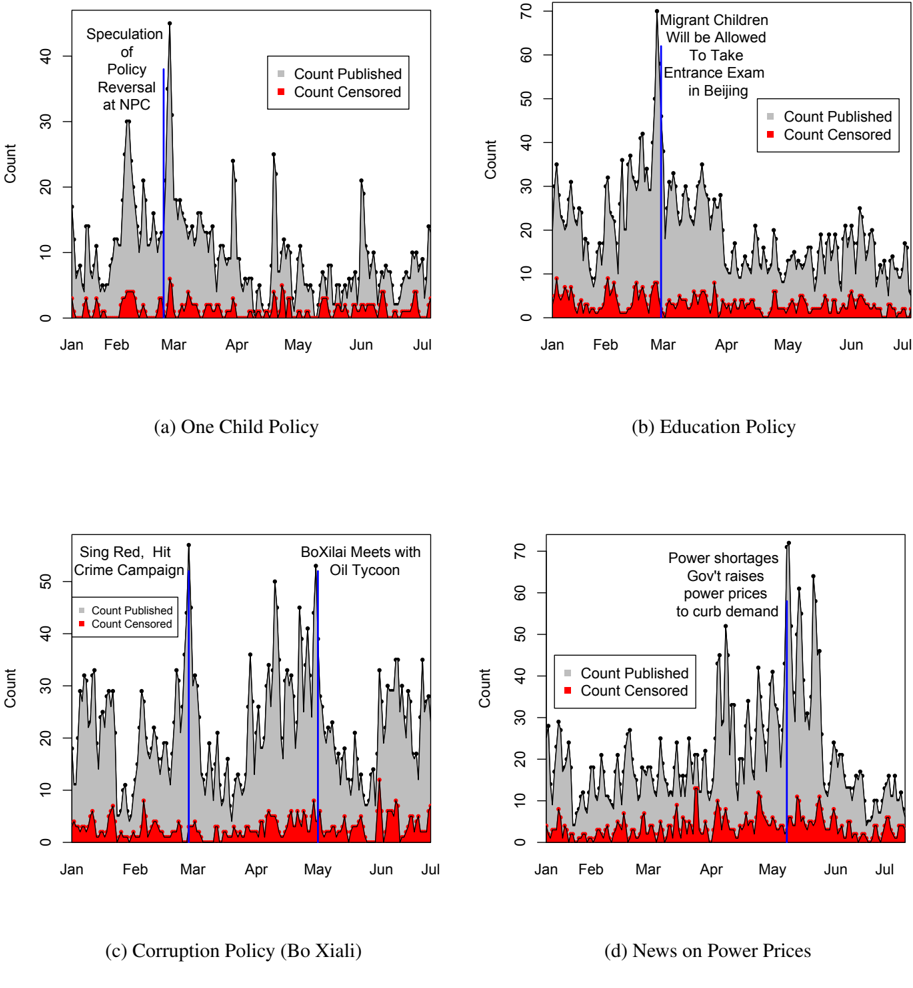
- Censorship was much higher during volume bursts tied to collective action: average censorship magnitude was 27% for collective action, compared with -1% for policy and -4% for news.
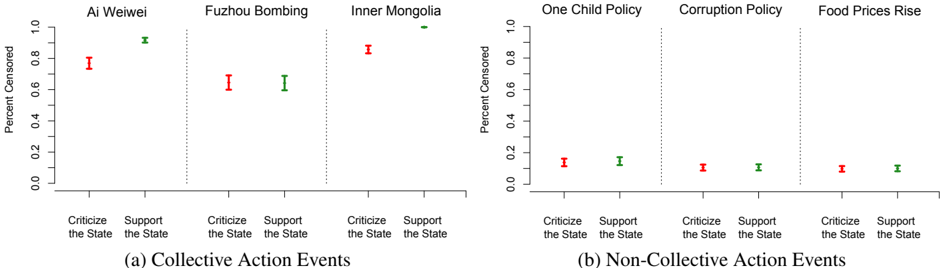
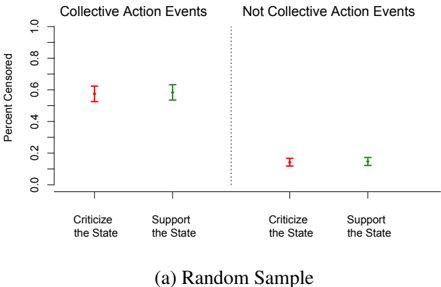
- For collective action events such as Ai Weiwei’s arrest, Inner Mongolia protests, and Fuzhou bombings, posts were censored at about 80% on average whether they criticized or supported the state. For non-collective-action events such as the one child policy, corruption policy, and food prices, censorship was about 10% on average for both critical and supportive posts.
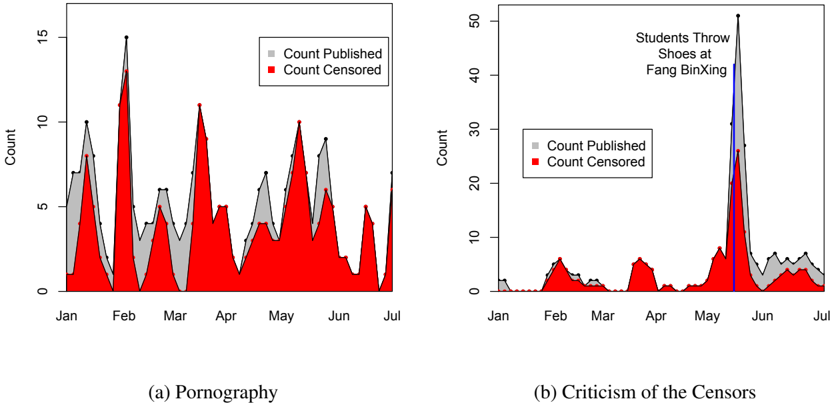
- Censorship also targeted pornography and criticism of the censors, but not government policy or other news. The authors argue censorship is aimed at curtailing collective action by silencing comments that represent, reinforce, or spur social mobilization.
Methods
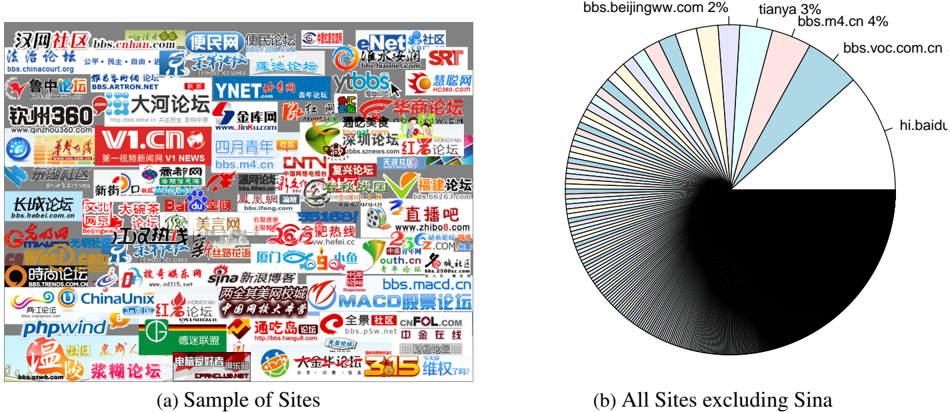
- The authors built a system to locate, download, and analyze posts from 1,382 Chinese websites during the first half of 2011, before government censors could remove them. They collected 3,674,698 posts, randomly selected 127,283 for further analysis, and overall collected and analyzed 11,382,221 posts.
- They used a stratified random sampling design covering 85 topic areas across three hypothesized political sensitivity levels, detected 87 volume bursts in 67 of the 85 topic areas using robust regression-based burst detection, and classified events into collective action potential, criticism of censors, pornography, government policies, and other news.
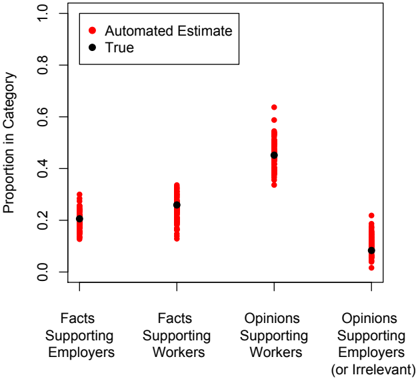
- To analyze content, they adapted the Hopkins and King “ReadMe” automated text analysis method to Chinese and extended it with a Bayesian procedure to estimate the percent censored within categories. Validation used native Chinese speakers coding 1,000 posts about 2010 labor strikes, with 100 as training and 900 as test; event coding reliability was 98.9% (86 of 87 events).
Limitations
- The paper states that its methodology misses self-censorship and censorship that may occur before the post is obtained; it also does not quantify the direct effects of the Great Firewall, keyword blocking, or search filtering.
- The authors state they have not studied physical violence, such as arrest of bloggers, or threats of the same; although many officials and levels of government influence censorship decisions, their data only sometimes distinguish among these sources, and they cannot determine the consequences of these limitations.
- The authors note that the presumably smaller number of discussions they cannot observe are likely to be those of most interest to the Chinese government, and they offer little evidence connecting social media findings to press freedom or other types of human expression in China. They also state that the predictive analysis was conducted retrospectively and with only three events, so further prospective validation would be valuable.
Model-written summary. Check it against the paper before relying on it.
Integrity signals
Registry
Cites
Statistics
Figures
Verification
Claims the paper makes
0 Valid · 7 Not valid · 7 Not checked · 88 Own results and interpretations
A result the paper reports from its own data — it cites no other source for it, so there is none to check. The quote shows it is in the paper.
In the paper
“Our data show that the Chinese censorship program allows for a wide variety of criticisms of the Chinese government, its officials, and its policies.”
§ How Censorship in China Allows Government Criticism but Silences Collective Expression * > Outline of Results
plain- Asserted: passes — The authors put it forward as true.
- Checkable: passes — It can be checked against evidence.
- Load-bearing: passes — The paper’s conclusions depend on it.
- Based: passes — The paper gives a reason why it holds.
A result the paper reports from its own data — it cites no other source for it, so there is none to check. The quote shows it is in the paper.
In the paper
“Contrary to previous understandings, posts with negative, even vitriolic, criticism of the state, its leaders, and its policies are not more likely to be censored.”
- Also stated in: § 1 Introduction · plain
“we find that when the Chinese people write scathing criticisms of their government and its leaders, the probability that their post will be censored does not increase.”
§ How Censorship in China Allows Government Criticism but Silences Collective Expression * > Abstract
plain- Asserted: passes — The authors put it forward as true.
- Checkable: passes — It can be checked against evidence.
- Load-bearing: passes — The paper’s conclusions depend on it.
- Based: passes — The paper gives a reason why it holds.
- Also stated in: § 1 Introduction · plain
A result the paper reports from its own data — it cites no other source for it, so there is none to check. The quote shows it is in the paper.
In the paper
“Large increases in online volume are good predictors of censorship when these increases are associated with events related to collective action, e.g., protest on the ground.”
§ How Censorship in China Allows Government Criticism but Silences Collective Expression * > Outline of Results
plainstates an association- Asserted: passes — The authors put it forward as true.
- Checkable: passes — It can be checked against evidence.
- Load-bearing: passes — The paper’s conclusions depend on it.
- Based: passes — The paper gives a reason why it holds.
A result the paper reports from its own data — it cites no other source for it, so there is none to check. The quote shows it is in the paper.
In the paper
“In addition, we measure sentiment within each of these events and show that during these events, the government censors views that are both supportive and critical of the state.”
§ How Censorship in China Allows Government Criticism but Silences Collective Expression * > Outline of Results
plainstates a cause- Asserted: passes — The authors put it forward as true.
- Checkable: passes — It can be checked against evidence.
- Load-bearing: passes — The paper’s conclusions depend on it.
- Based: passes — The paper gives a reason why it holds.
A result the paper reports from its own data — it cites no other source for it, so there is none to check. The quote shows it is in the paper.
In the paper
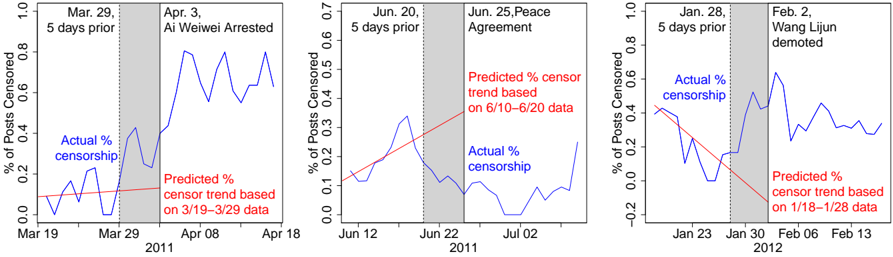
“We thus conduct the same analysis for the demotion of Wang Lijun in Panel (c) of Figure 11, and again see a large difference in actual and predicted percent censorship before Wang's demotion.”
§ How Censorship in China Allows Government Criticism but Silences Collective Expression * > Additional information
plainSingle case- Asserted: passes — The authors put it forward as true.
- Checkable: passes — It can be checked against evidence.
- Load-bearing: unclear — It is unclear whether the paper’s conclusions depend on it.
- Based: passes — The paper gives a reason why it holds.
46 more claims
Create a free account to see all 102 claims and every source verdict.
- Probably not a substantial claim. 26
- It may state two separate claims as one. 33
Claims other papers make about this one
Each is checked against this paper’s own text: does it say what the citing paper says it does?
The source backs part of the claim, not all of it — or backs it for a different population, condition or comparison.
In the citing paper
“Authorities are keen to review social media posts and have contentious messages removed (King etal., 2013) to ensure that potential threats remain invisible.”
From How Dictators Control the Internet: A Review Essay (2020) · cites this paper as King et al., 2013
Experimental — accuracy not yet measuredThe source backs part of the claim, not all of it — or backs it for a different population, condition or comparison.
In the citing paper
“In most autocratic regimes, governmental interference in digital infrastructure and communication is commonplace.”
From How Dictators Control the Internet: A Review Essay (2020) · cites this paper as King et al., 2013
Experimental — accuracy not yet measuredThe source backs part of the claim, not all of it — or backs it for a different population, condition or comparison.
In the citing paper
“First, the timing of censorship during a coup is consistent with many studies that have shown that Internet censorship is targeted during sensitive political time periods and periods of potential power transitions, such as elections and large-scale protests [23,25,44,47,73].”
From A multi-perspective view of Internet censorship in Myanmar (2021) · cites this paper as [44]
Experimental — accuracy not yet measuredThe cited source says what the claim attributes to it.
In the citing paper
“research has shown how mobilization organized through public coordination is repressed using that very same public information-for instance, repression is preemptively increased before focal days (Truex 2019); and autocracies censor online calls for collective action (King, Pan, and Roberts 2013), coerce online opinion leaders (Pan and Siegel 2020), and at times, turn off the internet entirely.”
From Coordinated Dis-Coordination (2024) · cites this paper as King, Pan, and Roberts 2013
The check wasn’t confident either way, so it gives no verdict — never disputed.
In the citing paper
“In China, for instance, two virtual police officers remind citizens that their browsing behavior is monitored (King etal., 2013).”
From How Dictators Control the Internet: A Review Essay (2020) · cites this paper as King et al., 2013
Experimental — accuracy not yet measured
1 more claim about this paper
Create a free account to see every claim other papers make about this one.
Citations
Cites
Robust estimation of a location parameter
Huber, P. J. (1964) · The Annals of Mathematical Statistics · doi:10.1214/aoms/1177703732 · Cited by 7,228
Robust Regression and Outlier Detection
Piepel, G. F. (1989) · Technometrics · doi:10.1080/00401706.1989.10488524 · Cited by 6,144
Robust Regression and Outlier Detection
Rousseeuw, P. J., & Leroy, A. M. (1987) · Wiley Series in Probability and Statistics · doi:10.1002/0471725382 · Cited by 5,609
Logistic Regression in Rare Events Data
King, G., & Zeng, L. (2001) · Political Analysis · doi:10.1093/oxfordjournals.pan.a004868 · Cited by 4,316 · cited 1×
“We do this via well-known and widely used case-control methodology (King and Zeng 2001).”
MethodSelf-citationDemocracy and Development: Political Institutions and Well-Being in the World, 1950–1990
Przeworski, A., Alvarez, M. E., Cheibub, J. A., & Limongi, F. (2000) · doi:10.1017/cbo9780511804946 · Cited by 2,845
Rightful Resistance in Rural China
O'Brien, K. J., & Li, L. (2006) · Cambridge University Press eBooks · doi:10.1017/cbo9780511791086 · Cited by 1,104
The Dynamics of Informational Cascades: The Monday Demonstrations in Leipzig, East Germany, 1989–91
Lohmann, S. (1994) · World Politics · doi:10.2307/2950679 · Cited by 1,035 · cited 1×
“Protests in East Germany, Eastern Europe, and most recently the Middle East have all preceded regime change (Ash 2002; Lohmann 1994; Przeworski et al. 2000).”
BackgroundRightful Resistance in Rural China
O'Brien, K., & Li, L.-J. (2006) · doi:10.1017/cbo9780511791086.003 · Cited by 987
China's Changing of the Guard: Authoritarian Resilience
Nathan, A. J. (2003) · Journal of Democracy · doi:10.1353/jod.2003.0019 · Cited by 927
Sparks and prairie fires: A theory of unanticipated political revolution
Kuran, T. (1989) · Public Choice · doi:10.1007/bf00116762 · Cited by 905 · cited 1×
“In fact, Kuran (1989) and Lohmann (2002) show that it is information about a collective action event that propels collective action and so distinguishing this from explicit calls for collective action would be difficult if not impossible.”
Background
Research works printed but not linked: 13
- 22. Freedom House. 2012. "Freedom of the Press, 2012." www.freedomhouse.org.
- 8. Chang, Parris. 1983. Elite Conflict in the Post-Mao China. New York: Occasional Papers Reprints.
- 26. Hinton, Harold. 1955. The "Unprincipled Dispute" Within Chinese Communist Top Lead- ership. Washington, DC: U.S. Information Agency.
- 44. Perry, Elizabeth. 2002. Challenging the Mandate of Heaven: Social Protest and State Power in China. Armork, NY: M. E. Sharpe.
- 52. Schurmann, Franz. 1966. Ideology and Organization in Communist China. Berkeley, CA: University of California Press.
- Tsai, 2007, Capitalism without Democracy: The Private Sector in Contemporary China
- 48. Qiang, Xiao. 2011. The Rise of Online Public Opinion and Its Political Impact. In Chang- ing Media, Changing China, ed. Susan Shirk. New York: Oxford University Press pp. 202-224.
- 9. Charles, David. 1966. The Dismissal of Marshal P'eng Teh-huai. In China Under Mao: Politics Takes Command, ed. Roderick MacFarquhar. Cambridge: MIT University Press pp. 20-33.
- 54. Shirk, Susan. 2007. China: Fragile Superpower: How China's Internal Politics Could Derail Its Peaceful Rise. New York: Oxford University Press.
- 56. Teiwes, Frederick. 1979. Politics and Purges in China: Retification and the Decline of Party Norms. Armork, NY: M. E. Sharpe. Tsai, Kellee. 2007a. Capitalism without Democracy: The Private Sector in Contemporary China. Ithaca, NY: Cornell University Press.
- 15. Duan, Qing. 2007. China's IT Leadership. Vdm Verlag.
- 38. MacFarquhar, Roderick. 1974. The Origins of the Cultural Revolution Volume 1: Contra- dictions Among the People 1956-1957. New York: Columbia University Press.
- 12. Chen, Xiaoyan and Peng Hwa Ang. 2011. Internet Police in China: Regulation, Scope and Myths. In Online Society in China: Creating, Celebrating, and Instrumentalising the Online Carnival, ed. David Herold and Peter Marolt. New York: Routledge pp. 40-52.
Cited by
Items 401–500 of 2,443
Determinants of political purges in autocracies: Evidence from ancient Chinese dynasties
Wong, S. H., & Chan, K. C.-M. (2020) · Journal of Peace Research · doi:10.1177/0022343319899155 · Cited by 36
Image Clustering: An Unsupervised Approach to Categorize Visual Data in Social Science Research
Zhang, H., & Peng, Y. (2022) · Sociological Methods & Research · doi:10.1177/00491241221082603 · Cited by 57
Varieties of Indoctrination: The Politicization of Education and the Media around the World
Neundorf, A., Nazrullaeva, E., Northmore‐Ball, K., Tertytchnaya, K., & Kim, W. (2024) · Perspectives on Politics · doi:10.1017/s1537592723002967 · Cited by 64
“…and social media (and the loss of monopoly over information dissemination), autocrats ’ strategies include internet shutdowns (Vargas-Leon 2016), strategic censorship (King, Pan, and Roberts 2013; Roberts 2018; 2020), and distraction (King, Pan, and Roberts 2017; Sobolev 2019; Stukal et al. 2019).”
Social Media and Collective Action in China
Qin, B., Strömberg, D., & Wu, Y. (2021) · Econometrica · doi:10.3982/ecta20146 · Cited by 71
Every Rose Has Its Thorn: Censorship and Surveillance on Social Video Platforms in China
Knockel, J., Crete‐Nishihata, M., Ng, J., Senft, A., & Crandall, J. R. (2015) · Cited by 58
The Government's Dividend: Complex Perceptions of Social Media Misinformation in China
Lu, Z., Jiang, Y., Lu, C., Naaman, M., & Wigdor, D. (2020) · CHI Conference on Human Factors in Computing Systems · doi:10.1145/3313831.3376612 · Cited by 45
“For example, Piyao.org.cn is a platform created by Chinese Internet Information Office and Xinhua.net, and publishes searchable, official (government endorsed) fact-checking information.”
BackgroundInfluentialJiang, M. (2015) · Information Communication & Society · doi:10.1080/1369118x.2015.1060723 · Cited by 34
Meng, T., & Su, Z. (2021) · World Development · doi:10.1016/j.worlddev.2021.105443 · Cited by 46
Tao, Y. (2021) · Discourse & Society · doi:10.1177/09579265211013116 · Cited by 39
“The previous literature about online opinion expression is mostly found in the fields of media and communication (Han, 2018; Jia, 2019) and political science (Gu and Li, 2020; King et al., 2013).”
BackgroundMethodInfluentialHou, R. C. (2019) · New Media & Society · doi:10.1177/1461444819889959 · Cited by 40
“…authoritarian regimes maintain their resilience under the impact of technological innovation has become one of the most important topics in the current social sciences (Deibert and Rohozinski, 2011; King et al., 2013; Kyriakopoulou, 2011; Mackinnon, 2011; Morozov, 2011; Moss, 2018; Pallin, 2017).”
BackgroundWhen digital feminisms collide with nationalism: Theorizing “pink feminism” on Chinese social media
Han, L., & Liu, Y. (2024) · Women s Studies International Forum · doi:10.1016/j.wsif.2024.102941 · Cited by 51
China’s ‘info-web’: How Beijing governs online political communication about Japan
Schneider, F. (2015) · New Media & Society · doi:10.1177/1461444815600379 · Cited by 33
“Discussion between diverse actors is not only possible in digital China, but in many ways encouraged (Sullivan, 2014; Tsang, 2009) – at least as long as these actors do not call on Internet users to mobilize (King et al., 2013).”
BackgroundSocial Networks and the Mass Media
Siegel, D. A. (2013) · American Political Science Review · doi:10.1017/s0003055413000452 · Cited by 44
“This appears to be in line with what the Chinese government presently does (King, Pan, and Roberts 2012).”
ResultChai Jing's Under the Dome: A multimedia documentary in the digital age
Cui, S. (2016) · Journal of Chinese Cinemas · doi:10.1080/17508061.2016.1269481 · Cited by 32
Trajectories of Blocked Community Members: Redemption, Recidivism and Departure
Chang, J. P., & Danescu-Niculescu-Mizil, C. (2019) · International World Wide Web Conference (WWW) · doi:10.1145/3308558.3313638 · Cited by 47
“he perpetrators, to outright excluding them [22]. Such actions, however, come at the cost of potentially alienating valuable community members and raise issues of freedom of speech, fairness and bias [22, 25, 45]. Considering their potential negative impacts, it is important to understand to what extent, and in which…”
BackgroundVision, Voice, and Technology: Is There a Global “Open Government” Trend?
Schnell, S. (2020) · Administration & Society · doi:10.1177/0095399720918316 · Cited by 54
“This can help higher level officials ensure that public policies have at least some public support and abuses by public agencies are not so egregious as to trigger significant public discontent or unrest, thus potentially increasing regime performance and legitimacy (Gueorguiev, 2017; King et al., 2013).”
BackgroundRemembering disappeared websites in China: Passion, community, and youth
Yang, G., & Wu, S. (2017) · New Media & Society · doi:10.1177/1461444817731921 · Cited by 39
“To manage contention, the Chinese government has shaped up a complex system of institutions and practices of censorship and governance (Esarey, 2015; Han, 2015; King et al., 2013; MacKinnon, 2008; Pan, 2016; Tsui, 2003).”
BackgroundKofanov, D., Kozlov, V., Libman, A., & Zakharov, N. (2020) · British Journal of Political Science · doi:10.1017/s0007123422000527 · Cited by 39
“…media publications and even social network posts are all subject to manipulation (see, for example, Bader and van Ham 2015; Hale 2018; Harvey 2020, King, Pan and Roberts 2013; King, Pan and Roberts 2017; Moser and White 2017; Myagkov, Ordeshook and Shakin 2009; Pearce and Kendzior 2012; Rozenas…”
BackgroundThe Information Dilemma: How ICT Strengthen or Weaken Authoritarian Rule
Göbel, C. (2013) · Statsvetenskaplig tidskrift · Cited by 58
Ong, E. (2015) · Journal of East Asian Studies · doi:10.1017/s1598240800009115 · Cited by 37
Special Issue Editors’ Introduction: Observing Autocracies from the Ground Floor*
Goode, J. P., & Ahram, A. I. (2016) · Social Science Quarterly · doi:10.1111/ssqu.12339 · Cited by 33
Jia, N., Shi, J., & Wang, Y. (2018) · Emerald Group Publishing Limited eBooks · doi:10.1108/s0742-332220180000038007 · Cited by 33
Strength in Expectation: Elections, Economic Performance, and Authoritarian Breakdown
Lucardi, A. (2019) · The Journal of Politics · doi:10.1086/701723 · Cited by 34
“On the other, the fact that elections are held at regular intervals (Fearon 2011; Harish and Little 2017; Knutsen et al. 2017; PopEleches and Robertson 2015; Wilson and Lindberg 2016) can increase authoritarian resiliency in nonelection years because opposition leaders and activists who have…”
BackgroundInfluentialThe Effects of Political Institutions on the Extensive and Intensive Margins of Trade
Kim, I., Londregan, J., & Ratkovic, M. (2019) · International Organization · doi:10.1017/s0020818319000237 · Cited by 39
“In this setting, potential rebels are unable to communicate confidentially with each other, as the autocrat has effective control of political contacts (e.g., King, Pan, and Roberts, 2013).”
BackgroundDesigning authoritarian deliberation: how social media platforms influence political talk in China
Stockmann, D., Luo, T., & Shen, M. (2019) · Democratization · doi:10.1080/13510347.2019.1679771 · Cited by 46
Mobile phones, social ties and collective action mobilization in China
Liu, J. (2016) · Acta Sociologica · doi:10.1177/0001699316660596 · Cited by 53
“With the increasing popularity of digital media, the authorities are working even harder to tighten their control over both CMC and social organizations in order to curtail the possibilities of collection action (e.g., King et al., 2013).”
BackgroundJudicial Transparency as Judicial Centralization: Mass Publicity of Court Decisions in China
Chen, L., Liu, Z., & Tang, Y. (2021) · Journal of Contemporary China · doi:10.1080/10670564.2021.2010871 · Cited by 31
Hollyer, J. R., Rosendorff, B. P., & Vreeland, J. R. (2018) · Journal of Conflict Resolution · doi:10.1177/0022002718792602 · Cited by 35
Su, Y. (2019) · Global Media and China · doi:10.1177/2059436419866012 · Cited by 33
Categorizing Live Streaming Moderation Tools: An Analysis of Twitch
Cai, J., & Wohn, D. Y. (2019) · International Journal of Interactive Communication Systems and Technologies · doi:10.4018/ijicst.2019070103 · Cited by 46
#rebel: Rebel communication strategies in the age of social media
Loyle, C. E., & Bestvater, S. E. (2019) · Conflict Management and Peace Science · doi:10.1177/0738894219881430 · Cited by 44
Song, Y., Kwon, K. H., Xu, J., Huang, X. S., & Li, S. (2020) · New Media & Society · doi:10.1177/1461444820905068 · Cited by 34
“…have shown that China’s civility campaigns and subsequent censorships have often framed an expression of high emotion such as anger as irrational and uncivil, thereby weakening online mobilization and contentious collective actions through Chinese digital networks (King et al., 2013; Yang, 2018).”
BackgroundWhat Motivates Non-Democratic Leadership: Evidence from COVID-19 Reopenings in China
Fisman, R. J., Lin, H. Y., Sun, C., Wang, Y., & Zhao, D. (2020) · Journal of Public Economics · doi:10.1016/j.jpubeco.2021.104389 · Cited by 42
“As observed by Kudumatsu and Besley (2008) command-and-control systems may be effective in, for example, providing public infrastructure and coordinating private investments.”
BackgroundIm, D.-K., & Meng, T. (2015) · International Journal of Public Opinion Research · doi:10.1093/ijpor/edv013 · Cited by 36
Affective networks: how WeChat enhances Tencent’s digital business governance
Peng, A. Y. (2017) · Chinese Journal of Communication · doi:10.1080/17544750.2017.1306573 · Cited by 41
“The existing literature on digital governance in China focuses on digital political governance, emphasizing the direct conflict between dissidents and the government (King, Pan, & Roberts, 2013 ; Stockmann & Luo, 2015).”
BackgroundWagner, K. M., Gainous, J., & Abbott, J. P. (2019) · Social Science Computer Review · doi:10.1177/0894439319865907 · Cited by 31
Digital activism and collective mourning by Chinese netizens during COVID-19
Cao, X., Zeng, R., & Evans, R. D. (2021) · China Information · doi:10.1177/0920203x211054172 · Cited by 45
Mapping Texts: Computational Text Analysis for the Social Sciences
Stoltz, D. S., & Taylor, M. A. (2023) · doi:10.1093/oso/9780197756874.001.0001 · Cited by 42
The Road to Cynicism: The Political Consequences of Online Satire Exposure in China
Shao, L. H., & Liu, D. (2018) · Political Studies · doi:10.1177/0032321718791373 · Cited by 37
“2 Researches found that related policy issues can be discussed as long as they do not involve collective actions or directly challenge the legitimacy (King et al., 2013; Shao, 2018).”
BackgroundBrantly, A. F. (2019) · Journal of Information Technology & Politics · doi:10.1080/19331681.2019.1657047 · Cited by 42
“China is a powerful example of the use of state control to manage media and identify those forms of information that individuals and organizations might utilize to mobilize.”
BackgroundInfluentialNie, K. (2021) · Poetics · doi:10.1016/j.poetic.2021.101590 · Cited by 46
Distract and Divert: How World Leaders Use Social Media During Contentious Politics
Barberá, P., Gohdes, A., Iakhnis, E., & Zeitzoff, T. (2022) · The International Journal of Press/Politics · doi:10.1177/19401612221102030 · Cited by 45
“…mobilization (Tufekci and Wilson 2012; Steinert-Threlkeld 2017; Larson et al. 2019) and how leaders and governments try to stymie protest and popular uprisings by engaging in censorship (King et al. 2013; Zhuravskaya et al. 2020) or cutting Internet access during mass repression (Gohdes 2020).”
BackgroundDenemark, D., & Chubb, A. (2015) · Information Communication & Society · doi:10.1080/1369118x.2015.1093527 · Cited by 36
Social Media, Democracy, and Democratization
Gayo-Avello, D. (2015) · IEEE Multimedia · doi:10.1109/mmul.2015.47 · Cited by 47
“” Chinese social media users are relatively free to criticize the state, its leaders, and their policies without fearing censorship; what is quickly censored is any message (even positive) calling for a collective action.(8) In short, social media is not a democratizing catalyzer per se.”
BackgroundChina’s Dormant and Active Social Volcanoes
Whyte, M. K. (2015) · The China Journal · doi:10.1086/683124 · Cited by 31
Cantoni, D., Kao, A., Yang, D., & Yuchtman, N. (2023) · National Bureau of Economic Research · doi:10.3386/w31617 · Cited by 31
Cyber state capacity: A model of authoritarian durability, ICTs, and emerging media
Christensen, B. (2019) · Government Information Quarterly · doi:10.1016/j.giq.2019.04.004 · Cited by 36
Zhao, X., & Wang, X. (2022) · Journalism & Mass Communication Quarterly · doi:10.1177/10776990211072508 · Cited by 38
“In authoritarian societies, social media operate in sophisticated, complex systems of digital control involving control over access, the censorship of content and/or accounts, and the fabrication of public opinion (King et al., 2013; Sullivan, 2012).”
BackgroundSocial Media in Industrial China
Wang, X. (2016) · UCL Press eBooks · doi:10.14324/111.9781910634646 · Cited by 142
Cantoni, D., Kao, A., Yang, D. Y., & Yuchtman, N. (2024) · Annual Review of Economics · doi:10.1146/annurev-economics-082423-032519 · Cited by 55
Xiang, J. Y., & Hmielowski, J. D. (2016) · International Journal of Public Opinion Research · doi:10.1093/ijpor/edw006 · Cited by 29
Internet Censorship in Thailand: User Practices and Potential Threats
Gebhart, G., & Kohno, T. (2017) · IEEE European Symposium on Security and Privacy · doi:10.1109/eurosp.2017.50 · Cited by 29
“On one side, government censorship policies have received in-depth study [28, 46, 54], and corresponding technical measurements of censorship are well developed [1, 14, 16, 47, 53].”
BackgroundAutocracy login: internet censorship and civil society in the digital age
Chang, C.-C., & Lin, T.-H. (2020) · Democratization · doi:10.1080/13510347.2020.1747051 · Cited by 47
How to Use Social Media Data for Political Science Research
Barberá, P., & STEINERT-THRELKELD, Z. (2020) · SAGE Publications Ltd eBooks · doi:10.4135/9781526486387.n26 · Cited by 34
Chan, M., Chen, H., & Lee, F. L. F. (2021) · Social Media + Society · doi:10.1177/20563051211035697 · Cited by 41
“For example, while citizens in China can criticize the government on social media to some degree, any posted content that attempts to ferment and mobilize collective action is censored (King et al., 2013) and the offenders can be sanctioned or arrested.”
BackgroundFreiling, I., Krause, N. M., Scheufele, D. A., & Chen, K. (2021) · Journal of Communication · doi:10.1093/joc/jqab032 · Cited by 42
Margetts, H. Z., & Hood, C. (2016) · Palgrave Macmillan UK eBooks · doi:10.1057/978-1-137-50494-4_8 · Cited by 35
Algorithmically Bypassing Censorship on Sina Weibo with Nondeterministic Homophone Substitutions
Hiruncharoenvate, C., Lin, Z. J., & Gilbert, É. (2021) · Proceedings of the International AAAI Conference on Web and Social Media · doi:10.1609/icwsm.v9i1.14637 · Cited by 45
“King et al. added that posts that promote collective actions—regardless of their pro-or antigovernment point of view—are mainly censored (King, Pan, and Roberts 2013).”
BackgroundChina's Responsiveness to Internet Opinion: A Double-Edged Sword
Hassid, J. (2015) · Journal of Current Chinese Affairs · doi:10.1177/186810261504400203 · Cited by 37
The Effect of Media Use on Institutional Trust in China
Yang, Y., Tang, M., Zhou, W., & Huhe, N. (2014) · Problems of Post-Communism · doi:10.2753/ppc1075-8216610304 · Cited by 31
“While there is more criticism of the government on the Web than in the traditional media, the taboo on negative reporting still exists for top leaders and key institutions (King, Pan, and roberts 2013).”
BackgroundA Confucian Look at Internet Censorship in China
Kou, Y., Semaan, B., & Nardi, B. A. (2017) · Lecture notes in computer science · doi:10.1007/978-3-319-67744-6_25 · Cited by 40
“King et al. conducted an analysis of deleted social media content on the Chinese Internet [40].”
Information and Communication Technologies, Protests, and CensorshipPreprint
Ananyev, M., Xefteris, D., Zudenkova, G., & Petrova, M. (2017) · SSRN Electronic Journal · doi:10.2139/ssrn.2978549 · Cited by 35
Shen, F., & Zhang, Z. (2018) · Journal of Information Technology & Politics · doi:10.1080/19331681.2018.1449700 · Cited by 35
“It is well known that Chinese social media platforms including news portal sites, discussion forums, and social networking sites frequently delete netizen expressions that are considered “ sensitive ” (Fu, Chan, & Chau, 2013; King, Pan, & Roberts, 2013; MacKinnon, 2009; Shen, 2014).”
Beazer, Q., Crabtree, C. D., Fariss, C. J., & Kern, H. (2021) · British Journal of Political Science · doi:10.1017/s0007123421000351 · Cited by 33
“In an influential contribution, King, Pan, and Roberts (2013) distinguish between two theories of autocratic censorship: collective action potential theory and state critique theory .”
BackgroundResultInfluentialAdvances in Public Opinion and Policy Attitudes Research
Bachner, J., & Hill, K. W. (2014) · Policy Studies Journal · doi:10.1111/psj.12052 · Cited by 33
Media's Influence on LGBTQ Support Across Africa
Winkler, S. J. (2019) · British Journal of Political Science · doi:10.1017/s000712341900019x · Cited by 37
Peng, A. Y. (2020) · Convergence The International Journal of Research into New Media Technologies · doi:10.1177/1354856520977851 · Cited by 32
“This is because the main purpose of the CCP’s censorship is to prevent collective protests against the Party-State (King et al., 2013).”
BackgroundAlyukov, M. (2021) · Politics · doi:10.1177/02633957211041440 · Cited by 49
“The crucial factor which determines whether a regime can deploy sophisticated techniques of digital control is the availability of resources (Egorov et al., 2009; King et al., 2013).”
InfluentialProvocation, Public Opinion, and International Disputes: Evidence from China
Dafoe, A., Liu, S., O'Keefe, B., & Weiss, J. C. (2022) · International Studies Quarterly · doi:10.1093/isq/sqac006 · Cited by 28
Social Protection under Authoritarianism: Health Politics and Policy in China
Huang, X. L. (2020) · doi:10.1093/oso/9780190073640.001.0001 · Cited by 32
Third person effect and Internet pornography in China
Chen, H., Wu, Y., & Atkin, D. J. (2015) · Telematics and Informatics · doi:10.1016/j.tele.2015.04.004 · Cited by 39
“Second, online policemen limit user’s posting of sensitive words relating to banned materials (King et al., 2013; Mou et al., 2013a,b, 2014).”
Cason, T. N., & Mui, V. (2014) · European Journal of Political Economy · doi:10.1016/j.ejpoleco.2014.10.005 · Cited by 29
The Argumentative Force of Image Networks: Greenpeace's Panmediated Global Detox Campaign
Brunner, E., & DeLuca, K. M. (2016) · Argumentation and Advocacy · doi:10.1080/00028533.2016.11821875 · Cited by 28
“emotional feeling, felt in its relevance to a world beyond" (p. 163). Feeling precedes thinking. As Shaviro (2009) summarized Whitehead, "Feeling, as such, is the primordial form of all relation and all communication" (p.”
BackgroundRepresentative Democracy: A Justification
Landa, D., & Pevnick, R. (2025) · doi:10.1093/oso/9780198897538.001.0001 · Cited by 51
Online Censorship and Journalists' Tactics
Xu, D. (2014) · Journalism Practice · doi:10.1080/17512786.2014.982968 · Cited by 27
“This is used to refer to “和谐”, the party-state’s official doctrine of building a harmonious society (King, Pan, and Roberts 2013).”
MethodDutton, M. (2016) · The China Quarterly · doi:10.1017/s0305741016000771 · Cited by 39
“The author wishes to thank Stacy Lo for her help with research and translation, Deborah Kessler for help with proof reading and comments, and Chris Berry, 46 See King, Pan and Roberts 2013, 327.”
BackgroundCui, D., & Wu, F. (2015) · Telecommunications Policy · doi:10.1016/j.telpol.2015.11.010 · Cited by 27
Refocusing democracy: the Chinese government’s framing strategy in political language
Hu, Y. (2019) · Democratization · doi:10.1080/13510347.2019.1690461 · Cited by 32
Cheng, Y., & Wu, Z. (2020) · Administration & Society · doi:10.1177/0095399720945969 · Cited by 28
“On one hand, governments are constraining the space of nonprofit organizations which make democratic claims (Spires, 2011) or collective expression (King et al., 2013).”
BackgroundMedia Freedom in the Shadow of a Coup
Boleslavsky, R., Shadmehr, M., & Сонин, К. И. (2020) · Journal of the European Economic Association · doi:10.1093/jeea/jvaa040 · Cited by 35
Consultation and Selective Censorship in China
Gueorguiev, D. D., & Malesky, E. J. (2019) · The Journal of Politics · doi:10.1086/704785 · Cited by 31
“Censorship magnitude is defined as the share of posts censored during a volume burst minus the baseline share of censored posts that occur outside a volume burst (King et al. 2013, 332).”
BackgroundHuman Rights Texts: Converting Human Rights Primary Source Documents into Data
Fariss, C. J., Linder, F., Jones, Z., Crabtree, C. D., Biek, M. A., Ross, A.-S. M., Kaur, T., & Tsai, M. (2015) · PLoS ONE · doi:10.1371/journal.pone.0138935 · Cited by 40
“…are more generally part of the emergent field of computational social science or “ big data ” analysis [17 – 19] of which there are several recent examples in the study of human rights [1, 10, 20 – 23] and many other examples from political science and social science more generally [11, 24 – 28].”
BackgroundComputer-Assisted Reading and Discovery for Student Generated Text in Massive Open Online CoursesPreprint
Reich, J., Tingley, D. H., Leder-Luis, J., et al. (2014) · SSRN Electronic Journal · doi:10.2139/ssrn.2499725 · Cited by 27
Self-citationA Model of Protests, Revolution, and InformationPreprint
Barberà, S., & Jackson, M. O. (2020) · Quarterly Journal of Political Science · doi:10.2139/ssrn.2732864 · Cited by 68
Stability justice: Petitioners versus non-petitioners in China's criminal adjudication
Feng, Y., & Zeng, Y. (2022) · Law & Society Review · doi:10.1111/lasr.12633 · Cited by 27
Wang, S., & Liang, Z. (2024) · Government Information Quarterly · doi:10.1016/j.giq.2024.101939 · Cited by 34
Hao, W., Cheng, E. W., Chen, X., & Liang, H. (2024) · Governance · doi:10.1111/gove.12907 · Cited by 45
Propaganda and Disinformation Go Online
Pavlíková, M., Šenkýřová, B., & Drmola, J. (2021) · Political campaigning and communication · doi:10.1007/978-3-030-58624-9_2 · Cited by 36
An Improved Method of Automated Nonparametric Content Analysis for Social Science
Jerzak, C., King, G., & Strezhnev, A. (2022) · Political Analysis · doi:10.1017/pan.2021.36 · Cited by 44
“…survey research applications in public health, and in Hopkins and King (2010) with applications to text analysis in political science; and it was extended in King, Lu, and Shibuya (2010) and King et al. (2013, Appendix B), with a U.S. Patent issued for the technology (King, Hopkins, and Lu 2012).”
Self-citationQiu, S., Gao, X., Yue, W., & Zhang, Q. (2023) · Government Information Quarterly · doi:10.1016/j.giq.2023.101806 · Cited by 35
Zhong, Z., Wang, T., & Huang, M. (2017) · Internet Research · doi:10.1108/intr-07-2016-0204 · Cited by 34
“Research questions about how Chinese people use the Internet for political or civil purposes and how Chinese government regulates the Internet have garnered enormous attention internationally (e.g., King et al., 2013; King et al., 2014; Roberts, 2015; Kou et al., 2017).”
BackgroundMethodInfluentialSocial Networks in Policy Making
Battaglini, M., & Patacchini, E. (2019) · Annual Review of Economics · doi:10.1146/annurev-economics-080218-030419 · Cited by 31
“King et al. (2017) estimate that 448 million comments each year in Chinese social media can be attributed to agents sponsored by the Chinese government; Qin et al.”
BackgroundKarakaya, S., & Glazier, R. A. (2019) · Journal of Information Technology & Politics · doi:10.1080/19331681.2019.1645784 · Cited by 30
Prefigurative Politics in Chinese Young People’s Online Social Participation
Fu, J. (2019) · Perspectives on children and young people · doi:10.1007/978-981-13-3750-5_17 · Cited by 26
Social Theory after the Internet: Media, Technology, and Globalization
Schroeder, R. (2018) · Project Muse (Johns Hopkins University) · doi:10.14324/111.9781787351226 · Cited by 72
Cinema Censorship and Media Citizenship in the Hong Kong Film Ten Years
Fang, K. Y. (2018) · Surveillance & Society · doi:10.24908/ss.v16i2.6826 · Cited by 25
Wu, Y., & Wall, M. (2019) · New Media & Society · doi:10.1177/1461444819830072 · Cited by 23
Taxing dissent: The impact of a social media tax in Uganda
Boxell, L., & STEINERT-THRELKELD, Z. (2022) · World Development · doi:10.1016/j.worlddev.2022.105950 · Cited by 38
Rappers as Knights-Errant: Classic Allusions in the Mainstreaming of Chinese Rap
Sullivan, J., & Zhao, Y. (2019) · Popular Music & Society · doi:10.1080/03007766.2019.1704476 · Cited by 32
The Chinese Dream: Hukou, Social Mobility, and Trust in Government
Huang, X. L. (2020) · Social Science Quarterly · doi:10.1111/ssqu.12847 · Cited by 29
Metadata
- Authors
- KING, G., PAN, J., & ROBERTS, M. E.
- Affiliations
- Harvard University (US)
- Corresponding author
- KING, GARY
- PAN, JENNIFER
- Venue
- American Political Science Review
- Publisher
- Cambridge University Press (CUP)
- Published
- 2013-05
- Volume
- 107
- Issue
- 2
- Pages
- 326-343
- ISSN
- 0003-0554 (ISSN-L)
- 1537-5943
- OpenAlex
- W2144188763
- Cited by
- 2,415
- References
- 48
- Citations by year
- 2026: 161 · 2025: 206 · 2024: 249 · 2023: 272 · 2022: 230 · 2021: 193 · 2020: 206 · 2019: 157 · 2018: 178 · 2017: 153 · 2016: 137 · 2015: 120 · 2014: 91 · 2013: 54
- FWCI
- 395.09
- Type
- journal article
- Language
- en
- Open access
- green
- nrs.harvard.edu
- Licence
- Locations
- American Political Science Review (publishedVersion)
- Digital Access to Scholarship at Harvard (DASH) (Harvard University) (submittedVersion, cc-by)
- RePEc: Research Papers in Economics (submittedVersion)
- Topics
- Social Sciences › Communication › Social Media and Politics
- Social Sciences › Law › Freedom of Expression and Defamation
- Social Sciences › Sociology and Political Science › Media Influence and Politics
- Keywords
- internet censorship, Chinese government, social media, collective action, social mobilization, political criticism, online speech
About these checks
Registry, retraction, Cites and statistics results are computed, not judged, with one exception: a printed reference that no index lists is read once by a model before it counts as a citation error. Claims are extracted by a model and kept only when their quote appears verbatim in the text; each cited source is then checked, with a model’s help, for whether it says what the claim relies on. Those verdicts can be wrong — read the claim’s quote and the cited source before relying on one.
A language model drew the claims from the paper on 2026-10-11, under version 3 of the claim definition (model deepseek-v4.1-flash, prompt extract-v3).
A second model labelled each claim on 2026-10-11 (model jev-1.13-20260917, definition revision gold-guideline-v0.2).
Statistics and arithmetic are recomputed, not judged.
Confidence bands are shown only for fields calibrated on our annotated test set. None is calibrated yet, so no band is shown.
What counts as a claim ›How we measure confidence ›How we check this ›
Are you an author, or do you see a problem with this page? Request a review
Data sources
Bibliographic data: Semantic Scholar, OpenAlex, Crossref.
Contains information from the Semantic Scholar Academic Graph Datasets, made available under the ODC Attribution License (ODC-BY 1.0).
Semantic Scholar’s data is described in: Kinney, R., et al. (2023). The Semantic Scholar Open Data Platform. arXiv:2301.10140.
