

How Censorship in China Allows Government Criticism but Silences Collective Expression
Open accessThe DOI matches its Crossref record; 53 of the 54 references it cites were found in a registry or an index, and 1 are not checked yet; none of the 12 sources its claims cite is checked for support yet.
Abstract
We offer the first large scale, multiple source analysis of the outcome of what may be the most extensive effort to selectively censor human expression ever implemented. To do this, we have devised a system to locate, download, and analyze the content of millions of social media posts originating from nearly 1,400 different social media services all over China before the Chinese government is able to find, evaluate, and censor (i.e., remove from the Internet) the subset they deem objectionable. Using modern computer-assisted text analytic methods that we adapt to and validate in the Chinese language, we compare the substantive content of posts censored to those not censored over time in each of 85 topic areas. Contrary to previous understandings, posts with negative, even vitriolic, criticism of the state, its leaders, and its policies are not more likely to be censored. Instead, we show that the censorship program is aimed at curtailing collective action by silencing comments that represent, reinforce, or spur social mobilization, regardless of content. Censorship is oriented toward attempting to forestall collective activities that are occurring now or may occur in the future—and, as such, seem to clearly expose government intent.
Checked 2026-11-22 · 1 reference not checked yet
Overview
CoChat Summary
TL;DR
The paper uses large-scale, real-time collection of Chinese social media posts to test why China censors online expression. It finds that censorship does not target criticism of the state or leaders; instead, it targets posts with collective action potential, regardless of whether they support or criticize the government.
Key findings
- Across the data, an average of approximately 13% of all social media posts were censored. Ex ante political sensitivity had only a weak relationship with censorship: Low and Medium categories were censored at 16% and 17%, respectively, versus 24% for High.
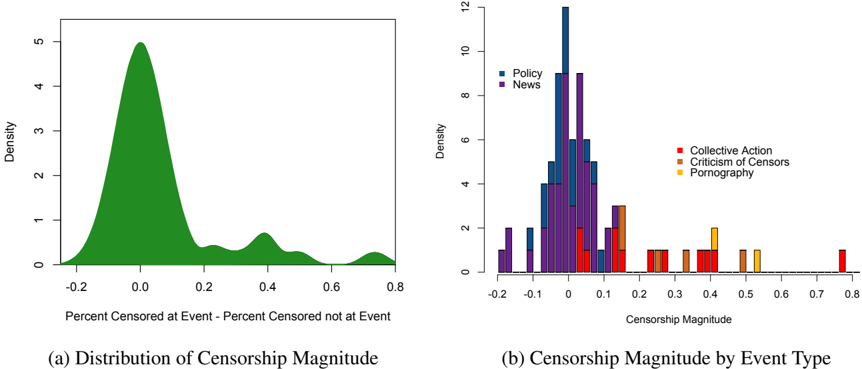
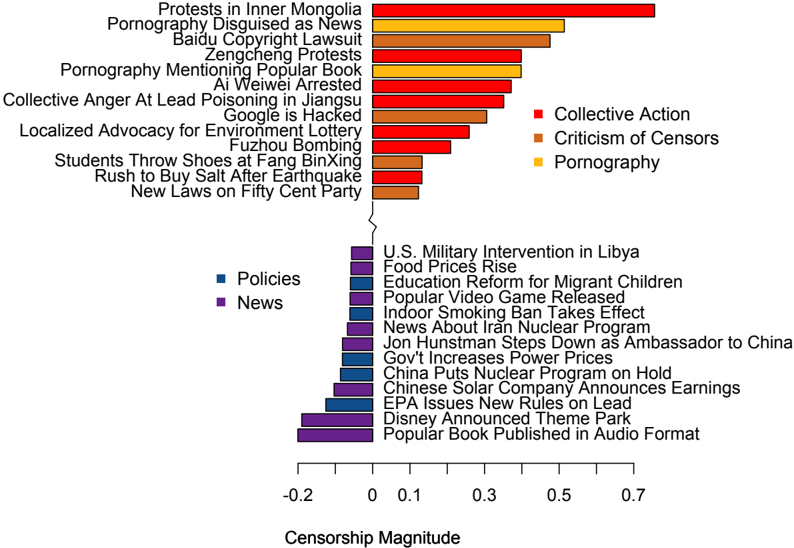
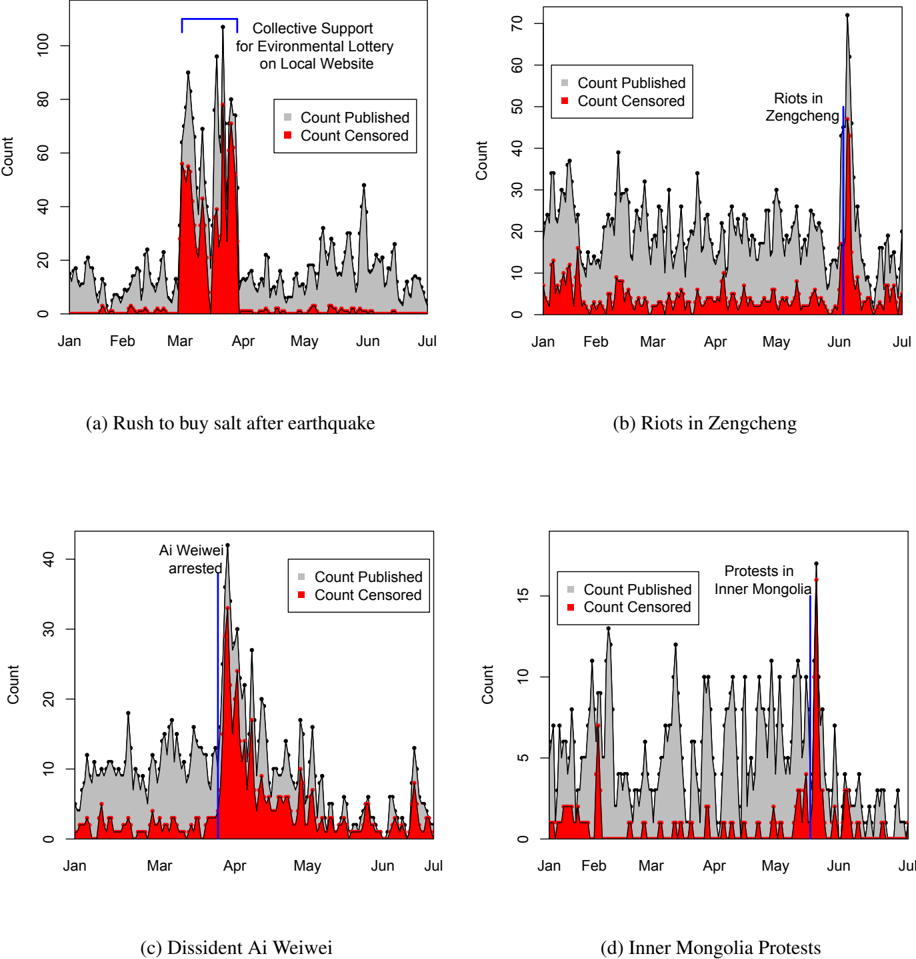
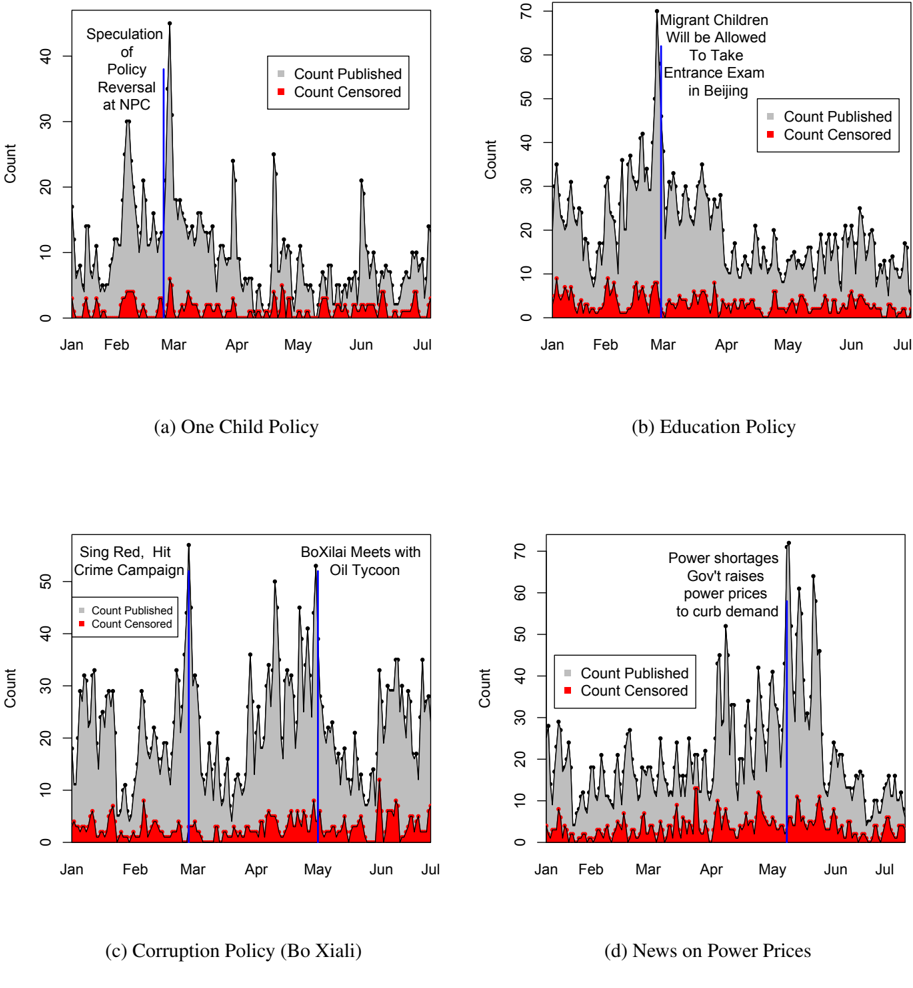
- Censorship was much higher during volume bursts tied to collective action: average censorship magnitude was 27% for collective action, compared with -1% for policy and -4% for news.
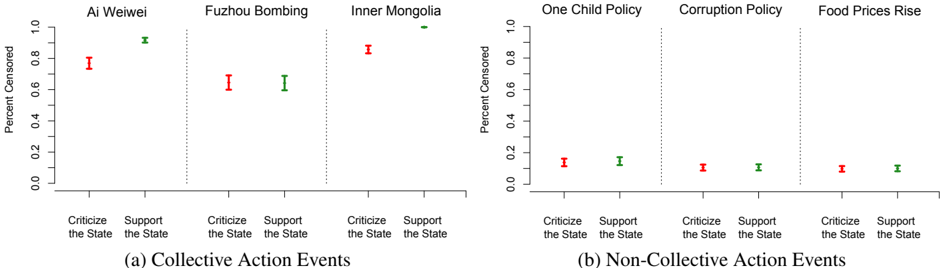
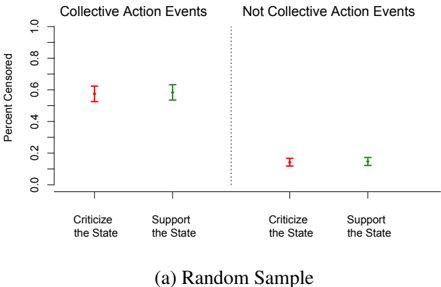
- For collective action events such as Ai Weiwei’s arrest, Inner Mongolia protests, and Fuzhou bombings, posts were censored at about 80% on average whether they criticized or supported the state. For non-collective-action events such as the one child policy, corruption policy, and food prices, censorship was about 10% on average for both critical and supportive posts.
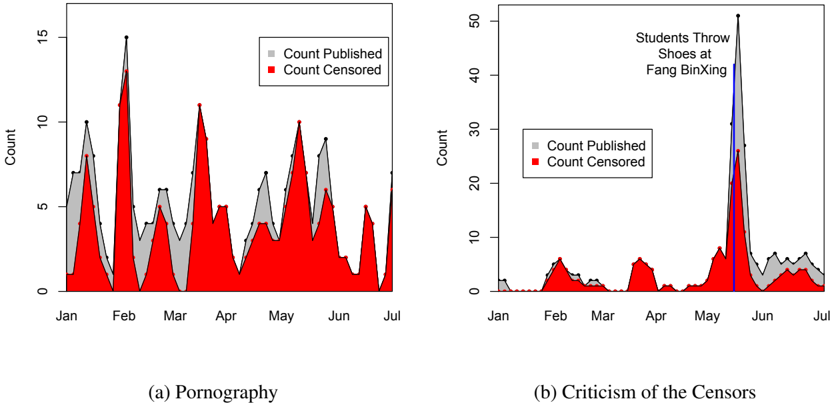
- Censorship also targeted pornography and criticism of the censors, but not government policy or other news. The authors argue censorship is aimed at curtailing collective action by silencing comments that represent, reinforce, or spur social mobilization.
Methods
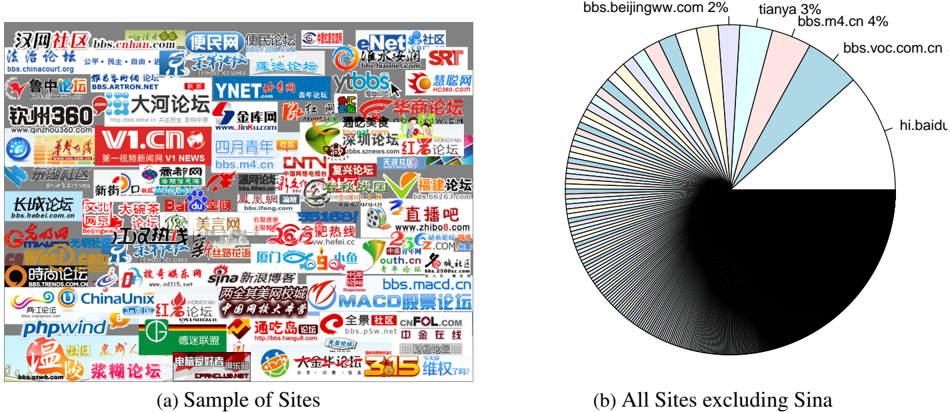
- The authors built a system to locate, download, and analyze posts from 1,382 Chinese websites during the first half of 2011, before government censors could remove them. They collected 3,674,698 posts, randomly selected 127,283 for further analysis, and overall collected and analyzed 11,382,221 posts.
- They used a stratified random sampling design covering 85 topic areas across three hypothesized political sensitivity levels, detected 87 volume bursts in 67 of the 85 topic areas using robust regression-based burst detection, and classified events into collective action potential, criticism of censors, pornography, government policies, and other news.
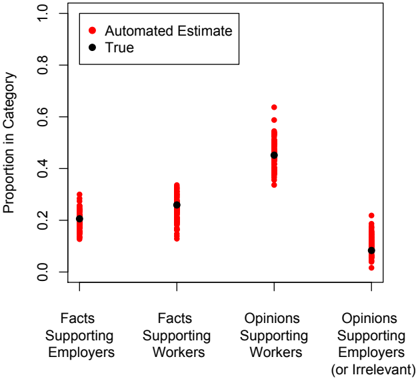
- To analyze content, they adapted the Hopkins and King “ReadMe” automated text analysis method to Chinese and extended it with a Bayesian procedure to estimate the percent censored within categories. Validation used native Chinese speakers coding 1,000 posts about 2010 labor strikes, with 100 as training and 900 as test; event coding reliability was 98.9% (86 of 87 events).
Limitations
- The paper states that its methodology misses self-censorship and censorship that may occur before the post is obtained; it also does not quantify the direct effects of the Great Firewall, keyword blocking, or search filtering.
- The authors state they have not studied physical violence, such as arrest of bloggers, or threats of the same; although many officials and levels of government influence censorship decisions, their data only sometimes distinguish among these sources, and they cannot determine the consequences of these limitations.
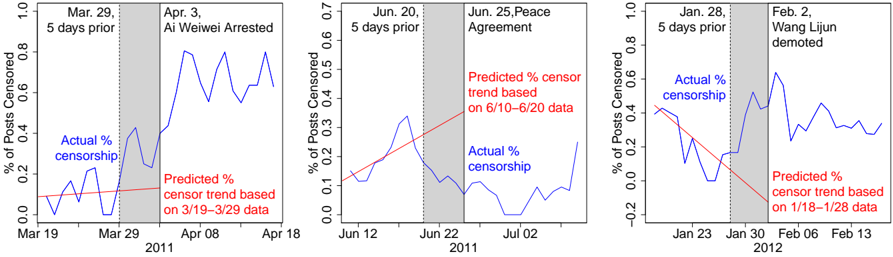
- The authors note that the presumably smaller number of discussions they cannot observe are likely to be those of most interest to the Chinese government, and they offer little evidence connecting social media findings to press freedom or other types of human expression in China. They also state that the predictive analysis was conducted retrospectively and with only three events, so further prospective validation would be valuable.
Model-written summary. Check it against the paper before relying on it.
Integrity signals
Registry
Cites
Statistics
Figures
Verification
Claims the paper makes
0 Valid · 7 Not valid · 7 Not checked · 88 Own results and interpretations
A result the paper reports from its own data — it cites no other source for it, so there is none to check. The quote shows it is in the paper.
In the paper
“Our data show that the Chinese censorship program allows for a wide variety of criticisms of the Chinese government, its officials, and its policies.”
§ How Censorship in China Allows Government Criticism but Silences Collective Expression * > Outline of Results
plain- Asserted: passes — The authors put it forward as true.
- Checkable: passes — It can be checked against evidence.
- Load-bearing: passes — The paper’s conclusions depend on it.
- Based: passes — The paper gives a reason why it holds.
A result the paper reports from its own data — it cites no other source for it, so there is none to check. The quote shows it is in the paper.
In the paper
“Contrary to previous understandings, posts with negative, even vitriolic, criticism of the state, its leaders, and its policies are not more likely to be censored.”
- Also stated in: § 1 Introduction · plain
“we find that when the Chinese people write scathing criticisms of their government and its leaders, the probability that their post will be censored does not increase.”
§ How Censorship in China Allows Government Criticism but Silences Collective Expression * > Abstract
plain- Asserted: passes — The authors put it forward as true.
- Checkable: passes — It can be checked against evidence.
- Load-bearing: passes — The paper’s conclusions depend on it.
- Based: passes — The paper gives a reason why it holds.
- Also stated in: § 1 Introduction · plain
A result the paper reports from its own data — it cites no other source for it, so there is none to check. The quote shows it is in the paper.
In the paper
“Large increases in online volume are good predictors of censorship when these increases are associated with events related to collective action, e.g., protest on the ground.”
§ How Censorship in China Allows Government Criticism but Silences Collective Expression * > Outline of Results
plainstates an association- Asserted: passes — The authors put it forward as true.
- Checkable: passes — It can be checked against evidence.
- Load-bearing: passes — The paper’s conclusions depend on it.
- Based: passes — The paper gives a reason why it holds.
A result the paper reports from its own data — it cites no other source for it, so there is none to check. The quote shows it is in the paper.
In the paper
“In addition, we measure sentiment within each of these events and show that during these events, the government censors views that are both supportive and critical of the state.”
§ How Censorship in China Allows Government Criticism but Silences Collective Expression * > Outline of Results
plainstates a cause- Asserted: passes — The authors put it forward as true.
- Checkable: passes — It can be checked against evidence.
- Load-bearing: passes — The paper’s conclusions depend on it.
- Based: passes — The paper gives a reason why it holds.
A result the paper reports from its own data — it cites no other source for it, so there is none to check. The quote shows it is in the paper.
In the paper
“We thus conduct the same analysis for the demotion of Wang Lijun in Panel (c) of Figure 11, and again see a large difference in actual and predicted percent censorship before Wang's demotion.”
§ How Censorship in China Allows Government Criticism but Silences Collective Expression * > Additional information
plainSingle case- Asserted: passes — The authors put it forward as true.
- Checkable: passes — It can be checked against evidence.
- Load-bearing: unclear — It is unclear whether the paper’s conclusions depend on it.
- Based: passes — The paper gives a reason why it holds.
46 more claims
Create a free account to see all 102 claims and every source verdict.
- Probably not a substantial claim. 26
- It may state two separate claims as one. 33
Claims other papers make about this one
Each is checked against this paper’s own text: does it say what the citing paper says it does?
The source backs part of the claim, not all of it — or backs it for a different population, condition or comparison.
In the citing paper
“Authorities are keen to review social media posts and have contentious messages removed (King etal., 2013) to ensure that potential threats remain invisible.”
From How Dictators Control the Internet: A Review Essay (2020) · cites this paper as King et al., 2013
Experimental — accuracy not yet measuredThe source backs part of the claim, not all of it — or backs it for a different population, condition or comparison.
In the citing paper
“In most autocratic regimes, governmental interference in digital infrastructure and communication is commonplace.”
From How Dictators Control the Internet: A Review Essay (2020) · cites this paper as King et al., 2013
Experimental — accuracy not yet measuredThe source backs part of the claim, not all of it — or backs it for a different population, condition or comparison.
In the citing paper
“First, the timing of censorship during a coup is consistent with many studies that have shown that Internet censorship is targeted during sensitive political time periods and periods of potential power transitions, such as elections and large-scale protests [23,25,44,47,73].”
From A multi-perspective view of Internet censorship in Myanmar (2021) · cites this paper as [44]
Experimental — accuracy not yet measuredThe cited source says what the claim attributes to it.
In the citing paper
“research has shown how mobilization organized through public coordination is repressed using that very same public information-for instance, repression is preemptively increased before focal days (Truex 2019); and autocracies censor online calls for collective action (King, Pan, and Roberts 2013), coerce online opinion leaders (Pan and Siegel 2020), and at times, turn off the internet entirely.”
From Coordinated Dis-Coordination (2024) · cites this paper as King, Pan, and Roberts 2013
The check wasn’t confident either way, so it gives no verdict — never disputed.
In the citing paper
“In China, for instance, two virtual police officers remind citizens that their browsing behavior is monitored (King etal., 2013).”
From How Dictators Control the Internet: A Review Essay (2020) · cites this paper as King et al., 2013
Experimental — accuracy not yet measured
1 more claim about this paper
Create a free account to see every claim other papers make about this one.
Citations
Cites
Robust estimation of a location parameter
Huber, P. J. (1964) · The Annals of Mathematical Statistics · doi:10.1214/aoms/1177703732 · Cited by 7,228
Robust Regression and Outlier Detection
Piepel, G. F. (1989) · Technometrics · doi:10.1080/00401706.1989.10488524 · Cited by 6,144
Robust Regression and Outlier Detection
Rousseeuw, P. J., & Leroy, A. M. (1987) · Wiley Series in Probability and Statistics · doi:10.1002/0471725382 · Cited by 5,609
Logistic Regression in Rare Events Data
King, G., & Zeng, L. (2001) · Political Analysis · doi:10.1093/oxfordjournals.pan.a004868 · Cited by 4,316 · cited 1×
“We do this via well-known and widely used case-control methodology (King and Zeng 2001).”
MethodSelf-citationDemocracy and Development: Political Institutions and Well-Being in the World, 1950–1990
Przeworski, A., Alvarez, M. E., Cheibub, J. A., & Limongi, F. (2000) · doi:10.1017/cbo9780511804946 · Cited by 2,845
Rightful Resistance in Rural China
O'Brien, K. J., & Li, L. (2006) · Cambridge University Press eBooks · doi:10.1017/cbo9780511791086 · Cited by 1,104
The Dynamics of Informational Cascades: The Monday Demonstrations in Leipzig, East Germany, 1989–91
Lohmann, S. (1994) · World Politics · doi:10.2307/2950679 · Cited by 1,035 · cited 1×
“Protests in East Germany, Eastern Europe, and most recently the Middle East have all preceded regime change (Ash 2002; Lohmann 1994; Przeworski et al. 2000).”
BackgroundRightful Resistance in Rural China
O'Brien, K., & Li, L.-J. (2006) · doi:10.1017/cbo9780511791086.003 · Cited by 987
China's Changing of the Guard: Authoritarian Resilience
Nathan, A. J. (2003) · Journal of Democracy · doi:10.1353/jod.2003.0019 · Cited by 927
Sparks and prairie fires: A theory of unanticipated political revolution
Kuran, T. (1989) · Public Choice · doi:10.1007/bf00116762 · Cited by 905 · cited 1×
“In fact, Kuran (1989) and Lohmann (2002) show that it is information about a collective action event that propels collective action and so distinguishing this from explicit calls for collective action would be difficult if not impossible.”
Background
Research works printed but not linked: 13
- 22. Freedom House. 2012. "Freedom of the Press, 2012." www.freedomhouse.org.
- 8. Chang, Parris. 1983. Elite Conflict in the Post-Mao China. New York: Occasional Papers Reprints.
- 26. Hinton, Harold. 1955. The "Unprincipled Dispute" Within Chinese Communist Top Lead- ership. Washington, DC: U.S. Information Agency.
- 44. Perry, Elizabeth. 2002. Challenging the Mandate of Heaven: Social Protest and State Power in China. Armork, NY: M. E. Sharpe.
- 52. Schurmann, Franz. 1966. Ideology and Organization in Communist China. Berkeley, CA: University of California Press.
- Tsai, 2007, Capitalism without Democracy: The Private Sector in Contemporary China
- 48. Qiang, Xiao. 2011. The Rise of Online Public Opinion and Its Political Impact. In Chang- ing Media, Changing China, ed. Susan Shirk. New York: Oxford University Press pp. 202-224.
- 9. Charles, David. 1966. The Dismissal of Marshal P'eng Teh-huai. In China Under Mao: Politics Takes Command, ed. Roderick MacFarquhar. Cambridge: MIT University Press pp. 20-33.
- 54. Shirk, Susan. 2007. China: Fragile Superpower: How China's Internal Politics Could Derail Its Peaceful Rise. New York: Oxford University Press.
- 56. Teiwes, Frederick. 1979. Politics and Purges in China: Retification and the Decline of Party Norms. Armork, NY: M. E. Sharpe. Tsai, Kellee. 2007a. Capitalism without Democracy: The Private Sector in Contemporary China. Ithaca, NY: Cornell University Press.
- 15. Duan, Qing. 2007. China's IT Leadership. Vdm Verlag.
- 38. MacFarquhar, Roderick. 1974. The Origins of the Cultural Revolution Volume 1: Contra- dictions Among the People 1956-1957. New York: Columbia University Press.
- 12. Chen, Xiaoyan and Peng Hwa Ang. 2011. Internet Police in China: Regulation, Scope and Myths. In Online Society in China: Creating, Celebrating, and Instrumentalising the Online Carnival, ed. David Herold and Peter Marolt. New York: Routledge pp. 40-52.
Cited by
Items 501–600 of 2,443
Information control by public punishment: The logic of signalling repression in China
Ruan, L., Knockel, J., & Crete‐Nishihata, M. (2020) · China Information · doi:10.1177/0920203x20963010 · Cited by 31
Weng, S., Schwarz, G., Schwarz, S. M., & Hardy, B. (2021) · International Journal of Public Administration · doi:10.1080/01900692.2020.1852569 · Cited by 46
“Most political systems rely on leaders keeping the public sufficiently mollified that they do not threaten government stability (King et al., 2013).”
BackgroundBreaking the silence on sexual harassment and assault: An analysis of #MeToo tweets
Drewett, C., Oxlad, M., & Augoustinos, M. (2021) · Computers in Human Behavior · doi:10.1016/j.chb.2021.106896 · Cited by 31
Catholic Censorship and the Demise of Knowledge Production in Early Modern Italy
Blasutto, F., & de la Croix, D. (2023) · The Economic Journal · doi:10.1093/ej/uead053 · Cited by 31
“…fact that a large share of the world population is currently subject to censorship, 4 previous research studied how autocratic go v ernments strate gically impose censorship (King et al. , 2013 ; Zhuang, 2022 ) and its ef fecti veness in stopping the spread of non-compliant ideas (Roberts, 2014 ).”
Anti-opposition crackdowns and protest: the case of Belarus, 2000–2019
de Vogel, S. (2022) · Post-Soviet Affairs · doi:10.1080/1060586x.2022.2037066 · Cited by 18
“The action attracted up to 20,000 participants on its first night, but over the next five days numbers quickly dwindled (Korosteleva 2009).”
BackgroundWang, H., Xiong, L., Wang, C., & Chen, N. (2022) · Journal of Risk Research · doi:10.1080/13669877.2022.2049621 · Cited by 28
How Exile Shapes Online Opposition: Evidence from Venezuela
Esberg, J., & Siegel, A. A. (2022) · American Political Science Review · doi:10.1017/s0003055422001290 · Cited by 56
“If discussions of local collective action are censored at home, we might observe an increase in such discussions as activ-ists have the opportunity to comment on such issues for the first time.”
InfluentialHu, D., Wang, E., Ye, Q., Chen, S., & Gu, X. (2023) · Journal of Chinese Political Science · doi:10.1007/s11366-023-09866-y · Cited by 28
“Regarding representativeness, studies show that the message that is more likely to lead to collective action or mass incidents will facilitate the responsiveness of local officials [26, 51].”
Poisoning the Well: Exploring the Great Firewall's Poisoned DNS Responses
Farnan, O., Darer, A., & Wright, J. (2016) · ACM Workshop on Privacy in the Electronic Society (WPES) · doi:10.1145/2994620.2994636 · Cited by 27
“They built upon the earlier work from Lowe et al.[12] and combined it with the King method[11] to map out where DNS poisoning was occurring.”
BackgroundMethodHutchison, M. L., & Xu, P. (2016) · Asian Journal of Comparative Politics · doi:10.1177/2057891116676409 · Cited by 27
“Furthermore, as King et al. (2013) show, censorship in China does not typically silence criticism of the government and its institutions but is focused on inhibiting mobilization of collective actions.”
Solis, J. A., & Antenangeli, L. (2017) · Social Science Quarterly · doi:10.1111/ssqu.12438 · Cited by 28
Charitable Crowdfunding in China: An Emergent Channel for Setting Policy Agendas?
Tsai, K. S., & Wang, Q. (2019) · The China Quarterly · doi:10.1017/s030574101800139x · Cited by 44
Perceived Popularity and Online Political Dissent: Evidence from Twitter in Venezuela
Morales, J. S. (2019) · The International Journal of Press/Politics · doi:10.1177/1940161219872942 · Cited by 32
“Several studies have highlighted both the promise and downsides of social media as a tool for transforming politics and advancing democracy (Enikolopov et al. 2017; Jost et al. 2018; King et al. 2013; Qin et al. 2017; Tucker et al. 2017; Tufekci and Wilson 2012; Suhay et al. 2018).”
BackgroundPolitik in der digitalen Gesellschaft: Zentrale Problemfelder und Forschungsperspektiven
Hofmann, J., Kersting, N., Ritzi, C., & Schünemann, W. J. (2019) · transcript Verlag eBooks · doi:10.14361/9783839448649 · Cited by 44
The Power of Empty Promises: Quasidemocratic Institutions and Activism in ChinaPreprint
Distelhorst, G. (2014) · SSRN Electronic Journal · doi:10.2139/ssrn.2491744 · Cited by 25
Withering Gongzhi: Cyber Criticism of Chinese Public IntellectualsPreprint
Han, R. (2018) · SSRN Electronic Journal · Cited by 30
The Limits of Commercialized Censorship in China
Miller, B. (2019) · doi:10.31235/osf.io/wn7pr · Cited by 14
Western Media Exposure and Chinese Immigrants’ Political Perceptions
Tai, Q. (2015) · Political Communication · doi:10.1080/10584609.2014.978921 · Cited by 27
“…each issue area.9 The results shown in Table 7 are largely consistent with the literature on China’s censorship practices—the government tends to suppress news that may incite collective actions, but is relatively open to reports that uncover local misbehavior (King et al., 2013; Lorentzen, 2014).”
ResultSeeking Truth and Hiding Facts: Information, Ideology, and Authoritarianism in China
Wallace, J. (2022) · doi:10.1093/oso/9780197627655.001.0001 · Cited by 47
Morris, C. (2023) · Territory Politics Governance · doi:10.1080/21622671.2023.2183894 · Cited by 26
“As research on contentious politics and general social media use in China has shown (King et al., 2013, 2014), content that is likely to cause protest or that calls for mass gatherings of people is more likely to be deleted than content that simply insults of fi cials.”
BackgroundThe Ideology is Blowing in the Wind: Managing Orthodoxy and Popularity in China’s Propaganda
Wang, C. Y. (2023) · Political Communication · doi:10.1080/10584609.2023.2290492 · Cited by 31
“An implicit assumption here is that as long as people do not rebel collectively, it is unnecessary to mold their thinking (Huang, 2015; King et al., 2013).”
BackgroundTactics of Disconnection: How Netizens Navigate China’s Censorship System
He, K., Eldridge, S. A., & Broersma, M. (2024) · Media and Communication · doi:10.17645/mac.8670 · Cited by 34
Li, P., Lu, Y., Lü, P., & Wang, J. (2024) · Journal of Environmental Economics and Management · doi:10.1016/j.jeem.2024.103066 · Cited by 61
Han cybernationalism and state territorialization in the People’s Republic of China
Leibold, J. (2016) · China Information · doi:10.1177/0920203x16631921 · Cited by 34
Uncertainty-aware generative models for inferring document class prevalence
Keith, K. A., & O’Connor, B. (2018) · Conference on Empirical Methods in Natural Language Processing (EMNLP) · doi:10.18653/v1/d18-1487 · Cited by 31
“…ReadMe software package 4 has been used in numerous political science studies, including inferring proportions of types of censored Chinese news (King et al., 2013), credit claiming in Congressional press re-leases (Grimmer et al., 2012), and voter intentions among Twitter messages (Ceron et…”
MethodCensorship, the Media, and the Market in China
Hassid, J. (2017) · Journal of Chinese Political Science · doi:10.1007/s11366-020-09660-0 · Cited by 29
Gamifying Contentious Politics: Gaming Capital and Playful Resistance
Huang, V. G., & Liu, T. (2021) · Games and Culture · doi:10.1177/15554120211014143 · Cited by 33
Deng, W., Hsu, J., Löfgren, K., & Cho, W. (2021) · Policy & Internet · doi:10.1002/poi3.264 · Cited by 40
“, 2013) to focus on guiding public opinion through a “more indirect, flexible and subtle way” (Chan, 2007; King et al., 2013).”
BackgroundFeminist podcasting: a new discursive intervention on gender in Mainland China
Yang, F. (2023) · Feminist Media Studies · doi:10.1080/14680777.2022.2108876 · Cited by 24
“Apart from the frequently applied tactics of avoiding “keyword blocking” (G. King and J. Pan 2013, 328), such as deploying “satire, euphemisms, literary allusions, vague or coded phrase” (MacKinnon 2009, 5), podcasters create multiple audio editing techniques to bypass potential censorship.”
MethodBlow the Lid Off: Public Complaints, Bargaining Power, and Government Responsiveness on Social Media
Wang, Q., Liu, M., Xu, J., & Zhang, B. (2023) · Environmental and Resource Economics · doi:10.1007/s10640-023-00761-x · Cited by 25
“Additionally, a high level of public promotion suggests the potential for collective action, which has been demonstrated to influence government responsiveness (King et al. 2013; Li 2014).”
BackgroundBulovsky, A. (2018) · International Communication Gazette · doi:10.1177/1748048518767798 · Cited by 40
“The first—traditional forms of user suppression—is well documented and includes removing content that encourages collective action (King et al., 2013) and tracking and arresting digital activists (Pearce and Kendzior, 2012).”
BackgroundTHE COMPLEXITY OF SYSTEM EFFECTS
Jones-Rooy, A., & Page, S. E. (2012) · Critical Review · doi:10.1080/08913811.2012.767045 · Cited by 25
“The media in China are, of course, censored (King, Pan, and Roberts 2012).”
BackgroundÜnver, H. A. (2018) · All Azimuth A Journal of Foreign Policy and Peace · doi:10.20991/allazimuth.476433 · Cited by 38
More than plain text: Censorship deletion in the Chinese social media
Liu, J., & Zhao, J. (2020) · Journal of the Association for Information Science and Technology · doi:10.1002/asi.24390 · Cited by 37
“…the vast majority of censorship literature is concerned with textual elements in online posts, it also acknowledges that censorship is rarely just an automated content deletion mechanism based on text (Bamman et al., 2012; Fu et al., 2013; King et al., 2013; Qin et al., 2017; Zhu et al., 2013).”
BackgroundMethodResultInfluentialFrom Bulletin Boards to Big Data: The Origins and Evolution of Public Complaint Websites in China
Göbel, C., & Li, J. (2021) · Journal of Current Chinese Affairs · doi:10.1177/1868102621992144 · Cited by 29
“Most notably, it is different from the commercial blogs and microblogs that have received much scholarly attention in recent years, especially in connection with the logic of government censorship (King et al., 2013; Lorentzen, 2014).”
BackgroundTowards a Bibliometric Mapping of Network Public Opinion Studies
Qiang, Y., Tao, X., Gou, X., Lang, Z., & Liu, H. (2022) · Information · doi:10.3390/info13010017 · Cited by 28
Political Discontent in China Is Associated with Isolating Personality Traits
Truex, R. (2022) · The Journal of Politics · doi:10.1086/719273 · Cited by 24
“This manifests itself in the way social media is censored (King, Pan, and Roberts 2013, 2014, 2017; Roberts 2018), how the press is controlled (Repnikova 2017; Stockmann 2013), and how protests and dissidents are managed (Cai 2008; Carter and Carter 2020; Truex 2019).”
BackgroundZhang, C., & Ma, Y. (2023) · Journal of Contemporary China · doi:10.1080/10670564.2023.2167054 · Cited by 22
Health system reform and political participation on the Chinese Internet
Balla, S. J. (2014) · China Information · doi:10.1177/0920203x14525915 · Cited by 26
Meta-information censorship and the creation of the Chinanet Bubble
Paltemaa, L., Vuori, J. A., Mattlin, M., & Katajisto, J. (2020) · Information Communication & Society · doi:10.1080/1369118x.2020.1732441 · Cited by 26
“…for example Bamman et al. (2012) found that the Sina Weibo microblog service deleted messages containing politically sensitive words, while King et al. (2013) found that the blogs, which contained contents with ‘collective action potential’, were the main target of overt content…”
BackgroundPerforming Artivism: Feminists, Lawyers, and Online Legal Mobilization in China
Wang, D., & Liu, S. (2020) · Law & Social Inquiry · doi:10.1017/lsi.2019.64 · Cited by 25
“The Chinese censorship system filters public information through both computation and human reading (King, Pan, and Roberts 2013), appropriates liberal messages for state propaganda (Fang and Repnikova 2017), blocks foreign social media platforms like Twitter and Facebook, and shuts down…”
BackgroundFindings of the NLP4IF-2021 Shared Tasks on Fighting the COVID-19 Infodemic and Censorship Detection
Shaar, S., Alam, F., Martino, G. D. S., Nikolov, A., Zaghouani, W., Nakov, P., & Feldman, A. (2021) · Workshop on Natural Language Processing for Internet Freedom: Censorship, Disinformation, and Propaganda (NLP4IF) · doi:10.18653/v1/2021.nlp4if-1.12 · Cited by 47
“King et al. (2013) in turn studied the relationship between political criticism and the chance of censorship.”
BackgroundThe Impact of the 2008 Labor Contract Law on Labor Disputes in China
Remington, T. F., & Cui, X. W. (2015) · Journal of East Asian Studies · doi:10.1017/s1598240800009371 · Cited by 24
Huang, R., & Sun, X. (2016) · Chinese Journal of Communication · doi:10.1080/17544750.2016.1206030 · Cited by 30
“Governments are to a certain degree tolerant of online criticism (King et al., 2013).”
BackgroundChina's Ideological SpectrumPreprint
Pan, J., & Xu, Y. (2015) · SSRN Electronic Journal · doi:10.2139/ssrn.2593377 · Cited by 23
Self-citationChina's Weibo Experiment: Social Media (Non-) Censorship and Autocratic Responsiveness
Cairns, C. M. (2017) · eCommons (Cornell University) · doi:10.7298/x41z42jr · Cited by 28
“Nonetheless, the CAC has helped Party leaders to centralize the bureaucracy.(74) To some extent, this has in fact meant the transfer of responsibilities for monitoring censorable topics and being the one to give Internet companies the order.”
Background'No Malicious Incidents': The Concern for Stability in China's Divorce Law PracticePreprint
He, X. (2017) · SSRN Electronic Journal · doi:10.2139/ssrn.2914856 · Cited by 23
How Much Should We Trust the Dictator's GDP Growth Estimates?Preprint
Luis Roberto Martinez, A. (2021) · SSRN Electronic Journal · doi:10.2139/ssrn.3882062 · Cited by 23
Zhang, R., Li, H., Chen, A., Liu, Z., & Lee, Y.-C. (2024) · Social Media + Society · doi:10.1177/20563051241290845 · Cited by 23
“In author-itarian regimes, however, institutional discourse is more likely to dominate and shape public perceptions, whereas public discourse hardly influences institutional policies (King et al., 2013).”
InfluentialGöbel, C., & Steinhardt, H. C. (2022) · Mobilization An International Quarterly · doi:10.17813/1086-671x-27-3-277 · Cited by 26
Stroup, D. R. (2023) · Ethnic and Racial Studies · doi:10.1080/01419870.2023.2268155 · Cited by 22
Zou, W., & Liu, Z. (2023) · Journal of Broadcasting & Electronic Media · doi:10.1080/08838151.2023.2275603 · Cited by 26
“Engaging in discussions that involve keywords considered “reactionary” by the government can result in the suspension of Weibo accounts (King et al., 2013).”
BackgroundHu, A., & Chen, Y. (2021) · Journal of Chinese Political Science · doi:10.1007/s11366-021-09751-6 · Cited by 23
Varieties of Digital Authoritarianism
Howells, L., & Henry, L. A. (2021) · Communist and Post-Communist Studies · doi:10.1525/j.postcomstud.2021.54.4.1 · Cited by 39
Why It Matters What Autocrats Say: Assessing Competing Theories of Propaganda
Boussalis, C., Dukalskis, A., & Gerschewski, J. (2022) · Problems of Post-Communism · doi:10.1080/10758216.2021.2012199 · Cited by 31
Feminist responses to COVID-19 in China through the lens of affect
Zhang, J. (2023) · Feminist Media Studies · doi:10.1080/14680777.2022.2041694 · Cited by 22
Digital displacement: The spatialities of contentious politics in China's digital territory
Morris, C. (2022) · Transactions of the Institute of British Geographers · doi:10.1111/tran.12559 · Cited by 43
Schlaufer, C., Pilkina, M., Chalaya, T., Khaynatskaya, T. I., Voronova, T., & Pozhivotko, A. (2022) · Review of Policy Research · doi:10.1111/ropr.12492 · Cited by 30
Perceptions of food safety, access to information, and political trust in China
Han, G., & Zhai, Y. (2022) · Chinese Journal of Communication · doi:10.1080/17544750.2022.2052129 · Cited by 25
“Media control by the government is highly selective and uncertain (King et al., 2013; Zhang, 2011).”
BackgroundThe Elements of Cultural Power: Novelty, Emotion, Status, and Cultural Capital
Zhou, D. (2022) · American Sociological Review · doi:10.1177/00031224221123030 · Cited by 26
“Moreover, state censorship is less of a problem in this analysis than it would be if the discussions under study were about Chinese domestic politics, because discussions of foreign politics face much less censorship (King et al. 2013).”
BackgroundEsuli, A., Fabris, A., Moreo, A., & Sebastiani, F. (2023) · The information retrieval series · doi:10.1007/978-3-031-20467-8 · Cited by 48
Mobilizing patriotic consumers: China’s new strategy of economic coercion
Wong, A., Easley, L., & Tang, H.-W. (2023) · Journal of Strategic Studies · doi:10.1080/01402390.2023.2205262 · Cited by 31
Web 2.0 and Political Engagement in China
Wu, F., & Yang, S. (2016) · VOLUNTAS International Journal of Voluntary and Nonprofit Organizations · doi:10.1007/s11266-015-9627-6 · Cited by 26
“…(Morozov 2011; Chen 2014), the Chinese state has established sophisticated censorship measures with a range of tactics and even maneuvered the virtual space to its own advantage (Bamman et al. 2012; Fu et al. 2013; King et al. 2013; MacKinnon 2009, 2011; Sullivan 2013; Zheng 2008, pp.160–165).”
BackgroundXu, W. W., & Feng, M. (2015) · Journal of Contemporary Eastern Asia · doi:10.17477/jcea.2015.14.1.023 · Cited by 23
Does China’s middle class prefer (liberal) democracy?
Wu, W., Chang, Y.-T., & Pan, H.-H. (2016) · Democratization · doi:10.1080/13510347.2016.1192607 · Cited by 27
The internet ecological perception, political trust and political efficacy of Chinese netizens
Chao, N., Yuan, G., Li, Y., et al. (2016) · Telematics and Informatics · doi:10.1016/j.tele.2016.05.014 · Cited by 22
“From the perspective of political participation, the Chinese censorship effort is by far the largest (King et al., 2013), and Chinese Internet ecology is considered to be centered on ‘‘strict censorship and supervision”.”
BackgroundCerón, A., Curini, L., & Iacus, S. M. (2019) · SAGE Open · doi:10.1177/2158244018789229 · Cited by 35
The Role of Media in the Repression–Protest Nexus: A Game-theoretic Model
Kim, H., Whitten‐Woodring, J., & James, P. (2014) · Journal of Conflict Resolution · doi:10.1177/0022002713520481 · Cited by 26
Digital Activism and Non‐Violent ConflictPreprint
Edwards, F., Howard, P. N., & Joyce, M. (2015) · SSRN Electronic Journal · doi:10.2139/ssrn.2595115 · Cited by 42
Authoritarian Regimes and Social Movements
Chen, X., & Moss, D. M. (2018) · Wiley eBooks · doi:10.1002/9781119168577.ch38 · Cited by 40
Who Is Doing Computational Social Science? Trends in Big Data Research A SAGE White Paper
Metzler, K., Kim, D. A., Allum, N., & Denman, A. (2016) · doi:10.4135/wp160926 · Cited by 32
Mediating state–society disputes in China: Outsourced lawyers and their selective responses
Zheng, R., & Hu, J. (2019) · China Information · doi:10.1177/0920203x19887670 · Cited by 22
Critical Journalists in China and Russia
Repnikova, M. (2020) · Oxford University Press eBooks · doi:10.1093/oso/9780190093488.003.0005 · Cited by 21
Heath, J. (2021) · Analyse & Kritik · doi:10.1515/auk-2021-0019 · Cited by 22
McLevey, J., Crick, T., Browne, P., & Durant, D. (2022) · Canadian Review of Sociology/Revue canadienne de sociologie · doi:10.1111/cars.12378 · Cited by 21
DIGITAL DIVIDES IN CHINESE HE: LEVERAGING AI AS STUDENT’S PARTNER (AIASSP) TO REDUCE PIRACY
DAY, M. J. (2024) · Quantum Journal of Social Sciences and Humanities · doi:10.55197/qjssh.v5i1.343 · Cited by 25
“Consequently, much of the censorship deployed is intended to silence collective expression, with a strategic undertaking intended to limit discourse not aligned to state interpretation of critical thought (Lorentzen, 2014; King et al., 2013).”
BackgroundChina’s Belt and Road Initiative
Wu, J. (2024) · Asian Survey · doi:10.1525/as.2024.2331585 · Cited by 21
What is Political Methodology?
Roberts, M. E. (2018) · PS Political Science & Politics · doi:10.1017/s1049096518000537 · Cited by 25
“…scholars have used this creatively, namely, to identify corruption and manipulation (Mebane Jr 2010; Ghanem and Zhang 2014; Hollyer, Rosendorff, and Vreeland 2014; King, Pan, and Roberts 2013) or use data errors to measure lack of institutionalization (Golden and Picci 2005; Lee and Zhang 2017).”
MethodSelf-citationFraming and counter-framing a Peace March in Russia: the use of Twitter during a hybrid war
Nikolayenko, O. (2019) · Social movement studies · doi:10.1080/14742837.2019.1599852 · Cited by 29
Li, H., & Meng, T. (2020) · Journal of Chinese Political Science · doi:10.1007/s11366-020-09672-w · Cited by 25
Chen, T. C.-C., & Hsu, C.-H. (2020) · The British Journal of Politics and International Relations · doi:10.1177/1369148120957611 · Cited by 28
“…unsupervised topic modelling using the stm package in R (Catalinac, 2016; Grimmer and King, 2013; Grimmer and Stewart, 2013; Jaros and Pan, 2018; King et al., 2013; Lowe and Benoit, 2013; Lucas et al., 2015; Monroe et al., 2008; Pan, 2019; Roberts et al., 2014, 2016; Stockmann, 2011; Zeng,…”
MethodAttraction or Distraction? Impacts of Pro-regime Social Media Comments on Chinese Netizens
Wong, S. H., & Liang, J. (2021) · Political Behavior · doi:10.1007/s11109-021-09744-4 · Cited by 32
Liu, B., Xiao, J., Li, L., & Wu, G. (2021) · Journal of Chinese Governance · doi:10.1080/23812346.2021.1974221 · Cited by 23
A Sentiment Index of the Housing Market in China: Text Mining of Narratives on Social Media
Zhu, E., Wu, J. R., Liu, H., & Li, K. (2022) · The Journal of Real Estate Finance and Economics · doi:10.1007/s11146-022-09900-5 · Cited by 33
“First, as revealed by King et al. (2013), censorship mainly aims at the postings with a collective action potential, especially for protests.”
BackgroundCantoni, D., Heizlsperger, L.-J., Yang, D. Y., Yuchtman, N., & Zhang, Y. J. (2022) · Journal of Public Economics · doi:10.1016/j.jpubeco.2022.104667 · Cited by 32
Institutions, interests, and policy support: Experimental evidence from China
Yang, W., & Zhao, J. C. (2022) · Public Administration · doi:10.1111/padm.12880 · Cited by 23
Chen, A., Lu, Y., Chen, K., & Ng, A. Y. K. (2023) · The International Journal of Press/Politics · doi:10.1177/19401612231153107 · Cited by 25
“Moreover, governments in authoritarian contexts have increasingly been using social media to mobilize content for publicity and to maintain state stability (King et al. 2013; Schlæger and Jiang 2014).”
BackgroundOn the Outside Looking In: Ethnography and Authoritarianism
Stroup, D. R., & Goode, J. P. (2023) · Perspectives on Politics · doi:10.1017/s1537592722004182 · Cited by 23
“Such surveillance increasingly extends into digital space, as regimes use online spaces to implement measures of authoritarian channeling and monitor online communication as a means of gathering information about resistance to the state (King, Pan, and Roberts 2013; MacKinnon 2011).”
BackgroundICT-based environmental participation in China: Same, same but digital?
Bondes, M., Kostka, G., & Rabe, W. (2024) · Environmental Science & Policy · doi:10.1016/j.envsci.2024.103688 · Cited by 30
Exploring on-line societal risk perception for harmonious society measurement
Tang, X. (2013) · Journal of Systems Science and Systems Engineering · doi:10.1007/s11518-013-5238-1 · Cited by 22
Changes in work values across the regions of China
Ralston, D. A., Egri, C. P., Karam, C. M., Li, Y., & Fu, P. (2017) · Asia Pacific Journal of Management · doi:10.1007/s10490-017-9519-y · Cited by 22
Wang, H., Cai, T., Mou, Y., & Shi, F. (2017) · Chinese Sociological Review · doi:10.1080/21620555.2017.1341813 · Cited by 21
“…the Internet as a platform to organize offline collective actions, involve high political risks because they are strictly prohibited and immediately suppressed by governments at different levels, regardless of whether these actions support or oppose the state (Zheng and Wu 2005; King et al. 2013).”
BackgroundInfluentialZhang, X., & Lin, W. (2017) · Computers in Human Behavior · doi:10.1016/j.chb.2017.10.036 · Cited by 21
On Feeding the Masses: An Anatomy of Regulatory Failure in China
Yasuda, J. K. (2017) · Cited by 21
Wittpahl, V. (2017) · Springer eBooks · doi:10.1007/978-3-662-55796-9 · Cited by 23
Beliefs about whose beliefs? Second-order beliefs and support for China's coal-to-gas policy
Schuldt, J. P., Yu, Y., Song, Y., & Liu, K. (2019) · Journal of Environmental Psychology · doi:10.1016/j.jenvp.2019.101367 · Cited by 24
Controlling for Selection Bias in Social Media Indicators through Official Statistics: a Proposal
Iacus, S. M., Porro, G., Salini, S., & Siletti, E. (2020) · Journal of Official Statistics · doi:10.2478/jos-2020-0017 · Cited by 32
“The opinions expressed on SNS cover a large spectrum of topics and interests, engage people from different social strata and usually do not suffer from censorship, although some exceptions have been investigated in King et al. (2013, 2014, 2017) .”
BackgroundAre College Graduates Agents of Change? Education and Political Participation in ChinaPreprint
Wang, Y. (2016) · SSRN Electronic Journal · doi:10.2139/ssrn.2905288 · Cited by 22
Is Assertiveness Paying the Bill? China’s Domestic Audience Costs in the South China Sea Disputes
Ramadhani, E. (2019) · Journal of Asian Security and International Affairs · doi:10.1177/2347797018823342 · Cited by 20
Metadata
- Authors
- KING, G., PAN, J., & ROBERTS, M. E.
- Affiliations
- Harvard University (US)
- Corresponding author
- KING, GARY
- PAN, JENNIFER
- Venue
- American Political Science Review
- Publisher
- Cambridge University Press (CUP)
- Published
- 2013-05
- Volume
- 107
- Issue
- 2
- Pages
- 326-343
- ISSN
- 0003-0554 (ISSN-L)
- 1537-5943
- OpenAlex
- W2144188763
- Cited by
- 2,415
- References
- 48
- Citations by year
- 2026: 161 · 2025: 206 · 2024: 249 · 2023: 272 · 2022: 230 · 2021: 193 · 2020: 206 · 2019: 157 · 2018: 178 · 2017: 153 · 2016: 137 · 2015: 120 · 2014: 91 · 2013: 54
- FWCI
- 395.09
- Type
- journal article
- Language
- en
- Open access
- green
- nrs.harvard.edu
- Licence
- Locations
- American Political Science Review (publishedVersion)
- Digital Access to Scholarship at Harvard (DASH) (Harvard University) (submittedVersion, cc-by)
- RePEc: Research Papers in Economics (submittedVersion)
- Topics
- Social Sciences › Communication › Social Media and Politics
- Social Sciences › Law › Freedom of Expression and Defamation
- Social Sciences › Sociology and Political Science › Media Influence and Politics
- Keywords
- internet censorship, Chinese government, social media, collective action, social mobilization, political criticism, online speech
About these checks
Registry, retraction, Cites and statistics results are computed, not judged, with one exception: a printed reference that no index lists is read once by a model before it counts as a citation error. Claims are extracted by a model and kept only when their quote appears verbatim in the text; each cited source is then checked, with a model’s help, for whether it says what the claim relies on. Those verdicts can be wrong — read the claim’s quote and the cited source before relying on one.
A language model drew the claims from the paper on 2026-10-11, under version 3 of the claim definition (model deepseek-v4.1-flash, prompt extract-v3).
A second model labelled each claim on 2026-10-11 (model jev-1.13-20260917, definition revision gold-guideline-v0.2).
Statistics and arithmetic are recomputed, not judged.
Confidence bands are shown only for fields calibrated on our annotated test set. None is calibrated yet, so no band is shown.
What counts as a claim ›How we measure confidence ›How we check this ›
Are you an author, or do you see a problem with this page? Request a review
Data sources
Bibliographic data: Semantic Scholar, OpenAlex, Crossref.
Contains information from the Semantic Scholar Academic Graph Datasets, made available under the ODC Attribution License (ODC-BY 1.0).
Semantic Scholar’s data is described in: Kinney, R., et al. (2023). The Semantic Scholar Open Data Platform. arXiv:2301.10140.
